
Magnus Corvus
1.1k Publications

Magnus Corvus
I'm Crypto Analyst & Elite Trader:X-@Magnus6424
25 Suivis
6.3K+ Abonnés
1.9K+ J’aime
Publications
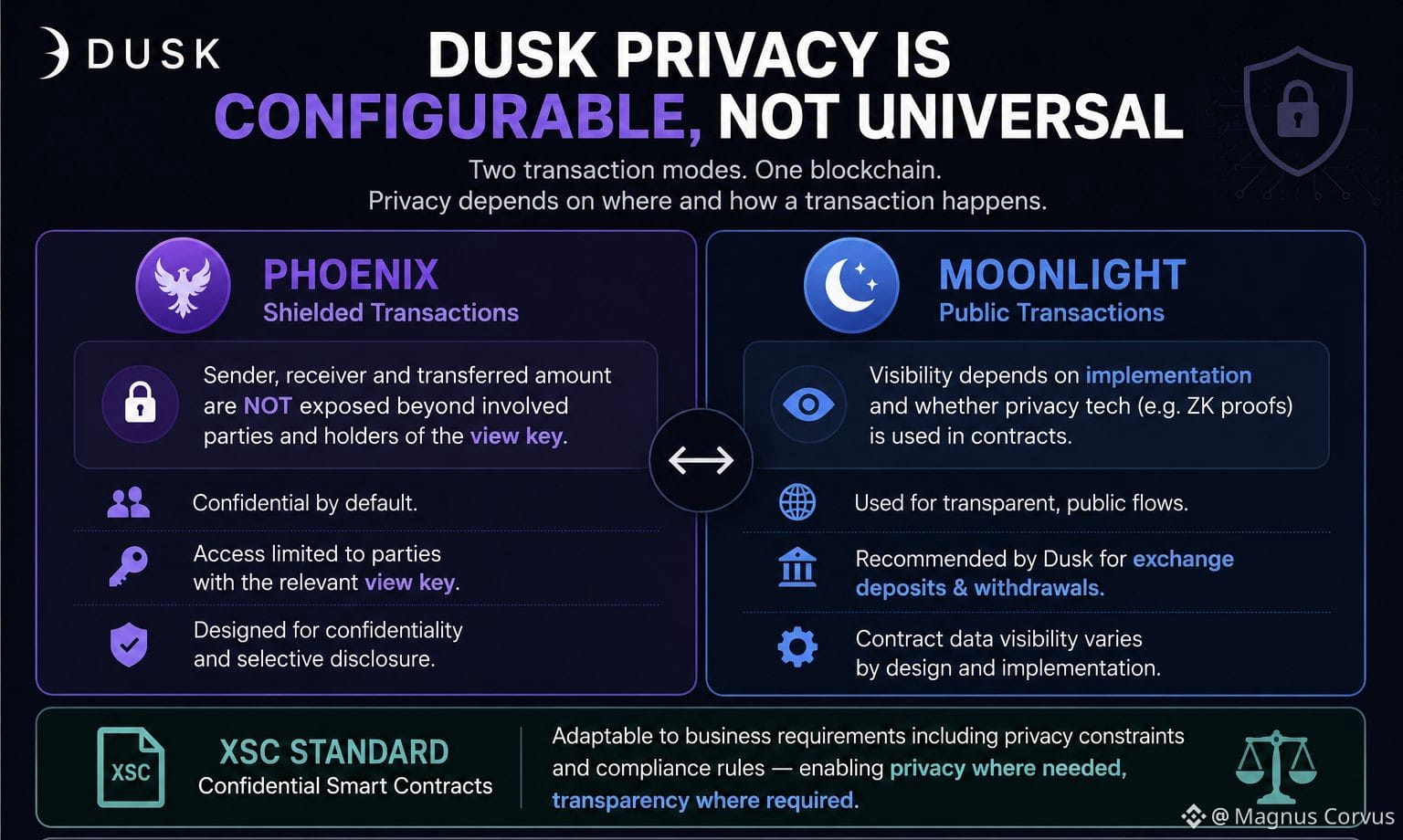
L’étiquette de “blockchain de confidentialité” de Dusk cache un détail plus utile : la confidentialité sur Dusk n’est pas un unique mode universel de transaction.
La documentation actuelle répartit l’activité entre Moonlight (publique) et Phoenix (protégée).
Pour les transactions Phoenix, Dusk indique que l’expéditeur, le destinataire et le montant transféré ne sont pas exposés au-delà des parties impliquées et des détenteurs de la clé de vue.
Mais pour les transactions Moonlight — et autres interactions de contrats — la visibilité dépend de l’implémentation et de la présence d’une technologie de confidentialité comme les preuves à divulgation nulle.
Cette distinction a changé ma façon de lire l’histoire XSC.
Le glossaire décrit XSC comme une norme de smart contract confidentiel adaptable aux exigences métier, y compris des contraintes de confidentialité et des règles de conformité.
Donc l’architecture ne consiste pas simplement à “tout masquer”.
Elle peut prendre en charge la confidentialité lorsque la confidentialité est importante, tout en permettant des flux transparents lorsque les exigences opérationnelles l’exigent.
Il y a un indice pratique : le guide d’intégration avec les échanges de Dusk recommande Moonlight pour les dépôts et retraits, tandis que Phoenix nécessite un modèle de garde et d’analyse différent.
Pour les applications financières, cette flexibilité peut être plus importante que la confidentialité maximale par défaut.
Ce que je surveille, c’est la façon dont les déploiements XSC exposent ce choix dans la pratique : quelles données restent protégées, lesquelles deviennent auditables, et qui contrôle cette frontière.
@Dusk $DUSK #dusk
La documentation actuelle répartit l’activité entre Moonlight (publique) et Phoenix (protégée).
Pour les transactions Phoenix, Dusk indique que l’expéditeur, le destinataire et le montant transféré ne sont pas exposés au-delà des parties impliquées et des détenteurs de la clé de vue.
Mais pour les transactions Moonlight — et autres interactions de contrats — la visibilité dépend de l’implémentation et de la présence d’une technologie de confidentialité comme les preuves à divulgation nulle.
Cette distinction a changé ma façon de lire l’histoire XSC.
Le glossaire décrit XSC comme une norme de smart contract confidentiel adaptable aux exigences métier, y compris des contraintes de confidentialité et des règles de conformité.
Donc l’architecture ne consiste pas simplement à “tout masquer”.
Elle peut prendre en charge la confidentialité lorsque la confidentialité est importante, tout en permettant des flux transparents lorsque les exigences opérationnelles l’exigent.
Il y a un indice pratique : le guide d’intégration avec les échanges de Dusk recommande Moonlight pour les dépôts et retraits, tandis que Phoenix nécessite un modèle de garde et d’analyse différent.
Pour les applications financières, cette flexibilité peut être plus importante que la confidentialité maximale par défaut.
Ce que je surveille, c’est la façon dont les déploiements XSC exposent ce choix dans la pratique : quelles données restent protégées, lesquelles deviennent auditables, et qui contrôle cette frontière.
@Dusk $DUSK #dusk
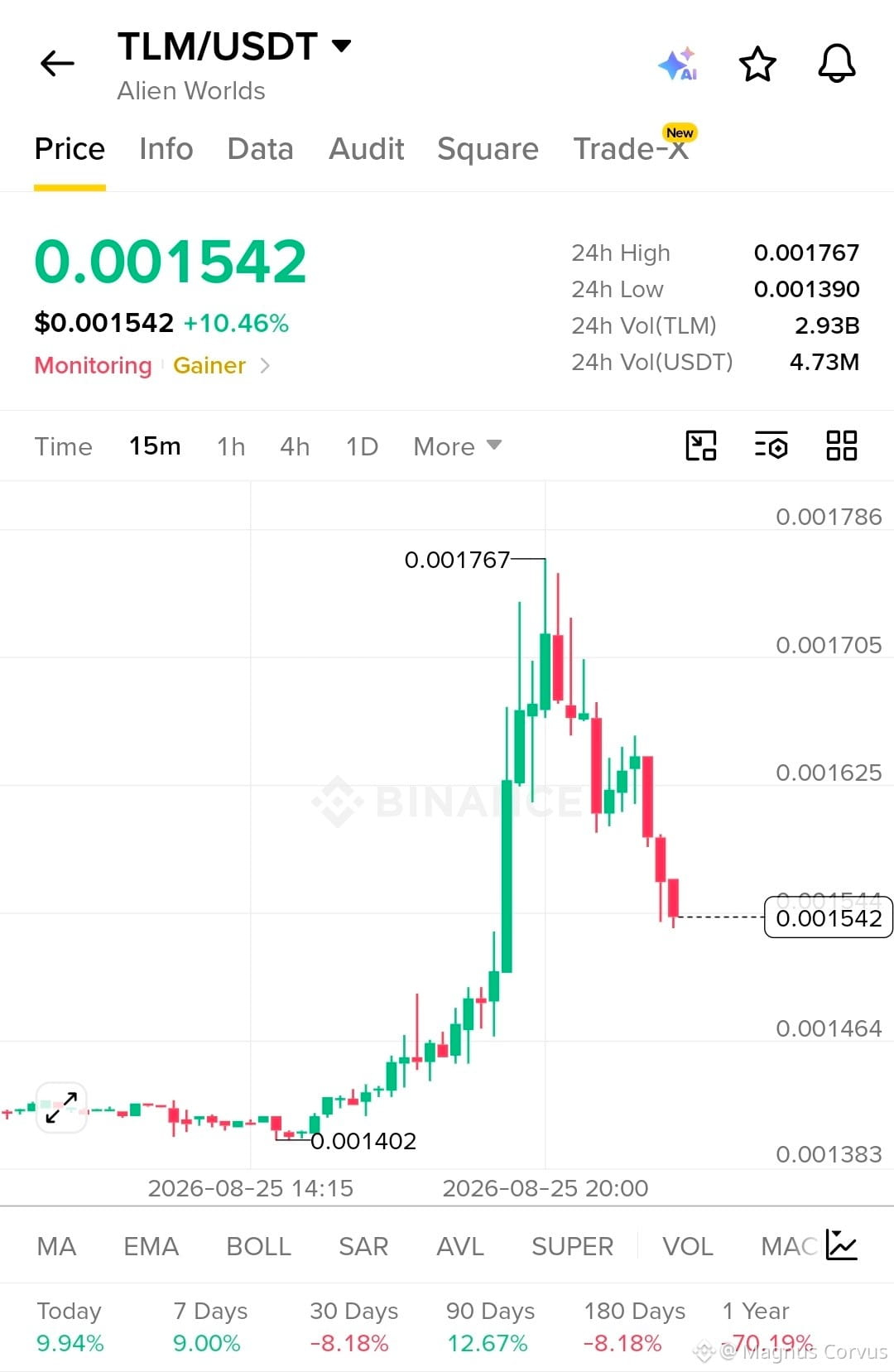
$TLM affiche une forte dynamique après une expansion marquée depuis les plus bas.
Les acheteurs maintiennent toujours la structure globale malgré le repli.
Zone d’entrée : 0.001520 - 0.001550
Stop Loss : 0.001460
Objectif 1 : 0.001625
Objectif 2 : 0.001705
Objectif 3 : 0.001767
La liquidité a été captée près du plus haut local, suivie d’une réaction contrôlée vers la structure de cassure. Le maintien dans la zone d’entrée garde les acheteurs sous contrôle et ouvre de la place pour une nouvelle poussée vers la liquidité supérieure.
On y va et Trade maintenant $TLM
Les acheteurs maintiennent toujours la structure globale malgré le repli.
Zone d’entrée : 0.001520 - 0.001550
Stop Loss : 0.001460
Objectif 1 : 0.001625
Objectif 2 : 0.001705
Objectif 3 : 0.001767
La liquidité a été captée près du plus haut local, suivie d’une réaction contrôlée vers la structure de cassure. Le maintien dans la zone d’entrée garde les acheteurs sous contrôle et ouvre de la place pour une nouvelle poussée vers la liquidité supérieure.
On y va et Trade maintenant $TLM
Voir la traduction
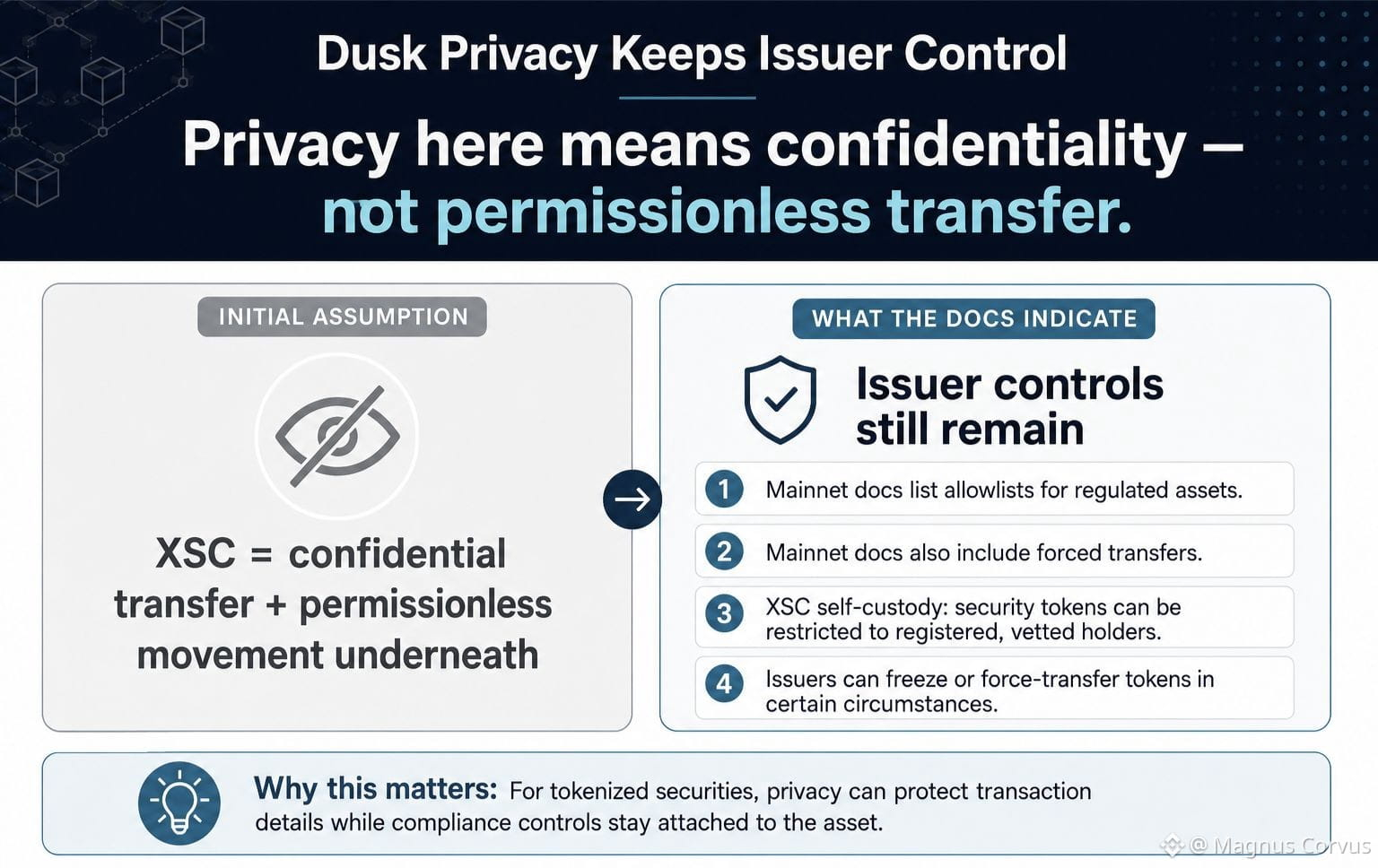
The most important thing I found about Dusk’s privacy model is that it does not remove issuer control. Dusk’s current mainnet docs explicitly list access controls such as allowlists, plus forced transfers for regulated assets.
I initially assumed XSC meant confidentiality first and permissionless transfer underneath.
Dusk’s own XSC self-custody material says otherwise: security tokens can be restricted to registered, vetted holders, while issuers can freeze or force-transfer tokens in certain circumstances.
That changes the interpretation. Privacy here is mainly about limiting who can see sensitive transaction information; it does not mean removing compliance authority from the asset itself.
For tokenized securities, that distinction matters. Eligibility requirements, asset recovery, and other legal obligations can demand controls that ordinary bearer-style crypto does not.
The detail I’d watch now is where Dusk draws the boundary between protocol-standardized controls and issuer-configurable rules, especially as current docs describe Hedger as the evolution of Zedger. That boundary may determine what “confidential securities” actually mean in practice.
@Dusk $DUSK #dusk
I initially assumed XSC meant confidentiality first and permissionless transfer underneath.
Dusk’s own XSC self-custody material says otherwise: security tokens can be restricted to registered, vetted holders, while issuers can freeze or force-transfer tokens in certain circumstances.
That changes the interpretation. Privacy here is mainly about limiting who can see sensitive transaction information; it does not mean removing compliance authority from the asset itself.
For tokenized securities, that distinction matters. Eligibility requirements, asset recovery, and other legal obligations can demand controls that ordinary bearer-style crypto does not.
The detail I’d watch now is where Dusk draws the boundary between protocol-standardized controls and issuer-configurable rules, especially as current docs describe Hedger as the evolution of Zedger. That boundary may determine what “confidential securities” actually mean in practice.
@Dusk $DUSK #dusk
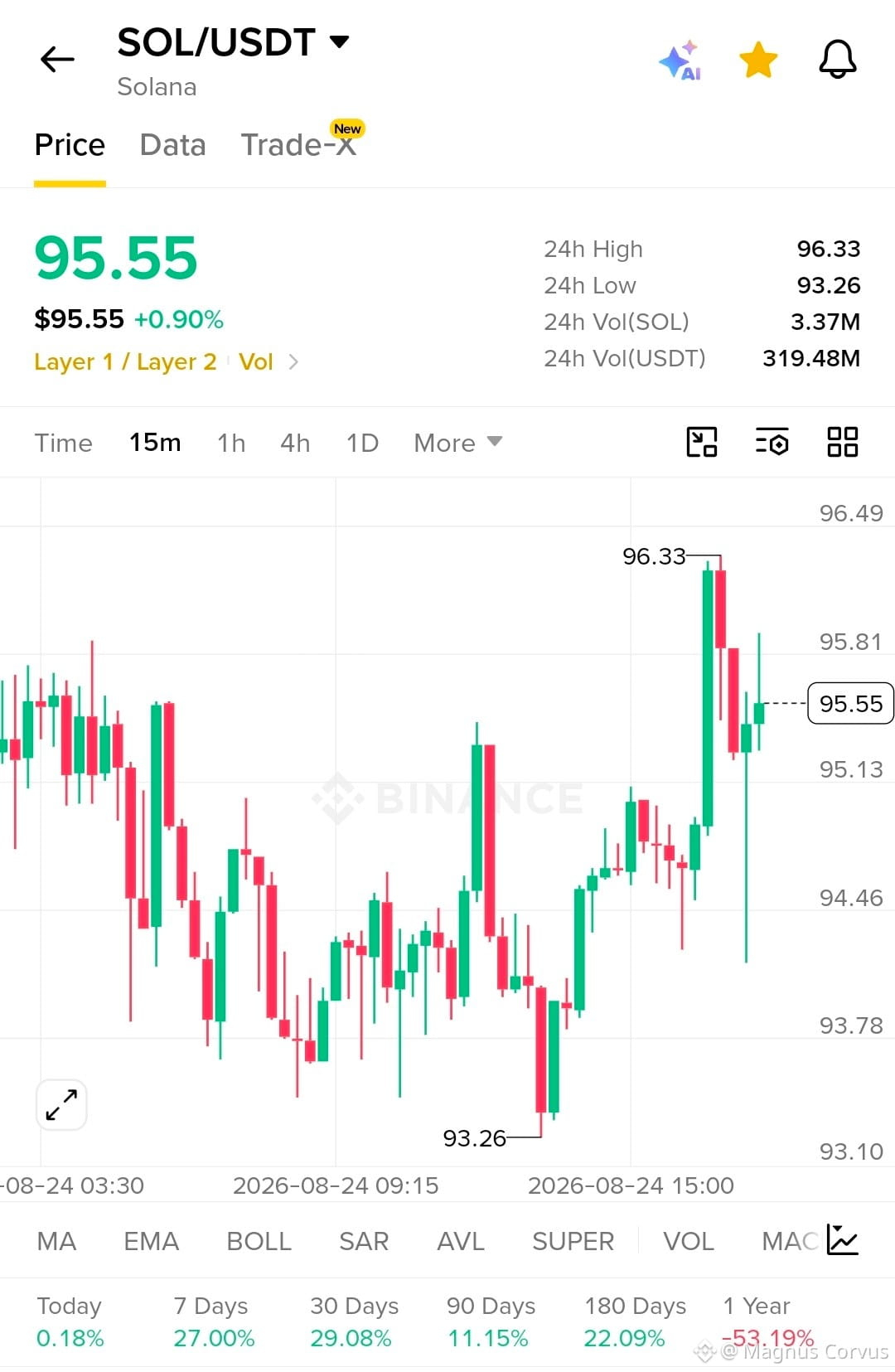
$SOL affiche une forte reprise au-dessus de la récente chasse de liquidité.
La structure haussière reste sous contrôle tant que le prix demeure au-dessus du support reconquis.
Zone d’entrée : 95,13 - 95,55
Stop Loss : 94,46
Objectif 1 : 95,81
Objectif 2 : 96,33
Objectif 3 : 96,49
La liquidité située en dessous a fortement été réagie, les acheteurs reprenant la structure et poussant le prix vers la résistance. Le maintien de la zone des 95,13 conserve la réaction haussière et ouvre de la place pour une poursuite vers des niveaux de liquidité plus élevés.
Allons-y et Trade maintenant $SOL
La structure haussière reste sous contrôle tant que le prix demeure au-dessus du support reconquis.
Zone d’entrée : 95,13 - 95,55
Stop Loss : 94,46
Objectif 1 : 95,81
Objectif 2 : 96,33
Objectif 3 : 96,49
La liquidité située en dessous a fortement été réagie, les acheteurs reprenant la structure et poussant le prix vers la résistance. Le maintien de la zone des 95,13 conserve la réaction haussière et ouvre de la place pour une poursuite vers des niveaux de liquidité plus élevés.
Allons-y et Trade maintenant $SOL
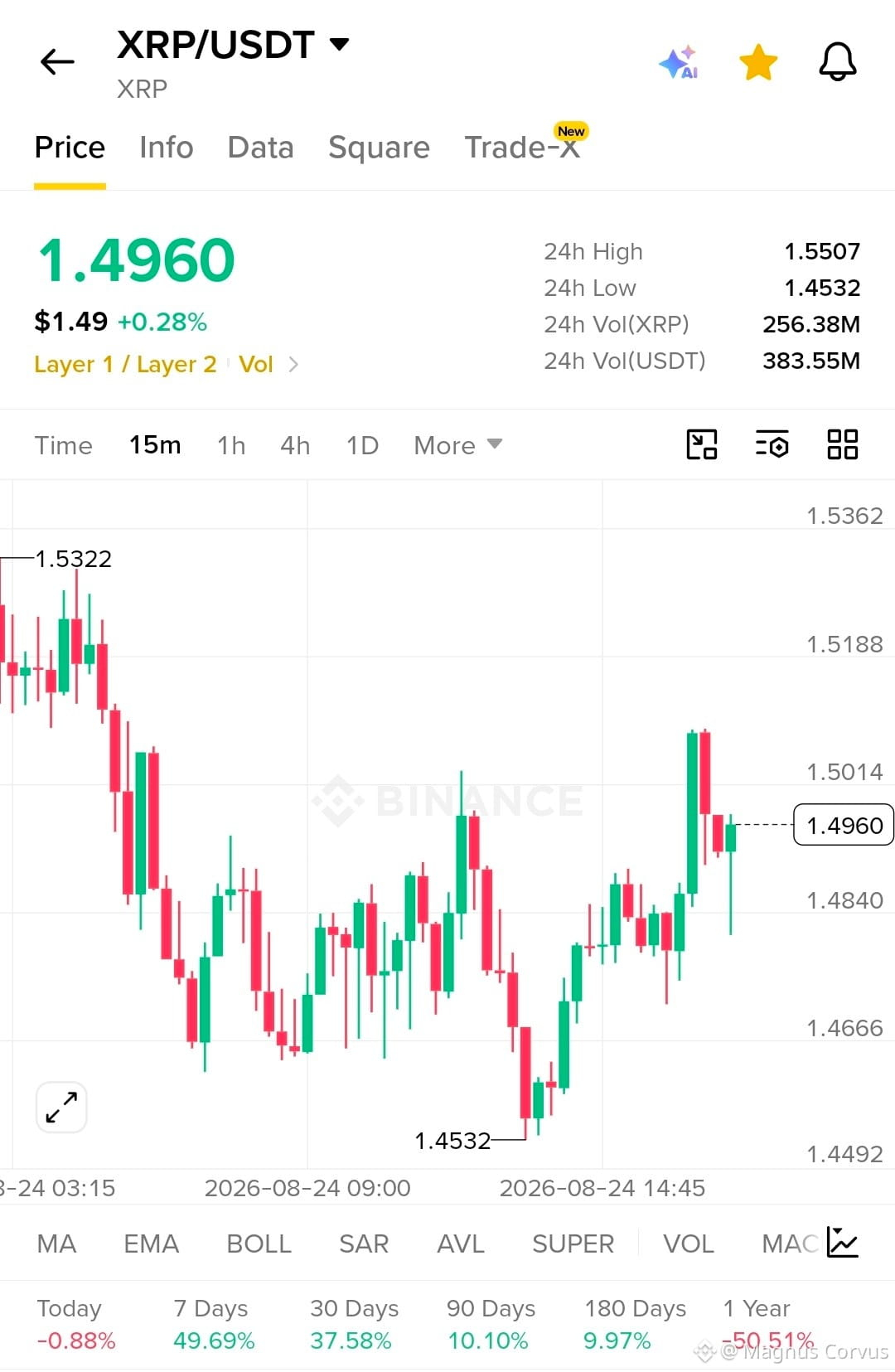
$XRP montre une forte reprise au-dessus du récent balayage de liquidité.
La structure haussière reste sous contrôle tant que le prix se maintient au-dessus du support récupéré.
Zone d’entrée : 1.4840 - 1.4960
Stop Loss : 1.4720
Objectif 1 : 1.5014
Objectif 2 : 1.5188
Objectif 3 : 1.5322
La liquidité située en dessous a été fortement réagie, avec des acheteurs qui reprennent la structure et poussent le prix de retour vers la résistance. Le maintien de la zone 1.4840 conserve la réaction haussière et ouvre de la place pour une poursuite vers des niveaux de liquidité plus élevés.
Allons-y et Trade maintenant $XRP
La structure haussière reste sous contrôle tant que le prix se maintient au-dessus du support récupéré.
Zone d’entrée : 1.4840 - 1.4960
Stop Loss : 1.4720
Objectif 1 : 1.5014
Objectif 2 : 1.5188
Objectif 3 : 1.5322
La liquidité située en dessous a été fortement réagie, avec des acheteurs qui reprennent la structure et poussent le prix de retour vers la résistance. Le maintien de la zone 1.4840 conserve la réaction haussière et ouvre de la place pour une poursuite vers des niveaux de liquidité plus élevés.
Allons-y et Trade maintenant $XRP
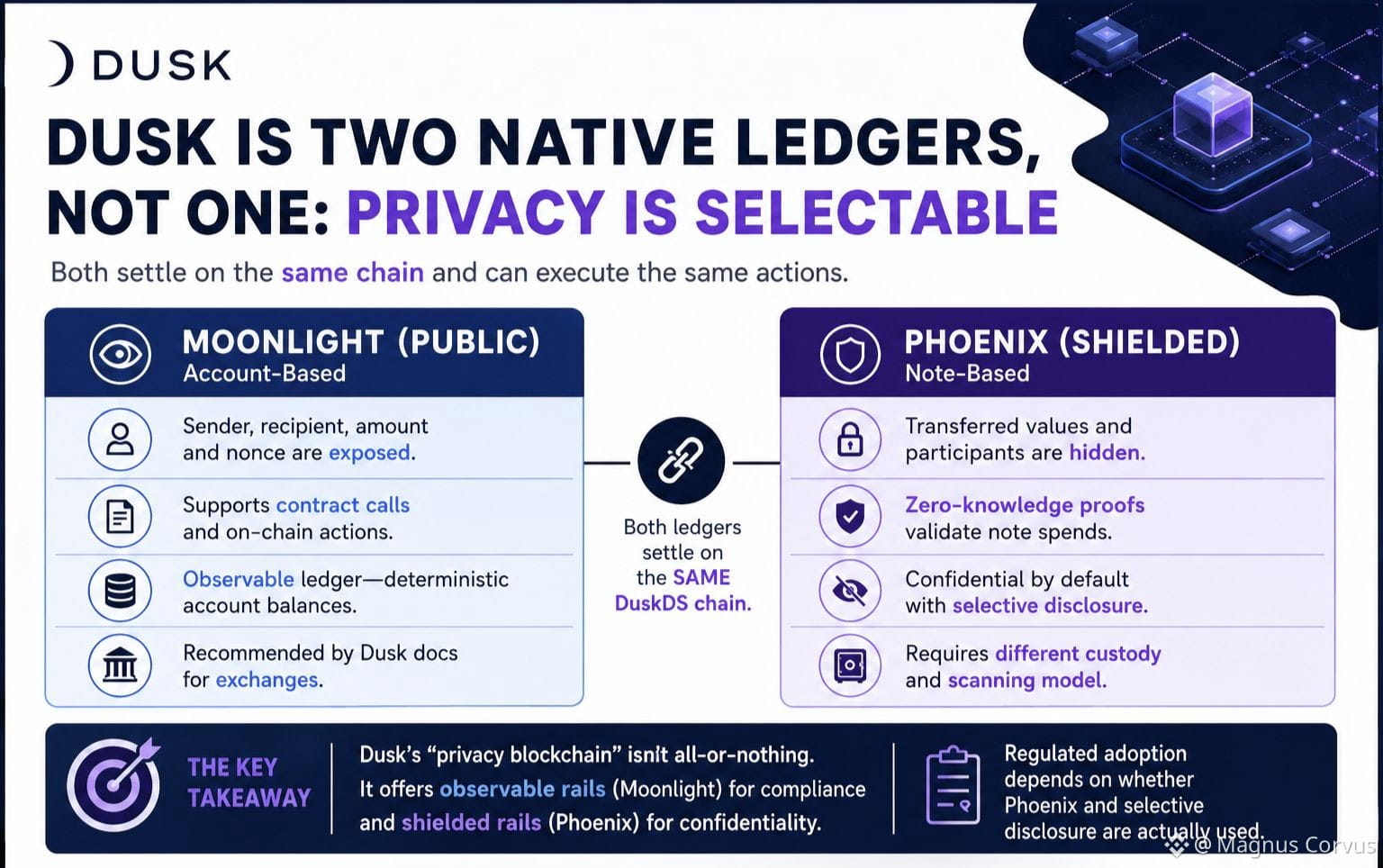
L’étiquette « privacy blockchain » de Dusk cache un détail architectural utile : la confidentialité est sélectionnable, pas universelle.
Au niveau DuskDS, DUSK évolue selon deux modèles natifs de transaction. Moonlight est public et basé sur un compte : l’expéditeur, le destinataire, le montant et le nonce sont exposés. Phoenix est protégé et basé sur des notes : les valeurs transférées et les participants sont masqués tandis que des preuves à connaissance nulle valident les dépenses de notes.
Les deux aboutissent à la même chaîne, et chaque famille peut porter des actions telles que des appels de contrat.
Les documents officiels d’intégration aux exchanges vont plus loin : il est conseillé aux exchanges d’utiliser Moonlight, tandis que Phoenix nécessite un modèle de détention et d’analyse différent.
J’ai d’abord interprété ce partage comme un compromis. En pratique, cela ressemble davantage à une plomberie de conformité : des rails observables où les intermédiaires ont besoin d’une comptabilité déterministe, et des rails protégés là où la confidentialité compte.
Cette distinction compte plus que le titre « privacy L1 ». Ce que je surveillerais, c’est de savoir si les applications régulées utilisent réellement Phoenix et la divulgation sélective, plutôt que de basculer par défaut opérationnellement sur Moonlight.
@Dusk $DUSK #dusk
Au niveau DuskDS, DUSK évolue selon deux modèles natifs de transaction. Moonlight est public et basé sur un compte : l’expéditeur, le destinataire, le montant et le nonce sont exposés. Phoenix est protégé et basé sur des notes : les valeurs transférées et les participants sont masqués tandis que des preuves à connaissance nulle valident les dépenses de notes.
Les deux aboutissent à la même chaîne, et chaque famille peut porter des actions telles que des appels de contrat.
Les documents officiels d’intégration aux exchanges vont plus loin : il est conseillé aux exchanges d’utiliser Moonlight, tandis que Phoenix nécessite un modèle de détention et d’analyse différent.
J’ai d’abord interprété ce partage comme un compromis. En pratique, cela ressemble davantage à une plomberie de conformité : des rails observables où les intermédiaires ont besoin d’une comptabilité déterministe, et des rails protégés là où la confidentialité compte.
Cette distinction compte plus que le titre « privacy L1 ». Ce que je surveillerais, c’est de savoir si les applications régulées utilisent réellement Phoenix et la divulgation sélective, plutôt que de basculer par défaut opérationnellement sur Moonlight.
@Dusk $DUSK #dusk
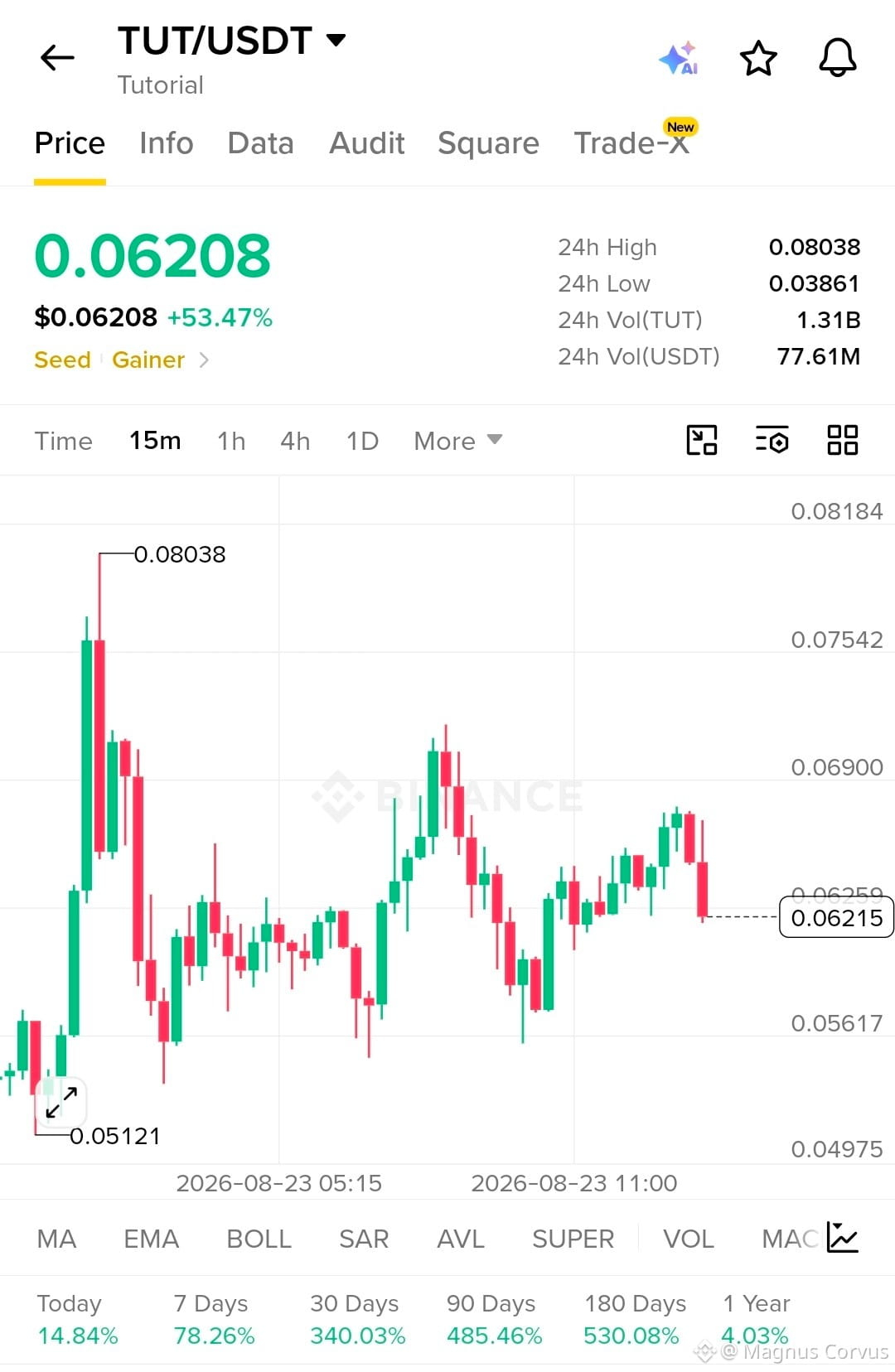
$TUT affiche une forte dynamique après une cassure puissante et une expansion marquée.
Les acheteurs continuent de défendre la structure au-dessus de la zone de support clé.
Zone d’entrée : 0.0610 - 0.0625
Stop Loss : 0.0580
Objectif 1 : 0.0665
Objectif 2 : 0.0690
Objectif 3 : 0.0754
La liquidité se renforce autour de la plage actuelle après la réaction au support de 0.0560. Tant que cette structure est maintenue, les acheteurs restent aux commandes, tandis qu’une poussée propre au-dessus de la liquidité proche peut ouvrir la voie vers des niveaux de résistance plus élevés.
Allons-y et Trade maintenant $TUT
Les acheteurs continuent de défendre la structure au-dessus de la zone de support clé.
Zone d’entrée : 0.0610 - 0.0625
Stop Loss : 0.0580
Objectif 1 : 0.0665
Objectif 2 : 0.0690
Objectif 3 : 0.0754
La liquidité se renforce autour de la plage actuelle après la réaction au support de 0.0560. Tant que cette structure est maintenue, les acheteurs restent aux commandes, tandis qu’une poussée propre au-dessus de la liquidité proche peut ouvrir la voie vers des niveaux de résistance plus élevés.
Allons-y et Trade maintenant $TUT
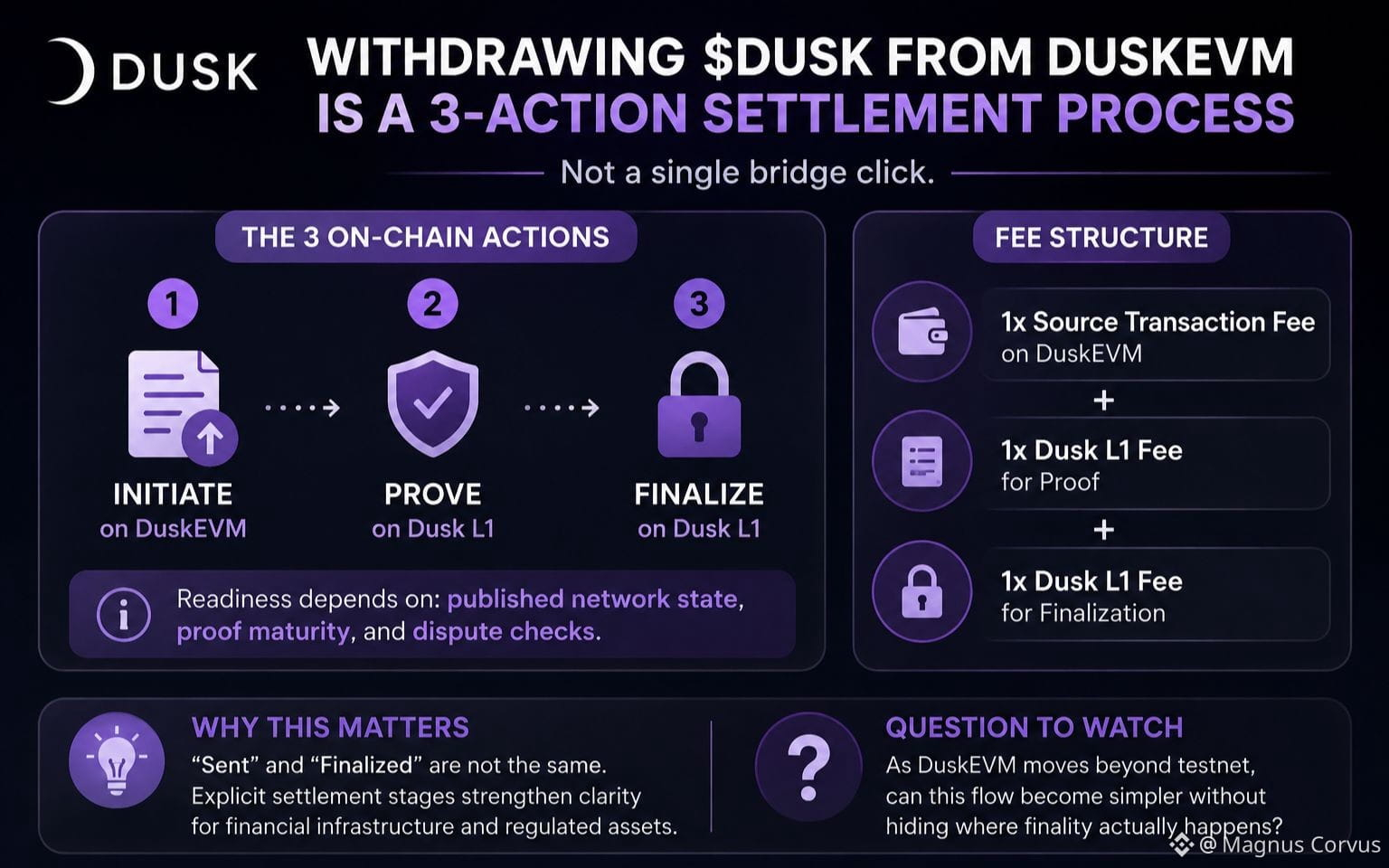
La partie que je n’avais pas anticipée : le fait de reculer DUSK de DuskEVM implique aujourd’hui un processus de règlement en trois actions, et pas un simple clic sur un pont.
D’après la documentation officielle de Dusk, le pont de la Testnet DuskEVM conserve DUSK comme actif natif des deux côtés, et DUSK paie aussi le gaz sur DuskEVM. Mais un retrait nécessite trois actions on-chain : initier sur DuskEVM, prouver sur Dusk L1, puis finaliser sur Dusk L1.
Il y a aussi un autre détail que j’ai presque manqué : le modèle de frais indique la commission de la transaction source, plus deux frais distincts sur Dusk L1 pour la preuve et la finalisation. La préparation dépend aussi de l’état du réseau publié, de la maturité de la preuve et des vérifications en cas de contestation—pas seulement du temps écoulé.
Mon interprétation : DuskFoundation échange une simplicité d’UX contre des étapes de règlement explicites. Pour de l’infrastructure financière, cela peut même être utile, car « envoyé » et « finalisé » ne sont pas traités comme la même chose. Cette distinction compte davantage lorsque des actifs réglementés franchissent des couches d’exécution.
La question que je surveille : lorsque DuskEVM dépassera le stade de la testnet, est-ce que ce flux peut devenir plus simple sans pour autant masquer l’endroit où la finalité se produit réellement.
@Dusk $DUSK #dusk
D’après la documentation officielle de Dusk, le pont de la Testnet DuskEVM conserve DUSK comme actif natif des deux côtés, et DUSK paie aussi le gaz sur DuskEVM. Mais un retrait nécessite trois actions on-chain : initier sur DuskEVM, prouver sur Dusk L1, puis finaliser sur Dusk L1.
Il y a aussi un autre détail que j’ai presque manqué : le modèle de frais indique la commission de la transaction source, plus deux frais distincts sur Dusk L1 pour la preuve et la finalisation. La préparation dépend aussi de l’état du réseau publié, de la maturité de la preuve et des vérifications en cas de contestation—pas seulement du temps écoulé.
Mon interprétation : DuskFoundation échange une simplicité d’UX contre des étapes de règlement explicites. Pour de l’infrastructure financière, cela peut même être utile, car « envoyé » et « finalisé » ne sont pas traités comme la même chose. Cette distinction compte davantage lorsque des actifs réglementés franchissent des couches d’exécution.
La question que je surveille : lorsque DuskEVM dépassera le stade de la testnet, est-ce que ce flux peut devenir plus simple sans pour autant masquer l’endroit où la finalité se produit réellement.
@Dusk $DUSK #dusk
Voir la traduction
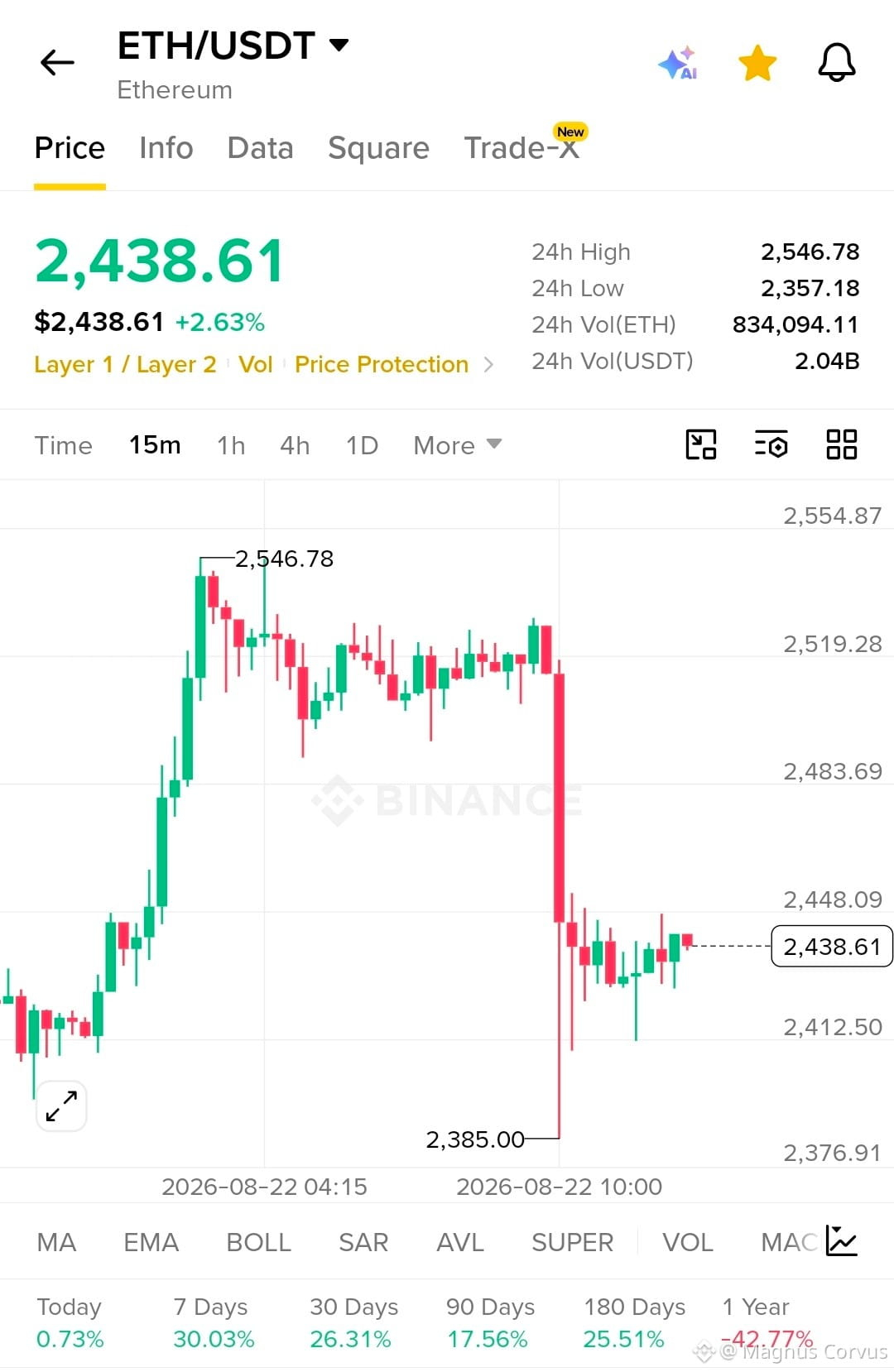
$ETH is showing strong momentum after a sharp liquidity reaction.
Bullish structure remains in control above the key support zone.
Entry Zone: 2,425 - 2,440
Stop Loss: 2,380
Target 1: 2,448
Target 2: 2,484
Target 3: 2,519
Liquidity below 2,412 has already triggered a strong reaction, while buyers are reclaiming structure around 2,438. Holding this zone keeps the bullish continuation setup active toward the upper liquidity levels.
Let’s go and Trade now $ETH
Bullish structure remains in control above the key support zone.
Entry Zone: 2,425 - 2,440
Stop Loss: 2,380
Target 1: 2,448
Target 2: 2,484
Target 3: 2,519
Liquidity below 2,412 has already triggered a strong reaction, while buyers are reclaiming structure around 2,438. Holding this zone keeps the bullish continuation setup active toward the upper liquidity levels.
Let’s go and Trade now $ETH
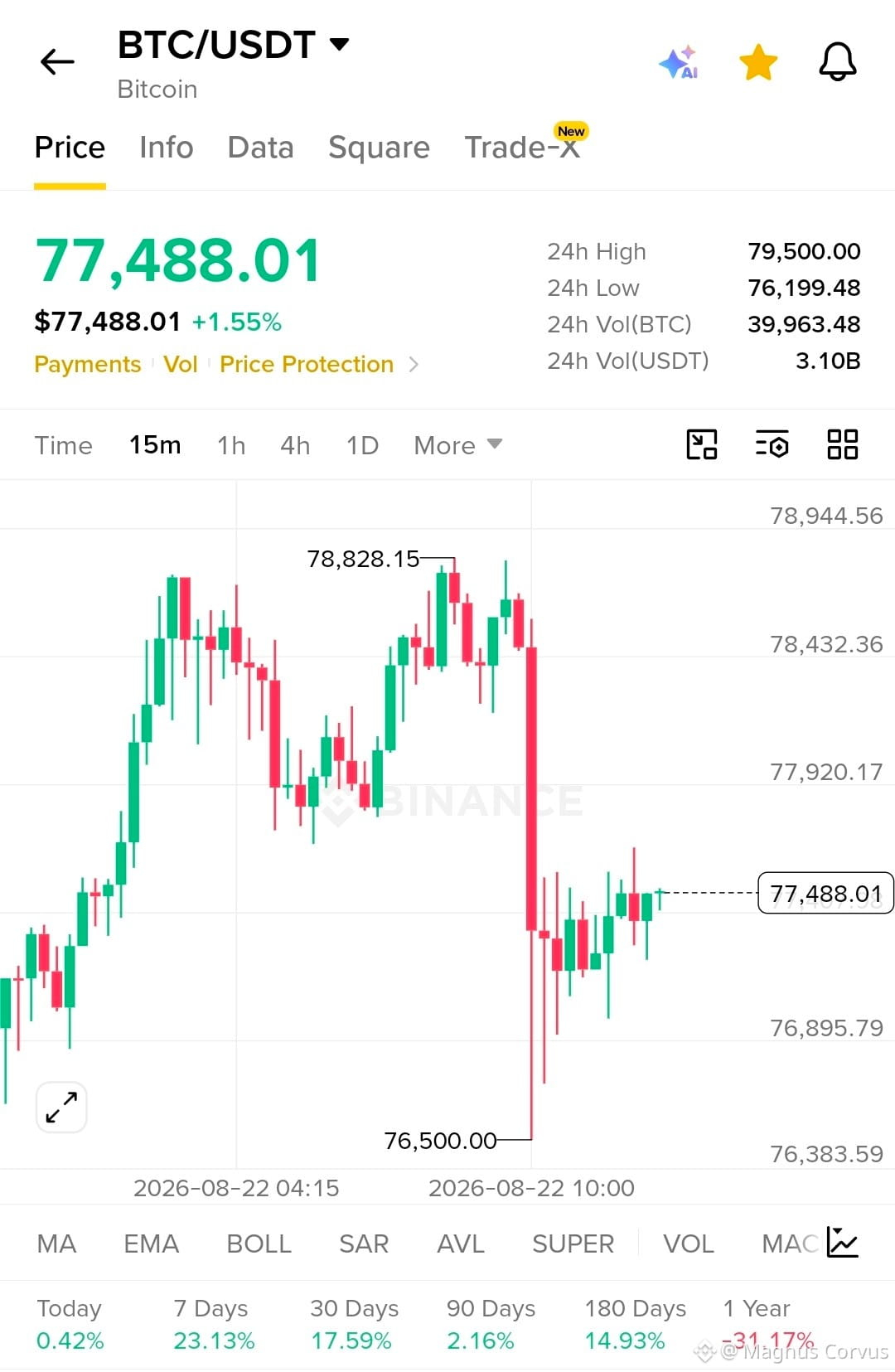
$BTC affiche une forte dynamique après une réaction de liquidité marquée.
La structure haussière reste sous contrôle au-dessus de la zone de support clé.
Zone d’entrée : 77 300 - 77 500
Stop Loss : 76 450
Objectif 1 : 77 920
Objectif 2 : 78 430
Objectif 3 : 78 830
La liquidité sous 76 900 a déjà déclenché une forte réaction, tandis que les acheteurs reconquièrent la structure autour de 77 500. Maintenir cette zone permet de garder actif le scénario de continuation haussière vers les niveaux supérieurs de liquidité.
Allons-y et Trade maintenant $BTC
La structure haussière reste sous contrôle au-dessus de la zone de support clé.
Zone d’entrée : 77 300 - 77 500
Stop Loss : 76 450
Objectif 1 : 77 920
Objectif 2 : 78 430
Objectif 3 : 78 830
La liquidité sous 76 900 a déjà déclenché une forte réaction, tandis que les acheteurs reconquièrent la structure autour de 77 500. Maintenir cette zone permet de garder actif le scénario de continuation haussière vers les niveaux supérieurs de liquidité.
Allons-y et Trade maintenant $BTC
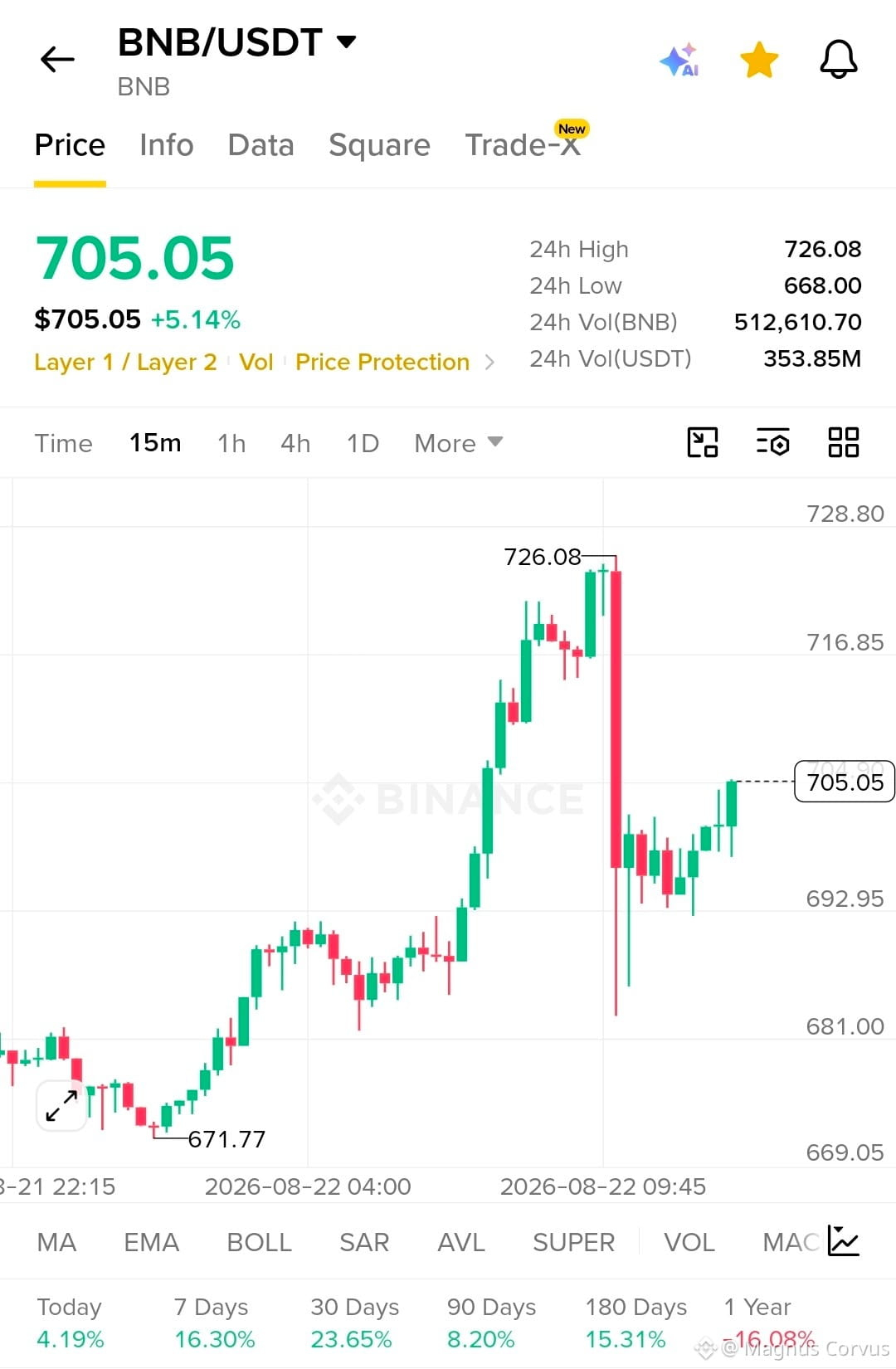
$BNB affiche une forte dynamique après une réaction de liquidité marquée.
La structure haussière reste sous contrôle au-dessus de la zone de support clé.
Zone d’entrée : 700 - 705
Stop Loss : 691
Objectif 1 : 716
Objectif 2 : 726
Objectif 3 : 738
La liquidité sous 693 a déjà déclenché une forte réaction, tandis que les acheteurs reprennent la structure autour de 705. Le maintien de cette zone garde le scénario de continuation haussière actif en direction des niveaux de liquidité supérieurs.
Allons-y et Trade maintenant $BNB
La structure haussière reste sous contrôle au-dessus de la zone de support clé.
Zone d’entrée : 700 - 705
Stop Loss : 691
Objectif 1 : 716
Objectif 2 : 726
Objectif 3 : 738
La liquidité sous 693 a déjà déclenché une forte réaction, tandis que les acheteurs reprennent la structure autour de 705. Le maintien de cette zone garde le scénario de continuation haussière actif en direction des niveaux de liquidité supérieurs.
Allons-y et Trade maintenant $BNB
Voir la traduction
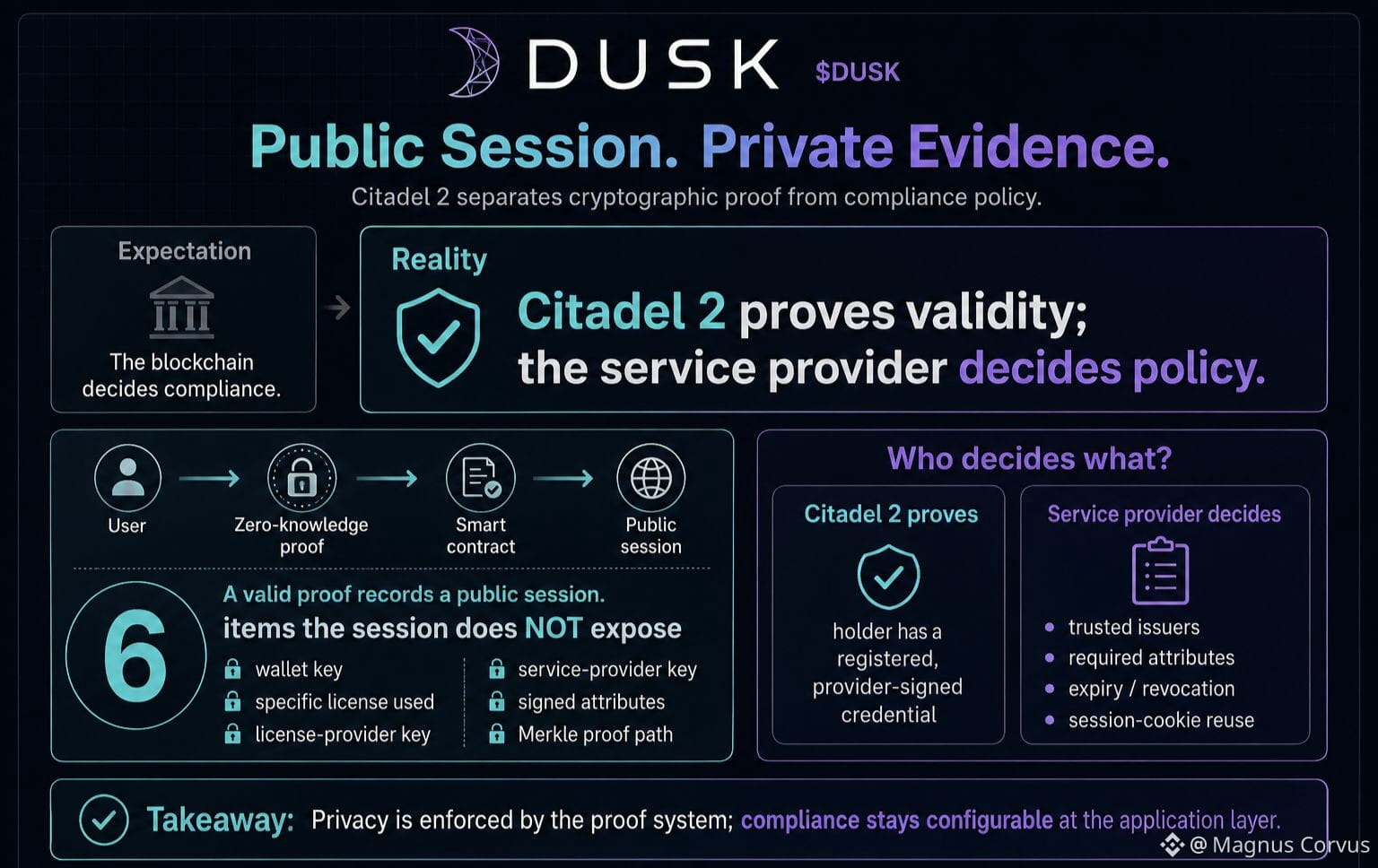
What caught my attention is that Dusk’s privacy model can leave an authorization event visible while keeping the identity evidence behind it hidden.
In Citadel 2, a user proves with zero knowledge that they hold a registered, provider-signed credential. The contract verifies that proof and records a public session. But Dusk’s docs say that session does not expose the wallet key, the specific license used, the license-provider key, the service-provider key, signed attributes, or the Merkle proof path.
That is a more interesting design choice than simply saying “private KYC.”
I expected the blockchain itself to decide whether a user is compliant. It doesn’t. Citadel proves that the credential/session is cryptographically valid; the service provider still decides which credential issuers it trusts, which attributes satisfy its policy, whether a session is expired or revoked, and whether a session cookie can be reused.
To me, that separation matters for financial applications. Privacy is handled by the proof system, while business and regulatory policy remains configurable at the application layer rather than being frozen into one universal rule.
That also creates a real trade-off: flexibility is useful, but security depends on service providers defining those policies correctly.
For dusk_foundation and DUSK, the part I’m watching is not just whether credentials stay private, but how consistently real applications implement the policy layer around them.
@Dusk $DUSK #dusk
In Citadel 2, a user proves with zero knowledge that they hold a registered, provider-signed credential. The contract verifies that proof and records a public session. But Dusk’s docs say that session does not expose the wallet key, the specific license used, the license-provider key, the service-provider key, signed attributes, or the Merkle proof path.
That is a more interesting design choice than simply saying “private KYC.”
I expected the blockchain itself to decide whether a user is compliant. It doesn’t. Citadel proves that the credential/session is cryptographically valid; the service provider still decides which credential issuers it trusts, which attributes satisfy its policy, whether a session is expired or revoked, and whether a session cookie can be reused.
To me, that separation matters for financial applications. Privacy is handled by the proof system, while business and regulatory policy remains configurable at the application layer rather than being frozen into one universal rule.
That also creates a real trade-off: flexibility is useful, but security depends on service providers defining those policies correctly.
For dusk_foundation and DUSK, the part I’m watching is not just whether credentials stay private, but how consistently real applications implement the policy layer around them.
@Dusk $DUSK #dusk
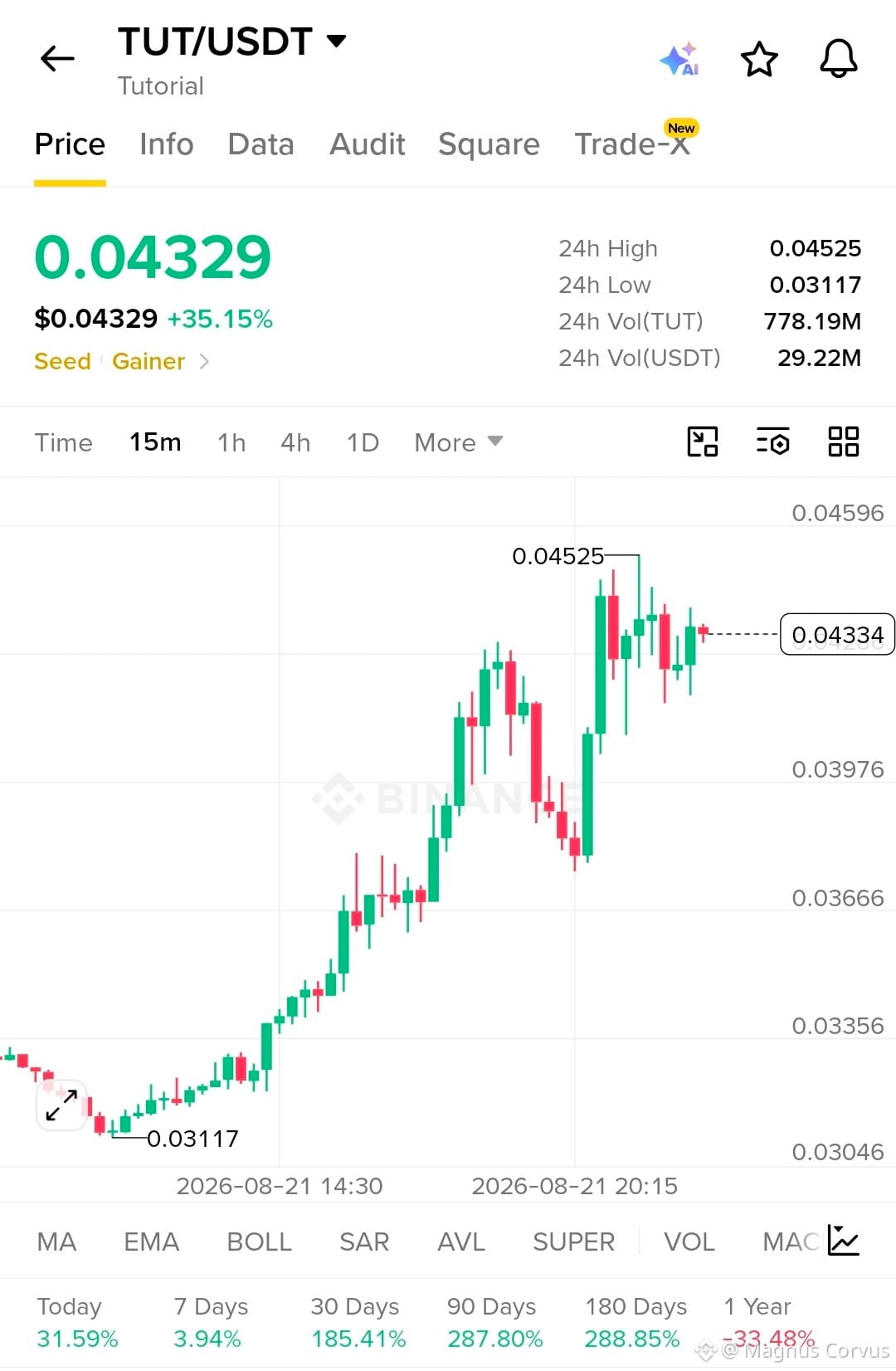
$TUT affiche une forte dynamique haussière après une expansion brusque vers le haut.
Les acheteurs restent aux commandes tandis que la structure se maintient au-dessus d’un support clé.
Zone d’entrée : 0.0420 - 0.0433
Stop Loss : 0.0397
Objectif 1 : 0.0453
Objectif 2 : 0.0480
Objectif 3 : 0.0500
La liquidité se renforce au-dessus des récents plus hauts, tandis que les réactions autour de 0.0420 confirment une demande active. Le maintien de cette structure conserve le scénario de poursuite haussière.
Allons-y et Trade maintenant $TUT
Les acheteurs restent aux commandes tandis que la structure se maintient au-dessus d’un support clé.
Zone d’entrée : 0.0420 - 0.0433
Stop Loss : 0.0397
Objectif 1 : 0.0453
Objectif 2 : 0.0480
Objectif 3 : 0.0500
La liquidité se renforce au-dessus des récents plus hauts, tandis que les réactions autour de 0.0420 confirment une demande active. Le maintien de cette structure conserve le scénario de poursuite haussière.
Allons-y et Trade maintenant $TUT
Voir la traduction
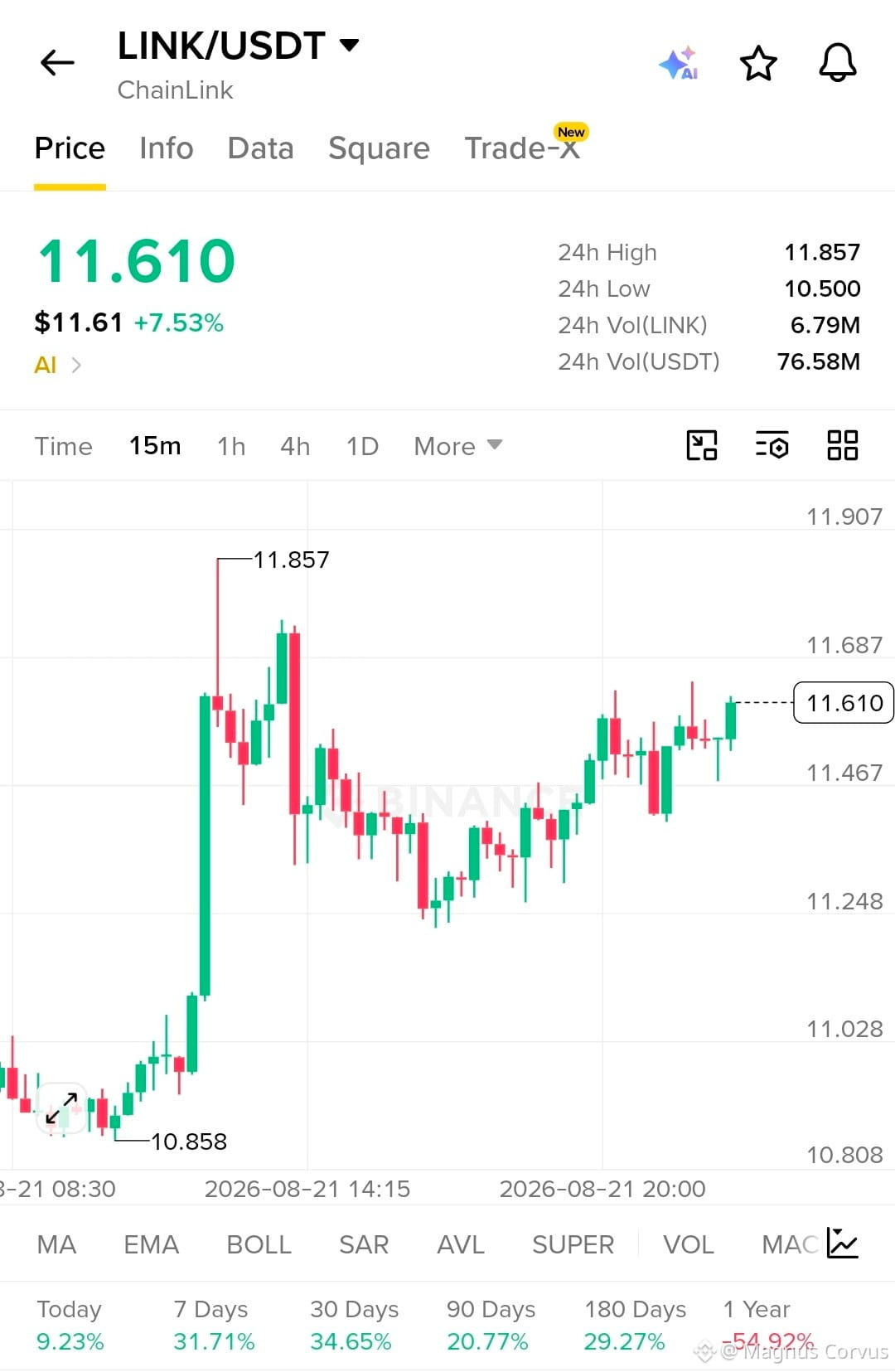
$LINK is showing strong bullish momentum after a sharp expansion higher.
Buyers remain in control as the structure holds above key support.
Entry Zone: 11.45 - 11.60
Stop Loss: 11.24
Target 1: 11.69
Target 2: 11.86
Target 3: 12.00
Liquidity is building above the recent highs, while reactions around 11.45 confirm active demand. Holding this structure keeps the bullish continuation setup intact.
Let’s go and Trade now $LINK
Buyers remain in control as the structure holds above key support.
Entry Zone: 11.45 - 11.60
Stop Loss: 11.24
Target 1: 11.69
Target 2: 11.86
Target 3: 12.00
Liquidity is building above the recent highs, while reactions around 11.45 confirm active demand. Holding this structure keeps the bullish continuation setup intact.
Let’s go and Trade now $LINK
Voir la traduction
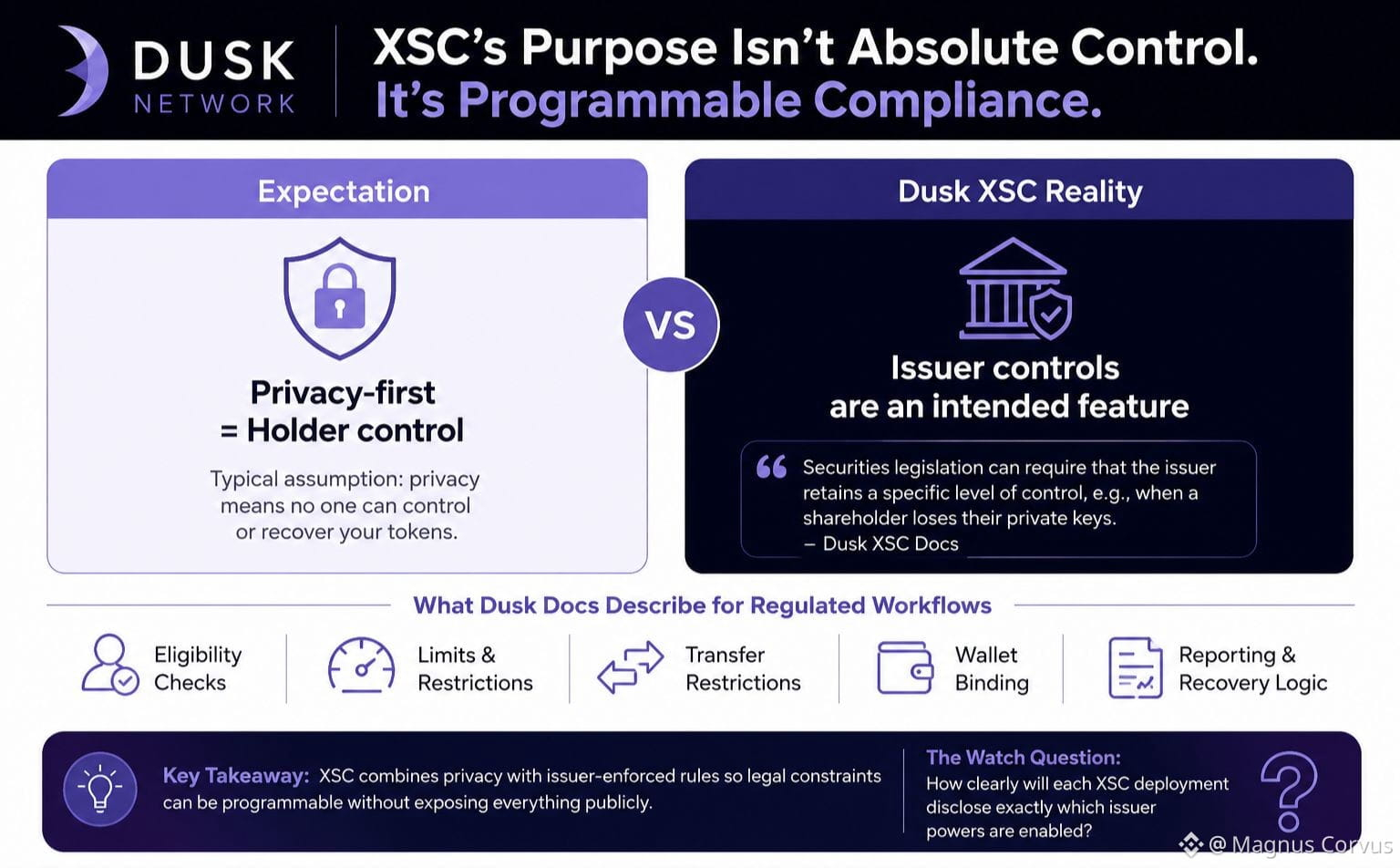
One Dusk detail made me look twice: XSC is not built around absolute holder control.
I expected a privacy-focused security-token standard to emphasize secrecy first. Dusk’s own XSC page instead says securities law can require issuers to retain a specific level of control, even using the example of a shareholder losing private keys while keeping legal ownership rights.
That changes how I read DUSK.
The privacy layer is only half the design. Current Dusk docs also describe regulated workflows with eligibility checks, limits, transfer restrictions, wallet binding, reporting and recovery logic. In other words, XSC’s goal is not to make securities behave like unstoppable bearer tokens; it is to make legal constraints programmable without exposing everything publicly.
Fact: issuer controls are an intended feature, not an accidental compromise.
My interpretation: that is useful for real securities, but it creates a different trust model from pure crypto assets.
The question I’d watch is simple: how clearly will each XSC deployment disclose exactly which issuer powers are enabled?
@Dusk $DUSK #dusk
I expected a privacy-focused security-token standard to emphasize secrecy first. Dusk’s own XSC page instead says securities law can require issuers to retain a specific level of control, even using the example of a shareholder losing private keys while keeping legal ownership rights.
That changes how I read DUSK.
The privacy layer is only half the design. Current Dusk docs also describe regulated workflows with eligibility checks, limits, transfer restrictions, wallet binding, reporting and recovery logic. In other words, XSC’s goal is not to make securities behave like unstoppable bearer tokens; it is to make legal constraints programmable without exposing everything publicly.
Fact: issuer controls are an intended feature, not an accidental compromise.
My interpretation: that is useful for real securities, but it creates a different trust model from pure crypto assets.
The question I’d watch is simple: how clearly will each XSC deployment disclose exactly which issuer powers are enabled?
@Dusk $DUSK #dusk
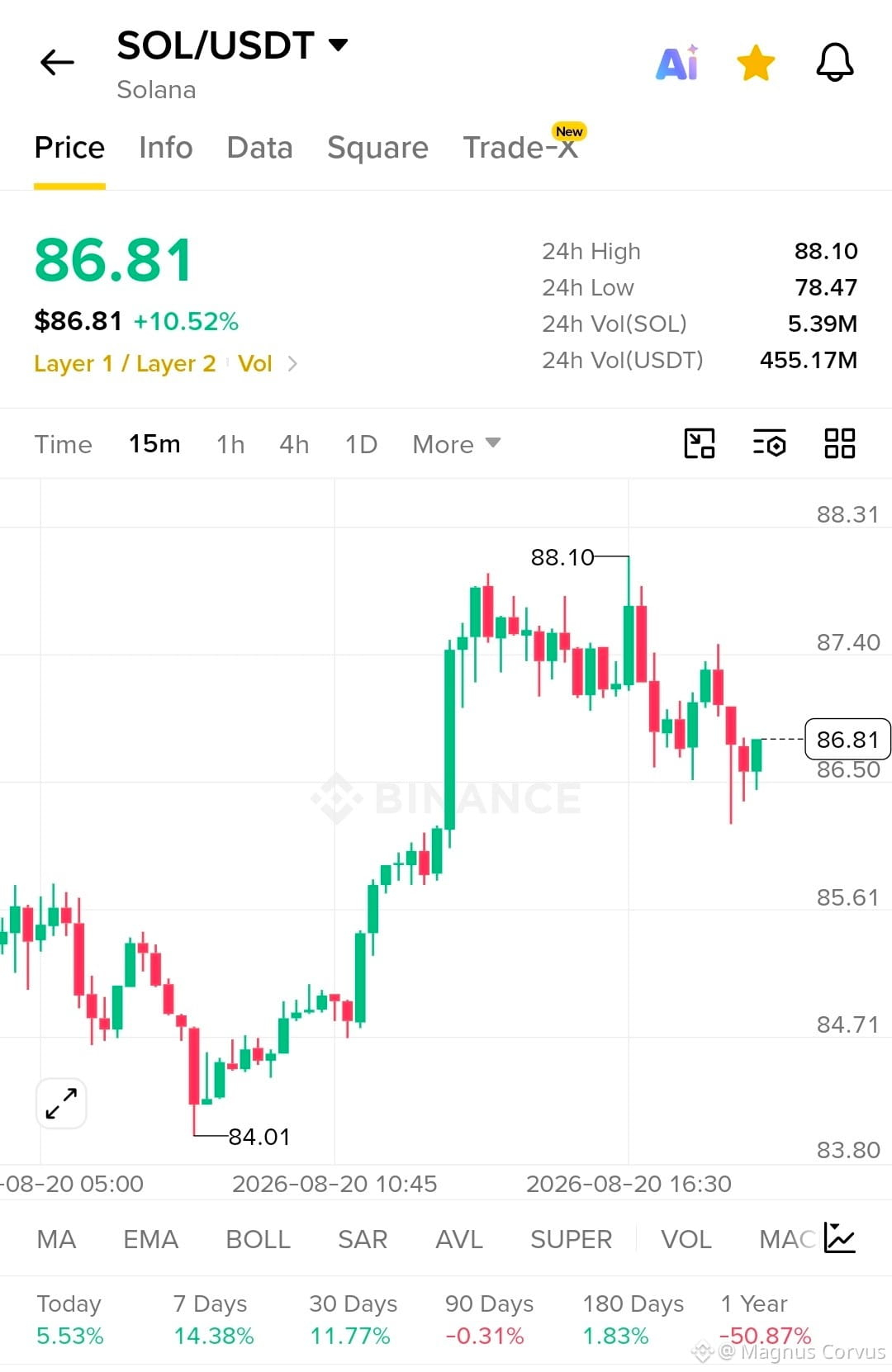
$SOL affiche une forte dynamique haussière après une expansion puissante.
La structure reste haussière alors que les acheteurs continuent de maintenir le contrôle au-dessus d’un support clé.
Zone d’entrée : 86.50 - 86.85
Stop Loss : 85.60
Objectif 1 : 87.40
Objectif 2 : 88.10
Objectif 3 : 89.00
La liquidité se renforce au-dessus du récent plus haut, tandis que les réactions depuis les niveaux plus bas continuent de montrer une demande. En maintenant la structure actuelle, la continuation reste possible vers les prochaines zones de liquidité.
Allons-y et Trade maintenant $SOL
La structure reste haussière alors que les acheteurs continuent de maintenir le contrôle au-dessus d’un support clé.
Zone d’entrée : 86.50 - 86.85
Stop Loss : 85.60
Objectif 1 : 87.40
Objectif 2 : 88.10
Objectif 3 : 89.00
La liquidité se renforce au-dessus du récent plus haut, tandis que les réactions depuis les niveaux plus bas continuent de montrer une demande. En maintenant la structure actuelle, la continuation reste possible vers les prochaines zones de liquidité.
Allons-y et Trade maintenant $SOL
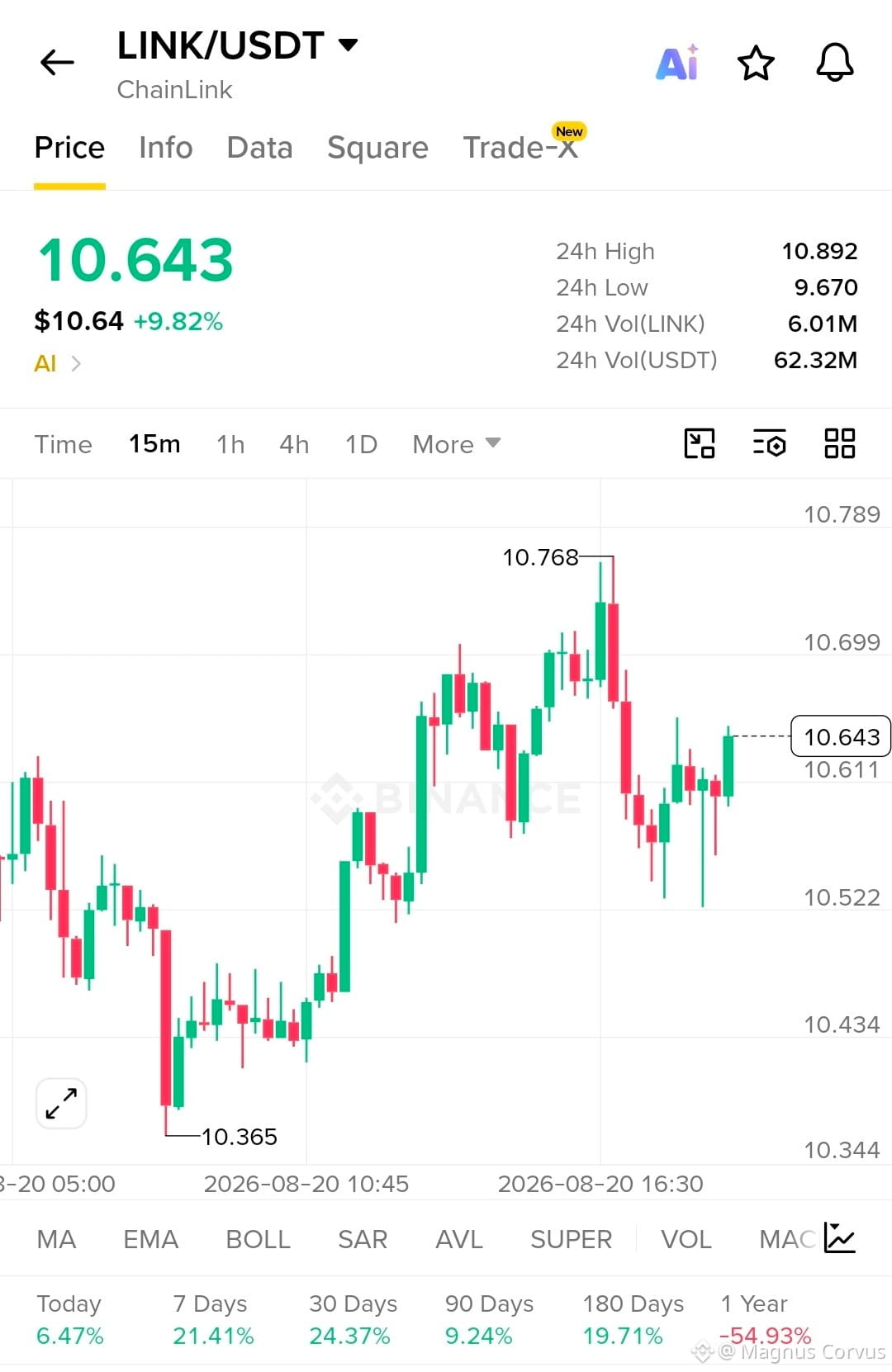
$LINK montre une forte dynamique haussière après une expansion puissante.
La structure reste haussière, car les acheteurs continuent de conserver le contrôle au-dessus du support clé.
Zone d’entrée : 10.58 - 10.64
Stop Loss : 10.50
Objectif 1 : 10.76
Objectif 2 : 10.89
Objectif 3 : 11.05
La liquidité se renforce au-dessus du dernier plus haut, tandis que les réactions depuis les niveaux inférieurs continuent de montrer une demande. Le maintien de la structure actuelle permet de garder une poursuite en vue vers les prochaines zones de liquidité.
Allons-y et trade maintenant $LINK
La structure reste haussière, car les acheteurs continuent de conserver le contrôle au-dessus du support clé.
Zone d’entrée : 10.58 - 10.64
Stop Loss : 10.50
Objectif 1 : 10.76
Objectif 2 : 10.89
Objectif 3 : 11.05
La liquidité se renforce au-dessus du dernier plus haut, tandis que les réactions depuis les niveaux inférieurs continuent de montrer une demande. Le maintien de la structure actuelle permet de garder une poursuite en vue vers les prochaines zones de liquidité.
Allons-y et trade maintenant $LINK
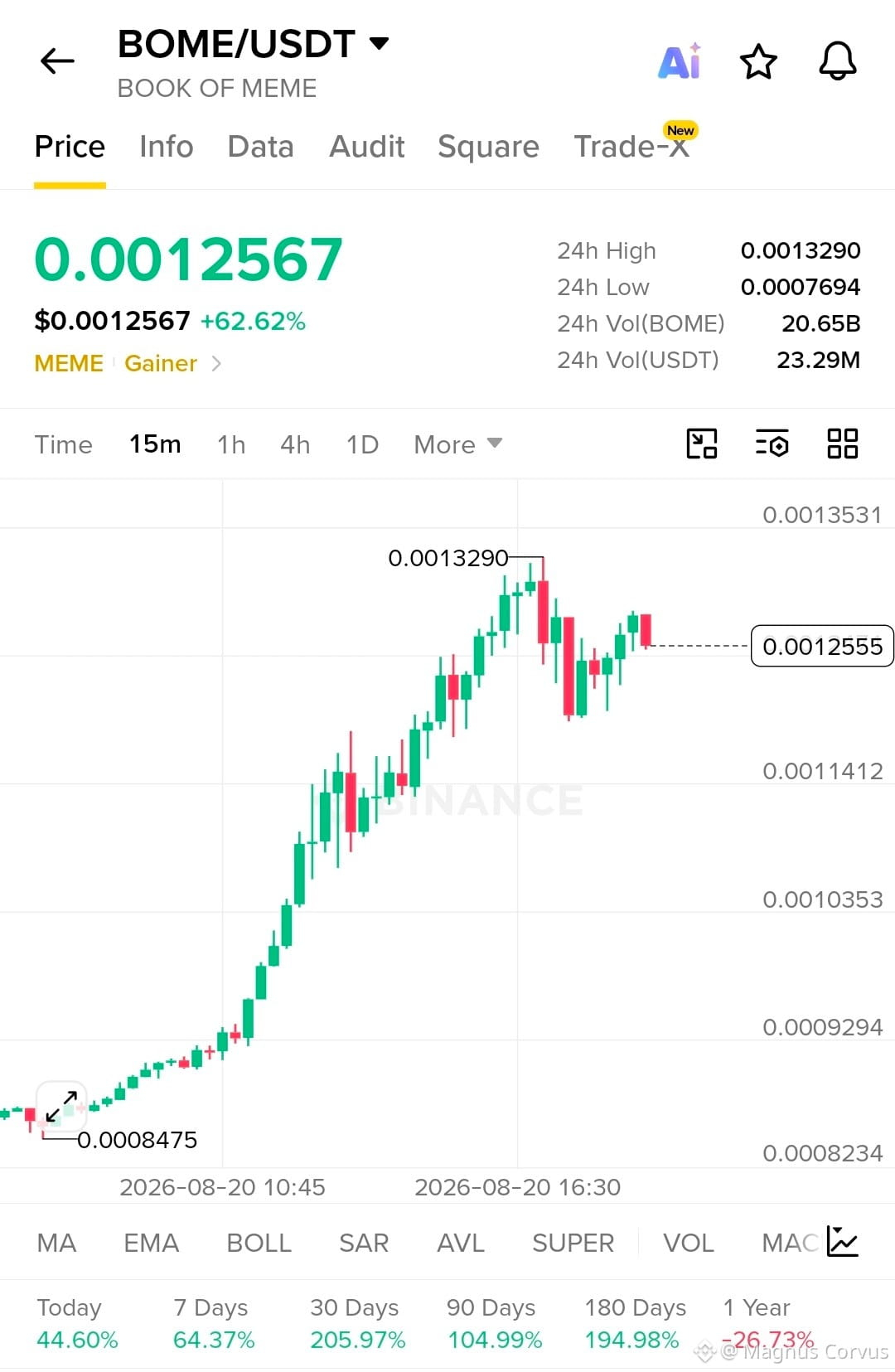
$BOME affiche une forte dynamique haussière après une expansion puissante.
La structure reste haussière puisque les acheteurs continuent de maintenir le contrôle au-dessus du support clé.
Zone d’entrée : 0.001220 - 0.001260
Stop Loss : 0.001175
Objectif 1 : 0.001329
Objectif 2 : 0.001380
Objectif 3 : 0.001450
La liquidité se renforce au-dessus du dernier plus haut, tandis que les réactions depuis les niveaux inférieurs continuent de montrer une demande. Maintenir la structure actuelle permet d’envisager la continuation vers les prochaines zones de liquidité.
Allons-y et Trade maintenant $BOME
La structure reste haussière puisque les acheteurs continuent de maintenir le contrôle au-dessus du support clé.
Zone d’entrée : 0.001220 - 0.001260
Stop Loss : 0.001175
Objectif 1 : 0.001329
Objectif 2 : 0.001380
Objectif 3 : 0.001450
La liquidité se renforce au-dessus du dernier plus haut, tandis que les réactions depuis les niveaux inférieurs continuent de montrer une demande. Maintenir la structure actuelle permet d’envisager la continuation vers les prochaines zones de liquidité.
Allons-y et Trade maintenant $BOME
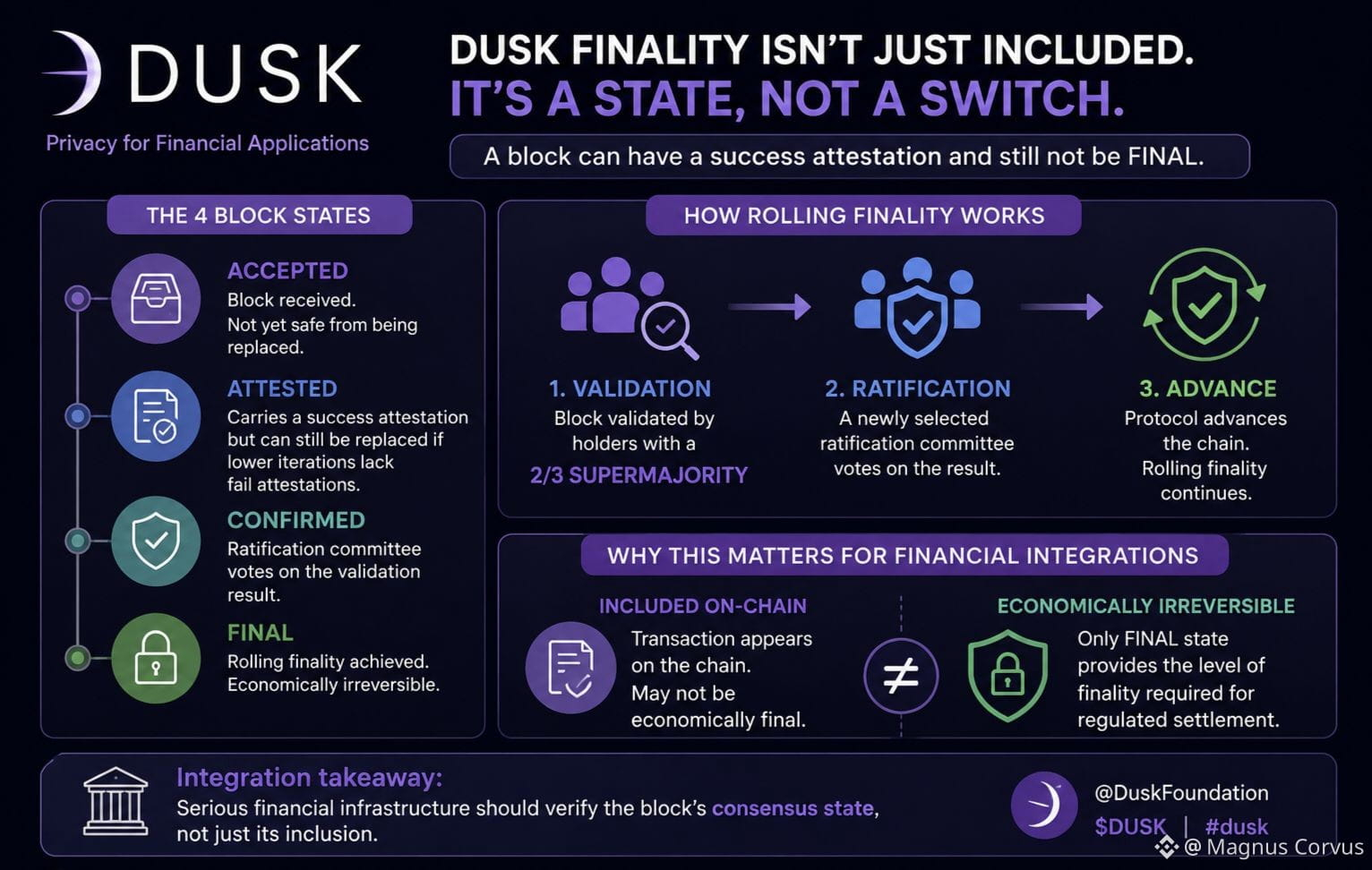
Le détail qui m’a fait regarder deux fois : le livre blanc de Dusk indique qu’un bloc peut porter une attestation de succès tout en n’étant pas FINAL.
L’aperçu actuel présente l’Attestation Succincte comme apportant une finalité déterministe une fois qu’un bloc est ratifié. Mais la spécification technique ajoute une couche importante : les blocs peuvent se trouver dans des états ACCEPTED, ATTESTED, CONFIRMED ou FINAL. Si un bloc se place au-dessus de l’itération 0 tandis que les itérations inférieures ne comportent pas d’attestations d’échec, il peut rester accepté et être potentiellement remplacé par un bloc d’itération inférieure.
Cela ne signifie pas que Dusk a une finalité faible. Le protocole gère explicitement cela grâce à une finalité « en roulement ». La validation exige une supermajorité de 2/3, puis un nouveau comité de ratification sélectionné vote sur ce résultat avant que le protocole ne progresse.
Ce qui a retenu mon attention, c’est l’implication en matière d’intégration. Pour un règlement réglementé, « inclus on-chain » et « économiquement irréversible » ne sont pas toujours des signaux identiques. Mon interprétation : les infrastructures financières sérieuses devraient s’appuyer sur l’état de consensus du bloc, pas seulement sur son inclusion.
Cette nuance peut compter autant que l’histoire de la confidentialité autour de DuskFoundation et de DUSK.
À quel point Dusk exposera-t-il clairement ces états de finalité aux institutions qui construisent des flux de travail de règlement ?
@Dusk $DUSK #dusk
L’aperçu actuel présente l’Attestation Succincte comme apportant une finalité déterministe une fois qu’un bloc est ratifié. Mais la spécification technique ajoute une couche importante : les blocs peuvent se trouver dans des états ACCEPTED, ATTESTED, CONFIRMED ou FINAL. Si un bloc se place au-dessus de l’itération 0 tandis que les itérations inférieures ne comportent pas d’attestations d’échec, il peut rester accepté et être potentiellement remplacé par un bloc d’itération inférieure.
Cela ne signifie pas que Dusk a une finalité faible. Le protocole gère explicitement cela grâce à une finalité « en roulement ». La validation exige une supermajorité de 2/3, puis un nouveau comité de ratification sélectionné vote sur ce résultat avant que le protocole ne progresse.
Ce qui a retenu mon attention, c’est l’implication en matière d’intégration. Pour un règlement réglementé, « inclus on-chain » et « économiquement irréversible » ne sont pas toujours des signaux identiques. Mon interprétation : les infrastructures financières sérieuses devraient s’appuyer sur l’état de consensus du bloc, pas seulement sur son inclusion.
Cette nuance peut compter autant que l’histoire de la confidentialité autour de DuskFoundation et de DUSK.
À quel point Dusk exposera-t-il clairement ces états de finalité aux institutions qui construisent des flux de travail de règlement ?
@Dusk $DUSK #dusk
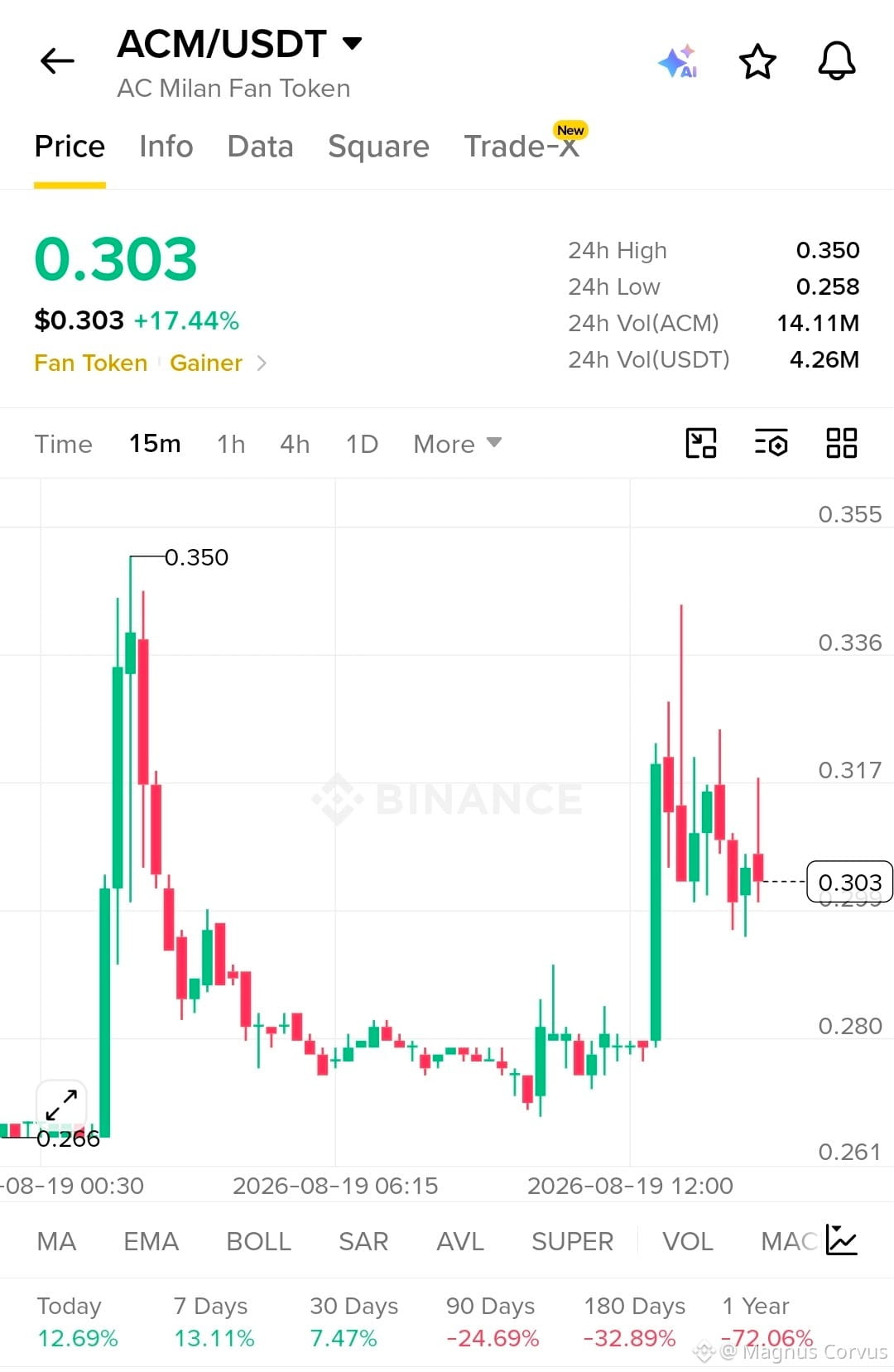
$ACM affiche une forte dynamique après une cassure agressive depuis la fourchette basse.
La structure haussière reste intacte tandis que les acheteurs défendent la zone de réaction clé.
Zone d’entrée : 0.298 - 0.304
Stop Loss : 0.289
Objectif 1 : 0.317
Objectif 2 : 0.336
Objectif 3 : 0.350
La liquidité a été balayée près des plus hauts, suivie d’une réaction marquée vers le support. ACM se maintient désormais au-dessus de la structure de cassure, et un contrôle soutenu des acheteurs peut déclencher un autre mouvement vers la liquidité supérieure.
Allons-y et Trade maintenant $ACM
La structure haussière reste intacte tandis que les acheteurs défendent la zone de réaction clé.
Zone d’entrée : 0.298 - 0.304
Stop Loss : 0.289
Objectif 1 : 0.317
Objectif 2 : 0.336
Objectif 3 : 0.350
La liquidité a été balayée près des plus hauts, suivie d’une réaction marquée vers le support. ACM se maintient désormais au-dessus de la structure de cassure, et un contrôle soutenu des acheteurs peut déclencher un autre mouvement vers la liquidité supérieure.
Allons-y et Trade maintenant $ACM
Connectez-vous pour découvrir plus de contenu