

TamaraSolovei
34 Publications

TamaraSolovei
Signaler
Bloquer l’utilisateur
7 Suivis
2 Abonnés
5 J’aime
Publications
Voir la traduction
#dusk $DUSK @Dusk_Foundation
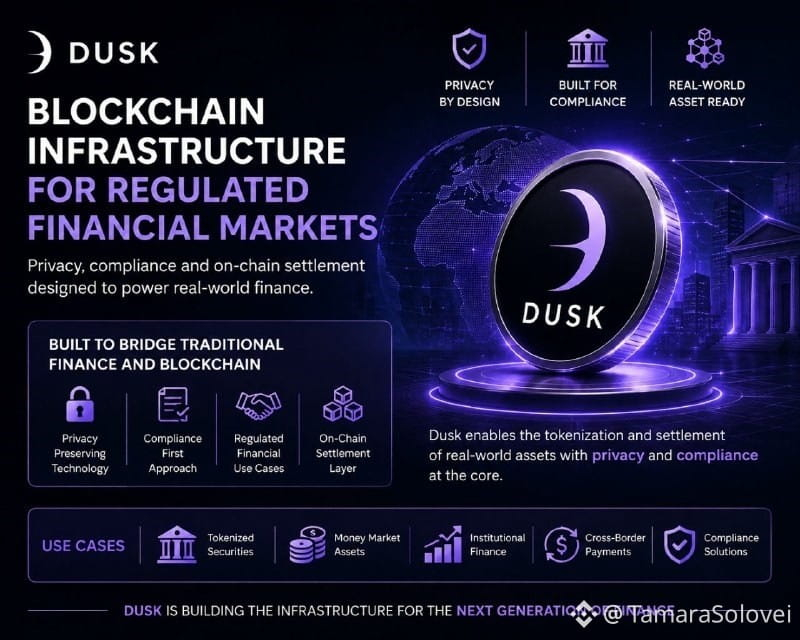
One of the most important things for institutional finance is knowing exactly what happens when a transaction is completed.
That's why Dusk's approach to settlement caught my attention.
In traditional financial markets, settlement can involve multiple systems and intermediaries. On-chain infrastructure offers the possibility of making the process more direct and programmable.
@Dusk_Foundation is building around deterministic settlement, while combining it with privacy and compliance features needed for regulated assets.
This matters because a tokenized security isn't useful simply because it exists on a blockchain.
The infrastructure also needs to answer:
🔹 Who is allowed to hold it?
🔹 Can it be transferred?
🔹 What information must be verified?
🔹 When is the transaction final?
Dusk is trying to make those rules part of the network itself.
For me, that's the more interesting RWA thesis: not just tokenizing assets, but making the entire financial transaction lifecycle programmable and verifiable.
#dusk $DUSK @Dusk
One of the most important things for institutional finance is knowing exactly what happens when a transaction is completed.
That's why Dusk's approach to settlement caught my attention.
In traditional financial markets, settlement can involve multiple systems and intermediaries. On-chain infrastructure offers the possibility of making the process more direct and programmable.
@Dusk is building around deterministic settlement, while combining it with privacy and compliance features needed for regulated assets.
This matters because a tokenized security isn't useful simply because it exists on a blockchain.
The infrastructure also needs to answer:
🔹 Who is allowed to hold it?
🔹 Can it be transferred?
🔹 What information must be verified?
🔹 When is the transaction final?
Dusk is trying to make those rules part of the network itself.
For me, that's the more interesting RWA thesis: not just tokenizing assets, but making the entire financial transaction lifecycle programmable and verifiable.
One of the most important things for institutional finance is knowing exactly what happens when a transaction is completed.
That's why Dusk's approach to settlement caught my attention.
In traditional financial markets, settlement can involve multiple systems and intermediaries. On-chain infrastructure offers the possibility of making the process more direct and programmable.
@Dusk is building around deterministic settlement, while combining it with privacy and compliance features needed for regulated assets.
This matters because a tokenized security isn't useful simply because it exists on a blockchain.
The infrastructure also needs to answer:
🔹 Who is allowed to hold it?
🔹 Can it be transferred?
🔹 What information must be verified?
🔹 When is the transaction final?
Dusk is trying to make those rules part of the network itself.
For me, that's the more interesting RWA thesis: not just tokenizing assets, but making the entire financial transaction lifecycle programmable and verifiable.
103
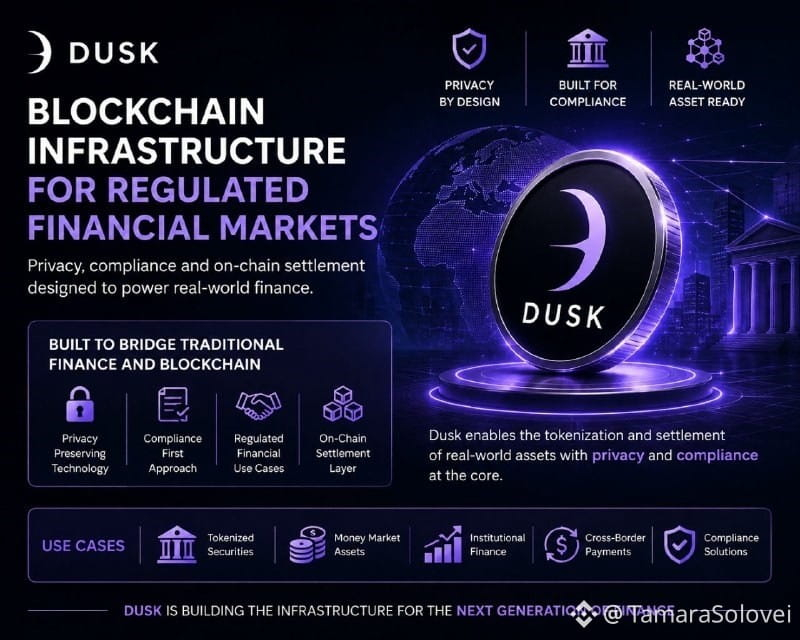
#dusk $DUSK @Dusk_Foundation Après avoir suivi Dusk pendant un moment, ce qui me frappe, c’est à quel point le réseau est construit spécifiquement autour des marchés financiers.
Dusk n’essaie pas de résoudre tous les cas d’usage possibles de la blockchain.
Son infrastructure se concentre sur un problème beaucoup plus restreint — mais potentiellement très important — : faire fonctionner des actifs financiers réglementés on-chain.
Cela signifie s’attaquer, dès le départ, à ce qui rend la finance traditionnelle compliquée :
🔹 Éligibilité des investisseurs
🔹 Transferts d’actifs
🔹 Confidentialité et divulgation sélective
🔹 Exigences de conformité
🔹 Règlement déterministe
🔹 Environnements d’exécution différents pour les développeurs
Et je pense que c’est la bonne approche pour le marché des RWA.
La tokenisation d’un actif n’est qu’un point de départ. Le vrai défi consiste à construire une infrastructure permettant à cet actif d’être effectivement émis, transféré, échangé et réglé, tout en garantissant que les règles qui l’entourent restent applicables.
C’est la thèse derrière Dusk, celle que je trouve la plus convaincante.
Pas « une blockchain pour tout ».
Une infrastructure blockchain conçue spécifiquement pour les marchés financiers.
La question majeure demeure : est-ce que Dusk pourra transformer cette architecture en une adoption réelle significative à grande échelle ?
Mais à mesure que le secteur des RWA continue de se développer, je pense que les projets qui résolvent le problème d’infrastructure méritent qu’on s’y intéresse.
Pour l’instant, $DUSK reste sur ma liste de surveillance.
#dusk $DUSK @Dusk Après avoir suivi Dusk pendant un moment, ce qui me frappe, c’est à quel point le réseau est construit spécifiquement autour des marchés financiers.
Dusk n’essaie pas de résoudre tous les cas d’usage possibles de la blockchain.
Son infrastructure se concentre sur un problème beaucoup plus restreint — mais potentiellement très important — : faire fonctionner des actifs financiers réglementés on-chain.
Cela signifie s’attaquer, dès le départ, à ce qui rend la finance traditionnelle compliquée :
🔹 Éligibilité des investisseurs
🔹 Transferts d’actifs
🔹 Confidentialité et divulgation sélective
🔹 Exigences de conformité
🔹 Règlement déterministe
🔹 Environnements d’exécution différents pour les développeurs
Et je pense que c’est la bonne approche pour le marché des RWA.
La tokenisation d’un actif n’est qu’un point de départ. Le vrai défi consiste à construire une infrastructure permettant à cet actif d’être effectivement émis, transféré, échangé et réglé, tout en garantissant que les règles qui l’entourent restent applicables.
C’est la thèse derrière Dusk, celle que je trouve la plus convaincante.
Pas « une blockchain pour tout ».
Une infrastructure blockchain conçue spécifiquement pour les marchés financiers.
La question majeure demeure : est-ce que Dusk pourra transformer cette architecture en une adoption réelle significative à grande échelle ?
Mais à mesure que le secteur des RWA continue de se développer, je pense que les projets qui résolvent le problème d’infrastructure méritent qu’on s’y intéresse.
Pour l’instant, $DUSK reste sur ma liste de surveillance.
Dusk n’essaie pas de résoudre tous les cas d’usage possibles de la blockchain.
Son infrastructure se concentre sur un problème beaucoup plus restreint — mais potentiellement très important — : faire fonctionner des actifs financiers réglementés on-chain.
Cela signifie s’attaquer, dès le départ, à ce qui rend la finance traditionnelle compliquée :
🔹 Éligibilité des investisseurs
🔹 Transferts d’actifs
🔹 Confidentialité et divulgation sélective
🔹 Exigences de conformité
🔹 Règlement déterministe
🔹 Environnements d’exécution différents pour les développeurs
Et je pense que c’est la bonne approche pour le marché des RWA.
La tokenisation d’un actif n’est qu’un point de départ. Le vrai défi consiste à construire une infrastructure permettant à cet actif d’être effectivement émis, transféré, échangé et réglé, tout en garantissant que les règles qui l’entourent restent applicables.
C’est la thèse derrière Dusk, celle que je trouve la plus convaincante.
Pas « une blockchain pour tout ».
Une infrastructure blockchain conçue spécifiquement pour les marchés financiers.
La question majeure demeure : est-ce que Dusk pourra transformer cette architecture en une adoption réelle significative à grande échelle ?
Mais à mesure que le secteur des RWA continue de se développer, je pense que les projets qui résolvent le problème d’infrastructure méritent qu’on s’y intéresse.
Pour l’instant, $DUSK reste sur ma liste de surveillance.
83
#dusk $DUSK @Dusk_Foundation
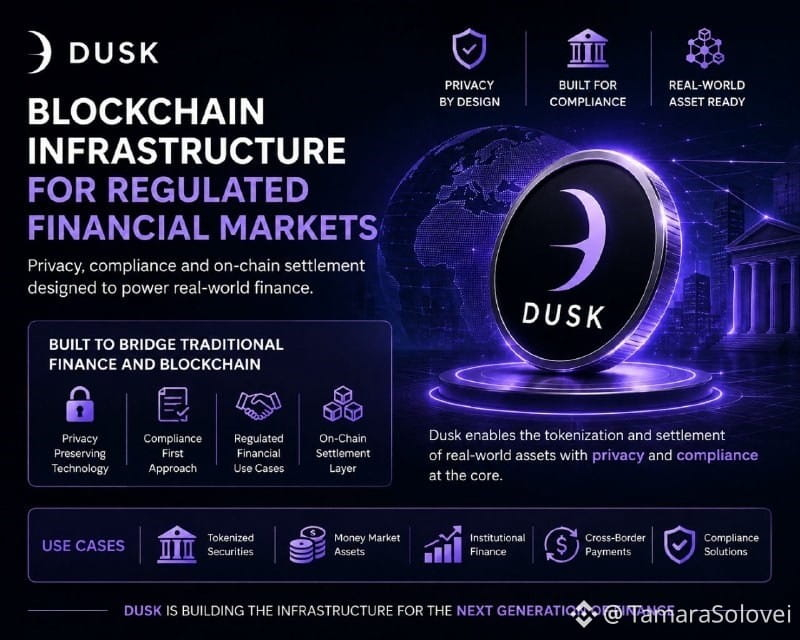
La partie la plus intéressante de Dusk pourrait bien être ce qui se passe entre le moment où un actif est émis et celui où il parvient à un investisseur.
La finance réglementée impose de nombreuses conditions qui doivent être respectées avant qu’un actif puisse réellement circuler : éligibilité des investisseurs, restrictions de transfert, contrôles de conformité et règlement.
@Dusk_Foundation construit ces exigences directement dans l’infrastructure blockchain.
Cela signifie que le réseau ne traite pas la conformité comme une couche distincte qu’il faudrait fixer à chaque application. Au lieu de cela, les flux d’actifs réglementés peuvent être conçus autour de contrôles d’accès natifs, de transactions préservant la confidentialité et d’un règlement déterministe.
Je pense que cette approche a du sens pour les marchés institutionnels.
Une blockchain publique peut offrir de la transparence, mais les institutions financières ont aussi besoin d’un accès contrôlé et d’une exécution prévisible.
Dusk cherche à combiner les deux :
Une infrastructure transparente là où c’est utile.
La confidentialité quand c’est nécessaire.
La vérification lorsque la réglementation l’exige.
Si, à terme, les titres tokenisés deviennent un marché majeur, ces détails pourraient compter bien davantage que le simple fait d’avoir une autre blockchain capable d’émettre des tokens.
Le vrai test est de savoir si les institutions financières peuvent réellement opérer sur le réseau.
C’est ce que je vais surveiller avec $DUSK .
#dusk $DUSK @Dusk
La partie la plus intéressante de Dusk pourrait bien être ce qui se passe entre le moment où un actif est émis et celui où il parvient à un investisseur.
La finance réglementée impose de nombreuses conditions qui doivent être respectées avant qu’un actif puisse réellement circuler : éligibilité des investisseurs, restrictions de transfert, contrôles de conformité et règlement.
@Dusk construit ces exigences directement dans l’infrastructure blockchain.
Cela signifie que le réseau ne traite pas la conformité comme une couche distincte qu’il faudrait fixer à chaque application. Au lieu de cela, les flux d’actifs réglementés peuvent être conçus autour de contrôles d’accès natifs, de transactions préservant la confidentialité et d’un règlement déterministe.
Je pense que cette approche a du sens pour les marchés institutionnels.
Une blockchain publique peut offrir de la transparence, mais les institutions financières ont aussi besoin d’un accès contrôlé et d’une exécution prévisible.
Dusk cherche à combiner les deux :
Une infrastructure transparente là où c’est utile.
La confidentialité quand c’est nécessaire.
La vérification lorsque la réglementation l’exige.
Si, à terme, les titres tokenisés deviennent un marché majeur, ces détails pourraient compter bien davantage que le simple fait d’avoir une autre blockchain capable d’émettre des tokens.
Le vrai test est de savoir si les institutions financières peuvent réellement opérer sur le réseau.
C’est ce que je vais surveiller avec $DUSK .
La partie la plus intéressante de Dusk pourrait bien être ce qui se passe entre le moment où un actif est émis et celui où il parvient à un investisseur.
La finance réglementée impose de nombreuses conditions qui doivent être respectées avant qu’un actif puisse réellement circuler : éligibilité des investisseurs, restrictions de transfert, contrôles de conformité et règlement.
@Dusk construit ces exigences directement dans l’infrastructure blockchain.
Cela signifie que le réseau ne traite pas la conformité comme une couche distincte qu’il faudrait fixer à chaque application. Au lieu de cela, les flux d’actifs réglementés peuvent être conçus autour de contrôles d’accès natifs, de transactions préservant la confidentialité et d’un règlement déterministe.
Je pense que cette approche a du sens pour les marchés institutionnels.
Une blockchain publique peut offrir de la transparence, mais les institutions financières ont aussi besoin d’un accès contrôlé et d’une exécution prévisible.
Dusk cherche à combiner les deux :
Une infrastructure transparente là où c’est utile.
La confidentialité quand c’est nécessaire.
La vérification lorsque la réglementation l’exige.
Si, à terme, les titres tokenisés deviennent un marché majeur, ces détails pourraient compter bien davantage que le simple fait d’avoir une autre blockchain capable d’émettre des tokens.
Le vrai test est de savoir si les institutions financières peuvent réellement opérer sur le réseau.
C’est ce que je vais surveiller avec $DUSK .
80
Voir la traduction
#dusk $DUSK @Dusk_Foundation
Most people hear “RWA” and immediately think about tokenizing government bonds or putting real estate onchain.
But I think the more interesting opportunity is much broader.
Private markets.
A huge amount of economic activity happens outside public markets.
Private companies need financing.
Investors need access to opportunities.
Ownership needs to be recorded.
Transfers need to be controlled.
Payments and settlement need to happen.
And every participant needs to know who is actually allowed to do what.
Today, a lot of this infrastructure is fragmented across issuers, banks, custodians, administrators, brokers and other intermediaries.
Tokenization doesn't automatically solve that.
Putting an asset on a blockchain doesn't magically create liquidity, demand or legal certainty.
The interesting part is what happens when the entire lifecycle of an asset can be represented digitally.
Issuance.
Investor eligibility.
Ownership.
Transfers.
Dividends.
Voting.
Settlement.
That's where @Dusk_Foundation _Foundation is taking an interesting approach.
Dusk isn't simply saying “let's put more assets onchain.”
It's trying to build infrastructure where regulated assets can exist onchain while still dealing with the requirements that financial markets can't ignore.
Privacy.
Selective disclosure.
Access controls.
Compliance.
Deterministic settlement.
And that's particularly important for private markets.
A public blockchain gives you transparency by default.
Financial markets often need the opposite: controlled visibility.
An investor may need to prove they're eligible without exposing every piece of personal information.
A company may need to keep sensitive positions private.
A regulated venue may need to know exactly who can hold or transfer an asset.
That doesn't mean blockchain has to choose between transparency and privacy.
It means the infrastructure needs to be designed for both.
This is why I'm paying attention to Dusk.
The interesting question isn't whether we can tokenize another asset.
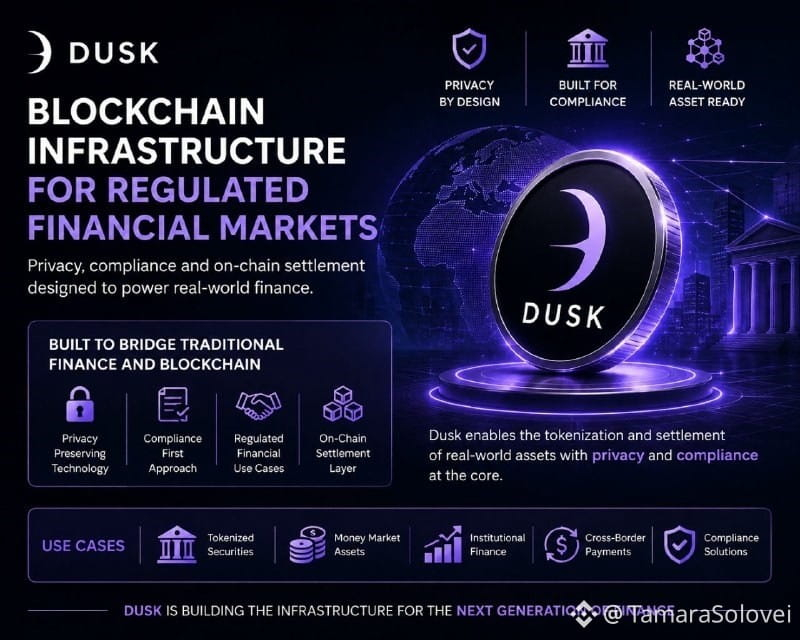
#dusk $DUSK @Dusk
Most people hear “RWA” and immediately think about tokenizing government bonds or putting real estate onchain.
But I think the more interesting opportunity is much broader.
Private markets.
A huge amount of economic activity happens outside public markets.
Private companies need financing.
Investors need access to opportunities.
Ownership needs to be recorded.
Transfers need to be controlled.
Payments and settlement need to happen.
And every participant needs to know who is actually allowed to do what.
Today, a lot of this infrastructure is fragmented across issuers, banks, custodians, administrators, brokers and other intermediaries.
Tokenization doesn't automatically solve that.
Putting an asset on a blockchain doesn't magically create liquidity, demand or legal certainty.
The interesting part is what happens when the entire lifecycle of an asset can be represented digitally.
Issuance.
Investor eligibility.
Ownership.
Transfers.
Dividends.
Voting.
Settlement.
That's where @Dusk _Foundation is taking an interesting approach.
Dusk isn't simply saying “let's put more assets onchain.”
It's trying to build infrastructure where regulated assets can exist onchain while still dealing with the requirements that financial markets can't ignore.
Privacy.
Selective disclosure.
Access controls.
Compliance.
Deterministic settlement.
And that's particularly important for private markets.
A public blockchain gives you transparency by default.
Financial markets often need the opposite: controlled visibility.
An investor may need to prove they're eligible without exposing every piece of personal information.
A company may need to keep sensitive positions private.
A regulated venue may need to know exactly who can hold or transfer an asset.
That doesn't mean blockchain has to choose between transparency and privacy.
It means the infrastructure needs to be designed for both.
This is why I'm paying attention to Dusk.
The interesting question isn't whether we can tokenize another asset.
Most people hear “RWA” and immediately think about tokenizing government bonds or putting real estate onchain.
But I think the more interesting opportunity is much broader.
Private markets.
A huge amount of economic activity happens outside public markets.
Private companies need financing.
Investors need access to opportunities.
Ownership needs to be recorded.
Transfers need to be controlled.
Payments and settlement need to happen.
And every participant needs to know who is actually allowed to do what.
Today, a lot of this infrastructure is fragmented across issuers, banks, custodians, administrators, brokers and other intermediaries.
Tokenization doesn't automatically solve that.
Putting an asset on a blockchain doesn't magically create liquidity, demand or legal certainty.
The interesting part is what happens when the entire lifecycle of an asset can be represented digitally.
Issuance.
Investor eligibility.
Ownership.
Transfers.
Dividends.
Voting.
Settlement.
That's where @Dusk _Foundation is taking an interesting approach.
Dusk isn't simply saying “let's put more assets onchain.”
It's trying to build infrastructure where regulated assets can exist onchain while still dealing with the requirements that financial markets can't ignore.
Privacy.
Selective disclosure.
Access controls.
Compliance.
Deterministic settlement.
And that's particularly important for private markets.
A public blockchain gives you transparency by default.
Financial markets often need the opposite: controlled visibility.
An investor may need to prove they're eligible without exposing every piece of personal information.
A company may need to keep sensitive positions private.
A regulated venue may need to know exactly who can hold or transfer an asset.
That doesn't mean blockchain has to choose between transparency and privacy.
It means the infrastructure needs to be designed for both.
This is why I'm paying attention to Dusk.
The interesting question isn't whether we can tokenize another asset.
71
#dusk $DUSK @Dusk_Foundation
La plupart des gens entendent « RWA » et pensent immédiatement à la tokenisation d’obligations d’État ou au fait de mettre l’immobilier onchain.
Mais je pense que l’opportunité la plus intéressante est beaucoup plus large.
Les marchés privés.
Une énorme quantité d’activité économique se déroule en dehors des marchés publics.
Les entreprises privées ont besoin de financements.
Les investisseurs ont besoin d’accéder à des opportunités.
La propriété doit être enregistrée.
Les transferts doivent être contrôlés.
Les paiements et le règlement doivent avoir lieu.
Et chaque participant doit savoir qui est réellement autorisé à faire quoi.
Aujourd’hui, une grande partie de cette infrastructure est fragmentée entre les émetteurs, les banques, les dépositaires, les administrateurs, les courtiers et d’autres intermédiaires.
La tokenisation ne résout pas automatiquement cela.
Mettre un actif sur une blockchain ne crée pas, par magie, de la liquidité, de la demande ou une certitude juridique.
Le point intéressant, c’est ce qui se passe lorsque l’ensemble du cycle de vie d’un actif peut être représenté numériquement.
Émission.
Éligibilité des investisseurs.
Propriété.
Transferts.
Dividendes.
Vote.
Règlement.
C’est là que @Dusk_Foundation _Foundation adopte une approche intéressante.
Dusk n’essaie pas seulement de dire « mettons plus d’actifs onchain ».
L’objectif est de construire une infrastructure permettant à des actifs réglementés d’exister onchain tout en répondant aux exigences que les marchés financiers ne peuvent pas ignorer.
La confidentialité.
La divulgation sélective.
Les contrôles d’accès.
La conformité.
Le règlement déterministe.
Et c’est particulièrement important pour les marchés privés.
Une blockchain publique vous offre de la transparence par défaut.
Les marchés financiers ont souvent besoin de l’inverse : une visibilité contrôlée.
Un investisseur peut devoir prouver qu’il est éligible sans exposer chaque élément d’information personnelle.
Une entreprise peut devoir garder des positions sensibles privées.
Un lieu réglementé peut avoir besoin de savoir exactement qui peut détenir ou transférer un actif.
Cela ne veut pas dire que la blockchain doive choisir entre transparence et confidentialité.
Cela signifie que l’infrastructure doit être conçue pour les deux.
C’est pourquoi je porte attention à Dusk.
La question intéressante n’est pas de savoir si nous pouvons tokeniser un autre actif.
#dusk $DUSK @Dusk
La plupart des gens entendent « RWA » et pensent immédiatement à la tokenisation d’obligations d’État ou au fait de mettre l’immobilier onchain.
Mais je pense que l’opportunité la plus intéressante est beaucoup plus large.
Les marchés privés.
Une énorme quantité d’activité économique se déroule en dehors des marchés publics.
Les entreprises privées ont besoin de financements.
Les investisseurs ont besoin d’accéder à des opportunités.
La propriété doit être enregistrée.
Les transferts doivent être contrôlés.
Les paiements et le règlement doivent avoir lieu.
Et chaque participant doit savoir qui est réellement autorisé à faire quoi.
Aujourd’hui, une grande partie de cette infrastructure est fragmentée entre les émetteurs, les banques, les dépositaires, les administrateurs, les courtiers et d’autres intermédiaires.
La tokenisation ne résout pas automatiquement cela.
Mettre un actif sur une blockchain ne crée pas, par magie, de la liquidité, de la demande ou une certitude juridique.
Le point intéressant, c’est ce qui se passe lorsque l’ensemble du cycle de vie d’un actif peut être représenté numériquement.
Émission.
Éligibilité des investisseurs.
Propriété.
Transferts.
Dividendes.
Vote.
Règlement.
C’est là que @Dusk _Foundation adopte une approche intéressante.
Dusk n’essaie pas seulement de dire « mettons plus d’actifs onchain ».
L’objectif est de construire une infrastructure permettant à des actifs réglementés d’exister onchain tout en répondant aux exigences que les marchés financiers ne peuvent pas ignorer.
La confidentialité.
La divulgation sélective.
Les contrôles d’accès.
La conformité.
Le règlement déterministe.
Et c’est particulièrement important pour les marchés privés.
Une blockchain publique vous offre de la transparence par défaut.
Les marchés financiers ont souvent besoin de l’inverse : une visibilité contrôlée.
Un investisseur peut devoir prouver qu’il est éligible sans exposer chaque élément d’information personnelle.
Une entreprise peut devoir garder des positions sensibles privées.
Un lieu réglementé peut avoir besoin de savoir exactement qui peut détenir ou transférer un actif.
Cela ne veut pas dire que la blockchain doive choisir entre transparence et confidentialité.
Cela signifie que l’infrastructure doit être conçue pour les deux.
C’est pourquoi je porte attention à Dusk.
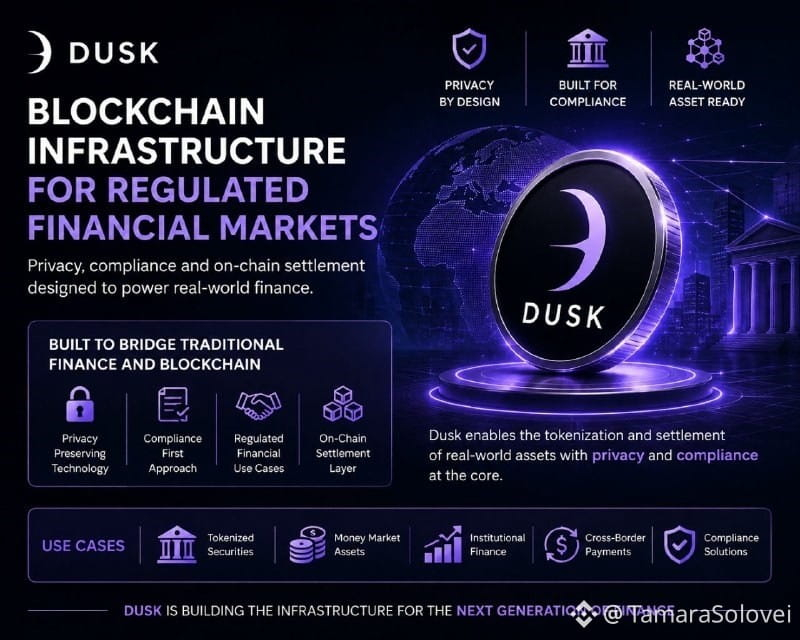
La question intéressante n’est pas de savoir si nous pouvons tokeniser un autre actif.
La plupart des gens entendent « RWA » et pensent immédiatement à la tokenisation d’obligations d’État ou au fait de mettre l’immobilier onchain.
Mais je pense que l’opportunité la plus intéressante est beaucoup plus large.
Les marchés privés.
Une énorme quantité d’activité économique se déroule en dehors des marchés publics.
Les entreprises privées ont besoin de financements.
Les investisseurs ont besoin d’accéder à des opportunités.
La propriété doit être enregistrée.
Les transferts doivent être contrôlés.
Les paiements et le règlement doivent avoir lieu.
Et chaque participant doit savoir qui est réellement autorisé à faire quoi.
Aujourd’hui, une grande partie de cette infrastructure est fragmentée entre les émetteurs, les banques, les dépositaires, les administrateurs, les courtiers et d’autres intermédiaires.
La tokenisation ne résout pas automatiquement cela.
Mettre un actif sur une blockchain ne crée pas, par magie, de la liquidité, de la demande ou une certitude juridique.
Le point intéressant, c’est ce qui se passe lorsque l’ensemble du cycle de vie d’un actif peut être représenté numériquement.
Émission.
Éligibilité des investisseurs.
Propriété.
Transferts.
Dividendes.
Vote.
Règlement.
C’est là que @Dusk _Foundation adopte une approche intéressante.
Dusk n’essaie pas seulement de dire « mettons plus d’actifs onchain ».
L’objectif est de construire une infrastructure permettant à des actifs réglementés d’exister onchain tout en répondant aux exigences que les marchés financiers ne peuvent pas ignorer.
La confidentialité.
La divulgation sélective.
Les contrôles d’accès.
La conformité.
Le règlement déterministe.
Et c’est particulièrement important pour les marchés privés.
Une blockchain publique vous offre de la transparence par défaut.
Les marchés financiers ont souvent besoin de l’inverse : une visibilité contrôlée.
Un investisseur peut devoir prouver qu’il est éligible sans exposer chaque élément d’information personnelle.
Une entreprise peut devoir garder des positions sensibles privées.
Un lieu réglementé peut avoir besoin de savoir exactement qui peut détenir ou transférer un actif.
Cela ne veut pas dire que la blockchain doive choisir entre transparence et confidentialité.
Cela signifie que l’infrastructure doit être conçue pour les deux.
C’est pourquoi je porte attention à Dusk.
La question intéressante n’est pas de savoir si nous pouvons tokeniser un autre actif.
64
Voir la traduction
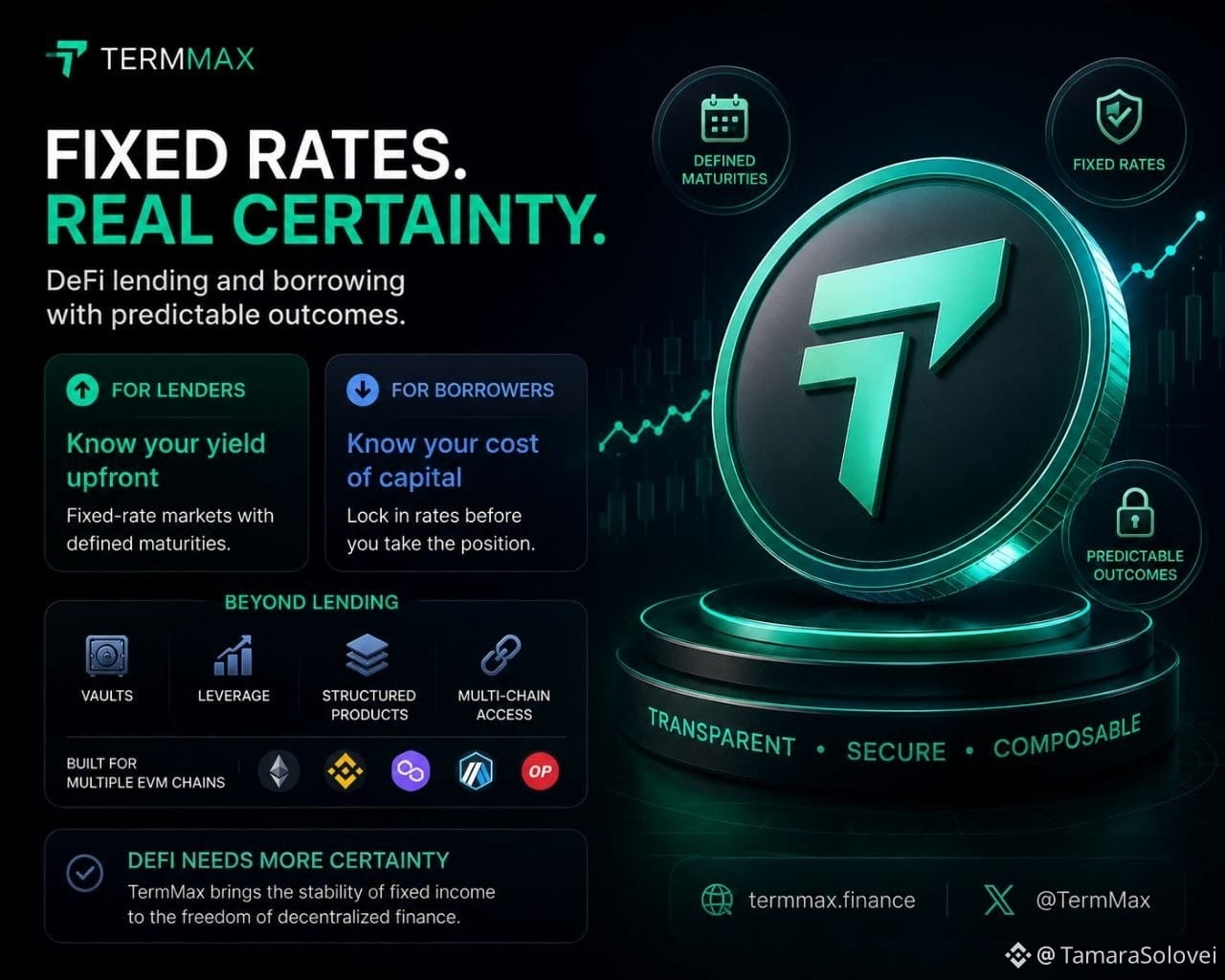
#termmax @termmax DeFi becomes much more interesting when financial positions can be built like Lego blocks.
That’s one reason I’m watching TermMax.
The protocol is focused on fixed-rate lending and borrowing with defined maturities, but the bigger idea is what these predictable positions can enable on top of them.
A fixed-rate position can become a building block for:
🔹 Hedging interest-rate exposure
🔹 More predictable leverage
🔹 Fixed-income strategies
🔹 Vaults and structured products
🔹 More precise capital management
Instead of every strategy depending on whatever the floating market rate happens to be at a particular moment, users can build around a known rate and a defined time horizon.
That's important because sophisticated financial strategies usually need more than liquidity. They need predictability.
TermMax is essentially bringing another primitive from traditional fixed-income markets into DeFi and making it composable with on-chain infrastructure.
The interesting question is how far fixed-rate markets can go once they become programmable.
$TMX is one token I'll be watching as this sector develops.
#termmax @TermMax DeFi becomes much more interesting when financial positions can be built like Lego blocks.
That’s one reason I’m watching TermMax.
The protocol is focused on fixed-rate lending and borrowing with defined maturities, but the bigger idea is what these predictable positions can enable on top of them.
A fixed-rate position can become a building block for:
🔹 Hedging interest-rate exposure
🔹 More predictable leverage
🔹 Fixed-income strategies
🔹 Vaults and structured products
🔹 More precise capital management
Instead of every strategy depending on whatever the floating market rate happens to be at a particular moment, users can build around a known rate and a defined time horizon.
That's important because sophisticated financial strategies usually need more than liquidity. They need predictability.
TermMax is essentially bringing another primitive from traditional fixed-income markets into DeFi and making it composable with on-chain infrastructure.
The interesting question is how far fixed-rate markets can go once they become programmable.
$TMX is one token I'll be watching as this sector develops.
That’s one reason I’m watching TermMax.
The protocol is focused on fixed-rate lending and borrowing with defined maturities, but the bigger idea is what these predictable positions can enable on top of them.
A fixed-rate position can become a building block for:
🔹 Hedging interest-rate exposure
🔹 More predictable leverage
🔹 Fixed-income strategies
🔹 Vaults and structured products
🔹 More precise capital management
Instead of every strategy depending on whatever the floating market rate happens to be at a particular moment, users can build around a known rate and a defined time horizon.
That's important because sophisticated financial strategies usually need more than liquidity. They need predictability.
TermMax is essentially bringing another primitive from traditional fixed-income markets into DeFi and making it composable with on-chain infrastructure.
The interesting question is how far fixed-rate markets can go once they become programmable.
$TMX is one token I'll be watching as this sector develops.
57
Voir la traduction
#dusk $DUSK @Dusk_Foundation
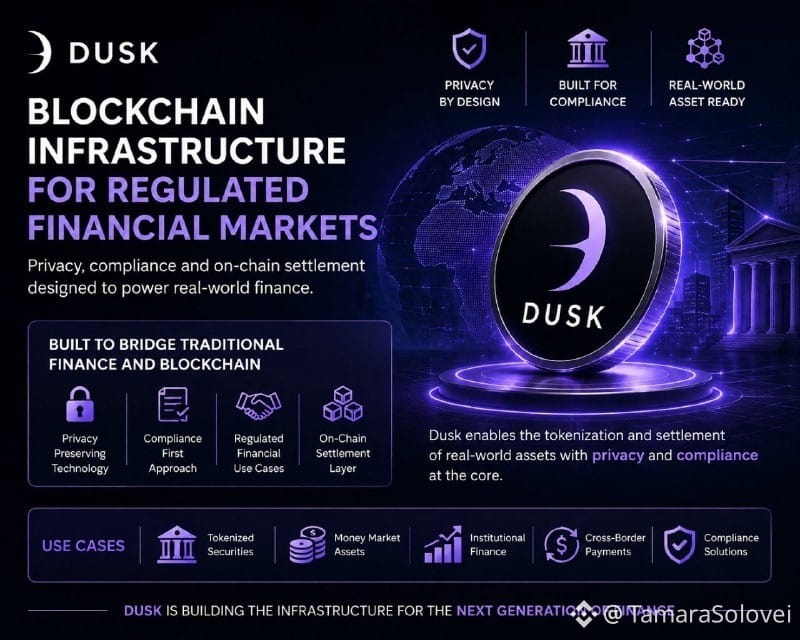
One thing I find interesting about Dusk is that it isn't trying to force every financial application into the same execution model.
The network provides DuskVM for native Rust/WASM applications and DuskEVM for developers who want an Ethereum-compatible environment.
That creates an interesting balance.
Developers can use familiar EVM tooling and smart-contract languages, while applications that need deeper access to Dusk's native capabilities can build directly on DuskVM.
Underneath both environments is DuskDS, providing the settlement and data-availability layer.
This architecture makes sense for a network focused on financial applications. Different products can have different technical requirements without necessarily needing completely separate chains.
And the native $DUSK token ties the ecosystem together through transaction fees and network staking.
For me, the interesting question isn't whether Dusk can attract developers — it's whether this architecture can turn into real financial activity on-chain.
If it does, $DUSK becomes more than just a token attached to an RWA narrative. It becomes part of the infrastructure powering the applications built on Dusk.
#dusk $DUSK @Dusk
One thing I find interesting about Dusk is that it isn't trying to force every financial application into the same execution model.
The network provides DuskVM for native Rust/WASM applications and DuskEVM for developers who want an Ethereum-compatible environment.
That creates an interesting balance.
Developers can use familiar EVM tooling and smart-contract languages, while applications that need deeper access to Dusk's native capabilities can build directly on DuskVM.
Underneath both environments is DuskDS, providing the settlement and data-availability layer.
This architecture makes sense for a network focused on financial applications. Different products can have different technical requirements without necessarily needing completely separate chains.
And the native $DUSK token ties the ecosystem together through transaction fees and network staking.
For me, the interesting question isn't whether Dusk can attract developers — it's whether this architecture can turn into real financial activity on-chain.
If it does, $DUSK becomes more than just a token attached to an RWA narrative. It becomes part of the infrastructure powering the applications built on Dusk.
One thing I find interesting about Dusk is that it isn't trying to force every financial application into the same execution model.
The network provides DuskVM for native Rust/WASM applications and DuskEVM for developers who want an Ethereum-compatible environment.
That creates an interesting balance.
Developers can use familiar EVM tooling and smart-contract languages, while applications that need deeper access to Dusk's native capabilities can build directly on DuskVM.
Underneath both environments is DuskDS, providing the settlement and data-availability layer.
This architecture makes sense for a network focused on financial applications. Different products can have different technical requirements without necessarily needing completely separate chains.
And the native $DUSK token ties the ecosystem together through transaction fees and network staking.
For me, the interesting question isn't whether Dusk can attract developers — it's whether this architecture can turn into real financial activity on-chain.
If it does, $DUSK becomes more than just a token attached to an RWA narrative. It becomes part of the infrastructure powering the applications built on Dusk.
79
Voir la traduction
#dusk $DUSK @Dusk_Foundation
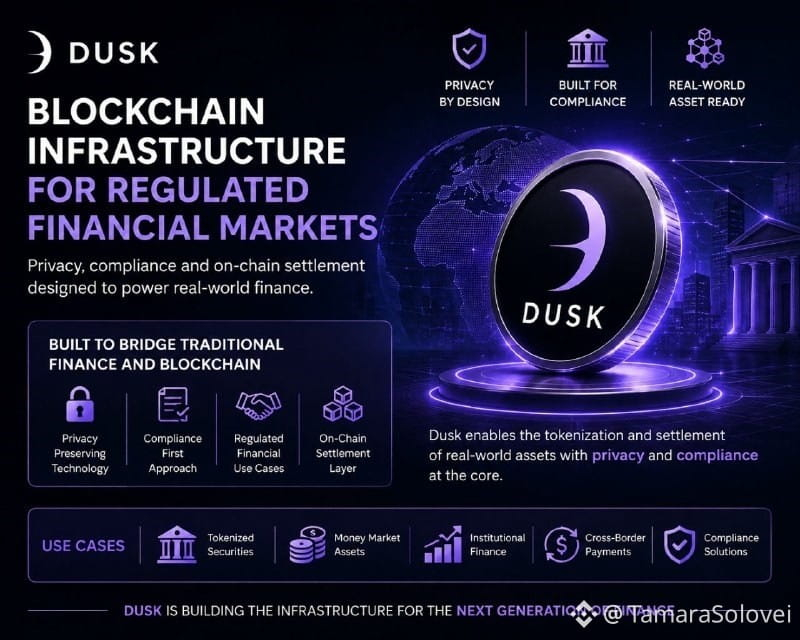
Dusk is taking an interesting approach to one of the biggest problems in on-chain finance: making different parts of the market work together.
A tokenized security needs more than a blockchain address. It needs rules around who can hold it, how it can move, what information can be disclosed and how settlement is finalized.
Dusk is building these requirements into its network rather than treating them as separate infrastructure.
What stands out to me is the combination of:
🔹 Permissioned access where required
🔹 Privacy-preserving transactions
🔹 Selective disclosure
🔹 Deterministic settlement
🔹 EVM compatibility for developers
That combination could make Dusk useful for financial applications where completely public transactions aren't practical, but completely private systems aren't acceptable either.
The interesting part of the Dusk thesis isn't putting finance on a blockchain. It's making blockchain infrastructure fit the way regulated finance actually works.
If RWAs continue moving toward institutional adoption, that's a niche worth watching.
#dusk $DUSK @Dusk
Dusk is taking an interesting approach to one of the biggest problems in on-chain finance: making different parts of the market work together.
A tokenized security needs more than a blockchain address. It needs rules around who can hold it, how it can move, what information can be disclosed and how settlement is finalized.
Dusk is building these requirements into its network rather than treating them as separate infrastructure.
What stands out to me is the combination of:
🔹 Permissioned access where required
🔹 Privacy-preserving transactions
🔹 Selective disclosure
🔹 Deterministic settlement
🔹 EVM compatibility for developers
That combination could make Dusk useful for financial applications where completely public transactions aren't practical, but completely private systems aren't acceptable either.
The interesting part of the Dusk thesis isn't putting finance on a blockchain. It's making blockchain infrastructure fit the way regulated finance actually works.
If RWAs continue moving toward institutional adoption, that's a niche worth watching.
Dusk is taking an interesting approach to one of the biggest problems in on-chain finance: making different parts of the market work together.
A tokenized security needs more than a blockchain address. It needs rules around who can hold it, how it can move, what information can be disclosed and how settlement is finalized.
Dusk is building these requirements into its network rather than treating them as separate infrastructure.
What stands out to me is the combination of:
🔹 Permissioned access where required
🔹 Privacy-preserving transactions
🔹 Selective disclosure
🔹 Deterministic settlement
🔹 EVM compatibility for developers
That combination could make Dusk useful for financial applications where completely public transactions aren't practical, but completely private systems aren't acceptable either.
The interesting part of the Dusk thesis isn't putting finance on a blockchain. It's making blockchain infrastructure fit the way regulated finance actually works.
If RWAs continue moving toward institutional adoption, that's a niche worth watching.
62
Voir la traduction
#termmax @termmax
Predictability can be just as valuable as yield in DeFi.
When borrowing rates constantly change, managing a position becomes a moving target. A strategy that looks attractive today can become expensive tomorrow simply because market conditions changed.
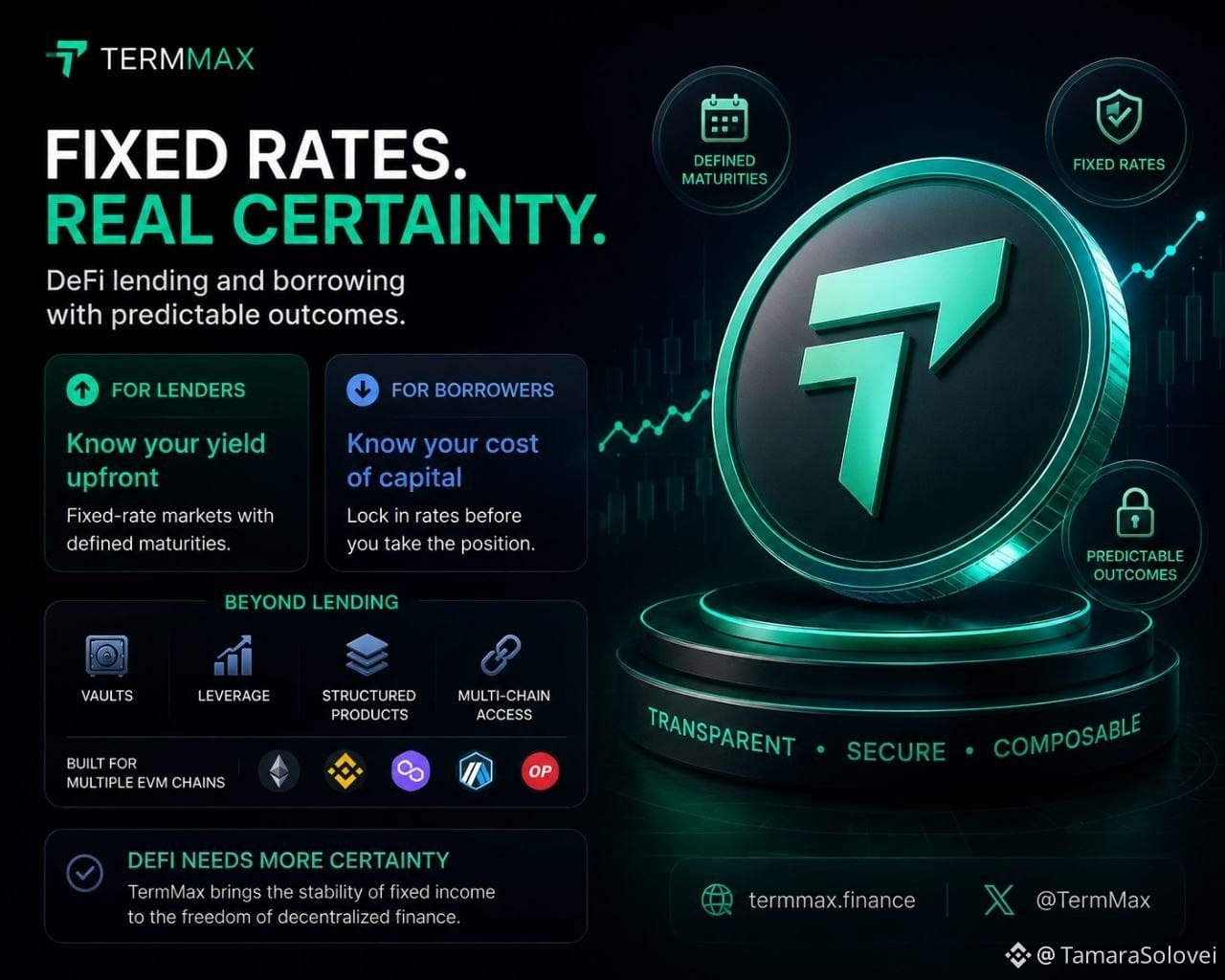
TermMax approaches this with fixed-rate markets and defined maturities.
That gives users something DeFi often lacks: a clearer framework for planning capital.
Borrowers can know their financing cost in advance, while lenders can evaluate an expected return over a specific period instead of relying entirely on a floating rate.
This also creates interesting possibilities for more sophisticated strategies:
🔹 Hedging interest-rate risk
🔹 Planning leverage more precisely
🔹 Building fixed-income strategies
🔹 Combining lending with structured products
🔹 Creating more predictable vault strategies
I think this is an important step if DeFi wants to move beyond short-term speculation and become a more complete financial ecosystem.
The ability to know your rate and maturity in advance may sound simple — but in a volatile market, predictability itself has value.
That’s what makes the TermMax approach worth watching.
#termmax @TermMax
Predictability can be just as valuable as yield in DeFi.
When borrowing rates constantly change, managing a position becomes a moving target. A strategy that looks attractive today can become expensive tomorrow simply because market conditions changed.
TermMax approaches this with fixed-rate markets and defined maturities.
That gives users something DeFi often lacks: a clearer framework for planning capital.
Borrowers can know their financing cost in advance, while lenders can evaluate an expected return over a specific period instead of relying entirely on a floating rate.
This also creates interesting possibilities for more sophisticated strategies:
🔹 Hedging interest-rate risk
🔹 Planning leverage more precisely
🔹 Building fixed-income strategies
🔹 Combining lending with structured products
🔹 Creating more predictable vault strategies
I think this is an important step if DeFi wants to move beyond short-term speculation and become a more complete financial ecosystem.
The ability to know your rate and maturity in advance may sound simple — but in a volatile market, predictability itself has value.
That’s what makes the TermMax approach worth watching.
Predictability can be just as valuable as yield in DeFi.
When borrowing rates constantly change, managing a position becomes a moving target. A strategy that looks attractive today can become expensive tomorrow simply because market conditions changed.
TermMax approaches this with fixed-rate markets and defined maturities.
That gives users something DeFi often lacks: a clearer framework for planning capital.
Borrowers can know their financing cost in advance, while lenders can evaluate an expected return over a specific period instead of relying entirely on a floating rate.
This also creates interesting possibilities for more sophisticated strategies:
🔹 Hedging interest-rate risk
🔹 Planning leverage more precisely
🔹 Building fixed-income strategies
🔹 Combining lending with structured products
🔹 Creating more predictable vault strategies
I think this is an important step if DeFi wants to move beyond short-term speculation and become a more complete financial ecosystem.
The ability to know your rate and maturity in advance may sound simple — but in a volatile market, predictability itself has value.
That’s what makes the TermMax approach worth watching.
77
Voir la traduction
#termmax @termmax
What makes TermMax interesting isn't only fixed-rate lending. It's the idea of turning predictable debt into a building block for DeFi.
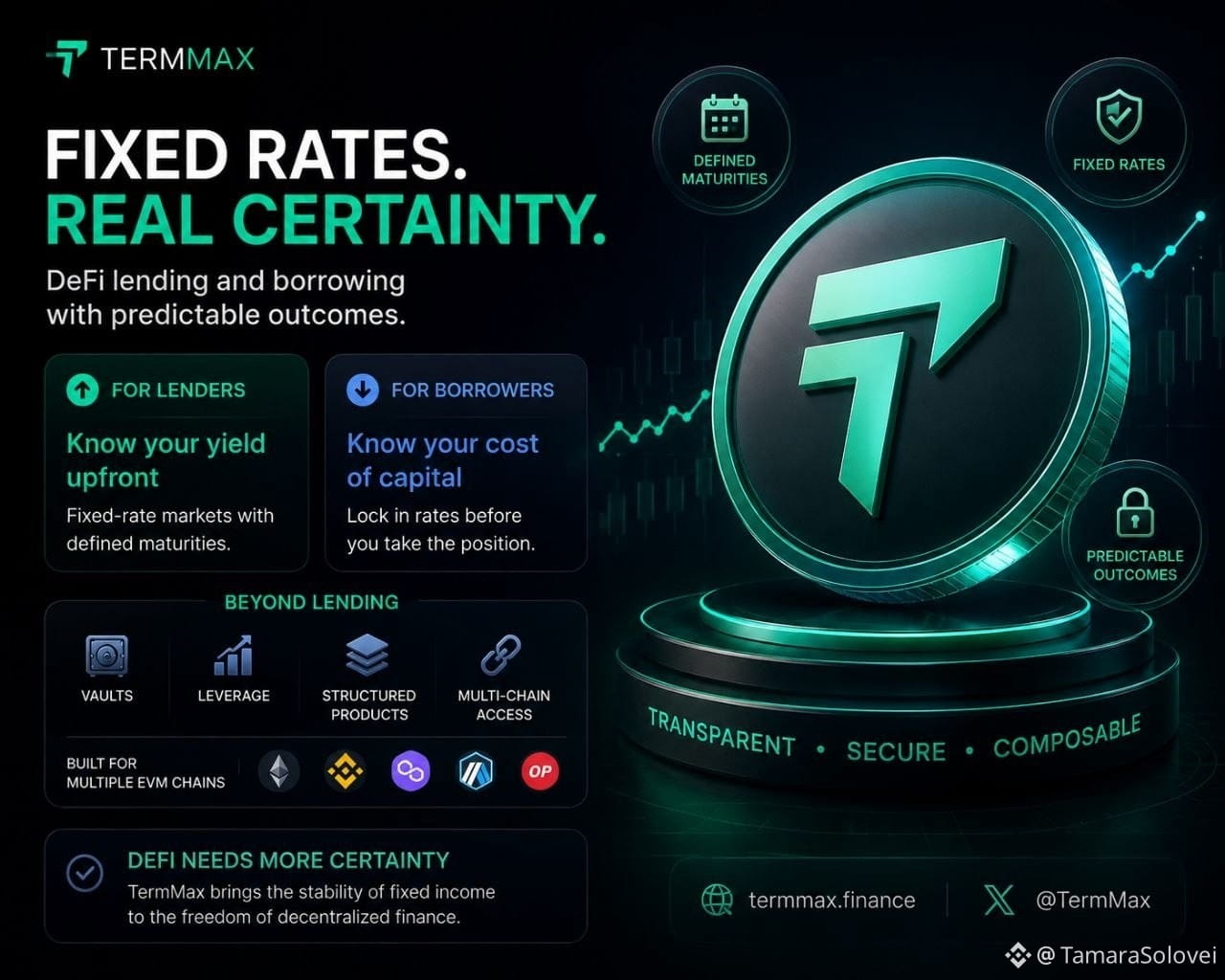
Fixed-rate markets can give users something that is often missing from on-chain finance: a clear timeline for a position.
Instead of constantly reacting to changing borrowing costs, users can structure positions around a known rate and maturity.
This creates interesting possibilities for more advanced strategies:
🔹 Fixed-rate borrowing
🔹 Predictable lending returns
🔹 Leveraged strategies
🔹 Vault-based products
🔹 Structured positions
The goal isn't simply to copy traditional fixed-income products on-chain. It's to make these financial primitives composable with the rest of DeFi.
That's where I think $TMX becomes interesting as part of the bigger TermMax ecosystem.
If DeFi wants to attract more sophisticated capital, predictable rates and defined maturities could become just as important as liquidity.
The next evolution of DeFi might not be about more leverage. It might be about better control over risk.
#termmax @TermMax
What makes TermMax interesting isn't only fixed-rate lending. It's the idea of turning predictable debt into a building block for DeFi.
Fixed-rate markets can give users something that is often missing from on-chain finance: a clear timeline for a position.
Instead of constantly reacting to changing borrowing costs, users can structure positions around a known rate and maturity.
This creates interesting possibilities for more advanced strategies:
🔹 Fixed-rate borrowing
🔹 Predictable lending returns
🔹 Leveraged strategies
🔹 Vault-based products
🔹 Structured positions
The goal isn't simply to copy traditional fixed-income products on-chain. It's to make these financial primitives composable with the rest of DeFi.
That's where I think $TMX becomes interesting as part of the bigger TermMax ecosystem.
If DeFi wants to attract more sophisticated capital, predictable rates and defined maturities could become just as important as liquidity.
The next evolution of DeFi might not be about more leverage. It might be about better control over risk.
What makes TermMax interesting isn't only fixed-rate lending. It's the idea of turning predictable debt into a building block for DeFi.
Fixed-rate markets can give users something that is often missing from on-chain finance: a clear timeline for a position.
Instead of constantly reacting to changing borrowing costs, users can structure positions around a known rate and maturity.
This creates interesting possibilities for more advanced strategies:
🔹 Fixed-rate borrowing
🔹 Predictable lending returns
🔹 Leveraged strategies
🔹 Vault-based products
🔹 Structured positions
The goal isn't simply to copy traditional fixed-income products on-chain. It's to make these financial primitives composable with the rest of DeFi.
That's where I think $TMX becomes interesting as part of the bigger TermMax ecosystem.
If DeFi wants to attract more sophisticated capital, predictable rates and defined maturities could become just as important as liquidity.
The next evolution of DeFi might not be about more leverage. It might be about better control over risk.
56
Voir la traduction
#dusk $DUSK @Dusk_Foundation
Why does regulated finance need its own blockchain infrastructure instead of simply using a public chain?
That question is becoming increasingly important as tokenized securities and real-world assets move on-chain.
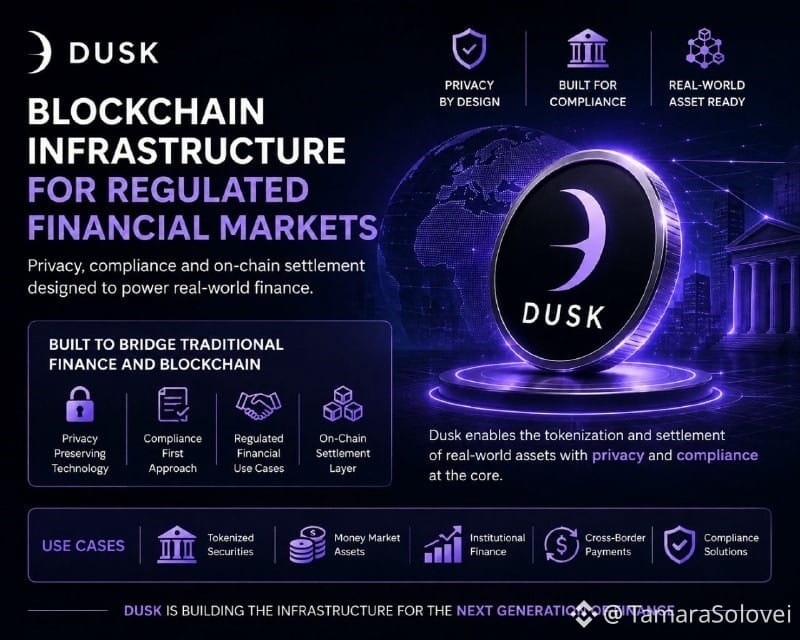
@Dusk_Foundation is built around the idea that financial markets have different requirements from ordinary crypto applications. Issuers, investors, custodians and regulators all need to interact with the same infrastructure while sensitive financial information remains protected.
One of the most interesting concepts is selective disclosure.
Instead of choosing between complete transparency or complete privacy, Dusk is designed to let authorized parties verify the information they need without exposing every transaction or portfolio detail publicly. Combined with deterministic settlement and access controls, this creates infrastructure tailored for regulated digital assets.
I think that distinction is what makes Dusk worth watching. The future of RWAs may depend less on creating tokens and more on creating networks capable of handling the real-world rules behind them.
#dusk $DUSK @Dusk
Why does regulated finance need its own blockchain infrastructure instead of simply using a public chain?
That question is becoming increasingly important as tokenized securities and real-world assets move on-chain.
@Dusk is built around the idea that financial markets have different requirements from ordinary crypto applications. Issuers, investors, custodians and regulators all need to interact with the same infrastructure while sensitive financial information remains protected.
One of the most interesting concepts is selective disclosure.
Instead of choosing between complete transparency or complete privacy, Dusk is designed to let authorized parties verify the information they need without exposing every transaction or portfolio detail publicly. Combined with deterministic settlement and access controls, this creates infrastructure tailored for regulated digital assets.
I think that distinction is what makes Dusk worth watching. The future of RWAs may depend less on creating tokens and more on creating networks capable of handling the real-world rules behind them.
Why does regulated finance need its own blockchain infrastructure instead of simply using a public chain?
That question is becoming increasingly important as tokenized securities and real-world assets move on-chain.
@Dusk is built around the idea that financial markets have different requirements from ordinary crypto applications. Issuers, investors, custodians and regulators all need to interact with the same infrastructure while sensitive financial information remains protected.
One of the most interesting concepts is selective disclosure.
Instead of choosing between complete transparency or complete privacy, Dusk is designed to let authorized parties verify the information they need without exposing every transaction or portfolio detail publicly. Combined with deterministic settlement and access controls, this creates infrastructure tailored for regulated digital assets.
I think that distinction is what makes Dusk worth watching. The future of RWAs may depend less on creating tokens and more on creating networks capable of handling the real-world rules behind them.
78
Voir la traduction
#termmax @termmax
DeFi is great at giving users flexibility, but flexibility often comes with uncertainty.
Interest rates can change quickly, making it difficult to plan the cost of borrowing or the return on lending.
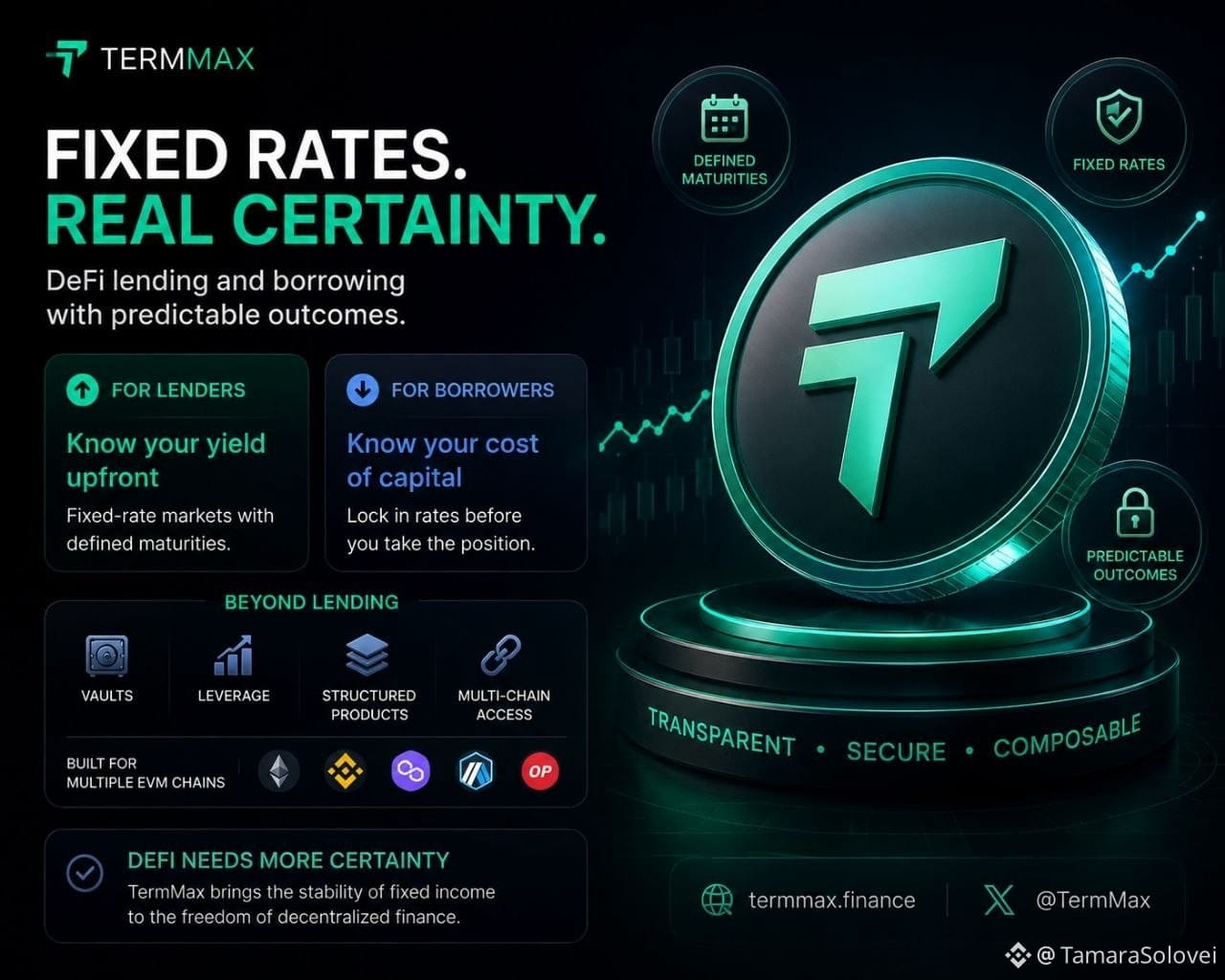
@termmax approaches this problem with fixed-rate markets and defined maturities.
Instead of constantly watching the lending rate, users can know the key parameters of a position in advance.
For lenders, that can mean clearer expectations around yield. For borrowers, it can make the cost of capital easier to plan.
I think this is an important direction for DeFi because predictable financial products could make on-chain markets more useful beyond short-term speculation.
More certainty doesn't have to mean less flexibility. It can simply mean better tools for managing risk.
#termmax @TermMax
DeFi is great at giving users flexibility, but flexibility often comes with uncertainty.
Interest rates can change quickly, making it difficult to plan the cost of borrowing or the return on lending.
@TermMax approaches this problem with fixed-rate markets and defined maturities.
Instead of constantly watching the lending rate, users can know the key parameters of a position in advance.
For lenders, that can mean clearer expectations around yield. For borrowers, it can make the cost of capital easier to plan.
I think this is an important direction for DeFi because predictable financial products could make on-chain markets more useful beyond short-term speculation.
More certainty doesn't have to mean less flexibility. It can simply mean better tools for managing risk.
DeFi is great at giving users flexibility, but flexibility often comes with uncertainty.
Interest rates can change quickly, making it difficult to plan the cost of borrowing or the return on lending.
@TermMax approaches this problem with fixed-rate markets and defined maturities.
Instead of constantly watching the lending rate, users can know the key parameters of a position in advance.
For lenders, that can mean clearer expectations around yield. For borrowers, it can make the cost of capital easier to plan.
I think this is an important direction for DeFi because predictable financial products could make on-chain markets more useful beyond short-term speculation.
More certainty doesn't have to mean less flexibility. It can simply mean better tools for managing risk.
40
Voir la traduction
#dusk $DUSK @Dusk_Foundation
A financial asset doesn't end its journey when the trade is completed.
That’s why I think the infrastructure behind tokenized assets is more important than the token itself.
In traditional markets, an asset can go through issuance, trading, settlement, dividends, reporting, transfers and other corporate actions. Each stage can involve different systems and intermediaries.
@Dusk_Foundation is approaching this as a complete on-chain workflow.
Its infrastructure is designed to handle things like eligibility checks, transfer restrictions, privacy, settlement, reporting and corporate actions as part of the asset lifecycle.
There is also an interesting distinction between public transparency and private financial information.
Dusk supports transparent transactions through Moonlight, while Phoenix enables shielded transfers using zero-knowledge proofs. Information can also be selectively disclosed when an authorized party needs it.
This is important because regulated finance doesn't necessarily need everything to be public.
It needs the right information to be visible to the right participants at the right time.
And that's a very different design philosophy from simply putting an existing financial asset on a public blockchain.
If tokenized securities become a major part of the next phase of Web3, I think infrastructure like this will be just as important as the assets themselves.
Dusk isn't only trying to put finance on-chain. It's trying to make the entire financial workflow work there.
#dusk $DUSK @Dusk
A financial asset doesn't end its journey when the trade is completed.
That’s why I think the infrastructure behind tokenized assets is more important than the token itself.
In traditional markets, an asset can go through issuance, trading, settlement, dividends, reporting, transfers and other corporate actions. Each stage can involve different systems and intermediaries.
@Dusk is approaching this as a complete on-chain workflow.
Its infrastructure is designed to handle things like eligibility checks, transfer restrictions, privacy, settlement, reporting and corporate actions as part of the asset lifecycle.
There is also an interesting distinction between public transparency and private financial information.
Dusk supports transparent transactions through Moonlight, while Phoenix enables shielded transfers using zero-knowledge proofs. Information can also be selectively disclosed when an authorized party needs it.
This is important because regulated finance doesn't necessarily need everything to be public.
It needs the right information to be visible to the right participants at the right time.
And that's a very different design philosophy from simply putting an existing financial asset on a public blockchain.
If tokenized securities become a major part of the next phase of Web3, I think infrastructure like this will be just as important as the assets themselves.
Dusk isn't only trying to put finance on-chain. It's trying to make the entire financial workflow work there.
A financial asset doesn't end its journey when the trade is completed.
That’s why I think the infrastructure behind tokenized assets is more important than the token itself.
In traditional markets, an asset can go through issuance, trading, settlement, dividends, reporting, transfers and other corporate actions. Each stage can involve different systems and intermediaries.
@Dusk is approaching this as a complete on-chain workflow.
Its infrastructure is designed to handle things like eligibility checks, transfer restrictions, privacy, settlement, reporting and corporate actions as part of the asset lifecycle.
There is also an interesting distinction between public transparency and private financial information.
Dusk supports transparent transactions through Moonlight, while Phoenix enables shielded transfers using zero-knowledge proofs. Information can also be selectively disclosed when an authorized party needs it.
This is important because regulated finance doesn't necessarily need everything to be public.
It needs the right information to be visible to the right participants at the right time.
And that's a very different design philosophy from simply putting an existing financial asset on a public blockchain.
If tokenized securities become a major part of the next phase of Web3, I think infrastructure like this will be just as important as the assets themselves.
Dusk isn't only trying to put finance on-chain. It's trying to make the entire financial workflow work there.
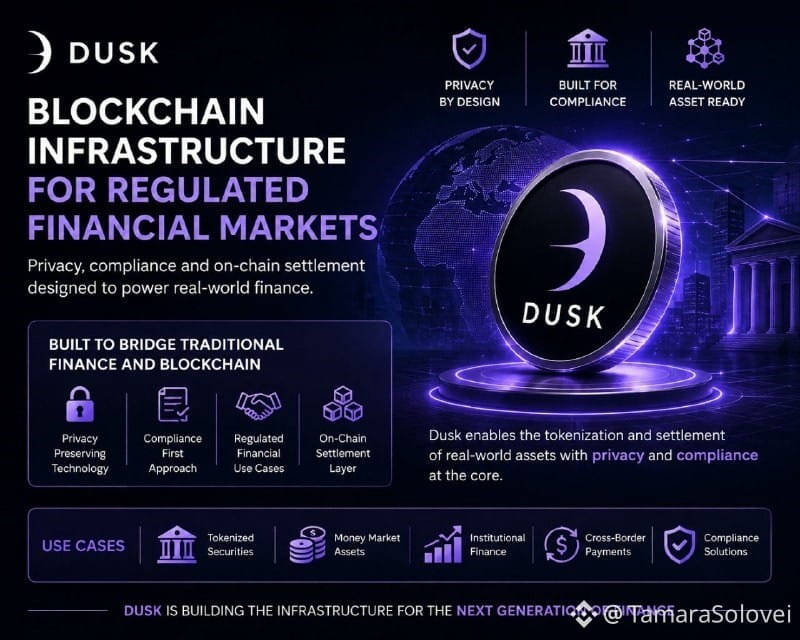
60
Voir la traduction
#bstockscis @BinanceCIS
What makes tokenized stocks interesting isn't just the ability to buy them on-chain. It's what happens after you own them.
bStocks bring traditional equity exposure into a blockchain environment, opening the door to features that don't exist in the same way with conventional brokerage accounts.
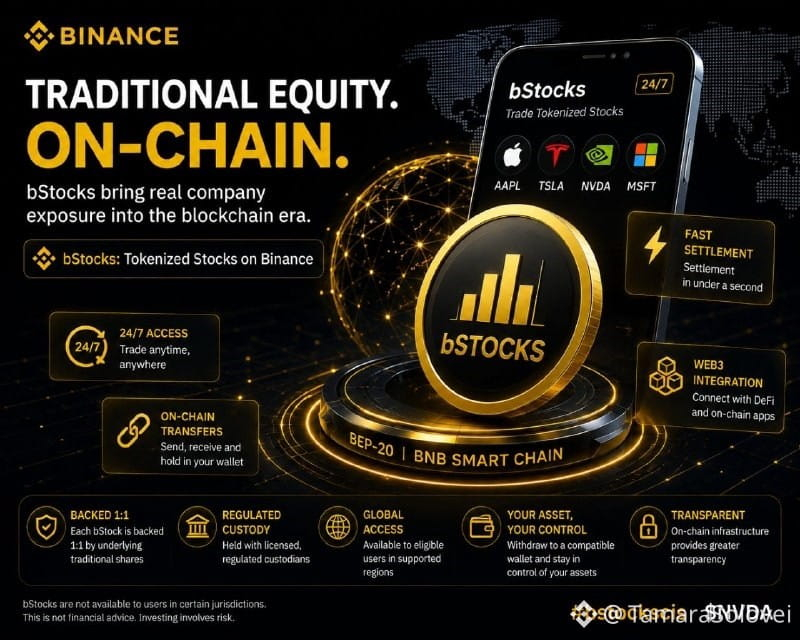
With bStocks operating as BEP-20 tokens on BNB Smart Chain, the asset can become part of a broader on-chain ecosystem rather than remaining locked inside a traditional financial platform.
That creates some interesting possibilities:
🔹
On-chain transfers
🔹
24/7 access
🔹
Blockchain-based settlement
🔹
Potential integration with Web3 infrastructure
🔹
The ability to hold tokenized equity in a compatible wallet
But the most important part for me is the bridge between two financial worlds.
Traditional stocks provide exposure to established companies and real businesses. Blockchain infrastructure adds programmability, portability and continuous settlement.
Put those two things together, and tokenized equities start looking less like a simple crypto product and more like a new financial primitive.
The RWA market is still developing, but this is exactly the kind of infrastructure I think is worth watching.
Which traditional asset would you most like to see become fully integrated with on-chain finance?
#bstockscis @BinanceCIS
What makes tokenized stocks interesting isn't just the ability to buy them on-chain. It's what happens after you own them.
bStocks bring traditional equity exposure into a blockchain environment, opening the door to features that don't exist in the same way with conventional brokerage accounts.
With bStocks operating as BEP-20 tokens on BNB Smart Chain, the asset can become part of a broader on-chain ecosystem rather than remaining locked inside a traditional financial platform.
That creates some interesting possibilities:
🔹
On-chain transfers
🔹
24/7 access
🔹
Blockchain-based settlement
🔹
Potential integration with Web3 infrastructure
🔹
The ability to hold tokenized equity in a compatible wallet
But the most important part for me is the bridge between two financial worlds.
Traditional stocks provide exposure to established companies and real businesses. Blockchain infrastructure adds programmability, portability and continuous settlement.
Put those two things together, and tokenized equities start looking less like a simple crypto product and more like a new financial primitive.
The RWA market is still developing, but this is exactly the kind of infrastructure I think is worth watching.
Which traditional asset would you most like to see become fully integrated with on-chain finance?
What makes tokenized stocks interesting isn't just the ability to buy them on-chain. It's what happens after you own them.
bStocks bring traditional equity exposure into a blockchain environment, opening the door to features that don't exist in the same way with conventional brokerage accounts.
With bStocks operating as BEP-20 tokens on BNB Smart Chain, the asset can become part of a broader on-chain ecosystem rather than remaining locked inside a traditional financial platform.
That creates some interesting possibilities:
🔹
On-chain transfers
🔹
24/7 access
🔹
Blockchain-based settlement
🔹
Potential integration with Web3 infrastructure
🔹
The ability to hold tokenized equity in a compatible wallet
But the most important part for me is the bridge between two financial worlds.
Traditional stocks provide exposure to established companies and real businesses. Blockchain infrastructure adds programmability, portability and continuous settlement.
Put those two things together, and tokenized equities start looking less like a simple crypto product and more like a new financial primitive.
The RWA market is still developing, but this is exactly the kind of infrastructure I think is worth watching.
Which traditional asset would you most like to see become fully integrated with on-chain finance?
147
Voir la traduction
#termmax @termmax
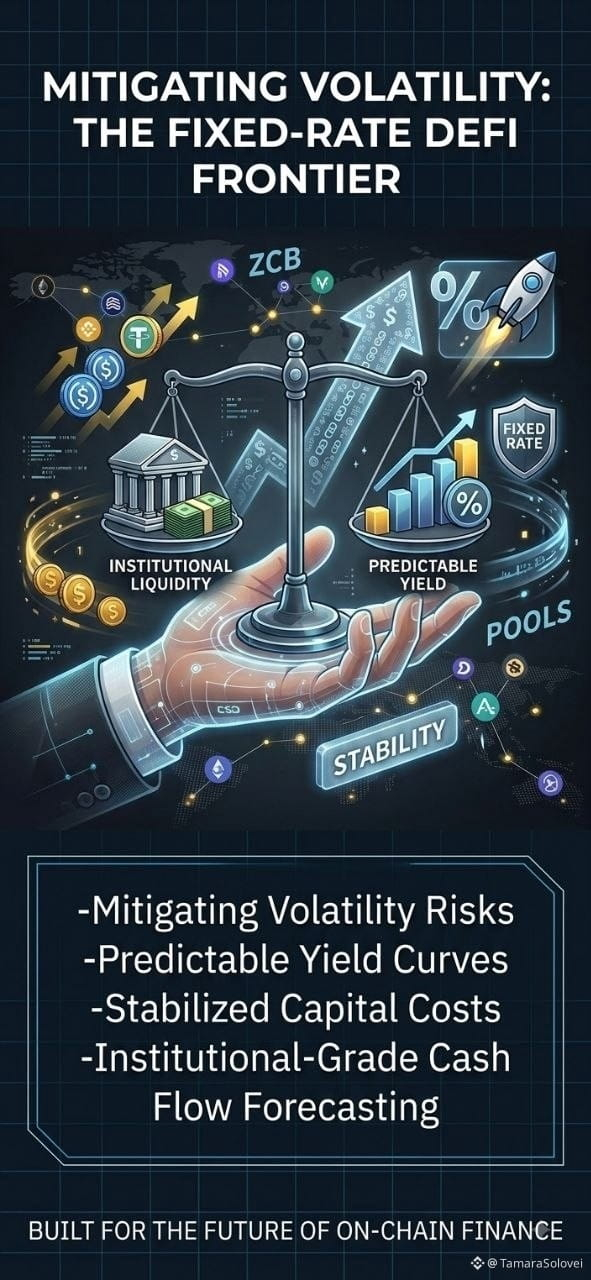
The maturity of the DeFi ecosystem is directly correlated with the introduction of primitive financial instruments capable of mitigating volatility risks. A significant gap in current credit markets is the lack of robust fixed-rate lending solutions. This is where @termmax introduces a crucial innovation.
By utilizing Zero-Coupon Bonds and Liquidity Pools, TermMax provides predictable yield curves for lenders and guaranteed capital costs for borrowers. This model dramatically reduces slippage and the uncertainty associated with variable interest rates. From my perspective, this approach is essential for attracting large-scale institutional liquidity, which requires accurate cash flow forecasting. Moving beyond variable-rate dependence is a critical step toward the long-term stabilization of capital markets on the blockchain.
#termmax @TermMax
The maturity of the DeFi ecosystem is directly correlated with the introduction of primitive financial instruments capable of mitigating volatility risks. A significant gap in current credit markets is the lack of robust fixed-rate lending solutions. This is where @TermMax introduces a crucial innovation.
By utilizing Zero-Coupon Bonds and Liquidity Pools, TermMax provides predictable yield curves for lenders and guaranteed capital costs for borrowers. This model dramatically reduces slippage and the uncertainty associated with variable interest rates. From my perspective, this approach is essential for attracting large-scale institutional liquidity, which requires accurate cash flow forecasting. Moving beyond variable-rate dependence is a critical step toward the long-term stabilization of capital markets on the blockchain.
The maturity of the DeFi ecosystem is directly correlated with the introduction of primitive financial instruments capable of mitigating volatility risks. A significant gap in current credit markets is the lack of robust fixed-rate lending solutions. This is where @TermMax introduces a crucial innovation.
By utilizing Zero-Coupon Bonds and Liquidity Pools, TermMax provides predictable yield curves for lenders and guaranteed capital costs for borrowers. This model dramatically reduces slippage and the uncertainty associated with variable interest rates. From my perspective, this approach is essential for attracting large-scale institutional liquidity, which requires accurate cash flow forecasting. Moving beyond variable-rate dependence is a critical step toward the long-term stabilization of capital markets on the blockchain.
47
#dusk $DUSK @Dusk_Foundation
Tokeniser un actif n’est que la première étape. Le véritable défi, c’est de construire le marché autour de lui.
C’est pourquoi je m’intéresse à ce que @Dusk_Foundation construit.
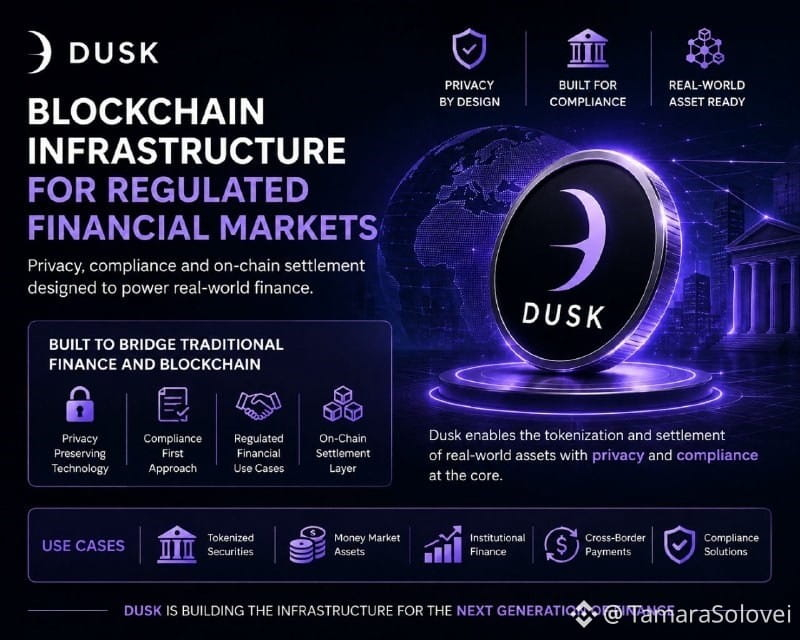
Dusk Trade est conçu comme une couche applicative pour les actifs financiers tokenisés, allant au-delà de la simple approche acheter-vendre. Le flux de travail peut inclure l’onboarding des investisseurs, des vérifications d’éligibilité, la connexion du portefeuille, la coordination des paiements et la compensation.
En dessous, Dusk fournit l’infrastructure des flux de travail réglementés : contrôles d’accès, confidentialité, divulgation sélective et règlement déterministe.
Cette approche me paraît logique car les vrais marchés financiers ne se résument pas à des contrats tokenisés. Ils impliquent des émetteurs, des investisseurs, des plateformes, des dépositaires, la conformité et le règlement — et tout cela doit fonctionner ensemble.
Si les RWA doivent passer à l’échelle, l’infrastructure doit prendre en charge l’ensemble du flux de travail du marché, pas simplement ajouter un autre actif sur la chaîne.
C’est la direction que je surveille avec Dusk.
#dusk $DUSK @Dusk
Tokeniser un actif n’est que la première étape. Le véritable défi, c’est de construire le marché autour de lui.
C’est pourquoi je m’intéresse à ce que @Dusk construit.
Dusk Trade est conçu comme une couche applicative pour les actifs financiers tokenisés, allant au-delà de la simple approche acheter-vendre. Le flux de travail peut inclure l’onboarding des investisseurs, des vérifications d’éligibilité, la connexion du portefeuille, la coordination des paiements et la compensation.
En dessous, Dusk fournit l’infrastructure des flux de travail réglementés : contrôles d’accès, confidentialité, divulgation sélective et règlement déterministe.
Cette approche me paraît logique car les vrais marchés financiers ne se résument pas à des contrats tokenisés. Ils impliquent des émetteurs, des investisseurs, des plateformes, des dépositaires, la conformité et le règlement — et tout cela doit fonctionner ensemble.
Si les RWA doivent passer à l’échelle, l’infrastructure doit prendre en charge l’ensemble du flux de travail du marché, pas simplement ajouter un autre actif sur la chaîne.
C’est la direction que je surveille avec Dusk.
Tokeniser un actif n’est que la première étape. Le véritable défi, c’est de construire le marché autour de lui.
C’est pourquoi je m’intéresse à ce que @Dusk construit.
Dusk Trade est conçu comme une couche applicative pour les actifs financiers tokenisés, allant au-delà de la simple approche acheter-vendre. Le flux de travail peut inclure l’onboarding des investisseurs, des vérifications d’éligibilité, la connexion du portefeuille, la coordination des paiements et la compensation.
En dessous, Dusk fournit l’infrastructure des flux de travail réglementés : contrôles d’accès, confidentialité, divulgation sélective et règlement déterministe.
Cette approche me paraît logique car les vrais marchés financiers ne se résument pas à des contrats tokenisés. Ils impliquent des émetteurs, des investisseurs, des plateformes, des dépositaires, la conformité et le règlement — et tout cela doit fonctionner ensemble.
Si les RWA doivent passer à l’échelle, l’infrastructure doit prendre en charge l’ensemble du flux de travail du marché, pas simplement ajouter un autre actif sur la chaîne.
C’est la direction que je surveille avec Dusk.
61
#bstockscis @BinanceCIS
Et si votre portefeuille d’actions pouvait devenir une partie de votre stratégie financière on-chain ?
C’est là que les actions tokenisées deviennent beaucoup plus intéressantes.
Les actions ne sont pas simplement des représentations digitales d’actions traditionnelles. Comme elles existent sous forme de tokens BEP-20 sur la BNB Smart Chain, elles peuvent potentiellement interagir avec la même infrastructure blockchain qui prend en charge d’autres actifs numériques.
Cela ouvre un espace de conception totalement différent.
Imaginez détenir une exposition à une entreprise et pouvoir utiliser ce token dans des applications DeFi compatibles plutôt que de laisser l’actif isolé dans un compte de courtage traditionnel.
Le mot important ici est la composabilité.
Les actions traditionnelles vivent généralement au sein d’une infrastructure de courtage. Les actifs tokenisés peuvent potentiellement devenir des éléments constitutifs d’autres applications financières — prêt, garantie, liquidité et autres stratégies on-chain — selon les protocoles spécifiques et les conditions d’éligibilité.
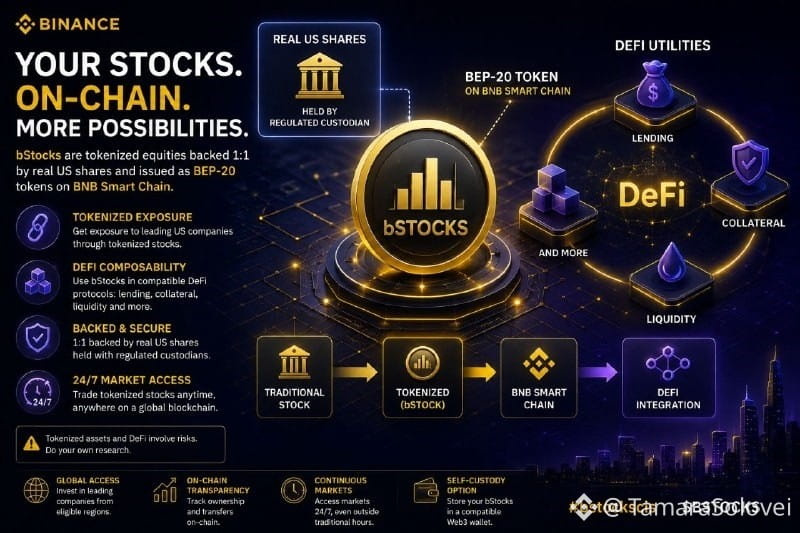
Le cadre bStocks actuel de Binance repose sur une couverture 1:1 par des actions US correspondantes détenues auprès d’un dépositaire réglementé, tandis que le token lui-même fonctionne sur la BNB Smart Chain.
Cela crée une combinaison intéressante :
Actif traditionnel → représentation tokenisée → infrastructure blockchain → utilité potentielle DeFi.
Et c’est pourquoi je pense que l’histoire des RWA est plus vaste que le simple fait de rendre les marchés accessibles 24/7.
La vraie innovation pourrait être de rendre des actifs financiers auparavant isolés composables avec une toute nouvelle “stack” financière.
Bien sûr, l’intégration à la DeFi introduit aussi des risques supplémentaires liés aux smart contracts, à la liquidité et aux marchés : “on-chain” ne signifie donc pas automatiquement “mieux”.
Mais la possibilité elle-même est fascinante.
Utiliseriez-vous réellement une action tokenisée comme garantie ou au sein de la DeFi, ou la garderiez-vous uniquement comme investissement ?
#bstockscis @BinanceCIS
Et si votre portefeuille d’actions pouvait devenir une partie de votre stratégie financière on-chain ?
C’est là que les actions tokenisées deviennent beaucoup plus intéressantes.
Les actions ne sont pas simplement des représentations digitales d’actions traditionnelles. Comme elles existent sous forme de tokens BEP-20 sur la BNB Smart Chain, elles peuvent potentiellement interagir avec la même infrastructure blockchain qui prend en charge d’autres actifs numériques.
Cela ouvre un espace de conception totalement différent.
Imaginez détenir une exposition à une entreprise et pouvoir utiliser ce token dans des applications DeFi compatibles plutôt que de laisser l’actif isolé dans un compte de courtage traditionnel.
Le mot important ici est la composabilité.
Les actions traditionnelles vivent généralement au sein d’une infrastructure de courtage. Les actifs tokenisés peuvent potentiellement devenir des éléments constitutifs d’autres applications financières — prêt, garantie, liquidité et autres stratégies on-chain — selon les protocoles spécifiques et les conditions d’éligibilité.
Le cadre bStocks actuel de Binance repose sur une couverture 1:1 par des actions US correspondantes détenues auprès d’un dépositaire réglementé, tandis que le token lui-même fonctionne sur la BNB Smart Chain.
Cela crée une combinaison intéressante :
Actif traditionnel → représentation tokenisée → infrastructure blockchain → utilité potentielle DeFi.
Et c’est pourquoi je pense que l’histoire des RWA est plus vaste que le simple fait de rendre les marchés accessibles 24/7.
La vraie innovation pourrait être de rendre des actifs financiers auparavant isolés composables avec une toute nouvelle “stack” financière.
Bien sûr, l’intégration à la DeFi introduit aussi des risques supplémentaires liés aux smart contracts, à la liquidité et aux marchés : “on-chain” ne signifie donc pas automatiquement “mieux”.
Mais la possibilité elle-même est fascinante.
Utiliseriez-vous réellement une action tokenisée comme garantie ou au sein de la DeFi, ou la garderiez-vous uniquement comme investissement ?
Et si votre portefeuille d’actions pouvait devenir une partie de votre stratégie financière on-chain ?
C’est là que les actions tokenisées deviennent beaucoup plus intéressantes.
Les actions ne sont pas simplement des représentations digitales d’actions traditionnelles. Comme elles existent sous forme de tokens BEP-20 sur la BNB Smart Chain, elles peuvent potentiellement interagir avec la même infrastructure blockchain qui prend en charge d’autres actifs numériques.
Cela ouvre un espace de conception totalement différent.
Imaginez détenir une exposition à une entreprise et pouvoir utiliser ce token dans des applications DeFi compatibles plutôt que de laisser l’actif isolé dans un compte de courtage traditionnel.
Le mot important ici est la composabilité.
Les actions traditionnelles vivent généralement au sein d’une infrastructure de courtage. Les actifs tokenisés peuvent potentiellement devenir des éléments constitutifs d’autres applications financières — prêt, garantie, liquidité et autres stratégies on-chain — selon les protocoles spécifiques et les conditions d’éligibilité.
Le cadre bStocks actuel de Binance repose sur une couverture 1:1 par des actions US correspondantes détenues auprès d’un dépositaire réglementé, tandis que le token lui-même fonctionne sur la BNB Smart Chain.
Cela crée une combinaison intéressante :
Actif traditionnel → représentation tokenisée → infrastructure blockchain → utilité potentielle DeFi.
Et c’est pourquoi je pense que l’histoire des RWA est plus vaste que le simple fait de rendre les marchés accessibles 24/7.
La vraie innovation pourrait être de rendre des actifs financiers auparavant isolés composables avec une toute nouvelle “stack” financière.
Bien sûr, l’intégration à la DeFi introduit aussi des risques supplémentaires liés aux smart contracts, à la liquidité et aux marchés : “on-chain” ne signifie donc pas automatiquement “mieux”.
Mais la possibilité elle-même est fascinante.
Utiliseriez-vous réellement une action tokenisée comme garantie ou au sein de la DeFi, ou la garderiez-vous uniquement comme investissement ?
69
Voir la traduction
#dusk $DUSK @Dusk_Foundation
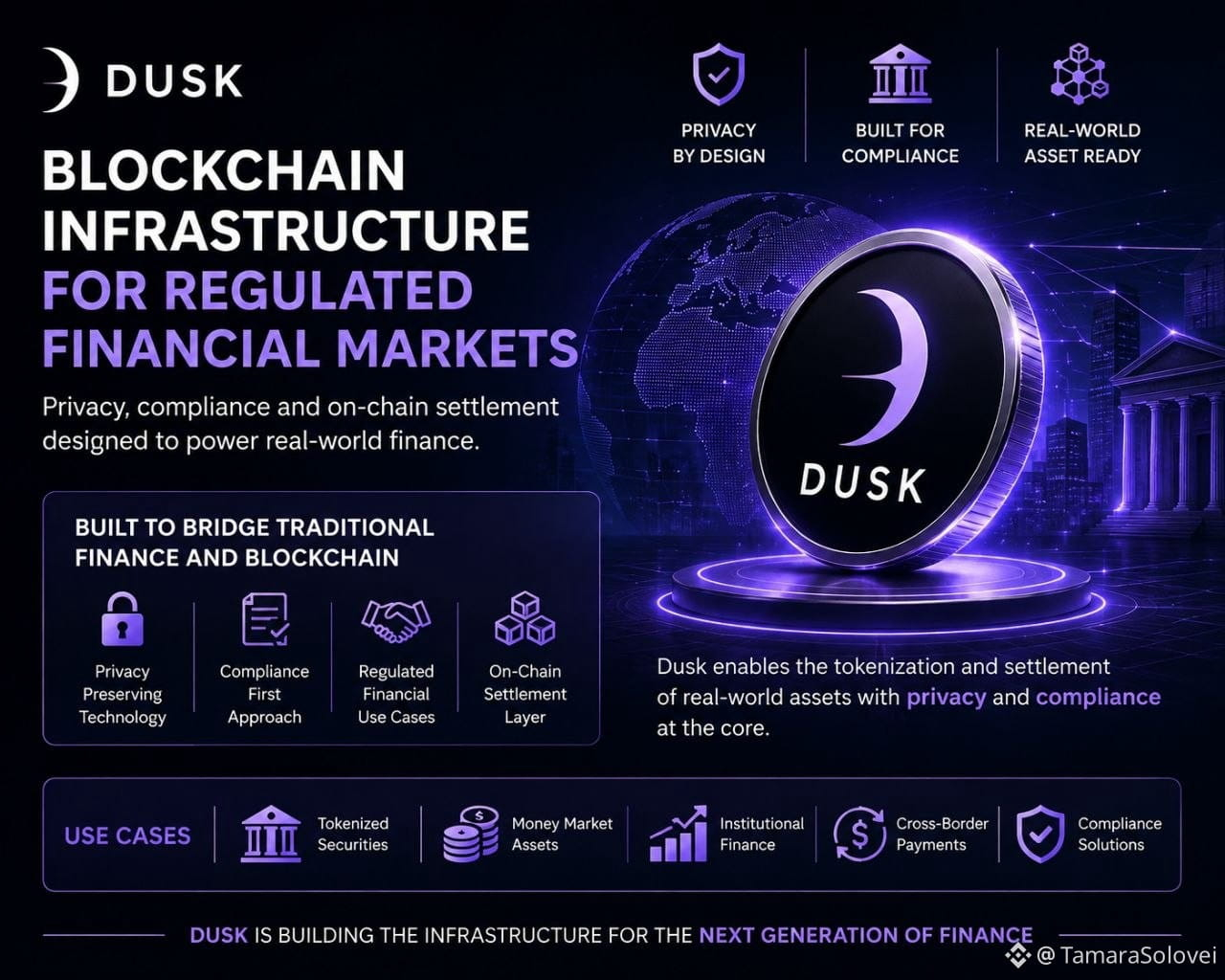
RWAs need more than tokenization. They need infrastructure built for real financial markets.
That’s what makes @Dusk_Foundation interesting to me.
Dusk is designed around regulated assets, combining privacy, compliance and on-chain settlement. Instead of making every transaction completely public, its architecture supports selective disclosure — allowing relevant information to be verified without exposing everything to everyone.
This could be especially useful for securities, bonds and other regulated assets where investor privacy and regulatory requirements have to coexist.
Another interesting part is Dusk’s EVM compatibility, which makes it easier for developers familiar with Ethereum tooling to build applications on the network.
If RWAs are going to become a major part of Web3, the infrastructure behind them needs to handle much more than simple token transfers.
That’s the niche Dusk is trying to build.
#dusk $DUSK @Dusk
RWAs need more than tokenization. They need infrastructure built for real financial markets.
That’s what makes @Dusk interesting to me.
Dusk is designed around regulated assets, combining privacy, compliance and on-chain settlement. Instead of making every transaction completely public, its architecture supports selective disclosure — allowing relevant information to be verified without exposing everything to everyone.
This could be especially useful for securities, bonds and other regulated assets where investor privacy and regulatory requirements have to coexist.
Another interesting part is Dusk’s EVM compatibility, which makes it easier for developers familiar with Ethereum tooling to build applications on the network.
If RWAs are going to become a major part of Web3, the infrastructure behind them needs to handle much more than simple token transfers.
That’s the niche Dusk is trying to build.
RWAs need more than tokenization. They need infrastructure built for real financial markets.
That’s what makes @Dusk interesting to me.
Dusk is designed around regulated assets, combining privacy, compliance and on-chain settlement. Instead of making every transaction completely public, its architecture supports selective disclosure — allowing relevant information to be verified without exposing everything to everyone.
This could be especially useful for securities, bonds and other regulated assets where investor privacy and regulatory requirements have to coexist.
Another interesting part is Dusk’s EVM compatibility, which makes it easier for developers familiar with Ethereum tooling to build applications on the network.
If RWAs are going to become a major part of Web3, the infrastructure behind them needs to handle much more than simple token transfers.
That’s the niche Dusk is trying to build.
1
79
Voir la traduction
#bstockscis @BinanceCIS
What happens when a stock stops being locked inside a brokerage account?
That’s one of the more interesting ideas behind bStocks.
A tokenized stock such as $AAPL isn't simply a ticker displayed on an exchange. bStocks are backed 1:1 by corresponding US shares held with a regulated custodian, while the token itself exists as a BEP-20 asset on BNB Smart Chain.
The interesting part is what this enables.
Instead of keeping your exposure exclusively inside a traditional brokerage environment, eligible users can withdraw the tokenized asset to a compatible Web3 wallet.
That opens the door to something traditional shares can't easily provide:
🔗 Blockchain-native transfers
🌐 On-chain composability
🔐 Self-custody through a compatible wallet
🕐 24/7 trading infrastructure
And this is where tokenization becomes more than just changing the format of an asset.
The underlying economic exposure remains connected to the traditional security, while the representation of that exposure can interact with blockchain infrastructure.
That's the part of tokenized equities I find most interesting: bringing real-world financial assets into an environment where ownership and blockchain applications can finally start to interact.
Would you keep a tokenized stock on Binance or move it to your own compatible wallet?
#bstockscis @BinanceCIS
What happens when a stock stops being locked inside a brokerage account?
That’s one of the more interesting ideas behind bStocks.
A tokenized stock such as $AAPL isn't simply a ticker displayed on an exchange. bStocks are backed 1:1 by corresponding US shares held with a regulated custodian, while the token itself exists as a BEP-20 asset on BNB Smart Chain.
The interesting part is what this enables.
Instead of keeping your exposure exclusively inside a traditional brokerage environment, eligible users can withdraw the tokenized asset to a compatible Web3 wallet.
That opens the door to something traditional shares can't easily provide:
🔗 Blockchain-native transfers
🌐 On-chain composability
🔐 Self-custody through a compatible wallet
🕐 24/7 trading infrastructure
And this is where tokenization becomes more than just changing the format of an asset.
The underlying economic exposure remains connected to the traditional security, while the representation of that exposure can interact with blockchain infrastructure.
That's the part of tokenized equities I find most interesting: bringing real-world financial assets into an environment where ownership and blockchain applications can finally start to interact.
Would you keep a tokenized stock on Binance or move it to your own compatible wallet?
What happens when a stock stops being locked inside a brokerage account?
That’s one of the more interesting ideas behind bStocks.
A tokenized stock such as $AAPL isn't simply a ticker displayed on an exchange. bStocks are backed 1:1 by corresponding US shares held with a regulated custodian, while the token itself exists as a BEP-20 asset on BNB Smart Chain.
The interesting part is what this enables.
Instead of keeping your exposure exclusively inside a traditional brokerage environment, eligible users can withdraw the tokenized asset to a compatible Web3 wallet.
That opens the door to something traditional shares can't easily provide:
🔗 Blockchain-native transfers
🌐 On-chain composability
🔐 Self-custody through a compatible wallet
🕐 24/7 trading infrastructure
And this is where tokenization becomes more than just changing the format of an asset.
The underlying economic exposure remains connected to the traditional security, while the representation of that exposure can interact with blockchain infrastructure.
That's the part of tokenized equities I find most interesting: bringing real-world financial assets into an environment where ownership and blockchain applications can finally start to interact.
Would you keep a tokenized stock on Binance or move it to your own compatible wallet?
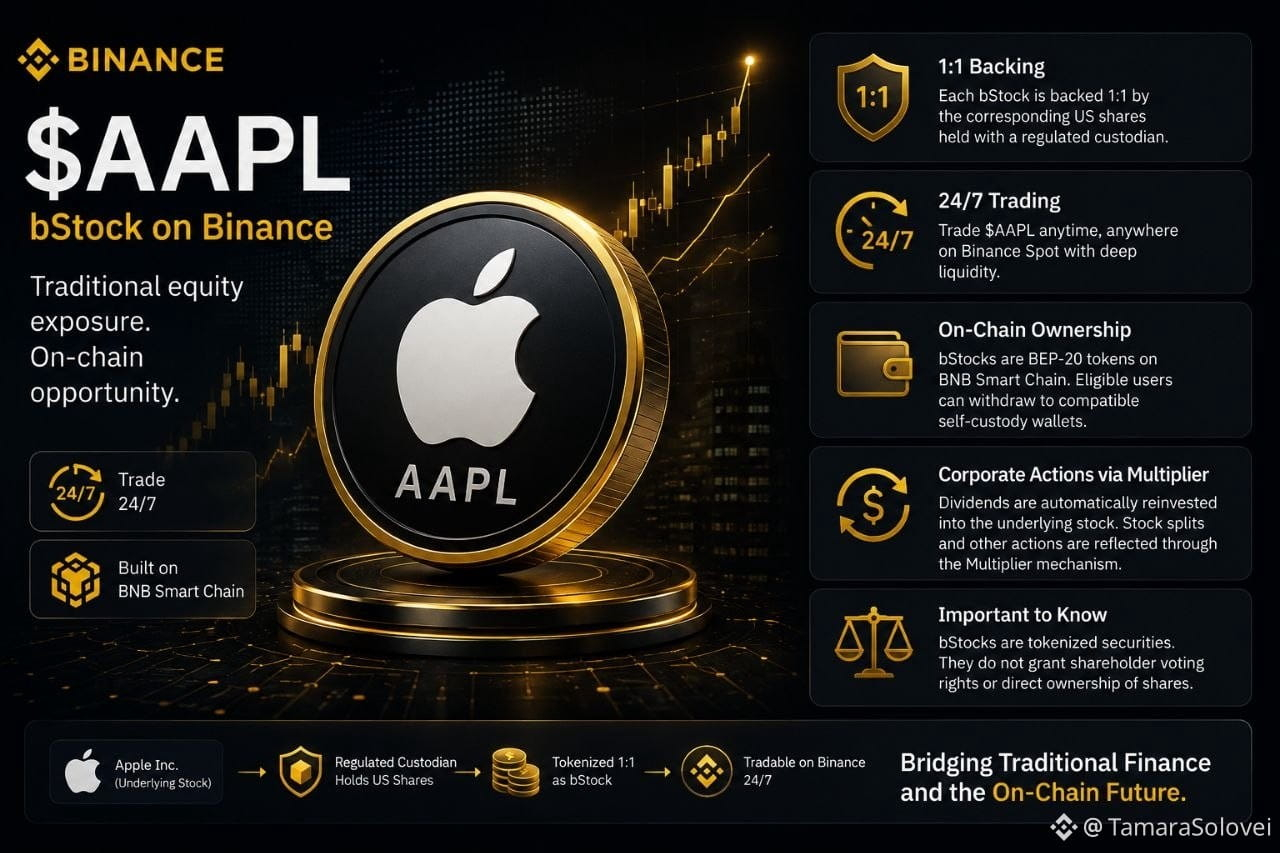
1
2
116
#dusk $DUSK @Dusk_Foundation
Une chose qui rend Dusk intéressant, c’est qu’il ne force pas chaque application à utiliser l’infrastructure blockchain de la même manière.
Dusk sépare le règlement de l’exécution grâce à son architecture modulaire.
À la base se trouve DuskDS, chargé du consensus, de la finalité et de la disponibilité des données. Par-dessus, les développeurs peuvent utiliser DuskVM pour des contrats intelligents natifs en Rust/WASM ou DuskEVM lorsqu’ils veulent un environnement compatible EVM et des outils Solidity familiers.
Pourquoi est-ce important pour la finance réglementée ?
Les différentes applications financières ont des exigences différentes. Un flux d’actifs natifs peut nécessiter un accès direct à la confidentialité de Dusk et à ses modèles de transactions, tandis qu’une autre application peut tirer avantage des outils Ethereum existants et de l’infrastructure de développement.
En essence, Dusk cherche à offrir ces deux approches sans renoncer à sa couche de règlement sous-jacente.
Et c’est là que l’architecture devient plus intéressante que le récit habituel du type « blockchain RWA ».
Le réseau est conçu autour de besoins tels que :
🔹 critères d’éligibilité et contrôles d’accès
🔹 divulgation sélective d’informations sensibles
🔹 transactions confidentielles
🔹 règlement déterministe
🔹 émission et service d’actifs réglementés
Sa documentation décrit spécifiquement des cas d’usage allant des actions et de la dette tokenisées jusqu’à la DeFi institutionnelle et le règlement livraison-contre-paiement.
Pour moi, la question clé n’est pas de savoir si les institutions finiront par utiliser la blockchain. Il s’agit plutôt de savoir si l’infrastructure sous-jacente est suffisamment flexible pour répondre aux exigences de vrais marchés financiers.
C’est la partie de la thèse de Dusk que j’observe.
#dusk $DUSK @Dusk
Une chose qui rend Dusk intéressant, c’est qu’il ne force pas chaque application à utiliser l’infrastructure blockchain de la même manière.
Dusk sépare le règlement de l’exécution grâce à son architecture modulaire.
À la base se trouve DuskDS, chargé du consensus, de la finalité et de la disponibilité des données. Par-dessus, les développeurs peuvent utiliser DuskVM pour des contrats intelligents natifs en Rust/WASM ou DuskEVM lorsqu’ils veulent un environnement compatible EVM et des outils Solidity familiers.
Pourquoi est-ce important pour la finance réglementée ?
Les différentes applications financières ont des exigences différentes. Un flux d’actifs natifs peut nécessiter un accès direct à la confidentialité de Dusk et à ses modèles de transactions, tandis qu’une autre application peut tirer avantage des outils Ethereum existants et de l’infrastructure de développement.
En essence, Dusk cherche à offrir ces deux approches sans renoncer à sa couche de règlement sous-jacente.
Et c’est là que l’architecture devient plus intéressante que le récit habituel du type « blockchain RWA ».
Le réseau est conçu autour de besoins tels que :
🔹 critères d’éligibilité et contrôles d’accès
🔹 divulgation sélective d’informations sensibles
🔹 transactions confidentielles
🔹 règlement déterministe
🔹 émission et service d’actifs réglementés
Sa documentation décrit spécifiquement des cas d’usage allant des actions et de la dette tokenisées jusqu’à la DeFi institutionnelle et le règlement livraison-contre-paiement.
Pour moi, la question clé n’est pas de savoir si les institutions finiront par utiliser la blockchain. Il s’agit plutôt de savoir si l’infrastructure sous-jacente est suffisamment flexible pour répondre aux exigences de vrais marchés financiers.
C’est la partie de la thèse de Dusk que j’observe.
Une chose qui rend Dusk intéressant, c’est qu’il ne force pas chaque application à utiliser l’infrastructure blockchain de la même manière.
Dusk sépare le règlement de l’exécution grâce à son architecture modulaire.
À la base se trouve DuskDS, chargé du consensus, de la finalité et de la disponibilité des données. Par-dessus, les développeurs peuvent utiliser DuskVM pour des contrats intelligents natifs en Rust/WASM ou DuskEVM lorsqu’ils veulent un environnement compatible EVM et des outils Solidity familiers.
Pourquoi est-ce important pour la finance réglementée ?
Les différentes applications financières ont des exigences différentes. Un flux d’actifs natifs peut nécessiter un accès direct à la confidentialité de Dusk et à ses modèles de transactions, tandis qu’une autre application peut tirer avantage des outils Ethereum existants et de l’infrastructure de développement.
En essence, Dusk cherche à offrir ces deux approches sans renoncer à sa couche de règlement sous-jacente.
Et c’est là que l’architecture devient plus intéressante que le récit habituel du type « blockchain RWA ».
Le réseau est conçu autour de besoins tels que :
🔹 critères d’éligibilité et contrôles d’accès
🔹 divulgation sélective d’informations sensibles
🔹 transactions confidentielles
🔹 règlement déterministe
🔹 émission et service d’actifs réglementés
Sa documentation décrit spécifiquement des cas d’usage allant des actions et de la dette tokenisées jusqu’à la DeFi institutionnelle et le règlement livraison-contre-paiement.
Pour moi, la question clé n’est pas de savoir si les institutions finiront par utiliser la blockchain. Il s’agit plutôt de savoir si l’infrastructure sous-jacente est suffisamment flexible pour répondre aux exigences de vrais marchés financiers.
C’est la partie de la thèse de Dusk que j’observe.
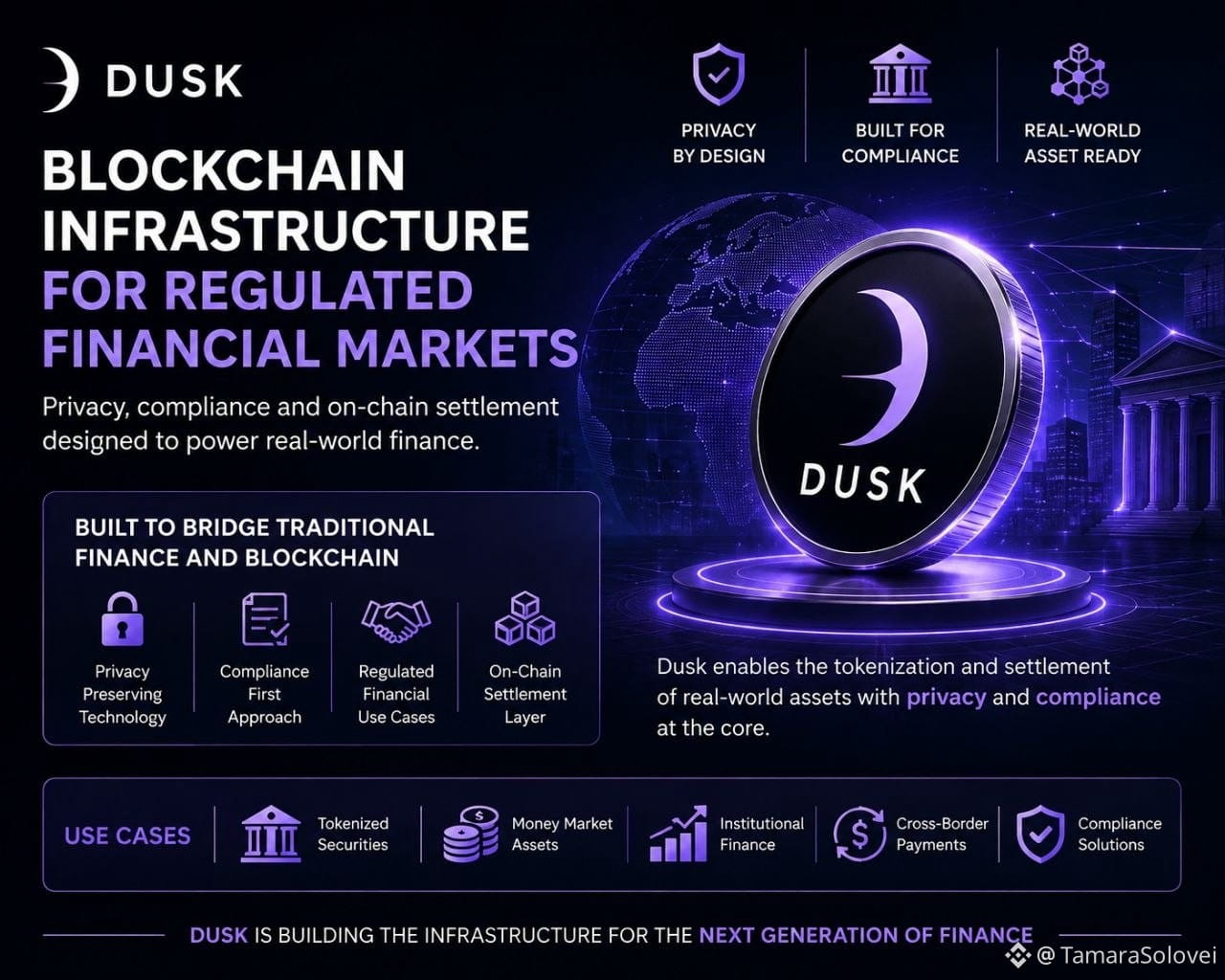
2
1
57
Connectez-vous pour découvrir plus de contenu
Rejoignez la communauté mondiale des adeptes de cryptomonnaies sur Binance Square
⚡️ Suviez les dernières informations importantes sur les cryptomonnaies.
💬 Jugé digne de confiance par la plus grande plateforme d’échange de cryptomonnaies au monde.
👍 Découvrez les connaissances que partagent les créateurs vérifiés.
Adresse e-mail/Nº de téléphone
Sujets d’actualité
CircleMints500MUSDCOnSolana
29,154 vues
819 mentions
#circlemints500musdconsolana
Rapport de Circle sur la frappe de 500 M USDC : où va la liquidité de Solana ?
Un demi-milliard d’USDC attire l’attention. L’endroit où il circule ensuite nous en dira plus.
D’après TokenPost, Circle a frappé 500 millions d’USDC sur Solana via deux transactions de 250 millions chacune. Les horodatages indiqués étaient le 25 septembre à 21 h 42 UTC et le 26 septembre à 3 h 04 UTC.
Comprendre le flux est important. L’infrastructure inter-chaînes de Circle permet de brûler l’USDC sur une blockchain et de le frapper sur une autre. Les montants frappés doivent donc être évalués avec les rachats et les mouvements inter-chaînes avant de tirer des conclusions sur un nouvel afflux de capitaux dans la crypto.
Mon avis : le suivi utile consiste à suivre la quantité d’USDC qui reste sur Solana et à voir où elle est déployée. Une croissance durable des dépôts de prêts, de l’activité de paiement et de la liquidité sur les échanges apporterait des preuves plus solides d’une demande pour les services du réseau.
Un simple transfert vers un exchange laisserait encore des questions : ces dollars pourraient soutenir le market making, rester en attente ou finalement financer des achats. Une émission du Trésor n’établit pas que quelqu’un a acheté du SOL.
Pour évaluer une adoption durable, je surveillerais plusieurs jours de variations nettes de l’offre et l’utilisation réelle avant de traiter une seule frappe importante comme un signal de marché directionnel.
Que surveilleriez-vous en premier : l’offre nette de stablecoins sur Solana, les dépôts DeFi ou l’activité de trading au comptant ?
#SOL #Solana #CryptoMarkets #Trading
$SOL
$RARE
$2Z
Jacob trade
·0 mentions J’aime
·51 vues
PolymarketBankFailureBetsDrawFDICConcern
43,301 vues
984 mentions
BlackRockBuildsTokenizedPortfoliosForOndo
35,737 vues
660 mentions