
schrodinger
138 Publications

schrodinger
Signaler
Bloquer l’utilisateur
Crypto _writer
Ouvert au trading
Trade fréquemment
5.7 an(s)
117 Suivis
63 Abonnés
87 J’aime
Publications
Portefeuille
Tous
Citations
·
--
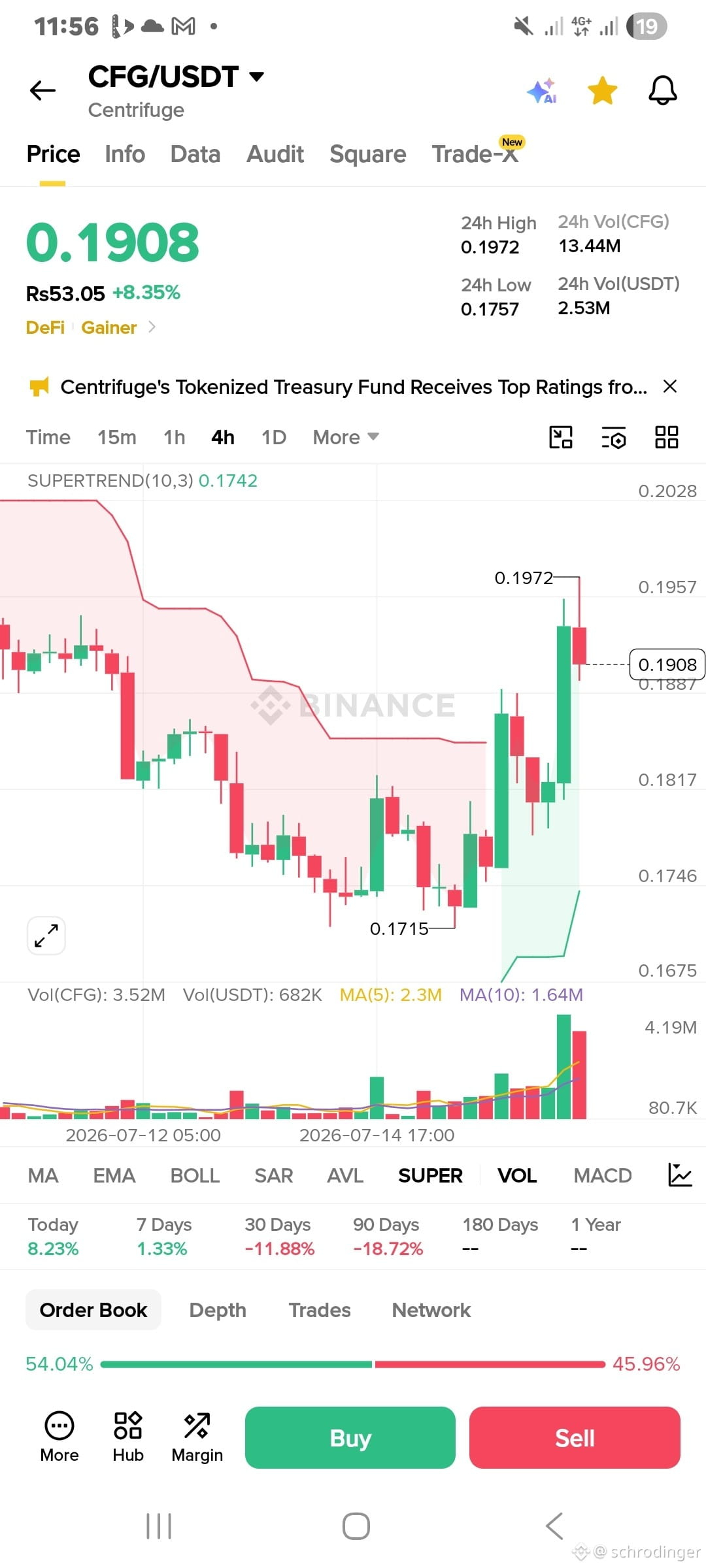
CFG se trouve à un point de décision critique après une chute massive depuis 0,30 $.
🔍 Analyse du graphique : que se passe-t-il
· Tendance immédiate : baissière à court terme. Le prix (0,1908 $) est bien en dessous de l’indicateur Supertrend (qui agit comme une résistance dynamique), ce qui signale que les vendeurs ont encore le contrôle.
· Momentum récent : la pièce est en baisse de -11,88 % sur 30 jours et de -18,72 % sur 90 jours, confirmant une tendance baissière à plus long terme. La récente chute depuis 0,30 $ correspond à une analyse de structure baissière du début de ce mois.
🚀 Scénario haussier (le rebond)
Si les acheteurs interviennent de manière agressive à ce niveau :
· Résistance immédiate : le premier gros obstacle est le plus haut sur 24h à 0,1972 $. Une cassure au-dessus, avec un volume élevé, serait le premier signe de force.
· Objectif principal : la ligne Supertrend près de 0,2028 $. La reprendre permettrait de repasser la tendance à court terme en mode haussier.
· Objectif en swing : si le momentum continue, la zone 0,218 $ - 0,220 $ devient la prochaine grande résistance.
🐻 Scénario baissier (continuation)
Compte tenu de fondamentaux faibles (forte pression de vente), le chemin de moindre résistance reste toujours à la baisse :
· Support clé : le plus bas sur 24h à 0,1757 $ doit tenir. S’il est cassé, le plancher pourrait chuter fortement.
· Prochaine grande zone : la dernière zone majeure de demande avant un éventuel redressement se situe autour de 0,12 $ - 0,14 $.
🛡️ Mon plan de trading
1. Ne poursuis pas : évite d’acheter au prix actuel (0,1908 $) sans confirmation.
2. L’entrée « Wait and See » : ne considère une entrée au comptant que si le prix clôture au-dessus de 0,1972 $ (plus haut sur 24h) sur le graphique 1 heure ou 4 heures. Cela confirme que les acheteurs s’installent.
3. Pour les traders agressifs : si le prix reteste le support à 0,1757 $ et tient fermement sans le casser, tu pourrais entrer une petite position à cet endroit, avec un stop-loss juste en dessous.
4. En cas de cassure : si le prix passe sous **0,1757 $**, mets-toi à l’écart. Attends qu’il trouve un terrain solide près de la zone des 0,14 $ avant d’envisager d’éventuels achats au comptant à long terme.
#Btc
#CFG_USDT
CFG se trouve à un point de décision critique après une chute massive depuis 0,30 $.
🔍 Analyse du graphique : que se passe-t-il
· Tendance immédiate : baissière à court terme. Le prix (0,1908 $) est bien en dessous de l’indicateur Supertrend (qui agit comme une résistance dynamique), ce qui signale que les vendeurs ont encore le contrôle.
· Momentum récent : la pièce est en baisse de -11,88 % sur 30 jours et de -18,72 % sur 90 jours, confirmant une tendance baissière à plus long terme. La récente chute depuis 0,30 $ correspond à une analyse de structure baissière du début de ce mois.
🚀 Scénario haussier (le rebond)
Si les acheteurs interviennent de manière agressive à ce niveau :
· Résistance immédiate : le premier gros obstacle est le plus haut sur 24h à 0,1972 $. Une cassure au-dessus, avec un volume élevé, serait le premier signe de force.
· Objectif principal : la ligne Supertrend près de 0,2028 $. La reprendre permettrait de repasser la tendance à court terme en mode haussier.
· Objectif en swing : si le momentum continue, la zone 0,218 $ - 0,220 $ devient la prochaine grande résistance.
🐻 Scénario baissier (continuation)
Compte tenu de fondamentaux faibles (forte pression de vente), le chemin de moindre résistance reste toujours à la baisse :
· Support clé : le plus bas sur 24h à 0,1757 $ doit tenir. S’il est cassé, le plancher pourrait chuter fortement.
· Prochaine grande zone : la dernière zone majeure de demande avant un éventuel redressement se situe autour de 0,12 $ - 0,14 $.
🛡️ Mon plan de trading
1. Ne poursuis pas : évite d’acheter au prix actuel (0,1908 $) sans confirmation.
2. L’entrée « Wait and See » : ne considère une entrée au comptant que si le prix clôture au-dessus de 0,1972 $ (plus haut sur 24h) sur le graphique 1 heure ou 4 heures. Cela confirme que les acheteurs s’installent.
3. Pour les traders agressifs : si le prix reteste le support à 0,1757 $ et tient fermement sans le casser, tu pourrais entrer une petite position à cet endroit, avec un stop-loss juste en dessous.
4. En cas de cassure : si le prix passe sous **0,1757 $**, mets-toi à l’écart. Attends qu’il trouve un terrain solide près de la zone des 0,14 $ avant d’envisager d’éventuels achats au comptant à long terme.
#Btc
#CFG_USDT
🔍 Analyse du graphique : que se passe-t-il
· Tendance immédiate : baissière à court terme. Le prix (0,1908 $) est bien en dessous de l’indicateur Supertrend (qui agit comme une résistance dynamique), ce qui signale que les vendeurs ont encore le contrôle.
· Momentum récent : la pièce est en baisse de -11,88 % sur 30 jours et de -18,72 % sur 90 jours, confirmant une tendance baissière à plus long terme. La récente chute depuis 0,30 $ correspond à une analyse de structure baissière du début de ce mois.
🚀 Scénario haussier (le rebond)
Si les acheteurs interviennent de manière agressive à ce niveau :
· Résistance immédiate : le premier gros obstacle est le plus haut sur 24h à 0,1972 $. Une cassure au-dessus, avec un volume élevé, serait le premier signe de force.
· Objectif principal : la ligne Supertrend près de 0,2028 $. La reprendre permettrait de repasser la tendance à court terme en mode haussier.
· Objectif en swing : si le momentum continue, la zone 0,218 $ - 0,220 $ devient la prochaine grande résistance.
🐻 Scénario baissier (continuation)
Compte tenu de fondamentaux faibles (forte pression de vente), le chemin de moindre résistance reste toujours à la baisse :
· Support clé : le plus bas sur 24h à 0,1757 $ doit tenir. S’il est cassé, le plancher pourrait chuter fortement.
· Prochaine grande zone : la dernière zone majeure de demande avant un éventuel redressement se situe autour de 0,12 $ - 0,14 $.
🛡️ Mon plan de trading
1. Ne poursuis pas : évite d’acheter au prix actuel (0,1908 $) sans confirmation.
2. L’entrée « Wait and See » : ne considère une entrée au comptant que si le prix clôture au-dessus de 0,1972 $ (plus haut sur 24h) sur le graphique 1 heure ou 4 heures. Cela confirme que les acheteurs s’installent.
3. Pour les traders agressifs : si le prix reteste le support à 0,1757 $ et tient fermement sans le casser, tu pourrais entrer une petite position à cet endroit, avec un stop-loss juste en dessous.
4. En cas de cassure : si le prix passe sous **0,1757 $**, mets-toi à l’écart. Attends qu’il trouve un terrain solide près de la zone des 0,14 $ avant d’envisager d’éventuels achats au comptant à long terme.
#Btc
#CFG_USDT
76
·
--
🚀 10 Coins prêts pour une hausse au cours des prochaines 24 heures (Spot Trading)
Aperçu rapide : la configuration du marché
🔥 Top 10 des coins à surveiller pour le trading spot
1. ONDO (Ondo Finance) – Leader du secteur RWA
· Gain sur 24h : +14,41% à +15,92%
· Catalyseur : lancement des premiers tokens d’actions US adossés directement à des titres détenus par la DTCC
· Pourquoi maintenant : le secteur RWA est le meilleur performeur du jour
2. HYPE (Hyperliquid) – RWA + extension de nouveau produit
· Forte hausse du volume quotidien : +36% à 433 millions de dollars
· Catalyseur : lancement du marché perpétuel avant IPO (IPOP) pour des actifs tokenisés ; l’intérêt ouvert RWA a atteint un niveau record de 2,13 Md$
· Technique : trading au-dessus de toutes les principales moyennes mobiles ; rebond du Stochastic RSI après une zone de survente
· Pourquoi maintenant : fondamentaux et aspects techniques alignés—de nouveaux catalyseurs attirent un capital frais.
---
3. ZERO (ZeroLend) – pari sur l’élan DeFi
· Gain sur 24h : +28,87%
· Catalyseur : le secteur DeFi a progressé de 0,96% aujourd’hui, avec ZERO en tête
· Pourquoi maintenant : meilleur performeur dans l’espace DeFi ; une forte volatilité offre des opportunités de scalping rapides.
---
4. XEC (eCash) – star du secteur PayFi
· Gain sur 24h : +13,68%
· Catalyseur : le secteur PayFi est en hausse de 0,32%, avec XEC comme meilleur gagnant
· Pourquoi maintenant : pic de volume solide ; rotation sectorielle vers des projets orientés paiements.
5. INJ (Injective) – solidité du Layer 1
· Gain sur 24h : +3,24%
· Technique : alignement haussier sur plusieurs horizons temporels
· Pourquoi maintenant : le secteur Layer 1 a vu INJ exploser pendant la séance ; signaux d’élan solides.
6. LDO (Lido DAO) – configuration de cassure haussière
· Technique : alignement haussier solide ; ADX à 50,51, ROC à 5,50%, RSI à 72,81
· Pourquoi maintenant : les 6 timeframes clés sont alignées en mode haussier ; la dynamique s’accélère.
7. RIF (RSK Infrastructure Framework) – le signal haussier le plus fort
· Technique : « Strong Bullish » sur TOUS les 6 timeframes—15m, 30m, 1h, 4h, 1d, 1w, 1M
· ROC : momentum de 8,51%
· Pourquoi maintenant : rare de voir un tel niveau d’alignement technique. Spot
8. DGB (DigiByte) – pari sur un momentum élevé
· Technique : 49,83 ADX, 41,95% ROC, RSI à 93,83
· Pourquoi maintenant : momentum extrême—réservé aux traders agressifs.
9. GMX (GMX) – bourse perpétuelle DeFi
🚀 10 Coins prêts pour une hausse au cours des prochaines 24 heures (Spot Trading)
Aperçu rapide : la configuration du marché
🔥 Top 10 des coins à surveiller pour le trading spot
1. ONDO (Ondo Finance) – Leader du secteur RWA
· Gain sur 24h : +14,41% à +15,92%
· Catalyseur : lancement des premiers tokens d’actions US adossés directement à des titres détenus par la DTCC
· Pourquoi maintenant : le secteur RWA est le meilleur performeur du jour
2. HYPE (Hyperliquid) – RWA + extension de nouveau produit
· Forte hausse du volume quotidien : +36% à 433 millions de dollars
· Catalyseur : lancement du marché perpétuel avant IPO (IPOP) pour des actifs tokenisés ; l’intérêt ouvert RWA a atteint un niveau record de 2,13 Md$
· Technique : trading au-dessus de toutes les principales moyennes mobiles ; rebond du Stochastic RSI après une zone de survente
· Pourquoi maintenant : fondamentaux et aspects techniques alignés—de nouveaux catalyseurs attirent un capital frais.
---
3. ZERO (ZeroLend) – pari sur l’élan DeFi
· Gain sur 24h : +28,87%
· Catalyseur : le secteur DeFi a progressé de 0,96% aujourd’hui, avec ZERO en tête
· Pourquoi maintenant : meilleur performeur dans l’espace DeFi ; une forte volatilité offre des opportunités de scalping rapides.
---
4. XEC (eCash) – star du secteur PayFi
· Gain sur 24h : +13,68%
· Catalyseur : le secteur PayFi est en hausse de 0,32%, avec XEC comme meilleur gagnant
· Pourquoi maintenant : pic de volume solide ; rotation sectorielle vers des projets orientés paiements.
5. INJ (Injective) – solidité du Layer 1
· Gain sur 24h : +3,24%
· Technique : alignement haussier sur plusieurs horizons temporels
· Pourquoi maintenant : le secteur Layer 1 a vu INJ exploser pendant la séance ; signaux d’élan solides.
6. LDO (Lido DAO) – configuration de cassure haussière
· Technique : alignement haussier solide ; ADX à 50,51, ROC à 5,50%, RSI à 72,81
· Pourquoi maintenant : les 6 timeframes clés sont alignées en mode haussier ; la dynamique s’accélère.
7. RIF (RSK Infrastructure Framework) – le signal haussier le plus fort
· Technique : « Strong Bullish » sur TOUS les 6 timeframes—15m, 30m, 1h, 4h, 1d, 1w, 1M
· ROC : momentum de 8,51%
· Pourquoi maintenant : rare de voir un tel niveau d’alignement technique. Spot
8. DGB (DigiByte) – pari sur un momentum élevé
· Technique : 49,83 ADX, 41,95% ROC, RSI à 93,83
· Pourquoi maintenant : momentum extrême—réservé aux traders agressifs.
9. GMX (GMX) – bourse perpétuelle DeFi
Aperçu rapide : la configuration du marché
🔥 Top 10 des coins à surveiller pour le trading spot
1. ONDO (Ondo Finance) – Leader du secteur RWA
· Gain sur 24h : +14,41% à +15,92%
· Catalyseur : lancement des premiers tokens d’actions US adossés directement à des titres détenus par la DTCC
· Pourquoi maintenant : le secteur RWA est le meilleur performeur du jour
2. HYPE (Hyperliquid) – RWA + extension de nouveau produit
· Forte hausse du volume quotidien : +36% à 433 millions de dollars
· Catalyseur : lancement du marché perpétuel avant IPO (IPOP) pour des actifs tokenisés ; l’intérêt ouvert RWA a atteint un niveau record de 2,13 Md$
· Technique : trading au-dessus de toutes les principales moyennes mobiles ; rebond du Stochastic RSI après une zone de survente
· Pourquoi maintenant : fondamentaux et aspects techniques alignés—de nouveaux catalyseurs attirent un capital frais.
---
3. ZERO (ZeroLend) – pari sur l’élan DeFi
· Gain sur 24h : +28,87%
· Catalyseur : le secteur DeFi a progressé de 0,96% aujourd’hui, avec ZERO en tête
· Pourquoi maintenant : meilleur performeur dans l’espace DeFi ; une forte volatilité offre des opportunités de scalping rapides.
---
4. XEC (eCash) – star du secteur PayFi
· Gain sur 24h : +13,68%
· Catalyseur : le secteur PayFi est en hausse de 0,32%, avec XEC comme meilleur gagnant
· Pourquoi maintenant : pic de volume solide ; rotation sectorielle vers des projets orientés paiements.
5. INJ (Injective) – solidité du Layer 1
· Gain sur 24h : +3,24%
· Technique : alignement haussier sur plusieurs horizons temporels
· Pourquoi maintenant : le secteur Layer 1 a vu INJ exploser pendant la séance ; signaux d’élan solides.
6. LDO (Lido DAO) – configuration de cassure haussière
· Technique : alignement haussier solide ; ADX à 50,51, ROC à 5,50%, RSI à 72,81
· Pourquoi maintenant : les 6 timeframes clés sont alignées en mode haussier ; la dynamique s’accélère.
7. RIF (RSK Infrastructure Framework) – le signal haussier le plus fort
· Technique : « Strong Bullish » sur TOUS les 6 timeframes—15m, 30m, 1h, 4h, 1d, 1w, 1M
· ROC : momentum de 8,51%
· Pourquoi maintenant : rare de voir un tel niveau d’alignement technique. Spot
8. DGB (DigiByte) – pari sur un momentum élevé
· Technique : 49,83 ADX, 41,95% ROC, RSI à 93,83
· Pourquoi maintenant : momentum extrême—réservé aux traders agressifs.
9. GMX (GMX) – bourse perpétuelle DeFi
233
·
--
Aperçu du marché : un rallye « prudent »
Aujourd’hui, le marché des cryptomonnaies brosse un tableau prudent. L’indice Fear & Greed se situe à 26 (« Fear »). Nous sommes dans un contexte où une approche prudente est cruciale.
Bitcoin (BTC) : Autour de 64 750 $** .
**Ethereum (ETH) :** Environ **1 918 $ .
🧐 Risques clés du marché & sentiment
· Fragilité cachée : la solidité du prix du BTC est alimentée par un levier extrême, et non par une demande spot véritable, ce qui accroît le risque d’une correction brutale .
· Vents contraires macroéconomiques : le ralentissement de l’inflation américaine (IPC/IPP) est positif, car il réduit les craintes de hausse des taux . Toutefois, l’escalade des tensions entre les États-Unis et l’Iran fait grimper les prix du pétrole et réduit l’appétit pour le risque dans son ensemble .
· Signaux techniques haussiers : le BTC a transformé le niveau des 64 000 $ en support à court terme**. Une cassure durable au-dessus des **64 700 $** pourrait ouvrir la voie à 67 500 $–68 000 $. Le support de repli clé se situe à 61 100 $–61 500 $.
🔥 Secteur prometteur : RWA (actifs du monde réel)
Les RWA sont le secteur phare du jour, en hausse de 6,40 % . Cette tendance est portée par de grandes institutions (DTCC, JPMorgan, BlackRock) qui accélèrent la tokenisation d’actifs du monde réel comme les actions et les bons du Trésor américains .
Meilleur performer :
· ONDO (Ondo Finance) : a bondi de plus de +14 % après le lancement des premiers tokens d’actions américaines directement adossés à des titres détenus par la DTCC .
🛡️ 3 règles de sécurité d’abord pour aujourd’hui
1. Gérez la taille des positions : ne risquez jamais plus de 1 à 2 % de votre capital total sur une seule opération à haut risque dans cet environnement volatil .
2. Serrez les stop-loss : vu le risque lié à l’effet de levier, utilisez des stop-loss stricts. Une cassure sous 64 000 $ pourrait déclencher une vente rapide .
3. Gardez des réserves de cash : conservez 10 à 20 % de votre portefeuille en stablecoins. Cela vous permet d’acheter la baisse si une correction survient et offre une marge pendant les phases de repli .#BTC
Aperçu du marché : un rallye « prudent »
Aujourd’hui, le marché des cryptomonnaies brosse un tableau prudent. L’indice Fear & Greed se situe à 26 (« Fear »). Nous sommes dans un contexte où une approche prudente est cruciale.
Bitcoin (BTC) : Autour de 64 750 $** .
**Ethereum (ETH) :** Environ **1 918 $ .
🧐 Risques clés du marché & sentiment
· Fragilité cachée : la solidité du prix du BTC est alimentée par un levier extrême, et non par une demande spot véritable, ce qui accroît le risque d’une correction brutale .
· Vents contraires macroéconomiques : le ralentissement de l’inflation américaine (IPC/IPP) est positif, car il réduit les craintes de hausse des taux . Toutefois, l’escalade des tensions entre les États-Unis et l’Iran fait grimper les prix du pétrole et réduit l’appétit pour le risque dans son ensemble .
· Signaux techniques haussiers : le BTC a transformé le niveau des 64 000 $ en support à court terme**. Une cassure durable au-dessus des **64 700 $** pourrait ouvrir la voie à 67 500 $–68 000 $. Le support de repli clé se situe à 61 100 $–61 500 $.
🔥 Secteur prometteur : RWA (actifs du monde réel)
Les RWA sont le secteur phare du jour, en hausse de 6,40 % . Cette tendance est portée par de grandes institutions (DTCC, JPMorgan, BlackRock) qui accélèrent la tokenisation d’actifs du monde réel comme les actions et les bons du Trésor américains .
Meilleur performer :
· ONDO (Ondo Finance) : a bondi de plus de +14 % après le lancement des premiers tokens d’actions américaines directement adossés à des titres détenus par la DTCC .
🛡️ 3 règles de sécurité d’abord pour aujourd’hui
1. Gérez la taille des positions : ne risquez jamais plus de 1 à 2 % de votre capital total sur une seule opération à haut risque dans cet environnement volatil .
2. Serrez les stop-loss : vu le risque lié à l’effet de levier, utilisez des stop-loss stricts. Une cassure sous 64 000 $ pourrait déclencher une vente rapide .
3. Gardez des réserves de cash : conservez 10 à 20 % de votre portefeuille en stablecoins. Cela vous permet d’acheter la baisse si une correction survient et offre une marge pendant les phases de repli .#BTC
Aujourd’hui, le marché des cryptomonnaies brosse un tableau prudent. L’indice Fear & Greed se situe à 26 (« Fear »). Nous sommes dans un contexte où une approche prudente est cruciale.
Bitcoin (BTC) : Autour de 64 750 $** .
**Ethereum (ETH) :** Environ **1 918 $ .
🧐 Risques clés du marché & sentiment
· Fragilité cachée : la solidité du prix du BTC est alimentée par un levier extrême, et non par une demande spot véritable, ce qui accroît le risque d’une correction brutale .
· Vents contraires macroéconomiques : le ralentissement de l’inflation américaine (IPC/IPP) est positif, car il réduit les craintes de hausse des taux . Toutefois, l’escalade des tensions entre les États-Unis et l’Iran fait grimper les prix du pétrole et réduit l’appétit pour le risque dans son ensemble .
· Signaux techniques haussiers : le BTC a transformé le niveau des 64 000 $ en support à court terme**. Une cassure durable au-dessus des **64 700 $** pourrait ouvrir la voie à 67 500 $–68 000 $. Le support de repli clé se situe à 61 100 $–61 500 $.
🔥 Secteur prometteur : RWA (actifs du monde réel)
Les RWA sont le secteur phare du jour, en hausse de 6,40 % . Cette tendance est portée par de grandes institutions (DTCC, JPMorgan, BlackRock) qui accélèrent la tokenisation d’actifs du monde réel comme les actions et les bons du Trésor américains .
Meilleur performer :
· ONDO (Ondo Finance) : a bondi de plus de +14 % après le lancement des premiers tokens d’actions américaines directement adossés à des titres détenus par la DTCC .
🛡️ 3 règles de sécurité d’abord pour aujourd’hui
1. Gérez la taille des positions : ne risquez jamais plus de 1 à 2 % de votre capital total sur une seule opération à haut risque dans cet environnement volatil .
2. Serrez les stop-loss : vu le risque lié à l’effet de levier, utilisez des stop-loss stricts. Une cassure sous 64 000 $ pourrait déclencher une vente rapide .
3. Gardez des réserves de cash : conservez 10 à 20 % de votre portefeuille en stablecoins. Cela vous permet d’acheter la baisse si une correction survient et offre une marge pendant les phases de repli .#BTC

118
·
--
#XUAT
🎯 Meilleure position d'achat (Spot Buy Position)
Prix actuel : 4,208.58
Stratégie : Achète petit à petit (DCA) — n'achète pas tout d'un coup
---
📥 Plan d'achat en trois parties
Plage de prix pour acheter Pourquoi
Première achat (maintenant ou sur petite baisse) 4,180 – 4,210 30% des fonds totaux SUPERTREND support + bande médiane
Deuxième achat (sur bonne baisse) 4,050 – 4,080 40% des fonds totaux Meilleure zone de remise
Troisième achat (sur forte baisse) 3,960 – 4,000 30% des fonds totaux Fort support historique (zone cadeau)
Si tu n'as pas de position, construis 30-40% de position dans la première zone.
---
📊 Raisons techniques
· SUPERTREND (10,3) : 4,180.51 — c'est un support solide
· Volume : le volume augmente lors de la baisse → il est probable que l'argent intelligent s'accumule
· Indicateur KDJ : est en bas (oversold) → possibilité de montée prochaine
· Résistance : près de 4,230 — acheter maintenant est un peu cher
---
⚠️ Gestion des risques
· XAUT peut soudainement faire une montée (wick) → Place un ordre limite, ne fais pas d'ordre de marché
· Ne mets pas tout ton argent à un prix
· Garde toujours un peu de USDT — pour pouvoir acheter si le prix baisse
---
✅ Résumé (Conseil final)
La meilleure zone d'achat = 4,050 – 4,080 (c'est la deuxième zone)
· Si tu dois acheter maintenant, achète un peu (30% des fonds)
· Garde le reste pour investir dans les zones plus basses
#XUAT
🎯 Meilleure position d'achat (Spot Buy Position)
Prix actuel : 4,208.58
Stratégie : Achète petit à petit (DCA) — n'achète pas tout d'un coup
---
📥 Plan d'achat en trois parties
Plage de prix pour acheter Pourquoi
Première achat (maintenant ou sur petite baisse) 4,180 – 4,210 30% des fonds totaux SUPERTREND support + bande médiane
Deuxième achat (sur bonne baisse) 4,050 – 4,080 40% des fonds totaux Meilleure zone de remise
Troisième achat (sur forte baisse) 3,960 – 4,000 30% des fonds totaux Fort support historique (zone cadeau)
Si tu n'as pas de position, construis 30-40% de position dans la première zone.
---
📊 Raisons techniques
· SUPERTREND (10,3) : 4,180.51 — c'est un support solide
· Volume : le volume augmente lors de la baisse → il est probable que l'argent intelligent s'accumule
· Indicateur KDJ : est en bas (oversold) → possibilité de montée prochaine
· Résistance : près de 4,230 — acheter maintenant est un peu cher
---
⚠️ Gestion des risques
· XAUT peut soudainement faire une montée (wick) → Place un ordre limite, ne fais pas d'ordre de marché
· Ne mets pas tout ton argent à un prix
· Garde toujours un peu de USDT — pour pouvoir acheter si le prix baisse
---
✅ Résumé (Conseil final)
La meilleure zone d'achat = 4,050 – 4,080 (c'est la deuxième zone)
· Si tu dois acheter maintenant, achète un peu (30% des fonds)
· Garde le reste pour investir dans les zones plus basses
🎯 Meilleure position d'achat (Spot Buy Position)
Prix actuel : 4,208.58
Stratégie : Achète petit à petit (DCA) — n'achète pas tout d'un coup
---
📥 Plan d'achat en trois parties
Plage de prix pour acheter Pourquoi
Première achat (maintenant ou sur petite baisse) 4,180 – 4,210 30% des fonds totaux SUPERTREND support + bande médiane
Deuxième achat (sur bonne baisse) 4,050 – 4,080 40% des fonds totaux Meilleure zone de remise
Troisième achat (sur forte baisse) 3,960 – 4,000 30% des fonds totaux Fort support historique (zone cadeau)
Si tu n'as pas de position, construis 30-40% de position dans la première zone.
---
📊 Raisons techniques
· SUPERTREND (10,3) : 4,180.51 — c'est un support solide
· Volume : le volume augmente lors de la baisse → il est probable que l'argent intelligent s'accumule
· Indicateur KDJ : est en bas (oversold) → possibilité de montée prochaine
· Résistance : près de 4,230 — acheter maintenant est un peu cher
---
⚠️ Gestion des risques
· XAUT peut soudainement faire une montée (wick) → Place un ordre limite, ne fais pas d'ordre de marché
· Ne mets pas tout ton argent à un prix
· Garde toujours un peu de USDT — pour pouvoir acheter si le prix baisse
---
✅ Résumé (Conseil final)
La meilleure zone d'achat = 4,050 – 4,080 (c'est la deuxième zone)
· Si tu dois acheter maintenant, achète un peu (30% des fonds)
· Garde le reste pour investir dans les zones plus basses
111
·
--
D'après les rapports récents, voici le développement le plus significatif causant une grosse disruption sur le marché
🚨 Grande Brèche de Sécurité : Exploit du Drift Protocol
La plus grande nouvelle est l'attaque du Drift Protocol le 1er avril 2026. Cet échange basé sur Solana a subi un exploit qui a envoyé des ondes de choc à travers l'écosystème.
· Pertes Estimées : Les estimations de pertes varient énormément, d'environ $136 millions** (CertiK) à un maximum de **$285 millions (TechCrunch/Arkham).
· Impact sur le Marché : La Valeur Totale Verrouillée (TVL) du protocole a été réduite de moitié (une chute de 55%), passant de $550 millions à environ $245 millions. Le token natif DRIFT a chuté de plus de 36% en seulement 24 heures.
· Effet Domino : L'exploit n'a pas seulement porté préjudice à Drift ; il a impacté plus de 20 autres projets Solana, mettant en évidence l'"effet domino" et la fragilité des systèmes DeFi interconnectés.
· Statut Actuel : L'équipe a gelé les dépôts et les retraits pour contenir l'attaque. Au début d'avril, aucun post-mortem final officiel n'avait été publié.
📈 Mise à Jour du Sentiment de Marché
Malgré le hack de Drift, le marché au sens large montre des signes de reprise grâce à d'autres événements. Bitcoin a récemment franchi le niveau des $80,000 pour atteindre un sommet de quatre mois. Ce rallye a été partiellement alimenté par l'annonce du "Project Freedom" de l'administration Trump, qui a apaisé les tensions géopolitiques, en plus de forts flux institutionnels vers les ETFs Bitcoin.
D'après les rapports récents, voici le développement le plus significatif causant une grosse disruption sur le marché
🚨 Grande Brèche de Sécurité : Exploit du Drift Protocol
La plus grande nouvelle est l'attaque du Drift Protocol le 1er avril 2026. Cet échange basé sur Solana a subi un exploit qui a envoyé des ondes de choc à travers l'écosystème.
· Pertes Estimées : Les estimations de pertes varient énormément, d'environ $136 millions** (CertiK) à un maximum de **$285 millions (TechCrunch/Arkham).
· Impact sur le Marché : La Valeur Totale Verrouillée (TVL) du protocole a été réduite de moitié (une chute de 55%), passant de $550 millions à environ $245 millions. Le token natif DRIFT a chuté de plus de 36% en seulement 24 heures.
· Effet Domino : L'exploit n'a pas seulement porté préjudice à Drift ; il a impacté plus de 20 autres projets Solana, mettant en évidence l'"effet domino" et la fragilité des systèmes DeFi interconnectés.
· Statut Actuel : L'équipe a gelé les dépôts et les retraits pour contenir l'attaque. Au début d'avril, aucun post-mortem final officiel n'avait été publié.
📈 Mise à Jour du Sentiment de Marché
Malgré le hack de Drift, le marché au sens large montre des signes de reprise grâce à d'autres événements. Bitcoin a récemment franchi le niveau des $80,000 pour atteindre un sommet de quatre mois. Ce rallye a été partiellement alimenté par l'annonce du "Project Freedom" de l'administration Trump, qui a apaisé les tensions géopolitiques, en plus de forts flux institutionnels vers les ETFs Bitcoin.
🚨 Grande Brèche de Sécurité : Exploit du Drift Protocol
La plus grande nouvelle est l'attaque du Drift Protocol le 1er avril 2026. Cet échange basé sur Solana a subi un exploit qui a envoyé des ondes de choc à travers l'écosystème.
· Pertes Estimées : Les estimations de pertes varient énormément, d'environ $136 millions** (CertiK) à un maximum de **$285 millions (TechCrunch/Arkham).
· Impact sur le Marché : La Valeur Totale Verrouillée (TVL) du protocole a été réduite de moitié (une chute de 55%), passant de $550 millions à environ $245 millions. Le token natif DRIFT a chuté de plus de 36% en seulement 24 heures.
· Effet Domino : L'exploit n'a pas seulement porté préjudice à Drift ; il a impacté plus de 20 autres projets Solana, mettant en évidence l'"effet domino" et la fragilité des systèmes DeFi interconnectés.
· Statut Actuel : L'équipe a gelé les dépôts et les retraits pour contenir l'attaque. Au début d'avril, aucun post-mortem final officiel n'avait été publié.
📈 Mise à Jour du Sentiment de Marché
Malgré le hack de Drift, le marché au sens large montre des signes de reprise grâce à d'autres événements. Bitcoin a récemment franchi le niveau des $80,000 pour atteindre un sommet de quatre mois. Ce rallye a été partiellement alimenté par l'annonce du "Project Freedom" de l'administration Trump, qui a apaisé les tensions géopolitiques, en plus de forts flux institutionnels vers les ETFs Bitcoin.
1
180
·
--
Analyse du prix de Solana (SOL) : Bataille pour 90 $ – Quelles sont les prochaines étapes ? Au 23 mars 2026, Solana se négocie près de 90 $, pris dans une lutte critique entre des techniques baissières et une accumulation haussière en chaîne. Le prochain mouvement dépend de quel côté casse en premier.
1. Le cas baissier : La pression technique demeure
La structure technique est encore fragile. Les niveaux de résistance clés sont regroupés au-dessus du prix actuel :
· 96 $–97 $ : zone de résistance Supertrend qui a maintenu les vendeurs au contrôle depuis octobre 2025
· 100 $ : niveau psychologique et structurel critique – SOL a échoué à récupérer cela, laissant les tendances à plus long terme faibles. Les analystes pointent vers un modèle de tête et épaules complété avec un objectif de baisse mesuré près de 70 $–75 $. Si SOL casse en dessous du support de 85 $–86 $, le chemin vers 70 $ s'ouvre.
Ajoutant à la pression : une baleine a désengagé 1,8M SOL (163M $) le 21 mars, ajoutant un potentiel d'offre côté vente. Les revenus des DApp ont également atteint un niveau bas de 18 mois en mars, signalant une activité économique en chaîne réduite. 2. Le cas haussier : Accumulation sous la surface
Malgré l'action de prix faible, les données en chaîne racontent une autre histoire. Plus de 11,8M SOL ont été retirés des échanges ces derniers jours – un signal d'accumulation classique qui réduit la pression de vente immédiate.
De plus, un "croisement doré" se forme sur les graphiques, un modèle technique précédant souvent un élan à la hausse. Le TVL DeFi reste stable autour de 6,9B $, et l'intérêt institutionnel se poursuit avec des ETF SOL au comptant voyant des entrées positives.
3. Le verdict : Signaux mixtes – Prochain mouvement décisif
Le marché est à un point de pivot. La structure technique baissière suggère un risque à la baisse vers 70 $–75 $ si le support de 85 $ échoue. Cependant, la **forte accumulation** en cours implique que si SOL peut casser au-dessus de **96 $–100 $**, une récupération plus marquée vers **115 $+** pourrait suivre.
#Btc #ETH
Analyse du prix de Solana (SOL) : Bataille pour 90 $ – Quelles sont les prochaines étapes ? Au 23 mars 2026, Solana se négocie près de 90 $, pris dans une lutte critique entre des techniques baissières et une accumulation haussière en chaîne. Le prochain mouvement dépend de quel côté casse en premier.
1. Le cas baissier : La pression technique demeure
La structure technique est encore fragile. Les niveaux de résistance clés sont regroupés au-dessus du prix actuel :
· 96 $–97 $ : zone de résistance Supertrend qui a maintenu les vendeurs au contrôle depuis octobre 2025
· 100 $ : niveau psychologique et structurel critique – SOL a échoué à récupérer cela, laissant les tendances à plus long terme faibles. Les analystes pointent vers un modèle de tête et épaules complété avec un objectif de baisse mesuré près de 70 $–75 $. Si SOL casse en dessous du support de 85 $–86 $, le chemin vers 70 $ s'ouvre.
Ajoutant à la pression : une baleine a désengagé 1,8M SOL (163M $) le 21 mars, ajoutant un potentiel d'offre côté vente. Les revenus des DApp ont également atteint un niveau bas de 18 mois en mars, signalant une activité économique en chaîne réduite. 2. Le cas haussier : Accumulation sous la surface
Malgré l'action de prix faible, les données en chaîne racontent une autre histoire. Plus de 11,8M SOL ont été retirés des échanges ces derniers jours – un signal d'accumulation classique qui réduit la pression de vente immédiate.
De plus, un "croisement doré" se forme sur les graphiques, un modèle technique précédant souvent un élan à la hausse. Le TVL DeFi reste stable autour de 6,9B $, et l'intérêt institutionnel se poursuit avec des ETF SOL au comptant voyant des entrées positives.
3. Le verdict : Signaux mixtes – Prochain mouvement décisif
Le marché est à un point de pivot. La structure technique baissière suggère un risque à la baisse vers 70 $–75 $ si le support de 85 $ échoue. Cependant, la **forte accumulation** en cours implique que si SOL peut casser au-dessus de **96 $–100 $**, une récupération plus marquée vers **115 $+** pourrait suivre.
#Btc #ETH
1. Le cas baissier : La pression technique demeure
La structure technique est encore fragile. Les niveaux de résistance clés sont regroupés au-dessus du prix actuel :
· 96 $–97 $ : zone de résistance Supertrend qui a maintenu les vendeurs au contrôle depuis octobre 2025
· 100 $ : niveau psychologique et structurel critique – SOL a échoué à récupérer cela, laissant les tendances à plus long terme faibles. Les analystes pointent vers un modèle de tête et épaules complété avec un objectif de baisse mesuré près de 70 $–75 $. Si SOL casse en dessous du support de 85 $–86 $, le chemin vers 70 $ s'ouvre.
Ajoutant à la pression : une baleine a désengagé 1,8M SOL (163M $) le 21 mars, ajoutant un potentiel d'offre côté vente. Les revenus des DApp ont également atteint un niveau bas de 18 mois en mars, signalant une activité économique en chaîne réduite. 2. Le cas haussier : Accumulation sous la surface
Malgré l'action de prix faible, les données en chaîne racontent une autre histoire. Plus de 11,8M SOL ont été retirés des échanges ces derniers jours – un signal d'accumulation classique qui réduit la pression de vente immédiate.
De plus, un "croisement doré" se forme sur les graphiques, un modèle technique précédant souvent un élan à la hausse. Le TVL DeFi reste stable autour de 6,9B $, et l'intérêt institutionnel se poursuit avec des ETF SOL au comptant voyant des entrées positives.
3. Le verdict : Signaux mixtes – Prochain mouvement décisif
Le marché est à un point de pivot. La structure technique baissière suggère un risque à la baisse vers 70 $–75 $ si le support de 85 $ échoue. Cependant, la **forte accumulation** en cours implique que si SOL peut casser au-dessus de **96 $–100 $**, une récupération plus marquée vers **115 $+** pourrait suivre.
#Btc #ETH
118
·
--
Midnight Network : La couche de confidentialité que Web3 attendaitDepuis des années, l'industrie de la blockchain fonctionne sous un compromis difficile : transparence ou confidentialité ? Les registres publics offrent immutabilité et auditabilité, mais ils exposent également chaque transaction, chaque solde de portefeuille et chaque interaction de contrat intelligent au monde. Pour la finance décentralisée, cette ouverture est une caractéristique. Mais pour les entreprises, les institutions et les particuliers qui nécessitent la confidentialité, cela reste une barrière significative à l'adoption.
Entrez @MidnightNetwork.
Midnight n'est pas qu'une autre blockchain de couche-1. Elle est conçue pour résoudre le paradoxe de la confidentialité sans sacrifier la conformité ou la décentralisation. Au cœur de Midnight, on trouve une cryptographie avancée à connaissance nulle—spécifiquement une approche novatrice appelée Kachina—qui permet aux développeurs et aux utilisateurs de contrôler de manière granulaire quelles données sont partagées sur la chaîne et lesquelles restent privées.
Midnight Network : La couche de confidentialité que Web3 attendait
Depuis des années, l'industrie de la blockchain fonctionne sous un compromis difficile : transparence ou confidentialité ? Les registres publics offrent immutabilité et auditabilité, mais ils exposent également chaque transaction, chaque solde de portefeuille et chaque interaction de contrat intelligent au monde. Pour la finance décentralisée, cette ouverture est une caractéristique. Mais pour les entreprises, les institutions et les particuliers qui nécessitent la confidentialité, cela reste une barrière significative à l'adoption.
Entrez @MidnightNetwork.
Midnight n'est pas qu'une autre blockchain de couche-1. Elle est conçue pour résoudre le paradoxe de la confidentialité sans sacrifier la conformité ou la décentralisation. Au cœur de Midnight, on trouve une cryptographie avancée à connaissance nulle—spécifiquement une approche novatrice appelée Kachina—qui permet aux développeurs et aux utilisateurs de contrôler de manière granulaire quelles données sont partagées sur la chaîne et lesquelles restent privées.
Entrez @MidnightNetwork.
Midnight n'est pas qu'une autre blockchain de couche-1. Elle est conçue pour résoudre le paradoxe de la confidentialité sans sacrifier la conformité ou la décentralisation. Au cœur de Midnight, on trouve une cryptographie avancée à connaissance nulle—spécifiquement une approche novatrice appelée Kachina—qui permet aux développeurs et aux utilisateurs de contrôler de manière granulaire quelles données sont partagées sur la chaîne et lesquelles restent privées.
20
·
--
#night $NIGHT
La vie privée n'est pas une fonctionnalité, c'est une fondation.
Dans un monde où les fuites de données et la surveillance deviennent la norme, @MidnightNetwork construit quelque chose de différent : une blockchain où ce que vous faites est votre affaire, et la vôtre seule.
Midnight exploite des preuves à connaissance nulle de pointe pour garantir que, bien que les transactions et les contrats intelligents restent vérifiables sur la chaîne, les détails sensibles restent cryptés et privés. Il ne s'agit pas seulement d'anonymat ; il s'agit de donner aux développeurs et aux entreprises les outils pour créer des applications conformes au monde réel sans exposer les données propriétaires ou les identités des utilisateurs au registre public.
Pour des secteurs comme la santé, la finance et la chaîne d'approvisionnement - où la confidentialité est non négociable - cela représente un changement de jeu. $NIGHT n'est pas juste un jeton ; c'est la clé pour débloquer un nouveau paradigme d'applications décentralisées axées sur l'utilité et prioritaires en matière de confidentialité.
L'avenir de Web3 appartient à ceux qui respectent la souveraineté des utilisateurs. Midnight mène cette charge.
#night $NIGHT @MidnightNetwork
#night $NIGHT
La vie privée n'est pas une fonctionnalité, c'est une fondation.
Dans un monde où les fuites de données et la surveillance deviennent la norme, @MidnightNetwork construit quelque chose de différent : une blockchain où ce que vous faites est votre affaire, et la vôtre seule.
Midnight exploite des preuves à connaissance nulle de pointe pour garantir que, bien que les transactions et les contrats intelligents restent vérifiables sur la chaîne, les détails sensibles restent cryptés et privés. Il ne s'agit pas seulement d'anonymat ; il s'agit de donner aux développeurs et aux entreprises les outils pour créer des applications conformes au monde réel sans exposer les données propriétaires ou les identités des utilisateurs au registre public.
Pour des secteurs comme la santé, la finance et la chaîne d'approvisionnement - où la confidentialité est non négociable - cela représente un changement de jeu. $NIGHT n'est pas juste un jeton ; c'est la clé pour débloquer un nouveau paradigme d'applications décentralisées axées sur l'utilité et prioritaires en matière de confidentialité.
L'avenir de Web3 appartient à ceux qui respectent la souveraineté des utilisateurs. Midnight mène cette charge.
#night $NIGHT @MidnightNetwork
La vie privée n'est pas une fonctionnalité, c'est une fondation.
Dans un monde où les fuites de données et la surveillance deviennent la norme, @MidnightNetwork construit quelque chose de différent : une blockchain où ce que vous faites est votre affaire, et la vôtre seule.
Midnight exploite des preuves à connaissance nulle de pointe pour garantir que, bien que les transactions et les contrats intelligents restent vérifiables sur la chaîne, les détails sensibles restent cryptés et privés. Il ne s'agit pas seulement d'anonymat ; il s'agit de donner aux développeurs et aux entreprises les outils pour créer des applications conformes au monde réel sans exposer les données propriétaires ou les identités des utilisateurs au registre public.
Pour des secteurs comme la santé, la finance et la chaîne d'approvisionnement - où la confidentialité est non négociable - cela représente un changement de jeu. $NIGHT n'est pas juste un jeton ; c'est la clé pour débloquer un nouveau paradigme d'applications décentralisées axées sur l'utilité et prioritaires en matière de confidentialité.
L'avenir de Web3 appartient à ceux qui respectent la souveraineté des utilisateurs. Midnight mène cette charge.
#night $NIGHT @MidnightNetwork
2
1
32
·
--
: Souveraineté Numérique : Le Lien Manquant dans la Transformation Économique du Moyen-OrientLe Moyen-Orient subit une métamorphose économique historique. Du plan ambitieux Vision 2030 en Arabie Saoudite aux cadres d'actifs numériques émergents aux Émirats Arabes Unis et à Bahreïn, la région se positionne agressivement comme un hub mondial pour l'innovation. Mais alors que nous construisons ces nouvelles économies brillantes, une question fondamentale demeure : Qui possède réellement l'infrastructure numérique ?
Trop longtemps, l'économie numérique mondiale a été construite sur une base de contrôle centralisé—où les utilisateurs sont des locataires, non des propriétaires, de leurs données, actifs et identités numériques. Pour une région visant une véritable indépendance économique et diversification, ce modèle présente une vulnérabilité critique.
: Souveraineté Numérique : Le Lien Manquant dans la Transformation Économique du Moyen-Orient
Le Moyen-Orient subit une métamorphose économique historique. Du plan ambitieux Vision 2030 en Arabie Saoudite aux cadres d'actifs numériques émergents aux Émirats Arabes Unis et à Bahreïn, la région se positionne agressivement comme un hub mondial pour l'innovation. Mais alors que nous construisons ces nouvelles économies brillantes, une question fondamentale demeure : Qui possède réellement l'infrastructure numérique ?
Trop longtemps, l'économie numérique mondiale a été construite sur une base de contrôle centralisé—où les utilisateurs sont des locataires, non des propriétaires, de leurs données, actifs et identités numériques. Pour une région visant une véritable indépendance économique et diversification, ce modèle présente une vulnérabilité critique.
Trop longtemps, l'économie numérique mondiale a été construite sur une base de contrôle centralisé—où les utilisateurs sont des locataires, non des propriétaires, de leurs données, actifs et identités numériques. Pour une région visant une véritable indépendance économique et diversification, ce modèle présente une vulnérabilité critique.
43
·
--
#sign
🚀 L'avenir de la croissance économique du Moyen-Orient ne concerne pas seulement le pétrole, mais aussi la souveraineté numérique.
Alors que la région s'accélère vers une économie post-pétrolière, le besoin de garde autonome et d'identité numérique vérifiable devient critique. @SignOfficial construit l'épine dorsale de cette transition.
Avec $SIGN, nous ne faisons pas que spéculer ; nous sécurisons l'infrastructure fondamentale qui permet aux entreprises et aux individus de la région MENA de posséder leurs données et leurs actifs sans dépendre d'intermédiaires centralisés.
La véritable indépendance économique commence par l'indépendance numérique.
#SignDigitalSovereignInfra $SIGN
#sign
🚀 L'avenir de la croissance économique du Moyen-Orient ne concerne pas seulement le pétrole, mais aussi la souveraineté numérique.
Alors que la région s'accélère vers une économie post-pétrolière, le besoin de garde autonome et d'identité numérique vérifiable devient critique. @SignOfficial construit l'épine dorsale de cette transition.
Avec $SIGN, nous ne faisons pas que spéculer ; nous sécurisons l'infrastructure fondamentale qui permet aux entreprises et aux individus de la région MENA de posséder leurs données et leurs actifs sans dépendre d'intermédiaires centralisés.
La véritable indépendance économique commence par l'indépendance numérique.
#SignDigitalSovereignInfra $SIGN
🚀 L'avenir de la croissance économique du Moyen-Orient ne concerne pas seulement le pétrole, mais aussi la souveraineté numérique.
Alors que la région s'accélère vers une économie post-pétrolière, le besoin de garde autonome et d'identité numérique vérifiable devient critique. @SignOfficial construit l'épine dorsale de cette transition.
Avec $SIGN, nous ne faisons pas que spéculer ; nous sécurisons l'infrastructure fondamentale qui permet aux entreprises et aux individus de la région MENA de posséder leurs données et leurs actifs sans dépendre d'intermédiaires centralisés.
La véritable indépendance économique commence par l'indépendance numérique.
#SignDigitalSovereignInfra $SIGN

24
·
--
#Binance Airdrop Super de Mars : Allocation de 50 000 USDT, Complétez les Tâches & Gagnez des Points https://www.binance.com/activity/trading-competition/march-super-airdrop?ref=59554247
#Binance Airdrop Super de Mars : Allocation de 50 000 USDT, Complétez les Tâches & Gagnez des Points https://www.binance.com/activity/trading-competition/march-super-airdrop?ref=59554247
16
·
--
Le problème de l'hallucination tue le potentiel de l'IA—Voici comment @mira_network le résout
Nous avonsNous avons tous vu les captures d'écran : une IA déclarant avec assurance que la capitale du Canada est Toronto (c'est Ottawa), ou inventant des affaires judiciaires de toutes pièces. Nous en rions comme des "hallucinations."
Mais que se passe-t-il lorsque ces hallucinations commencent à impacter le monde réel ?
Imaginez un agent IA gérant une chaîne d'approvisionnement, vérifiant une facture ou exécutant un contrat intelligent basé sur des informations erronées. Une hallucination ne fait plus rire et commence à coûter cher. C'est le mur invisible que l'IA frappe actuellement : l'instabilité.
Le problème de l'hallucination tue le potentiel de l'IA—Voici comment @mira_network le résout Nous avons
Nous avons tous vu les captures d'écran : une IA déclarant avec assurance que la capitale du Canada est Toronto (c'est Ottawa), ou inventant des affaires judiciaires de toutes pièces. Nous en rions comme des "hallucinations."
Mais que se passe-t-il lorsque ces hallucinations commencent à impacter le monde réel ?
Imaginez un agent IA gérant une chaîne d'approvisionnement, vérifiant une facture ou exécutant un contrat intelligent basé sur des informations erronées. Une hallucination ne fait plus rire et commence à coûter cher. C'est le mur invisible que l'IA frappe actuellement : l'instabilité.
Mais que se passe-t-il lorsque ces hallucinations commencent à impacter le monde réel ?
Imaginez un agent IA gérant une chaîne d'approvisionnement, vérifiant une facture ou exécutant un contrat intelligent basé sur des informations erronées. Une hallucination ne fait plus rire et commence à coûter cher. C'est le mur invisible que l'IA frappe actuellement : l'instabilité.
2
27
·
--
#mira $MIRA
Lorsque l'IA fait une erreur, qui paie le prix ?
Dans le monde d'aujourd'hui, nous faisons aveuglément confiance aux résultats de l'IA—même si les LLM ne sont que des générateurs d'énoncés probabilistes, pas des machines à faits.
@mira_network construit quelque chose de critique : une couche de vérification décentralisée pour l'IA. Au lieu de faire confiance à un seul modèle, Mira utilise des incitations économiques et un consensus de nœuds pour valider si un résultat d'IA est réellement correct.
Les opérateurs de nœuds misent $MIRA pour garantir les résultats. Vous avez raison ? Gagnez des récompenses. Vous avez tort ? Vous êtes sanctionné.
Cela transforme l'IA d'une boîte noire en une infrastructure responsable. Alors que les agents d'IA commencent à gérer de l'argent et des chaînes d'approvisionnement, nous ne pouvons plus nous permettre des hallucinations.
La confiance n'est plus abstraite—elle est économiquement imposée.
#Mira $MIRA @mira_network
#mira $MIRA
Lorsque l'IA fait une erreur, qui paie le prix ?
Dans le monde d'aujourd'hui, nous faisons aveuglément confiance aux résultats de l'IA—même si les LLM ne sont que des générateurs d'énoncés probabilistes, pas des machines à faits.
@mira_network construit quelque chose de critique : une couche de vérification décentralisée pour l'IA. Au lieu de faire confiance à un seul modèle, Mira utilise des incitations économiques et un consensus de nœuds pour valider si un résultat d'IA est réellement correct.
Les opérateurs de nœuds misent $MIRA pour garantir les résultats. Vous avez raison ? Gagnez des récompenses. Vous avez tort ? Vous êtes sanctionné.
Cela transforme l'IA d'une boîte noire en une infrastructure responsable. Alors que les agents d'IA commencent à gérer de l'argent et des chaînes d'approvisionnement, nous ne pouvons plus nous permettre des hallucinations.
La confiance n'est plus abstraite—elle est économiquement imposée.
#Mira $MIRA @mira_network
Lorsque l'IA fait une erreur, qui paie le prix ?
Dans le monde d'aujourd'hui, nous faisons aveuglément confiance aux résultats de l'IA—même si les LLM ne sont que des générateurs d'énoncés probabilistes, pas des machines à faits.
@mira_network construit quelque chose de critique : une couche de vérification décentralisée pour l'IA. Au lieu de faire confiance à un seul modèle, Mira utilise des incitations économiques et un consensus de nœuds pour valider si un résultat d'IA est réellement correct.
Les opérateurs de nœuds misent $MIRA pour garantir les résultats. Vous avez raison ? Gagnez des récompenses. Vous avez tort ? Vous êtes sanctionné.
Cela transforme l'IA d'une boîte noire en une infrastructure responsable. Alors que les agents d'IA commencent à gérer de l'argent et des chaînes d'approvisionnement, nous ne pouvons plus nous permettre des hallucinations.
La confiance n'est plus abstraite—elle est économiquement imposée.
#Mira $MIRA @mira_network
1
13
·
--
Au-delà du battage médiatique de l'IA : Pourquoi le $ROBO de Fabric Foundation construit la couche financière.Nous parlons beaucoup de l'intelligence artificielle prenant le contrôle du monde, mais nous discutons rarement des choses ennuyeuses : Comment un robot paie-t-il sa propre facture d'électricité ? Comment en embauche-t-il un autre pour l'aider à soulever une boîte lourde ?
C'est exactement le problème que résout Fabric Foundation avec $ROBO. Alors que tout le monde se concentre sur le fait de rendre les robots plus intelligents, Fabric se concentre sur le fait de les rendre solvables.
Pensez-y de cette façon : Nous avons donné aux robots des cerveaux (modèles d'IA comme ChatGPT) et des corps (matériel de sociétés comme Unitree ou Fourier). Mais ils manquent d'un portefeuille. Dans le système actuel, un robot n'est qu'un appareil coûteux relié au compte bancaire d'un humain. Si vous voulez déployer une flotte de robots de livraison, vous avez besoin d'un compte bancaire d'entreprise massif pour gérer les coûts opérationnels.
Au-delà du battage médiatique de l'IA : Pourquoi le $ROBO de Fabric Foundation construit la couche financière.
Nous parlons beaucoup de l'intelligence artificielle prenant le contrôle du monde, mais nous discutons rarement des choses ennuyeuses : Comment un robot paie-t-il sa propre facture d'électricité ? Comment en embauche-t-il un autre pour l'aider à soulever une boîte lourde ?
C'est exactement le problème que résout Fabric Foundation avec $ROBO. Alors que tout le monde se concentre sur le fait de rendre les robots plus intelligents, Fabric se concentre sur le fait de les rendre solvables.
Pensez-y de cette façon : Nous avons donné aux robots des cerveaux (modèles d'IA comme ChatGPT) et des corps (matériel de sociétés comme Unitree ou Fourier). Mais ils manquent d'un portefeuille. Dans le système actuel, un robot n'est qu'un appareil coûteux relié au compte bancaire d'un humain. Si vous voulez déployer une flotte de robots de livraison, vous avez besoin d'un compte bancaire d'entreprise massif pour gérer les coûts opérationnels.
C'est exactement le problème que résout Fabric Foundation avec $ROBO. Alors que tout le monde se concentre sur le fait de rendre les robots plus intelligents, Fabric se concentre sur le fait de les rendre solvables.
Pensez-y de cette façon : Nous avons donné aux robots des cerveaux (modèles d'IA comme ChatGPT) et des corps (matériel de sociétés comme Unitree ou Fourier). Mais ils manquent d'un portefeuille. Dans le système actuel, un robot n'est qu'un appareil coûteux relié au compte bancaire d'un humain. Si vous voulez déployer une flotte de robots de livraison, vous avez besoin d'un compte bancaire d'entreprise massif pour gérer les coûts opérationnels.
2
99
·
--
🎁 Option : Concentrez-vous sur la valeur mutuelle
"Créer activement du contenu sur le Binance Creator Pad pour gagner et partager des idées sur de nouveaux projets. 📝
Si vous êtes intéressé par les gains en crypto et le contenu de qualité, soutenons-nous mutuellement ! Suivez-moi et je vous suivrai en retour. Développons notre réseau Square ! 🤝 #Binance #CreatorPad #Web3"
🎁 Option : Concentrez-vous sur la valeur mutuelle
"Créer activement du contenu sur le Binance Creator Pad pour gagner et partager des idées sur de nouveaux projets. 📝
Si vous êtes intéressé par les gains en crypto et le contenu de qualité, soutenons-nous mutuellement ! Suivez-moi et je vous suivrai en retour. Développons notre réseau Square ! 🤝 #Binance #CreatorPad #Web3"
"Créer activement du contenu sur le Binance Creator Pad pour gagner et partager des idées sur de nouveaux projets. 📝
Si vous êtes intéressé par les gains en crypto et le contenu de qualité, soutenons-nous mutuellement ! Suivez-moi et je vous suivrai en retour. Développons notre réseau Square ! 🤝 #Binance #CreatorPad #Web3"
8
Connectez-vous pour découvrir plus de contenu
Rejoignez la communauté mondiale des adeptes de cryptomonnaies sur Binance Square
⚡️ Suviez les dernières informations importantes sur les cryptomonnaies.
💬 Jugé digne de confiance par la plus grande plateforme d’échange de cryptomonnaies au monde.
👍 Découvrez les connaissances que partagent les créateurs vérifiés.
Adresse e-mail/Nº de téléphone
Sujets d’actualité
SECReceivesGrayscaleLitecoinTrustETFFiling
53,585 vues
1,040 mentions
#secreceivesgrayscalelitecointrustetffiling
💎 L’attention institutionnelle atteint Litecoin
Le dépôt de l’ETF de Grayscale a placé le $LTC dans une conversation plus large. Pour les traders au comptant, des évolutions comme celle-ci sont un rappel d’étudier les actifs solides avant toute entrée.
$LSK
$ETH
$BZ
Alpha H U N T E R
·0 mentions J’aime
·191 vues
ClarityActFacesProceduralVoteSept15
172,293 vues
1,951 mentions
US10YearTreasuryYieldNears5%
58,629 vues
1,062 mentions