

Babaalicrypto
10 Publications

Babaalicrypto
Signaler
Bloquer l’utilisateur
5 Suivis
0 Abonnés
6 J’aime
Publications
Voir la traduction
DEFI SHOULD FEEL SIMPLE, NOT COMPLICATED.
Why should swapping assets require a long technical process?
STON.fi focuses on making the DeFi experience cleaner and easier to navigate.
Swap.
Explore liquidity.
Move across supported ecosystems.
The technology underneath can be complex — the user experience doesn’t have to be.
#STONfi
DEFI SHOULD FEEL SIMPLE, NOT COMPLICATED.
Why should swapping assets require a long technical process?
STON.fi focuses on making the DeFi experience cleaner and easier to navigate.
Swap.
Explore liquidity.
Move across supported ecosystems.
The technology underneath can be complex — the user experience doesn’t have to be.
#STONfi
Why should swapping assets require a long technical process?
STON.fi focuses on making the DeFi experience cleaner and easier to navigate.
Swap.
Explore liquidity.
Move across supported ecosystems.
The technology underneath can be complex — the user experience doesn’t have to be.
#STONfi
46
LA LIQUIDITÉ EST LE MOTEUR DE LA DEFI
Un token peut exister on-chain, mais sans suffisamment de liquidité, le trading devient difficile.
La liquidité aide les utilisateurs à échanger des actifs efficacement et maintient les marchés en mouvement.
C’est pourquoi les pools de liquidité sont un élément si important de l’infrastructure DeFi.
STON.fi place la liquidité au cœur de son écosystème, en reliant les utilisateurs, les actifs et le trading décentralisé.
Meilleure liquidité → échanges plus fluides → marchés DeFi plus solides.
LA LIQUIDITÉ EST LE MOTEUR DE LA DEFI
Un token peut exister on-chain, mais sans suffisamment de liquidité, le trading devient difficile.
La liquidité aide les utilisateurs à échanger des actifs efficacement et maintient les marchés en mouvement.
C’est pourquoi les pools de liquidité sont un élément si important de l’infrastructure DeFi.
STON.fi place la liquidité au cœur de son écosystème, en reliant les utilisateurs, les actifs et le trading décentralisé.
Meilleure liquidité → échanges plus fluides → marchés DeFi plus solides.
Un token peut exister on-chain, mais sans suffisamment de liquidité, le trading devient difficile.
La liquidité aide les utilisateurs à échanger des actifs efficacement et maintient les marchés en mouvement.
C’est pourquoi les pools de liquidité sont un élément si important de l’infrastructure DeFi.
STON.fi place la liquidité au cœur de son écosystème, en reliant les utilisateurs, les actifs et le trading décentralisé.
Meilleure liquidité → échanges plus fluides → marchés DeFi plus solides.
60
Voir la traduction
"One Swap Across Chains" STON.fi’s Cross-Chain Update Is LIVE
STON.fi has launched its new “One Swap. Across Chains.” experience.
Users can now access cross-chain swaps across networks including:
🔹 TON
🔹 TRON
🔹 Ethereum
🔹 BNB Chain
🔹 Base
🔹 Arbitrum
🔹 Polygon
🔹 Avalanche
🔹 X Layer
🔹 Robinhood
The experience uses Omniston for atomic, non-custodial execution.
But there’s another layer: Miles
Users can earn Miles through cross-chain swaps, missions, referrals and ecosystem partner activities, with Miles contributing to Flight Classes and access to Flight Deals.
The campaign’s main phase runs until October 26, 2026.
The bigger question for DeFi users is no longer just how many chains exist.
It’s how easily users can move between them.
#STONfi #DeFi #Crypto #TON #CrossChain
"One Swap Across Chains"
STON.fi’s Cross-Chain Update Is LIVE
STON.fi has launched its new “One Swap. Across Chains.” experience.
Users can now access cross-chain swaps across networks including:
🔹 TON
🔹 TRON
🔹 Ethereum
🔹 BNB Chain
🔹 Base
🔹 Arbitrum
🔹 Polygon
🔹 Avalanche
🔹 X Layer
🔹 Robinhood
The experience uses Omniston for atomic, non-custodial execution.
But there’s another layer: Miles
Users can earn Miles through cross-chain swaps, missions, referrals and ecosystem partner activities, with Miles contributing to Flight Classes and access to Flight Deals.
The campaign’s main phase runs until October 26, 2026.
The bigger question for DeFi users is no longer just how many chains exist.
It’s how easily users can move between them.
#STONfi #DeFi #Crypto #TON #CrossChain
STON.fi has launched its new “One Swap. Across Chains.” experience.
Users can now access cross-chain swaps across networks including:
🔹 TON
🔹 TRON
🔹 Ethereum
🔹 BNB Chain
🔹 Base
🔹 Arbitrum
🔹 Polygon
🔹 Avalanche
🔹 X Layer
🔹 Robinhood
The experience uses Omniston for atomic, non-custodial execution.
But there’s another layer: Miles
Users can earn Miles through cross-chain swaps, missions, referrals and ecosystem partner activities, with Miles contributing to Flight Classes and access to Flight Deals.
The campaign’s main phase runs until October 26, 2026.
The bigger question for DeFi users is no longer just how many chains exist.
It’s how easily users can move between them.
#STONfi #DeFi #Crypto #TON #CrossChain
1
89
Article
Voir la traduction
STON.fi for Beginners: What It Is and How Swapping WorksSTON.fi for Beginners: What It Is and How Swapping Works
If you are new to DeFi, one of the first things you will probably want to understand is how to swap one token for another without using a traditional centralized exchange.
This is where decentralized exchanges (DEXs) like STON.fi come in.
In this guide, I’ll explain what STON.fi is, how a swap works, what slippage means, and some things beginners should check before confirming a transaction.
What is STON.fi?
STON.fi is a decentralized exchange built on The Open Network (TON).
Instead of depositing your assets into a centralized exchange and letting the exchange hold them, you can connect a compatible wallet and swap tokens directly through the decentralized protocol.
The basic idea is simple:
Connect your wallet → Choose the tokens → Enter the amount → Review the swap → Confirm the transaction.
You remain in control of your wallet and approve the transaction yourself.
How does a swap work?
Imagine you have STON tokens and want to swap them for GRAM.
You would generally:
1. Connect your TON-compatible wallet to STON.fi.
2. Select STON as the token you want to sell.
3. Select GRAM as the token you want to receive.
4. Enter the amount you want to swap.
5. Review the estimated amount you will receive.
6. Check the price impact and slippage settings.
7. Confirm the transaction in your wallet.
After the transaction is processed on the network, the received tokens should appear in your wallet.
The exact amount you receive can change because token prices and liquidity can move while your transaction is being processed.
What is slippage?
Slippage is one of the most important concepts for beginners to understand.
The amount shown when you prepare a swap is an estimate. Between the time you submit the transaction and when it is executed, the market price can change.
For example, you might see an estimated amount of 100 GRAM, but the final amount could be slightly different.
Your slippage setting determines how much price movement you are willing to tolerate before the transaction is rejected.
A higher slippage tolerance does not mean you will automatically get a better price.
In fact, setting it unnecessarily high can expose you to a worse execution price.
So before confirming a swap, don't just look at the token amount. Check the slippage and minimum amount you are willing to receive.
What is price impact?
Price impact is another term beginners often confuse with slippage.
Price impact is related to the size of your trade compared with the available liquidity in the pool.
If a pool has limited liquidity and you make a relatively large swap, your trade can move the pool's price more significantly.
This means a large transaction in a low-liquidity pool may receive a less favorable price than a smaller transaction.
That's why liquidity matters when choosing a trading route.
Why use a DEX instead of a CEX?
A centralized exchange (CEX) and a decentralized exchange (DEX) work differently.
With a CEX, you normally deposit your funds into an exchange account and the platform manages the trading process.
With a DEX, you connect your own wallet and interact with the protocol directly.
This gives you more direct control over your assets, but it also means you are responsible for your wallet and transactions.
If you lose access to your wallet or send assets incorrectly, there may not be a customer-support team that can reverse the transaction for you.
Self-custody comes with responsibility.
What should beginners check before swapping?
Before pressing the confirmation button, take a few seconds to check:
- Are you using the correct token?
- Is the token contract/address correct?
- How much are you expected to receive?
- What is the price impact?
- What is your slippage tolerance?
- Do you have enough TON for network fees?
- Are you connected to the official STON.fi interface?
These small checks can prevent expensive mistakes.
Final thoughts
You don't need to understand every part of DeFi before making your first swap.
But you should understand the basics of what you are approving.
STON.fi makes token swapping on TON accessible, but the responsibility of checking the transaction still belongs to the user.
Always Dyor
STON.fi for Beginners: What It Is and How Swapping Works
STON.fi for Beginners: What It Is and How Swapping Works
If you are new to DeFi, one of the first things you will probably want to understand is how to swap one token for another without using a traditional centralized exchange.
This is where decentralized exchanges (DEXs) like STON.fi come in.
In this guide, I’ll explain what STON.fi is, how a swap works, what slippage means, and some things beginners should check before confirming a transaction.
What is STON.fi?
STON.fi is a decentralized exchange built on The Open Network (TON).
Instead of depositing your assets into a centralized exchange and letting the exchange hold them, you can connect a compatible wallet and swap tokens directly through the decentralized protocol.
The basic idea is simple:
Connect your wallet → Choose the tokens → Enter the amount → Review the swap → Confirm the transaction.
You remain in control of your wallet and approve the transaction yourself.
How does a swap work?
Imagine you have STON tokens and want to swap them for GRAM.
You would generally:
1. Connect your TON-compatible wallet to STON.fi.
2. Select STON as the token you want to sell.
3. Select GRAM as the token you want to receive.
4. Enter the amount you want to swap.
5. Review the estimated amount you will receive.
6. Check the price impact and slippage settings.
7. Confirm the transaction in your wallet.
After the transaction is processed on the network, the received tokens should appear in your wallet.
The exact amount you receive can change because token prices and liquidity can move while your transaction is being processed.
What is slippage?
Slippage is one of the most important concepts for beginners to understand.
The amount shown when you prepare a swap is an estimate. Between the time you submit the transaction and when it is executed, the market price can change.
For example, you might see an estimated amount of 100 GRAM, but the final amount could be slightly different.
Your slippage setting determines how much price movement you are willing to tolerate before the transaction is rejected.
A higher slippage tolerance does not mean you will automatically get a better price.
In fact, setting it unnecessarily high can expose you to a worse execution price.
So before confirming a swap, don't just look at the token amount. Check the slippage and minimum amount you are willing to receive.
What is price impact?
Price impact is another term beginners often confuse with slippage.
Price impact is related to the size of your trade compared with the available liquidity in the pool.
If a pool has limited liquidity and you make a relatively large swap, your trade can move the pool's price more significantly.
This means a large transaction in a low-liquidity pool may receive a less favorable price than a smaller transaction.
That's why liquidity matters when choosing a trading route.
Why use a DEX instead of a CEX?
A centralized exchange (CEX) and a decentralized exchange (DEX) work differently.
With a CEX, you normally deposit your funds into an exchange account and the platform manages the trading process.
With a DEX, you connect your own wallet and interact with the protocol directly.
This gives you more direct control over your assets, but it also means you are responsible for your wallet and transactions.
If you lose access to your wallet or send assets incorrectly, there may not be a customer-support team that can reverse the transaction for you.
Self-custody comes with responsibility.
What should beginners check before swapping?
Before pressing the confirmation button, take a few seconds to check:
- Are you using the correct token?
- Is the token contract/address correct?
- How much are you expected to receive?
- What is the price impact?
- What is your slippage tolerance?
- Do you have enough TON for network fees?
- Are you connected to the official STON.fi interface?
These small checks can prevent expensive mistakes.
Final thoughts
You don't need to understand every part of DeFi before making your first swap.
But you should understand the basics of what you are approving.
STON.fi makes token swapping on TON accessible, but the responsibility of checking the transaction still belongs to the user.
Always Dyor
If you are new to DeFi, one of the first things you will probably want to understand is how to swap one token for another without using a traditional centralized exchange.
This is where decentralized exchanges (DEXs) like STON.fi come in.
In this guide, I’ll explain what STON.fi is, how a swap works, what slippage means, and some things beginners should check before confirming a transaction.
What is STON.fi?
STON.fi is a decentralized exchange built on The Open Network (TON).
Instead of depositing your assets into a centralized exchange and letting the exchange hold them, you can connect a compatible wallet and swap tokens directly through the decentralized protocol.
The basic idea is simple:
Connect your wallet → Choose the tokens → Enter the amount → Review the swap → Confirm the transaction.
You remain in control of your wallet and approve the transaction yourself.
How does a swap work?
Imagine you have STON tokens and want to swap them for GRAM.
You would generally:
1. Connect your TON-compatible wallet to STON.fi.
2. Select STON as the token you want to sell.
3. Select GRAM as the token you want to receive.
4. Enter the amount you want to swap.
5. Review the estimated amount you will receive.
6. Check the price impact and slippage settings.
7. Confirm the transaction in your wallet.
After the transaction is processed on the network, the received tokens should appear in your wallet.
The exact amount you receive can change because token prices and liquidity can move while your transaction is being processed.
What is slippage?
Slippage is one of the most important concepts for beginners to understand.
The amount shown when you prepare a swap is an estimate. Between the time you submit the transaction and when it is executed, the market price can change.
For example, you might see an estimated amount of 100 GRAM, but the final amount could be slightly different.
Your slippage setting determines how much price movement you are willing to tolerate before the transaction is rejected.
A higher slippage tolerance does not mean you will automatically get a better price.
In fact, setting it unnecessarily high can expose you to a worse execution price.
So before confirming a swap, don't just look at the token amount. Check the slippage and minimum amount you are willing to receive.
What is price impact?
Price impact is another term beginners often confuse with slippage.
Price impact is related to the size of your trade compared with the available liquidity in the pool.
If a pool has limited liquidity and you make a relatively large swap, your trade can move the pool's price more significantly.
This means a large transaction in a low-liquidity pool may receive a less favorable price than a smaller transaction.
That's why liquidity matters when choosing a trading route.
Why use a DEX instead of a CEX?
A centralized exchange (CEX) and a decentralized exchange (DEX) work differently.
With a CEX, you normally deposit your funds into an exchange account and the platform manages the trading process.
With a DEX, you connect your own wallet and interact with the protocol directly.
This gives you more direct control over your assets, but it also means you are responsible for your wallet and transactions.
If you lose access to your wallet or send assets incorrectly, there may not be a customer-support team that can reverse the transaction for you.
Self-custody comes with responsibility.
What should beginners check before swapping?
Before pressing the confirmation button, take a few seconds to check:
- Are you using the correct token?
- Is the token contract/address correct?
- How much are you expected to receive?
- What is the price impact?
- What is your slippage tolerance?
- Do you have enough TON for network fees?
- Are you connected to the official STON.fi interface?
These small checks can prevent expensive mistakes.
Final thoughts
You don't need to understand every part of DeFi before making your first swap.
But you should understand the basics of what you are approving.
STON.fi makes token swapping on TON accessible, but the responsibility of checking the transaction still belongs to the user.
Always Dyor
1
339
$NVDAB
{spot}(NVDABUSDT)
probablement un taureau👀
$NVDAB
probablement un taureau👀
probablement un taureau👀
1
1
Qu’est-ce qu’exactement STON.fi, et pourquoi est-ce important pour l’écosystème TON ?
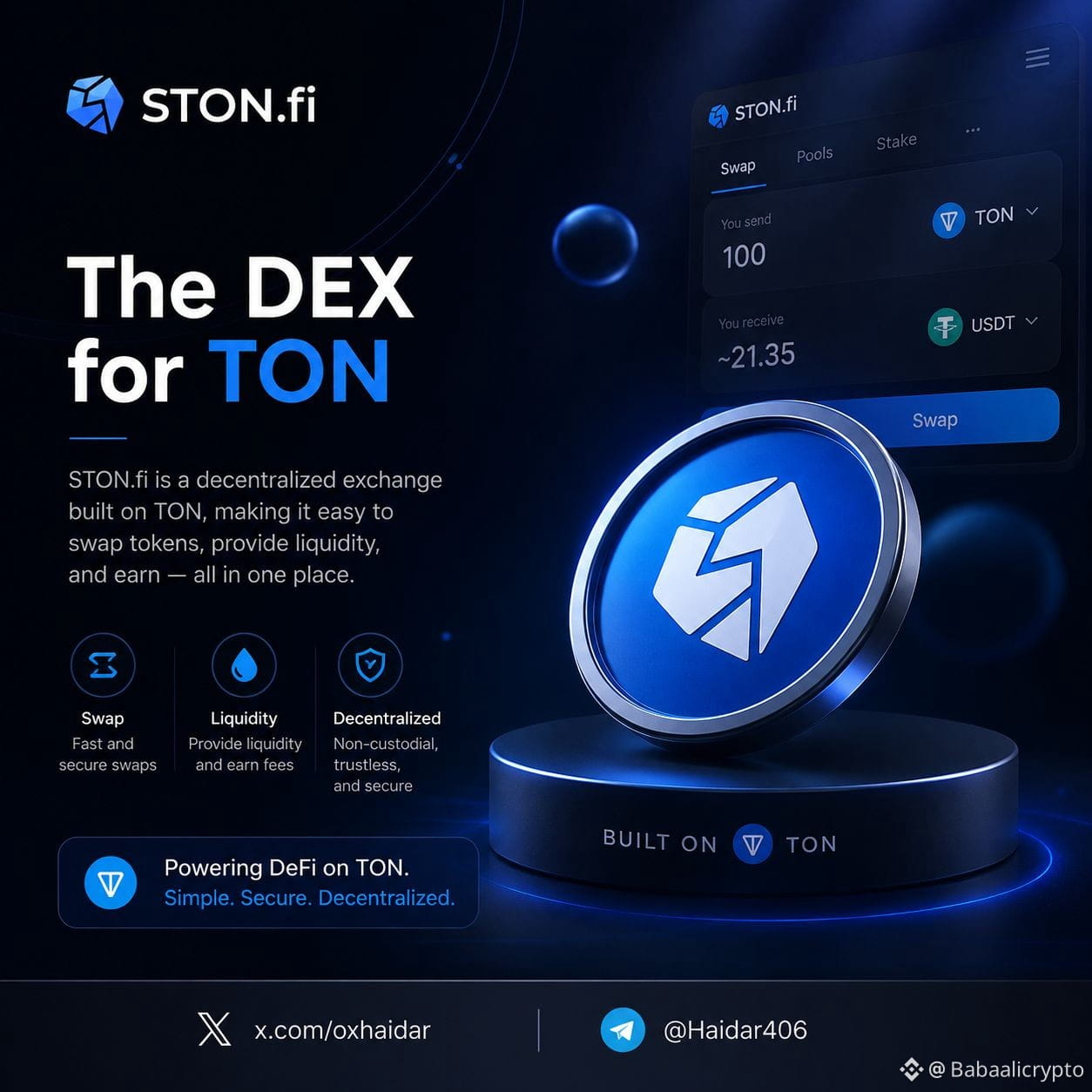
STON.fi est un échange décentralisé (DEX) construit sur TON qui permet aux utilisateurs d’échanger des tokens et d’interagir avec des pools de liquidité sans dépendre d’un échange centralisé.
Mais la partie importante, c’est de comprendre ce qui se passe derrière l’interface.
Les fournisseurs de liquidité apportent des actifs aux pools, tandis que les utilisateurs interagissent avec ces pools pour exécuter des swaps.
Cela crée un élément essentiel d’infrastructure DeFi pour TON.
Dans mes prochains posts, je vais détailler le fonctionnement de STON.fi, les pools de liquidité, le swapping, ainsi que les risques que les utilisateurs doivent comprendre avant d’utiliser un DEX.
#STON #TON #DEX
Qu’est-ce qu’exactement STON.fi, et pourquoi est-ce important pour l’écosystème TON ?
STON.fi est un échange décentralisé (DEX) construit sur TON qui permet aux utilisateurs d’échanger des tokens et d’interagir avec des pools de liquidité sans dépendre d’un échange centralisé.
Mais la partie importante, c’est de comprendre ce qui se passe derrière l’interface.
Les fournisseurs de liquidité apportent des actifs aux pools, tandis que les utilisateurs interagissent avec ces pools pour exécuter des swaps.
Cela crée un élément essentiel d’infrastructure DeFi pour TON.
Dans mes prochains posts, je vais détailler le fonctionnement de STON.fi, les pools de liquidité, le swapping, ainsi que les risques que les utilisateurs doivent comprendre avant d’utiliser un DEX.
#STON #TON #DEX
STON.fi est un échange décentralisé (DEX) construit sur TON qui permet aux utilisateurs d’échanger des tokens et d’interagir avec des pools de liquidité sans dépendre d’un échange centralisé.
Mais la partie importante, c’est de comprendre ce qui se passe derrière l’interface.
Les fournisseurs de liquidité apportent des actifs aux pools, tandis que les utilisateurs interagissent avec ces pools pour exécuter des swaps.
Cela crée un élément essentiel d’infrastructure DeFi pour TON.
Dans mes prochains posts, je vais détailler le fonctionnement de STON.fi, les pools de liquidité, le swapping, ainsi que les risques que les utilisateurs doivent comprendre avant d’utiliser un DEX.
#STON #TON #DEX
1
80
$BABY Chaque cycle de marché récompense les projets qui résolvent des problèmes réels plutôt que de poursuivre les tendances. Les Vaults Bitcoin sans confiance de @babylonlabs_io io se concentrent sur la protection du Bitcoin grâce à une conception transparente et minimisant la confiance. L’innovation durable surpassera toujours l’engouement de court terme. $BABY #baby
$BABY Chaque cycle de marché récompense les projets qui résolvent des problèmes réels plutôt que de poursuivre les tendances. Les Vaults Bitcoin sans confiance de @BabylonLabs_io io se concentrent sur la protection du Bitcoin grâce à une conception transparente et minimisant la confiance. L’innovation durable surpassera toujours l’engouement de court terme. $BABY #baby
1
84
Connectez-vous pour découvrir plus de contenu
Rejoignez la communauté mondiale des adeptes de cryptomonnaies sur Binance Square
⚡️ Suviez les dernières informations importantes sur les cryptomonnaies.
💬 Jugé digne de confiance par la plus grande plateforme d’échange de cryptomonnaies au monde.
👍 Découvrez les connaissances que partagent les créateurs vérifiés.
Adresse e-mail/Nº de téléphone
Sujets d’actualité
TrumpRejectsAIRulesForVoluntaryAudits
501 vues
68 mentions
#trumprejectsairulesforvoluntaryaudits
🚨 Changement de politique majeur ! Trump vient de rejeter des réglementations strictes du gouvernement sur l’IA, en choisissant un pacte « moralement contraignant » avec de grands acteurs de la tech comme OpenAI et Meta.
Les entreprises s’appuieront sur l’autorégulation et des audits externes volontaires plutôt que sur de nouvelles lois fédérales. Il a aussi officiellement rebaptisé l’IA en « Super Intelligence » 🤯.
L’autorégulation suffit-elle pour notre avenir technologique, ou s’agit-il d’un pari risqué ? 👇
$MOVR
$SOON
$BERA
Crypto With Faisal
·1 mentions J’aime
·392 vues
BitgetHotWalletBreachTiedToThirdPartySecurityFlaw
264 vues
58 mentions
OpenAIUnveilsAlwaysOnAgentDots
1,351 vues
108 mentions