

R3N 1
574 Publications

R3N 1
Signaler
Bloquer l’utilisateur
Web3 & crypto Analyst || Breaking down market moves || token updates daily ➪NFA!!!
0 Suivis
3 Abonnés
3 J’aime
Publications
·
--
Voir la traduction
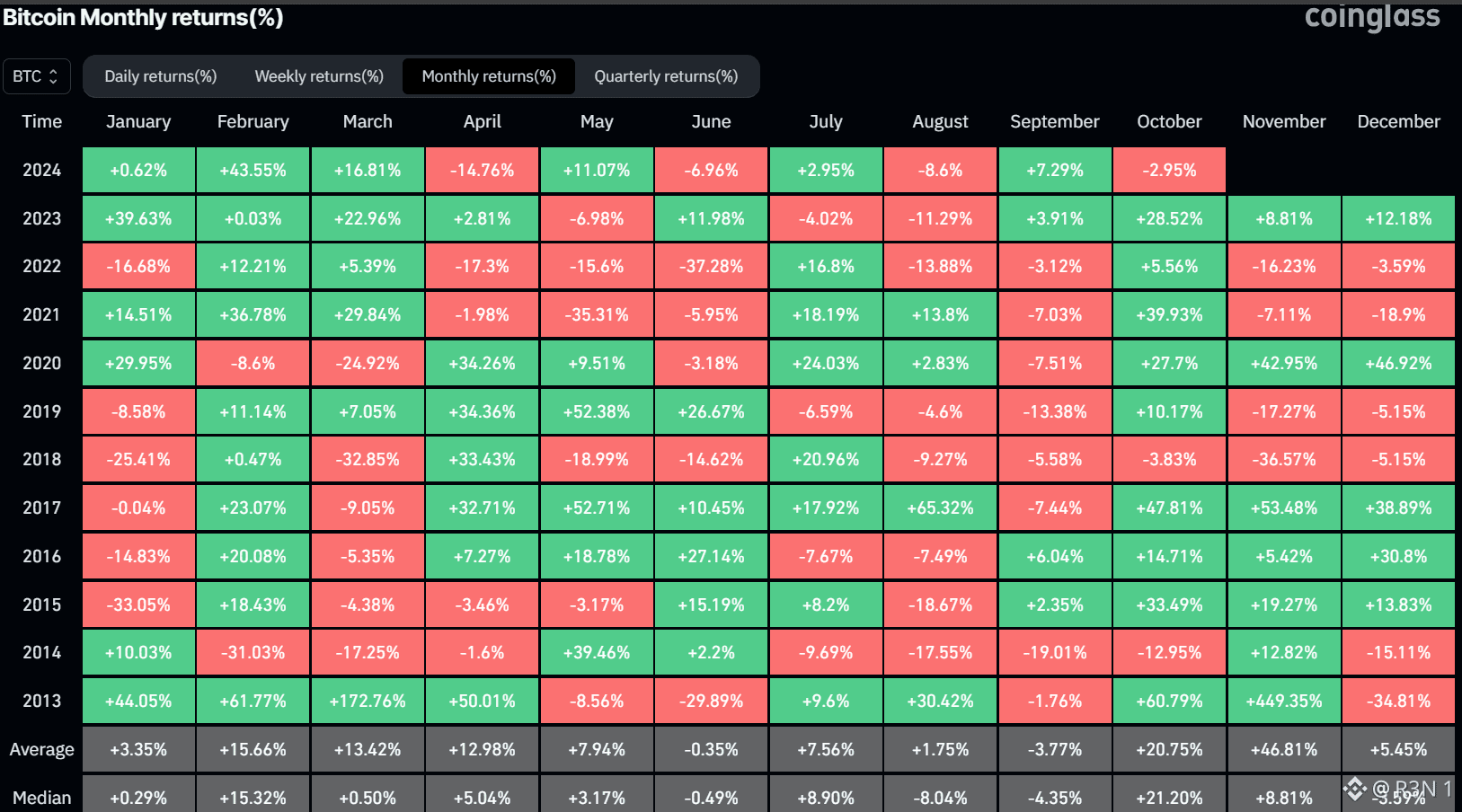
Ten green Octobers out of thirteen since 2013, averaging roughly 19% gains. That's the stat getting repeated everywhere right now, and it's accurate, but the one year that broke the pattern is actually more instructive than the nine that confirmed it. October 2025 started with $BTC near $119,000, hit a record above $126,000 early in the month, looked like Uptober playing out exactly as scripted, then finished down nearly 4%, the first red October since 2018. A US China trade dispute flare up and record liquidations did that, not a failure of the seasonal pattern itself, an external macro shock overriding historical tendency. That's the actual lesson, seasonality is a probability, not a guarantee, and it's broken before specifically when something unrelated to the calendar intervened. This year's setup into October is genuinely different from last year's though. BTC just posted three green months in a row for the first time since 2012, up roughly 25% in August and another 9% in September, reaching an eight month high above $87,000. Large entities reportedly accumulated around 30,269 BTC, worth about $2.57 billion, over a recent 96 hour stretch, and spot ETFs pulled in close to $3 billion over ten days. When September itself closed positive, the five prior instances still saw October gains four times, averaging just under 17%, a smaller sample worth noting, not treating as separately conclusive. My honest read: the base rate is real and well documented, not cherry picked, but 2025 proved strong seasonal odds don't override a genuine macro shock. This year's momentum looks more constructive than last year's setup, but that's a different claim than the pattern being more reliable this time. What I'm watching: whether any comparable macro catalyst, trade policy, Fed surprises, shows up this October the way it did last year, since that's historically been the actual variable that's broken this pattern, not anything about the calendar itself.
Ten green Octobers out of thirteen since 2013, averaging roughly 19% gains. That's the stat getting repeated everywhere right now, and it's accurate, but the one year that broke the pattern is actually more instructive than the nine that confirmed it. October 2025 started with $BTC near $119,000, hit a record above $126,000 early in the month, looked like Uptober playing out exactly as scripted, then finished down nearly 4%, the first red October since 2018. A US China trade dispute flare up and record liquidations did that, not a failure of the seasonal pattern itself, an external macro shock overriding historical tendency. That's the actual lesson, seasonality is a probability, not a guarantee, and it's broken before specifically when something unrelated to the calendar intervened. This year's setup into October is genuinely different from last year's though. BTC just posted three green months in a row for the first time since 2012, up roughly 25% in August and another 9% in September, reaching an eight month high above $87,000. Large entities reportedly accumulated around 30,269 BTC, worth about $2.57 billion, over a recent 96 hour stretch, and spot ETFs pulled in close to $3 billion over ten days. When September itself closed positive, the five prior instances still saw October gains four times, averaging just under 17%, a smaller sample worth noting, not treating as separately conclusive. My honest read: the base rate is real and well documented, not cherry picked, but 2025 proved strong seasonal odds don't override a genuine macro shock. This year's momentum looks more constructive than last year's setup, but that's a different claim than the pattern being more reliable this time. What I'm watching: whether any comparable macro catalyst, trade policy, Fed surprises, shows up this October the way it did last year, since that's historically been the actual variable that's broken this pattern, not anything about the calendar itself.
23
·
--
Voir la traduction
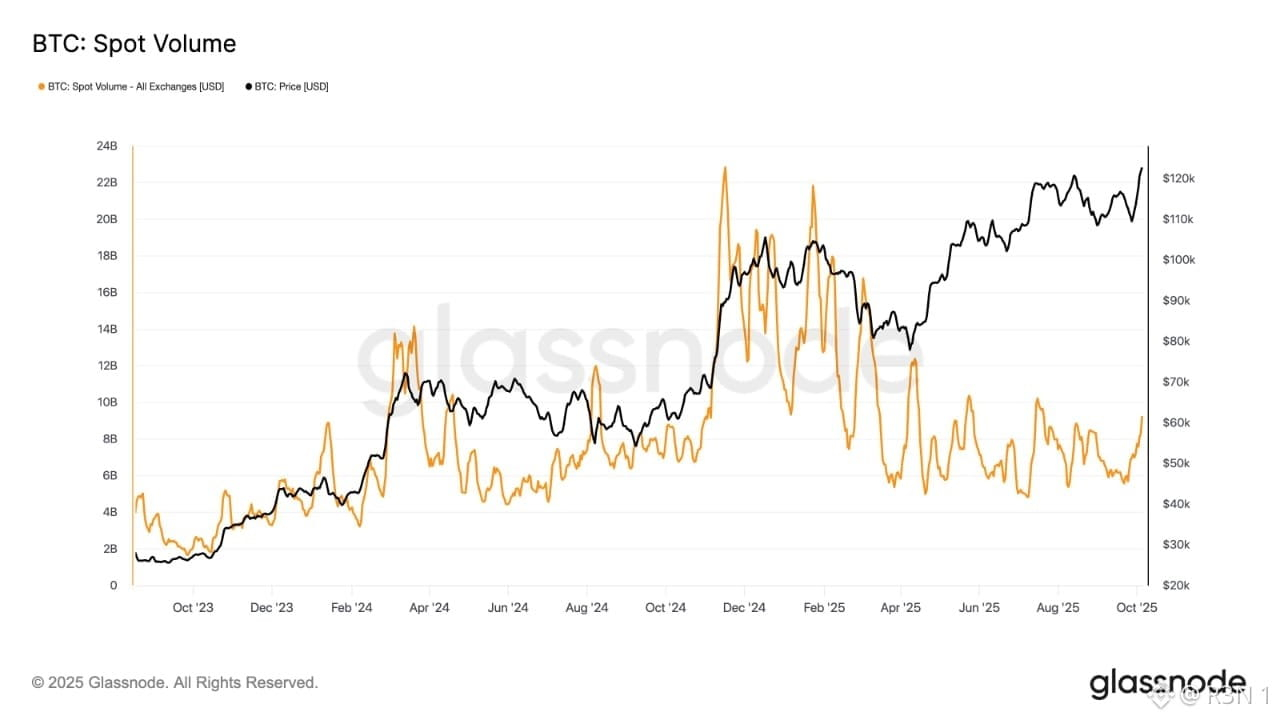
The 4x figure is turnover, not net capital inflow. The same money can get counted repeatedly as positions change hands, and volume captures both buying and selling, not a directional four times more capital rotating into alts. The more accurate read is that trading attention and liquidity have broadened beyond BTC, not that four times as much fresh money showed up.
The breadth data backs that broadening up. 72.5% of tracked altcoins outperformed Bitcoin over the seven days ending September 22, against just 39% during a similar August surge. The Altcoin Season Index climbed to 62%, up from 50% a week earlier and 33% a month prior. Zcash and Uniswap posted 295% and 248% three month gains, dwarfing BTC's own 44%. Worth noting the leverage picture looks calm, altcoin perpetual open interest has barely grown in 30 days, this rotation is showing up in spot participation, not leveraged futures.
Here's the genuine tension. Glassnode itself flagged that similar spikes in this ratio have historically coincided with local Bitcoin price tops, not confirmed altseason continuations. And September 28 specifically saw crypto's total market value fall about 3% while volume surged 125%, a pattern that reads more like forced liquidation than fresh altseason buying.
My honest read: the breadth and index data genuinely support an early altseason case, but Glassnode's own historical framing and last week's volume spike during a selloff argue the opposite just as plausibly. This is a real fork in the data, not a clean signal either way.
What I'm watching: whether altcoin exchange deposits keep climbing, since rising deposits alongside this volume would point toward selling pressure building rather than sustained rotation.
$BTC #BTC Price Analysis# #Altcoin Season# $XAUt
The 4x figure is turnover, not net capital inflow. The same money can get counted repeatedly as positions change hands, and volume captures both buying and selling, not a directional four times more capital rotating into alts. The more accurate read is that trading attention and liquidity have broadened beyond BTC, not that four times as much fresh money showed up.
The breadth data backs that broadening up. 72.5% of tracked altcoins outperformed Bitcoin over the seven days ending September 22, against just 39% during a similar August surge. The Altcoin Season Index climbed to 62%, up from 50% a week earlier and 33% a month prior. Zcash and Uniswap posted 295% and 248% three month gains, dwarfing BTC's own 44%. Worth noting the leverage picture looks calm, altcoin perpetual open interest has barely grown in 30 days, this rotation is showing up in spot participation, not leveraged futures.
Here's the genuine tension. Glassnode itself flagged that similar spikes in this ratio have historically coincided with local Bitcoin price tops, not confirmed altseason continuations. And September 28 specifically saw crypto's total market value fall about 3% while volume surged 125%, a pattern that reads more like forced liquidation than fresh altseason buying.
My honest read: the breadth and index data genuinely support an early altseason case, but Glassnode's own historical framing and last week's volume spike during a selloff argue the opposite just as plausibly. This is a real fork in the data, not a clean signal either way.
What I'm watching: whether altcoin exchange deposits keep climbing, since rising deposits alongside this volume would point toward selling pressure building rather than sustained rotation.
$BTC #BTC Price Analysis# #Altcoin Season# $XAUt
The breadth data backs that broadening up. 72.5% of tracked altcoins outperformed Bitcoin over the seven days ending September 22, against just 39% during a similar August surge. The Altcoin Season Index climbed to 62%, up from 50% a week earlier and 33% a month prior. Zcash and Uniswap posted 295% and 248% three month gains, dwarfing BTC's own 44%. Worth noting the leverage picture looks calm, altcoin perpetual open interest has barely grown in 30 days, this rotation is showing up in spot participation, not leveraged futures.
Here's the genuine tension. Glassnode itself flagged that similar spikes in this ratio have historically coincided with local Bitcoin price tops, not confirmed altseason continuations. And September 28 specifically saw crypto's total market value fall about 3% while volume surged 125%, a pattern that reads more like forced liquidation than fresh altseason buying.
My honest read: the breadth and index data genuinely support an early altseason case, but Glassnode's own historical framing and last week's volume spike during a selloff argue the opposite just as plausibly. This is a real fork in the data, not a clean signal either way.
What I'm watching: whether altcoin exchange deposits keep climbing, since rising deposits alongside this volume would point toward selling pressure building rather than sustained rotation.
$BTC #BTC Price Analysis# #Altcoin Season# $XAUt
57
·
--
Voir la traduction
UsePaid's native token dropped 38% not because the protocol failed, but because the payment rail underneath it couldn't handle success. That distinction matters for how you read this.
Claimed fees through UsePaid surged to $1.54 million on September 27, roughly 26 times the previous day's total and more than the entire prior seven days combined.
UsePaid routes creator fees from Pump.fun token launches directly to designated X accounts through X Money's payment rails, and the volume spike broke that pipeline. The protocol first capped payouts at $750 per recipient daily, then paused X Money transfers entirely by Sunday night.
What stands out to me is the mechanism generating this volume. Anyone can launch a Pump.fun token, redirect its creator fees to UsePaid, and name virtually any X account as beneficiary, no consent required. UsePaid's dashboard reportedly showed 367 tokens naming one prominent account and 764 naming Elon Musk's, some recipients have called it being "financially DDoS'd." The surge is downstream of that dynamic accelerating fast.
By September 28, UsePaid shipped a claims portal letting recipients withdraw directly to a Solana wallet in SOL, bypassing X Money entirely. Existing balances remain intact and fees keep accruing, per the protocol, this is a payout bottleneck, not a solvency issue.
Worth being precise on scope, X Money itself continues operating independently, this is specifically UsePaid's integration that got restricted, not a broader X Money outage.
The open question isn't whether the claims portal works as a stopgap, it's live and functional. It's whether this pushes UsePaid toward permanently favoring on-chain SOL claims over the X Money path it was originally built around, and what that means for a product whose entire pitch was frictionless fiat payouts.
$SOL #BTC Price Analysis# #Altcoin Season# $HYPE
UsePaid's native token dropped 38% not because the protocol failed, but because the payment rail underneath it couldn't handle success. That distinction matters for how you read this.
Claimed fees through UsePaid surged to $1.54 million on September 27, roughly 26 times the previous day's total and more than the entire prior seven days combined.
UsePaid routes creator fees from Pump.fun token launches directly to designated X accounts through X Money's payment rails, and the volume spike broke that pipeline. The protocol first capped payouts at $750 per recipient daily, then paused X Money transfers entirely by Sunday night.
What stands out to me is the mechanism generating this volume. Anyone can launch a Pump.fun token, redirect its creator fees to UsePaid, and name virtually any X account as beneficiary, no consent required. UsePaid's dashboard reportedly showed 367 tokens naming one prominent account and 764 naming Elon Musk's, some recipients have called it being "financially DDoS'd." The surge is downstream of that dynamic accelerating fast.
By September 28, UsePaid shipped a claims portal letting recipients withdraw directly to a Solana wallet in SOL, bypassing X Money entirely. Existing balances remain intact and fees keep accruing, per the protocol, this is a payout bottleneck, not a solvency issue.
Worth being precise on scope, X Money itself continues operating independently, this is specifically UsePaid's integration that got restricted, not a broader X Money outage.
The open question isn't whether the claims portal works as a stopgap, it's live and functional. It's whether this pushes UsePaid toward permanently favoring on-chain SOL claims over the X Money path it was originally built around, and what that means for a product whose entire pitch was frictionless fiat payouts.
$SOL #BTC Price Analysis# #Altcoin Season# $HYPE
Claimed fees through UsePaid surged to $1.54 million on September 27, roughly 26 times the previous day's total and more than the entire prior seven days combined.
UsePaid routes creator fees from Pump.fun token launches directly to designated X accounts through X Money's payment rails, and the volume spike broke that pipeline. The protocol first capped payouts at $750 per recipient daily, then paused X Money transfers entirely by Sunday night.
What stands out to me is the mechanism generating this volume. Anyone can launch a Pump.fun token, redirect its creator fees to UsePaid, and name virtually any X account as beneficiary, no consent required. UsePaid's dashboard reportedly showed 367 tokens naming one prominent account and 764 naming Elon Musk's, some recipients have called it being "financially DDoS'd." The surge is downstream of that dynamic accelerating fast.
By September 28, UsePaid shipped a claims portal letting recipients withdraw directly to a Solana wallet in SOL, bypassing X Money entirely. Existing balances remain intact and fees keep accruing, per the protocol, this is a payout bottleneck, not a solvency issue.
Worth being precise on scope, X Money itself continues operating independently, this is specifically UsePaid's integration that got restricted, not a broader X Money outage.
The open question isn't whether the claims portal works as a stopgap, it's live and functional. It's whether this pushes UsePaid toward permanently favoring on-chain SOL claims over the X Money path it was originally built around, and what that means for a product whose entire pitch was frictionless fiat payouts.
$SOL #BTC Price Analysis# #Altcoin Season# $HYPE

60
·
--
Voir la traduction
Blockchain.com hit $14 billion at the top of the last cycle. It's now targeting $4 to 6 billion, less than half that peak, and calling it a comeback story anyway. Worth sitting with that gap before reading this purely as bullish momentum.
Per Bloomberg, the company is telling prospective investors it wants to raise roughly $500 million in a US listing this year, with room to accept a smaller raise if market conditions demand it. It confidentially filed with the SEC back in May, and has reportedly posted adjusted profitability for three straight years, a real operating detail, not just a narrative pitch. The timing lines up with BTC's own recovery, up roughly 30 to 33% since mid August, when Treasury's buyback program started reshaping liquidity conditions.
Worth being honest about the backdrop this IPO is stepping into. Gemini, Bullish, and eToro all went public last year, and the aftermath hasn't been kind, Gemini's down more than 80% from its debut, BitGo roughly 60%, eToro around 50%. That's the actual track record recent crypto listings have set.
Blockchain.com has also been genuinely expanding its product surface beyond core wallet and exchange services, tokenized stocks and ETFs through Ondo Finance, and reportedly a new NYSE agreement explored last week. That diversification is a real part of the pitch to investors, not just riding BTC's price.
My honest read: profitable operations and a real product expansion story make this a more substantive listing than pure momentum plays, but the sector's post IPO performance this year is a genuine headwind this valuation range has to overcome, not just market sentiment.
What I'm watching: whether Blockchain.com actually files the S-1 and locks a valuation, and how it trades relative to Gemini, BitGo, and eToro's rough first year if it does.
$BTC #BTC Price Analysis# $XRP #Meme Alpha#
Blockchain.com hit $14 billion at the top of the last cycle. It's now targeting $4 to 6 billion, less than half that peak, and calling it a comeback story anyway. Worth sitting with that gap before reading this purely as bullish momentum.
Per Bloomberg, the company is telling prospective investors it wants to raise roughly $500 million in a US listing this year, with room to accept a smaller raise if market conditions demand it. It confidentially filed with the SEC back in May, and has reportedly posted adjusted profitability for three straight years, a real operating detail, not just a narrative pitch. The timing lines up with BTC's own recovery, up roughly 30 to 33% since mid August, when Treasury's buyback program started reshaping liquidity conditions.
Worth being honest about the backdrop this IPO is stepping into. Gemini, Bullish, and eToro all went public last year, and the aftermath hasn't been kind, Gemini's down more than 80% from its debut, BitGo roughly 60%, eToro around 50%. That's the actual track record recent crypto listings have set.
Blockchain.com has also been genuinely expanding its product surface beyond core wallet and exchange services, tokenized stocks and ETFs through Ondo Finance, and reportedly a new NYSE agreement explored last week. That diversification is a real part of the pitch to investors, not just riding BTC's price.
My honest read: profitable operations and a real product expansion story make this a more substantive listing than pure momentum plays, but the sector's post IPO performance this year is a genuine headwind this valuation range has to overcome, not just market sentiment.
What I'm watching: whether Blockchain.com actually files the S-1 and locks a valuation, and how it trades relative to Gemini, BitGo, and eToro's rough first year if it does.
$BTC #BTC Price Analysis# $XRP #Meme Alpha#
Per Bloomberg, the company is telling prospective investors it wants to raise roughly $500 million in a US listing this year, with room to accept a smaller raise if market conditions demand it. It confidentially filed with the SEC back in May, and has reportedly posted adjusted profitability for three straight years, a real operating detail, not just a narrative pitch. The timing lines up with BTC's own recovery, up roughly 30 to 33% since mid August, when Treasury's buyback program started reshaping liquidity conditions.
Worth being honest about the backdrop this IPO is stepping into. Gemini, Bullish, and eToro all went public last year, and the aftermath hasn't been kind, Gemini's down more than 80% from its debut, BitGo roughly 60%, eToro around 50%. That's the actual track record recent crypto listings have set.
Blockchain.com has also been genuinely expanding its product surface beyond core wallet and exchange services, tokenized stocks and ETFs through Ondo Finance, and reportedly a new NYSE agreement explored last week. That diversification is a real part of the pitch to investors, not just riding BTC's price.
My honest read: profitable operations and a real product expansion story make this a more substantive listing than pure momentum plays, but the sector's post IPO performance this year is a genuine headwind this valuation range has to overcome, not just market sentiment.
What I'm watching: whether Blockchain.com actually files the S-1 and locks a valuation, and how it trades relative to Gemini, BitGo, and eToro's rough first year if it does.
$BTC #BTC Price Analysis# $XRP #Meme Alpha#

66
·
--
STONfi DAO est l’endroit où les détenteurs de STON façonnent la direction du protocole. Huit propositions ont déjà été soumises, avec 11,576 votants uniques participants. Voici le processus complet pour voter et créer des propositions. Pour accéder au DAO, rendez-vous sur dao.ston.fi ou cliquez sur l’onglet DAO dans la navigation principale de Ston.fi à app.ston.fi. Pour obtenir du pouvoir de vote, vous devez miser (stake) des STON via ARKENSTON sur app.ston.fi/stake . Choisissez une période de blocage entre trois et vingt-quatre mois. Les blocages plus longs produisent un pouvoir de vote plus élevé par STON misé. Votre position mise émet un NFT soulbound ARKENSTON représentant votre poids de vote. Ce NFT ne peut pas être transféré ni emprunté. Pour voter sur une proposition existante, connectez votre portefeuille sur dao.ston.fi , allez dans Propositions, trouvez une proposition active dans l’onglet Vote, puis soumettez votre vote. Toute position de STON mise disposant d’un pouvoir de vote peut participer aux votes. Pour créer une proposition, vous avez besoin d’au moins 273.32 de pouvoir de vote dans un seul NFT ARKENSTON. Si votre mise est inférieure à ce seuil, vous ne pouvez pas créer de propositions, mais vous pouvez toujours voter. Les propositions nécessitent un titre pouvant aller jusqu’à 80 caractères et une description couvrant Résumé, Motivation et Détails. Le quorum nécessaire pour qu’une proposition soit acceptée est de 25,798 de pouvoir de vote. La période de discussion avant l’ouverture du vote est de sept jours. GEMSTON est gagné en parallèle des récompenses de mise en STON. La participation à la gouvernance est le résultat concret de la décision de mise que nous avons abordée dans le post « staking versus farming ». Accéder au STONfi DAO → https://dao.ston.fi $BTC #BTC Price Analysis# #Altcoin Season# $HYPE #Meme Alpha#
STONfi DAO est l’endroit où les détenteurs de STON façonnent la direction du protocole. Huit propositions ont déjà été soumises, avec 11,576 votants uniques participants. Voici le processus complet pour voter et créer des propositions. Pour accéder au DAO, rendez-vous sur dao.ston.fi ou cliquez sur l’onglet DAO dans la navigation principale de Ston.fi à app.ston.fi. Pour obtenir du pouvoir de vote, vous devez miser (stake) des STON via ARKENSTON sur app.ston.fi/stake . Choisissez une période de blocage entre trois et vingt-quatre mois. Les blocages plus longs produisent un pouvoir de vote plus élevé par STON misé. Votre position mise émet un NFT soulbound ARKENSTON représentant votre poids de vote. Ce NFT ne peut pas être transféré ni emprunté. Pour voter sur une proposition existante, connectez votre portefeuille sur dao.ston.fi , allez dans Propositions, trouvez une proposition active dans l’onglet Vote, puis soumettez votre vote. Toute position de STON mise disposant d’un pouvoir de vote peut participer aux votes. Pour créer une proposition, vous avez besoin d’au moins 273.32 de pouvoir de vote dans un seul NFT ARKENSTON. Si votre mise est inférieure à ce seuil, vous ne pouvez pas créer de propositions, mais vous pouvez toujours voter. Les propositions nécessitent un titre pouvant aller jusqu’à 80 caractères et une description couvrant Résumé, Motivation et Détails. Le quorum nécessaire pour qu’une proposition soit acceptée est de 25,798 de pouvoir de vote. La période de discussion avant l’ouverture du vote est de sept jours. GEMSTON est gagné en parallèle des récompenses de mise en STON. La participation à la gouvernance est le résultat concret de la décision de mise que nous avons abordée dans le post « staking versus farming ». Accéder au STONfi DAO → https://dao.ston.fi $BTC #BTC Price Analysis# #Altcoin Season# $HYPE #Meme Alpha#
70
·
--
« Ce n’est vraiment plus seulement une blockchain. » Une chose étrange à dire pour le propre cofondateur d’Ethereum à propos d’Ethereum, et l’essai qui l’accompagne est plus précis que le slogan ne le laisse entendre.
La nouvelle production de Buterin, « The Cryptographic World Computer », publiée dimanche, présente Hegota, la prochaine mise à niveau, comme une probabilité qu’il s’agisse du dernier « fork » « normal » d’Ethereum. Ensuite, un basculement vers des STARK récursifs, une vérification formelle automatisée et une cryptographie résistante aux attaques quantiques : un hybride qui combine la conception de la blockchain avec des outils cryptographiques qui n’étaient pas encore assez mûrs pour être utilisés en 2009.
Ce qui ressort pour moi, c’est le mécanisme qu’il cite pour expliquer pourquoi Ethereum ne devient plus une simple « blockchain ». FOCIL, fork-choice enforced inclusion lists (listes d’inclusion imposées par le choix du fork), est une fonctionnalité de Hegota permettant à un comité de validateurs de forcer des transactions valides dans des blocs plutôt que de s’en remettre à un seul constructeur (builder). Buterin relie cela directement à la confidentialité : il affirme que cela fera des transactions basées sur les ZK-SNARK — qui brisent déjà l’hypothèse du whitepaper selon laquelle les transactions sont annoncées publiquement — de « beaucoup plus des citoyens de première classe » à l’avenir.
À ajouter : il projette des chiffres concrets pour la vision, soit des durées de slot de 4 à 8 secondes et une finalité de 8 à 32 secondes d’ici 2030. Il est aussi direct sur une limite : la couche de base d’Ethereum ne devrait pas égaler la latence des serveurs centralisés, même avec tout cela, même si l’infrastructure environnante pourrait réduire une partie de cet écart.
Il convient aussi de noter que le périmètre de Hegota n’est pas finalisé : la feuille de route d’Ethereum le situe en 2027 après Glamsterdam, et cet essai est la façon dont Buterin cadre ce qui vient ensuite, pas une spécification figée.
La question ouverte n’est pas de savoir si cette direction est réelle : FOCIL et les EIP associés sont déjà planifiés. La vraie question est de savoir si la « hybrid architecture » livre à la fois confidentialité et performances à grande échelle, ou si l’un des objectifs finit par se faire au détriment de l’autre lorsque cette idée passera de l’essai à du code effectivement déployé.
#BTC Price Analysis# $ETH #Ethereum
« Ce n’est vraiment plus seulement une blockchain. » Une chose étrange à dire pour le propre cofondateur d’Ethereum à propos d’Ethereum, et l’essai qui l’accompagne est plus précis que le slogan ne le laisse entendre.
La nouvelle production de Buterin, « The Cryptographic World Computer », publiée dimanche, présente Hegota, la prochaine mise à niveau, comme une probabilité qu’il s’agisse du dernier « fork » « normal » d’Ethereum. Ensuite, un basculement vers des STARK récursifs, une vérification formelle automatisée et une cryptographie résistante aux attaques quantiques : un hybride qui combine la conception de la blockchain avec des outils cryptographiques qui n’étaient pas encore assez mûrs pour être utilisés en 2009.
Ce qui ressort pour moi, c’est le mécanisme qu’il cite pour expliquer pourquoi Ethereum ne devient plus une simple « blockchain ». FOCIL, fork-choice enforced inclusion lists (listes d’inclusion imposées par le choix du fork), est une fonctionnalité de Hegota permettant à un comité de validateurs de forcer des transactions valides dans des blocs plutôt que de s’en remettre à un seul constructeur (builder). Buterin relie cela directement à la confidentialité : il affirme que cela fera des transactions basées sur les ZK-SNARK — qui brisent déjà l’hypothèse du whitepaper selon laquelle les transactions sont annoncées publiquement — de « beaucoup plus des citoyens de première classe » à l’avenir.
À ajouter : il projette des chiffres concrets pour la vision, soit des durées de slot de 4 à 8 secondes et une finalité de 8 à 32 secondes d’ici 2030. Il est aussi direct sur une limite : la couche de base d’Ethereum ne devrait pas égaler la latence des serveurs centralisés, même avec tout cela, même si l’infrastructure environnante pourrait réduire une partie de cet écart.
Il convient aussi de noter que le périmètre de Hegota n’est pas finalisé : la feuille de route d’Ethereum le situe en 2027 après Glamsterdam, et cet essai est la façon dont Buterin cadre ce qui vient ensuite, pas une spécification figée.
La question ouverte n’est pas de savoir si cette direction est réelle : FOCIL et les EIP associés sont déjà planifiés. La vraie question est de savoir si la « hybrid architecture » livre à la fois confidentialité et performances à grande échelle, ou si l’un des objectifs finit par se faire au détriment de l’autre lorsque cette idée passera de l’essai à du code effectivement déployé.
#BTC Price Analysis# $ETH #Ethereum
La nouvelle production de Buterin, « The Cryptographic World Computer », publiée dimanche, présente Hegota, la prochaine mise à niveau, comme une probabilité qu’il s’agisse du dernier « fork » « normal » d’Ethereum. Ensuite, un basculement vers des STARK récursifs, une vérification formelle automatisée et une cryptographie résistante aux attaques quantiques : un hybride qui combine la conception de la blockchain avec des outils cryptographiques qui n’étaient pas encore assez mûrs pour être utilisés en 2009.
Ce qui ressort pour moi, c’est le mécanisme qu’il cite pour expliquer pourquoi Ethereum ne devient plus une simple « blockchain ». FOCIL, fork-choice enforced inclusion lists (listes d’inclusion imposées par le choix du fork), est une fonctionnalité de Hegota permettant à un comité de validateurs de forcer des transactions valides dans des blocs plutôt que de s’en remettre à un seul constructeur (builder). Buterin relie cela directement à la confidentialité : il affirme que cela fera des transactions basées sur les ZK-SNARK — qui brisent déjà l’hypothèse du whitepaper selon laquelle les transactions sont annoncées publiquement — de « beaucoup plus des citoyens de première classe » à l’avenir.
À ajouter : il projette des chiffres concrets pour la vision, soit des durées de slot de 4 à 8 secondes et une finalité de 8 à 32 secondes d’ici 2030. Il est aussi direct sur une limite : la couche de base d’Ethereum ne devrait pas égaler la latence des serveurs centralisés, même avec tout cela, même si l’infrastructure environnante pourrait réduire une partie de cet écart.
Il convient aussi de noter que le périmètre de Hegota n’est pas finalisé : la feuille de route d’Ethereum le situe en 2027 après Glamsterdam, et cet essai est la façon dont Buterin cadre ce qui vient ensuite, pas une spécification figée.
La question ouverte n’est pas de savoir si cette direction est réelle : FOCIL et les EIP associés sont déjà planifiés. La vraie question est de savoir si la « hybrid architecture » livre à la fois confidentialité et performances à grande échelle, ou si l’un des objectifs finit par se faire au détriment de l’autre lorsque cette idée passera de l’essai à du code effectivement déployé.
#BTC Price Analysis# $ETH #Ethereum

2
·
--
Omniston vient de franchir 7,5 millions de dollars de volume total de swaps inter-chaînes. Plus tôt ce mois-ci, il a dépassé les 3 millions de dollars. Il a plus que doublé entre ces deux jalons.
À lui seul, la semaine du 17 au 23 septembre a généré 1,8 million de dollars, soit une hausse de 26 % par rapport à la semaine précédente. La route la plus fréquentée était BNB Chain vers TON, représentant 78 % de ce volume hebdomadaire.
Cette répartition des routes est le point de données le plus intéressant. BNB Chain vers TON à 78 % du volume hebdomadaire vous indique d’où vient réellement la demande. Le capital sur BNB Chain cherche un accès à la couche DeFi de TON — les pools de STONfi, les opportunités de farming, xStocks, ainsi que des applications natives de Telegram. La route n’est pas théorique. C’est actuellement le chemin inter-chaînes le plus actif du réseau.
Le doublement de 3 M$ à 7,5 M$ en l’espace d’un mois reflète l’une de deux tendances. Les volumes explosent au lancement, portés par la nouveauté, puis se normalisent. Ou bien ils augmentent progressivement à mesure que davantage d’utilisateurs découvrent les routes et que plus de produits s’intègrent à la couche d’exécution. La croissance de 26 % d’une semaine sur l’autre, en parallèle du jalon historique, suggère la deuxième tendance.
La campagne One Swap Across Chains, lancée en même temps, stimule une participation structurée avec les routes inter-chaînes. Les campagnes qui enseignent en faisant produisent des comportements de volume plus durables que les campagnes de sensibilisation passive, car les participants ont réellement exécuté le swap plutôt que de simplement le lire.
7,5 millions de dollars au total. 1,8 million de dollars en une semaine. 78 % de BNB Chain vers TON. Le réseau est utilisé.
Lancez des swaps inter-chaînes →https://app.ston.fi/swap?mode=cross-chain
$ZEC #BTC Price Analysis# $NEAR #Altcoin Season#
Omniston vient de franchir 7,5 millions de dollars de volume total de swaps inter-chaînes. Plus tôt ce mois-ci, il a dépassé les 3 millions de dollars. Il a plus que doublé entre ces deux jalons.
À lui seul, la semaine du 17 au 23 septembre a généré 1,8 million de dollars, soit une hausse de 26 % par rapport à la semaine précédente. La route la plus fréquentée était BNB Chain vers TON, représentant 78 % de ce volume hebdomadaire.
Cette répartition des routes est le point de données le plus intéressant. BNB Chain vers TON à 78 % du volume hebdomadaire vous indique d’où vient réellement la demande. Le capital sur BNB Chain cherche un accès à la couche DeFi de TON — les pools de STONfi, les opportunités de farming, xStocks, ainsi que des applications natives de Telegram. La route n’est pas théorique. C’est actuellement le chemin inter-chaînes le plus actif du réseau.
Le doublement de 3 M$ à 7,5 M$ en l’espace d’un mois reflète l’une de deux tendances. Les volumes explosent au lancement, portés par la nouveauté, puis se normalisent. Ou bien ils augmentent progressivement à mesure que davantage d’utilisateurs découvrent les routes et que plus de produits s’intègrent à la couche d’exécution. La croissance de 26 % d’une semaine sur l’autre, en parallèle du jalon historique, suggère la deuxième tendance.
La campagne One Swap Across Chains, lancée en même temps, stimule une participation structurée avec les routes inter-chaînes. Les campagnes qui enseignent en faisant produisent des comportements de volume plus durables que les campagnes de sensibilisation passive, car les participants ont réellement exécuté le swap plutôt que de simplement le lire.
7,5 millions de dollars au total. 1,8 million de dollars en une semaine. 78 % de BNB Chain vers TON. Le réseau est utilisé.
Lancez des swaps inter-chaînes →https://app.ston.fi/swap?mode=cross-chain
$ZEC #BTC Price Analysis# $NEAR #Altcoin Season#
À lui seul, la semaine du 17 au 23 septembre a généré 1,8 million de dollars, soit une hausse de 26 % par rapport à la semaine précédente. La route la plus fréquentée était BNB Chain vers TON, représentant 78 % de ce volume hebdomadaire.
Cette répartition des routes est le point de données le plus intéressant. BNB Chain vers TON à 78 % du volume hebdomadaire vous indique d’où vient réellement la demande. Le capital sur BNB Chain cherche un accès à la couche DeFi de TON — les pools de STONfi, les opportunités de farming, xStocks, ainsi que des applications natives de Telegram. La route n’est pas théorique. C’est actuellement le chemin inter-chaînes le plus actif du réseau.
Le doublement de 3 M$ à 7,5 M$ en l’espace d’un mois reflète l’une de deux tendances. Les volumes explosent au lancement, portés par la nouveauté, puis se normalisent. Ou bien ils augmentent progressivement à mesure que davantage d’utilisateurs découvrent les routes et que plus de produits s’intègrent à la couche d’exécution. La croissance de 26 % d’une semaine sur l’autre, en parallèle du jalon historique, suggère la deuxième tendance.
La campagne One Swap Across Chains, lancée en même temps, stimule une participation structurée avec les routes inter-chaînes. Les campagnes qui enseignent en faisant produisent des comportements de volume plus durables que les campagnes de sensibilisation passive, car les participants ont réellement exécuté le swap plutôt que de simplement le lire.
7,5 millions de dollars au total. 1,8 million de dollars en une semaine. 78 % de BNB Chain vers TON. Le réseau est utilisé.
Lancez des swaps inter-chaînes →https://app.ston.fi/swap?mode=cross-chain
$ZEC #BTC Price Analysis# $NEAR #Altcoin Season#
38
·
--
Les actions tokenisées viennent de devenir une garantie, pas seulement un wrapper négociable, et cette distinction est le véritable déclencheur, bien plus que le chiffre en Une.
Le Hub d’Equities d’Aave V4 a été lancé vendredi sur Base, acceptant sept actions tokenisées émises par Coinbase — Apple, Amazon, Alphabet, Meta, Microsoft, Nvidia, Tesla — comme garantie pour des prêts en USDC. Les utilisateurs déposent des jetons de capitaux propres et empruntent de l’USDC sur la base de ces dépôts ; au lancement, la garantie seule est prise en compte, et les actions ne peuvent pas encore être empruntées ni vendues à découvert. Chainlink les valorise via des flux dédiés d’actions tokenisées, réservés à des utilisateurs non américains éligibles dans des juridictions autorisées ; ils ne sont pas disponibles pour le moment pour les particuliers aux États-Unis.
Ce qui ressort pour moi, c’est à quel point ce lancement est délibérément limité. Les plafonds initiaux s’établissent à 29 millions de dollars de collatéral total, 32 millions de dollars d’offre en USDC, 21 millions de dollars d’emprunt en USDC — vraiment minuscule face aux 3,6 trillions de dollars de dépôts cumulés d’Aave et aux 1 trillion de dollars de prêts cumulés sur toute la durée. Les facteurs de garantie varient de 65 à 79 % selon l’action. Un pilote prudent, pas un lancement à grande échelle, ce qui a du sens étant donné que les actions tokenisées se trouvent dans un espace réglementaire encore instable.
L’architecture compte aussi : Aave utilise son modèle Hub and Spoke. Elle regroupe les sept actions dans un seul marché USDC, tout en isolant les paramètres de risque par actif, de sorte qu’un problème lié à une action tokenisée ne se propage pas aux autres.
À noter : il y a déjà eu un mouvement parallèle. Morpho a lancé son propre marché de prêt pour cinq des actions tokenisées de Coinbase sur Base dès le 18 septembre ; Aave n’est donc pas le premier à cette idée. C’est le deuxième grand protocole de prêt à adopter la même catégorie de collatéral, dans environ une semaine.
La question ouverte n’est pas de savoir si les actions tokenisées peuvent fonctionner comme collatéral DeFi : cela prouve que le mécanisme marche. La vraie question est plutôt de savoir si les plafonds de 29 millions s’élargiront avec l’arrivée de données d’utilisation réelles, ou si l’incertitude réglementaire maintient ce modèle durablement dans une niche — réservée aux non-américains.
#Analyse du prix du BTC# $BTC #Meme Alpha#
Les actions tokenisées viennent de devenir une garantie, pas seulement un wrapper négociable, et cette distinction est le véritable déclencheur, bien plus que le chiffre en Une.
Le Hub d’Equities d’Aave V4 a été lancé vendredi sur Base, acceptant sept actions tokenisées émises par Coinbase — Apple, Amazon, Alphabet, Meta, Microsoft, Nvidia, Tesla — comme garantie pour des prêts en USDC. Les utilisateurs déposent des jetons de capitaux propres et empruntent de l’USDC sur la base de ces dépôts ; au lancement, la garantie seule est prise en compte, et les actions ne peuvent pas encore être empruntées ni vendues à découvert. Chainlink les valorise via des flux dédiés d’actions tokenisées, réservés à des utilisateurs non américains éligibles dans des juridictions autorisées ; ils ne sont pas disponibles pour le moment pour les particuliers aux États-Unis.
Ce qui ressort pour moi, c’est à quel point ce lancement est délibérément limité. Les plafonds initiaux s’établissent à 29 millions de dollars de collatéral total, 32 millions de dollars d’offre en USDC, 21 millions de dollars d’emprunt en USDC — vraiment minuscule face aux 3,6 trillions de dollars de dépôts cumulés d’Aave et aux 1 trillion de dollars de prêts cumulés sur toute la durée. Les facteurs de garantie varient de 65 à 79 % selon l’action. Un pilote prudent, pas un lancement à grande échelle, ce qui a du sens étant donné que les actions tokenisées se trouvent dans un espace réglementaire encore instable.
L’architecture compte aussi : Aave utilise son modèle Hub and Spoke. Elle regroupe les sept actions dans un seul marché USDC, tout en isolant les paramètres de risque par actif, de sorte qu’un problème lié à une action tokenisée ne se propage pas aux autres.
À noter : il y a déjà eu un mouvement parallèle. Morpho a lancé son propre marché de prêt pour cinq des actions tokenisées de Coinbase sur Base dès le 18 septembre ; Aave n’est donc pas le premier à cette idée. C’est le deuxième grand protocole de prêt à adopter la même catégorie de collatéral, dans environ une semaine.
La question ouverte n’est pas de savoir si les actions tokenisées peuvent fonctionner comme collatéral DeFi : cela prouve que le mécanisme marche. La vraie question est plutôt de savoir si les plafonds de 29 millions s’élargiront avec l’arrivée de données d’utilisation réelles, ou si l’incertitude réglementaire maintient ce modèle durablement dans une niche — réservée aux non-américains.
#Analyse du prix du BTC# $BTC #Meme Alpha#
Le Hub d’Equities d’Aave V4 a été lancé vendredi sur Base, acceptant sept actions tokenisées émises par Coinbase — Apple, Amazon, Alphabet, Meta, Microsoft, Nvidia, Tesla — comme garantie pour des prêts en USDC. Les utilisateurs déposent des jetons de capitaux propres et empruntent de l’USDC sur la base de ces dépôts ; au lancement, la garantie seule est prise en compte, et les actions ne peuvent pas encore être empruntées ni vendues à découvert. Chainlink les valorise via des flux dédiés d’actions tokenisées, réservés à des utilisateurs non américains éligibles dans des juridictions autorisées ; ils ne sont pas disponibles pour le moment pour les particuliers aux États-Unis.
Ce qui ressort pour moi, c’est à quel point ce lancement est délibérément limité. Les plafonds initiaux s’établissent à 29 millions de dollars de collatéral total, 32 millions de dollars d’offre en USDC, 21 millions de dollars d’emprunt en USDC — vraiment minuscule face aux 3,6 trillions de dollars de dépôts cumulés d’Aave et aux 1 trillion de dollars de prêts cumulés sur toute la durée. Les facteurs de garantie varient de 65 à 79 % selon l’action. Un pilote prudent, pas un lancement à grande échelle, ce qui a du sens étant donné que les actions tokenisées se trouvent dans un espace réglementaire encore instable.
L’architecture compte aussi : Aave utilise son modèle Hub and Spoke. Elle regroupe les sept actions dans un seul marché USDC, tout en isolant les paramètres de risque par actif, de sorte qu’un problème lié à une action tokenisée ne se propage pas aux autres.
À noter : il y a déjà eu un mouvement parallèle. Morpho a lancé son propre marché de prêt pour cinq des actions tokenisées de Coinbase sur Base dès le 18 septembre ; Aave n’est donc pas le premier à cette idée. C’est le deuxième grand protocole de prêt à adopter la même catégorie de collatéral, dans environ une semaine.
La question ouverte n’est pas de savoir si les actions tokenisées peuvent fonctionner comme collatéral DeFi : cela prouve que le mécanisme marche. La vraie question est plutôt de savoir si les plafonds de 29 millions s’élargiront avec l’arrivée de données d’utilisation réelles, ou si l’incertitude réglementaire maintient ce modèle durablement dans une niche — réservée aux non-américains.
#Analyse du prix du BTC# $BTC #Meme Alpha#


31
·
--
Le secrétaire à l’Énergie, Chris Wright, a en outre affirmé que les volumes quotidiens pouvaient atteindre 17 à 18 millions de barils, et un précédent article de Fortune avait spécifiquement mis en cause la pertinence du calcul de Wright. Le cofondateur de TankerTrackers, Samir Madani, a suggéré que Wright pourrait additionner des volumes de transferts navire-à-navire sur plusieurs jours et les présenter comme des totaux sur une seule journée, en plaisantant sur le fait qu’il s’agissait de « mathemagics ». Ainsi, même parmi ceux qui suivent la situation de très près, il existe de vraies divergences sur le chiffre exact, et pas seulement entre les États-Unis et l’Iran.
Ce qui explique le doublement lui-même est plus banal qu’une percée militaire. Tanker Trackers attribue une partie de ce phénomène au fait que l’Arabie saoudite a réacheminé ses expéditions de pétrole par le golfe Persique, après les avoir précédemment redirigées vers des ports de la mer Rouge via le pipeline Est-Ouest. Ce détour avait eu lieu parce que des combattants houthis et irakiens attaquaient les infrastructures saoudiennes. Le fait que ce contournement ait été suspendu, et non une capacité militaire américaine nouvellement acquise, fait réellement le travail sur ce chiffre.
Le détail des coûts compte toutefois davantage que le seul comptage du nombre de barils affiché. Des 30 à 40 dollars supplémentaires par baril, rien que pour l’acheminer, hors coût même de la présence militaire, constituent une taxe structurelle sur chaque baril quittant l’étroit. Un analyste résume la situation avec franchise : « ça ne marche pas si les prix mondiaux baissent ». Le WTI a reculé de 8 % à 92,41 $ cette semaine. Ces deux faits, placés côte à côte, révèlent la tension réelle : hausse des volumes de flux face à la baisse des prix, ce qui rend économiquement plus difficile le maintien de niveaux aussi élevés.
Le rejet par Trump d’une trêve de 7 jours, alors que les flux se situent déjà à 13 millions de barils, bien en dessous des quelque 20 millions d’avant-guerre, montre que la stratégie actuelle parie sur le temps et la pression au bénéfice de Washington avant que la partie « coûts » ne fasse céder ce calcul. À noter aussi : même des responsables américains ne revendiquent pas une normalisation complète. Il s’agit d’un redressement partiel dans des conditions coûteuses et contestées, et non d’une confirmation que le blocus est réellement brisé.
$BTC #BTC Price Analysis# #Altcoin Season# $XAUt
Le secrétaire à l’Énergie, Chris Wright, a en outre affirmé que les volumes quotidiens pouvaient atteindre 17 à 18 millions de barils, et un précédent article de Fortune avait spécifiquement mis en cause la pertinence du calcul de Wright. Le cofondateur de TankerTrackers, Samir Madani, a suggéré que Wright pourrait additionner des volumes de transferts navire-à-navire sur plusieurs jours et les présenter comme des totaux sur une seule journée, en plaisantant sur le fait qu’il s’agissait de « mathemagics ». Ainsi, même parmi ceux qui suivent la situation de très près, il existe de vraies divergences sur le chiffre exact, et pas seulement entre les États-Unis et l’Iran.
Ce qui explique le doublement lui-même est plus banal qu’une percée militaire. Tanker Trackers attribue une partie de ce phénomène au fait que l’Arabie saoudite a réacheminé ses expéditions de pétrole par le golfe Persique, après les avoir précédemment redirigées vers des ports de la mer Rouge via le pipeline Est-Ouest. Ce détour avait eu lieu parce que des combattants houthis et irakiens attaquaient les infrastructures saoudiennes. Le fait que ce contournement ait été suspendu, et non une capacité militaire américaine nouvellement acquise, fait réellement le travail sur ce chiffre.
Le détail des coûts compte toutefois davantage que le seul comptage du nombre de barils affiché. Des 30 à 40 dollars supplémentaires par baril, rien que pour l’acheminer, hors coût même de la présence militaire, constituent une taxe structurelle sur chaque baril quittant l’étroit. Un analyste résume la situation avec franchise : « ça ne marche pas si les prix mondiaux baissent ». Le WTI a reculé de 8 % à 92,41 $ cette semaine. Ces deux faits, placés côte à côte, révèlent la tension réelle : hausse des volumes de flux face à la baisse des prix, ce qui rend économiquement plus difficile le maintien de niveaux aussi élevés.
Le rejet par Trump d’une trêve de 7 jours, alors que les flux se situent déjà à 13 millions de barils, bien en dessous des quelque 20 millions d’avant-guerre, montre que la stratégie actuelle parie sur le temps et la pression au bénéfice de Washington avant que la partie « coûts » ne fasse céder ce calcul. À noter aussi : même des responsables américains ne revendiquent pas une normalisation complète. Il s’agit d’un redressement partiel dans des conditions coûteuses et contestées, et non d’une confirmation que le blocus est réellement brisé.
$BTC #BTC Price Analysis# #Altcoin Season# $XAUt
Ce qui explique le doublement lui-même est plus banal qu’une percée militaire. Tanker Trackers attribue une partie de ce phénomène au fait que l’Arabie saoudite a réacheminé ses expéditions de pétrole par le golfe Persique, après les avoir précédemment redirigées vers des ports de la mer Rouge via le pipeline Est-Ouest. Ce détour avait eu lieu parce que des combattants houthis et irakiens attaquaient les infrastructures saoudiennes. Le fait que ce contournement ait été suspendu, et non une capacité militaire américaine nouvellement acquise, fait réellement le travail sur ce chiffre.
Le détail des coûts compte toutefois davantage que le seul comptage du nombre de barils affiché. Des 30 à 40 dollars supplémentaires par baril, rien que pour l’acheminer, hors coût même de la présence militaire, constituent une taxe structurelle sur chaque baril quittant l’étroit. Un analyste résume la situation avec franchise : « ça ne marche pas si les prix mondiaux baissent ». Le WTI a reculé de 8 % à 92,41 $ cette semaine. Ces deux faits, placés côte à côte, révèlent la tension réelle : hausse des volumes de flux face à la baisse des prix, ce qui rend économiquement plus difficile le maintien de niveaux aussi élevés.
Le rejet par Trump d’une trêve de 7 jours, alors que les flux se situent déjà à 13 millions de barils, bien en dessous des quelque 20 millions d’avant-guerre, montre que la stratégie actuelle parie sur le temps et la pression au bénéfice de Washington avant que la partie « coûts » ne fasse céder ce calcul. À noter aussi : même des responsables américains ne revendiquent pas une normalisation complète. Il s’agit d’un redressement partiel dans des conditions coûteuses et contestées, et non d’une confirmation que le blocus est réellement brisé.
$BTC #BTC Price Analysis# #Altcoin Season# $XAUt


95
·
--
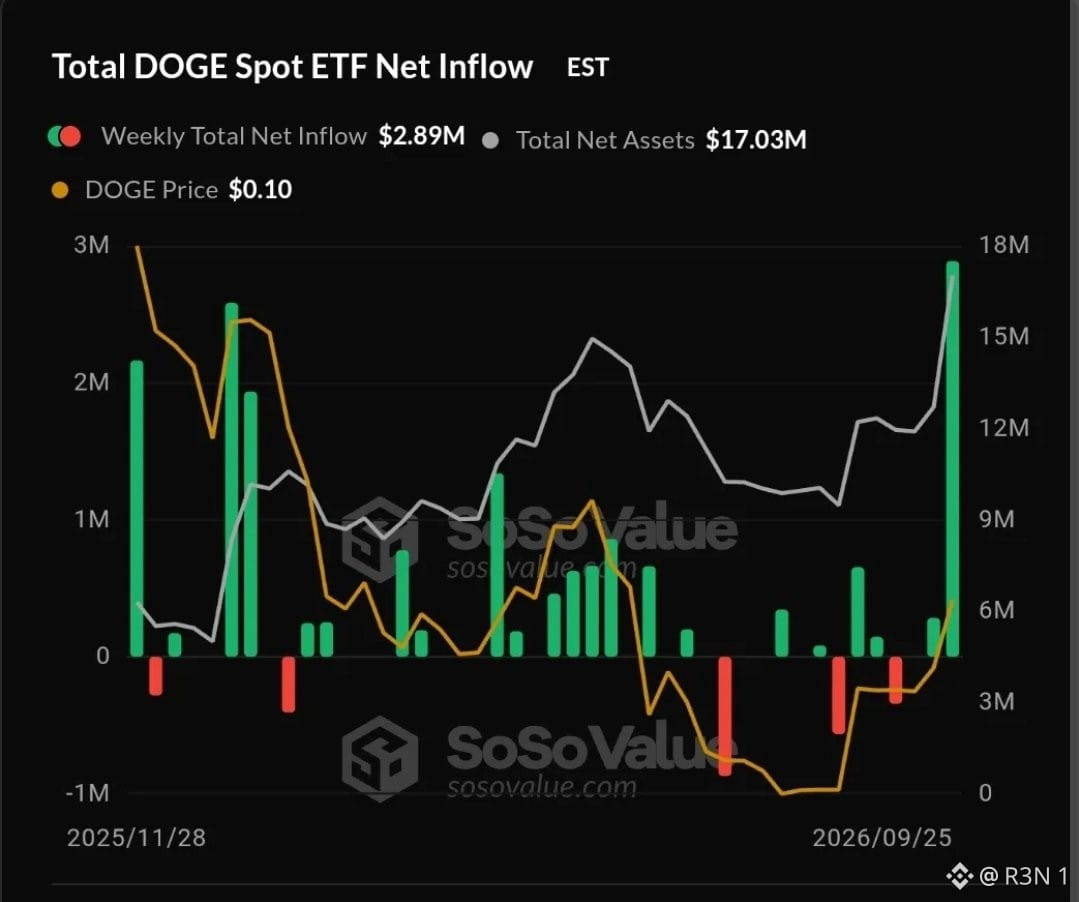
2,89 millions de dollars versés en ETF DOGE cette semaine, le plus fort niveau depuis leur lancement en novembre 2025, mais la composition sous ce chiffre-titre raconte une histoire plus fragile que ce que laisse entendre le « record de la semaine ».
La majeure partie des entrées, 3,48 millions de dollars, provient à elle seule du Dogecoin Trust de Grayscale. 21Shares a en revanche enregistré 593 000 $ de sorties sur la même période, et l’ETF DOGE de Bitwise a enregistré zéro, car il ferme totalement le 14 octobre. Un seul fonds porte ce record, pas une demande généralisée à l’échelle de la catégorie de produits, et l’un des quatre fonds qui suivent le DOGE quitte déjà le marché.
Ce qui ressort pour moi, c’est une comparaison que presque personne ne fait en parallèle avec ce titre. Les émissions de Dogecoin via son protocole représentent environ 13,53 millions de nouvelles pièces par jour, soit environ 1,32 million de dollars aux prix actuels.
La plus forte journée d’ETF de ce mois-ci, 1,17 million de dollars le 22 septembre, est pourtant restée inférieure à la valeur d’une seule journée de nouvelle offre. Les émissions nouvelles ont dépassé la meilleure journée que les ETF aient jamais connue. Cela ne signifie pas forcément que le prix doive baisser : de la nouvelle offre qui arrive sur le marché ne submerge pas automatiquement la demande, mais cela veut dire qu’une semaine d’entrées record n’est pas, pour l’instant, la force dominante qui agit sur l’équilibre offre-demande du DOGE.
Il faut aussi remettre ces chiffres à l’échelle : l’encours total des ETF DOGE s’élève à 17,03 millions de dollars, soit seulement 0,11 % de la capitalisation boursière de Dogecoin (16,6 milliards de dollars). Il s’agit encore, quoi qu’il arrive, d’une catégorie de produit réellement minuscule en valeur absolue, « record de la semaine » ou pas.
La question ouverte n’est pas de savoir si l’intérêt institutionnel augmente : la tendance des flux sur septembre, surtout de zéro à 2,89 millions de dollars, correspond à un vrai changement de direction. Il s’agit plutôt de savoir si cet intérêt peut s’élargir au-delà de Grayscale en particulier, et s’il peut compenser de manière significative les nouvelles émissions quotidiennes, avant qu’une gamme de fonds qui se réduit signifie que le « record de la semaine » devient un bassin de plus en plus petit pour établir des records.
$DOGE #BTC Price Analysis# #BNBChain# #BNBChain#
2,89 millions de dollars versés en ETF DOGE cette semaine, le plus fort niveau depuis leur lancement en novembre 2025, mais la composition sous ce chiffre-titre raconte une histoire plus fragile que ce que laisse entendre le « record de la semaine ».
La majeure partie des entrées, 3,48 millions de dollars, provient à elle seule du Dogecoin Trust de Grayscale. 21Shares a en revanche enregistré 593 000 $ de sorties sur la même période, et l’ETF DOGE de Bitwise a enregistré zéro, car il ferme totalement le 14 octobre. Un seul fonds porte ce record, pas une demande généralisée à l’échelle de la catégorie de produits, et l’un des quatre fonds qui suivent le DOGE quitte déjà le marché.
Ce qui ressort pour moi, c’est une comparaison que presque personne ne fait en parallèle avec ce titre. Les émissions de Dogecoin via son protocole représentent environ 13,53 millions de nouvelles pièces par jour, soit environ 1,32 million de dollars aux prix actuels.
La plus forte journée d’ETF de ce mois-ci, 1,17 million de dollars le 22 septembre, est pourtant restée inférieure à la valeur d’une seule journée de nouvelle offre. Les émissions nouvelles ont dépassé la meilleure journée que les ETF aient jamais connue. Cela ne signifie pas forcément que le prix doive baisser : de la nouvelle offre qui arrive sur le marché ne submerge pas automatiquement la demande, mais cela veut dire qu’une semaine d’entrées record n’est pas, pour l’instant, la force dominante qui agit sur l’équilibre offre-demande du DOGE.
Il faut aussi remettre ces chiffres à l’échelle : l’encours total des ETF DOGE s’élève à 17,03 millions de dollars, soit seulement 0,11 % de la capitalisation boursière de Dogecoin (16,6 milliards de dollars). Il s’agit encore, quoi qu’il arrive, d’une catégorie de produit réellement minuscule en valeur absolue, « record de la semaine » ou pas.
La question ouverte n’est pas de savoir si l’intérêt institutionnel augmente : la tendance des flux sur septembre, surtout de zéro à 2,89 millions de dollars, correspond à un vrai changement de direction. Il s’agit plutôt de savoir si cet intérêt peut s’élargir au-delà de Grayscale en particulier, et s’il peut compenser de manière significative les nouvelles émissions quotidiennes, avant qu’une gamme de fonds qui se réduit signifie que le « record de la semaine » devient un bassin de plus en plus petit pour établir des records.
$DOGE #BTC Price Analysis# #BNBChain# #BNBChain#
La majeure partie des entrées, 3,48 millions de dollars, provient à elle seule du Dogecoin Trust de Grayscale. 21Shares a en revanche enregistré 593 000 $ de sorties sur la même période, et l’ETF DOGE de Bitwise a enregistré zéro, car il ferme totalement le 14 octobre. Un seul fonds porte ce record, pas une demande généralisée à l’échelle de la catégorie de produits, et l’un des quatre fonds qui suivent le DOGE quitte déjà le marché.
Ce qui ressort pour moi, c’est une comparaison que presque personne ne fait en parallèle avec ce titre. Les émissions de Dogecoin via son protocole représentent environ 13,53 millions de nouvelles pièces par jour, soit environ 1,32 million de dollars aux prix actuels.
La plus forte journée d’ETF de ce mois-ci, 1,17 million de dollars le 22 septembre, est pourtant restée inférieure à la valeur d’une seule journée de nouvelle offre. Les émissions nouvelles ont dépassé la meilleure journée que les ETF aient jamais connue. Cela ne signifie pas forcément que le prix doive baisser : de la nouvelle offre qui arrive sur le marché ne submerge pas automatiquement la demande, mais cela veut dire qu’une semaine d’entrées record n’est pas, pour l’instant, la force dominante qui agit sur l’équilibre offre-demande du DOGE.
Il faut aussi remettre ces chiffres à l’échelle : l’encours total des ETF DOGE s’élève à 17,03 millions de dollars, soit seulement 0,11 % de la capitalisation boursière de Dogecoin (16,6 milliards de dollars). Il s’agit encore, quoi qu’il arrive, d’une catégorie de produit réellement minuscule en valeur absolue, « record de la semaine » ou pas.
La question ouverte n’est pas de savoir si l’intérêt institutionnel augmente : la tendance des flux sur septembre, surtout de zéro à 2,89 millions de dollars, correspond à un vrai changement de direction. Il s’agit plutôt de savoir si cet intérêt peut s’élargir au-delà de Grayscale en particulier, et s’il peut compenser de manière significative les nouvelles émissions quotidiennes, avant qu’une gamme de fonds qui se réduit signifie que le « record de la semaine » devient un bassin de plus en plus petit pour établir des records.
$DOGE #BTC Price Analysis# #BNBChain# #BNBChain#
49
·
--
Voir la traduction
Circle's SEC filing confirms Binance bought 1,237,011 Class A shares at $80.84 each, $100 million total, in a private placement that closed September 17, at roughly a 5% discount to Circle's market price that day. The five-year commercial agreement signed alongside it replaces earlier deals from November 2024 and August 2025, which reportedly ran shorter and structured payments differently, a $60.25 million upfront fee back then versus straight equity now.
What stands out to me is the lockup structure. Binance can't sell, transfer, or hedge these shares for up to two years, but keeps full voting rights the entire time. That's a real constraint on Binance's ability to just flip the position, while still giving it a say in how Circle's run, a meaningfully different commitment than a short-term commercial partnership.
The stated focus is emerging markets specifically, expanding USDC access where Circle's presence has been thinner, competing more directly against Tether's dominance there. Circle pays Binance a monthly incentive fee tied to USDC balances held through its Modular Smart Contract Wallet infrastructure, so Binance now profits from USDC in two separate ways at once, the fee stream and the equity stake itself.
Worth being precise about scale though, $100 million is real money but it's a minority stake, not board control or anything close to it. Circle's stock did rise over 1% in premarket trading on the news, a modest, not explosive, market reaction.
The open question isn't whether this deepens the relationship, it clearly does structurally. It's whether Binance actually pushes USDC adoption meaningfully in emerging markets where Tether has entrenched network effects, or whether owning equity doesn't translate into the distribution edge both companies are describing.
$BNB #BTC Price Analysis# $XRP #Macro Insights# #Macro Insights#
Circle's SEC filing confirms Binance bought 1,237,011 Class A shares at $80.84 each, $100 million total, in a private placement that closed September 17, at roughly a 5% discount to Circle's market price that day. The five-year commercial agreement signed alongside it replaces earlier deals from November 2024 and August 2025, which reportedly ran shorter and structured payments differently, a $60.25 million upfront fee back then versus straight equity now.
What stands out to me is the lockup structure. Binance can't sell, transfer, or hedge these shares for up to two years, but keeps full voting rights the entire time. That's a real constraint on Binance's ability to just flip the position, while still giving it a say in how Circle's run, a meaningfully different commitment than a short-term commercial partnership.
The stated focus is emerging markets specifically, expanding USDC access where Circle's presence has been thinner, competing more directly against Tether's dominance there. Circle pays Binance a monthly incentive fee tied to USDC balances held through its Modular Smart Contract Wallet infrastructure, so Binance now profits from USDC in two separate ways at once, the fee stream and the equity stake itself.
Worth being precise about scale though, $100 million is real money but it's a minority stake, not board control or anything close to it. Circle's stock did rise over 1% in premarket trading on the news, a modest, not explosive, market reaction.
The open question isn't whether this deepens the relationship, it clearly does structurally. It's whether Binance actually pushes USDC adoption meaningfully in emerging markets where Tether has entrenched network effects, or whether owning equity doesn't translate into the distribution edge both companies are describing.
$BNB #BTC Price Analysis# $XRP #Macro Insights# #Macro Insights#
What stands out to me is the lockup structure. Binance can't sell, transfer, or hedge these shares for up to two years, but keeps full voting rights the entire time. That's a real constraint on Binance's ability to just flip the position, while still giving it a say in how Circle's run, a meaningfully different commitment than a short-term commercial partnership.
The stated focus is emerging markets specifically, expanding USDC access where Circle's presence has been thinner, competing more directly against Tether's dominance there. Circle pays Binance a monthly incentive fee tied to USDC balances held through its Modular Smart Contract Wallet infrastructure, so Binance now profits from USDC in two separate ways at once, the fee stream and the equity stake itself.
Worth being precise about scale though, $100 million is real money but it's a minority stake, not board control or anything close to it. Circle's stock did rise over 1% in premarket trading on the news, a modest, not explosive, market reaction.
The open question isn't whether this deepens the relationship, it clearly does structurally. It's whether Binance actually pushes USDC adoption meaningfully in emerging markets where Tether has entrenched network effects, or whether owning equity doesn't translate into the distribution edge both companies are describing.
$BNB #BTC Price Analysis# $XRP #Macro Insights# #Macro Insights#


68
·
--
Voir la traduction
Strategy's 950 BTC purchase looks tiny next to Strive's 1,355, until you realize Strategy already holds 32 times Strive's entire stack. Same week, same price range, completely different scale story. Per the filings, Strategy bought 950 BTC at an average $79,670 between September 14 and 20, its first purchase since August, bringing total holdings to 846,000 BTC at a $75,416 average cost basis. Strive bought 1,355 BTC at $79,475 over roughly the same window, lifting its treasury to 26,355 BTC. I don't have independent confirmation of the 1.273 million BTC figure for all public companies combined, so I'd treat that aggregate as reported rather than verified. What's actually interesting is how differently this identical dollar range affects each company. Strategy's 846,000 BTC represents just over 4% of Bitcoin's fixed 21 million supply, at that scale even tens of millions in fresh buying barely moves the needle, this week's purchase added roughly 0.16% to its position. Strive's 1,355 BTC add represented 5.42% of its own starting stack, materially faster percentage growth simply from a smaller base. Strive's BTC per effective common share reportedly rose 14.1% between August 21 and September 18. Strategy also repurchased $174 million of its STRC preferred shares this same week, resuming Bitcoin buying after roughly a two week pause while simultaneously managing a more complex balance sheet, cash, BTC, preferred securities, and recurring distributions all competing for capital. My honest read: treating these two purchases as equivalent signals misses the actual story, Strategy optimizing a mature, multi lever balance sheet, and Strive still on a steep, straightforward accumulation curve. Same asset, same week, genuinely different capital allocation problems. What I'm watching: whether Strategy's resumed buying continues at this pace, or whether this was a one week return before pausing again for buybacks. #BTC Price Analysis# $BTC #Altcoin Season# #Meme Alpha#
Strategy's 950 BTC purchase looks tiny next to Strive's 1,355, until you realize Strategy already holds 32 times Strive's entire stack. Same week, same price range, completely different scale story. Per the filings, Strategy bought 950 BTC at an average $79,670 between September 14 and 20, its first purchase since August, bringing total holdings to 846,000 BTC at a $75,416 average cost basis. Strive bought 1,355 BTC at $79,475 over roughly the same window, lifting its treasury to 26,355 BTC. I don't have independent confirmation of the 1.273 million BTC figure for all public companies combined, so I'd treat that aggregate as reported rather than verified. What's actually interesting is how differently this identical dollar range affects each company. Strategy's 846,000 BTC represents just over 4% of Bitcoin's fixed 21 million supply, at that scale even tens of millions in fresh buying barely moves the needle, this week's purchase added roughly 0.16% to its position. Strive's 1,355 BTC add represented 5.42% of its own starting stack, materially faster percentage growth simply from a smaller base. Strive's BTC per effective common share reportedly rose 14.1% between August 21 and September 18. Strategy also repurchased $174 million of its STRC preferred shares this same week, resuming Bitcoin buying after roughly a two week pause while simultaneously managing a more complex balance sheet, cash, BTC, preferred securities, and recurring distributions all competing for capital. My honest read: treating these two purchases as equivalent signals misses the actual story, Strategy optimizing a mature, multi lever balance sheet, and Strive still on a steep, straightforward accumulation curve. Same asset, same week, genuinely different capital allocation problems. What I'm watching: whether Strategy's resumed buying continues at this pace, or whether this was a one week return before pausing again for buybacks. #BTC Price Analysis# $BTC #Altcoin Season# #Meme Alpha#


10
·
--
"La décentralisation est un principe de conception, pas un bouclier pour faciliter le déplacement de fonds volés connus." C’est une phrase exacte de Gracy Chen, et elle constitue un rappel direct d’un schéma que THORChain a déjà été appelée une fois auparavant. Bitget a confirmé que l’attaquant a transféré environ 387,5 millions de dollars vers des adresses contrôlées, chiffre revu à la hausse par rapport aux 351,6 millions de dollars initiaux après le comptage des transferts sur Zcash et TRON. Chen a publiquement demandé à THORChain de refuser le service aux adresses signalées le 26 septembre, et la comparaison qu’elle a établie est éloquente : après le piratage de Bybit de 1,46 milliard de dollars l’année dernière, environ 1,2 milliard de dollars de fonds volés auraient transité par THORChain pendant le blanchiment. TRM Labs a par ailleurs qualifié THORChain de "pont de choix" pour blanchir les plus grandes opérations de piratage de la Corée du Nord, notant que le protocole a systématiquement refusé de bloquer les activités illicites. À noter également le propre historique de THORChain : il n’a pas gelé les transactions après son exploit de coffre de 10,7 millions de dollars plus tôt cette année, donc rien ne laisse penser que cette demande obtiendra une réponse différente. D’autres acteurs ont agi plus vite : Circle et Tether auraient déjà gelé près de 318 000 dollars en mouvements de stablecoins liés à ce même piratage le 25 septembre. L’implication nord-coréenne est décrite comme "très probable" par Chen, sur la base d’adresses IP associées à des services VPN rattachés à un groupe de piratage nord-coréen connu, avec des recoupements on-chain reliant les portefeuilles de blanchiment à d’anciens flux liés à Bybit et aux opérations de l’AFX Bridge. Mon avis honnête : c’est une question légitime de redevabilité de l’industrie, pas seulement une posture PR. Un protocole qui est à maintes reprises la voie privilégiée pour blanchir des piratages majeurs, et qui a à maintes reprises refusé d’agir même lorsque les adresses sont publiquement connues, présente un véritable manque de gouvernance qui mérite d’être scruté. Ce que je surveille : est-ce que THORChain répondra réellement cette fois, ou bien est-ce que le précédent de Bybit se répétera ? #Analyse du prix BTC# $BGB #Perspectives macroéconomiques# $SOL
"La décentralisation est un principe de conception, pas un bouclier pour faciliter le déplacement de fonds volés connus." C’est une phrase exacte de Gracy Chen, et elle constitue un rappel direct d’un schéma que THORChain a déjà été appelée une fois auparavant. Bitget a confirmé que l’attaquant a transféré environ 387,5 millions de dollars vers des adresses contrôlées, chiffre revu à la hausse par rapport aux 351,6 millions de dollars initiaux après le comptage des transferts sur Zcash et TRON. Chen a publiquement demandé à THORChain de refuser le service aux adresses signalées le 26 septembre, et la comparaison qu’elle a établie est éloquente : après le piratage de Bybit de 1,46 milliard de dollars l’année dernière, environ 1,2 milliard de dollars de fonds volés auraient transité par THORChain pendant le blanchiment. TRM Labs a par ailleurs qualifié THORChain de "pont de choix" pour blanchir les plus grandes opérations de piratage de la Corée du Nord, notant que le protocole a systématiquement refusé de bloquer les activités illicites. À noter également le propre historique de THORChain : il n’a pas gelé les transactions après son exploit de coffre de 10,7 millions de dollars plus tôt cette année, donc rien ne laisse penser que cette demande obtiendra une réponse différente. D’autres acteurs ont agi plus vite : Circle et Tether auraient déjà gelé près de 318 000 dollars en mouvements de stablecoins liés à ce même piratage le 25 septembre. L’implication nord-coréenne est décrite comme "très probable" par Chen, sur la base d’adresses IP associées à des services VPN rattachés à un groupe de piratage nord-coréen connu, avec des recoupements on-chain reliant les portefeuilles de blanchiment à d’anciens flux liés à Bybit et aux opérations de l’AFX Bridge. Mon avis honnête : c’est une question légitime de redevabilité de l’industrie, pas seulement une posture PR. Un protocole qui est à maintes reprises la voie privilégiée pour blanchir des piratages majeurs, et qui a à maintes reprises refusé d’agir même lorsque les adresses sont publiquement connues, présente un véritable manque de gouvernance qui mérite d’être scruté. Ce que je surveille : est-ce que THORChain répondra réellement cette fois, ou bien est-ce que le précédent de Bybit se répétera ? #Analyse du prix BTC# $BGB #Perspectives macroéconomiques# $SOL


31
·
--
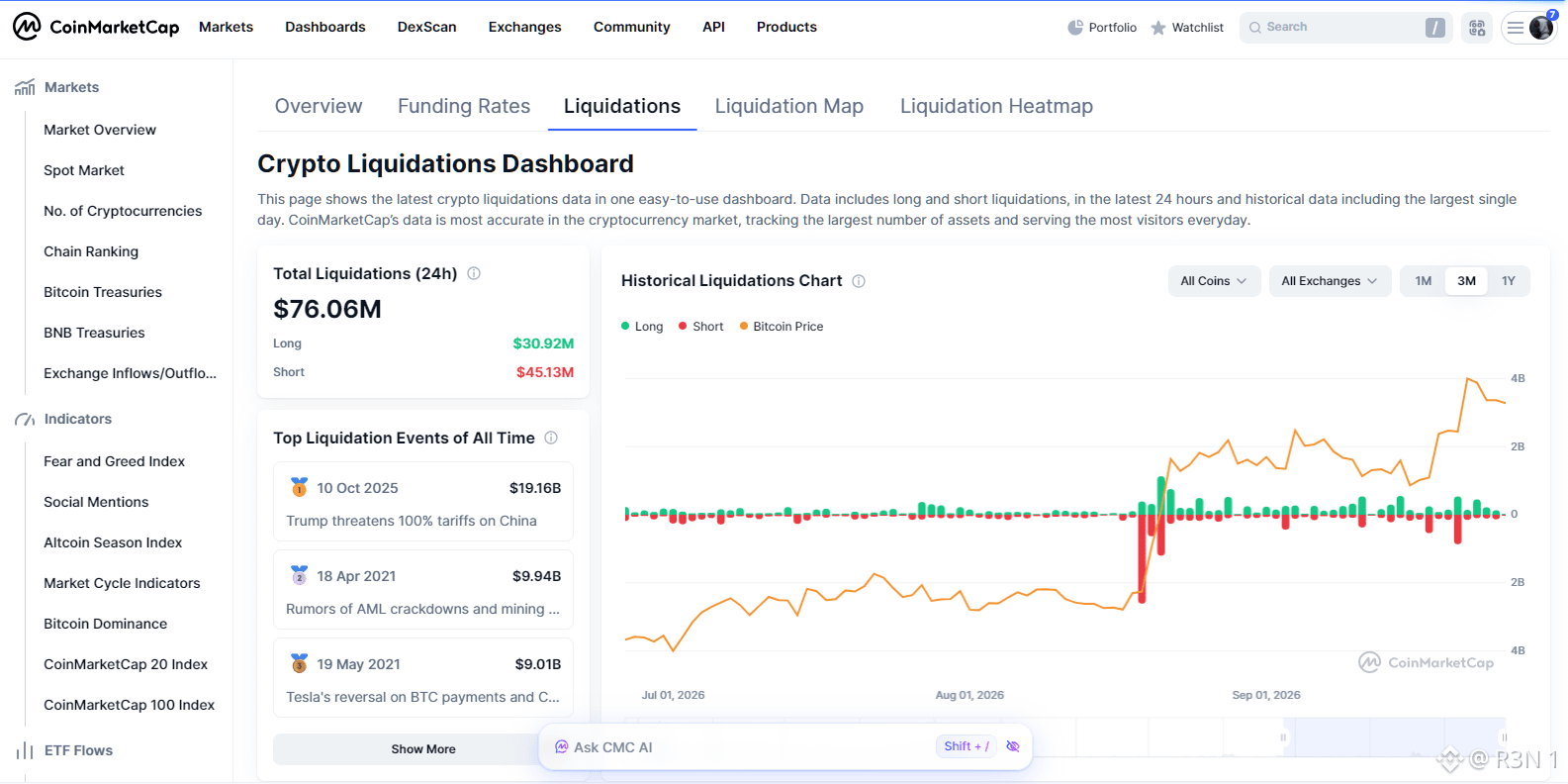
76,06 millions de dollars de liquidations totales au cours des 24 dernières heures, réparties entre 30,92 millions de dollars en positions longues contre 45,13 millions de dollars en positions courtes. Les liquidations à découvert menant la danse ne sont pas inhabituelles lors d’un rallye : c’est même le mécanisme attendu. Lorsque le prix grimpe, il force les shorts à couvrir, ce qui constitue une situation différente de celle de la forte hausse visible plus tôt sur ce même graphique. Cette pointe, la grande barre rouge visible dans la vue historique vers la mi-septembre, coïncide directement avec l’échec au Sénat de la loi CLARITY et avec la hausse des taux de la Fed sur la même période : deux catalyseurs réels qui ont déclenché de véritables liquidations de positions longues lorsque le BTC chutait vers 75 000 $. Ce qui est notable sur le graphique depuis lors, c’est que les liquidations sont restées élevées et volatiles des deux côtés : alternance de pics verts et rouges, plutôt que de retomber vers les barres plus calmes et plus petites qui dominaient en juillet et pendant la majeure partie d’août. La ligne de prix du BTC sur ce graphique raconte toutefois la partie la plus importante de l’histoire : elle a fortement baissé au moment de cette pointe de liquidations, puis a continué de grimper ensuite jusqu’aux récents sommets. Cette séquence compte : le marché a absorbé un choc réel et a continué de progresser, plutôt que l’événement de liquidation ne marque un sommet durable. Mon avis sans détour : l’instantané d’aujourd’hui, avec des liquidations courtes dépassant les longues à une échelle modérée, correspond à un marché qui continue de digérer une véritable tendance haussière plutôt que de montrer un malaise. La plus grande pointe historique plus tôt dans le mois a été le véritable test de résistance, et la reprise du prix au-delà de ce niveau dit davantage sur la demande sous-jacente que sur la division des liquidations d’une seule journée. Ce que je surveille : si les liquidations restent aussi élevées et équilibrées entre les deux côtés alors que le prix continue de monter, ou si elles retombent vers le niveau plus calme d’avant septembre, ce qui indiquerait que le marché trouve une tendance plus stabilisée plutôt que de remuer constamment avec l’effet de levier. #Analyse du prix du BTC# #Saison des altcoins# #BNBChain# $BTC $ETH
76,06 millions de dollars de liquidations totales au cours des 24 dernières heures, réparties entre 30,92 millions de dollars en positions longues contre 45,13 millions de dollars en positions courtes. Les liquidations à découvert menant la danse ne sont pas inhabituelles lors d’un rallye : c’est même le mécanisme attendu. Lorsque le prix grimpe, il force les shorts à couvrir, ce qui constitue une situation différente de celle de la forte hausse visible plus tôt sur ce même graphique. Cette pointe, la grande barre rouge visible dans la vue historique vers la mi-septembre, coïncide directement avec l’échec au Sénat de la loi CLARITY et avec la hausse des taux de la Fed sur la même période : deux catalyseurs réels qui ont déclenché de véritables liquidations de positions longues lorsque le BTC chutait vers 75 000 $. Ce qui est notable sur le graphique depuis lors, c’est que les liquidations sont restées élevées et volatiles des deux côtés : alternance de pics verts et rouges, plutôt que de retomber vers les barres plus calmes et plus petites qui dominaient en juillet et pendant la majeure partie d’août. La ligne de prix du BTC sur ce graphique raconte toutefois la partie la plus importante de l’histoire : elle a fortement baissé au moment de cette pointe de liquidations, puis a continué de grimper ensuite jusqu’aux récents sommets. Cette séquence compte : le marché a absorbé un choc réel et a continué de progresser, plutôt que l’événement de liquidation ne marque un sommet durable. Mon avis sans détour : l’instantané d’aujourd’hui, avec des liquidations courtes dépassant les longues à une échelle modérée, correspond à un marché qui continue de digérer une véritable tendance haussière plutôt que de montrer un malaise. La plus grande pointe historique plus tôt dans le mois a été le véritable test de résistance, et la reprise du prix au-delà de ce niveau dit davantage sur la demande sous-jacente que sur la division des liquidations d’une seule journée. Ce que je surveille : si les liquidations restent aussi élevées et équilibrées entre les deux côtés alors que le prix continue de monter, ou si elles retombent vers le niveau plus calme d’avant septembre, ce qui indiquerait que le marché trouve une tendance plus stabilisée plutôt que de remuer constamment avec l’effet de levier. #Analyse du prix du BTC# #Saison des altcoins# #BNBChain# $BTC $ETH
27
·
--
PUMP fait encore du bruit.
Le token Pump est en hausse d’environ 11% sur les dernières 24 heures, s’échangeant autour de 0,00446$, avec une capitalisation boursière qui dépasse désormais les 2Md$.
Mais le chiffre qui a attiré mon attention n’est pas le prix.
C’est le volume.
Le volume d’échanges sur 24h se situe autour de 280M$, en hausse de plus de 53% en même temps que le mouvement.
Cela me dit que ce n’est pas juste une progression lente. Il y a une attention nouvelle et de véritables transactions derrière.
Et Pump est maintenant en hausse d’environ 133% sur l’année.
Cela dit, c’est là que je ralentis.
Une capitalisation de 2Md$ face à une FDV de 4,46Md$ laisse un écart assez important entre la valorisation en circulation et la valorisation totalement diluée. Et avec des récits propulsés par les launchpads, l’élan peut changer très vite.
Une chose que j’ai apprise en observant la DeFi, c’est que la métrique mise en avant ne raconte presque jamais toute l’histoire.
Le prix peut bouger.
Le volume peut exploser.
Mais je veux savoir ce qui se passe en dessous et si l’activité peut réellement la soutenir.
C’est pour ça que je surveille le volume plus que la bougie verte.
Si les acheteurs continuent d’affluer et que PUMP commence à construire au-dessus de ces niveaux, le mouvement devient beaucoup plus intéressant.
Si le volume disparaît et que le prix rend tout, alors il s’agissait peut-être simplement d’une autre rotation de liquidité.
Pour l’instant, je regarde ce qui se passe sous le mouvement.
Découvrez l’infrastructure derrière la liquidité onchain → https://ston.fi/omniston
$PUMP #BTC Price Analysis# $BTC #Altcoin Season#
PUMP fait encore du bruit.
Le token Pump est en hausse d’environ 11% sur les dernières 24 heures, s’échangeant autour de 0,00446$, avec une capitalisation boursière qui dépasse désormais les 2Md$.
Mais le chiffre qui a attiré mon attention n’est pas le prix.
C’est le volume.
Le volume d’échanges sur 24h se situe autour de 280M$, en hausse de plus de 53% en même temps que le mouvement.
Cela me dit que ce n’est pas juste une progression lente. Il y a une attention nouvelle et de véritables transactions derrière.
Et Pump est maintenant en hausse d’environ 133% sur l’année.
Cela dit, c’est là que je ralentis.
Une capitalisation de 2Md$ face à une FDV de 4,46Md$ laisse un écart assez important entre la valorisation en circulation et la valorisation totalement diluée. Et avec des récits propulsés par les launchpads, l’élan peut changer très vite.
Une chose que j’ai apprise en observant la DeFi, c’est que la métrique mise en avant ne raconte presque jamais toute l’histoire.
Le prix peut bouger.
Le volume peut exploser.
Mais je veux savoir ce qui se passe en dessous et si l’activité peut réellement la soutenir.
C’est pour ça que je surveille le volume plus que la bougie verte.
Si les acheteurs continuent d’affluer et que PUMP commence à construire au-dessus de ces niveaux, le mouvement devient beaucoup plus intéressant.
Si le volume disparaît et que le prix rend tout, alors il s’agissait peut-être simplement d’une autre rotation de liquidité.
Pour l’instant, je regarde ce qui se passe sous le mouvement.
Découvrez l’infrastructure derrière la liquidité onchain → https://ston.fi/omniston
$PUMP #BTC Price Analysis# $BTC #Altcoin Season#
Le token Pump est en hausse d’environ 11% sur les dernières 24 heures, s’échangeant autour de 0,00446$, avec une capitalisation boursière qui dépasse désormais les 2Md$.
Mais le chiffre qui a attiré mon attention n’est pas le prix.
C’est le volume.
Le volume d’échanges sur 24h se situe autour de 280M$, en hausse de plus de 53% en même temps que le mouvement.
Cela me dit que ce n’est pas juste une progression lente. Il y a une attention nouvelle et de véritables transactions derrière.
Et Pump est maintenant en hausse d’environ 133% sur l’année.
Cela dit, c’est là que je ralentis.
Une capitalisation de 2Md$ face à une FDV de 4,46Md$ laisse un écart assez important entre la valorisation en circulation et la valorisation totalement diluée. Et avec des récits propulsés par les launchpads, l’élan peut changer très vite.
Une chose que j’ai apprise en observant la DeFi, c’est que la métrique mise en avant ne raconte presque jamais toute l’histoire.
Le prix peut bouger.
Le volume peut exploser.
Mais je veux savoir ce qui se passe en dessous et si l’activité peut réellement la soutenir.
C’est pour ça que je surveille le volume plus que la bougie verte.
Si les acheteurs continuent d’affluer et que PUMP commence à construire au-dessus de ces niveaux, le mouvement devient beaucoup plus intéressant.
Si le volume disparaît et que le prix rend tout, alors il s’agissait peut-être simplement d’une autre rotation de liquidité.
Pour l’instant, je regarde ce qui se passe sous le mouvement.
Découvrez l’infrastructure derrière la liquidité onchain → https://ston.fi/omniston
$PUMP #BTC Price Analysis# $BTC #Altcoin Season#
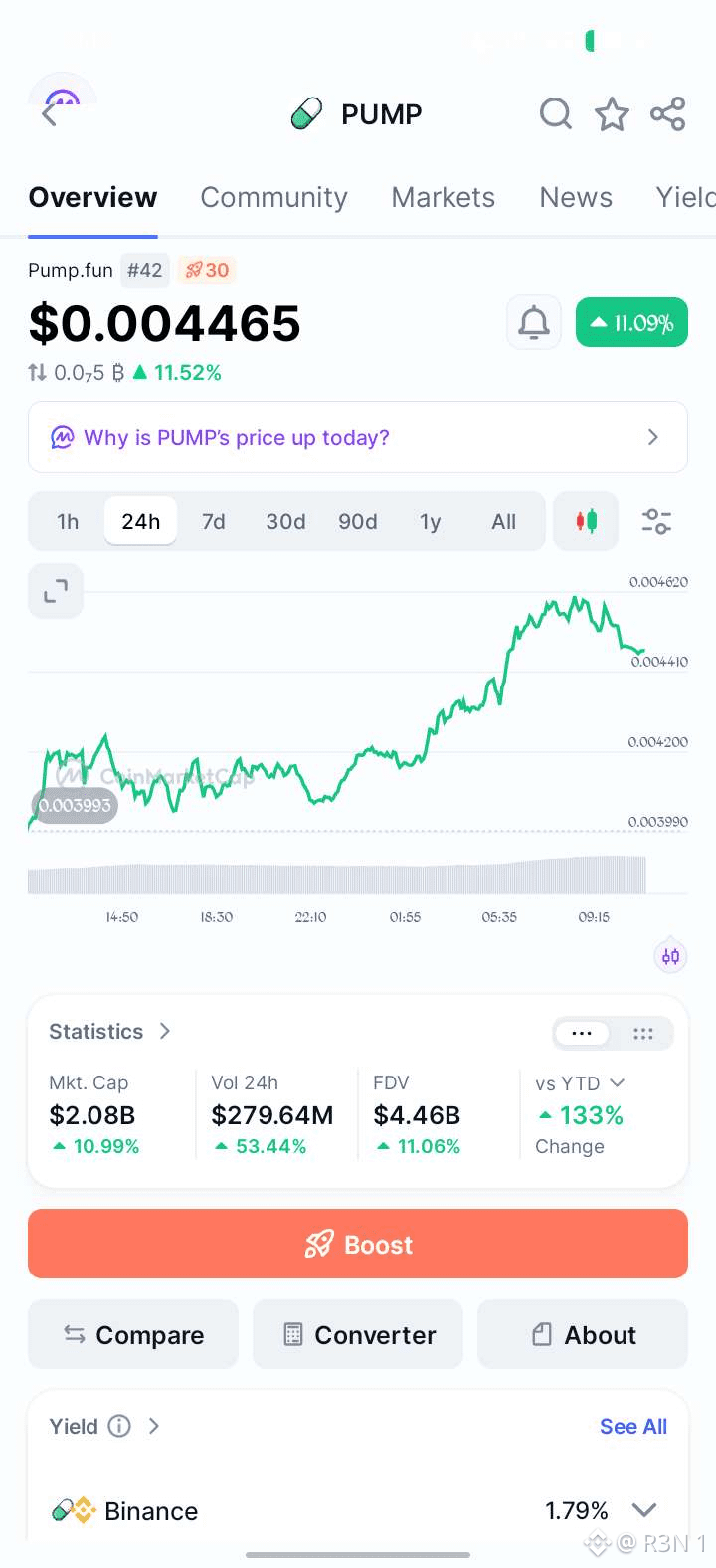
40
·
--
Le glissement (slippage) et l’impact sur le prix (price impact) sont deux termes parmi les plus couramment confondus dans DeFi. La plupart des utilisateurs les traitent comme interchangeables. Ils décrivent pourtant des choses différentes, et comprendre les deux change la façon dont vous configurez vos échanges.
L’impact sur le prix correspond à ce que votre transaction spécifique fait au prix du pool. Lorsque vous achetez un actif depuis un pool de liquidité, vous retirez cet actif du pool et vous ajoutez l’actif que vous vendez. Cela modifie le ratio des actifs dans le pool, ce qui fait varier le prix. Un petit échange dans un pool profond entraîne un impact minime sur le prix. Un gros échange dans un pool peu profond entraîne un impact significatif : vous déplacez en réalité le marché contre vous au moment où vous exécutez.
L’impact sur le prix est déterministe. Étant donné la profondeur actuelle du pool et la taille de votre échange, l’impact sur le prix est calculable avant de soumettre la transaction. L’interface de STONfi affiche ce chiffre avant la confirmation. Un impact sur le prix supérieur à 1 % sur un échange en stablecoins mérite d’être reconsidéré. Au-delà de 3 % sur n’importe quel échange, c’est généralement le signe que le pool est trop peu profond pour la taille de votre transaction.
Le glissement, lui, est différent. Il s’agit de l’écart entre le prix que vous aviez anticipé au moment de soumettre la transaction et le prix que vous avez réellement reçu une fois la transaction confirmée. Le glissement se produit parce que d’autres transactions peuvent être traitées entre votre soumission et la confirmation, modifiant l’état du pool avant l’exécution de votre échange.
La tolérance au glissement correspond au glissement maximal que vous êtes prêt à accepter. Si vous la fixez trop bas, votre transaction échoue s’il y a le moindre mouvement de prix entre la soumission et la confirmation. Si vous la fixez trop haut, vous acceptez plus d’écart que nécessaire. Pour les échanges en stablecoins, 0,5 % est généralement approprié. Pour les échanges d’actifs volatils, 1 % à 2 % est plus réaliste pendant les périodes actives du marché.
Impact sur le prix connu avant confirmation. Le glissement, c’est ce qui peut se produire entre la soumission et la confirmation. Les deux comptent et nécessitent des réponses différentes.
Échanger sur STONfi → https://app.ston.fi/swap
$BTC #BTC Analyse de prix# #Meme Alpha# $SOL
Le glissement (slippage) et l’impact sur le prix (price impact) sont deux termes parmi les plus couramment confondus dans DeFi. La plupart des utilisateurs les traitent comme interchangeables. Ils décrivent pourtant des choses différentes, et comprendre les deux change la façon dont vous configurez vos échanges.
L’impact sur le prix correspond à ce que votre transaction spécifique fait au prix du pool. Lorsque vous achetez un actif depuis un pool de liquidité, vous retirez cet actif du pool et vous ajoutez l’actif que vous vendez. Cela modifie le ratio des actifs dans le pool, ce qui fait varier le prix. Un petit échange dans un pool profond entraîne un impact minime sur le prix. Un gros échange dans un pool peu profond entraîne un impact significatif : vous déplacez en réalité le marché contre vous au moment où vous exécutez.
L’impact sur le prix est déterministe. Étant donné la profondeur actuelle du pool et la taille de votre échange, l’impact sur le prix est calculable avant de soumettre la transaction. L’interface de STONfi affiche ce chiffre avant la confirmation. Un impact sur le prix supérieur à 1 % sur un échange en stablecoins mérite d’être reconsidéré. Au-delà de 3 % sur n’importe quel échange, c’est généralement le signe que le pool est trop peu profond pour la taille de votre transaction.
Le glissement, lui, est différent. Il s’agit de l’écart entre le prix que vous aviez anticipé au moment de soumettre la transaction et le prix que vous avez réellement reçu une fois la transaction confirmée. Le glissement se produit parce que d’autres transactions peuvent être traitées entre votre soumission et la confirmation, modifiant l’état du pool avant l’exécution de votre échange.
La tolérance au glissement correspond au glissement maximal que vous êtes prêt à accepter. Si vous la fixez trop bas, votre transaction échoue s’il y a le moindre mouvement de prix entre la soumission et la confirmation. Si vous la fixez trop haut, vous acceptez plus d’écart que nécessaire. Pour les échanges en stablecoins, 0,5 % est généralement approprié. Pour les échanges d’actifs volatils, 1 % à 2 % est plus réaliste pendant les périodes actives du marché.
Impact sur le prix connu avant confirmation. Le glissement, c’est ce qui peut se produire entre la soumission et la confirmation. Les deux comptent et nécessitent des réponses différentes.
Échanger sur STONfi → https://app.ston.fi/swap
$BTC #BTC Analyse de prix# #Meme Alpha# $SOL
L’impact sur le prix correspond à ce que votre transaction spécifique fait au prix du pool. Lorsque vous achetez un actif depuis un pool de liquidité, vous retirez cet actif du pool et vous ajoutez l’actif que vous vendez. Cela modifie le ratio des actifs dans le pool, ce qui fait varier le prix. Un petit échange dans un pool profond entraîne un impact minime sur le prix. Un gros échange dans un pool peu profond entraîne un impact significatif : vous déplacez en réalité le marché contre vous au moment où vous exécutez.
L’impact sur le prix est déterministe. Étant donné la profondeur actuelle du pool et la taille de votre échange, l’impact sur le prix est calculable avant de soumettre la transaction. L’interface de STONfi affiche ce chiffre avant la confirmation. Un impact sur le prix supérieur à 1 % sur un échange en stablecoins mérite d’être reconsidéré. Au-delà de 3 % sur n’importe quel échange, c’est généralement le signe que le pool est trop peu profond pour la taille de votre transaction.
Le glissement, lui, est différent. Il s’agit de l’écart entre le prix que vous aviez anticipé au moment de soumettre la transaction et le prix que vous avez réellement reçu une fois la transaction confirmée. Le glissement se produit parce que d’autres transactions peuvent être traitées entre votre soumission et la confirmation, modifiant l’état du pool avant l’exécution de votre échange.
La tolérance au glissement correspond au glissement maximal que vous êtes prêt à accepter. Si vous la fixez trop bas, votre transaction échoue s’il y a le moindre mouvement de prix entre la soumission et la confirmation. Si vous la fixez trop haut, vous acceptez plus d’écart que nécessaire. Pour les échanges en stablecoins, 0,5 % est généralement approprié. Pour les échanges d’actifs volatils, 1 % à 2 % est plus réaliste pendant les périodes actives du marché.
Impact sur le prix connu avant confirmation. Le glissement, c’est ce qui peut se produire entre la soumission et la confirmation. Les deux comptent et nécessitent des réponses différentes.
Échanger sur STONfi → https://app.ston.fi/swap
$BTC #BTC Analyse de prix# #Meme Alpha# $SOL

44
·
--
Voir la traduction
$1.23 million just moved through Binance and landed in the Bitget hacker's wallet, two days after the original breach. The laundering trail is still active in real time, not wrapped up.
Per Arkham and multiple on chain trackers, wallet 0x4885 withdrew 257.6 ETH and 545,000 USDT from Binance on September 26, swapped the USDT for another 200.2 ETH, then forwarded all 457.9 ETH to an address tied to the Bitget attacker. This follows the same playbook as five earlier Binance withdrawals from September 25, pull funds from a major exchange, consolidate into ETH, move it somewhere no single platform can freeze.
Worth updating the broader numbers too. Bitget's total loss was revised upward from $351.6 million to $387.5 million after investigators found additional affected assets on Zcash and TRON not included in the initial estimate. North Korean linked actors, possibly Lazarus Group, are now suspected based on IP address patterns, though that attribution remains unconfirmed by authorities. The attack itself didn't involve stolen keys, the attacker compromised Bitget's backend system, spoofing transaction data to trick it into authorizing transfers that looked legitimate internally.
My honest read: this specific $1.23 million movement is small relative to the total loss, but it matters as a signal, the laundering operation is still active and methodical two days later, not a one time smash and grab. Bitget and Binance collaborating on tracing this publicly is a genuine positive, transparency here beats silence, but tracing funds and recovering them are different outcomes.
What I'm watching: whether any of these tracked addresses actually get frozen or funds recovered, versus this staying a running commentary on funds moving further out of reach.
$BTC $ETH #Macro Insights# #BNBChain# #BTC Price Analysis#
$1.23 million just moved through Binance and landed in the Bitget hacker's wallet, two days after the original breach. The laundering trail is still active in real time, not wrapped up.
Per Arkham and multiple on chain trackers, wallet 0x4885 withdrew 257.6 ETH and 545,000 USDT from Binance on September 26, swapped the USDT for another 200.2 ETH, then forwarded all 457.9 ETH to an address tied to the Bitget attacker. This follows the same playbook as five earlier Binance withdrawals from September 25, pull funds from a major exchange, consolidate into ETH, move it somewhere no single platform can freeze.
Worth updating the broader numbers too. Bitget's total loss was revised upward from $351.6 million to $387.5 million after investigators found additional affected assets on Zcash and TRON not included in the initial estimate. North Korean linked actors, possibly Lazarus Group, are now suspected based on IP address patterns, though that attribution remains unconfirmed by authorities. The attack itself didn't involve stolen keys, the attacker compromised Bitget's backend system, spoofing transaction data to trick it into authorizing transfers that looked legitimate internally.
My honest read: this specific $1.23 million movement is small relative to the total loss, but it matters as a signal, the laundering operation is still active and methodical two days later, not a one time smash and grab. Bitget and Binance collaborating on tracing this publicly is a genuine positive, transparency here beats silence, but tracing funds and recovering them are different outcomes.
What I'm watching: whether any of these tracked addresses actually get frozen or funds recovered, versus this staying a running commentary on funds moving further out of reach.
$BTC $ETH #Macro Insights# #BNBChain# #BTC Price Analysis#
Per Arkham and multiple on chain trackers, wallet 0x4885 withdrew 257.6 ETH and 545,000 USDT from Binance on September 26, swapped the USDT for another 200.2 ETH, then forwarded all 457.9 ETH to an address tied to the Bitget attacker. This follows the same playbook as five earlier Binance withdrawals from September 25, pull funds from a major exchange, consolidate into ETH, move it somewhere no single platform can freeze.
Worth updating the broader numbers too. Bitget's total loss was revised upward from $351.6 million to $387.5 million after investigators found additional affected assets on Zcash and TRON not included in the initial estimate. North Korean linked actors, possibly Lazarus Group, are now suspected based on IP address patterns, though that attribution remains unconfirmed by authorities. The attack itself didn't involve stolen keys, the attacker compromised Bitget's backend system, spoofing transaction data to trick it into authorizing transfers that looked legitimate internally.
My honest read: this specific $1.23 million movement is small relative to the total loss, but it matters as a signal, the laundering operation is still active and methodical two days later, not a one time smash and grab. Bitget and Binance collaborating on tracing this publicly is a genuine positive, transparency here beats silence, but tracing funds and recovering them are different outcomes.
What I'm watching: whether any of these tracked addresses actually get frozen or funds recovered, versus this staying a running commentary on funds moving further out of reach.
$BTC $ETH #Macro Insights# #BNBChain# #BTC Price Analysis#

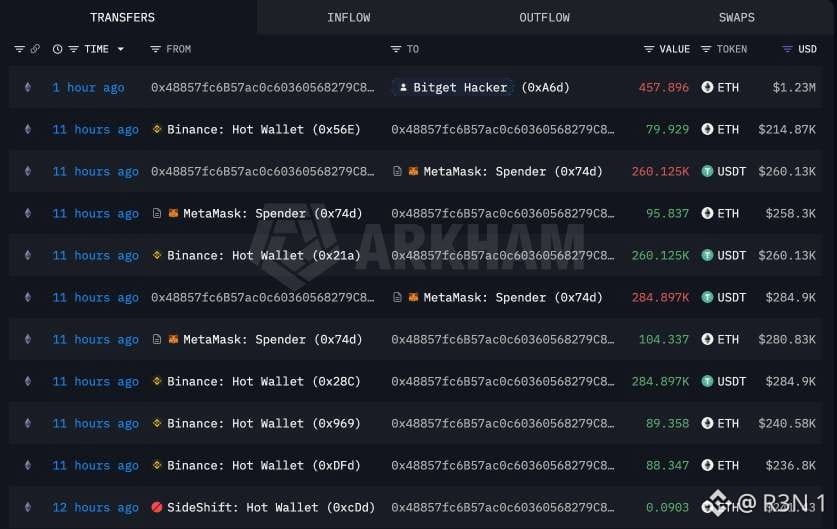
58
·
--
Aucune clé privée n’a été volée ici. Ce détail compte plus que le titre de 351,6 millions de dollars, car il change la nature réelle du problème.
La PDG de Bitget, Gracy Chen, a confirmé que l’attaquant avait compromis un système backend au sein de l’infrastructure du portefeuille, falsifié des données de transaction et déclenché le propre processus d’autorisation de l’échange pour faire sortir des fonds, plutôt que d’obtenir les clés directement. La compromission a touché les portefeuilles à chaud et à tiède, détectée à 18 h 31 UTC le 24 septembre. Le XRP a été l’actif unique le plus important pris ; selon Lookonchain, il s’agit de 102,93 millions de tokens d’une valeur de 157,48 millions de dollars. Les portefeuilles à froid, dit Bitget, restent entièrement sûrs et n’ont pas été touchés.
La réponse a été rapide, du moins sur le papier. Des protocoles d’urgence ont été activés en quelques minutes : les retraits ont été suspendus en attendant un examen de sécurité, tandis que les dépôts et les échanges restaient ouverts. Chen affirme que la perte totale relève du Fonds de protection des utilisateurs de Bitget, qui détient plus de 464 millions de dollars. Les forces de l’ordre et des sociétés de sécurité on-chain ont été informées ; des adresses ciblées ont déjà été identifiées. Chen a également indiqué que des similitudes préliminaires d’IP et de VPN suggèrent une éventuelle implication nord-coréenne, même si elle s’est abstenue de le confirmer.
Le contexte qui compte : il s’agit désormais du plus important vol de crypto à un seul montant de 2026, dépassant les quelque 320 millions de dollars dérobés au Liquid Network de Blockstream le 6 septembre, faisant de septembre le mois le plus coûteux pour les piratages de crypto cette année.
Mon avis honnête : un processus d’autorisation compromis plutôt que des clés volées correspond à un mode de défaillance plus facilement contenible ; un problème d’infrastructure ou de contrôle d’accès plutôt qu’une compromission cryptographique, et la séparation des portefeuilles à froid a tenu. La question de savoir si les fonds sont réellement en sécurité dépend encore du fait que le fonds de protection verse effectivement les indemnisations promises.
Ce que je surveille : le rapport technique complet que Chen a promis, et si les retraits reprennent une fois l’examen terminé. Elle a explicitement dit qu’elle ne s’engagerait pas sur un calendrier qu’elle ne pourrait pas garantir.
#BTC Price Analysis# #Altcoin Season# $BTC $ETH
Aucune clé privée n’a été volée ici. Ce détail compte plus que le titre de 351,6 millions de dollars, car il change la nature réelle du problème.
La PDG de Bitget, Gracy Chen, a confirmé que l’attaquant avait compromis un système backend au sein de l’infrastructure du portefeuille, falsifié des données de transaction et déclenché le propre processus d’autorisation de l’échange pour faire sortir des fonds, plutôt que d’obtenir les clés directement. La compromission a touché les portefeuilles à chaud et à tiède, détectée à 18 h 31 UTC le 24 septembre. Le XRP a été l’actif unique le plus important pris ; selon Lookonchain, il s’agit de 102,93 millions de tokens d’une valeur de 157,48 millions de dollars. Les portefeuilles à froid, dit Bitget, restent entièrement sûrs et n’ont pas été touchés.
La réponse a été rapide, du moins sur le papier. Des protocoles d’urgence ont été activés en quelques minutes : les retraits ont été suspendus en attendant un examen de sécurité, tandis que les dépôts et les échanges restaient ouverts. Chen affirme que la perte totale relève du Fonds de protection des utilisateurs de Bitget, qui détient plus de 464 millions de dollars. Les forces de l’ordre et des sociétés de sécurité on-chain ont été informées ; des adresses ciblées ont déjà été identifiées. Chen a également indiqué que des similitudes préliminaires d’IP et de VPN suggèrent une éventuelle implication nord-coréenne, même si elle s’est abstenue de le confirmer.
Le contexte qui compte : il s’agit désormais du plus important vol de crypto à un seul montant de 2026, dépassant les quelque 320 millions de dollars dérobés au Liquid Network de Blockstream le 6 septembre, faisant de septembre le mois le plus coûteux pour les piratages de crypto cette année.
Mon avis honnête : un processus d’autorisation compromis plutôt que des clés volées correspond à un mode de défaillance plus facilement contenible ; un problème d’infrastructure ou de contrôle d’accès plutôt qu’une compromission cryptographique, et la séparation des portefeuilles à froid a tenu. La question de savoir si les fonds sont réellement en sécurité dépend encore du fait que le fonds de protection verse effectivement les indemnisations promises.
Ce que je surveille : le rapport technique complet que Chen a promis, et si les retraits reprennent une fois l’examen terminé. Elle a explicitement dit qu’elle ne s’engagerait pas sur un calendrier qu’elle ne pourrait pas garantir.
#BTC Price Analysis# #Altcoin Season# $BTC $ETH
La PDG de Bitget, Gracy Chen, a confirmé que l’attaquant avait compromis un système backend au sein de l’infrastructure du portefeuille, falsifié des données de transaction et déclenché le propre processus d’autorisation de l’échange pour faire sortir des fonds, plutôt que d’obtenir les clés directement. La compromission a touché les portefeuilles à chaud et à tiède, détectée à 18 h 31 UTC le 24 septembre. Le XRP a été l’actif unique le plus important pris ; selon Lookonchain, il s’agit de 102,93 millions de tokens d’une valeur de 157,48 millions de dollars. Les portefeuilles à froid, dit Bitget, restent entièrement sûrs et n’ont pas été touchés.
La réponse a été rapide, du moins sur le papier. Des protocoles d’urgence ont été activés en quelques minutes : les retraits ont été suspendus en attendant un examen de sécurité, tandis que les dépôts et les échanges restaient ouverts. Chen affirme que la perte totale relève du Fonds de protection des utilisateurs de Bitget, qui détient plus de 464 millions de dollars. Les forces de l’ordre et des sociétés de sécurité on-chain ont été informées ; des adresses ciblées ont déjà été identifiées. Chen a également indiqué que des similitudes préliminaires d’IP et de VPN suggèrent une éventuelle implication nord-coréenne, même si elle s’est abstenue de le confirmer.
Le contexte qui compte : il s’agit désormais du plus important vol de crypto à un seul montant de 2026, dépassant les quelque 320 millions de dollars dérobés au Liquid Network de Blockstream le 6 septembre, faisant de septembre le mois le plus coûteux pour les piratages de crypto cette année.
Mon avis honnête : un processus d’autorisation compromis plutôt que des clés volées correspond à un mode de défaillance plus facilement contenible ; un problème d’infrastructure ou de contrôle d’accès plutôt qu’une compromission cryptographique, et la séparation des portefeuilles à froid a tenu. La question de savoir si les fonds sont réellement en sécurité dépend encore du fait que le fonds de protection verse effectivement les indemnisations promises.
Ce que je surveille : le rapport technique complet que Chen a promis, et si les retraits reprennent une fois l’examen terminé. Elle a explicitement dit qu’elle ne s’engagerait pas sur un calendrier qu’elle ne pourrait pas garantir.
#BTC Price Analysis# #Altcoin Season# $BTC $ETH

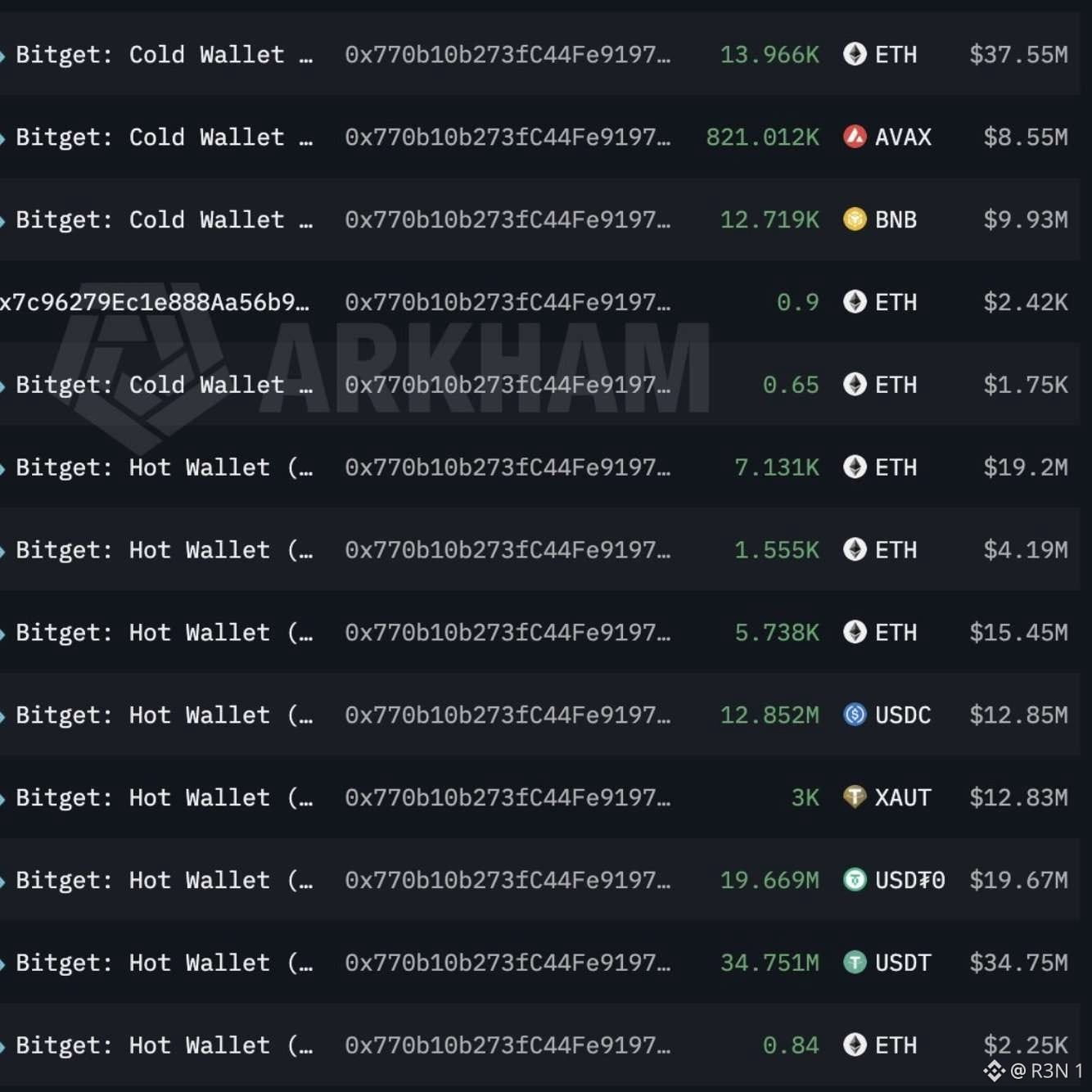
59
·
--
Un pool de liquidité est un smart contract qui détient deux actifs que les utilisateurs peuvent échanger entre eux. Les actifs sont déposés par des apporteurs de liquidité, des personnes qui bloquent leurs tokens dans le contrat en échange d’une part des frais que chaque échange génère.
Quand quelqu’un échange Token A contre Token B sur un DEX comme Ston.fi, il ne fait pas un échange contre une autre personne. Il échange contre le pool. Le pool fournit toujours un prix à l’aide d’une formule basée sur le ratio actuel des deux actifs. Acheter Token A fait bouger le ratio : Token A devient plus cher, tandis que Token B devient moins cher. La formule le fait automatiquement à chaque transaction.
Les apporteurs de liquidité gagnent car chaque échange paie des frais. Sur Ston.fi, ces frais correspondent à 0,2 % du montant de l’échange. Ce 0,2 % est distribué à tous ceux qui apportent de la liquidité au pool, proportionnellement à leur part. Si vous détenez 1 % de la liquidité totale du pool, vous gagnez 1 % de chaque frais généré.
L’enjeu, c’est la perte impermanente. Quand le ratio de prix entre les deux actifs de votre pool change, le pool se rééquilibre automatiquement à votre détriment : il accumule davantage de l’actif dont le prix baisse et moins de celui dont le prix augmente. Lorsque vous retirez votre position, celle-ci reflète ce ratio rééquilibré plutôt que ce que vous aviez déposé. La différence entre ce que vous auriez détenu et ce que vous détenez réellement correspond à la perte impermanente.
Le fait de fournir de la liquidité est rentable ou non dépend de si les frais gagnés dépassent la perte impermanente accumulée sur la période de détention. Les pools avec un volume de transactions élevé par rapport à leur liquidité totale génèrent plus de frais par dollar déployé. Les paires stables, dont le ratio de prix change rarement, produisent moins de perte impermanente.
Lire ensemble ces deux chiffres avant d’entrer dans n’importe quel pool est le point de départ pour évaluer si la position a du sens.
Explorez les pools STONfi → https://app.ston.fi/pools
$BTC #BTC Price Analysis# #Meme Alpha# $SOL
Un pool de liquidité est un smart contract qui détient deux actifs que les utilisateurs peuvent échanger entre eux. Les actifs sont déposés par des apporteurs de liquidité, des personnes qui bloquent leurs tokens dans le contrat en échange d’une part des frais que chaque échange génère.
Quand quelqu’un échange Token A contre Token B sur un DEX comme Ston.fi, il ne fait pas un échange contre une autre personne. Il échange contre le pool. Le pool fournit toujours un prix à l’aide d’une formule basée sur le ratio actuel des deux actifs. Acheter Token A fait bouger le ratio : Token A devient plus cher, tandis que Token B devient moins cher. La formule le fait automatiquement à chaque transaction.
Les apporteurs de liquidité gagnent car chaque échange paie des frais. Sur Ston.fi, ces frais correspondent à 0,2 % du montant de l’échange. Ce 0,2 % est distribué à tous ceux qui apportent de la liquidité au pool, proportionnellement à leur part. Si vous détenez 1 % de la liquidité totale du pool, vous gagnez 1 % de chaque frais généré.
L’enjeu, c’est la perte impermanente. Quand le ratio de prix entre les deux actifs de votre pool change, le pool se rééquilibre automatiquement à votre détriment : il accumule davantage de l’actif dont le prix baisse et moins de celui dont le prix augmente. Lorsque vous retirez votre position, celle-ci reflète ce ratio rééquilibré plutôt que ce que vous aviez déposé. La différence entre ce que vous auriez détenu et ce que vous détenez réellement correspond à la perte impermanente.
Le fait de fournir de la liquidité est rentable ou non dépend de si les frais gagnés dépassent la perte impermanente accumulée sur la période de détention. Les pools avec un volume de transactions élevé par rapport à leur liquidité totale génèrent plus de frais par dollar déployé. Les paires stables, dont le ratio de prix change rarement, produisent moins de perte impermanente.
Lire ensemble ces deux chiffres avant d’entrer dans n’importe quel pool est le point de départ pour évaluer si la position a du sens.
Explorez les pools STONfi → https://app.ston.fi/pools
$BTC #BTC Price Analysis# #Meme Alpha# $SOL
Quand quelqu’un échange Token A contre Token B sur un DEX comme Ston.fi, il ne fait pas un échange contre une autre personne. Il échange contre le pool. Le pool fournit toujours un prix à l’aide d’une formule basée sur le ratio actuel des deux actifs. Acheter Token A fait bouger le ratio : Token A devient plus cher, tandis que Token B devient moins cher. La formule le fait automatiquement à chaque transaction.
Les apporteurs de liquidité gagnent car chaque échange paie des frais. Sur Ston.fi, ces frais correspondent à 0,2 % du montant de l’échange. Ce 0,2 % est distribué à tous ceux qui apportent de la liquidité au pool, proportionnellement à leur part. Si vous détenez 1 % de la liquidité totale du pool, vous gagnez 1 % de chaque frais généré.
L’enjeu, c’est la perte impermanente. Quand le ratio de prix entre les deux actifs de votre pool change, le pool se rééquilibre automatiquement à votre détriment : il accumule davantage de l’actif dont le prix baisse et moins de celui dont le prix augmente. Lorsque vous retirez votre position, celle-ci reflète ce ratio rééquilibré plutôt que ce que vous aviez déposé. La différence entre ce que vous auriez détenu et ce que vous détenez réellement correspond à la perte impermanente.
Le fait de fournir de la liquidité est rentable ou non dépend de si les frais gagnés dépassent la perte impermanente accumulée sur la période de détention. Les pools avec un volume de transactions élevé par rapport à leur liquidité totale génèrent plus de frais par dollar déployé. Les paires stables, dont le ratio de prix change rarement, produisent moins de perte impermanente.
Lire ensemble ces deux chiffres avant d’entrer dans n’importe quel pool est le point de départ pour évaluer si la position a du sens.
Explorez les pools STONfi → https://app.ston.fi/pools
$BTC #BTC Price Analysis# #Meme Alpha# $SOL

33
·
--
Voir la traduction
Omniston is the cross-chain execution protocol built by Ston.fi's development team. It is what powers every swap between TON and the ten chains currently supported in STONfi's cross-chain interface. Understanding what it actually does not just what it is called, is the most useful thing anyone new to TON DeFi can learn before making their first cross-chain move.
The core idea is straightforward. When you submit a cross-chain swap on STONfi you are not sending instructions to a bridge. You are expressing an intent, I want to receive this asset on this chain in this amount. Omniston broadcasts that intent to a network of professional liquidity providers called resolvers. Resolvers compete to fill the intent through a Request for Quote process. The one who offers the best rate wins the order.
The resolver who wins does not just promise to deliver. They lock the destination-side assets in a Hashed Timelock Contract before the user's source-side assets commit. Both contracts share the same cryptographic condition. When the condition is met both sides settle simultaneously. The user receives exactly what was quoted or both sides return to their starting position automatically through the timelock. There is no execution path where both parties lose funds.
This is why quote certainty is the defining property of Omniston swaps. The amount shown at confirmation is the amount that arrives. The resolver committed to delivering it. The HTLC structure enforced that commitment cryptographically rather than through trust.
Omniston currently connects TON to TRON, Ethereum, Base, BNB Chain, Polygon, Avalanche, Arbitrum, Robinhood Chain, and X Layer. It is also integrated into TONCO, My Wallet, TractionEye, Predict, Gramstox, Gram Store, and a growing list of TON products.
Try Omniston →https://app.ston.fi/swap?mode=cross-chain
#BTC Price Analysis# #Macro Insights# $ONDO #Altcoin Season# $LTC
Omniston is the cross-chain execution protocol built by Ston.fi's development team. It is what powers every swap between TON and the ten chains currently supported in STONfi's cross-chain interface. Understanding what it actually does not just what it is called, is the most useful thing anyone new to TON DeFi can learn before making their first cross-chain move.
The core idea is straightforward. When you submit a cross-chain swap on STONfi you are not sending instructions to a bridge. You are expressing an intent, I want to receive this asset on this chain in this amount. Omniston broadcasts that intent to a network of professional liquidity providers called resolvers. Resolvers compete to fill the intent through a Request for Quote process. The one who offers the best rate wins the order.
The resolver who wins does not just promise to deliver. They lock the destination-side assets in a Hashed Timelock Contract before the user's source-side assets commit. Both contracts share the same cryptographic condition. When the condition is met both sides settle simultaneously. The user receives exactly what was quoted or both sides return to their starting position automatically through the timelock. There is no execution path where both parties lose funds.
This is why quote certainty is the defining property of Omniston swaps. The amount shown at confirmation is the amount that arrives. The resolver committed to delivering it. The HTLC structure enforced that commitment cryptographically rather than through trust.
Omniston currently connects TON to TRON, Ethereum, Base, BNB Chain, Polygon, Avalanche, Arbitrum, Robinhood Chain, and X Layer. It is also integrated into TONCO, My Wallet, TractionEye, Predict, Gramstox, Gram Store, and a growing list of TON products.
Try Omniston →https://app.ston.fi/swap?mode=cross-chain
#BTC Price Analysis# #Macro Insights# $ONDO #Altcoin Season# $LTC
The core idea is straightforward. When you submit a cross-chain swap on STONfi you are not sending instructions to a bridge. You are expressing an intent, I want to receive this asset on this chain in this amount. Omniston broadcasts that intent to a network of professional liquidity providers called resolvers. Resolvers compete to fill the intent through a Request for Quote process. The one who offers the best rate wins the order.
The resolver who wins does not just promise to deliver. They lock the destination-side assets in a Hashed Timelock Contract before the user's source-side assets commit. Both contracts share the same cryptographic condition. When the condition is met both sides settle simultaneously. The user receives exactly what was quoted or both sides return to their starting position automatically through the timelock. There is no execution path where both parties lose funds.
This is why quote certainty is the defining property of Omniston swaps. The amount shown at confirmation is the amount that arrives. The resolver committed to delivering it. The HTLC structure enforced that commitment cryptographically rather than through trust.
Omniston currently connects TON to TRON, Ethereum, Base, BNB Chain, Polygon, Avalanche, Arbitrum, Robinhood Chain, and X Layer. It is also integrated into TONCO, My Wallet, TractionEye, Predict, Gramstox, Gram Store, and a growing list of TON products.
Try Omniston →https://app.ston.fi/swap?mode=cross-chain
#BTC Price Analysis# #Macro Insights# $ONDO #Altcoin Season# $LTC
57
Connectez-vous pour découvrir plus de contenu
Rejoignez la communauté mondiale des adeptes de cryptomonnaies sur Binance Square
⚡️ Suviez les dernières informations importantes sur les cryptomonnaies.
💬 Jugé digne de confiance par la plus grande plateforme d’échange de cryptomonnaies au monde.
👍 Découvrez les connaissances que partagent les créateurs vérifiés.
Adresse e-mail/Nº de téléphone
Sujets d’actualité
MetaMaskExitsLidoValidatorsAfterSecurityIncident
41,962 vues
717 mentions
MetaMask signale un incident de sécurité
SOYEZ PRUDENT
MetaMask a confirmé qu’un incident touche une partie de son infrastructure. Par précaution, l’entreprise retire les validateurs concernés de ses opérations de staking non-custodial et travaille avec des partenaires et experts en sécurité.
Point important : MetaMask indique n’avoir identifié aucune menace immédiate pour les wallets MetaMask à ce stade. L’origine et l’étendue exacte de l’incident n’ont pas encore été détaillées.
🛡️ En crypto : pas de panique, mais toujours de la vigilance. Ne cliquez pas sur de faux liens « MetaMask Support » qui pourraient profiter de l’actualité.
💬 Vous utilisez MetaMask ?
#DrYo242 — votre bouclier dans la volatilité.
$LDO $ETH $BTC
#metamaskexitslidovalidatorsaftersecurityincident
DrYo242
·2 mentions J’aime
·53 vues
MicronBeatsEarningsLiftsGuidance
27,830 vues
573 mentions
CFTCSubmitsTwoEventContractRulesToWhiteHouse
20,338 vues
500 mentions