
AngryhulkHuu
273 Publications

AngryhulkHuu
Crypto Market | BTC Analysis Market observations, setups & early narratives.
94 Suivis
85 Abonnés
170 J’aime
Publications
Tous
Citations
Voir la traduction
BTC just gave back the $80K area after pushing above $81K.
What interests me now isn’t whether the move was bullish or bearish. It’s how buyers react after the pullback.
If BTC can reclaim $80K and hold it as support, the recent breakout still has a chance to continue.
But if $80K keeps acting as resistance, I’d rather stay patient and wait for a cleaner setup.
The next move matters less to me than the confirmation behind it.
What do you think comes first: another test of $80K or a deeper pullback?
#bitcoin #BTC #crypto
What interests me now isn’t whether the move was bullish or bearish. It’s how buyers react after the pullback.
If BTC can reclaim $80K and hold it as support, the recent breakout still has a chance to continue.
But if $80K keeps acting as resistance, I’d rather stay patient and wait for a cleaner setup.
The next move matters less to me than the confirmation behind it.
What do you think comes first: another test of $80K or a deeper pullback?
#bitcoin #BTC #crypto

Voir la traduction
I’m paying more attention to how BTC reacts around $80K than the actual pump.
Bitcoin has pushed back above $80K, but after such a strong August rally, this is where I want to see confirmation rather than chase the move.
If BTC can hold above $80K and build support there, the next leg could become interesting.
But if $80K turns into resistance again, a deeper pullback wouldn’t surprise me.
For me, the important question isn’t “how high can BTC go?”
It’s whether buyers can defend the breakout.
What are you watching here: continuation or rejection?
#Bitcoin #BTC #Crypto
Bitcoin has pushed back above $80K, but after such a strong August rally, this is where I want to see confirmation rather than chase the move.
If BTC can hold above $80K and build support there, the next leg could become interesting.
But if $80K turns into resistance again, a deeper pullback wouldn’t surprise me.
For me, the important question isn’t “how high can BTC go?”
It’s whether buyers can defend the breakout.
What are you watching here: continuation or rejection?
#Bitcoin #BTC #Crypto
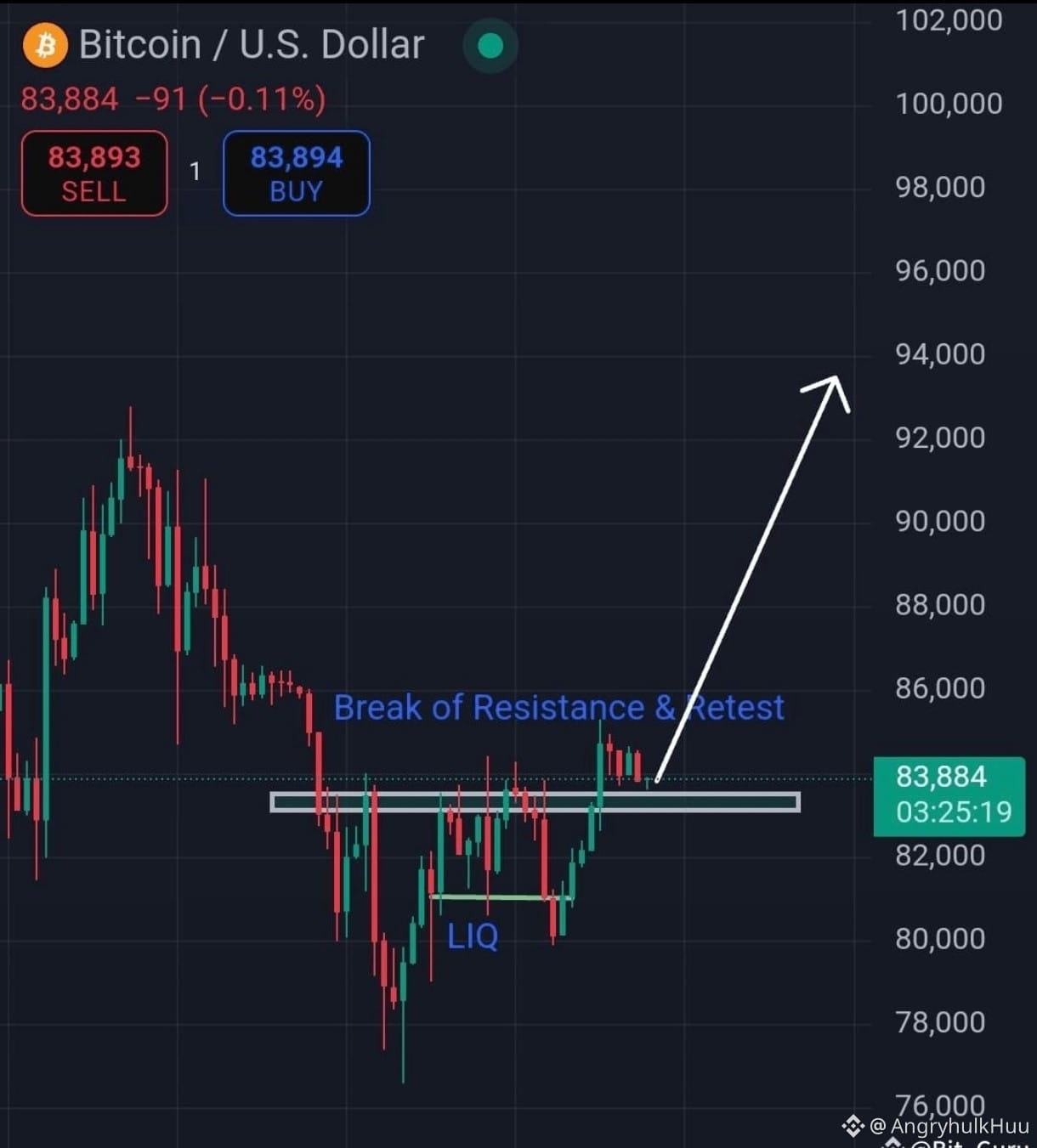
Je ne vais pas appeler ça un véritable retour haussier complet simplement parce que le BTC a touché 80 000 $.
Le mouvement au cours des derniers jours a été impressionnant, mais après une telle reprise, une pause à court terme ou un repli ne me surprendrait pas.
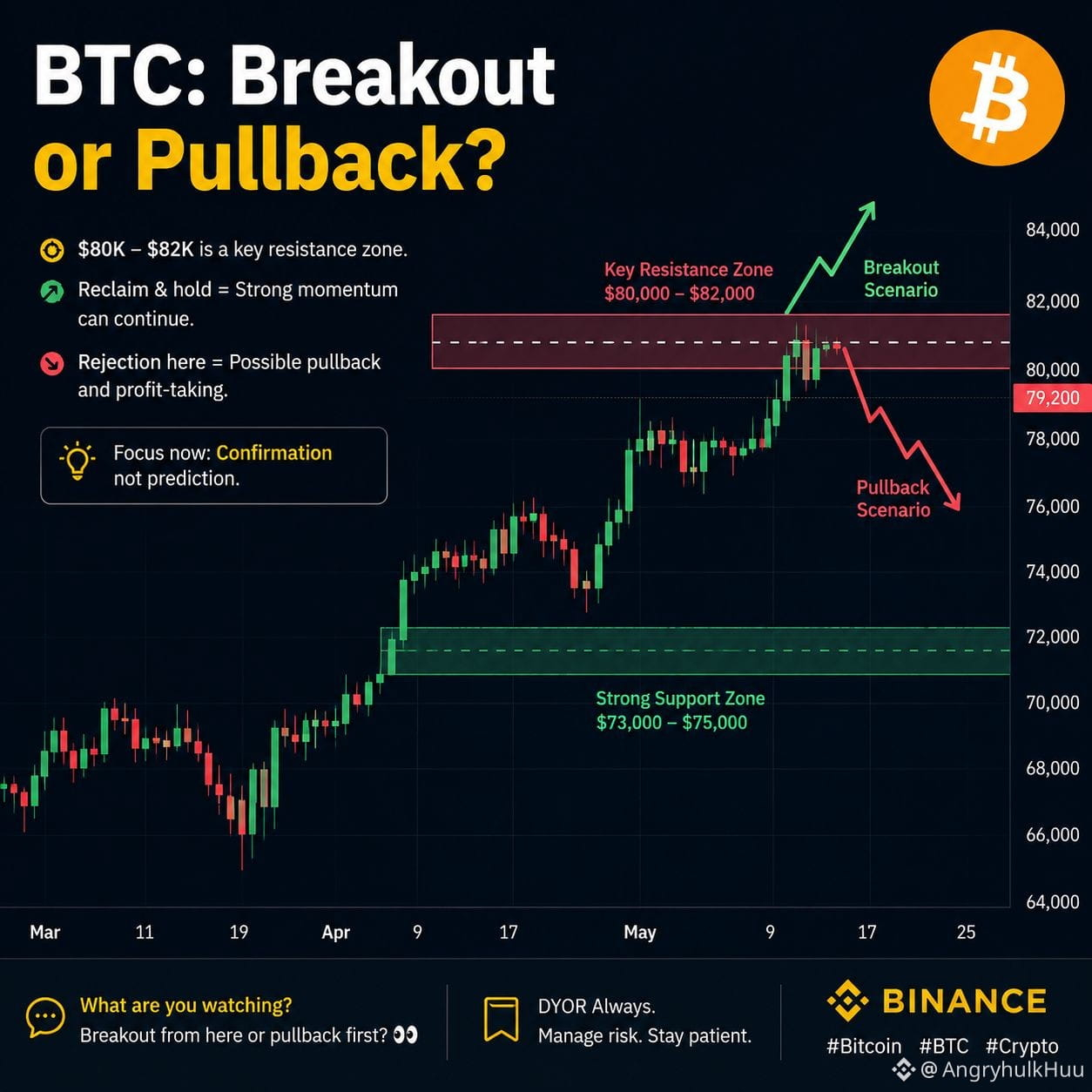
Pour moi, la zone intéressante en ce moment se situe entre 80 000 $ et 82 000 $.
Si le BTC parvient à reprendre correctement et à maintenir cette zone, l’élan pourrait devenir beaucoup plus fort. Si nous voyons un rejet, une prise de profits serait tout à fait normale.
Pour l’instant, je suis davantage intéressé par une confirmation que par des prédictions.
Qu’est-ce que vous surveillez — une cassure d’ici, ou d’abord un autre repli ? 👀
#Bitcoin #BTC #crypto
Le mouvement au cours des derniers jours a été impressionnant, mais après une telle reprise, une pause à court terme ou un repli ne me surprendrait pas.
Pour moi, la zone intéressante en ce moment se situe entre 80 000 $ et 82 000 $.
Si le BTC parvient à reprendre correctement et à maintenir cette zone, l’élan pourrait devenir beaucoup plus fort. Si nous voyons un rejet, une prise de profits serait tout à fait normale.
Pour l’instant, je suis davantage intéressé par une confirmation que par des prédictions.
Qu’est-ce que vous surveillez — une cassure d’ici, ou d’abord un autre repli ? 👀
#Bitcoin #BTC #crypto
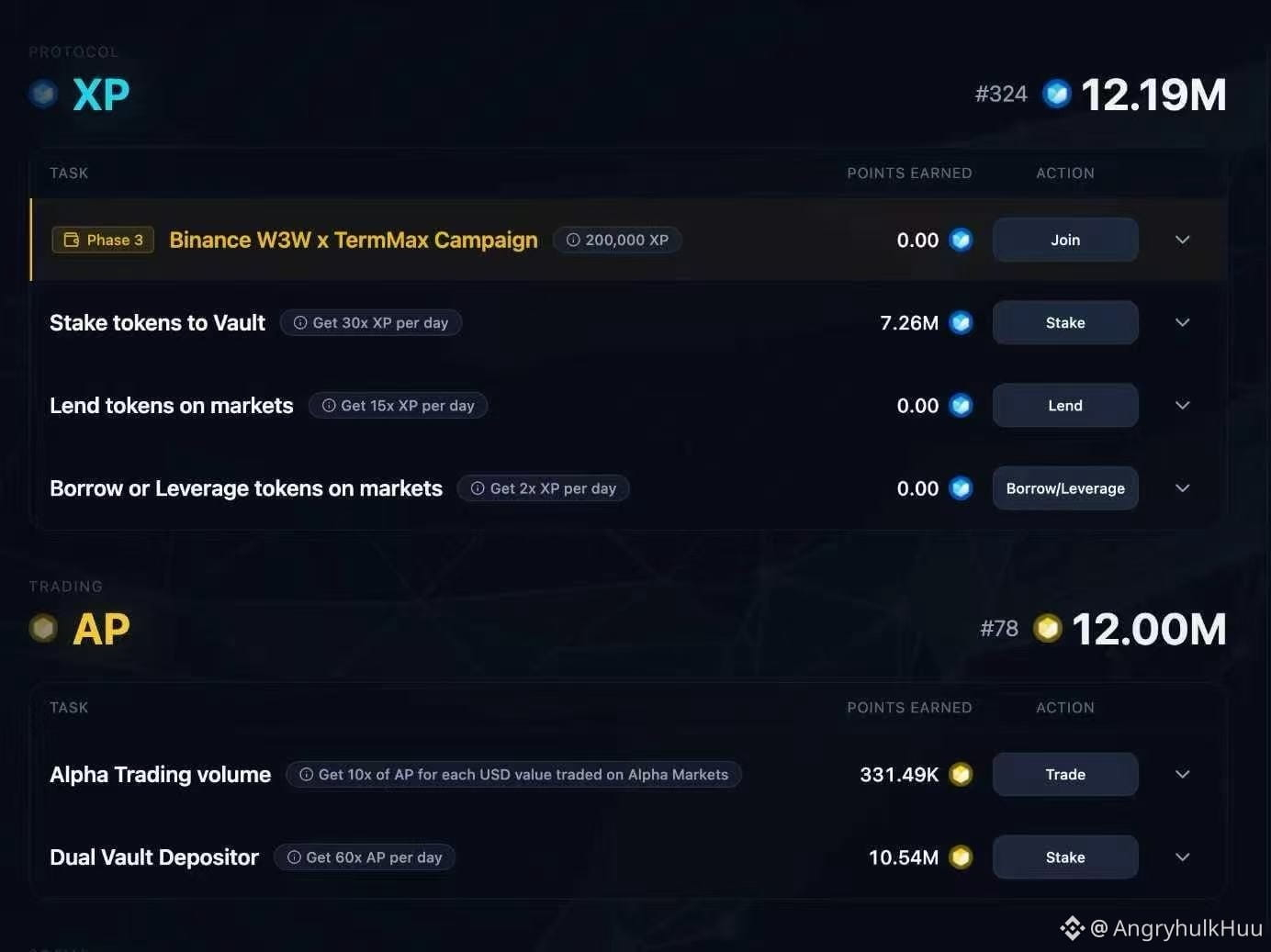
Je regardais aujourd’hui le système de récompenses Alpha sur @TermMax , et les chiffres m’ont vraiment fait m’arrêter un instant.
Ce que j’apprécie, c’est que les XP et les AP ne sont pas traités comme une seule réserve de points générique.
La configuration actuelle affiche différents multiplicateurs selon ce que vous faites réellement :
• Mise de jetons (Stake tokens) → 30× XP par jour
• Prêt (Lend) → 15× XP par jour
• Emprunt/Levier (Borrow/Leverage) → 2× XP par jour
• Trading Alpha → 10× AP par USD échangé
• Double Vault (Dual Vault) → 60× AP par jour
La partie Trading Alpha est particulièrement facile à mettre en perspective.
100 $ de volume de trading × 10 = 1 000 AP.
À 1 000 $ de volume, cela devient 10 000 AP.
Bien sûr, les AP ne sont pas la même chose que le profit. Ce qui m’intéresse, c’est surtout la conception de l’incitation.
Votre activité détermine à quel flux de récompenses vous contribuez, au lieu de tout réduire simplement au fait de détenir quelque chose et d’attendre.
Cela donne au système Alpha l’impression d’être davantage le reflet d’une participation réelle.
Pour moi, c’est une façon beaucoup plus intéressante de concevoir un système de points.
$TMX #TermMax
Ce que j’apprécie, c’est que les XP et les AP ne sont pas traités comme une seule réserve de points générique.
La configuration actuelle affiche différents multiplicateurs selon ce que vous faites réellement :
• Mise de jetons (Stake tokens) → 30× XP par jour
• Prêt (Lend) → 15× XP par jour
• Emprunt/Levier (Borrow/Leverage) → 2× XP par jour
• Trading Alpha → 10× AP par USD échangé
• Double Vault (Dual Vault) → 60× AP par jour
La partie Trading Alpha est particulièrement facile à mettre en perspective.
100 $ de volume de trading × 10 = 1 000 AP.
À 1 000 $ de volume, cela devient 10 000 AP.
Bien sûr, les AP ne sont pas la même chose que le profit. Ce qui m’intéresse, c’est surtout la conception de l’incitation.
Votre activité détermine à quel flux de récompenses vous contribuez, au lieu de tout réduire simplement au fait de détenir quelque chose et d’attendre.
Cela donne au système Alpha l’impression d’être davantage le reflet d’une participation réelle.
Pour moi, c’est une façon beaucoup plus intéressante de concevoir un système de points.
$TMX #TermMax
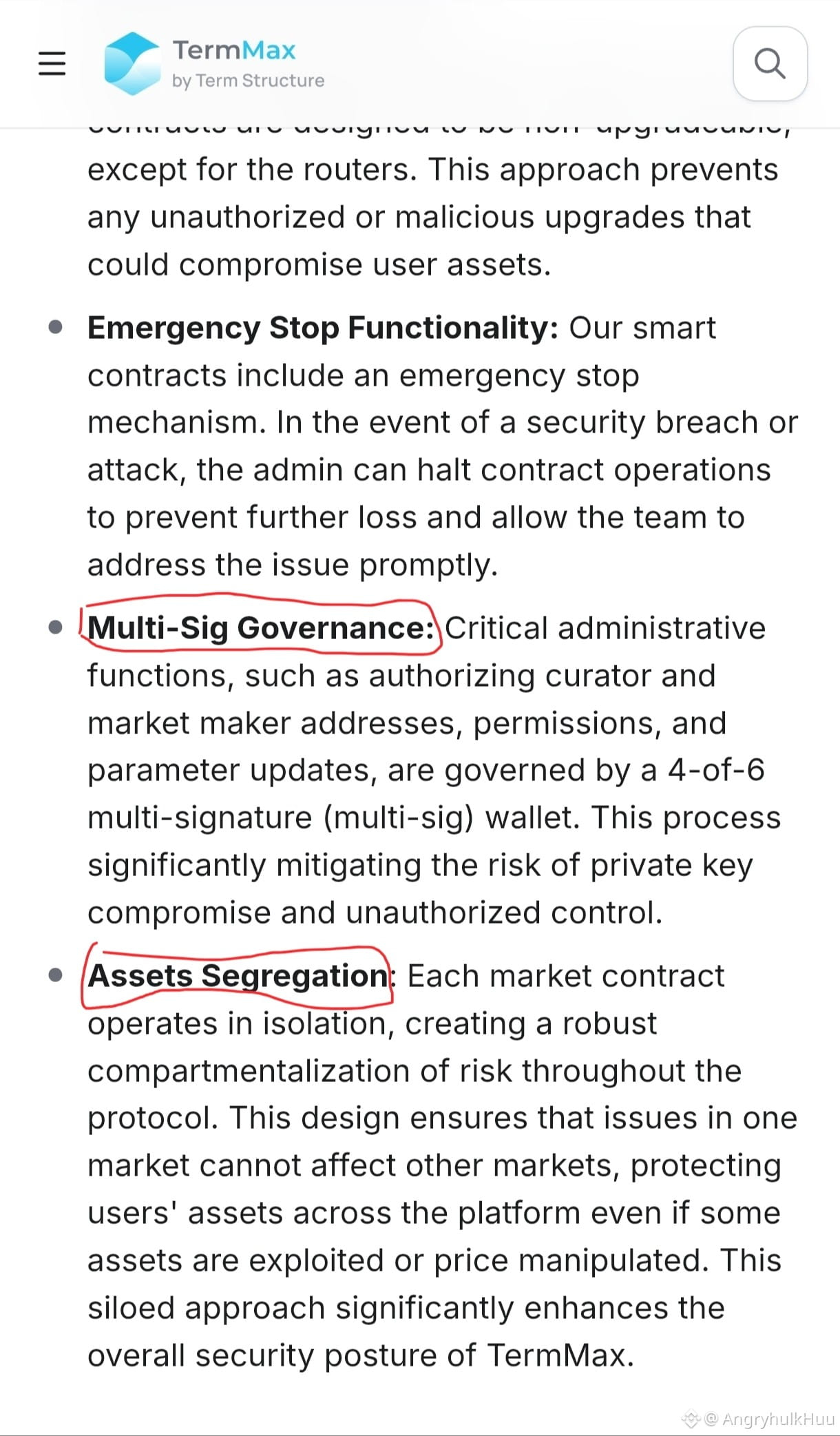
Aujourd’hui, j’ai fait quelque chose que j’ai d’habitude tendance à éviter quand je découvre un nouveau protocole DeFi.
J’ai cessé de regarder l’interface et je suis plutôt passé en revue la conception de sécurité @TermMax .
Un détail que j’ai trouvé intéressant, c’est que chaque marché fonctionne de manière isolée ; ainsi, un problème sur un marché n’est pas censé se propager automatiquement à l’ensemble du protocole.
J’ai aussi vérifié la configuration admin et j’ai constaté que les fonctions critiques sont contrôlées par un multisig 4 sur 6.
Ces chiffres comptent pour moi bien plus qu’une autre capture d’écran APY tape-à-l’œil.
Un produit DeFi peut avoir de super taux et des mécanismes ingénieux, mais si les contrôles de risque sous-jacents sont faibles, alors tout cela ne sert pas à grand-chose.
Ce que je commence à apprécier avec TermMax, c’est que la conception du produit et l’architecture de risque semblent traitées comme deux parties d’un même système.
C’était probablement la chose la plus utile que j’ai apprise en fouillant dans la documentation aujourd’hui.
$TMX #TermMax
J’ai cessé de regarder l’interface et je suis plutôt passé en revue la conception de sécurité @TermMax .
Un détail que j’ai trouvé intéressant, c’est que chaque marché fonctionne de manière isolée ; ainsi, un problème sur un marché n’est pas censé se propager automatiquement à l’ensemble du protocole.
J’ai aussi vérifié la configuration admin et j’ai constaté que les fonctions critiques sont contrôlées par un multisig 4 sur 6.
Ces chiffres comptent pour moi bien plus qu’une autre capture d’écran APY tape-à-l’œil.
Un produit DeFi peut avoir de super taux et des mécanismes ingénieux, mais si les contrôles de risque sous-jacents sont faibles, alors tout cela ne sert pas à grand-chose.
Ce que je commence à apprécier avec TermMax, c’est que la conception du produit et l’architecture de risque semblent traitées comme deux parties d’un même système.
C’était probablement la chose la plus utile que j’ai apprise en fouillant dans la documentation aujourd’hui.
$TMX #TermMax
J’ai passé un moment à parcourir TermMax et, honnêtement, ce qui m’est resté n’est pas un titre accrocheur.
C’est plutôt la sensation d’avoir plus de contrôle sur le taux.
Quand je cherche une opportunité d’emprunt, je ne veux pas toujours me lancer simplement parce qu’un taux de marché est disponible tout de suite. Parfois, j’ai déjà un chiffre en tête qui correspond à la stratégie que j’envisage.
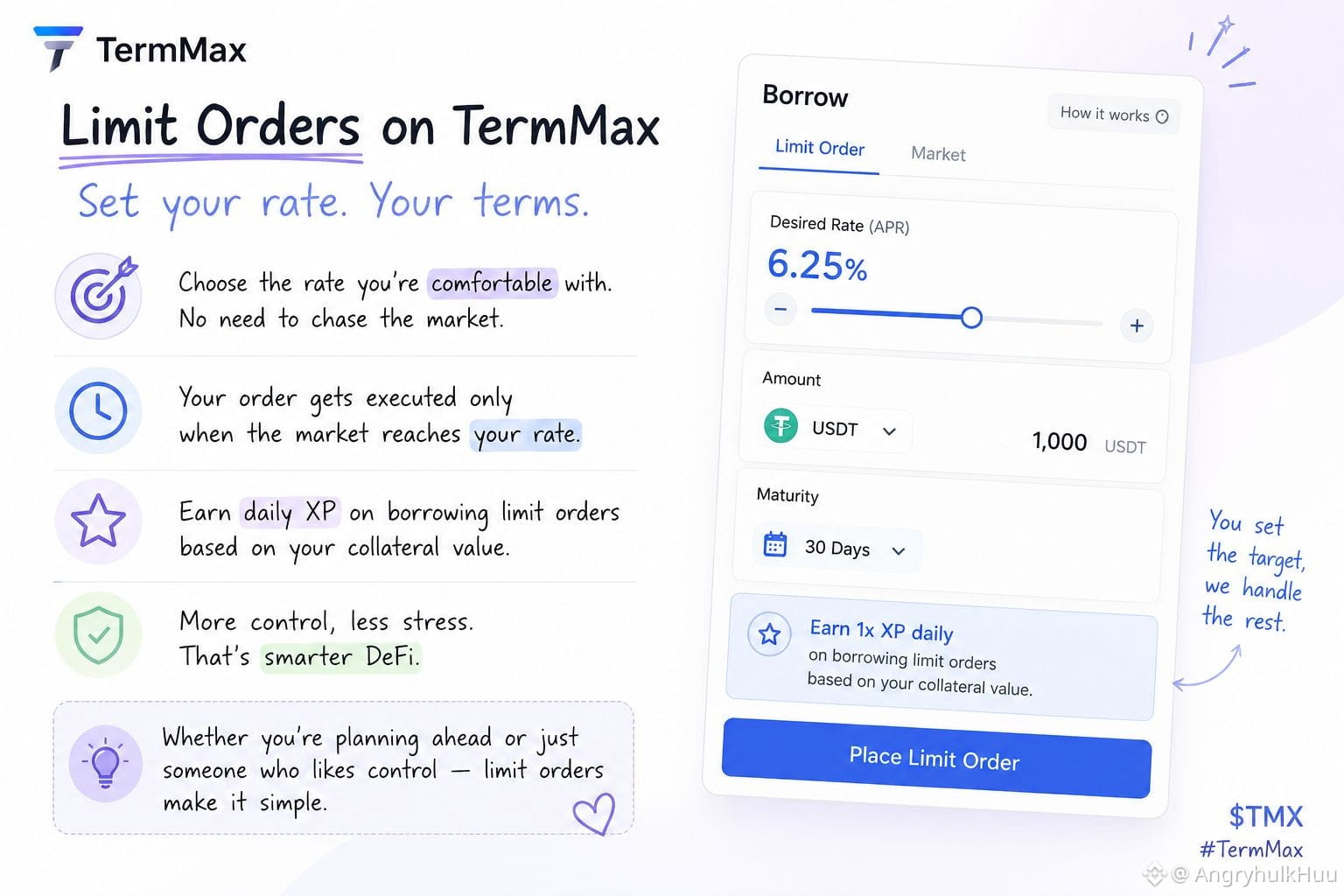
C’est là que la fonctionnalité d’ordres à cours limité a commencé à faire sens pour moi.
Au lieu de surveiller constamment l’écran et de se demander si le taux va évoluer vers une fourchette qui me convient, je peux définir le taux que je veux réellement et laisser l’ordre en place.
Ça ressemble à une petite amélioration de l’expérience utilisateur, mais dans la DeFi, ce genre de détails change la façon dont on interagit avec un produit.
J’ai aussi remarqué que les ordres à cours limité pour l’emprunt peuvent gagner des XP quotidiens en fonction de la valeur du collatéral, ce qui donne l’impression que la fonctionnalité est davantage connectée à l’expérience plus large de TermMax Alpha, plutôt que d’être juste un autre type d’ordre.
Après l’avoir parcouru, mon avis tient en une phrase assez simple :
De bons produits DeFi ne devraient pas vous obliger à surveiller le marché chaque seconde. Ils devraient vous donner assez de contrôle pour décider de vos conditions, puis vous laisser tranquille.
C’est probablement la partie de @TermMax que j’apprécie le plus pour l’instant.
$TMX #TermMax
C’est plutôt la sensation d’avoir plus de contrôle sur le taux.
Quand je cherche une opportunité d’emprunt, je ne veux pas toujours me lancer simplement parce qu’un taux de marché est disponible tout de suite. Parfois, j’ai déjà un chiffre en tête qui correspond à la stratégie que j’envisage.
C’est là que la fonctionnalité d’ordres à cours limité a commencé à faire sens pour moi.
Au lieu de surveiller constamment l’écran et de se demander si le taux va évoluer vers une fourchette qui me convient, je peux définir le taux que je veux réellement et laisser l’ordre en place.
Ça ressemble à une petite amélioration de l’expérience utilisateur, mais dans la DeFi, ce genre de détails change la façon dont on interagit avec un produit.
J’ai aussi remarqué que les ordres à cours limité pour l’emprunt peuvent gagner des XP quotidiens en fonction de la valeur du collatéral, ce qui donne l’impression que la fonctionnalité est davantage connectée à l’expérience plus large de TermMax Alpha, plutôt que d’être juste un autre type d’ordre.
Après l’avoir parcouru, mon avis tient en une phrase assez simple :
De bons produits DeFi ne devraient pas vous obliger à surveiller le marché chaque seconde. Ils devraient vous donner assez de contrôle pour décider de vos conditions, puis vous laisser tranquille.
C’est probablement la partie de @TermMax que j’apprécie le plus pour l’instant.
$TMX #TermMax
Voir la traduction
One thing I find interesting about @TermMax is how its Call/Put product changes the way leverage can be approached.
With a traditional leveraged position, you usually have to keep an eye on margin, liquidation levels and changing funding conditions. That can make a simple directional trade more complicated than it needs to be.
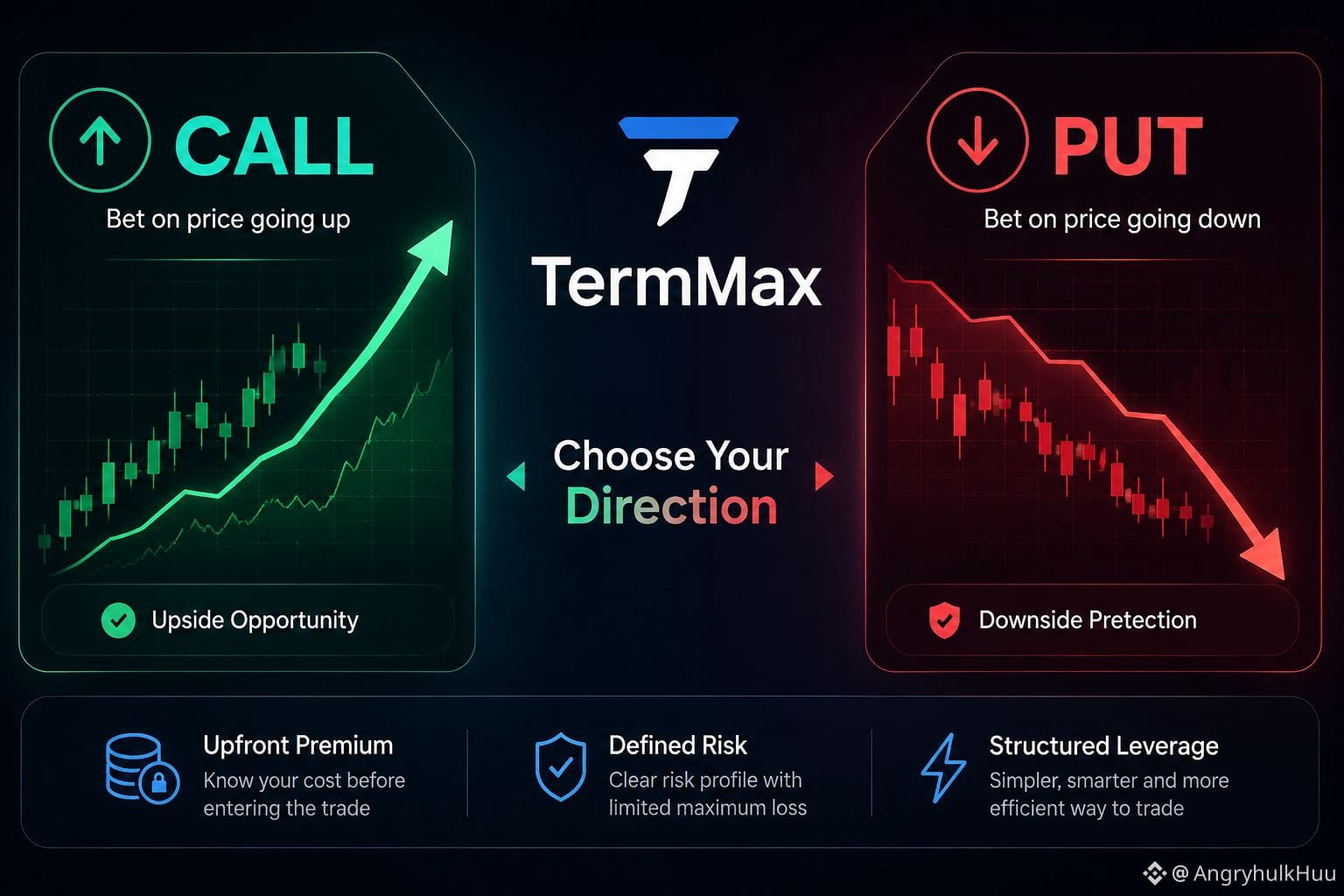
TermMax takes a different route. With Call/Put, the trader can choose a defined market direction and pay an upfront premium for the position. That makes the potential cost clearer before entering the trade.
For me, the interesting part isn’t simply “more leverage.” It’s having a more structured way to express a market view while knowing the cost upfront.
That’s the kind of DeFi primitive I think is worth watching.
$TMX #TermMax
With a traditional leveraged position, you usually have to keep an eye on margin, liquidation levels and changing funding conditions. That can make a simple directional trade more complicated than it needs to be.
TermMax takes a different route. With Call/Put, the trader can choose a defined market direction and pay an upfront premium for the position. That makes the potential cost clearer before entering the trade.
For me, the interesting part isn’t simply “more leverage.” It’s having a more structured way to express a market view while knowing the cost upfront.
That’s the kind of DeFi primitive I think is worth watching.
$TMX #TermMax
Voir la traduction
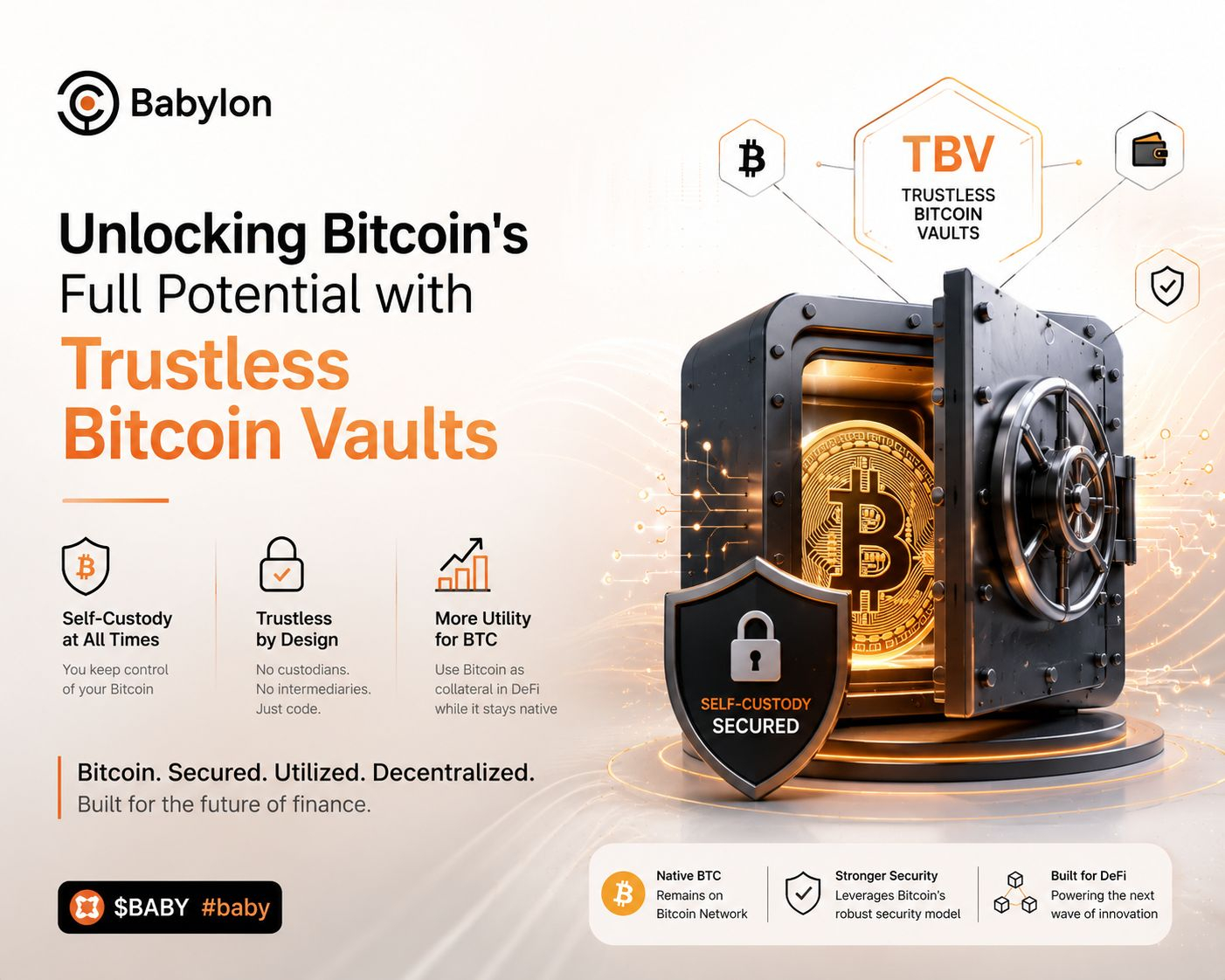
The more I learn about Bitcoin infrastructure, the more I feel that "native" matters more than most people realize. Wrapped BTC solved an important problem by bringing liquidity into DeFi, but it also introduced new trust assumptions that many long-term Bitcoin holders were never completely comfortable with.
That's why the direction @BabylonLabs_io is taking feels worth paying attention to. Instead of asking users to move away from native Bitcoin, Trustless Bitcoin Vaults are designed around preserving ownership while expanding what BTC can actually do. To me, that's a much stronger design philosophy because it doesn't force users to choose between security and utility.
I don't think the future of Bitcoin DeFi will be decided by who offers the highest yield. It will be decided by which infrastructure minimizes unnecessary trust while keeping the user experience practical. If people can unlock more value from their BTC without compromising the principles that made Bitcoin successful in the first place, that's a much more meaningful innovation than simply creating another financial product.
The strongest infrastructure is usually the one users don't have to think about. It simply works while preserving the properties they already trust. That's the direction I hope Bitcoin continues to move toward.
$BABY #baby
That's why the direction @BabylonLabs_io is taking feels worth paying attention to. Instead of asking users to move away from native Bitcoin, Trustless Bitcoin Vaults are designed around preserving ownership while expanding what BTC can actually do. To me, that's a much stronger design philosophy because it doesn't force users to choose between security and utility.
I don't think the future of Bitcoin DeFi will be decided by who offers the highest yield. It will be decided by which infrastructure minimizes unnecessary trust while keeping the user experience practical. If people can unlock more value from their BTC without compromising the principles that made Bitcoin successful in the first place, that's a much more meaningful innovation than simply creating another financial product.
The strongest infrastructure is usually the one users don't have to think about. It simply works while preserving the properties they already trust. That's the direction I hope Bitcoin continues to move toward.
$BABY #baby
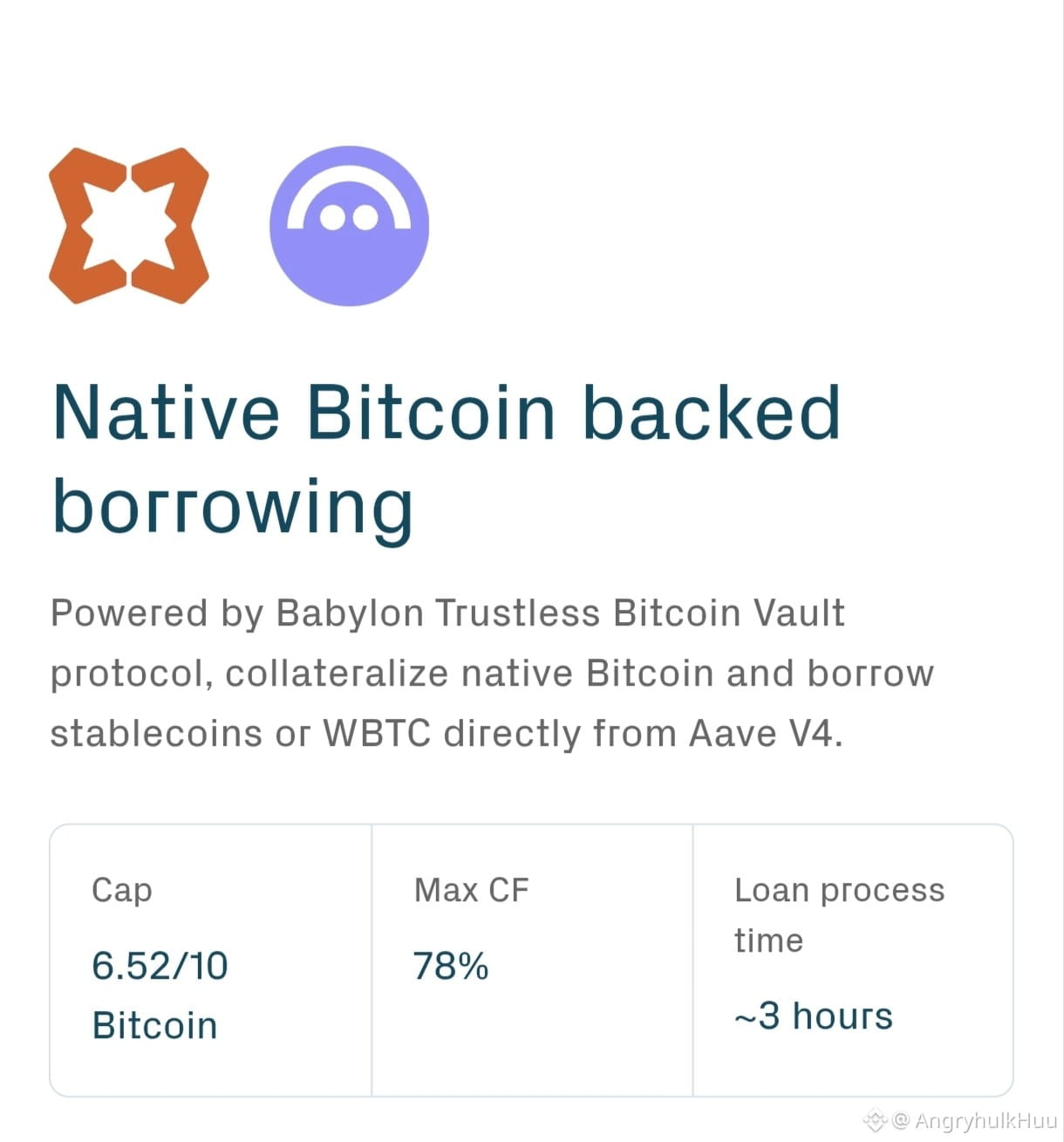
Bitcoin a toujours été apprécié pour le fait qu’il donne aux gens la pleine propriété de leurs actifs, mais l’utilisation de BTC dans la DeFi a souvent nécessité des compromis, comme l’enrobage des pièces (wrapping) ou la confiance envers des dépositaires centralisés. C’est pourquoi l’approche proposée par @BabylonLabs_io semble différente. Les coffres Bitcoin sans confiance (Trustless Bitcoin Vaults) sont conçus pour permettre aux utilisateurs de conserver leur Bitcoin en autoconservation (self-custody) tout en le rendant utilisable comme garantie grâce à une vérification cryptographique plutôt qu’à l’intervention d’intermédiaires de confiance. Cela signifie que le Bitcoin peut rester natif de son propre réseau tout en devenant plus productif au sein de la finance décentralisée. Plutôt que de modifier le Bitcoin lui-même, TBV construit une infrastructure autour de son modèle de sécurité existant, créant de nouvelles possibilités financières sans sacrifier les principes qui ont rendu Bitcoin précieux en premier lieu. Si ce modèle continue de mûrir, il pourrait devenir un socle important pour la phase suivante de l’adoption de Bitcoin.
$BABY #baby
$BABY #baby
Voir la traduction
For years, Bitcoin has been seen as a store of value, but much of its capital has remained inactive. What I find interesting about @BabylonLabs_io is the focus on improving Bitcoin's capital efficiency without changing its core principles. Trustless Bitcoin Vaults are designed to let native BTC remain under user control while supporting broader financial use cases. Instead of asking users to choose between security and utility, this approach aims to deliver both. If Bitcoin is going to become a more active part of decentralized finance, building on trustless infrastructure like TBV feels like the right direction.
$BABY #baby
$BABY #baby
Voir la traduction
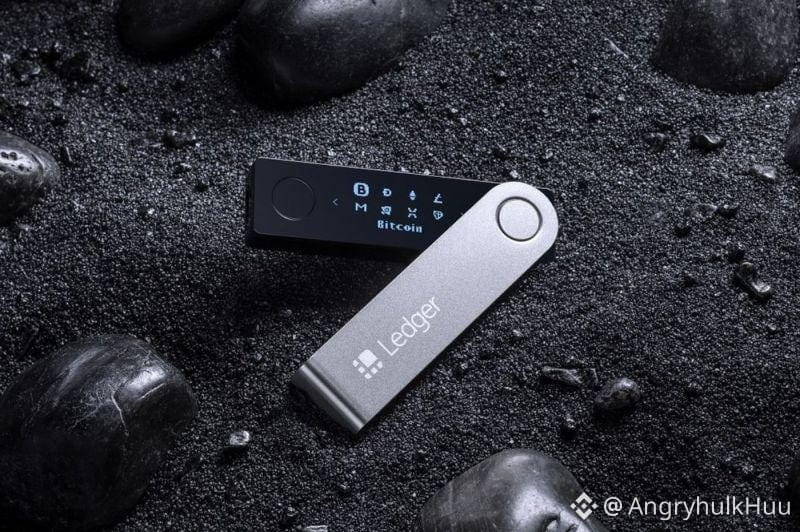
The latest Ledger integration from @BabylonLabs_io caught my attention because it solves a real concern for long term Bitcoin holders. Most people don't want to move their BTC to wrapped versions or hand control over to a custodian just to access DeFi. Trustless Bitcoin Vaults take a different approach by keeping Bitcoin on its native chain while allowing it to be used as collateral. With Ledger Clear Signing, every vault action can be verified directly on the hardware wallet, giving users greater confidence before approving transactions. This combination of self custody, cryptographic verification, and practical DeFi access feels like meaningful infrastructure rather than another short term trend. If Bitcoin is going to play a bigger role in decentralized finance, this is the type of foundation that makes sense to build. $BABY
#baby
#baby
Je pensais que déplacer des fonds entre des portefeuilles et des plateformes faisait simplement partie de la crypto.
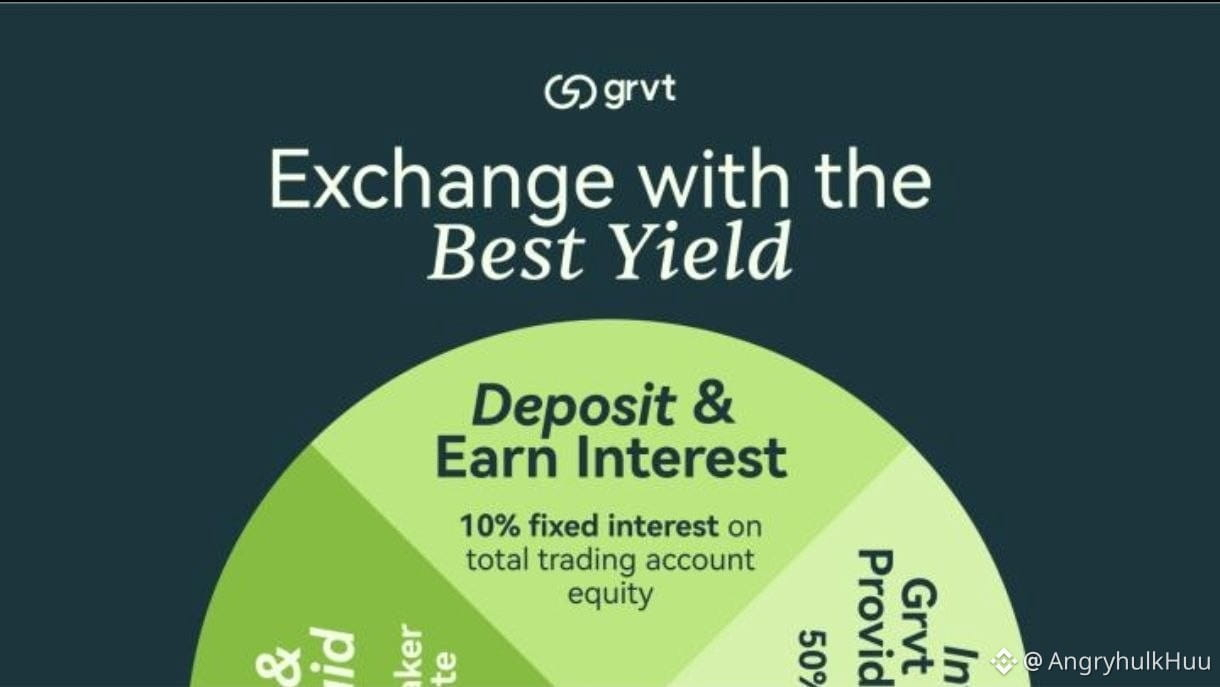
Après avoir passé un certain temps à lire à propos de @grvt_io , j’ai commencé à remettre cela en question.
Si vos actifs restent inactifs à chaque fois que vous ne tradez pas activement, c’est un capital qui ne travaille pas vraiment pour vous.
Ce que j’aime dans la direction de GRVT, c’est l’accent mis sur la création d’un seul portefeuille plus utile, plutôt que de demander aux utilisateurs de déplacer constamment des fonds. C’est un petit changement de perspective, mais il pourrait faire une grande différence dans le trading du quotidien.
C’est le genre de conception de produit qui m’intéresse à suivre.
#grvt
Après avoir passé un certain temps à lire à propos de @grvt_io , j’ai commencé à remettre cela en question.
Si vos actifs restent inactifs à chaque fois que vous ne tradez pas activement, c’est un capital qui ne travaille pas vraiment pour vous.
Ce que j’aime dans la direction de GRVT, c’est l’accent mis sur la création d’un seul portefeuille plus utile, plutôt que de demander aux utilisateurs de déplacer constamment des fonds. C’est un petit changement de perspective, mais il pourrait faire une grande différence dans le trading du quotidien.
C’est le genre de conception de produit qui m’intéresse à suivre.
#grvt
Voir la traduction
I spent some time reading the new Onchain Wealth Report from @grvt_io today.
One idea really stood out to me.
The conversation is slowly shifting from "Where should I trade?" to "How can my capital keep working all the time?"
That's a very different way of thinking about crypto. Instead of moving funds between multiple apps to trade, earn, and invest, the focus is becoming how one balance can do more with less friction.
Whether that vision becomes the standard or not, I think it's a discussion the industry needed.
Looking forward to seeing how @grvt_io turns that vision into real products.
#grvt
One idea really stood out to me.
The conversation is slowly shifting from "Where should I trade?" to "How can my capital keep working all the time?"
That's a very different way of thinking about crypto. Instead of moving funds between multiple apps to trade, earn, and invest, the focus is becoming how one balance can do more with less friction.
Whether that vision becomes the standard or not, I think it's a discussion the industry needed.
Looking forward to seeing how @grvt_io turns that vision into real products.
#grvt

Voir la traduction
I've finally decided how I'm handling my GRVT allocation.
At first, I was only thinking about claiming everything as soon as possible. After reading the official guide, I realized GRVT isn't just asking us to claim tokens. It's actually letting every participant choose the strategy that fits them best.
Some people need liquidity on day one, and that's completely understandable. Others are willing to wait for a higher multiplier because they believe in the long-term potential of the ecosystem.
I don't think there's a right or wrong answer here. It really depends on your own goals.
I like that @grvt_io didn't force everyone into a single option. Giving the community flexibility is a small detail, but it makes the distribution feel much more thoughtful.
Before making any decision, I'll double-check everything through the official registration page instead of relying on random posts online.
That's my approach. Curious to see how everyone else is thinking about it.
#grvt
At first, I was only thinking about claiming everything as soon as possible. After reading the official guide, I realized GRVT isn't just asking us to claim tokens. It's actually letting every participant choose the strategy that fits them best.
Some people need liquidity on day one, and that's completely understandable. Others are willing to wait for a higher multiplier because they believe in the long-term potential of the ecosystem.
I don't think there's a right or wrong answer here. It really depends on your own goals.
I like that @grvt_io didn't force everyone into a single option. Giving the community flexibility is a small detail, but it makes the distribution feel much more thoughtful.
Before making any decision, I'll double-check everything through the official registration page instead of relying on random posts online.
That's my approach. Curious to see how everyone else is thinking about it.
#grvt

Voir la traduction
One of the most interesting updates from @grvt_io is the launch of Grvt Invest, a product focused on making institutional-style Real World Asset (RWA) yield more accessible. Instead of requiring large capital or complex investment processes, Grvt Invest introduces curated strategies that simplify participation while maintaining a self-custodial experience.
According to the official announcement, the platform launches with Balanced and Opportunistic strategies, giving users different ways to approach yield based on their goals. This reflects GRVT's broader vision of combining trading, earning, and investing within a single ecosystem, so capital doesn't have to sit idle while waiting for the next opportunity.
As the RWA sector continues to grow, products that make these opportunities easier to access could play an important role in bringing more users onchain. It's great to see @grvt_io focusing on practical financial tools instead of short-term hype.
#grvt
According to the official announcement, the platform launches with Balanced and Opportunistic strategies, giving users different ways to approach yield based on their goals. This reflects GRVT's broader vision of combining trading, earning, and investing within a single ecosystem, so capital doesn't have to sit idle while waiting for the next opportunity.
As the RWA sector continues to grow, products that make these opportunities easier to access could play an important role in bringing more users onchain. It's great to see @grvt_io focusing on practical financial tools instead of short-term hype.
#grvt

Partiellement vrai
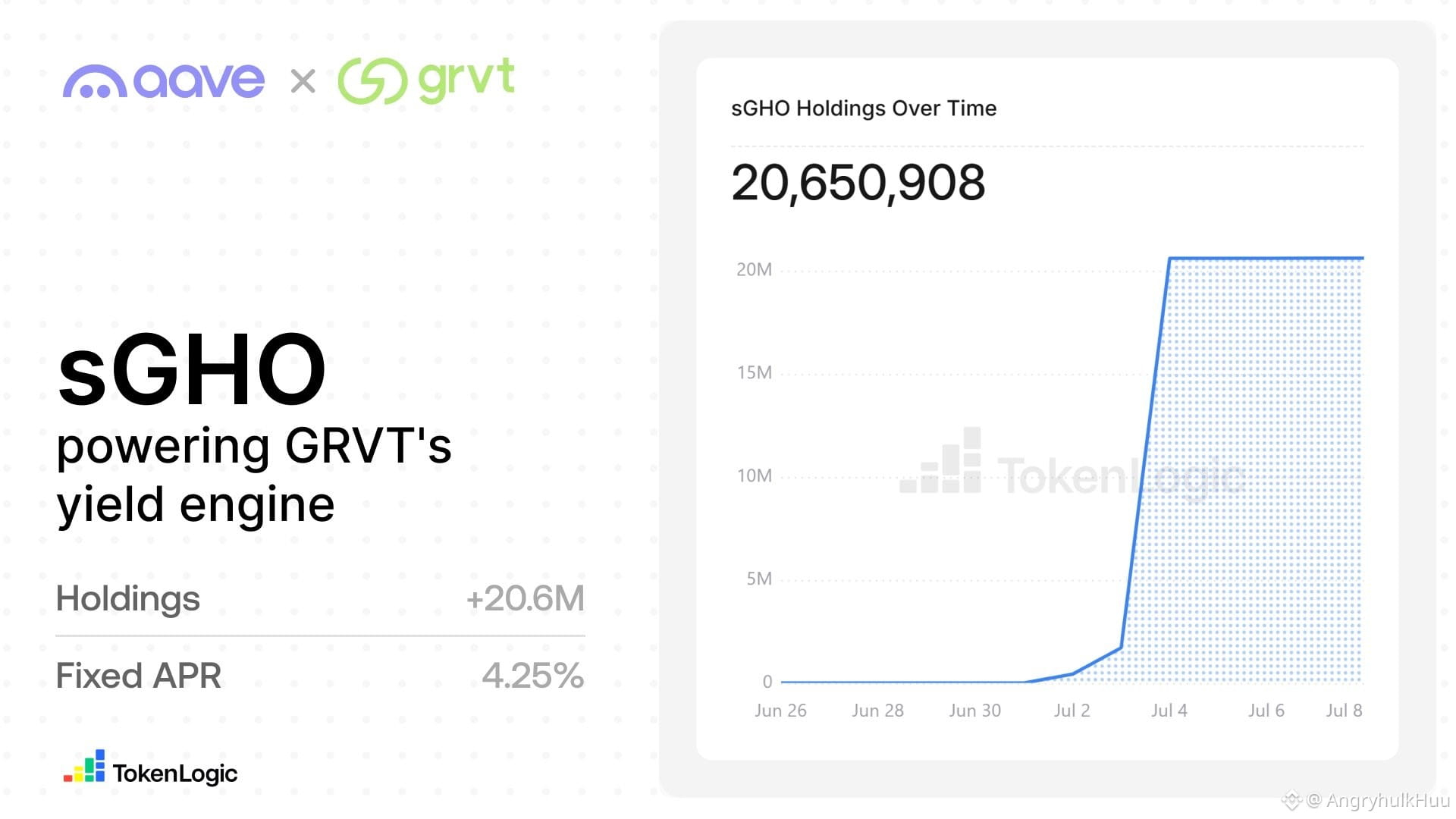
Le rendement ne compte que s’il repose sur une infrastructure fiable. Le fait de voir plus de 20,6 M sGHO alloués pour alimenter le moteur de rendement de GRVT met en évidence une confiance croissante dans son approche. Des partenariats solides et une utilité concrète parlent souvent plus fort que le battage. @grvt_io construit dans une optique de durabilité à long terme.
#grvt
#grvt
Voir la traduction
Pump or dump?
Voir la traduction
Walrus is quietly building one of the most interesting pieces of Web3 infrastructure. With @Walrus 🦭/acc focusing on decentralized, scalable data storage, the $WAL ecosystem feels designed for long-term builders rather than hype cycles. Real utility, real demand, real innovation. #Walrus
Connectez-vous pour découvrir plus de contenu