
AdCentral Global
63 Publications

AdCentral Global
Signaler
Bloquer l’utilisateur
DOOH ad network turning idle screens into revenue. Screen owners earn, advertisers reach real places. Dubai-based. Token: ADCL
17 Suivis
14 Abonnés
72 J’aime
Publications
Tous
Vidéos
PINNED
🏆 Une étape dont AdCentral peut être fière.
Nous avons décroché la 2e place au concours mondial d’innovation « Building the Future of Web3 on BNB Chain », organisé par BNBChain et IgnyteDIFC, et avons été mis à l’honneur sur scène à #DubaiFinTechSummit .
Pour nous, la plus grande valeur a été l’occasion de partager une vision concrète du Web3 :
Transformer des écrans détenus indépendamment en un réseau publicitaire vérifiable unique.
Merci à BNB Chain, IgnyteDIFC, aux juges et à toutes les personnes qui ont pris le temps d’écouter l’histoire d’AdCentral.
Dubaï d’abord. Conçu pour évoluer à grande échelle.
#AdCentral #DePIN #BNBChain #IgnyteDIFC

1
1
108
PINNED
AdCentral en 60 secondes 🎥
Réservez des annonces sur de vrais écrans. Suivez les résultats en direct. Gérez tout au même endroit.
Regardez 👆
AdCentral en 60 secondes 🎥
Réservez des annonces sur de vrais écrans. Suivez les résultats en direct. Gérez tout au même endroit.
Regardez 👆
Réservez des annonces sur de vrais écrans. Suivez les résultats en direct. Gérez tout au même endroit.
Regardez 👆
1
2
7
Nous participons au Doers Summit Dubai les 25 et 26 novembre, où fondateurs, investisseurs et opérateurs se réunissent. Qui d’autre vient ? #DoersSummit #Dubai. #DubaiSiliconOasis #DoersUnited
Nous participons au Doers Summit Dubai les 25 et 26 novembre, où fondateurs, investisseurs et opérateurs se réunissent. Qui d’autre vient ? #DoersSummit #Dubai. #DubaiSiliconOasis #DoersUnited
75

Voir la traduction
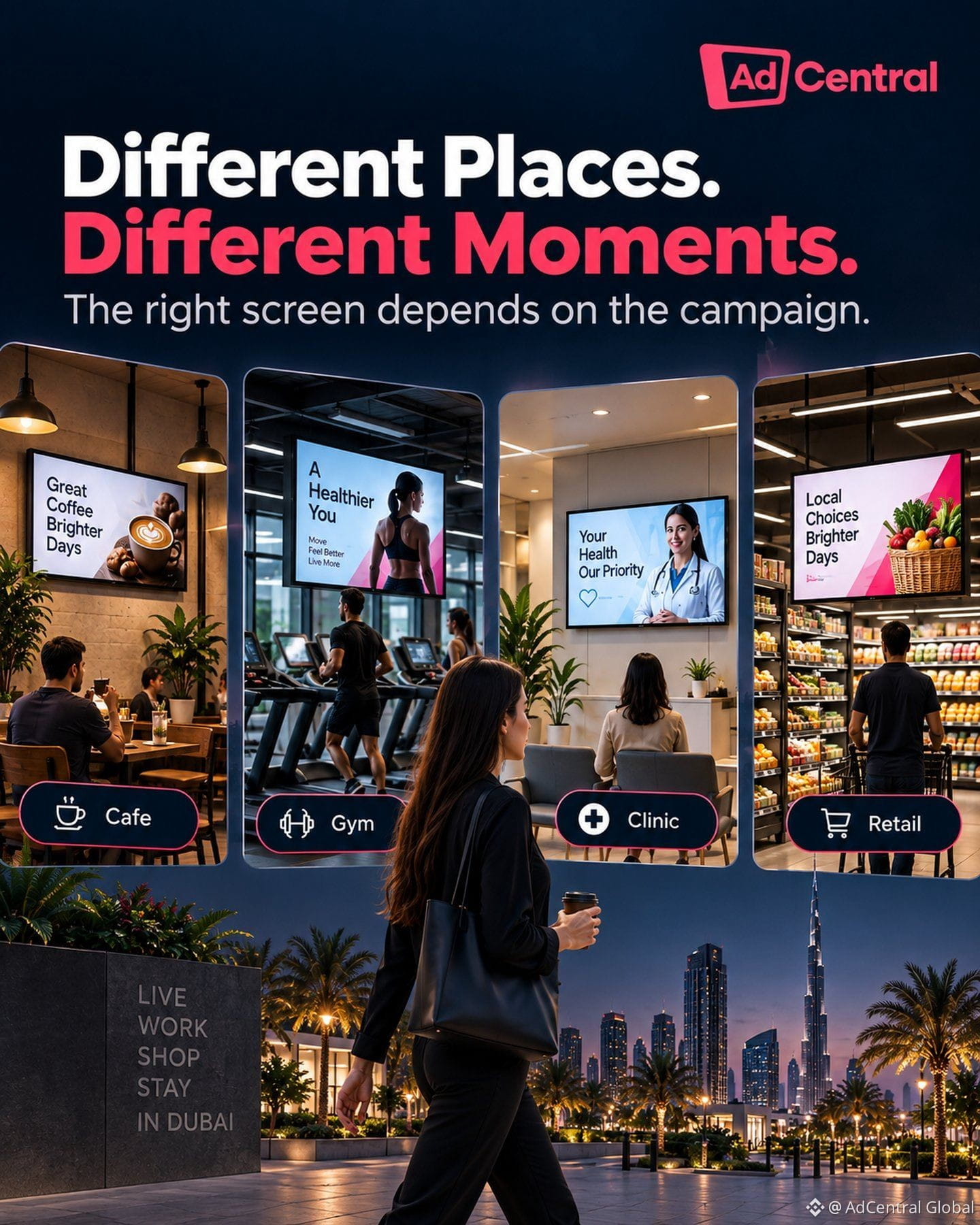
The right screen is not always the nearest screen.
A cafe, gym, clinic and supermarket can all reach people at different moments of their day.
We are building AdCentral to help advertisers discover screens that fit where, when and how they want to be seen.
Location matters. Context matters too.
The right screen is not always the nearest screen.
A cafe, gym, clinic and supermarket can all reach people at different moments of their day.
We are building AdCentral to help advertisers discover screens that fit where, when and how they want to be seen.
Location matters. Context matters too.
A cafe, gym, clinic and supermarket can all reach people at different moments of their day.
We are building AdCentral to help advertisers discover screens that fit where, when and how they want to be seen.
Location matters. Context matters too.
81
Voir la traduction
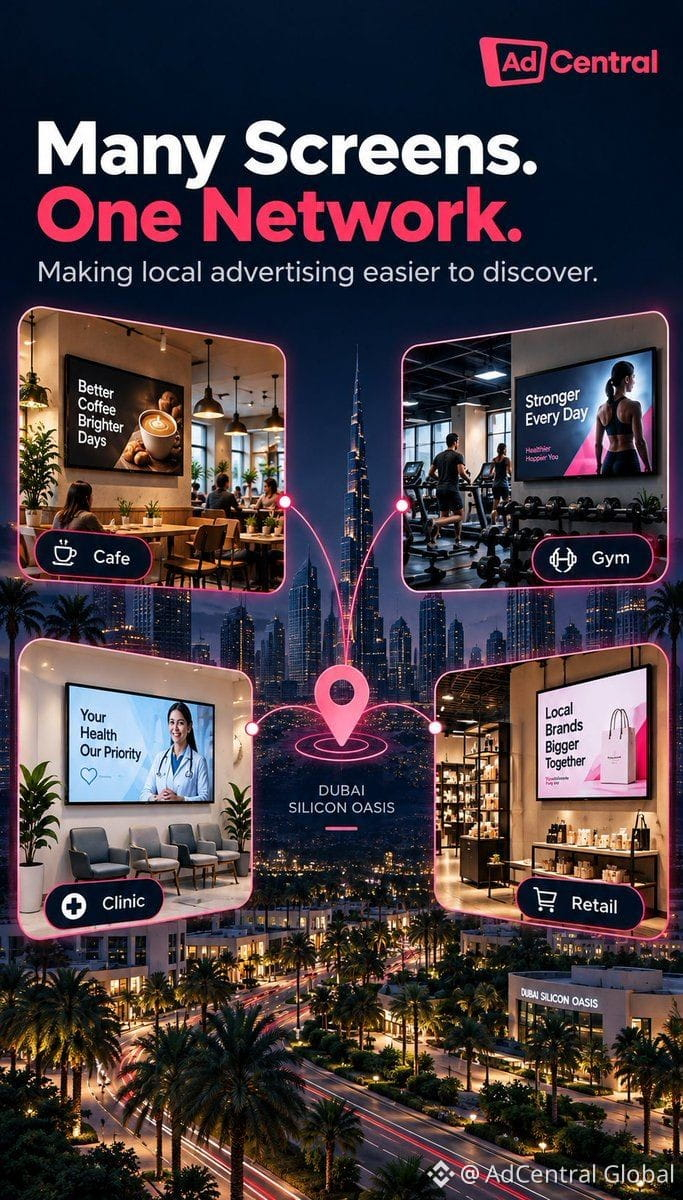
There are digital screens everywhere.
But for a local advertiser, finding the right ones is still not easy.
We are building AdCentral to bring independently owned screens into one network, so advertisers can discover useful locations and screen owners can participate in local advertising.
One network. Many local screens.
But for a local advertiser, finding the right ones is still not easy.
We are building AdCentral to bring independently owned screens into one network, so advertisers can discover useful locations and screen owners can participate in local advertising.
One network. Many local screens.
70
Article
Voir la traduction
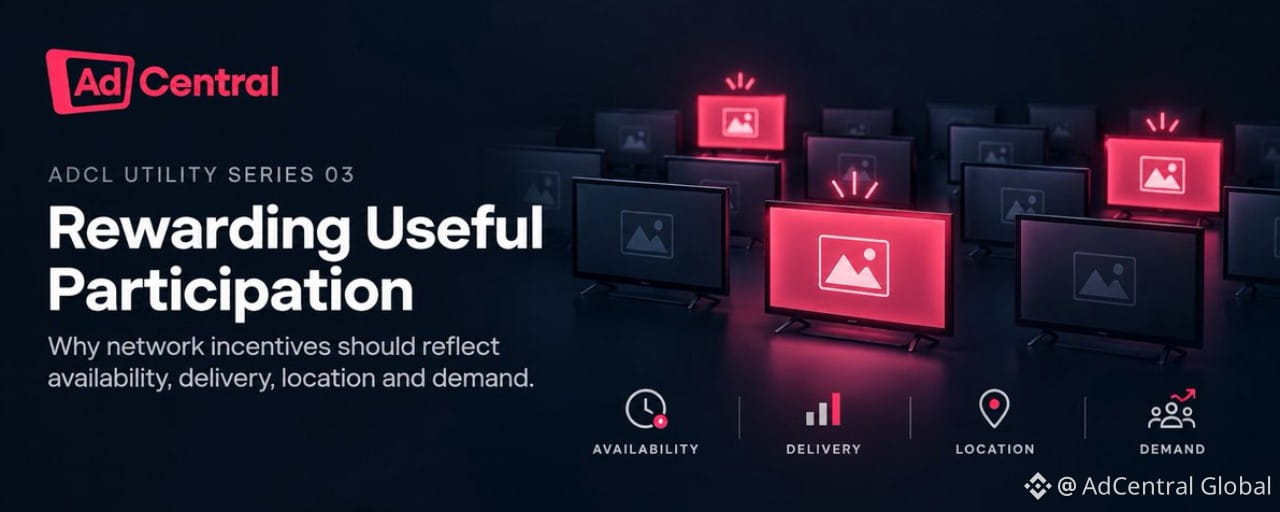
ADCL Utility Series 03: Rewarding Useful ParticipationA DePIN network can connect thousands of devices. But connection alone does not make every device equally useful.
For AdCentral, a screen should not become eligible for network incentives just because it is online.
Useful participation matters.
What makes a screen useful?
A screen becomes more valuable to the network when it can reliably support real advertising activity. That can depend on a few simple things:
Availability: Is the screen ready when campaigns need it?
Delivery: Does it reliably deliver when selected?
Location: Does it improve useful coverage for advertisers?
Demand: Is that screen relevant to real advertiser needs?
These signals help separate simple presence from productive participation.
Why should rewards follow performance?
Independent screen owners provide the physical infrastructure.
They keep screens powered, connected, maintained and available.
That contribution continues even when advertising demand is uneven.
Network incentives can help support useful screens during those periods.
But support should not become automatic.
If one screen contributes more value to the network than another, the incentive model should be able to reflect that difference.
Where ADCL fits
ADCL is designed to support this coordination layer.
The model is not:
Connect a screen → earn rewards
It is closer to:
Participate → stay useful → prove performance → become eligible for incentives
That creates a healthier relationship between infrastructure and rewards.
Demand still comes first
Incentives can help bootstrap and support the network.
But they should not replace real demand.
For AdCentral, advertising activity remains the economic foundation.
As the network grows, the goal is for incentives to support productive infrastructure, not simply encourage more screens to connect.
The principle
The goal is not to build the largest possible screen network.
It is to build a network that remains:
Available. Reliable. Relevant. Useful.
That is why ADCL incentives are designed around useful participation.
Not every screen should necessarily be rewarded in the same way.
ADCL Utility Series 03: Rewarding Useful Participation
A DePIN network can connect thousands of devices. But connection alone does not make every device equally useful.
For AdCentral, a screen should not become eligible for network incentives just because it is online.
Useful participation matters.
What makes a screen useful?
A screen becomes more valuable to the network when it can reliably support real advertising activity. That can depend on a few simple things:
Availability: Is the screen ready when campaigns need it?
Delivery: Does it reliably deliver when selected?
Location: Does it improve useful coverage for advertisers?
Demand: Is that screen relevant to real advertiser needs?
These signals help separate simple presence from productive participation.
Why should rewards follow performance?
Independent screen owners provide the physical infrastructure.
They keep screens powered, connected, maintained and available.
That contribution continues even when advertising demand is uneven.
Network incentives can help support useful screens during those periods.
But support should not become automatic.
If one screen contributes more value to the network than another, the incentive model should be able to reflect that difference.
Where ADCL fits
ADCL is designed to support this coordination layer.
The model is not:
Connect a screen → earn rewards
It is closer to:
Participate → stay useful → prove performance → become eligible for incentives
That creates a healthier relationship between infrastructure and rewards.
Demand still comes first
Incentives can help bootstrap and support the network.
But they should not replace real demand.
For AdCentral, advertising activity remains the economic foundation.
As the network grows, the goal is for incentives to support productive infrastructure, not simply encourage more screens to connect.
The principle
The goal is not to build the largest possible screen network.
It is to build a network that remains:
Available. Reliable. Relevant. Useful.
That is why ADCL incentives are designed around useful participation.
Not every screen should necessarily be rewarded in the same way.
1
76
Voir la traduction
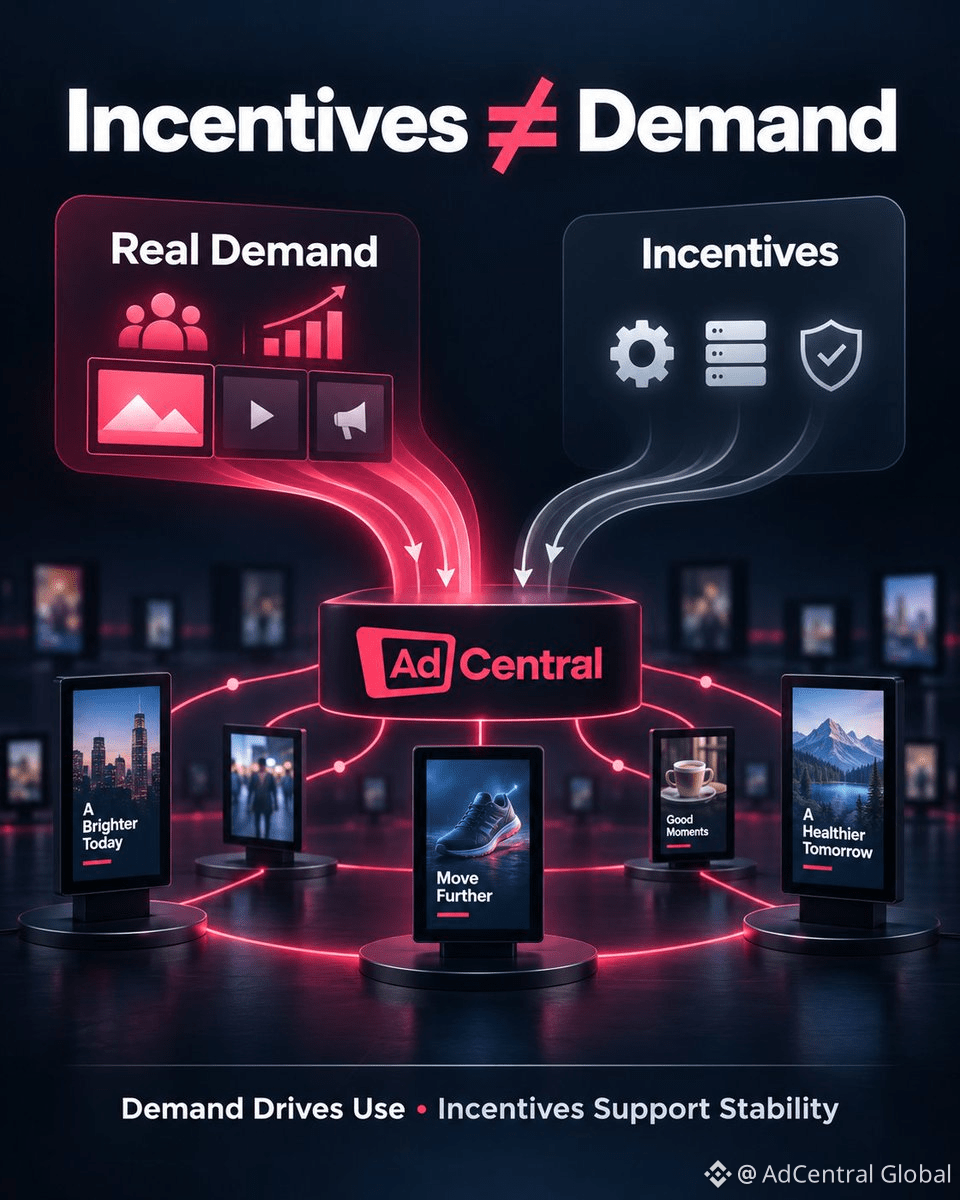
Network incentives should support real demand, not replace it.
In DePIN, incentives can help useful infrastructure stay available while demand is still developing or temporarily uneven.
But long term value has to come from real usage.
For AdCentral, that means advertising demand remains the economic foundation of the network.
In DePIN, incentives can help useful infrastructure stay available while demand is still developing or temporarily uneven.
But long term value has to come from real usage.
For AdCentral, that means advertising demand remains the economic foundation of the network.
1
68
Voir la traduction
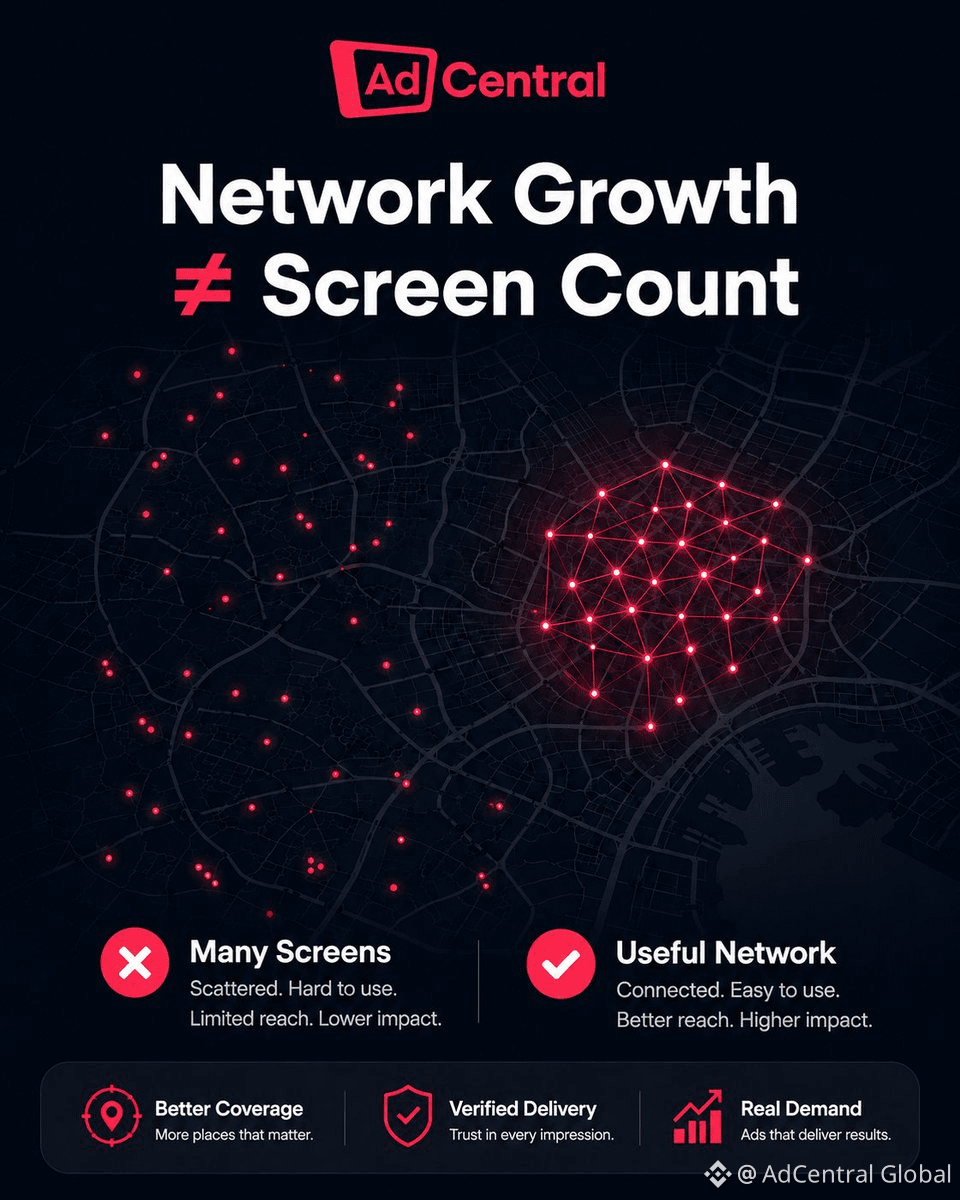
More screens do not automatically make a better DePIN network.
For AdCentral, network growth means useful coverage, verified delivery and real demand.
The goal is not simply to connect more screens.
It is to build a network advertisers can actually use.
More screens do not automatically make a better DePIN network.
For AdCentral, network growth means useful coverage, verified delivery and real demand.
The goal is not simply to connect more screens.
It is to build a network advertisers can actually use.
For AdCentral, network growth means useful coverage, verified delivery and real demand.
The goal is not simply to connect more screens.
It is to build a network advertisers can actually use.
1
56
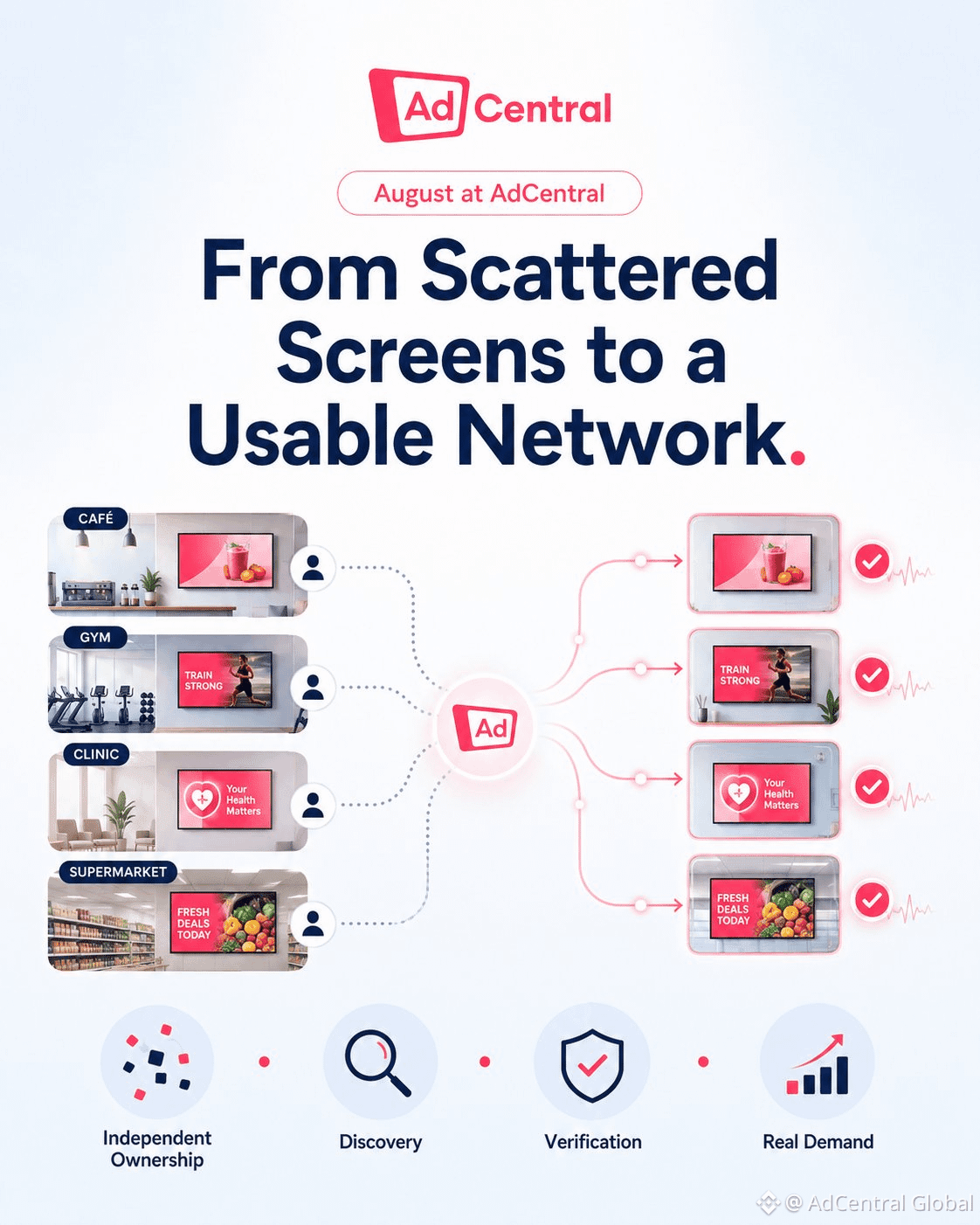
En août, il y avait une seule question : qu’est-ce qui transforme des écrans dispersés en un réseau utile ?
Pour nous, cela se résume à quatre éléments :
Propriété indépendante.
Inventaire trouvable.
Livraison vérifiée.
Des modèles économiques liés à une demande réelle.
C’est sur cette base qu’AdCentral construit à partir des EAU.
Pour nous, cela se résume à quatre éléments :
Propriété indépendante.
Inventaire trouvable.
Livraison vérifiée.
Des modèles économiques liés à une demande réelle.
C’est sur cette base qu’AdCentral construit à partir des EAU.
119
Voir la traduction
DOOH is consolidating.
DePIN opens a different path for distributed screen infrastructure.
DOOH is consolidating.
DePIN opens a different path for distributed screen infrastructure.
DePIN opens a different path for distributed screen infrastructure.
1
72
Voir la traduction
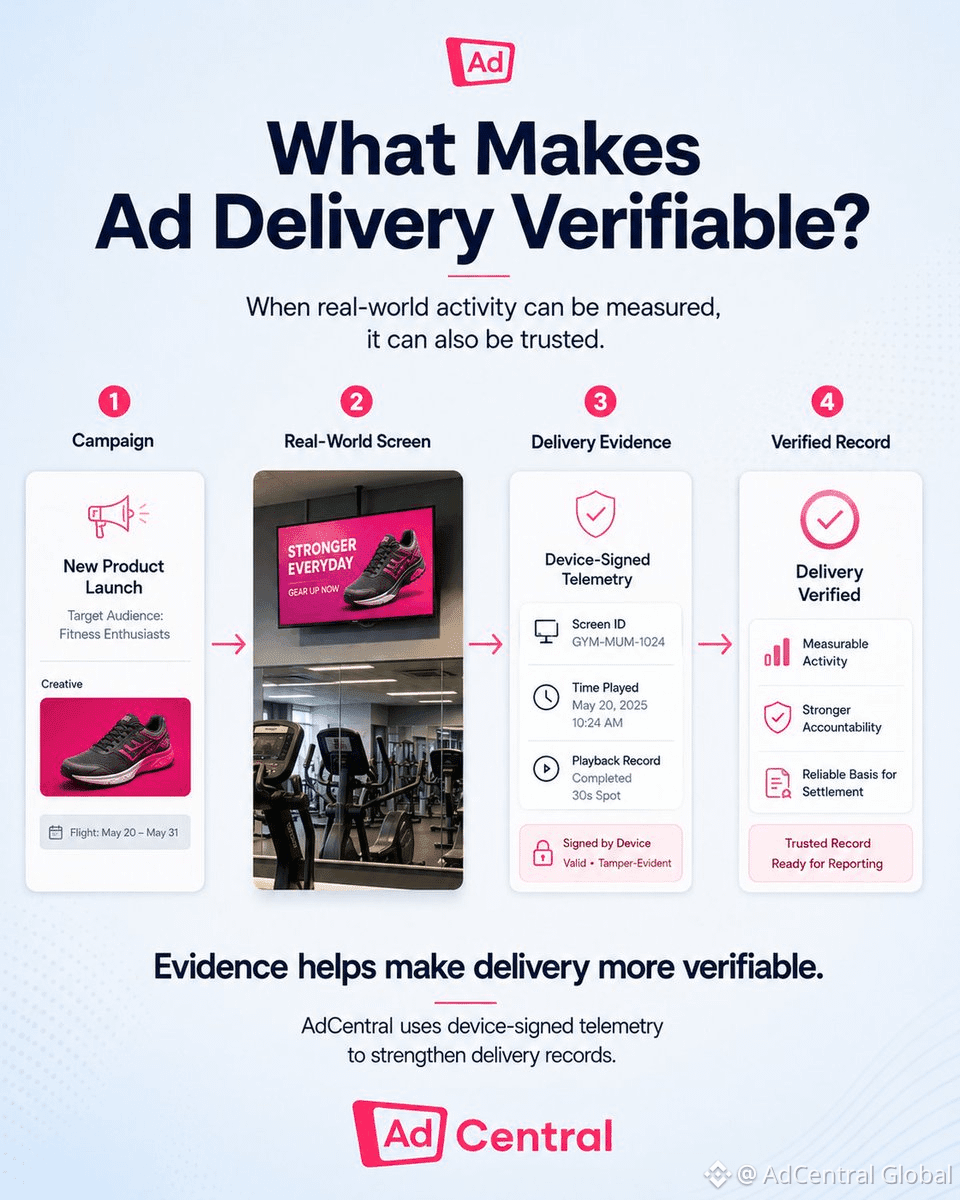
What makes ad delivery verifiable?
For AdCentral, every campaign should leave evidence behind.
Device-signed telemetry shows which screen played the campaign and when.
That gives advertisers clearer proof of delivery and gives the network a stronger basis for settlement.
When real-world activity can be measured, it can also be verified.
1
68
Article
Voir la traduction
Why Would AdCentral Keep Only 5%?An investor recently looked at AdCentral’s economic model and stopped at one number.
5%.
“How can a platform survive if it keeps only 5%?”
It was a fair question.
Technology costs money. Finding advertisers costs money. People, cloud infrastructure, compliance and operations all cost money.
So why would we deliberately design AdCentral around an approximately 5% platform allocation?
The answer becomes clearer when you look at what the rest of the value is designed to do.
Start with the campaign
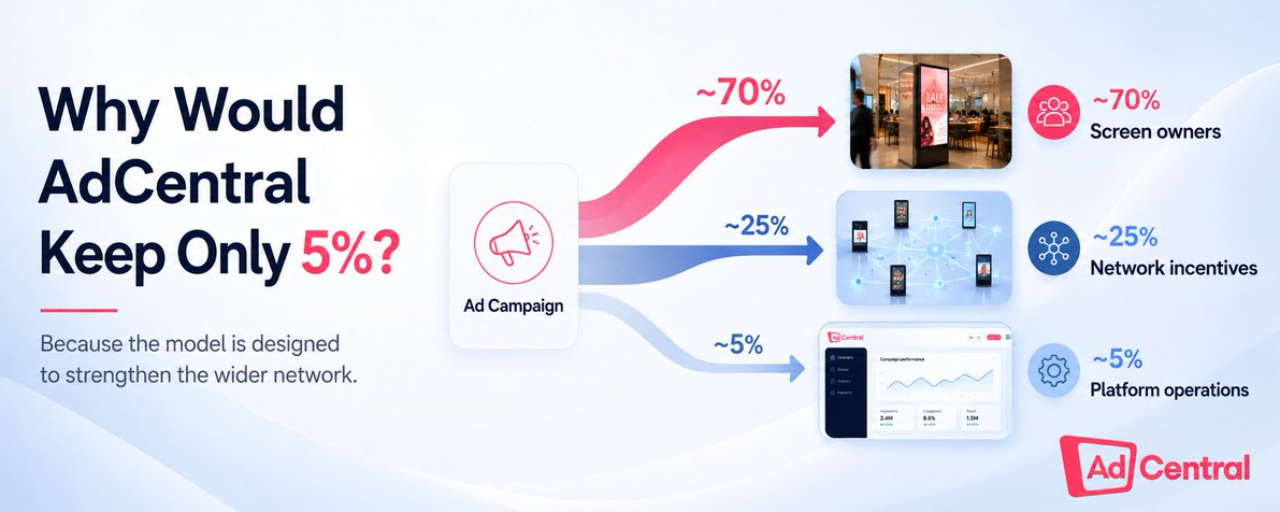
Under AdCentral’s current economic model, verified campaign value is approximately allocated like this:
~70% → Screen owners
For the screens that delivered the campaign.
~25% → Network incentives
Used to acquire ADCL for controlled network incentives.
~5% → Platform operations
For operating and developing the marketplace.
These percentages apply after relevant third-party fees and applicable taxes.
At first glance, the unusual number appears to be the 5%.
But the more interesting question is:
Why would we deliberately recycle part of the campaign value back into the network instead of simply keeping more of it?
A marketplace needs both sides to stay active
AdCentral needs advertisers.
But acquiring an advertiser once is not enough.
A healthy marketplace needs businesses to run campaigns, see value and come back again.
AdCentral also needs useful screens.
Advertising demand will never be perfectly even. A good screen may receive campaigns this month and fewer campaigns next month.
But the inventory still needs to be available when advertisers return.
That creates two very practical challenges:
Give advertisers another reason to come back.
Give useful screen owners another reason to stay available.
This is where Web3 becomes interesting for us.
Give advertisers another reason to return
Advertiser acquisition can be expensive.
A conventional marketplace may use sales, promotions, discounts and loyalty programs to bring customers back.
AdCentral can use those tools too.
But ADCL gives us an additional option.
A separate ADCL incentive pool can reward eligible advertisers who keep running real campaigns.
The idea is simple:
Run campaigns regularly, and eligible advertisers can qualify for additional incentives.
The token does not create advertising demand.
The goal is to use it as another tool to help turn first-time advertisers into repeat advertisers.
Give useful screens another reason to stay
Screen owners already earn when their screens deliver campaigns.
But demand can be uneven while a network is growing.
Network incentives can give useful, eligible screens another reason to remain active and available while demand develops.
Campaigns give screen owners direct earnings. Network incentives give useful screens another reason to remain available when demand is uneven.
That matters because advertisers only have a useful marketplace if the inventory is there when they need it.
Web3 gives us another growth tool
ADCL also gives the ecosystem controlled treasury resources that can support approved growth needs such as product development, partnerships and expansion.
That is another tool alongside normal company funding.
But it does not replace the need for a sustainable business.
So is 5% enough?
Tokenomics does not make that question disappear.
AdCentral still has to pay for people, technology, cloud infrastructure, advertiser acquisition, compliance and operations.
During early growth, platform operations may be supplemented by disclosed funding sources while campaign volume develops.
Over time, real operating data has to show whether the approximately 5% platform allocation can sustainably support the business at scale.
That has to be proven.
Now the 5% question looks different
The investor saw:
“The platform only keeps 5%.”
We see a model designed to share value differently.
Most of the campaign value goes to the screens that delivered the advertising.
Another portion is recycled into strengthening the network.
A smaller portion supports the platform operating the marketplace.
The business still has to create real advertising demand and prove that its economics work at scale.
Web3 simply gives us additional tools to help advertisers return, useful screens stay available, and the network grow around real business activity.
That is what AdCentral is building to prove.
Why Would AdCentral Keep Only 5%?
An investor recently looked at AdCentral’s economic model and stopped at one number.
5%.
“How can a platform survive if it keeps only 5%?”
It was a fair question.
Technology costs money. Finding advertisers costs money. People, cloud infrastructure, compliance and operations all cost money.
So why would we deliberately design AdCentral around an approximately 5% platform allocation?
The answer becomes clearer when you look at what the rest of the value is designed to do.
Start with the campaign
Under AdCentral’s current economic model, verified campaign value is approximately allocated like this:
~70% → Screen owners
For the screens that delivered the campaign.
~25% → Network incentives
Used to acquire ADCL for controlled network incentives.
~5% → Platform operations
For operating and developing the marketplace.
These percentages apply after relevant third-party fees and applicable taxes.
At first glance, the unusual number appears to be the 5%.
But the more interesting question is:
Why would we deliberately recycle part of the campaign value back into the network instead of simply keeping more of it?
A marketplace needs both sides to stay active
AdCentral needs advertisers.
But acquiring an advertiser once is not enough.
A healthy marketplace needs businesses to run campaigns, see value and come back again.
AdCentral also needs useful screens.
Advertising demand will never be perfectly even. A good screen may receive campaigns this month and fewer campaigns next month.
But the inventory still needs to be available when advertisers return.
That creates two very practical challenges:
Give advertisers another reason to come back.
Give useful screen owners another reason to stay available.
This is where Web3 becomes interesting for us.
Give advertisers another reason to return
Advertiser acquisition can be expensive.
A conventional marketplace may use sales, promotions, discounts and loyalty programs to bring customers back.
AdCentral can use those tools too.
But ADCL gives us an additional option.
A separate ADCL incentive pool can reward eligible advertisers who keep running real campaigns.
The idea is simple:
Run campaigns regularly, and eligible advertisers can qualify for additional incentives.
The token does not create advertising demand.
The goal is to use it as another tool to help turn first-time advertisers into repeat advertisers.
Give useful screens another reason to stay
Screen owners already earn when their screens deliver campaigns.
But demand can be uneven while a network is growing.
Network incentives can give useful, eligible screens another reason to remain active and available while demand develops.
Campaigns give screen owners direct earnings. Network incentives give useful screens another reason to remain available when demand is uneven.
That matters because advertisers only have a useful marketplace if the inventory is there when they need it.
Web3 gives us another growth tool
ADCL also gives the ecosystem controlled treasury resources that can support approved growth needs such as product development, partnerships and expansion.
That is another tool alongside normal company funding.
But it does not replace the need for a sustainable business.
So is 5% enough?
Tokenomics does not make that question disappear.
AdCentral still has to pay for people, technology, cloud infrastructure, advertiser acquisition, compliance and operations.
During early growth, platform operations may be supplemented by disclosed funding sources while campaign volume develops.
Over time, real operating data has to show whether the approximately 5% platform allocation can sustainably support the business at scale.
That has to be proven.
Now the 5% question looks different
The investor saw:
“The platform only keeps 5%.”
We see a model designed to share value differently.
Most of the campaign value goes to the screens that delivered the advertising.
Another portion is recycled into strengthening the network.
A smaller portion supports the platform operating the marketplace.
The business still has to create real advertising demand and prove that its economics work at scale.
Web3 simply gives us additional tools to help advertisers return, useful screens stay available, and the network grow around real business activity.
That is what AdCentral is building to prove.
1
74
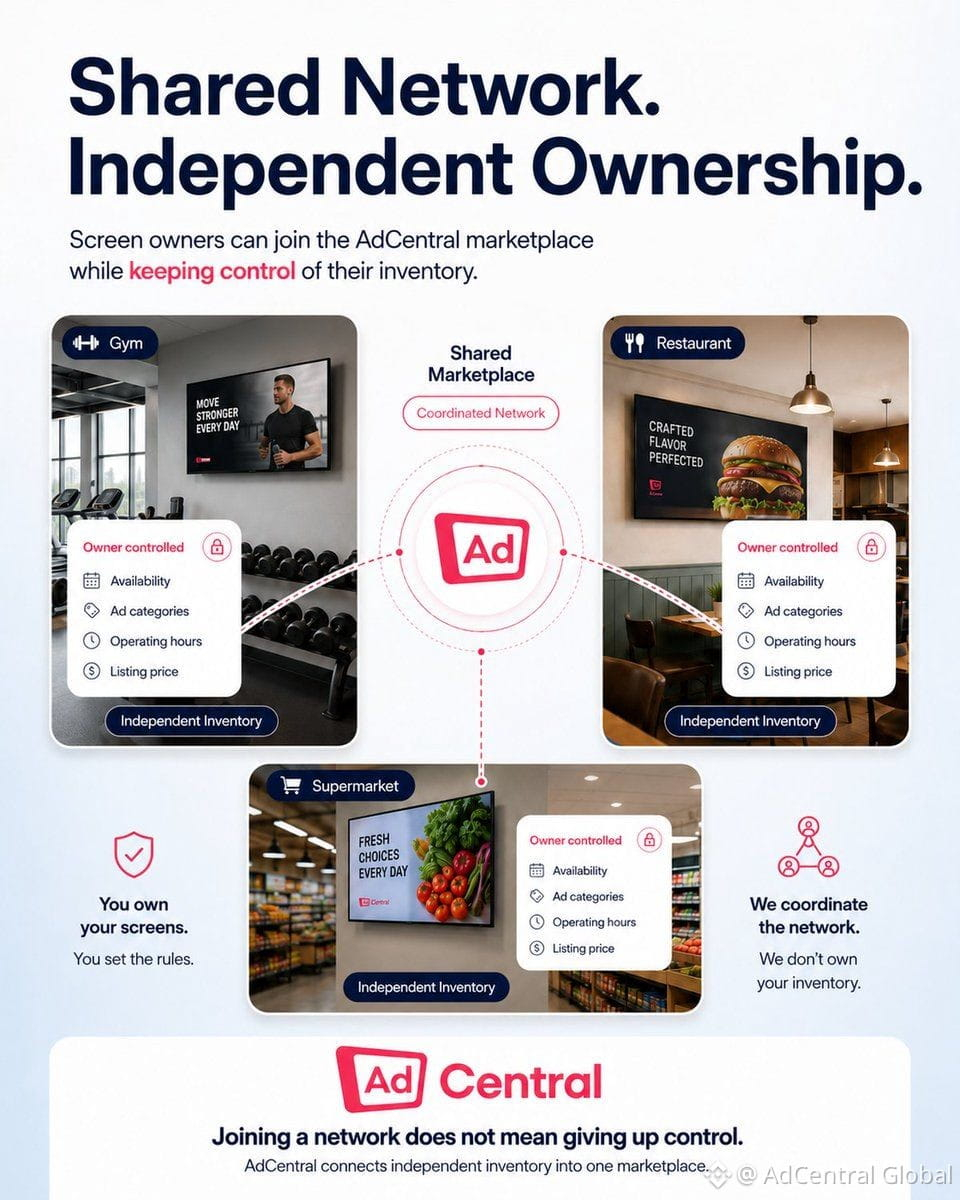
Rejoindre un réseau partagé ne signifie pas renoncer au contrôle.
Avec AdCentral, les propriétaires d’écrans peuvent décider à quel moment leurs écrans sont disponibles, quelles catégories de publicités ils acceptent et comment leur inventaire est tarifé.
AdCentral relie cet inventaire indépendant en un seul marché.
#DePIN
Réseau partagé. Propriété indépendante.
Avec AdCentral, les propriétaires d’écrans peuvent décider à quel moment leurs écrans sont disponibles, quelles catégories de publicités ils acceptent et comment leur inventaire est tarifé.
AdCentral relie cet inventaire indépendant en un seul marché.
#DePIN
Réseau partagé. Propriété indépendante.
1
92
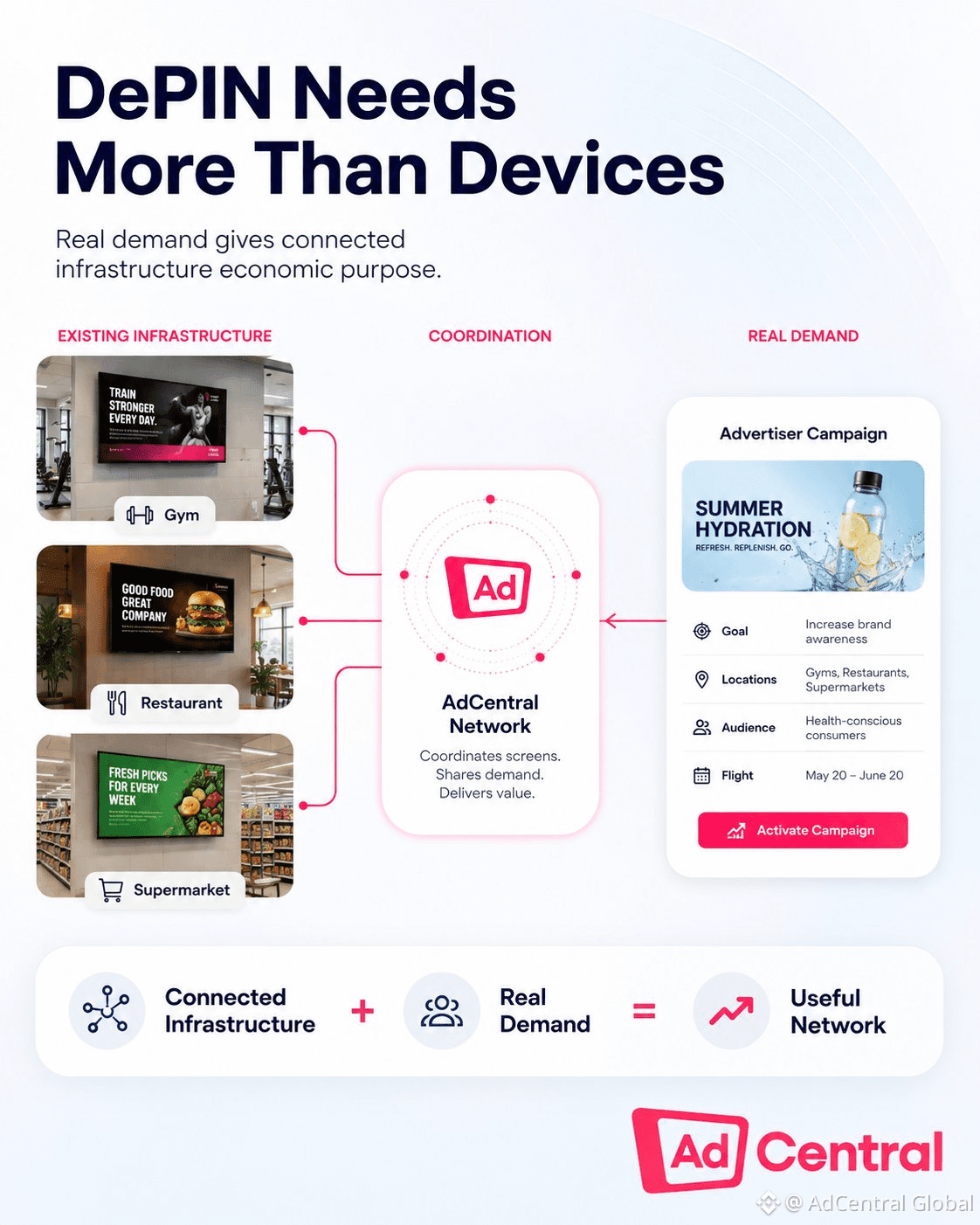
#DePIN a besoin de plus que des appareils connectés.
Un réseau devient utile lorsqu’il existe une demande réelle pour ce que cette infrastructure peut fournir.
Pour AdCentral, cela signifie des écrans détenus indépendamment, connectés à des annonceurs qui mènent de vraies campagnes.
Plus d’appareils peuvent accroître l’offre.
Une demande réelle, c’est ce qui donne à cette offre une raison économique.
1
68
Vous êtes-vous déjà contenté de passer devant un écran dans un centre commercial, un café ou un hall de bureau qui reste là, sans rien montrer d’utile ?
On appelle ça le DOOH, pour publicité digitale extérieure (digital out-of-home). En termes simples, il s’agit de tout écran numérique installé dans un lieu public ou semi-public, capable de diffuser des publicités.
La plupart de ces écrans restent inactifs beaucoup plus longtemps que ce que l’on imagine. Aucune publicité en cours, aucun revenu… juste allumé.
AdCentral met en relation les propriétaires d’écrans avec des annonceurs qui veulent cet espace, transformant l’inactivité en revenus. Le propriétaire de l’écran gagne, l’annonceur touche de vraies personnes, au bon endroit, et personne n’a besoin de manipuler un tableur pour que cela fonctionne.
Si vous ne saviez pas que des écrans pouvaient générer des revenus, suivez-nous : ce n’est que le début.
5
Article
Série ADCL Utility 02 : Comment les incitations réseau de l’ADCL sont financéesNotre premier article de l’ADCL Utility a expliqué pourquoi des écrans utiles peuvent avoir besoin d’incitations réseau lorsque la demande publicitaire augmente et diminue.
Cela soulève une autre question :
D’où provient l’ADCL utilisé pour ces incitations ?
En commençant par un fonds de démarrage
Un réseau publicitaire en pleine croissance ne dispose peut-être pas immédiatement d’assez d’activités de campagnes régulières pour financer ses incitations réseau.
AdCentral dispose donc d’un fonds de démarrage dédié.
Ce fonds fournit de l’ADCL pour des incitations réseau éligibles, tandis que l’activité publicitaire se développe.
Série ADCL Utility 02 : Comment les incitations réseau de l’ADCL sont financées
Notre premier article de l’ADCL Utility a expliqué pourquoi des écrans utiles peuvent avoir besoin d’incitations réseau lorsque la demande publicitaire augmente et diminue.
Cela soulève une autre question :
D’où provient l’ADCL utilisé pour ces incitations ?
En commençant par un fonds de démarrage
Un réseau publicitaire en pleine croissance ne dispose peut-être pas immédiatement d’assez d’activités de campagnes régulières pour financer ses incitations réseau.
AdCentral dispose donc d’un fonds de démarrage dédié.
Ce fonds fournit de l’ADCL pour des incitations réseau éligibles, tandis que l’activité publicitaire se développe.
1
4
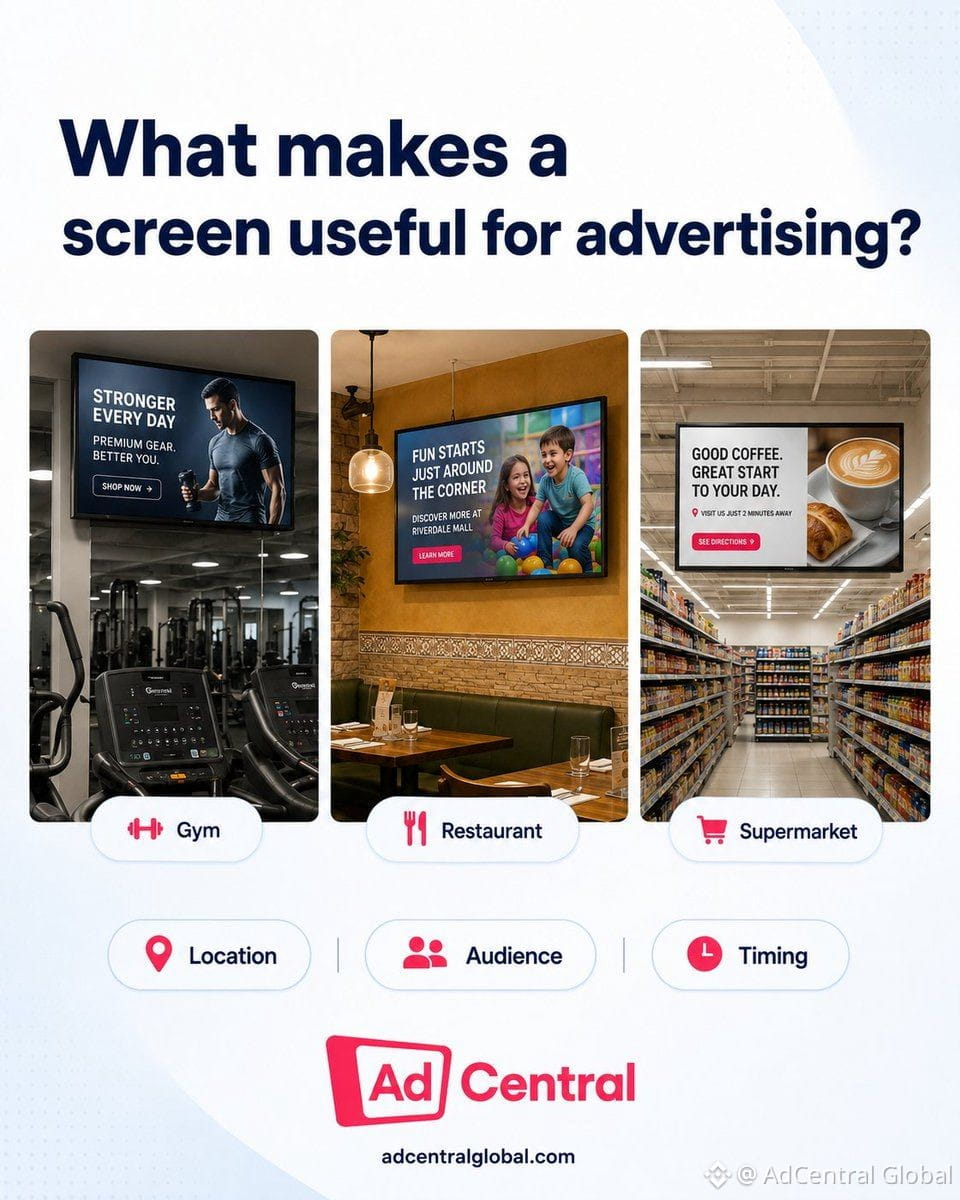
Un écran dans une salle de sport ne s’adresse pas au même public que dans un restaurant ou un supermarché.
L’emplacement de l’écran, les personnes susceptibles de le voir et le moment où elles s’y trouvent jouent un rôle déterminant.
AdCentral aide les annonceurs à trouver des écrans qui correspondent à leur campagne.
L’emplacement de l’écran, les personnes susceptibles de le voir et le moment où elles s’y trouvent jouent un rôle déterminant.
AdCentral aide les annonceurs à trouver des écrans qui correspondent à leur campagne.
1
42
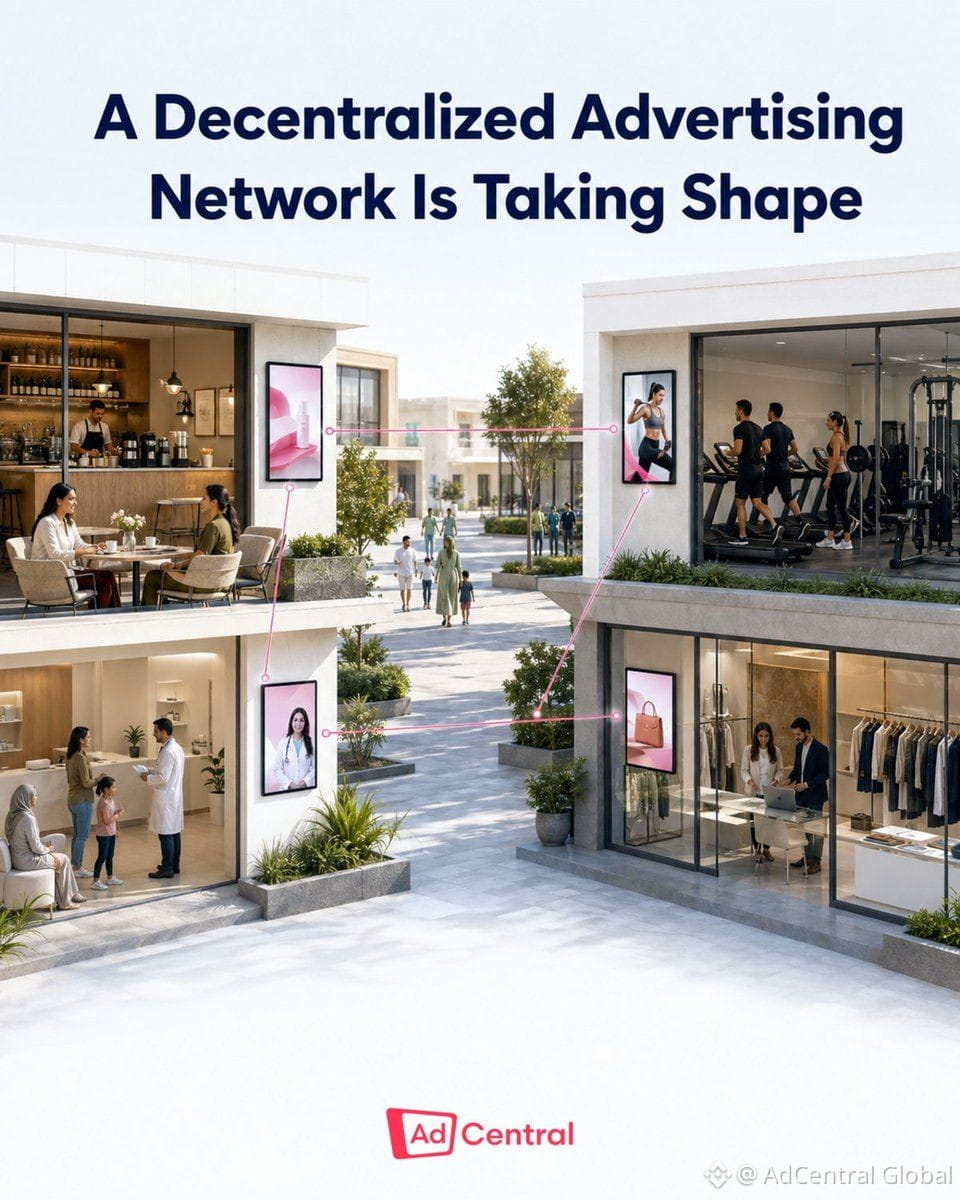
Un réseau publicitaire décentralisé se met en place à Dubaï.
Les écrans dans les cafés, les salles de sport et les cliniques restent la propriété d’entreprises locales.
AdCentral les relie pour former un réseau commun unique.
C’est une DePIN construite à partir d’une infrastructure du monde réel.
Un réseau publicitaire décentralisé se met en place à Dubaï.
Les écrans dans les cafés, les salles de sport et les cliniques restent la propriété d’entreprises locales.
AdCentral les relie pour former un réseau commun unique.
C’est une DePIN construite à partir d’une infrastructure du monde réel.
Les écrans dans les cafés, les salles de sport et les cliniques restent la propriété d’entreprises locales.
AdCentral les relie pour former un réseau commun unique.
C’est une DePIN construite à partir d’une infrastructure du monde réel.
1
30
Qu’est-ce qui rend ce réseau utile ?
Les annonceurs peuvent découvrir et utiliser des écrans dans des lieux indépendants via une seule place de marché.
AdCentral vérifie la diffusion des campagnes.
Cela relie une infrastructure décentralisée à une demande professionnelle réelle.
Qu’est-ce qui rend ce réseau utile ?
Les annonceurs peuvent découvrir et utiliser des écrans dans des lieux indépendants via une seule place de marché.
AdCentral vérifie la diffusion des campagnes.
Cela relie une infrastructure décentralisée à une demande professionnelle réelle.
Les annonceurs peuvent découvrir et utiliser des écrans dans des lieux indépendants via une seule place de marché.
AdCentral vérifie la diffusion des campagnes.
Cela relie une infrastructure décentralisée à une demande professionnelle réelle.
1
44
Connectez-vous pour découvrir plus de contenu
Rejoignez la communauté mondiale des adeptes de cryptomonnaies sur Binance Square
⚡️ Suviez les dernières informations importantes sur les cryptomonnaies.
💬 Jugé digne de confiance par la plus grande plateforme d’échange de cryptomonnaies au monde.
👍 Découvrez les connaissances que partagent les créateurs vérifiés.
Adresse e-mail/Nº de téléphone