

An investor recently looked at AdCentral’s economic model and stopped at one number.
5%.
“How can a platform survive if it keeps only 5%?”
It was a fair question.
Technology costs money. Finding advertisers costs money. People, cloud infrastructure, compliance and operations all cost money.
So why would we deliberately design AdCentral around an approximately 5% platform allocation?
The answer becomes clearer when you look at what the rest of the value is designed to do.
Start with the campaign
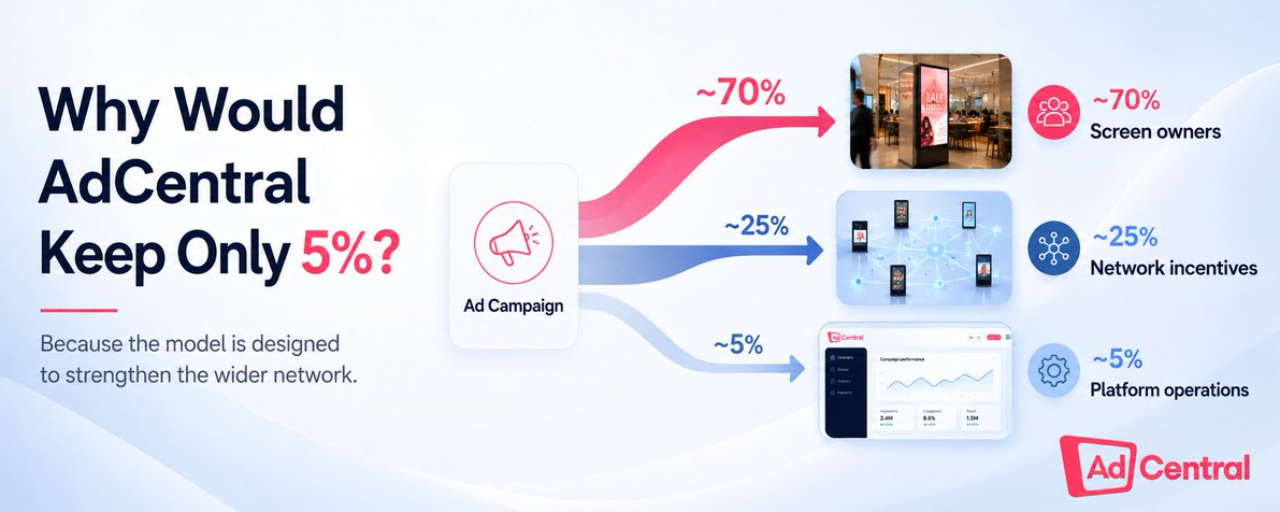
Under AdCentral’s current economic model, verified campaign value is approximately allocated like this:
~70% → Screen owners
For the screens that delivered the campaign.
~25% → Network incentives
Used to acquire ADCL for controlled network incentives.
~5% → Platform operations
For operating and developing the marketplace.
These percentages apply after relevant third-party fees and applicable taxes.
At first glance, the unusual number appears to be the 5%.
But the more interesting question is:
Why would we deliberately recycle part of the campaign value back into the network instead of simply keeping more of it?
A marketplace needs both sides to stay active
AdCentral needs advertisers.
But acquiring an advertiser once is not enough.
A healthy marketplace needs businesses to run campaigns, see value and come back again.
AdCentral also needs useful screens.
Advertising demand will never be perfectly even. A good screen may receive campaigns this month and fewer campaigns next month.
But the inventory still needs to be available when advertisers return.
That creates two very practical challenges:
Give advertisers another reason to come back.
Give useful screen owners another reason to stay available.
This is where Web3 becomes interesting for us.
Give advertisers another reason to return
Advertiser acquisition can be expensive.
A conventional marketplace may use sales, promotions, discounts and loyalty programs to bring customers back.
AdCentral can use those tools too.
But ADCL gives us an additional option.
A separate ADCL incentive pool can reward eligible advertisers who keep running real campaigns.
The idea is simple:
Run campaigns regularly, and eligible advertisers can qualify for additional incentives.
The token does not create advertising demand.
The goal is to use it as another tool to help turn first-time advertisers into repeat advertisers.
Give useful screens another reason to stay
Screen owners already earn when their screens deliver campaigns.
But demand can be uneven while a network is growing.
Network incentives can give useful, eligible screens another reason to remain active and available while demand develops.
Campaigns give screen owners direct earnings. Network incentives give useful screens another reason to remain available when demand is uneven.
That matters because advertisers only have a useful marketplace if the inventory is there when they need it.
Web3 gives us another growth tool
ADCL also gives the ecosystem controlled treasury resources that can support approved growth needs such as product development, partnerships and expansion.
That is another tool alongside normal company funding.
But it does not replace the need for a sustainable business.
So is 5% enough?
Tokenomics does not make that question disappear.
AdCentral still has to pay for people, technology, cloud infrastructure, advertiser acquisition, compliance and operations.
During early growth, platform operations may be supplemented by disclosed funding sources while campaign volume develops.
Over time, real operating data has to show whether the approximately 5% platform allocation can sustainably support the business at scale.
That has to be proven.
Now the 5% question looks different
The investor saw:
“The platform only keeps 5%.”
We see a model designed to share value differently.
Most of the campaign value goes to the screens that delivered the advertising.
Another portion is recycled into strengthening the network.
A smaller portion supports the platform operating the marketplace.
The business still has to create real advertising demand and prove that its economics work at scale.
Web3 simply gives us additional tools to help advertisers return, useful screens stay available, and the network grow around real business activity.
That is what AdCentral is building to prove.