
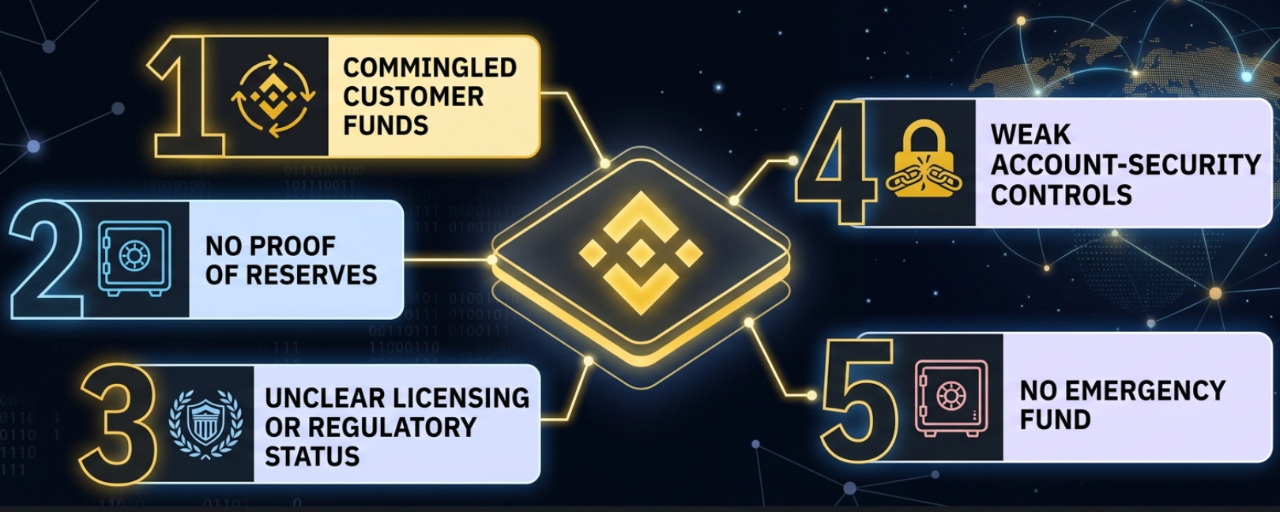
Before choosing a crypto or financial platform, look beyond trading fees and the number of assets listed. Unclear licensing, commingled funds, no proof of reserves, no emergency fund and weak account controls are five important warning signs to investigate.
Binance addresses these areas through its ADGM-regulated structure, custody arrangements, Proof of Reserves, SAFU and account-security controls including passkeys, 2FA, anti-phishing codes and withdrawal allowlisting.
Here is what to check before depositing funds.
Red Flag 1: Unclear Licensing or Regulatory Status
The first question should be: Which legal entity is actually providing the service to me, and who regulates it?
A platform operating internationally may use different legal entities for different services and jurisdictions. A regulatory authorization in one country does not automatically mean the platform is licensed in every country where users can access it.
Since January 2026, Binance's global platform has operated through three ADGM-regulated entities under the supervision of the Financial Services Regulatory Authority (FSRA):
Nest Exchange Limited — exchange activities, including spot and derivatives trading
Nest Clearing and Custody Limited — clearing, settlement and custody
Nest Trading Limited — broker-dealer and certain off-exchange activities
The structure is designed to separate responsibilities across the platform rather than placing all functions within a single entity.
For users in Ethiopia, an important distinction remains: ADGM regulation is not the same thing as a license from the National Bank of Ethiopia. Users should always check the regulatory status and product availability that applies to their own jurisdiction. The broader lesson is simple: don't just ask whether a platform is "regulated." Find out which entity is regulated, by which authority, and for which activities.
Red Flag 2: Commingled or Unclear Customer Funds
Another warning sign is when a platform provides little information about how customer assets are held.
Users should be able to understand who has custody of their assets and whether customer assets are treated separately from the platform's own operating funds.
Binance's current ADGM structure assigns custody of user digital assets to Nest Clearing and Custody Limited, an ADGM-recognized clearing house with authorization to provide custody.
Binance also states through its Proof of Reserves system that user assets held in custody are backed 1:1, plus reserves.
That gives users two different things to examine:
Legal custody: Who is responsible for safeguarding the assets?
Reserve transparency: Can the platform provide evidence that the assets it holds for customers are actually there?
Both questions matter when evaluating a centralized financial platform.
Red Flag 3: No Proof of Reserves
If a centralized platform holds customer crypto, users should ask whether they can independently verify that their balances are represented in the platform's reported reserves.
Binance's Proof of Reserves (PoR) uses cryptographic verification, including Merkle Trees, to allow users to verify that their account balance was included in the published reserve calculation. Binance also uses zero-knowledge technology in its PoR system.
A Merkle Tree allows many account balances to be represented through a cryptographic structure while allowing an individual user to verify inclusion without exposing other customers' balances.
Binance's PoR page currently states that the platform holds user assets 1:1, with additional reserves.
The important point is that users don't have to treat a reserve statement as something they simply have to trust.
They can go to Binance's official Proof of Reserves page and use the available verification mechanism to check whether their account was included in the relevant snapshot.
PoR does have limitations: it is a point-in-time representation and does not by itself establish the absence of every possible liability or financial risk. Binance's own Academy explanation notes these limitations.
So PoR should be viewed as a transparency mechanism, not as a complete substitute for understanding a platform's legal and financial structure.
Red Flag 4: No Emergency Fund
Even a platform with strong custody and security systems needs to consider what happens in an extreme incident.
Binance's Secure Asset Fund for Users (SAFU) was established as an emergency protection mechanism for users' assets.
As of January 2026, SAFU comprises 1 billion USDC, according to Binance. The fund's value can change with market conditions. Binance says SAFU is held and managed by Nest Clearing and Custody Limited under the ADGM regulatory structure.
SAFU is not a replacement for normal account security or responsible risk management. It is an additional layer intended for extreme situations. That distinction is important because no emergency fund can eliminate the market risk associated with buying or trading crypto assets.
Red Flag 5: Weak Account-Security Controls
Even if a platform has institutional-level security, users still need strong controls over their individual accounts.
Binance provides several tools that address different parts of this problem.
Passkeys
Passkeys provide a passwordless authentication option based on cryptographic credentials stored on compatible devices. They can reduce reliance on traditional passwords and can be used as part of Binance's account-security setup.
Two-Factor Authentication
2FA adds another verification layer to account access and sensitive actions. Binance supports multiple authentication methods that users can configure according to their security preferences.
Anti-Phishing Codes
An anti-phishing code helps users distinguish genuine Binance communications from fraudulent messages. When enabled, the user's chosen code appears in legitimate Binance communications, making unexpected messages without the code easier to identify as suspicious.
Withdrawal Allowlisting
Withdrawal allowlisting lets users restrict withdrawals to previously approved wallet addresses.
This can add another barrier if an attacker gains access to an account. Instead of being able to send funds to any address immediately, withdrawals can be restricted to addresses the user has explicitly approved.
The strongest approach is not relying on one security feature.
Passkeys + 2FA + anti-phishing protection + withdrawal controls create multiple layers between an attacker and the user's assets.
What These Five Checks Tell You
Choosing a financial platform is not simply about finding the lowest trading fee.
Before depositing, ask five basic questions:
1. Who regulates the platform?
Identify the legal entity serving you and the regulator responsible for that entity.
2. Who holds my assets?
Understand the custody arrangement and how customer assets are safeguarded.
3. Can the platform prove its reserves?
Look for verifiable evidence rather than relying solely on a company's statement.
4. What happens during an extreme incident?
Check whether an emergency protection mechanism exists and understand what it actually covers.
5. Can I secure my own account?
Look for strong authentication, anti-phishing protection and withdrawal controls.
No centralized platform eliminates every risk. But transparency around regulation, custody, reserves, emergency protection and account security gives users more information with which to assess those risks.
That is ultimately what users should look for before choosing where to keep and manage their assets.