
A few years ago, when people talked about AI and crypto together, most conversations were about generating trading signals.
“Tell me when Bitcoin will pump.”
“Predict the next altcoin.”
“Give me the next 100x.”
That isn't the AI future I'm most interested in.
I'm more interested in something much more practical:
What happens when AI can actually interact with financial infrastructure?
That's one of the reasons Binance's development around AI and Agent OS has caught my attention.
1. I already use AI for research
As someone involved in crypto communities, content creation and education, AI has already become part of my workflow.
I use AI to organize information.
I use it to understand complicated concepts.
I use it to structure educational content.
I use it to compare information and turn technical ideas into explanations that ordinary users can understand. But there's an important limitation.
An AI that can tell me something is different from an AI that can do something.
That's where agentic systems become interesting.
2. The next step isn't just answers
Imagine asking an AI:
“What happened to this asset today?”
That's information.
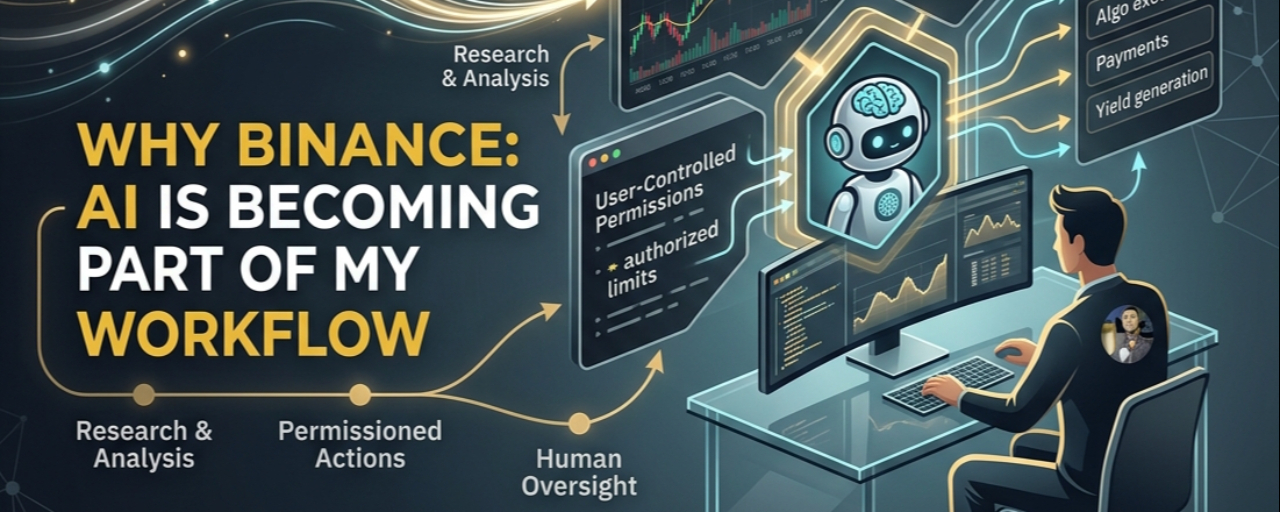
Now imagine an AI being able to access market data, analyze a wallet, check relevant information, prepare an action and where explicitly authorized interact with supported financial tools. That's closer to an agent than a chatbot.
Binance has been building toward that model.
Binance launched its first AI Agent Skills in March 2026, giving AI agents access to Binance market information, order execution and other capabilities through a unified interface.
Then in August, Binance introduced Binance Agent OS, describing it as a developer platform connecting compatible AI applications and agents with supported Binance capabilities through user-controlled permissions.
That phrase, user controlled permissions is particularly important to me. Because AI interacting with money is obviously different from AI writing an email.
3. AI shouldn't mean “give the bot my money and hope”
This is where I think crypto users need to be careful. The exciting part of agentic finance is also the part that requires the most responsibility.
If an AI can execute actions, permissions matter.
Security matters.
API controls matter.
Limits matter.
Human oversight matters.
A smart model isn't automatically a trustworthy financial operator.
It can misunderstand a request.
It can misinterpret data.
It can make an incorrect assumption.
Markets can change faster than an AI's reasoning.
So I don't see AI as:
“Let the machine trade while I sleep.”
I see it more as:
“Give me better tools so I can spend less time doing repetitive work and more time thinking about strategy.”
That's a very different philosophy.
4. Binance is moving from AI assistant toward AI infrastructure
This is what makes Agent OS more interesting than simply adding another chatbot.
Binance describes Agent OS as bringing together Binance APIs, Wallet Agentic Hub, x402, Skill Hub and MCP support into a more coherent platform for agentic crypto experiences.
Earlier in 2026, Binance also expanded its AI Agent Skills so agents could interact with capabilities across areas including derivatives, algorithmic execution, payments, yield generation and real-world assets.
That tells me the bigger objective isn't just:
“Ask Binance AI a question.”
It's closer to:
“Build an environment where AI agents can interact with different parts of the Binance ecosystem.”
That's a much bigger idea.
5. Why this matters to my workflow
As an Angel and content creator, one of the biggest challenges isn't always finding information.
It's dealing with the amount of information.
Crypto never stops.
Markets move 24/7.
New products appear.
New announcements arrive.
New tokens launch.
Communities ask questions.
There are charts, announcements, research, wallet data, product updates and security considerations to keep track of.
AI can help reduce some of that information overload.
But the real value comes when research, analysis and execution become connected in a controlled way.
Instead of jumping between ten different tools, the user could eventually have an intelligent interface capable of working across multiple parts of the financial workflow.
That's the direction I find exciting.
AI won't replace DYOR
If anything, I think AI makes DYOR more important.
Why?
Because an AI can process information quickly, but speed doesn't guarantee correctness.
If an AI gives me a market interpretation, I still need to understand what information it used.
If it proposes an action, I need to understand the consequences.
If it executes an action, I need to know exactly what permissions I gave it.
And if money is involved, I don't want “the AI said so” to become my investment thesis.
AI should improve my decision-making process.
It shouldn't eliminate my responsibility for the decision.
From assistant to agent
This is the transition I'm watching.
Chatbot:
“Here's some information.”
AI assistant:
“Here's an analysis and some possible actions.”
AI agent:
“I can perform authorized tasks across connected systems.”
That's a fundamental change in how software works.
And crypto is an interesting environment for this because financial infrastructure is already increasingly programmable.
Wallets are programmable.
Smart contracts are programmable.
Trading systems are programmable.
Payments are programmable.
Now AI is becoming capable of interacting with some of those systems.
Why this is one of my reasons for choosing Binance
My reason isn't:
“Binance has AI, therefore Binance is better.”
That's too simplistic.
My reason is that I want to be where the technology is moving.
I've watched crypto evolve from simply buying and selling digital assets into an ecosystem involving payments, Earn products, tokenization, automated trading and now increasingly AI-driven interaction.
Binance Agent OS represents one example of that shift.
For me, the exciting question isn't whether AI can predict the next Bitcoin move.
It's whether AI can eventually help me manage the complexity of digital finance while keeping me in control. That's the future I'm interested in.
And if AI is going to become part of my financial workflow, I want to understand it early rather than wait until everyone else is already using it.
AI shouldn't replace the person behind the strategy.
It should give that person better tools.
DYOR. AI systems can make mistakes, and financial actions involving AI carry additional technical and market risks. Features, permissions and availability vary by product and jurisdiction. This is personal commentary, not financial advice.