#dusk @Dusk $DUSK
The provisioner list has a column I walked past last time: accumulated reward. It reads like noise. One operator sitting on 652,827 DUSK, another on 50.08, both securing the same chain at the same moment. Then it occurred to me that the column is a clock, and that I could read it.
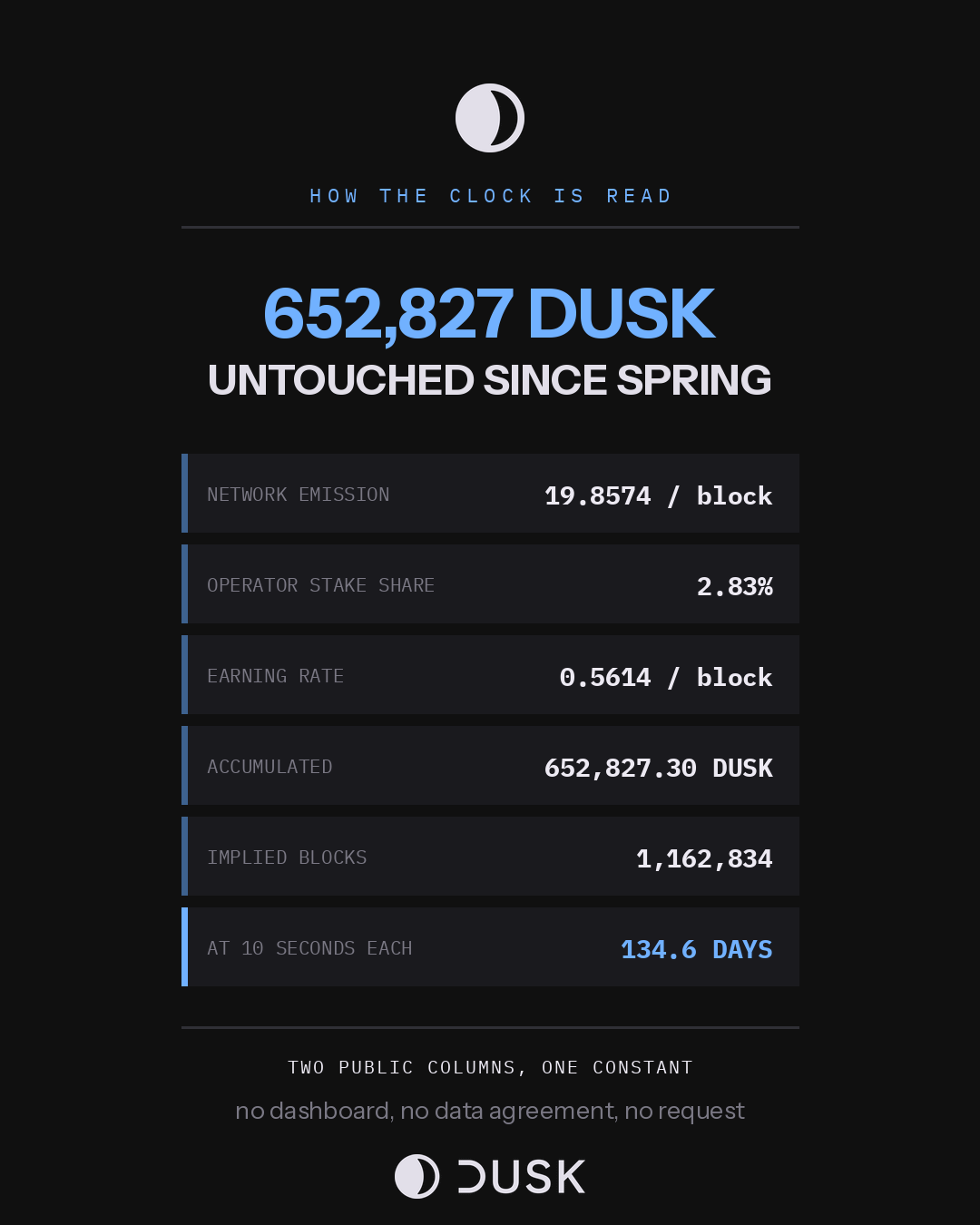
Emission on Dusk is fixed. 19.8574 DUSK per block, a block every ten seconds, split by stake weight. So an operator's earning rate is not a matter of luck or strategy, it is arithmetic. The node holding 2.83% of the 213.57M staked earns 0.5614 DUSK per block, always. Divide its accumulated balance by that rate and you recover how long it has been since it last swept.
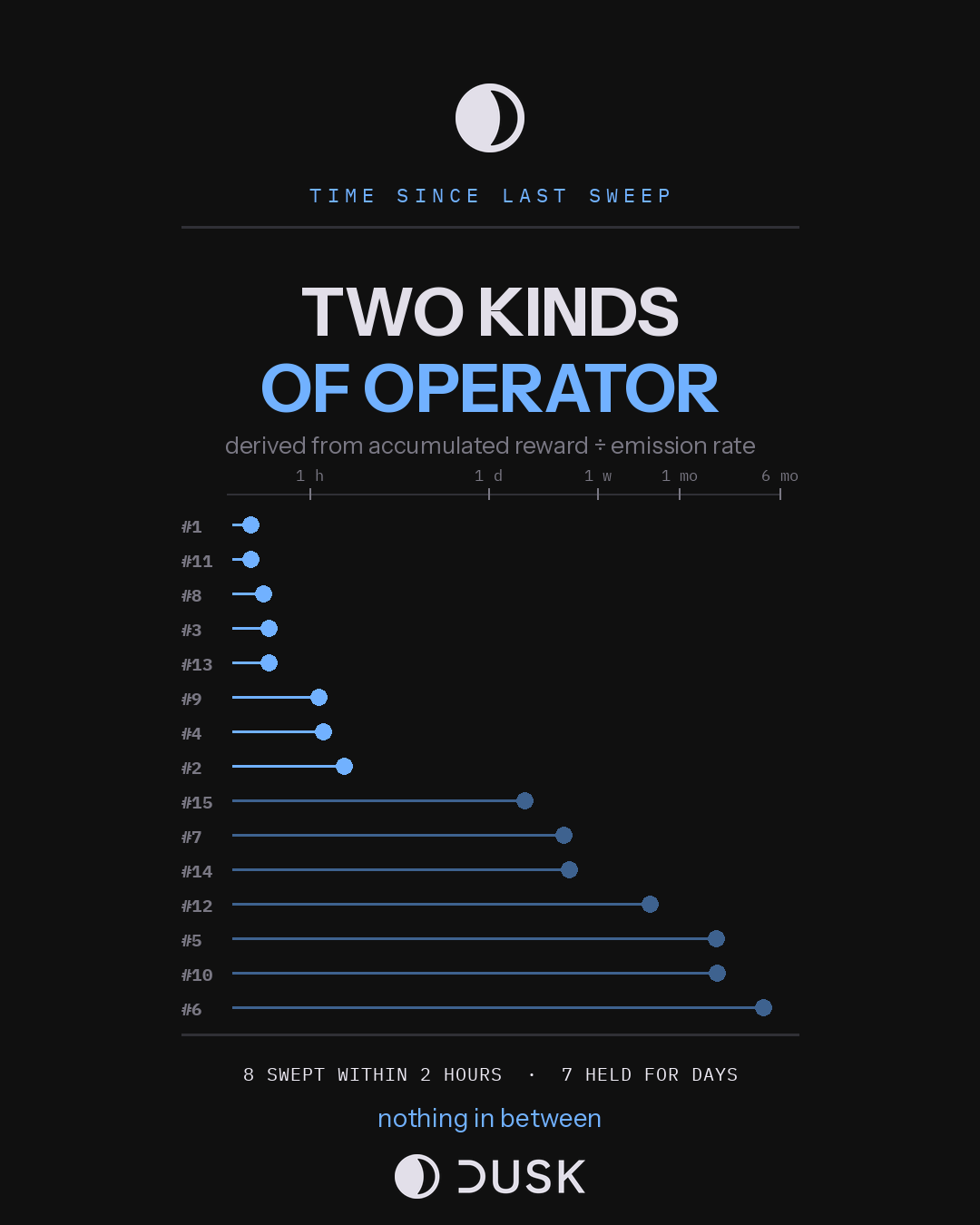
Run that across the top fifteen and they split into two populations with nothing in between. Eight had swept within the previous two hours - the largest provisioner on the network, 7.20% of all stake, had collected 21 minutes before I loaded the page. The other seven were letting it ride: 1.9 days, 3.8, 4.2, 17.7, 57.4, 58.6, and one at 134.6 days holding 652,827 DUSK it has not touched since spring.
Nobody published that. I derived it from two public columns and one protocol constant. That is the part worth sitting with. An institution reconciling what its validators earned does not have to ask them, or trust a dashboard, or sign a data agreement. The ledger already answers, per address, for anyone who cares to divide.
The honest limit: this assumes each stake held steady across the whole window. Over 134 days it almost certainly did not, so the long intervals are estimates with real error bars, not invoices. The short ones, measured in minutes, are solid.
Which is the quieter half of what Dusk is building. Balances can be made confidential. The record of who secured the chain, and what they were paid for it, stays legible to anyone with a calculator.
If you ran a regulated venue, would you rather audit your validators by request, or by arithmetic?
The provisioner list has a column I walked past last time: accumulated reward. It reads like noise. One operator sitting on 652,827 DUSK, another on 50.08, both securing the same chain at the same moment. Then it occurred to me that the column is a clock, and that I could read it.
Emission on Dusk is fixed. 19.8574 DUSK per block, a block every ten seconds, split by stake weight. So an operator's earning rate is not a matter of luck or strategy, it is arithmetic. The node holding 2.83% of the 213.57M staked earns 0.5614 DUSK per block, always. Divide its accumulated balance by that rate and you recover how long it has been since it last swept.
Run that across the top fifteen and they split into two populations with nothing in between. Eight had swept within the previous two hours - the largest provisioner on the network, 7.20% of all stake, had collected 21 minutes before I loaded the page. The other seven were letting it ride: 1.9 days, 3.8, 4.2, 17.7, 57.4, 58.6, and one at 134.6 days holding 652,827 DUSK it has not touched since spring.
Nobody published that. I derived it from two public columns and one protocol constant. That is the part worth sitting with. An institution reconciling what its validators earned does not have to ask them, or trust a dashboard, or sign a data agreement. The ledger already answers, per address, for anyone who cares to divide.
The honest limit: this assumes each stake held steady across the whole window. Over 134 days it almost certainly did not, so the long intervals are estimates with real error bars, not invoices. The short ones, measured in minutes, are solid.
Which is the quieter half of what Dusk is building. Balances can be made confidential. The record of who secured the chain, and what they were paid for it, stays legible to anyone with a calculator.
If you ran a regulated venue, would you rather audit your validators by request, or by arithmetic?