



Decentralized storage is blowing up in Web3 because everyone wants to ditch big centralized cloud giants like AWS or Google for something more secure, private, and actually owned by users. Walrus is one of those projects that's turning heads right now—it's a full-on storage protocol tied super tight to the Sui blockchain, aiming to handle massive files (think videos, AI datasets, media blobs) in a way that's reliable, cheap, and programmable without the usual headaches of other decentralized options.
What Walrus Really Does
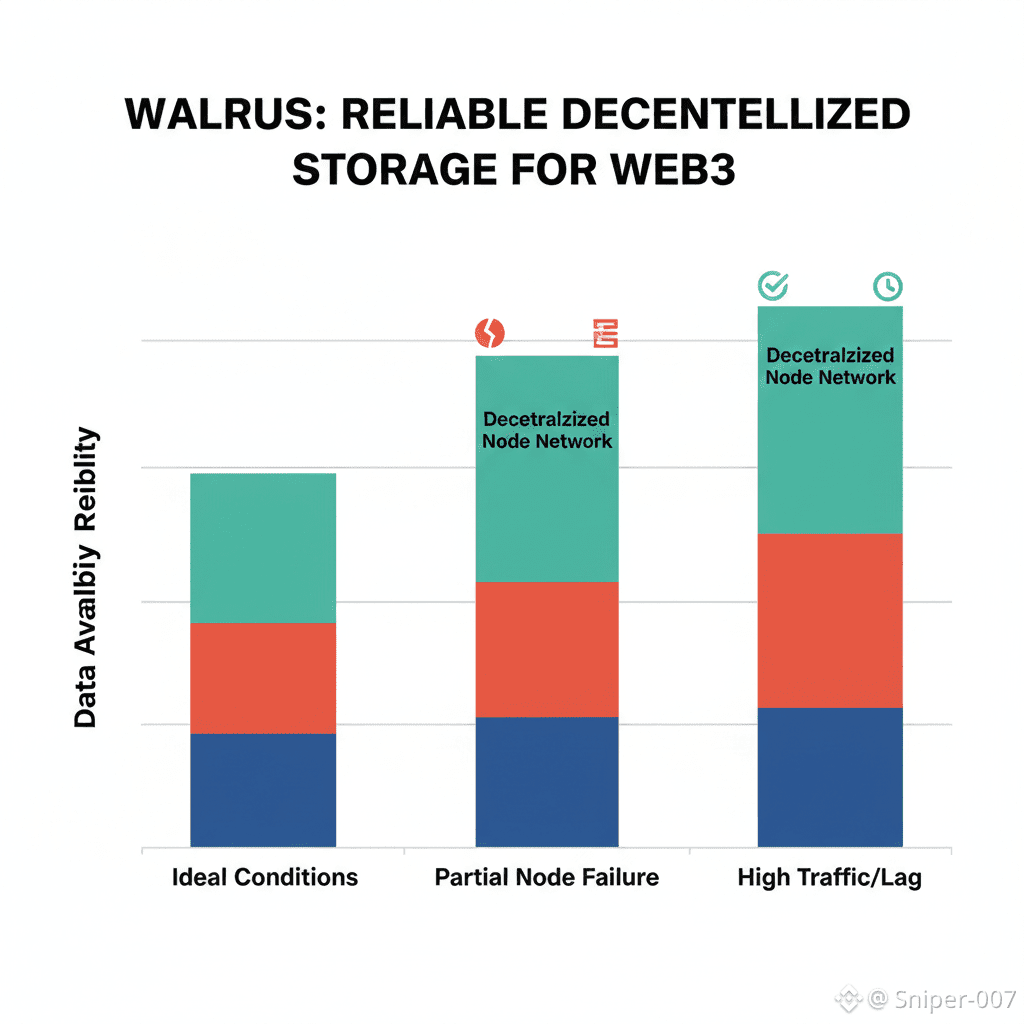
At its heart, Walrus is this decentralized data availability and storage layer built right on Sui. Instead of cramming huge files onto the blockchain (which would be insanely expensive and slow), it chops them up using something called Red Stuff—this clever two-dimensional erasure coding trick. Basically, your file gets turned into a bunch of small coded fragments spread across tons of independent storage nodes. Even if a bunch of those nodes flake out or go offline, you can still rebuild the whole thing from the surviving pieces.
The Sui chain itself only holds the lightweight metadata, proofs, and verifiability stuff—so everything stays cheap, decentralized, and verifiable. Smart contracts on Sui can point to or control these blobs without ever touching the raw data directly. It's like having a super-efficient off-chain hard drive that's still fully on-chain accountable.
The Magic Behind Red Stuff
Red Stuff is the star tech here. Traditional erasure coding already beats full replication (where you copy the whole file everywhere, wasting space), but Red Stuff takes it up a notch with 2D encoding—splitting data both horizontally and vertically into a matrix with overlapping parities. That means lower overhead (around 4-5x replication factor instead of way more), faster recovery, and it's "self-healing" in a Byzantine-tolerant setup. Nodes have to keep proving they still have their slivers periodically, and those proofs hit the Sui chain so anyone (or any contract) can check: yep, the data's still there and retrievable.
The WAL Token Keeping It All Running
WAL is the fuel. Users pay in WAL to store blobs, node operators stake WAL to join the network and handle storage/serving, and they earn rewards for staying reliable and online. Stakers get in on governance too—voting on pricing tweaks, penalties for bad actors, protocol upgrades, all that jazz.
Total supply is capped at 5 billion WAL. A big chunk (over 60%) goes to the community through airdrops, subsidies, reserves, and incentives to get devs and users hooked. There was an initial 4% airdrop via soulbound NFTs for early Sui/Walrus contributors, plus more reserved for ongoing drops and growth. By early 2026, over a billion WAL is staked, and usage burns fees to keep things deflationary as adoption ramps.
How You Actually Use It Day-to-Day
Pretty straightforward once you're set up:
- Upload your blob via CLI, SDKs, or integrated apps.
- Walrus encodes it with Red Stuff, scatters the pieces to nodes.
- Nodes commit, start proving availability on Sui.
- You (or your app) can request reconstruction anytime—pulls from multiple nodes to rebuild fast.
- Smart contracts reference it via on-chain certs, attach rules like expiry, access controls, or metadata.
The whole thing runs in epochs—set periods where node committees handle ops, proofs roll in, and rewards get dished out based on uptime and performance.

Real-World Stuff It's Powering (or Could)
It's not just dumping files—Walrus shines for:
- AI workloads: Storing huge training datasets, model checkpoints, or inference outputs in a verifiable, decentralized spot so no one can tamper or vanish the data.
- Archiving blockchain history or logs without relying on centralized servers.
- Fully decentralized websites/frontends—host static sites or dynamic content blobs right on Walrus.
- Layer 2 data needs, fraud proofs, audit trails—anywhere you want provable availability without central trust.
Mainnet went live March 27, 2025, after a big $140M raise (led by Standard Crypto, a16z crypto, etc.). Started with over 100 nodes, and by 2026 it's scaled with integrations across 170+ projects, Pudgy Penguins using it for media, and ties into Sui's privacy/compute stack (like Seal for encryption). Roadmap for 2026 includes cranking up throughput for AI/media, expanding access controls, and even multichain support beyond Sui/Solana to Ethereum/Cosmos via partners like Pipe Network.
Why Walrus Feels Different
- Programmable storage: Blobs aren't dumb files—they're resources smart contracts can interact with natively on Sui (Move language perks).
- Super-efficient encoding cuts costs while keeping recovery rock-solid.
- On-chain proofs mean no "trust me bro" for availability.
- Sui integration gives it low-latency, high-throughput edges over standalone storage plays.
- Community-heavy tokenomics with burns and incentives to drive real usage.
Sure, it competes with Filecoin, Arweave, IPFS-based stuff, but the tight Sui coupling, Move programmability, and Red Stuff's efficiency give it a legit technical moat. As AI explodes and Web3 apps need to handle bigger data without centralized chokepoints, something like Walrus could become the go-to backbone—making big data feel native to blockchain instead of bolted-on.
Bottom line: Walrus isn't hyping vaporware. It's live, growing, and solving a real pain point in a way that actually matters for the next wave of decentralized apps. If you're into Sui or just tired of centralized storage risks, this one's worth keeping an eye on.