


The Architecture of a Frictionless, Censorship-Resistant Blockchain:
How Protocol-Level Paymasters, Bitcoin State Anchoring, and Modular Execution Redefine Plasma’s Design
Introduction: The Three Barriers Holding Blockchain Back
After more than a decade of blockchain innovation, one uncomfortable truth remains: most blockchains are still not built for everyday users.
Despite massive progress in decentralization, cryptography, and financial primitives, three persistent barriers continue to limit real-world adoption:
1. Fee friction – users must hold native gas tokens just to move common assets like USDT.
2. Censorship risk – Proof-of-Stake (PoS) systems remain vulnerable to validator collusion or external pressure.
3. Latency and settlement delays – even EVM-compatible chains struggle with predictable, low-latency finality.
These problems are not cosmetic. They are architectural. And they cannot be solved by wallets, bridges, or UX polish alone.
Plasma approaches this challenge differently — not by optimizing one layer, but by re-architecting the entire settlement stack around three foundational ideas:
Protocol-level Paymasters for zero-fee stablecoin transfers
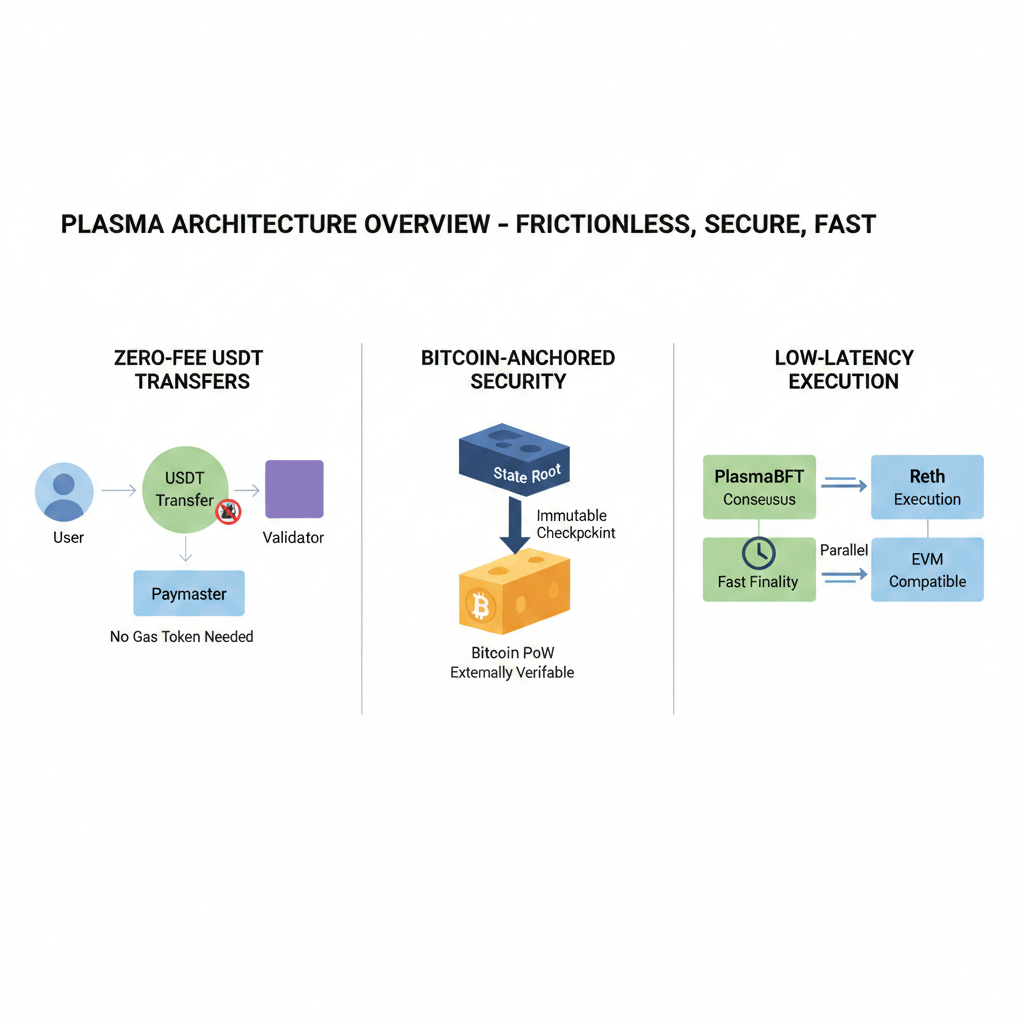
Bitcoin-anchored state commitments for censorship resistance
A modular execution-consensus split, pairing Reth with PlasmaBFT for low latency
Individually, each innovation is powerful. Together, they form a cohesive system designed for real payments, real users, and real adversarial environments.
This article explains how these components work, how they reinforce each other, and why their combination represents a meaningful step forward in blockchain design.
Part I: Removing the First Friction — Gas Fees and the Paymaster Revolution
Why Gas Tokens Are a UX Dead End
In most blockchains today, sending USDT is paradoxically complicated.
Before a user can move a stablecoin — a token explicitly designed to behave like money — they must:
acquire the chain’s native token,
understand gas pricing,
maintain a balance of an asset unrelated to their actual transfer.
This requirement is not a security feature. It is an artifact of early blockchain design, where execution fees and user identity were tightly coupled.
For experienced users, this is an annoyance.
For new users, it is a deal-breaker.
Protocol-level Paymasters exist to break this coupling.
What Is a Paymaster, Really?
At a technical level, a Paymaster is a smart-contract-based entity introduced through Account Abstraction standards, most notably EIP-4337.
Instead of a traditional transaction, users submit a UserOperation, a richer transaction format that includes:
account logic,
signature validation,
and optional instructions specifying how gas fees are paid.
The Paymaster’s role is simple but powerful:
> It sponsors or replaces the gas payment normally required from the user.
This can happen in two ways:
The Paymaster pays gas entirely on the user’s behalf
Or it accepts payment in an ERC-20 token like USDT instead of the native asset
The result: users no longer need native tokens to transact.
Why Protocol-Level Paymasters Matter
Most Paymaster implementations today exist at the application or wallet layer. While useful, they introduce new trust assumptions:
off-chain relayers,
centralized sponsorship logic,
opaque fee policies.
Plasma moves Paymasters into the protocol itself.
This distinction is critical.
A protocol-level Paymaster:
is part of the chain’s execution rules,
is enforced by consensus,
and operates transparently at transaction execution time.
For zero-fee USDT transfers, this means:
The protocol recognizes standard USDT transfer calls
The Paymaster automatically covers the gas
Validators are compensated from a native token pool
No off-chain coordination is required
From the user’s perspective, the transfer is simply… free.
Abuse Resistance Without Centralization
Free transactions invite abuse — unless carefully constrained.
Plasma addresses this with narrow scope and explicit rules:
Only basic peer-to-peer USDT transfers qualify
Complex contract interactions still require gas
Rate limits and eligibility checks prevent spam
These safeguards are enforced on-chain, not by a centralized gatekeeper.
The key principle here is subtle but important:
> Zero-fee does not mean zero rules.
It means fees are abstracted — not eliminated from the system’s economic logic.
Validators Still Get Paid (And Why That Matters)
One common misconception is that gas abstraction undermines decentralization by removing validator incentives.
In reality, nothing changes for validators.
Gas is still paid
Blocks still have economic weight
Execution still has a cost
The only difference is who pays.
Instead of individual users, the protocol-maintained Paymaster pays from a funded pool of native tokens. Validators see no distinction at the consensus level.
This preserves:
incentive alignment,
fee market dynamics,
and long-term network security.
Part II: Why Zero-Fee Payments Need Strong Censorship Resistance
Removing friction is only half the story.
If a blockchain enables seamless payments but can be censored, rolled back, or politically captured, it becomes fragile the moment it gains real usage.
This is where Plasma’s Bitcoin anchoring becomes essential.
Part III: Anchoring Plasma’s State to Bitcoin — Security Beyond PoS
The Limits of Traditional Proof-of-Stake Security
Proof-of-Stake systems rely on economic incentives and validator honesty. While effective, they share a structural limitation:
> Finality is internal.
If enough validators collude — or are pressured — they can:
censor transactions,
delay blocks,
or rewrite recent history.
This risk increases as chains grow in economic relevance.
Plasma mitigates this by anchoring its state to Bitcoin, the most decentralized and censorship-resistant blockchain in existence.
What State Anchoring Actually Does
At regular intervals, Plasma publishes a cryptographic commitment of its state — a state root — onto the Bitcoin blockchain.
Once recorded on Bitcoin:
that Plasma state becomes immutable,
publicly verifiable,
and externally enforced.
To rewrite Plasma’s history beyond an anchored checkpoint, an attacker would need to reorganize Bitcoin itself.
That is not a theoretical deterrent. It is a practical impossibility.
Bitcoin as a Neutral Settlement Layer
Bitcoin does not care about Plasma.
It does not validate Plasma transactions.
It does not participate in Plasma governance.
It does not benefit from Plasma’s success or failure.
This neutrality is precisely its value.
By anchoring to Bitcoin:
Plasma gains an external source of truth,
independent of its validator set,
immune to internal politics or coercion.
This transforms Bitcoin into a decentralized judge, not an operator.
External Verifiability and Censorship Detection
Because Plasma’s state is anchored externally:
anyone can compare Plasma’s reported history with Bitcoin’s record,
discrepancies become immediately detectable,
silent censorship becomes impossible.
This changes the threat model dramatically.
Censorship no longer needs to be prevented absolutely — it only needs to be detectable quickly, because detection itself undermines the attack.
Why This Matters for Payments
Stablecoin payments are not abstract DeFi experiments. They are economic infrastructure.
Once real salaries, remittances, and commerce rely on a network:
censorship becomes political,
rollbacks become unacceptable,
and “social consensus” is not enough.
Bitcoin anchoring gives Plasma credible neutrality at the settlement layer — a property most PoS chains cannot claim on their own.
Part IV: Speed Without Sacrifice — Solving Latency at the Execution Layer
Security and usability are meaningless if settlement is slow.
This is where Plasma’s execution-consensus architecture comes into play.
Why Traditional EVM Chains Are Slow
In many EVM-compatible chains:
execution and consensus are tightly coupled,
blocks cannot finalize until execution completes,
validators are forced into sequential pipelines.
This creates:
confirmation delays,
unpredictable finality,
and throughput ceilings.
Plasma breaks this pattern.
Modular Design: PlasmaBFT + Reth
Plasma separates responsibilities cleanly:
PlasmaBFT handles consensus and ordering
Reth handles execution and state transitions
They communicate via the Engine API, allowing both systems to operate in parallel, not in sequence.
PlasmaBFT: Pipelined, Fast-Path Finality
PlasmaBFT is based on modern BFT designs like Fast HotStuff, optimized for:
pipelined proposals,
aggregated signatures,
minimal communication rounds.
In optimistic conditions:
blocks finalize in seconds,
without waiting for global execution completion.
This gives Plasma deterministic, low-latency finality — essential for payment systems.
Reth: A Modern Execution Engine
Reth brings:
Rust-level performance,
modular execution stages,
and asynchronous payload handling.
Because execution is no longer on the critical path:
slow contract execution does not stall consensus,
throughput scales without increasing latency,
EVM compatibility is preserved.
Developers use standard Ethereum tooling.
Users experience near-instant settlement.
Part V: The System View — Why These Pieces Reinforce Each Other
What makes Plasma’s design compelling is not any single feature, but how the pieces interact.
Zero-fee USDT transfers drive user adoption
Bitcoin anchoring protects those transfers from censorship
Low-latency execution makes them usable in real time
Remove any one of these, and the system weakens.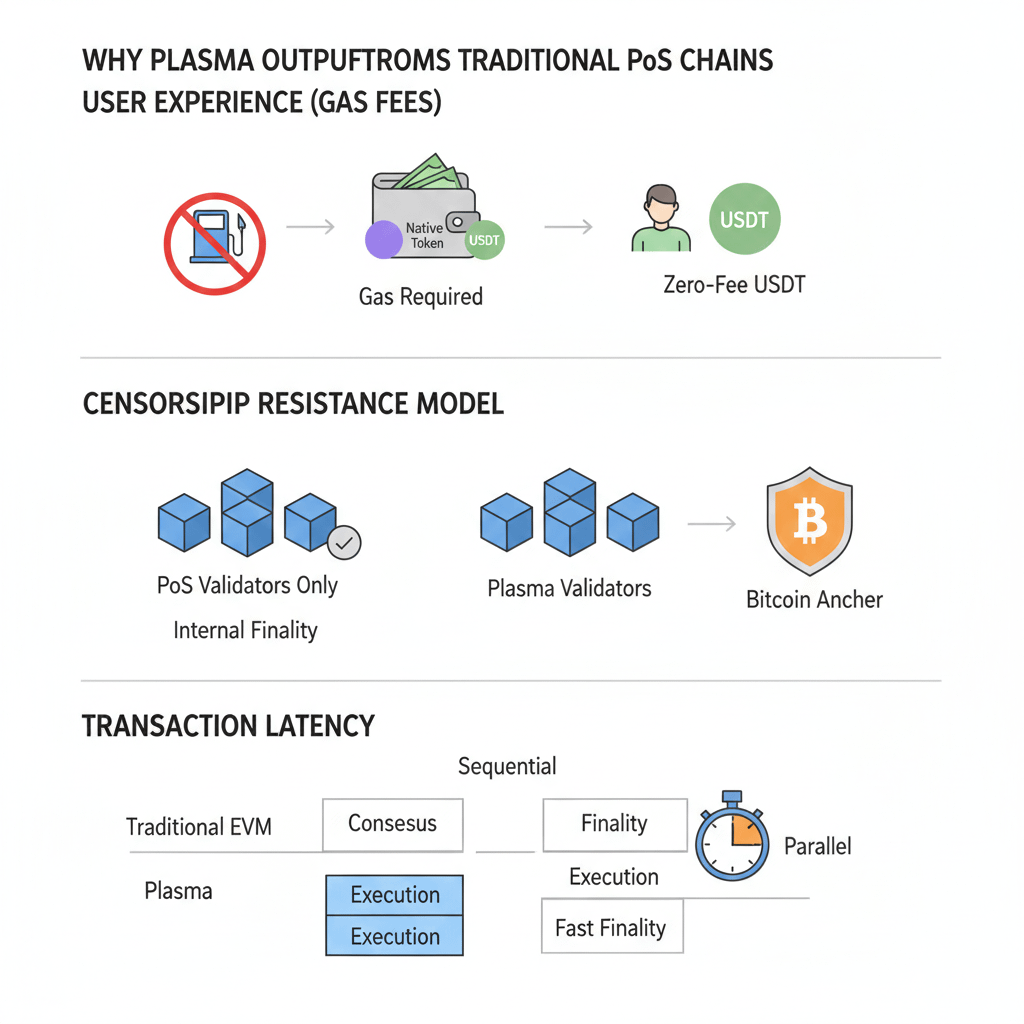
Together, they form a coherent architecture optimized for real-world payments under adversarial conditions.
Conclusion: A Different Philosophy of Blockchain Design
Plasma does not attempt to replace Ethereum.
It does not compete with Bitcoin.
It does not chase raw TPS metrics.
Instead, it asks a more grounded question:
> What does a blockchain need to work for billions of people, under real political and economic pressure?
The answer, as Plasma demonstrates, is not a single breakthrough but a careful alignment of:
protocol-level usability,
external security guarantees,
and modular performance engineering.
Zero-fee stablecoin transfers are not a gimmick.
Bitcoin anchoring is not marketing.
Low-latency execution is not optional.
Together, they represent a blueprint for blockchains that are not just decentralized in theory but usable, resilient, and credible in practice.

