
#biyapay
biyapay
641,297 vues
3,501 mentions
Populaire
Récents

·
--
Article
Combien payez-vous réellement pour envoyer des USDT vers un compte bancaire ?Avertissement : ceci ne constitue pas un conseil financier
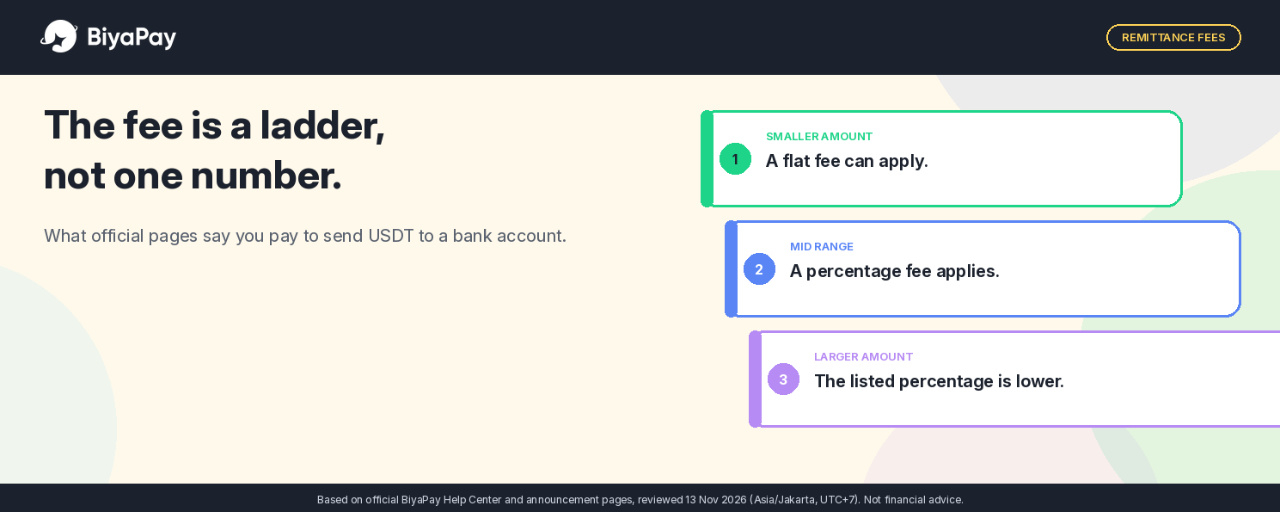
Une courte phrase sur des frais de transfert peut donner l’impression que le coût se résume à un seul montant. Les pages officielles de BiyaPay décrivent autre chose : des frais par paliers qui varient selon le montant du transfert.
Il ne s’agit pas d’une recommandation d’envoyer des fonds. C’est une lecture de ce que disent réellement le centre d’aide officiel et une annonce sur les frais de transfert, ainsi que des points que je vérifierais avant de confirmer.
Deux méthodes officielles, présentées comme offrant le même montant à l’arrivée
Selon un guide du centre d’aide de BiyaPay daté du 28 février 2026, il existe deux façons de retirer des devises fiduciaires, et les montants reçus sont les mêmes avec les deux méthodes. L’exemple présenté sur cette page concerne un retrait en USD.
Combien payez-vous réellement pour envoyer des USDT vers un compte bancaire ?
Avertissement : ceci ne constitue pas un conseil financier
Une courte phrase sur des frais de transfert peut donner l’impression que le coût se résume à un seul montant. Les pages officielles de BiyaPay décrivent autre chose : des frais par paliers qui varient selon le montant du transfert.
Il ne s’agit pas d’une recommandation d’envoyer des fonds. C’est une lecture de ce que disent réellement le centre d’aide officiel et une annonce sur les frais de transfert, ainsi que des points que je vérifierais avant de confirmer.
Deux méthodes officielles, présentées comme offrant le même montant à l’arrivée
Selon un guide du centre d’aide de BiyaPay daté du 28 février 2026, il existe deux façons de retirer des devises fiduciaires, et les montants reçus sont les mêmes avec les deux méthodes. L’exemple présenté sur cette page concerne un retrait en USD.
293
·
--
Vérifié
Article
Que détenez-vous réellement : l’action américaine ou le contrat perpétuel sur actions ?Avertissement : ceci ne constitue pas un conseil financier
Un symbole boursier connu peut apparaître dans plusieurs produits. Cela ne signifie pas que vous détenez la même chose.
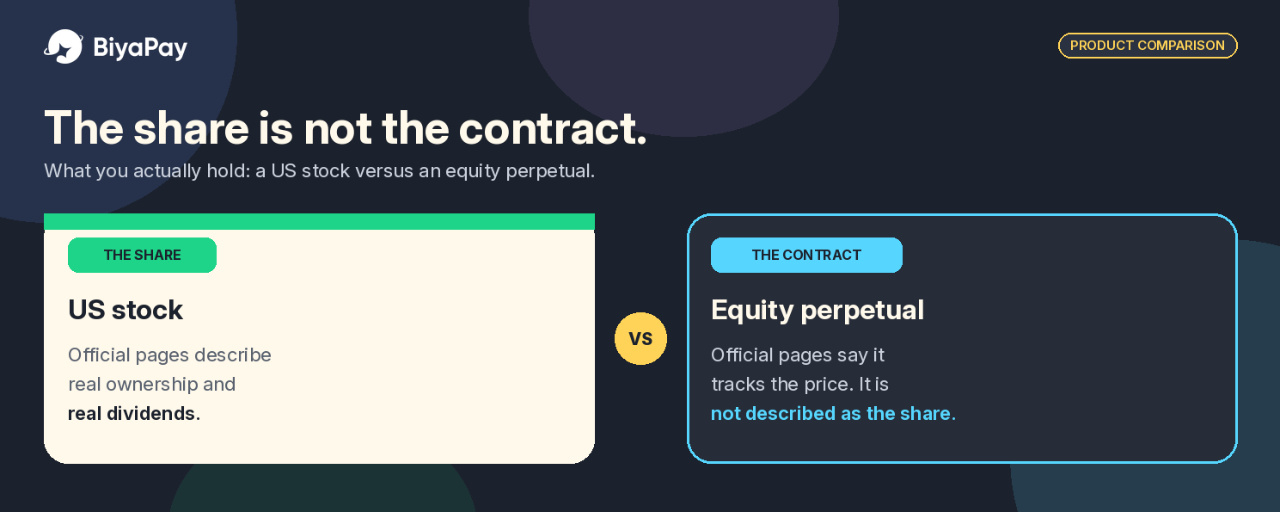
Sur BiyaPay, vous pouvez acheter une action américaine et négocier également un contrat perpétuel sur actions qui suit le cours de cette action. L’écran peut sembler similaire. Mais ce que vous détenez est différent.
Je distinguerais ces produits avant de décider lequel correspond à l’intention. Il ne s’agit pas d’une recommandation d’utiliser l’un ou l’autre. C’est une lecture de ce que les pages officielles indiquent réellement que vous détenez, et de ce qu’elles ne précisent pas.
Que détenez-vous réellement : l’action américaine ou le contrat perpétuel sur actions ?
Avertissement : ceci ne constitue pas un conseil financier
Un symbole boursier connu peut apparaître dans plusieurs produits. Cela ne signifie pas que vous détenez la même chose.
Sur BiyaPay, vous pouvez acheter une action américaine et négocier également un contrat perpétuel sur actions qui suit le cours de cette action. L’écran peut sembler similaire. Mais ce que vous détenez est différent.
Je distinguerais ces produits avant de décider lequel correspond à l’intention. Il ne s’agit pas d’une recommandation d’utiliser l’un ou l’autre. C’est une lecture de ce que les pages officielles indiquent réellement que vous détenez, et de ce qu’elles ne précisent pas.
1
1.1k
·
--
Article
Voir la traduction
Crypto Withdrawal Checklist on BiyaPay: Networks, MEMO Tags, Fees and Review TimeDisclosure: It is not financial advice
The 1 USDT versus 10 USDT withdrawal fee can look like the whole decision. In my view, it is not.
Official BiyaPay Help Center examples put the on-chain fee for USDT at 1 USDT on TRC20 and 10 USDT on ERC20. That is a 9 USDT gap, and it is easy to treat the cheaper figure as the default. The same Help Center also says that if the network does not match the receiving side, or if a required MEMO or tag is missing, the currency will be lost.
This is not a recommendation to withdraw. It is my reading of those official pages, and of which mistake actually costs more once you run the numbers.
The fee gap is real. The loss from a mismatch is larger.
Take the official examples first, and treat them as examples, because the Help Center notes that on-chain fees can change with network congestion.
On a 50 USDT withdrawal, a 1 USDT TRC20 fee is 2 percent of the amount. A 10 USDT ERC20 fee is 20 percent.
On 100 USDT, the same fees are 1 percent and 10 percent. On 1,000 USDT, they are 0.1 percent and 1 percent.
The 9 USDT difference does not grow with the size of the transfer, in these examples. The percentage shrinks as the amount gets larger, which makes the fee look cheaper, but a smaller percentage does not make the network choice safer.
If the receiving wallet or exchange only accepts USDT on ERC20, and the withdrawal is sent on TRC20 to "save" 9 USDT, the Help Center's wording is not that you pay a higher fee. It is that the currency will be lost. On a 1,000 USDT withdrawal, that is the entire 1,000, not the 9 you were trying to keep.
That is why, in my view, the most expensive withdrawal mistake is not paying the higher network fee. It is treating the cheaper network as a default before checking what the receiving side actually supports.
When paying the higher fee is the right call, and when it is not
If the receiving side supports both TRC20 and ERC20, I would pick the cheaper network it officially lists, after opening its deposit page and reading the network it shows. In the Help Center examples, that would be TRC20 at 1 USDT rather than ERC20 at 10 USDT.
If it only lists ERC20, I would pay the 10 USDT example fee, or I would not send, rather than choose TRC20 because it is cheaper. The 9 USDT "saving" is not a saving if the funds do not arrive.
The order matters. I would let the receiving side tell me the network first, for example TRC20 or ERC20, and only then choose the exact same network on BiyaPay's On-chain Withdrawal page. The Help Center's own example is USDT-TRC20 on both sides, and it says the two networks must be consistent.
A MEMO is not a fee problem. It is the same kind of total-loss problem.
The Help Center gives XRP and EOS as examples of coins that need more than an address. A label (MEMO) is shown above the withdrawal address, usually a string of numbers, and you must fill in both the address and the label, otherwise the currency will be lost.
There is no 1 USDT or 10 USDT figure attached to a missing MEMO. The official cost is the whole transfer. I would copy the MEMO, tag, or similar field at the same time as the address and treat both as one unit. If the receiving side shows a MEMO and I do not have it, I would not submit.
A cheaper route exists, but only for a different destination.
The Help Center lists three withdrawal methods: on-chain withdrawal, for sending cryptocurrency to an external wallet or exchange; fiat remittance, for sending fiat currency out to a bank account; and email account transfer, for moving funds to another BiyaPay account using its registered email.
If the person I am paying also uses BiyaPay and the transfer is fiat, an email account transfer may make more sense than going on-chain. The Help Center states there is no handling fee for transferring fiat currency between BiyaPay wallets through a registered email. Next to a 1 USDT or 10 USDT on-chain fee, that is a different cost entirely. It only applies to that route, and only to fiat between BiyaPay wallets. It is not a reason to skip the network check on an on-chain withdrawal to an outside wallet.
I would also check the minimum withdrawal amount on the day itself, on the On-chain Withdrawal page. Minimums differ by currency and by protocol, and they can change with the coin price or network congestion. A small withdrawal and a large one are not the same decision: 10 USDT is 20 percent of 50 USDT, and only 1 percent of 1,000 USDT. I would look at that percentage and at the live minimum together, and I would not assume the 1 USDT TRC20 example applies to a destination that does not support TRC20.
A second withdrawal, sent too early, can double the cost.
The official web flow asks you to check the address and amount again before Submit, then enter an email verification code or a Biya verification code. I would treat that code step as a last checkpoint, not a formality. If the network, the MEMO, or the amount feels off, that is the time to stop.
The Help Center says a crypto withdrawal goes through a review that takes from a few minutes to half an hour, and the arrival time after approval depends on the protocol and network congestion. If a withdrawal is pending for more than 30 minutes, it says you should contact support.
In my view, a withdrawal that has been pending for ten minutes is not a reason to submit a second one. On a 100 USDT send, a duplicate would not be a 1 USDT or 10 USDT question. It would be another 100 USDT, plus another fee, sitting in a window the Help Center describes as normal. Past 30 minutes, I would contact support through the official channels on the BiyaPay site, and I would not send a duplicate in the meantime.
Support for a coin or network can change, so I would treat the app screen on the day as the source of truth. BiyaPay says it supports withdrawal of over 200 cryptocurrencies including USDT, subject to what the app displays or what customer service announces.
What I would actually do
My takeaway is simple. I would rather pay the higher official fee on a network the receiver supports than try to keep 9 USDT on a network it does not. The fee in the Help Center examples is visible and bounded: 1 USDT or 10 USDT, subject to change with congestion. A mismatch or a missing MEMO is described as a loss of the currency itself.
A short list I would keep in front of me:
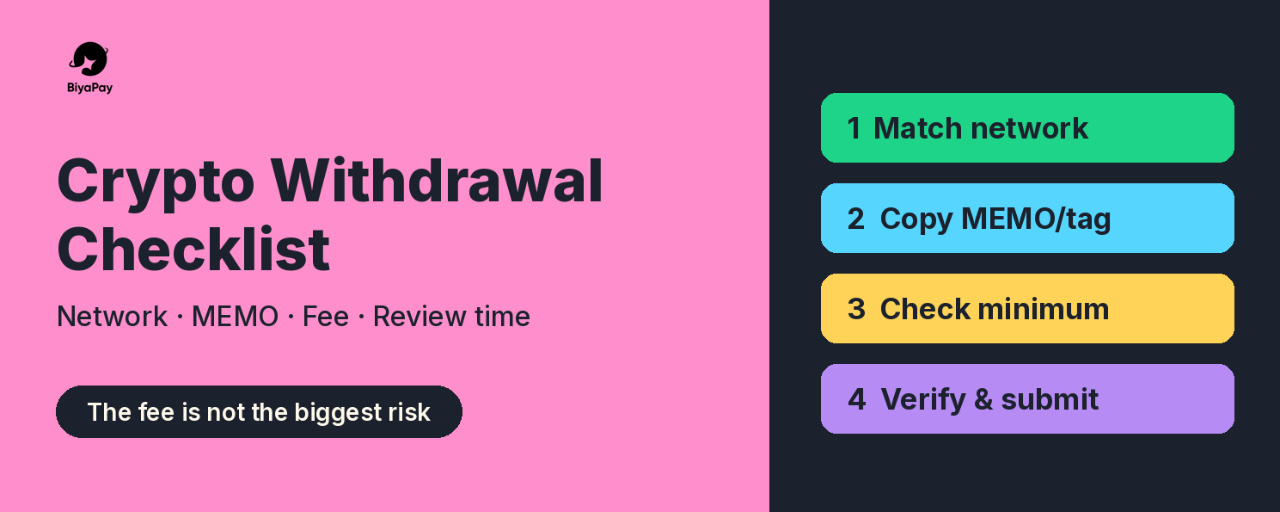
Decide the route first: on-chain, fiat remittance, or email transfer. Fiat between BiyaPay wallets via registered email has no handling fee.Let the receiving side tell you the network, then match it exactly. Only compare fees among networks that side supports.Copy any MEMO or tag together with the address. No MEMO, no submit.Check the current minimum and the live fee on the On-chain Withdrawal page, and look at the fee as a percentage of this amount, not only as a flat number.Re-check address and amount, then complete the verification code step.Expect review of a few minutes up to about 30 minutes. Contact support if it goes longer, and do not submit a second withdrawal while the first is still inside that window.
None of this is a recommendation to withdraw. Official fees, minimums, and supported networks can change. I would re-read the Help Center and the withdrawal page in the app before sending.
Source: BiyaPay Help Center, Withdrawal and Wallet sections, checked on November 9, 2026.
#BiyaPay #CryptoWithdrawal #USDT #CryptoSafety
Crypto Withdrawal Checklist on BiyaPay: Networks, MEMO Tags, Fees and Review Time
Disclosure: It is not financial advice
The 1 USDT versus 10 USDT withdrawal fee can look like the whole decision. In my view, it is not.
Official BiyaPay Help Center examples put the on-chain fee for USDT at 1 USDT on TRC20 and 10 USDT on ERC20. That is a 9 USDT gap, and it is easy to treat the cheaper figure as the default. The same Help Center also says that if the network does not match the receiving side, or if a required MEMO or tag is missing, the currency will be lost.
This is not a recommendation to withdraw. It is my reading of those official pages, and of which mistake actually costs more once you run the numbers.
The fee gap is real. The loss from a mismatch is larger.
Take the official examples first, and treat them as examples, because the Help Center notes that on-chain fees can change with network congestion.
On a 50 USDT withdrawal, a 1 USDT TRC20 fee is 2 percent of the amount. A 10 USDT ERC20 fee is 20 percent.
On 100 USDT, the same fees are 1 percent and 10 percent. On 1,000 USDT, they are 0.1 percent and 1 percent.
The 9 USDT difference does not grow with the size of the transfer, in these examples. The percentage shrinks as the amount gets larger, which makes the fee look cheaper, but a smaller percentage does not make the network choice safer.
If the receiving wallet or exchange only accepts USDT on ERC20, and the withdrawal is sent on TRC20 to "save" 9 USDT, the Help Center's wording is not that you pay a higher fee. It is that the currency will be lost. On a 1,000 USDT withdrawal, that is the entire 1,000, not the 9 you were trying to keep.
That is why, in my view, the most expensive withdrawal mistake is not paying the higher network fee. It is treating the cheaper network as a default before checking what the receiving side actually supports.
When paying the higher fee is the right call, and when it is not
If the receiving side supports both TRC20 and ERC20, I would pick the cheaper network it officially lists, after opening its deposit page and reading the network it shows. In the Help Center examples, that would be TRC20 at 1 USDT rather than ERC20 at 10 USDT.
If it only lists ERC20, I would pay the 10 USDT example fee, or I would not send, rather than choose TRC20 because it is cheaper. The 9 USDT "saving" is not a saving if the funds do not arrive.
The order matters. I would let the receiving side tell me the network first, for example TRC20 or ERC20, and only then choose the exact same network on BiyaPay's On-chain Withdrawal page. The Help Center's own example is USDT-TRC20 on both sides, and it says the two networks must be consistent.
A MEMO is not a fee problem. It is the same kind of total-loss problem.
The Help Center gives XRP and EOS as examples of coins that need more than an address. A label (MEMO) is shown above the withdrawal address, usually a string of numbers, and you must fill in both the address and the label, otherwise the currency will be lost.
There is no 1 USDT or 10 USDT figure attached to a missing MEMO. The official cost is the whole transfer. I would copy the MEMO, tag, or similar field at the same time as the address and treat both as one unit. If the receiving side shows a MEMO and I do not have it, I would not submit.
A cheaper route exists, but only for a different destination.
The Help Center lists three withdrawal methods: on-chain withdrawal, for sending cryptocurrency to an external wallet or exchange; fiat remittance, for sending fiat currency out to a bank account; and email account transfer, for moving funds to another BiyaPay account using its registered email.
If the person I am paying also uses BiyaPay and the transfer is fiat, an email account transfer may make more sense than going on-chain. The Help Center states there is no handling fee for transferring fiat currency between BiyaPay wallets through a registered email. Next to a 1 USDT or 10 USDT on-chain fee, that is a different cost entirely. It only applies to that route, and only to fiat between BiyaPay wallets. It is not a reason to skip the network check on an on-chain withdrawal to an outside wallet.
I would also check the minimum withdrawal amount on the day itself, on the On-chain Withdrawal page. Minimums differ by currency and by protocol, and they can change with the coin price or network congestion. A small withdrawal and a large one are not the same decision: 10 USDT is 20 percent of 50 USDT, and only 1 percent of 1,000 USDT. I would look at that percentage and at the live minimum together, and I would not assume the 1 USDT TRC20 example applies to a destination that does not support TRC20.
A second withdrawal, sent too early, can double the cost.
The official web flow asks you to check the address and amount again before Submit, then enter an email verification code or a Biya verification code. I would treat that code step as a last checkpoint, not a formality. If the network, the MEMO, or the amount feels off, that is the time to stop.
The Help Center says a crypto withdrawal goes through a review that takes from a few minutes to half an hour, and the arrival time after approval depends on the protocol and network congestion. If a withdrawal is pending for more than 30 minutes, it says you should contact support.
In my view, a withdrawal that has been pending for ten minutes is not a reason to submit a second one. On a 100 USDT send, a duplicate would not be a 1 USDT or 10 USDT question. It would be another 100 USDT, plus another fee, sitting in a window the Help Center describes as normal. Past 30 minutes, I would contact support through the official channels on the BiyaPay site, and I would not send a duplicate in the meantime.
Support for a coin or network can change, so I would treat the app screen on the day as the source of truth. BiyaPay says it supports withdrawal of over 200 cryptocurrencies including USDT, subject to what the app displays or what customer service announces.
What I would actually do
My takeaway is simple. I would rather pay the higher official fee on a network the receiver supports than try to keep 9 USDT on a network it does not. The fee in the Help Center examples is visible and bounded: 1 USDT or 10 USDT, subject to change with congestion. A mismatch or a missing MEMO is described as a loss of the currency itself.
A short list I would keep in front of me:
Decide the route first: on-chain, fiat remittance, or email transfer. Fiat between BiyaPay wallets via registered email has no handling fee.Let the receiving side tell you the network, then match it exactly. Only compare fees among networks that side supports.Copy any MEMO or tag together with the address. No MEMO, no submit.Check the current minimum and the live fee on the On-chain Withdrawal page, and look at the fee as a percentage of this amount, not only as a flat number.Re-check address and amount, then complete the verification code step.Expect review of a few minutes up to about 30 minutes. Contact support if it goes longer, and do not submit a second withdrawal while the first is still inside that window.
None of this is a recommendation to withdraw. Official fees, minimums, and supported networks can change. I would re-read the Help Center and the withdrawal page in the app before sending.
Source: BiyaPay Help Center, Withdrawal and Wallet sections, checked on November 9, 2026.
#BiyaPay #CryptoWithdrawal #USDT #CryptoSafety
335
·
--
Article
Voir la traduction
Before You Paste a USDT Address: My Network Checklist for BiyaPay DepositsDisclosure: It is not financial advice
In crypto circles in Indonesia, moving USDT between platforms feels routine. Copy, paste, confirm, done. But some of the most expensive mistakes in crypto have nothing to do with price moves. They come from a deposit sent on the wrong network, or a missing memo tag.
This article is not a story about a transfer I made. It is my reading of BiyaPay's Help Center articles on crypto deposits, turned into a checklist I would want in front of me before sending anything.
The one rule BiyaPay repeats
BiyaPay guide on on-chain deposits describes the flow on the App like this:
Open the homepage and tap Deposit, then On-chain Deposit (Cryptocurrency), and pick a currency such as USDT.Select the deposit network, for example USDT-TRC20, and get the deposit address.Paste that address into the other platform or wallet and complete the withdrawal there.Use the deposit record icon in the upper right corner of the address page to view the order details.
On Web, the path starts from My Assets, then Funds, then Deposit, with the same network step.
The note attached to step 2 is the part I would read twice. The withdrawal network on the other exchange or wallet must match the BiyaPay deposit network, for example both USDT-TRC20. The Help Center says plainly that otherwise the coins will be lost.
In my opinion, that sentence matters more than any speed or fee comparison. The same token name, USDT, exists on several blockchains, so "USDT" alone is not enough information.
Memo tags are the second trap
The same guide adds that some currencies require a tag, with XRP and EOS given as examples. The tag, or MEMO, is shown above the deposit address and is usually a string of numbers. For those currencies, both the address and the tag must be filled in, otherwise the coins will be lost.
People used to USDT may never have needed a memo, so it is easy to skip the field the first time they move a different coin.
What changes between networks
BiyaPay article on deposit times explains that USDT runs on multiple blockchains and gives general characteristics for each:
Ethereum (ERC-20): usually 15 seconds to several minutes to confirm, depending on congestion and gas fees paidBitcoin (Omni Layer): about 10 minutes per block, and multiple confirmations may take more timeTron (TRC-20): block time of about 3 seconds, usually confirmed within a few minutesSolana (SPL): usually confirmed within seconds
The article also lists other factors: BiyaPay own confirmation requirements (shown on the network selection page), network congestion, transaction fees, and internal processing time at exchanges and wallets. I read these as general blockchain descriptions, not a promise of how fast any single deposit will land.
Minimums differ by network
According to BiyaPay FAQ on minimum deposits, amounts vary by currency and protocol. The examples given:
USDT on TRC20: minimum 1USDT on ERC20: minimum 10
The FAQ notes these can change and that the amount displayed in the app is what counts. For small test transfers, I think this detail is easy to miss. Sending less than the minimum for the chosen network is a question worth checking in the app before, not after.
Fees: whose fee is it?
BiyaPay Help Center states that it does not charge fees for depositing cryptocurrency to BiyaPay. My personal note here: that covers the receiving side. The platform or wallet you send from may still charge its own withdrawal fee, and the blockchain itself has network costs. So "free deposit" and "free transfer" are not the same thing.
If a deposit does not arrive
BiyaPay has a separate article for this, and its first advice is not to panic. The suggested order is roughly:
Check the transaction status on a blockchain explorer using the transaction hash, or in the sending platform's withdrawal records.Confirm the address was correct, ideally copied and pasted, with each character checked.Allow for network confirmation time, which can be longer during congestion.If the chain shows the transaction confirmed but the balance has not updated, contact BiyaPay support.
For that support request, the article lists useful information: transaction hash, registered email, currency name, deposit protocol type, deposit address, transaction time, and any screenshots or proof. I like that this list exists, because gathering it before contacting support saves a lot of back and forth.
My intended checklist before any USDT deposit
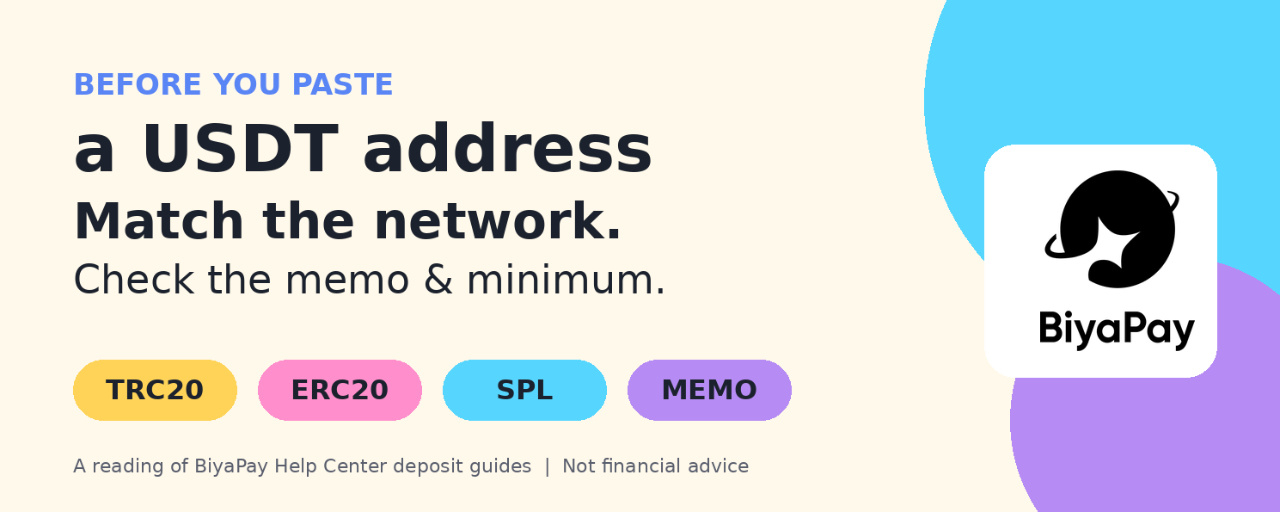
Pick the network on BiyaPay first, then match the exact same network on the sending side.Check whether the coin needs a memo tag. If yes, fill in both address and tag.Check the minimum deposit for that network on the network selection page.Check the confirmation requirement shown in the app, and do not plan around best-case timing.Check the sending platform's withdrawal fee separately.Copy and paste the address, then verify the first and last characters.Save the transaction hash until the balance shows up.
Final thoughts
Choosing a network can sound like a technical detail, but BiyaPay own documentation treats it as the difference between a deposit arriving and coins being lost. None of this guarantees a smooth transfer. Chains get congested, and platforms have their own processing steps.
What I take from the Help Center is simple: match the network, respect the memo, check the minimum, and keep the hash. That is my reading of the official guides, not a recommendation to use any particular chain.
#BiyaPay #USDT #CryptoDeposit #Blockchain #CryptoSafety
Before You Paste a USDT Address: My Network Checklist for BiyaPay Deposits
Disclosure: It is not financial advice
In crypto circles in Indonesia, moving USDT between platforms feels routine. Copy, paste, confirm, done. But some of the most expensive mistakes in crypto have nothing to do with price moves. They come from a deposit sent on the wrong network, or a missing memo tag.
This article is not a story about a transfer I made. It is my reading of BiyaPay's Help Center articles on crypto deposits, turned into a checklist I would want in front of me before sending anything.
The one rule BiyaPay repeats
BiyaPay guide on on-chain deposits describes the flow on the App like this:
Open the homepage and tap Deposit, then On-chain Deposit (Cryptocurrency), and pick a currency such as USDT.Select the deposit network, for example USDT-TRC20, and get the deposit address.Paste that address into the other platform or wallet and complete the withdrawal there.Use the deposit record icon in the upper right corner of the address page to view the order details.
On Web, the path starts from My Assets, then Funds, then Deposit, with the same network step.
The note attached to step 2 is the part I would read twice. The withdrawal network on the other exchange or wallet must match the BiyaPay deposit network, for example both USDT-TRC20. The Help Center says plainly that otherwise the coins will be lost.
In my opinion, that sentence matters more than any speed or fee comparison. The same token name, USDT, exists on several blockchains, so "USDT" alone is not enough information.
Memo tags are the second trap
The same guide adds that some currencies require a tag, with XRP and EOS given as examples. The tag, or MEMO, is shown above the deposit address and is usually a string of numbers. For those currencies, both the address and the tag must be filled in, otherwise the coins will be lost.
People used to USDT may never have needed a memo, so it is easy to skip the field the first time they move a different coin.
What changes between networks
BiyaPay article on deposit times explains that USDT runs on multiple blockchains and gives general characteristics for each:
Ethereum (ERC-20): usually 15 seconds to several minutes to confirm, depending on congestion and gas fees paidBitcoin (Omni Layer): about 10 minutes per block, and multiple confirmations may take more timeTron (TRC-20): block time of about 3 seconds, usually confirmed within a few minutesSolana (SPL): usually confirmed within seconds
The article also lists other factors: BiyaPay own confirmation requirements (shown on the network selection page), network congestion, transaction fees, and internal processing time at exchanges and wallets. I read these as general blockchain descriptions, not a promise of how fast any single deposit will land.
Minimums differ by network
According to BiyaPay FAQ on minimum deposits, amounts vary by currency and protocol. The examples given:
USDT on TRC20: minimum 1USDT on ERC20: minimum 10
The FAQ notes these can change and that the amount displayed in the app is what counts. For small test transfers, I think this detail is easy to miss. Sending less than the minimum for the chosen network is a question worth checking in the app before, not after.
Fees: whose fee is it?
BiyaPay Help Center states that it does not charge fees for depositing cryptocurrency to BiyaPay. My personal note here: that covers the receiving side. The platform or wallet you send from may still charge its own withdrawal fee, and the blockchain itself has network costs. So "free deposit" and "free transfer" are not the same thing.
If a deposit does not arrive
BiyaPay has a separate article for this, and its first advice is not to panic. The suggested order is roughly:
Check the transaction status on a blockchain explorer using the transaction hash, or in the sending platform's withdrawal records.Confirm the address was correct, ideally copied and pasted, with each character checked.Allow for network confirmation time, which can be longer during congestion.If the chain shows the transaction confirmed but the balance has not updated, contact BiyaPay support.
For that support request, the article lists useful information: transaction hash, registered email, currency name, deposit protocol type, deposit address, transaction time, and any screenshots or proof. I like that this list exists, because gathering it before contacting support saves a lot of back and forth.
My intended checklist before any USDT deposit
Pick the network on BiyaPay first, then match the exact same network on the sending side.Check whether the coin needs a memo tag. If yes, fill in both address and tag.Check the minimum deposit for that network on the network selection page.Check the confirmation requirement shown in the app, and do not plan around best-case timing.Check the sending platform's withdrawal fee separately.Copy and paste the address, then verify the first and last characters.Save the transaction hash until the balance shows up.
Final thoughts
Choosing a network can sound like a technical detail, but BiyaPay own documentation treats it as the difference between a deposit arriving and coins being lost. None of this guarantees a smooth transfer. Chains get congested, and platforms have their own processing steps.
What I take from the Help Center is simple: match the network, respect the memo, check the minimum, and keep the hash. That is my reading of the official guides, not a recommendation to use any particular chain.
#BiyaPay #USDT #CryptoDeposit #Blockchain #CryptoSafety
120
·
--
Article
Voir la traduction
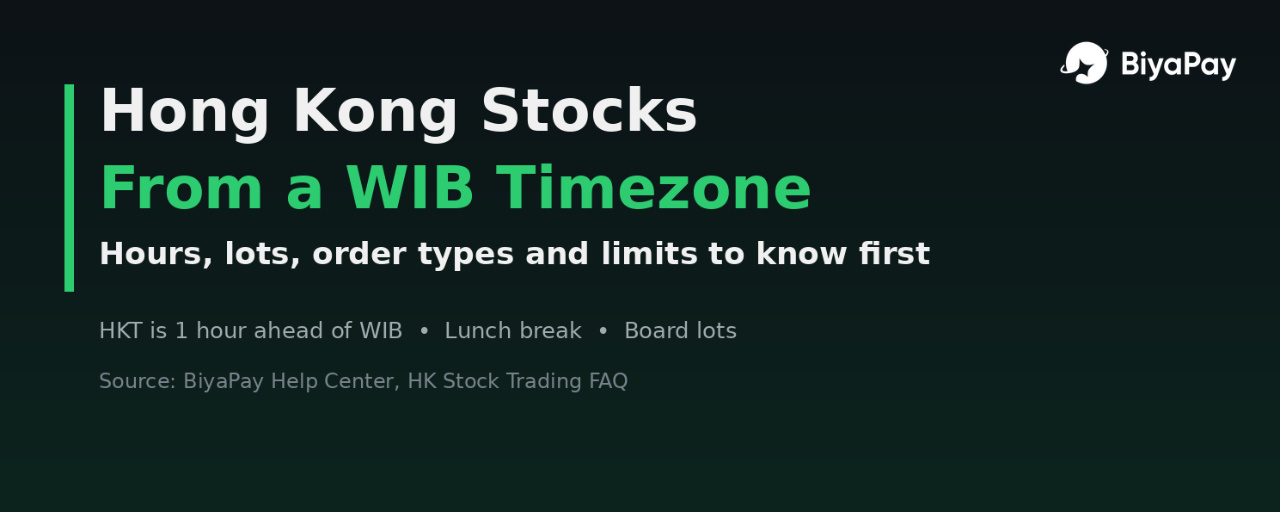
Hong Kong Stocks From a WIB Timezone: Hours, Lots and Limits I Would Read FirstDisclosure: It is not financial advice
Most crypto people in Indonesia who look at stocks think of the US first. That makes sense: big tech names, long overnight sessions, lots of news. But for a WIB timezone, Hong Kong is arguably the more convenient market on the clock. It trades during our morning and early afternoon, not at midnight.
This article is not a trading diary. I am not describing orders I placed. It is my reading of BiyaPay's Hong Kong stock FAQ, plus the questions I think are worth answering before anyone treats HK stocks as "just like US stocks, but earlier."
Why the clock is friendlier
Hong Kong Time is UTC+8. WIB is UTC+7. Neither observes daylight saving time, so the gap stays at one hour all year. That is a nice contrast with the US, where the WIB mapping shifts twice a year.
According to BiyaPay Help Center, HK stock trading hours are:
Morning session: 09:30–12:00 HKT, which is 08:30–11:00 WIBLunch break: 12:00–13:00 HKT, which is 11:00–12:00 WIBAfternoon session: 13:00–16:00 HKT, which is 12:00–15:00 WIB
In my opinion, the lunch break is the detail that surprises people coming from US stocks, where the regular session runs continuously. An order plan made at 10:55 WIB may not behave the way someone expects if they forget the market pauses for an hour.
These are generic exchange hours. Market holidays exist, and what is available in the app on a given day is the final reference.
The board lot rule
This is the one I would read twice. BiyaPay's FAQ says the minimum trading unit for HK stocks is 1 lot, and the number of shares per lot varies by stock.
In practice that means:
The smallest order is not "1 share" like many people assume from US-stock habitsTwo stocks with similar share prices can need very different minimum amounts, because their lot sizes differBefore sizing anything, it makes sense to check the lot size shown for that specific stock
For small budgets, I think this matters more than the share price itself. A cheap-looking stock can still require a meaningful amount per lot.
What BiyaPay says is supported
From the same Help Center section:
All Hong Kong stocks, including ETFs, can be traded, along with margin tradingShort selling for HK stocks is supportedTrading is T+0, so shares bought today can be sold the same dayThere are no daily price limits in the HK market, and the FAQ itself notes that investors need to manage risks
And what is not supported:
WarrantsCallable bull/bear contracts (CBBCs)
I like that the FAQ states the exclusions directly. Warrants and CBBCs are a big part of Hong Kong market chatter, so knowing they are out of scope avoids a wasted search.
Order types
BiyaPay lists five order types for HK stocks: limit order, market order, stop-loss/take-profit, two-way stop-loss/take-profit, and trailing stop-loss/take-profit.
My personal view on them is cautious:
A limit order is the clearest way to state the price you are willing to acceptA market order prioritizes execution, not priceStop and take-profit orders are triggers, not promises of an exact exit price, especially when a stock moves quickly with no daily limit to slow it down
Margin and short selling: opinion first
The FAQ says margin trading and short selling are supported for HK stocks. Supported does not mean suitable. Leverage amplifies losses as well as gains, and short positions can lose more than the starting amount if a price keeps rising. Combined with no daily price limits, I would treat both features as advanced tools, not a starting point.
Fees are their own topic
Hong Kong fee structures are different from US stock fees. BiyaPay's own blog makes the same point: do not apply one market's fee rules to another product. Instead of guessing, I would open the Cost Center and the order page for the exact HK stock before deciding anything. The fee details shown on the order page should be the final reference.
Funding and withdrawals
According to the FAQ, funds can be withdrawn after closing HK stock positions, and if USDT is used for deposits and withdrawals, funds can arrive within minutes. I read "can" carefully here. Network choice, verification status and platform processing can all affect timing, so I would not plan around a best-case number.
My intended checklist before a first HK order
Convert the session times to WIB and remember the 11:00–12:00 WIB lunch break.Check the lot size of the specific stock and calculate the minimum amount per lot.Confirm the product is a regular stock or ETF, not a warrant or CBBC.Choose an order type I can explain in one sentence, defaulting to limit when unsure.Skip margin and short selling unless I fully understand the downside.Check the Cost Center and the order page for HK fees.Check for market holidays and in-app availability on the day.
Final thoughts
For someone in WIB, Hong Kong may be the most time-friendly major stock market: one fixed hour of difference, morning trading, and no seasonal clock shift. But the rules are genuinely different from the US. Board lots, a lunch break, no daily limits and a separate fee structure all deserve attention before anything else.
That is my reading of the official FAQ, not a recommendation to buy any Hong Kong stock. Read the rules, check the app, and decide at your own pace.
#BiyaPay #HKStocks #HongKong #StockMarket #CryptoInvesting
Hong Kong Stocks From a WIB Timezone: Hours, Lots and Limits I Would Read First
Disclosure: It is not financial advice
Most crypto people in Indonesia who look at stocks think of the US first. That makes sense: big tech names, long overnight sessions, lots of news. But for a WIB timezone, Hong Kong is arguably the more convenient market on the clock. It trades during our morning and early afternoon, not at midnight.
This article is not a trading diary. I am not describing orders I placed. It is my reading of BiyaPay's Hong Kong stock FAQ, plus the questions I think are worth answering before anyone treats HK stocks as "just like US stocks, but earlier."
Why the clock is friendlier
Hong Kong Time is UTC+8. WIB is UTC+7. Neither observes daylight saving time, so the gap stays at one hour all year. That is a nice contrast with the US, where the WIB mapping shifts twice a year.
According to BiyaPay Help Center, HK stock trading hours are:
Morning session: 09:30–12:00 HKT, which is 08:30–11:00 WIBLunch break: 12:00–13:00 HKT, which is 11:00–12:00 WIBAfternoon session: 13:00–16:00 HKT, which is 12:00–15:00 WIB
In my opinion, the lunch break is the detail that surprises people coming from US stocks, where the regular session runs continuously. An order plan made at 10:55 WIB may not behave the way someone expects if they forget the market pauses for an hour.
These are generic exchange hours. Market holidays exist, and what is available in the app on a given day is the final reference.
The board lot rule
This is the one I would read twice. BiyaPay's FAQ says the minimum trading unit for HK stocks is 1 lot, and the number of shares per lot varies by stock.
In practice that means:
The smallest order is not "1 share" like many people assume from US-stock habitsTwo stocks with similar share prices can need very different minimum amounts, because their lot sizes differBefore sizing anything, it makes sense to check the lot size shown for that specific stock
For small budgets, I think this matters more than the share price itself. A cheap-looking stock can still require a meaningful amount per lot.
What BiyaPay says is supported
From the same Help Center section:
All Hong Kong stocks, including ETFs, can be traded, along with margin tradingShort selling for HK stocks is supportedTrading is T+0, so shares bought today can be sold the same dayThere are no daily price limits in the HK market, and the FAQ itself notes that investors need to manage risks
And what is not supported:
WarrantsCallable bull/bear contracts (CBBCs)
I like that the FAQ states the exclusions directly. Warrants and CBBCs are a big part of Hong Kong market chatter, so knowing they are out of scope avoids a wasted search.
Order types
BiyaPay lists five order types for HK stocks: limit order, market order, stop-loss/take-profit, two-way stop-loss/take-profit, and trailing stop-loss/take-profit.
My personal view on them is cautious:
A limit order is the clearest way to state the price you are willing to acceptA market order prioritizes execution, not priceStop and take-profit orders are triggers, not promises of an exact exit price, especially when a stock moves quickly with no daily limit to slow it down
Margin and short selling: opinion first
The FAQ says margin trading and short selling are supported for HK stocks. Supported does not mean suitable. Leverage amplifies losses as well as gains, and short positions can lose more than the starting amount if a price keeps rising. Combined with no daily price limits, I would treat both features as advanced tools, not a starting point.
Fees are their own topic
Hong Kong fee structures are different from US stock fees. BiyaPay's own blog makes the same point: do not apply one market's fee rules to another product. Instead of guessing, I would open the Cost Center and the order page for the exact HK stock before deciding anything. The fee details shown on the order page should be the final reference.
Funding and withdrawals
According to the FAQ, funds can be withdrawn after closing HK stock positions, and if USDT is used for deposits and withdrawals, funds can arrive within minutes. I read "can" carefully here. Network choice, verification status and platform processing can all affect timing, so I would not plan around a best-case number.
My intended checklist before a first HK order
Convert the session times to WIB and remember the 11:00–12:00 WIB lunch break.Check the lot size of the specific stock and calculate the minimum amount per lot.Confirm the product is a regular stock or ETF, not a warrant or CBBC.Choose an order type I can explain in one sentence, defaulting to limit when unsure.Skip margin and short selling unless I fully understand the downside.Check the Cost Center and the order page for HK fees.Check for market holidays and in-app availability on the day.
Final thoughts
For someone in WIB, Hong Kong may be the most time-friendly major stock market: one fixed hour of difference, morning trading, and no seasonal clock shift. But the rules are genuinely different from the US. Board lots, a lunch break, no daily limits and a separate fee structure all deserve attention before anything else.
That is my reading of the official FAQ, not a recommendation to buy any Hong Kong stock. Read the rules, check the app, and decide at your own pace.
#BiyaPay #HKStocks #HongKong #StockMarket #CryptoInvesting
1
150
·
--
Vérifié
Article
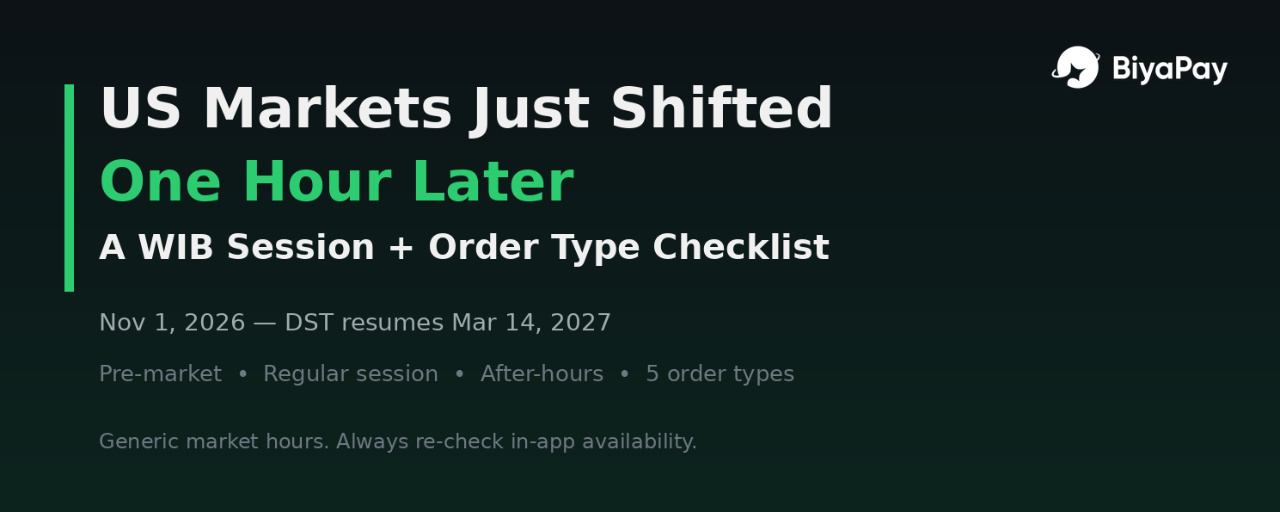
Les marchés américains viennent de décaler leurs horaires d’une heure : liste de vérification WIB pour les séances et les types d’ordresAvertissement : ceci ne constitue pas un conseil financier
Si vous suivez les actions américaines depuis l’Indonésie, le mois de novembre entraîne un changement de calendrier qu’il vaut la peine de vérifier avant d’ouvrir un ticket d’ordre. Les États-Unis sont repassés à l’heure standard. La séance régulière ouvre toujours à 09:30 et clôture à 16:00, heure de l’Est, mais son équivalent en WIB est décalé d’une heure par rapport à la période de l’heure d’été.
Après avoir examiné les frais de négociation, la prochaine question utile me semble porter sur les horaires : à quelle heure chaque séance a-t-elle lieu en Indonésie, et quel type d’ordre est adapté aux différentes conditions ?
Les marchés américains viennent de décaler leurs horaires d’une heure : liste de vérification WIB pour les séances et les types d’ordres
Avertissement : ceci ne constitue pas un conseil financier
Si vous suivez les actions américaines depuis l’Indonésie, le mois de novembre entraîne un changement de calendrier qu’il vaut la peine de vérifier avant d’ouvrir un ticket d’ordre. Les États-Unis sont repassés à l’heure standard. La séance régulière ouvre toujours à 09:30 et clôture à 16:00, heure de l’Est, mais son équivalent en WIB est décalé d’une heure par rapport à la période de l’heure d’été.
Après avoir examiné les frais de négociation, la prochaine question utile me semble porter sur les horaires : à quelle heure chaque séance a-t-elle lieu en Indonésie, et quel type d’ordre est adapté aux différentes conditions ?
1
141
·
--
Vérifié
Article
Voir la traduction
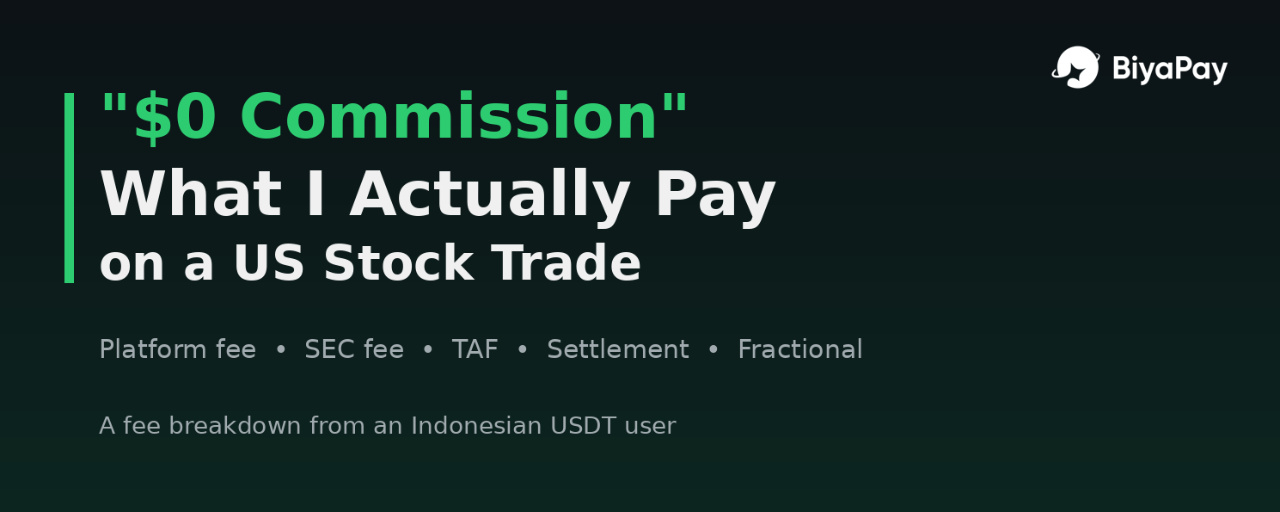
"$0 Commission" Isn't $0: What I Actually Pay on a US Stock TradeDisclosure: It is not financial advice
A few days ago I wrote about moving part of my USDT into US stocks without converting through Rupiah first. After that post, a friend asked me a simple question: "If commission is $0, what are you actually paying?"
I realized I didn't have a precise answer. I had seen the "$0 commission" label and stopped reading there. So this time I opened the fee page, went line by line, and did the math on a few realistic orders. This is what I found.
Why "$0 commission" is only part of the story
In US markets, commission is just one layer of cost. A stock order can also include a platform fee charged by the app, plus small regulatory and clearing fees that get passed through. None of these are hidden on purpose, but most of us never read past the headline number.
As an Indonesian user, I also care about this because my orders are usually small. A fixed minimum fee hurts a $200 order much more than a $20,000 order.
The fee table, line by line
On BiyaPay's Cost Center, under Stock → US Stocks, the fee table currently lists:
Commission: $0 (every order)
Platform fee: $0.005 per share, min $0.99 per order, max 1% of trade value (every order)
SEC fee: 0.0000206 × trade value, min $0.01 (sell orders only)
Trading Activity Fee (TAF): $0.000195 per share, min $0.01, max $9.79 per execution (sell orders only)
CAT fee: $0.000003 per share (every order)
Settlement fee: $0.003 per share, capped at 7% of trade value (every order)
So the honest summary is: commission is $0, but the platform fee and settlement fee are the two items that actually matter for most trades. SEC, TAF, and CAT are tiny, and SEC and TAF only show up when you sell.
Running the numbers on real-looking orders
I used three example orders. These are my own estimates using the table above, rounded, and actual charges can differ slightly.
Example 1: Buy 10 shares at $180 (about $1,800)
Platform fee: 10 × $0.005 = $0.05, so the $0.99 minimum appliesSettlement fee: 10 × $0.003 = $0.03CAT fee: basically $0.00Estimated total: around $1.02, or roughly 0.06% of the order
Example 2: Sell the same 10 shares at $180
Platform fee: $0.99 minimumSettlement fee: $0.03SEC fee: $1,800 × 0.0000206 ≈ $0.04TAF: 10 × $0.000195 is below the minimum, so $0.01Estimated total: around $1.07
Example 3: Buy 300 shares at $20 (about $6,000)
Platform fee: 300 × $0.005 = $1.50 (above the minimum)Settlement fee: 300 × $0.003 = $0.90Estimated total: around $2.40, or roughly 0.04%
Two lessons jumped out. First, the $0.99 minimum is what you pay on most small orders. Second, because the platform and settlement fees are per share, buying many cheap shares costs more in fees than buying a few expensive shares of the same total value.
The fractional share rule
This was the part I didn't expect. According to the notes on the same page, for fractional orders of less than 1 whole share, BiyaPay charges a 1% platform fee on the transaction value, capped at $1, with no commission or third-party fees. For fractional orders above 1 whole share, the standard table applies.
What that means in practice:
A $30 fractional buy costs about $0.30A $100 fractional buy hits the $1 cap
For someone testing with small amounts, that is easier to understand than the per-share table. But at around $100 and up, the cost is close to the $0.99 minimum anyway, so it doesn't save much.
My personal checklist before placing an order
After doing this exercise, this is what I now check:
Order size vs. the $0.99 minimum. If my order is very small, the minimum is a big percentage. I'd rather make fewer, slightly larger orders.Share count, not just dollar value. Per-share fees add up with low-priced stocks.Buy and sell together. I estimate the round-trip cost, since SEC and TAF only appear on the sell side.Fractional or whole shares. Under 1 share, the 1% (max $1) rule applies.Re-check the fee page. Fees can change, so I look at the current table instead of relying on old screenshots, including my own.
Final thoughts
"$0 commission" is true, but it isn't the full price of a trade. What I liked about doing this on BiyaPay is that every line item is listed on one fee page, so I could do the math myself instead of guessing. For my habit of small, occasional US stock purchases funded from USDT, knowing about the $0.99 minimum and the fractional rule changes how I size my orders.
If you trade US stocks from crypto, try running your own last order through a table like this. The number you find might be different from what you assumed.
#BiyaPay #USStocks #TradingFees #USDT #CryptoInvesting
"$0 Commission" Isn't $0: What I Actually Pay on a US Stock Trade
Disclosure: It is not financial advice
A few days ago I wrote about moving part of my USDT into US stocks without converting through Rupiah first. After that post, a friend asked me a simple question: "If commission is $0, what are you actually paying?"
I realized I didn't have a precise answer. I had seen the "$0 commission" label and stopped reading there. So this time I opened the fee page, went line by line, and did the math on a few realistic orders. This is what I found.
Why "$0 commission" is only part of the story
In US markets, commission is just one layer of cost. A stock order can also include a platform fee charged by the app, plus small regulatory and clearing fees that get passed through. None of these are hidden on purpose, but most of us never read past the headline number.
As an Indonesian user, I also care about this because my orders are usually small. A fixed minimum fee hurts a $200 order much more than a $20,000 order.
The fee table, line by line
On BiyaPay's Cost Center, under Stock → US Stocks, the fee table currently lists:
Commission: $0 (every order)
Platform fee: $0.005 per share, min $0.99 per order, max 1% of trade value (every order)
SEC fee: 0.0000206 × trade value, min $0.01 (sell orders only)
Trading Activity Fee (TAF): $0.000195 per share, min $0.01, max $9.79 per execution (sell orders only)
CAT fee: $0.000003 per share (every order)
Settlement fee: $0.003 per share, capped at 7% of trade value (every order)
So the honest summary is: commission is $0, but the platform fee and settlement fee are the two items that actually matter for most trades. SEC, TAF, and CAT are tiny, and SEC and TAF only show up when you sell.
Running the numbers on real-looking orders
I used three example orders. These are my own estimates using the table above, rounded, and actual charges can differ slightly.
Example 1: Buy 10 shares at $180 (about $1,800)
Platform fee: 10 × $0.005 = $0.05, so the $0.99 minimum appliesSettlement fee: 10 × $0.003 = $0.03CAT fee: basically $0.00Estimated total: around $1.02, or roughly 0.06% of the order
Example 2: Sell the same 10 shares at $180
Platform fee: $0.99 minimumSettlement fee: $0.03SEC fee: $1,800 × 0.0000206 ≈ $0.04TAF: 10 × $0.000195 is below the minimum, so $0.01Estimated total: around $1.07
Example 3: Buy 300 shares at $20 (about $6,000)
Platform fee: 300 × $0.005 = $1.50 (above the minimum)Settlement fee: 300 × $0.003 = $0.90Estimated total: around $2.40, or roughly 0.04%
Two lessons jumped out. First, the $0.99 minimum is what you pay on most small orders. Second, because the platform and settlement fees are per share, buying many cheap shares costs more in fees than buying a few expensive shares of the same total value.
The fractional share rule
This was the part I didn't expect. According to the notes on the same page, for fractional orders of less than 1 whole share, BiyaPay charges a 1% platform fee on the transaction value, capped at $1, with no commission or third-party fees. For fractional orders above 1 whole share, the standard table applies.
What that means in practice:
A $30 fractional buy costs about $0.30A $100 fractional buy hits the $1 cap
For someone testing with small amounts, that is easier to understand than the per-share table. But at around $100 and up, the cost is close to the $0.99 minimum anyway, so it doesn't save much.
My personal checklist before placing an order
After doing this exercise, this is what I now check:
Order size vs. the $0.99 minimum. If my order is very small, the minimum is a big percentage. I'd rather make fewer, slightly larger orders.Share count, not just dollar value. Per-share fees add up with low-priced stocks.Buy and sell together. I estimate the round-trip cost, since SEC and TAF only appear on the sell side.Fractional or whole shares. Under 1 share, the 1% (max $1) rule applies.Re-check the fee page. Fees can change, so I look at the current table instead of relying on old screenshots, including my own.
Final thoughts
"$0 commission" is true, but it isn't the full price of a trade. What I liked about doing this on BiyaPay is that every line item is listed on one fee page, so I could do the math myself instead of guessing. For my habit of small, occasional US stock purchases funded from USDT, knowing about the $0.99 minimum and the fractional rule changes how I size my orders.
If you trade US stocks from crypto, try running your own last order through a table like this. The number you find might be different from what you assumed.
#BiyaPay #USStocks #TradingFees #USDT #CryptoInvesting
313
·
--
Article
Voir la traduction
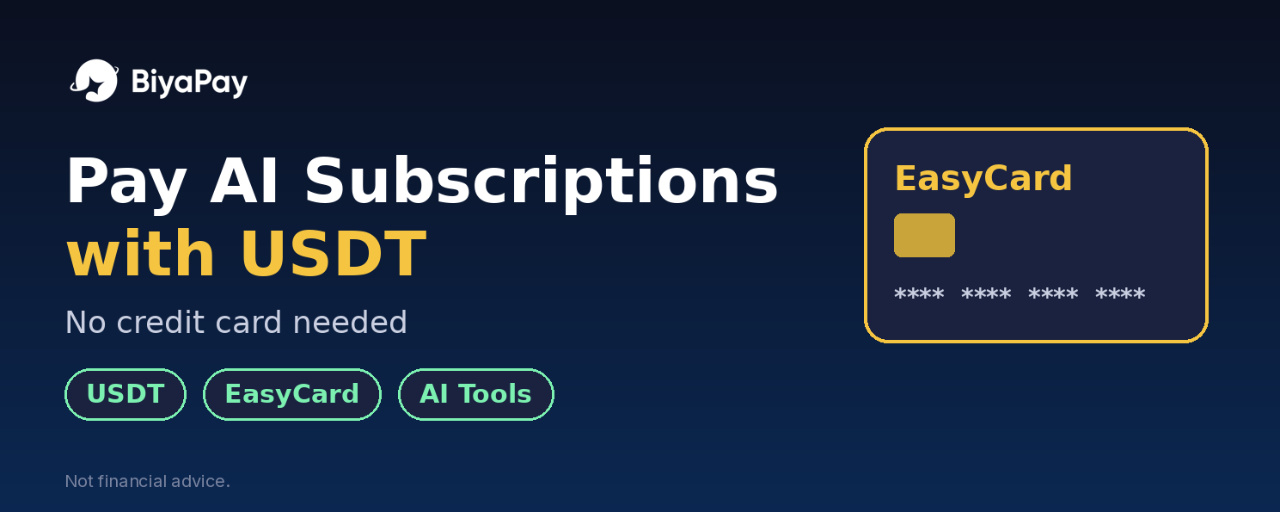
No Credit Card for ChatGPT or Claude? How I Think About Paying AI Subscriptions With USDTDisclosure: It is not financial advice
A problem a lot of us quietly have
AI tools have become part of my daily routine. I use them for research, writing, and checking ideas before I post. But the moment I want a paid plan, I hit the same wall many people in Indonesia hit: the checkout asks for a credit card.
Not everyone has one. Some local debit cards get declined on foreign sites. Some people don't want to link their main bank card to a dozen recurring subscriptions. Meanwhile, a lot of crypto users like me already hold USDT, a dollar-pegged balance that's sitting right there but can't be typed into a checkout form.
Why this matters more now
AI subscriptions aren't a one-off purchase anymore. Many people pay for two or three tools at once, plus software like design apps, cloud storage, or VPNs. Most of these are billed in USD. So the real question becomes: what's a practical way to pay recurring USD bills when your money lives in USDT?
The usual workarounds
Before looking at other options, these were the routes I knew about:
Asking a friend with a credit card to pay, then paying them back. It works, but it's awkward and not sustainable.Selling USDT for rupiah, then hoping a local card gets accepted. That means extra conversion steps, and it still might fail.Buying gift cards or vouchers from resellers. That adds markup and trust risk.
None of these feel clean for something you pay every month.
One option I looked into: BiyaPay EasyCard
BiyaPay has a virtual card called EasyCard that can be funded with USDT and used for supported online payments, such as subscriptions. The idea is simple: your USDT becomes a card balance you can use at checkout, without needing a traditional credit card.
This is the EasyCard page from BiyaPay. It lists popular AI services like ChatGPT, Gemini, Claude, Midjourney, Cursor and Deepseek.
How the flow generally works
Sign in. Create a BiyaPay account.Apply for EasyCard. Choose a card BIN, fill in the details, and top up the card with USDT.Use the card. Once approved, the virtual card can be used right away, with no separate activation step.Keep enough balance for the next billing cycle, since subscriptions renew automatically.
The official EasyCard steps: sign in, apply and top up, then use it right away.
What to check before you rely on it
This is the part I think matters most, because no card works everywhere:
Supported merchants. "Supported online payments" means not every site will accept it. Test with one subscription first before moving everything over.Fees. Check top-up, conversion, and any card fees in the app before you start. They affect the real monthly cost.Renewal timing. If the card balance runs low on the billing date, the payment can fail and your plan may pause.Availability. Card services can differ by region, so confirm you're eligible where you live.Security habits. Never share full card details in screenshots, chats, or with "helpers" offering to pay for you.
Who this makes sense for
From my perspective, this is most useful if you:
Already hold USDT and pay for one or more USD subscriptions.Don't have a credit card, or don't want to use your main card for recurring payments.Want subscription spending separated from the rest of your money.
If you rarely pay online or already have a card that works fine everywhere, you may not need it.
My takeaway
Paying for AI tools shouldn't require jumping through hoops. A USDT-funded virtual card like EasyCard is a practical option to consider, especially for crypto users without a credit card. Start small, test one subscription, check the fees, and decide from there.
How do you pay for your AI subscriptions right now? Let me know in the comments.
#BiyaPay #USDT #AITools #EasyCard
No Credit Card for ChatGPT or Claude? How I Think About Paying AI Subscriptions With USDT
Disclosure: It is not financial advice
A problem a lot of us quietly have
AI tools have become part of my daily routine. I use them for research, writing, and checking ideas before I post. But the moment I want a paid plan, I hit the same wall many people in Indonesia hit: the checkout asks for a credit card.
Not everyone has one. Some local debit cards get declined on foreign sites. Some people don't want to link their main bank card to a dozen recurring subscriptions. Meanwhile, a lot of crypto users like me already hold USDT, a dollar-pegged balance that's sitting right there but can't be typed into a checkout form.
Why this matters more now
AI subscriptions aren't a one-off purchase anymore. Many people pay for two or three tools at once, plus software like design apps, cloud storage, or VPNs. Most of these are billed in USD. So the real question becomes: what's a practical way to pay recurring USD bills when your money lives in USDT?
The usual workarounds
Before looking at other options, these were the routes I knew about:
Asking a friend with a credit card to pay, then paying them back. It works, but it's awkward and not sustainable.Selling USDT for rupiah, then hoping a local card gets accepted. That means extra conversion steps, and it still might fail.Buying gift cards or vouchers from resellers. That adds markup and trust risk.
None of these feel clean for something you pay every month.
One option I looked into: BiyaPay EasyCard
BiyaPay has a virtual card called EasyCard that can be funded with USDT and used for supported online payments, such as subscriptions. The idea is simple: your USDT becomes a card balance you can use at checkout, without needing a traditional credit card.
This is the EasyCard page from BiyaPay. It lists popular AI services like ChatGPT, Gemini, Claude, Midjourney, Cursor and Deepseek.
How the flow generally works
Sign in. Create a BiyaPay account.Apply for EasyCard. Choose a card BIN, fill in the details, and top up the card with USDT.Use the card. Once approved, the virtual card can be used right away, with no separate activation step.Keep enough balance for the next billing cycle, since subscriptions renew automatically.
The official EasyCard steps: sign in, apply and top up, then use it right away.
What to check before you rely on it
This is the part I think matters most, because no card works everywhere:
Supported merchants. "Supported online payments" means not every site will accept it. Test with one subscription first before moving everything over.Fees. Check top-up, conversion, and any card fees in the app before you start. They affect the real monthly cost.Renewal timing. If the card balance runs low on the billing date, the payment can fail and your plan may pause.Availability. Card services can differ by region, so confirm you're eligible where you live.Security habits. Never share full card details in screenshots, chats, or with "helpers" offering to pay for you.
Who this makes sense for
From my perspective, this is most useful if you:
Already hold USDT and pay for one or more USD subscriptions.Don't have a credit card, or don't want to use your main card for recurring payments.Want subscription spending separated from the rest of your money.
If you rarely pay online or already have a card that works fine everywhere, you may not need it.
My takeaway
Paying for AI tools shouldn't require jumping through hoops. A USDT-funded virtual card like EasyCard is a practical option to consider, especially for crypto users without a credit card. Start small, test one subscription, check the fees, and decide from there.
How do you pay for your AI subscriptions right now? Let me know in the comments.
#BiyaPay #USDT #AITools #EasyCard
1
1.3k
·
--
Article
Voir la traduction
My Funds Were Sitting in USDT, So I Looked for a Way Into NVDA Without Going Through RupiahDisclosure: It is not financial advice
The problem I kept running into
As an Indonesian who's active in crypto, most of my idle funds sit in USDT. It's stable, it moves easily, and it's good for waiting on the right moment. But every time I watch stocks like NVIDIA or Apple move, I ask the same question: how do I get from USDT into real US stocks, not tokenized copies or CFDs?
The traditional route is long. I sell USDT for rupiah, withdraw the rupiah to my bank, open an account with a broker that offers US stocks, deposit again, and convert to dollars. Every step adds spreads, fees, and waiting time. When you want to invest small amounts on a regular schedule, that friction really adds up.
Why this question keeps coming up
A lot of crypto traders are now looking at traditional assets to diversify. US tech stocks, ETFs, and even gold come up often as a counterweight to a volatile crypto portfolio. The question isn't "should I?" anymore. It's "which route has the least hassle?"
One option I looked into: BiyaPay
One platform I looked into for this is BiyaPay. It's built as a one-stop platform: you can use USDT to invest in real US stocks through a licensed broker-dealer, without converting to rupiah first.
Here's what stood out to me, based on their official information:
US stock trading with 0 commission.Beyond stocks, access to ETFs, commodities, precious metals, and futures.0 maker fee on perpetual and spot trading.If you need fiat later, you can convert USDT to supported fiat currencies and send it to a bank account, at rates starting from 0.1%.
What the process looks like
This is the BiyaPay home screen on my phone, where stocks, crypto and transfers sit in one app.
Sign up and verify. Have your ID ready, since licensed investment platforms require KYC.Deposit USDT. Check which networks are supported (for example, TRC20 or ERC20) so your funds don't get lost.Allocate to your stock account. Your USDT balance funds purchases on the US market.Find the ticker and buy. For example, NVDA or AAPL, then choose an order type (market or limit).
Here's the NVDA page in the app, with the price chart and the buy option on the same screen.
Monitor and rebalance. If you need liquidity, you can sell the position and reuse the funds or convert them.
A quick comparison from my perspective
Fewer steps and fewer apps was the main difference for me. Fees and availability still depend on your region, so check them in the app.
What you still need to check
I don't want this to sound like everything is seamless. A few things you need to verify yourself:
Availability in your country. Services and features can differ by region, so make sure you're a supported user.Other fees. Zero commission doesn't mean zero cost. Check deposit, withdrawal, and conversion fees, plus spreads.US market hours. US exchanges open at night in Indonesia, so the biggest price moves often happen while we're asleep.Investment risk. Stocks can go down. No platform can guarantee returns.Taxes. Gains from foreign stocks still have tax implications, so learn the rules where you live.
My takeaway
If you hold USDT and want to diversify into US stocks without going back and forth through rupiah, a one stop platform like BiyaPay is worth looking into. What I appreciate is that the process gets shorter. But the final decision should still come from your own research, your risk tolerance, and the rules where you live.
If you hold USDT too, would you rather stay in crypto or start moving part of it into US stocks? Let me know in the comments.
#BiyaPay #USStocks #USDT #GlobalInvesting #NVDA
My Funds Were Sitting in USDT, So I Looked for a Way Into NVDA Without Going Through Rupiah
Disclosure: It is not financial advice
The problem I kept running into
As an Indonesian who's active in crypto, most of my idle funds sit in USDT. It's stable, it moves easily, and it's good for waiting on the right moment. But every time I watch stocks like NVIDIA or Apple move, I ask the same question: how do I get from USDT into real US stocks, not tokenized copies or CFDs?
The traditional route is long. I sell USDT for rupiah, withdraw the rupiah to my bank, open an account with a broker that offers US stocks, deposit again, and convert to dollars. Every step adds spreads, fees, and waiting time. When you want to invest small amounts on a regular schedule, that friction really adds up.
Why this question keeps coming up
A lot of crypto traders are now looking at traditional assets to diversify. US tech stocks, ETFs, and even gold come up often as a counterweight to a volatile crypto portfolio. The question isn't "should I?" anymore. It's "which route has the least hassle?"
One option I looked into: BiyaPay
One platform I looked into for this is BiyaPay. It's built as a one-stop platform: you can use USDT to invest in real US stocks through a licensed broker-dealer, without converting to rupiah first.
Here's what stood out to me, based on their official information:
US stock trading with 0 commission.Beyond stocks, access to ETFs, commodities, precious metals, and futures.0 maker fee on perpetual and spot trading.If you need fiat later, you can convert USDT to supported fiat currencies and send it to a bank account, at rates starting from 0.1%.
What the process looks like
This is the BiyaPay home screen on my phone, where stocks, crypto and transfers sit in one app.
Sign up and verify. Have your ID ready, since licensed investment platforms require KYC.Deposit USDT. Check which networks are supported (for example, TRC20 or ERC20) so your funds don't get lost.Allocate to your stock account. Your USDT balance funds purchases on the US market.Find the ticker and buy. For example, NVDA or AAPL, then choose an order type (market or limit).
Here's the NVDA page in the app, with the price chart and the buy option on the same screen.
Monitor and rebalance. If you need liquidity, you can sell the position and reuse the funds or convert them.
A quick comparison from my perspective
Fewer steps and fewer apps was the main difference for me. Fees and availability still depend on your region, so check them in the app.
What you still need to check
I don't want this to sound like everything is seamless. A few things you need to verify yourself:
Availability in your country. Services and features can differ by region, so make sure you're a supported user.Other fees. Zero commission doesn't mean zero cost. Check deposit, withdrawal, and conversion fees, plus spreads.US market hours. US exchanges open at night in Indonesia, so the biggest price moves often happen while we're asleep.Investment risk. Stocks can go down. No platform can guarantee returns.Taxes. Gains from foreign stocks still have tax implications, so learn the rules where you live.
My takeaway
If you hold USDT and want to diversify into US stocks without going back and forth through rupiah, a one stop platform like BiyaPay is worth looking into. What I appreciate is that the process gets shorter. But the final decision should still come from your own research, your risk tolerance, and the rules where you live.
If you hold USDT too, would you rather stay in crypto or start moving part of it into US stocks? Let me know in the comments.
#BiyaPay #USStocks #USDT #GlobalInvesting #NVDA
1
387


·
--
Après un transfert d’USDT vers BiyaPay, le solde ne s’affiche pas encore. Puis-je acheter directement des actions américaines ou hongkongaises ?Après un transfert d’USDT vers BiyaPay, le solde ne s’affiche pas encore. Puis-je acheter directement des actions américaines ou hongkongaises ?
La plateforme indique que l’envoi a été traité avec succès et le navigateur blockchain affiche également une transaction, mais le solde attendu n’apparaît pas encore sur le compte BiyaPay. Avant de poursuivre avec une conversion ou de vous renseigner sur la négociation d’actions américaines ou hongkongaises, vérifiez d’abord à quelle étape se trouvent les fonds.
L’envoi de l’opération, la transaction sur la blockchain et l’écriture comptable sur le compte de la plateforme correspondent à des étapes distinctes. La réussite de l’une d’elles ne permet pas de conclure que toutes les étapes suivantes sont terminées.
Pour les utilisateurs qui souhaitent utiliser des USDT pour accéder à d’autres marchés, il est plus facile de vérifier ensuite les conditions de conversion et de négociation d’actions une fois le statut de l’arrivée des fonds clarifié.
Après un transfert d’USDT vers BiyaPay, le solde ne s’affiche pas encore. Puis-je acheter directement des actions américaines ou hongkongaises ?
Après un transfert d’USDT vers BiyaPay, le solde ne s’affiche pas encore. Puis-je acheter directement des actions américaines ou hongkongaises ?
La plateforme indique que l’envoi a été traité avec succès et le navigateur blockchain affiche également une transaction, mais le solde attendu n’apparaît pas encore sur le compte BiyaPay. Avant de poursuivre avec une conversion ou de vous renseigner sur la négociation d’actions américaines ou hongkongaises, vérifiez d’abord à quelle étape se trouvent les fonds.
L’envoi de l’opération, la transaction sur la blockchain et l’écriture comptable sur le compte de la plateforme correspondent à des étapes distinctes. La réussite de l’une d’elles ne permet pas de conclure que toutes les étapes suivantes sont terminées.
Pour les utilisateurs qui souhaitent utiliser des USDT pour accéder à d’autres marchés, il est plus facile de vérifier ensuite les conditions de conversion et de négociation d’actions une fois le statut de l’arrivée des fonds clarifié.
170
·
--
Acheter des actions américaines avec de l’USDT : pourquoi le pouvoir d’achat peut-il dépasser le solde des liquidités ? Pour comprendre BiyaPay, il faut d’abord distinguer les différents champs liés aux fondsAcheter des actions américaines avec de l’USDT : pourquoi le pouvoir d’achat peut-il dépasser le solde des liquidités ? Pour comprendre BiyaPay, il faut d’abord distinguer les différents champs liés aux fonds
Après avoir transféré de l’USDT et vu le pouvoir d’achat affiché sur la page des actions, on peut croire que tous les montants à l’écran correspondent à des liquidités déjà disponibles. C’est un malentendu fréquent lorsqu’on découvre les comptes multi-actifs.
La source des fonds, les liquidités du compte-titres et le pouvoir d’achat décrivent des éléments différents. Si le compte est soumis à des règles de financement sur marge, le pouvoir d’achat peut aussi dépendre d’autres conditions de calcul ; il ne peut donc pas remplacer directement le solde réel des liquidités.
Pour les utilisateurs qui souhaitent simplement savoir comment utiliser leurs fonds disponibles pour accéder aux marchés américain et hongkongais, il faut d’abord bien comprendre les champs afin de savoir quels fonds une transaction pourrait mobiliser.
Acheter des actions américaines avec de l’USDT : pourquoi le pouvoir d’achat peut-il dépasser le solde des liquidités ? Pour comprendre BiyaPay, il faut d’abord distinguer les différents champs liés aux fonds
Acheter des actions américaines avec de l’USDT : pourquoi le pouvoir d’achat peut-il dépasser le solde des liquidités ? Pour comprendre BiyaPay, il faut d’abord distinguer les différents champs liés aux fonds
Après avoir transféré de l’USDT et vu le pouvoir d’achat affiché sur la page des actions, on peut croire que tous les montants à l’écran correspondent à des liquidités déjà disponibles. C’est un malentendu fréquent lorsqu’on découvre les comptes multi-actifs.
La source des fonds, les liquidités du compte-titres et le pouvoir d’achat décrivent des éléments différents. Si le compte est soumis à des règles de financement sur marge, le pouvoir d’achat peut aussi dépendre d’autres conditions de calcul ; il ne peut donc pas remplacer directement le solde réel des liquidités.
Pour les utilisateurs qui souhaitent simplement savoir comment utiliser leurs fonds disponibles pour accéder aux marchés américain et hongkongais, il faut d’abord bien comprendre les champs afin de savoir quels fonds une transaction pourrait mobiliser.
127
·
--
Comment négocier des actions américaines et hongkongaises avec de l’USDT ? Avant de découvrir BiyaPay, vérifiez le parcours des fonds, les droits liés aux actions et les modalités de retraitComment négocier des actions américaines et hongkongaises avec de l’USDT ? Avant de découvrir BiyaPay, vérifiez le parcours des fonds, les droits liés aux actions et les modalités de retrait
Vous détenez déjà de l’USDT et souhaitez en savoir plus sur les actions américaines, hongkongaises ou sur une valeur en particulier. Dans les résultats de recherche, on trouve souvent des formules comme « un seul compte pour accéder à plusieurs marchés ». Mais chaque étape doit être comprise concrètement : du transfert des fonds à la vérification de ce que vous détenez réellement, puis à leur retrait.
L’USDT est une forme d’actif servant au financement. Le simple fait de l’utiliser ne permet pas de déterminer si l’ordre final porte sur de véritables actions, un produit lié à leur cours ou une autre activité. Pour vous renseigner sur un outil, il est plus utile de vérifier d’abord le parcours des fonds et la nature du produit que de vous fier à une brève présentation.
Comment négocier des actions américaines et hongkongaises avec de l’USDT ? Avant de découvrir BiyaPay, vérifiez le parcours des fonds, les droits liés aux actions et les modalités de retrait
Comment négocier des actions américaines et hongkongaises avec de l’USDT ? Avant de découvrir BiyaPay, vérifiez le parcours des fonds, les droits liés aux actions et les modalités de retrait
Vous détenez déjà de l’USDT et souhaitez en savoir plus sur les actions américaines, hongkongaises ou sur une valeur en particulier. Dans les résultats de recherche, on trouve souvent des formules comme « un seul compte pour accéder à plusieurs marchés ». Mais chaque étape doit être comprise concrètement : du transfert des fonds à la vérification de ce que vous détenez réellement, puis à leur retrait.
L’USDT est une forme d’actif servant au financement. Le simple fait de l’utiliser ne permet pas de déterminer si l’ordre final porte sur de véritables actions, un produit lié à leur cours ou une autre activité. Pour vous renseigner sur un outil, il est plus utile de vérifier d’abord le parcours des fonds et la nature du produit que de vous fier à une brève présentation.
129

·
--
BIYAPAY LANCE LE CARNAVAL DE LA COUPE DU MONDE AVEC UN TRADING INCITATIF ET ALLOCATION D'ACTIFS ⚽
La plateforme a lancé une période promotionnelle se terminant le 10 juillet qui incite à un volume de trading accru via une structure de récompenses basée sur une loterie. En intégrant des transactions sans frais avec des jalons basés sur des tâches, ils essaient de booster la liquidité et l'acquisition d'utilisateurs pendant cet événement mondial.
Les acteurs du marché devraient surveiller si cet afflux d'activité correspond à une augmentation mesurable du volume de la plateforme ou s'il reste purement promotionnel. Un engagement accru sur la plateforme précède souvent des changements dans le flux de commandes pour des actifs de niche. Considérez-vous ces structures incitatives comme des moteurs efficaces pour une liquidité à long terme ?
Ce n'est pas un conseil financier. Gérez toujours votre risque.
#BIYAPAY #MarketStructure #Liquidity #CryptoTrading
🎯
66

·
--
SpaceX s'installe officiellement sur BiyaPay le 12 juin ! L'événement de distribution de fonds est lancé, un pot de récompense de 1000U à se partager, avec des tirages pour des récompenses SpaceX, Tesla et USDT, cette opportunité est à saisir avant de perdre gros 😎
Comment participer :
Suivez @BIYAPAYOFFICIAL
Aimez et partagez le tweet de l'événement
Balancez votre UID dans les commentaires
Un total de 20 chanceux, ne traînez pas !
L'événement se termine le 12 juin 2026, dépêchez-vous de monter à bord, suivez-moi pour profiter des avantages Web3 🚀
#SpaceX #BiyaPay #événement d'airdrop
193

·
--
⚽️ Le Mondial 2026 USA-Canada-Mexique bat son plein !
Alors que la compétition entre dans la phase à élimination directe, chaque match est porteur de suspense et chaque but suffit à enflammer la ferveur des supporters du monde entier.
Sur le terrain, les joueurs donnent tout : vitesse, technique et volonté pour décrocher leur qualification, avec l’espoir de se faire connaître lors de la scène du Mondial.
En dehors des stades, des fans venus des quatre coins du monde crient et encouragent leurs équipes, profitant de la passion et de la gloire que le football apporte.
Prédire le score, pronostiquer l’issue des matchs, analyser les résultats : tout cela fait désormais partie intégrante du Mondial.
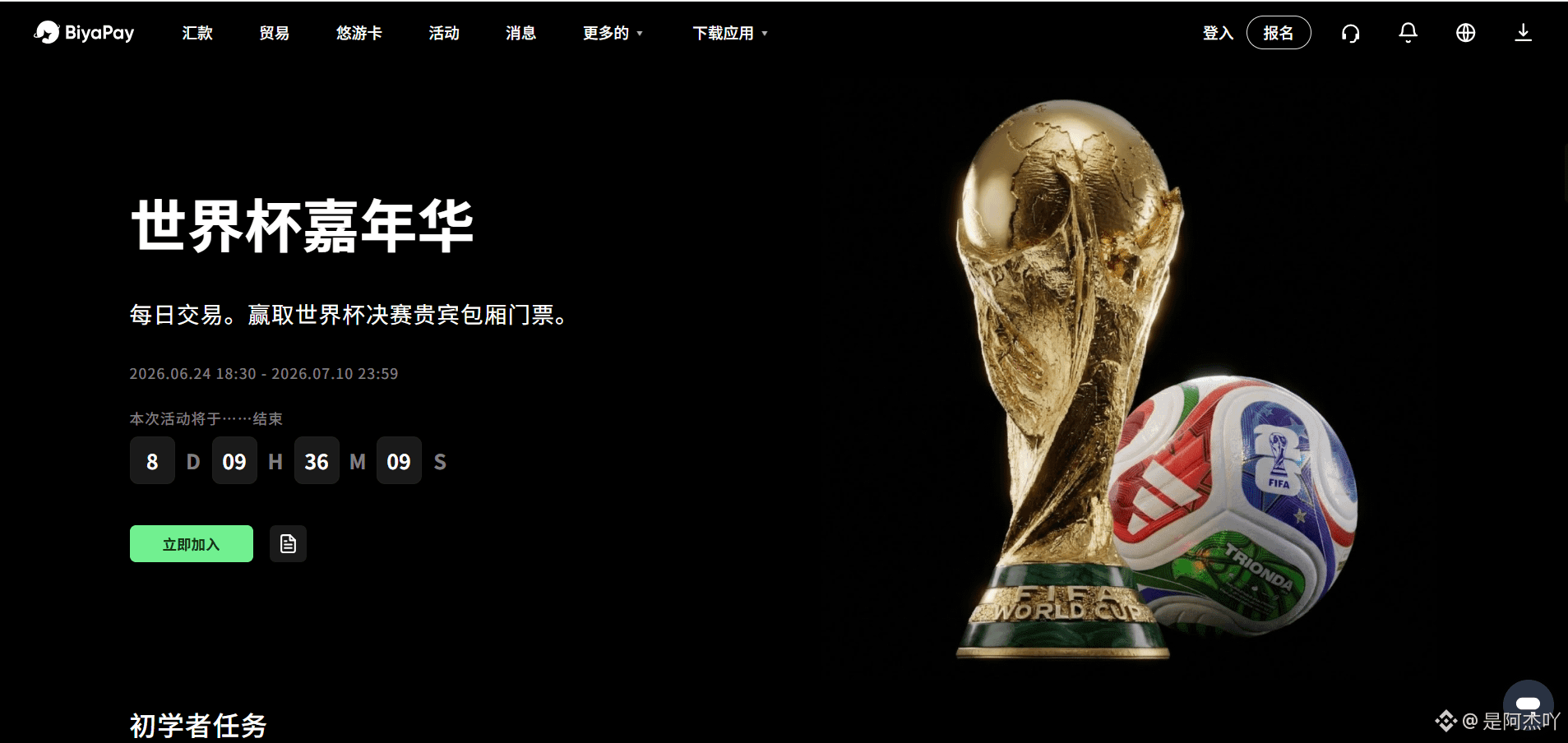
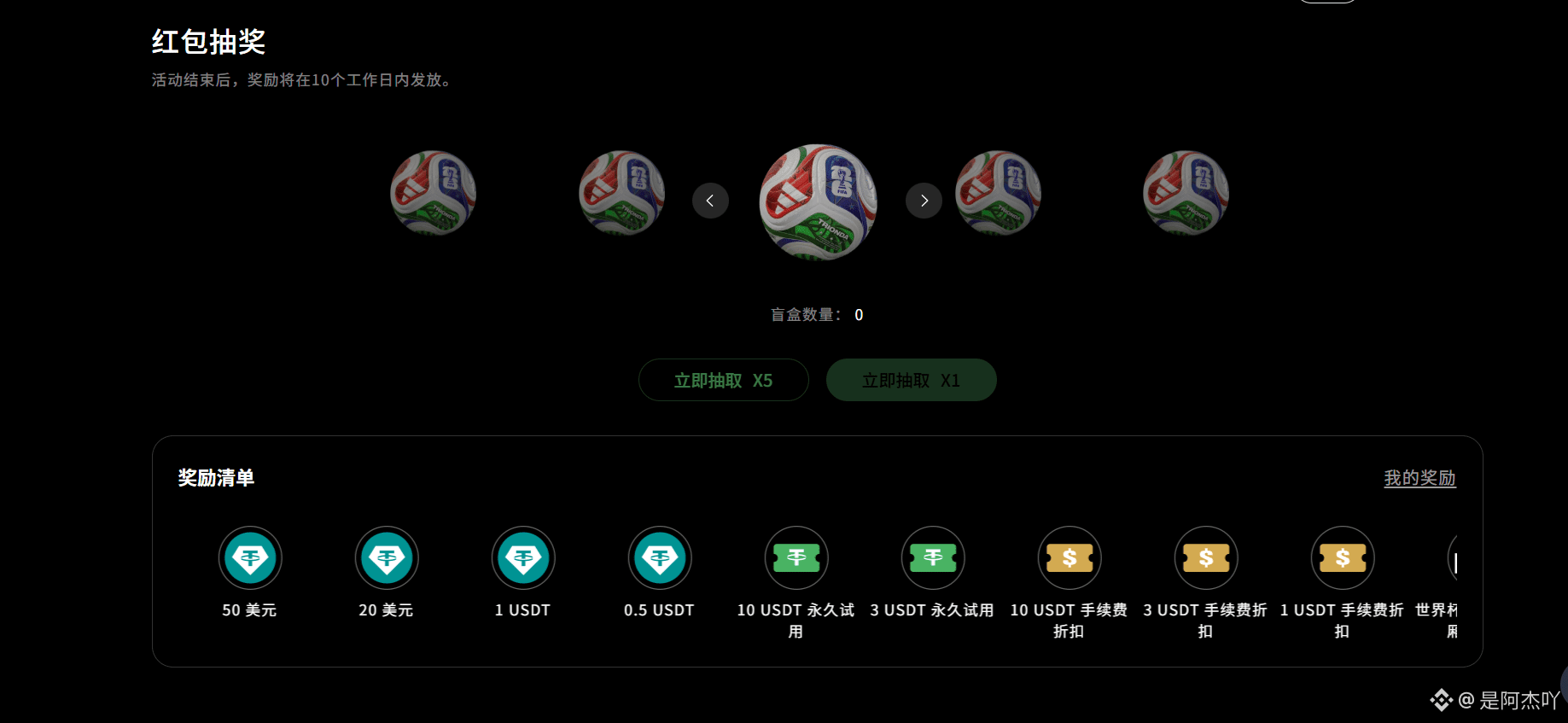
Si vous aimez aussi regarder les matchs tout en vivant le plaisir des pronostics, essayez donc BiyaPay【Carrefour du Mondial】 🏆
🎁 Points forts de l’événement :
✅ Pronostics sans frais
✅ Chaque jour offre l’opportunité de remporter de grands prix
✅ Profitez du Mondial tout en débloquant davantage de surprises et de récompenses
Cet été, ce n’est pas seulement pour assister à la naissance du champion : c’est aussi pour donner à chaque match la chance d’apporter des gains supplémentaires.
Choisissez BiyaPay et lancez-vous dans votre voyage de folie pour le Mondial !⚽🔥
#biyapay #世界杯 #prediction
3
9
7.4k

·
--
BiyaPay U-Card : lancement d’une offre exclusive, paiements par carte pour les actifs numériques directement dans le monde entier
Depuis toujours, j’utilise BiyaPay pour gérer mes actifs numériques et investir dans les actions des marchés US et Hong Kong. En plus des fonctions essentielles comme l’échange de devises, les virements internationaux et le trading d’actions US sans commission, la carte de paiement U-Card est aussi un outil quotidien très utilisé : elle permet de convertir directement l’USDT en monnaie fiduciaire. Vous pouvez régler des achats en ligne et en point de vente partout dans le monde, couvrant divers scénarios comme les abonnements à l’étranger, le e-commerce cross-border (achats depuis l’étranger) et les boutiques physiques situées à l’étranger.
Désormais, la plateforme lance une offre à durée limitée réservée à la U-Card. Période de l’événement : du 1er août au 15 septembre. Les règles des avantages sont simples et concrètes :
Pour tout nouvel utilisateur effectuant son premier paiement par carte avec la U-Card, profitez d’un cashback de 50 % sur le montant dépensé, avec un maximum pouvant atteindre 10 USDT ; invitez des amis à s’inscrire et à remplir les conditions d’utilisation : pour chaque nouvel utilisateur invité remplissant les critères, recevez 5 USDT. Il n’y a pas de limite au nombre d’invitations : plus vous invitez, plus vous gagnez.
Une seule U-Card relie les actifs numériques aux dépenses du quotidien : plus besoin de passer par des démarches compliquées pour échanger des devises et retirer de l’argent. Avec ce cashback généreux et la récompense d’invitation sans limite, que vous soyez un habitué des achats depuis l’étranger, des abonnements à des logiciels étrangers, ou que vous ayez des besoins de paiement à l’étranger, cette offre est faite pour vous.
Twitter officiel : @BIYAPAYOFFICIAL
#biyapay #Ucard #CryptoPayment
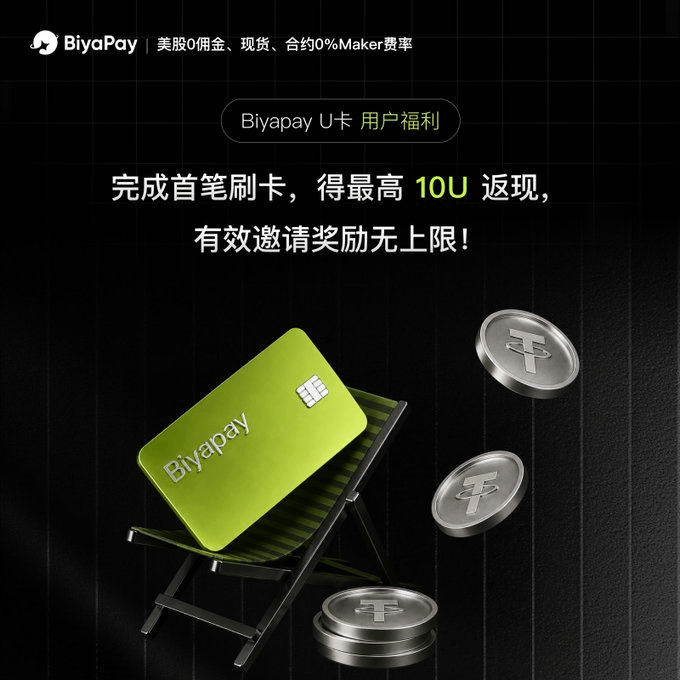
1
2
265

BIYAPAY LANCE LE CARNAVAL DE LA COUPE DU MONDE AVEC UN TRADING SANS FRAIS ET DES PRIX VIP ⚽
BiyaPay vient de lancer son événement lié à la Coupe du Monde, et la structure d’incitation mérite d’être examinée si vous êtes déjà actif sur le marché. Ils proposent des transactions sans frais et diverses récompenses jusqu’au 10 juillet pour les utilisateurs qui accomplissent des tâches spécifiques comme le trading et les transferts de fonds transfrontaliers.
La plateforme cherche clairement à capter une partie de l’élan actuel du sport pour générer du volume. Avec des prix allant de places en loge VIP à des récompenses en boîte aveugle, cela ajoute une couche d’utilité à l’activité de trading standard. Pensez-vous que ce type d’incitations axées sur des événements change réellement votre comportement de trading ?
Ce n’est pas un conseil financier. Gérez toujours votre risque.
#BIYAPAY #CryptoTrading #WorldCup #TradingIncentives
⚡
54

·
--
Visa adopte Monad : les stablecoins sont-ils encore loin des paiements du quotidien ?Une nouvelle récente dans le monde des cryptomonnaies ne suscite peut-être pas autant d’agitation qu’une forte hausse ou une chute brutale, mais elle mérite qu’on s’y attarde. Le 10 novembre, la Fondation Monad a annoncé que Visa avait ajouté Monad aux options de son réseau de règlement en stablecoins. Les établissements émetteurs et acquéreurs participant au projet peuvent utiliser cette blockchain pour régler les paiements liés à Visa. Voir Visa associé à une blockchain publique peut facilement faire penser que, bientôt, on pourra dépenser ses stablecoins où l’on veut. Mais la portée réelle de cette annonce est plus limitée.
Elle modifie d’abord le circuit de règlement en arrière-plan entre les prestataires de paiement. Les établissements émetteurs servent les titulaires de cartes, tandis que les établissements acquéreurs servent les commerçants. Derrière chaque paiement par carte, ces établissements doivent aussi procéder à la compensation et au règlement entre eux. Ajouter une option blockchain revient à proposer aux établissements participants un moyen supplémentaire de transférer des fonds. Cela ne signifie pas automatiquement que tous les commerçants accepteront désormais les stablecoins, ni que les utilisateurs auront bientôt un nouveau bouton de paiement.
Visa adopte Monad : les stablecoins sont-ils encore loin des paiements du quotidien ?
Une nouvelle récente dans le monde des cryptomonnaies ne suscite peut-être pas autant d’agitation qu’une forte hausse ou une chute brutale, mais elle mérite qu’on s’y attarde. Le 10 novembre, la Fondation Monad a annoncé que Visa avait ajouté Monad aux options de son réseau de règlement en stablecoins. Les établissements émetteurs et acquéreurs participant au projet peuvent utiliser cette blockchain pour régler les paiements liés à Visa. Voir Visa associé à une blockchain publique peut facilement faire penser que, bientôt, on pourra dépenser ses stablecoins où l’on veut. Mais la portée réelle de cette annonce est plus limitée.
Elle modifie d’abord le circuit de règlement en arrière-plan entre les prestataires de paiement. Les établissements émetteurs servent les titulaires de cartes, tandis que les établissements acquéreurs servent les commerçants. Derrière chaque paiement par carte, ces établissements doivent aussi procéder à la compensation et au règlement entre eux. Ajouter une option blockchain revient à proposer aux établissements participants un moyen supplémentaire de transférer des fonds. Cela ne signifie pas automatiquement que tous les commerçants accepteront désormais les stablecoins, ni que les utilisateurs auront bientôt un nouveau bouton de paiement.
Elle modifie d’abord le circuit de règlement en arrière-plan entre les prestataires de paiement. Les établissements émetteurs servent les titulaires de cartes, tandis que les établissements acquéreurs servent les commerçants. Derrière chaque paiement par carte, ces établissements doivent aussi procéder à la compensation et au règlement entre eux. Ajouter une option blockchain revient à proposer aux établissements participants un moyen supplémentaire de transférer des fonds. Cela ne signifie pas automatiquement que tous les commerçants accepteront désormais les stablecoins, ni que les utilisateurs auront bientôt un nouveau bouton de paiement.
1
262

·
--
Note sur la hausse des trois grands indices : le jour où Nvidia a baissé seule, ne paniquez pas au moment de renouveler votre abonnement IAÀ la clôture de Wall Street le 9 novembre, les écrans étaient enfin tous au vert : le Dow Jones à 52 389,75 points, soit environ +2,15 % (+1 104,02) ; le S&P 500 à 7 549,94 points, soit environ +2,35 % (+173,08) ; le Nasdaq à 25 253,14 points, soit environ +2,74 % (+673,71). Le VIX a reflué à environ 19,92, en baisse d’environ 22,31 %, repassant sous la barre des 20. Les cours du pétrole ont eux aussi nettement reculé : le Brent a perdu environ 5,85 %, à 92,57, et le WTI environ 4,38 %, à 86,85, ce qui a quelque peu apaisé les craintes d’inflation. Le même jour, Nvidia a pourtant clôturé à 178,67, en baisse d’environ 4,27 % ; son plus bas en début de séance était d’environ 170,24, soit un recul ponctuel d’environ 8,8 % en cours de séance. Les trois grands indices peuvent tous progresser tandis que Nvidia baisse seule : le rebond des indices larges et la divergence entre les grandes valeurs, ce sont deux histoires différentes. Distinguer « tout est au vert » de « tout est aligné dans la structure du marché » est plus proche d’une analyse vérifiable que de simplement repartager une capture d’écran de la clôture.
Note sur la hausse des trois grands indices : le jour où Nvidia a baissé seule, ne paniquez pas au moment de renouveler votre abonnement IA
À la clôture de Wall Street le 9 novembre, les écrans étaient enfin tous au vert : le Dow Jones à 52 389,75 points, soit environ +2,15 % (+1 104,02) ; le S&P 500 à 7 549,94 points, soit environ +2,35 % (+173,08) ; le Nasdaq à 25 253,14 points, soit environ +2,74 % (+673,71). Le VIX a reflué à environ 19,92, en baisse d’environ 22,31 %, repassant sous la barre des 20. Les cours du pétrole ont eux aussi nettement reculé : le Brent a perdu environ 5,85 %, à 92,57, et le WTI environ 4,38 %, à 86,85, ce qui a quelque peu apaisé les craintes d’inflation. Le même jour, Nvidia a pourtant clôturé à 178,67, en baisse d’environ 4,27 % ; son plus bas en début de séance était d’environ 170,24, soit un recul ponctuel d’environ 8,8 % en cours de séance. Les trois grands indices peuvent tous progresser tandis que Nvidia baisse seule : le rebond des indices larges et la divergence entre les grandes valeurs, ce sont deux histoires différentes. Distinguer « tout est au vert » de « tout est aligné dans la structure du marché » est plus proche d’une analyse vérifiable que de simplement repartager une capture d’écran de la clôture.
297
·
--
CoreWeave relève ses prévisions : la controverse sur la puissance de calcul de l’IA est-elle terminée ?Pour suivre le monde des cryptomonnaies, il n’est pas nécessaire de ne regarder que les cours. Les réponses à certaines questions se trouvent parfois plutôt dans les résultats financiers des sociétés cotées aux États-Unis. Par exemple, l’IA a-t-elle encore besoin de davantage de puissance de calcul ? Quelle différence y a-t-il entre gagner de l’argent grâce aux centres de données et attirer des capitaux en surfant sur le thème de la puissance de calcul ? Les résultats du troisième trimestre publiés par CoreWeave le 10 novembre apportent des données qui permettent d’examiner sérieusement ces deux questions.
Au troisième trimestre, cette entreprise de services cloud spécialisés en IA a réalisé un chiffre d’affaires de 3,661 milliards de dollars, contre 1,365 milliard à la même période l’année précédente, soit une hausse d’environ 168 %. À la fin du mois de septembre, son carnet de revenus s’élevait à environ 132,5 milliards de dollars. L’entreprise a également relevé sa prévision de chiffre d’affaires pour l’ensemble de 2026 à une fourchette de 13 à 13,3 milliards de dollars. À en juger par ces seuls chiffres, la demande reste forte : on ne peut du moins pas affirmer simplement que « plus personne ne veut d’infrastructures d’IA ». Toutefois, les prévisions reflètent les attentes de la direction, et les revenus inscrits au carnet ne pourront être comptabilisés qu’au fur et à mesure de l’exécution des livraisons et des services convenus.
CoreWeave relève ses prévisions : la controverse sur la puissance de calcul de l’IA est-elle terminée ?
Pour suivre le monde des cryptomonnaies, il n’est pas nécessaire de ne regarder que les cours. Les réponses à certaines questions se trouvent parfois plutôt dans les résultats financiers des sociétés cotées aux États-Unis. Par exemple, l’IA a-t-elle encore besoin de davantage de puissance de calcul ? Quelle différence y a-t-il entre gagner de l’argent grâce aux centres de données et attirer des capitaux en surfant sur le thème de la puissance de calcul ? Les résultats du troisième trimestre publiés par CoreWeave le 10 novembre apportent des données qui permettent d’examiner sérieusement ces deux questions.
Au troisième trimestre, cette entreprise de services cloud spécialisés en IA a réalisé un chiffre d’affaires de 3,661 milliards de dollars, contre 1,365 milliard à la même période l’année précédente, soit une hausse d’environ 168 %. À la fin du mois de septembre, son carnet de revenus s’élevait à environ 132,5 milliards de dollars. L’entreprise a également relevé sa prévision de chiffre d’affaires pour l’ensemble de 2026 à une fourchette de 13 à 13,3 milliards de dollars. À en juger par ces seuls chiffres, la demande reste forte : on ne peut du moins pas affirmer simplement que « plus personne ne veut d’infrastructures d’IA ». Toutefois, les prévisions reflètent les attentes de la direction, et les revenus inscrits au carnet ne pourront être comptabilisés qu’au fur et à mesure de l’exécution des livraisons et des services convenus.
Au troisième trimestre, cette entreprise de services cloud spécialisés en IA a réalisé un chiffre d’affaires de 3,661 milliards de dollars, contre 1,365 milliard à la même période l’année précédente, soit une hausse d’environ 168 %. À la fin du mois de septembre, son carnet de revenus s’élevait à environ 132,5 milliards de dollars. L’entreprise a également relevé sa prévision de chiffre d’affaires pour l’ensemble de 2026 à une fourchette de 13 à 13,3 milliards de dollars. À en juger par ces seuls chiffres, la demande reste forte : on ne peut du moins pas affirmer simplement que « plus personne ne veut d’infrastructures d’IA ». Toutefois, les prévisions reflètent les attentes de la direction, et les revenus inscrits au carnet ne pourront être comptabilisés qu’au fur et à mesure de l’exécution des livraisons et des services convenus.
115
Connectez-vous pour découvrir plus de contenu
Rejoignez la communauté mondiale des adeptes de cryptomonnaies sur Binance Square
⚡️ Suviez les dernières informations importantes sur les cryptomonnaies.
💬 Jugé digne de confiance par la plus grande plateforme d’échange de cryptomonnaies au monde.
👍 Découvrez les connaissances que partagent les créateurs vérifiés.
Adresse e-mail/Nº de téléphone
Sujets d’actualité
1
#USPPIMissMayEaseBTCPressure
3,396 vues
183 mentions
2
#BitcoinCoreDisclosesTorTrafficVulnerability
0 vues
0 mentions
3
#WhatWillDriveCryptoandStocks’NextRebound?
88,888 vues
1,201 mentions
4
#BitcoinBreaksBelow200WeekMovingAverage
13,061 vues
240 mentions
5
#SpaceXTeslaMergerTalksWouldCombine30220BTC
4,767 vues
113 mentions
6
#Anthropic’s6xIPODemandSignalsPotentialRecordRaise
29,579 vues
562 mentions
7
#USCryptoETFsLose$1.48BInFiveDays
1,017 vues
28 mentions
8
#KoreaDigitalAssetBasicActFinalDraftExpectedEarlyJanuary
2,526 vues
15 mentions
9
#RippleRLUSDMarketCapSurpassesPayPalPYUSD
1,868 vues
74 mentions
10
#JaneStreetNearlyOctuplesFidelityBitcoinETFHoldings
10,346 vues
178 mentions