

quiet_capital
54 Publications

quiet_capital
Signaler
Bloquer l’utilisateur
Overthinks every position. Writes about it anyway💎
3 Suivis
4 Abonnés
28 J’aime
Publications
Tous
Citations
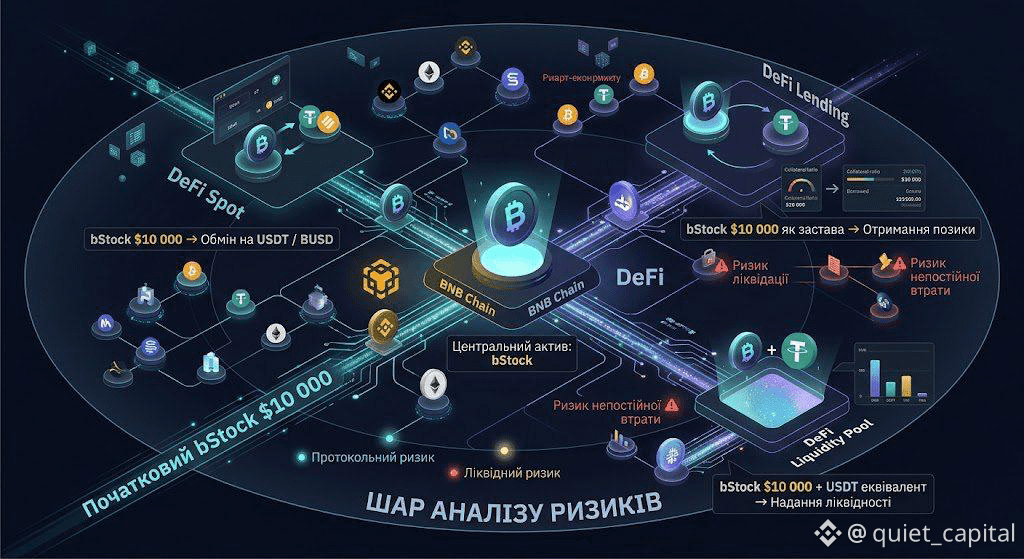
@Binance_Ukraine #BinanceUkraine Огляд ринку плюс гайд для тих, хто ще не чув: bStocks тепер інтегровані в кілька DeFi-протоколів на BNB Chain, і це змінює те, чим токен може бути після покупки. 🔌
На практиці це означає, що NVDAB чи TSLAB — не просто баланс на споті, а актив, який можна використати як робочий капітал: наприклад, як забезпечення в протоколах на кшталт Venus або в пулах ліквідності. Простими словами: токен не мусить просто лежати й чекати руху ціни — за бажанням він може одночасно працювати в DeFi. 🧩
Це відкриває нові варіанти для портфеля: частина bStocks може залишатись довгостроковою позицією, а інша — активно використовуватись у DeFi-протоколах для потенційної додаткової дохідності. Водночас додається окремий шар смартконтрактного ризику, про який не варто забувати. ⚠️
Найрозумніше тут починати з невеликої суми й спершу розібратися в механіці конкретного протоколу. Новий рівень використання активу автоматично означає й новий набір ризиків.
Використовуєте bStocks десь у DeFi, чи тримаєте їх виключно на споті Binance?
#bstock
@Binance_Ukraine #BinanceUkraine Огляд ринку плюс гайд для тих, хто ще не чув: bStocks тепер інтегровані в кілька DeFi-протоколів на BNB Chain, і це змінює те, чим токен може бути після покупки. 🔌
На практиці це означає, що NVDAB чи TSLAB — не просто баланс на споті, а актив, який можна використати як робочий капітал: наприклад, як забезпечення в протоколах на кшталт Venus або в пулах ліквідності. Простими словами: токен не мусить просто лежати й чекати руху ціни — за бажанням він може одночасно працювати в DeFi. 🧩
Це відкриває нові варіанти для портфеля: частина bStocks може залишатись довгостроковою позицією, а інша — активно використовуватись у DeFi-протоколах для потенційної додаткової дохідності. Водночас додається окремий шар смартконтрактного ризику, про який не варто забувати. ⚠️
Найрозумніше тут починати з невеликої суми й спершу розібратися в механіці конкретного протоколу. Новий рівень використання активу автоматично означає й новий набір ризиків.
Використовуєте bStocks десь у DeFi, чи тримаєте їх виключно на споті Binance?
#bstock
На практиці це означає, що NVDAB чи TSLAB — не просто баланс на споті, а актив, який можна використати як робочий капітал: наприклад, як забезпечення в протоколах на кшталт Venus або в пулах ліквідності. Простими словами: токен не мусить просто лежати й чекати руху ціни — за бажанням він може одночасно працювати в DeFi. 🧩
Це відкриває нові варіанти для портфеля: частина bStocks може залишатись довгостроковою позицією, а інша — активно використовуватись у DeFi-протоколах для потенційної додаткової дохідності. Водночас додається окремий шар смартконтрактного ризику, про який не варто забувати. ⚠️
Найрозумніше тут починати з невеликої суми й спершу розібратися в механіці конкретного протоколу. Новий рівень використання активу автоматично означає й новий набір ризиків.
Використовуєте bStocks десь у DeFi, чи тримаєте їх виключно на споті Binance?
#bstock
93
Спробував Dual Investment вперше цього тижня, бо чув про продукт, але обходив його стороною. 🧪 Виявилось простіше: обираєш пару активів, цільову ціну та дату, і система одразу показує дохідність ще до підписки — без прихованих умов. 📊
Головне, що я зрозумів на практиці: це не «депозит зі стабільним відсотком», а продукт із ціновою експозицією. Якщо ціна на дату розрахунку піде не туди, повернення буде в іншому активі, а не в тому, що вносив. Це не погано, просто це треба чітко розуміти заздалегідь, а не постфактум. ⚠️
Ще один нюанс: чим ближче цільова ціна до ринкової, тим вища дохідність, але й вища ймовірність конверсії. Усвідомлюєш це, коли сам порівнюєш кілька варіантів.
Моє просте правило: заходити тільки в ті пари, де готовий спокійно тримати обидва активи. Поки враження позитивні — усі умови видно завчасно. ✅
Хтось користувався Dual Investment регулярно, чи теж пробували лише для знайомства з механікою?
@Binance_Ukraine
Спробував Dual Investment вперше цього тижня, бо чув про продукт, але обходив його стороною. 🧪 Виявилось простіше: обираєш пару активів, цільову ціну та дату, і система одразу показує дохідність ще до підписки — без прихованих умов. 📊
Головне, що я зрозумів на практиці: це не «депозит зі стабільним відсотком», а продукт із ціновою експозицією. Якщо ціна на дату розрахунку піде не туди, повернення буде в іншому активі, а не в тому, що вносив. Це не погано, просто це треба чітко розуміти заздалегідь, а не постфактум. ⚠️
Ще один нюанс: чим ближче цільова ціна до ринкової, тим вища дохідність, але й вища ймовірність конверсії. Усвідомлюєш це, коли сам порівнюєш кілька варіантів.
Моє просте правило: заходити тільки в ті пари, де готовий спокійно тримати обидва активи. Поки враження позитивні — усі умови видно завчасно. ✅
Хтось користувався Dual Investment регулярно, чи теж пробували лише для знайомства з механікою?
@Binance_Ukraine
Головне, що я зрозумів на практиці: це не «депозит зі стабільним відсотком», а продукт із ціновою експозицією. Якщо ціна на дату розрахунку піде не туди, повернення буде в іншому активі, а не в тому, що вносив. Це не погано, просто це треба чітко розуміти заздалегідь, а не постфактум. ⚠️
Ще один нюанс: чим ближче цільова ціна до ринкової, тим вища дохідність, але й вища ймовірність конверсії. Усвідомлюєш це, коли сам порівнюєш кілька варіантів.
Моє просте правило: заходити тільки в ті пари, де готовий спокійно тримати обидва активи. Поки враження позитивні — усі умови видно завчасно. ✅
Хтось користувався Dual Investment регулярно, чи теж пробували лише для знайомства з механікою?
@Binance_Ukraine

79
Караулити відкриття біржі Нью-Йорка о 16:30 — це кам'яний вік.
📉 Місяць тестую токенізовані акції на Binance і роблю конвертацію, щоб оцінити реальний профіт.
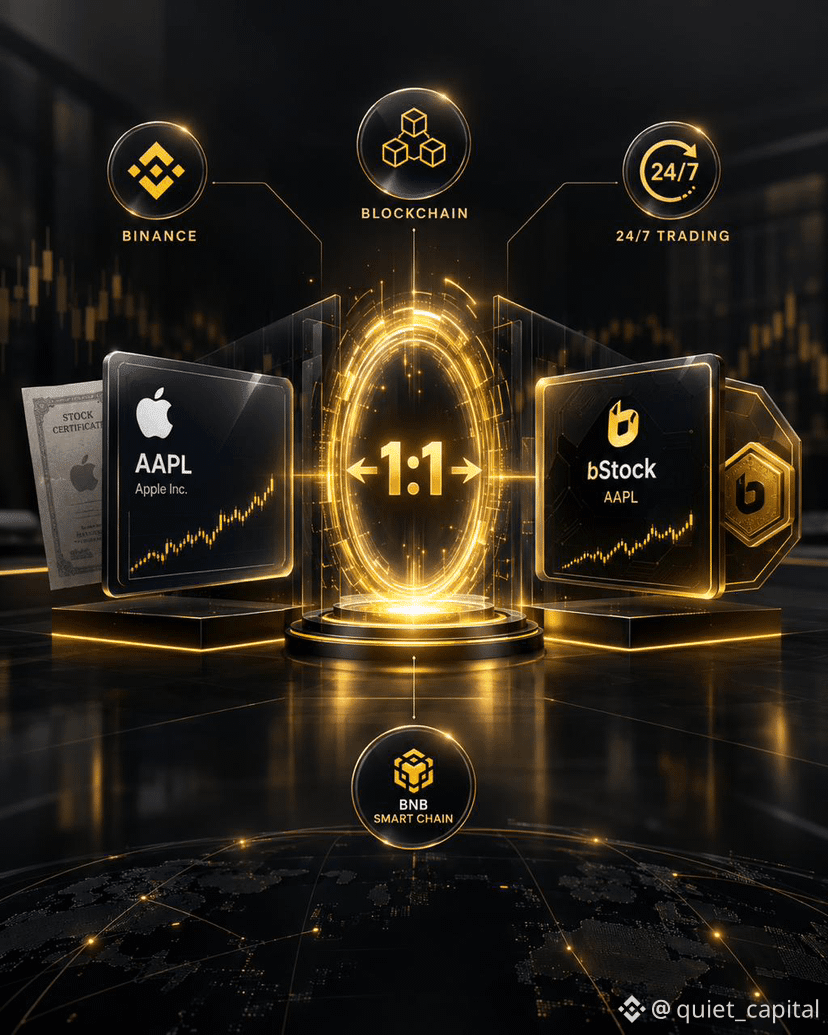
Головний кайф — час. У TradFi чекаєш розрахунків T+1, доки кошти «долетять». Тут обміняв акцію на bStock 1:1 — і в грі. Без комісії, цілодобово. Паузи бувають лише через корпоративні події чи технічні роботи компаній. ⏰
Плюс на споті — миттєве виконання за частки секунди. ⚡ Вийшла нічна новина — брокер спить, а ти вже закрив позицію чи зайшов у ринок.
Але варто тверезо оцінювати інструмент: це не папір із реєстром акціонерів і правом голосу, а токен, що повторює ціну акції. Для швидкої торгівлі — ідеально. Вивів на BNB Smart Chain, інтегрував у криптоекосистему і торгуєш. 🔗
Така мобільність значно виграє у банківських додатків із паузами на вихідні.
Хто вже тестував конвертацію, як швидкість? Чи заходили суто заради торгівлі 24/7? 💬
#BinanceUkraine @Binance_Ukraine #BStocks
Караулити відкриття біржі Нью-Йорка о 16:30 — це кам'яний вік.
📉 Місяць тестую токенізовані акції на Binance і роблю конвертацію, щоб оцінити реальний профіт.
Головний кайф — час. У TradFi чекаєш розрахунків T+1, доки кошти «долетять». Тут обміняв акцію на bStock 1:1 — і в грі. Без комісії, цілодобово. Паузи бувають лише через корпоративні події чи технічні роботи компаній. ⏰
Плюс на споті — миттєве виконання за частки секунди. ⚡ Вийшла нічна новина — брокер спить, а ти вже закрив позицію чи зайшов у ринок.
Але варто тверезо оцінювати інструмент: це не папір із реєстром акціонерів і правом голосу, а токен, що повторює ціну акції. Для швидкої торгівлі — ідеально. Вивів на BNB Smart Chain, інтегрував у криптоекосистему і торгуєш. 🔗
Така мобільність значно виграє у банківських додатків із паузами на вихідні.
Хто вже тестував конвертацію, як швидкість? Чи заходили суто заради торгівлі 24/7? 💬
#BinanceUkraine @Binance_Ukraine #BStocks
📉 Місяць тестую токенізовані акції на Binance і роблю конвертацію, щоб оцінити реальний профіт.
Головний кайф — час. У TradFi чекаєш розрахунків T+1, доки кошти «долетять». Тут обміняв акцію на bStock 1:1 — і в грі. Без комісії, цілодобово. Паузи бувають лише через корпоративні події чи технічні роботи компаній. ⏰
Плюс на споті — миттєве виконання за частки секунди. ⚡ Вийшла нічна новина — брокер спить, а ти вже закрив позицію чи зайшов у ринок.
Але варто тверезо оцінювати інструмент: це не папір із реєстром акціонерів і правом голосу, а токен, що повторює ціну акції. Для швидкої торгівлі — ідеально. Вивів на BNB Smart Chain, інтегрував у криптоекосистему і торгуєш. 🔗
Така мобільність значно виграє у банківських додатків із паузами на вихідні.
Хто вже тестував конвертацію, як швидкість? Чи заходили суто заради торгівлі 24/7? 💬
#BinanceUkraine @Binance_Ukraine #BStocks
97
#termmax @termmax
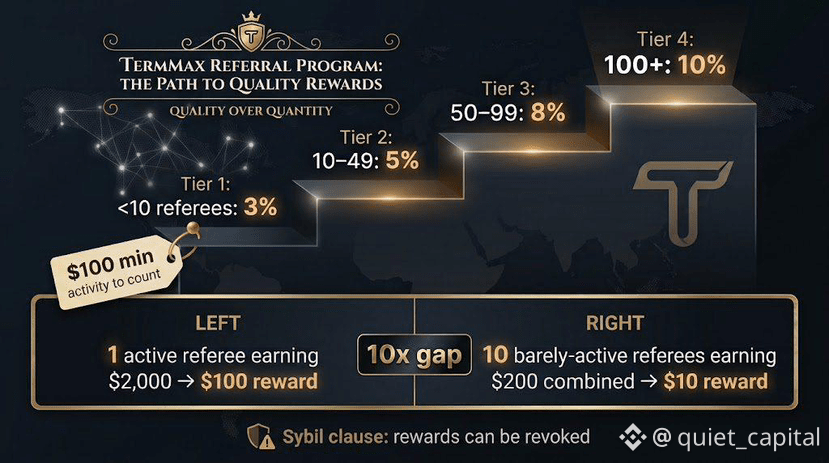
The referral system on TermMax's leaderboard isn't "invite a friend, get a flat bonus" — it's a percentage cut of what your referee actually earns, tiered by how many active referees you've brought in. 🎯
Mechanic, straight from the docs: Referral Reward = (sum of your referees' Position-Pool rewards) × your Referral Boost Rate, where the rate climbs in tiers — 3% under 10 active referees, 5% for 10-49, 8% for 50-99, and 10% at 100 or more. An "active" referee needs at least $100 in qualifying lending or vault activity — someone who signs up and does nothing doesn't count toward your tier at all. 📶
Rough illustration at the 5% tier (10-49 active referees): one genuinely active referee earning $2,000 in Position-Pool rewards nets you $100 in referral rewards. Ten referees who barely clear the $100 activity threshold and earn a combined $200 in rewards nets you just $10 — a 10x gap in your actual earnings despite "more referrals" by headcount. 💸 Under a formula like this, who you refer and whether they stay active matters more than how many links you send out.
Worth also flagging plainly: there's an explicit Sybil-prevention clause here — TermMax reserves the right to retroactively revoke all corresponding TMX rewards and entitlements tied to detected Sybil activity, meaning gaming this with fake accounts referring yourself is a disclosed, real risk. 🚨
Are you actually prioritizing quality referrals over volume, or have you been treating this as a numbers game up to now? 👥 Has anyone actually climbed from the 3% to the 5%+ tier — was the jump in earnings meaningful?
@termmax #TermMax
#termmax @TermMax
The referral system on TermMax's leaderboard isn't "invite a friend, get a flat bonus" — it's a percentage cut of what your referee actually earns, tiered by how many active referees you've brought in. 🎯
Mechanic, straight from the docs: Referral Reward = (sum of your referees' Position-Pool rewards) × your Referral Boost Rate, where the rate climbs in tiers — 3% under 10 active referees, 5% for 10-49, 8% for 50-99, and 10% at 100 or more. An "active" referee needs at least $100 in qualifying lending or vault activity — someone who signs up and does nothing doesn't count toward your tier at all. 📶
Rough illustration at the 5% tier (10-49 active referees): one genuinely active referee earning $2,000 in Position-Pool rewards nets you $100 in referral rewards. Ten referees who barely clear the $100 activity threshold and earn a combined $200 in rewards nets you just $10 — a 10x gap in your actual earnings despite "more referrals" by headcount. 💸 Under a formula like this, who you refer and whether they stay active matters more than how many links you send out.
Worth also flagging plainly: there's an explicit Sybil-prevention clause here — TermMax reserves the right to retroactively revoke all corresponding TMX rewards and entitlements tied to detected Sybil activity, meaning gaming this with fake accounts referring yourself is a disclosed, real risk. 🚨
Are you actually prioritizing quality referrals over volume, or have you been treating this as a numbers game up to now? 👥 Has anyone actually climbed from the 3% to the 5%+ tier — was the jump in earnings meaningful?
@TermMax #TermMax
The referral system on TermMax's leaderboard isn't "invite a friend, get a flat bonus" — it's a percentage cut of what your referee actually earns, tiered by how many active referees you've brought in. 🎯
Mechanic, straight from the docs: Referral Reward = (sum of your referees' Position-Pool rewards) × your Referral Boost Rate, where the rate climbs in tiers — 3% under 10 active referees, 5% for 10-49, 8% for 50-99, and 10% at 100 or more. An "active" referee needs at least $100 in qualifying lending or vault activity — someone who signs up and does nothing doesn't count toward your tier at all. 📶
Rough illustration at the 5% tier (10-49 active referees): one genuinely active referee earning $2,000 in Position-Pool rewards nets you $100 in referral rewards. Ten referees who barely clear the $100 activity threshold and earn a combined $200 in rewards nets you just $10 — a 10x gap in your actual earnings despite "more referrals" by headcount. 💸 Under a formula like this, who you refer and whether they stay active matters more than how many links you send out.
Worth also flagging plainly: there's an explicit Sybil-prevention clause here — TermMax reserves the right to retroactively revoke all corresponding TMX rewards and entitlements tied to detected Sybil activity, meaning gaming this with fake accounts referring yourself is a disclosed, real risk. 🚨
Are you actually prioritizing quality referrals over volume, or have you been treating this as a numbers game up to now? 👥 Has anyone actually climbed from the 3% to the 5%+ tier — was the jump in earnings meaningful?
@TermMax #TermMax
83
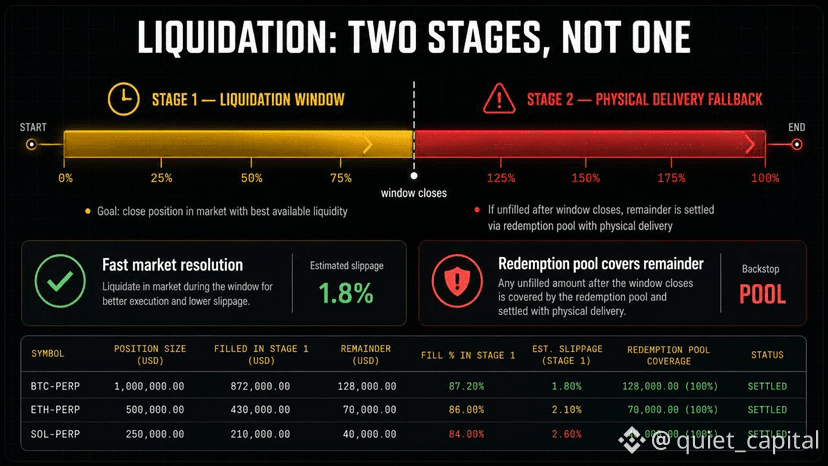
#termmax @termmax Assumed "liquidation" on TermMax happened the moment a position crossed its threshold, the same instant-trigger model most lending markets use. Reading the actual mechanism changed that assumption. 🧩
TermMax's liquidation isn't a single instant event — there's a defined liquidation window, a period during which the position can still be liquidated through normal means before the more drastic physical delivery fallback kicks in. ⏳ Only if a loan remains unpaid or only partially liquidated after that window closes does physical delivery begin, with the redemption pool covering the remainder from underlying tokens and borrower collateral together.
Quick numbers to make the trade-off concrete: say a position needs to unwind $500K of collateral. In a thin market, dumping that in one instant block can realize 8-12% slippage easily. Spread across a window where the engine can work in smaller tranches as liquidity refills, realized slippage on the same $500K can land closer to 2-4% — the window isn't just a grace period, it's a mechanism for capturing better average execution. 📐
That's a meaningfully different design than "one liquidation attempt and you're done" — it's an acknowledgment that liquidations don't always resolve cleanly on the first try, especially exactly when they matter most, and that a few extra minutes of patience can be worth several percentage points of value saved for both sides. 🚨
Does knowing there's a defined window before the fallback triggers change how you'd size a position on a less liquid TermMax market? 👇 Has anyone actually watched a position go through both stages — how long did the window run before delivery kicked in?
@termmax #TermMax
#termmax @TermMax Assumed "liquidation" on TermMax happened the moment a position crossed its threshold, the same instant-trigger model most lending markets use. Reading the actual mechanism changed that assumption. 🧩
TermMax's liquidation isn't a single instant event — there's a defined liquidation window, a period during which the position can still be liquidated through normal means before the more drastic physical delivery fallback kicks in. ⏳ Only if a loan remains unpaid or only partially liquidated after that window closes does physical delivery begin, with the redemption pool covering the remainder from underlying tokens and borrower collateral together.
Quick numbers to make the trade-off concrete: say a position needs to unwind $500K of collateral. In a thin market, dumping that in one instant block can realize 8-12% slippage easily. Spread across a window where the engine can work in smaller tranches as liquidity refills, realized slippage on the same $500K can land closer to 2-4% — the window isn't just a grace period, it's a mechanism for capturing better average execution. 📐
That's a meaningfully different design than "one liquidation attempt and you're done" — it's an acknowledgment that liquidations don't always resolve cleanly on the first try, especially exactly when they matter most, and that a few extra minutes of patience can be worth several percentage points of value saved for both sides. 🚨
Does knowing there's a defined window before the fallback triggers change how you'd size a position on a less liquid TermMax market? 👇 Has anyone actually watched a position go through both stages — how long did the window run before delivery kicked in?
@TermMax #TermMax
TermMax's liquidation isn't a single instant event — there's a defined liquidation window, a period during which the position can still be liquidated through normal means before the more drastic physical delivery fallback kicks in. ⏳ Only if a loan remains unpaid or only partially liquidated after that window closes does physical delivery begin, with the redemption pool covering the remainder from underlying tokens and borrower collateral together.
Quick numbers to make the trade-off concrete: say a position needs to unwind $500K of collateral. In a thin market, dumping that in one instant block can realize 8-12% slippage easily. Spread across a window where the engine can work in smaller tranches as liquidity refills, realized slippage on the same $500K can land closer to 2-4% — the window isn't just a grace period, it's a mechanism for capturing better average execution. 📐
That's a meaningfully different design than "one liquidation attempt and you're done" — it's an acknowledgment that liquidations don't always resolve cleanly on the first try, especially exactly when they matter most, and that a few extra minutes of patience can be worth several percentage points of value saved for both sides. 🚨
Does knowing there's a defined window before the fallback triggers change how you'd size a position on a less liquid TermMax market? 👇 Has anyone actually watched a position go through both stages — how long did the window run before delivery kicked in?
@TermMax #TermMax
1
119
Vérifié
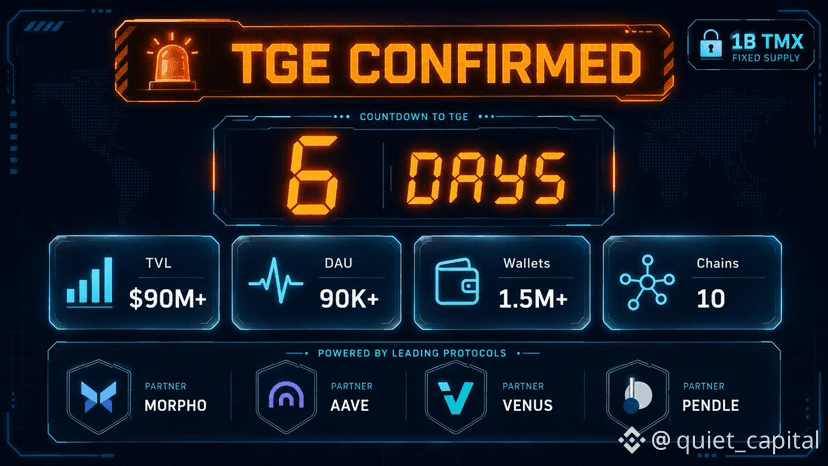
#termmax @termmax Breaking, not analysis: TermMax just confirmed the TMX Token Generation Event for August 25, 2026. 📣 Six days out from this post, so this is the fastest-moving update I've written on this protocol.
Alongside the TGE date, TermMax dropped updated protocol numbers: TVL now sitting above $90M, over 1.5M registered wallets, and daily active users north of 90K. 📈 Deployed across 10 EVM chains, with integrations into Morpho, Aave, Venus, and Pendle already live. 🔗
The mechanics: XP, AP, and MP — TermMax's three-point systems — become claimable as TMX after TGE. What's still not published: the exact conversion formula from points to token allocation, plus lockup and staking details, which TermMax says will be announced ahead of the event. ⏳ Six days is a tight window for that to drop, so if you're holding points, this is worth watching closely, not filing away as "later."
Total supply is fixed at 1 billion TMX — that number alone tells you nothing about your actual allocation until the points-to-token formula publishes, so resist doing your own math on hypothetical value until the real numbers land. 🧩
Are you checking TermMax's official channels daily now that there's an actual date, or waiting for the allocation formula before paying closer attention?
👀 What's the first thing you're doing the moment claim opens — check the number, or read the vesting terms first? 🔍
#termmax @TermMax Breaking, not analysis: TermMax just confirmed the TMX Token Generation Event for August 25, 2026. 📣 Six days out from this post, so this is the fastest-moving update I've written on this protocol.
Alongside the TGE date, TermMax dropped updated protocol numbers: TVL now sitting above $90M, over 1.5M registered wallets, and daily active users north of 90K. 📈 Deployed across 10 EVM chains, with integrations into Morpho, Aave, Venus, and Pendle already live. 🔗
The mechanics: XP, AP, and MP — TermMax's three-point systems — become claimable as TMX after TGE. What's still not published: the exact conversion formula from points to token allocation, plus lockup and staking details, which TermMax says will be announced ahead of the event. ⏳ Six days is a tight window for that to drop, so if you're holding points, this is worth watching closely, not filing away as "later."
Total supply is fixed at 1 billion TMX — that number alone tells you nothing about your actual allocation until the points-to-token formula publishes, so resist doing your own math on hypothetical value until the real numbers land. 🧩
Are you checking TermMax's official channels daily now that there's an actual date, or waiting for the allocation formula before paying closer attention?
👀 What's the first thing you're doing the moment claim opens — check the number, or read the vesting terms first? 🔍
Alongside the TGE date, TermMax dropped updated protocol numbers: TVL now sitting above $90M, over 1.5M registered wallets, and daily active users north of 90K. 📈 Deployed across 10 EVM chains, with integrations into Morpho, Aave, Venus, and Pendle already live. 🔗
The mechanics: XP, AP, and MP — TermMax's three-point systems — become claimable as TMX after TGE. What's still not published: the exact conversion formula from points to token allocation, plus lockup and staking details, which TermMax says will be announced ahead of the event. ⏳ Six days is a tight window for that to drop, so if you're holding points, this is worth watching closely, not filing away as "later."
Total supply is fixed at 1 billion TMX — that number alone tells you nothing about your actual allocation until the points-to-token formula publishes, so resist doing your own math on hypothetical value until the real numbers land. 🧩
Are you checking TermMax's official channels daily now that there's an actual date, or waiting for the allocation formula before paying closer attention?
👀 What's the first thing you're doing the moment claim opens — check the number, or read the vesting terms first? 🔍
2
1
83
#bstockscis @BinanceCIS I keep re-reading these two prints because the percentages feel like typos. They're not. Let's go through them.
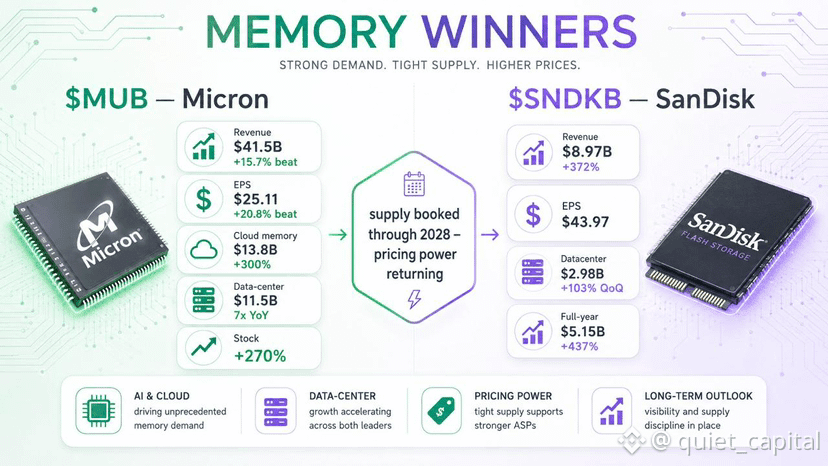
Micron ($MUB) — fiscal Q3, reported June 24 📊 Revenue: $41.46B vs $35.84B est → +15.7% beat 📊 Adjusted EPS: $25.11 vs $20.78 est → +20.8% beat ☁️ Cloud memory revenue: $13.77B, +300% YoY 🏢 Data-center revenue: $11.5B, more than 7x YoY 📈 Stock: +270% YTD, +15–17% the session after the print
SanDisk ($SNDKB) — fiscal Q4, reported August 5 (arguably sharper) 📊 Revenue: $8.965B, +372% YoY, +51% sequentially 📊 GAAP diluted EPS: $43.97 🏢 Datacenter revenue: $2.977B, +103% QoQ 🏢 Full-year datacenter revenue: $5.153B, +437% YoY
Here's the detail that actually matters most: management attributes roughly ⅓ of the sequential jump to higher volume and ⅔ to higher pricing. This isn't just "more demand" — it's genuine pricing power returning to a commoditized market for the first time in years. 💪
What ties both together 🔗 Micron says supply shortages may take considerable time to resolve — industry supply only gradually improving through 2028. HBM output is reportedly booked out through 2027. SanDisk backed that read with an additional $14B buyback on top of remaining capacity — betting its own cash the pricing environment isn't a one-quarter fluke.
Two suppliers, 300%+ growth, supply locked into 2028 — this doesn't smell like a peak to me yet. Are you buying this memory supercycle or waiting for a pullback? 🌊📈
@BinanceCIS $MUB $SNDKB #bStocksCIS
{spot}(MUBUSDT)
{spot}(SNDKBUSDT)
#bstockscis @BinanceCIS I keep re-reading these two prints because the percentages feel like typos. They're not. Let's go through them.
Micron ($MUB ) — fiscal Q3, reported June 24 📊 Revenue: $41.46B vs $35.84B est → +15.7% beat 📊 Adjusted EPS: $25.11 vs $20.78 est → +20.8% beat ☁️ Cloud memory revenue: $13.77B, +300% YoY 🏢 Data-center revenue: $11.5B, more than 7x YoY 📈 Stock: +270% YTD, +15–17% the session after the print
SanDisk ($SNDKB ) — fiscal Q4, reported August 5 (arguably sharper) 📊 Revenue: $8.965B, +372% YoY, +51% sequentially 📊 GAAP diluted EPS: $43.97 🏢 Datacenter revenue: $2.977B, +103% QoQ 🏢 Full-year datacenter revenue: $5.153B, +437% YoY
Here's the detail that actually matters most: management attributes roughly ⅓ of the sequential jump to higher volume and ⅔ to higher pricing. This isn't just "more demand" — it's genuine pricing power returning to a commoditized market for the first time in years. 💪
What ties both together 🔗 Micron says supply shortages may take considerable time to resolve — industry supply only gradually improving through 2028. HBM output is reportedly booked out through 2027. SanDisk backed that read with an additional $14B buyback on top of remaining capacity — betting its own cash the pricing environment isn't a one-quarter fluke.
Two suppliers, 300%+ growth, supply locked into 2028 — this doesn't smell like a peak to me yet. Are you buying this memory supercycle or waiting for a pullback? 🌊📈
@BinanceCIS $MUB $SNDKB #bStocksCIS
Micron ($MUB ) — fiscal Q3, reported June 24 📊 Revenue: $41.46B vs $35.84B est → +15.7% beat 📊 Adjusted EPS: $25.11 vs $20.78 est → +20.8% beat ☁️ Cloud memory revenue: $13.77B, +300% YoY 🏢 Data-center revenue: $11.5B, more than 7x YoY 📈 Stock: +270% YTD, +15–17% the session after the print
SanDisk ($SNDKB ) — fiscal Q4, reported August 5 (arguably sharper) 📊 Revenue: $8.965B, +372% YoY, +51% sequentially 📊 GAAP diluted EPS: $43.97 🏢 Datacenter revenue: $2.977B, +103% QoQ 🏢 Full-year datacenter revenue: $5.153B, +437% YoY
Here's the detail that actually matters most: management attributes roughly ⅓ of the sequential jump to higher volume and ⅔ to higher pricing. This isn't just "more demand" — it's genuine pricing power returning to a commoditized market for the first time in years. 💪
What ties both together 🔗 Micron says supply shortages may take considerable time to resolve — industry supply only gradually improving through 2028. HBM output is reportedly booked out through 2027. SanDisk backed that read with an additional $14B buyback on top of remaining capacity — betting its own cash the pricing environment isn't a one-quarter fluke.
Two suppliers, 300%+ growth, supply locked into 2028 — this doesn't smell like a peak to me yet. Are you buying this memory supercycle or waiting for a pullback? 🌊📈
@BinanceCIS $MUB $SNDKB #bStocksCIS
1
2
89
#termmax @termmax The market maker sets the curve, not the protocol
Voice: fixed-income-minded analyst
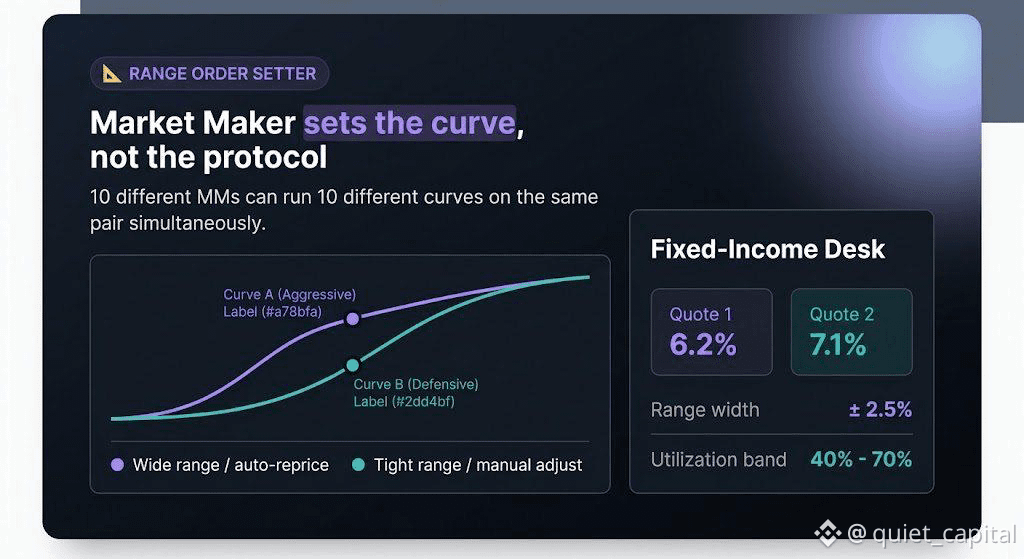
Everyone treats "AMM interest rate" as something the protocol decides for you. On TermMax, the market maker decides it — and I finally read how much control that actually gives them. 📐
A Range Order Setter (the market-maker role on TermMax) doesn't accept a single algorithmic rate the way a lot of lending pools work. They configure their own pricing curve — the rate range they're willing to lend or borrow at, and how that rate moves as utilization shifts within their chosen band.
🎛️Compare that to a typical utilization-based interest rate model, which computes one rate for the entire market off one shared formula. On TermMax, ten different market makers can run ten different curves on the exact same collateral/debt pair simultaneously — quoting different rates based on their own risk read, not one shared algorithm.
🧮That's structurally closer to how professional fixed-income desks work — multiple counterparties quoting their own terms — than to a single automated curve pricing everyone the same. 🏦
If you were setting a range order right now on a volatile pair, would you quote a wide range with room to reprice, or a tight range you adjust manually more often? 🤔
Has anyone actually run a range order — did your curve fill the way you expected?
@termmax #TermMax
#termmax @TermMax The market maker sets the curve, not the protocol
Voice: fixed-income-minded analyst
Everyone treats "AMM interest rate" as something the protocol decides for you. On TermMax, the market maker decides it — and I finally read how much control that actually gives them. 📐
A Range Order Setter (the market-maker role on TermMax) doesn't accept a single algorithmic rate the way a lot of lending pools work. They configure their own pricing curve — the rate range they're willing to lend or borrow at, and how that rate moves as utilization shifts within their chosen band.
🎛️Compare that to a typical utilization-based interest rate model, which computes one rate for the entire market off one shared formula. On TermMax, ten different market makers can run ten different curves on the exact same collateral/debt pair simultaneously — quoting different rates based on their own risk read, not one shared algorithm.
🧮That's structurally closer to how professional fixed-income desks work — multiple counterparties quoting their own terms — than to a single automated curve pricing everyone the same. 🏦
If you were setting a range order right now on a volatile pair, would you quote a wide range with room to reprice, or a tight range you adjust manually more often? 🤔
Has anyone actually run a range order — did your curve fill the way you expected?
@TermMax #TermMax
Voice: fixed-income-minded analyst
Everyone treats "AMM interest rate" as something the protocol decides for you. On TermMax, the market maker decides it — and I finally read how much control that actually gives them. 📐
A Range Order Setter (the market-maker role on TermMax) doesn't accept a single algorithmic rate the way a lot of lending pools work. They configure their own pricing curve — the rate range they're willing to lend or borrow at, and how that rate moves as utilization shifts within their chosen band.
🎛️Compare that to a typical utilization-based interest rate model, which computes one rate for the entire market off one shared formula. On TermMax, ten different market makers can run ten different curves on the exact same collateral/debt pair simultaneously — quoting different rates based on their own risk read, not one shared algorithm.
🧮That's structurally closer to how professional fixed-income desks work — multiple counterparties quoting their own terms — than to a single automated curve pricing everyone the same. 🏦
If you were setting a range order right now on a volatile pair, would you quote a wide range with room to reprice, or a tight range you adjust manually more often? 🤔
Has anyone actually run a range order — did your curve fill the way you expected?
@TermMax #TermMax
81
#termmax @termmax Ran the actual numbers on a TermMax FT position instead of just reading "fixed-rate lending" and moving on. 🧮 Here's what a real position looks like, step by step.
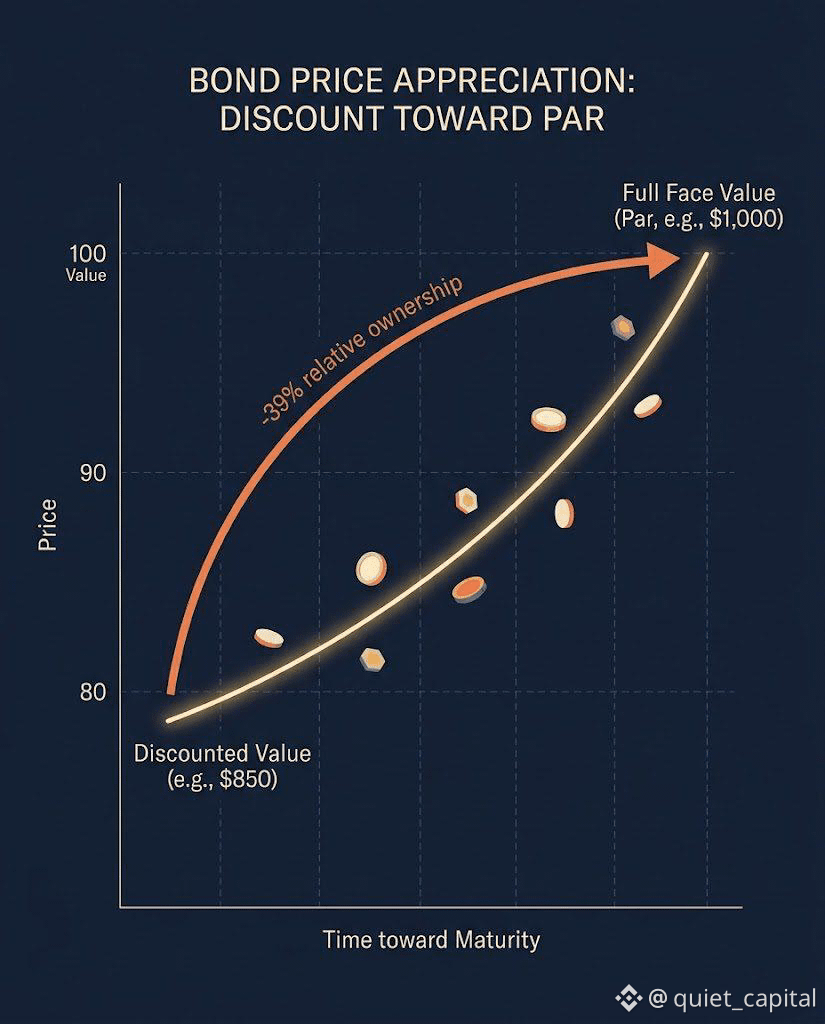
Say you buy 1,000 FT-USDC today for 980 USDC, with 60 days left until maturity. FT is a zero-coupon bond — no periodic interest, just a discount today that closes to full face value at maturity. 📉➡️📈
Your return: (1,000 − 980) / 980 = 2.04% over 60 days. Annualize that with a simple 365/60 multiplier: 2.04% × 6.08 ≈ 12.4% fixed APR. 🔒
That number is locked the moment you buy the FT. Doesn't matter what happens to floating rates on other platforms for the next 60 days — you already know your exact return in USDC terms, down to the cent, before you commit a single dollar. 💵
The part that took me a minute to actually appreciate: FT price isn't static, it's supposed to drift upward toward $1.00 as maturity approaches, purely from time passing — no news, no vote, no rate change required. 🕰️
Would a locked 12.4% for 60 days beat whatever floating rate you're currently getting somewhere else, or does floating still win when rates are trending up? 🤔 And has anyone actually held an FT to maturity and redeemed it — did it land exactly at face value like the mechanism promises?
@termmax #TermMax
#termmax @TermMax Ran the actual numbers on a TermMax FT position instead of just reading "fixed-rate lending" and moving on. 🧮 Here's what a real position looks like, step by step.
Say you buy 1,000 FT-USDC today for 980 USDC, with 60 days left until maturity. FT is a zero-coupon bond — no periodic interest, just a discount today that closes to full face value at maturity. 📉➡️📈
Your return: (1,000 − 980) / 980 = 2.04% over 60 days. Annualize that with a simple 365/60 multiplier: 2.04% × 6.08 ≈ 12.4% fixed APR. 🔒
That number is locked the moment you buy the FT. Doesn't matter what happens to floating rates on other platforms for the next 60 days — you already know your exact return in USDC terms, down to the cent, before you commit a single dollar. 💵
The part that took me a minute to actually appreciate: FT price isn't static, it's supposed to drift upward toward $1.00 as maturity approaches, purely from time passing — no news, no vote, no rate change required. 🕰️
Would a locked 12.4% for 60 days beat whatever floating rate you're currently getting somewhere else, or does floating still win when rates are trending up? 🤔 And has anyone actually held an FT to maturity and redeemed it — did it land exactly at face value like the mechanism promises?
@TermMax #TermMax
Say you buy 1,000 FT-USDC today for 980 USDC, with 60 days left until maturity. FT is a zero-coupon bond — no periodic interest, just a discount today that closes to full face value at maturity. 📉➡️📈
Your return: (1,000 − 980) / 980 = 2.04% over 60 days. Annualize that with a simple 365/60 multiplier: 2.04% × 6.08 ≈ 12.4% fixed APR. 🔒
That number is locked the moment you buy the FT. Doesn't matter what happens to floating rates on other platforms for the next 60 days — you already know your exact return in USDC terms, down to the cent, before you commit a single dollar. 💵
The part that took me a minute to actually appreciate: FT price isn't static, it's supposed to drift upward toward $1.00 as maturity approaches, purely from time passing — no news, no vote, no rate change required. 🕰️
Would a locked 12.4% for 60 days beat whatever floating rate you're currently getting somewhere else, or does floating still win when rates are trending up? 🤔 And has anyone actually held an FT to maturity and redeemed it — did it land exactly at face value like the mechanism promises?
@TermMax #TermMax
56
#bstockscis @BinanceCIS
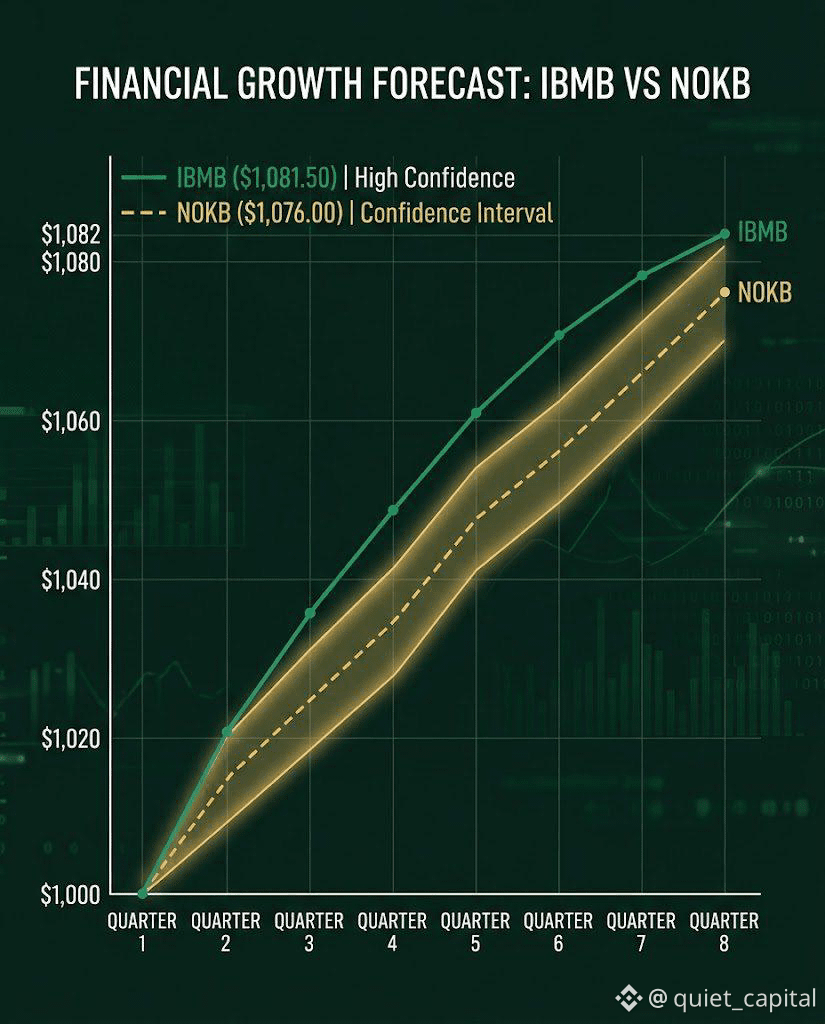
$NOKB vs $IBMB — same mechanism, wildly different sample size. 📐 Put them side by side and ran the actual compounding math on both, because "dividend bStock" gets treated as one category when the two histories underneath it aren't remotely the same length.
NOKB's confirmed payout was $0.02 per share, reinvested via the Multiplier rather than paid in cash — we watched this fire for real a few weeks back, live proof the mechanism works. ✅ IBM's dividend history runs back decades, mature and unglamorous, the kind of payout a serious income strategy gets built around.
Run the same illustrative model on both: a $1,000 position, reinvesting roughly 2% of value per quarter, compounding on the growing base each time. 🧮 After 8 quarters (2 years), that position lands closer to $1,082 than flat math would suggest. Modest in absolute dollars over just 2 years — but here's the actual question worth asking: would you trust that same 2%-per-quarter assumption to hold for NOKB the way you'd trust it for IBMB? 🤔
NOKB has one confirmed live payout as of this month. IBMB's underlying business has been proving this exact behavior, dividend after dividend, for longer than most people holding bStocks have been trading anything at all. Same automated mechanism. Wildly different confidence interval behind it. 📊
If you're building an income sleeve, are you weighting NOKB and IBMB equally, or does track record length change your sizing between them?
@BinanceCIS #bStocksCIS
{spot}(IBMBUSDT)
{spot}(NOKBUSDT)
#bstockscis @BinanceCIS
$NOKB vs $IBMB — same mechanism, wildly different sample size. 📐 Put them side by side and ran the actual compounding math on both, because "dividend bStock" gets treated as one category when the two histories underneath it aren't remotely the same length.
NOKB's confirmed payout was $0.02 per share, reinvested via the Multiplier rather than paid in cash — we watched this fire for real a few weeks back, live proof the mechanism works. ✅ IBM's dividend history runs back decades, mature and unglamorous, the kind of payout a serious income strategy gets built around.
Run the same illustrative model on both: a $1,000 position, reinvesting roughly 2% of value per quarter, compounding on the growing base each time. 🧮 After 8 quarters (2 years), that position lands closer to $1,082 than flat math would suggest. Modest in absolute dollars over just 2 years — but here's the actual question worth asking: would you trust that same 2%-per-quarter assumption to hold for NOKB the way you'd trust it for IBMB? 🤔
NOKB has one confirmed live payout as of this month. IBMB's underlying business has been proving this exact behavior, dividend after dividend, for longer than most people holding bStocks have been trading anything at all. Same automated mechanism. Wildly different confidence interval behind it. 📊
If you're building an income sleeve, are you weighting NOKB and IBMB equally, or does track record length change your sizing between them?
@BinanceCIS #bStocksCIS
$NOKB vs $IBMB — same mechanism, wildly different sample size. 📐 Put them side by side and ran the actual compounding math on both, because "dividend bStock" gets treated as one category when the two histories underneath it aren't remotely the same length.
NOKB's confirmed payout was $0.02 per share, reinvested via the Multiplier rather than paid in cash — we watched this fire for real a few weeks back, live proof the mechanism works. ✅ IBM's dividend history runs back decades, mature and unglamorous, the kind of payout a serious income strategy gets built around.
Run the same illustrative model on both: a $1,000 position, reinvesting roughly 2% of value per quarter, compounding on the growing base each time. 🧮 After 8 quarters (2 years), that position lands closer to $1,082 than flat math would suggest. Modest in absolute dollars over just 2 years — but here's the actual question worth asking: would you trust that same 2%-per-quarter assumption to hold for NOKB the way you'd trust it for IBMB? 🤔
NOKB has one confirmed live payout as of this month. IBMB's underlying business has been proving this exact behavior, dividend after dividend, for longer than most people holding bStocks have been trading anything at all. Same automated mechanism. Wildly different confidence interval behind it. 📊
If you're building an income sleeve, are you weighting NOKB and IBMB equally, or does track record length change your sizing between them?
@BinanceCIS #bStocksCIS
92
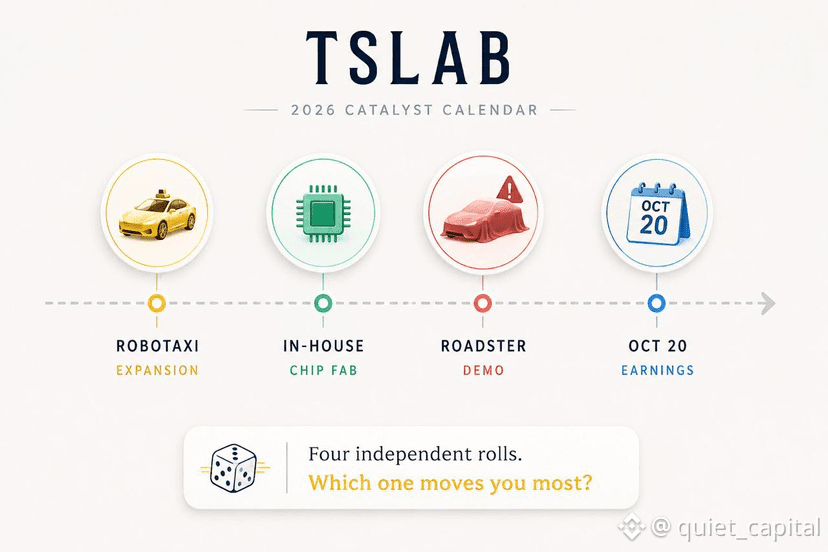
#bstockscis @BinanceCIS TSLAB has an unusually stacked calendar of near-term catalysts sitting on top of an already-rough year, worth actually weighing against each other instead of reacting to headlines one at a time. 🗓️
Robotaxi expansion progress, a planned in-house chip/semiconductor manufacturing facility, the Roadster demo Musk himself has flagged as carrying real execution risk, and October 20 earnings all sit in the pipeline over the coming months. Layer that against a year that's already seen operating margin compress to roughly 1.4% and a Jefferies price-target cut from $400 to $350 — call it a rough 12.5% target reduction on its own — and you've got at least four distinct, largely independent catalysts stacked against a baseline that's already been cut once this year.
Four independent dice rolls instead of one is a meaningfully different risk profile than a single binary earnings date alone. 🎲
Which of the four catalysts would actually move your position size the most if it hit tomorrow❓
@BinanceCIS $TSLAB #bStocksCIS
{spot}(TSLABUSDT)
#bstockscis @BinanceCIS TSLAB has an unusually stacked calendar of near-term catalysts sitting on top of an already-rough year, worth actually weighing against each other instead of reacting to headlines one at a time. 🗓️
Robotaxi expansion progress, a planned in-house chip/semiconductor manufacturing facility, the Roadster demo Musk himself has flagged as carrying real execution risk, and October 20 earnings all sit in the pipeline over the coming months. Layer that against a year that's already seen operating margin compress to roughly 1.4% and a Jefferies price-target cut from $400 to $350 — call it a rough 12.5% target reduction on its own — and you've got at least four distinct, largely independent catalysts stacked against a baseline that's already been cut once this year.
Four independent dice rolls instead of one is a meaningfully different risk profile than a single binary earnings date alone. 🎲
Which of the four catalysts would actually move your position size the most if it hit tomorrow❓
@BinanceCIS $TSLAB #bStocksCIS
Robotaxi expansion progress, a planned in-house chip/semiconductor manufacturing facility, the Roadster demo Musk himself has flagged as carrying real execution risk, and October 20 earnings all sit in the pipeline over the coming months. Layer that against a year that's already seen operating margin compress to roughly 1.4% and a Jefferies price-target cut from $400 to $350 — call it a rough 12.5% target reduction on its own — and you've got at least four distinct, largely independent catalysts stacked against a baseline that's already been cut once this year.
Four independent dice rolls instead of one is a meaningfully different risk profile than a single binary earnings date alone. 🎲
Which of the four catalysts would actually move your position size the most if it hit tomorrow❓
@BinanceCIS $TSLAB #bStocksCIS
2
83
Vérifié
#bstockscis @BinanceCIS
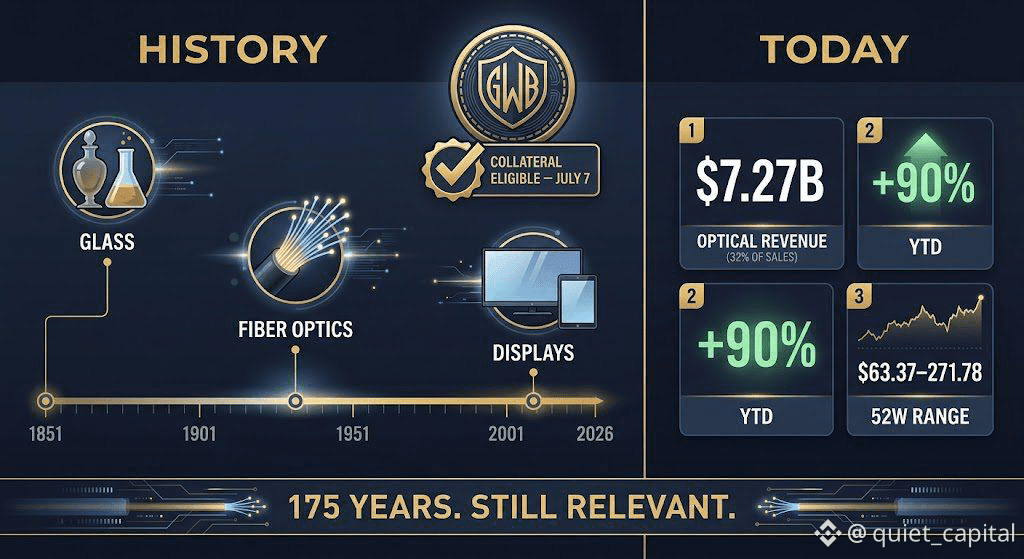
GLWB is one of the quieter names on the bStocks roster, but the numbers behind it are genuinely hard to ignore. 🔍
Corning (GLW) has been around since 1851 — that's 175 years of making glass, ceramics, and optical fiber across six distinct end markets. Not exactly a "new economy" story. But the recent trajectory? That's a different conversation entirely. 📈
🤔Some context:
Corning's Optical Communications segment alone pulled in roughly $7.27B in revenue by mid-2026, making up about 32% of total sales . That's the part of the business that makes fiber cables and connectors for internet, telecom, and AI data centers — the physical infrastructure that actually moves data around. The Springboard plan the company introduced in 2024 aims to add $3B in annualized sales by 2026 .
The price action:
$GLWB tracks Corning's stock performance as a BEP-20 tokenized security, trading around $165 per GLWB as of mid-August 2026, with a circulating supply of roughly 9.9K tokens . The underlying stock, GLW, is up about 90% year-to-date and 155% over the past year . A 52-week range that stretches from $63.37 to $271.78 tells you this hasn't been a smooth ride — but the trend line has been unmistakably upward.
✨Collateral mechanics:
GLWB was added as eligible collateral on Binance Cross Margin and Portfolio Margin on July 7, along with nine other bStocks, for VIP 3+ users in permitted jurisdictions . Borrowing against it isn't supported — deposit-only, tiered access, no lending market sitting on top .
Not a "sexy" trade.
No AI narrative, no meme potential, no founder drama. Just a 175-year-old company making fiber optics, display glass, and ceramic filters, quietly executing a growth plan that's caught the market's attention — even if the market hasn't fully decided what to do with it yet. 🧊
@BinanceCIS $GLWB #bStocksCIS
{spot}(GLWBUSDT)
#bstockscis @BinanceCIS
GLWB is one of the quieter names on the bStocks roster, but the numbers behind it are genuinely hard to ignore. 🔍
Corning (GLW) has been around since 1851 — that's 175 years of making glass, ceramics, and optical fiber across six distinct end markets. Not exactly a "new economy" story. But the recent trajectory? That's a different conversation entirely. 📈
🤔Some context:
Corning's Optical Communications segment alone pulled in roughly $7.27B in revenue by mid-2026, making up about 32% of total sales . That's the part of the business that makes fiber cables and connectors for internet, telecom, and AI data centers — the physical infrastructure that actually moves data around. The Springboard plan the company introduced in 2024 aims to add $3B in annualized sales by 2026 .
The price action:
$GLWB tracks Corning's stock performance as a BEP-20 tokenized security, trading around $165 per GLWB as of mid-August 2026, with a circulating supply of roughly 9.9K tokens . The underlying stock, GLW, is up about 90% year-to-date and 155% over the past year . A 52-week range that stretches from $63.37 to $271.78 tells you this hasn't been a smooth ride — but the trend line has been unmistakably upward.
✨Collateral mechanics:
GLWB was added as eligible collateral on Binance Cross Margin and Portfolio Margin on July 7, along with nine other bStocks, for VIP 3+ users in permitted jurisdictions . Borrowing against it isn't supported — deposit-only, tiered access, no lending market sitting on top .
Not a "sexy" trade.
No AI narrative, no meme potential, no founder drama. Just a 175-year-old company making fiber optics, display glass, and ceramic filters, quietly executing a growth plan that's caught the market's attention — even if the market hasn't fully decided what to do with it yet. 🧊
@BinanceCIS $GLWB #bStocksCIS
GLWB is one of the quieter names on the bStocks roster, but the numbers behind it are genuinely hard to ignore. 🔍
Corning (GLW) has been around since 1851 — that's 175 years of making glass, ceramics, and optical fiber across six distinct end markets. Not exactly a "new economy" story. But the recent trajectory? That's a different conversation entirely. 📈
🤔Some context:
Corning's Optical Communications segment alone pulled in roughly $7.27B in revenue by mid-2026, making up about 32% of total sales . That's the part of the business that makes fiber cables and connectors for internet, telecom, and AI data centers — the physical infrastructure that actually moves data around. The Springboard plan the company introduced in 2024 aims to add $3B in annualized sales by 2026 .
The price action:
$GLWB tracks Corning's stock performance as a BEP-20 tokenized security, trading around $165 per GLWB as of mid-August 2026, with a circulating supply of roughly 9.9K tokens . The underlying stock, GLW, is up about 90% year-to-date and 155% over the past year . A 52-week range that stretches from $63.37 to $271.78 tells you this hasn't been a smooth ride — but the trend line has been unmistakably upward.
✨Collateral mechanics:
GLWB was added as eligible collateral on Binance Cross Margin and Portfolio Margin on July 7, along with nine other bStocks, for VIP 3+ users in permitted jurisdictions . Borrowing against it isn't supported — deposit-only, tiered access, no lending market sitting on top .
Not a "sexy" trade.
No AI narrative, no meme potential, no founder drama. Just a 175-year-old company making fiber optics, display glass, and ceramic filters, quietly executing a growth plan that's caught the market's attention — even if the market hasn't fully decided what to do with it yet. 🧊
@BinanceCIS $GLWB #bStocksCIS
10
7
211
that's honestly the underrated part of the Multiplier — the math only matters if people actually stick around long enough to let it run, and automatic beats "I'll remember to reinvest" every single time
that's honestly the underrated part of the Multiplier — the math only matters if people actually stick around long enough to let it run, and automatic beats "I'll remember to reinvest" every single time

gasfee_eth
·
--
love that this is automatic via the Multiplier too — the math working out is one thing, but not having to manually reinvest every quarter is what actually makes people stick with it long enough to see it
1
72
Vérifié
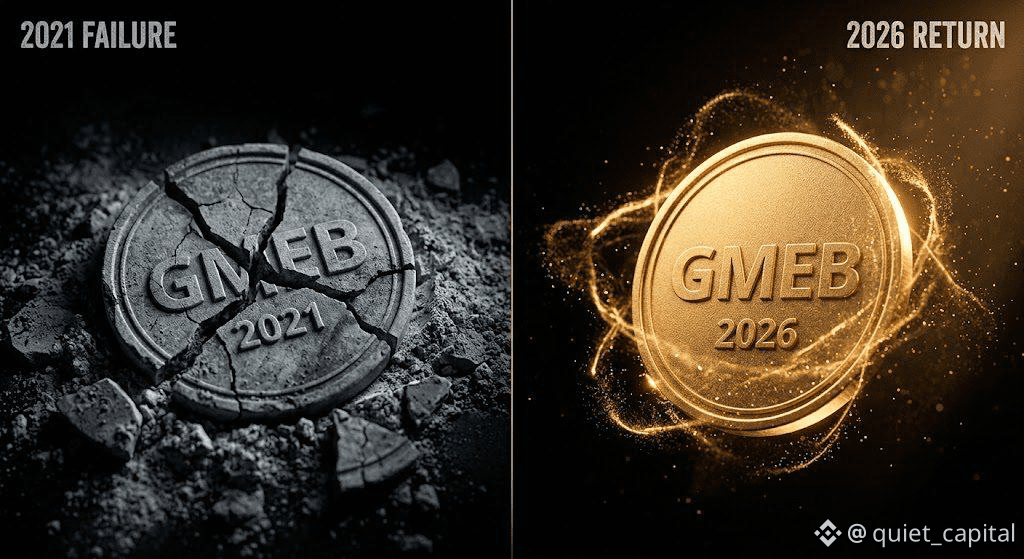
#bstockscis @BinanceCIS GameStop tried to kill Binance's tokenized-stock ambitions once already. Now GameStop IS one.🎮
Binance attempted a similar tokenized-stock product back in 2021 — shut it down within months after regulators in Germany, the UK, and Hong Kong flagged structural and disclosure concerns. Fast forward to August 12, 2026: GMEB goes live, backed 1:1 by a real GME share held with a regulated custodian under ADGM rules, and collateral-eligible for Cross and Portfolio Margin from day one — no waiting period like most new listings get. 🔄
The irony writes itself: the meme-stock mascot of 2021 retail chaos lands on the same exchange that got burned trying this exact category during that same era, except this time under a regulatory structure built to survive the scrutiny that killed the first attempt.
Volume backs up the interest — GMEB saw a 1,381% single-day volume spike right after listing. 📈
Are you touching GMEB because you actually like the trade, or purely for the nostalgia of it? 😅
@BinanceCIS $GMEB #bStocksCIS
{spot}(GMEBUSDT)
#bstockscis @BinanceCIS GameStop tried to kill Binance's tokenized-stock ambitions once already. Now GameStop IS one.🎮
Binance attempted a similar tokenized-stock product back in 2021 — shut it down within months after regulators in Germany, the UK, and Hong Kong flagged structural and disclosure concerns. Fast forward to August 12, 2026: GMEB goes live, backed 1:1 by a real GME share held with a regulated custodian under ADGM rules, and collateral-eligible for Cross and Portfolio Margin from day one — no waiting period like most new listings get. 🔄
The irony writes itself: the meme-stock mascot of 2021 retail chaos lands on the same exchange that got burned trying this exact category during that same era, except this time under a regulatory structure built to survive the scrutiny that killed the first attempt.
Volume backs up the interest — GMEB saw a 1,381% single-day volume spike right after listing. 📈
Are you touching GMEB because you actually like the trade, or purely for the nostalgia of it? 😅
@BinanceCIS $GMEB #bStocksCIS
Binance attempted a similar tokenized-stock product back in 2021 — shut it down within months after regulators in Germany, the UK, and Hong Kong flagged structural and disclosure concerns. Fast forward to August 12, 2026: GMEB goes live, backed 1:1 by a real GME share held with a regulated custodian under ADGM rules, and collateral-eligible for Cross and Portfolio Margin from day one — no waiting period like most new listings get. 🔄
The irony writes itself: the meme-stock mascot of 2021 retail chaos lands on the same exchange that got burned trying this exact category during that same era, except this time under a regulatory structure built to survive the scrutiny that killed the first attempt.
Volume backs up the interest — GMEB saw a 1,381% single-day volume spike right after listing. 📈
Are you touching GMEB because you actually like the trade, or purely for the nostalgia of it? 😅
@BinanceCIS $GMEB #bStocksCIS
7
4
7
#bstockscis @BinanceCIS quick math quiz before you assume dividend compounding on a bStock is too small to matter. 🧮
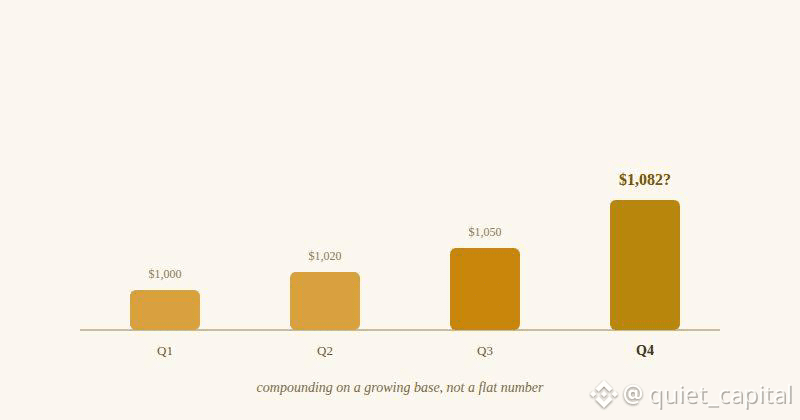
Say you hold a position worth $1,000 in a dividend-paying bStock like $NOKB , and it reinvests roughly 2% of position value every quarter via the Multiplier — automatically, no action from you. Run that for 4 quarters, compounding each time on the new, slightly larger balance.
Where does your position land, closest answer? 👇
1️⃣ $1,000
2️⃣ $1,020
3️⃣ $1,082
4️⃣ $1,200
Answer's closer to option 3 than people usually guess — compounding on a growing base beats flat math every time, even at small percentages. 📈
Did you guess right on the first try?
@BinanceCIS #bStocksCIS
{spot}(NOKBUSDT)
#bstockscis @BinanceCIS quick math quiz before you assume dividend compounding on a bStock is too small to matter. 🧮
Say you hold a position worth $1,000 in a dividend-paying bStock like $NOKB , and it reinvests roughly 2% of position value every quarter via the Multiplier — automatically, no action from you. Run that for 4 quarters, compounding each time on the new, slightly larger balance.
Where does your position land, closest answer? 👇
1️⃣ $1,000
2️⃣ $1,020
3️⃣ $1,082
4️⃣ $1,200
Answer's closer to option 3 than people usually guess — compounding on a growing base beats flat math every time, even at small percentages. 📈
Did you guess right on the first try?
@BinanceCIS #bStocksCIS
Say you hold a position worth $1,000 in a dividend-paying bStock like $NOKB , and it reinvests roughly 2% of position value every quarter via the Multiplier — automatically, no action from you. Run that for 4 quarters, compounding each time on the new, slightly larger balance.
Where does your position land, closest answer? 👇
1️⃣ $1,000
2️⃣ $1,020
3️⃣ $1,082
4️⃣ $1,200
Answer's closer to option 3 than people usually guess — compounding on a growing base beats flat math every time, even at small percentages. 📈
Did you guess right on the first try?
@BinanceCIS #bStocksCIS
10
3
123
#bstockscis #bStocksCIS
Does the $SPCXB story end with this week's unlock? No — and I think a lot of people assumed it did. 🚀
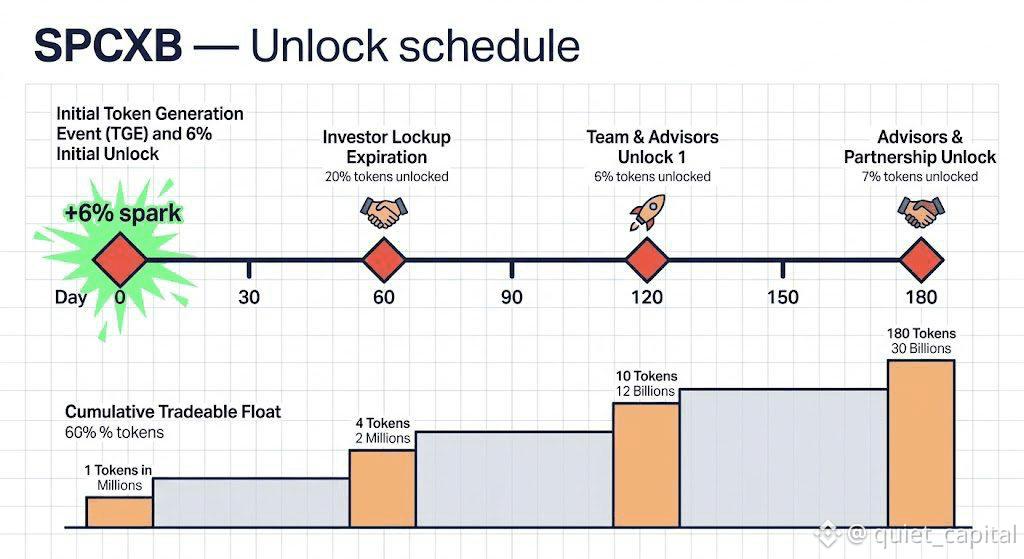
That 900M+ share tranche was one release on a 180-day lockup schedule, not the whole schedule. SpaceX's early investors, employees, and Musk's own stake are still sitting behind additional tranches that unlock in stages over the following months — this week's event just happened to be the first big one, and the biggest single jump in tradeable float so far.
Practical read: if this unlock alone was enough to move SPCXB 6% off an all-time low, the float mechanics behind the next scheduled tranche are worth actually calendaring, not just reacting to after the fact. 📅
Anyone tracking the remaining unlock dates, or is everyone just going to get surprised again next time too? 😅
@BinanceCIS
{spot}(SPCXBUSDT)
#bstockscis #bStocksCIS
Does the $SPCXB story end with this week's unlock? No — and I think a lot of people assumed it did. 🚀
That 900M+ share tranche was one release on a 180-day lockup schedule, not the whole schedule. SpaceX's early investors, employees, and Musk's own stake are still sitting behind additional tranches that unlock in stages over the following months — this week's event just happened to be the first big one, and the biggest single jump in tradeable float so far.
Practical read: if this unlock alone was enough to move SPCXB 6% off an all-time low, the float mechanics behind the next scheduled tranche are worth actually calendaring, not just reacting to after the fact. 📅
Anyone tracking the remaining unlock dates, or is everyone just going to get surprised again next time too? 😅
@BinanceCIS
Does the $SPCXB story end with this week's unlock? No — and I think a lot of people assumed it did. 🚀
That 900M+ share tranche was one release on a 180-day lockup schedule, not the whole schedule. SpaceX's early investors, employees, and Musk's own stake are still sitting behind additional tranches that unlock in stages over the following months — this week's event just happened to be the first big one, and the biggest single jump in tradeable float so far.
Practical read: if this unlock alone was enough to move SPCXB 6% off an all-time low, the float mechanics behind the next scheduled tranche are worth actually calendaring, not just reacting to after the fact. 📅
Anyone tracking the remaining unlock dates, or is everyone just going to get surprised again next time too? 😅
@BinanceCIS
6
1
193
#bstockscis The false sense of security in portfolio building. 🗑️
You buy $METAB, add $GOOGLB, stack $MSFTB, and top it off with $NVDAB. You look at your wallet and think: "Look at this well-diversified portfolio!"It’s a complete illusion. You’ve simply placed the exact same bet on US Mega-Cap Tech four different ways. If a major regulatory crack-down on AI or an interest rate shock hits tomorrow, all four tokens will drop in tandem.
@BinanceCIS $METAB $GOOGLB $MSFTB $NVDAB #bStocksCIS
True diversification requires assets driven by different macro forces, not a long list of tickers with a 0.9 correlation. The convenience of tokenization makes it easy to accumulate tickers, but it doesn't protect you from sectoral concentration risk.
Poll: What does adding another Big Tech bStock to your existing tech positions actually give you❓
#bstockscis The false sense of security in portfolio building. 🗑️
You buy $METAB, add $GOOGLB , stack $MSFTB , and top it off with $NVDAB . You look at your wallet and think: "Look at this well-diversified portfolio!"It’s a complete illusion. You’ve simply placed the exact same bet on US Mega-Cap Tech four different ways. If a major regulatory crack-down on AI or an interest rate shock hits tomorrow, all four tokens will drop in tandem.
@BinanceCIS $METAB $GOOGLB $MSFTB $NVDAB #bStocksCIS
True diversification requires assets driven by different macro forces, not a long list of tickers with a 0.9 correlation. The convenience of tokenization makes it easy to accumulate tickers, but it doesn't protect you from sectoral concentration risk.
Poll: What does adding another Big Tech bStock to your existing tech positions actually give you❓
You buy $METAB, add $GOOGLB , stack $MSFTB , and top it off with $NVDAB . You look at your wallet and think: "Look at this well-diversified portfolio!"It’s a complete illusion. You’ve simply placed the exact same bet on US Mega-Cap Tech four different ways. If a major regulatory crack-down on AI or an interest rate shock hits tomorrow, all four tokens will drop in tandem.
@BinanceCIS $METAB $GOOGLB $MSFTB $NVDAB #bStocksCIS
True diversification requires assets driven by different macro forces, not a long list of tickers with a 0.9 correlation. The convenience of tokenization makes it easy to accumulate tickers, but it doesn't protect you from sectoral concentration risk.
Poll: What does adding another Big Tech bStock to your existing tech positions actually give you❓
True portfolio diversification
25%
Focused exposure to one theme
75%
Reduced portfolio volatility
0%
4 Votes • Vote fermé
4
1
313
#bstockscis MSTRB and SOXLB both get called "leveraged crypto/tech plays" but the leverage works through completely different mechanics, and the difference actually matters for how you size a position. 🧮
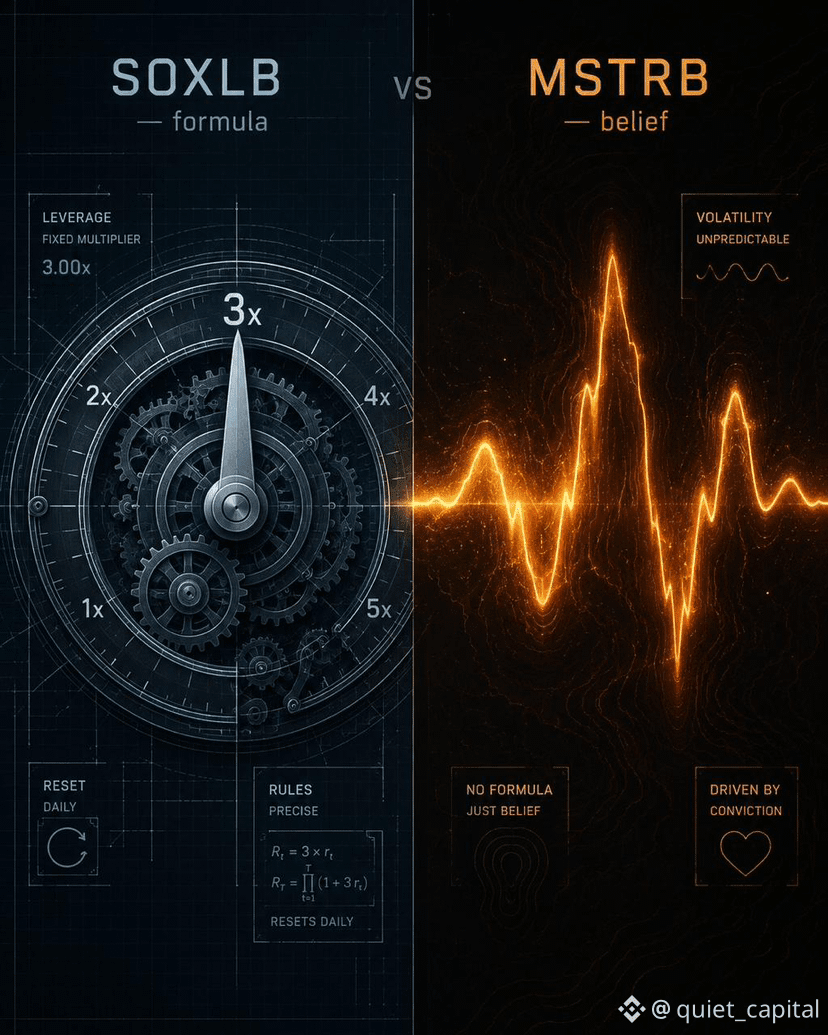
SOXLB's leverage is a formula. 📐 3x, daily, mechanical, reset every 24 hours regardless of what anyone believes about semiconductors. If the sector index moves +2% today, SOXLB is engineered to move roughly +6% today — no opinion involved, just math running on a schedule.
MSTRB's leverage is a belief. 🌀 There's no contractual multiplier — the amplification comes from the market pricing Strategy's balance sheet as a bitcoin proxy, which has historically meant something like 2–3x BTC's move on a given day, but that ratio isn't fixed anywhere. It can compress toward 1x if sentiment shifts, or blow out past 3x during a squeeze. It's leverage by consensus, not by contract.
Quick illustrative comparison: a +10% day in the underlying gives you a fairly predictable ~+30% from SOXLB (formula), versus something like +20–35% from MSTRB on a good day, or noticeably less if the market's in a mood to discount the balance-sheet story that week (belief, not formula).
One you can model 📊. The other you have to read the room on. 👀
Which kind of leverage do you actually trust more with real size behind it?
1️⃣ The formula — SOXLB
2️⃣ The belief — MSTRB
3️⃣ Both, sized small
4️⃣ Neither, too much for me
@BinanceCIS $MSTRB $SOXLB #bStocksCIS
{spot}(MSTRBUSDT)
{spot}(SOXLBUSDT)
#bstockscis MSTRB and SOXLB both get called "leveraged crypto/tech plays" but the leverage works through completely different mechanics, and the difference actually matters for how you size a position. 🧮
SOXLB's leverage is a formula. 📐 3x, daily, mechanical, reset every 24 hours regardless of what anyone believes about semiconductors. If the sector index moves +2% today, SOXLB is engineered to move roughly +6% today — no opinion involved, just math running on a schedule.
MSTRB's leverage is a belief. 🌀 There's no contractual multiplier — the amplification comes from the market pricing Strategy's balance sheet as a bitcoin proxy, which has historically meant something like 2–3x BTC's move on a given day, but that ratio isn't fixed anywhere. It can compress toward 1x if sentiment shifts, or blow out past 3x during a squeeze. It's leverage by consensus, not by contract.
Quick illustrative comparison: a +10% day in the underlying gives you a fairly predictable ~+30% from SOXLB (formula), versus something like +20–35% from MSTRB on a good day, or noticeably less if the market's in a mood to discount the balance-sheet story that week (belief, not formula).
One you can model 📊. The other you have to read the room on. 👀
Which kind of leverage do you actually trust more with real size behind it?
1️⃣ The formula — SOXLB
2️⃣ The belief — MSTRB
3️⃣ Both, sized small
4️⃣ Neither, too much for me
@BinanceCIS $MSTRB $SOXLB #bStocksCIS
SOXLB's leverage is a formula. 📐 3x, daily, mechanical, reset every 24 hours regardless of what anyone believes about semiconductors. If the sector index moves +2% today, SOXLB is engineered to move roughly +6% today — no opinion involved, just math running on a schedule.
MSTRB's leverage is a belief. 🌀 There's no contractual multiplier — the amplification comes from the market pricing Strategy's balance sheet as a bitcoin proxy, which has historically meant something like 2–3x BTC's move on a given day, but that ratio isn't fixed anywhere. It can compress toward 1x if sentiment shifts, or blow out past 3x during a squeeze. It's leverage by consensus, not by contract.
Quick illustrative comparison: a +10% day in the underlying gives you a fairly predictable ~+30% from SOXLB (formula), versus something like +20–35% from MSTRB on a good day, or noticeably less if the market's in a mood to discount the balance-sheet story that week (belief, not formula).
One you can model 📊. The other you have to read the room on. 👀
Which kind of leverage do you actually trust more with real size behind it?
1️⃣ The formula — SOXLB
2️⃣ The belief — MSTRB
3️⃣ Both, sized small
4️⃣ Neither, too much for me
@BinanceCIS $MSTRB $SOXLB #bStocksCIS
8
108
#bstockscis quick one on IBMB for anyone building an income-focused bStocks position instead of a growth one. 💵
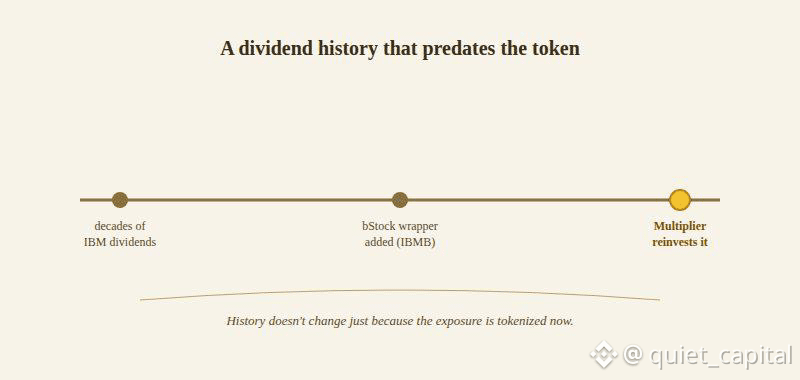
IBM has paid a dividend for decades 🏛️ — that history doesn't change just because the exposure is tokenized now. If IBMB pays out the way the underlying does, the Multiplier mechanism reinvests it automatically 🔄, same as NOKB did a few weeks back.
Does anyone actually hold IBMB deliberately for the dividend history, or is it mostly ending up in people's baskets by accident? 🤷
@BinanceCIS $IBMB #bStocksCIS
{spot}(IBMBUSDT)
#bstockscis quick one on IBMB for anyone building an income-focused bStocks position instead of a growth one. 💵
IBM has paid a dividend for decades 🏛️ — that history doesn't change just because the exposure is tokenized now. If IBMB pays out the way the underlying does, the Multiplier mechanism reinvests it automatically 🔄, same as NOKB did a few weeks back.
Does anyone actually hold IBMB deliberately for the dividend history, or is it mostly ending up in people's baskets by accident? 🤷
@BinanceCIS $IBMB #bStocksCIS
IBM has paid a dividend for decades 🏛️ — that history doesn't change just because the exposure is tokenized now. If IBMB pays out the way the underlying does, the Multiplier mechanism reinvests it automatically 🔄, same as NOKB did a few weeks back.
Does anyone actually hold IBMB deliberately for the dividend history, or is it mostly ending up in people's baskets by accident? 🤷
@BinanceCIS $IBMB #bStocksCIS
79
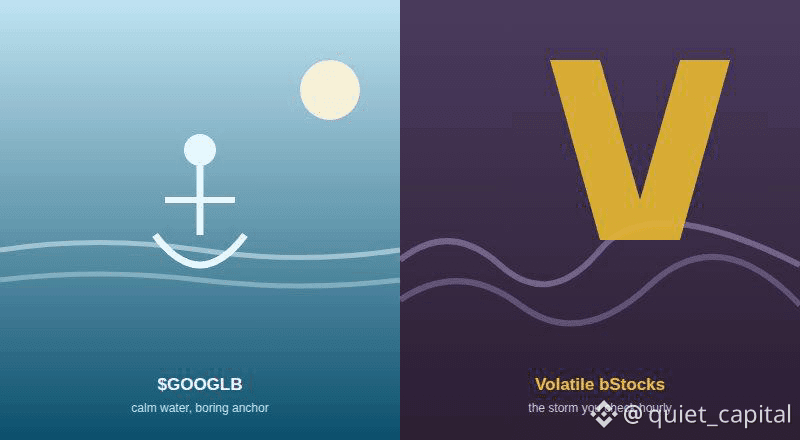
#bstockscis GOOGLB doesn't get talked about much in this space and I think that's honestly a mistake. It's about as close to a "boring mega-cap anchor" as the bStocks lineup gets right now — not the token you check three times a day, more the one you check once a month and it's quietly done what mega-caps do. Not every position needs a story attached to it.
🧭 Question for the group: do you keep at least one "boring" bStock in your bag on purpose, or is your whole portfolio built around the volatile ones? A) Always keep a boring anchor
B) All volatility, no anchor
C) Didn't think about it until this post
D) New to bStocks, still figuring out my mix
@BinanceCIS #bStocksCIS
{spot}(GOOGLBUSDT)
#bstockscis GOOGLB doesn't get talked about much in this space and I think that's honestly a mistake. It's about as close to a "boring mega-cap anchor" as the bStocks lineup gets right now — not the token you check three times a day, more the one you check once a month and it's quietly done what mega-caps do. Not every position needs a story attached to it.
🧭 Question for the group: do you keep at least one "boring" bStock in your bag on purpose, or is your whole portfolio built around the volatile ones? A) Always keep a boring anchor
B) All volatility, no anchor
C) Didn't think about it until this post
D) New to bStocks, still figuring out my mix
@BinanceCIS #bStocksCIS
🧭 Question for the group: do you keep at least one "boring" bStock in your bag on purpose, or is your whole portfolio built around the volatile ones? A) Always keep a boring anchor
B) All volatility, no anchor
C) Didn't think about it until this post
D) New to bStocks, still figuring out my mix
@BinanceCIS #bStocksCIS
57
Connectez-vous pour découvrir plus de contenu
Rejoignez la communauté mondiale des adeptes de cryptomonnaies sur Binance Square
⚡️ Suviez les dernières informations importantes sur les cryptomonnaies.
💬 Jugé digne de confiance par la plus grande plateforme d’échange de cryptomonnaies au monde.
👍 Découvrez les connaissances que partagent les créateurs vérifiés.
Adresse e-mail/Nº de téléphone
Sujets d’actualité
CircleMints500MUSDCOnSolana
2,145 vues
168 mentions
💰 MASSIVE: Circle Mints $500M $USDC on Solana!
Circle just minted 500 Million $USDC on Solana in 2 transactions ($250M + $250M) on Sept 25, in just 5.5 hours! 🚀
Solana now holds $7.48B+ $USDC dominance - over 50% of its $14.7B stablecoin supply.
Why Solana?
⚡️ Speed: 65k TPS
💸 Low Fees: $0.00025
🔥 DeFi Hub: Jupiter, Raydium pumping
This is one of the largest single-day mints & signals HUGE institutional demand for Solana ecosystem.
Bullish for $SOL? 👇
#Circle #USDC #Solana #Stablecoin #DeFi#circlemints500musdconsolana
True News
·8 mentions J’aime
·2.1k vues
PolymarketBankFailureBetsDrawFDICConcern
13,635 vues
428 mentions
BlackRockBuildsTokenizedPortfoliosForOndo
10,534 vues
299 mentions