

V E L O R I A
12.9k Publications

V E L O R I A
 Compte Square Vérifié+
Signaler
Bloquer l’utilisateur
Less Emotions, More Confirmations | Lost in Charts, Found in Profit 📈
1.0K+ Suivis
32.2K+ Abonnés
22.4K+ J’aime
Publications
Tous
Citations
Direct
$BTC 🔥
$BTC 🔥

Jin_e_rebal
·
--
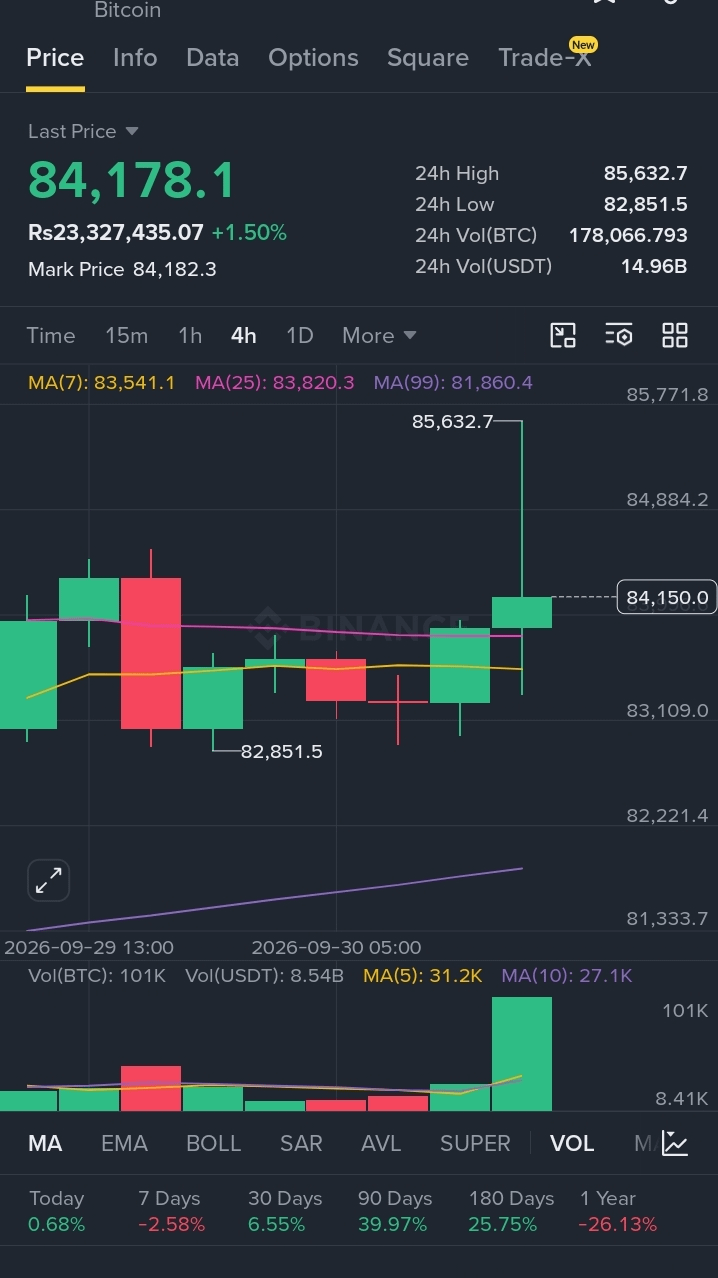
📊 BTC/USDT FUTURES SIGNAL
🟢 Direction: LONG
💰 Entry: 84,000–84,200
🎯 TP1: 84,700
🎯 TP2: 85,300
🎯 TP3: 86,000
🛑 Stop Loss: 83,500
📈 24H Change: +1.16%
💎 Market: Bitcoin Perpetual
🔥 Volume: 15.15B USDT$BTC
$QNT
🟢 Direction: LONG
💰 Entry: 84,000–84,200
🎯 TP1: 84,700
🎯 TP2: 85,300
🎯 TP3: 86,000
🛑 Stop Loss: 83,500
📈 24H Change: +1.16%
💎 Market: Bitcoin Perpetual
🔥 Volume: 15.15B USDT$BTC
$QNT
69
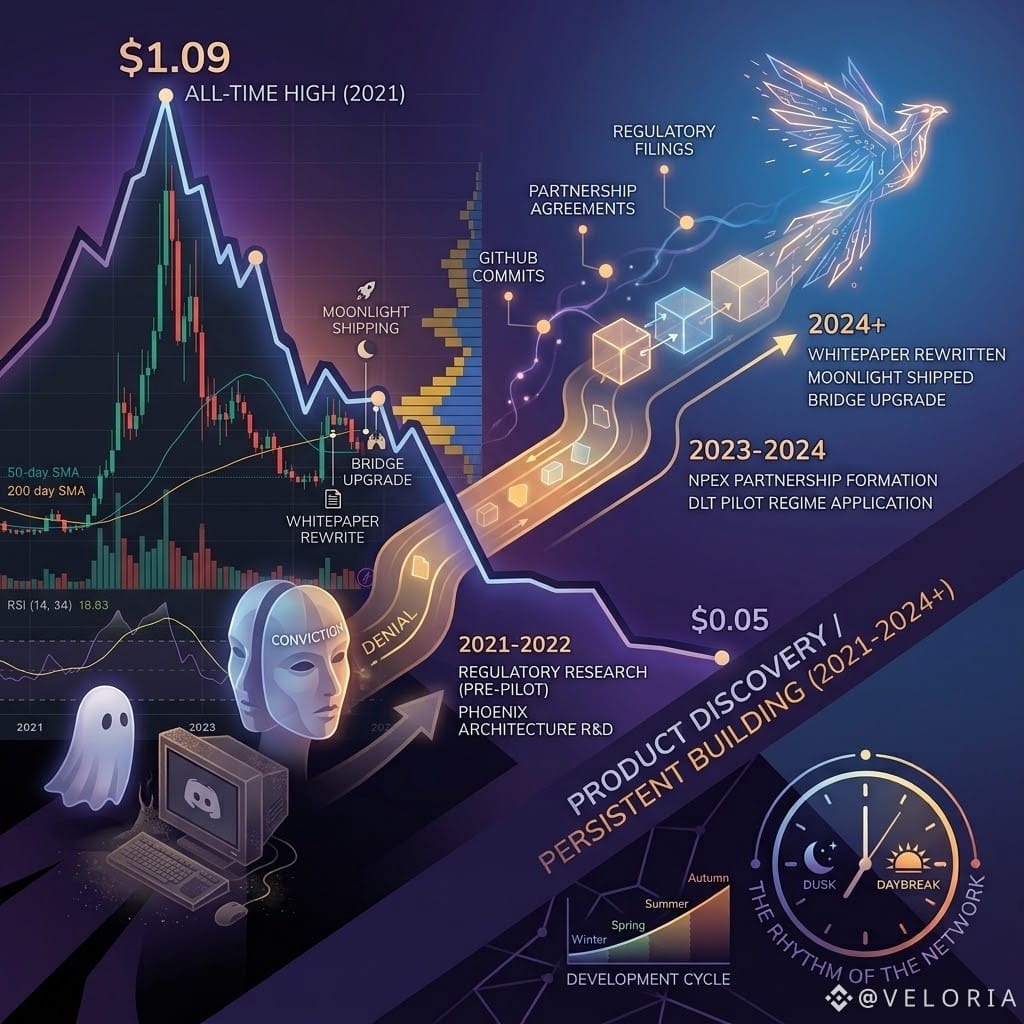
#dusk $DUSK @Dusk_Foundation Really,... I pulled up Dusk's all-time high almost by accident, and the number stopped me. $1.09. Back in 2021. It trades for a few cents now -$ nowhere close to that number, not even in the same neighborhood.
Normally that's the part of a project's story people use to write it off. Down 90-plus percent from an all-time high usually means abandoned GitHub, a Discord full of ghosts, a team that quietly moved on. That's the pattern everyone's seen a hundred times.
Except that's not what happened here. The whitepaper got rewritten in 2024. Moonlight shipped. The NPEX partnership formed. The DLT Pilot Regime application went in. The bridge got upgraded. None of that reads like a team coasting on a dead chart. It reads like a team that built through the exact years the price was punishing them for it.
What that gap reveals, underneath the numbers, is something crypto doesn't reward very often — the difference between price discovery and product discovery happening on different timelines. The market priced in a 2021 narrative instantly. The actual infrastructure for regulated on-chain finance takes years longer to earn, because it depends on things speculation can't rush: regulatory frameworks finalizing, institutions doing real diligence, exchanges willing to be first.
The uncomfortable counterpoint is that a low price for years can also just mean the market's right, and the project never finds its moment at all. Conviction and denial look identical from the outside.
But there's a specific kind of signal in a token that's down 95% while its GitHub, partnerships, and regulatory filings keep moving forward. It's not proof of success. It's just proof that somebody kept building after the reason to give up would've been easy to find.
$DUSK
{spot}(DUSKUSDT)
#dusk $DUSK @Dusk Really,... I pulled up Dusk's all-time high almost by accident, and the number stopped me. $1.09. Back in 2021. It trades for a few cents now -$ nowhere close to that number, not even in the same neighborhood.
Normally that's the part of a project's story people use to write it off. Down 90-plus percent from an all-time high usually means abandoned GitHub, a Discord full of ghosts, a team that quietly moved on. That's the pattern everyone's seen a hundred times.
Except that's not what happened here. The whitepaper got rewritten in 2024. Moonlight shipped. The NPEX partnership formed. The DLT Pilot Regime application went in. The bridge got upgraded. None of that reads like a team coasting on a dead chart. It reads like a team that built through the exact years the price was punishing them for it.
What that gap reveals, underneath the numbers, is something crypto doesn't reward very often — the difference between price discovery and product discovery happening on different timelines. The market priced in a 2021 narrative instantly. The actual infrastructure for regulated on-chain finance takes years longer to earn, because it depends on things speculation can't rush: regulatory frameworks finalizing, institutions doing real diligence, exchanges willing to be first.
The uncomfortable counterpoint is that a low price for years can also just mean the market's right, and the project never finds its moment at all. Conviction and denial look identical from the outside.
But there's a specific kind of signal in a token that's down 95% while its GitHub, partnerships, and regulatory filings keep moving forward. It's not proof of success. It's just proof that somebody kept building after the reason to give up would've been easy to find.
$DUSK
Normally that's the part of a project's story people use to write it off. Down 90-plus percent from an all-time high usually means abandoned GitHub, a Discord full of ghosts, a team that quietly moved on. That's the pattern everyone's seen a hundred times.
Except that's not what happened here. The whitepaper got rewritten in 2024. Moonlight shipped. The NPEX partnership formed. The DLT Pilot Regime application went in. The bridge got upgraded. None of that reads like a team coasting on a dead chart. It reads like a team that built through the exact years the price was punishing them for it.
What that gap reveals, underneath the numbers, is something crypto doesn't reward very often — the difference between price discovery and product discovery happening on different timelines. The market priced in a 2021 narrative instantly. The actual infrastructure for regulated on-chain finance takes years longer to earn, because it depends on things speculation can't rush: regulatory frameworks finalizing, institutions doing real diligence, exchanges willing to be first.
The uncomfortable counterpoint is that a low price for years can also just mean the market's right, and the project never finds its moment at all. Conviction and denial look identical from the outside.
But there's a specific kind of signal in a token that's down 95% while its GitHub, partnerships, and regulatory filings keep moving forward. It's not proof of success. It's just proof that somebody kept building after the reason to give up would've been easy to find.
$DUSK
4
190
#dusk $DUSK @Dusk_Foundation
Really,... the distinction I kept missing was this: hiding a transaction and hiding a smart contract's internal state are two completely different problems, and most people talking about Dusk conflate them.
Privacy coins solved the first one years ago — hide who sent what to whom. That's Phoenix's job on Dusk. But a smart contract isn't just a transaction, it's a running program with internal variables. A lending contract needs to know your collateral ratio. An auction contract needs to track bids. If that state sits on a public chain in the clear, the privacy of the transaction that created it barely matters - anyone can just read the contract's memory.
Dusk built its confidential contract execution around that second problem specifically, letting contract state stay encrypted while the contract still runs correctly against it. That's a harder guarantee than hiding a transfer amount. The contract has to prove it followed its own rules - enforced a valid bid, checked a real collateral threshold - without ever revealing the numbers it used to do it.
What that enables is private financial logic, not just private payments. A regulated security with built-in trading restrictions can enforce those restrictions on-chain without exposing who's being restricted or why, which is close to what real securities law actually requires - control without surveillance.
The catch is verification cost. Proving a computation happened correctly over hidden data takes more cryptographic work than proving a plain transaction was valid. That overhead is the price of contracts that can think privately.
It's a small distinction with a big consequence: private payments were the easy problem in this space. Private computation was always the real one.
{spot}(DUSKUSDT)
#dusk $DUSK @Dusk
Really,... the distinction I kept missing was this: hiding a transaction and hiding a smart contract's internal state are two completely different problems, and most people talking about Dusk conflate them.
Privacy coins solved the first one years ago — hide who sent what to whom. That's Phoenix's job on Dusk. But a smart contract isn't just a transaction, it's a running program with internal variables. A lending contract needs to know your collateral ratio. An auction contract needs to track bids. If that state sits on a public chain in the clear, the privacy of the transaction that created it barely matters - anyone can just read the contract's memory.
Dusk built its confidential contract execution around that second problem specifically, letting contract state stay encrypted while the contract still runs correctly against it. That's a harder guarantee than hiding a transfer amount. The contract has to prove it followed its own rules - enforced a valid bid, checked a real collateral threshold - without ever revealing the numbers it used to do it.
What that enables is private financial logic, not just private payments. A regulated security with built-in trading restrictions can enforce those restrictions on-chain without exposing who's being restricted or why, which is close to what real securities law actually requires - control without surveillance.
The catch is verification cost. Proving a computation happened correctly over hidden data takes more cryptographic work than proving a plain transaction was valid. That overhead is the price of contracts that can think privately.
It's a small distinction with a big consequence: private payments were the easy problem in this space. Private computation was always the real one.
Really,... the distinction I kept missing was this: hiding a transaction and hiding a smart contract's internal state are two completely different problems, and most people talking about Dusk conflate them.
Privacy coins solved the first one years ago — hide who sent what to whom. That's Phoenix's job on Dusk. But a smart contract isn't just a transaction, it's a running program with internal variables. A lending contract needs to know your collateral ratio. An auction contract needs to track bids. If that state sits on a public chain in the clear, the privacy of the transaction that created it barely matters - anyone can just read the contract's memory.
Dusk built its confidential contract execution around that second problem specifically, letting contract state stay encrypted while the contract still runs correctly against it. That's a harder guarantee than hiding a transfer amount. The contract has to prove it followed its own rules - enforced a valid bid, checked a real collateral threshold - without ever revealing the numbers it used to do it.
What that enables is private financial logic, not just private payments. A regulated security with built-in trading restrictions can enforce those restrictions on-chain without exposing who's being restricted or why, which is close to what real securities law actually requires - control without surveillance.
The catch is verification cost. Proving a computation happened correctly over hidden data takes more cryptographic work than proving a plain transaction was valid. That overhead is the price of contracts that can think privately.
It's a small distinction with a big consequence: private payments were the easy problem in this space. Private computation was always the real one.
3
7
331
#dusk $DUSK @Dusk_Foundation
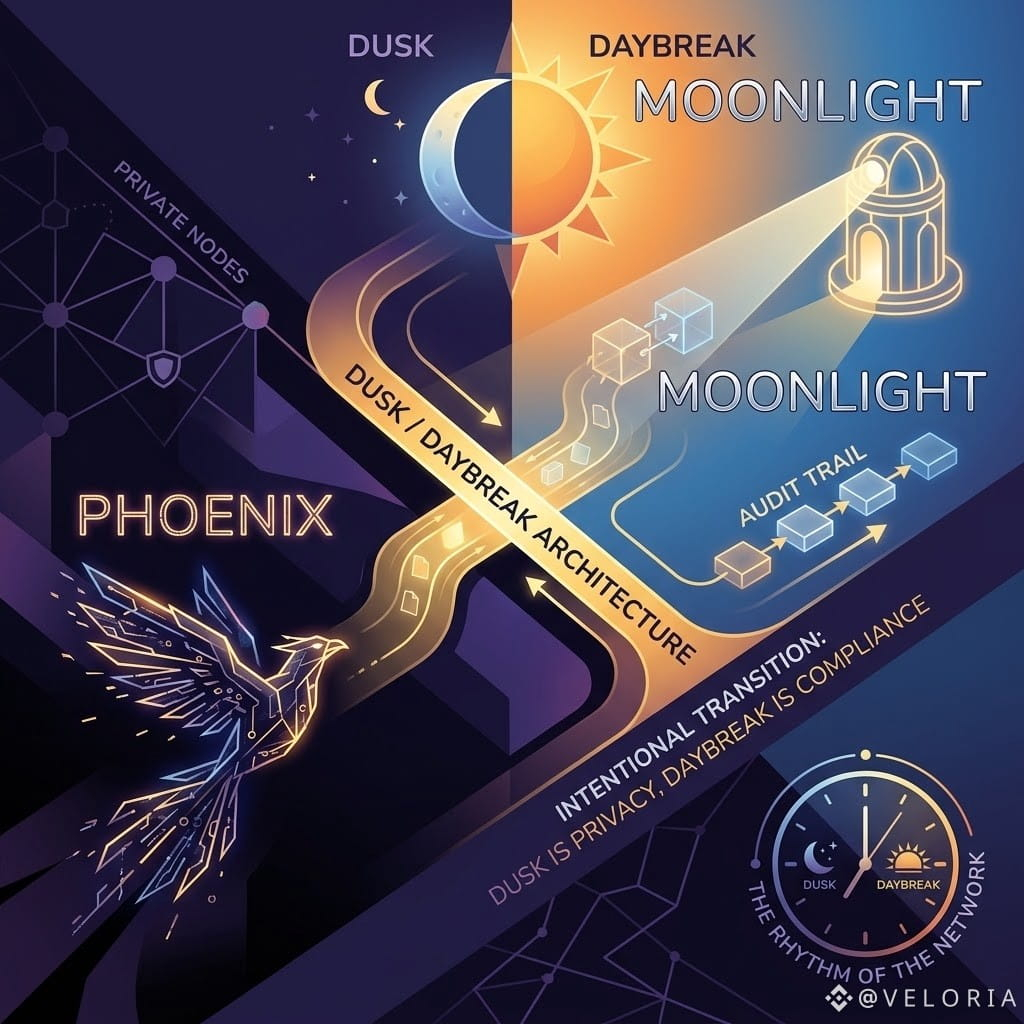
Really,... it wasn't a technical doc that got me thinking, it was the name itself. Dusk. Then their current roadmap milestone is called Daybreak. That's not random branding - it's the whole philosophy encoded in two words.
Dusk is the moment right before dark, when things are still visible but going private. Daybreak is the opposite - the moment things become visible again. Once you notice that, the network's actual architecture starts to look like it's tracing that exact arc.
Phoenix, the original transaction model, is the "dusk" half — private notes, no visible balances, value that exists in shadow until it's spent. Moonlight, the newer public transaction layer, is the "daybreak" half — the same value, but chosen to be visible when visibility is what compliance requires. The system isn't just private or public. It's built to move between the two states on purpose, the way daylight actually shifts to dark and back.
What that naming does underneath is signal intent rather than just describe a feature. A lot of privacy chains treat transparency as a failure state, something forced on them by regulation. Dusk treats it as a natural, expected phase - daybreak isn't a compromise of the dark, it's just what comes next.
The risk in reading too much into a naming convention is obvious - words don't secure a network, code does. A nice metaphor doesn't guarantee Moonlight and Phoenix actually interoperate cleanly under real load.
But there's something honest about a project naming its milestones after the exact tension it's trying to resolve. Most chains hide their trade-offs. Dusk put theirs in the company name.
{spot}(DUSKUSDT)
#dusk $DUSK @Dusk
Really,... it wasn't a technical doc that got me thinking, it was the name itself. Dusk. Then their current roadmap milestone is called Daybreak. That's not random branding - it's the whole philosophy encoded in two words.
Dusk is the moment right before dark, when things are still visible but going private. Daybreak is the opposite - the moment things become visible again. Once you notice that, the network's actual architecture starts to look like it's tracing that exact arc.
Phoenix, the original transaction model, is the "dusk" half — private notes, no visible balances, value that exists in shadow until it's spent. Moonlight, the newer public transaction layer, is the "daybreak" half — the same value, but chosen to be visible when visibility is what compliance requires. The system isn't just private or public. It's built to move between the two states on purpose, the way daylight actually shifts to dark and back.
What that naming does underneath is signal intent rather than just describe a feature. A lot of privacy chains treat transparency as a failure state, something forced on them by regulation. Dusk treats it as a natural, expected phase - daybreak isn't a compromise of the dark, it's just what comes next.
The risk in reading too much into a naming convention is obvious - words don't secure a network, code does. A nice metaphor doesn't guarantee Moonlight and Phoenix actually interoperate cleanly under real load.
But there's something honest about a project naming its milestones after the exact tension it's trying to resolve. Most chains hide their trade-offs. Dusk put theirs in the company name.
Really,... it wasn't a technical doc that got me thinking, it was the name itself. Dusk. Then their current roadmap milestone is called Daybreak. That's not random branding - it's the whole philosophy encoded in two words.
Dusk is the moment right before dark, when things are still visible but going private. Daybreak is the opposite - the moment things become visible again. Once you notice that, the network's actual architecture starts to look like it's tracing that exact arc.
Phoenix, the original transaction model, is the "dusk" half — private notes, no visible balances, value that exists in shadow until it's spent. Moonlight, the newer public transaction layer, is the "daybreak" half — the same value, but chosen to be visible when visibility is what compliance requires. The system isn't just private or public. It's built to move between the two states on purpose, the way daylight actually shifts to dark and back.
What that naming does underneath is signal intent rather than just describe a feature. A lot of privacy chains treat transparency as a failure state, something forced on them by regulation. Dusk treats it as a natural, expected phase - daybreak isn't a compromise of the dark, it's just what comes next.
The risk in reading too much into a naming convention is obvious - words don't secure a network, code does. A nice metaphor doesn't guarantee Moonlight and Phoenix actually interoperate cleanly under real load.
But there's something honest about a project naming its milestones after the exact tension it's trying to resolve. Most chains hide their trade-offs. Dusk put theirs in the company name.
2
4
532
#dusk $DUSK @Dusk_Foundation
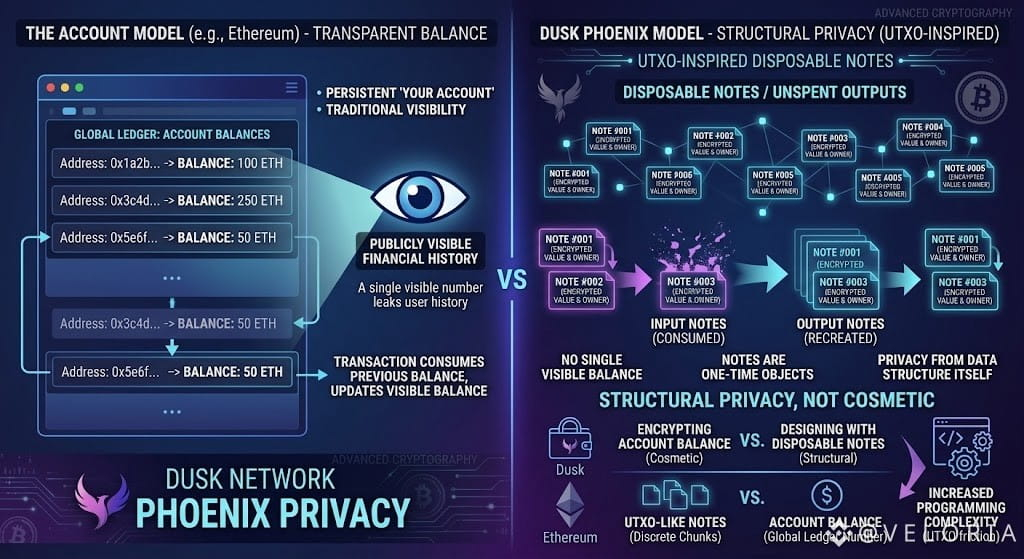
Really,... what I didn't expect was how much Dusk's privacy model owes to an idea most people associate with Bitcoin, not with cutting-edge cryptography -the UTXO.
Ethereum runs on accounts. Your balance is a number sitting in a global ledger, visible to anyone who looks. Bitcoin runs on UTXOs instead - unspent transaction outputs, little discrete chunks of value that get consumed and recreated with every transaction, no running balance anywhere to read.
Dusk's Phoenix model builds on that second idea, not the first, and the reason is almost obvious once you see it. An account balance is a single visible number that leaks your entire financial history just by existing. A UTXO - or in Dusk's case, a "note" - is a self-contained, one-time object. Nobody staring at the ledger can add them up into your net worth, because there's no persistent "your account" to look at in the first place.
What that enables is privacy that comes from the data structure itself, not from tricks layered on top of it. Encrypt an account balance and you're hiding a number that used to be visible. Design the system around disposable notes from the start, and there's no equivalent number to hide - the privacy is structural, not cosmetic.
The trade-off is complexity. UTXO systems are harder to program against than accounts - Ethereum's dominance partly comes from how much easier accounts are to build on. Dusk inherited that friction the moment it chose notes over balances.
It's a strange kind of irony. The chain built for the most modern use case in crypto - regulated institutional finance - leans on one of the oldest architectural ideas in the space to make it work.
$DUSK
{spot}(DUSKUSDT)
#dusk $DUSK @Dusk
Really,... what I didn't expect was how much Dusk's privacy model owes to an idea most people associate with Bitcoin, not with cutting-edge cryptography -the UTXO.
Ethereum runs on accounts. Your balance is a number sitting in a global ledger, visible to anyone who looks. Bitcoin runs on UTXOs instead - unspent transaction outputs, little discrete chunks of value that get consumed and recreated with every transaction, no running balance anywhere to read.
Dusk's Phoenix model builds on that second idea, not the first, and the reason is almost obvious once you see it. An account balance is a single visible number that leaks your entire financial history just by existing. A UTXO - or in Dusk's case, a "note" - is a self-contained, one-time object. Nobody staring at the ledger can add them up into your net worth, because there's no persistent "your account" to look at in the first place.
What that enables is privacy that comes from the data structure itself, not from tricks layered on top of it. Encrypt an account balance and you're hiding a number that used to be visible. Design the system around disposable notes from the start, and there's no equivalent number to hide - the privacy is structural, not cosmetic.
The trade-off is complexity. UTXO systems are harder to program against than accounts - Ethereum's dominance partly comes from how much easier accounts are to build on. Dusk inherited that friction the moment it chose notes over balances.
It's a strange kind of irony. The chain built for the most modern use case in crypto - regulated institutional finance - leans on one of the oldest architectural ideas in the space to make it work.
$DUSK
Really,... what I didn't expect was how much Dusk's privacy model owes to an idea most people associate with Bitcoin, not with cutting-edge cryptography -the UTXO.
Ethereum runs on accounts. Your balance is a number sitting in a global ledger, visible to anyone who looks. Bitcoin runs on UTXOs instead - unspent transaction outputs, little discrete chunks of value that get consumed and recreated with every transaction, no running balance anywhere to read.
Dusk's Phoenix model builds on that second idea, not the first, and the reason is almost obvious once you see it. An account balance is a single visible number that leaks your entire financial history just by existing. A UTXO - or in Dusk's case, a "note" - is a self-contained, one-time object. Nobody staring at the ledger can add them up into your net worth, because there's no persistent "your account" to look at in the first place.
What that enables is privacy that comes from the data structure itself, not from tricks layered on top of it. Encrypt an account balance and you're hiding a number that used to be visible. Design the system around disposable notes from the start, and there's no equivalent number to hide - the privacy is structural, not cosmetic.
The trade-off is complexity. UTXO systems are harder to program against than accounts - Ethereum's dominance partly comes from how much easier accounts are to build on. Dusk inherited that friction the moment it chose notes over balances.
It's a strange kind of irony. The chain built for the most modern use case in crypto - regulated institutional finance - leans on one of the oldest architectural ideas in the space to make it work.
$DUSK
2
4
166
Vérifié
#dusk $DUSK @Dusk_Foundation
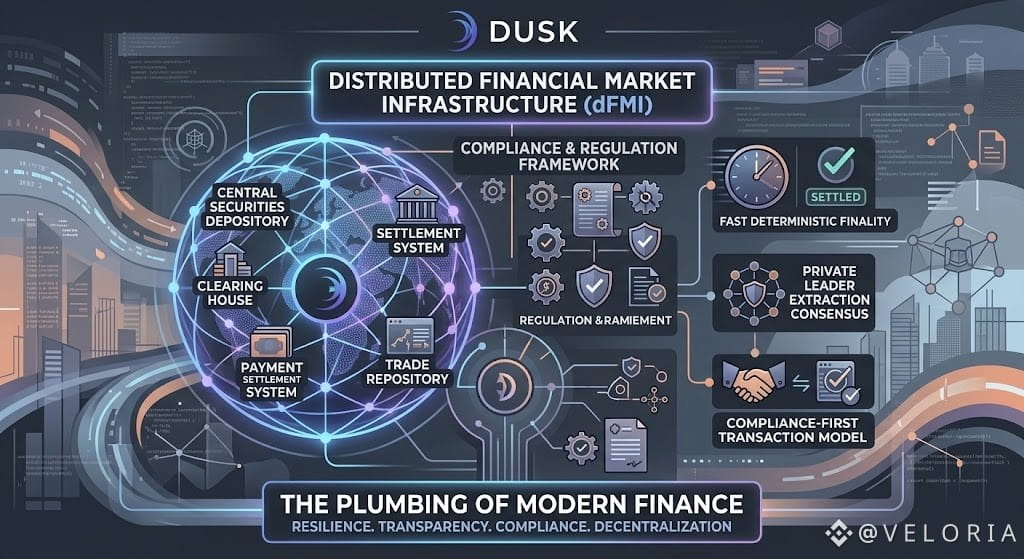
Really,... the phrase that stuck with me wasn't anything technical — it was "distributed Financial Market Infrastructure." Dusk uses that exact term, dFMI, and it's not crypto vocabulary. It's regulatory vocabulary.
Financial Market Infrastructure is an actual defined category regulators use for the systems that keep markets running underneath the trades everyone sees — clearing houses, settlement systems, central securities depositories. It's boring by design. Nobody hypes a clearing house. But if it fails, the whole market seizes up behind it.
Most blockchains describe themselves as disruptors - replacing banks, cutting out middlemen, rebuilding finance from scratch. Dusk describes itself as infrastructure using the regulator's own framework, just decentralized instead of centralized. That's a completely different posture. It's not asking permission to replace the system. It's asking to be classified as a compliant version of a category that already exists.
What that reframing does underneath is subtle but real. An FMI has to meet specific expectations: clear and final settlement, resilience, risk management, oversight. Dusk's push for fast deterministic finality, its private leader extraction consensus, its compliance-first transaction model — none of it reads as a coincidence once you see the target was never "decentralized app platform." It was "meets the definition of an FMI, but on-chain."
The tension is that traditional FMIs are heavily supervised, sometimes state-linked, built over decades of trust. A blockchain claiming that role has to earn in years what banks earned in generations.
But naming the goal that specifically tells you something. Dusk isn't trying to sound like the future of finance. It's trying to sound like the plumbing regulators already trust — just rebuilt underneath.
$DUSK
{spot}(DUSKUSDT)
#dusk $DUSK @Dusk
Really,... the phrase that stuck with me wasn't anything technical — it was "distributed Financial Market Infrastructure." Dusk uses that exact term, dFMI, and it's not crypto vocabulary. It's regulatory vocabulary.
Financial Market Infrastructure is an actual defined category regulators use for the systems that keep markets running underneath the trades everyone sees — clearing houses, settlement systems, central securities depositories. It's boring by design. Nobody hypes a clearing house. But if it fails, the whole market seizes up behind it.
Most blockchains describe themselves as disruptors - replacing banks, cutting out middlemen, rebuilding finance from scratch. Dusk describes itself as infrastructure using the regulator's own framework, just decentralized instead of centralized. That's a completely different posture. It's not asking permission to replace the system. It's asking to be classified as a compliant version of a category that already exists.
What that reframing does underneath is subtle but real. An FMI has to meet specific expectations: clear and final settlement, resilience, risk management, oversight. Dusk's push for fast deterministic finality, its private leader extraction consensus, its compliance-first transaction model — none of it reads as a coincidence once you see the target was never "decentralized app platform." It was "meets the definition of an FMI, but on-chain."
The tension is that traditional FMIs are heavily supervised, sometimes state-linked, built over decades of trust. A blockchain claiming that role has to earn in years what banks earned in generations.
But naming the goal that specifically tells you something. Dusk isn't trying to sound like the future of finance. It's trying to sound like the plumbing regulators already trust — just rebuilt underneath.
$DUSK
Really,... the phrase that stuck with me wasn't anything technical — it was "distributed Financial Market Infrastructure." Dusk uses that exact term, dFMI, and it's not crypto vocabulary. It's regulatory vocabulary.
Financial Market Infrastructure is an actual defined category regulators use for the systems that keep markets running underneath the trades everyone sees — clearing houses, settlement systems, central securities depositories. It's boring by design. Nobody hypes a clearing house. But if it fails, the whole market seizes up behind it.
Most blockchains describe themselves as disruptors - replacing banks, cutting out middlemen, rebuilding finance from scratch. Dusk describes itself as infrastructure using the regulator's own framework, just decentralized instead of centralized. That's a completely different posture. It's not asking permission to replace the system. It's asking to be classified as a compliant version of a category that already exists.
What that reframing does underneath is subtle but real. An FMI has to meet specific expectations: clear and final settlement, resilience, risk management, oversight. Dusk's push for fast deterministic finality, its private leader extraction consensus, its compliance-first transaction model — none of it reads as a coincidence once you see the target was never "decentralized app platform." It was "meets the definition of an FMI, but on-chain."
The tension is that traditional FMIs are heavily supervised, sometimes state-linked, built over decades of trust. A blockchain claiming that role has to earn in years what banks earned in generations.
But naming the goal that specifically tells you something. Dusk isn't trying to sound like the future of finance. It's trying to sound like the plumbing regulators already trust — just rebuilt underneath.
$DUSK
4
7
800
Vérifié
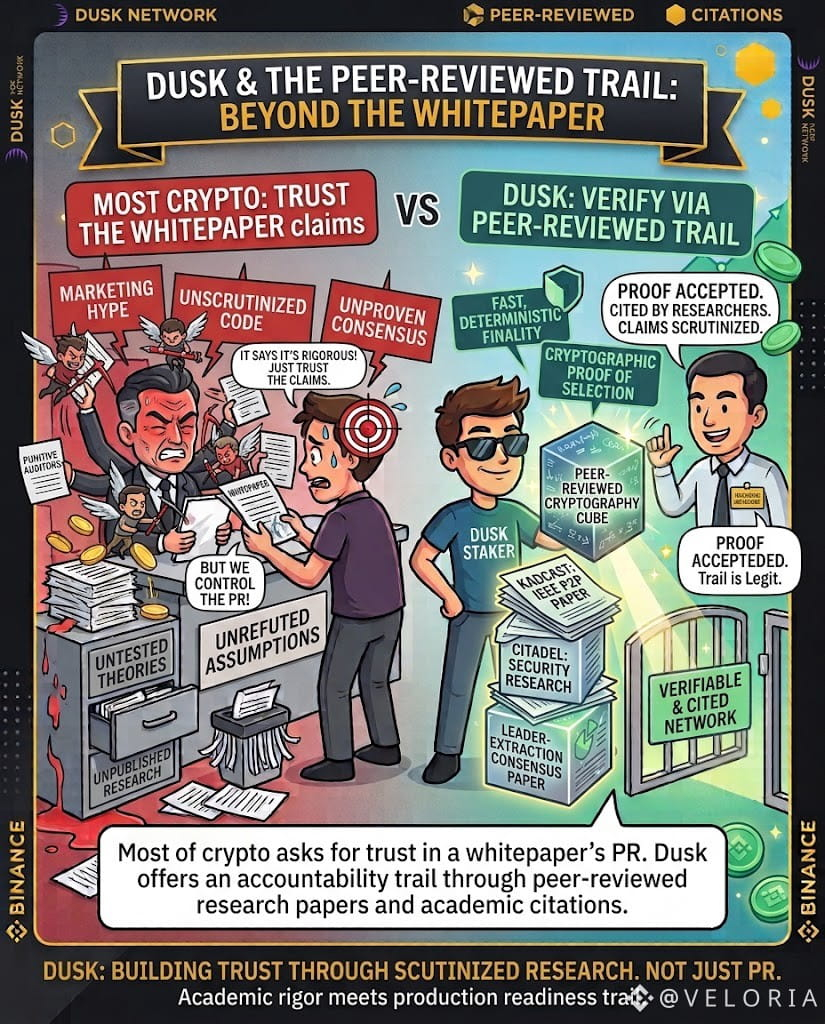
#dusk $DUSK @Dusk_Foundation Really,... what caught me off guard was realizing how much of Dusk's technology exists as actual peer-reviewed research, not just whitepaper claims dressed up to sound rigorous.
Kadcast, the networking protocol Dusk uses for block propagation, isn't just a feature Dusk marketing invented — it's a paper that went through academic review, built on Kademlia's structured overlay work from the early 2000s peer-to-peer literature. Citadel, their identity system, shows up the same way, referenced in security research alongside other privacy-preserving credential systems.
That distinction matters more than it sounds like it should. Most crypto projects write a whitepaper, call it research, and never submit anything to a process where other cryptographers can actually poke holes in it before it ships. Dusk's core pieces went through something closer to the peer-review path — publish, get scrutinized, get cited by researchers working on unrelated systems.
What that enables is a kind of accountability that marketing can't fake. When someone else's paper on privacy-preserving blockchains cites Dusk's leader-extraction consensus as a comparison point, that's not a partnership announcement — that's the research community treating the work as real enough to reference.
The flip side is that academic rigor and production readiness aren't the same thing. A protocol proven sound on paper can still fail under real network conditions, adversarial actors, or the specific mess of running alongside a live financial settlement system.
But there's something reassuring in a project whose foundational claims exist outside the company's own PR, in venues where the authors don't control the review. Most of crypto asks you to trust the whitepaper. Dusk gives you a paper trail instead.
{spot}(DUSKUSDT)
#dusk $DUSK @Dusk Really,... what caught me off guard was realizing how much of Dusk's technology exists as actual peer-reviewed research, not just whitepaper claims dressed up to sound rigorous.
Kadcast, the networking protocol Dusk uses for block propagation, isn't just a feature Dusk marketing invented — it's a paper that went through academic review, built on Kademlia's structured overlay work from the early 2000s peer-to-peer literature. Citadel, their identity system, shows up the same way, referenced in security research alongside other privacy-preserving credential systems.
That distinction matters more than it sounds like it should. Most crypto projects write a whitepaper, call it research, and never submit anything to a process where other cryptographers can actually poke holes in it before it ships. Dusk's core pieces went through something closer to the peer-review path — publish, get scrutinized, get cited by researchers working on unrelated systems.
What that enables is a kind of accountability that marketing can't fake. When someone else's paper on privacy-preserving blockchains cites Dusk's leader-extraction consensus as a comparison point, that's not a partnership announcement — that's the research community treating the work as real enough to reference.
The flip side is that academic rigor and production readiness aren't the same thing. A protocol proven sound on paper can still fail under real network conditions, adversarial actors, or the specific mess of running alongside a live financial settlement system.
But there's something reassuring in a project whose foundational claims exist outside the company's own PR, in venues where the authors don't control the review. Most of crypto asks you to trust the whitepaper. Dusk gives you a paper trail instead.
Kadcast, the networking protocol Dusk uses for block propagation, isn't just a feature Dusk marketing invented — it's a paper that went through academic review, built on Kademlia's structured overlay work from the early 2000s peer-to-peer literature. Citadel, their identity system, shows up the same way, referenced in security research alongside other privacy-preserving credential systems.
That distinction matters more than it sounds like it should. Most crypto projects write a whitepaper, call it research, and never submit anything to a process where other cryptographers can actually poke holes in it before it ships. Dusk's core pieces went through something closer to the peer-review path — publish, get scrutinized, get cited by researchers working on unrelated systems.
What that enables is a kind of accountability that marketing can't fake. When someone else's paper on privacy-preserving blockchains cites Dusk's leader-extraction consensus as a comparison point, that's not a partnership announcement — that's the research community treating the work as real enough to reference.
The flip side is that academic rigor and production readiness aren't the same thing. A protocol proven sound on paper can still fail under real network conditions, adversarial actors, or the specific mess of running alongside a live financial settlement system.
But there's something reassuring in a project whose foundational claims exist outside the company's own PR, in venues where the authors don't control the review. Most of crypto asks you to trust the whitepaper. Dusk gives you a paper trail instead.
8
10
218
#dusk $DUSK @Dusk_Foundation
Really,... the detail that got me was learning Dusk Network operates as a Dutch B.V. - a registered legal entity in Amsterdam -and that felt like such a boring fact until I thought about what it actually means for a "decentralized" project.
Most crypto projects go out of their way to blur who's accountable. Foundations in Switzerland, entities in the Caymans, DAOs with no legal person behind them at all. The point, usually, is deniability - if regulators come knocking, there's no clear door to knock on.
Dusk did the opposite. A registered company, in a jurisdiction inside the EU, subject to Dutch corporate law. That's not a loophole-friendly setup. That's the setup of a company that expects to be regulated and wants a legal identity ready when it happens.
What that enables is something most crypto projects can't offer: someone to sign a contract with. NPEX isn't going to route regulated securities through an anonymous DAO. A Dutch exchange needs a counterparty it can sue, audit, and hold liable if something breaks. Legal personhood is what makes a partnership like that possible in the first place.
The tension is real, though. A legal entity is also a pressure point - something regulators can compel, freeze, or shut down in a way a truly decentralized protocol can't be. Dusk trades censorship-resistance for exactly the kind of accountability institutions require.
That's the part I keep circling back to. Crypto spent years treating "no one's in charge" as the whole point. Dusk is betting that for the specific problem it's solving, someone being in charge is the feature, not the bug.
$DUSK
{spot}(DUSKUSDT)
#dusk $DUSK @Dusk
Really,... the detail that got me was learning Dusk Network operates as a Dutch B.V. - a registered legal entity in Amsterdam -and that felt like such a boring fact until I thought about what it actually means for a "decentralized" project.
Most crypto projects go out of their way to blur who's accountable. Foundations in Switzerland, entities in the Caymans, DAOs with no legal person behind them at all. The point, usually, is deniability - if regulators come knocking, there's no clear door to knock on.
Dusk did the opposite. A registered company, in a jurisdiction inside the EU, subject to Dutch corporate law. That's not a loophole-friendly setup. That's the setup of a company that expects to be regulated and wants a legal identity ready when it happens.
What that enables is something most crypto projects can't offer: someone to sign a contract with. NPEX isn't going to route regulated securities through an anonymous DAO. A Dutch exchange needs a counterparty it can sue, audit, and hold liable if something breaks. Legal personhood is what makes a partnership like that possible in the first place.
The tension is real, though. A legal entity is also a pressure point - something regulators can compel, freeze, or shut down in a way a truly decentralized protocol can't be. Dusk trades censorship-resistance for exactly the kind of accountability institutions require.
That's the part I keep circling back to. Crypto spent years treating "no one's in charge" as the whole point. Dusk is betting that for the specific problem it's solving, someone being in charge is the feature, not the bug.
$DUSK
Really,... the detail that got me was learning Dusk Network operates as a Dutch B.V. - a registered legal entity in Amsterdam -and that felt like such a boring fact until I thought about what it actually means for a "decentralized" project.
Most crypto projects go out of their way to blur who's accountable. Foundations in Switzerland, entities in the Caymans, DAOs with no legal person behind them at all. The point, usually, is deniability - if regulators come knocking, there's no clear door to knock on.
Dusk did the opposite. A registered company, in a jurisdiction inside the EU, subject to Dutch corporate law. That's not a loophole-friendly setup. That's the setup of a company that expects to be regulated and wants a legal identity ready when it happens.
What that enables is something most crypto projects can't offer: someone to sign a contract with. NPEX isn't going to route regulated securities through an anonymous DAO. A Dutch exchange needs a counterparty it can sue, audit, and hold liable if something breaks. Legal personhood is what makes a partnership like that possible in the first place.
The tension is real, though. A legal entity is also a pressure point - something regulators can compel, freeze, or shut down in a way a truly decentralized protocol can't be. Dusk trades censorship-resistance for exactly the kind of accountability institutions require.
That's the part I keep circling back to. Crypto spent years treating "no one's in charge" as the whole point. Dusk is betting that for the specific problem it's solving, someone being in charge is the feature, not the bug.
$DUSK

2
172
#dusk $DUSK @Dusk_Foundation
Really,... what stopped me was the minimum stake required to become a Provisioner on Dusk - it's high enough that it changes who actually shows up to secure the network.
Most proof-of-stake chains keep the validator bar low on purpose. Cheap entry means more participants, more decentralization on paper. Dusk went the other way, setting a stake threshold that filters out casual operators before they even start.
At first that reads like a flaw - fewer validators sounds like more centralization.
But underneath it, the logic fits everything else Dusk is building. A chain settling regulated securities can't have its consensus run by whoever happened to buy a cheap VPS and some tokens. It needs operators with enough capital at risk that cutting corners costs something real.
That's the quiet trade Dusk keeps making across the whole system: fewer, more committed participants over a larger, looser crowd. The private leader extraction process only matters if the pool of potential leaders is made up of people who have something to lose by acting badly. High stake requirements are what give that assumption teeth.
The obvious counterpoint is concentration risk — a smaller validator set is, mechanically, a smaller attack surface to capture if enough capital wants in.
But I keep coming back to what Dusk is actually optimizing for. Not censorship-resistance as an ideology. Reliability as a service. Institutions don't need a thousand anonymous validators. They need a network where whoever's securing it can be held accountable if something goes wrong.
That's a narrower definition of decentralization. It might also be the more honest one.
{future}(DUSKUSDT)
#dusk $DUSK @Dusk
Really,... what stopped me was the minimum stake required to become a Provisioner on Dusk - it's high enough that it changes who actually shows up to secure the network.
Most proof-of-stake chains keep the validator bar low on purpose. Cheap entry means more participants, more decentralization on paper. Dusk went the other way, setting a stake threshold that filters out casual operators before they even start.
At first that reads like a flaw - fewer validators sounds like more centralization.
But underneath it, the logic fits everything else Dusk is building. A chain settling regulated securities can't have its consensus run by whoever happened to buy a cheap VPS and some tokens. It needs operators with enough capital at risk that cutting corners costs something real.
That's the quiet trade Dusk keeps making across the whole system: fewer, more committed participants over a larger, looser crowd. The private leader extraction process only matters if the pool of potential leaders is made up of people who have something to lose by acting badly. High stake requirements are what give that assumption teeth.
The obvious counterpoint is concentration risk — a smaller validator set is, mechanically, a smaller attack surface to capture if enough capital wants in.
But I keep coming back to what Dusk is actually optimizing for. Not censorship-resistance as an ideology. Reliability as a service. Institutions don't need a thousand anonymous validators. They need a network where whoever's securing it can be held accountable if something goes wrong.
That's a narrower definition of decentralization. It might also be the more honest one.
Really,... what stopped me was the minimum stake required to become a Provisioner on Dusk - it's high enough that it changes who actually shows up to secure the network.
Most proof-of-stake chains keep the validator bar low on purpose. Cheap entry means more participants, more decentralization on paper. Dusk went the other way, setting a stake threshold that filters out casual operators before they even start.
At first that reads like a flaw - fewer validators sounds like more centralization.
But underneath it, the logic fits everything else Dusk is building. A chain settling regulated securities can't have its consensus run by whoever happened to buy a cheap VPS and some tokens. It needs operators with enough capital at risk that cutting corners costs something real.
That's the quiet trade Dusk keeps making across the whole system: fewer, more committed participants over a larger, looser crowd. The private leader extraction process only matters if the pool of potential leaders is made up of people who have something to lose by acting badly. High stake requirements are what give that assumption teeth.
The obvious counterpoint is concentration risk — a smaller validator set is, mechanically, a smaller attack surface to capture if enough capital wants in.
But I keep coming back to what Dusk is actually optimizing for. Not censorship-resistance as an ideology. Reliability as a service. Institutions don't need a thousand anonymous validators. They need a network where whoever's securing it can be held accountable if something goes wrong.
That's a narrower definition of decentralization. It might also be the more honest one.

21
11
247
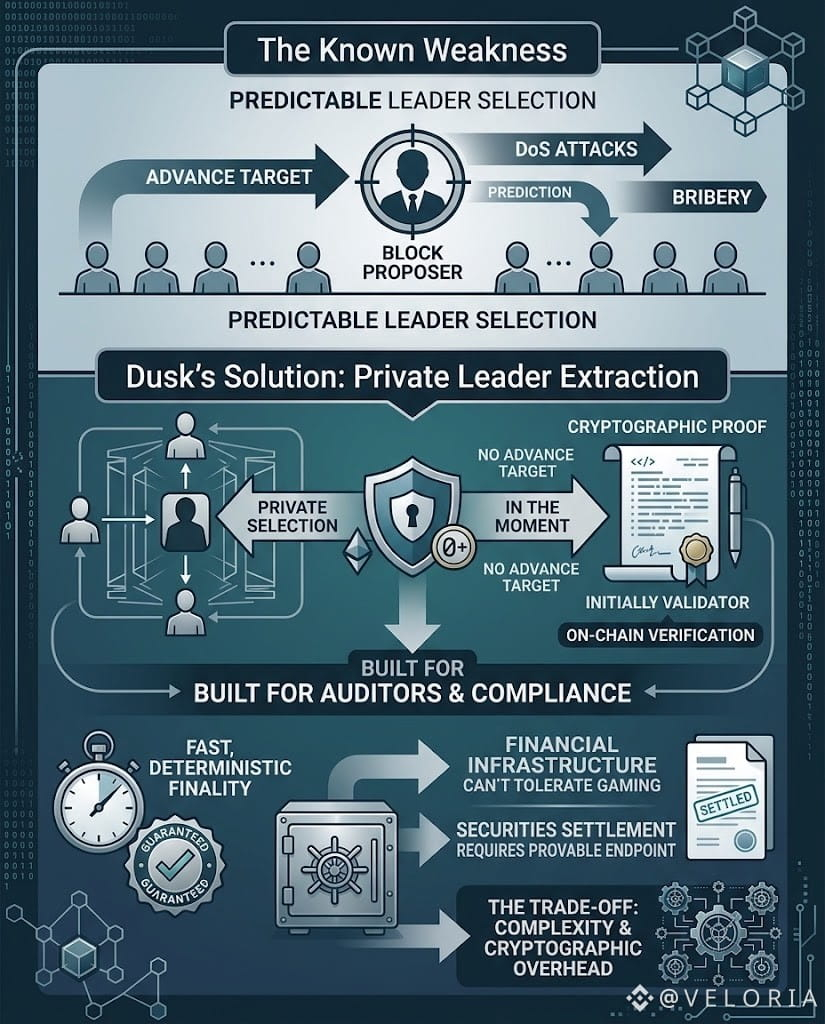
#dusk $DUSK @Dusk_Foundation What gets overlooked about Dusk is the consensus mechanism itself, mostly because "proof-of-stake" sounds settled and boring by now - except Dusk's version isn't quite the version everyone assumes.
Most proof-of-stake chains pick a leader publicly, in advance, which creates an obvious target. Whoever knows they're about to propose the next block can be pressured, bribed, or hit with a denial-of-service attack right before their turn. It's a known weakness, and most chains just accept it as the cost of doing business.
Dusk's answer is a private leader extraction process - nobody knows who the next block proposer is until the moment they act. The selection happens through cryptographic proofs the leader generates themselves, so there's no announcement window, no advance target. That's the surface fix.
Underneath it, this matters more for a compliance-focused chain than a speculative one. Financial infrastructure can't tolerate predictable points of failure - an exchange settling securities on-chain needs assurance that block production can't be gamed by whoever has the resources to watch the mempool and time an attack.
What that enables is fast, deterministic finality - transactions settle in seconds, not the "probably final after enough confirmations" logic Bitcoin still runs on. For securities settlement, "probably final" isn't good enough. Regulators want a clean, provable endpoint.
The trade-off is complexity. Hiding leader selection means more cryptographic overhead per block, and more moving parts that need to work correctly under adversarial conditions.
Still, it's a reminder that Dusk's engineering choices keep circling back to the same instinct: build for the auditor in the room, not just the trader outside it.
{spot}(DUSKUSDT)
#dusk $DUSK @Dusk What gets overlooked about Dusk is the consensus mechanism itself, mostly because "proof-of-stake" sounds settled and boring by now - except Dusk's version isn't quite the version everyone assumes.
Most proof-of-stake chains pick a leader publicly, in advance, which creates an obvious target. Whoever knows they're about to propose the next block can be pressured, bribed, or hit with a denial-of-service attack right before their turn. It's a known weakness, and most chains just accept it as the cost of doing business.
Dusk's answer is a private leader extraction process - nobody knows who the next block proposer is until the moment they act. The selection happens through cryptographic proofs the leader generates themselves, so there's no announcement window, no advance target. That's the surface fix.
Underneath it, this matters more for a compliance-focused chain than a speculative one. Financial infrastructure can't tolerate predictable points of failure - an exchange settling securities on-chain needs assurance that block production can't be gamed by whoever has the resources to watch the mempool and time an attack.
What that enables is fast, deterministic finality - transactions settle in seconds, not the "probably final after enough confirmations" logic Bitcoin still runs on. For securities settlement, "probably final" isn't good enough. Regulators want a clean, provable endpoint.
The trade-off is complexity. Hiding leader selection means more cryptographic overhead per block, and more moving parts that need to work correctly under adversarial conditions.
Still, it's a reminder that Dusk's engineering choices keep circling back to the same instinct: build for the auditor in the room, not just the trader outside it.
Most proof-of-stake chains pick a leader publicly, in advance, which creates an obvious target. Whoever knows they're about to propose the next block can be pressured, bribed, or hit with a denial-of-service attack right before their turn. It's a known weakness, and most chains just accept it as the cost of doing business.
Dusk's answer is a private leader extraction process - nobody knows who the next block proposer is until the moment they act. The selection happens through cryptographic proofs the leader generates themselves, so there's no announcement window, no advance target. That's the surface fix.
Underneath it, this matters more for a compliance-focused chain than a speculative one. Financial infrastructure can't tolerate predictable points of failure - an exchange settling securities on-chain needs assurance that block production can't be gamed by whoever has the resources to watch the mempool and time an attack.
What that enables is fast, deterministic finality - transactions settle in seconds, not the "probably final after enough confirmations" logic Bitcoin still runs on. For securities settlement, "probably final" isn't good enough. Regulators want a clean, provable endpoint.
The trade-off is complexity. Hiding leader selection means more cryptographic overhead per block, and more moving parts that need to work correctly under adversarial conditions.
Still, it's a reminder that Dusk's engineering choices keep circling back to the same instinct: build for the auditor in the room, not just the trader outside it.
6
5
172
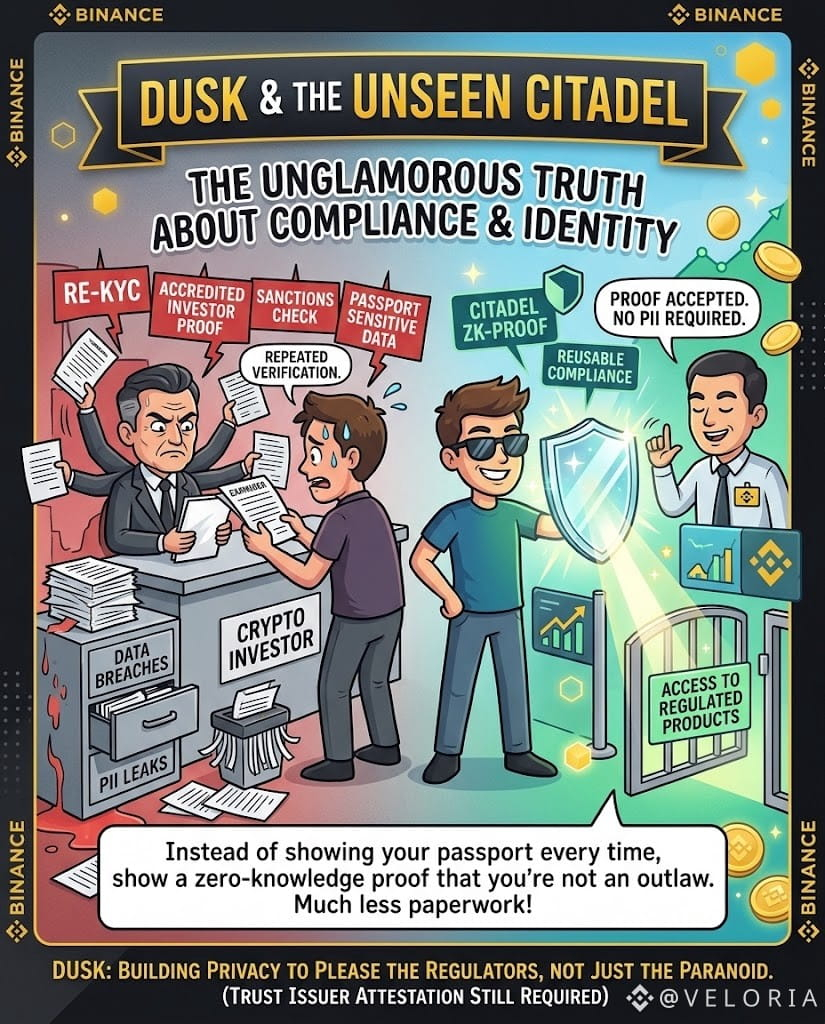
#dusk $DUSK @Dusk_Foundation What's odd about Dusk is that buried inside a chain built for financial compliance is a system for proving who you are without ever showing anyone your actual identity - and that piece, Citadel, barely gets discussed next to the transaction stuff.
The problem Citadel solves is old and unglamorous: every regulated financial product needs KYC, needs proof you're accredited, proof you're not sanctioned, proof of a dozen boring facts about you. Normally that means handing documents to every platform you touch, and each one becomes a place your data can leak.
Citadel flips the order. Your rights and credentials live on the Dusk blockchain, privately, and instead of showing the underlying documents, you generate a proof that a statement about you is true. "I am an accredited investor" gets verified without the counterparty ever seeing your bank statement. That's the zero-knowledge idea applied to identity instead of transactions - same math, different target.
What that enables is something regulated finance has never really had: reusable compliance. Prove your status once, use that proof everywhere, without re-exposing the underlying data each time. The alternative - every exchange holding its own copy of your passport - is exactly the model that keeps causing breaches.
The catch is trust in the issuer. A zero-knowledge proof only means something if whoever attested to the underlying fact was honest and diligent in the first place. The cryptography doesn't fix bad verification upstream, it just protects what happens downstream.
Still,
it's the clearest evidence that Dusk isn't building privacy for its own sake. It's building privacy as a compliance tool - which is a stranger, more useful goal than it sounds.
{spot}(DUSKUSDT)
#dusk $DUSK @Dusk What's odd about Dusk is that buried inside a chain built for financial compliance is a system for proving who you are without ever showing anyone your actual identity - and that piece, Citadel, barely gets discussed next to the transaction stuff.
The problem Citadel solves is old and unglamorous: every regulated financial product needs KYC, needs proof you're accredited, proof you're not sanctioned, proof of a dozen boring facts about you. Normally that means handing documents to every platform you touch, and each one becomes a place your data can leak.
Citadel flips the order. Your rights and credentials live on the Dusk blockchain, privately, and instead of showing the underlying documents, you generate a proof that a statement about you is true. "I am an accredited investor" gets verified without the counterparty ever seeing your bank statement. That's the zero-knowledge idea applied to identity instead of transactions - same math, different target.
What that enables is something regulated finance has never really had: reusable compliance. Prove your status once, use that proof everywhere, without re-exposing the underlying data each time. The alternative - every exchange holding its own copy of your passport - is exactly the model that keeps causing breaches.
The catch is trust in the issuer. A zero-knowledge proof only means something if whoever attested to the underlying fact was honest and diligent in the first place. The cryptography doesn't fix bad verification upstream, it just protects what happens downstream.
Still,
it's the clearest evidence that Dusk isn't building privacy for its own sake. It's building privacy as a compliance tool - which is a stranger, more useful goal than it sounds.
The problem Citadel solves is old and unglamorous: every regulated financial product needs KYC, needs proof you're accredited, proof you're not sanctioned, proof of a dozen boring facts about you. Normally that means handing documents to every platform you touch, and each one becomes a place your data can leak.
Citadel flips the order. Your rights and credentials live on the Dusk blockchain, privately, and instead of showing the underlying documents, you generate a proof that a statement about you is true. "I am an accredited investor" gets verified without the counterparty ever seeing your bank statement. That's the zero-knowledge idea applied to identity instead of transactions - same math, different target.
What that enables is something regulated finance has never really had: reusable compliance. Prove your status once, use that proof everywhere, without re-exposing the underlying data each time. The alternative - every exchange holding its own copy of your passport - is exactly the model that keeps causing breaches.
The catch is trust in the issuer. A zero-knowledge proof only means something if whoever attested to the underlying fact was honest and diligent in the first place. The cryptography doesn't fix bad verification upstream, it just protects what happens downstream.
Still,
it's the clearest evidence that Dusk isn't building privacy for its own sake. It's building privacy as a compliance tool - which is a stranger, more useful goal than it sounds.
7
7
181
#dusk $DUSK Maybe you noticed something strange about Dusk: the interesting part isn’t privacy alone. It’s what privacy makes possible.
When I first looked at Dusk, I expected another blockchain making the usual argument that financial institutions need confidentiality. But the deeper I went, the more the design started to feel like a response to a specific problem: real financial markets cannot simply put everything on a public ledger and call it adoption.
Imagine an institution holding a tokenized bond. Ownership needs to be verifiable, transfers may require eligibility checks, and regulators may need evidence. But competitors don’t need to see the institution’s entire position. Dusk approaches this with shielded transactions, zero-knowledge proofs, and selective disclosure—proving that a rule was satisfied without exposing everything underneath.
That creates an interesting layer beneath the obvious privacy story. Dusk supports transparent activity alongside confidential transfers. The point isn’t making everything invisible; it’s deciding what should remain visible and what should remain private.
There is a tradeoff, though. More sophisticated privacy and compliance infrastructure means more complexity, and complexity creates its own risks. The surrounding infrastructure can become part of the security perimeter even when the underlying protocol remains secure.
If this direction holds, the bigger shift is quiet: blockchain adoption may depend less on making finance completely transparent and more on making the right information verifiable without making everything public.
That, to me, is where Dusk becomes interesting.
@Dusk_Foundation
{spot}(DUSKUSDT)
What should blockchain privacy prioritize?
#dusk $DUSK Maybe you noticed something strange about Dusk: the interesting part isn’t privacy alone. It’s what privacy makes possible.
When I first looked at Dusk, I expected another blockchain making the usual argument that financial institutions need confidentiality. But the deeper I went, the more the design started to feel like a response to a specific problem: real financial markets cannot simply put everything on a public ledger and call it adoption.
Imagine an institution holding a tokenized bond. Ownership needs to be verifiable, transfers may require eligibility checks, and regulators may need evidence. But competitors don’t need to see the institution’s entire position. Dusk approaches this with shielded transactions, zero-knowledge proofs, and selective disclosure—proving that a rule was satisfied without exposing everything underneath.
That creates an interesting layer beneath the obvious privacy story. Dusk supports transparent activity alongside confidential transfers. The point isn’t making everything invisible; it’s deciding what should remain visible and what should remain private.
There is a tradeoff, though. More sophisticated privacy and compliance infrastructure means more complexity, and complexity creates its own risks. The surrounding infrastructure can become part of the security perimeter even when the underlying protocol remains secure.
If this direction holds, the bigger shift is quiet: blockchain adoption may depend less on making finance completely transparent and more on making the right information verifiable without making everything public.
That, to me, is where Dusk becomes interesting.
@Dusk
What should blockchain privacy prioritize?
When I first looked at Dusk, I expected another blockchain making the usual argument that financial institutions need confidentiality. But the deeper I went, the more the design started to feel like a response to a specific problem: real financial markets cannot simply put everything on a public ledger and call it adoption.
Imagine an institution holding a tokenized bond. Ownership needs to be verifiable, transfers may require eligibility checks, and regulators may need evidence. But competitors don’t need to see the institution’s entire position. Dusk approaches this with shielded transactions, zero-knowledge proofs, and selective disclosure—proving that a rule was satisfied without exposing everything underneath.
That creates an interesting layer beneath the obvious privacy story. Dusk supports transparent activity alongside confidential transfers. The point isn’t making everything invisible; it’s deciding what should remain visible and what should remain private.
There is a tradeoff, though. More sophisticated privacy and compliance infrastructure means more complexity, and complexity creates its own risks. The surrounding infrastructure can become part of the security perimeter even when the underlying protocol remains secure.
If this direction holds, the bigger shift is quiet: blockchain adoption may depend less on making finance completely transparent and more on making the right information verifiable without making everything public.
That, to me, is where Dusk becomes interesting.
@Dusk
What should blockchain privacy prioritize?
A) Privacy
0%
B) Compliance
100%
C) Both
0%
D) Control
0%
1 Votes • Vote fermé
7
7
182
#dusk $DUSK What nobody talks about with Dusk is the emission schedule, and once you notice it, it explains a lot about the project's whole temperament.
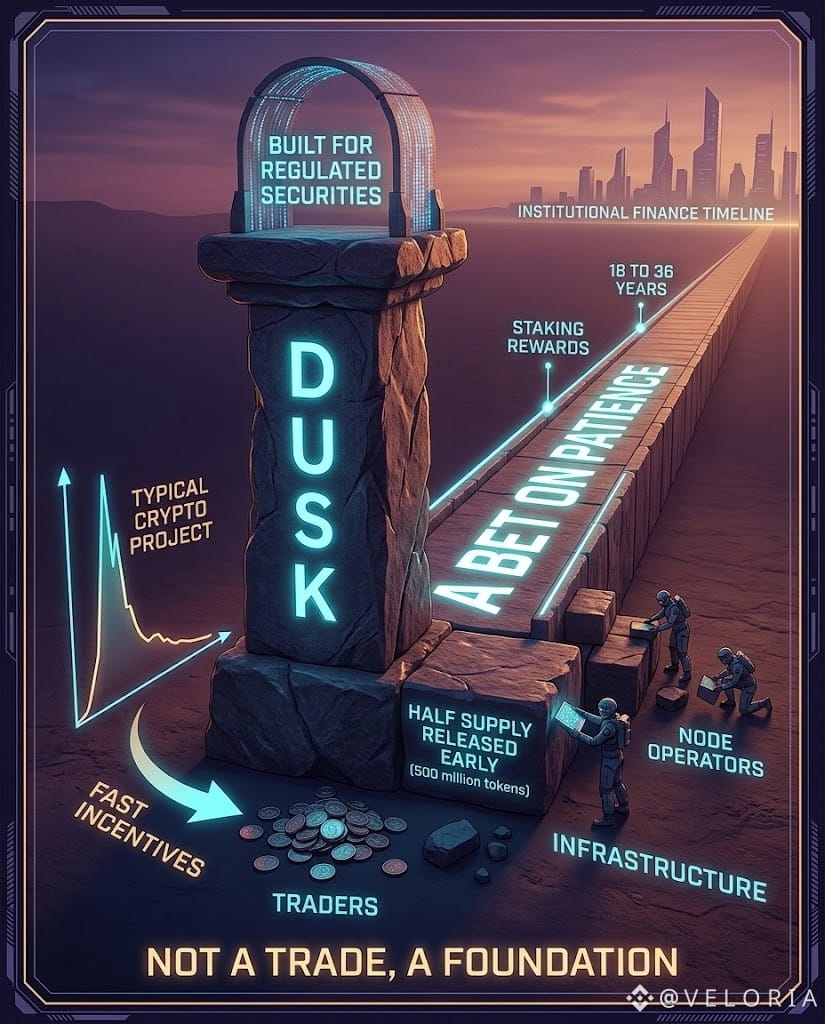
Half the total supply - 500 million tokens - was released early. The other half unlocks gradually, over 18 to 36 years, mostly through staking rewards. That's not a typo. Most projects front-load incentives to bootstrap activity fast, then hope the ecosystem is strong enough to carry itself once the rewards taper off. Dusk did the opposite: it stretched the runway out almost to the length of a career.
Underneath that choice is a bet on patience. A chain built for regulated securities isn't trying to win a liquidity war this quarter. It's trying to still be operating, still compliant, still trusted, decades from now - because that's the actual timeline institutional finance runs on. A pension fund doesn't care if your token pumped in March. It cares if the settlement layer will still exist when the bond matures.
That long tail also shapes who stays. Fast emissions attract traders chasing yield. Slow, decades-long emissions filter for node operators who are in it for infrastructure, not exit velocity. It's a quieter kind of network effect - fewer people, but stickier ones.
The risk, obviously, is that patience isn't rewarded if adoption never arrives. A 30-year unlock schedule means nothing if the chain is irrelevant in five.
But the design tells you what Dusk actually believes about itself: not a trade, a foundation. Whether that foundation gets built on remains, honestly, an open question.
@Dusk_Foundation
{future}(DUSKUSDT)
#dusk $DUSK What nobody talks about with Dusk is the emission schedule, and once you notice it, it explains a lot about the project's whole temperament.
Half the total supply - 500 million tokens - was released early. The other half unlocks gradually, over 18 to 36 years, mostly through staking rewards. That's not a typo. Most projects front-load incentives to bootstrap activity fast, then hope the ecosystem is strong enough to carry itself once the rewards taper off. Dusk did the opposite: it stretched the runway out almost to the length of a career.
Underneath that choice is a bet on patience. A chain built for regulated securities isn't trying to win a liquidity war this quarter. It's trying to still be operating, still compliant, still trusted, decades from now - because that's the actual timeline institutional finance runs on. A pension fund doesn't care if your token pumped in March. It cares if the settlement layer will still exist when the bond matures.
That long tail also shapes who stays. Fast emissions attract traders chasing yield. Slow, decades-long emissions filter for node operators who are in it for infrastructure, not exit velocity. It's a quieter kind of network effect - fewer people, but stickier ones.
The risk, obviously, is that patience isn't rewarded if adoption never arrives. A 30-year unlock schedule means nothing if the chain is irrelevant in five.
But the design tells you what Dusk actually believes about itself: not a trade, a foundation. Whether that foundation gets built on remains, honestly, an open question.
@Dusk
Half the total supply - 500 million tokens - was released early. The other half unlocks gradually, over 18 to 36 years, mostly through staking rewards. That's not a typo. Most projects front-load incentives to bootstrap activity fast, then hope the ecosystem is strong enough to carry itself once the rewards taper off. Dusk did the opposite: it stretched the runway out almost to the length of a career.
Underneath that choice is a bet on patience. A chain built for regulated securities isn't trying to win a liquidity war this quarter. It's trying to still be operating, still compliant, still trusted, decades from now - because that's the actual timeline institutional finance runs on. A pension fund doesn't care if your token pumped in March. It cares if the settlement layer will still exist when the bond matures.
That long tail also shapes who stays. Fast emissions attract traders chasing yield. Slow, decades-long emissions filter for node operators who are in it for infrastructure, not exit velocity. It's a quieter kind of network effect - fewer people, but stickier ones.
The risk, obviously, is that patience isn't rewarded if adoption never arrives. A 30-year unlock schedule means nothing if the chain is irrelevant in five.
But the design tells you what Dusk actually believes about itself: not a trade, a foundation. Whether that foundation gets built on remains, honestly, an open question.
@Dusk
6
6
207
#dusk $DUSK What struck me first about Dusk wasn't the privacy tech-it was who it's trying to talk to. Most chains chase retail speculation. Dusk built its whole roadmap around regulators, and that's a strange bet until you look underneath it.
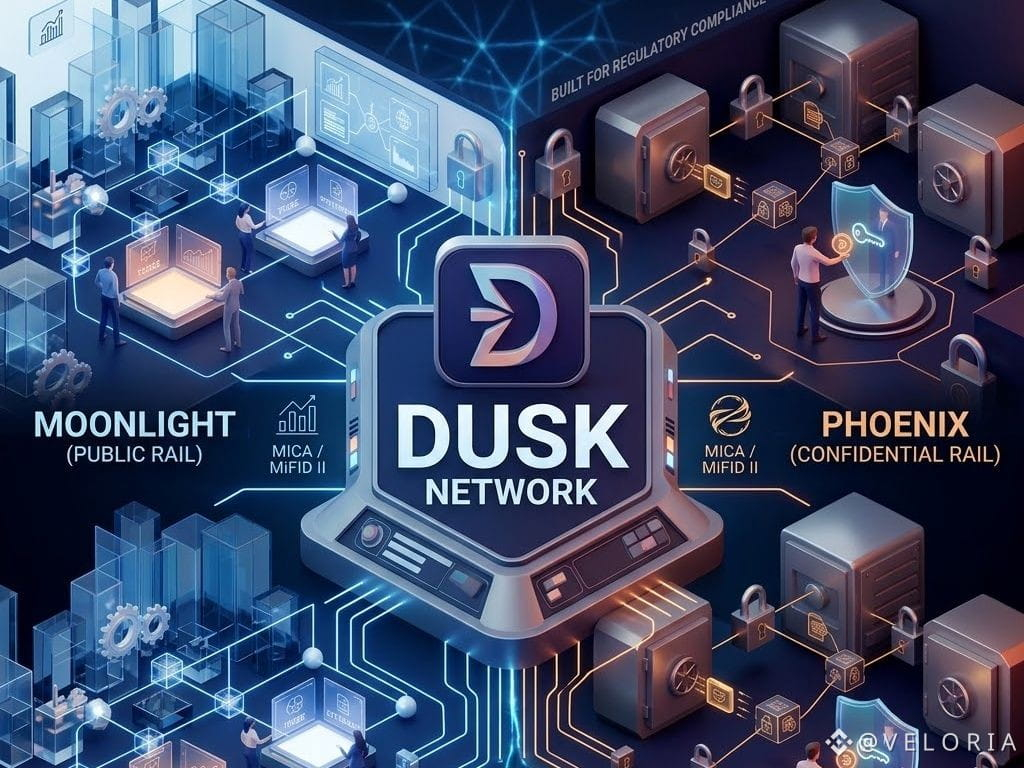
The core idea is simple: financial markets need privacy, but they also need to prove compliance. Those two things usually fight each other. Dusk's answer is Phoenix, a transaction model where the sender can be revealed to the receiver without broadcasting it to the world. That's not anonymity — it's selective disclosure, and the distinction matters more than it sounds like it should, because MiCA and MiFID II don't ask for secrecy, they ask for accountability.
Meanwhile Moonlight sits next to Phoenix as a public rail, so the same network can settle a transparent trade and a confidential one, side by side. That flexibility is the quiet bet here: institutions won't move real securities onto a chain that forces an all-or-nothing choice between openness and privacy.
The NPEX partnership is the tell. A regulated Dutch exchange doesn't plug into infrastructure for narrative reasons — it does it because settlement finality and compliance logic already work. Early signs suggest that relationship is doing more for Dusk's credibility than any exchange listing could.
The token's market cap still looks small next to the ambition, and that gap is honest — building for institutions is slow, unglamorous work with no guarantee of adoption.
But if regulated finance ever does move on-chain at scale, it won't be loud. It'll look exactly like this: boring, compliant, and already there.
@Dusk_Foundation
{future}(DUSKUSDT)
#dusk $DUSK What struck me first about Dusk wasn't the privacy tech-it was who it's trying to talk to. Most chains chase retail speculation. Dusk built its whole roadmap around regulators, and that's a strange bet until you look underneath it.
The core idea is simple: financial markets need privacy, but they also need to prove compliance. Those two things usually fight each other. Dusk's answer is Phoenix, a transaction model where the sender can be revealed to the receiver without broadcasting it to the world. That's not anonymity — it's selective disclosure, and the distinction matters more than it sounds like it should, because MiCA and MiFID II don't ask for secrecy, they ask for accountability.
Meanwhile Moonlight sits next to Phoenix as a public rail, so the same network can settle a transparent trade and a confidential one, side by side. That flexibility is the quiet bet here: institutions won't move real securities onto a chain that forces an all-or-nothing choice between openness and privacy.
The NPEX partnership is the tell. A regulated Dutch exchange doesn't plug into infrastructure for narrative reasons — it does it because settlement finality and compliance logic already work. Early signs suggest that relationship is doing more for Dusk's credibility than any exchange listing could.
The token's market cap still looks small next to the ambition, and that gap is honest — building for institutions is slow, unglamorous work with no guarantee of adoption.
But if regulated finance ever does move on-chain at scale, it won't be loud. It'll look exactly like this: boring, compliant, and already there.
@Dusk
The core idea is simple: financial markets need privacy, but they also need to prove compliance. Those two things usually fight each other. Dusk's answer is Phoenix, a transaction model where the sender can be revealed to the receiver without broadcasting it to the world. That's not anonymity — it's selective disclosure, and the distinction matters more than it sounds like it should, because MiCA and MiFID II don't ask for secrecy, they ask for accountability.
Meanwhile Moonlight sits next to Phoenix as a public rail, so the same network can settle a transparent trade and a confidential one, side by side. That flexibility is the quiet bet here: institutions won't move real securities onto a chain that forces an all-or-nothing choice between openness and privacy.
The NPEX partnership is the tell. A regulated Dutch exchange doesn't plug into infrastructure for narrative reasons — it does it because settlement finality and compliance logic already work. Early signs suggest that relationship is doing more for Dusk's credibility than any exchange listing could.
The token's market cap still looks small next to the ambition, and that gap is honest — building for institutions is slow, unglamorous work with no guarantee of adoption.
But if regulated finance ever does move on-chain at scale, it won't be loud. It'll look exactly like this: boring, compliant, and already there.
@Dusk
3
7
292
V E L O R I A
·
--
[Terminé] 🎙️ USD1 meets WLFI — crypto momentum rising 🚀
370 auditeurs
31
#baby $BABY I hadn't thought much about ecosystem integrations until I noticed how often Cosmos, Polygon, and various Bitcoin Layer 2s all get mentioned together, as if plugging into Babylon is a simple, uniform process. The more I looked into it, the more it felt like these integrations aren't really doing the same thing under the hood, even though they get described that way.
Cosmos is one clear example.... It uses Babylon's Comet extension to strengthen security across the Cosmos Hub and its connected chains, mainly to prevent issues like double signing. ..
That's a specific, technical use case tied closely to how Cosmos validators operate. Polygon and various Bitcoin Layer 2s have different consensus setups entirely, so the way they benefit from Babylon likely isn't identical, even if the end goal sounds the same on the surface.
What stood out to me is that all these different ecosystems end up depending on the same underlying resource, whether that's Bitcoin's blockspace for timestamping or the same pool of finality providers confirming things across chains. That's efficient in one sense, since nobody has to build their own security system from scratch. But it also means these ecosystems aren't as independent from each other as they might appear.
I found myself wondering what happens if multiple integrated chains need something from that shared system at the same time. Does one get prioritized over another? Is there enough capacity for all of them without friction? I haven't seen this explained clearly anywhere, and it isn't something that shows up until real demand actually tests it.
Right now, each new integration just looks like another chain plugging in. Whether that shared dependency causes problems later probably won't be clear until enough of these ecosystems are relying on it under real, simultaneous pressure.
@babylonlabs_io $BABY
{spot}(BABYUSDT)
#baby $BABY I hadn't thought much about ecosystem integrations until I noticed how often Cosmos, Polygon, and various Bitcoin Layer 2s all get mentioned together, as if plugging into Babylon is a simple, uniform process. The more I looked into it, the more it felt like these integrations aren't really doing the same thing under the hood, even though they get described that way.
Cosmos is one clear example.... It uses Babylon's Comet extension to strengthen security across the Cosmos Hub and its connected chains, mainly to prevent issues like double signing. ..
That's a specific, technical use case tied closely to how Cosmos validators operate. Polygon and various Bitcoin Layer 2s have different consensus setups entirely, so the way they benefit from Babylon likely isn't identical, even if the end goal sounds the same on the surface.
What stood out to me is that all these different ecosystems end up depending on the same underlying resource, whether that's Bitcoin's blockspace for timestamping or the same pool of finality providers confirming things across chains. That's efficient in one sense, since nobody has to build their own security system from scratch. But it also means these ecosystems aren't as independent from each other as they might appear.
I found myself wondering what happens if multiple integrated chains need something from that shared system at the same time. Does one get prioritized over another? Is there enough capacity for all of them without friction? I haven't seen this explained clearly anywhere, and it isn't something that shows up until real demand actually tests it.
Right now, each new integration just looks like another chain plugging in. Whether that shared dependency causes problems later probably won't be clear until enough of these ecosystems are relying on it under real, simultaneous pressure.
@BabylonLabs_io $BABY
Cosmos is one clear example.... It uses Babylon's Comet extension to strengthen security across the Cosmos Hub and its connected chains, mainly to prevent issues like double signing. ..
That's a specific, technical use case tied closely to how Cosmos validators operate. Polygon and various Bitcoin Layer 2s have different consensus setups entirely, so the way they benefit from Babylon likely isn't identical, even if the end goal sounds the same on the surface.
What stood out to me is that all these different ecosystems end up depending on the same underlying resource, whether that's Bitcoin's blockspace for timestamping or the same pool of finality providers confirming things across chains. That's efficient in one sense, since nobody has to build their own security system from scratch. But it also means these ecosystems aren't as independent from each other as they might appear.
I found myself wondering what happens if multiple integrated chains need something from that shared system at the same time. Does one get prioritized over another? Is there enough capacity for all of them without friction? I haven't seen this explained clearly anywhere, and it isn't something that shows up until real demand actually tests it.
Right now, each new integration just looks like another chain plugging in. Whether that shared dependency causes problems later probably won't be clear until enough of these ecosystems are relying on it under real, simultaneous pressure.
@BabylonLabs_io $BABY
6
8
139
#baby $BABY I wasn't planning to dig into this part specifically, but I kept circling back to how casually "checkpointing" gets mentioned in Babylon's writeups, like it's a settled feature rather than something that has to hold up under real adversarial pressure. The basic claim is that Babylon timestamps proof-of-stake chain events onto the Bitcoin mainnet through a relay mechanism, which is meant to strengthen protection against long-range attacks — the kind where someone tries to rewrite a chain's history from far back. On paper, that's an elegant fix. In practice, I found myself wondering what "timestamped" actually guarantees once you look past the headline.
The problem long-range attacks solve for is subtle: in a pure proof-of-stake system, there's nothing physically stopping someone from building an alternate history from genesis if they can acquire old validator keys. Bitcoin's proof-of-work makes rewriting history expensive because you'd need to redo real computational work. Babylon's move is to borrow that expense by anchoring PoS history into Bitcoin's own immutable record. What seems interesting is that this doesn't prevent someone from attempting a rewrite — it just makes the rewrite provably inconsistent with what's already stamped on Bitcoin.
But that raises a question I haven't seen addressed directly: what's the actual latency between an event happening on the PoS chain and it being safely checkpointed into Bitcoin? Because until that checkpoint lands, doesn't the chain still have some exposure window where a rollback attempt hasn't been "caught" yet? I'm not sure if that window is negligible or meaningful under stress, and the documentation doesn't dwell on it.
It sounds like a security guarantee, and mostly it is, but it might really be closer to a security guarantee with a lag baked into it — something that probably only becomes visible once someone actually tries to exploit that gap in practice.
@babylonlabs_io
{spot}(BABYUSDT)
#baby $BABY I wasn't planning to dig into this part specifically, but I kept circling back to how casually "checkpointing" gets mentioned in Babylon's writeups, like it's a settled feature rather than something that has to hold up under real adversarial pressure. The basic claim is that Babylon timestamps proof-of-stake chain events onto the Bitcoin mainnet through a relay mechanism, which is meant to strengthen protection against long-range attacks — the kind where someone tries to rewrite a chain's history from far back. On paper, that's an elegant fix. In practice, I found myself wondering what "timestamped" actually guarantees once you look past the headline.
The problem long-range attacks solve for is subtle: in a pure proof-of-stake system, there's nothing physically stopping someone from building an alternate history from genesis if they can acquire old validator keys. Bitcoin's proof-of-work makes rewriting history expensive because you'd need to redo real computational work. Babylon's move is to borrow that expense by anchoring PoS history into Bitcoin's own immutable record. What seems interesting is that this doesn't prevent someone from attempting a rewrite — it just makes the rewrite provably inconsistent with what's already stamped on Bitcoin.
But that raises a question I haven't seen addressed directly: what's the actual latency between an event happening on the PoS chain and it being safely checkpointed into Bitcoin? Because until that checkpoint lands, doesn't the chain still have some exposure window where a rollback attempt hasn't been "caught" yet? I'm not sure if that window is negligible or meaningful under stress, and the documentation doesn't dwell on it.
It sounds like a security guarantee, and mostly it is, but it might really be closer to a security guarantee with a lag baked into it — something that probably only becomes visible once someone actually tries to exploit that gap in practice.
@BabylonLabs_io
The problem long-range attacks solve for is subtle: in a pure proof-of-stake system, there's nothing physically stopping someone from building an alternate history from genesis if they can acquire old validator keys. Bitcoin's proof-of-work makes rewriting history expensive because you'd need to redo real computational work. Babylon's move is to borrow that expense by anchoring PoS history into Bitcoin's own immutable record. What seems interesting is that this doesn't prevent someone from attempting a rewrite — it just makes the rewrite provably inconsistent with what's already stamped on Bitcoin.
But that raises a question I haven't seen addressed directly: what's the actual latency between an event happening on the PoS chain and it being safely checkpointed into Bitcoin? Because until that checkpoint lands, doesn't the chain still have some exposure window where a rollback attempt hasn't been "caught" yet? I'm not sure if that window is negligible or meaningful under stress, and the documentation doesn't dwell on it.
It sounds like a security guarantee, and mostly it is, but it might really be closer to a security guarantee with a lag baked into it — something that probably only becomes visible once someone actually tries to exploit that gap in practice.
@BabylonLabs_io
3
2
187
CRO BUY SIGNAL ALERT 🚀
CRO has broken above a key resistance at $0.35, signaling a potential buying opportunity. The 24h candle has closed with a strong green candle, indicating a strong bullish momentum.
Current Price: $0.37
24h Change: +4.5%
Previous Support: $0.32
Buy and hold or accumulate CRO on dips. The next target is $0.45. Don't miss out on this CRO rally! 💸 #CRO #Crypto #Binance
CRO BUY SIGNAL ALERT 🚀
CRO has broken above a key resistance at $0.35, signaling a potential buying opportunity. The 24h candle has closed with a strong green candle, indicating a strong bullish momentum.
Current Price: $0.37
24h Change: +4.5%
Previous Support: $0.32
Buy and hold or accumulate CRO on dips. The next target is $0.45. Don't miss out on this CRO rally! 💸 #CRO #Crypto #Binance
CRO has broken above a key resistance at $0.35, signaling a potential buying opportunity. The 24h candle has closed with a strong green candle, indicating a strong bullish momentum.
Current Price: $0.37
24h Change: +4.5%
Previous Support: $0.32
Buy and hold or accumulate CRO on dips. The next target is $0.45. Don't miss out on this CRO rally! 💸 #CRO #Crypto #Binance
2
3
45
BREAKING NEWS: SEI PRICE ACTION
SEI/USDT is seeing a surge in trading activity with 24h volume surpassing 23 million USDT. The asset has managed to stay above the 24h low of 0.04438 USDT, despite the slight 1.10% price correction. SEI currently trades at 0.04518 USDT, just below the 24h high of 0.04573 USDT. This minor price fluctuation may be a sign of consolidation before a potential price jump. Stay tuned for further updates. #SEI #Crypto #Binance
BREAKING NEWS: SEI PRICE ACTION
SEI/USDT is seeing a surge in trading activity with 24h volume surpassing 23 million USDT. The asset has managed to stay above the 24h low of 0.04438 USDT, despite the slight 1.10% price correction. SEI currently trades at 0.04518 USDT, just below the 24h high of 0.04573 USDT. This minor price fluctuation may be a sign of consolidation before a potential price jump. Stay tuned for further updates. #SEI #Crypto #Binance
SEI/USDT is seeing a surge in trading activity with 24h volume surpassing 23 million USDT. The asset has managed to stay above the 24h low of 0.04438 USDT, despite the slight 1.10% price correction. SEI currently trades at 0.04518 USDT, just below the 24h high of 0.04573 USDT. This minor price fluctuation may be a sign of consolidation before a potential price jump. Stay tuned for further updates. #SEI #Crypto #Binance
2
69
USTC Market Analysis
USTC/USDT continues to trade sideways, with a slight dip in the past 24 hours. The current price of 0.00531 USDT represents a 0.75% decrease from yesterday's levels.
The asset's trading volume remains substantial at 17,203,351 USDT, indicating a relatively high level of market activity. The 24-hour high and low of 0.00535 USDT and 0.00527 USDT, respectively, suggest a relatively narrow price range.
Given the current stability and moderate trading volume, we may see a short-term consolidation phase for USTC. Investors should closely monitor the asset's performance and be prepared for potential market fluctuations.
#USTC #Crypto #Binance
USTC Market Analysis
USTC/USDT continues to trade sideways, with a slight dip in the past 24 hours. The current price of 0.00531 USDT represents a 0.75% decrease from yesterday's levels.
The asset's trading volume remains substantial at 17,203,351 USDT, indicating a relatively high level of market activity. The 24-hour high and low of 0.00535 USDT and 0.00527 USDT, respectively, suggest a relatively narrow price range.
Given the current stability and moderate trading volume, we may see a short-term consolidation phase for USTC. Investors should closely monitor the asset's performance and be prepared for potential market fluctuations.
#USTC #Crypto #Binance
USTC/USDT continues to trade sideways, with a slight dip in the past 24 hours. The current price of 0.00531 USDT represents a 0.75% decrease from yesterday's levels.
The asset's trading volume remains substantial at 17,203,351 USDT, indicating a relatively high level of market activity. The 24-hour high and low of 0.00535 USDT and 0.00527 USDT, respectively, suggest a relatively narrow price range.
Given the current stability and moderate trading volume, we may see a short-term consolidation phase for USTC. Investors should closely monitor the asset's performance and be prepared for potential market fluctuations.
#USTC #Crypto #Binance
1
1
270
Connectez-vous pour découvrir plus de contenu
Rejoignez la communauté mondiale des adeptes de cryptomonnaies sur Binance Square
⚡️ Suviez les dernières informations importantes sur les cryptomonnaies.
💬 Jugé digne de confiance par la plus grande plateforme d’échange de cryptomonnaies au monde.
👍 Découvrez les connaissances que partagent les créateurs vérifiés.
Adresse e-mail/Nº de téléphone