

Just_Mike
39 Publications

Just_Mike
Signaler
Bloquer l’utilisateur
7 Suivis
22 Abonnés
41 J’aime
Publications
Tous
Citations
·
--
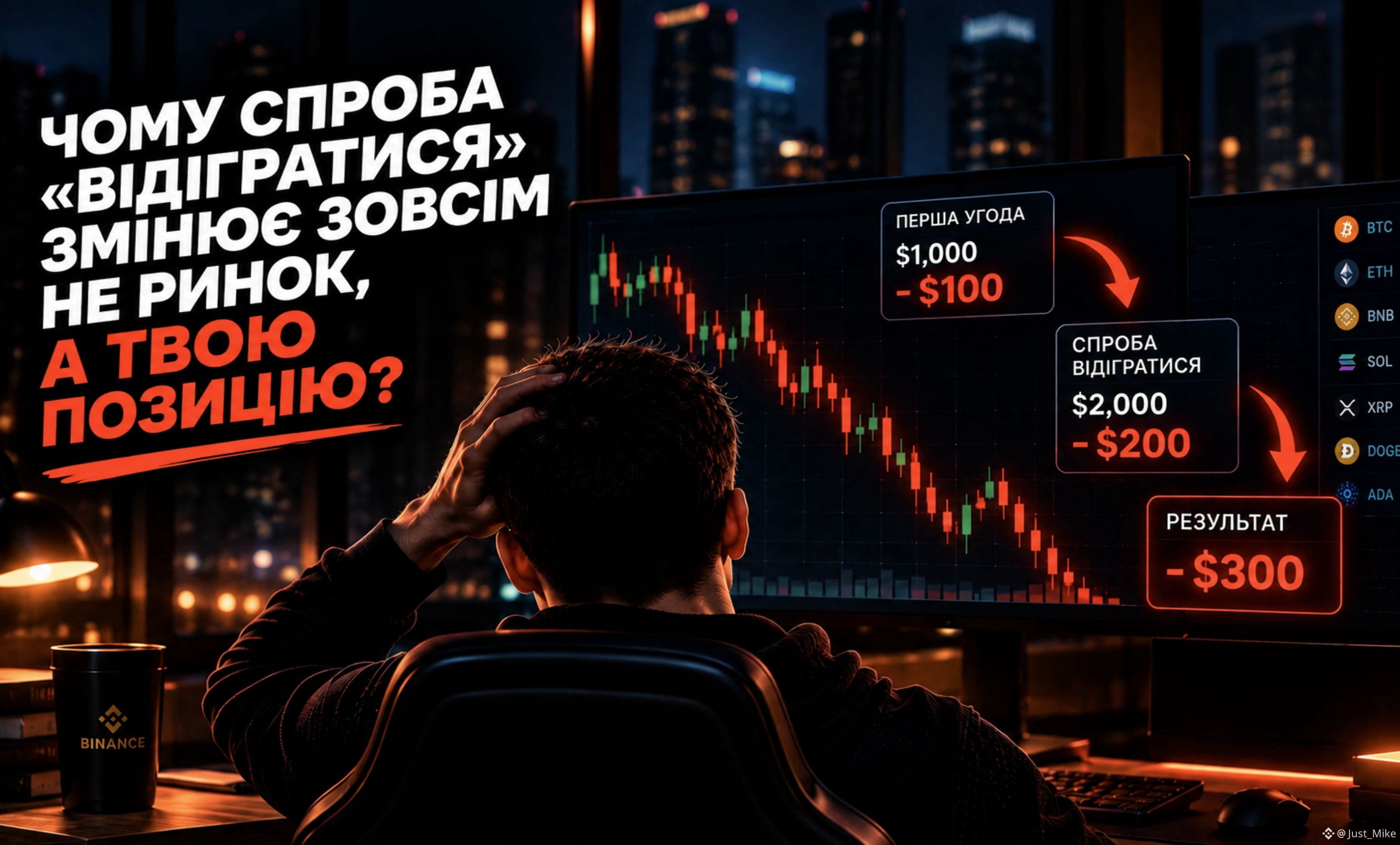
Чому спроба «відігратися» змінює зовсім не ринок, а твою позицію?
Уявімо:
Ти відкрив угоду на $1 000 і втратив $100.
Перша думка може бути:
«Треба повернути ці $100 наступною угодою».
І тут часто змінюється не ринок, а твоя поведінка.
Замість позиції на $1 000 ти відкриваєш уже на $2 000.
Ринок при цьому нічого не знає про твої попередні збитки.
Але твій ризик змінився.
Якщо наступна позиція також піде проти тебе на 10%:
−$100 → ще −$200 = −$300.
Тобто бажання «відігратися» не збільшує твої шанси повернути збиток. Воно може просто збільшити суму, яку ти готовий втратити в наступній угоді.
І тут важливо розділяти:
ринок → рухається незалежно від твоєї попередньої угоди;
позиція → змінюється залежно від того, як ти вирішив торгувати далі.
Тому після збитку головне питання не:
«Як швидше повернути ці гроші?»
а:
«Чи змінився мій ризик через бажання їх повернути?»
#Trading #RiskManagement
Чому спроба «відігратися» змінює зовсім не ринок, а твою позицію?
Уявімо:
Ти відкрив угоду на $1 000 і втратив $100.
Перша думка може бути:
«Треба повернути ці $100 наступною угодою».
І тут часто змінюється не ринок, а твоя поведінка.
Замість позиції на $1 000 ти відкриваєш уже на $2 000.
Ринок при цьому нічого не знає про твої попередні збитки.
Але твій ризик змінився.
Якщо наступна позиція також піде проти тебе на 10%:
−$100 → ще −$200 = −$300.
Тобто бажання «відігратися» не збільшує твої шанси повернути збиток. Воно може просто збільшити суму, яку ти готовий втратити в наступній угоді.
І тут важливо розділяти:
ринок → рухається незалежно від твоєї попередньої угоди;
позиція → змінюється залежно від того, як ти вирішив торгувати далі.
Тому після збитку головне питання не:
«Як швидше повернути ці гроші?»
а:
«Чи змінився мій ризик через бажання їх повернути?»
#Trading #RiskManagement
Уявімо:
Ти відкрив угоду на $1 000 і втратив $100.
Перша думка може бути:
«Треба повернути ці $100 наступною угодою».
І тут часто змінюється не ринок, а твоя поведінка.
Замість позиції на $1 000 ти відкриваєш уже на $2 000.
Ринок при цьому нічого не знає про твої попередні збитки.
Але твій ризик змінився.
Якщо наступна позиція також піде проти тебе на 10%:
−$100 → ще −$200 = −$300.
Тобто бажання «відігратися» не збільшує твої шанси повернути збиток. Воно може просто збільшити суму, яку ти готовий втратити в наступній угоді.
І тут важливо розділяти:
ринок → рухається незалежно від твоєї попередньої угоди;
позиція → змінюється залежно від того, як ти вирішив торгувати далі.
Тому після збитку головне питання не:
«Як швидше повернути ці гроші?»
а:
«Чи змінився мій ризик через бажання їх повернути?»
#Trading #RiskManagement
100
·
--
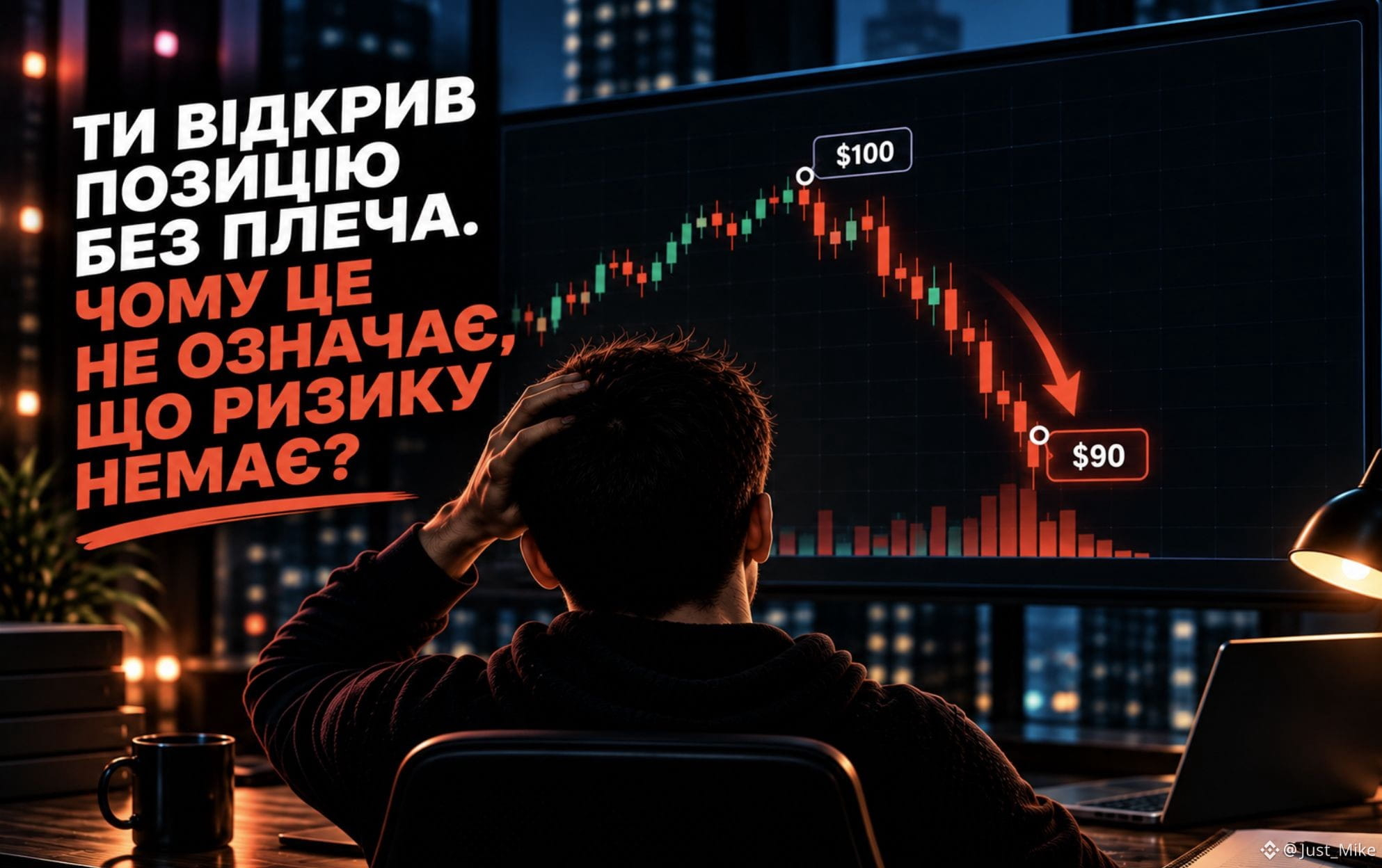
Ти відкрив позицію без плеча. Чому це не означає, що ризику немає?
Многие считают:
«Я не використовую плече → отже, мене не можуть ліквідувати → значить, ризику майже немає».
Перша частина логіки справді правильна: без плеча немає ризику ліквідації, характерного для leveraged futures-позицій. Але це не означає, що сама позиція безпечна.
Уявімо:
Ти купив активів на $1 000.
Актив падає на 10% → твоя позиція коштує вже $900.
Плеча не було. Ліквідації немає. Але $100 вартості позиції ти все одно втратив.
І тут залишаються інші ризики:
🔹 Ризик ціни — актив може падати далі.
🔹 Ризик розміру позиції — 10% від $100 і від $10 000 — це зовсім різні суми.
🔹 Ризик ліквідності — з великої позиції може бути складніше вийти за бажаною ціною, що може призвести до slippage.
Тому «без плеча» ≠ «без ризику».
Плечо додає ще один шар ризику — збільшує експозицію відносно власного капіталу та може наблизити ліквідацію.
Але навіть без нього варто запитати себе:
скільки я можу втратити, якщо ціна піде проти мене?
#Trading #RiskManagement
Ти відкрив позицію без плеча. Чому це не означає, що ризику немає?
Многие считают:
«Я не використовую плече → отже, мене не можуть ліквідувати → значить, ризику майже немає».
Перша частина логіки справді правильна: без плеча немає ризику ліквідації, характерного для leveraged futures-позицій. Але це не означає, що сама позиція безпечна.
Уявімо:
Ти купив активів на $1 000.
Актив падає на 10% → твоя позиція коштує вже $900.
Плеча не було. Ліквідації немає. Але $100 вартості позиції ти все одно втратив.
І тут залишаються інші ризики:
🔹 Ризик ціни — актив може падати далі.
🔹 Ризик розміру позиції — 10% від $100 і від $10 000 — це зовсім різні суми.
🔹 Ризик ліквідності — з великої позиції може бути складніше вийти за бажаною ціною, що може призвести до slippage.
Тому «без плеча» ≠ «без ризику».
Плечо додає ще один шар ризику — збільшує експозицію відносно власного капіталу та може наблизити ліквідацію.
Але навіть без нього варто запитати себе:
скільки я можу втратити, якщо ціна піде проти мене?
#Trading #RiskManagement
Многие считают:
«Я не використовую плече → отже, мене не можуть ліквідувати → значить, ризику майже немає».
Перша частина логіки справді правильна: без плеча немає ризику ліквідації, характерного для leveraged futures-позицій. Але це не означає, що сама позиція безпечна.
Уявімо:
Ти купив активів на $1 000.
Актив падає на 10% → твоя позиція коштує вже $900.
Плеча не було. Ліквідації немає. Але $100 вартості позиції ти все одно втратив.
І тут залишаються інші ризики:
🔹 Ризик ціни — актив може падати далі.
🔹 Ризик розміру позиції — 10% від $100 і від $10 000 — це зовсім різні суми.
🔹 Ризик ліквідності — з великої позиції може бути складніше вийти за бажаною ціною, що може призвести до slippage.
Тому «без плеча» ≠ «без ризику».
Плечо додає ще один шар ризику — збільшує експозицію відносно власного капіталу та може наблизити ліквідацію.
Але навіть без нього варто запитати себе:
скільки я можу втратити, якщо ціна піде проти мене?
#Trading #RiskManagement
599
·
--
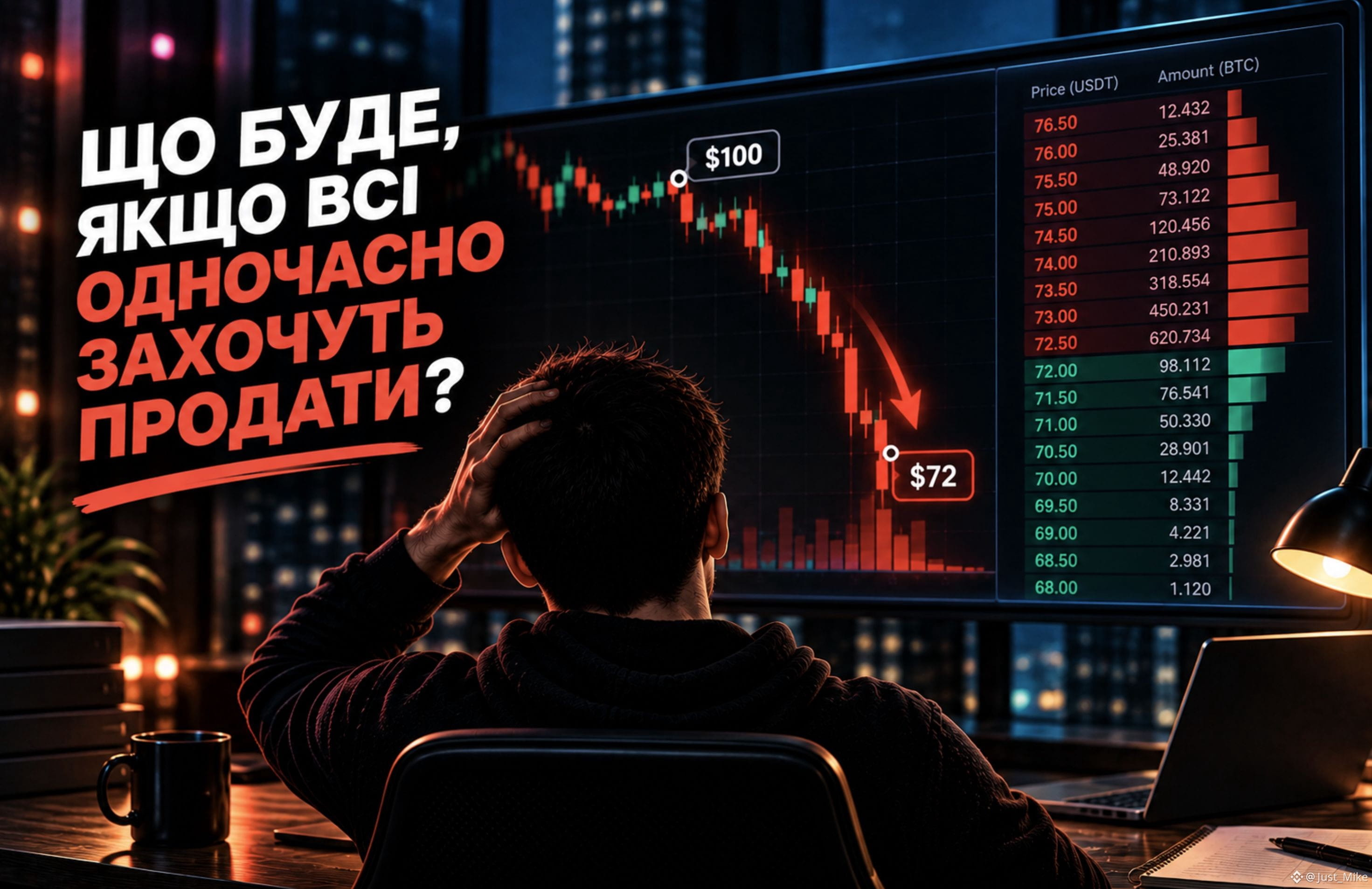
Що буде, якщо всі одночасно захочуть продати?
Уявімо ситуацію:
ти купив актив за $100.
А потім на ринку одночасно з'являється дуже багато продавців.
Що відбувається?
Покупців за ціною $100 може просто не вистачити на весь обсяг продажу.
Тоді продавці починають забирати заявки покупців нижче:
$100 → $99 → $98 → $95…
І ціна може падати дуже швидко.
Саме тут важлива ліквідність.
Ліквідність показує, наскільки легко купити або продати актив без суттєвого впливу на його ціну.
📉 Висока ліквідність → багато заявок у ринку, великий обсяг можна провести з меншим впливом на ціну.
📉 Низька ліквідність → заявок менше, тому навіть відносно великий ордер може сильно посунути ціну.
Тому різке падіння — це не завжди означає, що актив раптом став «гіршим».
Іноді проблема в іншому:
продавців стало набагато більше, ніж готових покупців за поточними цінами.
Ось чому під час різких рухів важливо дивитися не лише на ціну активу, а й на те, скільки ліквідності є на ринку.
#Trading #Liquidity
Що буде, якщо всі одночасно захочуть продати?
Уявімо ситуацію:
ти купив актив за $100.
А потім на ринку одночасно з'являється дуже багато продавців.
Що відбувається?
Покупців за ціною $100 може просто не вистачити на весь обсяг продажу.
Тоді продавці починають забирати заявки покупців нижче:
$100 → $99 → $98 → $95…
І ціна може падати дуже швидко.
Саме тут важлива ліквідність.
Ліквідність показує, наскільки легко купити або продати актив без суттєвого впливу на його ціну.
📉 Висока ліквідність → багато заявок у ринку, великий обсяг можна провести з меншим впливом на ціну.
📉 Низька ліквідність → заявок менше, тому навіть відносно великий ордер може сильно посунути ціну.
Тому різке падіння — це не завжди означає, що актив раптом став «гіршим».
Іноді проблема в іншому:
продавців стало набагато більше, ніж готових покупців за поточними цінами.
Ось чому під час різких рухів важливо дивитися не лише на ціну активу, а й на те, скільки ліквідності є на ринку.
#Trading #Liquidity
Уявімо ситуацію:
ти купив актив за $100.
А потім на ринку одночасно з'являється дуже багато продавців.
Що відбувається?
Покупців за ціною $100 може просто не вистачити на весь обсяг продажу.
Тоді продавці починають забирати заявки покупців нижче:
$100 → $99 → $98 → $95…
І ціна може падати дуже швидко.
Саме тут важлива ліквідність.
Ліквідність показує, наскільки легко купити або продати актив без суттєвого впливу на його ціну.
📉 Висока ліквідність → багато заявок у ринку, великий обсяг можна провести з меншим впливом на ціну.
📉 Низька ліквідність → заявок менше, тому навіть відносно великий ордер може сильно посунути ціну.
Тому різке падіння — це не завжди означає, що актив раптом став «гіршим».
Іноді проблема в іншому:
продавців стало набагато більше, ніж готових покупців за поточними цінами.
Ось чому під час різких рухів важливо дивитися не лише на ціну активу, а й на те, скільки ліквідності є на ринку.
#Trading #Liquidity
143
·
--
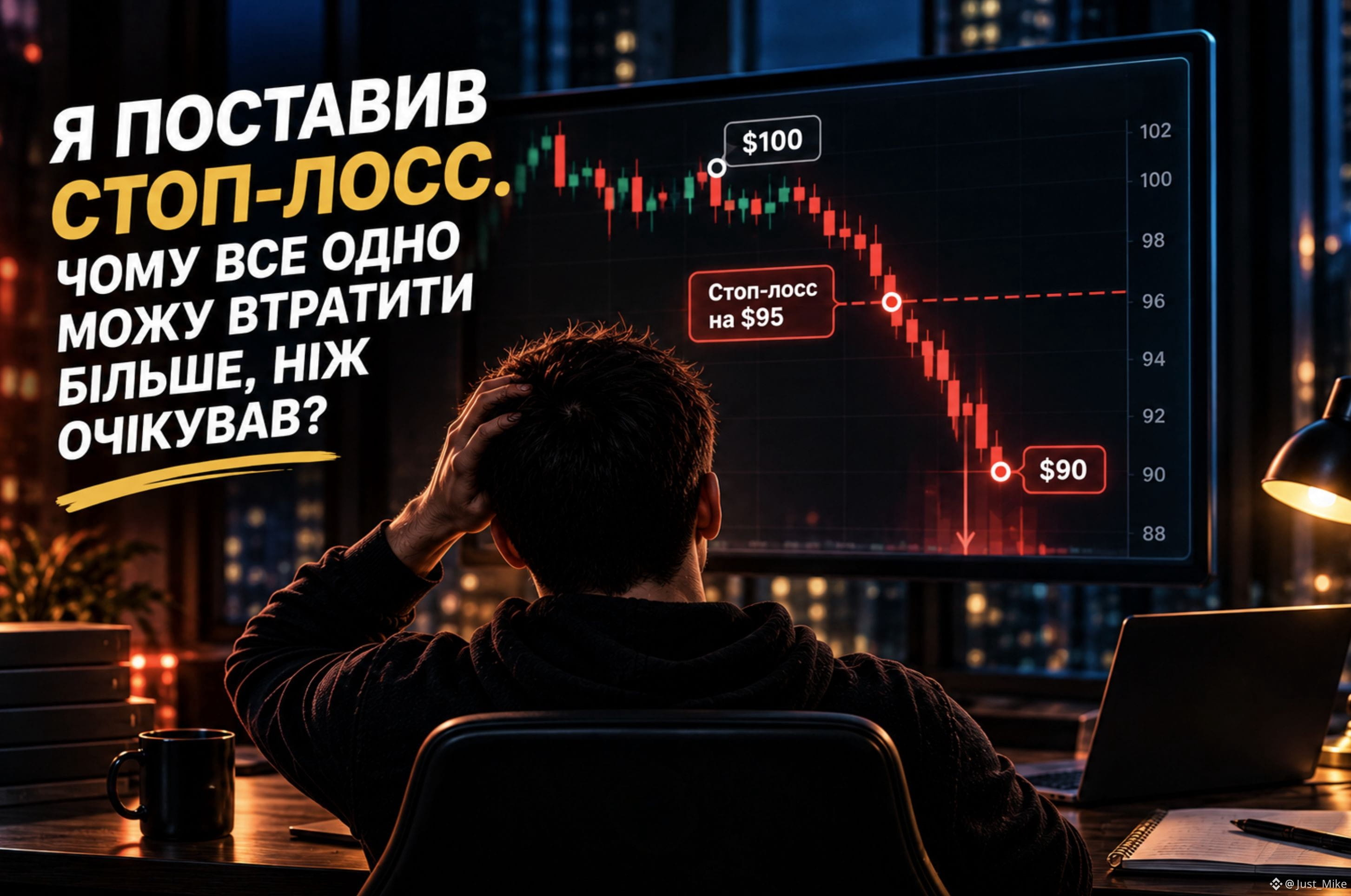
Я поставив стоп-лосс. Чому все одно можу втратити більше, ніж очікував?
Уявімо:
Ти купив актив за $100 і поставив стоп-лосс на $95.
Логіка проста:
«Я розраховую втратити близько 5%».
Але ринок не завжди рухається плавно.
Якщо ціна різко падає:
$100 → $95 → $90
стоп може виконатися не за $95.
При стоп-маркет ордері після спрацювання заявка виконується за доступними цінами. За високої волатильності між ціною спрацювання та фактичною ціною виконання може виникнути проскальзування.
А зі стоп-лімітом інша ситуація: ти контролюєш ціну виконання, але при дуже швидкому русі ордер може не виконатися.
Тобто стоп-лосс — це не гарантія:
«Я точно втрачу не більше 5%».
Це інструмент управління ризиком, але спосіб виконання ордера теж має значення.
Тому перед встановленням стопа варто розуміти не лише:
«Де я вийду?»
а й:
«Що станеться, якщо ціна пройде цей рівень за секунду?»
#Trading #RiskManagement
Я поставив стоп-лосс. Чому все одно можу втратити більше, ніж очікував?
Уявімо:
Ти купив актив за $100 і поставив стоп-лосс на $95.
Логіка проста:
«Я розраховую втратити близько 5%».
Але ринок не завжди рухається плавно.
Якщо ціна різко падає:
$100 → $95 → $90
стоп може виконатися не за $95.
При стоп-маркет ордері після спрацювання заявка виконується за доступними цінами. За високої волатильності між ціною спрацювання та фактичною ціною виконання може виникнути проскальзування.
А зі стоп-лімітом інша ситуація: ти контролюєш ціну виконання, але при дуже швидкому русі ордер може не виконатися.
Тобто стоп-лосс — це не гарантія:
«Я точно втрачу не більше 5%».
Це інструмент управління ризиком, але спосіб виконання ордера теж має значення.
Тому перед встановленням стопа варто розуміти не лише:
«Де я вийду?»
а й:
«Що станеться, якщо ціна пройде цей рівень за секунду?»
#Trading #RiskManagement
Уявімо:
Ти купив актив за $100 і поставив стоп-лосс на $95.
Логіка проста:
«Я розраховую втратити близько 5%».
Але ринок не завжди рухається плавно.
Якщо ціна різко падає:
$100 → $95 → $90
стоп може виконатися не за $95.
При стоп-маркет ордері після спрацювання заявка виконується за доступними цінами. За високої волатильності між ціною спрацювання та фактичною ціною виконання може виникнути проскальзування.
А зі стоп-лімітом інша ситуація: ти контролюєш ціну виконання, але при дуже швидкому русі ордер може не виконатися.
Тобто стоп-лосс — це не гарантія:
«Я точно втрачу не більше 5%».
Це інструмент управління ризиком, але спосіб виконання ордера теж має значення.
Тому перед встановленням стопа варто розуміти не лише:
«Де я вийду?»
а й:
«Що станеться, якщо ціна пройде цей рівень за секунду?»
#Trading #RiskManagement
139
·
--
Якщо perpetual слідує за ціною акції, навіщо йому funding?
На перший погляд funding здається просто додатковою комісією.
Але його роль зовсім інша.
TradFi Perpetual відстежує ціну базового активу, але сам контракт торгується окремо. Тому його ціна може відхилятися від underlying.
І тут виникає питання:
як зблизити ці дві ціни, якщо у perpetual немає дати експірації?
Саме для цього потрібен funding.
Якщо perpetual торгується вище ціни underlying, funding стає позитивним — long-позиції платять short-позиціям.
Якщо perpetual торгується нижче, funding може стати негативним — shorts платять longs.
Логіка проста:
ціна занадто високо → short отримує виплату → з'являється стимул продавати
ціна занадто низько → long отримує виплату → з'являється стимул купувати
Так funding допомагає утримувати ціну perpetual ближче до underlying.
І тут важлива одна річ:
funding — це не плата Binance за те, що я тримаю позицію.
Це механізм взаєморозрахунків між long і short, який допомагає підтримувати зв'язок із базовим активом.
Binance зазначає, що funding-платежі переходять між трейдерами, а не стягуються біржею як комісія.
Тому perpetual не має експірації, але funding допомагає підтримувати його зв'язок з underlying.
#TradFi
Якщо perpetual слідує за ціною акції, навіщо йому funding?
На перший погляд funding здається просто додатковою комісією.
Але його роль зовсім інша.
TradFi Perpetual відстежує ціну базового активу, але сам контракт торгується окремо. Тому його ціна може відхилятися від underlying.
І тут виникає питання:
як зблизити ці дві ціни, якщо у perpetual немає дати експірації?
Саме для цього потрібен funding.
Якщо perpetual торгується вище ціни underlying, funding стає позитивним — long-позиції платять short-позиціям.
Якщо perpetual торгується нижче, funding може стати негативним — shorts платять longs.
Логіка проста:
ціна занадто високо → short отримує виплату → з'являється стимул продавати
ціна занадто низько → long отримує виплату → з'являється стимул купувати
Так funding допомагає утримувати ціну perpetual ближче до underlying.
І тут важлива одна річ:
funding — це не плата Binance за те, що я тримаю позицію.
Це механізм взаєморозрахунків між long і short, який допомагає підтримувати зв'язок із базовим активом.
Binance зазначає, що funding-платежі переходять між трейдерами, а не стягуються біржею як комісія.
Тому perpetual не має експірації, але funding допомагає підтримувати його зв'язок з underlying.
#TradFi
На перший погляд funding здається просто додатковою комісією.
Але його роль зовсім інша.
TradFi Perpetual відстежує ціну базового активу, але сам контракт торгується окремо. Тому його ціна може відхилятися від underlying.
І тут виникає питання:
як зблизити ці дві ціни, якщо у perpetual немає дати експірації?
Саме для цього потрібен funding.
Якщо perpetual торгується вище ціни underlying, funding стає позитивним — long-позиції платять short-позиціям.
Якщо perpetual торгується нижче, funding може стати негативним — shorts платять longs.
Логіка проста:
ціна занадто високо → short отримує виплату → з'являється стимул продавати
ціна занадто низько → long отримує виплату → з'являється стимул купувати
Так funding допомагає утримувати ціну perpetual ближче до underlying.
І тут важлива одна річ:
funding — це не плата Binance за те, що я тримаю позицію.
Це механізм взаєморозрахунків між long і short, який допомагає підтримувати зв'язок із базовим активом.
Binance зазначає, що funding-платежі переходять між трейдерами, а не стягуються біржею як комісія.
Тому perpetual не має експірації, але funding допомагає підтримувати його зв'язок з underlying.
#TradFi

77
·
--
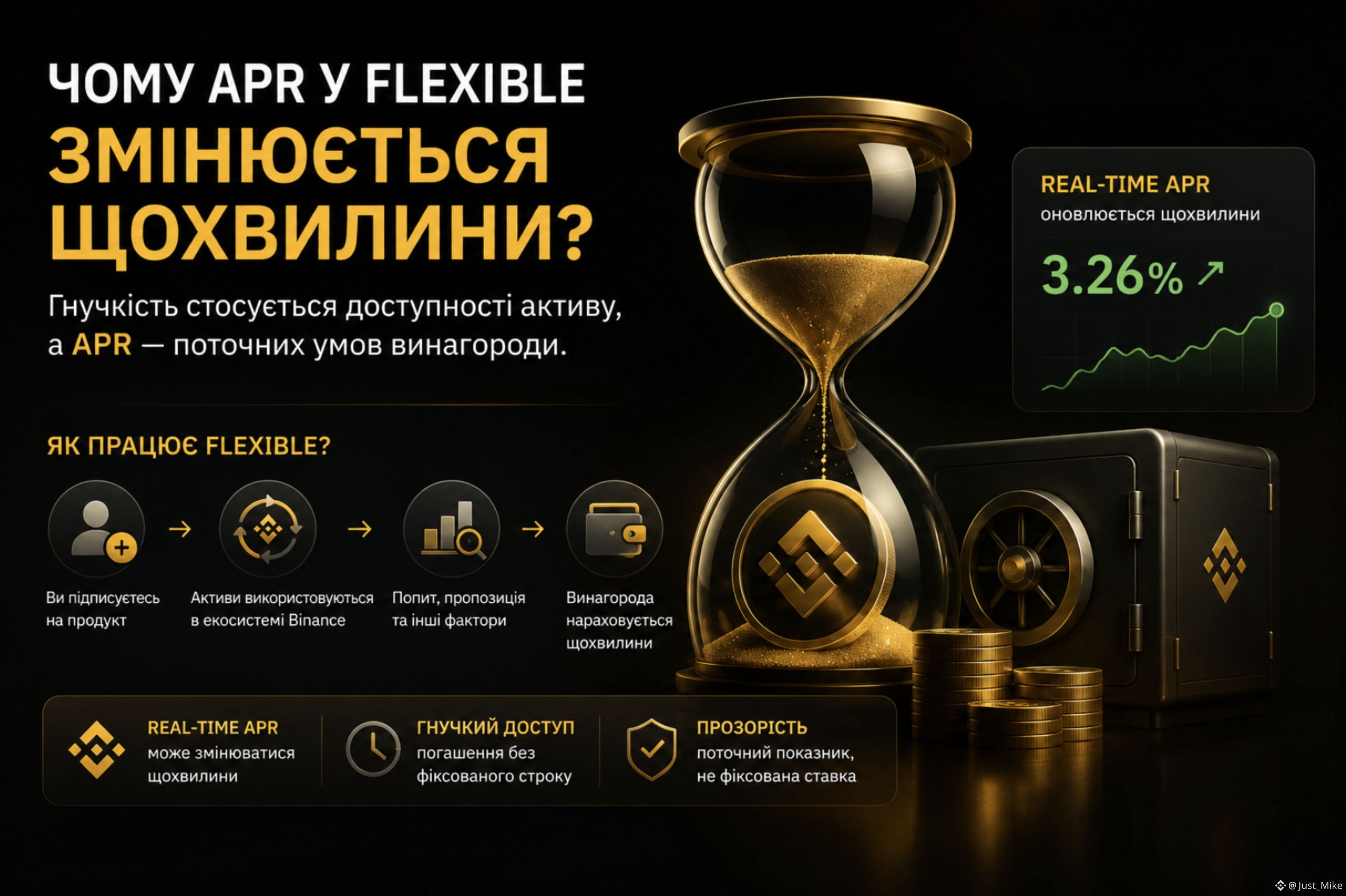
Якщо актив у Flexible можна погасити без фіксованого строку,
чому його APR змінюється щохвилини?
Раніше я сприймав Earn досить просто:
поклав актив ➞ отримую дохідність ➞ за потреби забираю актив.
Але у Flexible Products є цікава деталь.
Binance називає цю ставку Real-Time APR — вона може змінюватися щохвилини, а винагорода нараховується щохвилини.
І тут у мене виникло питання:
якщо строк не фіксований, то від чого залежить поточна дохідність?
Виявляється, механіка цікавіша, ніж просто «Binance платить відсоток за те, що ти тримаєш актив».
За інформацією Binance, активи у Flexible Products можуть використовуватися для операцій, зокрема для кредитування через Margin та Loan. Real-Time APR для токена враховує його попит, пропозицію та інші фактори.
Тобто APR тут — не обіцянка фіксованої ставки.
Це поточний показник винагороди, який може змінюватися разом з умовами, що впливають на використання активів.
І саме це мені здається найцікавішим у Flexible:
гнучкість стосується доступності активу, а APR — поточних умов винагороди.
Тому дивитися лише на цифру APR недостатньо.
Важливіше розуміти, звідки вона береться і чому може змінитися вже невдовзі після того, як ти її побачив.
#BinanceEarn #SimpleEarn
Якщо актив у Flexible можна погасити без фіксованого строку,
чому його APR змінюється щохвилини?
Раніше я сприймав Earn досить просто:
поклав актив ➞ отримую дохідність ➞ за потреби забираю актив.
Але у Flexible Products є цікава деталь.
Binance називає цю ставку Real-Time APR — вона може змінюватися щохвилини, а винагорода нараховується щохвилини.
І тут у мене виникло питання:
якщо строк не фіксований, то від чого залежить поточна дохідність?
Виявляється, механіка цікавіша, ніж просто «Binance платить відсоток за те, що ти тримаєш актив».
За інформацією Binance, активи у Flexible Products можуть використовуватися для операцій, зокрема для кредитування через Margin та Loan. Real-Time APR для токена враховує його попит, пропозицію та інші фактори.
Тобто APR тут — не обіцянка фіксованої ставки.
Це поточний показник винагороди, який може змінюватися разом з умовами, що впливають на використання активів.
І саме це мені здається найцікавішим у Flexible:
гнучкість стосується доступності активу, а APR — поточних умов винагороди.
Тому дивитися лише на цифру APR недостатньо.
Важливіше розуміти, звідки вона береться і чому може змінитися вже невдовзі після того, як ти її побачив.
#BinanceEarn #SimpleEarn
чому його APR змінюється щохвилини?
Раніше я сприймав Earn досить просто:
поклав актив ➞ отримую дохідність ➞ за потреби забираю актив.
Але у Flexible Products є цікава деталь.
Binance називає цю ставку Real-Time APR — вона може змінюватися щохвилини, а винагорода нараховується щохвилини.
І тут у мене виникло питання:
якщо строк не фіксований, то від чого залежить поточна дохідність?
Виявляється, механіка цікавіша, ніж просто «Binance платить відсоток за те, що ти тримаєш актив».
За інформацією Binance, активи у Flexible Products можуть використовуватися для операцій, зокрема для кредитування через Margin та Loan. Real-Time APR для токена враховує його попит, пропозицію та інші фактори.
Тобто APR тут — не обіцянка фіксованої ставки.
Це поточний показник винагороди, який може змінюватися разом з умовами, що впливають на використання активів.
І саме це мені здається найцікавішим у Flexible:
гнучкість стосується доступності активу, а APR — поточних умов винагороди.
Тому дивитися лише на цифру APR недостатньо.
Важливіше розуміти, звідки вона береться і чому може змінитися вже невдовзі після того, як ти її побачив.
#BinanceEarn #SimpleEarn
152
·
--
A curator may look like the person deciding where Vault capital goes.
But how much of that decision is actually made before the curator chooses a market?
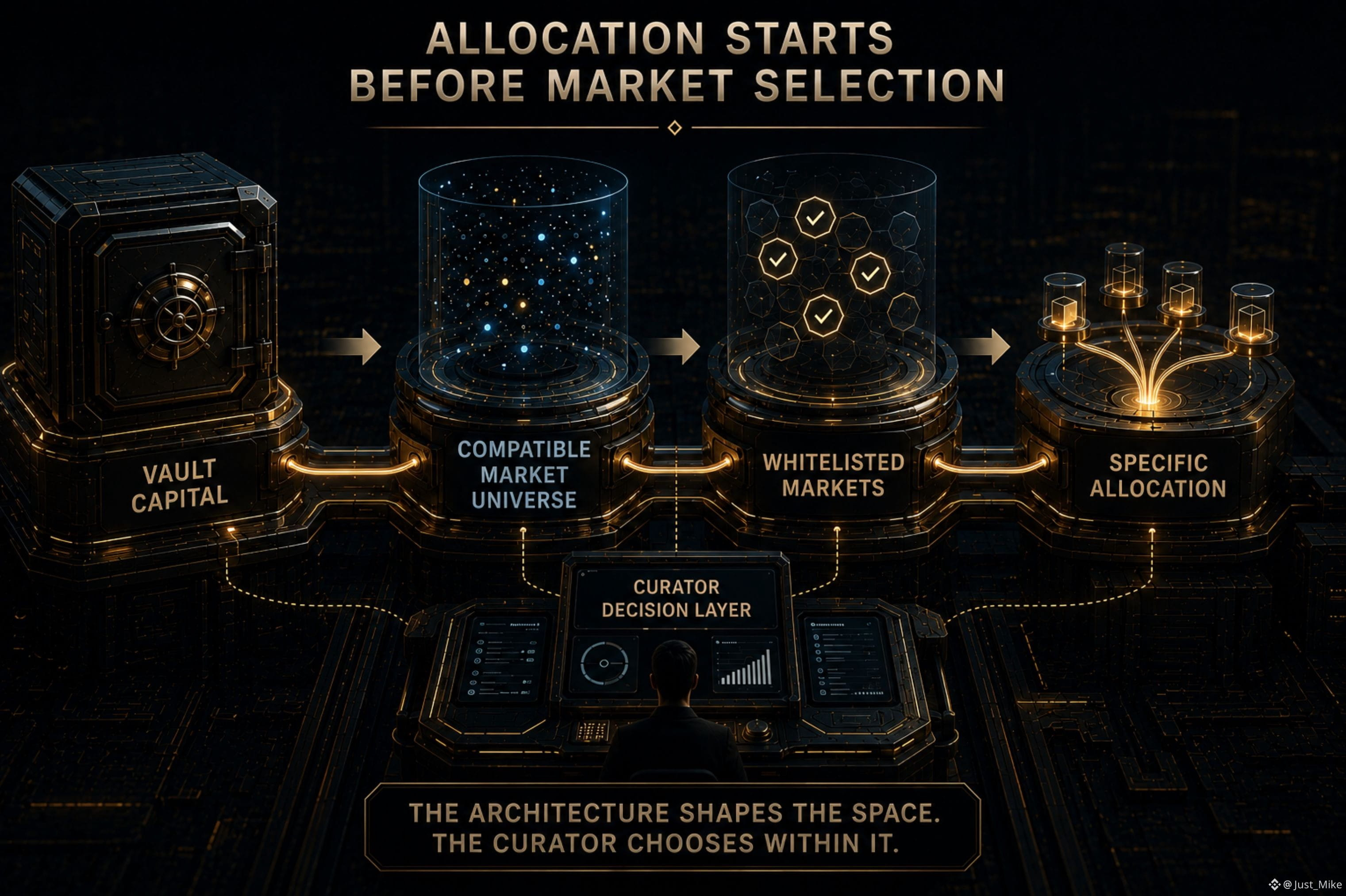
A multi-market Vault does not start with an unlimited list of markets.
Its architecture already places a condition on which markets can be connected: markets in the same Vault must use the same Debt Token.
The market whitelist then further defines which of those markets can actually be used for orders.
Only after those boundaries exist does the curator make the specific allocation decision.
So the process is closer to:
Vault capital
→ compatible market universe
→ whitelisted markets
→ specific allocation
That changes how I think about Vault allocation.
The curator still chooses where capital goes.
But that choice is made inside a market universe that the protocol architecture has already partially defined.
In other words:
Allocation ≠ simply choosing a market.
Allocation = choosing within an architecture-defined market universe.
Maybe the more interesting question isn't only where a curator puts capital.
It's how much of that choice already exists before the choice is made.
#termmax @termmax
A curator may look like the person deciding where Vault capital goes.
But how much of that decision is actually made before the curator chooses a market?
A multi-market Vault does not start with an unlimited list of markets.
Its architecture already places a condition on which markets can be connected: markets in the same Vault must use the same Debt Token.
The market whitelist then further defines which of those markets can actually be used for orders.
Only after those boundaries exist does the curator make the specific allocation decision.
So the process is closer to:
Vault capital
→ compatible market universe
→ whitelisted markets
→ specific allocation
That changes how I think about Vault allocation.
The curator still chooses where capital goes.
But that choice is made inside a market universe that the protocol architecture has already partially defined.
In other words:
Allocation ≠ simply choosing a market.
Allocation = choosing within an architecture-defined market universe.
Maybe the more interesting question isn't only where a curator puts capital.
It's how much of that choice already exists before the choice is made.
#termmax @TermMax
But how much of that decision is actually made before the curator chooses a market?
A multi-market Vault does not start with an unlimited list of markets.
Its architecture already places a condition on which markets can be connected: markets in the same Vault must use the same Debt Token.
The market whitelist then further defines which of those markets can actually be used for orders.
Only after those boundaries exist does the curator make the specific allocation decision.
So the process is closer to:
Vault capital
→ compatible market universe
→ whitelisted markets
→ specific allocation
That changes how I think about Vault allocation.
The curator still chooses where capital goes.
But that choice is made inside a market universe that the protocol architecture has already partially defined.
In other words:
Allocation ≠ simply choosing a market.
Allocation = choosing within an architecture-defined market universe.
Maybe the more interesting question isn't only where a curator puts capital.
It's how much of that choice already exists before the choice is made.
#termmax @TermMax
93
·
--
Who gets to make which decision?
A fixed-rate market can look like a simple relationship:
lender ↔ borrower
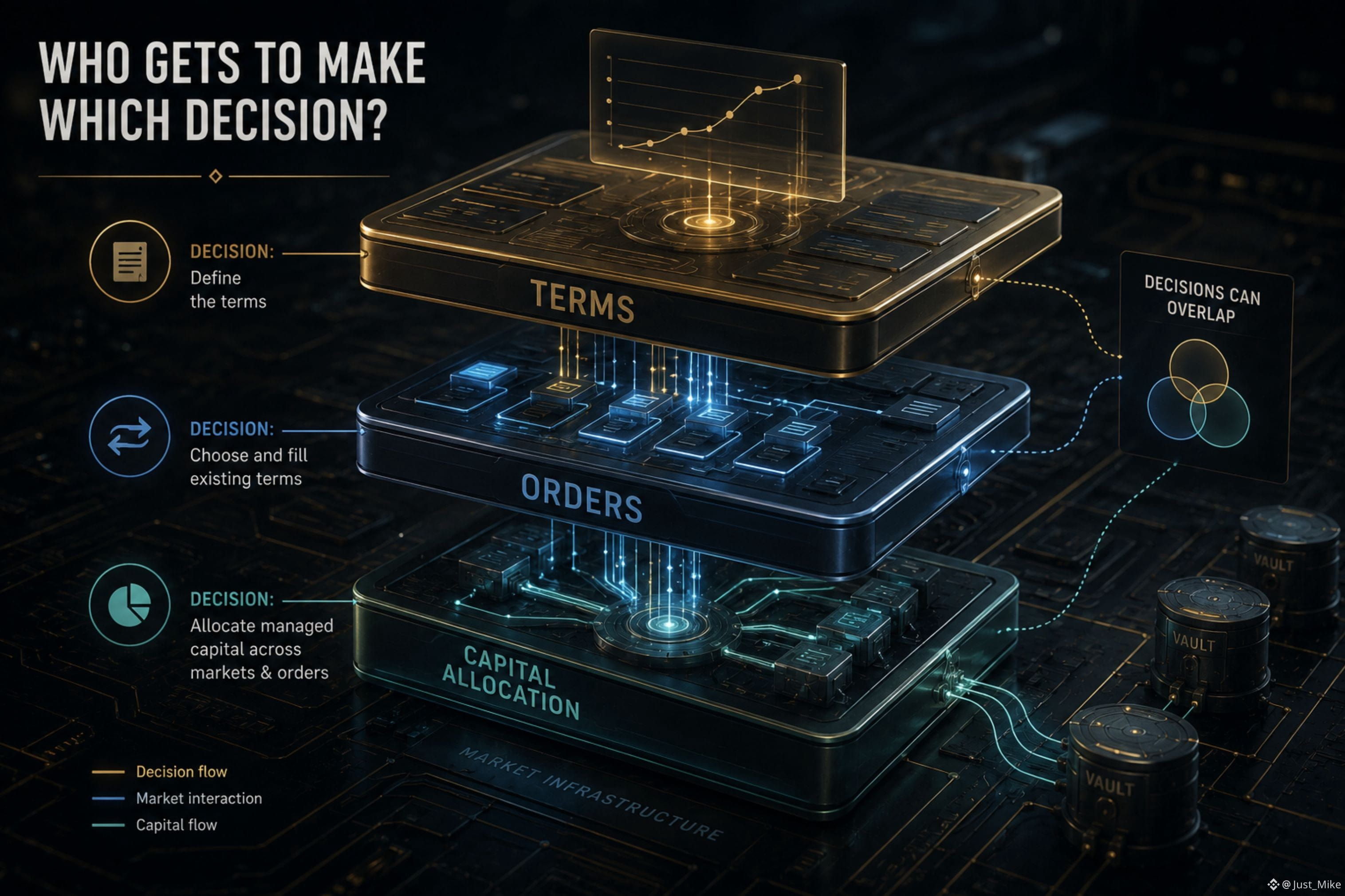
But TermMax separates more decisions than that.
One participant can define the terms of a Range Order. Another can choose to fill those existing terms. And a Vault curator can decide where managed capital is deployed across markets and orders.
That distinction matters because these are different decisions.
Setting terms is not the same as accepting terms.
And neither is the same as deciding where pooled capital should be deployed.
The interesting part is that these functions are separated conceptually, but not necessarily between three completely independent actors.
A curator, for example, can manage Vault capital while also creating and managing supported orders.
So I wouldn't think about TermMax simply as:
lender meets borrower.
I'd think about it as several decision layers interacting:
terms are defined
↓
orders are filled
↓
managed capital is allocated
That creates a different way to read the market.
The key question isn't only who provides liquidity.
It's:
who gets to decide the terms, who decides whether to take them, and who decides where managed capital goes?
That separation of decisions may be one of the more interesting pieces of TermMax's market structure.
#termmax @termmax
Who gets to make which decision?
A fixed-rate market can look like a simple relationship:
lender ↔ borrower
But TermMax separates more decisions than that.
One participant can define the terms of a Range Order. Another can choose to fill those existing terms. And a Vault curator can decide where managed capital is deployed across markets and orders.
That distinction matters because these are different decisions.
Setting terms is not the same as accepting terms.
And neither is the same as deciding where pooled capital should be deployed.
The interesting part is that these functions are separated conceptually, but not necessarily between three completely independent actors.
A curator, for example, can manage Vault capital while also creating and managing supported orders.
So I wouldn't think about TermMax simply as:
lender meets borrower.
I'd think about it as several decision layers interacting:
terms are defined
↓
orders are filled
↓
managed capital is allocated
That creates a different way to read the market.
The key question isn't only who provides liquidity.
It's:
who gets to decide the terms, who decides whether to take them, and who decides where managed capital goes?
That separation of decisions may be one of the more interesting pieces of TermMax's market structure.
#termmax @TermMax
A fixed-rate market can look like a simple relationship:
lender ↔ borrower
But TermMax separates more decisions than that.
One participant can define the terms of a Range Order. Another can choose to fill those existing terms. And a Vault curator can decide where managed capital is deployed across markets and orders.
That distinction matters because these are different decisions.
Setting terms is not the same as accepting terms.
And neither is the same as deciding where pooled capital should be deployed.
The interesting part is that these functions are separated conceptually, but not necessarily between three completely independent actors.
A curator, for example, can manage Vault capital while also creating and managing supported orders.
So I wouldn't think about TermMax simply as:
lender meets borrower.
I'd think about it as several decision layers interacting:
terms are defined
↓
orders are filled
↓
managed capital is allocated
That creates a different way to read the market.
The key question isn't only who provides liquidity.
It's:
who gets to decide the terms, who decides whether to take them, and who decides where managed capital goes?
That separation of decisions may be one of the more interesting pieces of TermMax's market structure.
#termmax @TermMax
86
·
--
The interesting part of a TermMax Vault may not be what the curator can do.
It may be what the curator cannot do.
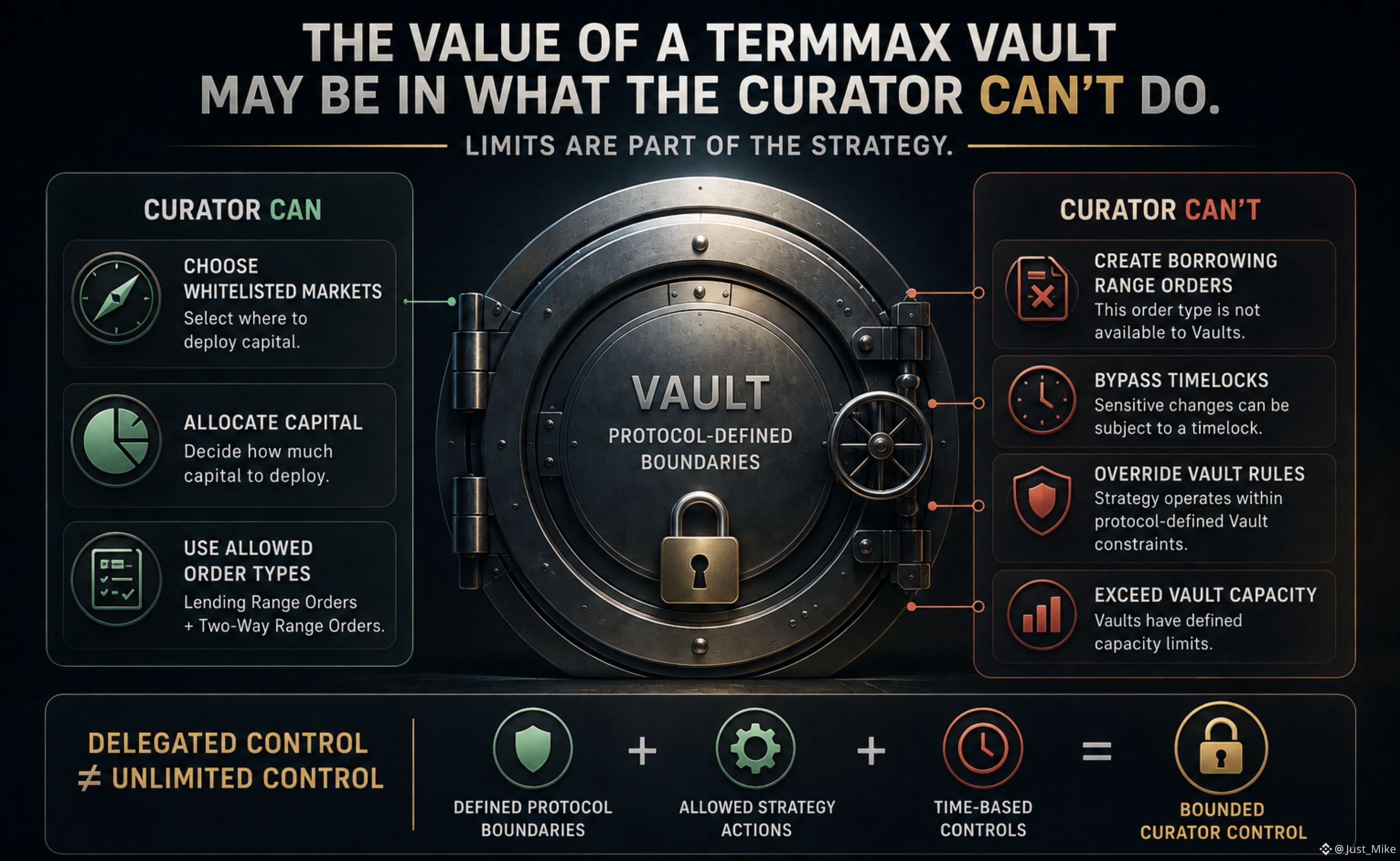
A curator manages the strategy, but that control is not unlimited.
First, the capital can only be deployed into whitelisted markets.
Then there is a capacity limit, which caps how much capital the Vault can accept and helps prevent over-concentration.
The more interesting constraint is what the Vault can actually do inside those markets.
Vaults can use Lending Range Orders and Two-Way Range Orders, but they cannot create Borrowing Range Orders.
And even in a Two-Way Order, the Vault cannot simply collateralize its assets and borrow. It must lend first, then it can borrow by selling the FT acquired through that lending activity.
Finally, sensitive changes do not necessarily happen immediately. They can go through a timelock, giving the Guardian time to review and cancel a pending change.
Put together, these aren't just separate Vault features.
They define a bounded decision space for the curator:
→ where capital can go
→ how much can be deployed
→ what kind of orders can be created
→ how quickly strategy parameters can change
My takeaway is that a curator-managed Vault isn't simply delegated control.
It's delegated control inside a set of protocol-defined boundaries.
And that may be the more interesting way to think about Vault design.
#termmax @termmax
The interesting part of a TermMax Vault may not be what the curator can do.
It may be what the curator cannot do.
A curator manages the strategy, but that control is not unlimited.
First, the capital can only be deployed into whitelisted markets.
Then there is a capacity limit, which caps how much capital the Vault can accept and helps prevent over-concentration.
The more interesting constraint is what the Vault can actually do inside those markets.
Vaults can use Lending Range Orders and Two-Way Range Orders, but they cannot create Borrowing Range Orders.
And even in a Two-Way Order, the Vault cannot simply collateralize its assets and borrow. It must lend first, then it can borrow by selling the FT acquired through that lending activity.
Finally, sensitive changes do not necessarily happen immediately. They can go through a timelock, giving the Guardian time to review and cancel a pending change.
Put together, these aren't just separate Vault features.
They define a bounded decision space for the curator:
→ where capital can go
→ how much can be deployed
→ what kind of orders can be created
→ how quickly strategy parameters can change
My takeaway is that a curator-managed Vault isn't simply delegated control.
It's delegated control inside a set of protocol-defined boundaries.
And that may be the more interesting way to think about Vault design.
#termmax @TermMax
It may be what the curator cannot do.
A curator manages the strategy, but that control is not unlimited.
First, the capital can only be deployed into whitelisted markets.
Then there is a capacity limit, which caps how much capital the Vault can accept and helps prevent over-concentration.
The more interesting constraint is what the Vault can actually do inside those markets.
Vaults can use Lending Range Orders and Two-Way Range Orders, but they cannot create Borrowing Range Orders.
And even in a Two-Way Order, the Vault cannot simply collateralize its assets and borrow. It must lend first, then it can borrow by selling the FT acquired through that lending activity.
Finally, sensitive changes do not necessarily happen immediately. They can go through a timelock, giving the Guardian time to review and cancel a pending change.
Put together, these aren't just separate Vault features.
They define a bounded decision space for the curator:
→ where capital can go
→ how much can be deployed
→ what kind of orders can be created
→ how quickly strategy parameters can change
My takeaway is that a curator-managed Vault isn't simply delegated control.
It's delegated control inside a set of protocol-defined boundaries.
And that may be the more interesting way to think about Vault design.
#termmax @TermMax
89
·
--
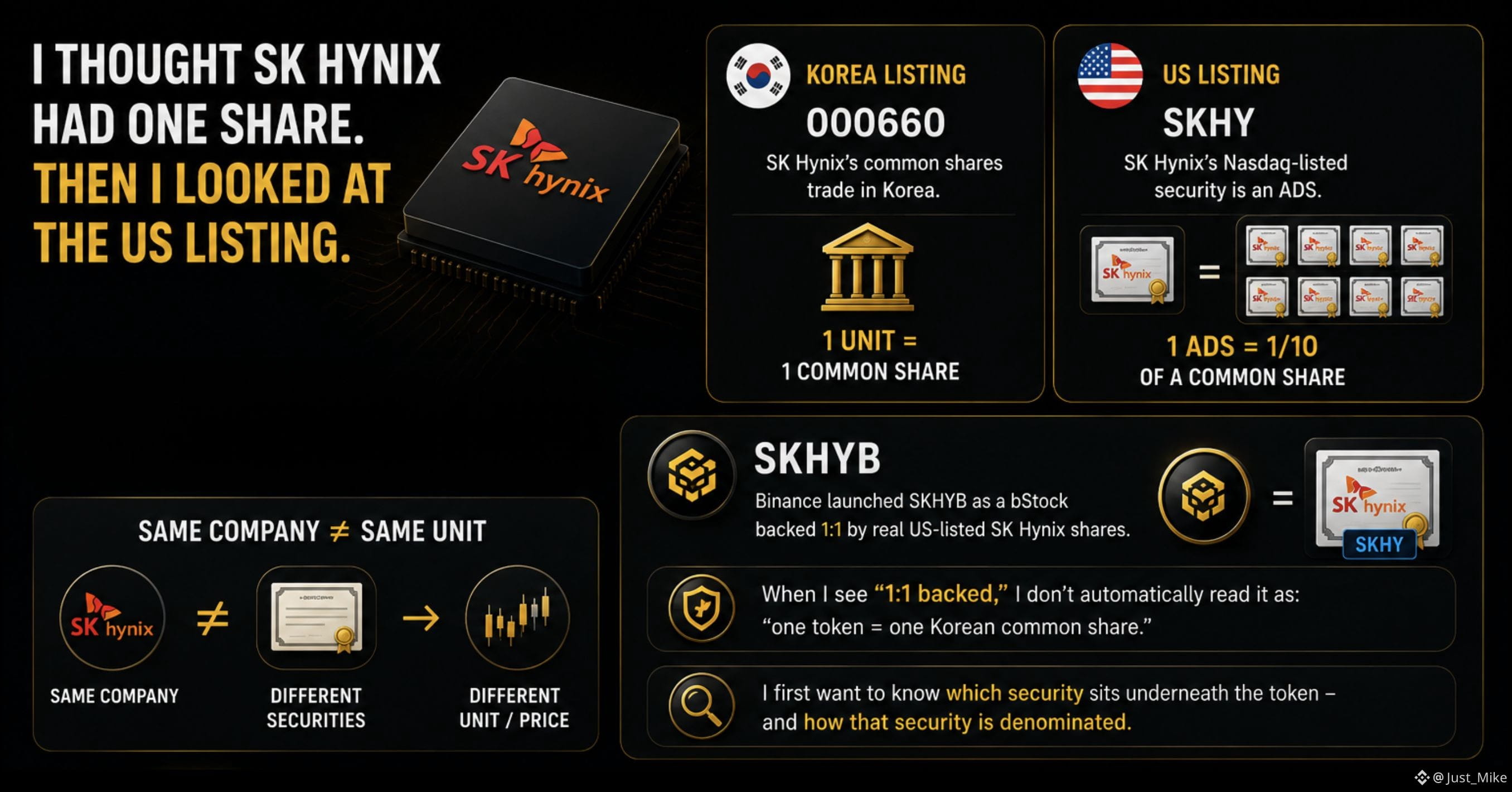
I thought SK Hynix had one share. Then I looked at the US listing.
SK Hynix’s common shares trade in Korea under 000660.
Its Nasdaq-listed security, SKHY, is an ADS — and 1 ADS represents 1/10 of a common share.
That sounds like a technical detail.
But it changes how I read prices.
A price only makes sense once I know what one unit represents.
Then there is SKHYB.
Binance launched SKHYB as a bStock backed 1:1 by real US-listed SK Hynix shares.
So when I see “1:1 backed,” I don’t automatically read it as:
“one token = one Korean common share.”
That’s why “1:1 backed” is only the starting point for me — I also want to know what security that 1 actually refers to.
I first want to know which security sits underneath the token — and how that security is denominated.
Same company ≠ same unit.
That’s the useful check for me:
before comparing prices, check what one unit actually represents.
#bstockscis @BinanceCIS
I thought SK Hynix had one share. Then I looked at the US listing.
SK Hynix’s common shares trade in Korea under 000660.
Its Nasdaq-listed security, SKHY, is an ADS — and 1 ADS represents 1/10 of a common share.
That sounds like a technical detail.
But it changes how I read prices.
A price only makes sense once I know what one unit represents.
Then there is SKHYB.
Binance launched SKHYB as a bStock backed 1:1 by real US-listed SK Hynix shares.
So when I see “1:1 backed,” I don’t automatically read it as:
“one token = one Korean common share.”
That’s why “1:1 backed” is only the starting point for me — I also want to know what security that 1 actually refers to.
I first want to know which security sits underneath the token — and how that security is denominated.
Same company ≠ same unit.
That’s the useful check for me:
before comparing prices, check what one unit actually represents.
#bstockscis @BinanceCIS
SK Hynix’s common shares trade in Korea under 000660.
Its Nasdaq-listed security, SKHY, is an ADS — and 1 ADS represents 1/10 of a common share.
That sounds like a technical detail.
But it changes how I read prices.
A price only makes sense once I know what one unit represents.
Then there is SKHYB.
Binance launched SKHYB as a bStock backed 1:1 by real US-listed SK Hynix shares.
So when I see “1:1 backed,” I don’t automatically read it as:
“one token = one Korean common share.”
That’s why “1:1 backed” is only the starting point for me — I also want to know what security that 1 actually refers to.
I first want to know which security sits underneath the token — and how that security is denominated.
Same company ≠ same unit.
That’s the useful check for me:
before comparing prices, check what one unit actually represents.
#bstockscis @BinanceCIS
72
·
--
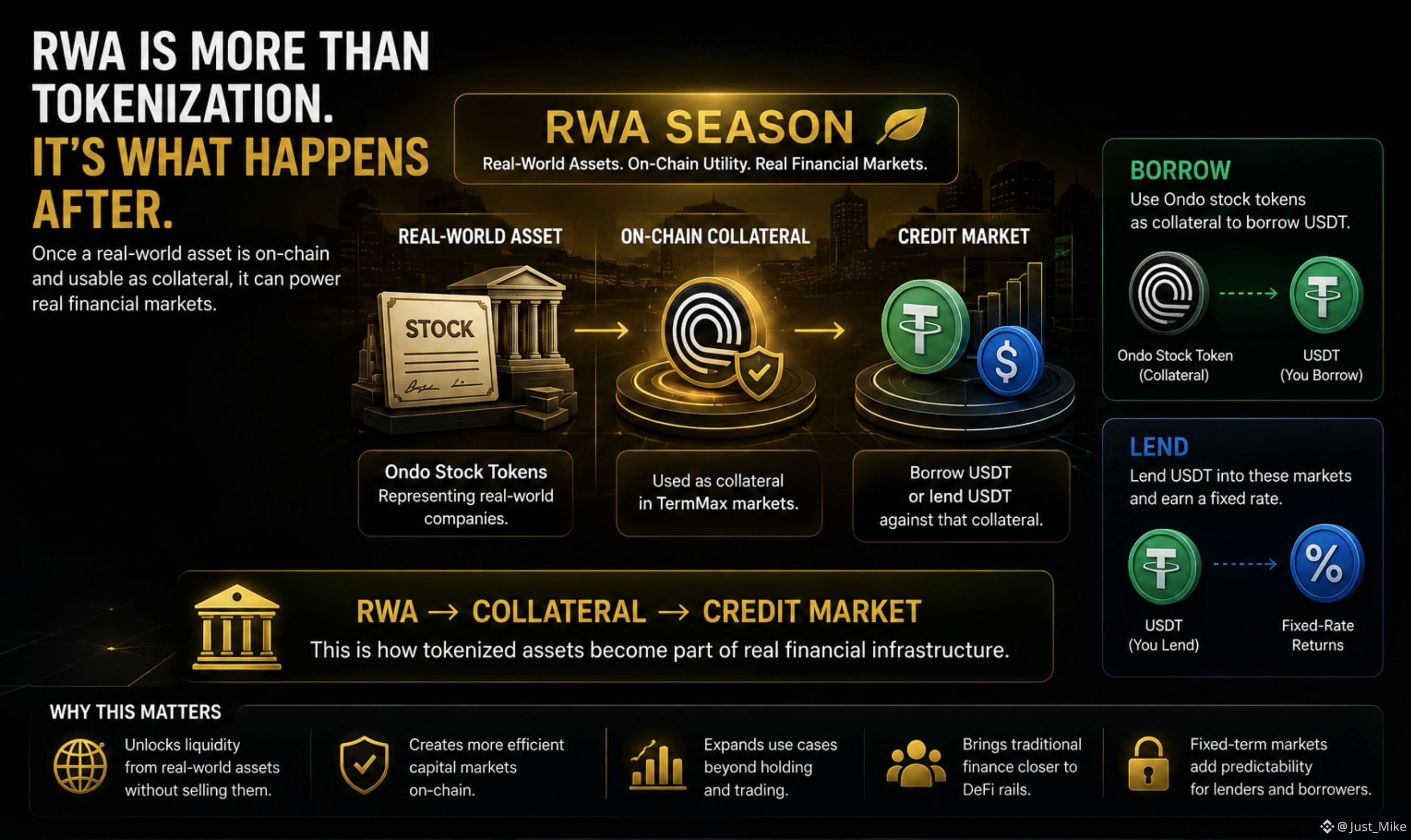
Tokenizing a real-world asset is only the beginning.
The more interesting question is what you can actually do with it once it's on-chain.
TermMax's current RWA Season gives a pretty practical example.
Ondo stock tokens can be used as collateral to borrow USDT on BNB Chain.
And on the other side, users can lend USDT into those markets.
So the structure becomes:
RWA → collateral → credit market
That is a much bigger idea than simply putting a tokenized stock into a wallet.
Once an asset becomes usable collateral, it can become part of an actual financial market.
And that's where I think RWA gets interesting.
Not:
“Can we tokenize this asset?”
But:
“What can the asset do after it is tokenized?”
TermMax is experimenting with one possible answer: fixed-term borrowing and lending around tokenized assets.
#termmax @termmax
Tokenizing a real-world asset is only the beginning.
The more interesting question is what you can actually do with it once it's on-chain.
TermMax's current RWA Season gives a pretty practical example.
Ondo stock tokens can be used as collateral to borrow USDT on BNB Chain.
And on the other side, users can lend USDT into those markets.
So the structure becomes:
RWA → collateral → credit market
That is a much bigger idea than simply putting a tokenized stock into a wallet.
Once an asset becomes usable collateral, it can become part of an actual financial market.
And that's where I think RWA gets interesting.
Not:
“Can we tokenize this asset?”
But:
“What can the asset do after it is tokenized?”
TermMax is experimenting with one possible answer: fixed-term borrowing and lending around tokenized assets.
#termmax @TermMax
The more interesting question is what you can actually do with it once it's on-chain.
TermMax's current RWA Season gives a pretty practical example.
Ondo stock tokens can be used as collateral to borrow USDT on BNB Chain.
And on the other side, users can lend USDT into those markets.
So the structure becomes:
RWA → collateral → credit market
That is a much bigger idea than simply putting a tokenized stock into a wallet.
Once an asset becomes usable collateral, it can become part of an actual financial market.
And that's where I think RWA gets interesting.
Not:
“Can we tokenize this asset?”
But:
“What can the asset do after it is tokenized?”
TermMax is experimenting with one possible answer: fixed-term borrowing and lending around tokenized assets.
#termmax @TermMax
107
·
--
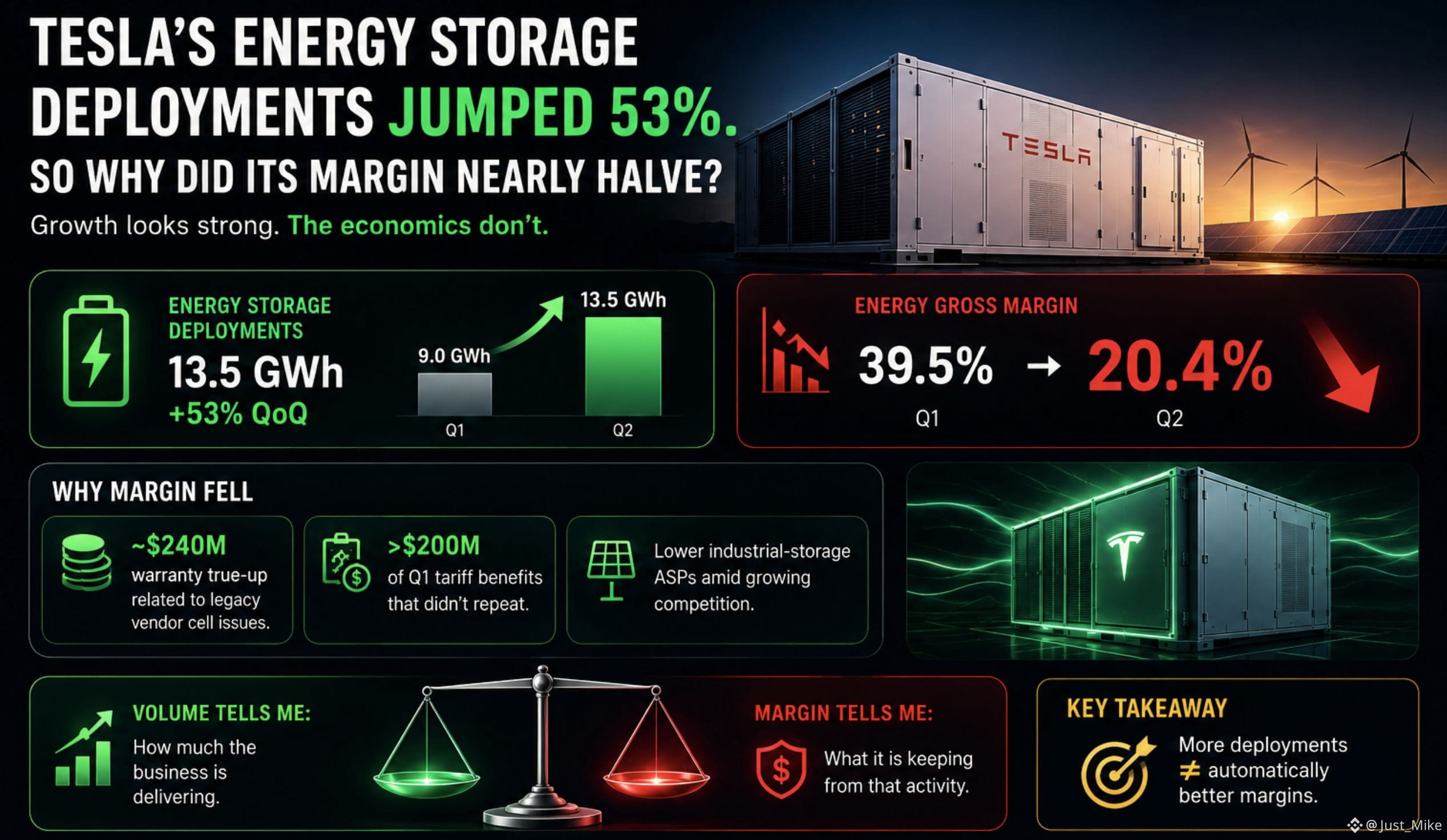
Tesla's energy storage deployments jumped 53%. So why did its margin nearly halve?
Tesla's energy business caught my attention for a reason that wasn't obvious from the headline growth.
In Q2, Tesla deployed 13.5 GWh of energy storage, up 53% QoQ.
That sounds like exactly what you want to see from a growing business.
Then I looked at the margin.
Energy gross margin fell from 39.5% to 20.4%.
That changed how I read the deployment number.
The explanation wasn't simply “growth is expensive.”
Tesla pointed to several factors:
a roughly $240M warranty true-up related to legacy vendor cell issues,
more than $200M of Q1 tariff benefits that didn't repeat,
and lower industrial-storage ASPs amid growing competition.
So the business deployed significantly more storage, while the economics of each dollar of that business became less favorable in the quarter.
That's what I find interesting about TSLAB as a bStock.
The obvious question is:
“How fast is Tesla's energy business growing?”
I'd also ask:
“What is happening to the economics of that growth?”
For me:
More deployments ≠ automatically better margins.
Volume tells me how much the business is delivering.
Margin tells me what it is keeping from that activity.
#bstockscis @BinanceCIS
Tesla's energy storage deployments jumped 53%. So why did its margin nearly halve?
Tesla's energy business caught my attention for a reason that wasn't obvious from the headline growth.
In Q2, Tesla deployed 13.5 GWh of energy storage, up 53% QoQ.
That sounds like exactly what you want to see from a growing business.
Then I looked at the margin.
Energy gross margin fell from 39.5% to 20.4%.
That changed how I read the deployment number.
The explanation wasn't simply “growth is expensive.”
Tesla pointed to several factors:
a roughly $240M warranty true-up related to legacy vendor cell issues,
more than $200M of Q1 tariff benefits that didn't repeat,
and lower industrial-storage ASPs amid growing competition.
So the business deployed significantly more storage, while the economics of each dollar of that business became less favorable in the quarter.
That's what I find interesting about TSLAB as a bStock.
The obvious question is:
“How fast is Tesla's energy business growing?”
I'd also ask:
“What is happening to the economics of that growth?”
For me:
More deployments ≠ automatically better margins.
Volume tells me how much the business is delivering.
Margin tells me what it is keeping from that activity.
#bstockscis @BinanceCIS
Tesla's energy business caught my attention for a reason that wasn't obvious from the headline growth.
In Q2, Tesla deployed 13.5 GWh of energy storage, up 53% QoQ.
That sounds like exactly what you want to see from a growing business.
Then I looked at the margin.
Energy gross margin fell from 39.5% to 20.4%.
That changed how I read the deployment number.
The explanation wasn't simply “growth is expensive.”
Tesla pointed to several factors:
a roughly $240M warranty true-up related to legacy vendor cell issues,
more than $200M of Q1 tariff benefits that didn't repeat,
and lower industrial-storage ASPs amid growing competition.
So the business deployed significantly more storage, while the economics of each dollar of that business became less favorable in the quarter.
That's what I find interesting about TSLAB as a bStock.
The obvious question is:
“How fast is Tesla's energy business growing?”
I'd also ask:
“What is happening to the economics of that growth?”
For me:
More deployments ≠ automatically better margins.
Volume tells me how much the business is delivering.
Margin tells me what it is keeping from that activity.
#bstockscis @BinanceCIS
3
3
110
·
--
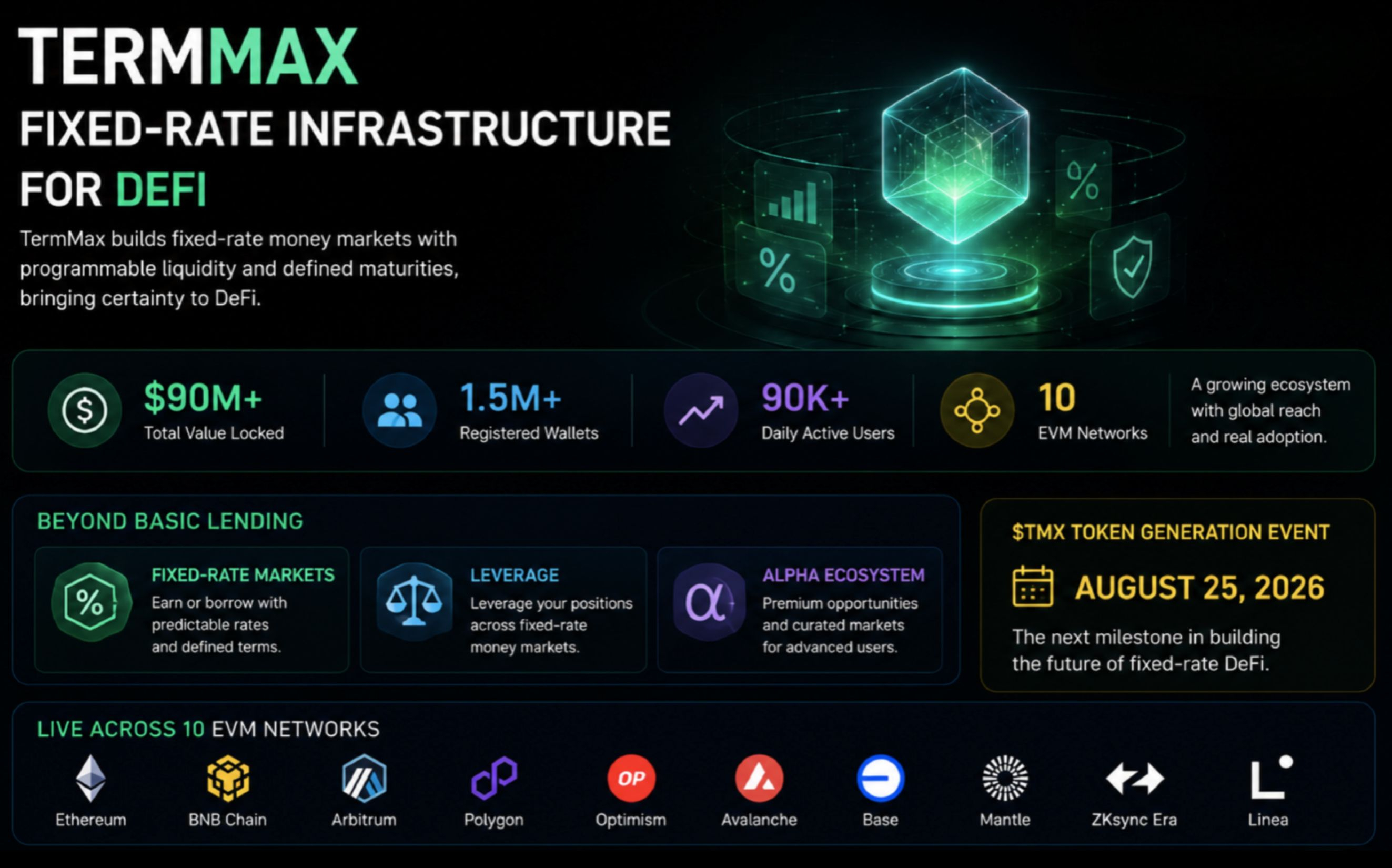
I’ve been looking at TermMax beyond the usual “another DeFi lending protocol” narrative.
The bigger idea is fixed-rate infrastructure for DeFi: markets built around defined maturities, fixed-rate positions and programmable liquidity.
Some numbers from the project currently stand out:
• $90M+ TVL
• 1.5M+ registered wallets
• 90K+ daily active users
• deployed across 10 EVM networks
And the product goes beyond basic lending, with fixed-rate markets, leverage and its Alpha ecosystem.
Another date worth watching: TermMax has announced its $TMX TGE for August 25.
What interests me most is whether fixed-rate markets can become a meaningful layer of DeFi infrastructure rather than just another lending product.
#termmax @termmax
I’ve been looking at TermMax beyond the usual “another DeFi lending protocol” narrative.
The bigger idea is fixed-rate infrastructure for DeFi: markets built around defined maturities, fixed-rate positions and programmable liquidity.
Some numbers from the project currently stand out:
• $90M+ TVL
• 1.5M+ registered wallets
• 90K+ daily active users
• deployed across 10 EVM networks
And the product goes beyond basic lending, with fixed-rate markets, leverage and its Alpha ecosystem.
Another date worth watching: TermMax has announced its $TMX TGE for August 25.
What interests me most is whether fixed-rate markets can become a meaningful layer of DeFi infrastructure rather than just another lending product.
#termmax @TermMax
The bigger idea is fixed-rate infrastructure for DeFi: markets built around defined maturities, fixed-rate positions and programmable liquidity.
Some numbers from the project currently stand out:
• $90M+ TVL
• 1.5M+ registered wallets
• 90K+ daily active users
• deployed across 10 EVM networks
And the product goes beyond basic lending, with fixed-rate markets, leverage and its Alpha ecosystem.
Another date worth watching: TermMax has announced its $TMX TGE for August 25.
What interests me most is whether fixed-rate markets can become a meaningful layer of DeFi infrastructure rather than just another lending product.
#termmax @TermMax
92
·
--
What does a $7.8B revenue quarter tell me if the company is spending $18.4B on what comes next?
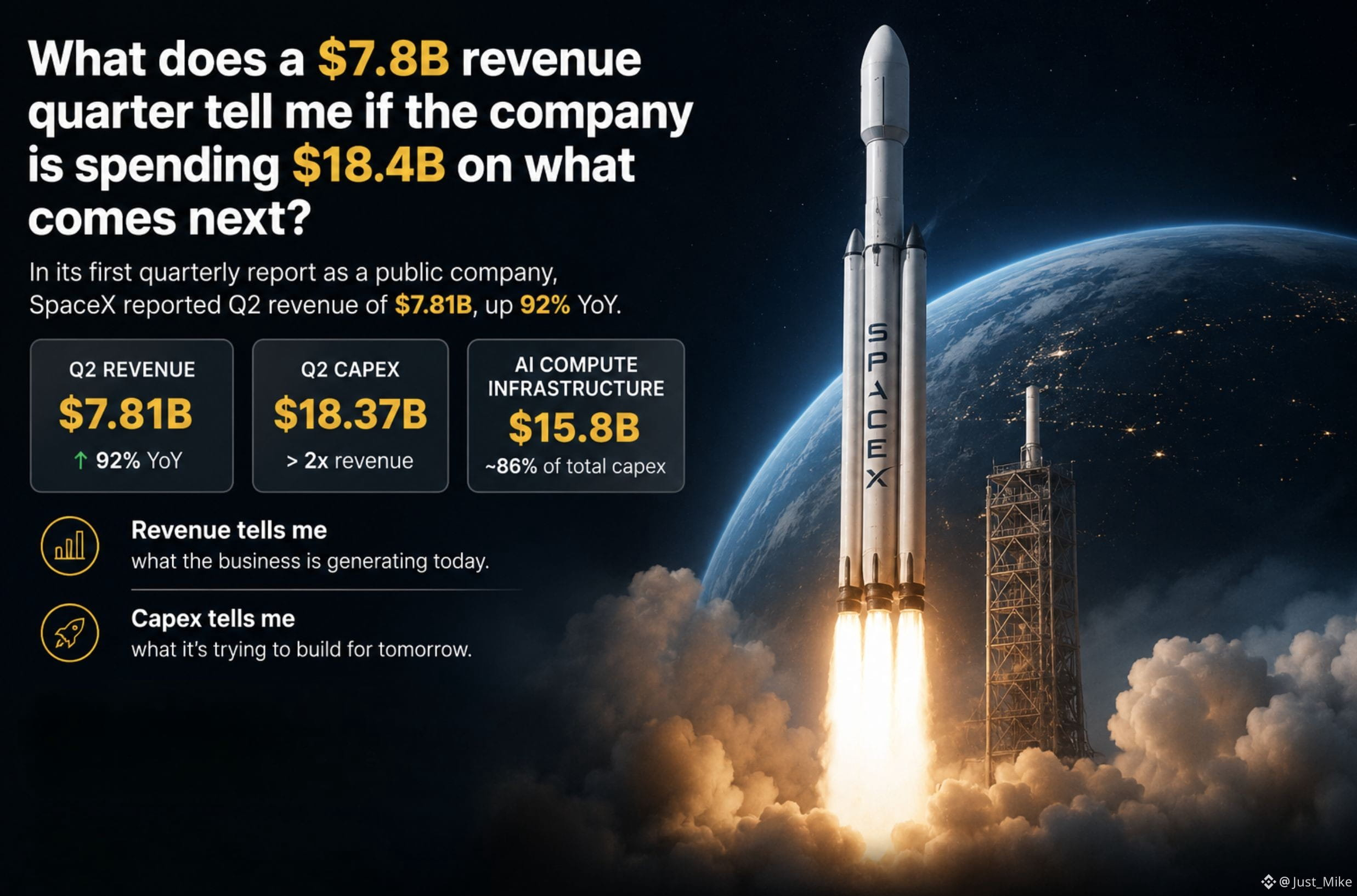
In its first quarterly report as a public company, SpaceX reported Q2 revenue of $7.81B, up 92% YoY.
Then I looked at capex:
$18.37B for the quarter.
That's more than twice the company's quarterly revenue.
And it changed how I read the first number.
Revenue tells me the scale of the business today.
Capex tells me how much capital the company is committing to build for the next stage of growth.
About $15.8B of that Q2 capex went toward AI infrastructure.
That doesn't automatically mean the spending is inefficient — capex is an investment, not an expense.
But it does tell me something revenue growth alone doesn't:
how aggressively the company is investing behind its next stage of growth.
That's what I find interesting about SPCXB as a bStock.
The ticker gives me exposure to SpaceX.
But instead of asking only:
“How fast is revenue growing?”
I'd also ask:
“What is the company spending to make the next stage of growth possible?”
For me:
Revenue tells me what the business is generating today.
Capex tells me what it's trying to build for tomorrow.
#bstockscis @BinanceCIS
What does a $7.8B revenue quarter tell me if the company is spending $18.4B on what comes next?
In its first quarterly report as a public company, SpaceX reported Q2 revenue of $7.81B, up 92% YoY.
Then I looked at capex:
$18.37B for the quarter.
That's more than twice the company's quarterly revenue.
And it changed how I read the first number.
Revenue tells me the scale of the business today.
Capex tells me how much capital the company is committing to build for the next stage of growth.
About $15.8B of that Q2 capex went toward AI infrastructure.
That doesn't automatically mean the spending is inefficient — capex is an investment, not an expense.
But it does tell me something revenue growth alone doesn't:
how aggressively the company is investing behind its next stage of growth.
That's what I find interesting about SPCXB as a bStock.
The ticker gives me exposure to SpaceX.
But instead of asking only:
“How fast is revenue growing?”
I'd also ask:
“What is the company spending to make the next stage of growth possible?”
For me:
Revenue tells me what the business is generating today.
Capex tells me what it's trying to build for tomorrow.
#bstockscis @BinanceCIS
In its first quarterly report as a public company, SpaceX reported Q2 revenue of $7.81B, up 92% YoY.
Then I looked at capex:
$18.37B for the quarter.
That's more than twice the company's quarterly revenue.
And it changed how I read the first number.
Revenue tells me the scale of the business today.
Capex tells me how much capital the company is committing to build for the next stage of growth.
About $15.8B of that Q2 capex went toward AI infrastructure.
That doesn't automatically mean the spending is inefficient — capex is an investment, not an expense.
But it does tell me something revenue growth alone doesn't:
how aggressively the company is investing behind its next stage of growth.
That's what I find interesting about SPCXB as a bStock.
The ticker gives me exposure to SpaceX.
But instead of asking only:
“How fast is revenue growing?”
I'd also ask:
“What is the company spending to make the next stage of growth possible?”
For me:
Revenue tells me what the business is generating today.
Capex tells me what it's trying to build for tomorrow.
#bstockscis @BinanceCIS
2
1
124
·
--
One ticker can contain businesses moving in opposite directions.
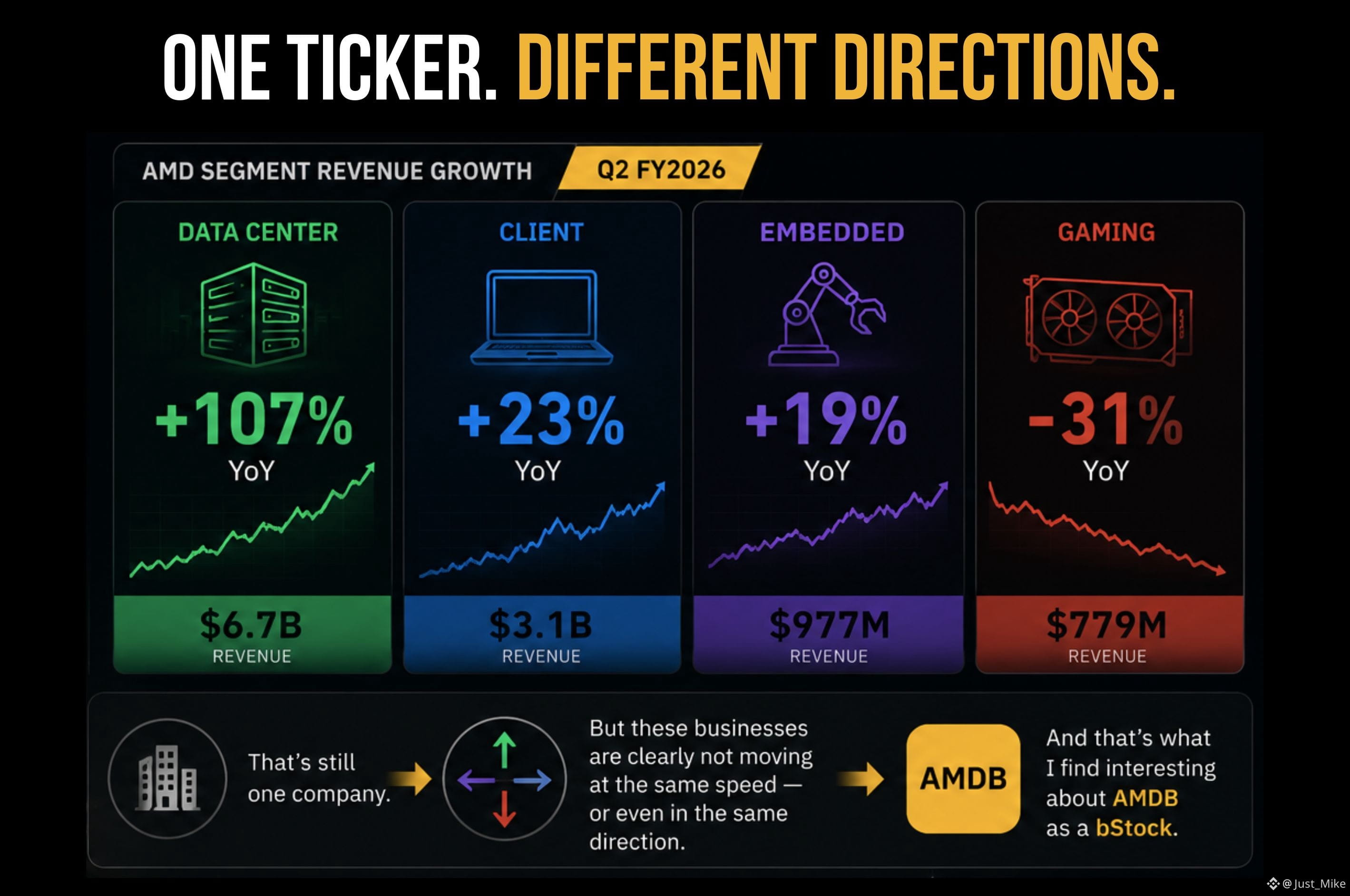
When I see AMDB, it’s tempting to think of it as one big AMD growth story.
But AMD’s latest numbers made me look at the ticker differently.
In Q2 FY2026:
Data Center: +107% YoY
Client: +23%
Embedded: +19%
Gaming: −31%
That’s still one company.
But these businesses are clearly not moving at the same speed — or even in the same direction.
And that’s what I find interesting about AMDB as a bStock.
The ticker tells me which company I’m getting exposure to.
The business mix tells me what is actually driving that exposure.
So when I see “AMD growth”, I don’t want to stop at the headline.
I want to ask:
Which part of AMD is actually growing?
For me, that’s a much more useful way to read a single ticker.
#bstockscis @BinanceCIS
One ticker can contain businesses moving in opposite directions.
When I see AMDB, it’s tempting to think of it as one big AMD growth story.
But AMD’s latest numbers made me look at the ticker differently.
In Q2 FY2026:
Data Center: +107% YoY
Client: +23%
Embedded: +19%
Gaming: −31%
That’s still one company.
But these businesses are clearly not moving at the same speed — or even in the same direction.
And that’s what I find interesting about AMDB as a bStock.
The ticker tells me which company I’m getting exposure to.
The business mix tells me what is actually driving that exposure.
So when I see “AMD growth”, I don’t want to stop at the headline.
I want to ask:
Which part of AMD is actually growing?
For me, that’s a much more useful way to read a single ticker.
#bstockscis @BinanceCIS
When I see AMDB, it’s tempting to think of it as one big AMD growth story.
But AMD’s latest numbers made me look at the ticker differently.
In Q2 FY2026:
Data Center: +107% YoY
Client: +23%
Embedded: +19%
Gaming: −31%
That’s still one company.
But these businesses are clearly not moving at the same speed — or even in the same direction.
And that’s what I find interesting about AMDB as a bStock.
The ticker tells me which company I’m getting exposure to.
The business mix tells me what is actually driving that exposure.
So when I see “AMD growth”, I don’t want to stop at the headline.
I want to ask:
Which part of AMD is actually growing?
For me, that’s a much more useful way to read a single ticker.
#bstockscis @BinanceCIS
4
3
105
·
--
Bitcoin on the balance sheet is not the same thing as Bitcoin exposure per share.
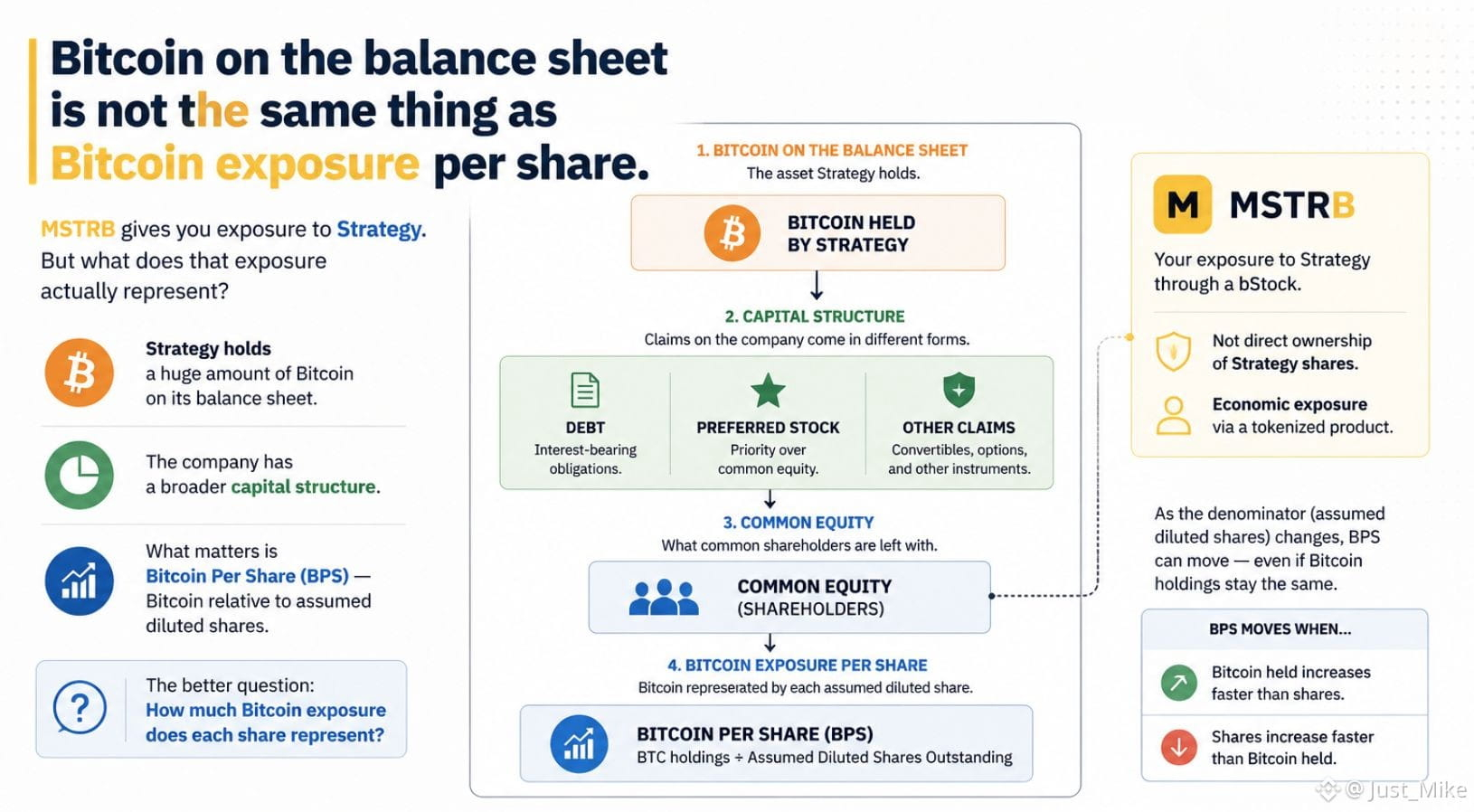
Strategy holds a huge amount of Bitcoin on its balance sheet.
So at first glance, owning MSTRB might look like a simple way to get Bitcoin exposure through a company.
But there is another layer to look at.
Strategy itself measures Bitcoin Per Share (BPS) — the amount of Bitcoin represented per assumed diluted share.
And that ratio matters because the numerator and denominator can move independently.
If Strategy adds Bitcoin, BPS can increase.
But if the company increases its assumed diluted share count without adding Bitcoin at the same pace, BPS can move in the other direction.
That's why I find MSTRB more interesting than simply saying:
“Strategy owns a lot of Bitcoin.”
The better question is:
How much Bitcoin exposure does each share actually represent?
And this is also what makes tokenized exposure interesting to me.
With a bStock like MSTRB, you're getting exposure to the underlying company through a tokenized product — not directly owning the Bitcoin that sits on Strategy's balance sheet.
So there are really two layers to think about:
Bitcoin held by the company.
Bitcoin exposure represented by the security.
The headline asset is only the first layer.
When a company becomes a vehicle for an asset, look at the structure between you and it.
#bstockscis @BinanceCIS
Bitcoin on the balance sheet is not the same thing as Bitcoin exposure per share.
Strategy holds a huge amount of Bitcoin on its balance sheet.
So at first glance, owning MSTRB might look like a simple way to get Bitcoin exposure through a company.
But there is another layer to look at.
Strategy itself measures Bitcoin Per Share (BPS) — the amount of Bitcoin represented per assumed diluted share.
And that ratio matters because the numerator and denominator can move independently.
If Strategy adds Bitcoin, BPS can increase.
But if the company increases its assumed diluted share count without adding Bitcoin at the same pace, BPS can move in the other direction.
That's why I find MSTRB more interesting than simply saying:
“Strategy owns a lot of Bitcoin.”
The better question is:
How much Bitcoin exposure does each share actually represent?
And this is also what makes tokenized exposure interesting to me.
With a bStock like MSTRB, you're getting exposure to the underlying company through a tokenized product — not directly owning the Bitcoin that sits on Strategy's balance sheet.
So there are really two layers to think about:
Bitcoin held by the company.
Bitcoin exposure represented by the security.
The headline asset is only the first layer.
When a company becomes a vehicle for an asset, look at the structure between you and it.
#bstockscis @BinanceCIS
Strategy holds a huge amount of Bitcoin on its balance sheet.
So at first glance, owning MSTRB might look like a simple way to get Bitcoin exposure through a company.
But there is another layer to look at.
Strategy itself measures Bitcoin Per Share (BPS) — the amount of Bitcoin represented per assumed diluted share.
And that ratio matters because the numerator and denominator can move independently.
If Strategy adds Bitcoin, BPS can increase.
But if the company increases its assumed diluted share count without adding Bitcoin at the same pace, BPS can move in the other direction.
That's why I find MSTRB more interesting than simply saying:
“Strategy owns a lot of Bitcoin.”
The better question is:
How much Bitcoin exposure does each share actually represent?
And this is also what makes tokenized exposure interesting to me.
With a bStock like MSTRB, you're getting exposure to the underlying company through a tokenized product — not directly owning the Bitcoin that sits on Strategy's balance sheet.
So there are really two layers to think about:
Bitcoin held by the company.
Bitcoin exposure represented by the security.
The headline asset is only the first layer.
When a company becomes a vehicle for an asset, look at the structure between you and it.
#bstockscis @BinanceCIS
102
·
--
If Meta and Microsoft aren't bStocks, what actually determines who makes the list?
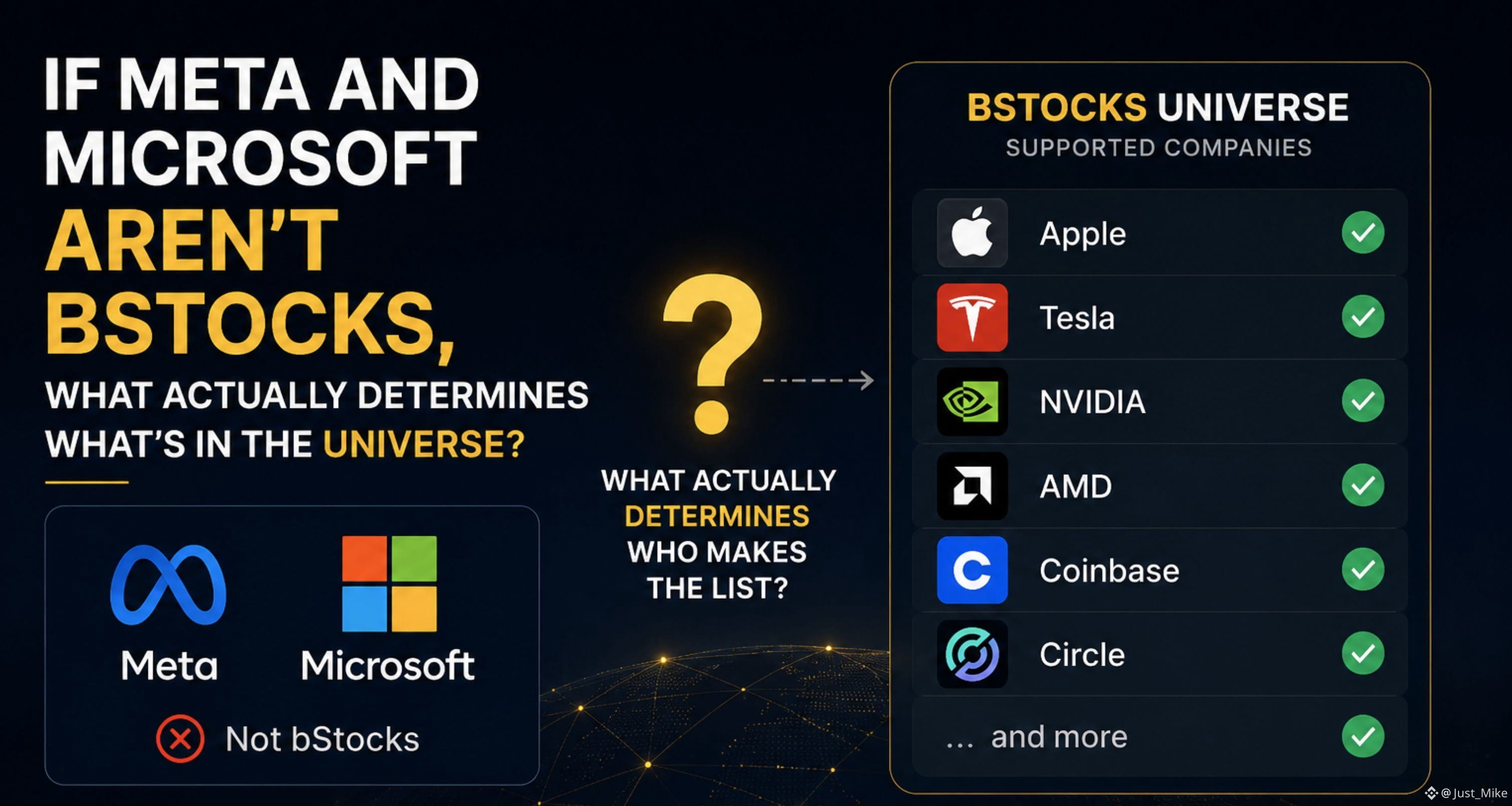
When I first looked at the bStocks universe, I made a simple assumption.
If a company is a large, well-known public company, I expected it to be available as a bStock.
Then I noticed something that challenged that assumption:
Meta and Microsoft aren't bStocks.
Both are major public companies.
But being a major public company and being an available bStock are clearly not the same thing.
That made me look at the Supported Companies list differently.
Instead of asking:
“Why isn't Meta here?”
I started asking:
“What actually determines whether an asset becomes part of the bStocks universe?”
Because the list isn't simply a mirror of the companies I already know from the US stock market.
It's a specific set of supported tokenized stock exposures.
And I think that distinction matters.
When I look at a bStock now, I don't want to assume that familiarity with the underlying company tells me whether that exposure is available.
I'd rather start with a simpler question:
Is this asset actually supported as a bStock?
#bstockscis @BinanceCIS
If Meta and Microsoft aren't bStocks, what actually determines who makes the list?
When I first looked at the bStocks universe, I made a simple assumption.
If a company is a large, well-known public company, I expected it to be available as a bStock.
Then I noticed something that challenged that assumption:
Meta and Microsoft aren't bStocks.
Both are major public companies.
But being a major public company and being an available bStock are clearly not the same thing.
That made me look at the Supported Companies list differently.
Instead of asking:
“Why isn't Meta here?”
I started asking:
“What actually determines whether an asset becomes part of the bStocks universe?”
Because the list isn't simply a mirror of the companies I already know from the US stock market.
It's a specific set of supported tokenized stock exposures.
And I think that distinction matters.
When I look at a bStock now, I don't want to assume that familiarity with the underlying company tells me whether that exposure is available.
I'd rather start with a simpler question:
Is this asset actually supported as a bStock?
#bstockscis @BinanceCIS
When I first looked at the bStocks universe, I made a simple assumption.
If a company is a large, well-known public company, I expected it to be available as a bStock.
Then I noticed something that challenged that assumption:
Meta and Microsoft aren't bStocks.
Both are major public companies.
But being a major public company and being an available bStock are clearly not the same thing.
That made me look at the Supported Companies list differently.
Instead of asking:
“Why isn't Meta here?”
I started asking:
“What actually determines whether an asset becomes part of the bStocks universe?”
Because the list isn't simply a mirror of the companies I already know from the US stock market.
It's a specific set of supported tokenized stock exposures.
And I think that distinction matters.
When I look at a bStock now, I don't want to assume that familiarity with the underlying company tells me whether that exposure is available.
I'd rather start with a simpler question:
Is this asset actually supported as a bStock?
#bstockscis @BinanceCIS
1
110
·
--
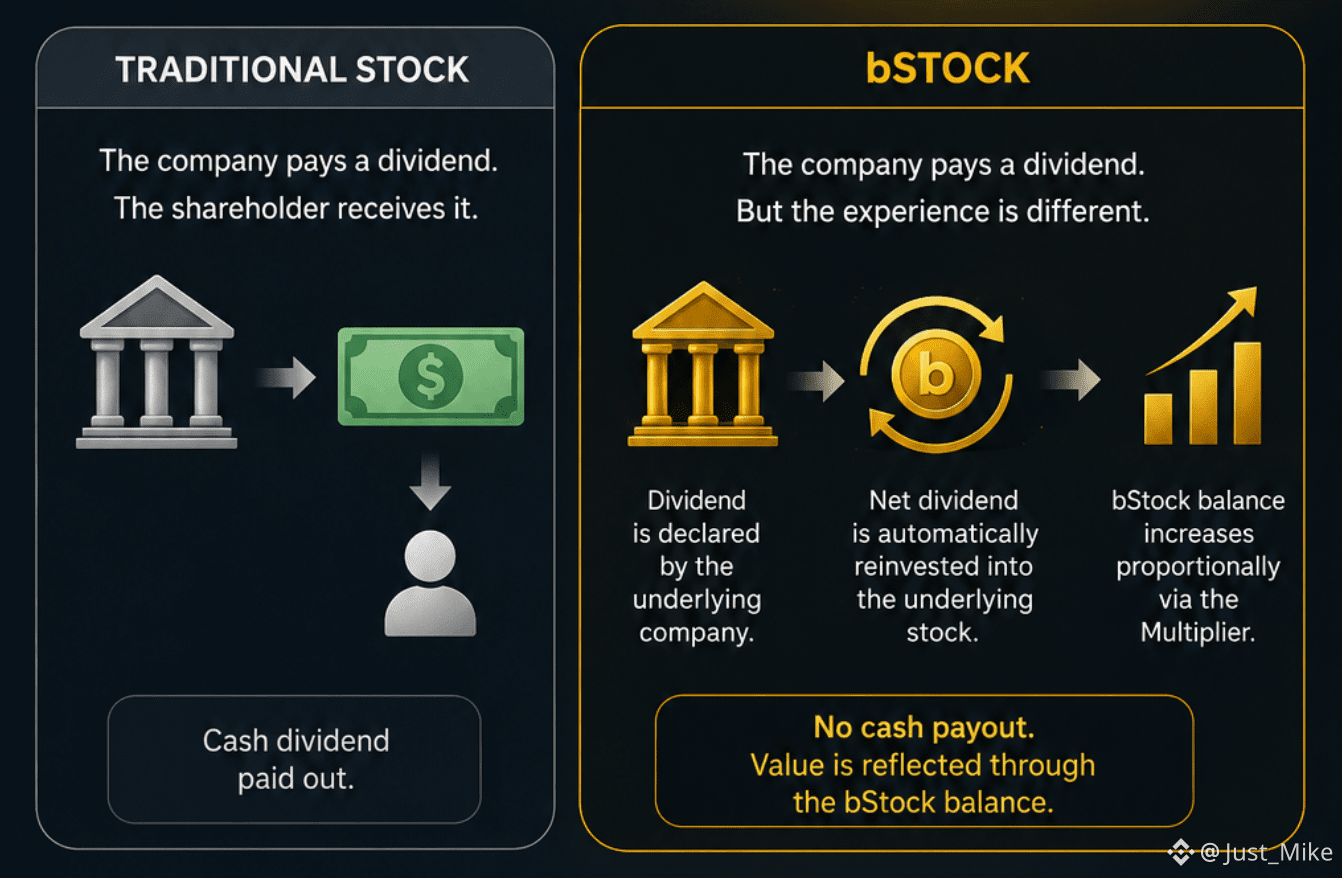
What happens when the stock behind a bStock pays a dividend?
I used to think of dividends as one of the simplest parts of owning a stock.
The company pays a dividend.
The shareholder receives it.
Simple.
But then I started looking at how dividends work with bStocks.
The underlying stock can still pay a dividend, but the experience isn't the same as holding the stock directly.
With bStocks, the net dividend isn't paid out as cash.
Instead, it's automatically reinvested into the underlying stock, and the value is reflected through a proportional increase in the bStock balance via the Multiplier.
That made me think about something I hadn't considered before.
Having exposure to the same company doesn't necessarily mean experiencing every corporate event in the same way.
The underlying company can be the same.
The economic benefit can still be reflected.
But the way that benefit reaches me can be completely different.
And I think that's one of the more interesting things about tokenized assets.
Same underlying company doesn't necessarily mean the same investor experience.
#bstockscis @BinanceCIS
What happens when the stock behind a bStock pays a dividend?
I used to think of dividends as one of the simplest parts of owning a stock.
The company pays a dividend.
The shareholder receives it.
Simple.
But then I started looking at how dividends work with bStocks.
The underlying stock can still pay a dividend, but the experience isn't the same as holding the stock directly.
With bStocks, the net dividend isn't paid out as cash.
Instead, it's automatically reinvested into the underlying stock, and the value is reflected through a proportional increase in the bStock balance via the Multiplier.
That made me think about something I hadn't considered before.
Having exposure to the same company doesn't necessarily mean experiencing every corporate event in the same way.
The underlying company can be the same.
The economic benefit can still be reflected.
But the way that benefit reaches me can be completely different.
And I think that's one of the more interesting things about tokenized assets.
Same underlying company doesn't necessarily mean the same investor experience.
#bstockscis @BinanceCIS
I used to think of dividends as one of the simplest parts of owning a stock.
The company pays a dividend.
The shareholder receives it.
Simple.
But then I started looking at how dividends work with bStocks.
The underlying stock can still pay a dividend, but the experience isn't the same as holding the stock directly.
With bStocks, the net dividend isn't paid out as cash.
Instead, it's automatically reinvested into the underlying stock, and the value is reflected through a proportional increase in the bStock balance via the Multiplier.
That made me think about something I hadn't considered before.
Having exposure to the same company doesn't necessarily mean experiencing every corporate event in the same way.
The underlying company can be the same.
The economic benefit can still be reflected.
But the way that benefit reaches me can be completely different.
And I think that's one of the more interesting things about tokenized assets.
Same underlying company doesn't necessarily mean the same investor experience.
#bstockscis @BinanceCIS
72
·
--
If I trade a bStock on Binance, who actually issues it?
When I first looked at bStocks, I naturally connected the product to Binance.
I see the ticker on Binance.
I trade it on Binance.
I manage the position through Binance.
So I started wondering:
Who is actually issuing the certificate I'm holding?
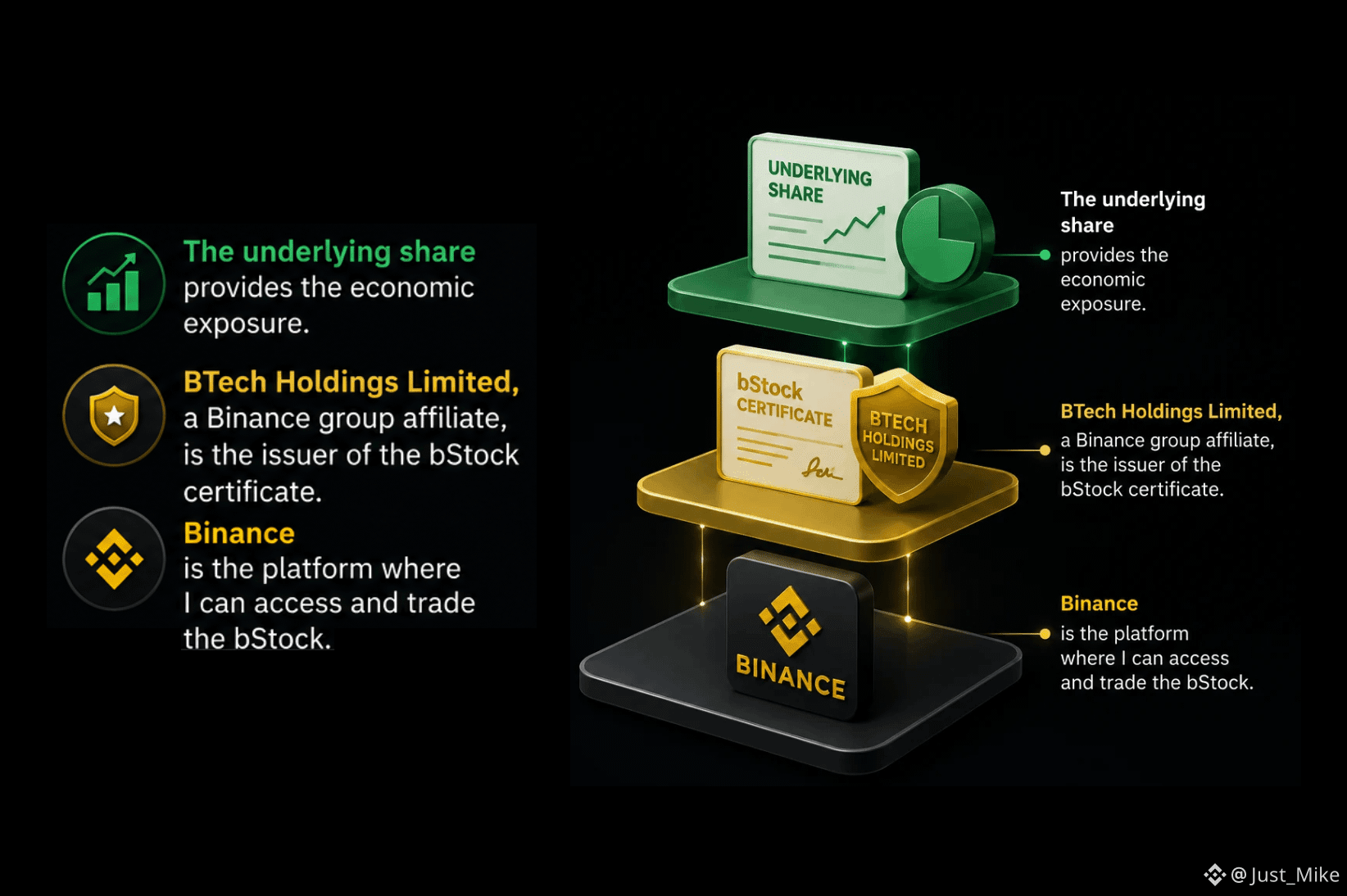
The answer surprised me a little: BTech Holdings Limited, a Binance group affiliate, is the issuer.
And that distinction caught my attention.
Binance is where I access and trade the asset.
BTech Holdings is the issuer of the bStock certificate.
Those two things are easy to mentally merge when everything appears inside the same interface.
But they describe different parts of the structure.
And I think that's an important question when looking at tokenized assets.
When I see an asset inside an exchange, I shouldn't automatically assume that the exchange itself is the issuer.
So now, alongside:
“What is this token backed by?”
I'm also asking:
“Who actually issued the certificate I'm holding?”
For me, that adds another layer to understanding what a tokenized asset really is.
The ticker tells me what exposure I'm looking at.
The issuer tells me who issued the certificate representing that exposure.
#bstockscis @BinanceCIS
If I trade a bStock on Binance, who actually issues it?
When I first looked at bStocks, I naturally connected the product to Binance.
I see the ticker on Binance.
I trade it on Binance.
I manage the position through Binance.
So I started wondering:
Who is actually issuing the certificate I'm holding?
The answer surprised me a little: BTech Holdings Limited, a Binance group affiliate, is the issuer.
And that distinction caught my attention.
Binance is where I access and trade the asset.
BTech Holdings is the issuer of the bStock certificate.
Those two things are easy to mentally merge when everything appears inside the same interface.
But they describe different parts of the structure.
And I think that's an important question when looking at tokenized assets.
When I see an asset inside an exchange, I shouldn't automatically assume that the exchange itself is the issuer.
So now, alongside:
“What is this token backed by?”
I'm also asking:
“Who actually issued the certificate I'm holding?”
For me, that adds another layer to understanding what a tokenized asset really is.
The ticker tells me what exposure I'm looking at.
The issuer tells me who issued the certificate representing that exposure.
#bstockscis @BinanceCIS
When I first looked at bStocks, I naturally connected the product to Binance.
I see the ticker on Binance.
I trade it on Binance.
I manage the position through Binance.
So I started wondering:
Who is actually issuing the certificate I'm holding?
The answer surprised me a little: BTech Holdings Limited, a Binance group affiliate, is the issuer.
And that distinction caught my attention.
Binance is where I access and trade the asset.
BTech Holdings is the issuer of the bStock certificate.
Those two things are easy to mentally merge when everything appears inside the same interface.
But they describe different parts of the structure.
And I think that's an important question when looking at tokenized assets.
When I see an asset inside an exchange, I shouldn't automatically assume that the exchange itself is the issuer.
So now, alongside:
“What is this token backed by?”
I'm also asking:
“Who actually issued the certificate I'm holding?”
For me, that adds another layer to understanding what a tokenized asset really is.
The ticker tells me what exposure I'm looking at.
The issuer tells me who issued the certificate representing that exposure.
#bstockscis @BinanceCIS
1
1
101
·
--
If roughly 73% of stockholders in Binance's broader stock-trading push are from emerging markets, should equity access work the same way everywhere?
One number in the bStocks materials caught my attention:
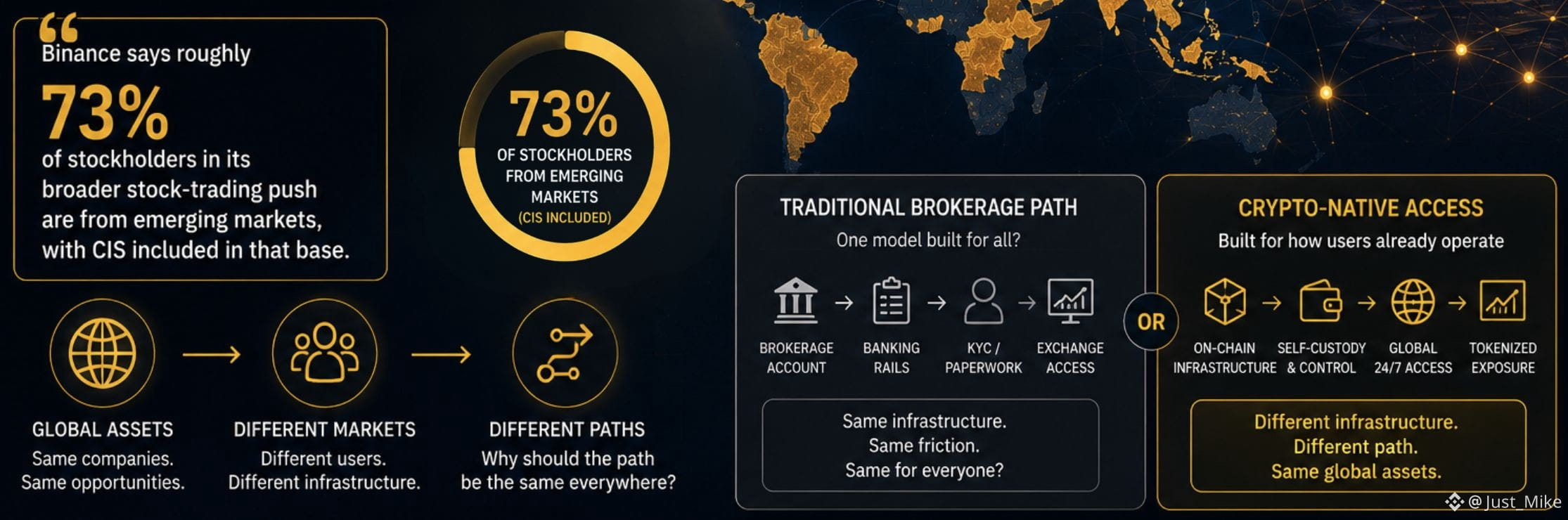
Binance says roughly 73% of stockholders in its broader stock-trading push are from emerging markets, with CIS included in that base.
That made me think about tokenization differently.
We often treat access to global stocks as if the infrastructure behind that access should look the same everywhere.
I'm not convinced it should.
If users already operate through crypto infrastructure, why should equity access necessarily follow the same path as it does in a traditional brokerage market?
So the interesting question isn't only:
“Can stocks be put on-chain?”
It's also:
“Why should the path to global equities be the same everywhere?”
And I think the 73% figure makes that question more interesting.
Maybe the future of equity access won't be one universal model.
Maybe different markets will use different paths to reach the same global assets.
#bstockscis @BinanceCIS
If roughly 73% of stockholders in Binance's broader stock-trading push are from emerging markets, should equity access work the same way everywhere?
One number in the bStocks materials caught my attention:
Binance says roughly 73% of stockholders in its broader stock-trading push are from emerging markets, with CIS included in that base.
That made me think about tokenization differently.
We often treat access to global stocks as if the infrastructure behind that access should look the same everywhere.
I'm not convinced it should.
If users already operate through crypto infrastructure, why should equity access necessarily follow the same path as it does in a traditional brokerage market?
So the interesting question isn't only:
“Can stocks be put on-chain?”
It's also:
“Why should the path to global equities be the same everywhere?”
And I think the 73% figure makes that question more interesting.
Maybe the future of equity access won't be one universal model.
Maybe different markets will use different paths to reach the same global assets.
#bstockscis @BinanceCIS
One number in the bStocks materials caught my attention:
Binance says roughly 73% of stockholders in its broader stock-trading push are from emerging markets, with CIS included in that base.
That made me think about tokenization differently.
We often treat access to global stocks as if the infrastructure behind that access should look the same everywhere.
I'm not convinced it should.
If users already operate through crypto infrastructure, why should equity access necessarily follow the same path as it does in a traditional brokerage market?
So the interesting question isn't only:
“Can stocks be put on-chain?”
It's also:
“Why should the path to global equities be the same everywhere?”
And I think the 73% figure makes that question more interesting.
Maybe the future of equity access won't be one universal model.
Maybe different markets will use different paths to reach the same global assets.
#bstockscis @BinanceCIS
2
1
104
Connectez-vous pour découvrir plus de contenu
Rejoignez la communauté mondiale des adeptes de cryptomonnaies sur Binance Square
⚡️ Suviez les dernières informations importantes sur les cryptomonnaies.
💬 Jugé digne de confiance par la plus grande plateforme d’échange de cryptomonnaies au monde.
👍 Découvrez les connaissances que partagent les créateurs vérifiés.
Adresse e-mail/Nº de téléphone
Sujets d’actualité
UKFCAWinsCourtOrderToRecover851400Pounds
29,967 vues
745 mentions
🚨 CRYPTO REGULATION JUST ENTERED A NEW PHASE: THEY’RE NOT ONLY WRITING RULES — THEY’RE TAKING MONEY BACK.
The UK’s FCA has secured another court-backed asset recovery, reinforcing a broader enforcement push against unauthorized financial and crypto-related activity.
And look at what’s happening simultaneously:
🇬🇧 FCA → enforcement + asset recovery
🇺🇸 SEC → clearer rules for functional crypto assets
🇺🇸 Fed → formal stablecoin supervision under the GENIUS Act
That combination matters.
Regulators are no longer debating whether crypto belongs inside the financial system.
They’re increasingly deciding who gets access, what rules they follow, and what happens when those rules are broken.
The next crypto cycle may not be “regulation vs innovation.”
It may be regulated crypto vs everyone who can’t meet the standard. 👀
$COIN $CRCL $BTC
#ukfcawinscourtordertorecover851400pounds #ChainlinkLaunchesCCIP2WithEnterpriseVerification #GoldFallsTo$4144 #QNTFallsOver40%FromMorningHigh #USDTAdds845900HoldersInPast7Days
KimHotbae
·3 mentions J’aime
·4.3k vues
ChainlinkLaunchesCCIP2WithEnterpriseVerification
44,151 vues
928 mentions
GoldFallsTo$4144
15,476 vues
158 mentions