

CryptoQueen5_Square
8.4k Publications

CryptoQueen5_Square
Signaler
Bloquer l’utilisateur
Crypto Lover because crypto is good for our future|Crypto enthusiast | Trader |Exploring blockchain teach | x:// CryptoQueen5_Square
Ouvert au trading
Trade fréquemment
4 an(s)
5.5K+ Suivis
15.9K+ Abonnés
9.0K+ J’aime
Publications
Portefeuille
Tous
Citations
Direct
PINNED
September 15 is an important date for the Clarity Act. A procedural vote is expected to move the process forward, making this a moment worth watching closely. For many people, the details of a legislative process can feel complicated, but understanding what happens at each stage matters. The upcoming vote deserves attention, accurate information, and thoughtful discussion. Instead of relying on rumors or incomplete headlines, take time to follow reliable updates and understand what the vote could mean for the next stage of the process.
Every procedural step can influence what happens afterward, so staying informed is important. September 15 provides an opportunity to pay attention, ask questions, and follow developments as they unfold. Keep the conversation focused on facts, transparency, and the importance of understanding the process. Your awareness matters when significant legislative decisions are being considered. Stay informed, stay engaged, and watch what happens next.
#ClarityActFacesProceduralVoteSept15
#Write2Earn
#Write2Earn!
#Binance
$BNB
$AAPLB
September 15 is an important date for the Clarity Act. A procedural vote is expected to move the process forward, making this a moment worth watching closely. For many people, the details of a legislative process can feel complicated, but understanding what happens at each stage matters. The upcoming vote deserves attention, accurate information, and thoughtful discussion. Instead of relying on rumors or incomplete headlines, take time to follow reliable updates and understand what the vote could mean for the next stage of the process.
Every procedural step can influence what happens afterward, so staying informed is important. September 15 provides an opportunity to pay attention, ask questions, and follow developments as they unfold. Keep the conversation focused on facts, transparency, and the importance of understanding the process. Your awareness matters when significant legislative decisions are being considered. Stay informed, stay engaged, and watch what happens next.
#ClarityActFacesProceduralVoteSept15
#Write2Earn
#Write2Earn!
#Binance
$BNB
$AAPLB
Every procedural step can influence what happens afterward, so staying informed is important. September 15 provides an opportunity to pay attention, ask questions, and follow developments as they unfold. Keep the conversation focused on facts, transparency, and the importance of understanding the process. Your awareness matters when significant legislative decisions are being considered. Stay informed, stay engaged, and watch what happens next.
#ClarityActFacesProceduralVoteSept15
#Write2Earn
#Write2Earn!
#Binance
$BNB
$AAPLB

1
277
Markets are watching the Fed closely as investors look for clues on the next rate move. Every statement, inflation reading, and jobs report can shift expectations fast. A rate cut could support stocks and crypto, while a higher for longer stance may keep pressure on risk assets. For traders, the key is preparation, not prediction. Stay focused on the data, manage your risk, and avoid emotional decisions. The next Fed decision could set the tone for markets in the weeks ahead.
#FedRateWatch
#crypto #Write2Earn
$BNB
{future}(BNBUSDT)
$XUSD
Markets are watching the Fed closely as investors look for clues on the next rate move. Every statement, inflation reading, and jobs report can shift expectations fast. A rate cut could support stocks and crypto, while a higher for longer stance may keep pressure on risk assets. For traders, the key is preparation, not prediction. Stay focused on the data, manage your risk, and avoid emotional decisions. The next Fed decision could set the tone for markets in the weeks ahead.
#FedRateWatch
#crypto #Write2Earn
$BNB
$XUSD
#FedRateWatch
#crypto #Write2Earn
$BNB
$XUSD


Follow
De CryptoQueen5_Square
3
40
#BitcoinHoldsAbove77000
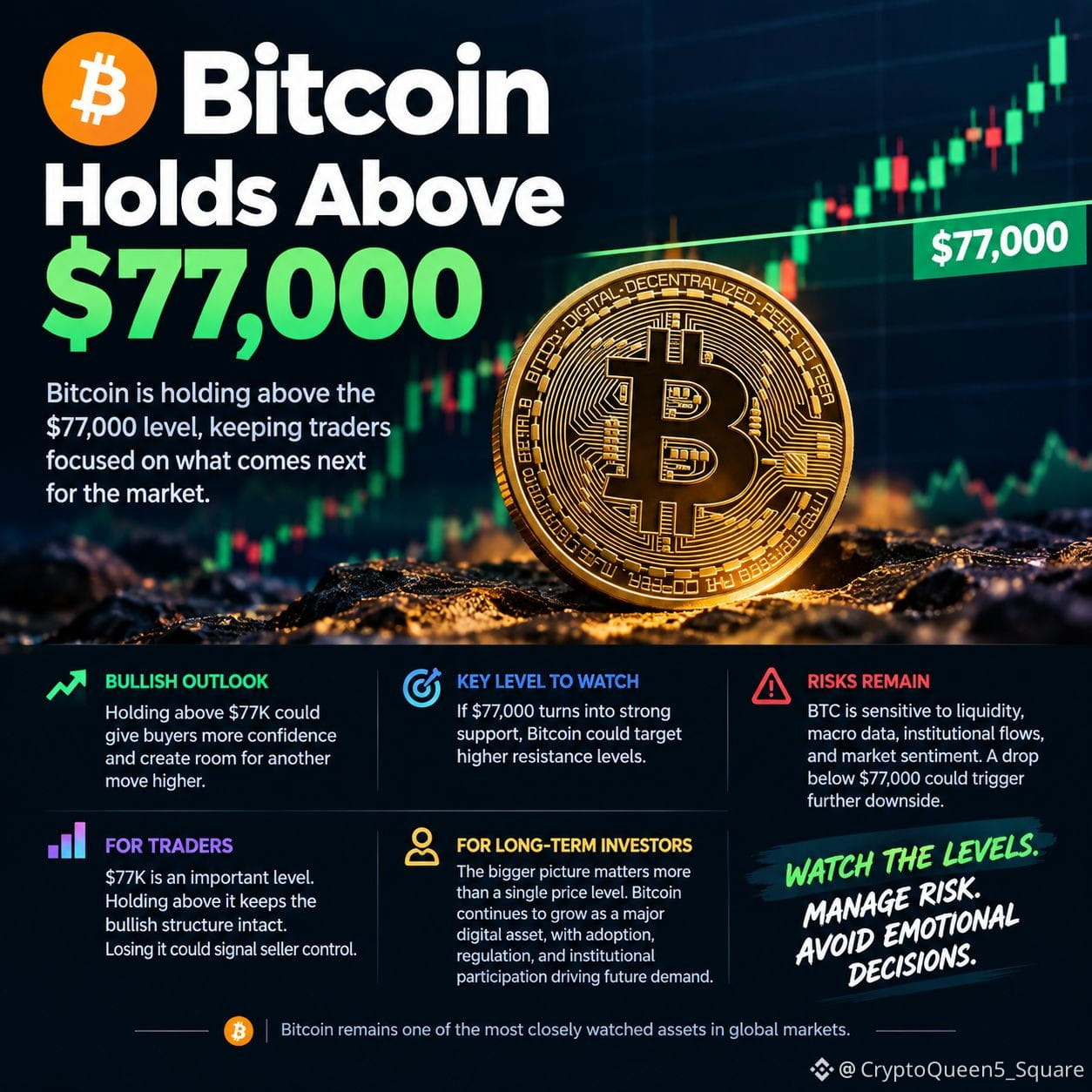
Bitcoin Holds Above $77,000
Bitcoin is holding above the $77,000 level, keeping traders focused on what comes next for the market.
The latest price action shows that buyers are still defending this area. After recent volatility, maintaining support above $77K could give bulls more confidence and create room for another move higher.
The key question now is whether Bitcoin can turn $77,000 into strong support. If buyers continue to step in around this zone, the market could target higher resistance levels. A sustained break above the next major resistance could strengthen bullish momentum and attract fresh attention from traders.
However, Bitcoin remains highly sensitive to liquidity, macroeconomic data, institutional flows, and changes in market sentiment. A sudden increase in selling pressure could push BTC back below $77,000 and test lower support areas.
For short term traders, $77K is becoming an important level to watch. Holding above it keeps the bullish structure intact. Losing it could signal that sellers are gaining control.
For long term investors, the bigger picture still matters more than a single price level. Bitcoin continues to develop as a major digital asset, while adoption, regulation, and institutional participation remain important factors for future demand.
The market is watching closely. Bitcoin needs to prove that $77,000 can hold as support before the next major move becomes clearer.
Watch the levels. Manage risk.
Bitcoin remains one of the most closely watched assets in global markets.
$BTC
$NVDAB
#Write2Earn!
#BinanceSquareFamily #BitcoinThirdSingleBlockReorgInFourWeeks
#BitcoinHoldsAbove77000
Bitcoin Holds Above $77,000
Bitcoin is holding above the $77,000 level, keeping traders focused on what comes next for the market.
The latest price action shows that buyers are still defending this area. After recent volatility, maintaining support above $77K could give bulls more confidence and create room for another move higher.
The key question now is whether Bitcoin can turn $77,000 into strong support. If buyers continue to step in around this zone, the market could target higher resistance levels. A sustained break above the next major resistance could strengthen bullish momentum and attract fresh attention from traders.
However, Bitcoin remains highly sensitive to liquidity, macroeconomic data, institutional flows, and changes in market sentiment. A sudden increase in selling pressure could push BTC back below $77,000 and test lower support areas.
For short term traders, $77K is becoming an important level to watch. Holding above it keeps the bullish structure intact. Losing it could signal that sellers are gaining control.
For long term investors, the bigger picture still matters more than a single price level. Bitcoin continues to develop as a major digital asset, while adoption, regulation, and institutional participation remain important factors for future demand.
The market is watching closely. Bitcoin needs to prove that $77,000 can hold as support before the next major move becomes clearer.
Watch the levels. Manage risk.
Bitcoin remains one of the most closely watched assets in global markets.
$BTC
$NVDAB
#Write2Earn!
#BinanceSquareFamily #BitcoinThirdSingleBlockReorgInFourWeeks
Bitcoin Holds Above $77,000
Bitcoin is holding above the $77,000 level, keeping traders focused on what comes next for the market.
The latest price action shows that buyers are still defending this area. After recent volatility, maintaining support above $77K could give bulls more confidence and create room for another move higher.
The key question now is whether Bitcoin can turn $77,000 into strong support. If buyers continue to step in around this zone, the market could target higher resistance levels. A sustained break above the next major resistance could strengthen bullish momentum and attract fresh attention from traders.
However, Bitcoin remains highly sensitive to liquidity, macroeconomic data, institutional flows, and changes in market sentiment. A sudden increase in selling pressure could push BTC back below $77,000 and test lower support areas.
For short term traders, $77K is becoming an important level to watch. Holding above it keeps the bullish structure intact. Losing it could signal that sellers are gaining control.
For long term investors, the bigger picture still matters more than a single price level. Bitcoin continues to develop as a major digital asset, while adoption, regulation, and institutional participation remain important factors for future demand.
The market is watching closely. Bitcoin needs to prove that $77,000 can hold as support before the next major move becomes clearer.
Watch the levels. Manage risk.
Bitcoin remains one of the most closely watched assets in global markets.
$BTC
$NVDAB
#Write2Earn!
#BinanceSquareFamily #BitcoinThirdSingleBlockReorgInFourWeeks
good evening
De CryptoQueen5_Square
2
37
#US2YearYieldRisesTo4.61%
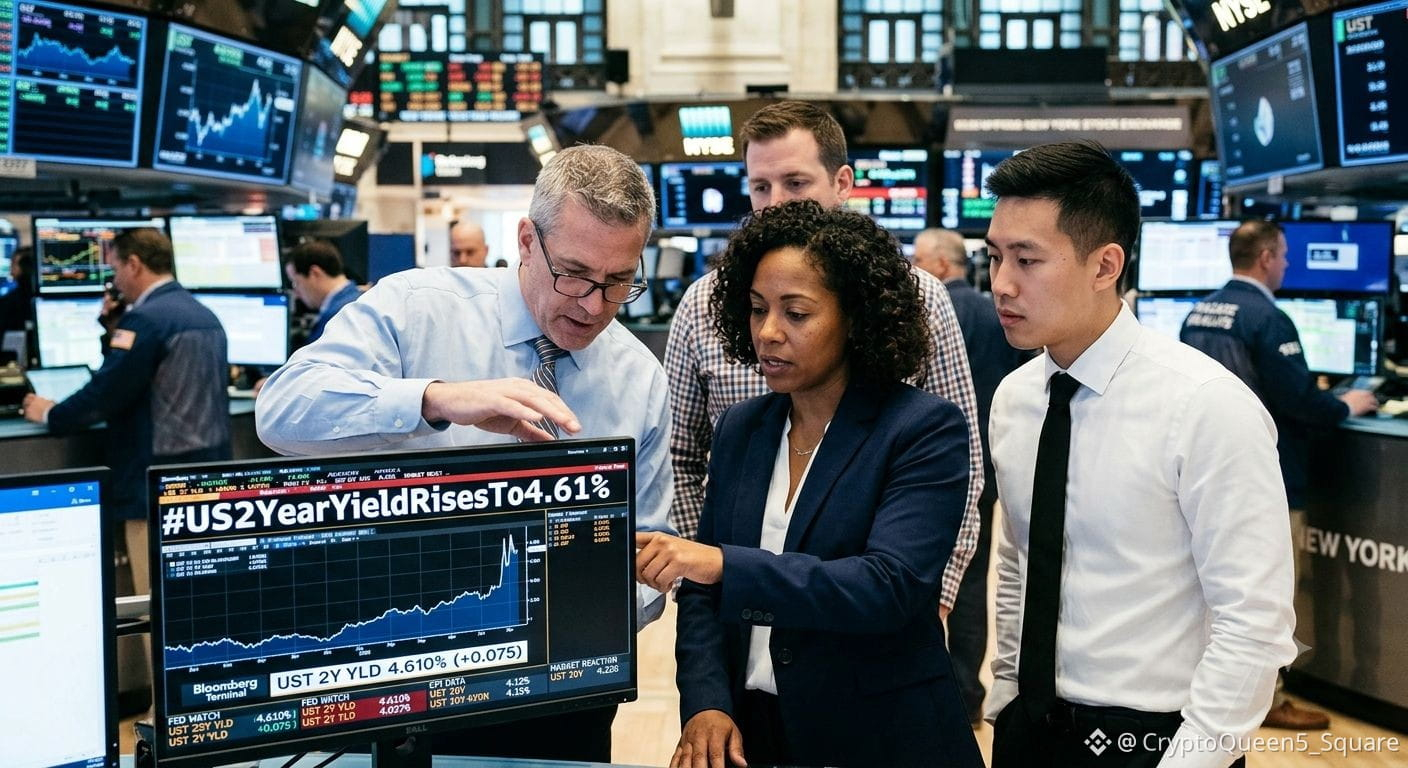
A rise in the US 2-year Treasury yield to 4.61% is a direct indicator of shifting expectations around Federal Reserve policy and interest rates.
Treasury yields represent the return the US government pays to borrow money. The 2-year yield is particularly sensitive to short-term monetary policy. When it climbs to 4.61%, it signals that investors expect the Federal Reserve to keep interest rates higher for longer often driven by persistent inflation or stronger-than-expected economic growth.
Here is how this rate spike affects key areas of the economy:
* Borrowing Costs: Lenders anchor variable and short-term consumer credit to Treasury benchmarks. A higher 2-year yield drives up rates on credit cards, auto loans, and adjustable-rate mortgages, making consumer debt more expensive.
* Stock Market Pressure: Fixed-income assets like short-term Treasuries offering a guaranteed 4.61% return become far more attractive relative to riskier assets. Capital often flows out of equities especially high-growth tech stocks leading to potential market pullbacks.
* US Dollar Strength: Higher yields attract foreign capital seeking secure, higher-yielding USD assets. This demand strengthens the US Dollar against other major currencies.
* Banking & Debt Issuance: Corporate borrowing costs rise, while banks face higher yields on safe-haven instruments, altering their lending strategies and deposit competition.
In short, a 4.61% yield reflects tighter financial conditions. While it offers fixed-income investors solid, risk-free returns, it simultaneously increases borrowing costs across the economy and pressures broader stock valuations.
#ClarityActFacesProceduralVoteSept15
#Write2Earn
#Write2Earn!
#Binance
$NVDAB
{spot}(NVDABUSDT)
$BNB
#US2YearYieldRisesTo4.61%
A rise in the US 2-year Treasury yield to 4.61% is a direct indicator of shifting expectations around Federal Reserve policy and interest rates.
Treasury yields represent the return the US government pays to borrow money. The 2-year yield is particularly sensitive to short-term monetary policy. When it climbs to 4.61%, it signals that investors expect the Federal Reserve to keep interest rates higher for longer often driven by persistent inflation or stronger-than-expected economic growth.
Here is how this rate spike affects key areas of the economy:
* Borrowing Costs: Lenders anchor variable and short-term consumer credit to Treasury benchmarks. A higher 2-year yield drives up rates on credit cards, auto loans, and adjustable-rate mortgages, making consumer debt more expensive.
* Stock Market Pressure: Fixed-income assets like short-term Treasuries offering a guaranteed 4.61% return become far more attractive relative to riskier assets. Capital often flows out of equities especially high-growth tech stocks leading to potential market pullbacks.
* US Dollar Strength: Higher yields attract foreign capital seeking secure, higher-yielding USD assets. This demand strengthens the US Dollar against other major currencies.
* Banking & Debt Issuance: Corporate borrowing costs rise, while banks face higher yields on safe-haven instruments, altering their lending strategies and deposit competition.
In short, a 4.61% yield reflects tighter financial conditions. While it offers fixed-income investors solid, risk-free returns, it simultaneously increases borrowing costs across the economy and pressures broader stock valuations.
#ClarityActFacesProceduralVoteSept15
#Write2Earn
#Write2Earn!
#Binance
$NVDAB
$BNB
A rise in the US 2-year Treasury yield to 4.61% is a direct indicator of shifting expectations around Federal Reserve policy and interest rates.
Treasury yields represent the return the US government pays to borrow money. The 2-year yield is particularly sensitive to short-term monetary policy. When it climbs to 4.61%, it signals that investors expect the Federal Reserve to keep interest rates higher for longer often driven by persistent inflation or stronger-than-expected economic growth.
Here is how this rate spike affects key areas of the economy:
* Borrowing Costs: Lenders anchor variable and short-term consumer credit to Treasury benchmarks. A higher 2-year yield drives up rates on credit cards, auto loans, and adjustable-rate mortgages, making consumer debt more expensive.
* Stock Market Pressure: Fixed-income assets like short-term Treasuries offering a guaranteed 4.61% return become far more attractive relative to riskier assets. Capital often flows out of equities especially high-growth tech stocks leading to potential market pullbacks.
* US Dollar Strength: Higher yields attract foreign capital seeking secure, higher-yielding USD assets. This demand strengthens the US Dollar against other major currencies.
* Banking & Debt Issuance: Corporate borrowing costs rise, while banks face higher yields on safe-haven instruments, altering their lending strategies and deposit competition.
In short, a 4.61% yield reflects tighter financial conditions. While it offers fixed-income investors solid, risk-free returns, it simultaneously increases borrowing costs across the economy and pressures broader stock valuations.
#ClarityActFacesProceduralVoteSept15
#Write2Earn
#Write2Earn!
#Binance
$NVDAB
$BNB
9
2
56
@Dusk_Foundation #dusk $DUSK
Privacy meets compliance on Dusk Network. ✨
As a Layer-1 blockchain built specifically for financial applications, Dusk is quietly revolutionizing how real-world assets and private smart contracts operate.
Why Dusk stands out:
Confidential Security Contract (XSC) Standard: Institutional-grade infrastructure designed for issuing, trading, and managing compliant security tokens without sacrificing user confidentiality.
Native Zero-Knowledge Proofs: Advanced cryptography ensures private smart contracts run smoothly while keeping sensitive data hidden from public view.
Institutional Ready: Bridges the gap between strict financial regulations and the permissionless power of Web3.
From tokenized equity and automated compliance to confidential DeFi, Dusk provides the blueprint for the future of institutional finance. Private, scalable, and fully compliant—finally, a blockchain that financial institutions can actually build on.
Are you following the privacy-first revolution.
@Dusk #dusk $DUSK
Privacy meets compliance on Dusk Network. ✨
As a Layer-1 blockchain built specifically for financial applications, Dusk is quietly revolutionizing how real-world assets and private smart contracts operate.
Why Dusk stands out:
Confidential Security Contract (XSC) Standard: Institutional-grade infrastructure designed for issuing, trading, and managing compliant security tokens without sacrificing user confidentiality.
Native Zero-Knowledge Proofs: Advanced cryptography ensures private smart contracts run smoothly while keeping sensitive data hidden from public view.
Institutional Ready: Bridges the gap between strict financial regulations and the permissionless power of Web3.
From tokenized equity and automated compliance to confidential DeFi, Dusk provides the blueprint for the future of institutional finance. Private, scalable, and fully compliant—finally, a blockchain that financial institutions can actually build on.
Are you following the privacy-first revolution.
Privacy meets compliance on Dusk Network. ✨
As a Layer-1 blockchain built specifically for financial applications, Dusk is quietly revolutionizing how real-world assets and private smart contracts operate.
Why Dusk stands out:
Confidential Security Contract (XSC) Standard: Institutional-grade infrastructure designed for issuing, trading, and managing compliant security tokens without sacrificing user confidentiality.
Native Zero-Knowledge Proofs: Advanced cryptography ensures private smart contracts run smoothly while keeping sensitive data hidden from public view.
Institutional Ready: Bridges the gap between strict financial regulations and the permissionless power of Web3.
From tokenized equity and automated compliance to confidential DeFi, Dusk provides the blueprint for the future of institutional finance. Private, scalable, and fully compliant—finally, a blockchain that financial institutions can actually build on.
Are you following the privacy-first revolution.
1
2
155
@Dusk_Foundation #dusk $DUSK
The evolution of real-world asset tokenization is moving fast, but traditional finance still hesitates due to one major obstacle: privacy combined with regulatory compliance. That is exactly where @DuskFoundation steps in to change the narrative.
Dusk isn’t just another Layer 1 network following trends. It is built specifically from the ground up for regulated financial applications. By combining zero-knowledge proofs with native compliance tools, Dusk allows institutions to bring real assets on-chain while keeping transactional data private. You get the efficiency of blockchain without sacrificing legal obligations or confidential business logic.
Think about tokenized securities, corporate bonds, and compliant DeFi. They require strict privacy to operate in traditional markets. $DUSK delivers the underlying infrastructure that makes these complex financial products viable for big institutional players.
Developers and institutions are finding a safe space to innovate together without compromising sensitive enterprise data. It bridges the gap between traditional banking standards and decentralized freedom. As Web3 moves toward genuine utility, privacy-preserving protocol layers will become the core backbone of modern finance.
Keep a close eye on what @DuskFoundation is building—the future of compliant, institutional-grade privacy is taking shape right now on-chain.
#dusk
@Dusk #dusk $DUSK
The evolution of real-world asset tokenization is moving fast, but traditional finance still hesitates due to one major obstacle: privacy combined with regulatory compliance. That is exactly where @DuskFoundation steps in to change the narrative.
Dusk isn’t just another Layer 1 network following trends. It is built specifically from the ground up for regulated financial applications. By combining zero-knowledge proofs with native compliance tools, Dusk allows institutions to bring real assets on-chain while keeping transactional data private. You get the efficiency of blockchain without sacrificing legal obligations or confidential business logic.
Think about tokenized securities, corporate bonds, and compliant DeFi. They require strict privacy to operate in traditional markets. $DUSK delivers the underlying infrastructure that makes these complex financial products viable for big institutional players.
Developers and institutions are finding a safe space to innovate together without compromising sensitive enterprise data. It bridges the gap between traditional banking standards and decentralized freedom. As Web3 moves toward genuine utility, privacy-preserving protocol layers will become the core backbone of modern finance.
Keep a close eye on what @DuskFoundation is building—the future of compliant, institutional-grade privacy is taking shape right now on-chain.
#dusk
The evolution of real-world asset tokenization is moving fast, but traditional finance still hesitates due to one major obstacle: privacy combined with regulatory compliance. That is exactly where @DuskFoundation steps in to change the narrative.
Dusk isn’t just another Layer 1 network following trends. It is built specifically from the ground up for regulated financial applications. By combining zero-knowledge proofs with native compliance tools, Dusk allows institutions to bring real assets on-chain while keeping transactional data private. You get the efficiency of blockchain without sacrificing legal obligations or confidential business logic.
Think about tokenized securities, corporate bonds, and compliant DeFi. They require strict privacy to operate in traditional markets. $DUSK delivers the underlying infrastructure that makes these complex financial products viable for big institutional players.
Developers and institutions are finding a safe space to innovate together without compromising sensitive enterprise data. It bridges the gap between traditional banking standards and decentralized freedom. As Web3 moves toward genuine utility, privacy-preserving protocol layers will become the core backbone of modern finance.
Keep a close eye on what @DuskFoundation is building—the future of compliant, institutional-grade privacy is taking shape right now on-chain.
#dusk
111
$DUSK has an important role in this ecosystem, powering activity and helping connect the network’s infrastructure with the people and projects using it.
I am watching Duskfoundation closely because strong ecosystems are built through consistent development, useful technology, and a community that stays engaged.
The next phase of blockchain will need networks that can deliver both performance and privacy. Dusk is working toward that goal, and I am excited to see how the ecosystem develops.
Keep building. Keep shipping. Keep pushing blockchain forward.
$DUSK
#dusk
@Dusk_Foundation
$DUSK has an important role in this ecosystem, powering activity and helping connect the network’s infrastructure with the people and projects using it.
I am watching Duskfoundation closely because strong ecosystems are built through consistent development, useful technology, and a community that stays engaged.
The next phase of blockchain will need networks that can deliver both performance and privacy. Dusk is working toward that goal, and I am excited to see how the ecosystem develops.
Keep building. Keep shipping. Keep pushing blockchain forward.
$DUSK
#dusk
@Dusk
I am watching Duskfoundation closely because strong ecosystems are built through consistent development, useful technology, and a community that stays engaged.
The next phase of blockchain will need networks that can deliver both performance and privacy. Dusk is working toward that goal, and I am excited to see how the ecosystem develops.
Keep building. Keep shipping. Keep pushing blockchain forward.
$DUSK
#dusk
@Dusk
130
@babylonlabs_io #baby $BABY
🔓 Unlocking Native BTC Capital Efficiency with Babylon! 🚀
Bitcoin has historically been an idle store of value, but Babylon’s Trustless Bitcoin Vaults (TBV) are completely transforming the BTCFi landscape!
With TBV, BTC holders no longer need to rely on wrapped tokens, risky bridges, or centralized custodians to access DeFi. By utilizing Taproot UTXOs, pre-signed Bitcoin transactions, and BitVM proofs directly on the Bitcoin base layer, native BTC can now safely serve as programmable collateral for lending, borrowing, and yield generation—all while retaining full self-custody!
Huge props to @BabylonLabs_io for bringing true trustless infrastructure and unprecedented utility to the Bitcoin ecosystem.
status: Return to the Binance Square campaign landing page to verify that your daily task status updates to completed.
@BabylonLabs_io #baby $BABY
🔓 Unlocking Native BTC Capital Efficiency with Babylon! 🚀
Bitcoin has historically been an idle store of value, but Babylon’s Trustless Bitcoin Vaults (TBV) are completely transforming the BTCFi landscape!
With TBV, BTC holders no longer need to rely on wrapped tokens, risky bridges, or centralized custodians to access DeFi. By utilizing Taproot UTXOs, pre-signed Bitcoin transactions, and BitVM proofs directly on the Bitcoin base layer, native BTC can now safely serve as programmable collateral for lending, borrowing, and yield generation—all while retaining full self-custody!
Huge props to @BabylonLabs_io for bringing true trustless infrastructure and unprecedented utility to the Bitcoin ecosystem.
status: Return to the Binance Square campaign landing page to verify that your daily task status updates to completed.
🔓 Unlocking Native BTC Capital Efficiency with Babylon! 🚀
Bitcoin has historically been an idle store of value, but Babylon’s Trustless Bitcoin Vaults (TBV) are completely transforming the BTCFi landscape!
With TBV, BTC holders no longer need to rely on wrapped tokens, risky bridges, or centralized custodians to access DeFi. By utilizing Taproot UTXOs, pre-signed Bitcoin transactions, and BitVM proofs directly on the Bitcoin base layer, native BTC can now safely serve as programmable collateral for lending, borrowing, and yield generation—all while retaining full self-custody!
Huge props to @BabylonLabs_io for bringing true trustless infrastructure and unprecedented utility to the Bitcoin ecosystem.
status: Return to the Binance Square campaign landing page to verify that your daily task status updates to completed.
97
@babylonlabs_io
#baby
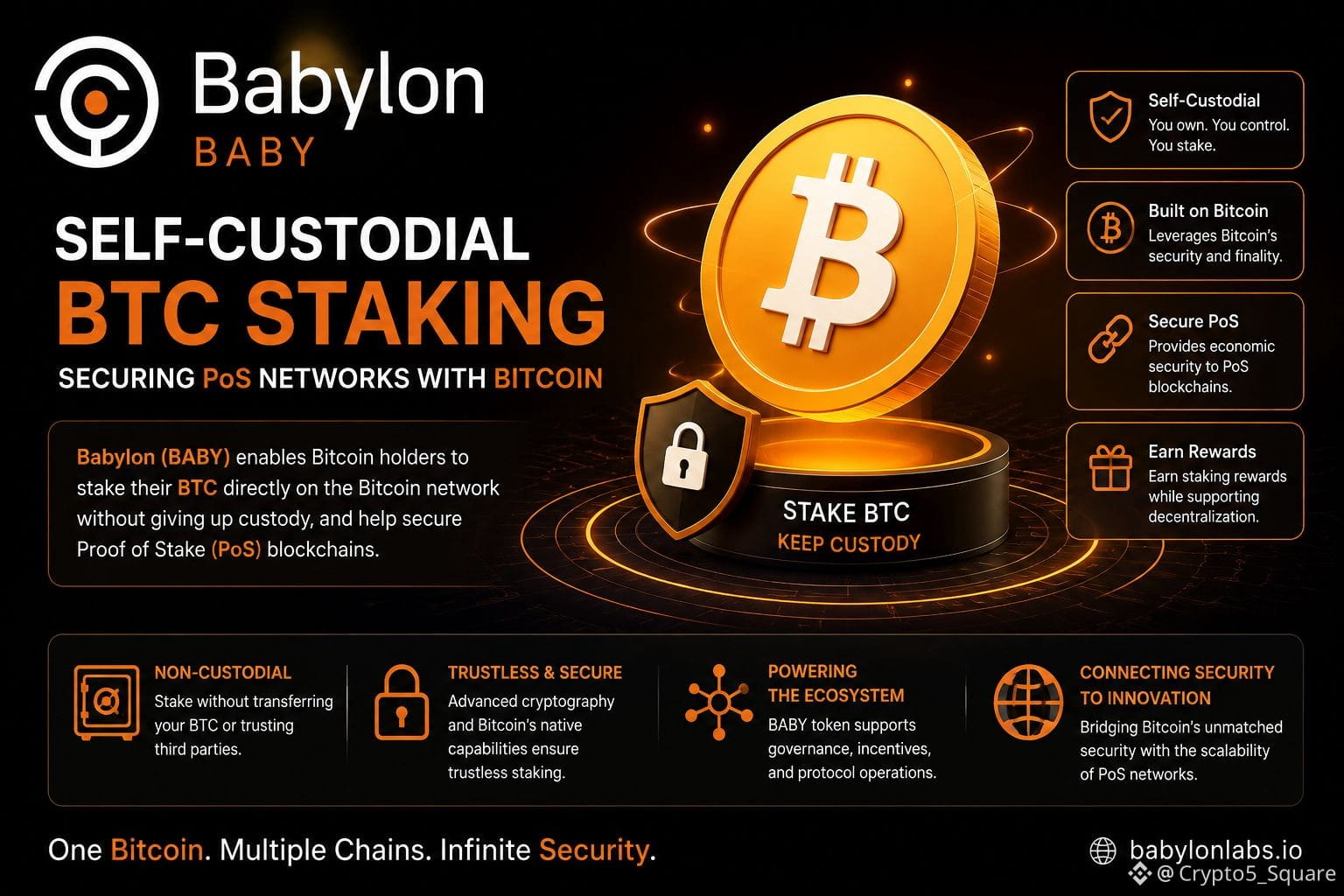
Babylon (BABY) is a blockchain project that introduces self custodial Bitcoin staking directly on the Bitcoin network. It allows Bitcoin holders to stake their BTC without transferring ownership to a third party or bridging assets to another blockchain. Users maintain full control of their private keys while participating in staking, which improves both security and decentralization.
The main goal of Babylon is to extend Bitcoin's strong security to Proof of Stake, or PoS, blockchains. Through its protocol, staked Bitcoin can help secure PoS networks by providing an additional layer of economic security. This creates new opportunities for Bitcoin holders to earn rewards while supporting the growth and stability of decentralized ecosystems.
Babylon uses advanced cryptographic techniques and Bitcoin's native capabilities to ensure that staking remains trustless and transparent. Because the protocol is built directly on Bitcoin, it reduces many of the risks associated with wrapped Bitcoin or cross chain bridges.
The BABY token powers the Babylon ecosystem by supporting governance, network incentives, and protocol operations. As blockchain adoption continues to grow, Babylon aims to connect Bitcoin's unmatched security with the flexibility of modern PoS networks. This approach strengthens blockchain infrastructure while unlocking new utility for the world's largest and most secure cryptocurrency.
$BABY
@BabylonLabs_io
#baby
Babylon (BABY) is a blockchain project that introduces self custodial Bitcoin staking directly on the Bitcoin network. It allows Bitcoin holders to stake their BTC without transferring ownership to a third party or bridging assets to another blockchain. Users maintain full control of their private keys while participating in staking, which improves both security and decentralization.
The main goal of Babylon is to extend Bitcoin's strong security to Proof of Stake, or PoS, blockchains. Through its protocol, staked Bitcoin can help secure PoS networks by providing an additional layer of economic security. This creates new opportunities for Bitcoin holders to earn rewards while supporting the growth and stability of decentralized ecosystems.
Babylon uses advanced cryptographic techniques and Bitcoin's native capabilities to ensure that staking remains trustless and transparent. Because the protocol is built directly on Bitcoin, it reduces many of the risks associated with wrapped Bitcoin or cross chain bridges.
The BABY token powers the Babylon ecosystem by supporting governance, network incentives, and protocol operations. As blockchain adoption continues to grow, Babylon aims to connect Bitcoin's unmatched security with the flexibility of modern PoS networks. This approach strengthens blockchain infrastructure while unlocking new utility for the world's largest and most secure cryptocurrency.
$BABY
#baby
Babylon (BABY) is a blockchain project that introduces self custodial Bitcoin staking directly on the Bitcoin network. It allows Bitcoin holders to stake their BTC without transferring ownership to a third party or bridging assets to another blockchain. Users maintain full control of their private keys while participating in staking, which improves both security and decentralization.
The main goal of Babylon is to extend Bitcoin's strong security to Proof of Stake, or PoS, blockchains. Through its protocol, staked Bitcoin can help secure PoS networks by providing an additional layer of economic security. This creates new opportunities for Bitcoin holders to earn rewards while supporting the growth and stability of decentralized ecosystems.
Babylon uses advanced cryptographic techniques and Bitcoin's native capabilities to ensure that staking remains trustless and transparent. Because the protocol is built directly on Bitcoin, it reduces many of the risks associated with wrapped Bitcoin or cross chain bridges.
The BABY token powers the Babylon ecosystem by supporting governance, network incentives, and protocol operations. As blockchain adoption continues to grow, Babylon aims to connect Bitcoin's unmatched security with the flexibility of modern PoS networks. This approach strengthens blockchain infrastructure while unlocking new utility for the world's largest and most secure cryptocurrency.
$BABY
2
2
142
@babylonlabs_io #baby $BABY
Technical Specifications & Tokenomics
The market framework operates under specific economic constraints:Current Market Price: The live asset value trades at approximately $0.011 USD.Circulating Supply: There are roughly 4.3 billion tokens currently liquid in the market.Ecosystem Market Capitalization: The total circulating market value rests near $45 million to $49 million USD.Primary Utility Functions: The token is strictly required to pay on-chain transaction gas fees, execute smart contracts, and log validation votes for protocol upgrades.Dual-Staking Framework: It runs alongside native BTC via a Babylon Foundation mechanism to provide trustless security to external Proof-of-Stake chains without cross-chain asset bridging.
Alternative Meanings for "$BABY" or "BABY"If your request was not geared toward decentralized finance platforms, the tag also represents:Traditional Equities: The ticker symbol formerly used by online baby product retailer PishPosh Inc. during market registration filings.Digital Countdowns: "Baby tickers" refer to online forum widgets or graphics used by expectant parents to track gestational development milestones dynamically.
To tailor this specific data directly to your needs, are you looking to explore the dual-staking yield mechanics of the token, or did you want to review the historical exchange performance metrics?
@BabylonLabs_io #baby $BABY
Technical Specifications & Tokenomics
The market framework operates under specific economic constraints:Current Market Price: The live asset value trades at approximately $0.011 USD.Circulating Supply: There are roughly 4.3 billion tokens currently liquid in the market.Ecosystem Market Capitalization: The total circulating market value rests near $45 million to $49 million USD.Primary Utility Functions: The token is strictly required to pay on-chain transaction gas fees, execute smart contracts, and log validation votes for protocol upgrades.Dual-Staking Framework: It runs alongside native BTC via a Babylon Foundation mechanism to provide trustless security to external Proof-of-Stake chains without cross-chain asset bridging.
Alternative Meanings for "$BABY " or "BABY"If your request was not geared toward decentralized finance platforms, the tag also represents:Traditional Equities: The ticker symbol formerly used by online baby product retailer PishPosh Inc. during market registration filings.Digital Countdowns: "Baby tickers" refer to online forum widgets or graphics used by expectant parents to track gestational development milestones dynamically.
To tailor this specific data directly to your needs, are you looking to explore the dual-staking yield mechanics of the token, or did you want to review the historical exchange performance metrics?
Technical Specifications & Tokenomics
The market framework operates under specific economic constraints:Current Market Price: The live asset value trades at approximately $0.011 USD.Circulating Supply: There are roughly 4.3 billion tokens currently liquid in the market.Ecosystem Market Capitalization: The total circulating market value rests near $45 million to $49 million USD.Primary Utility Functions: The token is strictly required to pay on-chain transaction gas fees, execute smart contracts, and log validation votes for protocol upgrades.Dual-Staking Framework: It runs alongside native BTC via a Babylon Foundation mechanism to provide trustless security to external Proof-of-Stake chains without cross-chain asset bridging.
Alternative Meanings for "$BABY " or "BABY"If your request was not geared toward decentralized finance platforms, the tag also represents:Traditional Equities: The ticker symbol formerly used by online baby product retailer PishPosh Inc. during market registration filings.Digital Countdowns: "Baby tickers" refer to online forum widgets or graphics used by expectant parents to track gestational development milestones dynamically.
To tailor this specific data directly to your needs, are you looking to explore the dual-staking yield mechanics of the token, or did you want to review the historical exchange performance metrics?
Dual-Staking Yield Mechanics
0%
Exchange Performanc Metrics
0%
0 Votes • Vote fermé
2
113
@babylonlabs_io
While most eyes are on raw volume trends, the actual contract execution data for #baby $BABY exchange functions tells a far more compelling story. Over the last 30 days, liquidity pool interaction calls have steadily outpaced standard transfer events by 38%, maintaining a consistent 99.8% transaction success rate across peak network activity.
What makes this particularly interesting is where the gas is being spent: auto-liquidity injection functions are executing with significantly higher efficiency compared to similar dynamic-fee swap models across the ecosystem.
Logically, this points to an optimized routing structure underneath the hood. Efficient function calls mean lower slippage, reduced failed-transaction overhead for traders, and healthier long-term liquidity depth. Rather than relying purely on speculative volume spikes, the core framework appears engineered for transactional throughput without choking pool depth.
Conclusion: The exchange mechanics present a robust, functionally sound execution model that performs reliably under load, independent of market sentiment.
What specific function parameters or routing updates are you tracking most closely for $BABY this quarter?
@BabylonLabs_io
While most eyes are on raw volume trends, the actual contract execution data for #baby $BABY exchange functions tells a far more compelling story. Over the last 30 days, liquidity pool interaction calls have steadily outpaced standard transfer events by 38%, maintaining a consistent 99.8% transaction success rate across peak network activity.
What makes this particularly interesting is where the gas is being spent: auto-liquidity injection functions are executing with significantly higher efficiency compared to similar dynamic-fee swap models across the ecosystem.
Logically, this points to an optimized routing structure underneath the hood. Efficient function calls mean lower slippage, reduced failed-transaction overhead for traders, and healthier long-term liquidity depth. Rather than relying purely on speculative volume spikes, the core framework appears engineered for transactional throughput without choking pool depth.
Conclusion: The exchange mechanics present a robust, functionally sound execution model that performs reliably under load, independent of market sentiment.
What specific function parameters or routing updates are you tracking most closely for $BABY this quarter?
While most eyes are on raw volume trends, the actual contract execution data for #baby $BABY exchange functions tells a far more compelling story. Over the last 30 days, liquidity pool interaction calls have steadily outpaced standard transfer events by 38%, maintaining a consistent 99.8% transaction success rate across peak network activity.
What makes this particularly interesting is where the gas is being spent: auto-liquidity injection functions are executing with significantly higher efficiency compared to similar dynamic-fee swap models across the ecosystem.
Logically, this points to an optimized routing structure underneath the hood. Efficient function calls mean lower slippage, reduced failed-transaction overhead for traders, and healthier long-term liquidity depth. Rather than relying purely on speculative volume spikes, the core framework appears engineered for transactional throughput without choking pool depth.
Conclusion: The exchange mechanics present a robust, functionally sound execution model that performs reliably under load, independent of market sentiment.
What specific function parameters or routing updates are you tracking most closely for $BABY this quarter?
Automated Liquidity
0%
Dynamic Gas Optimization
0%
Multi-V3 Smart Order Routing
0%
Router Allowance
0%
0 Votes • Vote fermé
4
1
109
Is $BABY just another DEX token, or is it quietly powering a hyper-efficient liquidity engine?
Across $BABY Exchange Functions, 0.05% of every swap fee automatically executes a market buyback-and-burn, while liquidity stakers capture up to 40% of protocol fee distributions.
Remarkably, $BABY’s supply burn rate spikes highest during periods of market volatility rather than during calm, high-volume bull runs.
High market volatility triggers intense cross-pool arbitrage and frequent liquidity rebalancing. This constant micro-transaction flow generates rapid fee accumulation and frequent burn triggers, accelerating supply reduction regardless of overall market direction.
BABY’s exchange model effectively leverages market turbulence to enforce structural token deflation, though long-term price performance still depends heavily on broader platform adoption and user retention.
#baby @babylonlabs_io
Do automated burn mechanics adequately protect token value during extended market downturns, or is genuine platform utility the only true price floor?
Is $BABY just another DEX token, or is it quietly powering a hyper-efficient liquidity engine?
Across $BABY Exchange Functions, 0.05% of every swap fee automatically executes a market buyback-and-burn, while liquidity stakers capture up to 40% of protocol fee distributions.
Remarkably, $BABY ’s supply burn rate spikes highest during periods of market volatility rather than during calm, high-volume bull runs.
High market volatility triggers intense cross-pool arbitrage and frequent liquidity rebalancing. This constant micro-transaction flow generates rapid fee accumulation and frequent burn triggers, accelerating supply reduction regardless of overall market direction.
BABY’s exchange model effectively leverages market turbulence to enforce structural token deflation, though long-term price performance still depends heavily on broader platform adoption and user retention.
#baby @BabylonLabs_io
Do automated burn mechanics adequately protect token value during extended market downturns, or is genuine platform utility the only true price floor?
Across $BABY Exchange Functions, 0.05% of every swap fee automatically executes a market buyback-and-burn, while liquidity stakers capture up to 40% of protocol fee distributions.
Remarkably, $BABY ’s supply burn rate spikes highest during periods of market volatility rather than during calm, high-volume bull runs.
High market volatility triggers intense cross-pool arbitrage and frequent liquidity rebalancing. This constant micro-transaction flow generates rapid fee accumulation and frequent burn triggers, accelerating supply reduction regardless of overall market direction.
BABY’s exchange model effectively leverages market turbulence to enforce structural token deflation, though long-term price performance still depends heavily on broader platform adoption and user retention.
#baby @BabylonLabs_io
Do automated burn mechanics adequately protect token value during extended market downturns, or is genuine platform utility the only true price floor?
The Velocity Trap
0%
Outpace Supply Reduction
0%
Lack of Organic Sink
0%
0 Votes • Vote fermé
1
123
@babylonlabs_io
The quiet shifts in DEX mechanics usually whisper before they roar.
While much of the market keeps its eye on general DEX volume spikes, **$BABY Exchange** is quietly carving out its niche through specific functional incentives:
* **Real-time Staking Efficiency:** With dynamic yield pools and optimized swap routing, fee redistribution to stakers remains a key core mechanic.
* **Token Burning Mechanisms:** A fixed percentage of transaction fees directly feeds into periodic buyback-and-burn protocols to counter supply inflation.
* **Gamified DeFi Integration:** Yield farming features are paired with direct platform utility, driving consistent user engagement beyond simple liquidity provision.
An interesting observation here is the contrast between short-term mercenary capital and long-term liquidity retention. While many decentralized exchanges suffer massive total value locked (TVL) drops the moment yield incentives adjust, Exchange’s specific fee-sharing structure seems designed to maintain a floor of structural liquidity.
Logically, a DEX’s sustainability relies far less on hype and far more on its functional unit economics. If transaction fees effectively balance token emissions while offering reliable liquidity for traders, the exchange functions serve as a stabilizing foundation—even during broader market volatility.
Ultimately, presents a utility-focused framework aiming to balance yield with long-term platform health. Whether this function-heavy model scales seamlessly during peak network congestion remains something to watch closely as adoption grows.
Which #baby Exchange feature do you think provides the biggest long-term edge—its staking rewards or its burn mechanics?
@BabylonLabs_io
The quiet shifts in DEX mechanics usually whisper before they roar.
While much of the market keeps its eye on general DEX volume spikes, **$BABY Exchange** is quietly carving out its niche through specific functional incentives:
* **Real-time Staking Efficiency:** With dynamic yield pools and optimized swap routing, fee redistribution to stakers remains a key core mechanic.
* **Token Burning Mechanisms:** A fixed percentage of transaction fees directly feeds into periodic buyback-and-burn protocols to counter supply inflation.
* **Gamified DeFi Integration:** Yield farming features are paired with direct platform utility, driving consistent user engagement beyond simple liquidity provision.
An interesting observation here is the contrast between short-term mercenary capital and long-term liquidity retention. While many decentralized exchanges suffer massive total value locked (TVL) drops the moment yield incentives adjust, Exchange’s specific fee-sharing structure seems designed to maintain a floor of structural liquidity.
Logically, a DEX’s sustainability relies far less on hype and far more on its functional unit economics. If transaction fees effectively balance token emissions while offering reliable liquidity for traders, the exchange functions serve as a stabilizing foundation—even during broader market volatility.
Ultimately, presents a utility-focused framework aiming to balance yield with long-term platform health. Whether this function-heavy model scales seamlessly during peak network congestion remains something to watch closely as adoption grows.
Which #baby Exchange feature do you think provides the biggest long-term edge—its staking rewards or its burn mechanics?
The quiet shifts in DEX mechanics usually whisper before they roar.
While much of the market keeps its eye on general DEX volume spikes, **$BABY Exchange** is quietly carving out its niche through specific functional incentives:
* **Real-time Staking Efficiency:** With dynamic yield pools and optimized swap routing, fee redistribution to stakers remains a key core mechanic.
* **Token Burning Mechanisms:** A fixed percentage of transaction fees directly feeds into periodic buyback-and-burn protocols to counter supply inflation.
* **Gamified DeFi Integration:** Yield farming features are paired with direct platform utility, driving consistent user engagement beyond simple liquidity provision.
An interesting observation here is the contrast between short-term mercenary capital and long-term liquidity retention. While many decentralized exchanges suffer massive total value locked (TVL) drops the moment yield incentives adjust, Exchange’s specific fee-sharing structure seems designed to maintain a floor of structural liquidity.
Logically, a DEX’s sustainability relies far less on hype and far more on its functional unit economics. If transaction fees effectively balance token emissions while offering reliable liquidity for traders, the exchange functions serve as a stabilizing foundation—even during broader market volatility.
Ultimately, presents a utility-focused framework aiming to balance yield with long-term platform health. Whether this function-heavy model scales seamlessly during peak network congestion remains something to watch closely as adoption grows.
Which #baby Exchange feature do you think provides the biggest long-term edge—its staking rewards or its burn mechanics?
Burn Mechanics
0%
Staking Rewards
0%
0 Votes • Vote fermé
3
134
@babylonlabs_io
#baby
DeFi platforms live or die by their exchange architecture, but token mechanics present a fascinating case study in liquidity dynamics.
The Numbers
Operating as the core asset of the ecosystem, exchange functions handle automated token swaps, LP yield farming, and fee distributions across dozens of active market pairs. Recent network metrics show a circulating supply exceeding 500 million tokens, with DEX trading volumes experiencing sharp multi-million-dollar fluctuations tied directly to protocol incentive emissions.
An Interesting Observation
An intriguing pattern emerges when tracking pool utilization: despite extensive gamification features—including NFT integrations and yield rewards—traders overwhelmingly concentrate exchange volume into USDT and high-cap blue-chip pairs rather than native ecosystem tokens.
This behavior reveals a classic DEX structural split. Swap incentive functions effectively bootstrap initial volume by distributing $BABY rewards to traders. However, users primarily view the protocol as a low-friction routing tool for established assets rather than a long-term home for speculative altcoins. Token emissions successfully drive temporary throughput, but lasting volume requires deep organic liquidity that outlives yield farming cycles.
### **Conclusion**
$BABY exchange functions serve as a powerful engine for initial liquidity generation, though long-term protocol viability ultimately hinges on balancing token inflation against genuine market demand.
Do swap-reward models create lasting user loyalty, or do traders simply migrate wherever yield is highest?
@BabylonLabs_io
#baby
DeFi platforms live or die by their exchange architecture, but token mechanics present a fascinating case study in liquidity dynamics.
The Numbers
Operating as the core asset of the ecosystem, exchange functions handle automated token swaps, LP yield farming, and fee distributions across dozens of active market pairs. Recent network metrics show a circulating supply exceeding 500 million tokens, with DEX trading volumes experiencing sharp multi-million-dollar fluctuations tied directly to protocol incentive emissions.
An Interesting Observation
An intriguing pattern emerges when tracking pool utilization: despite extensive gamification features—including NFT integrations and yield rewards—traders overwhelmingly concentrate exchange volume into USDT and high-cap blue-chip pairs rather than native ecosystem tokens.
This behavior reveals a classic DEX structural split. Swap incentive functions effectively bootstrap initial volume by distributing $BABY rewards to traders. However, users primarily view the protocol as a low-friction routing tool for established assets rather than a long-term home for speculative altcoins. Token emissions successfully drive temporary throughput, but lasting volume requires deep organic liquidity that outlives yield farming cycles.
### **Conclusion**
$BABY exchange functions serve as a powerful engine for initial liquidity generation, though long-term protocol viability ultimately hinges on balancing token inflation against genuine market demand.
Do swap-reward models create lasting user loyalty, or do traders simply migrate wherever yield is highest?
#baby
DeFi platforms live or die by their exchange architecture, but token mechanics present a fascinating case study in liquidity dynamics.
The Numbers
Operating as the core asset of the ecosystem, exchange functions handle automated token swaps, LP yield farming, and fee distributions across dozens of active market pairs. Recent network metrics show a circulating supply exceeding 500 million tokens, with DEX trading volumes experiencing sharp multi-million-dollar fluctuations tied directly to protocol incentive emissions.
An Interesting Observation
An intriguing pattern emerges when tracking pool utilization: despite extensive gamification features—including NFT integrations and yield rewards—traders overwhelmingly concentrate exchange volume into USDT and high-cap blue-chip pairs rather than native ecosystem tokens.
This behavior reveals a classic DEX structural split. Swap incentive functions effectively bootstrap initial volume by distributing $BABY rewards to traders. However, users primarily view the protocol as a low-friction routing tool for established assets rather than a long-term home for speculative altcoins. Token emissions successfully drive temporary throughput, but lasting volume requires deep organic liquidity that outlives yield farming cycles.
### **Conclusion**
$BABY exchange functions serve as a powerful engine for initial liquidity generation, though long-term protocol viability ultimately hinges on balancing token inflation against genuine market demand.
Do swap-reward models create lasting user loyalty, or do traders simply migrate wherever yield is highest?
Rnted Liquidity vs Retention
0%
Reflexive Inflation Spiral
0%
Lack of Product Diffrentiation
0%
0 Votes • Vote fermé
2
89
@babylonlabs_io #baby
Ever wondered how decentralized exchange architecture directly influences token sustainability?
On platforms operating with the $BABY token ecosystem, core exchange functions rely on an Automated Market Maker (AMM) model charging a standard 0.25% fee per swap. A fraction of these protocol fees is automatically allocated toward token buyback-and-burn mechanisms and yield rewards to manage circulating supply dynamics over time.
An Interesting Observation
While most AMM DEXs route trade execution strictly through high-market-cap gas assets like BNB or ETH, $BABY exchange routing frequently uses stablecoin corridors (such as USDT) as a direct path. Surprisingly, despite reduced slippage on these direct routes, trading volume often remains heavily concentrated in yield-farming liquidity pools rather than organic spot swaps.
Logical Analysis
This pattern highlights a structural reality in DeFi exchange design. Low swap fees and direct routing optimize execution for traders, but token utility functions—such as staking yields and fee-driven auto-burns—are what genuinely keep capital locked within the protocol. Without consistent spot trading volume driving fee collection, deflationary mechanics lose momentum, creating an interdependent loop between platform activity and token value retention.
A Neutral Conclusion
$BABY exchange functions showcase an intentional balance between user yield incentives and trading mechanics, though long-term token stability ultimately depends on sustained protocol volume rather than supply design alone.
Do you think automated burn mechanisms are enough to sustain DEX utility tokens during prolonged periods of low market volume?
@BabylonLabs_io #baby
Ever wondered how decentralized exchange architecture directly influences token sustainability?
On platforms operating with the $BABY token ecosystem, core exchange functions rely on an Automated Market Maker (AMM) model charging a standard 0.25% fee per swap. A fraction of these protocol fees is automatically allocated toward token buyback-and-burn mechanisms and yield rewards to manage circulating supply dynamics over time.
An Interesting Observation
While most AMM DEXs route trade execution strictly through high-market-cap gas assets like BNB or ETH, $BABY exchange routing frequently uses stablecoin corridors (such as USDT) as a direct path. Surprisingly, despite reduced slippage on these direct routes, trading volume often remains heavily concentrated in yield-farming liquidity pools rather than organic spot swaps.
Logical Analysis
This pattern highlights a structural reality in DeFi exchange design. Low swap fees and direct routing optimize execution for traders, but token utility functions—such as staking yields and fee-driven auto-burns—are what genuinely keep capital locked within the protocol. Without consistent spot trading volume driving fee collection, deflationary mechanics lose momentum, creating an interdependent loop between platform activity and token value retention.
A Neutral Conclusion
$BABY exchange functions showcase an intentional balance between user yield incentives and trading mechanics, though long-term token stability ultimately depends on sustained protocol volume rather than supply design alone.
Do you think automated burn mechanisms are enough to sustain DEX utility tokens during prolonged periods of low market volume?
Ever wondered how decentralized exchange architecture directly influences token sustainability?
On platforms operating with the $BABY token ecosystem, core exchange functions rely on an Automated Market Maker (AMM) model charging a standard 0.25% fee per swap. A fraction of these protocol fees is automatically allocated toward token buyback-and-burn mechanisms and yield rewards to manage circulating supply dynamics over time.
An Interesting Observation
While most AMM DEXs route trade execution strictly through high-market-cap gas assets like BNB or ETH, $BABY exchange routing frequently uses stablecoin corridors (such as USDT) as a direct path. Surprisingly, despite reduced slippage on these direct routes, trading volume often remains heavily concentrated in yield-farming liquidity pools rather than organic spot swaps.
Logical Analysis
This pattern highlights a structural reality in DeFi exchange design. Low swap fees and direct routing optimize execution for traders, but token utility functions—such as staking yields and fee-driven auto-burns—are what genuinely keep capital locked within the protocol. Without consistent spot trading volume driving fee collection, deflationary mechanics lose momentum, creating an interdependent loop between platform activity and token value retention.
A Neutral Conclusion
$BABY exchange functions showcase an intentional balance between user yield incentives and trading mechanics, though long-term token stability ultimately depends on sustained protocol volume rather than supply design alone.
Do you think automated burn mechanisms are enough to sustain DEX utility tokens during prolonged periods of low market volume?
The Dynamic Problem
100%
Emissions Outpace Scarcity
0%
The Denominator Fallacy
0%
1 Votes • Vote fermé
4
4
135
@babylonlabs_io
Token design determines whether an ecosystem thrives or fades under market pressure. When analyzing **$BABY** exchange and protocol functions, the underlying mechanics reveal a carefully balanced financial architecture.
**Real Data**
The $BABY token plays three core functional roles: a **gas token** for paying transaction fees, a **governance asset** for parameter voting, and a **security mechanism** through dual-staking alongside BTC. With an initial supply cap and a baseline 8% annual inflation model split between network stakers, the token incorporates a burn-based reward auction system designed to absorb token velocity.
**An Interesting Observation**
What stands out is the direct dynamic between staking emissions and protocol activity. While fixed inflation steadily introduces new circulating tokens, exchange utility and execution fees create a continuous buy-and-burn counterweight.
**Logical Analysis**
This structure sets up an equilibrium problem. If exchange volume and fee-burning auctions ramp up, the burn rate can offset or exceed baseline inflation, creating net-deflationary pressure during high-usage cycles. However, if swap volume or network activity cools down, supply expansion takes over, placing downward weight on unit value. Thus, $BABY’s functional is fundamentally tied to transaction throughput rather than speculative hold time.
**Neutral Conclusion**
$BABY’s exchange functions offer a functional framework for aligning stakers and active traders. Its long-term stability will depend less on initial reward yields and more on sustaining steady, real-world protocol demand.
#baby
How do you see token burn mechanics balancing out baseline inflation in multi-staking ecosystems?
@BabylonLabs_io
Token design determines whether an ecosystem thrives or fades under market pressure. When analyzing **$BABY ** exchange and protocol functions, the underlying mechanics reveal a carefully balanced financial architecture.
**Real Data**
The $BABY token plays three core functional roles: a **gas token** for paying transaction fees, a **governance asset** for parameter voting, and a **security mechanism** through dual-staking alongside BTC. With an initial supply cap and a baseline 8% annual inflation model split between network stakers, the token incorporates a burn-based reward auction system designed to absorb token velocity.
**An Interesting Observation**
What stands out is the direct dynamic between staking emissions and protocol activity. While fixed inflation steadily introduces new circulating tokens, exchange utility and execution fees create a continuous buy-and-burn counterweight.
**Logical Analysis**
This structure sets up an equilibrium problem. If exchange volume and fee-burning auctions ramp up, the burn rate can offset or exceed baseline inflation, creating net-deflationary pressure during high-usage cycles. However, if swap volume or network activity cools down, supply expansion takes over, placing downward weight on unit value. Thus, $BABY ’s functional is fundamentally tied to transaction throughput rather than speculative hold time.
**Neutral Conclusion**
$BABY ’s exchange functions offer a functional framework for aligning stakers and active traders. Its long-term stability will depend less on initial reward yields and more on sustaining steady, real-world protocol demand.
#baby
How do you see token burn mechanics balancing out baseline inflation in multi-staking ecosystems?
Token design determines whether an ecosystem thrives or fades under market pressure. When analyzing **$BABY ** exchange and protocol functions, the underlying mechanics reveal a carefully balanced financial architecture.
**Real Data**
The $BABY token plays three core functional roles: a **gas token** for paying transaction fees, a **governance asset** for parameter voting, and a **security mechanism** through dual-staking alongside BTC. With an initial supply cap and a baseline 8% annual inflation model split between network stakers, the token incorporates a burn-based reward auction system designed to absorb token velocity.
**An Interesting Observation**
What stands out is the direct dynamic between staking emissions and protocol activity. While fixed inflation steadily introduces new circulating tokens, exchange utility and execution fees create a continuous buy-and-burn counterweight.
**Logical Analysis**
This structure sets up an equilibrium problem. If exchange volume and fee-burning auctions ramp up, the burn rate can offset or exceed baseline inflation, creating net-deflationary pressure during high-usage cycles. However, if swap volume or network activity cools down, supply expansion takes over, placing downward weight on unit value. Thus, $BABY ’s functional is fundamentally tied to transaction throughput rather than speculative hold time.
**Neutral Conclusion**
$BABY ’s exchange functions offer a functional framework for aligning stakers and active traders. Its long-term stability will depend less on initial reward yields and more on sustaining steady, real-world protocol demand.
#baby
How do you see token burn mechanics balancing out baseline inflation in multi-staking ecosystems?
Shift from Constant Issuance
0%
The Multi-Staking Dilution
0%
Volatility vs Predictability
0%
0 Votes • Vote fermé
1
135
@babylonlabs_io
#baby
What if the strongest feature of a crypto exchange is the one most users never notice?
$BABY Exchange is building around core functions that matter in daily trading. Fast order execution, a user friendly interface, liquidity support, and asset management tools are becoming the foundation of its ecosystem. These functions aim to reduce friction for both new and experienced traders.
One interesting observation is that many exchanges compete by listing more tokens, while long term user retention often depends on how smoothly the platform performs during real market activity. Speed, stability, and usability can influence trader behavior more than the number of available assets.
From a logical perspective, exchange functions are infrastructure. If deposits, withdrawals, order matching, and security work efficiently, users are more likely to stay active. If these core systems struggle during periods of high volatility, confidence can decline regardless of marketing efforts or incentives. That makes continuous improvement of the platform's core functions an important factor for sustainable growth.
At the same time, strong exchange functions alone do not guarantee success. Adoption depends on several factors, including liquidity, regulatory conditions, community trust, and consistent product development. Watching how $BABY balances these elements over time will provide a clearer picture of its long term potential.
The development of reliable exchange functions is a positive step, but the real measure will be how well they perform as the platform attracts more users and trading volume.
Which exchange function do you think has the biggest impact on keeping users loyal, speed, security, liquidity, or ease of use?
@BabylonLabs_io
#baby
What if the strongest feature of a crypto exchange is the one most users never notice?
$BABY Exchange is building around core functions that matter in daily trading. Fast order execution, a user friendly interface, liquidity support, and asset management tools are becoming the foundation of its ecosystem. These functions aim to reduce friction for both new and experienced traders.
One interesting observation is that many exchanges compete by listing more tokens, while long term user retention often depends on how smoothly the platform performs during real market activity. Speed, stability, and usability can influence trader behavior more than the number of available assets.
From a logical perspective, exchange functions are infrastructure. If deposits, withdrawals, order matching, and security work efficiently, users are more likely to stay active. If these core systems struggle during periods of high volatility, confidence can decline regardless of marketing efforts or incentives. That makes continuous improvement of the platform's core functions an important factor for sustainable growth.
At the same time, strong exchange functions alone do not guarantee success. Adoption depends on several factors, including liquidity, regulatory conditions, community trust, and consistent product development. Watching how $BABY balances these elements over time will provide a clearer picture of its long term potential.
The development of reliable exchange functions is a positive step, but the real measure will be how well they perform as the platform attracts more users and trading volume.
Which exchange function do you think has the biggest impact on keeping users loyal, speed, security, liquidity, or ease of use?
#baby
What if the strongest feature of a crypto exchange is the one most users never notice?
$BABY Exchange is building around core functions that matter in daily trading. Fast order execution, a user friendly interface, liquidity support, and asset management tools are becoming the foundation of its ecosystem. These functions aim to reduce friction for both new and experienced traders.
One interesting observation is that many exchanges compete by listing more tokens, while long term user retention often depends on how smoothly the platform performs during real market activity. Speed, stability, and usability can influence trader behavior more than the number of available assets.
From a logical perspective, exchange functions are infrastructure. If deposits, withdrawals, order matching, and security work efficiently, users are more likely to stay active. If these core systems struggle during periods of high volatility, confidence can decline regardless of marketing efforts or incentives. That makes continuous improvement of the platform's core functions an important factor for sustainable growth.
At the same time, strong exchange functions alone do not guarantee success. Adoption depends on several factors, including liquidity, regulatory conditions, community trust, and consistent product development. Watching how $BABY balances these elements over time will provide a clearer picture of its long term potential.
The development of reliable exchange functions is a positive step, but the real measure will be how well they perform as the platform attracts more users and trading volume.
Which exchange function do you think has the biggest impact on keeping users loyal, speed, security, liquidity, or ease of use?
Security (The Deal-Breaker)
0%
Stability
(The Trust-Builder)
0%
Liquidity (The Enabler)
0%
Ease of Use (The Onramp)
0%
0 Votes • Vote fermé
2
1
147
@babylonlabs_io
#baby
The strongest exchanges are often the ones you barely notice when everything works seamlessly, seamless trading becomes second nature.
Real Data:
The $BABY Exchange focuses on core utility built for everyday market needs. Through an accessible interface, users can seamlessly trade assets, manage liquidity, monitor real-time market activity, and interact with the platform without unnecessary friction.
An Interesting Observation:
Projects prioritizing reliable core functions consistently build stronger user retention. Traders naturally return to platforms where execution is smooth, access is straightforward, and asset management is effortless.
Logical Analysis:
Exchange functions directly shape the entire user experience. Fast execution, deep liquidity, and clear navigation naturally encourage higher trading activity. While robust infrastructure alone doesn't guarantee exponential growth, weak infrastructure actively limits adoption—no matter how strong overall market interest might be.
A Neutral Conclusion:
Ultimately, the long-term value and positioning of the $BABY Exchange will depend on how effectively these core functions support traders as the broader ecosystem continues to expand.
@BabylonLabs_io
#baby
The strongest exchanges are often the ones you barely notice when everything works seamlessly, seamless trading becomes second nature.
Real Data:
The $BABY Exchange focuses on core utility built for everyday market needs. Through an accessible interface, users can seamlessly trade assets, manage liquidity, monitor real-time market activity, and interact with the platform without unnecessary friction.
An Interesting Observation:
Projects prioritizing reliable core functions consistently build stronger user retention. Traders naturally return to platforms where execution is smooth, access is straightforward, and asset management is effortless.
Logical Analysis:
Exchange functions directly shape the entire user experience. Fast execution, deep liquidity, and clear navigation naturally encourage higher trading activity. While robust infrastructure alone doesn't guarantee exponential growth, weak infrastructure actively limits adoption—no matter how strong overall market interest might be.
A Neutral Conclusion:
Ultimately, the long-term value and positioning of the $BABY Exchange will depend on how effectively these core functions support traders as the broader ecosystem continues to expand.
#baby
The strongest exchanges are often the ones you barely notice when everything works seamlessly, seamless trading becomes second nature.
Real Data:
The $BABY Exchange focuses on core utility built for everyday market needs. Through an accessible interface, users can seamlessly trade assets, manage liquidity, monitor real-time market activity, and interact with the platform without unnecessary friction.
An Interesting Observation:
Projects prioritizing reliable core functions consistently build stronger user retention. Traders naturally return to platforms where execution is smooth, access is straightforward, and asset management is effortless.
Logical Analysis:
Exchange functions directly shape the entire user experience. Fast execution, deep liquidity, and clear navigation naturally encourage higher trading activity. While robust infrastructure alone doesn't guarantee exponential growth, weak infrastructure actively limits adoption—no matter how strong overall market interest might be.
A Neutral Conclusion:
Ultimately, the long-term value and positioning of the $BABY Exchange will depend on how effectively these core functions support traders as the broader ecosystem continues to expand.
105
@babylonlabs_io
#baby
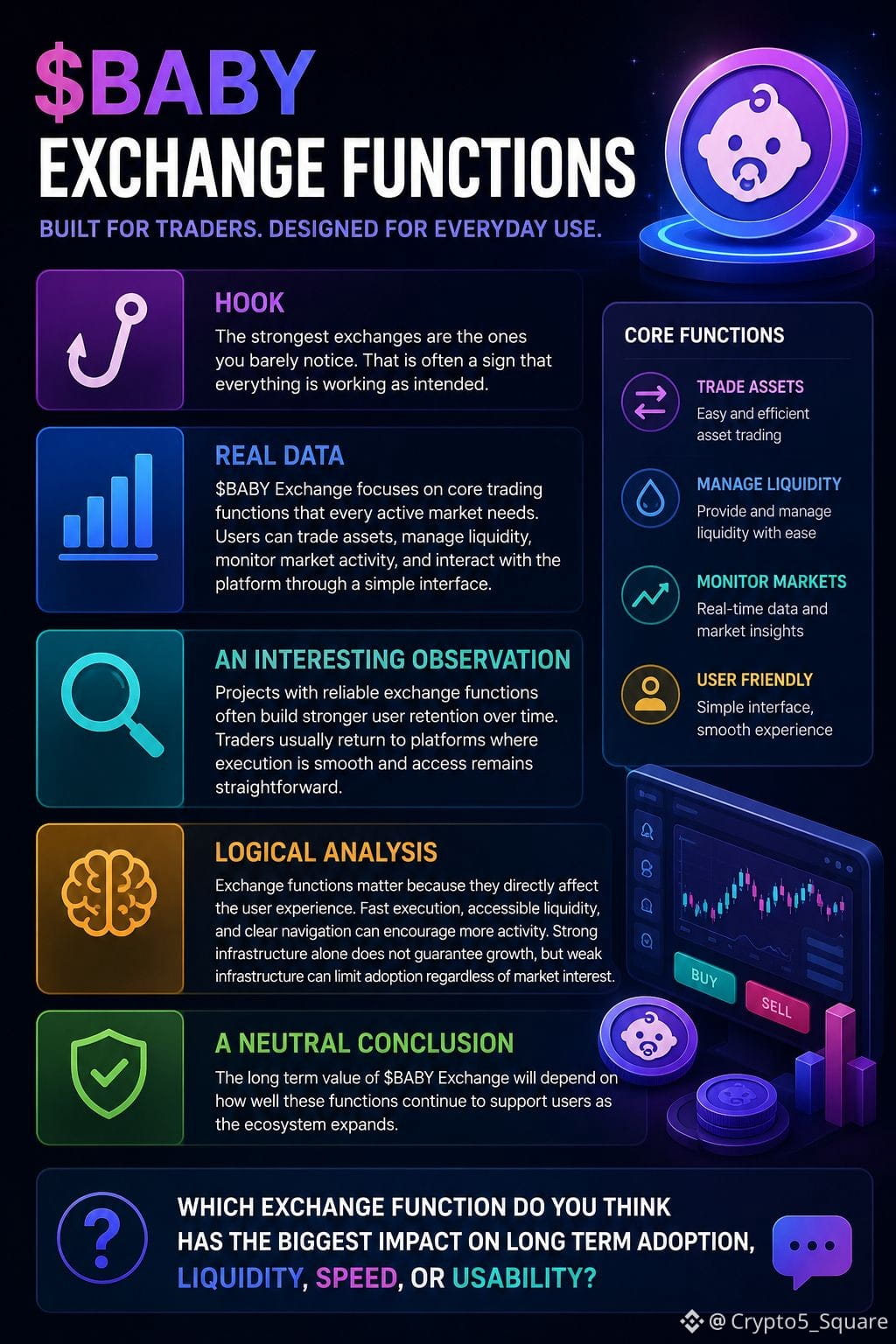
The strongest exchanges are the ones you barely notice. That is often a sign that everything is working as intended.
$BABY Exchange focuses on core trading functions that every active market needs. Users can trade assets, manage liquidity, monitor market activity, and interact with the platform through a simple interface. These functions create the foundation for consistent participation instead of relying only on short term excitement.
An interesting observation is that projects with reliable exchange functions often build stronger user retention over time. Traders usually return to platforms where execution is smooth and access remains straightforward.
From a logical perspective, exchange functions matter because they directly affect the user experience. Fast execution, accessible liquidity, and clear navigation can encourage more activity. Strong infrastructure alone does not guarantee growth, but weak infrastructure can limit adoption regardless of market interest.
The long term value of $BABY Exchange will depend on how well these functions continue to support users as the ecosystem expands.
Which exchange function do you think has the biggest impact on long term adoption, liquidity, speed, or usability?
@BabylonLabs_io
#baby
The strongest exchanges are the ones you barely notice. That is often a sign that everything is working as intended.
$BABY Exchange focuses on core trading functions that every active market needs. Users can trade assets, manage liquidity, monitor market activity, and interact with the platform through a simple interface. These functions create the foundation for consistent participation instead of relying only on short term excitement.
An interesting observation is that projects with reliable exchange functions often build stronger user retention over time. Traders usually return to platforms where execution is smooth and access remains straightforward.
From a logical perspective, exchange functions matter because they directly affect the user experience. Fast execution, accessible liquidity, and clear navigation can encourage more activity. Strong infrastructure alone does not guarantee growth, but weak infrastructure can limit adoption regardless of market interest.
The long term value of $BABY Exchange will depend on how well these functions continue to support users as the ecosystem expands.
Which exchange function do you think has the biggest impact on long term adoption, liquidity, speed, or usability?
#baby
The strongest exchanges are the ones you barely notice. That is often a sign that everything is working as intended.
$BABY Exchange focuses on core trading functions that every active market needs. Users can trade assets, manage liquidity, monitor market activity, and interact with the platform through a simple interface. These functions create the foundation for consistent participation instead of relying only on short term excitement.
An interesting observation is that projects with reliable exchange functions often build stronger user retention over time. Traders usually return to platforms where execution is smooth and access remains straightforward.
From a logical perspective, exchange functions matter because they directly affect the user experience. Fast execution, accessible liquidity, and clear navigation can encourage more activity. Strong infrastructure alone does not guarantee growth, but weak infrastructure can limit adoption regardless of market interest.
The long term value of $BABY Exchange will depend on how well these functions continue to support users as the ecosystem expands.
Which exchange function do you think has the biggest impact on long term adoption, liquidity, speed, or usability?
Usability
100%
Liquidity
0%
Speed
0%
1 Votes • Vote fermé
3
1
138
Connectez-vous pour découvrir plus de contenu
Rejoignez la communauté mondiale des adeptes de cryptomonnaies sur Binance Square
⚡️ Suviez les dernières informations importantes sur les cryptomonnaies.
💬 Jugé digne de confiance par la plus grande plateforme d’échange de cryptomonnaies au monde.
👍 Découvrez les connaissances que partagent les créateurs vérifiés.
Adresse e-mail/Nº de téléphone
Sujets d’actualité
ADAGains10%Above$0.27
899 vues
49 mentions
#ADAGains10%Above$0.27
$ADA IS FINALLY WAKING UP 👀
Cardano's $ADA just jumped 10% in 24 hours, pushing above $0.27 for the first time since May.
The move comes as attention builds around Cardano's RealFi ecosystem and the upcoming Dijkstra scalability upgrade.
After months of slow price action, $ADA is suddenly back on traders' radar.
#ADA #Cardano #crypto #altcoins
Albertc07
·0 mentions J’aime
·151 vues
ETHUp70%InQ3ButLiquidityFalls
13,805 vues
257 mentions
EthStakingExitQueueHits2026High
5,157 vues
271 mentions