

Khurum Gulzar
109 Publications
Khurum Gulzar
Signaler
Bloquer l’utilisateur
Crypto enthusiast | Exploring digital markets | Focused on growth, knowledge, and smart earning.
41 Suivis
36 Abonnés
22 J’aime
Publications
Tous
Citations
·
--
Is Quantum Computing Threatening Bitcoin Sooner Than Expected?
New research reveals that over 100 researchers used AI coding agents to optimize Shor’s algorithm, reducing the resource score for Bitcoin’s secp256k1 elliptic curve subroutine by 86.1% (dropping from 10.75B to 1.496B).
No Immediate Breach: This optimization targets a single mathematical step. Cracking private keys or moving funds still requires fault-tolerant quantum hardware that does not yet exist.
On-Chain Risk: According to Glassnode data, roughly 6.04 million $BTC (30.2% of circulating supply) have public keys exposed on-chain, making them the primary vulnerability surface.
Governance Challenge: While Ethereum targets full quantum resistance by December 2029, Bitcoin faces significant consensus hurdles—including how to handle ~1.7M BTC sitting in dormant Satoshi-era P2PK addresses.
How should the Bitcoin community deal with dormant P2PK addresses before quantum hardware matures?
{future}(BTCUSDT)
{future}(ETHUSDT)
Is Quantum Computing Threatening Bitcoin Sooner Than Expected?
New research reveals that over 100 researchers used AI coding agents to optimize Shor’s algorithm, reducing the resource score for Bitcoin’s secp256k1 elliptic curve subroutine by 86.1% (dropping from 10.75B to 1.496B).
No Immediate Breach: This optimization targets a single mathematical step. Cracking private keys or moving funds still requires fault-tolerant quantum hardware that does not yet exist.
On-Chain Risk: According to Glassnode data, roughly 6.04 million $BTC (30.2% of circulating supply) have public keys exposed on-chain, making them the primary vulnerability surface.
Governance Challenge: While Ethereum targets full quantum resistance by December 2029, Bitcoin faces significant consensus hurdles—including how to handle ~1.7M BTC sitting in dormant Satoshi-era P2PK addresses.
How should the Bitcoin community deal with dormant P2PK addresses before quantum hardware matures?
New research reveals that over 100 researchers used AI coding agents to optimize Shor’s algorithm, reducing the resource score for Bitcoin’s secp256k1 elliptic curve subroutine by 86.1% (dropping from 10.75B to 1.496B).
No Immediate Breach: This optimization targets a single mathematical step. Cracking private keys or moving funds still requires fault-tolerant quantum hardware that does not yet exist.
On-Chain Risk: According to Glassnode data, roughly 6.04 million $BTC (30.2% of circulating supply) have public keys exposed on-chain, making them the primary vulnerability surface.
Governance Challenge: While Ethereum targets full quantum resistance by December 2029, Bitcoin faces significant consensus hurdles—including how to handle ~1.7M BTC sitting in dormant Satoshi-era P2PK addresses.
How should the Bitcoin community deal with dormant P2PK addresses before quantum hardware matures?
58
·
--
I started looking at DUSK differently when I realized the token isn't just sitting on top of the network.
DUSK is the native token used for gas and staking on Dusk. Every transaction pays its network fee in DUSK, while staking helps secure the network.
There’s another detail I found interesting: Dusk has a 1 billion DUSK maximum supply—500 million initial supply plus 500 million emitted over time for staking rewards. Those emissions are designed to halve every four years.
So the token has two very different jobs:
DUSK pays for activity. DUSK also helps secure that activity.
For me, that makes the real question pretty simple:
Can Dusk create enough real usage for the token’s utility to matter beyond speculation?
That's what I'm watching.
#dusk $DUSK @Dusk_Foundation
{spot}(DUSKUSDT)
I started looking at DUSK differently when I realized the token isn't just sitting on top of the network.
DUSK is the native token used for gas and staking on Dusk. Every transaction pays its network fee in DUSK, while staking helps secure the network.
There’s another detail I found interesting: Dusk has a 1 billion DUSK maximum supply—500 million initial supply plus 500 million emitted over time for staking rewards. Those emissions are designed to halve every four years.
So the token has two very different jobs:
DUSK pays for activity. DUSK also helps secure that activity.
For me, that makes the real question pretty simple:
Can Dusk create enough real usage for the token’s utility to matter beyond speculation?
That's what I'm watching.
#dusk $DUSK @Dusk
DUSK is the native token used for gas and staking on Dusk. Every transaction pays its network fee in DUSK, while staking helps secure the network.
There’s another detail I found interesting: Dusk has a 1 billion DUSK maximum supply—500 million initial supply plus 500 million emitted over time for staking rewards. Those emissions are designed to halve every four years.
So the token has two very different jobs:
DUSK pays for activity. DUSK also helps secure that activity.
For me, that makes the real question pretty simple:
Can Dusk create enough real usage for the token’s utility to matter beyond speculation?
That's what I'm watching.
#dusk $DUSK @Dusk
98
·
--
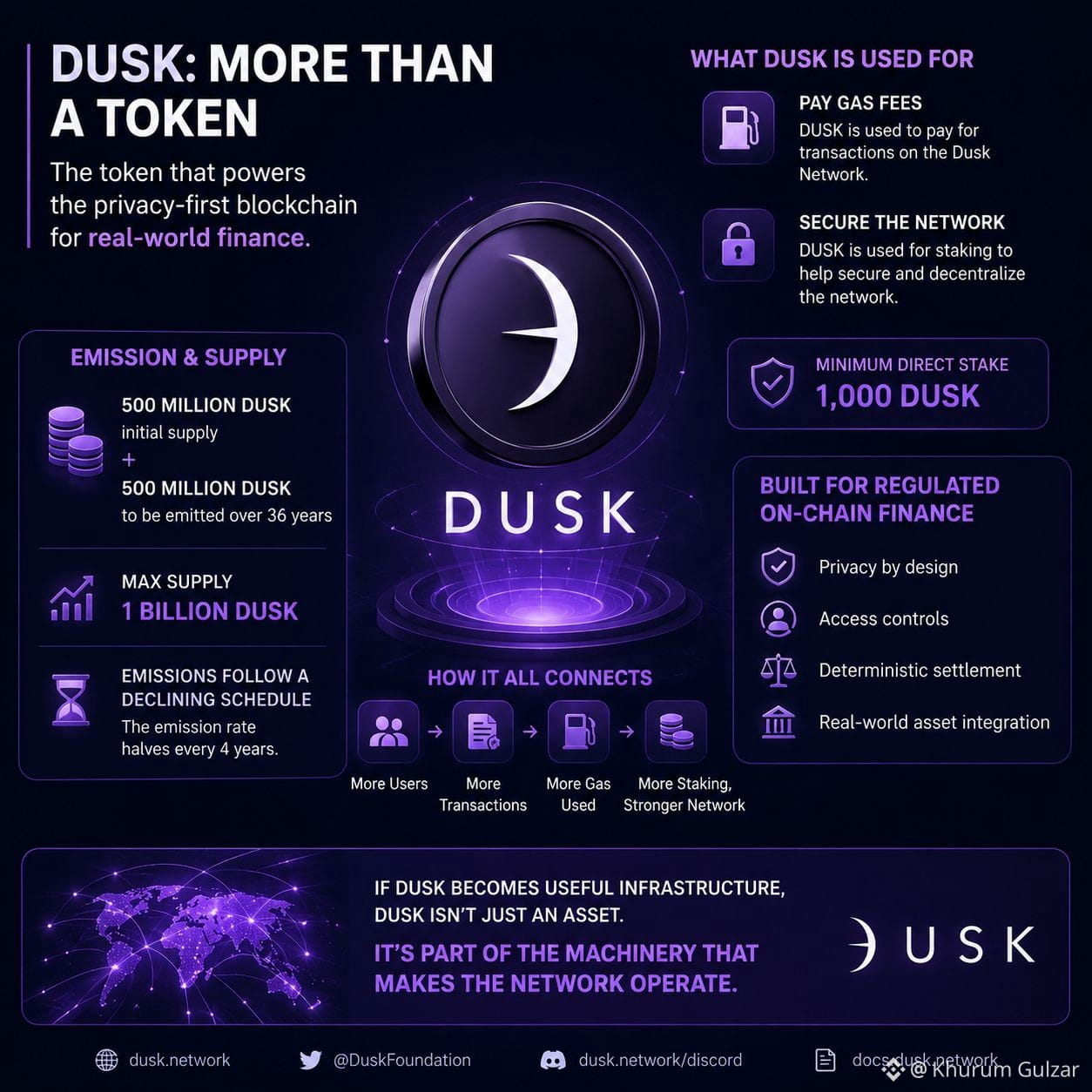
I used to look at DUSK mainly through the lens of what Dusk is building. Then I looked more closely at what the token actually does.
DUSK isn't simply a token attached to the ecosystem.
On Dusk, DUSK is used to pay gas and secure the network through staking. The protocol's current documentation sets the minimum direct stake at 1,000 DUSK.
What caught my attention even more is the emission design.
Dusk has 500 million DUSK initially, with another 500 million emitted over 36 years, giving it a maximum supply of 1 billion. Those emissions follow a declining schedule, with the emission rate halving every four years.
So there's an interesting connection here:
More network activity means more transactions, transactions require gas, and staking is part of how the network is secured.
That makes DUSK's long-term story less about simply having a fixed token supply and more about whether the network can generate genuine usage.
Dusk is targeting regulated on-chain finance, where privacy, access controls and deterministic settlement all have to work together.
That's the part I find most interesting.
If Dusk becomes useful infrastructure, DUSK isn't just the asset representing the project—it becomes part of the machinery that makes the network operate.
#dusk $DUSK @Dusk_Foundation
{spot}(DUSKUSDT)
I used to look at DUSK mainly through the lens of what Dusk is building. Then I looked more closely at what the token actually does.
DUSK isn't simply a token attached to the ecosystem.
On Dusk, DUSK is used to pay gas and secure the network through staking. The protocol's current documentation sets the minimum direct stake at 1,000 DUSK.
What caught my attention even more is the emission design.
Dusk has 500 million DUSK initially, with another 500 million emitted over 36 years, giving it a maximum supply of 1 billion. Those emissions follow a declining schedule, with the emission rate halving every four years.
So there's an interesting connection here:
More network activity means more transactions, transactions require gas, and staking is part of how the network is secured.
That makes DUSK's long-term story less about simply having a fixed token supply and more about whether the network can generate genuine usage.
Dusk is targeting regulated on-chain finance, where privacy, access controls and deterministic settlement all have to work together.
That's the part I find most interesting.
If Dusk becomes useful infrastructure, DUSK isn't just the asset representing the project—it becomes part of the machinery that makes the network operate.
#dusk $DUSK @Dusk
DUSK isn't simply a token attached to the ecosystem.
On Dusk, DUSK is used to pay gas and secure the network through staking. The protocol's current documentation sets the minimum direct stake at 1,000 DUSK.
What caught my attention even more is the emission design.
Dusk has 500 million DUSK initially, with another 500 million emitted over 36 years, giving it a maximum supply of 1 billion. Those emissions follow a declining schedule, with the emission rate halving every four years.
So there's an interesting connection here:
More network activity means more transactions, transactions require gas, and staking is part of how the network is secured.
That makes DUSK's long-term story less about simply having a fixed token supply and more about whether the network can generate genuine usage.
Dusk is targeting regulated on-chain finance, where privacy, access controls and deterministic settlement all have to work together.
That's the part I find most interesting.
If Dusk becomes useful infrastructure, DUSK isn't just the asset representing the project—it becomes part of the machinery that makes the network operate.
#dusk $DUSK @Dusk
2
1
70
·
--
Vérifié
One thing I find more interesting than a token's launch is what the protocol chooses to reward before it.
TermMax gives us an interesting example with TMX.
Its pre-mine program allocates 40 million TMX, or 4% of the total 1 billion supply, to incentivize early users.
But the interesting part isn't simply the size of the allocation.
The rewards are tied to actual protocol activity. FT holders can qualify, while contributors to matched orders—including Range Order Makers and Curators—can also participate.
I think that creates a more interesting question than simply asking how many tokens will be distributed.
What kind of behavior is the token actually encouraging?
If incentives bring people into the protocol, but those users disappear when rewards decline, the program has only created temporary activity.
If they help build lasting liquidity, lending and market participation, the effect could be very different.
That's why I'm more interested in watching what happens to real protocol activity around TMX than simply watching the token launch itself.
#termmax @termmax
One thing I find more interesting than a token's launch is what the protocol chooses to reward before it.
TermMax gives us an interesting example with TMX.
Its pre-mine program allocates 40 million TMX, or 4% of the total 1 billion supply, to incentivize early users.
But the interesting part isn't simply the size of the allocation.
The rewards are tied to actual protocol activity. FT holders can qualify, while contributors to matched orders—including Range Order Makers and Curators—can also participate.
I think that creates a more interesting question than simply asking how many tokens will be distributed.
What kind of behavior is the token actually encouraging?
If incentives bring people into the protocol, but those users disappear when rewards decline, the program has only created temporary activity.
If they help build lasting liquidity, lending and market participation, the effect could be very different.
That's why I'm more interested in watching what happens to real protocol activity around TMX than simply watching the token launch itself.
#termmax @TermMax
TermMax gives us an interesting example with TMX.
Its pre-mine program allocates 40 million TMX, or 4% of the total 1 billion supply, to incentivize early users.
But the interesting part isn't simply the size of the allocation.
The rewards are tied to actual protocol activity. FT holders can qualify, while contributors to matched orders—including Range Order Makers and Curators—can also participate.
I think that creates a more interesting question than simply asking how many tokens will be distributed.
What kind of behavior is the token actually encouraging?
If incentives bring people into the protocol, but those users disappear when rewards decline, the program has only created temporary activity.
If they help build lasting liquidity, lending and market participation, the effect could be very different.
That's why I'm more interested in watching what happens to real protocol activity around TMX than simply watching the token launch itself.
#termmax @TermMax
74
·
--
Vérifié
One TermMax design choice deserves more attention than it gets:
It doesn't give the person managing a market unlimited freedom to change parameters instantly.
@termmax separates two distinct roles:
The Curator manages strategy: creating Range Orders, setting pricing curves, adjusting parameters, and managing liquidity.
The Guardian handles security oversight.
Certain changes that could increase risk are subject to a strict timelock, giving the Guardian time to review and veto them. Risk-reducing changes, on the other hand, can move faster.
I find that more interesting than it first sounds.
In DeFi, decentralization isn't only about removing administrators—it's also about deciding what each administrator is allowed to do.
Give one role too much power and you create concentration risk. Give every role equal power and risk management becomes painfully slow.
TermMax is experimenting with a middle ground: specialized authority + delayed high-risk execution.
But there is an obvious question to ask:
Does this actually make the system safer, or does it simply shift the trust assumption from the smart contracts to the individuals operating its risk controls?
Because the strongest risk-management architecture isn't the one with the most controls—it's the one where no single mistake can easily become a system-wide problem.
Which approach do you prefer for DeFi protocol risk: automated immutable parameters or active Curator/Guardian oversight? Let me know below! 👇
#termmax @termmax
One TermMax design choice deserves more attention than it gets:
It doesn't give the person managing a market unlimited freedom to change parameters instantly.
@TermMax separates two distinct roles:
The Curator manages strategy: creating Range Orders, setting pricing curves, adjusting parameters, and managing liquidity.
The Guardian handles security oversight.
Certain changes that could increase risk are subject to a strict timelock, giving the Guardian time to review and veto them. Risk-reducing changes, on the other hand, can move faster.
I find that more interesting than it first sounds.
In DeFi, decentralization isn't only about removing administrators—it's also about deciding what each administrator is allowed to do.
Give one role too much power and you create concentration risk. Give every role equal power and risk management becomes painfully slow.
TermMax is experimenting with a middle ground: specialized authority + delayed high-risk execution.
But there is an obvious question to ask:
Does this actually make the system safer, or does it simply shift the trust assumption from the smart contracts to the individuals operating its risk controls?
Because the strongest risk-management architecture isn't the one with the most controls—it's the one where no single mistake can easily become a system-wide problem.
Which approach do you prefer for DeFi protocol risk: automated immutable parameters or active Curator/Guardian oversight? Let me know below! 👇
#termmax @TermMax
It doesn't give the person managing a market unlimited freedom to change parameters instantly.
@TermMax separates two distinct roles:
The Curator manages strategy: creating Range Orders, setting pricing curves, adjusting parameters, and managing liquidity.
The Guardian handles security oversight.
Certain changes that could increase risk are subject to a strict timelock, giving the Guardian time to review and veto them. Risk-reducing changes, on the other hand, can move faster.
I find that more interesting than it first sounds.
In DeFi, decentralization isn't only about removing administrators—it's also about deciding what each administrator is allowed to do.
Give one role too much power and you create concentration risk. Give every role equal power and risk management becomes painfully slow.
TermMax is experimenting with a middle ground: specialized authority + delayed high-risk execution.
But there is an obvious question to ask:
Does this actually make the system safer, or does it simply shift the trust assumption from the smart contracts to the individuals operating its risk controls?
Because the strongest risk-management architecture isn't the one with the most controls—it's the one where no single mistake can easily become a system-wide problem.
Which approach do you prefer for DeFi protocol risk: automated immutable parameters or active Curator/Guardian oversight? Let me know below! 👇
#termmax @TermMax
68
·
--
Most people looking at TermMax focus on the FT.
I think the more interesting question is: why does TermMax need an XT at all?
TermMax splits a debt position into two pieces:
FT represents the fixed-rate side, while XT represents the interest obligation.
The important part is that these aren't two unrelated tokens.
TermMax’s model defines their relationship so that the FT and XT together preserve the underlying debt value throughout the position’s lifecycle. As maturity approaches, FT moves toward face value while XT moves toward zero.
That sounds like token engineering.
But economically, it is doing something much more interesting.
It separates principal exposure from the obligation created by time.
And that matters because fixed-rate lending isn't just about choosing an APR.
It is about turning an uncertain future payment into something that can be represented, priced and transferred on-chain.
The FT gets most of the attention because it is easier to understand.
But without the XT side of the equation, the accounting relationship wouldn't work the same way.
That's why I think TermMax's deeper innovation isn't simply “fixed-rate lending.”
It is the attempt to tokenize the different economic components of a debt position instead of treating the debt as one indivisible asset.
The question now is whether this elegant structure creates enough composability and demand to matter beyond the protocol itself.
Because clever token mathematics is only the beginning.
The real test is what financial products other users can build on top of it.
#termmax @termmax
Most people looking at TermMax focus on the FT.
I think the more interesting question is: why does TermMax need an XT at all?
TermMax splits a debt position into two pieces:
FT represents the fixed-rate side, while XT represents the interest obligation.
The important part is that these aren't two unrelated tokens.
TermMax’s model defines their relationship so that the FT and XT together preserve the underlying debt value throughout the position’s lifecycle. As maturity approaches, FT moves toward face value while XT moves toward zero.
That sounds like token engineering.
But economically, it is doing something much more interesting.
It separates principal exposure from the obligation created by time.
And that matters because fixed-rate lending isn't just about choosing an APR.
It is about turning an uncertain future payment into something that can be represented, priced and transferred on-chain.
The FT gets most of the attention because it is easier to understand.
But without the XT side of the equation, the accounting relationship wouldn't work the same way.
That's why I think TermMax's deeper innovation isn't simply “fixed-rate lending.”
It is the attempt to tokenize the different economic components of a debt position instead of treating the debt as one indivisible asset.
The question now is whether this elegant structure creates enough composability and demand to matter beyond the protocol itself.
Because clever token mathematics is only the beginning.
The real test is what financial products other users can build on top of it.
#termmax @TermMax
I think the more interesting question is: why does TermMax need an XT at all?
TermMax splits a debt position into two pieces:
FT represents the fixed-rate side, while XT represents the interest obligation.
The important part is that these aren't two unrelated tokens.
TermMax’s model defines their relationship so that the FT and XT together preserve the underlying debt value throughout the position’s lifecycle. As maturity approaches, FT moves toward face value while XT moves toward zero.
That sounds like token engineering.
But economically, it is doing something much more interesting.
It separates principal exposure from the obligation created by time.
And that matters because fixed-rate lending isn't just about choosing an APR.
It is about turning an uncertain future payment into something that can be represented, priced and transferred on-chain.
The FT gets most of the attention because it is easier to understand.
But without the XT side of the equation, the accounting relationship wouldn't work the same way.
That's why I think TermMax's deeper innovation isn't simply “fixed-rate lending.”
It is the attempt to tokenize the different economic components of a debt position instead of treating the debt as one indivisible asset.
The question now is whether this elegant structure creates enough composability and demand to matter beyond the protocol itself.
Because clever token mathematics is only the beginning.
The real test is what financial products other users can build on top of it.
#termmax @TermMax
80
·
--
DeFi is getting better at lending. But I think the next step is making lending easier to plan.
That's one reason TermMax caught my attention.
Its focus on fixed-rate and fixed-term lending gives borrowers more certainty over financing costs, while lenders can work with a defined term instead of relying entirely on changing rates.
What makes the idea more interesting is that TermMax is building beyond basic lending, with different collateral types, leverage products and other yield-focused markets.
For TMX, the interesting question isn't simply whether the token gets attention.
It's whether TermMax can turn this fixed-rate model into something users actually keep coming back to.
It's still early, but that's the part of TMX I'll be watching.
#termmax @termmax #ACE
DeFi is getting better at lending. But I think the next step is making lending easier to plan.
That's one reason TermMax caught my attention.
Its focus on fixed-rate and fixed-term lending gives borrowers more certainty over financing costs, while lenders can work with a defined term instead of relying entirely on changing rates.
What makes the idea more interesting is that TermMax is building beyond basic lending, with different collateral types, leverage products and other yield-focused markets.
For TMX, the interesting question isn't simply whether the token gets attention.
It's whether TermMax can turn this fixed-rate model into something users actually keep coming back to.
It's still early, but that's the part of TMX I'll be watching.
#termmax @TermMax #ACE
That's one reason TermMax caught my attention.
Its focus on fixed-rate and fixed-term lending gives borrowers more certainty over financing costs, while lenders can work with a defined term instead of relying entirely on changing rates.
What makes the idea more interesting is that TermMax is building beyond basic lending, with different collateral types, leverage products and other yield-focused markets.
For TMX, the interesting question isn't simply whether the token gets attention.
It's whether TermMax can turn this fixed-rate model into something users actually keep coming back to.
It's still early, but that's the part of TMX I'll be watching.
#termmax @TermMax #ACE
82
·
--
Vérifié
#termmax @termmax I used to think the biggest challenge in DeFi lending was simply getting access to liquidity.
But the more I look at fixed-rate protocols, the more I think another problem deserves attention: knowing what that liquidity will actually cost over time.
Most DeFi lending has traditionally been built around variable rates. When market conditions change, borrowing costs can change with them. That can make it harder to plan a position, especially when the strategy depends on a specific time horizon.
That's what made TermMax interesting to me.
Instead of treating fixed rates as just another lending feature, TermMax is building its markets around fixed-rate and fixed-term borrowing and lending. A borrower can lock in a rate for a defined term, while lenders can know the yield they're targeting from the beginning.
The technical part is even more interesting.
TermMax uses Fixed-rate Tokens (FT) and Yield Tokens (XT) to separate the components of a debt position. It also uses a custom AMM design for its fixed-rate markets, with curators helping manage pricing and risk parameters.
For me, this changes the question.
It's not simply whether DeFi can offer a fixed borrowing rate. The bigger question is whether fixed-rate markets can become liquid and composable enough to become useful infrastructure for the wider DeFi ecosystem.
TermMax is also expanding beyond simple crypto collateral. Its documentation lists assets including Pendle PT tokens, liquid-staking assets and RWA-related collateral. That makes the fixed-rate idea more interesting because the potential use cases aren't limited to one type of DeFi user.
And this is where I started looking at TMX differently.
The interesting part isn't simply the token's supply. The March 2026 TMX whitepaper describes TMX as the planned utility and governance token, with a fixed maximum supply of 1 billion tokens. It also outlines governance, staking and ecosystem incentives as key functions.
But I don't think tokenomics alone tell the story.
#termmax @TermMax I used to think the biggest challenge in DeFi lending was simply getting access to liquidity.
But the more I look at fixed-rate protocols, the more I think another problem deserves attention: knowing what that liquidity will actually cost over time.
Most DeFi lending has traditionally been built around variable rates. When market conditions change, borrowing costs can change with them. That can make it harder to plan a position, especially when the strategy depends on a specific time horizon.
That's what made TermMax interesting to me.
Instead of treating fixed rates as just another lending feature, TermMax is building its markets around fixed-rate and fixed-term borrowing and lending. A borrower can lock in a rate for a defined term, while lenders can know the yield they're targeting from the beginning.
The technical part is even more interesting.
TermMax uses Fixed-rate Tokens (FT) and Yield Tokens (XT) to separate the components of a debt position. It also uses a custom AMM design for its fixed-rate markets, with curators helping manage pricing and risk parameters.
For me, this changes the question.
It's not simply whether DeFi can offer a fixed borrowing rate. The bigger question is whether fixed-rate markets can become liquid and composable enough to become useful infrastructure for the wider DeFi ecosystem.
TermMax is also expanding beyond simple crypto collateral. Its documentation lists assets including Pendle PT tokens, liquid-staking assets and RWA-related collateral. That makes the fixed-rate idea more interesting because the potential use cases aren't limited to one type of DeFi user.
And this is where I started looking at TMX differently.
The interesting part isn't simply the token's supply. The March 2026 TMX whitepaper describes TMX as the planned utility and governance token, with a fixed maximum supply of 1 billion tokens. It also outlines governance, staking and ecosystem incentives as key functions.
But I don't think tokenomics alone tell the story.
But the more I look at fixed-rate protocols, the more I think another problem deserves attention: knowing what that liquidity will actually cost over time.
Most DeFi lending has traditionally been built around variable rates. When market conditions change, borrowing costs can change with them. That can make it harder to plan a position, especially when the strategy depends on a specific time horizon.
That's what made TermMax interesting to me.
Instead of treating fixed rates as just another lending feature, TermMax is building its markets around fixed-rate and fixed-term borrowing and lending. A borrower can lock in a rate for a defined term, while lenders can know the yield they're targeting from the beginning.
The technical part is even more interesting.
TermMax uses Fixed-rate Tokens (FT) and Yield Tokens (XT) to separate the components of a debt position. It also uses a custom AMM design for its fixed-rate markets, with curators helping manage pricing and risk parameters.
For me, this changes the question.
It's not simply whether DeFi can offer a fixed borrowing rate. The bigger question is whether fixed-rate markets can become liquid and composable enough to become useful infrastructure for the wider DeFi ecosystem.
TermMax is also expanding beyond simple crypto collateral. Its documentation lists assets including Pendle PT tokens, liquid-staking assets and RWA-related collateral. That makes the fixed-rate idea more interesting because the potential use cases aren't limited to one type of DeFi user.
And this is where I started looking at TMX differently.
The interesting part isn't simply the token's supply. The March 2026 TMX whitepaper describes TMX as the planned utility and governance token, with a fixed maximum supply of 1 billion tokens. It also outlines governance, staking and ecosystem incentives as key functions.
But I don't think tokenomics alone tell the story.
75
·
--
🌍 Football connects people through passion, respect, and unforgettable memories. The 2026 Football Challenge adds another level of excitement by encouraging fans to make thoughtful predictions before every match. I'm excited to follow the tournament closely and see how far my picks can take me. Good luck to everyone joining the challenge! ⚽🏅
#BinancePickAndWin #FootballChallenge #Binance
🌍 Football connects people through passion, respect, and unforgettable memories. The 2026 Football Challenge adds another level of excitement by encouraging fans to make thoughtful predictions before every match. I'm excited to follow the tournament closely and see how far my picks can take me. Good luck to everyone joining the challenge! ⚽🏅
#BinancePickAndWin #FootballChallenge #Binance
#BinancePickAndWin #FootballChallenge #Binance
71
·
--
⚽ Football is a game of passion, patience, and unforgettable moments. Every match offers a new opportunity to test our instincts and enjoy the excitement on the pitch. I'm joining the 2026 Football Challenge with confidence and looking forward to making thoughtful predictions throughout the tournament. 🏆🔥
#BinancePickAndWin #FootballChallenge #Binance
⚽ Football is a game of passion, patience, and unforgettable moments. Every match offers a new opportunity to test our instincts and enjoy the excitement on the pitch. I'm joining the 2026 Football Challenge with confidence and looking forward to making thoughtful predictions throughout the tournament. 🏆🔥
#BinancePickAndWin #FootballChallenge #Binance
#BinancePickAndWin #FootballChallenge #Binance
72
·
--
⚽ Every football fan enjoys the challenge of predicting what happens next. Will it be a dominant performance or an unforgettable upset? The 2026 Football Challenge makes every fixture even more exciting by rewarding thoughtful predictions. I'm ready to enjoy every match and see how my picks perform throughout the tournament. 🏆🔥
#BinancePickAndWin #FootballChallenge #Binance
⚽ Every football fan enjoys the challenge of predicting what happens next. Will it be a dominant performance or an unforgettable upset? The 2026 Football Challenge makes every fixture even more exciting by rewarding thoughtful predictions. I'm ready to enjoy every match and see how my picks perform throughout the tournament. 🏆🔥
#BinancePickAndWin #FootballChallenge #Binance
#BinancePickAndWin #FootballChallenge #Binance
10
·
--
🌍 Every kickoff brings fresh opportunities, every goal creates unforgettable memories, and every prediction adds to the excitement. The 2026 Football Challenge is a great way to stay engaged with the tournament while putting football knowledge to the test. Wishing everyone accurate picks and an amazing football journey! ⚽🏅
#BinancePickAndWin #FootballChallenge #Binance
🌍 Every kickoff brings fresh opportunities, every goal creates unforgettable memories, and every prediction adds to the excitement. The 2026 Football Challenge is a great way to stay engaged with the tournament while putting football knowledge to the test. Wishing everyone accurate picks and an amazing football journey! ⚽🏅
#BinancePickAndWin #FootballChallenge #Binance
#BinancePickAndWin #FootballChallenge #Binance
67
·
--
🌍 The journey through a football tournament is filled with passion, teamwork, and unforgettable memories. The 2026 Football Challenge gives fans the chance to be part of that excitement by making thoughtful predictions. I'm looking forward to every match, every surprise, and every opportunity to improve my score. ⚽🚀
#BinancePickAndWin #FootballChallenge #Binance
🌍 The journey through a football tournament is filled with passion, teamwork, and unforgettable memories. The 2026 Football Challenge gives fans the chance to be part of that excitement by making thoughtful predictions. I'm looking forward to every match, every surprise, and every opportunity to improve my score. ⚽🚀
#BinancePickAndWin #FootballChallenge #Binance
#BinancePickAndWin #FootballChallenge #Binance
2
·
--
Every crypto cycle reminds us that technology alone isn't enough—users also need confidence in the platforms they choose. That's why I've been looking into @grvt_io .Instead of treating speed, security, and user control as separate goals, its hybrid exchange vision aims to bring them together in a single trading experience.
I like the idea of giving traders more ownership over their assets while still providing the efficiency many people expect from modern exchanges. If this balance is achieved, it could make Web3 more approachable for newcomers and more practical for experienced traders alike.
Of course, real success depends on consistent development, reliable performance, and earning the community's trust over time. I'm interested to see how GRVT continues to improve its ecosystem and deliver on its long-term vision.
Crypto is evolving quickly, and the projects that focus on real utility rather than short-term excitement often leave the biggest impact. What feature would make you trust a hybrid exchange enough to use it as your primary trading platform? #grvt
Every crypto cycle reminds us that technology alone isn't enough—users also need confidence in the platforms they choose. That's why I've been looking into @grvt_io .Instead of treating speed, security, and user control as separate goals, its hybrid exchange vision aims to bring them together in a single trading experience.
I like the idea of giving traders more ownership over their assets while still providing the efficiency many people expect from modern exchanges. If this balance is achieved, it could make Web3 more approachable for newcomers and more practical for experienced traders alike.
Of course, real success depends on consistent development, reliable performance, and earning the community's trust over time. I'm interested to see how GRVT continues to improve its ecosystem and deliver on its long-term vision.
Crypto is evolving quickly, and the projects that focus on real utility rather than short-term excitement often leave the biggest impact. What feature would make you trust a hybrid exchange enough to use it as your primary trading platform? #grvt
I like the idea of giving traders more ownership over their assets while still providing the efficiency many people expect from modern exchanges. If this balance is achieved, it could make Web3 more approachable for newcomers and more practical for experienced traders alike.
Of course, real success depends on consistent development, reliable performance, and earning the community's trust over time. I'm interested to see how GRVT continues to improve its ecosystem and deliver on its long-term vision.
Crypto is evolving quickly, and the projects that focus on real utility rather than short-term excitement often leave the biggest impact. What feature would make you trust a hybrid exchange enough to use it as your primary trading platform? #grvt
45
·
--
🌍 Football is at its best when passion meets competition. The 2026 Football Challenge lets fans take their love for the game one step further by making thoughtful predictions throughout the tournament. I'm looking forward to every kickoff, every surprise, and every unforgettable football memory. ⚽🏅
#BinancePickAndWin #FootballChallenge #Binance
🌍 Football is at its best when passion meets competition. The 2026 Football Challenge lets fans take their love for the game one step further by making thoughtful predictions throughout the tournament. I'm looking forward to every kickoff, every surprise, and every unforgettable football memory. ⚽🏅
#BinancePickAndWin #FootballChallenge #Binance
#BinancePickAndWin #FootballChallenge #Binance
64
·
--
#BinanceTurns9 Binance Turns 9 - Built By You
Celebrating 9 years of incredible growth with Binance! Happy 9th Anniversary to the best crypto platform. Here's to building the future together! 🚀 #BinanceTurns9
#BinanceTurns9 Binance Turns 9 - Built By You
Celebrating 9 years of incredible growth with Binance! Happy 9th Anniversary to the best crypto platform. Here's to building the future together! 🚀 #BinanceTurns9
Celebrating 9 years of incredible growth with Binance! Happy 9th Anniversary to the best crypto platform. Here's to building the future together! 🚀 #BinanceTurns9
66
·
--
Crypto adoption depends on more than market trends—it depends on trust. As more users enter Web3, they want platforms that are not only fast but also transparent and secure. That's one reason @grvt_io stands out to me. Its hybrid exchange model aims to combine the performance and smooth user experience of centralized exchanges with the control and ownership that come from self-custody.
I think this approach has the potential to make crypto trading more accessible without asking users to compromise on security. Of course, every project needs time to deliver on its vision, but I appreciate teams that focus on building real infrastructure instead of relying on hype alone. If GRVT continues improving liquidity, usability, and reliability, it could become an important part of the next phase of digital asset trading.
The future of crypto will likely belong to platforms that put users first while continuing to innovate. I'll be following GRVT's progress with interest and look forward to seeing how the platform evolves.
What do you think is the most important feature a hybrid exchange should prioritize: security, trading performance, liquidity, or user experience? #grvt
Crypto adoption depends on more than market trends—it depends on trust. As more users enter Web3, they want platforms that are not only fast but also transparent and secure. That's one reason @grvt_io stands out to me. Its hybrid exchange model aims to combine the performance and smooth user experience of centralized exchanges with the control and ownership that come from self-custody.
I think this approach has the potential to make crypto trading more accessible without asking users to compromise on security. Of course, every project needs time to deliver on its vision, but I appreciate teams that focus on building real infrastructure instead of relying on hype alone. If GRVT continues improving liquidity, usability, and reliability, it could become an important part of the next phase of digital asset trading.
The future of crypto will likely belong to platforms that put users first while continuing to innovate. I'll be following GRVT's progress with interest and look forward to seeing how the platform evolves.
What do you think is the most important feature a hybrid exchange should prioritize: security, trading performance, liquidity, or user experience? #grvt
I think this approach has the potential to make crypto trading more accessible without asking users to compromise on security. Of course, every project needs time to deliver on its vision, but I appreciate teams that focus on building real infrastructure instead of relying on hype alone. If GRVT continues improving liquidity, usability, and reliability, it could become an important part of the next phase of digital asset trading.
The future of crypto will likely belong to platforms that put users first while continuing to innovate. I'll be following GRVT's progress with interest and look forward to seeing how the platform evolves.
What do you think is the most important feature a hybrid exchange should prioritize: security, trading performance, liquidity, or user experience? #grvt
62
·
--
⚽ Every football fan has a prediction before kickoff, but only the match decides the outcome. That's what makes the 2026 Football Challenge so engaging. I'm excited to test my football instincts, follow every fixture, and enjoy the journey one match at a time. Here's to great football and smart predictions! 🏆
#BinancePickAndWin #FootballChallenge #Binance
⚽ Every football fan has a prediction before kickoff, but only the match decides the outcome. That's what makes the 2026 Football Challenge so engaging. I'm excited to test my football instincts, follow every fixture, and enjoy the journey one match at a time. Here's to great football and smart predictions! 🏆
#BinancePickAndWin #FootballChallenge #Binance
#BinancePickAndWin #FootballChallenge #Binance
74
·
--
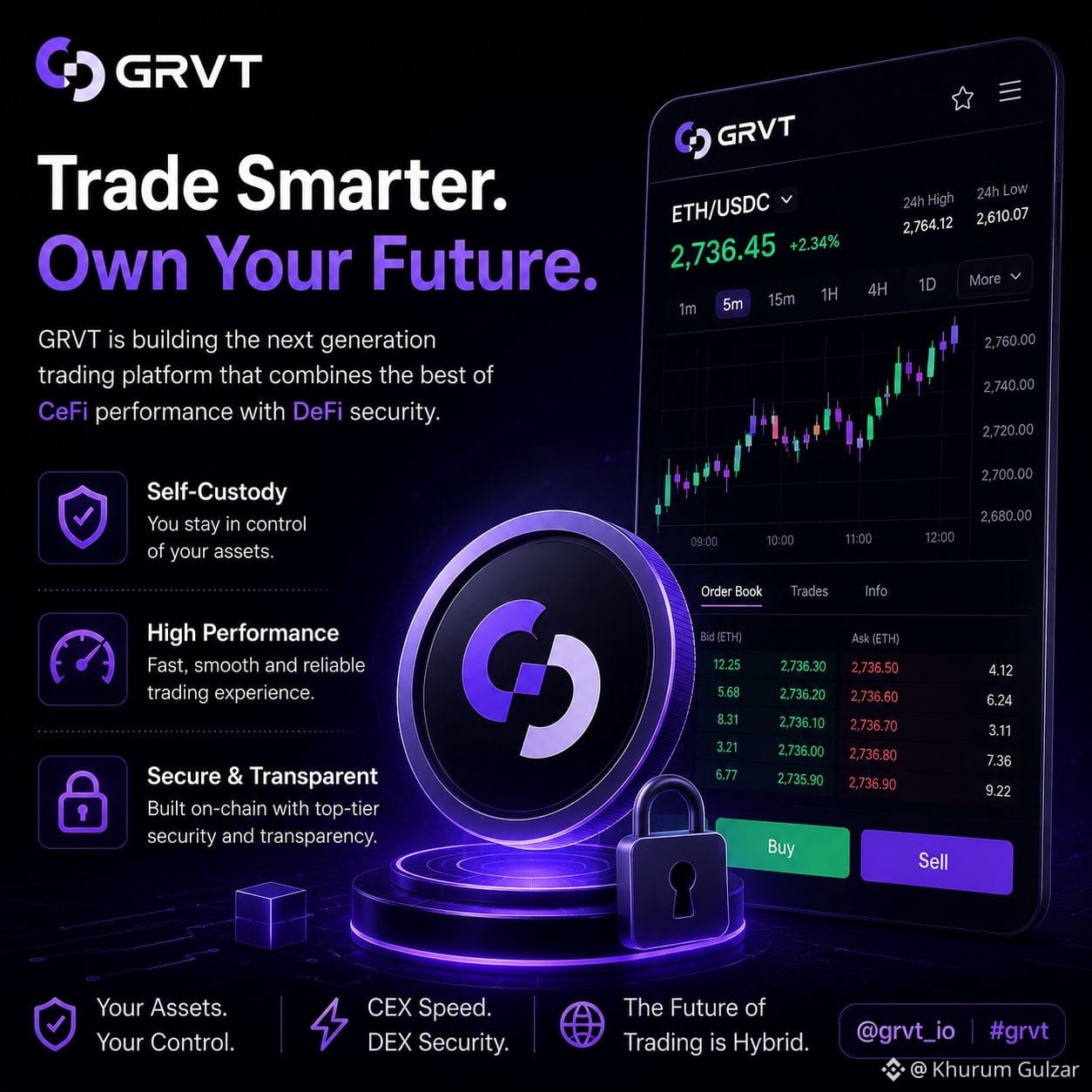
As crypto continues to evolve, platforms that balance security and usability will stand out. That's one reason I'm following @grvt_io .Its vision of combining self-custody with a smooth trading experience could make decentralized trading more practical for everyday users. Innovation isn't just about new technology—it's about solving real problems. I'm excited to see how GRVT develops in the months ahead. What do you think is the biggest challenge for modern crypto exchanges? #grvt
As crypto continues to evolve, platforms that balance security and usability will stand out. That's one reason I'm following @grvt_io .Its vision of combining self-custody with a smooth trading experience could make decentralized trading more practical for everyday users. Innovation isn't just about new technology—it's about solving real problems. I'm excited to see how GRVT develops in the months ahead. What do you think is the biggest challenge for modern crypto exchanges? #grvt
53
·
--
⚽ Every football match offers a fresh opportunity to witness skill, passion, and determination. The 2026 Football Challenge makes every prediction more meaningful by turning football knowledge into friendly competition. I'm excited to follow every fixture and see if my picks can stay on target throughout the tournament. 🏆🔥
#BinancePickAndWin #FootballChallenge #Binance
⚽ Every football match offers a fresh opportunity to witness skill, passion, and determination. The 2026 Football Challenge makes every prediction more meaningful by turning football knowledge into friendly competition. I'm excited to follow every fixture and see if my picks can stay on target throughout the tournament. 🏆🔥
#BinancePickAndWin #FootballChallenge #Binance
#BinancePickAndWin #FootballChallenge #Binance
72
Connectez-vous pour découvrir plus de contenu
Rejoignez la communauté mondiale des adeptes de cryptomonnaies sur Binance Square
⚡️ Suviez les dernières informations importantes sur les cryptomonnaies.
💬 Jugé digne de confiance par la plus grande plateforme d’échange de cryptomonnaies au monde.
👍 Découvrez les connaissances que partagent les créateurs vérifiés.
Adresse e-mail/Nº de téléphone