I used to look at DUSK mainly through the lens of what Dusk is building. Then I looked more closely at what the token actually does.
DUSK isn't simply a token attached to the ecosystem.
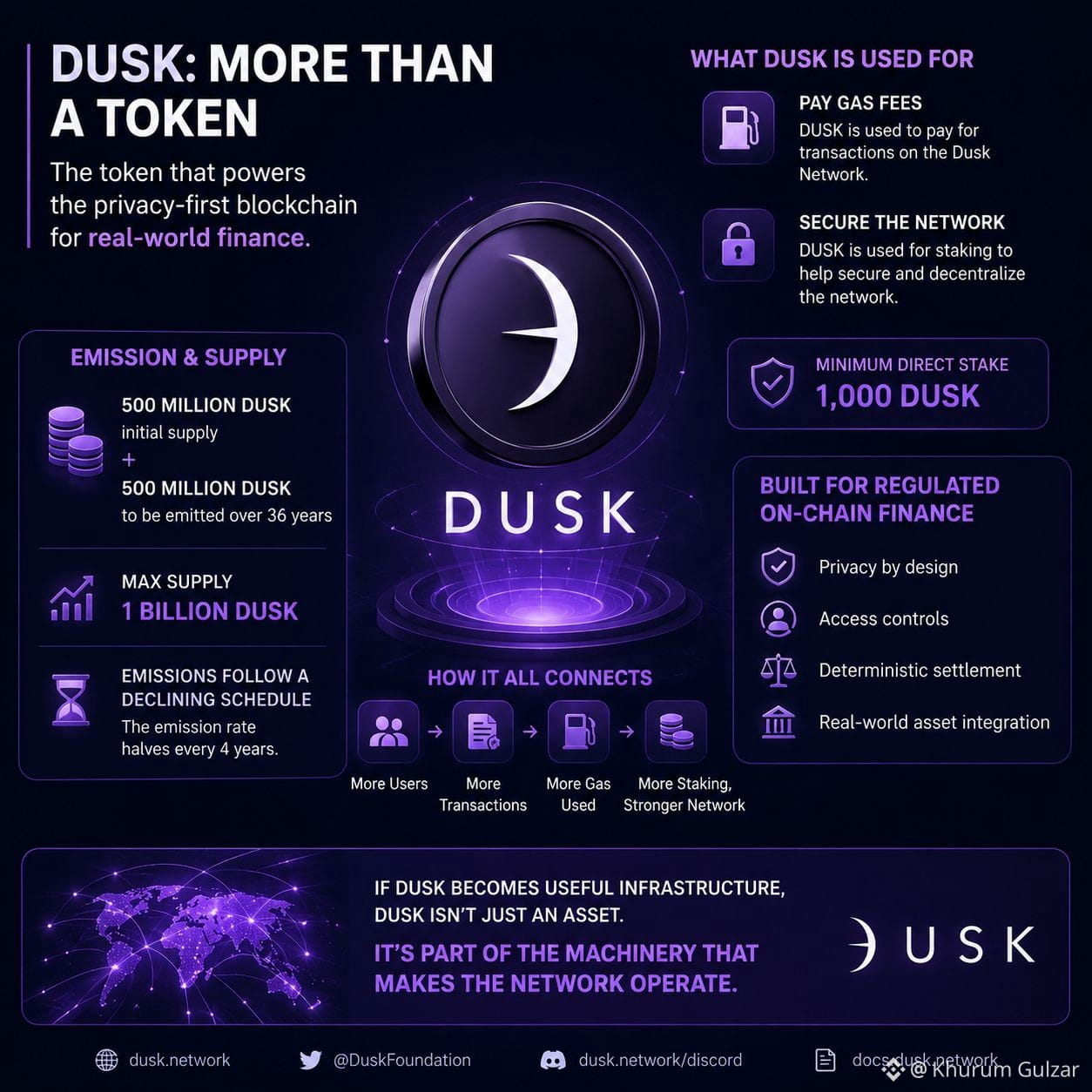
On Dusk, DUSK is used to pay gas and secure the network through staking. The protocol's current documentation sets the minimum direct stake at 1,000 DUSK.
What caught my attention even more is the emission design.
Dusk has 500 million DUSK initially, with another 500 million emitted over 36 years, giving it a maximum supply of 1 billion. Those emissions follow a declining schedule, with the emission rate halving every four years.
So there's an interesting connection here:
More network activity means more transactions, transactions require gas, and staking is part of how the network is secured.
That makes DUSK's long-term story less about simply having a fixed token supply and more about whether the network can generate genuine usage.
Dusk is targeting regulated on-chain finance, where privacy, access controls and deterministic settlement all have to work together.
That's the part I find most interesting.
If Dusk becomes useful infrastructure, DUSK isn't just the asset representing the project—it becomes part of the machinery that makes the network operate.
#dusk $DUSK @Dusk
DUSK isn't simply a token attached to the ecosystem.
On Dusk, DUSK is used to pay gas and secure the network through staking. The protocol's current documentation sets the minimum direct stake at 1,000 DUSK.
What caught my attention even more is the emission design.
Dusk has 500 million DUSK initially, with another 500 million emitted over 36 years, giving it a maximum supply of 1 billion. Those emissions follow a declining schedule, with the emission rate halving every four years.
So there's an interesting connection here:
More network activity means more transactions, transactions require gas, and staking is part of how the network is secured.
That makes DUSK's long-term story less about simply having a fixed token supply and more about whether the network can generate genuine usage.
Dusk is targeting regulated on-chain finance, where privacy, access controls and deterministic settlement all have to work together.
That's the part I find most interesting.
If Dusk becomes useful infrastructure, DUSK isn't just the asset representing the project—it becomes part of the machinery that makes the network operate.
#dusk $DUSK @Dusk