

Aylin 美玲
359 Publications

Aylin 美玲
Signaler
Bloquer l’utilisateur
Square creator | Web3 | blockchain & DeFi explorer | and NFT | enthusiast shaping the future of digital innovation
225 Suivis
1.0K+ Abonnés
208 J’aime
Publications
Tous
Citations
Vidéos
Direct
PINNED
·
--
Haussier
Trading sur 30 j de 121.2 USDT en $DUSK
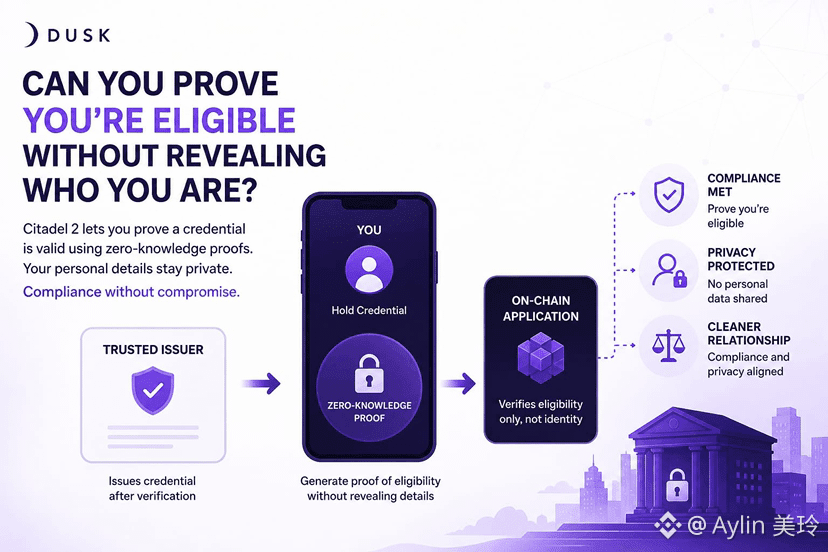
Can You Prove You’re Eligible Without Revealing Who You Are?
There’s a part of regulated finance that blockchain usually makes awkward: proving you’re allowed to do something without exposing everything about yourself. Citadel 2 takes a different approach.
A user can hold a credential issued by a trusted provider, then generate a zero-knowledge proof showing that the credential is valid. The actual personal details and the specific credential used don’t have to become public onchain.
I find that more interesting than another privacy feature announcement.
Imagine an application that needs to know you passed a required check, but has no real reason to keep your full identity on its ledger.
That’s a much cleaner relationship between compliance and privacy.
The difficult part now is adoption.
Will institutions actually prefer proving eligibility this way once real financial workflows start using it?
#dusk $DUSK @Dusk_Foundation $EDEN $ONG
{future}(ONGUSDT)
{future}(EDENUSDT)
Can You Prove You’re Eligible Without Revealing Who You Are?
There’s a part of regulated finance that blockchain usually makes awkward: proving you’re allowed to do something without exposing everything about yourself. Citadel 2 takes a different approach.
A user can hold a credential issued by a trusted provider, then generate a zero-knowledge proof showing that the credential is valid. The actual personal details and the specific credential used don’t have to become public onchain.
I find that more interesting than another privacy feature announcement.
Imagine an application that needs to know you passed a required check, but has no real reason to keep your full identity on its ledger.
That’s a much cleaner relationship between compliance and privacy.
The difficult part now is adoption.
Will institutions actually prefer proving eligibility this way once real financial workflows start using it?
#dusk $DUSK @Dusk $EDEN $ONG
There’s a part of regulated finance that blockchain usually makes awkward: proving you’re allowed to do something without exposing everything about yourself. Citadel 2 takes a different approach.
A user can hold a credential issued by a trusted provider, then generate a zero-knowledge proof showing that the credential is valid. The actual personal details and the specific credential used don’t have to become public onchain.
I find that more interesting than another privacy feature announcement.
Imagine an application that needs to know you passed a required check, but has no real reason to keep your full identity on its ledger.
That’s a much cleaner relationship between compliance and privacy.
The difficult part now is adoption.
Will institutions actually prefer proving eligibility this way once real financial workflows start using it?
#dusk $DUSK @Dusk $EDEN $ONG
1
1
1
296
PINNED
·
--
Haussier
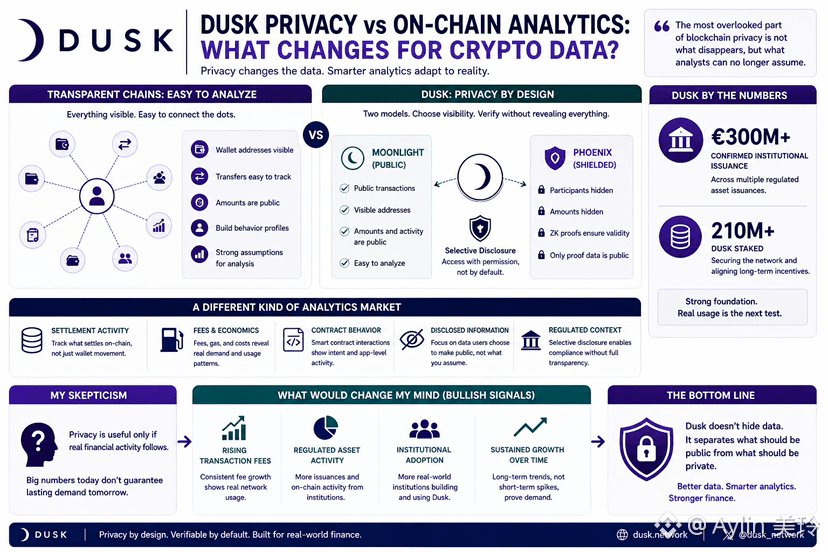
Dusk Privacy vs On-Chain Analytics.What Changes for Crypto Data?
I think the most overlooked part of blockchain privacy is not what disappears, but what analysts can no longer assume. On a transparent chain, wallet addresses, transfers and amounts can become raw material for market analysis. Dusk separates that model through Moonlight public transactions and Phoenix shielded transfers, where participants and transferred values can remain hidden while cryptographic data still allows verification.
That creates a different kind of analytics market. Instead of tracking every wallet movement, researchers may need to focus more on settlement activity, fees, contract behavior and information that users intentionally disclose. Dusk's current architecture also combines public and confidential transaction models with selective disclosure, rather than treating privacy as total invisibility.
My skepticism is simple: privacy is useful only if real financial activity follows. Dusk currently reports more than €300 million in confirmed institutional issuance and over 210 million DUSK staked, but those figures do not by themselves prove lasting demand.
I would become more bullish if transaction fees, regulated asset activity and independent institutional usage kept rising together. If usage remains thin, privacy alone would not convince me.
#dusk @Dusk_Foundation $DUSK $ONG $HOLO
{future}(DUSKUSDT)
{future}(HOLOUSDT)
{future}(ONGUSDT)
Dusk Privacy vs On-Chain Analytics.What Changes for Crypto Data?
I think the most overlooked part of blockchain privacy is not what disappears, but what analysts can no longer assume. On a transparent chain, wallet addresses, transfers and amounts can become raw material for market analysis. Dusk separates that model through Moonlight public transactions and Phoenix shielded transfers, where participants and transferred values can remain hidden while cryptographic data still allows verification.
That creates a different kind of analytics market. Instead of tracking every wallet movement, researchers may need to focus more on settlement activity, fees, contract behavior and information that users intentionally disclose. Dusk's current architecture also combines public and confidential transaction models with selective disclosure, rather than treating privacy as total invisibility.
My skepticism is simple: privacy is useful only if real financial activity follows. Dusk currently reports more than €300 million in confirmed institutional issuance and over 210 million DUSK staked, but those figures do not by themselves prove lasting demand.
I would become more bullish if transaction fees, regulated asset activity and independent institutional usage kept rising together. If usage remains thin, privacy alone would not convince me.
#dusk @Dusk $DUSK $ONG $HOLO
I think the most overlooked part of blockchain privacy is not what disappears, but what analysts can no longer assume. On a transparent chain, wallet addresses, transfers and amounts can become raw material for market analysis. Dusk separates that model through Moonlight public transactions and Phoenix shielded transfers, where participants and transferred values can remain hidden while cryptographic data still allows verification.
That creates a different kind of analytics market. Instead of tracking every wallet movement, researchers may need to focus more on settlement activity, fees, contract behavior and information that users intentionally disclose. Dusk's current architecture also combines public and confidential transaction models with selective disclosure, rather than treating privacy as total invisibility.
My skepticism is simple: privacy is useful only if real financial activity follows. Dusk currently reports more than €300 million in confirmed institutional issuance and over 210 million DUSK staked, but those figures do not by themselves prove lasting demand.
I would become more bullish if transaction fees, regulated asset activity and independent institutional usage kept rising together. If usage remains thin, privacy alone would not convince me.
#dusk @Dusk $DUSK $ONG $HOLO
212
·
--
Haussier
Aylin 美玲
·
--
HaussierCan You Prove You’re Eligible Without Revealing Who You Are?
There’s a part of regulated finance that blockchain usually makes awkward: proving you’re allowed to do something without exposing everything about yourself. Citadel 2 takes a different approach.
A user can hold a credential issued by a trusted provider, then generate a zero-knowledge proof showing that the credential is valid. The actual personal details and the specific credential used don’t have to become public onchain.
I find that more interesting than another privacy feature announcement.
Imagine an application that needs to know you passed a required check, but has no real reason to keep your full identity on its ledger.
That’s a much cleaner relationship between compliance and privacy.
The difficult part now is adoption.
Will institutions actually prefer proving eligibility this way once real financial workflows start using it?
#dusk $DUSK @Dusk $EDEN $ONG
There’s a part of regulated finance that blockchain usually makes awkward: proving you’re allowed to do something without exposing everything about yourself. Citadel 2 takes a different approach.
A user can hold a credential issued by a trusted provider, then generate a zero-knowledge proof showing that the credential is valid. The actual personal details and the specific credential used don’t have to become public onchain.
I find that more interesting than another privacy feature announcement.
Imagine an application that needs to know you passed a required check, but has no real reason to keep your full identity on its ledger.
That’s a much cleaner relationship between compliance and privacy.
The difficult part now is adoption.
Will institutions actually prefer proving eligibility this way once real financial workflows start using it?
#dusk $DUSK @Dusk $EDEN $ONG
1
88
·
--
Haussier
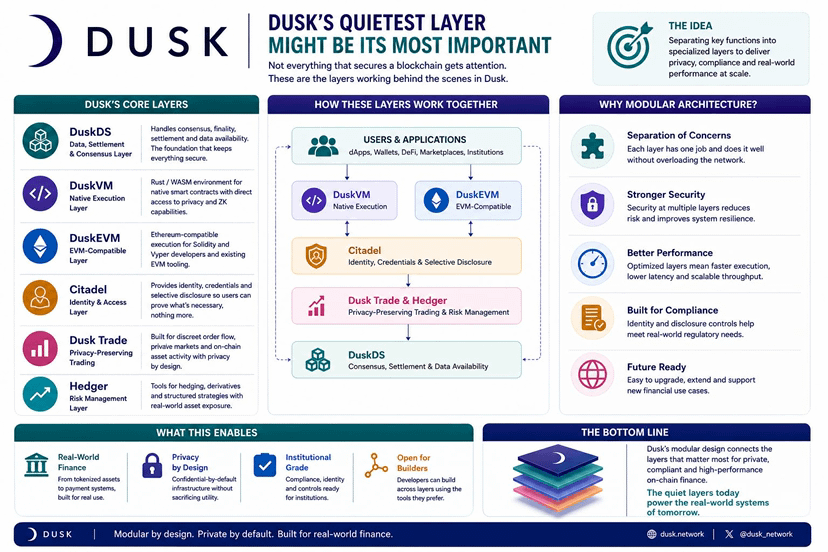
#dusk @Dusk_Foundation Quietest Layer Might Be Its Most Important.
Most people looking at a blockchain start with the visible stuff.
Wallets. Apps. Tokens. Trading.
I’ve started looking lower down.
Dusk is built as a modular system rather than one giant execution layer. DuskDS handles consensus, settlement and data availability. DuskVM runs Rust/WASM contracts directly on the L1, while DuskEVM provides an Ethereum-compatible execution environment. Citadel adds identity and selective-disclosure primitives.
None of that makes for the easiest headline.
But it tells me something about how Dusk is being designed.
Different jobs are being separated instead of forcing one layer to do everything.
That can be useful when the requirements are complicated, especially for financial applications where settlement, execution, identity and privacy don't necessarily have the same needs.
Of course, modular architecture isn't automatically better. It also creates more moving parts that have to work together properly.
So that's what I'd watch.
Not which component gets the most attention.
I'd watch whether all these quieter pieces actually work together when someone uses Dusk for something real.
$DUSK $PROM $TUT
{future}(DUSKUSDT)
{future}(TUTUSDT)
{future}(PROMUSDT)
#dusk @Dusk Quietest Layer Might Be Its Most Important.
Most people looking at a blockchain start with the visible stuff.
Wallets. Apps. Tokens. Trading.
I’ve started looking lower down.
Dusk is built as a modular system rather than one giant execution layer. DuskDS handles consensus, settlement and data availability. DuskVM runs Rust/WASM contracts directly on the L1, while DuskEVM provides an Ethereum-compatible execution environment. Citadel adds identity and selective-disclosure primitives.
None of that makes for the easiest headline.
But it tells me something about how Dusk is being designed.
Different jobs are being separated instead of forcing one layer to do everything.
That can be useful when the requirements are complicated, especially for financial applications where settlement, execution, identity and privacy don't necessarily have the same needs.
Of course, modular architecture isn't automatically better. It also creates more moving parts that have to work together properly.
So that's what I'd watch.
Not which component gets the most attention.
I'd watch whether all these quieter pieces actually work together when someone uses Dusk for something real.
$DUSK $PROM $TUT
Most people looking at a blockchain start with the visible stuff.
Wallets. Apps. Tokens. Trading.
I’ve started looking lower down.
Dusk is built as a modular system rather than one giant execution layer. DuskDS handles consensus, settlement and data availability. DuskVM runs Rust/WASM contracts directly on the L1, while DuskEVM provides an Ethereum-compatible execution environment. Citadel adds identity and selective-disclosure primitives.
None of that makes for the easiest headline.
But it tells me something about how Dusk is being designed.
Different jobs are being separated instead of forcing one layer to do everything.
That can be useful when the requirements are complicated, especially for financial applications where settlement, execution, identity and privacy don't necessarily have the same needs.
Of course, modular architecture isn't automatically better. It also creates more moving parts that have to work together properly.
So that's what I'd watch.
Not which component gets the most attention.
I'd watch whether all these quieter pieces actually work together when someone uses Dusk for something real.
$DUSK $PROM $TUT
1
164
·
--
Haussier
🚨 US–Canada Trade Talks Just Took a Sharp Turn
A deal looked almost within reach… and then everything fell apart. 👀
🇺🇸 The US has reportedly moved ahead with a 50% tariff on around $20B worth of Canadian goods.
🇨🇦 Canada says it’s ready to respond with dollar-for-dollar countermeasures from September 8.
That could mean more than just political headlines:
📈 Rising import costs
🛒 Fresh inflation pressure
🏭 Supply-chain uncertainty
💰 More volatility across risk assets
And here’s where crypto gets interesting. 👇
When trade tensions escalate, markets can quickly switch from risk-on to risk-off. Bitcoin and altcoins may react sharply as investors reassess global growth, inflation, and liquidity.
🔥 Trade war 2.0 or temporary market noise?
The next few moves could be crucial for BTC and the broader crypto market.
👀 Are we heading toward another major tariff battle — or will markets simply absorb the shock?
#USCanadaTradeTalksCollapseCanadaVowsRetaliation #CryptoNews #Write2Earn
$BTC
$TRUMP
$SANTOS
{future}(TRUMPUSDT)
{future}(BTCUSDT)
{future}(SANTOSUSDT)
🚨 US–Canada Trade Talks Just Took a Sharp Turn
A deal looked almost within reach… and then everything fell apart. 👀
🇺🇸 The US has reportedly moved ahead with a 50% tariff on around $20B worth of Canadian goods.
🇨🇦 Canada says it’s ready to respond with dollar-for-dollar countermeasures from September 8.
That could mean more than just political headlines:
📈 Rising import costs
🛒 Fresh inflation pressure
🏭 Supply-chain uncertainty
💰 More volatility across risk assets
And here’s where crypto gets interesting. 👇
When trade tensions escalate, markets can quickly switch from risk-on to risk-off. Bitcoin and altcoins may react sharply as investors reassess global growth, inflation, and liquidity.
🔥 Trade war 2.0 or temporary market noise?
The next few moves could be crucial for BTC and the broader crypto market.
👀 Are we heading toward another major tariff battle — or will markets simply absorb the shock?
#USCanadaTradeTalksCollapseCanadaVowsRetaliation #CryptoNews #Write2Earn
$BTC
$TRUMP
$SANTOS
A deal looked almost within reach… and then everything fell apart. 👀
🇺🇸 The US has reportedly moved ahead with a 50% tariff on around $20B worth of Canadian goods.
🇨🇦 Canada says it’s ready to respond with dollar-for-dollar countermeasures from September 8.
That could mean more than just political headlines:
📈 Rising import costs
🛒 Fresh inflation pressure
🏭 Supply-chain uncertainty
💰 More volatility across risk assets
And here’s where crypto gets interesting. 👇
When trade tensions escalate, markets can quickly switch from risk-on to risk-off. Bitcoin and altcoins may react sharply as investors reassess global growth, inflation, and liquidity.
🔥 Trade war 2.0 or temporary market noise?
The next few moves could be crucial for BTC and the broader crypto market.
👀 Are we heading toward another major tariff battle — or will markets simply absorb the shock?
#USCanadaTradeTalksCollapseCanadaVowsRetaliation #CryptoNews #Write2Earn
$BTC
$TRUMP
$SANTOS
421
·
--
Haussier
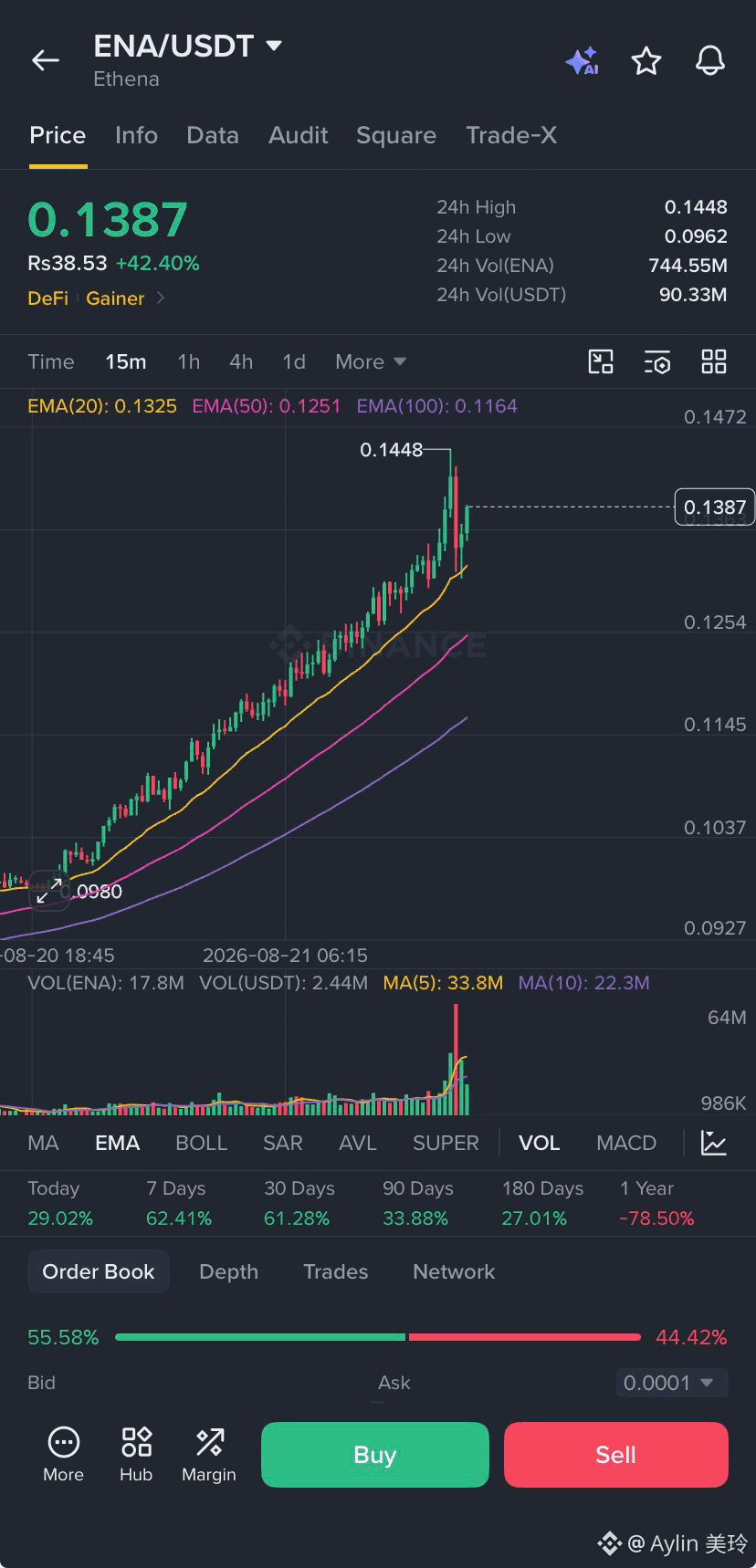
🚨 Crypto momentum is heating up, but the bigger story isn’t just one token.
Several names are seeing strong buying pressure at the same time:
🔥 $TUT +51%
⚡ $ZRO +24%
🚀 $ENA +23%
💥 PUMP +23%
📈 UAI +18%
🟢 STX +16%
🔥 FF +14%
When multiple sectors start moving together, it can signal a broader risk-on mood across the market.
But remember: fast pumps attract fast profit-taking too. The next few sessions will be more important than the candles that already printed.
👀 PUMP and ENA are worth watching for whether volume and momentum can stay elevated — not because a green candle guarantees another move higher.
Green markets are exciting.
Smart entries, position sizing, and patience matter even more. 📊
Trade the setup, not the hype. ⚠️
{future}(ZROUSDT)
{future}(ENAUSDT)
{future}(TUTUSDT)
🚨 Crypto momentum is heating up, but the bigger story isn’t just one token.
Several names are seeing strong buying pressure at the same time:
🔥 $TUT +51%
⚡ $ZRO +24%
🚀 $ENA +23%
💥 PUMP +23%
📈 UAI +18%
🟢 STX +16%
🔥 FF +14%
When multiple sectors start moving together, it can signal a broader risk-on mood across the market.
But remember: fast pumps attract fast profit-taking too. The next few sessions will be more important than the candles that already printed.
👀 PUMP and ENA are worth watching for whether volume and momentum can stay elevated — not because a green candle guarantees another move higher.
Green markets are exciting.
Smart entries, position sizing, and patience matter even more. 📊
Trade the setup, not the hype. ⚠️
Several names are seeing strong buying pressure at the same time:
🔥 $TUT +51%
⚡ $ZRO +24%
🚀 $ENA +23%
💥 PUMP +23%
📈 UAI +18%
🟢 STX +16%
🔥 FF +14%
When multiple sectors start moving together, it can signal a broader risk-on mood across the market.
But remember: fast pumps attract fast profit-taking too. The next few sessions will be more important than the candles that already printed.
👀 PUMP and ENA are worth watching for whether volume and momentum can stay elevated — not because a green candle guarantees another move higher.
Green markets are exciting.
Smart entries, position sizing, and patience matter even more. 📊
Trade the setup, not the hype. ⚠️
Tut
17%
Zro
4%
Ena
79%
24 Votes • Vote fermé
1k
·
--
Haussier
Vérifié
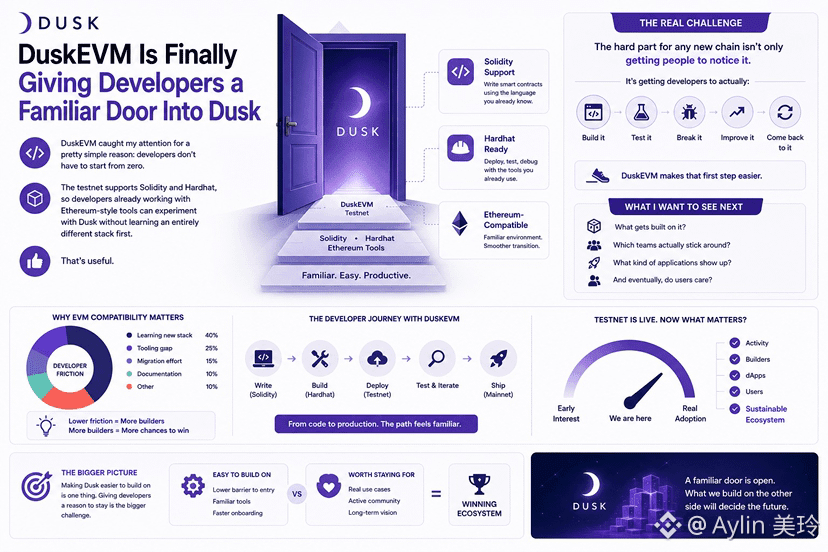
@Dusk_Foundation DuskEVM Is Finally Giving Developers a Familiar Door Into Dusk.
DuskEVM caught my attention for a pretty simple reason: developers don’t have to start from zero.
The testnet supports Solidity and Hardhat, so developers already working with Ethereum-style tools can experiment with Dusk without learning an entirely different stack first.
That’s useful.
The hard part for any new chain isn’t only getting people to notice it. It’s getting developers to actually build something, test it, break it, improve it, and then come back to it.
DuskEVM makes that first step easier.
But I wouldn’t call the job done just because the testnet is live.
Now I want to see what gets built on it.
Which teams actually stick around?
What kind of applications show up?
And, eventually, do users care?
Making Dusk easier to build on is one thing. Giving developers a reason to stay is the bigger challenge.
$DUSK #dusk $TUT $ZEC
@Dusk DuskEVM Is Finally Giving Developers a Familiar Door Into Dusk.
DuskEVM caught my attention for a pretty simple reason: developers don’t have to start from zero.
The testnet supports Solidity and Hardhat, so developers already working with Ethereum-style tools can experiment with Dusk without learning an entirely different stack first.
That’s useful.
The hard part for any new chain isn’t only getting people to notice it. It’s getting developers to actually build something, test it, break it, improve it, and then come back to it.
DuskEVM makes that first step easier.
But I wouldn’t call the job done just because the testnet is live.
Now I want to see what gets built on it.
Which teams actually stick around?
What kind of applications show up?
And, eventually, do users care?
Making Dusk easier to build on is one thing. Giving developers a reason to stay is the bigger challenge.
$DUSK #dusk $TUT $ZEC
DuskEVM caught my attention for a pretty simple reason: developers don’t have to start from zero.
The testnet supports Solidity and Hardhat, so developers already working with Ethereum-style tools can experiment with Dusk without learning an entirely different stack first.
That’s useful.
The hard part for any new chain isn’t only getting people to notice it. It’s getting developers to actually build something, test it, break it, improve it, and then come back to it.
DuskEVM makes that first step easier.
But I wouldn’t call the job done just because the testnet is live.
Now I want to see what gets built on it.
Which teams actually stick around?
What kind of applications show up?
And, eventually, do users care?
Making Dusk easier to build on is one thing. Giving developers a reason to stay is the bigger challenge.
$DUSK #dusk $TUT $ZEC
5
2
589
·
--
Haussier
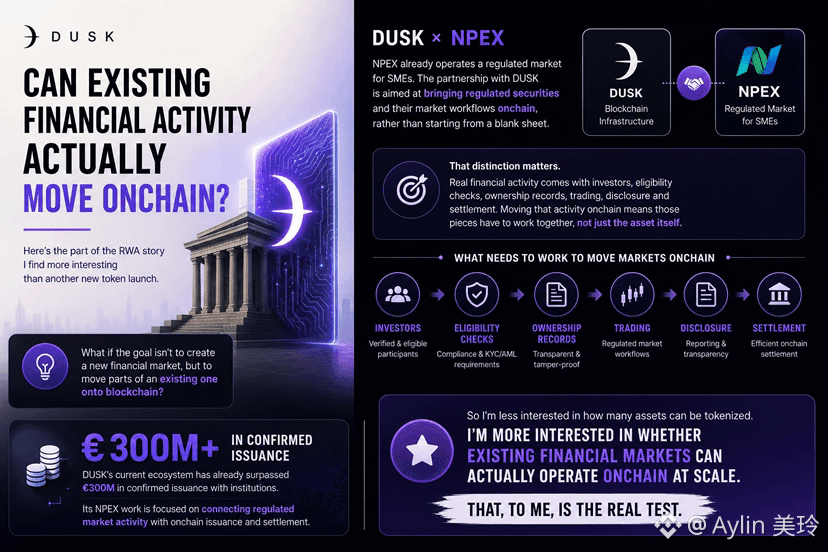
Can Existing Financial Activity Actually Move Onchain?
Here’s the part of the RWA story I find more interesting than another new token launch.
What if the goal isn’t to create a new financial market, but to move parts of an existing one onto blockchain?
That is where DUSK’s work with NPEX becomes interesting.
NPEX already operates a regulated market for SMEs. The partnership with DUSK is aimed at bringing regulated securities and their market workflows onchain, rather than starting from a blank sheet.
That distinction matters.
Real financial activity comes with investors, eligibility checks, ownership records, trading, disclosure and settlement. Moving that activity onchain means those pieces have to work together, not just the asset itself.
DUSK says its current ecosystem has already surpassed €300M in confirmed issuance with institutions, while its NPEX work is focused on connecting regulated market activity with onchain issuance and settlement.
So I’m less interested in how many assets can be tokenized.
I’m more interested in whether existing financial markets can actually operate onchain at scale.
That to me is the real test.
#dusk @Dusk_Foundation $DUSK $TRUMP
{future}(TRUMPUSDT)
{future}(DUSKUSDT)
Can Existing Financial Activity Actually Move Onchain?
Here’s the part of the RWA story I find more interesting than another new token launch.
What if the goal isn’t to create a new financial market, but to move parts of an existing one onto blockchain?
That is where DUSK’s work with NPEX becomes interesting.
NPEX already operates a regulated market for SMEs. The partnership with DUSK is aimed at bringing regulated securities and their market workflows onchain, rather than starting from a blank sheet.
That distinction matters.
Real financial activity comes with investors, eligibility checks, ownership records, trading, disclosure and settlement. Moving that activity onchain means those pieces have to work together, not just the asset itself.
DUSK says its current ecosystem has already surpassed €300M in confirmed issuance with institutions, while its NPEX work is focused on connecting regulated market activity with onchain issuance and settlement.
So I’m less interested in how many assets can be tokenized.
I’m more interested in whether existing financial markets can actually operate onchain at scale.
That to me is the real test.
#dusk @Dusk $DUSK $TRUMP
Here’s the part of the RWA story I find more interesting than another new token launch.
What if the goal isn’t to create a new financial market, but to move parts of an existing one onto blockchain?
That is where DUSK’s work with NPEX becomes interesting.
NPEX already operates a regulated market for SMEs. The partnership with DUSK is aimed at bringing regulated securities and their market workflows onchain, rather than starting from a blank sheet.
That distinction matters.
Real financial activity comes with investors, eligibility checks, ownership records, trading, disclosure and settlement. Moving that activity onchain means those pieces have to work together, not just the asset itself.
DUSK says its current ecosystem has already surpassed €300M in confirmed issuance with institutions, while its NPEX work is focused on connecting regulated market activity with onchain issuance and settlement.
So I’m less interested in how many assets can be tokenized.
I’m more interested in whether existing financial markets can actually operate onchain at scale.
That to me is the real test.
#dusk @Dusk $DUSK $TRUMP
180
·
--
Haussier
#GoldReboundsNearly5%
Gold is heating up FAST. 🔥📈
Gold just ripped +4.7% to ~$4,588/oz in 5 days a move that has traders watching closely.
A softer Dollar, rising US debt concerns, and the rush toward safe-haven assets are fueling the breakout. And with UBS eyeing $5,400, the bulls clearly aren’t backing down.
Trader’s Playbook 👇
1️⃣ Don’t FOMO into vertical green candles.
2️⃣ Watch DXY + Treasury yields for signs of a macro shift.
3️⃣ Keep Bitcoin & $PAXG on the radar — if gold keeps running, digital gold could catch the momentum.
🚀 Gold breakout or blow-off top?
Are you riding the wave or waiting for a pullback?
Not financial advice. DYOR.
$PAXG
{future}(PAXGUSDT)
#GoldReboundsNearly5%
Gold is heating up FAST. 🔥📈
Gold just ripped +4.7% to ~$4,588/oz in 5 days a move that has traders watching closely.
A softer Dollar, rising US debt concerns, and the rush toward safe-haven assets are fueling the breakout. And with UBS eyeing $5,400, the bulls clearly aren’t backing down.
Trader’s Playbook 👇
1️⃣ Don’t FOMO into vertical green candles.
2️⃣ Watch DXY + Treasury yields for signs of a macro shift.
3️⃣ Keep Bitcoin & $PAXG on the radar — if gold keeps running, digital gold could catch the momentum.
🚀 Gold breakout or blow-off top?
Are you riding the wave or waiting for a pullback?
Not financial advice. DYOR.
$PAXG
Gold is heating up FAST. 🔥📈
Gold just ripped +4.7% to ~$4,588/oz in 5 days a move that has traders watching closely.
A softer Dollar, rising US debt concerns, and the rush toward safe-haven assets are fueling the breakout. And with UBS eyeing $5,400, the bulls clearly aren’t backing down.
Trader’s Playbook 👇
1️⃣ Don’t FOMO into vertical green candles.
2️⃣ Watch DXY + Treasury yields for signs of a macro shift.
3️⃣ Keep Bitcoin & $PAXG on the radar — if gold keeps running, digital gold could catch the momentum.
🚀 Gold breakout or blow-off top?
Are you riding the wave or waiting for a pullback?
Not financial advice. DYOR.
$PAXG

166
·
--
Haussier
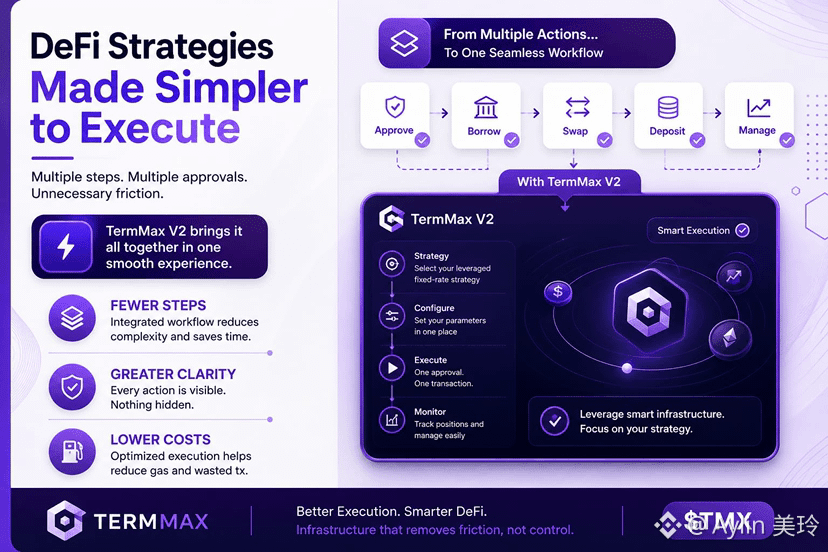
DeFi can be powerful, but sometimes the user experience makes a simple strategy feel unnecessarily complicated.
You might need to approve an asset, borrow, swap, deposit again, and keep track of several transactions along the way. Every extra step means more time, more gas, and another point where something can go wrong.
That’s why the execution side of @termmax V2 caught my attention.
Its architecture brings several actions into a more coordinated workflow for leveraged strategies. The interesting part isn’t simply reducing clicks. It’s making the process easier to follow while keeping the underlying actions visible to the user.
Of course, simpler execution doesn’t make a strategy risk-free. Leverage still requires careful risk management.
But better infrastructure should reduce unnecessary friction, not add to it.
If DeFi wants to become easier for more people to use, I think execution design will matter a lot more than it gets credit for today.
#TermMax $ENA
{future}(ENAUSDT)
DeFi can be powerful, but sometimes the user experience makes a simple strategy feel unnecessarily complicated.
You might need to approve an asset, borrow, swap, deposit again, and keep track of several transactions along the way. Every extra step means more time, more gas, and another point where something can go wrong.
That’s why the execution side of @TermMax V2 caught my attention.
Its architecture brings several actions into a more coordinated workflow for leveraged strategies. The interesting part isn’t simply reducing clicks. It’s making the process easier to follow while keeping the underlying actions visible to the user.
Of course, simpler execution doesn’t make a strategy risk-free. Leverage still requires careful risk management.
But better infrastructure should reduce unnecessary friction, not add to it.
If DeFi wants to become easier for more people to use, I think execution design will matter a lot more than it gets credit for today.
#TermMax $ENA
You might need to approve an asset, borrow, swap, deposit again, and keep track of several transactions along the way. Every extra step means more time, more gas, and another point where something can go wrong.
That’s why the execution side of @TermMax V2 caught my attention.
Its architecture brings several actions into a more coordinated workflow for leveraged strategies. The interesting part isn’t simply reducing clicks. It’s making the process easier to follow while keeping the underlying actions visible to the user.
Of course, simpler execution doesn’t make a strategy risk-free. Leverage still requires careful risk management.
But better infrastructure should reduce unnecessary friction, not add to it.
If DeFi wants to become easier for more people to use, I think execution design will matter a lot more than it gets credit for today.
#TermMax $ENA
90
·
--
Haussier
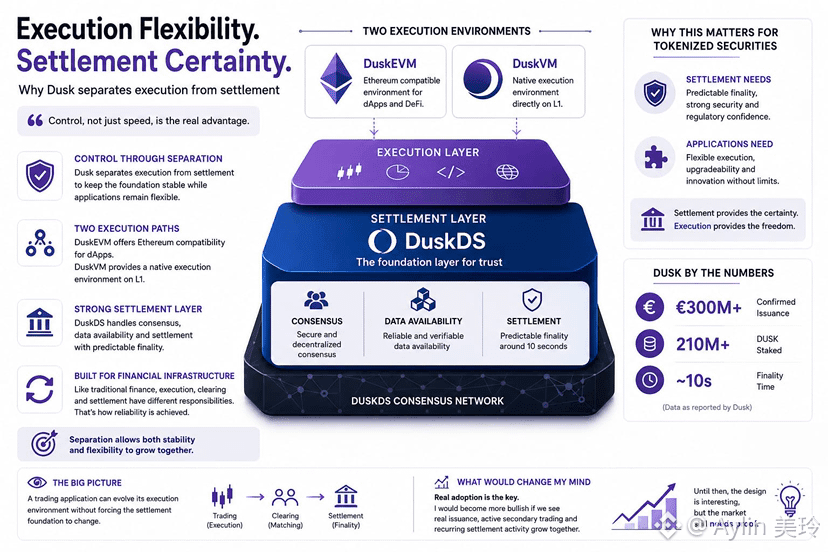
I keep wondering why financial blockchains need to separate execution from settlement when one chain can theoretically do both. The answer is control.
Dusk’s architecture puts DuskDS underneath execution handling consensus data availability and settlement, while DuskEVM provides an Ethereum compatible environment for applications. DuskVM offers another execution path directly on the L1.
I think the important idea is not speed alone. It is specialization. A trading application can change its execution environment without forcing the settlement foundation to change with it. That resembles traditional financial infrastructure where trading clearing and settlement have different responsibilities.
This could matter for tokenized securities because settlement needs predictable finality, while applications need flexibility. Dusk currently reports more than €300M in confirmed issuance and around 210M DUSK staked with finality around 10 seconds.
Still, architecture is not adoption. I would become more bullish if real issuance secondary trading and recurring settlement activity grow together. Until then the design is interesting but the market still needs proof.
#dusk @Dusk_Foundation $DUSK $BB
{future}(DUSKUSDT)
{future}(BBUSDT)
I keep wondering why financial blockchains need to separate execution from settlement when one chain can theoretically do both. The answer is control.
Dusk’s architecture puts DuskDS underneath execution handling consensus data availability and settlement, while DuskEVM provides an Ethereum compatible environment for applications. DuskVM offers another execution path directly on the L1.
I think the important idea is not speed alone. It is specialization. A trading application can change its execution environment without forcing the settlement foundation to change with it. That resembles traditional financial infrastructure where trading clearing and settlement have different responsibilities.
This could matter for tokenized securities because settlement needs predictable finality, while applications need flexibility. Dusk currently reports more than €300M in confirmed issuance and around 210M DUSK staked with finality around 10 seconds.
Still, architecture is not adoption. I would become more bullish if real issuance secondary trading and recurring settlement activity grow together. Until then the design is interesting but the market still needs proof.
#dusk @Dusk $DUSK $BB
Dusk’s architecture puts DuskDS underneath execution handling consensus data availability and settlement, while DuskEVM provides an Ethereum compatible environment for applications. DuskVM offers another execution path directly on the L1.
I think the important idea is not speed alone. It is specialization. A trading application can change its execution environment without forcing the settlement foundation to change with it. That resembles traditional financial infrastructure where trading clearing and settlement have different responsibilities.
This could matter for tokenized securities because settlement needs predictable finality, while applications need flexibility. Dusk currently reports more than €300M in confirmed issuance and around 210M DUSK staked with finality around 10 seconds.
Still, architecture is not adoption. I would become more bullish if real issuance secondary trading and recurring settlement activity grow together. Until then the design is interesting but the market still needs proof.
#dusk @Dusk $DUSK $BB
2
2
177
·
--
Haussier
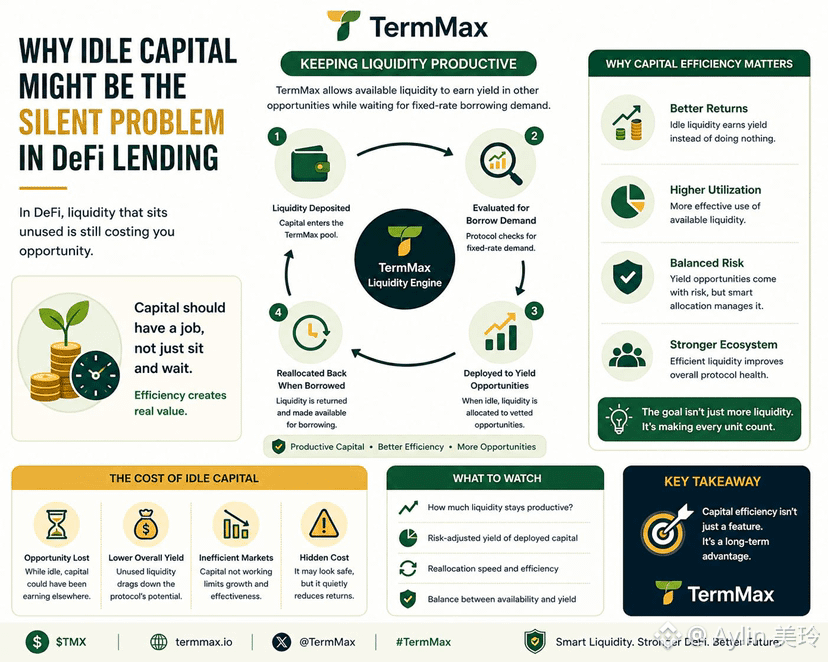
Here’s a DeFi problem that doesn’t get enough attention: what happens to liquidity when nobody is using it?
Capital sitting on the sidelines may look harmless, but from a lender’s perspective, unused liquidity is still an opportunity cost.
That’s why I find the capital-efficiency side of @termmax worth watching. Its design allows available liquidity to interact with other yield opportunities while the protocol is waiting for fixed-rate borrowing demand.
The bigger idea here is pretty simple: liquidity should ideally have a job.
Of course, moving capital into another strategy also introduces its own risks, so efficiency shouldn’t come at the expense of risk management. But I like seeing protocols think beyond the basic deposit and wait model.
If TermMax can keep liquidity productive while maintaining a healthy balance between yield, availability and risk, that could become an important part of its long-term value proposition.
For me, the interesting metric isn’t just how much liquidity enters the protocol. It’s how efficiently that liquidity is actually being used.
$RE @termmax #TermMax
{future}(REUSDT)
Here’s a DeFi problem that doesn’t get enough attention: what happens to liquidity when nobody is using it?
Capital sitting on the sidelines may look harmless, but from a lender’s perspective, unused liquidity is still an opportunity cost.
That’s why I find the capital-efficiency side of @TermMax worth watching. Its design allows available liquidity to interact with other yield opportunities while the protocol is waiting for fixed-rate borrowing demand.
The bigger idea here is pretty simple: liquidity should ideally have a job.
Of course, moving capital into another strategy also introduces its own risks, so efficiency shouldn’t come at the expense of risk management. But I like seeing protocols think beyond the basic deposit and wait model.
If TermMax can keep liquidity productive while maintaining a healthy balance between yield, availability and risk, that could become an important part of its long-term value proposition.
For me, the interesting metric isn’t just how much liquidity enters the protocol. It’s how efficiently that liquidity is actually being used.
$RE @TermMax #TermMax
Capital sitting on the sidelines may look harmless, but from a lender’s perspective, unused liquidity is still an opportunity cost.
That’s why I find the capital-efficiency side of @TermMax worth watching. Its design allows available liquidity to interact with other yield opportunities while the protocol is waiting for fixed-rate borrowing demand.
The bigger idea here is pretty simple: liquidity should ideally have a job.
Of course, moving capital into another strategy also introduces its own risks, so efficiency shouldn’t come at the expense of risk management. But I like seeing protocols think beyond the basic deposit and wait model.
If TermMax can keep liquidity productive while maintaining a healthy balance between yield, availability and risk, that could become an important part of its long-term value proposition.
For me, the interesting metric isn’t just how much liquidity enters the protocol. It’s how efficiently that liquidity is actually being used.
$RE @TermMax #TermMax
7
7
229
·
--
Haussier
Oh gosh… I came to Binance to trade and somehow $RE & $TRUMP stole the spotlight with those pumps 😂🔥
My trades went green so fast I completely forgot about DUSK 😭💰
Now I’m back at @Dusk_Foundation with my research and thoughts.🐕🚀
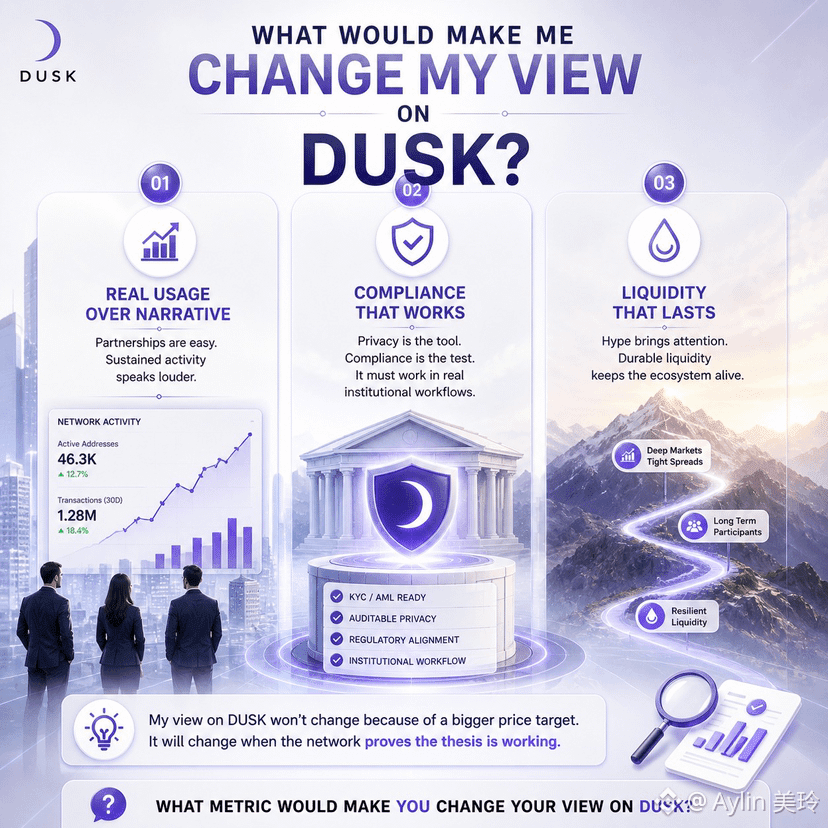
What would make me change my view on DUSK?
Being bullish is easy when everything looks promising.
The harder exercise is deciding what evidence would make you reconsider.
For DUSK, I would watch three things.
First, real usage over narrative. Partnerships and announcements are interesting, but sustained activity would tell me much more.
Second, whether compliance becomes practical rather than theoretical. DUSK is targeting regulated financial markets, so the real test is whether its privacy and compliance infrastructure can work in actual institutional workflows.
Third, whether liquidity becomes durable. A token can attract attention during a campaign, but lasting liquidity needs participants who have reasons to stay.
None of these happen overnight.
And that is exactly why I would rather track measurable progress than react to every bullish headline.
My view on DUSK wouldn't change because someone posted a bigger price target.
It would change if the underlying network started producing evidence that the thesis is working.
#dusk $DUSK
{future}(DUSKUSDT)
What metric would make you change your view on DUSK?
Oh gosh… I came to Binance to trade and somehow $RE & $TRUMP stole the spotlight with those pumps 😂🔥
My trades went green so fast I completely forgot about DUSK 😭💰
Now I’m back at @Dusk with my research and thoughts.🐕🚀
What would make me change my view on DUSK?
Being bullish is easy when everything looks promising.
The harder exercise is deciding what evidence would make you reconsider.
For DUSK, I would watch three things.
First, real usage over narrative. Partnerships and announcements are interesting, but sustained activity would tell me much more.
Second, whether compliance becomes practical rather than theoretical. DUSK is targeting regulated financial markets, so the real test is whether its privacy and compliance infrastructure can work in actual institutional workflows.
Third, whether liquidity becomes durable. A token can attract attention during a campaign, but lasting liquidity needs participants who have reasons to stay.
None of these happen overnight.
And that is exactly why I would rather track measurable progress than react to every bullish headline.
My view on DUSK wouldn't change because someone posted a bigger price target.
It would change if the underlying network started producing evidence that the thesis is working.
#dusk $DUSK
What metric would make you change your view on DUSK?
My trades went green so fast I completely forgot about DUSK 😭💰
Now I’m back at @Dusk with my research and thoughts.🐕🚀
What would make me change my view on DUSK?
Being bullish is easy when everything looks promising.
The harder exercise is deciding what evidence would make you reconsider.
For DUSK, I would watch three things.
First, real usage over narrative. Partnerships and announcements are interesting, but sustained activity would tell me much more.
Second, whether compliance becomes practical rather than theoretical. DUSK is targeting regulated financial markets, so the real test is whether its privacy and compliance infrastructure can work in actual institutional workflows.
Third, whether liquidity becomes durable. A token can attract attention during a campaign, but lasting liquidity needs participants who have reasons to stay.
None of these happen overnight.
And that is exactly why I would rather track measurable progress than react to every bullish headline.
My view on DUSK wouldn't change because someone posted a bigger price target.
It would change if the underlying network started producing evidence that the thesis is working.
#dusk $DUSK
What metric would make you change your view on DUSK?
12
12
246
·
--
Haussier
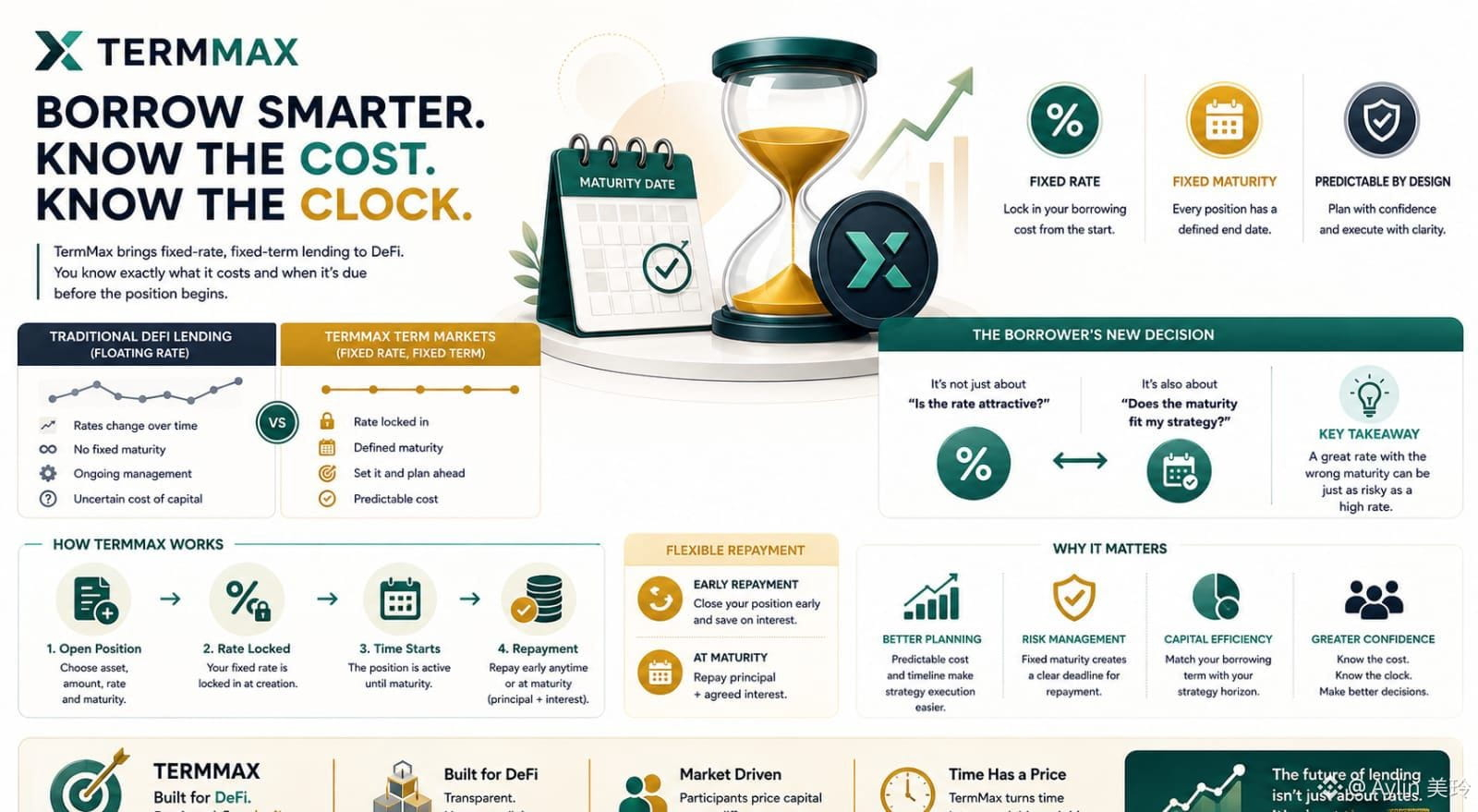
TermMax made me think about borrowing a little differently. The interesting part isn't only the rate. It's the fact that the position has a defined maturity.
In many DeFi lending markets, a borrower can keep a position open while continuously managing collateral and changing borrowing costs. TermMax takes a different approach with fixed-rate, fixed-term markets, so the cost and maturity are known when the position is created.
That changes the decision for the borrower.
Instead of only asking whether the rate looks attractive, there is another question that matters just as much: does the maturity actually fit the strategy?
A predictable borrowing cost can make planning easier, but a fixed maturity also creates a clear deadline for repayment. TermMax allows early repayment, while repayment at maturity requires the principal plus the agreed interest.
For me, this is what makes the model interesting.
It isn't simply about borrowing at a fixed rate. It's about knowing both the cost and the clock before the position begins.
#TermMax @termmax
$HEMI
{future}(HEMIUSDT)
TermMax made me think about borrowing a little differently. The interesting part isn't only the rate. It's the fact that the position has a defined maturity.
In many DeFi lending markets, a borrower can keep a position open while continuously managing collateral and changing borrowing costs. TermMax takes a different approach with fixed-rate, fixed-term markets, so the cost and maturity are known when the position is created.
That changes the decision for the borrower.
Instead of only asking whether the rate looks attractive, there is another question that matters just as much: does the maturity actually fit the strategy?
A predictable borrowing cost can make planning easier, but a fixed maturity also creates a clear deadline for repayment. TermMax allows early repayment, while repayment at maturity requires the principal plus the agreed interest.
For me, this is what makes the model interesting.
It isn't simply about borrowing at a fixed rate. It's about knowing both the cost and the clock before the position begins.
#TermMax @TermMax
$HEMI
In many DeFi lending markets, a borrower can keep a position open while continuously managing collateral and changing borrowing costs. TermMax takes a different approach with fixed-rate, fixed-term markets, so the cost and maturity are known when the position is created.
That changes the decision for the borrower.
Instead of only asking whether the rate looks attractive, there is another question that matters just as much: does the maturity actually fit the strategy?
A predictable borrowing cost can make planning easier, but a fixed maturity also creates a clear deadline for repayment. TermMax allows early repayment, while repayment at maturity requires the principal plus the agreed interest.
For me, this is what makes the model interesting.
It isn't simply about borrowing at a fixed rate. It's about knowing both the cost and the clock before the position begins.
#TermMax @TermMax
$HEMI
1
2
171
·
--
Haussier
#dusk $DUSK @Dusk_Foundation The interesting part of DUSK’s staking model may not be today’s rewards. It’s what happens when emissions keep shrinking.
Dusk’s token model is designed around a long emission curve. The network plans to emit 500M DUSK over 36 years, with the emission rate reduced by 50% every four years. But block rewards aren’t funded only by new tokens. Transaction fees are also included in the reward structure.
That creates a question I think is more interesting than simply asking whether DUSK staking is attractive today.
What happens when the network has to rely increasingly on actual activity rather than fresh emissions?
In the early stages, emissions can help bootstrap network security. Over time, though, the economics gradually put more attention on whether people are actually using the network and generating fees.
That makes adoption more important than a headline staking number.
If Dusk eventually handles meaningful regulated-market activity, transaction demand could become an increasingly important part of the security economy.
But that is still a thesis, not a proven outcome.
For me, the metric worth watching isn't just how much DUSK is staked.
It’s whether real network usage eventually becomes strong enough to matter to the reward model.
{future}(DUSKUSDT)
#dusk $DUSK @Dusk The interesting part of DUSK’s staking model may not be today’s rewards. It’s what happens when emissions keep shrinking.
Dusk’s token model is designed around a long emission curve. The network plans to emit 500M DUSK over 36 years, with the emission rate reduced by 50% every four years. But block rewards aren’t funded only by new tokens. Transaction fees are also included in the reward structure.
That creates a question I think is more interesting than simply asking whether DUSK staking is attractive today.
What happens when the network has to rely increasingly on actual activity rather than fresh emissions?
In the early stages, emissions can help bootstrap network security. Over time, though, the economics gradually put more attention on whether people are actually using the network and generating fees.
That makes adoption more important than a headline staking number.
If Dusk eventually handles meaningful regulated-market activity, transaction demand could become an increasingly important part of the security economy.
But that is still a thesis, not a proven outcome.
For me, the metric worth watching isn't just how much DUSK is staked.
It’s whether real network usage eventually becomes strong enough to matter to the reward model.
Dusk’s token model is designed around a long emission curve. The network plans to emit 500M DUSK over 36 years, with the emission rate reduced by 50% every four years. But block rewards aren’t funded only by new tokens. Transaction fees are also included in the reward structure.
That creates a question I think is more interesting than simply asking whether DUSK staking is attractive today.
What happens when the network has to rely increasingly on actual activity rather than fresh emissions?
In the early stages, emissions can help bootstrap network security. Over time, though, the economics gradually put more attention on whether people are actually using the network and generating fees.
That makes adoption more important than a headline staking number.
If Dusk eventually handles meaningful regulated-market activity, transaction demand could become an increasingly important part of the security economy.
But that is still a thesis, not a proven outcome.
For me, the metric worth watching isn't just how much DUSK is staked.
It’s whether real network usage eventually becomes strong enough to matter to the reward model.
Staking Meets Adoption 🧐
0%
Beyond Staking Rewards 🙊
0%
Emissions Meet Adoption 🤔
0%
0 Votes • Vote fermé
6
4
78
·
--
Haussier
$ALPINE is staying strong around $0.39, with buyers continuing to defend this level. If momentum picks up, we could see a breakout that may trigger the next bullish move.
Long setup 🎯
TP1: $0.43
TP2: $0.48
TP3: $0.54
$ALPINE 🚀
{future}(ALPINEUSDT)
$ALPINE is staying strong around $0.39, with buyers continuing to defend this level. If momentum picks up, we could see a breakout that may trigger the next bullish move.
Long setup 🎯
TP1: $0.43
TP2: $0.48
TP3: $0.54
$ALPINE 🚀
Long setup 🎯
TP1: $0.43
TP2: $0.48
TP3: $0.54
$ALPINE 🚀
1
20
·
--
Haussier
🌋 Breakout watchlist while the big names are taking a breather, three altcoins are making some serious moves — $ACE, $CLO, and $CYS. 👀
📈 $ACE : +31.56% → $0.22250 🚀
📈 $CLO : +25.28% → $0.14532 💫
📈 $CYS : +14.88% → $0.5242 ⚡
ACE is clearly leading the charge right now, with CLO close behind, while CYS is moving at a more measured pace.
If the momentum continues, the upside targets are interesting:
🔥 ACE → $0.50
💥 CLO → $0.30
⚡ CYS → $1.00
But the real question is: which one has the strongest chart from here, and which one could lose momentum first? 👇
Drop your pick and tell me why. 🗳️
⚠️ Not financial advice. DYOR.
#altcoins #crypto #cryptotrading #MarketWatch #Write2Earn
{future}(CYSUSDT)
{future}(CLOUSDT)
{future}(ACEUSDT)
🌋 Breakout watchlist while the big names are taking a breather, three altcoins are making some serious moves — $ACE , $CLO , and $CYS . 👀
📈 $ACE : +31.56% → $0.22250 🚀
📈 $CLO : +25.28% → $0.14532 💫
📈 $CYS : +14.88% → $0.5242 ⚡
ACE is clearly leading the charge right now, with CLO close behind, while CYS is moving at a more measured pace.
If the momentum continues, the upside targets are interesting:
🔥 ACE → $0.50
💥 CLO → $0.30
⚡ CYS → $1.00
But the real question is: which one has the strongest chart from here, and which one could lose momentum first? 👇
Drop your pick and tell me why. 🗳️
⚠️ Not financial advice. DYOR.
#altcoins #crypto #cryptotrading #MarketWatch #Write2Earn
📈 $ACE : +31.56% → $0.22250 🚀
📈 $CLO : +25.28% → $0.14532 💫
📈 $CYS : +14.88% → $0.5242 ⚡
ACE is clearly leading the charge right now, with CLO close behind, while CYS is moving at a more measured pace.
If the momentum continues, the upside targets are interesting:
🔥 ACE → $0.50
💥 CLO → $0.30
⚡ CYS → $1.00
But the real question is: which one has the strongest chart from here, and which one could lose momentum first? 👇
Drop your pick and tell me why. 🗳️
⚠️ Not financial advice. DYOR.
#altcoins #crypto #cryptotrading #MarketWatch #Write2Earn
CYS
74%
CLO
2%
ACE
24%
59 Votes • Vote fermé
2
2.2k
Connectez-vous pour découvrir plus de contenu
Rejoignez la communauté mondiale des adeptes de cryptomonnaies sur Binance Square
⚡️ Suviez les dernières informations importantes sur les cryptomonnaies.
💬 Jugé digne de confiance par la plus grande plateforme d’échange de cryptomonnaies au monde.
👍 Découvrez les connaissances que partagent les créateurs vérifiés.
Adresse e-mail/Nº de téléphone
Sujets d’actualité
SECHaltsCryptoETFReviewsAmidFundingLapse
259 vues
36 mentions
Everyone Was Waiting for the Next Crypto ETF… Then Washington Hit PAUSE 👀
This one caught my attention this morning.
The SEC has paused reviews of new crypto ETFs during the U.S. funding lapse.
Important part: this is not a rejection.
Existing ETFs keep trading.
New applications are basically stuck waiting for the SEC machinery to restart.
And reportedly 90+ applications were sitting in the pipeline as October began.
So I’m not watching this as bearish news.
I’m watching what happens when that pipeline starts moving again. 👀
Sometimes the bigger move comes after the pause, not during it.
—Master CX
$BTC $ETH
#SECHaltsCryptoETFReviewsAmidFundingLapse
Master CX
·2 mentions J’aime
·25 vues
ZcashETFPostsFirstWeeklyOutflow$93.6M
52,943 vues
157 mentions
GreekPoliceBustCryptoScamRingArrest17
150,114 vues
1,073 mentions