Here’s a DeFi problem that doesn’t get enough attention: what happens to liquidity when nobody is using it?
Capital sitting on the sidelines may look harmless, but from a lender’s perspective, unused liquidity is still an opportunity cost.
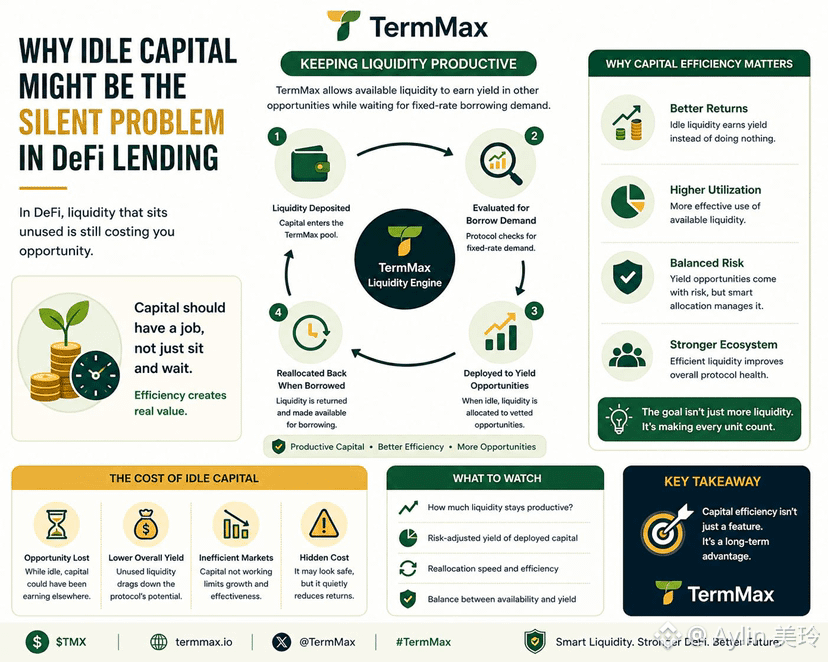
That’s why I find the capital-efficiency side of @TermMax worth watching. Its design allows available liquidity to interact with other yield opportunities while the protocol is waiting for fixed-rate borrowing demand.
The bigger idea here is pretty simple: liquidity should ideally have a job.
Of course, moving capital into another strategy also introduces its own risks, so efficiency shouldn’t come at the expense of risk management. But I like seeing protocols think beyond the basic deposit and wait model.
If TermMax can keep liquidity productive while maintaining a healthy balance between yield, availability and risk, that could become an important part of its long-term value proposition.
For me, the interesting metric isn’t just how much liquidity enters the protocol. It’s how efficiently that liquidity is actually being used.
$RE @TermMax #TermMax
Capital sitting on the sidelines may look harmless, but from a lender’s perspective, unused liquidity is still an opportunity cost.
That’s why I find the capital-efficiency side of @TermMax worth watching. Its design allows available liquidity to interact with other yield opportunities while the protocol is waiting for fixed-rate borrowing demand.
The bigger idea here is pretty simple: liquidity should ideally have a job.
Of course, moving capital into another strategy also introduces its own risks, so efficiency shouldn’t come at the expense of risk management. But I like seeing protocols think beyond the basic deposit and wait model.
If TermMax can keep liquidity productive while maintaining a healthy balance between yield, availability and risk, that could become an important part of its long-term value proposition.
For me, the interesting metric isn’t just how much liquidity enters the protocol. It’s how efficiently that liquidity is actually being used.
$RE @TermMax #TermMax