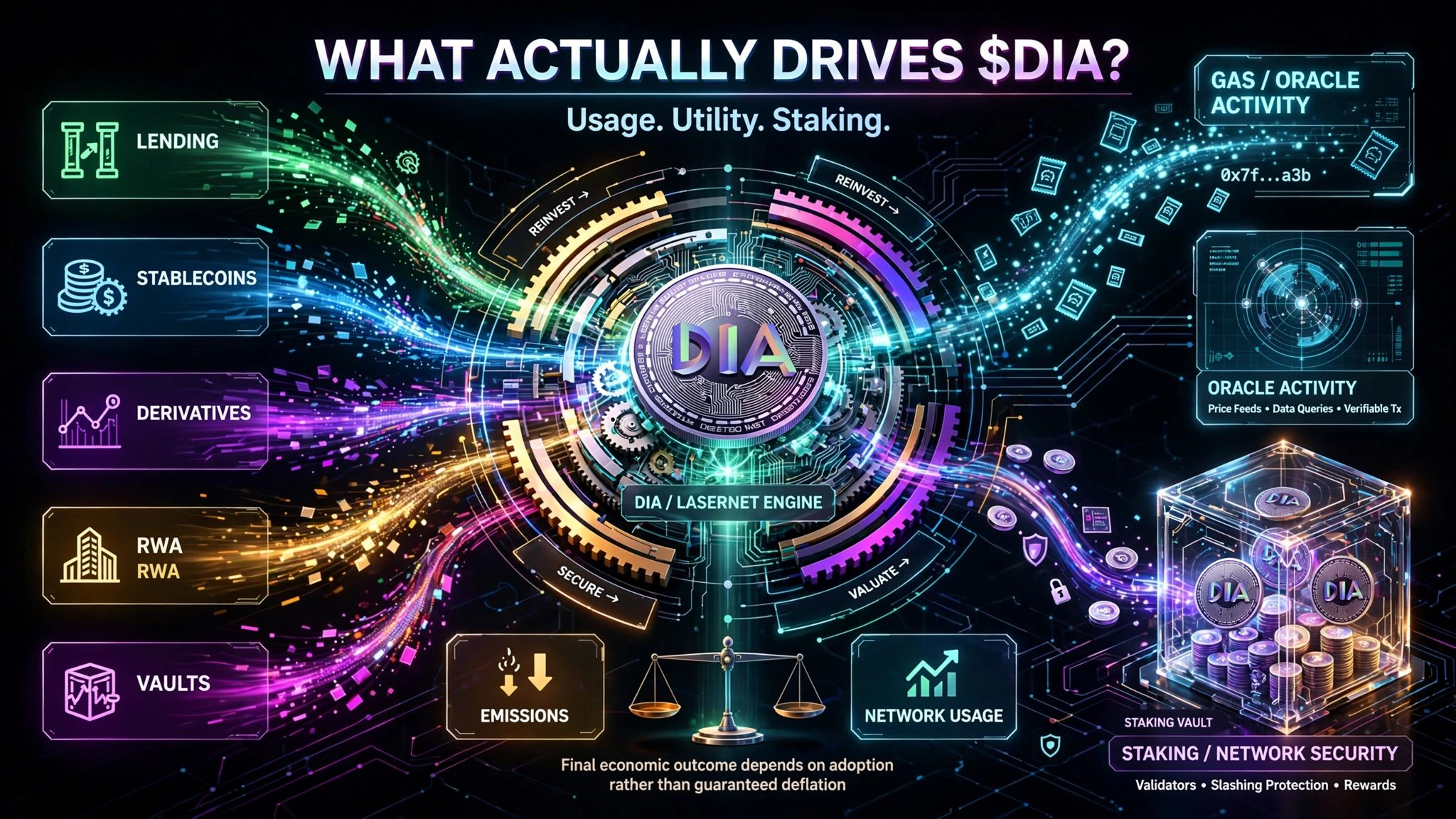
The part of $DIA
tokenomics I find most interesting isn't the APY. It's the utility loop.
DIA is the native gas token on Lasernet.
That means oracle computations, data submissions and verification-layer transactions use DIA.
Then staking adds another layer.
You stake wDIA to help secure oracle operations, with:
→ 1 wDIA minimum
→ Auto-compounding rewards
→ 7-day cooldown
→ Variable APY
Now imagine oracle adoption keeps expanding.
More dApps
→ more data requests
→ more oracle activity
→ more Lasernet transactions
→ more DIA utility
At the same time, staking can remove tokens from active circulation while they are securing the network.
But there’s an important distinction:
Usage does not automatically make DIA deflationary.
Staking rewards create emissions, while gas creates network demand and token consumption.
Whether usage eventually outweighs emissions is an empirical question that depends on adoption and network economics.
So I’m less interested in saying “DIA is deflationary.”
I’m more interested in whether real oracle demand can create a durable token utility loop.
That’s the tokenomics thesis worth tracking.
#DIA #DeFi #Tokenomics #Crypto
tokenomics I find most interesting isn't the APY. It's the utility loop.
DIA is the native gas token on Lasernet.
That means oracle computations, data submissions and verification-layer transactions use DIA.
Then staking adds another layer.
You stake wDIA to help secure oracle operations, with:
→ 1 wDIA minimum
→ Auto-compounding rewards
→ 7-day cooldown
→ Variable APY
Now imagine oracle adoption keeps expanding.
More dApps
→ more data requests
→ more oracle activity
→ more Lasernet transactions
→ more DIA utility
At the same time, staking can remove tokens from active circulation while they are securing the network.
But there’s an important distinction:
Usage does not automatically make DIA deflationary.
Staking rewards create emissions, while gas creates network demand and token consumption.
Whether usage eventually outweighs emissions is an empirical question that depends on adoption and network economics.
So I’m less interested in saying “DIA is deflationary.”
I’m more interested in whether real oracle demand can create a durable token utility loop.
That’s the tokenomics thesis worth tracking.
#DIA #DeFi #Tokenomics #Crypto