

#drifthack
drifthack
13,498 vues
21 mentions
Populaire
Récents

Article
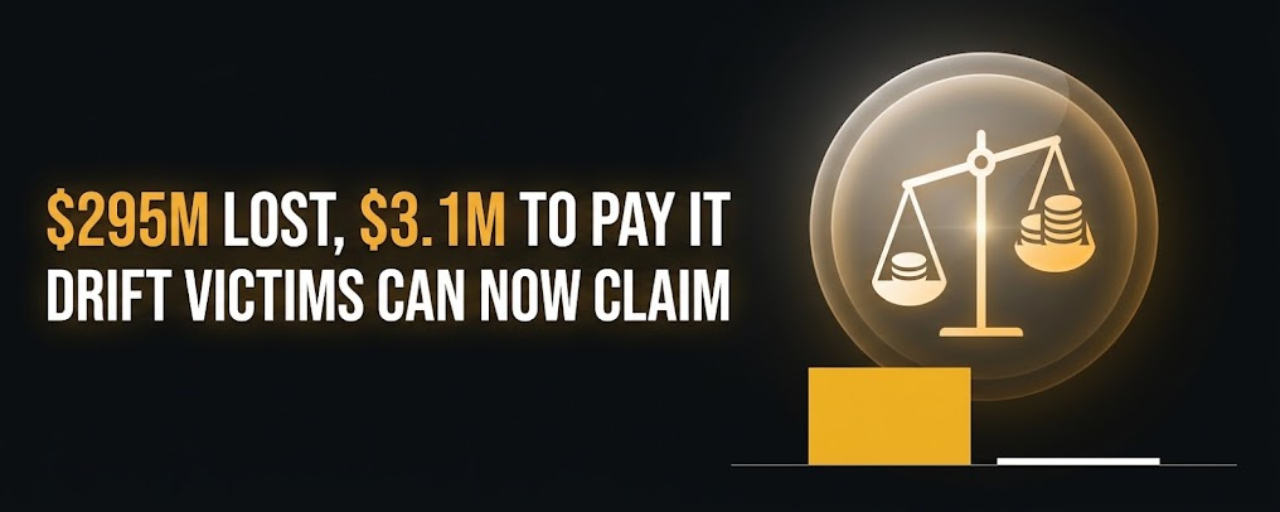
Drift Hack Victims Can Now Claim $3.1M for $295M in Losses: Here's the MathThat's about 1 cent on the dollar at launch. Here's how the recovery pool actually works, and what grows it over time.
🚀 Last April, Drift, a Solana-based trading protocol, was hacked. The damage was severe: $295.4 million in verified losses across its user base.
On October 1, almost six months later, victims finally got a way to claim something back. The starting pool to pay them: about $3.11 million.
🧮 Let's do the math honestly, because the headline number undersells how thin this actually is.
$3.11 million against $295.4 million works out to roughly 1.04 cents per dollar lost. For a round number: a $1,000 loss is worth about $10.40 at launch. That's not a typo and not a rounding error, it's the genuine starting payout ratio, and it's worth sitting with that number before looking at how the mechanism works.
🪙 Here's how the claims system is actually built.
Victims receive a token called DFX, with a fixed total supply of 299,500,810.998, each token tied to exactly one verified dollar of loss from the April incident, and no additional issuance planned, ever. Holders have three choices: burn DFX for USDT at the current exchange rate, sell the tokens on secondary markets like Raydium, or hold them and wait for the recovery pool to grow over time. Once you exchange, that's final, completed transactions can't be reversed. Unclaimed DFX expires when the claims window closes on January 1, 2028.
📈 The part that matters most is this: the pool isn't fixed at $3.11 million forever.
It's designed to grow through several channels. Drift was rebuilt and renamed Velocity, and a portion of Velocity's daily net protocol revenue now feeds the recovery pool. Tether has pledged up to 127.5 million USDT, and strategic partners have pledged another 20 million USDT. Recovered stolen assets also flow into the pool as they're identified and clawed back. In theory, holding DFX rather than cashing out immediately is a bet that the pool meaningfully grows before the 2028 deadline.
📊 Here's what actually happened in the first real week of claims, and it's a useful reality check on both paths.
On the first Friday after claims opened, about 216,480 DFX were exchanged for roughly 2,250 USDT, people choosing to take the immediate, small payout rather than wait. Velocity's first protocol revenue transfer into the pool totaled just 31 USDT, a genuinely tiny early contribution that shows how slowly the "grow over time" mechanism is starting out. On the recovery side, about 13,025.9 ETH was distributed across four Ethereum wallets, while another 2,309.4 ETH was routed through Tornado Cash, a privacy mixer frequently used to obscure the trail of stolen funds. Roughly $9.2 million in assets were frozen at other addresses, funds that may eventually be recoverable but aren't liquid yet.
🧠 Why does this specific recovery structure matter beyond Drift itself?
Because it's a real, live test case for how post-hack recovery actually plays out when a protocol tries to make victims whole honestly rather than just disappearing. A fixed-supply, loss-pegged token with a transparent, revenue-funded growth mechanism and a hard expiry date is a genuinely different approach than many past hack aftermaths, where victims got vague promises or nothing at all. Whether it works, whether the pool actually grows enough to matter before 2028, is the open question.
✅ What this means for you
If you were a Drift victim, the core decision is straightforward to state even if it's hard to make take the small, certain payout now, or hold DFX and bet that Velocity's revenue and asset recovery meaningfully grow the pool before January 2028. Neither choice is obviously right, it depends on your own risk tolerance and need for liquidity now versus later.
If you're not directly affected, this is worth watching as a template. If this mechanism genuinely improves payout ratios over the next year or two, it could become a model other hacked protocols point to. If the pool barely grows past its early trickle, it's a cautionary example of how good intentions in a recovery design don't guarantee a good outcome for victims.
If you're evaluating any protocol's risk profile generally, the roughly $11.5 million still in motion or frozen (the Tornado Cash-routed and frozen amounts) is a reminder that even after a hack is "resolved" publicly, meaningful portions of stolen funds often remain genuinely unrecovered or hard to trace for a long time afterward.
🟢 What would make this recovery design look successful
Velocity's protocol revenue scales up meaningfully beyond its initial 31 USDT contribution, a larger share of frozen or traced funds gets successfully recovered and added to the pool, and the effective payout ratio climbs well above 1 cent on the dollar before the 2028 deadline.
🔴 What would make it look like a weak consolation
Protocol revenue contributions stay minimal, little of the Tornado Cash-routed or frozen funds is ever recovered, and most victims end up taking the small immediate payout simply because waiting never meaningfully pays off.
👀 Three things to watch
1️⃣ Velocity's revenue contributions over time
Does the daily protocol revenue feeding the pool grow substantially beyond its 31 USDT opening transfer, or does it stay negligible?
2️⃣ Recovery of frozen and traced funds
Does any of the $9.2 million in frozen assets or the funds routed through Tornado Cash get successfully recovered and added to the pool?
3️⃣ How victims actually behave
Does the early pattern of quick cashouts (like the 216,480 DFX exchanged in week one) continue, or do more holders start waiting as the pool shows signs of meaningful growth?
💡 The key takeaway
This is a genuinely transparent, structured attempt to make hack victims whole, not a vague promise and not nothing. But the honest starting math is stark: about 1 cent on the dollar, with a recovery mechanism that's off to a very slow start.
The real question is whether Velocity's revenue and ongoing fund recovery meaningfully close that gap before the January 2028 deadline, or whether most victims end up with close to the starting payout regardless of which path they choose.
That is the part worth watching.
This post is for informational and educational purposes only and is not financial advice. Crypto markets are volatile. Always conduct your own research before making financial decisions.
#BinanceSquare #DriftHack #Solana #CryptoSecurity #Recovery
Drift Hack Victims Can Now Claim $3.1M for $295M in Losses: Here's the Math
That's about 1 cent on the dollar at launch. Here's how the recovery pool actually works, and what grows it over time.
🚀 Last April, Drift, a Solana-based trading protocol, was hacked. The damage was severe: $295.4 million in verified losses across its user base.
On October 1, almost six months later, victims finally got a way to claim something back. The starting pool to pay them: about $3.11 million.
🧮 Let's do the math honestly, because the headline number undersells how thin this actually is.
$3.11 million against $295.4 million works out to roughly 1.04 cents per dollar lost. For a round number: a $1,000 loss is worth about $10.40 at launch. That's not a typo and not a rounding error, it's the genuine starting payout ratio, and it's worth sitting with that number before looking at how the mechanism works.
🪙 Here's how the claims system is actually built.
Victims receive a token called DFX, with a fixed total supply of 299,500,810.998, each token tied to exactly one verified dollar of loss from the April incident, and no additional issuance planned, ever. Holders have three choices: burn DFX for USDT at the current exchange rate, sell the tokens on secondary markets like Raydium, or hold them and wait for the recovery pool to grow over time. Once you exchange, that's final, completed transactions can't be reversed. Unclaimed DFX expires when the claims window closes on January 1, 2028.
📈 The part that matters most is this: the pool isn't fixed at $3.11 million forever.
It's designed to grow through several channels. Drift was rebuilt and renamed Velocity, and a portion of Velocity's daily net protocol revenue now feeds the recovery pool. Tether has pledged up to 127.5 million USDT, and strategic partners have pledged another 20 million USDT. Recovered stolen assets also flow into the pool as they're identified and clawed back. In theory, holding DFX rather than cashing out immediately is a bet that the pool meaningfully grows before the 2028 deadline.
📊 Here's what actually happened in the first real week of claims, and it's a useful reality check on both paths.
On the first Friday after claims opened, about 216,480 DFX were exchanged for roughly 2,250 USDT, people choosing to take the immediate, small payout rather than wait. Velocity's first protocol revenue transfer into the pool totaled just 31 USDT, a genuinely tiny early contribution that shows how slowly the "grow over time" mechanism is starting out. On the recovery side, about 13,025.9 ETH was distributed across four Ethereum wallets, while another 2,309.4 ETH was routed through Tornado Cash, a privacy mixer frequently used to obscure the trail of stolen funds. Roughly $9.2 million in assets were frozen at other addresses, funds that may eventually be recoverable but aren't liquid yet.
🧠 Why does this specific recovery structure matter beyond Drift itself?
Because it's a real, live test case for how post-hack recovery actually plays out when a protocol tries to make victims whole honestly rather than just disappearing. A fixed-supply, loss-pegged token with a transparent, revenue-funded growth mechanism and a hard expiry date is a genuinely different approach than many past hack aftermaths, where victims got vague promises or nothing at all. Whether it works, whether the pool actually grows enough to matter before 2028, is the open question.
✅ What this means for you
If you were a Drift victim, the core decision is straightforward to state even if it's hard to make take the small, certain payout now, or hold DFX and bet that Velocity's revenue and asset recovery meaningfully grow the pool before January 2028. Neither choice is obviously right, it depends on your own risk tolerance and need for liquidity now versus later.
If you're not directly affected, this is worth watching as a template. If this mechanism genuinely improves payout ratios over the next year or two, it could become a model other hacked protocols point to. If the pool barely grows past its early trickle, it's a cautionary example of how good intentions in a recovery design don't guarantee a good outcome for victims.
If you're evaluating any protocol's risk profile generally, the roughly $11.5 million still in motion or frozen (the Tornado Cash-routed and frozen amounts) is a reminder that even after a hack is "resolved" publicly, meaningful portions of stolen funds often remain genuinely unrecovered or hard to trace for a long time afterward.
🟢 What would make this recovery design look successful
Velocity's protocol revenue scales up meaningfully beyond its initial 31 USDT contribution, a larger share of frozen or traced funds gets successfully recovered and added to the pool, and the effective payout ratio climbs well above 1 cent on the dollar before the 2028 deadline.
🔴 What would make it look like a weak consolation
Protocol revenue contributions stay minimal, little of the Tornado Cash-routed or frozen funds is ever recovered, and most victims end up taking the small immediate payout simply because waiting never meaningfully pays off.
👀 Three things to watch
1️⃣ Velocity's revenue contributions over time
Does the daily protocol revenue feeding the pool grow substantially beyond its 31 USDT opening transfer, or does it stay negligible?
2️⃣ Recovery of frozen and traced funds
Does any of the $9.2 million in frozen assets or the funds routed through Tornado Cash get successfully recovered and added to the pool?
3️⃣ How victims actually behave
Does the early pattern of quick cashouts (like the 216,480 DFX exchanged in week one) continue, or do more holders start waiting as the pool shows signs of meaningful growth?
💡 The key takeaway
This is a genuinely transparent, structured attempt to make hack victims whole, not a vague promise and not nothing. But the honest starting math is stark: about 1 cent on the dollar, with a recovery mechanism that's off to a very slow start.
The real question is whether Velocity's revenue and ongoing fund recovery meaningfully close that gap before the January 2028 deadline, or whether most victims end up with close to the starting payout regardless of which path they choose.
That is the part worth watching.
This post is for informational and educational purposes only and is not financial advice. Crypto markets are volatile. Always conduct your own research before making financial decisions.
#BinanceSquare #DriftHack #Solana #CryptoSecurity #Recovery
🚀 Last April, Drift, a Solana-based trading protocol, was hacked. The damage was severe: $295.4 million in verified losses across its user base.
On October 1, almost six months later, victims finally got a way to claim something back. The starting pool to pay them: about $3.11 million.
🧮 Let's do the math honestly, because the headline number undersells how thin this actually is.
$3.11 million against $295.4 million works out to roughly 1.04 cents per dollar lost. For a round number: a $1,000 loss is worth about $10.40 at launch. That's not a typo and not a rounding error, it's the genuine starting payout ratio, and it's worth sitting with that number before looking at how the mechanism works.
🪙 Here's how the claims system is actually built.
Victims receive a token called DFX, with a fixed total supply of 299,500,810.998, each token tied to exactly one verified dollar of loss from the April incident, and no additional issuance planned, ever. Holders have three choices: burn DFX for USDT at the current exchange rate, sell the tokens on secondary markets like Raydium, or hold them and wait for the recovery pool to grow over time. Once you exchange, that's final, completed transactions can't be reversed. Unclaimed DFX expires when the claims window closes on January 1, 2028.
📈 The part that matters most is this: the pool isn't fixed at $3.11 million forever.
It's designed to grow through several channels. Drift was rebuilt and renamed Velocity, and a portion of Velocity's daily net protocol revenue now feeds the recovery pool. Tether has pledged up to 127.5 million USDT, and strategic partners have pledged another 20 million USDT. Recovered stolen assets also flow into the pool as they're identified and clawed back. In theory, holding DFX rather than cashing out immediately is a bet that the pool meaningfully grows before the 2028 deadline.
📊 Here's what actually happened in the first real week of claims, and it's a useful reality check on both paths.
On the first Friday after claims opened, about 216,480 DFX were exchanged for roughly 2,250 USDT, people choosing to take the immediate, small payout rather than wait. Velocity's first protocol revenue transfer into the pool totaled just 31 USDT, a genuinely tiny early contribution that shows how slowly the "grow over time" mechanism is starting out. On the recovery side, about 13,025.9 ETH was distributed across four Ethereum wallets, while another 2,309.4 ETH was routed through Tornado Cash, a privacy mixer frequently used to obscure the trail of stolen funds. Roughly $9.2 million in assets were frozen at other addresses, funds that may eventually be recoverable but aren't liquid yet.
🧠 Why does this specific recovery structure matter beyond Drift itself?
Because it's a real, live test case for how post-hack recovery actually plays out when a protocol tries to make victims whole honestly rather than just disappearing. A fixed-supply, loss-pegged token with a transparent, revenue-funded growth mechanism and a hard expiry date is a genuinely different approach than many past hack aftermaths, where victims got vague promises or nothing at all. Whether it works, whether the pool actually grows enough to matter before 2028, is the open question.
✅ What this means for you
If you were a Drift victim, the core decision is straightforward to state even if it's hard to make take the small, certain payout now, or hold DFX and bet that Velocity's revenue and asset recovery meaningfully grow the pool before January 2028. Neither choice is obviously right, it depends on your own risk tolerance and need for liquidity now versus later.
If you're not directly affected, this is worth watching as a template. If this mechanism genuinely improves payout ratios over the next year or two, it could become a model other hacked protocols point to. If the pool barely grows past its early trickle, it's a cautionary example of how good intentions in a recovery design don't guarantee a good outcome for victims.
If you're evaluating any protocol's risk profile generally, the roughly $11.5 million still in motion or frozen (the Tornado Cash-routed and frozen amounts) is a reminder that even after a hack is "resolved" publicly, meaningful portions of stolen funds often remain genuinely unrecovered or hard to trace for a long time afterward.
🟢 What would make this recovery design look successful
Velocity's protocol revenue scales up meaningfully beyond its initial 31 USDT contribution, a larger share of frozen or traced funds gets successfully recovered and added to the pool, and the effective payout ratio climbs well above 1 cent on the dollar before the 2028 deadline.
🔴 What would make it look like a weak consolation
Protocol revenue contributions stay minimal, little of the Tornado Cash-routed or frozen funds is ever recovered, and most victims end up taking the small immediate payout simply because waiting never meaningfully pays off.
👀 Three things to watch
1️⃣ Velocity's revenue contributions over time
Does the daily protocol revenue feeding the pool grow substantially beyond its 31 USDT opening transfer, or does it stay negligible?
2️⃣ Recovery of frozen and traced funds
Does any of the $9.2 million in frozen assets or the funds routed through Tornado Cash get successfully recovered and added to the pool?
3️⃣ How victims actually behave
Does the early pattern of quick cashouts (like the 216,480 DFX exchanged in week one) continue, or do more holders start waiting as the pool shows signs of meaningful growth?
💡 The key takeaway
This is a genuinely transparent, structured attempt to make hack victims whole, not a vague promise and not nothing. But the honest starting math is stark: about 1 cent on the dollar, with a recovery mechanism that's off to a very slow start.
The real question is whether Velocity's revenue and ongoing fund recovery meaningfully close that gap before the January 2028 deadline, or whether most victims end up with close to the starting payout regardless of which path they choose.
That is the part worth watching.
This post is for informational and educational purposes only and is not financial advice. Crypto markets are volatile. Always conduct your own research before making financial decisions.
#BinanceSquare #DriftHack #Solana #CryptoSecurity #Recovery
1
1
34


·
--
#drifthackvictimsbeginclaims
DRIFT HACK RECOVERY UPDATE
Victims of the April 1 Drift exploit can now begin claiming DFX recovery tokens based on their verified losses.
The exploit resulted in roughly $295.4M in reported losses while the initial recovery pool contains about $3.11M. That puts the starting redemption value near $0.0104 for every $1 of the verified losses.
The recovery pool could increase through protocol revenue, partner commitments, Tether support and recovered funds.
The bigger question is whether victims claim now or wait for potential future recovery.
#DriftHack #CryptoNews #DeFi $DRIFT
{future}(DRIFTUSDT)
#drifthackvictimsbeginclaims
DRIFT HACK RECOVERY UPDATE
Victims of the April 1 Drift exploit can now begin claiming DFX recovery tokens based on their verified losses.
The exploit resulted in roughly $295.4M in reported losses while the initial recovery pool contains about $3.11M. That puts the starting redemption value near $0.0104 for every $1 of the verified losses.
The recovery pool could increase through protocol revenue, partner commitments, Tether support and recovered funds.
The bigger question is whether victims claim now or wait for potential future recovery.
#DriftHack #CryptoNews #DeFi $DRIFT
DRIFT HACK RECOVERY UPDATE
Victims of the April 1 Drift exploit can now begin claiming DFX recovery tokens based on their verified losses.
The exploit resulted in roughly $295.4M in reported losses while the initial recovery pool contains about $3.11M. That puts the starting redemption value near $0.0104 for every $1 of the verified losses.
The recovery pool could increase through protocol revenue, partner commitments, Tether support and recovered funds.
The bigger question is whether victims claim now or wait for potential future recovery.
#DriftHack #CryptoNews #DeFi $DRIFT
3
3.5k

·
--
Haussier
#drifthackvictimsbeginclaims
🚨 DRIFT HACK VICTIMS CAN FINALLY START CLAIMING
After the massive April 1 Drift exploit, victims are now able to claim DFX recovery tokens tied to their verified losses.
💰 Around $295.4M in losses were recorded, while the initial recovery pool holds only about $3.11M.
That means the launch redemption value is roughly $0.0104 per $1 lost — about 1.04% of the verified loss.
But the recovery pool is expected to grow through protocol revenue, partner commitments, Tether support, and recovered funds.
The big question now: Will victims hold for a larger future recovery, or take the payout now? 👀
#DriftHack #CryptoNews #defi
#drifthackvictimsbeginclaims
🚨 DRIFT HACK VICTIMS CAN FINALLY START CLAIMING
After the massive April 1 Drift exploit, victims are now able to claim DFX recovery tokens tied to their verified losses.
💰 Around $295.4M in losses were recorded, while the initial recovery pool holds only about $3.11M.
That means the launch redemption value is roughly $0.0104 per $1 lost — about 1.04% of the verified loss.
But the recovery pool is expected to grow through protocol revenue, partner commitments, Tether support, and recovered funds.
The big question now: Will victims hold for a larger future recovery, or take the payout now? 👀
#DriftHack #CryptoNews #defi
🚨 DRIFT HACK VICTIMS CAN FINALLY START CLAIMING
After the massive April 1 Drift exploit, victims are now able to claim DFX recovery tokens tied to their verified losses.
💰 Around $295.4M in losses were recorded, while the initial recovery pool holds only about $3.11M.
That means the launch redemption value is roughly $0.0104 per $1 lost — about 1.04% of the verified loss.
But the recovery pool is expected to grow through protocol revenue, partner commitments, Tether support, and recovered funds.
The big question now: Will victims hold for a larger future recovery, or take the payout now? 👀
#DriftHack #CryptoNews #defi
3
13.9k

#drifthackvictimsbeginclaims انتباهًا لمستخدمي Drift!
أصبح بإمكانكم الآن تقديم المطالبات بشأن الاختراق الأخير. ويُفيد المتضررون بنجاح طلباتهم مع بدء مرحلة التعافي.
احموا أنفسكم: اعتمدوا على الإعلانات الرسمية فقط. فالمحتالون يتربصون بكم بالفعل.
توخوا الحذر.
متابعة من فضلكم
#DriftHack #CryptoSafety #Binance $CT $SOL $AIN
#drifthackvictimsbeginclaims انتباهًا لمستخدمي Drift!
أصبح بإمكانكم الآن تقديم المطالبات بشأن الاختراق الأخير. ويُفيد المتضررون بنجاح طلباتهم مع بدء مرحلة التعافي.
احموا أنفسكم: اعتمدوا على الإعلانات الرسمية فقط. فالمحتالون يتربصون بكم بالفعل.
توخوا الحذر.
متابعة من فضلكم
#DriftHack #CryptoSafety #Binance $CT $SOL $AIN
أصبح بإمكانكم الآن تقديم المطالبات بشأن الاختراق الأخير. ويُفيد المتضررون بنجاح طلباتهم مع بدء مرحلة التعافي.
احموا أنفسكم: اعتمدوا على الإعلانات الرسمية فقط. فالمحتالون يتربصون بكم بالفعل.
توخوا الحذر.
متابعة من فضلكم
#DriftHack #CryptoSafety #Binance $CT $SOL $AIN
1
1k

#DriftHackVictimsBeginClaims
🚨 DRIFT HACK VICTIMS CAN FINALLY CLAIM RECOVERY TOKENS 💔⚡️
Drift hack victims have started filing claims after the massive April exploit.
Nearly $295.4M in verified losses are linked to the attack.
The recovery pool started with around $3.11M, meaning roughly 1 cent is available per $1 lost. 📊
💡 WHAT THIS MEANS FOR TRADERS:
Victims can redeem, sell, or hold their DFX recovery tokens.
Future funding from revenue, partners and recovered assets could increase the recovery pool. 🔥
🔍 2 TOP COINS TO WATCH:
🌐 $BTC (Bitcoin) — Holding around the $86K area; a strong breakout could improve overall market sentiment. 🚀
⚡️ $SOL (Solana) — Drift is built on Solana, so traders will be watching SOL closely as the recovery story develops. 💎
Will this recovery plan rebuild trust in the Solana DeFi ecosystem? Drop your thoughts below! 👇✨
#DriftHack #SolanaDeFi #CryptoRecovery #DeFiNews
{future}(BTCUSDT)
#DriftHackVictimsBeginClaims
🚨 DRIFT HACK VICTIMS CAN FINALLY CLAIM RECOVERY TOKENS 💔⚡️
Drift hack victims have started filing claims after the massive April exploit.
Nearly $295.4M in verified losses are linked to the attack.
The recovery pool started with around $3.11M, meaning roughly 1 cent is available per $1 lost. 📊
💡 WHAT THIS MEANS FOR TRADERS:
Victims can redeem, sell, or hold their DFX recovery tokens.
Future funding from revenue, partners and recovered assets could increase the recovery pool. 🔥
🔍 2 TOP COINS TO WATCH:
🌐 $BTC (Bitcoin) — Holding around the $86K area; a strong breakout could improve overall market sentiment. 🚀
⚡️ $SOL (Solana) — Drift is built on Solana, so traders will be watching SOL closely as the recovery story develops. 💎
Will this recovery plan rebuild trust in the Solana DeFi ecosystem? Drop your thoughts below! 👇✨
#DriftHack #SolanaDeFi #CryptoRecovery #DeFiNews
🚨 DRIFT HACK VICTIMS CAN FINALLY CLAIM RECOVERY TOKENS 💔⚡️
Drift hack victims have started filing claims after the massive April exploit.
Nearly $295.4M in verified losses are linked to the attack.
The recovery pool started with around $3.11M, meaning roughly 1 cent is available per $1 lost. 📊
💡 WHAT THIS MEANS FOR TRADERS:
Victims can redeem, sell, or hold their DFX recovery tokens.
Future funding from revenue, partners and recovered assets could increase the recovery pool. 🔥
🔍 2 TOP COINS TO WATCH:
🌐 $BTC (Bitcoin) — Holding around the $86K area; a strong breakout could improve overall market sentiment. 🚀
⚡️ $SOL (Solana) — Drift is built on Solana, so traders will be watching SOL closely as the recovery story develops. 💎
Will this recovery plan rebuild trust in the Solana DeFi ecosystem? Drop your thoughts below! 👇✨
#DriftHack #SolanaDeFi #CryptoRecovery #DeFiNews

1
131
Connectez-vous pour découvrir plus de contenu
Rejoignez la communauté mondiale des adeptes de cryptomonnaies sur Binance Square
⚡️ Suviez les dernières informations importantes sur les cryptomonnaies.
💬 Jugé digne de confiance par la plus grande plateforme d’échange de cryptomonnaies au monde.
👍 Découvrez les connaissances que partagent les créateurs vérifiés.
Adresse e-mail/Nº de téléphone
Sujets d’actualité
1
#BinanceLaunchesBinanceIntelligence
618,447 vues
3,812 mentions
2
#BTCFallsBelow$84K
2,221 vues
29 mentions
3
#WinklevossFilesSpotZcashETFApplication
4,227 vues
103 mentions
4
#SouthKoreaAITradeLiftsWorldcoinTo$7.41B
571 vues
15 mentions
5
#StrategyEstimates$4.1BIncomeTaxBenefit
559 vues
11 mentions
6
#IglooShutsDownAbstractBlockchain
794 vues
47 mentions
7
#StrategyMarketCapSurpassesRumble
33,102 vues
712 mentions
8
#StriveBuys2000BTCFor$169M
17,271 vues
154 mentions
9
#EvernorthXRPTreasuryCompletesSPACMerger
233,030 vues
1,908 mentions
10
#ADAGains10%Above$0.27
80,370 vues
265 mentions