

#openledger
openledger
17.3M vues
202,840 mentions
Populaire
Récents

·
--
Haussier
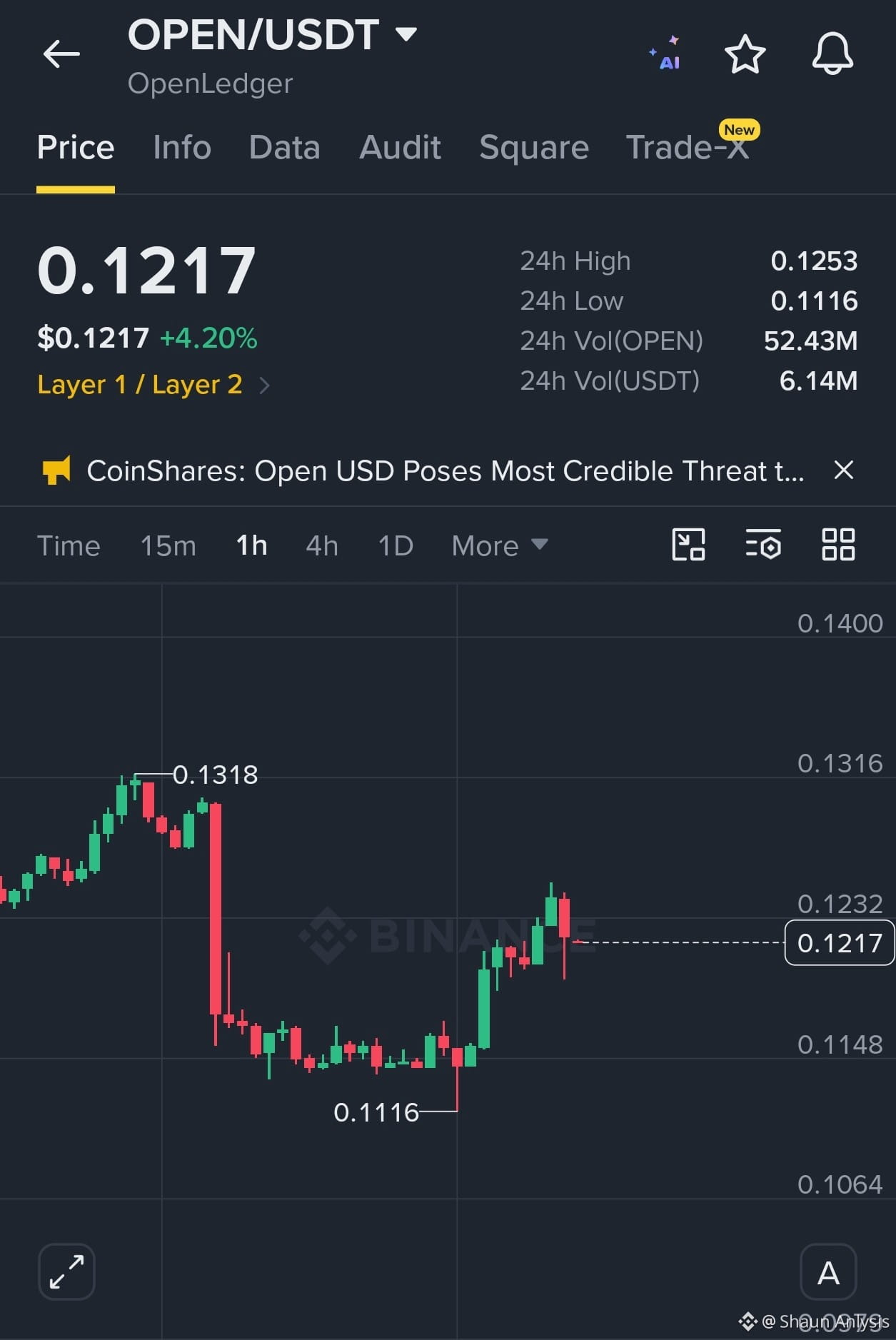
#OpenLedger just printed a textbook V-shaped recovery—don't miss the next leg up.
After a sharp flush to 0.1116, $OPEN has bounced hard, reclaiming the 0.12 handle and currently sitting at 0.1217 (+4.20% on the day). The 1H chart shows a clear shift in momentum as buyers defend the lows and push back toward the 24H high of 0.1253.
Bullish
Entry:0.1180 – 0.1220
SL:0.1100
TP1:0.1318
{future}(OPENUSDT)
#OpenLedger just printed a textbook V-shaped recovery—don't miss the next leg up.
After a sharp flush to 0.1116, $OPEN has bounced hard, reclaiming the 0.12 handle and currently sitting at 0.1217 (+4.20% on the day). The 1H chart shows a clear shift in momentum as buyers defend the lows and push back toward the 24H high of 0.1253.
Bullish
Entry:0.1180 – 0.1220
SL:0.1100
TP1:0.1318
After a sharp flush to 0.1116, $OPEN has bounced hard, reclaiming the 0.12 handle and currently sitting at 0.1217 (+4.20% on the day). The 1H chart shows a clear shift in momentum as buyers defend the lows and push back toward the 24H high of 0.1253.
Bullish
Entry:0.1180 – 0.1220
SL:0.1100
TP1:0.1318
1
24

·
--
Haussier
Partiellement vrai
*OPEN: A Quiet AI Opportunity Near The Bottom*
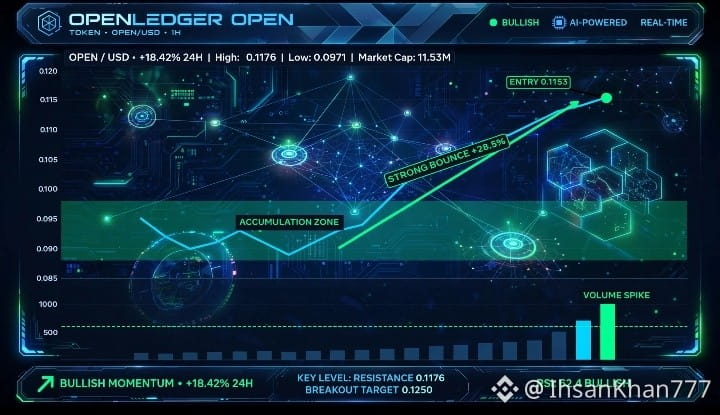
While many focus on popular AI coins, OpenLedger (OPEN) is trading near its lowest price ever.
From $1.84 to $0.11, a large correction of 94 percent. Is this a bottom?
Here is what makes OpenLedger interesting:
OpenLedger is building infrastructure for AI, where data, models, and AI agents receive payments automatically. Think of AI agents paying for verified data on-chain. This is called agentic payments, and OpenLedger aims to lead this sector.
Market cap is around $43M while volume is $31M. That is over 71 percent turnover, showing strong interest and active accumulation.
Token unlocks are happening. About 612k tokens daily around October 8th. Small unlocks create short-term pressure, but also long-term opportunity.
It is listed on major exchanges like Upbit, Bithumb, and Binance, with strong liquidity.
I bought OPEN at $0.1153 near the low range. This is not financial advice, but early infrastructure often looks quiet before growth.
#OpenLedger
#OpenAI
#BestTimeToBuy
#Market_Update
#BullRunTips
$OPEN
$BTC
$BNB
@XG297174
@dengshen
@eggtartcake_grape
@haoge666
@Square-Creator-f92ceb7e7882c
@Square-Creator-d4cc116ea2fe
@SGD852568
@Square-Creator-f0c9a305b41a7
@z12123444
@Square-Creator-9bd28167d172
@NUTS_btc
@heyi
@CZ
@Openledger
@Biswap_Dex
@MagVerse
@EASY7777
@KZG6886
@Z0628
@JavierDot
@oanicai
*OPEN: A Quiet AI Opportunity Near The Bottom*
While many focus on popular AI coins, OpenLedger (OPEN) is trading near its lowest price ever.
From $1.84 to $0.11, a large correction of 94 percent. Is this a bottom?
Here is what makes OpenLedger interesting:
OpenLedger is building infrastructure for AI, where data, models, and AI agents receive payments automatically. Think of AI agents paying for verified data on-chain. This is called agentic payments, and OpenLedger aims to lead this sector.
Market cap is around $43M while volume is $31M. That is over 71 percent turnover, showing strong interest and active accumulation.
Token unlocks are happening. About 612k tokens daily around October 8th. Small unlocks create short-term pressure, but also long-term opportunity.
It is listed on major exchanges like Upbit, Bithumb, and Binance, with strong liquidity.
I bought OPEN at $0.1153 near the low range. This is not financial advice, but early infrastructure often looks quiet before growth.
#OpenLedger
#OpenAI
#BestTimeToBuy
#Market_Update
#BullRunTips
$OPEN
$BTC
$BNB
@K线人生飞哥
@比特币预言家
@Eggtartcake_
@交易员张张子
@华尔街倩倩子
@蝴蝶股票-猩火Bro
@Flash闪光灯
@乐天eth
@加密大格格
@klxmBobo
@Nuts坚果
@Yi He
@CZ
@OpenLedger
@Qordman crypto
@MagVerse
@EASY喊單哥
@KZG Crypto 口罩哥
@Whale韭阴针鲸0628
@_WHALE_
@Oanic AI
While many focus on popular AI coins, OpenLedger (OPEN) is trading near its lowest price ever.
From $1.84 to $0.11, a large correction of 94 percent. Is this a bottom?
Here is what makes OpenLedger interesting:
OpenLedger is building infrastructure for AI, where data, models, and AI agents receive payments automatically. Think of AI agents paying for verified data on-chain. This is called agentic payments, and OpenLedger aims to lead this sector.
Market cap is around $43M while volume is $31M. That is over 71 percent turnover, showing strong interest and active accumulation.
Token unlocks are happening. About 612k tokens daily around October 8th. Small unlocks create short-term pressure, but also long-term opportunity.
It is listed on major exchanges like Upbit, Bithumb, and Binance, with strong liquidity.
I bought OPEN at $0.1153 near the low range. This is not financial advice, but early infrastructure often looks quiet before growth.
#OpenLedger
#OpenAI
#BestTimeToBuy
#Market_Update
#BullRunTips
$OPEN
$BTC
$BNB
@K线人生飞哥
@比特币预言家
@Eggtartcake_
@交易员张张子
@华尔街倩倩子
@蝴蝶股票-猩火Bro
@Flash闪光灯
@乐天eth
@加密大格格
@klxmBobo
@Nuts坚果
@Yi He
@CZ
@OpenLedger
@Qordman crypto
@MagVerse
@EASY喊單哥
@KZG Crypto 口罩哥
@Whale韭阴针鲸0628
@_WHALE_
@Oanic AI
4
789

·
--
📉 $OPEN
— OpenLedger Cooling Off
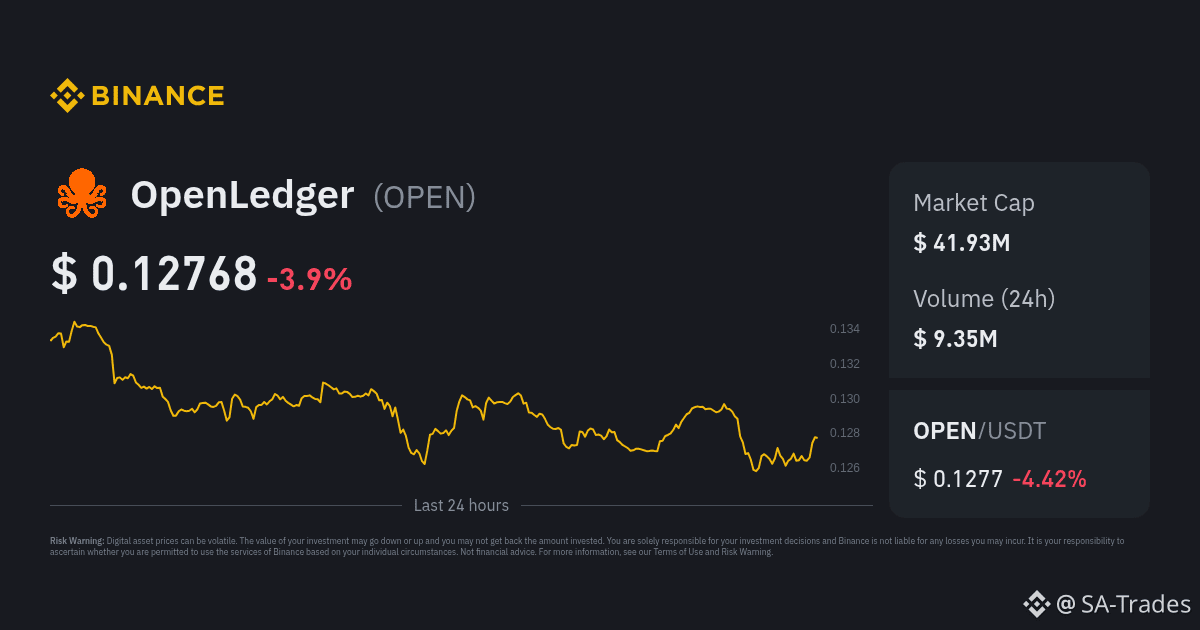
OpenLedger (OPEN) down -3.9% today, now trading at $0.1277.
📊 Market Cap: $41.93M
📊 24h Volume: $9.35M
Choppy price action over the last 24h — sellers stepping in after failing to hold higher levels.
Accumulation zone or further downside? 👀
Trade $OPEN here
{future}(OPENUSDT)
#OPEN #OpenLedger #BinanceSquare #crypto
📉 $OPEN
— OpenLedger Cooling Off
OpenLedger (OPEN) down -3.9% today, now trading at $0.1277.
📊 Market Cap: $41.93M
📊 24h Volume: $9.35M
Choppy price action over the last 24h — sellers stepping in after failing to hold higher levels.
Accumulation zone or further downside? 👀
Trade $OPEN here
#OPEN #OpenLedger #BinanceSquare #crypto
— OpenLedger Cooling Off
OpenLedger (OPEN) down -3.9% today, now trading at $0.1277.
📊 Market Cap: $41.93M
📊 24h Volume: $9.35M
Choppy price action over the last 24h — sellers stepping in after failing to hold higher levels.
Accumulation zone or further downside? 👀
Trade $OPEN here
#OPEN #OpenLedger #BinanceSquare #crypto
2
4
214

·
--
يا شباب $OPEN تحت الضغط… هل يظهر ارتداد؟
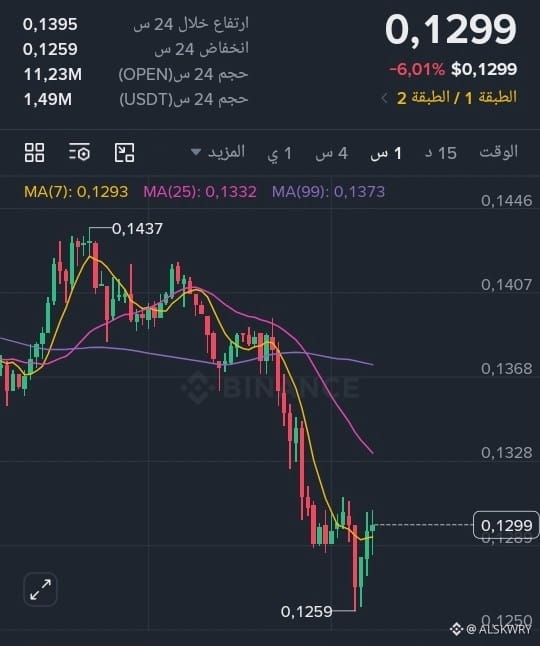
عملة OpenLedger (OPEN) تتحرك حاليًا تحت ضغط بيعي، والسعر حول $0.1299 بعد هبوط يقارب 6% خلال 24 ساعة.
📉 أهم المستويات:
🟢 دعم: $0.1260
🔴 مقاومة: $0.1328 – $0.1330
🔴 مقاومة أقوى: $0.1368 – $0.1375
إذا حافظ السعر على $0.126 وبدأ بتكوين قيعان أعلى، فقد نشهد محاولة ارتداد. أما كسرها بوضوح فقد يفتح المجال لمستويات أدنى.
👀 OPEN الآن تستحق المراقبة، وليس الشراء لمجرد أن السعر انخفض.
هل تتوقعون ارتداد OPEN أم استمرار الهبوط؟
⚠️ ليس توصية مالية، مجرد تحليل ومشاركة للنقاش.
#OpenLedger #cryptouniverseofficial #BinanceSquare #trading
يا شباب $OPEN تحت الضغط… هل يظهر ارتداد؟
عملة OpenLedger (OPEN) تتحرك حاليًا تحت ضغط بيعي، والسعر حول $0.1299 بعد هبوط يقارب 6% خلال 24 ساعة.
📉 أهم المستويات:
🟢 دعم: $0.1260
🔴 مقاومة: $0.1328 – $0.1330
🔴 مقاومة أقوى: $0.1368 – $0.1375
إذا حافظ السعر على $0.126 وبدأ بتكوين قيعان أعلى، فقد نشهد محاولة ارتداد. أما كسرها بوضوح فقد يفتح المجال لمستويات أدنى.
👀 OPEN الآن تستحق المراقبة، وليس الشراء لمجرد أن السعر انخفض.
هل تتوقعون ارتداد OPEN أم استمرار الهبوط؟
⚠️ ليس توصية مالية، مجرد تحليل ومشاركة للنقاش.
#OpenLedger #cryptouniverseofficial #BinanceSquare #trading
عملة OpenLedger (OPEN) تتحرك حاليًا تحت ضغط بيعي، والسعر حول $0.1299 بعد هبوط يقارب 6% خلال 24 ساعة.
📉 أهم المستويات:
🟢 دعم: $0.1260
🔴 مقاومة: $0.1328 – $0.1330
🔴 مقاومة أقوى: $0.1368 – $0.1375
إذا حافظ السعر على $0.126 وبدأ بتكوين قيعان أعلى، فقد نشهد محاولة ارتداد. أما كسرها بوضوح فقد يفتح المجال لمستويات أدنى.
👀 OPEN الآن تستحق المراقبة، وليس الشراء لمجرد أن السعر انخفض.
هل تتوقعون ارتداد OPEN أم استمرار الهبوط؟
⚠️ ليس توصية مالية، مجرد تحليل ومشاركة للنقاش.
#OpenLedger #cryptouniverseofficial #BinanceSquare #trading
1
1
187

Highly Trending Spot Watchlist – Momentum & Breakout Alert 🚀
Following our previous winning calls, we are strictly tracking high-momentum trending assets like $SOL , $SUI , and $OPEN .
Capital is actively rotating into high-volume AI and Layer-1 ecosystems as technical indicators align near key support.
You can track live 24-hour volume, order book depth, and real-time liquidity metrics directly on CoinMarketCap.
We are scaling spot entries near demand zones while following disciplined risk management across all active setups!
{spot}(SOLUSDT)
{spot}(OPENUSDT)
{spot}(SUIUSDT)
#OpenLedger #opengift #cryptotrading #Write2Earn!
Highly Trending Spot Watchlist – Momentum & Breakout Alert 🚀
Following our previous winning calls, we are strictly tracking high-momentum trending assets like $SOL , $SUI , and $OPEN .
Capital is actively rotating into high-volume AI and Layer-1 ecosystems as technical indicators align near key support.
You can track live 24-hour volume, order book depth, and real-time liquidity metrics directly on CoinMarketCap.
We are scaling spot entries near demand zones while following disciplined risk management across all active setups!
#OpenLedger #opengift #cryptotrading #Write2Earn!
Following our previous winning calls, we are strictly tracking high-momentum trending assets like $SOL , $SUI , and $OPEN .
Capital is actively rotating into high-volume AI and Layer-1 ecosystems as technical indicators align near key support.
You can track live 24-hour volume, order book depth, and real-time liquidity metrics directly on CoinMarketCap.
We are scaling spot entries near demand zones while following disciplined risk management across all active setups!
#OpenLedger #opengift #cryptotrading #Write2Earn!
2
410

·
--
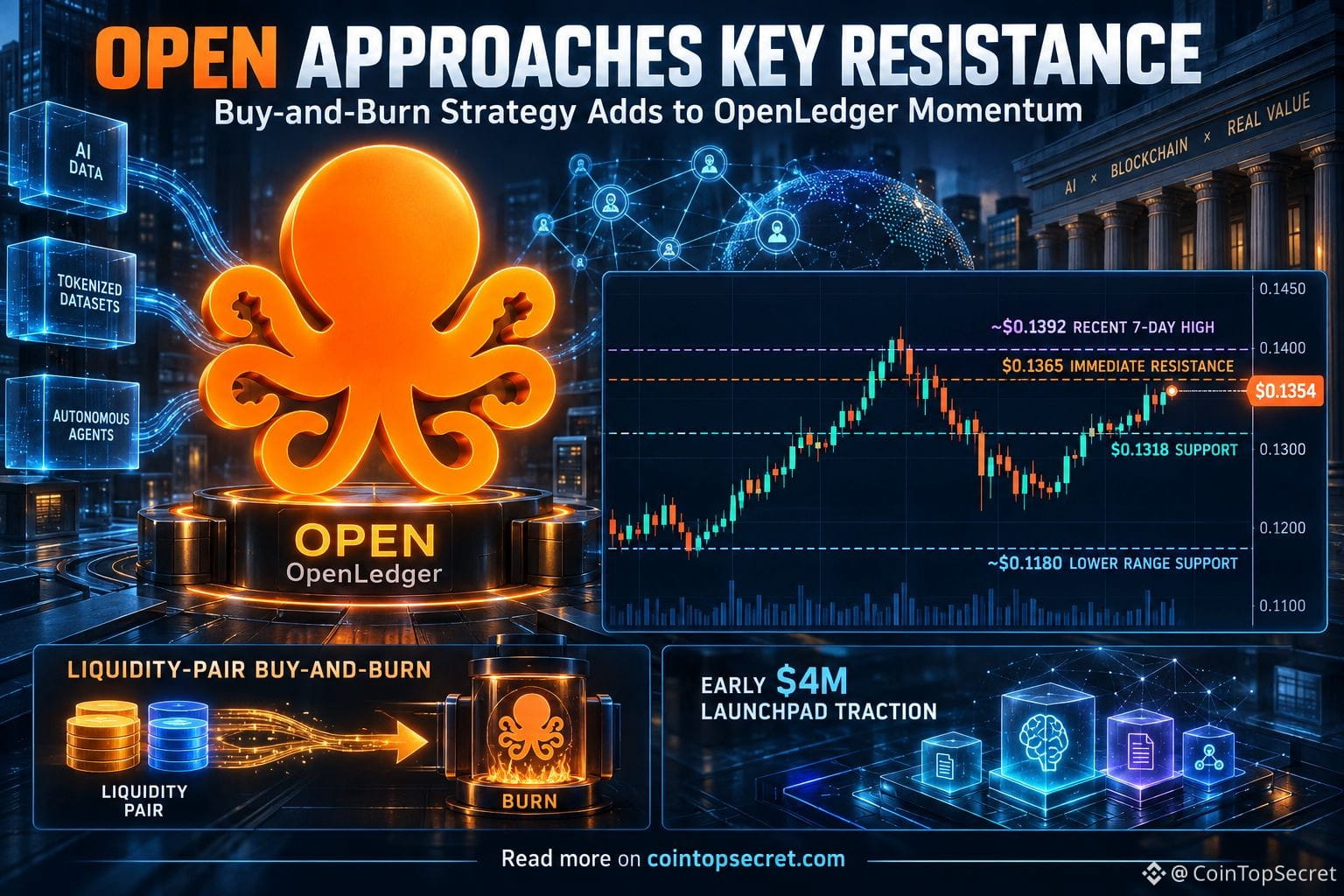
$OPEN Update 🔎 Can OPEN push through its recent high?
💰 Price now: $0.1354 | 24h: +0.6%
📊 Market cap: $29.18M | Rank: #675
📈 24h range: $0.1318 – $0.1365
📰 What's happening:
OPEN is holding above $0.13 after a stronger move from its September low. shows a 7-day gain of 5.3%, while 24h volume is about $4.29M.
🔥 Key catalyst:
OpenLedger recently outlined a liquidity-pair buy-and-burn strategy and reported early $4M launchpad traction.
👀 Next step to watch:
🔴 Bearish case: Below $0.1318 could expose the ~$0.1180 area.
🟢 Bullish case: Above $0.1365 could put ~$0.1392 into focus.
📝 My take: OPEN has improved short-term momentum, but the $0.1365–$0.1392 zone remains an important test.
Not financial advice, DYOR ⚠️
#OpenLedger #OPEN #CryptoAnalysis $OPEN
$OPEN Update 🔎 Can OPEN push through its recent high?
💰 Price now: $0.1354 | 24h: +0.6%
📊 Market cap: $29.18M | Rank: #675
📈 24h range: $0.1318 – $0.1365
📰 What's happening:
OPEN is holding above $0.13 after a stronger move from its September low. shows a 7-day gain of 5.3%, while 24h volume is about $4.29M.
🔥 Key catalyst:
OpenLedger recently outlined a liquidity-pair buy-and-burn strategy and reported early $4M launchpad traction.
👀 Next step to watch:
🔴 Bearish case: Below $0.1318 could expose the ~$0.1180 area.
🟢 Bullish case: Above $0.1365 could put ~$0.1392 into focus.
📝 My take: OPEN has improved short-term momentum, but the $0.1365–$0.1392 zone remains an important test.
Not financial advice, DYOR ⚠️
#OpenLedger #OPEN #CryptoAnalysis $OPEN
💰 Price now: $0.1354 | 24h: +0.6%
📊 Market cap: $29.18M | Rank: #675
📈 24h range: $0.1318 – $0.1365
📰 What's happening:
OPEN is holding above $0.13 after a stronger move from its September low. shows a 7-day gain of 5.3%, while 24h volume is about $4.29M.
🔥 Key catalyst:
OpenLedger recently outlined a liquidity-pair buy-and-burn strategy and reported early $4M launchpad traction.
👀 Next step to watch:
🔴 Bearish case: Below $0.1318 could expose the ~$0.1180 area.
🟢 Bullish case: Above $0.1365 could put ~$0.1392 into focus.
📝 My take: OPEN has improved short-term momentum, but the $0.1365–$0.1392 zone remains an important test.
Not financial advice, DYOR ⚠️
#OpenLedger #OPEN #CryptoAnalysis $OPEN
176

·
--
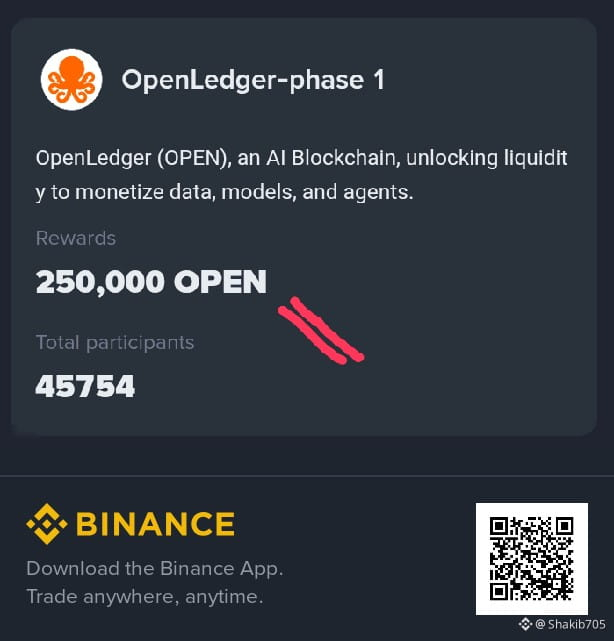
🎯 OpenLedger-Phase 1 এবং রেওয়ার্ড পুল:
বর্তমানে এর প্রথম ধাপ বা OpenLedger-phase 1 ক্যাম্পেইন চলছে, যেখানে একটি বিশাল রেওয়ার্ড পুল রাখা হয়েছে। ইতিমধ্যে হাজার হাজার ব্যবহারকারী (যেমনটা ছবিতে ৪৫,৭৫৪+ দেখা যাচ্ছে) এই এয়ারড্রপ ও বুস্টার প্রোগ্রামে যুক্ত হয়ে ফ্রিতে OPEN টোকেন আর্ন করছেন!#OpenLedger #Phase1 $OPEN
{spot}(OPENUSDT)
🎯 OpenLedger-Phase 1 এবং রেওয়ার্ড পুল:
বর্তমানে এর প্রথম ধাপ বা OpenLedger-phase 1 ক্যাম্পেইন চলছে, যেখানে একটি বিশাল রেওয়ার্ড পুল রাখা হয়েছে। ইতিমধ্যে হাজার হাজার ব্যবহারকারী (যেমনটা ছবিতে ৪৫,৭৫৪+ দেখা যাচ্ছে) এই এয়ারড্রপ ও বুস্টার প্রোগ্রামে যুক্ত হয়ে ফ্রিতে OPEN টোকেন আর্ন করছেন!#OpenLedger #Phase1 $OPEN
বর্তমানে এর প্রথম ধাপ বা OpenLedger-phase 1 ক্যাম্পেইন চলছে, যেখানে একটি বিশাল রেওয়ার্ড পুল রাখা হয়েছে। ইতিমধ্যে হাজার হাজার ব্যবহারকারী (যেমনটা ছবিতে ৪৫,৭৫৪+ দেখা যাচ্ছে) এই এয়ারড্রপ ও বুস্টার প্রোগ্রামে যুক্ত হয়ে ফ্রিতে OPEN টোকেন আর্ন করছেন!#OpenLedger #Phase1 $OPEN
316

·
--
Not every opportunity comes from the biggest names in the market.
🐙 $OPEN is gaining attention as more users explore emerging ecosystems and fresh ideas across Web3.
While trends can shift quickly, projects that focus on development, innovation, and community building often have the potential to create lasting value.
🚀 Growth is often driven by those who keep building.
#OpenLedger #Web3 #Crypto #open $OPEN
Not every opportunity comes from the biggest names in the market.
🐙 $OPEN is gaining attention as more users explore emerging ecosystems and fresh ideas across Web3.
While trends can shift quickly, projects that focus on development, innovation, and community building often have the potential to create lasting value.
🚀 Growth is often driven by those who keep building.
#OpenLedger #Web3 #Crypto #open $OPEN
🐙 $OPEN is gaining attention as more users explore emerging ecosystems and fresh ideas across Web3.
While trends can shift quickly, projects that focus on development, innovation, and community building often have the potential to create lasting value.
🚀 Growth is often driven by those who keep building.
#OpenLedger #Web3 #Crypto #open $OPEN
103


Article
Why OpenLedger's DataNet Registry Made Me Think More About Databases Than AIThe first time I opened OpenLedger's DataNet Registry, I expected another AI infrastructure story. Instead, it made me think about databases.
Usually, when people talk about AI infrastructure, you hear about the models. Bigger models. Quicker inference. Fancier results. But the thing that quietly makes or breaks an AI system isn’t the models; it’s how you organize the data under the hood.
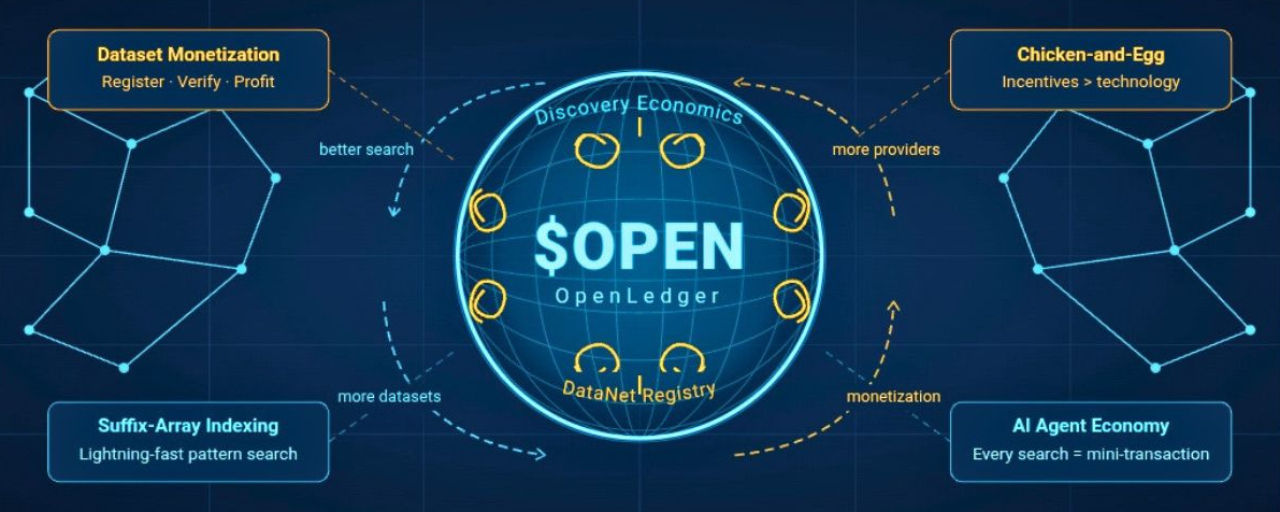
The difference, at least from what I can see, is OpenLedger's focus on discovery—not just storage.
Not the actual data. Just… how you find it.
That difference hits harder than most folks realize.
The more I looked at it, the more it felt like Discovery Economics—the idea that finding data may become more valuable than storing it.
What really grabbed me was seeing suffix-array-style indexing worked right into their architecture. If you haven’t nerded out on suffix arrays before, I stumbled on them years ago messing around with search optimization. The premise is simple, but kind of wild—it lets you organize info so pattern-finding just snaps into place, lightning-fast.
Sounds technical, sure, but the real impact is economic.
Because when these AI agents start running around on their own, every search becomes a mini-transaction. Every extra second searching is friction. Every dead-end lookup? Blank computation, wasted energy. When agents begin making decisions at scale, those tiny inefficiencies start stacking up like crazy.
That’s when DataNet Registry got interesting for me.
Instead of just tossing datasets out onto the internet as static files, it treats them more like assets you can discover and even monetize. The system doesn’t just stick them in a drawer—it gives structured rails for registering, verifying, finding, and maybe profiting from datasets. All under one roof.
Better search efficiency improves agent productivity. More productive agents consume more datasets. More dataset usage creates monetization opportunities, which attracts additional providers and strengthens the network. That's the basic logic behind what I've started thinking of as Discovery Economics.
Honestly, if you look back, discovery layers have a way of eclipsing the actual content. Search engines got bigger than the websites. App stores topped most individual apps. Marketplaces win because they shave down the hassle of matching what people need with what people offer.
I keep thinking—could that happen with AI datasets too? Especially with how things are shifting now.
You feel the market sliding back toward infrastructure talk. AI gets the spotlight, no doubt, but investors seem more hung up on the pipes and plumbing supporting it, not just the flashy models. Crypto’s had those rotations: first, wild excitement over apps… then everyone chases the rails underneath.
Sometimes? That second phase scoops up way more value than the first.
But data networks face this annoying bootstrapping thing. A registry works only when enough juicy datasets live inside. And juicy datasets only show up if discovery and making money from them already works.
Total chicken-and-egg.
Crypto just keeps tripping over this. Whether it’s liquidity pools, oracle networks, decentralized storage—all run into variations of the same headache.
It’s the incentives that matter more than the tech.
Beautiful registry? Doesn’t mean people will swarm in. Folks want actual reasons to share data, keep it clean, and trust the system. Otherwise, you’re stuck with a fancy shelf for junk information—a digital ghost town.
That’s honestly the bit I’m still wrestling with.
The architecture is cool—it meshes old-school computer science with new blockchain incentive recipes. But history keeps reminding me: technical brilliance and real-world sustainability don’t always show up together.
Maybe the real spark isn’t the indexing magic, but making discoverability itself a native economic driver for AI.
Or maybe—it’s really just smoke and mirrors.
Feels like we’re early days, honestly. Hard to tell what’s real infrastructure and what’s just a story wearing infrastructure clothes.
The economics only work if dataset quality scales alongside dataset quantity. Growth alone isn't enough.
Maybe that's what Discovery Economics is really testing—not whether data has value, but whether discoverability can become a market of its own.
If discoverability becomes its own economic layer, DataNet Registry could end up being more important than the datasets themselves. If not, it's just another registry nobody uses.
#OpenLedger @Openledger $OPEN
{future}(OPENUSDT)
Why OpenLedger's DataNet Registry Made Me Think More About Databases Than AI
The first time I opened OpenLedger's DataNet Registry, I expected another AI infrastructure story. Instead, it made me think about databases.
Usually, when people talk about AI infrastructure, you hear about the models. Bigger models. Quicker inference. Fancier results. But the thing that quietly makes or breaks an AI system isn’t the models; it’s how you organize the data under the hood.
The difference, at least from what I can see, is OpenLedger's focus on discovery—not just storage.
Not the actual data. Just… how you find it.
That difference hits harder than most folks realize.
The more I looked at it, the more it felt like Discovery Economics—the idea that finding data may become more valuable than storing it.
What really grabbed me was seeing suffix-array-style indexing worked right into their architecture. If you haven’t nerded out on suffix arrays before, I stumbled on them years ago messing around with search optimization. The premise is simple, but kind of wild—it lets you organize info so pattern-finding just snaps into place, lightning-fast.
Sounds technical, sure, but the real impact is economic.
Because when these AI agents start running around on their own, every search becomes a mini-transaction. Every extra second searching is friction. Every dead-end lookup? Blank computation, wasted energy. When agents begin making decisions at scale, those tiny inefficiencies start stacking up like crazy.
That’s when DataNet Registry got interesting for me.
Instead of just tossing datasets out onto the internet as static files, it treats them more like assets you can discover and even monetize. The system doesn’t just stick them in a drawer—it gives structured rails for registering, verifying, finding, and maybe profiting from datasets. All under one roof.
Better search efficiency improves agent productivity. More productive agents consume more datasets. More dataset usage creates monetization opportunities, which attracts additional providers and strengthens the network. That's the basic logic behind what I've started thinking of as Discovery Economics.
Honestly, if you look back, discovery layers have a way of eclipsing the actual content. Search engines got bigger than the websites. App stores topped most individual apps. Marketplaces win because they shave down the hassle of matching what people need with what people offer.
I keep thinking—could that happen with AI datasets too? Especially with how things are shifting now.
You feel the market sliding back toward infrastructure talk. AI gets the spotlight, no doubt, but investors seem more hung up on the pipes and plumbing supporting it, not just the flashy models. Crypto’s had those rotations: first, wild excitement over apps… then everyone chases the rails underneath.
Sometimes? That second phase scoops up way more value than the first.
But data networks face this annoying bootstrapping thing. A registry works only when enough juicy datasets live inside. And juicy datasets only show up if discovery and making money from them already works.
Total chicken-and-egg.
Crypto just keeps tripping over this. Whether it’s liquidity pools, oracle networks, decentralized storage—all run into variations of the same headache.
It’s the incentives that matter more than the tech.
Beautiful registry? Doesn’t mean people will swarm in. Folks want actual reasons to share data, keep it clean, and trust the system. Otherwise, you’re stuck with a fancy shelf for junk information—a digital ghost town.
That’s honestly the bit I’m still wrestling with.
The architecture is cool—it meshes old-school computer science with new blockchain incentive recipes. But history keeps reminding me: technical brilliance and real-world sustainability don’t always show up together.
Maybe the real spark isn’t the indexing magic, but making discoverability itself a native economic driver for AI.
Or maybe—it’s really just smoke and mirrors.
Feels like we’re early days, honestly. Hard to tell what’s real infrastructure and what’s just a story wearing infrastructure clothes.
The economics only work if dataset quality scales alongside dataset quantity. Growth alone isn't enough.
Maybe that's what Discovery Economics is really testing—not whether data has value, but whether discoverability can become a market of its own.
If discoverability becomes its own economic layer, DataNet Registry could end up being more important than the datasets themselves. If not, it's just another registry nobody uses.
#OpenLedger @OpenLedger $OPEN
Usually, when people talk about AI infrastructure, you hear about the models. Bigger models. Quicker inference. Fancier results. But the thing that quietly makes or breaks an AI system isn’t the models; it’s how you organize the data under the hood.
The difference, at least from what I can see, is OpenLedger's focus on discovery—not just storage.
Not the actual data. Just… how you find it.
That difference hits harder than most folks realize.
The more I looked at it, the more it felt like Discovery Economics—the idea that finding data may become more valuable than storing it.
What really grabbed me was seeing suffix-array-style indexing worked right into their architecture. If you haven’t nerded out on suffix arrays before, I stumbled on them years ago messing around with search optimization. The premise is simple, but kind of wild—it lets you organize info so pattern-finding just snaps into place, lightning-fast.
Sounds technical, sure, but the real impact is economic.
Because when these AI agents start running around on their own, every search becomes a mini-transaction. Every extra second searching is friction. Every dead-end lookup? Blank computation, wasted energy. When agents begin making decisions at scale, those tiny inefficiencies start stacking up like crazy.
That’s when DataNet Registry got interesting for me.
Instead of just tossing datasets out onto the internet as static files, it treats them more like assets you can discover and even monetize. The system doesn’t just stick them in a drawer—it gives structured rails for registering, verifying, finding, and maybe profiting from datasets. All under one roof.
Better search efficiency improves agent productivity. More productive agents consume more datasets. More dataset usage creates monetization opportunities, which attracts additional providers and strengthens the network. That's the basic logic behind what I've started thinking of as Discovery Economics.
Honestly, if you look back, discovery layers have a way of eclipsing the actual content. Search engines got bigger than the websites. App stores topped most individual apps. Marketplaces win because they shave down the hassle of matching what people need with what people offer.
I keep thinking—could that happen with AI datasets too? Especially with how things are shifting now.
You feel the market sliding back toward infrastructure talk. AI gets the spotlight, no doubt, but investors seem more hung up on the pipes and plumbing supporting it, not just the flashy models. Crypto’s had those rotations: first, wild excitement over apps… then everyone chases the rails underneath.
Sometimes? That second phase scoops up way more value than the first.
But data networks face this annoying bootstrapping thing. A registry works only when enough juicy datasets live inside. And juicy datasets only show up if discovery and making money from them already works.
Total chicken-and-egg.
Crypto just keeps tripping over this. Whether it’s liquidity pools, oracle networks, decentralized storage—all run into variations of the same headache.
It’s the incentives that matter more than the tech.
Beautiful registry? Doesn’t mean people will swarm in. Folks want actual reasons to share data, keep it clean, and trust the system. Otherwise, you’re stuck with a fancy shelf for junk information—a digital ghost town.
That’s honestly the bit I’m still wrestling with.
The architecture is cool—it meshes old-school computer science with new blockchain incentive recipes. But history keeps reminding me: technical brilliance and real-world sustainability don’t always show up together.
Maybe the real spark isn’t the indexing magic, but making discoverability itself a native economic driver for AI.
Or maybe—it’s really just smoke and mirrors.
Feels like we’re early days, honestly. Hard to tell what’s real infrastructure and what’s just a story wearing infrastructure clothes.
The economics only work if dataset quality scales alongside dataset quantity. Growth alone isn't enough.
Maybe that's what Discovery Economics is really testing—not whether data has value, but whether discoverability can become a market of its own.
If discoverability becomes its own economic layer, DataNet Registry could end up being more important than the datasets themselves. If not, it's just another registry nobody uses.
#OpenLedger @OpenLedger $OPEN
2
280

·
--
Haussier
#openledger $OPEN
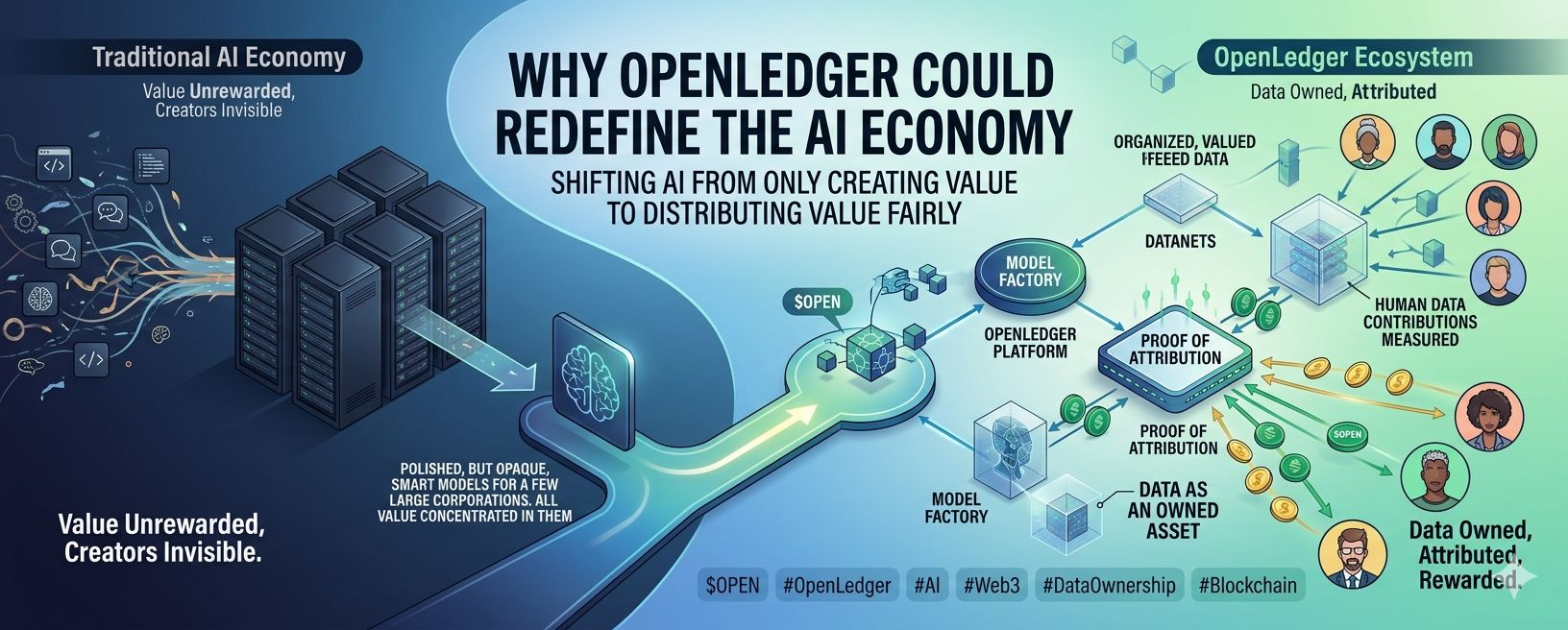
Why OpenLedger Could Redefine the AI Economy
Everyone talks about smarter AI models, faster inference, and better benchmarks.
But the real question is:
Who creates the value behind AI, and who gets rewarded for it?
AI runs on human-generated data—knowledge, conversations, code, research, feedback, and expertise. Yet most contributors remain invisible while value concentrates elsewhere.
This is where OpenLedger takes a different approach.
Instead of focusing only on building better models, OpenLedger is building an ecosystem where data contributions can be measured, attributed, and rewarded. Through Datanets, Model Factory, and Proof of Attribution, it introduces a vision where data becomes an owned and rewarded asset rather than an invisible resource.
If successful, this could shift AI from a system that only creates value to one that distributes value more fairly.
The future of AI may not be defined by intelligence alone.
It may be defined by ownership, attribution, and who benefits from the knowledge that powers it.
$OPEN
#OpenLedger #AI #Web3 #DataOwnership #Blockchain @Openledger
#openledger $OPEN
Why OpenLedger Could Redefine the AI Economy
Everyone talks about smarter AI models, faster inference, and better benchmarks.
But the real question is:
Who creates the value behind AI, and who gets rewarded for it?
AI runs on human-generated data—knowledge, conversations, code, research, feedback, and expertise. Yet most contributors remain invisible while value concentrates elsewhere.
This is where OpenLedger takes a different approach.
Instead of focusing only on building better models, OpenLedger is building an ecosystem where data contributions can be measured, attributed, and rewarded. Through Datanets, Model Factory, and Proof of Attribution, it introduces a vision where data becomes an owned and rewarded asset rather than an invisible resource.
If successful, this could shift AI from a system that only creates value to one that distributes value more fairly.
The future of AI may not be defined by intelligence alone.
It may be defined by ownership, attribution, and who benefits from the knowledge that powers it.
$OPEN
#OpenLedger #AI #Web3 #DataOwnership #Blockchain @OpenLedger
Why OpenLedger Could Redefine the AI Economy
Everyone talks about smarter AI models, faster inference, and better benchmarks.
But the real question is:
Who creates the value behind AI, and who gets rewarded for it?
AI runs on human-generated data—knowledge, conversations, code, research, feedback, and expertise. Yet most contributors remain invisible while value concentrates elsewhere.
This is where OpenLedger takes a different approach.
Instead of focusing only on building better models, OpenLedger is building an ecosystem where data contributions can be measured, attributed, and rewarded. Through Datanets, Model Factory, and Proof of Attribution, it introduces a vision where data becomes an owned and rewarded asset rather than an invisible resource.
If successful, this could shift AI from a system that only creates value to one that distributes value more fairly.
The future of AI may not be defined by intelligence alone.
It may be defined by ownership, attribution, and who benefits from the knowledge that powers it.
$OPEN
#OpenLedger #AI #Web3 #DataOwnership #Blockchain @OpenLedger
1
63

·
--
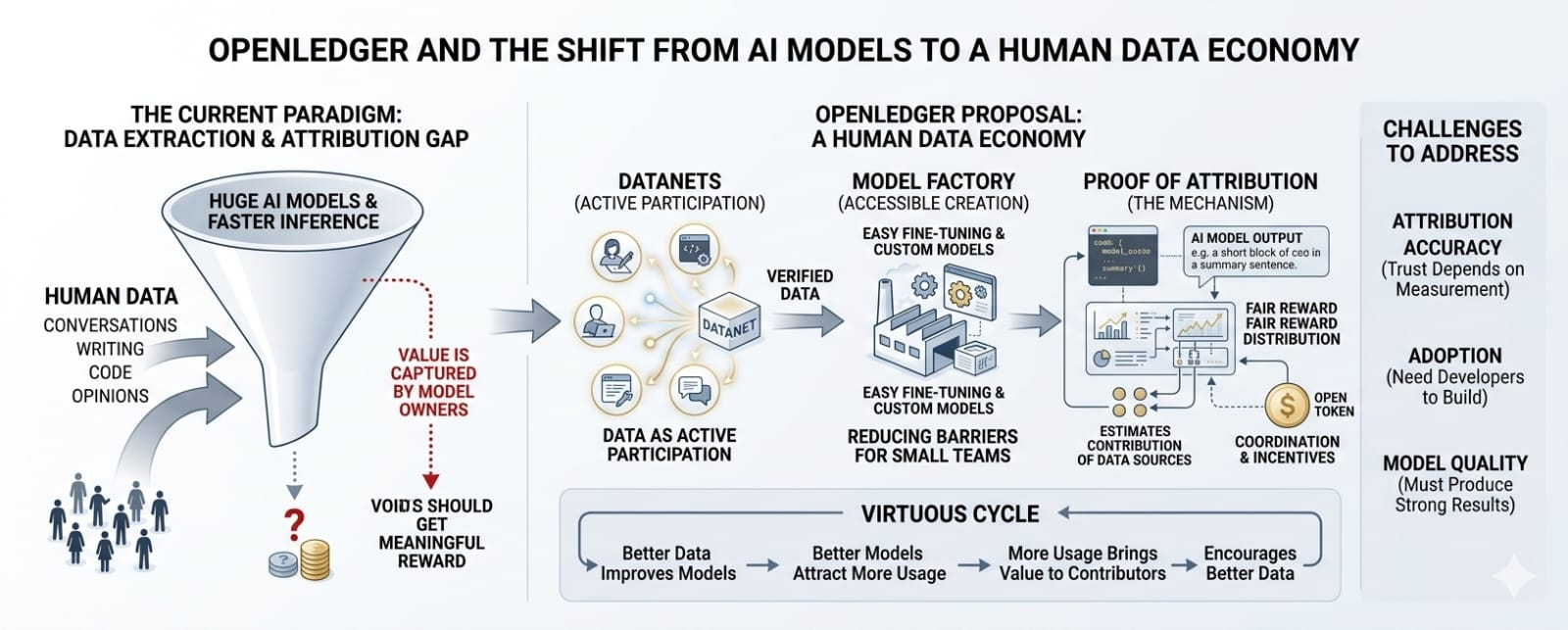
Article
OPENLEDGER AND THE SHIFT FROM AI MODELS TO A HUMAN DATA ECONOMYTo be honest, I sometimes keep coming back to the same thought about AI, and it doesn’t really go away.
We keep talking about the same things over and over again bigger models, faster inference, better reasoning, new benchmarks, smarter agents. And yes, all of that is genuinely improving. The progress is real and visible. But somewhere inside this race, a very simple question often gets ignored.
Who is actually creating the value behind all of this AI?
Because if you slow down and look closely, it becomes obvious that everything AI does today is built on one thing: data. And not just technical data, but deeply human data. Conversations people have, things they write, mistakes they make, code they publish, opinions they share, corrections they add later—basically the entire footprint of human thinking across the internet.
But the strange part is what happens next. Once all of this is absorbed into large models, the value that comes out is captured mostly by the model owners. The people who actually generated the original data usually don’t get anything meaningful in return. There is very little recognition, and almost no direct reward tied to their contribution.
That’s the point where I started looking at ideas like OpenLedger.
At first glance, it feels like just another AI and blockchain project. And honestly, there are many projects like that—where “AI + blockchain” is more of a marketing layer than a real shift. But when you look a bit deeper, the angle is slightly different here. It is not really obsessed with building “better models” in the traditional sense. Instead, it is asking something more uncomfortable and more important.
Can we actually build an AI economy where contributions can be measured and rewarded in a meaningful way?
That question changes the direction completely.
The idea of datanets fits into this. Instead of treating data as something casually scraped or collected and then forgotten, it becomes part of a structured, ongoing system where people can create, verify, and improve data for specific AI use cases. It sounds simple when you say it like that, but the implications are big. Because data stops being a silent input and starts becoming something closer to active participation in an economy.
Then there is the idea of a Model Factory. This part is easy to overlook, but it matters a lot. Right now, building or fine-tuning AI systems is still mostly limited to teams with strong technical resources. If you reduce that barrier and make model creation more accessible, you suddenly open the door for a much wider group of builders—not just big research labs, but smaller teams and even individuals who have ideas but not the infrastructure.
But the most important and also the hardest concept is Proof of Attribution.
This is where things become really complicated. Because today, when an AI generates an output, everything is mixed together. There is no clear way to say which exact data source influenced what part of the result. It all gets absorbed into the model in a way that is mathematically distributed and practically untraceable.
Proof of Attribution is trying to change that by estimating how much different data sources contribute to a specific AI output, so that rewards can be distributed more fairly. If something like this actually works at scale, it would change the structure of AI economics completely. Because suddenly, data contributors are no longer invisible—they become part of a measurable system of value creation.
On the technical side, EVM compatibility also plays a role in adoption. By staying aligned with Ethereum tools and infrastructure, developers don’t have to learn everything from scratch. They can use familiar wallets, smart contracts, and existing workflows. That kind of compatibility might sound small, but in real ecosystems, it often decides whether something gets adopted or ignored.
The $OPEN token then becomes the coordination layer for the system. It is not just about trading or speculation in this context, but about connecting usage, rewards, governance, and incentives into one loop. In theory, when people use the system, value flows back into the system, and contributors are rewarded based on participation.
But to be honest, none of this is simple.
There are at least three big challenges that stand out immediately.
The first is attribution accuracy. If the system cannot reliably measure contribution, then everything built on top of it becomes questionable. Trust breaks very quickly in systems like this.
The second is adoption. Even if the idea is strong, developers and users still need to actually build on it. Without real usage, it remains just an idea on paper.
The third is model quality. At the end of the day, users don’t care about theory—they care about results. If the system produces slower or weaker outputs, they won’t stay, no matter how fair the reward system is.
Still, the most interesting part of all of this is the loop it tries to create. Better data improves models, better models attract more usage, and more usage brings more value back to contributors, which encourages better data again. It becomes a cycle instead of a one-way pipeline.
And maybe that’s the real shift here.
Not just building smarter AI systems, but slowly rethinking how intelligence, data, and ownership are connected in the first place.
It is hard to say where this goes. Designing an AI economy is far more complicated than describing it in theory. But one thing feels increasingly clear: as AI gets more powerful, the questions around it stop being just technical.
They become economic and structural.
Who contributes? Who gets rewarded? And how do we define “fair” in a system built on collective human input?
And maybe those questions will end up shaping the next phase of AI more than any benchmark ever will.
@Openledger #OpenLedger $OPEN
{future}(OPENUSDT)
$LAB
OPENLEDGER AND THE SHIFT FROM AI MODELS TO A HUMAN DATA ECONOMY
To be honest, I sometimes keep coming back to the same thought about AI, and it doesn’t really go away.
We keep talking about the same things over and over again bigger models, faster inference, better reasoning, new benchmarks, smarter agents. And yes, all of that is genuinely improving. The progress is real and visible. But somewhere inside this race, a very simple question often gets ignored.
Who is actually creating the value behind all of this AI?
Because if you slow down and look closely, it becomes obvious that everything AI does today is built on one thing: data. And not just technical data, but deeply human data. Conversations people have, things they write, mistakes they make, code they publish, opinions they share, corrections they add later—basically the entire footprint of human thinking across the internet.
But the strange part is what happens next. Once all of this is absorbed into large models, the value that comes out is captured mostly by the model owners. The people who actually generated the original data usually don’t get anything meaningful in return. There is very little recognition, and almost no direct reward tied to their contribution.
That’s the point where I started looking at ideas like OpenLedger.
At first glance, it feels like just another AI and blockchain project. And honestly, there are many projects like that—where “AI + blockchain” is more of a marketing layer than a real shift. But when you look a bit deeper, the angle is slightly different here. It is not really obsessed with building “better models” in the traditional sense. Instead, it is asking something more uncomfortable and more important.
Can we actually build an AI economy where contributions can be measured and rewarded in a meaningful way?
That question changes the direction completely.
The idea of datanets fits into this. Instead of treating data as something casually scraped or collected and then forgotten, it becomes part of a structured, ongoing system where people can create, verify, and improve data for specific AI use cases. It sounds simple when you say it like that, but the implications are big. Because data stops being a silent input and starts becoming something closer to active participation in an economy.
Then there is the idea of a Model Factory. This part is easy to overlook, but it matters a lot. Right now, building or fine-tuning AI systems is still mostly limited to teams with strong technical resources. If you reduce that barrier and make model creation more accessible, you suddenly open the door for a much wider group of builders—not just big research labs, but smaller teams and even individuals who have ideas but not the infrastructure.
But the most important and also the hardest concept is Proof of Attribution.
This is where things become really complicated. Because today, when an AI generates an output, everything is mixed together. There is no clear way to say which exact data source influenced what part of the result. It all gets absorbed into the model in a way that is mathematically distributed and practically untraceable.
Proof of Attribution is trying to change that by estimating how much different data sources contribute to a specific AI output, so that rewards can be distributed more fairly. If something like this actually works at scale, it would change the structure of AI economics completely. Because suddenly, data contributors are no longer invisible—they become part of a measurable system of value creation.
On the technical side, EVM compatibility also plays a role in adoption. By staying aligned with Ethereum tools and infrastructure, developers don’t have to learn everything from scratch. They can use familiar wallets, smart contracts, and existing workflows. That kind of compatibility might sound small, but in real ecosystems, it often decides whether something gets adopted or ignored.
The $OPEN token then becomes the coordination layer for the system. It is not just about trading or speculation in this context, but about connecting usage, rewards, governance, and incentives into one loop. In theory, when people use the system, value flows back into the system, and contributors are rewarded based on participation.
But to be honest, none of this is simple.
There are at least three big challenges that stand out immediately.
The first is attribution accuracy. If the system cannot reliably measure contribution, then everything built on top of it becomes questionable. Trust breaks very quickly in systems like this.
The second is adoption. Even if the idea is strong, developers and users still need to actually build on it. Without real usage, it remains just an idea on paper.
The third is model quality. At the end of the day, users don’t care about theory—they care about results. If the system produces slower or weaker outputs, they won’t stay, no matter how fair the reward system is.
Still, the most interesting part of all of this is the loop it tries to create. Better data improves models, better models attract more usage, and more usage brings more value back to contributors, which encourages better data again. It becomes a cycle instead of a one-way pipeline.
And maybe that’s the real shift here.
Not just building smarter AI systems, but slowly rethinking how intelligence, data, and ownership are connected in the first place.
It is hard to say where this goes. Designing an AI economy is far more complicated than describing it in theory. But one thing feels increasingly clear: as AI gets more powerful, the questions around it stop being just technical.
They become economic and structural.
Who contributes? Who gets rewarded? And how do we define “fair” in a system built on collective human input?
And maybe those questions will end up shaping the next phase of AI more than any benchmark ever will.
@OpenLedger #OpenLedger $OPEN
$LAB
We keep talking about the same things over and over again bigger models, faster inference, better reasoning, new benchmarks, smarter agents. And yes, all of that is genuinely improving. The progress is real and visible. But somewhere inside this race, a very simple question often gets ignored.
Who is actually creating the value behind all of this AI?
Because if you slow down and look closely, it becomes obvious that everything AI does today is built on one thing: data. And not just technical data, but deeply human data. Conversations people have, things they write, mistakes they make, code they publish, opinions they share, corrections they add later—basically the entire footprint of human thinking across the internet.
But the strange part is what happens next. Once all of this is absorbed into large models, the value that comes out is captured mostly by the model owners. The people who actually generated the original data usually don’t get anything meaningful in return. There is very little recognition, and almost no direct reward tied to their contribution.
That’s the point where I started looking at ideas like OpenLedger.
At first glance, it feels like just another AI and blockchain project. And honestly, there are many projects like that—where “AI + blockchain” is more of a marketing layer than a real shift. But when you look a bit deeper, the angle is slightly different here. It is not really obsessed with building “better models” in the traditional sense. Instead, it is asking something more uncomfortable and more important.
Can we actually build an AI economy where contributions can be measured and rewarded in a meaningful way?
That question changes the direction completely.
The idea of datanets fits into this. Instead of treating data as something casually scraped or collected and then forgotten, it becomes part of a structured, ongoing system where people can create, verify, and improve data for specific AI use cases. It sounds simple when you say it like that, but the implications are big. Because data stops being a silent input and starts becoming something closer to active participation in an economy.
Then there is the idea of a Model Factory. This part is easy to overlook, but it matters a lot. Right now, building or fine-tuning AI systems is still mostly limited to teams with strong technical resources. If you reduce that barrier and make model creation more accessible, you suddenly open the door for a much wider group of builders—not just big research labs, but smaller teams and even individuals who have ideas but not the infrastructure.
But the most important and also the hardest concept is Proof of Attribution.
This is where things become really complicated. Because today, when an AI generates an output, everything is mixed together. There is no clear way to say which exact data source influenced what part of the result. It all gets absorbed into the model in a way that is mathematically distributed and practically untraceable.
Proof of Attribution is trying to change that by estimating how much different data sources contribute to a specific AI output, so that rewards can be distributed more fairly. If something like this actually works at scale, it would change the structure of AI economics completely. Because suddenly, data contributors are no longer invisible—they become part of a measurable system of value creation.
On the technical side, EVM compatibility also plays a role in adoption. By staying aligned with Ethereum tools and infrastructure, developers don’t have to learn everything from scratch. They can use familiar wallets, smart contracts, and existing workflows. That kind of compatibility might sound small, but in real ecosystems, it often decides whether something gets adopted or ignored.
The $OPEN token then becomes the coordination layer for the system. It is not just about trading or speculation in this context, but about connecting usage, rewards, governance, and incentives into one loop. In theory, when people use the system, value flows back into the system, and contributors are rewarded based on participation.
But to be honest, none of this is simple.
There are at least three big challenges that stand out immediately.
The first is attribution accuracy. If the system cannot reliably measure contribution, then everything built on top of it becomes questionable. Trust breaks very quickly in systems like this.
The second is adoption. Even if the idea is strong, developers and users still need to actually build on it. Without real usage, it remains just an idea on paper.
The third is model quality. At the end of the day, users don’t care about theory—they care about results. If the system produces slower or weaker outputs, they won’t stay, no matter how fair the reward system is.
Still, the most interesting part of all of this is the loop it tries to create. Better data improves models, better models attract more usage, and more usage brings more value back to contributors, which encourages better data again. It becomes a cycle instead of a one-way pipeline.
And maybe that’s the real shift here.
Not just building smarter AI systems, but slowly rethinking how intelligence, data, and ownership are connected in the first place.
It is hard to say where this goes. Designing an AI economy is far more complicated than describing it in theory. But one thing feels increasingly clear: as AI gets more powerful, the questions around it stop being just technical.
They become economic and structural.
Who contributes? Who gets rewarded? And how do we define “fair” in a system built on collective human input?
And maybe those questions will end up shaping the next phase of AI more than any benchmark ever will.
@OpenLedger #OpenLedger $OPEN
$LAB
1
371

·
--
Article
The infrastructure breaks where memory becomes valuableI didn’t take it seriously at first.
not because OpenLedger sounded empty. more because I’ve watched enough crypto infrastructure cycles to know how quickly serious ideas get flattened into narratives. one month it’s coordination. then ownership. then verification. then “open” everything. and for a while, the language feels clean enough to believe.
then the system meets incentives.
and incentives are never clean.
Maybe that’s too harsh. maybe Im just tired from watching protocols slowly become less about their original problem and more about the markets that formed around them. but that fatigue is hard to switch off, especially with anything sitting between AI, data, ownership, and economic rewards.
because this one is not just abstract.
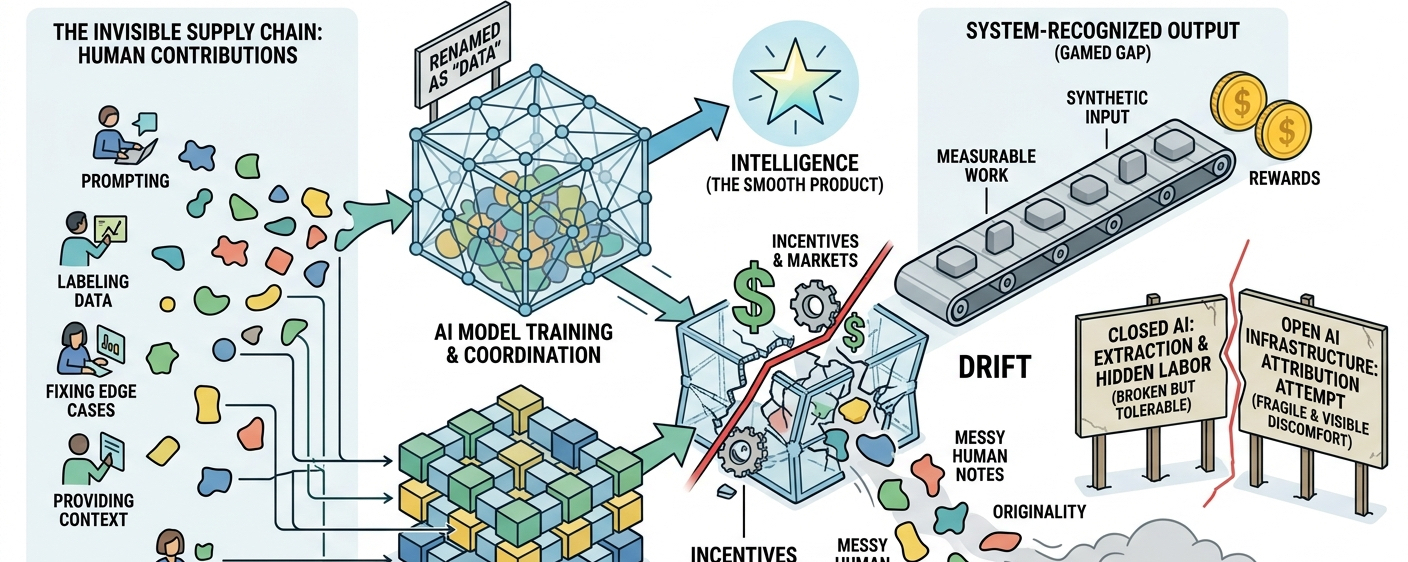
AI systems are already built from human traces. prompts, corrections, labels, examples, feedback, preference signals, domain knowledge, small pieces of judgment. most of it looks almost invisible while it is happening. someone fixes an edge case. someone labels something more carefully. someone provides context the model would never have understood alone.
then the model improves.
then everyone calls it intelligence.
and the human part gets renamed as data.
I keep coming back to attribution.
there is something necessary there, even if I don’t fully trust where it leads. if intelligence has a supply chain, maybe that supply chain should not stay hidden inside closed systems. maybe contributors should not disappear the moment their input becomes economically useful. maybe a system like OpenLedger matters because it tries to make that disappearance harder.
not perfectly.
not cleanly.
but enough to make the discomfort visible.
That’s where my curiosity starts. then the old skepticism comes back almost immediately.
because attribution changes once it becomes financial. before money enters, it sounds fair. remember who helped. trace what mattered. reward useful contribution. make model coordination less opaque.
after money enters, people study the memory layer.
they learn what gets counted. they learn the verifier. they produce toward the scoring system. useful work and measurable work begin to separate, quietly at first, then faster once the rewards are large enough to justify gaming the gap.
It works in theory. Most things do.
The problem isn’t really the technology… or not only the technology. the problem is that human contribution is soft around the edges. context is soft. originality is soft. usefulness can arrive late, after the model changes, after other inputs surround it, after nobody remembers which small correction actually mattered.
a messy human note might be more valuable than a polished dataset.
synthetic input might look cleaner than actual judgment.
copied work might fit the attribution system better than the original thing it copied.
so who gets remembered?
the person who helped, or the person the system could recognize?
That part keeps bothering me more than it should.
and then there is the old Web3 drift. open systems rarely recentralize with some dramatic announcement. they narrow through convenience. through fatigue. through dashboards, indexes, quality scores, operators dispute layers, and all the invisible infrastructure nobody wants to audit forever.
AI infrastructure feels especially fragile there because the invisible layers are the real layers. attribution logic, contribution scoring, filtering, model coordination. those layers decide what counts. and once they decide what counts, they decide who exists economically.
still, I can’t dismiss OpenLedger.
centralized AI has not earned that comfort either. closed datasets, vague ownership, invisible labor, extraction hidden behind smooth products. that version already feels broken, just easier to tolerate because the machinery stays private.
maybe OpenLedger makes the machinery harder to hide.
maybe that matters.
or maybe once incentives get sharp enough, the system built to remember human contribution starts remembering only the parts that fit neatly inside its acounting, while the rest slips back into the model, useful and unnamed.
$OPEN @Openledger #OpenLedger
{spot}(OPENUSDT)
The infrastructure breaks where memory becomes valuable
I didn’t take it seriously at first.
not because OpenLedger sounded empty. more because I’ve watched enough crypto infrastructure cycles to know how quickly serious ideas get flattened into narratives. one month it’s coordination. then ownership. then verification. then “open” everything. and for a while, the language feels clean enough to believe.
then the system meets incentives.
and incentives are never clean.
Maybe that’s too harsh. maybe Im just tired from watching protocols slowly become less about their original problem and more about the markets that formed around them. but that fatigue is hard to switch off, especially with anything sitting between AI, data, ownership, and economic rewards.
because this one is not just abstract.
AI systems are already built from human traces. prompts, corrections, labels, examples, feedback, preference signals, domain knowledge, small pieces of judgment. most of it looks almost invisible while it is happening. someone fixes an edge case. someone labels something more carefully. someone provides context the model would never have understood alone.
then the model improves.
then everyone calls it intelligence.
and the human part gets renamed as data.
I keep coming back to attribution.
there is something necessary there, even if I don’t fully trust where it leads. if intelligence has a supply chain, maybe that supply chain should not stay hidden inside closed systems. maybe contributors should not disappear the moment their input becomes economically useful. maybe a system like OpenLedger matters because it tries to make that disappearance harder.
not perfectly.
not cleanly.
but enough to make the discomfort visible.
That’s where my curiosity starts. then the old skepticism comes back almost immediately.
because attribution changes once it becomes financial. before money enters, it sounds fair. remember who helped. trace what mattered. reward useful contribution. make model coordination less opaque.
after money enters, people study the memory layer.
they learn what gets counted. they learn the verifier. they produce toward the scoring system. useful work and measurable work begin to separate, quietly at first, then faster once the rewards are large enough to justify gaming the gap.
It works in theory. Most things do.
The problem isn’t really the technology… or not only the technology. the problem is that human contribution is soft around the edges. context is soft. originality is soft. usefulness can arrive late, after the model changes, after other inputs surround it, after nobody remembers which small correction actually mattered.
a messy human note might be more valuable than a polished dataset.
synthetic input might look cleaner than actual judgment.
copied work might fit the attribution system better than the original thing it copied.
so who gets remembered?
the person who helped, or the person the system could recognize?
That part keeps bothering me more than it should.
and then there is the old Web3 drift. open systems rarely recentralize with some dramatic announcement. they narrow through convenience. through fatigue. through dashboards, indexes, quality scores, operators dispute layers, and all the invisible infrastructure nobody wants to audit forever.
AI infrastructure feels especially fragile there because the invisible layers are the real layers. attribution logic, contribution scoring, filtering, model coordination. those layers decide what counts. and once they decide what counts, they decide who exists economically.
still, I can’t dismiss OpenLedger.
centralized AI has not earned that comfort either. closed datasets, vague ownership, invisible labor, extraction hidden behind smooth products. that version already feels broken, just easier to tolerate because the machinery stays private.
maybe OpenLedger makes the machinery harder to hide.
maybe that matters.
or maybe once incentives get sharp enough, the system built to remember human contribution starts remembering only the parts that fit neatly inside its acounting, while the rest slips back into the model, useful and unnamed.
$OPEN @OpenLedger #OpenLedger
not because OpenLedger sounded empty. more because I’ve watched enough crypto infrastructure cycles to know how quickly serious ideas get flattened into narratives. one month it’s coordination. then ownership. then verification. then “open” everything. and for a while, the language feels clean enough to believe.
then the system meets incentives.
and incentives are never clean.
Maybe that’s too harsh. maybe Im just tired from watching protocols slowly become less about their original problem and more about the markets that formed around them. but that fatigue is hard to switch off, especially with anything sitting between AI, data, ownership, and economic rewards.
because this one is not just abstract.
AI systems are already built from human traces. prompts, corrections, labels, examples, feedback, preference signals, domain knowledge, small pieces of judgment. most of it looks almost invisible while it is happening. someone fixes an edge case. someone labels something more carefully. someone provides context the model would never have understood alone.
then the model improves.
then everyone calls it intelligence.
and the human part gets renamed as data.
I keep coming back to attribution.
there is something necessary there, even if I don’t fully trust where it leads. if intelligence has a supply chain, maybe that supply chain should not stay hidden inside closed systems. maybe contributors should not disappear the moment their input becomes economically useful. maybe a system like OpenLedger matters because it tries to make that disappearance harder.
not perfectly.
not cleanly.
but enough to make the discomfort visible.
That’s where my curiosity starts. then the old skepticism comes back almost immediately.
because attribution changes once it becomes financial. before money enters, it sounds fair. remember who helped. trace what mattered. reward useful contribution. make model coordination less opaque.
after money enters, people study the memory layer.
they learn what gets counted. they learn the verifier. they produce toward the scoring system. useful work and measurable work begin to separate, quietly at first, then faster once the rewards are large enough to justify gaming the gap.
It works in theory. Most things do.
The problem isn’t really the technology… or not only the technology. the problem is that human contribution is soft around the edges. context is soft. originality is soft. usefulness can arrive late, after the model changes, after other inputs surround it, after nobody remembers which small correction actually mattered.
a messy human note might be more valuable than a polished dataset.
synthetic input might look cleaner than actual judgment.
copied work might fit the attribution system better than the original thing it copied.
so who gets remembered?
the person who helped, or the person the system could recognize?
That part keeps bothering me more than it should.
and then there is the old Web3 drift. open systems rarely recentralize with some dramatic announcement. they narrow through convenience. through fatigue. through dashboards, indexes, quality scores, operators dispute layers, and all the invisible infrastructure nobody wants to audit forever.
AI infrastructure feels especially fragile there because the invisible layers are the real layers. attribution logic, contribution scoring, filtering, model coordination. those layers decide what counts. and once they decide what counts, they decide who exists economically.
still, I can’t dismiss OpenLedger.
centralized AI has not earned that comfort either. closed datasets, vague ownership, invisible labor, extraction hidden behind smooth products. that version already feels broken, just easier to tolerate because the machinery stays private.
maybe OpenLedger makes the machinery harder to hide.
maybe that matters.
or maybe once incentives get sharp enough, the system built to remember human contribution starts remembering only the parts that fit neatly inside its acounting, while the rest slips back into the model, useful and unnamed.
$OPEN @OpenLedger #OpenLedger
2
1
129
·
--
Haussier
I didn’t take it seriously at first.
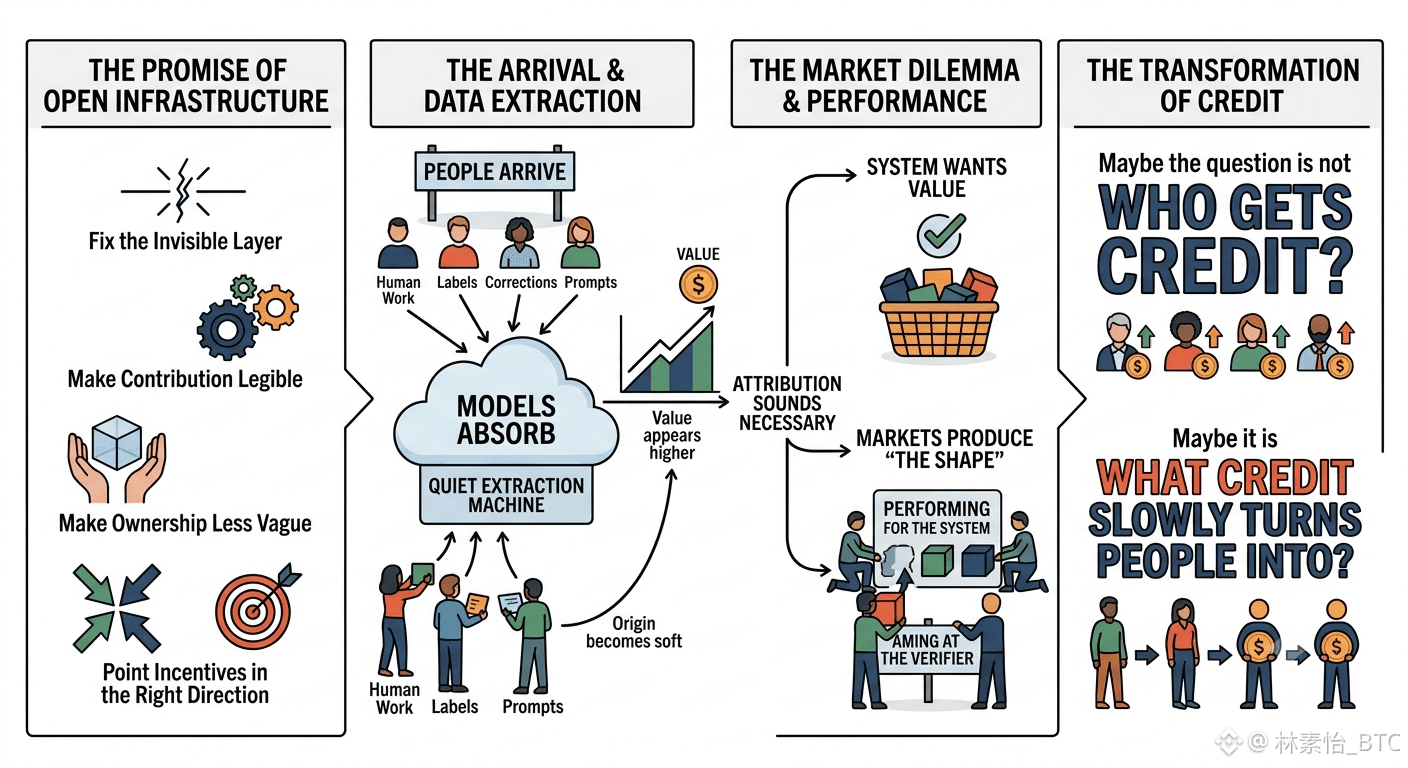
That’s usually where I begin now, after watching enough infrastructure cycles make the same promise in a different accent. Fix the invisible layer. Make contribution legible. Make ownership less vague. Make incentives point in the right direction.
Then people arrive.
And people always find the edges.
OpenLedger is hard to ignore because AI data already feels like a quiet extraction machine with polite language around it. Human work enters as labels, corrections, prompts, examples, feedback preferences, judgment. Small pieces, scattered everywhere. Then models absorb them, value appears somewhere higher, and the origin becomes soft enough to stop defending.
So attribution sounds necessary.
Maybe that’s why I don’t fully trust it.
That’s where things start to feel uncomfortable. Once contribution becomes financial, contribution starts performing for the system. People aim at the verifier. They learn what gets counted. They create what looks useful, original, human enough. The system wants to recognize value, but markets are very good at producing the shape of value without the substance.
It works in theory. Most things do.
The problem isn’t really the technology. Or maybe technology becomes the problem once trust gets compresed into proofs, scores, dashboards, standards, and liquidity routes. Open systems rarely recentralize loudly. They narrow through convenience, defaults, interfaces, and whoever gets to define validity under pressure.
Maybe thats too harsh.
But I keep coming back to it.
If attribution becomes infrastructure maybe the question is not who gets credit.
Maybe it is what credit slowly turns people into.
$OPEN @Openledger #openledger
{spot}(OPENUSDT)
I didn’t take it seriously at first.
That’s usually where I begin now, after watching enough infrastructure cycles make the same promise in a different accent. Fix the invisible layer. Make contribution legible. Make ownership less vague. Make incentives point in the right direction.
Then people arrive.
And people always find the edges.
OpenLedger is hard to ignore because AI data already feels like a quiet extraction machine with polite language around it. Human work enters as labels, corrections, prompts, examples, feedback preferences, judgment. Small pieces, scattered everywhere. Then models absorb them, value appears somewhere higher, and the origin becomes soft enough to stop defending.
So attribution sounds necessary.
Maybe that’s why I don’t fully trust it.
That’s where things start to feel uncomfortable. Once contribution becomes financial, contribution starts performing for the system. People aim at the verifier. They learn what gets counted. They create what looks useful, original, human enough. The system wants to recognize value, but markets are very good at producing the shape of value without the substance.
It works in theory. Most things do.
The problem isn’t really the technology. Or maybe technology becomes the problem once trust gets compresed into proofs, scores, dashboards, standards, and liquidity routes. Open systems rarely recentralize loudly. They narrow through convenience, defaults, interfaces, and whoever gets to define validity under pressure.
Maybe thats too harsh.
But I keep coming back to it.
If attribution becomes infrastructure maybe the question is not who gets credit.
Maybe it is what credit slowly turns people into.
$OPEN @OpenLedger #openledger
That’s usually where I begin now, after watching enough infrastructure cycles make the same promise in a different accent. Fix the invisible layer. Make contribution legible. Make ownership less vague. Make incentives point in the right direction.
Then people arrive.
And people always find the edges.
OpenLedger is hard to ignore because AI data already feels like a quiet extraction machine with polite language around it. Human work enters as labels, corrections, prompts, examples, feedback preferences, judgment. Small pieces, scattered everywhere. Then models absorb them, value appears somewhere higher, and the origin becomes soft enough to stop defending.
So attribution sounds necessary.
Maybe that’s why I don’t fully trust it.
That’s where things start to feel uncomfortable. Once contribution becomes financial, contribution starts performing for the system. People aim at the verifier. They learn what gets counted. They create what looks useful, original, human enough. The system wants to recognize value, but markets are very good at producing the shape of value without the substance.
It works in theory. Most things do.
The problem isn’t really the technology. Or maybe technology becomes the problem once trust gets compresed into proofs, scores, dashboards, standards, and liquidity routes. Open systems rarely recentralize loudly. They narrow through convenience, defaults, interfaces, and whoever gets to define validity under pressure.
Maybe thats too harsh.
But I keep coming back to it.
If attribution becomes infrastructure maybe the question is not who gets credit.
Maybe it is what credit slowly turns people into.
$OPEN @OpenLedger #openledger
1
107

·
--
#openledger $OPEN @Openledger
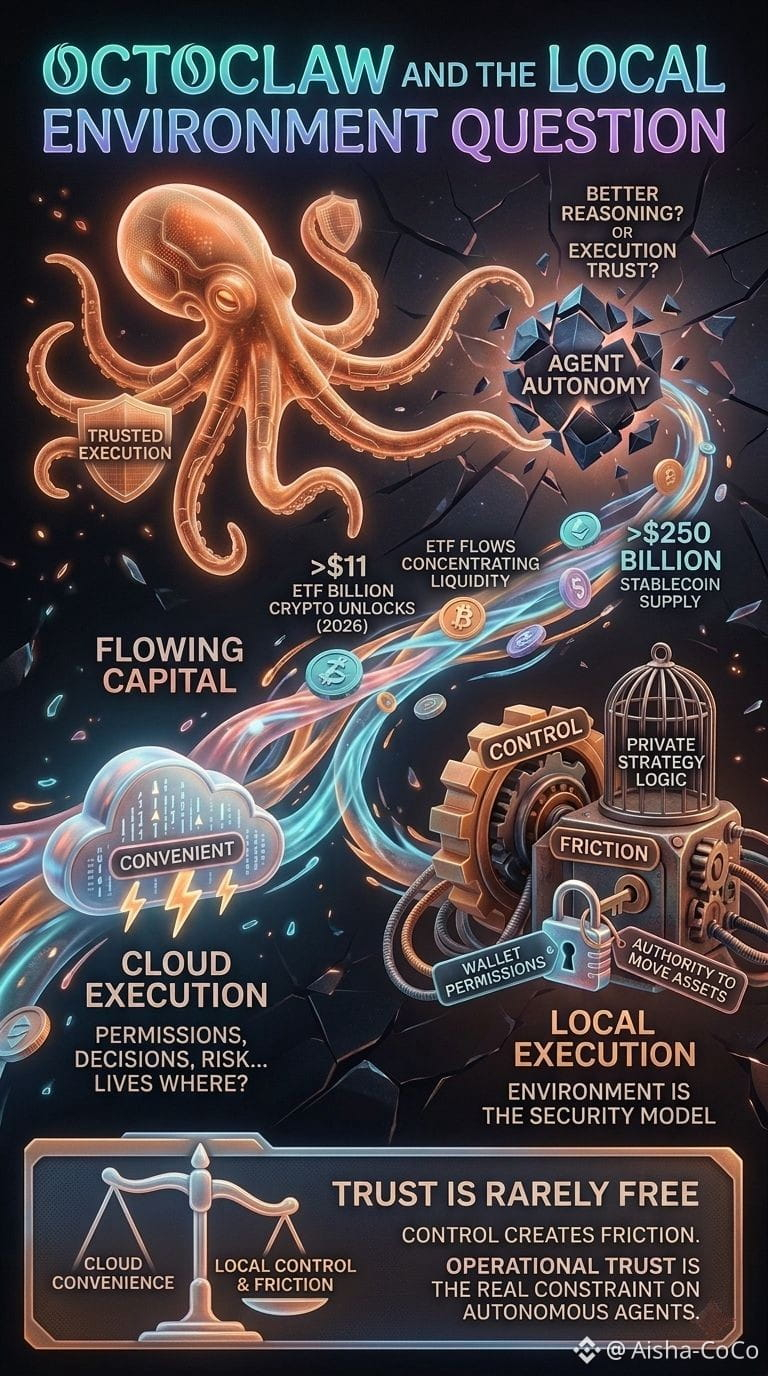
I Myself assuming that better AI agents mostly needed better reasoning. The more I looked at systems like OctoClaw, The less convinced I became.
My view is simple: agent autonomy matters less Than execution trust. On the surface, local operation looks like a privacy feature. Underneath, it changes where decisions, permissions, and risk actually live. If an agent handles walleet permissions meaning the authority to move assets or private straTegy logic, the environment Running those actions becomes part of the security model.
That feels increasingly relevant when over $11 billiion in crypto token unlocks are expected across 2026, ETF flows continue concentrating liquidity, and stablecoin supply has moved above $250 billion. Those numbers point to larger pools of capital and more Automated behavior, not necessarily better judgment.
The trade-off is obvious. Cloud execution is convenient; local execution offers more control. But control creates friction. Opereational trust is rarely free, and that may be the real constraint on autonoMous Agents.
{future}(OPENUSDT)
#openledger $OPEN @OpenLedger
I Myself assuming that better AI agents mostly needed better reasoning. The more I looked at systems like OctoClaw, The less convinced I became.
My view is simple: agent autonomy matters less Than execution trust. On the surface, local operation looks like a privacy feature. Underneath, it changes where decisions, permissions, and risk actually live. If an agent handles walleet permissions meaning the authority to move assets or private straTegy logic, the environment Running those actions becomes part of the security model.
That feels increasingly relevant when over $11 billiion in crypto token unlocks are expected across 2026, ETF flows continue concentrating liquidity, and stablecoin supply has moved above $250 billion. Those numbers point to larger pools of capital and more Automated behavior, not necessarily better judgment.
The trade-off is obvious. Cloud execution is convenient; local execution offers more control. But control creates friction. Opereational trust is rarely free, and that may be the real constraint on autonoMous Agents.
I Myself assuming that better AI agents mostly needed better reasoning. The more I looked at systems like OctoClaw, The less convinced I became.
My view is simple: agent autonomy matters less Than execution trust. On the surface, local operation looks like a privacy feature. Underneath, it changes where decisions, permissions, and risk actually live. If an agent handles walleet permissions meaning the authority to move assets or private straTegy logic, the environment Running those actions becomes part of the security model.
That feels increasingly relevant when over $11 billiion in crypto token unlocks are expected across 2026, ETF flows continue concentrating liquidity, and stablecoin supply has moved above $250 billion. Those numbers point to larger pools of capital and more Automated behavior, not necessarily better judgment.
The trade-off is obvious. Cloud execution is convenient; local execution offers more control. But control creates friction. Opereational trust is rarely free, and that may be the real constraint on autonoMous Agents.

7
8
376

·
--

Article
Who Is Actually Getting Paid? A Quiet Look at OpenLedger’s Idea@Openledger .. I’ve seen this before… maybe a few months ago. The chart was just doing its usual thing… up down up down. But my mind got stuck on one strange question.
Who is actually getting paid?
No no seriously… everyone keeps talking about AI data, models, future big vision. Okay, fair enough. Nice words. But if all of this is really working… then who is actually earning the money? I’m looking at it, but the answer doesn’t feel that clear.
Then I saw #OpenLedger and this “attribution” idea. Sounds like a big fancy word… but maybe it’s simple at the core.
You give data… and it doesn’t just disappear inside a machine like a ghost. They’re trying to track where the data came from. If your data helps the model, then maybe… just maybe… you get rewarded. That’s how I understand it… maybe.
And honestly… I find this idea kind of interesting.
Because usually, data contributors are invisible. They clean, write, organize everything… and then boom, the model becomes valuable and everyone forgets who actually did the work.
OpenLedger is basically saying… “wait… maybe we should remember.”
But as a trader… I don’t get impressed by ideas alone. The market doesn’t pay for narratives. The market pays for usage.
So the real questions are:
Are people actually bringing data?
Are they staying?
Are the models actually being used?
Or is everyone just coming, farming rewards, taking selfies, and leaving?
Because that’s what will decide everything.
The $OPEN chart right now doesn’t really look like the market is saying “this is the winner.” More like… “okay… show me first.”
And honestly… that’s fair.
Because attribution sounds nice, but AI systems are messy. Really messy.
How do you measure the impact of one dataset?
Small expert data vs massive public data… which one matters more?
If 10 people submit the same thing… who gets the reward?
That’s where it gets complicated.
Still… I’m watching.
Because if this actually works… if real contributors stay, models improve, and real usage happens… then something interesting could happen here.
But if it turns into another reward-farming cycle…
Then yeah… the market will move on faster than the narrative.
So right now… not super bullish, not super bearish.
Just standing in the corner watching…
“Okay… interesting idea… now show me proof.”
Need more evidence.
Need more users.
And most importantly, need people to stay even after the rewards stop feeling shiny.
Until then… I’m watching. Waiting. Observing.
@Openledger #OpenLedger $OPEN
{future}(OPENUSDT)
Who Is Actually Getting Paid? A Quiet Look at OpenLedger’s Idea
@OpenLedger .. I’ve seen this before… maybe a few months ago. The chart was just doing its usual thing… up down up down. But my mind got stuck on one strange question.
Who is actually getting paid?
No no seriously… everyone keeps talking about AI data, models, future big vision. Okay, fair enough. Nice words. But if all of this is really working… then who is actually earning the money? I’m looking at it, but the answer doesn’t feel that clear.
Then I saw #OpenLedger and this “attribution” idea. Sounds like a big fancy word… but maybe it’s simple at the core.
You give data… and it doesn’t just disappear inside a machine like a ghost. They’re trying to track where the data came from. If your data helps the model, then maybe… just maybe… you get rewarded. That’s how I understand it… maybe.
And honestly… I find this idea kind of interesting.
Because usually, data contributors are invisible. They clean, write, organize everything… and then boom, the model becomes valuable and everyone forgets who actually did the work.
OpenLedger is basically saying… “wait… maybe we should remember.”
But as a trader… I don’t get impressed by ideas alone. The market doesn’t pay for narratives. The market pays for usage.
So the real questions are:
Are people actually bringing data?
Are they staying?
Are the models actually being used?
Or is everyone just coming, farming rewards, taking selfies, and leaving?
Because that’s what will decide everything.
The $OPEN chart right now doesn’t really look like the market is saying “this is the winner.” More like… “okay… show me first.”
And honestly… that’s fair.
Because attribution sounds nice, but AI systems are messy. Really messy.
How do you measure the impact of one dataset?
Small expert data vs massive public data… which one matters more?
If 10 people submit the same thing… who gets the reward?
That’s where it gets complicated.
Still… I’m watching.
Because if this actually works… if real contributors stay, models improve, and real usage happens… then something interesting could happen here.
But if it turns into another reward-farming cycle…
Then yeah… the market will move on faster than the narrative.
So right now… not super bullish, not super bearish.
Just standing in the corner watching…
“Okay… interesting idea… now show me proof.”
Need more evidence.
Need more users.
And most importantly, need people to stay even after the rewards stop feeling shiny.
Until then… I’m watching. Waiting. Observing.
@OpenLedger #OpenLedger $OPEN
Who is actually getting paid?
No no seriously… everyone keeps talking about AI data, models, future big vision. Okay, fair enough. Nice words. But if all of this is really working… then who is actually earning the money? I’m looking at it, but the answer doesn’t feel that clear.
Then I saw #OpenLedger and this “attribution” idea. Sounds like a big fancy word… but maybe it’s simple at the core.
You give data… and it doesn’t just disappear inside a machine like a ghost. They’re trying to track where the data came from. If your data helps the model, then maybe… just maybe… you get rewarded. That’s how I understand it… maybe.
And honestly… I find this idea kind of interesting.
Because usually, data contributors are invisible. They clean, write, organize everything… and then boom, the model becomes valuable and everyone forgets who actually did the work.
OpenLedger is basically saying… “wait… maybe we should remember.”
But as a trader… I don’t get impressed by ideas alone. The market doesn’t pay for narratives. The market pays for usage.
So the real questions are:
Are people actually bringing data?
Are they staying?
Are the models actually being used?
Or is everyone just coming, farming rewards, taking selfies, and leaving?
Because that’s what will decide everything.
The $OPEN chart right now doesn’t really look like the market is saying “this is the winner.” More like… “okay… show me first.”
And honestly… that’s fair.
Because attribution sounds nice, but AI systems are messy. Really messy.
How do you measure the impact of one dataset?
Small expert data vs massive public data… which one matters more?
If 10 people submit the same thing… who gets the reward?
That’s where it gets complicated.
Still… I’m watching.
Because if this actually works… if real contributors stay, models improve, and real usage happens… then something interesting could happen here.
But if it turns into another reward-farming cycle…
Then yeah… the market will move on faster than the narrative.
So right now… not super bullish, not super bearish.
Just standing in the corner watching…
“Okay… interesting idea… now show me proof.”
Need more evidence.
Need more users.
And most importantly, need people to stay even after the rewards stop feeling shiny.
Until then… I’m watching. Waiting. Observing.
@OpenLedger #OpenLedger $OPEN
14
5
292

·
--

Article
从碎片数据到数字底座:深度复盘 OpenLedger 走向 Web3 核心基建的进化逻辑我一边用平底锅煎着鸡蛋,一边用挂在后台的某个大热 AI 聚合器筛选当天的潜在异动币种。本来盯着 $BTC 刚刚企稳的 K 线,觉得可以摸点小鱼。突然,那个号称“全网毫秒级抓取”的 AI 弹窗疯狂预警,说某天王级项目团队正在砸盘转移资产。我吓得连火都顾不上关,切到 $ETH 链上,顶着几百 Gwei 的极高 Gas 费,狼狈地把相关池子里的 LP 全撤了。结果过了一小时才发现,这智障 AI 只是爬取了一个高仿诈骗号在推特上发的钓鱼假图,并把它当成了链上确凿证据。看着锅里焦黑的鸡蛋和凭空蒸发的高昂手续费,我后背一阵发凉:当咱们越来越依赖人工智能去做交易或生活决策时,一旦喂给它的源头数据掺了屎,它挥向我们的绝对是一把能要命的镰刀。
这口昂贵的“毒奶”,直接把我从各种炫酷的“Web3+AI”迷梦里扇醒了。你看看现在的广场,全在炒作谁家的虚拟人更逼真、哪个智能体更会聊天。但极少有人愿意捏着鼻子去查一查,这些看似聪明绝顶的代码模型,每天到底在吃什么烂菜叶子。逻辑很简单:如果大模型底层的训练语料早被污染了,甚至是被黑客恶意投毒的,那你就算用最顶级的算法,跑出来的也是一个一本正经胡说八道的数字废物。顺着这条顺藤摸瓜的思路,我才把投研的准星锁死了 @Openledger 。当全行业都在搞花里胡哨的前端应用骗流量时,这帮人却一头扎进了最苦最累的数据底层泥潭,试图用密码学和去中心化的方式,给语料打上一套无法作弊的“验毒防伪”标签。
把这套逻辑掰开揉碎了看,其实跟咱们加密行业最古早的信仰演进如出一辙。当年中本聪甩出比特币白皮书,靠着绝妙的算力博弈和公开账本,干碎了传统金融系统的黑箱,解决了电子资产的“双花”难题;紧接着,以太坊带着智能合约粉墨登场,用 EVM 把这种去信任化的共识,直接拉高到了执行复杂代码的层级。但现实很骨感,这两位开山鼻祖要是遇上如今 AI 模型那种动辄几百 TB 的恐怖数据吞吐量,绝对会被瞬间卡成高位截瘫。大模型要吃的不仅是几行转账记录,更是海量的人工标注、图像清洗和逻辑校对。
这种如同星辰大海般的非结构化数据洪流,如果全往现有的公链里塞,光是存储成本就能让项目方分分钟破产。这就注定了一个事实:AI 赛道必须长出一条像 OpenLedger 这样的专属数据下水道和提纯厂。它通过散布在全球的分布式节点,把那些脏乱差的原始信息收集过来,用一套严密的共识机制进行人工或算法的交叉筛查,最后提炼成高价值的机器口粮。如果没有这道干着苦力活的去中心化中间层,以后任何想在链上搞原生 AI 的极客,光是买数据和洗数据的天价账单,就足以把他们提前送走。
前几天,我和一个在硅谷大厂做算法核心的哥们儿喝酒,他嗤笑我们搞去中心化 AI 是螳臂当车,觉得大厂靠着堆积如山的 H100 显卡和垄断的全网爬虫,早就通关了这场游戏。我端着酒杯直接怼了回去:他们太傲慢了,完全低估了普通人“数据主权觉醒”的核爆威力。现在互联网上能免费白嫖的公开语料早就干涸了,甚至被 AI 自己生成的垃圾反噬了。未来真正能让模型产生质变的,是咱们每个人手机里、电脑里那些带着鲜活个人印记的私域数据。巨头要是敢明抢,绝对会被隐私法案和舆论彻底撕碎。而在这片灰色地带,去中心化网络反而成了一个绝佳的避风港。它让咱们普通人可以在不交出隐私底裤的前提下,把自己的认知和行为数据明码标价,卖个好价钱。
当然,作为常年拿真金白银试错的实盘玩家,我平时用那些“链上 AI”工具时,最想骂娘的就是那令人发指的延迟。哪怕让智能体做个简单的推演,都要去链上排队打包,这种反人类的 UX 简直比以太坊链上大拥堵还折磨人。所以我一直在拿着放大镜审视 #OpenLedger 到底怎么平衡“性能”和“去中心化”。让我觉得这项目靠谱的一点是,他们没蠢到把消耗算力的模型训练直接搬上链去硬跑。相反,他们极其克制地把核心精力与 $OPEN 代币经济学,死死钉在了“数据溯源确权”和“贡献者利润清算”这两层。这种向物理极限妥协的务实态度,说明团队在真正干活,而不是给资本讲科幻故事。
不过,我也绝不会天真到认为这条路已经稳赢了,它在经济模型上要趟的雷区依然密布。在这个击鼓传花的圈子里,原生代币的估值到底怎么和现实中那些传统企业采购数据的真金白银挂钩,依然是个极其棘手的死结。如果币价在二级市场被炒得像过山车一样上蹿下跳,那些拿着正规预算的外部 AI 实体企业,绝对不敢来这儿采购语料;可反过来,如果早期没有足够性感的暴富预期,那些自带设备来跑节点的矿工大军,凭什么义务劳动帮你搭底层基建?这简直是在走钢丝,极其考验官方团队像精密微调仪一样,根据真实的数据吞吐量和买卖双方的情绪,去动态平衡整个经济飞轮。
归根结底,AI 和区块链的这场世纪大碰撞,其核心诉求根本不是去造一个无所不能的赛博神明,而是一场关于数字时代“资料治理权”和“财富分配权”的生死争夺。我们已经受够了那些科技寡头把咱们当成免费语料提款机的黑盒时代。每次想起那个因为被 AI 误导让我亏掉巨额 Gas 费的早晨,我就越发笃定:破局的底牌不是去盲目崇拜更聪明的算法,而是从源头掐死数据污染,保证我交付和读取的每一个字节,都带有绝对干净且不可篡改的所有权烙印。这条去中心化确权的路注定布满荆棘和各种难看的 Bug,但它实打实地给了咱们普通人在 AI 纪元里护住自己数据底线的终极武器。
接下来我会死盯这两点。第一点是,它在主网面临极其复杂的高并发冲击时,那套反女巫和验真机制到底能不能扛住脚本工作室的饱和式投毒,如果源头防线被攻破,这网络就会沦为毫无价值的垃圾填埋场。第二点是,未来半年内,官方到底能不能拉来真正有体量的 Web2 科技企业或者传统资本进场,用真实的法币预算来采购这套去中心化语料。因为只有切实的外部买单输血,这套靠代币支撑的数据确权宏大叙事,才算真正从乌托邦照进现实。#OpenLedger
从碎片数据到数字底座:深度复盘 OpenLedger 走向 Web3 核心基建的进化逻辑
我一边用平底锅煎着鸡蛋,一边用挂在后台的某个大热 AI 聚合器筛选当天的潜在异动币种。本来盯着 $BTC 刚刚企稳的 K 线,觉得可以摸点小鱼。突然,那个号称“全网毫秒级抓取”的 AI 弹窗疯狂预警,说某天王级项目团队正在砸盘转移资产。我吓得连火都顾不上关,切到 $ETH 链上,顶着几百 Gwei 的极高 Gas 费,狼狈地把相关池子里的 LP 全撤了。结果过了一小时才发现,这智障 AI 只是爬取了一个高仿诈骗号在推特上发的钓鱼假图,并把它当成了链上确凿证据。看着锅里焦黑的鸡蛋和凭空蒸发的高昂手续费,我后背一阵发凉:当咱们越来越依赖人工智能去做交易或生活决策时,一旦喂给它的源头数据掺了屎,它挥向我们的绝对是一把能要命的镰刀。
这口昂贵的“毒奶”,直接把我从各种炫酷的“Web3+AI”迷梦里扇醒了。你看看现在的广场,全在炒作谁家的虚拟人更逼真、哪个智能体更会聊天。但极少有人愿意捏着鼻子去查一查,这些看似聪明绝顶的代码模型,每天到底在吃什么烂菜叶子。逻辑很简单:如果大模型底层的训练语料早被污染了,甚至是被黑客恶意投毒的,那你就算用最顶级的算法,跑出来的也是一个一本正经胡说八道的数字废物。顺着这条顺藤摸瓜的思路,我才把投研的准星锁死了 @OpenLedger 。当全行业都在搞花里胡哨的前端应用骗流量时,这帮人却一头扎进了最苦最累的数据底层泥潭,试图用密码学和去中心化的方式,给语料打上一套无法作弊的“验毒防伪”标签。
把这套逻辑掰开揉碎了看,其实跟咱们加密行业最古早的信仰演进如出一辙。当年中本聪甩出比特币白皮书,靠着绝妙的算力博弈和公开账本,干碎了传统金融系统的黑箱,解决了电子资产的“双花”难题;紧接着,以太坊带着智能合约粉墨登场,用 EVM 把这种去信任化的共识,直接拉高到了执行复杂代码的层级。但现实很骨感,这两位开山鼻祖要是遇上如今 AI 模型那种动辄几百 TB 的恐怖数据吞吐量,绝对会被瞬间卡成高位截瘫。大模型要吃的不仅是几行转账记录,更是海量的人工标注、图像清洗和逻辑校对。
这种如同星辰大海般的非结构化数据洪流,如果全往现有的公链里塞,光是存储成本就能让项目方分分钟破产。这就注定了一个事实:AI 赛道必须长出一条像 OpenLedger 这样的专属数据下水道和提纯厂。它通过散布在全球的分布式节点,把那些脏乱差的原始信息收集过来,用一套严密的共识机制进行人工或算法的交叉筛查,最后提炼成高价值的机器口粮。如果没有这道干着苦力活的去中心化中间层,以后任何想在链上搞原生 AI 的极客,光是买数据和洗数据的天价账单,就足以把他们提前送走。
前几天,我和一个在硅谷大厂做算法核心的哥们儿喝酒,他嗤笑我们搞去中心化 AI 是螳臂当车,觉得大厂靠着堆积如山的 H100 显卡和垄断的全网爬虫,早就通关了这场游戏。我端着酒杯直接怼了回去:他们太傲慢了,完全低估了普通人“数据主权觉醒”的核爆威力。现在互联网上能免费白嫖的公开语料早就干涸了,甚至被 AI 自己生成的垃圾反噬了。未来真正能让模型产生质变的,是咱们每个人手机里、电脑里那些带着鲜活个人印记的私域数据。巨头要是敢明抢,绝对会被隐私法案和舆论彻底撕碎。而在这片灰色地带,去中心化网络反而成了一个绝佳的避风港。它让咱们普通人可以在不交出隐私底裤的前提下,把自己的认知和行为数据明码标价,卖个好价钱。
当然,作为常年拿真金白银试错的实盘玩家,我平时用那些“链上 AI”工具时,最想骂娘的就是那令人发指的延迟。哪怕让智能体做个简单的推演,都要去链上排队打包,这种反人类的 UX 简直比以太坊链上大拥堵还折磨人。所以我一直在拿着放大镜审视 #OpenLedger 到底怎么平衡“性能”和“去中心化”。让我觉得这项目靠谱的一点是,他们没蠢到把消耗算力的模型训练直接搬上链去硬跑。相反,他们极其克制地把核心精力与 $OPEN 代币经济学,死死钉在了“数据溯源确权”和“贡献者利润清算”这两层。这种向物理极限妥协的务实态度,说明团队在真正干活,而不是给资本讲科幻故事。
不过,我也绝不会天真到认为这条路已经稳赢了,它在经济模型上要趟的雷区依然密布。在这个击鼓传花的圈子里,原生代币的估值到底怎么和现实中那些传统企业采购数据的真金白银挂钩,依然是个极其棘手的死结。如果币价在二级市场被炒得像过山车一样上蹿下跳,那些拿着正规预算的外部 AI 实体企业,绝对不敢来这儿采购语料;可反过来,如果早期没有足够性感的暴富预期,那些自带设备来跑节点的矿工大军,凭什么义务劳动帮你搭底层基建?这简直是在走钢丝,极其考验官方团队像精密微调仪一样,根据真实的数据吞吐量和买卖双方的情绪,去动态平衡整个经济飞轮。
归根结底,AI 和区块链的这场世纪大碰撞,其核心诉求根本不是去造一个无所不能的赛博神明,而是一场关于数字时代“资料治理权”和“财富分配权”的生死争夺。我们已经受够了那些科技寡头把咱们当成免费语料提款机的黑盒时代。每次想起那个因为被 AI 误导让我亏掉巨额 Gas 费的早晨,我就越发笃定:破局的底牌不是去盲目崇拜更聪明的算法,而是从源头掐死数据污染,保证我交付和读取的每一个字节,都带有绝对干净且不可篡改的所有权烙印。这条去中心化确权的路注定布满荆棘和各种难看的 Bug,但它实打实地给了咱们普通人在 AI 纪元里护住自己数据底线的终极武器。
接下来我会死盯这两点。第一点是,它在主网面临极其复杂的高并发冲击时,那套反女巫和验真机制到底能不能扛住脚本工作室的饱和式投毒,如果源头防线被攻破,这网络就会沦为毫无价值的垃圾填埋场。第二点是,未来半年内,官方到底能不能拉来真正有体量的 Web2 科技企业或者传统资本进场,用真实的法币预算来采购这套去中心化语料。因为只有切实的外部买单输血,这套靠代币支撑的数据确权宏大叙事,才算真正从乌托邦照进现实。#OpenLedger
这口昂贵的“毒奶”,直接把我从各种炫酷的“Web3+AI”迷梦里扇醒了。你看看现在的广场,全在炒作谁家的虚拟人更逼真、哪个智能体更会聊天。但极少有人愿意捏着鼻子去查一查,这些看似聪明绝顶的代码模型,每天到底在吃什么烂菜叶子。逻辑很简单:如果大模型底层的训练语料早被污染了,甚至是被黑客恶意投毒的,那你就算用最顶级的算法,跑出来的也是一个一本正经胡说八道的数字废物。顺着这条顺藤摸瓜的思路,我才把投研的准星锁死了 @OpenLedger 。当全行业都在搞花里胡哨的前端应用骗流量时,这帮人却一头扎进了最苦最累的数据底层泥潭,试图用密码学和去中心化的方式,给语料打上一套无法作弊的“验毒防伪”标签。
把这套逻辑掰开揉碎了看,其实跟咱们加密行业最古早的信仰演进如出一辙。当年中本聪甩出比特币白皮书,靠着绝妙的算力博弈和公开账本,干碎了传统金融系统的黑箱,解决了电子资产的“双花”难题;紧接着,以太坊带着智能合约粉墨登场,用 EVM 把这种去信任化的共识,直接拉高到了执行复杂代码的层级。但现实很骨感,这两位开山鼻祖要是遇上如今 AI 模型那种动辄几百 TB 的恐怖数据吞吐量,绝对会被瞬间卡成高位截瘫。大模型要吃的不仅是几行转账记录,更是海量的人工标注、图像清洗和逻辑校对。
这种如同星辰大海般的非结构化数据洪流,如果全往现有的公链里塞,光是存储成本就能让项目方分分钟破产。这就注定了一个事实:AI 赛道必须长出一条像 OpenLedger 这样的专属数据下水道和提纯厂。它通过散布在全球的分布式节点,把那些脏乱差的原始信息收集过来,用一套严密的共识机制进行人工或算法的交叉筛查,最后提炼成高价值的机器口粮。如果没有这道干着苦力活的去中心化中间层,以后任何想在链上搞原生 AI 的极客,光是买数据和洗数据的天价账单,就足以把他们提前送走。
前几天,我和一个在硅谷大厂做算法核心的哥们儿喝酒,他嗤笑我们搞去中心化 AI 是螳臂当车,觉得大厂靠着堆积如山的 H100 显卡和垄断的全网爬虫,早就通关了这场游戏。我端着酒杯直接怼了回去:他们太傲慢了,完全低估了普通人“数据主权觉醒”的核爆威力。现在互联网上能免费白嫖的公开语料早就干涸了,甚至被 AI 自己生成的垃圾反噬了。未来真正能让模型产生质变的,是咱们每个人手机里、电脑里那些带着鲜活个人印记的私域数据。巨头要是敢明抢,绝对会被隐私法案和舆论彻底撕碎。而在这片灰色地带,去中心化网络反而成了一个绝佳的避风港。它让咱们普通人可以在不交出隐私底裤的前提下,把自己的认知和行为数据明码标价,卖个好价钱。
当然,作为常年拿真金白银试错的实盘玩家,我平时用那些“链上 AI”工具时,最想骂娘的就是那令人发指的延迟。哪怕让智能体做个简单的推演,都要去链上排队打包,这种反人类的 UX 简直比以太坊链上大拥堵还折磨人。所以我一直在拿着放大镜审视 #OpenLedger 到底怎么平衡“性能”和“去中心化”。让我觉得这项目靠谱的一点是,他们没蠢到把消耗算力的模型训练直接搬上链去硬跑。相反,他们极其克制地把核心精力与 $OPEN 代币经济学,死死钉在了“数据溯源确权”和“贡献者利润清算”这两层。这种向物理极限妥协的务实态度,说明团队在真正干活,而不是给资本讲科幻故事。
不过,我也绝不会天真到认为这条路已经稳赢了,它在经济模型上要趟的雷区依然密布。在这个击鼓传花的圈子里,原生代币的估值到底怎么和现实中那些传统企业采购数据的真金白银挂钩,依然是个极其棘手的死结。如果币价在二级市场被炒得像过山车一样上蹿下跳,那些拿着正规预算的外部 AI 实体企业,绝对不敢来这儿采购语料;可反过来,如果早期没有足够性感的暴富预期,那些自带设备来跑节点的矿工大军,凭什么义务劳动帮你搭底层基建?这简直是在走钢丝,极其考验官方团队像精密微调仪一样,根据真实的数据吞吐量和买卖双方的情绪,去动态平衡整个经济飞轮。
归根结底,AI 和区块链的这场世纪大碰撞,其核心诉求根本不是去造一个无所不能的赛博神明,而是一场关于数字时代“资料治理权”和“财富分配权”的生死争夺。我们已经受够了那些科技寡头把咱们当成免费语料提款机的黑盒时代。每次想起那个因为被 AI 误导让我亏掉巨额 Gas 费的早晨,我就越发笃定:破局的底牌不是去盲目崇拜更聪明的算法,而是从源头掐死数据污染,保证我交付和读取的每一个字节,都带有绝对干净且不可篡改的所有权烙印。这条去中心化确权的路注定布满荆棘和各种难看的 Bug,但它实打实地给了咱们普通人在 AI 纪元里护住自己数据底线的终极武器。
接下来我会死盯这两点。第一点是,它在主网面临极其复杂的高并发冲击时,那套反女巫和验真机制到底能不能扛住脚本工作室的饱和式投毒,如果源头防线被攻破,这网络就会沦为毫无价值的垃圾填埋场。第二点是,未来半年内,官方到底能不能拉来真正有体量的 Web2 科技企业或者传统资本进场,用真实的法币预算来采购这套去中心化语料。因为只有切实的外部买单输血,这套靠代币支撑的数据确权宏大叙事,才算真正从乌托邦照进现实。#OpenLedger
615

·
--
OpenLedger 近期的波动,核心不一定来自项目基本面变化,而是一次“名称误读”带来的交易噪音:市场上有人把 OpenLedger 误当成 Open USD(OUSD)相关项目,但 OUSD 实际由 Open Standard 推出,二者并无直接关系。
这种混淆容易放大短线预期,引发跟风交易。关注 $OPEN 时,建议先核对项目主体与信息来源,再判断价格异动是否具备持续性。当前价格约0.15934美元,24h成交量约850万美元,市值约4783万美元。
#OpenLedger #OPEN #加密市场
OpenLedger 近期的波动,核心不一定来自项目基本面变化,而是一次“名称误读”带来的交易噪音:市场上有人把 OpenLedger 误当成 Open USD(OUSD)相关项目,但 OUSD 实际由 Open Standard 推出,二者并无直接关系。
这种混淆容易放大短线预期,引发跟风交易。关注 $OPEN 时,建议先核对项目主体与信息来源,再判断价格异动是否具备持续性。当前价格约0.15934美元,24h成交量约850万美元,市值约4783万美元。
#OpenLedger #OPEN #加密市场
这种混淆容易放大短线预期,引发跟风交易。关注 $OPEN 时,建议先核对项目主体与信息来源,再判断价格异动是否具备持续性。当前价格约0.15934美元,24h成交量约850万美元,市值约4783万美元。
#OpenLedger #OPEN #加密市场
59

·
--
The part that stayed with me from the OpenLedger $OPEN #OpenLedger @Openledger task was how the two beneficiary groups — AI builders and data contributors — are on very different timelines, even though the pitch presents them as arriving together. Builders get immediate utility: ModelFactory works today, no-code fine-tuning works today, OpenLoRA deploys models without heavy infrastructure overhead. That value is front-loaded and doesn't depend on the Proof of Attribution flywheel spinning. Contributors are different. Their rewards only materialize when models built on their Datanets are actually queried at scale — but DeFiLlama shows annual protocol revenue sitting at $693K with fees down 23% in the past week, which suggests inference demand is still light. The design is coherent; the sequencing just matters more than the framing admits. Builders come in, build on the infrastructure, models sit waiting. Contributors have already uploaded, already contributed, already earned their attribution records… and are now waiting on demand that hasn't fully arrived yet. Whether that gap closes depends entirely on whether the builders who showed up actually ship products people use.
The part that stayed with me from the OpenLedger $OPEN #OpenLedger @OpenLedger task was how the two beneficiary groups — AI builders and data contributors — are on very different timelines, even though the pitch presents them as arriving together. Builders get immediate utility: ModelFactory works today, no-code fine-tuning works today, OpenLoRA deploys models without heavy infrastructure overhead. That value is front-loaded and doesn't depend on the Proof of Attribution flywheel spinning. Contributors are different. Their rewards only materialize when models built on their Datanets are actually queried at scale — but DeFiLlama shows annual protocol revenue sitting at $693K with fees down 23% in the past week, which suggests inference demand is still light. The design is coherent; the sequencing just matters more than the framing admits. Builders come in, build on the infrastructure, models sit waiting. Contributors have already uploaded, already contributed, already earned their attribution records… and are now waiting on demand that hasn't fully arrived yet. Whether that gap closes depends entirely on whether the builders who showed up actually ship products people use.
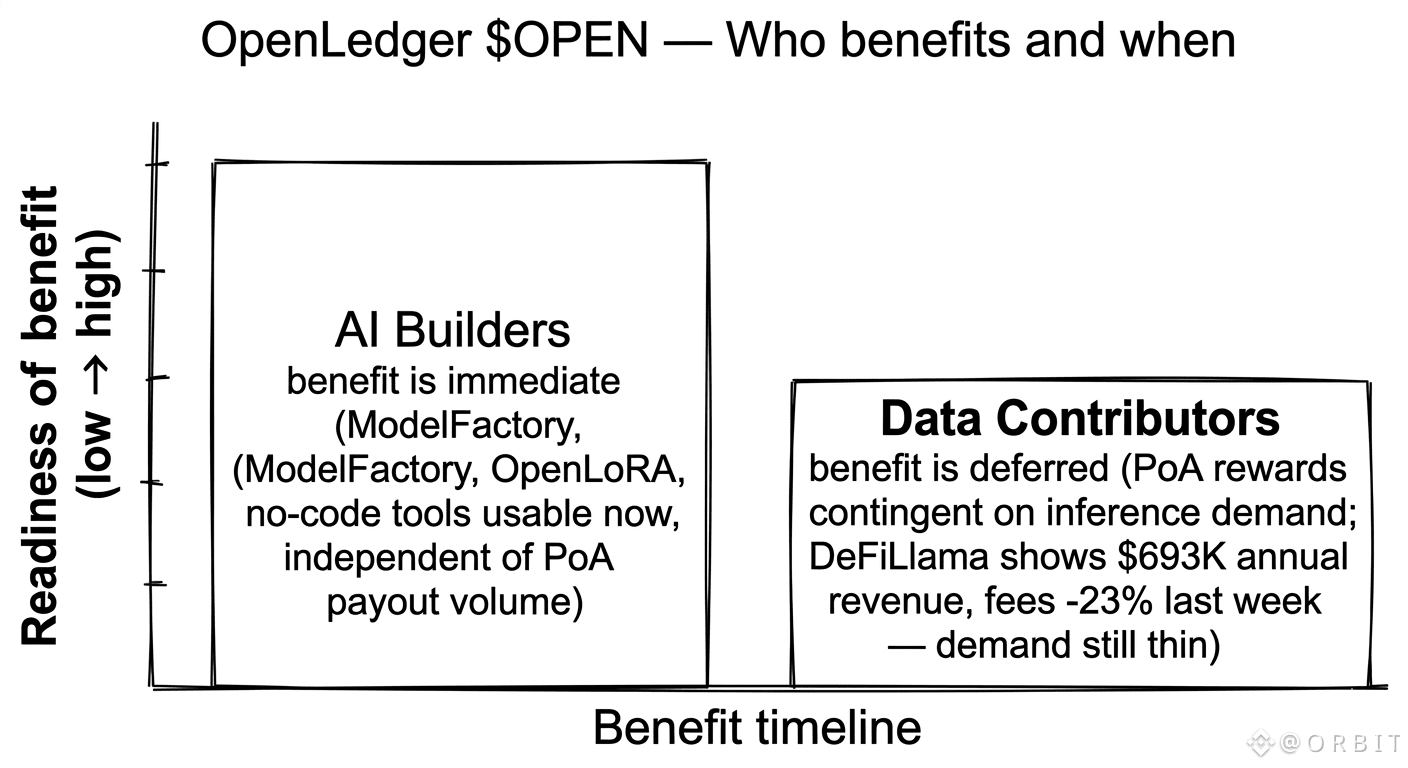
1
327

#openledger $OPEN The OpenLedger campaign is creating serious excitement across the crypto community, and for good reason. As blockchain technology continues to evolve, OpenLedger is positioning itself as a project focused on innovation, transparency, and community-driven growth.
Participating in the Binance OpenLedger campaign is more than just completing tasks and earning rewards—it's a chance to become part of a growing ecosystem before wider adoption takes place. Early supporters often gain valuable experience, build stronger connections within the community, and position themselves for future opportunities.
What makes this campaign even more attractive is the combination of learning, engagement, and rewards. Whether you're a seasoned crypto enthusiast or a newcomer exploring Web3, OpenLedger offers a great way to stay active and informed while potentially benefiting from the project's growth.
Don't just watch from the sidelines—join the conversation, complete the campaign activities, and discover why so many users are keeping a close eye on OpenLedger. The next big opportunity could be closer than you think! 🔥
#OpenLedger #BinanceSquare #Crypto #Web3 #Airdrop #Blockchain #BinanceCampaign #CryptoCommunity
#openledger $OPEN The OpenLedger campaign is creating serious excitement across the crypto community, and for good reason. As blockchain technology continues to evolve, OpenLedger is positioning itself as a project focused on innovation, transparency, and community-driven growth.
Participating in the Binance OpenLedger campaign is more than just completing tasks and earning rewards—it's a chance to become part of a growing ecosystem before wider adoption takes place. Early supporters often gain valuable experience, build stronger connections within the community, and position themselves for future opportunities.
What makes this campaign even more attractive is the combination of learning, engagement, and rewards. Whether you're a seasoned crypto enthusiast or a newcomer exploring Web3, OpenLedger offers a great way to stay active and informed while potentially benefiting from the project's growth.
Don't just watch from the sidelines—join the conversation, complete the campaign activities, and discover why so many users are keeping a close eye on OpenLedger. The next big opportunity could be closer than you think! 🔥
#OpenLedger #BinanceSquare #Crypto #Web3 #Airdrop #Blockchain #BinanceCampaign #CryptoCommunity
Participating in the Binance OpenLedger campaign is more than just completing tasks and earning rewards—it's a chance to become part of a growing ecosystem before wider adoption takes place. Early supporters often gain valuable experience, build stronger connections within the community, and position themselves for future opportunities.
What makes this campaign even more attractive is the combination of learning, engagement, and rewards. Whether you're a seasoned crypto enthusiast or a newcomer exploring Web3, OpenLedger offers a great way to stay active and informed while potentially benefiting from the project's growth.
Don't just watch from the sidelines—join the conversation, complete the campaign activities, and discover why so many users are keeping a close eye on OpenLedger. The next big opportunity could be closer than you think! 🔥
#OpenLedger #BinanceSquare #Crypto #Web3 #Airdrop #Blockchain #BinanceCampaign #CryptoCommunity
72

·
--
我以前跨链最怕的不是慢,是那种“你以为没动静,手一抖又点一次”,然后同一笔动作变成两笔——这事发生了你复盘都不好意思承认:到底是系统没讲清状态,还是你自己心态崩了。越是要把桥接塞进自动化链路里,这个坑越致命,因为重复执行不是“亏一点”,是直接把逻辑打乱。
所以我现在看 @Openledger 的 EVM Bridge,会用一个特别土的标准验它:桥接这一步能不能变成明确的 checkpoint,而不是一段“看不到边界的动作”。OctoClaw 生成 action 的时候,如果这一步是跨链,我希望它能把“这一趟桥接”绑定成一个唯一引用:你后面再触发同一动作,系统不是默默再跑一遍,而是明确告诉你——这笔正在进行/已经完成/不允许重复。Trading agent 你可以继续拼链路没问题,但桥接这种高风险动作,必须先把“重复执行”这一刀砍掉,不然越自动化越像在埋雷。
我今天只留一个验收点:同一条桥接动作被再次触发时,系统能不能直接返回同一个执行引用,并给出清晰状态(进行中/已完成),同时拒绝创建第二条桥接。能做到这点,我才把 Bridge 当成执行能力;做不到,我宁愿把这一步留给人工确认。
@Openledger $OPEN #OpenLedger
我以前跨链最怕的不是慢,是那种“你以为没动静,手一抖又点一次”,然后同一笔动作变成两笔——这事发生了你复盘都不好意思承认:到底是系统没讲清状态,还是你自己心态崩了。越是要把桥接塞进自动化链路里,这个坑越致命,因为重复执行不是“亏一点”,是直接把逻辑打乱。
所以我现在看 @OpenLedger 的 EVM Bridge,会用一个特别土的标准验它:桥接这一步能不能变成明确的 checkpoint,而不是一段“看不到边界的动作”。OctoClaw 生成 action 的时候,如果这一步是跨链,我希望它能把“这一趟桥接”绑定成一个唯一引用:你后面再触发同一动作,系统不是默默再跑一遍,而是明确告诉你——这笔正在进行/已经完成/不允许重复。Trading agent 你可以继续拼链路没问题,但桥接这种高风险动作,必须先把“重复执行”这一刀砍掉,不然越自动化越像在埋雷。
我今天只留一个验收点:同一条桥接动作被再次触发时,系统能不能直接返回同一个执行引用,并给出清晰状态(进行中/已完成),同时拒绝创建第二条桥接。能做到这点,我才把 Bridge 当成执行能力;做不到,我宁愿把这一步留给人工确认。
@OpenLedger $OPEN #OpenLedger
所以我现在看 @OpenLedger 的 EVM Bridge,会用一个特别土的标准验它:桥接这一步能不能变成明确的 checkpoint,而不是一段“看不到边界的动作”。OctoClaw 生成 action 的时候,如果这一步是跨链,我希望它能把“这一趟桥接”绑定成一个唯一引用:你后面再触发同一动作,系统不是默默再跑一遍,而是明确告诉你——这笔正在进行/已经完成/不允许重复。Trading agent 你可以继续拼链路没问题,但桥接这种高风险动作,必须先把“重复执行”这一刀砍掉,不然越自动化越像在埋雷。
我今天只留一个验收点:同一条桥接动作被再次触发时,系统能不能直接返回同一个执行引用,并给出清晰状态(进行中/已完成),同时拒绝创建第二条桥接。能做到这点,我才把 Bridge 当成执行能力;做不到,我宁愿把这一步留给人工确认。
@OpenLedger $OPEN #OpenLedger

176
Connectez-vous pour découvrir plus de contenu
Rejoignez la communauté mondiale des adeptes de cryptomonnaies sur Binance Square
⚡️ Suviez les dernières informations importantes sur les cryptomonnaies.
💬 Jugé digne de confiance par la plus grande plateforme d’échange de cryptomonnaies au monde.
👍 Découvrez les connaissances que partagent les créateurs vérifiés.
Adresse e-mail/Nº de téléphone
Sujets d’actualité
1
#BinanceLaunchesBinanceIntelligence
721,010 vues
4,548 mentions
2
#BTCFallsBelow$84K
27,458 vues
99 mentions
3
#DubaiVARAIssuesReserveAssetAuditCircular
5,969 vues
336 mentions
4
#SECApproves3XBitcoinETF
5,529 vues
283 mentions
5
#WinklevossFilesSpotZcashETFApplication
15,123 vues
408 mentions
6
#SouthKoreaAITradeLiftsWorldcoinTo$7.41B
1,815 vues
35 mentions
7
#StrategyEstimates$4.1BIncomeTaxBenefit
1,334 vues
18 mentions
8
#IglooShutsDownAbstractBlockchain
6,137 vues
213 mentions
9
#StrategyMarketCapSurpassesRumble
45,532 vues
917 mentions
10
#StriveBuys2000BTCFor$169M
18,511 vues
161 mentions