

#bonds
bonds
148,173 vues
514 mentions
Populaire
Récents

·
--
*⛏️ Vale Eyes $522M Panda Bond Debut — Brazil's Mining Giant Looks to China*
Vale S.A. (NYSE: VALE), the world's largest producer of iron ore, is looking at making a strategic entry into China's onshore debt market.
It was reported that Vale is considering a Panda Bond with a value of about 522 million dollars (roughly 3.78 billion CNY) — a bond that is its very first one denominated in Chinese Yuan (CNY) and issued in China.
On Sept 9, 2026, Vale issued clarification:
There has still been no decision on the question of issuing debt securities, and we regularly examine various methods of financing as part of our ordinary financial management.
They are exploring but have not yet signed.
What constitutes a Panda bond?
- Bonds issued in China by a FOREIGN company, denominated in Yuan
- Sold on China Interbank Bond Market, cleared via Shanghai Clearing House
- Requires strong credit rating (AA+ or higher for Vale expected)
Why would Vale carry out this action?
1. Diversify Funding: Currently Vale has $5.5 billion in cash, $5 billion in credit lines and a total debt of $17.3 billion (according to Fitch). The Panda market provides CNY rates that are lower than those of USD SOFR loans.
2. *More than 50% of Vale's iron ore is sold to China:* Since Vale both earns money and takes out loans in Chinese yuan, this acts as a natural hedge.
3. Green financing: Funding is expected to be obtained for low-carbon mining, for sustainable iron ore production, and for energy transition projects.
4. The deepening of Brazil's ties with China is in keeping with the growing trend among Latin American companies of accessing Chinese capital.
#Vale #PandaBond #China #Mining #IronOre #VALE #Corporat$NVDAB eFinance #Brazil #CNY #Bonds
*⛏️ Vale Eyes $522M Panda Bond Debut — Brazil's Mining Giant Looks to China*
Vale S.A. (NYSE: VALE), the world's largest producer of iron ore, is looking at making a strategic entry into China's onshore debt market.
It was reported that Vale is considering a Panda Bond with a value of about 522 million dollars (roughly 3.78 billion CNY) — a bond that is its very first one denominated in Chinese Yuan (CNY) and issued in China.
On Sept 9, 2026, Vale issued clarification:
There has still been no decision on the question of issuing debt securities, and we regularly examine various methods of financing as part of our ordinary financial management.
They are exploring but have not yet signed.
What constitutes a Panda bond?
- Bonds issued in China by a FOREIGN company, denominated in Yuan
- Sold on China Interbank Bond Market, cleared via Shanghai Clearing House
- Requires strong credit rating (AA+ or higher for Vale expected)
Why would Vale carry out this action?
1. Diversify Funding: Currently Vale has $5.5 billion in cash, $5 billion in credit lines and a total debt of $17.3 billion (according to Fitch). The Panda market provides CNY rates that are lower than those of USD SOFR loans.
2. *More than 50% of Vale's iron ore is sold to China:* Since Vale both earns money and takes out loans in Chinese yuan, this acts as a natural hedge.
3. Green financing: Funding is expected to be obtained for low-carbon mining, for sustainable iron ore production, and for energy transition projects.
4. The deepening of Brazil's ties with China is in keeping with the growing trend among Latin American companies of accessing Chinese capital.
#Vale #PandaBond #China #Mining #IronOre #VALE #Corporat$NVDAB eFinance #Brazil #CNY #Bonds
Vale S.A. (NYSE: VALE), the world's largest producer of iron ore, is looking at making a strategic entry into China's onshore debt market.
It was reported that Vale is considering a Panda Bond with a value of about 522 million dollars (roughly 3.78 billion CNY) — a bond that is its very first one denominated in Chinese Yuan (CNY) and issued in China.
On Sept 9, 2026, Vale issued clarification:
There has still been no decision on the question of issuing debt securities, and we regularly examine various methods of financing as part of our ordinary financial management.
They are exploring but have not yet signed.
What constitutes a Panda bond?
- Bonds issued in China by a FOREIGN company, denominated in Yuan
- Sold on China Interbank Bond Market, cleared via Shanghai Clearing House
- Requires strong credit rating (AA+ or higher for Vale expected)
Why would Vale carry out this action?
1. Diversify Funding: Currently Vale has $5.5 billion in cash, $5 billion in credit lines and a total debt of $17.3 billion (according to Fitch). The Panda market provides CNY rates that are lower than those of USD SOFR loans.
2. *More than 50% of Vale's iron ore is sold to China:* Since Vale both earns money and takes out loans in Chinese yuan, this acts as a natural hedge.
3. Green financing: Funding is expected to be obtained for low-carbon mining, for sustainable iron ore production, and for energy transition projects.
4. The deepening of Brazil's ties with China is in keeping with the growing trend among Latin American companies of accessing Chinese capital.
#Vale #PandaBond #China #Mining #IronOre #VALE #Corporat$NVDAB eFinance #Brazil #CNY #Bonds

VALEUS+0,00%
162

🚨 JUST IN: Jim Cramer is warning of a move in the bond market that could catch a lot of traders off guard.
His words: "I think a bond short squeeze could actually occur."
Most people scrolling past this won't understand why it matters. It matters a lot.
A lot of money is betting that bond prices will keep falling. That's the short trade.
But a short squeeze is what happens when that bet goes wrong. Prices stop falling and start rising. Traders who were short get forced to buy bonds back to cut their losses.
That buying pushes prices higher. Higher prices force more shorts to buy. And the loop feeds itself.
When bond prices spike, yields plunge. Yields set the cost of mortgages, car loans, corporate debt and government borrowing.
So one violent move in bonds doesn't stay in bonds. It can ripple through stocks, the dollar and every asset priced off the risk-free rate.
Cramer isn't saying it's certain. He's saying it's possible. But squeezes don't announce themselves. They look quiet, and then they aren't.
The crowded trade is only safe until the moment it isn't.
Keep your eyes on yields.
Follow for real-time macro and market updates as this develops.
#Bonds #Markets #Finance #Economy #BreakingNews
🚨 JUST IN: Jim Cramer is warning of a move in the bond market that could catch a lot of traders off guard.
His words: "I think a bond short squeeze could actually occur."
Most people scrolling past this won't understand why it matters. It matters a lot.
A lot of money is betting that bond prices will keep falling. That's the short trade.
But a short squeeze is what happens when that bet goes wrong. Prices stop falling and start rising. Traders who were short get forced to buy bonds back to cut their losses.
That buying pushes prices higher. Higher prices force more shorts to buy. And the loop feeds itself.
When bond prices spike, yields plunge. Yields set the cost of mortgages, car loans, corporate debt and government borrowing.
So one violent move in bonds doesn't stay in bonds. It can ripple through stocks, the dollar and every asset priced off the risk-free rate.
Cramer isn't saying it's certain. He's saying it's possible. But squeezes don't announce themselves. They look quiet, and then they aren't.
The crowded trade is only safe until the moment it isn't.
Keep your eyes on yields.
Follow for real-time macro and market updates as this develops.
#Bonds #Markets #Finance #Economy #BreakingNews
His words: "I think a bond short squeeze could actually occur."
Most people scrolling past this won't understand why it matters. It matters a lot.
A lot of money is betting that bond prices will keep falling. That's the short trade.
But a short squeeze is what happens when that bet goes wrong. Prices stop falling and start rising. Traders who were short get forced to buy bonds back to cut their losses.
That buying pushes prices higher. Higher prices force more shorts to buy. And the loop feeds itself.
When bond prices spike, yields plunge. Yields set the cost of mortgages, car loans, corporate debt and government borrowing.
So one violent move in bonds doesn't stay in bonds. It can ripple through stocks, the dollar and every asset priced off the risk-free rate.
Cramer isn't saying it's certain. He's saying it's possible. But squeezes don't announce themselves. They look quiet, and then they aren't.
The crowded trade is only safe until the moment it isn't.
Keep your eyes on yields.
Follow for real-time macro and market updates as this develops.
#Bonds #Markets #Finance #Economy #BreakingNews

1
60

·
--
JUST NOW:Risky assets are reacting to the ongoing surge in global bond yields.
As yields rise, financial conditions tighten and the opportunity cost of holding riskier assets increases.
That can put pressure on equities, crypto, and other high-beta assets, especially if yields continue climbing.
The key question now: how high can yields go before markets start repricing risk more aggressively?
#bonds #crypto #bitcoin
JUST NOW:Risky assets are reacting to the ongoing surge in global bond yields.
As yields rise, financial conditions tighten and the opportunity cost of holding riskier assets increases.
That can put pressure on equities, crypto, and other high-beta assets, especially if yields continue climbing.
The key question now: how high can yields go before markets start repricing risk more aggressively?
#bonds #crypto #bitcoin
As yields rise, financial conditions tighten and the opportunity cost of holding riskier assets increases.
That can put pressure on equities, crypto, and other high-beta assets, especially if yields continue climbing.
The key question now: how high can yields go before markets start repricing risk more aggressively?
#bonds #crypto #bitcoin
22

·
--
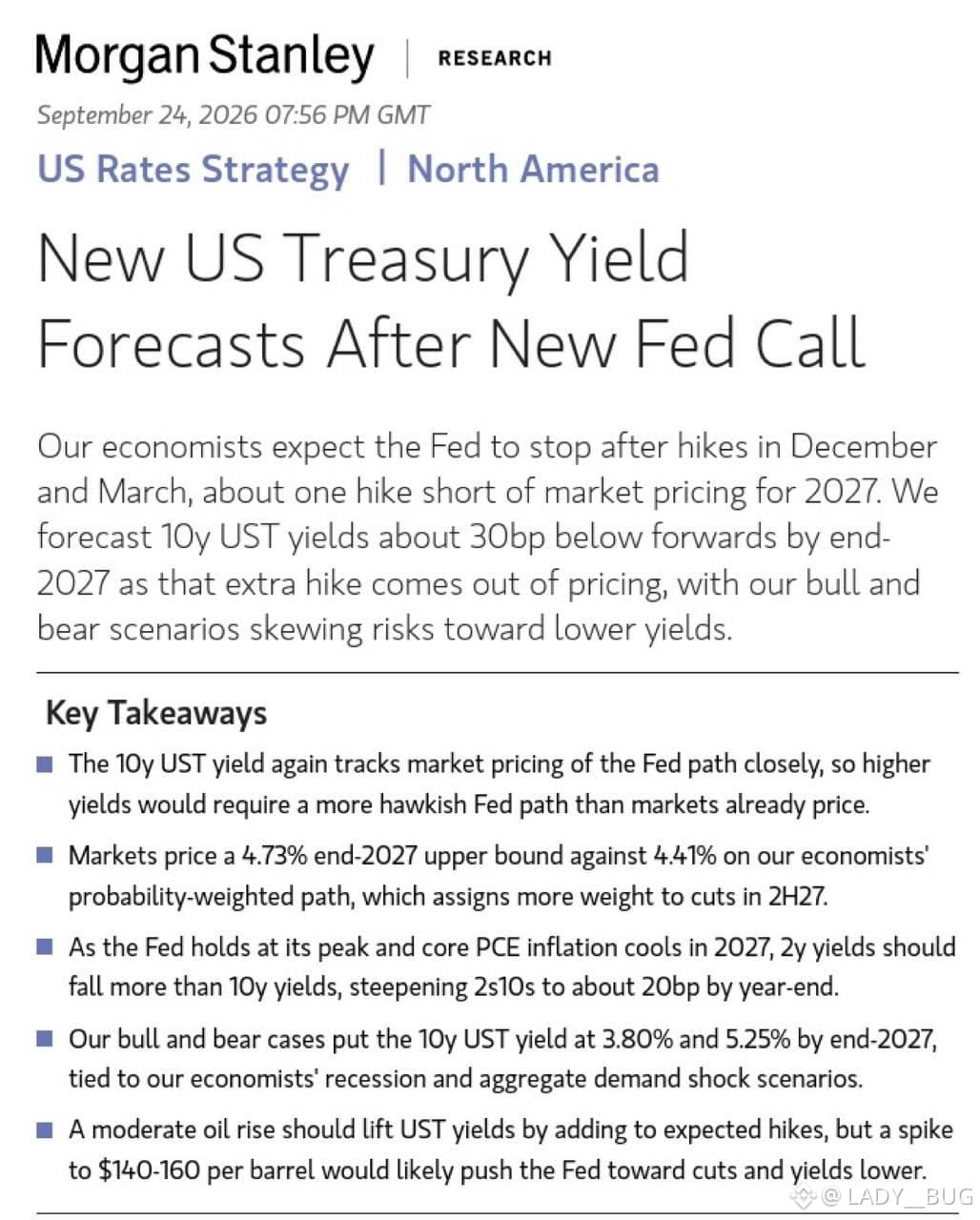
📉 Bond Market Outlook
The 10Y yield sitting in the 5% range is unlikely to last long.
Morgan Stanley forecasts the Fed will hike 25bps in December and another 25bps in March, then hold at 4.25–4.50%.
The market is pricing one more hike by 2027. If those expectations fade, Treasury yields could fall.
Key call: The 2Y may fall more sharply than the 10Y in H2 2027, causing the yield curve to steepen again.
Watch: oil prices $CL $BZ & the economy.
Bottom line: The bond market looks like it’s overreacting to further Fed tightening. In 2027, lower Treasury yields are more likely than higher.
#Bonds #Fed #TreasuryYields #Macro
NFA
📉 Bond Market Outlook
The 10Y yield sitting in the 5% range is unlikely to last long.
Morgan Stanley forecasts the Fed will hike 25bps in December and another 25bps in March, then hold at 4.25–4.50%.
The market is pricing one more hike by 2027. If those expectations fade, Treasury yields could fall.
Key call: The 2Y may fall more sharply than the 10Y in H2 2027, causing the yield curve to steepen again.
Watch: oil prices $CL $BZ & the economy.
Bottom line: The bond market looks like it’s overreacting to further Fed tightening. In 2027, lower Treasury yields are more likely than higher.
#Bonds #Fed #TreasuryYields #Macro
NFA
The 10Y yield sitting in the 5% range is unlikely to last long.
Morgan Stanley forecasts the Fed will hike 25bps in December and another 25bps in March, then hold at 4.25–4.50%.
The market is pricing one more hike by 2027. If those expectations fade, Treasury yields could fall.
Key call: The 2Y may fall more sharply than the 10Y in H2 2027, causing the yield curve to steepen again.
Watch: oil prices $CL $BZ & the economy.
Bottom line: The bond market looks like it’s overreacting to further Fed tightening. In 2027, lower Treasury yields are more likely than higher.
#Bonds #Fed #TreasuryYields #Macro
NFA
84

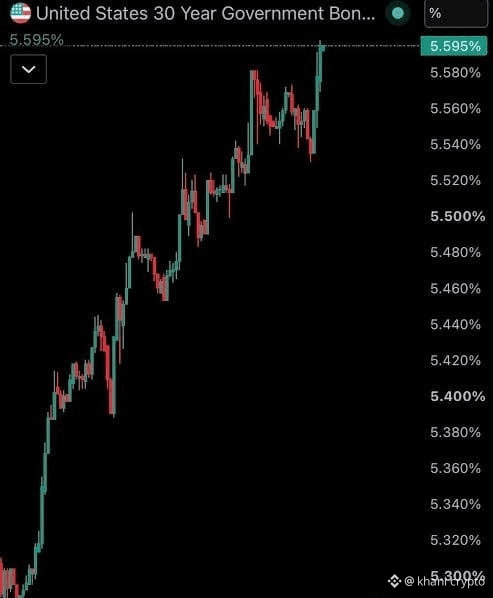

🚨 LES TAUX DES OBLIGATIONS AMÉRICAINES ACCÉLÈRENT
🇺🇸 Le rendement du Trésor à 10 ans repasse près de ses plus hauts niveaux depuis 2023, tandis que le rendement à 30 ans atteint 5,035 %, soit à l’identique des niveaux de 2007.
La hausse des déficits, l’inflation et la crise énergétique mondiale maintiennent la pression sur les rendements.
L’ère des taux ultra-bas pourrait être plus lointaine que prévu.
#US #Treasury #Bonds
$XAU
{future}(XAUUSDT)
$BTC
{future}(BTCUSDT)
🚨 LES TAUX DES OBLIGATIONS AMÉRICAINES ACCÉLÈRENT
🇺🇸 Le rendement du Trésor à 10 ans repasse près de ses plus hauts niveaux depuis 2023, tandis que le rendement à 30 ans atteint 5,035 %, soit à l’identique des niveaux de 2007.
La hausse des déficits, l’inflation et la crise énergétique mondiale maintiennent la pression sur les rendements.
L’ère des taux ultra-bas pourrait être plus lointaine que prévu.
#US #Treasury #Bonds
$XAU
$BTC
🇺🇸 Le rendement du Trésor à 10 ans repasse près de ses plus hauts niveaux depuis 2023, tandis que le rendement à 30 ans atteint 5,035 %, soit à l’identique des niveaux de 2007.
La hausse des déficits, l’inflation et la crise énergétique mondiale maintiennent la pression sur les rendements.
L’ère des taux ultra-bas pourrait être plus lointaine que prévu.
#US #Treasury #Bonds
$XAU
$BTC
75

Vérifié
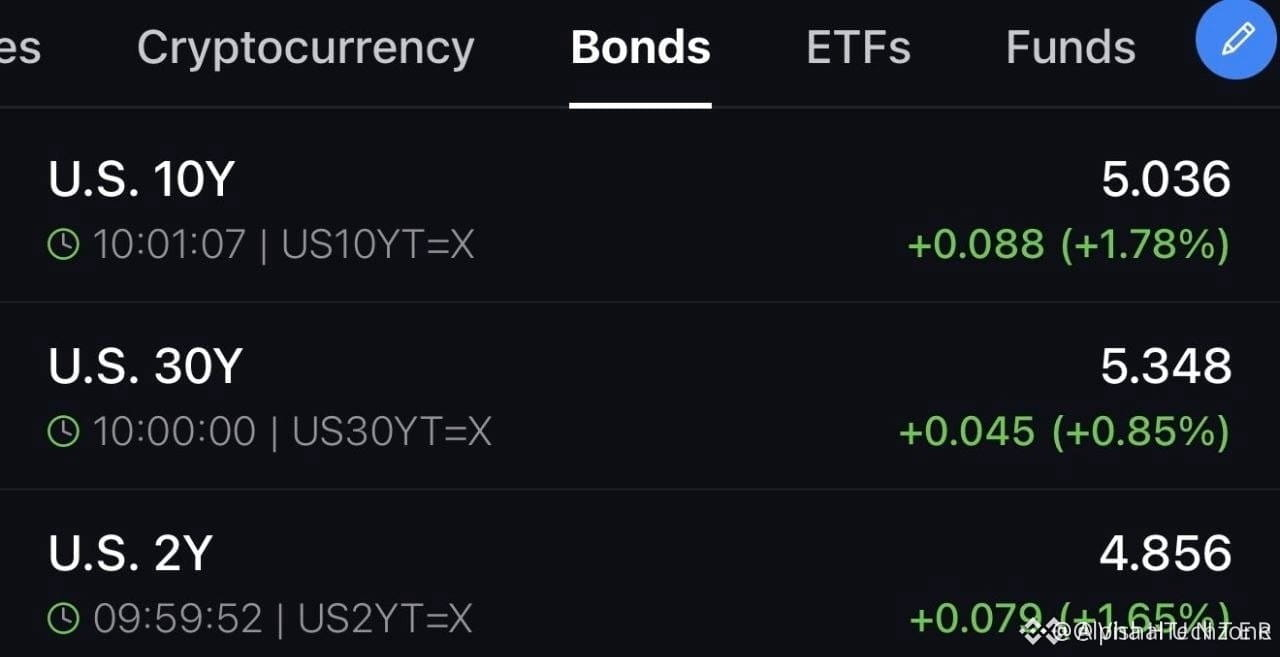
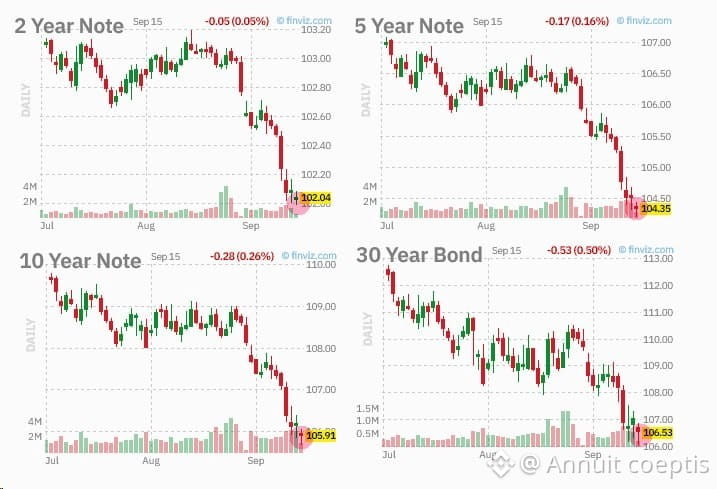
⚠️🇺🇸#bonds #usa #yields US Treasury bonds are falling again, yields are rising
Bessent just said that rising oil prices are to blame for the rise in yields
After Bessent's words, even the dumbest traders will now sell US bonds when they see rising oil prices, analysts say
Iran is making all this clear
⚠️🇺🇸#bonds #usa #yields US Treasury bonds are falling again, yields are rising
Bessent just said that rising oil prices are to blame for the rise in yields
After Bessent's words, even the dumbest traders will now sell US bonds when they see rising oil prices, analysts say
Iran is making all this clear
Bessent just said that rising oil prices are to blame for the rise in yields
After Bessent's words, even the dumbest traders will now sell US bonds when they see rising oil prices, analysts say
Iran is making all this clear
714

·
--
英国央行被曝正准备在英国财政大臣杰里米·亨特(Jeremy Hunt)于10月28日发布首份预算案前,暂停出售长期国债。据《每日电讯报》披露,英国央行计划停止抛售在以往金融危机期间积累的20年期和30年期国债,以缓解借贷成本上升对财政部造成的重压。
这背后的关键在于巨额的财政损耗。经济学家估算,自2022年启动出售这些长期债务以来,已给英国纳税人造成了约220亿英镑的损失。在当前全球债券遭遇抛售的大环境下,停止这种折价抛售每年可为财政部节省约25亿英镑的开支,从而为新上任的财政大臣腾出一定的政策回旋空间,尽管这也让平衡日常开支的预算规则变得更为复杂。
从传统宏观市场来看,央行缩表节奏的调整直接影响到债券市场的供需格局。暂停抛售长端国债有助于阶段性缓解长端收益率的上行压力,并在一定程度上稳定市场对英国主权信用的情绪,同时美元与英镑之间的流动性博弈也会因此产生微调。
对于加密市场来说,这反映出主要央行在流动性紧缩与财政承受力之间面临的现实权衡。虽然这并不代表全面转向宽松,但长端抛售压力的减轻可能会使整体流动性环境稍有缓和。加密投资者后续可继续观察各主要经济体国债市场的动态反应,理性看待资金面的结构性变化。 $BTC
#BankOfEngland #Bonds #MacroEconomy
英国央行被曝正准备在英国财政大臣杰里米·亨特(Jeremy Hunt)于10月28日发布首份预算案前,暂停出售长期国债。据《每日电讯报》披露,英国央行计划停止抛售在以往金融危机期间积累的20年期和30年期国债,以缓解借贷成本上升对财政部造成的重压。
这背后的关键在于巨额的财政损耗。经济学家估算,自2022年启动出售这些长期债务以来,已给英国纳税人造成了约220亿英镑的损失。在当前全球债券遭遇抛售的大环境下,停止这种折价抛售每年可为财政部节省约25亿英镑的开支,从而为新上任的财政大臣腾出一定的政策回旋空间,尽管这也让平衡日常开支的预算规则变得更为复杂。
从传统宏观市场来看,央行缩表节奏的调整直接影响到债券市场的供需格局。暂停抛售长端国债有助于阶段性缓解长端收益率的上行压力,并在一定程度上稳定市场对英国主权信用的情绪,同时美元与英镑之间的流动性博弈也会因此产生微调。
对于加密市场来说,这反映出主要央行在流动性紧缩与财政承受力之间面临的现实权衡。虽然这并不代表全面转向宽松,但长端抛售压力的减轻可能会使整体流动性环境稍有缓和。加密投资者后续可继续观察各主要经济体国债市场的动态反应,理性看待资金面的结构性变化。 $BTC
#BankOfEngland #Bonds #MacroEconomy
这背后的关键在于巨额的财政损耗。经济学家估算,自2022年启动出售这些长期债务以来,已给英国纳税人造成了约220亿英镑的损失。在当前全球债券遭遇抛售的大环境下,停止这种折价抛售每年可为财政部节省约25亿英镑的开支,从而为新上任的财政大臣腾出一定的政策回旋空间,尽管这也让平衡日常开支的预算规则变得更为复杂。
从传统宏观市场来看,央行缩表节奏的调整直接影响到债券市场的供需格局。暂停抛售长端国债有助于阶段性缓解长端收益率的上行压力,并在一定程度上稳定市场对英国主权信用的情绪,同时美元与英镑之间的流动性博弈也会因此产生微调。
对于加密市场来说,这反映出主要央行在流动性紧缩与财政承受力之间面临的现实权衡。虽然这并不代表全面转向宽松,但长端抛售压力的减轻可能会使整体流动性环境稍有缓和。加密投资者后续可继续观察各主要经济体国债市场的动态反应,理性看待资金面的结构性变化。 $BTC
#BankOfEngland #Bonds #MacroEconomy
54

据英国《每日电讯报》最新报道,在财政大臣杰里米·亨特(Jeremy Hunt)于10月28日公布首份财政预算案前夕,英国央行(BOE)正准备停止出售20年期和30年期的长期国债。这一政策调整旨在缓解借贷成本激增对财政部的巨大压力,此前在金融危机期间积累的这些长期债务自2022年出售以来,已造成纳税人约220亿英镑的巨额损失。
从深层宏观逻辑来看,在全球债券遭到抛售的逆风下,英国央行被动踩下量化紧缩(QT)的刹车,本质上反映了主权债务可持续性与紧缩货币政策之间的尖锐冲突。虽然停止亏本出售长期国债每年可节省约25亿英镑的账面亏损,但这种妥协并不能掩盖英国深层次的财政脆弱性,甚至会让财政大臣在实现日常支出预算平衡规则的努力变得更加复杂与被动。
对传统金融市场而言,长端国债抛售的暂停可能会在短期内抑制长端英债收益率的飙升,暂时缓解流动性压力。然而,这种被迫的政策调整向市场传递了一个警示信号:主要央行的资产负债表正常化进程正撞上主权债务成本的硬天花板。如果财政赤字压力继续倒逼央行放缓缩表,法币信用扩张的隐患和二次通胀的风险将进一步累积。
对于加密货币市场来说,这种由债务危机引发的货币政策摇摆并不完全是利好。尽管流动性紧缩预期的放缓可能给 $BTC 等风险资产带来短暂的喘息空间,但背后折射出的主权信用体系脆弱性与宏观不确定性,或将在短期内加剧避险情绪驱动的资产波动,投资者仍需警惕流动性分化带来的下行风险。
#BankOfEngland #Bonds #MacroEconomy
据英国《每日电讯报》最新报道,在财政大臣杰里米·亨特(Jeremy Hunt)于10月28日公布首份财政预算案前夕,英国央行(BOE)正准备停止出售20年期和30年期的长期国债。这一政策调整旨在缓解借贷成本激增对财政部的巨大压力,此前在金融危机期间积累的这些长期债务自2022年出售以来,已造成纳税人约220亿英镑的巨额损失。
从深层宏观逻辑来看,在全球债券遭到抛售的逆风下,英国央行被动踩下量化紧缩(QT)的刹车,本质上反映了主权债务可持续性与紧缩货币政策之间的尖锐冲突。虽然停止亏本出售长期国债每年可节省约25亿英镑的账面亏损,但这种妥协并不能掩盖英国深层次的财政脆弱性,甚至会让财政大臣在实现日常支出预算平衡规则的努力变得更加复杂与被动。
对传统金融市场而言,长端国债抛售的暂停可能会在短期内抑制长端英债收益率的飙升,暂时缓解流动性压力。然而,这种被迫的政策调整向市场传递了一个警示信号:主要央行的资产负债表正常化进程正撞上主权债务成本的硬天花板。如果财政赤字压力继续倒逼央行放缓缩表,法币信用扩张的隐患和二次通胀的风险将进一步累积。
对于加密货币市场来说,这种由债务危机引发的货币政策摇摆并不完全是利好。尽管流动性紧缩预期的放缓可能给 $BTC 等风险资产带来短暂的喘息空间,但背后折射出的主权信用体系脆弱性与宏观不确定性,或将在短期内加剧避险情绪驱动的资产波动,投资者仍需警惕流动性分化带来的下行风险。
#BankOfEngland #Bonds #MacroEconomy
从深层宏观逻辑来看,在全球债券遭到抛售的逆风下,英国央行被动踩下量化紧缩(QT)的刹车,本质上反映了主权债务可持续性与紧缩货币政策之间的尖锐冲突。虽然停止亏本出售长期国债每年可节省约25亿英镑的账面亏损,但这种妥协并不能掩盖英国深层次的财政脆弱性,甚至会让财政大臣在实现日常支出预算平衡规则的努力变得更加复杂与被动。
对传统金融市场而言,长端国债抛售的暂停可能会在短期内抑制长端英债收益率的飙升,暂时缓解流动性压力。然而,这种被迫的政策调整向市场传递了一个警示信号:主要央行的资产负债表正常化进程正撞上主权债务成本的硬天花板。如果财政赤字压力继续倒逼央行放缓缩表,法币信用扩张的隐患和二次通胀的风险将进一步累积。
对于加密货币市场来说,这种由债务危机引发的货币政策摇摆并不完全是利好。尽管流动性紧缩预期的放缓可能给 $BTC 等风险资产带来短暂的喘息空间,但背后折射出的主权信用体系脆弱性与宏观不确定性,或将在短期内加剧避险情绪驱动的资产波动,投资者仍需警惕流动性分化带来的下行风险。
#BankOfEngland #Bonds #MacroEconomy
8
美债收益率在关键决策前夕全线调整。随着美联储最新政策决议临近,美国国债收益率多数走低,2年期收益率下跌3.3个基点至4.610%,10年期基准收益率微跌1个基点至4.964%,仅30年期长端逆势小幅上行0.8个基点至5.362%。与此同时,道明证券(TD Securities)分析师发布预警,预计美联储不仅可能在9月加息25个基点开启新一轮紧缩周期,更可能在截至2027年第一季度前累计加息75个基点,并在后续多个月份维持偏鹰动作。
这一研判与市场主流对政策转向宽松的预期形成了极其尖锐的矛盾。当前宏观经济数据的黏性以及机构对于持续紧缩周期的预判,表明通胀压力的韧性可能远超广泛投资者的乐观预估。如果美联储选择维持更高、更久的利率路径甚至重启加息通道,过去半年建立在降息预期基础上的资产定价逻辑将被彻底颠覆。
从传统金融市场来看,收益率曲线的微妙变动反映了资金对中短期流动性收紧与长期经济潜在衰退的双重担忧。高利率环境对美元形成强劲支撑,但对高估值的权益市场和风险资产构成了直接的估值挤压,市场防御情绪正在显著升温。
对于加密资产而言,这种长期的流动性紧缩预期是极其严峻的潜在利空。在真实利率维持高位的背景下,机构资金增量流入将受到严重压制,$BTC 及主流加密资产的流动性溢价可能面临压缩。投资者需保持高度谨慎,警惕市场在紧缩预期落空后的去杠杆风险。
#Fed #InterestRates #Bonds #CryptoMacro
美债收益率在关键决策前夕全线调整。随着美联储最新政策决议临近,美国国债收益率多数走低,2年期收益率下跌3.3个基点至4.610%,10年期基准收益率微跌1个基点至4.964%,仅30年期长端逆势小幅上行0.8个基点至5.362%。与此同时,道明证券(TD Securities)分析师发布预警,预计美联储不仅可能在9月加息25个基点开启新一轮紧缩周期,更可能在截至2027年第一季度前累计加息75个基点,并在后续多个月份维持偏鹰动作。
这一研判与市场主流对政策转向宽松的预期形成了极其尖锐的矛盾。当前宏观经济数据的黏性以及机构对于持续紧缩周期的预判,表明通胀压力的韧性可能远超广泛投资者的乐观预估。如果美联储选择维持更高、更久的利率路径甚至重启加息通道,过去半年建立在降息预期基础上的资产定价逻辑将被彻底颠覆。
从传统金融市场来看,收益率曲线的微妙变动反映了资金对中短期流动性收紧与长期经济潜在衰退的双重担忧。高利率环境对美元形成强劲支撑,但对高估值的权益市场和风险资产构成了直接的估值挤压,市场防御情绪正在显著升温。
对于加密资产而言,这种长期的流动性紧缩预期是极其严峻的潜在利空。在真实利率维持高位的背景下,机构资金增量流入将受到严重压制,$BTC 及主流加密资产的流动性溢价可能面临压缩。投资者需保持高度谨慎,警惕市场在紧缩预期落空后的去杠杆风险。
#Fed #InterestRates #Bonds #CryptoMacro
这一研判与市场主流对政策转向宽松的预期形成了极其尖锐的矛盾。当前宏观经济数据的黏性以及机构对于持续紧缩周期的预判,表明通胀压力的韧性可能远超广泛投资者的乐观预估。如果美联储选择维持更高、更久的利率路径甚至重启加息通道,过去半年建立在降息预期基础上的资产定价逻辑将被彻底颠覆。
从传统金融市场来看,收益率曲线的微妙变动反映了资金对中短期流动性收紧与长期经济潜在衰退的双重担忧。高利率环境对美元形成强劲支撑,但对高估值的权益市场和风险资产构成了直接的估值挤压,市场防御情绪正在显著升温。
对于加密资产而言,这种长期的流动性紧缩预期是极其严峻的潜在利空。在真实利率维持高位的背景下,机构资金增量流入将受到严重压制,$BTC 及主流加密资产的流动性溢价可能面临压缩。投资者需保持高度谨慎,警惕市场在紧缩预期落空后的去杠杆风险。
#Fed #InterestRates #Bonds #CryptoMacro
37
·
--
今天日本债券市场迎来新动态。在市场对日本央行加息预期的推动下,日本长期国债收益率出现上行,基准10年期日本国债收益率上涨0.5个基点,报收于2.990%。除了本土政策预期的升温,此前美国偏强的消费通胀数据推高美债收益率,也对日本国内债市产生了联动效应。
这一走势背后的核心在于,本周晚些时候美联储与日本央行都将迎来关键的议息会议。当前市场不仅在紧盯两大央行的政策决议,还在密切关注伊朗局势发展以及能源价格的潜在波动。在多重宏观不确定性交织下,投资者的预期博弈愈发激烈。
从更广泛的金融市场来看,日债收益率逼近关键水平,反映出全球借贷成本仍面临重新定价的压力。随着美日利差的变化以及地缘局势对大宗商品带来的扰动,外汇市场的波动率以及全球流动性流向都可能受到连锁反应的影响。
对于加密市场而言,全球主要央行的利率路径是资金流动性的风向标。日债收益率上升通常伴随着日元套息交易的潜在重整,而短期内宏观消息面密集,包括 $BTC 在内的风险资产整体处于观望和消化信息的阶段,未来走势仍需观察宏观资金面的进一步明朗化。
#BOJ #InterestRates #Bonds #MacroEconomics
今天日本债券市场迎来新动态。在市场对日本央行加息预期的推动下,日本长期国债收益率出现上行,基准10年期日本国债收益率上涨0.5个基点,报收于2.990%。除了本土政策预期的升温,此前美国偏强的消费通胀数据推高美债收益率,也对日本国内债市产生了联动效应。
这一走势背后的核心在于,本周晚些时候美联储与日本央行都将迎来关键的议息会议。当前市场不仅在紧盯两大央行的政策决议,还在密切关注伊朗局势发展以及能源价格的潜在波动。在多重宏观不确定性交织下,投资者的预期博弈愈发激烈。
从更广泛的金融市场来看,日债收益率逼近关键水平,反映出全球借贷成本仍面临重新定价的压力。随着美日利差的变化以及地缘局势对大宗商品带来的扰动,外汇市场的波动率以及全球流动性流向都可能受到连锁反应的影响。
对于加密市场而言,全球主要央行的利率路径是资金流动性的风向标。日债收益率上升通常伴随着日元套息交易的潜在重整,而短期内宏观消息面密集,包括 $BTC 在内的风险资产整体处于观望和消化信息的阶段,未来走势仍需观察宏观资金面的进一步明朗化。
#BOJ #InterestRates #Bonds #MacroEconomics
这一走势背后的核心在于,本周晚些时候美联储与日本央行都将迎来关键的议息会议。当前市场不仅在紧盯两大央行的政策决议,还在密切关注伊朗局势发展以及能源价格的潜在波动。在多重宏观不确定性交织下,投资者的预期博弈愈发激烈。
从更广泛的金融市场来看,日债收益率逼近关键水平,反映出全球借贷成本仍面临重新定价的压力。随着美日利差的变化以及地缘局势对大宗商品带来的扰动,外汇市场的波动率以及全球流动性流向都可能受到连锁反应的影响。
对于加密市场而言,全球主要央行的利率路径是资金流动性的风向标。日债收益率上升通常伴随着日元套息交易的潜在重整,而短期内宏观消息面密集,包括 $BTC 在内的风险资产整体处于观望和消化信息的阶段,未来走势仍需观察宏观资金面的进一步明朗化。
#BOJ #InterestRates #Bonds #MacroEconomics
42

Australian government bond yields surged to their highest levels since May 2011 during recent trading sessions, driven by a sharp overnight sell-off in US Treasuries. The benchmark 3-year Australian yield jumped 18 basis points to 5.03%, while the 10-year yield climbed 13 basis points to 5.38%, reflecting intense global selling pressure across sovereign debt markets.
This aggressive spike in global yields is primarily fueled by escalating geopolitical tensions in the Middle East, which have driven oil prices sharply higher. Rising energy costs are reigniting inflation fears across major economies, forcing traders to rapidly unwind rate-cut expectations and brace for a prolonged higher-for-longer policy stance from global central banks.
The broader financial landscape is feeling the immediate chill of tightening conditions. Higher sovereign yields strengthen sovereign debt returns relative to risk assets, putting severe downward pressure on global equities and commodities while lifting fiat yields and driving capital into conservative safe havens like cash and the US dollar.
For the crypto sector, surging sovereign yields typically drain liquidity from speculative assets. With traditional risk-free returns exceeding 5%, institutional appetite for high-beta plays like $BTC diminishes in the near term, making broad digital asset markets vulnerable to consolidation until energy prices stabilize and geopolitical tensions cool down.
#bonds #macro #oil
Australian government bond yields surged to their highest levels since May 2011 during recent trading sessions, driven by a sharp overnight sell-off in US Treasuries. The benchmark 3-year Australian yield jumped 18 basis points to 5.03%, while the 10-year yield climbed 13 basis points to 5.38%, reflecting intense global selling pressure across sovereign debt markets.
This aggressive spike in global yields is primarily fueled by escalating geopolitical tensions in the Middle East, which have driven oil prices sharply higher. Rising energy costs are reigniting inflation fears across major economies, forcing traders to rapidly unwind rate-cut expectations and brace for a prolonged higher-for-longer policy stance from global central banks.
The broader financial landscape is feeling the immediate chill of tightening conditions. Higher sovereign yields strengthen sovereign debt returns relative to risk assets, putting severe downward pressure on global equities and commodities while lifting fiat yields and driving capital into conservative safe havens like cash and the US dollar.
For the crypto sector, surging sovereign yields typically drain liquidity from speculative assets. With traditional risk-free returns exceeding 5%, institutional appetite for high-beta plays like $BTC diminishes in the near term, making broad digital asset markets vulnerable to consolidation until energy prices stabilize and geopolitical tensions cool down.
#bonds #macro #oil
This aggressive spike in global yields is primarily fueled by escalating geopolitical tensions in the Middle East, which have driven oil prices sharply higher. Rising energy costs are reigniting inflation fears across major economies, forcing traders to rapidly unwind rate-cut expectations and brace for a prolonged higher-for-longer policy stance from global central banks.
The broader financial landscape is feeling the immediate chill of tightening conditions. Higher sovereign yields strengthen sovereign debt returns relative to risk assets, putting severe downward pressure on global equities and commodities while lifting fiat yields and driving capital into conservative safe havens like cash and the US dollar.
For the crypto sector, surging sovereign yields typically drain liquidity from speculative assets. With traditional risk-free returns exceeding 5%, institutional appetite for high-beta plays like $BTC diminishes in the near term, making broad digital asset markets vulnerable to consolidation until energy prices stabilize and geopolitical tensions cool down.
#bonds #macro #oil
14
US macroeconomic data released today showed US existing home sales for August hitting 3.98 million units, matching expectations but retreating from the previous month's 4.06 million level. Concurrently, US wholesale sales for July rebounded sharply by 0.8% after an upwardly revised -2.9% drop, while US 3-year and 5-year Treasury yields jumped by 10 basis points on the day.
This mixed economic picture underscores a resilient broader economy despite persistent tightness in interest rate-sensitive segments. While the housing market reflects the cooling impact of elevated mortgage rates, the strong rebound in wholesale activity highlights lingering domestic demand and persistent underlying economic momentum.
The swift 10 bps spike across intermediate Treasury yields indicates that bond markets are repricing rate-cut expectations, exerting fresh upward pressure on borrowing costs and offering short-term support to the US dollar. As yields push higher, traditional safe-haven appetite adjusts to tighter monetary conditions for longer.
For crypto markets, elevated bond yields typically tighten risk-asset liquidity and limit aggressive upside momentum for $BTC in the near term. Investors should expect range-bound consolidation across major digital assets until clearer signals on liquidity and future Fed easing trajectories emerge.
#macro #bonds #crypto
US macroeconomic data released today showed US existing home sales for August hitting 3.98 million units, matching expectations but retreating from the previous month's 4.06 million level. Concurrently, US wholesale sales for July rebounded sharply by 0.8% after an upwardly revised -2.9% drop, while US 3-year and 5-year Treasury yields jumped by 10 basis points on the day.
This mixed economic picture underscores a resilient broader economy despite persistent tightness in interest rate-sensitive segments. While the housing market reflects the cooling impact of elevated mortgage rates, the strong rebound in wholesale activity highlights lingering domestic demand and persistent underlying economic momentum.
The swift 10 bps spike across intermediate Treasury yields indicates that bond markets are repricing rate-cut expectations, exerting fresh upward pressure on borrowing costs and offering short-term support to the US dollar. As yields push higher, traditional safe-haven appetite adjusts to tighter monetary conditions for longer.
For crypto markets, elevated bond yields typically tighten risk-asset liquidity and limit aggressive upside momentum for $BTC in the near term. Investors should expect range-bound consolidation across major digital assets until clearer signals on liquidity and future Fed easing trajectories emerge.
#macro #bonds #crypto
This mixed economic picture underscores a resilient broader economy despite persistent tightness in interest rate-sensitive segments. While the housing market reflects the cooling impact of elevated mortgage rates, the strong rebound in wholesale activity highlights lingering domestic demand and persistent underlying economic momentum.
The swift 10 bps spike across intermediate Treasury yields indicates that bond markets are repricing rate-cut expectations, exerting fresh upward pressure on borrowing costs and offering short-term support to the US dollar. As yields push higher, traditional safe-haven appetite adjusts to tighter monetary conditions for longer.
For crypto markets, elevated bond yields typically tighten risk-asset liquidity and limit aggressive upside momentum for $BTC in the near term. Investors should expect range-bound consolidation across major digital assets until clearer signals on liquidity and future Fed easing trajectories emerge.
#macro #bonds #crypto
23
UK government bond yields extended their sharp selloff on Thursday, hitting 19-year highs after crude oil surged past $100 per barrel for the first time in six weeks. The UK Debt Management Office completed a £5 billion auction of 2030 gilts with an average yield of 4.786%—the highest since October 2023—following a 30-year bond sale earlier in the week that reached levels not seen since 1998.
This aggressive repricing of sovereign debt highlights growing market anxiety over sticky inflation reignited by spiking energy prices. As Wealth Club’s Susannah Streeter observed, soaring oil is serving as a key catalyst, compounding structural shifts where institutional capital is increasingly rotating away from traditional sovereign debt in search of higher yield.
Surging global yields inevitably tighten broader financial conditions, raising borrowing costs across the board and exerting downward pressure on risk assets, equities, and high-duration growth sectors.
For crypto markets, higher risk-free benchmark yields mean tighter global liquidity and a cautious risk-off environment. Until sovereign bond markets stabilize and energy-driven inflation fears cool, $BTC and digital assets may continue navigating near-term macroeconomic headwinds.
#bonds #macro #inflation
UK government bond yields extended their sharp selloff on Thursday, hitting 19-year highs after crude oil surged past $100 per barrel for the first time in six weeks. The UK Debt Management Office completed a £5 billion auction of 2030 gilts with an average yield of 4.786%—the highest since October 2023—following a 30-year bond sale earlier in the week that reached levels not seen since 1998.
This aggressive repricing of sovereign debt highlights growing market anxiety over sticky inflation reignited by spiking energy prices. As Wealth Club’s Susannah Streeter observed, soaring oil is serving as a key catalyst, compounding structural shifts where institutional capital is increasingly rotating away from traditional sovereign debt in search of higher yield.
Surging global yields inevitably tighten broader financial conditions, raising borrowing costs across the board and exerting downward pressure on risk assets, equities, and high-duration growth sectors.
For crypto markets, higher risk-free benchmark yields mean tighter global liquidity and a cautious risk-off environment. Until sovereign bond markets stabilize and energy-driven inflation fears cool, $BTC and digital assets may continue navigating near-term macroeconomic headwinds.
#bonds #macro #inflation
This aggressive repricing of sovereign debt highlights growing market anxiety over sticky inflation reignited by spiking energy prices. As Wealth Club’s Susannah Streeter observed, soaring oil is serving as a key catalyst, compounding structural shifts where institutional capital is increasingly rotating away from traditional sovereign debt in search of higher yield.
Surging global yields inevitably tighten broader financial conditions, raising borrowing costs across the board and exerting downward pressure on risk assets, equities, and high-duration growth sectors.
For crypto markets, higher risk-free benchmark yields mean tighter global liquidity and a cautious risk-off environment. Until sovereign bond markets stabilize and energy-driven inflation fears cool, $BTC and digital assets may continue navigating near-term macroeconomic headwinds.
#bonds #macro #inflation
13

·
--
Baissier
🚨 BOND MARKET ALERT 🇺🇸🇨🇳
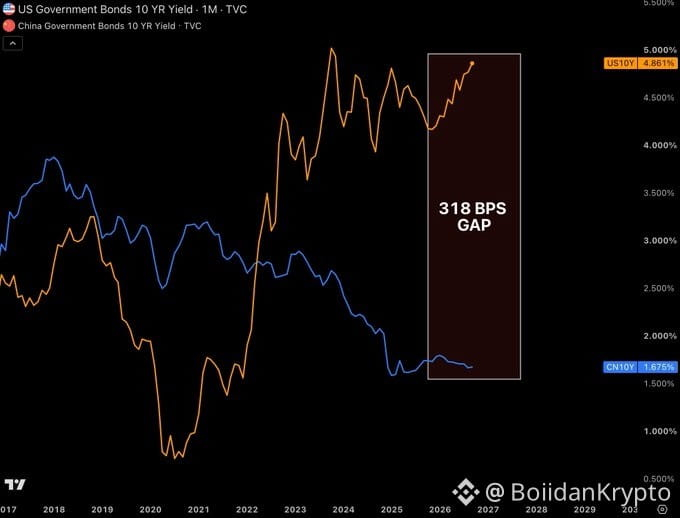
The US–China 10-year yield gap is blowing out to levels rarely seen in over a decade — and almost nobody's talking about what it means for your portfolio.
📈 US yields keep climbing — the Fed is white-knuckling its inflation fight, even as the Treasury quietly tries to talk yields back down.
📉 China's yields are pinned near record lows — weak growth data has the PBOC leaning harder toward stimulus.
Two of the world's biggest economies, moving in completely opposite directions. 🌍⚡
Question for the comments 👇
Is this the biggest macro divergence of the decade — or a bond trap in the making? Where does the spread go from here?
Drop your take below. Bulls vs. bears — let's hear it. 🔥
#Bonds #Macro #FederalReserve
$NVDA
{future}(NVDAUSDT)
$SPCX
{future}(SPCXUSDT)
$BTC
{future}(BTCUSDT)
🚨 BOND MARKET ALERT 🇺🇸🇨🇳
The US–China 10-year yield gap is blowing out to levels rarely seen in over a decade — and almost nobody's talking about what it means for your portfolio.
📈 US yields keep climbing — the Fed is white-knuckling its inflation fight, even as the Treasury quietly tries to talk yields back down.
📉 China's yields are pinned near record lows — weak growth data has the PBOC leaning harder toward stimulus.
Two of the world's biggest economies, moving in completely opposite directions. 🌍⚡
Question for the comments 👇
Is this the biggest macro divergence of the decade — or a bond trap in the making? Where does the spread go from here?
Drop your take below. Bulls vs. bears — let's hear it. 🔥
#Bonds #Macro #FederalReserve
$NVDA
$SPCX
$BTC
The US–China 10-year yield gap is blowing out to levels rarely seen in over a decade — and almost nobody's talking about what it means for your portfolio.
📈 US yields keep climbing — the Fed is white-knuckling its inflation fight, even as the Treasury quietly tries to talk yields back down.
📉 China's yields are pinned near record lows — weak growth data has the PBOC leaning harder toward stimulus.
Two of the world's biggest economies, moving in completely opposite directions. 🌍⚡
Question for the comments 👇
Is this the biggest macro divergence of the decade — or a bond trap in the making? Where does the spread go from here?
Drop your take below. Bulls vs. bears — let's hear it. 🔥
#Bonds #Macro #FederalReserve
$NVDA
$SPCX
$BTC
191
THE U.S. TREASURY IS ABOUT TO ENTER THE BOND MARKET WITH BILLIONS.
The Treasury is set to buy back up to $6 BILLION of longer-term U.S. debt tomorrow.
This is bigger than a routine transaction.
Treasury buybacks can help improve liquidity and put support under longer-dated bonds at a time when yields are elevated. The move comes as the 10-year yield is hovering around 4.8%, near its highest levels in years.
But here's the part markets should be watching:
The government is simultaneously running enormous deficits and actively managing the functioning of the Treasury market.
That means the bond market is becoming one of the most important pressure points for global markets.
If buybacks help push long-term yields lower, financial conditions could loosen.
That can ripple into stocks, gold, the dollar and Bitcoin.
But if investors continue demanding higher yields despite Treasury intervention, the message becomes much more uncomfortable:
The market wants more compensation to hold U.S. debt.
And that is a problem no buyback program can permanently solve.
The real battle isn't just about $6 billion.
It's about whether the world's largest bond market can absorb America's enormous borrowing needs without continuously demanding higher yields.
Tomorrow's buyback could be small.
The signal it sends could be enormous.
#Treasury #Bonds #Bitcoin #Gold #Markets
THE U.S. TREASURY IS ABOUT TO ENTER THE BOND MARKET WITH BILLIONS.
The Treasury is set to buy back up to $6 BILLION of longer-term U.S. debt tomorrow.
This is bigger than a routine transaction.
Treasury buybacks can help improve liquidity and put support under longer-dated bonds at a time when yields are elevated. The move comes as the 10-year yield is hovering around 4.8%, near its highest levels in years.
But here's the part markets should be watching:
The government is simultaneously running enormous deficits and actively managing the functioning of the Treasury market.
That means the bond market is becoming one of the most important pressure points for global markets.
If buybacks help push long-term yields lower, financial conditions could loosen.
That can ripple into stocks, gold, the dollar and Bitcoin.
But if investors continue demanding higher yields despite Treasury intervention, the message becomes much more uncomfortable:
The market wants more compensation to hold U.S. debt.
And that is a problem no buyback program can permanently solve.
The real battle isn't just about $6 billion.
It's about whether the world's largest bond market can absorb America's enormous borrowing needs without continuously demanding higher yields.
Tomorrow's buyback could be small.
The signal it sends could be enormous.
#Treasury #Bonds #Bitcoin #Gold #Markets
The Treasury is set to buy back up to $6 BILLION of longer-term U.S. debt tomorrow.
This is bigger than a routine transaction.
Treasury buybacks can help improve liquidity and put support under longer-dated bonds at a time when yields are elevated. The move comes as the 10-year yield is hovering around 4.8%, near its highest levels in years.
But here's the part markets should be watching:
The government is simultaneously running enormous deficits and actively managing the functioning of the Treasury market.
That means the bond market is becoming one of the most important pressure points for global markets.
If buybacks help push long-term yields lower, financial conditions could loosen.
That can ripple into stocks, gold, the dollar and Bitcoin.
But if investors continue demanding higher yields despite Treasury intervention, the message becomes much more uncomfortable:
The market wants more compensation to hold U.S. debt.
And that is a problem no buyback program can permanently solve.
The real battle isn't just about $6 billion.
It's about whether the world's largest bond market can absorb America's enormous borrowing needs without continuously demanding higher yields.
Tomorrow's buyback could be small.
The signal it sends could be enormous.
#Treasury #Bonds #Bitcoin #Gold #Markets

1
170
The UK Debt Management Office is preparing to price a syndicated gilt offering due January 2056 on Tuesday evening, with borrowing costs surging to levels unseen since 1998. Driven by an intense global bond sell-off that hit British debt harder than other developed markets, the UK's 30-year yield spiked to 5.83%, while the new issuance is priced 0.75 to 1 basis point above the 2055 notes.
This benchmark expansion—potentially raising up to £5 billion as a tap on an existing £59 billion line—highlights severe fiscal strain. Borrowing at the highest cost since the debt office was established over 25 years ago reflects deeply entrenched inflation expectations and growing market skepticism toward long-term sovereign debt sustainability.
Broadly, soaring gilt yields ripple across global fixed-income markets, pushing term premiums higher, tightening financial conditions, and reinforcing the 'higher-for-longer' rate backdrop across major economies. This dynamic continues to pressure both equity multiples and credit spreads worldwide.
For crypto, persistent surges in risk-free sovereign yields directly drain liquidity from risk-on assets. As capital retreats into defensive yields, $BTC and the broader market face headwinds, requiring sustained macroeconomic stabilization before high-beta momentum can genuinely reignite. 📉
#bonds #macroeconomics #liquidity
The UK Debt Management Office is preparing to price a syndicated gilt offering due January 2056 on Tuesday evening, with borrowing costs surging to levels unseen since 1998. Driven by an intense global bond sell-off that hit British debt harder than other developed markets, the UK's 30-year yield spiked to 5.83%, while the new issuance is priced 0.75 to 1 basis point above the 2055 notes.
This benchmark expansion—potentially raising up to £5 billion as a tap on an existing £59 billion line—highlights severe fiscal strain. Borrowing at the highest cost since the debt office was established over 25 years ago reflects deeply entrenched inflation expectations and growing market skepticism toward long-term sovereign debt sustainability.
Broadly, soaring gilt yields ripple across global fixed-income markets, pushing term premiums higher, tightening financial conditions, and reinforcing the 'higher-for-longer' rate backdrop across major economies. This dynamic continues to pressure both equity multiples and credit spreads worldwide.
For crypto, persistent surges in risk-free sovereign yields directly drain liquidity from risk-on assets. As capital retreats into defensive yields, $BTC and the broader market face headwinds, requiring sustained macroeconomic stabilization before high-beta momentum can genuinely reignite. 📉
#bonds #macroeconomics #liquidity
This benchmark expansion—potentially raising up to £5 billion as a tap on an existing £59 billion line—highlights severe fiscal strain. Borrowing at the highest cost since the debt office was established over 25 years ago reflects deeply entrenched inflation expectations and growing market skepticism toward long-term sovereign debt sustainability.
Broadly, soaring gilt yields ripple across global fixed-income markets, pushing term premiums higher, tightening financial conditions, and reinforcing the 'higher-for-longer' rate backdrop across major economies. This dynamic continues to pressure both equity multiples and credit spreads worldwide.
For crypto, persistent surges in risk-free sovereign yields directly drain liquidity from risk-on assets. As capital retreats into defensive yields, $BTC and the broader market face headwinds, requiring sustained macroeconomic stabilization before high-beta momentum can genuinely reignite. 📉
#bonds #macroeconomics #liquidity
16
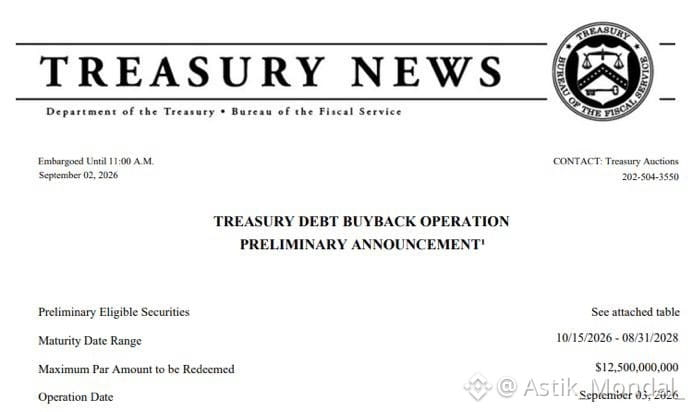
🚨 THE U.S. TREASURY IS ABOUT TO BUY BACK ITS OWN DEBT.
And the timing is WILD. 🇺🇸💵
The U.S. government is now spending more than $1 TRILLION a year just on interest.
Now Treasury is preparing to repurchase $12.5 BILLION of its own bonds as yields sit near their highest levels in almost TWO DECADES.
Why does this matter?
Because the bond market is becoming one of the biggest pressure points in the U.S. economy.
Higher yields = higher borrowing costs.
Higher borrowing costs = even more interest expense.
And now the Treasury is stepping into the market.
Just days ago at the G20, Treasury Secretary Scott Bessent said:
“I have not bought anything yet.”
But the bigger warning came from legendary investor Stanley Druckenmiller.
Bessent’s former mentor publicly argued that the government should NOT be intervening in the bond market.
That sets up a fascinating clash:
🇺🇸 Treasury wants to manage its debt burden.
📈 Bond investors want market forces to determine yields.
💰 Taxpayers are already facing a massive interest bill.
And if Treasury buybacks become larger or more frequent The bond market could become one of the biggest macro stories of the cycle.
Watch U.S. Treasuries closely.
Something BIG is changing underneath the surface.
#Bitcoin #Economy #Bonds #Markets #Finance
🚨 THE U.S. TREASURY IS ABOUT TO BUY BACK ITS OWN DEBT.
And the timing is WILD. 🇺🇸💵
The U.S. government is now spending more than $1 TRILLION a year just on interest.
Now Treasury is preparing to repurchase $12.5 BILLION of its own bonds as yields sit near their highest levels in almost TWO DECADES.
Why does this matter?
Because the bond market is becoming one of the biggest pressure points in the U.S. economy.
Higher yields = higher borrowing costs.
Higher borrowing costs = even more interest expense.
And now the Treasury is stepping into the market.
Just days ago at the G20, Treasury Secretary Scott Bessent said:
“I have not bought anything yet.”
But the bigger warning came from legendary investor Stanley Druckenmiller.
Bessent’s former mentor publicly argued that the government should NOT be intervening in the bond market.
That sets up a fascinating clash:
🇺🇸 Treasury wants to manage its debt burden.
📈 Bond investors want market forces to determine yields.
💰 Taxpayers are already facing a massive interest bill.
And if Treasury buybacks become larger or more frequent The bond market could become one of the biggest macro stories of the cycle.
Watch U.S. Treasuries closely.
Something BIG is changing underneath the surface.
#Bitcoin #Economy #Bonds #Markets #Finance
And the timing is WILD. 🇺🇸💵
The U.S. government is now spending more than $1 TRILLION a year just on interest.
Now Treasury is preparing to repurchase $12.5 BILLION of its own bonds as yields sit near their highest levels in almost TWO DECADES.
Why does this matter?
Because the bond market is becoming one of the biggest pressure points in the U.S. economy.
Higher yields = higher borrowing costs.
Higher borrowing costs = even more interest expense.
And now the Treasury is stepping into the market.
Just days ago at the G20, Treasury Secretary Scott Bessent said:
“I have not bought anything yet.”
But the bigger warning came from legendary investor Stanley Druckenmiller.
Bessent’s former mentor publicly argued that the government should NOT be intervening in the bond market.
That sets up a fascinating clash:
🇺🇸 Treasury wants to manage its debt burden.
📈 Bond investors want market forces to determine yields.
💰 Taxpayers are already facing a massive interest bill.
And if Treasury buybacks become larger or more frequent The bond market could become one of the biggest macro stories of the cycle.
Watch U.S. Treasuries closely.
Something BIG is changing underneath the surface.
#Bitcoin #Economy #Bonds #Markets #Finance

1
43

Article
Bond markets face selling pressure as inflation risks returnGlobal bond markets came under renewed pressure on Monday as a sharp rise in oil prices intensified concerns that inflation could remain stubborn and force central banks to keep interest rates higher. Short-term borrowing costs in Europe and Japan climbed to multiyear highs.
The selloff accelerated after Brent crude rose above $90 a barrel amid renewed military action between the United States and Iran. The oil move added another inflation risk just as investors were reassessing the outlook for monetary policy following Federal Reserve Chair Kevin Warsh’s Jackson Hole speech, Reuters reported.
Bond yields climb across major markets
Japan’s two-year government bond yield reached its highest level in 31 years, reflecting expectations that inflationary pressure could keep the Bank of Japan on a tighter policy path. In Europe, two-year German and French yields climbed to their highest levels since 2024.
Pressure extended further along the European yield curve. Longer-dated euro-area yields reached their highest levels in more than 15 years, continuing a broader rise in borrowing costs that has gathered momentum in recent weeks.
The latest oil shock gives bond investors another reason to demand higher yields. More expensive energy can feed into transportation, manufacturing, and consumer costs, complicating efforts by central banks to bring inflation sustainably under control.
The European Central Bank is widely expected to raise rates at its September 9-10 meeting, adding to the pressure on government debt.
Fed expectations add to selling pressure
The repricing has also reached U.S. monetary policy. Markets now assign roughly a 60% probability to a Federal Reserve rate increase in September, up from less than 50% last week.
Warsh’s Jackson Hole remarks reinforced expectations that the Fed could respond more aggressively if inflation remains elevated. Barclays now expects quarter-point increases in both September and December, while some economists continue to see December as the more likely starting point.
Stocks reflected the same caution without matching the scale of the bond move. Europe’s STOXX 600 slipped about 0.2%, while U.S. equity futures edged lower. Gold, meanwhile, was heading toward its strongest monthly performance since January.
Higher yields raise the stakes for markets
The combination of rising energy prices and hawkish central-bank expectations leaves bonds exposed to further selling if inflation risks intensify. Brent above $90 has become particularly important because another sustained energy shock could undermine assumptions that price pressures will continue easing.
For investors, the next question is whether higher yields represent another temporary geopolitical shock or the beginning of a more durable repricing of global interest rates.
We have previously highlighted that U.S. Treasury Secretary Bessent urges the G20 to increase pressure on China.
#world #bonds
Bond markets face selling pressure as inflation risks return
Global bond markets came under renewed pressure on Monday as a sharp rise in oil prices intensified concerns that inflation could remain stubborn and force central banks to keep interest rates higher. Short-term borrowing costs in Europe and Japan climbed to multiyear highs.
The selloff accelerated after Brent crude rose above $90 a barrel amid renewed military action between the United States and Iran. The oil move added another inflation risk just as investors were reassessing the outlook for monetary policy following Federal Reserve Chair Kevin Warsh’s Jackson Hole speech, Reuters reported.
Bond yields climb across major markets
Japan’s two-year government bond yield reached its highest level in 31 years, reflecting expectations that inflationary pressure could keep the Bank of Japan on a tighter policy path. In Europe, two-year German and French yields climbed to their highest levels since 2024.
Pressure extended further along the European yield curve. Longer-dated euro-area yields reached their highest levels in more than 15 years, continuing a broader rise in borrowing costs that has gathered momentum in recent weeks.
The latest oil shock gives bond investors another reason to demand higher yields. More expensive energy can feed into transportation, manufacturing, and consumer costs, complicating efforts by central banks to bring inflation sustainably under control.
The European Central Bank is widely expected to raise rates at its September 9-10 meeting, adding to the pressure on government debt.
Fed expectations add to selling pressure
The repricing has also reached U.S. monetary policy. Markets now assign roughly a 60% probability to a Federal Reserve rate increase in September, up from less than 50% last week.
Warsh’s Jackson Hole remarks reinforced expectations that the Fed could respond more aggressively if inflation remains elevated. Barclays now expects quarter-point increases in both September and December, while some economists continue to see December as the more likely starting point.
Stocks reflected the same caution without matching the scale of the bond move. Europe’s STOXX 600 slipped about 0.2%, while U.S. equity futures edged lower. Gold, meanwhile, was heading toward its strongest monthly performance since January.
Higher yields raise the stakes for markets
The combination of rising energy prices and hawkish central-bank expectations leaves bonds exposed to further selling if inflation risks intensify. Brent above $90 has become particularly important because another sustained energy shock could undermine assumptions that price pressures will continue easing.
For investors, the next question is whether higher yields represent another temporary geopolitical shock or the beginning of a more durable repricing of global interest rates.
We have previously highlighted that U.S. Treasury Secretary Bessent urges the G20 to increase pressure on China.
#world #bonds
The selloff accelerated after Brent crude rose above $90 a barrel amid renewed military action between the United States and Iran. The oil move added another inflation risk just as investors were reassessing the outlook for monetary policy following Federal Reserve Chair Kevin Warsh’s Jackson Hole speech, Reuters reported.
Bond yields climb across major markets
Japan’s two-year government bond yield reached its highest level in 31 years, reflecting expectations that inflationary pressure could keep the Bank of Japan on a tighter policy path. In Europe, two-year German and French yields climbed to their highest levels since 2024.
Pressure extended further along the European yield curve. Longer-dated euro-area yields reached their highest levels in more than 15 years, continuing a broader rise in borrowing costs that has gathered momentum in recent weeks.
The latest oil shock gives bond investors another reason to demand higher yields. More expensive energy can feed into transportation, manufacturing, and consumer costs, complicating efforts by central banks to bring inflation sustainably under control.
The European Central Bank is widely expected to raise rates at its September 9-10 meeting, adding to the pressure on government debt.
Fed expectations add to selling pressure
The repricing has also reached U.S. monetary policy. Markets now assign roughly a 60% probability to a Federal Reserve rate increase in September, up from less than 50% last week.
Warsh’s Jackson Hole remarks reinforced expectations that the Fed could respond more aggressively if inflation remains elevated. Barclays now expects quarter-point increases in both September and December, while some economists continue to see December as the more likely starting point.
Stocks reflected the same caution without matching the scale of the bond move. Europe’s STOXX 600 slipped about 0.2%, while U.S. equity futures edged lower. Gold, meanwhile, was heading toward its strongest monthly performance since January.
Higher yields raise the stakes for markets
The combination of rising energy prices and hawkish central-bank expectations leaves bonds exposed to further selling if inflation risks intensify. Brent above $90 has become particularly important because another sustained energy shock could undermine assumptions that price pressures will continue easing.
For investors, the next question is whether higher yields represent another temporary geopolitical shock or the beginning of a more durable repricing of global interest rates.
We have previously highlighted that U.S. Treasury Secretary Bessent urges the G20 to increase pressure on China.
#world #bonds
1
191
U.S. Treasury Secretary Janet Yellen recently addressed mounting concerns regarding stress in the sovereign debt market, firmly dismissing claims of dysfunction. Speaking on current economic conditions, Yellen emphasized that she does not see turmoil in the U.S. Treasury market, asserting it continues to outperform peers despite a massive fiscal deficit.
Her remarks aim to anchor market sentiment at a time when sticky energy prices and escalating Middle East tensions involving Iran have exerted upward pressure on long-term yields. By defending Treasury buybacks as non-disruptive, Yellen is actively pushing back against central banker critiques to preserve predictable debt management.
For traditional finance, this reassurance helps stabilize the bond market, preventing a sharp spike in yields that could otherwise strengthen the DXY and rattle equities. If energy-driven inflation softens as projected, rate volatility should subside, providing breathing room for risk assets.
For the crypto ecosystem, stable debt markets reduce the threat of aggressive liquidity drainage, keeping capital rotation into $BTC and digital assets viable as macro panic eases.
#treasury #economy #bonds
U.S. Treasury Secretary Janet Yellen recently addressed mounting concerns regarding stress in the sovereign debt market, firmly dismissing claims of dysfunction. Speaking on current economic conditions, Yellen emphasized that she does not see turmoil in the U.S. Treasury market, asserting it continues to outperform peers despite a massive fiscal deficit.
Her remarks aim to anchor market sentiment at a time when sticky energy prices and escalating Middle East tensions involving Iran have exerted upward pressure on long-term yields. By defending Treasury buybacks as non-disruptive, Yellen is actively pushing back against central banker critiques to preserve predictable debt management.
For traditional finance, this reassurance helps stabilize the bond market, preventing a sharp spike in yields that could otherwise strengthen the DXY and rattle equities. If energy-driven inflation softens as projected, rate volatility should subside, providing breathing room for risk assets.
For the crypto ecosystem, stable debt markets reduce the threat of aggressive liquidity drainage, keeping capital rotation into $BTC and digital assets viable as macro panic eases.
#treasury #economy #bonds
Her remarks aim to anchor market sentiment at a time when sticky energy prices and escalating Middle East tensions involving Iran have exerted upward pressure on long-term yields. By defending Treasury buybacks as non-disruptive, Yellen is actively pushing back against central banker critiques to preserve predictable debt management.
For traditional finance, this reassurance helps stabilize the bond market, preventing a sharp spike in yields that could otherwise strengthen the DXY and rattle equities. If energy-driven inflation softens as projected, rate volatility should subside, providing breathing room for risk assets.
For the crypto ecosystem, stable debt markets reduce the threat of aggressive liquidity drainage, keeping capital rotation into $BTC and digital assets viable as macro panic eases.
#treasury #economy #bonds
77
Connectez-vous pour découvrir plus de contenu
Rejoignez la communauté mondiale des adeptes de cryptomonnaies sur Binance Square
⚡️ Suviez les dernières informations importantes sur les cryptomonnaies.
💬 Jugé digne de confiance par la plus grande plateforme d’échange de cryptomonnaies au monde.
👍 Découvrez les connaissances que partagent les créateurs vérifiés.
Adresse e-mail/Nº de téléphone
Sujets d’actualité
1
#EtherGains70.9%InQ3
122,928 vues
1,029 mentions
2
#TreasuryLetsStatesFileStablecoinCertificationsEarly
6,663 vues
73 mentions
3
#US10YearYieldNears5.3%
134,037 vues
1,061 mentions
4
#DollarIndexHitsHighestSinceMay2025
30,437 vues
554 mentions
5
#USWeeklyJoblessClaimsFallTo197000
29,256 vues
466 mentions
6
#BitcoinETFsTake$6.34BillionInQ3
8,746 vues
70 mentions
7
#KoreaProposesTokenizingStocksAndBonds
66,018 vues
802 mentions
8
#MetaMaskExitsLidoValidatorsAfterSecurityIncident
163,902 vues
1,522 mentions
9
#MicronBeatsEarningsLiftsGuidance
82,512 vues
1,104 mentions
10
#CFTCSubmitsTwoEventContractRulesToWhiteHouse
56,473 vues
823 mentions