

#avax
avax
197.8M vues
609,830 mentions
Populaire
Récents

$AVAX
{spot}(AVAXUSDT)
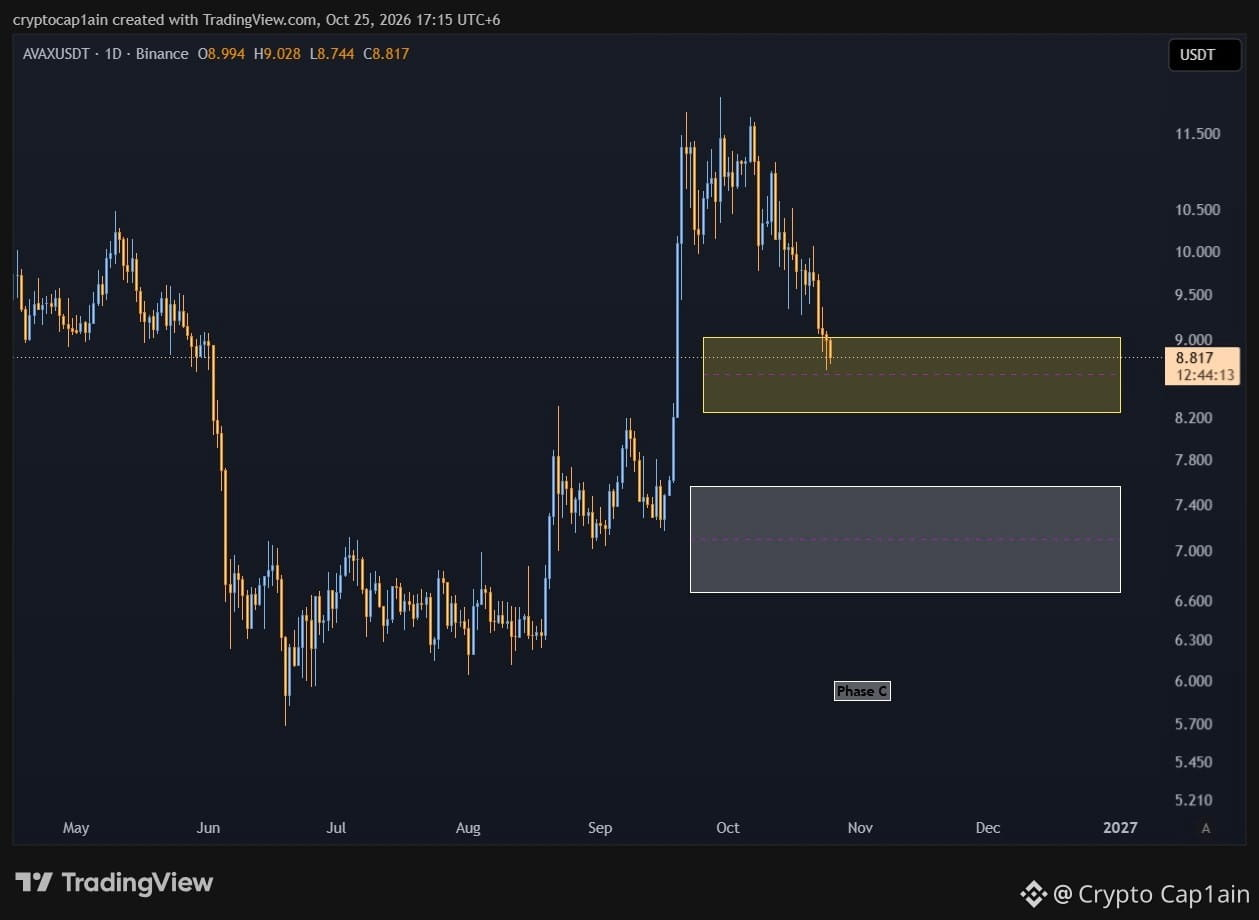
Last time we bought AVAX, it gave us a 63% profit. Now it’s ongoing a correction.
I have put Fibonacci tool on it and drawn two boxes for you. Currently, it’s inside the yellow box. This box is a strong support box. As long as it holds, we can expect a good pump on AVAX from it.
However, if this box fails to hold then a deeper correction is waiting for AVAX. This correction will take AVAX to the white box which is another support.
My advice will be buy some little here and dca at the white box. Let's see what comes next.
#AVAX #Avalanche
$AVAX
Last time we bought AVAX, it gave us a 63% profit. Now it’s ongoing a correction.
I have put Fibonacci tool on it and drawn two boxes for you. Currently, it’s inside the yellow box. This box is a strong support box. As long as it holds, we can expect a good pump on AVAX from it.
However, if this box fails to hold then a deeper correction is waiting for AVAX. This correction will take AVAX to the white box which is another support.
My advice will be buy some little here and dca at the white box. Let's see what comes next.
#AVAX #Avalanche
Last time we bought AVAX, it gave us a 63% profit. Now it’s ongoing a correction.
I have put Fibonacci tool on it and drawn two boxes for you. Currently, it’s inside the yellow box. This box is a strong support box. As long as it holds, we can expect a good pump on AVAX from it.
However, if this box fails to hold then a deeper correction is waiting for AVAX. This correction will take AVAX to the white box which is another support.
My advice will be buy some little here and dca at the white box. Let's see what comes next.
#AVAX #Avalanche
ENİS-20X:
Could it hit $5.75 - $6.00 ?
2
8
3.2k

$AVAX Token Price Forecast 🚀✨🤣🔥💥⚡
If you short-sell $ 1,000.00 worth of Avalanche today and repurchase it on Dec 29, 2026, you could make a potential profit of $ 229.84, reflecting a 22.98% ROI over the next 66 days.
The coin would be a profitable asset in the short term, even though it might have strong fundamentals.
Price Prediction 2026
According to the technical analysis of prices expected in 2026, the minimum cost of will be $9.26 The maximum level that the AVAX price can reach is $26.11 The average trading price is expected around $20.50
Price Prediction 2027
After the analysis of the prices of in previous years, it is assumed that in 2027, the minimum price of will be around $18.26 The maximum expected AVAX price may be around $37.48. On average, the trading price might be $34.88 in 2026.
Price Prediction 2028
Based on the technical analysis by cryptocurrency experts regarding the prices of , in 2028, AVAX is expected to have the following minimum and maximum prices: about $71.93 and $85.4, respectively. The average expected trading cost is $74.44.
Price Prediction 2029
The experts in the field of cryptocurrency have analyzed the prices of and their fluctuations during the previous years. It is assumed that in 2029, the minimum AVAX price might drop to $106.24, while its maximum can reach $123.62. On average, the trading cost will be around $109.22.
Please🙏 Follow Me ❤
#AVAX
$AVAX Token Price Forecast 🚀✨🤣🔥💥⚡
If you short-sell $ 1,000.00 worth of Avalanche today and repurchase it on Dec 29, 2026, you could make a potential profit of $ 229.84, reflecting a 22.98% ROI over the next 66 days.
The coin would be a profitable asset in the short term, even though it might have strong fundamentals.
Price Prediction 2026
According to the technical analysis of prices expected in 2026, the minimum cost of will be $9.26 The maximum level that the AVAX price can reach is $26.11 The average trading price is expected around $20.50
Price Prediction 2027
After the analysis of the prices of in previous years, it is assumed that in 2027, the minimum price of will be around $18.26 The maximum expected AVAX price may be around $37.48. On average, the trading price might be $34.88 in 2026.
Price Prediction 2028
Based on the technical analysis by cryptocurrency experts regarding the prices of , in 2028, AVAX is expected to have the following minimum and maximum prices: about $71.93 and $85.4, respectively. The average expected trading cost is $74.44.
Price Prediction 2029
The experts in the field of cryptocurrency have analyzed the prices of and their fluctuations during the previous years. It is assumed that in 2029, the minimum AVAX price might drop to $106.24, while its maximum can reach $123.62. On average, the trading cost will be around $109.22.
Please🙏 Follow Me ❤
#AVAX
If you short-sell $ 1,000.00 worth of Avalanche today and repurchase it on Dec 29, 2026, you could make a potential profit of $ 229.84, reflecting a 22.98% ROI over the next 66 days.
The coin would be a profitable asset in the short term, even though it might have strong fundamentals.
Price Prediction 2026
According to the technical analysis of prices expected in 2026, the minimum cost of will be $9.26 The maximum level that the AVAX price can reach is $26.11 The average trading price is expected around $20.50
Price Prediction 2027
After the analysis of the prices of in previous years, it is assumed that in 2027, the minimum price of will be around $18.26 The maximum expected AVAX price may be around $37.48. On average, the trading price might be $34.88 in 2026.
Price Prediction 2028
Based on the technical analysis by cryptocurrency experts regarding the prices of , in 2028, AVAX is expected to have the following minimum and maximum prices: about $71.93 and $85.4, respectively. The average expected trading cost is $74.44.
Price Prediction 2029
The experts in the field of cryptocurrency have analyzed the prices of and their fluctuations during the previous years. It is assumed that in 2029, the minimum AVAX price might drop to $106.24, while its maximum can reach $123.62. On average, the trading cost will be around $109.22.
Please🙏 Follow Me ❤
#AVAX

3
1.1k


🟢 $AVAX /USDT — LONG SETUP 📈🚀
━━━━━━━━━━━━━━
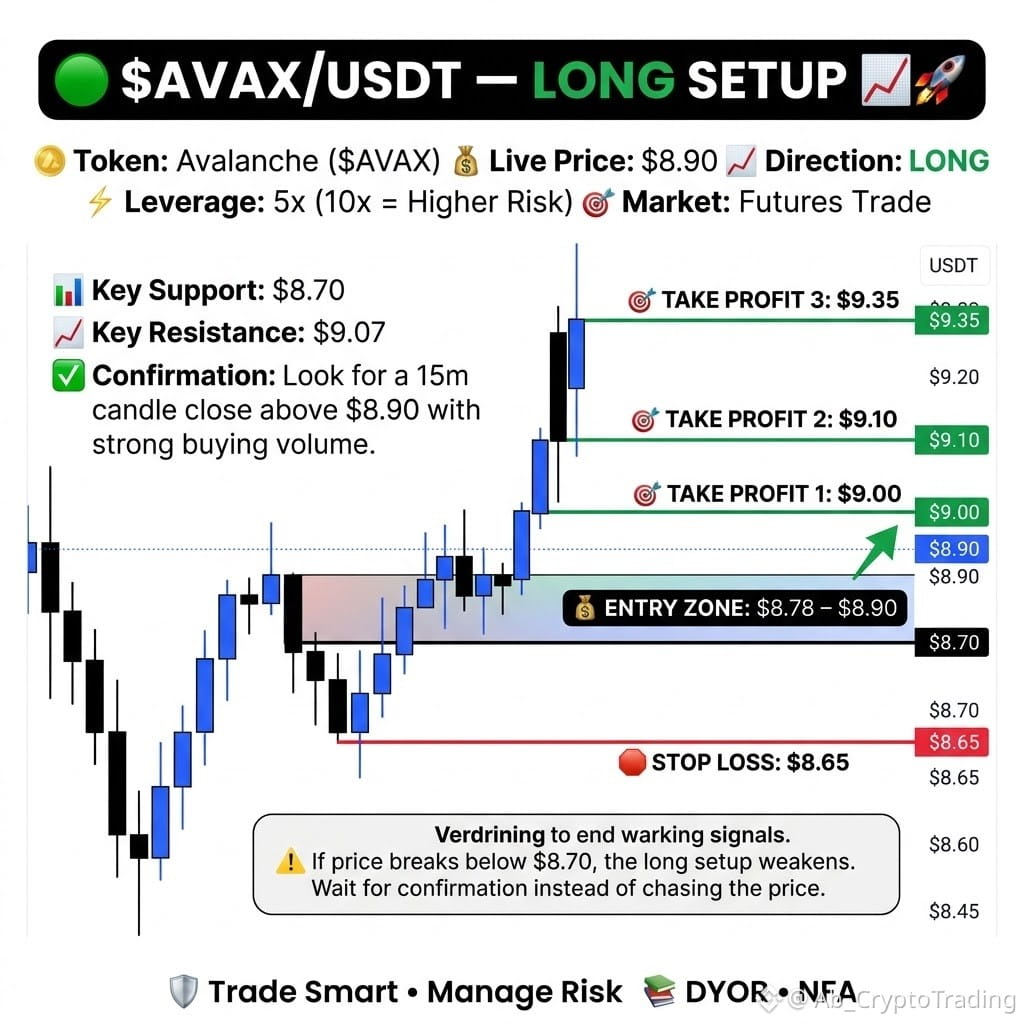
💰 Entry Zone: $8.78 – $8.90
🎯 Take Profit 1: $9.00 🎯 Take Profit 2: $9.10 🎯 Take Profit 3: $9.35
🛑 Stop Loss: $8.65
━━━━━━━━━━━━━━
📊 Key Support: $8.70 📈 Key Resistance: $9.07 ✅ Confirmation: Look for a 15m candle close above $8.90 with strong buying volume.
⚠️ If price breaks below $8.70, the long setup weakens. Wait for confirmation instead of chasing the price.
🛡️ Trade Smart • Manage Risk 📚 DYOR • NFA
#AVAX #BinancePick #EarningsSeason #AnthropicTTMRevenueGrewAbout1200% #AnthropicS1ExpectedToday
🟢 $AVAX /USDT — LONG SETUP 📈🚀
━━━━━━━━━━━━━━
💰 Entry Zone: $8.78 – $8.90
🎯 Take Profit 1: $9.00 🎯 Take Profit 2: $9.10 🎯 Take Profit 3: $9.35
🛑 Stop Loss: $8.65
━━━━━━━━━━━━━━
📊 Key Support: $8.70 📈 Key Resistance: $9.07 ✅ Confirmation: Look for a 15m candle close above $8.90 with strong buying volume.
⚠️ If price breaks below $8.70, the long setup weakens. Wait for confirmation instead of chasing the price.
🛡️ Trade Smart • Manage Risk 📚 DYOR • NFA
#AVAX #BinancePick #EarningsSeason #AnthropicTTMRevenueGrewAbout1200% #AnthropicS1ExpectedToday
━━━━━━━━━━━━━━
💰 Entry Zone: $8.78 – $8.90
🎯 Take Profit 1: $9.00 🎯 Take Profit 2: $9.10 🎯 Take Profit 3: $9.35
🛑 Stop Loss: $8.65
━━━━━━━━━━━━━━
📊 Key Support: $8.70 📈 Key Resistance: $9.07 ✅ Confirmation: Look for a 15m candle close above $8.90 with strong buying volume.
⚠️ If price breaks below $8.70, the long setup weakens. Wait for confirmation instead of chasing the price.
🛡️ Trade Smart • Manage Risk 📚 DYOR • NFA
#AVAX #BinancePick #EarningsSeason #AnthropicTTMRevenueGrewAbout1200% #AnthropicS1ExpectedToday
1
23

·
--
Haussier
🚨 ALTCOIN BOUNCE INCOMING… OR ANOTHER TRAP? 👀
Live Binance spot data 📊
🟢 $AVAX — $8.887 | +0.95%
Resistance: $8.994
🔵 $LINK — $11.402 | +0.41%
Resistance: $11.554
⚡ $SOL — $100.93 | +0.31%
Resistance: $102.27
BTC is down 0.75% in 24H, so will these altcoins hold their strength if Bitcoin keeps falling? 👀
🎯 Watch for a resistance breakout with volume confirmation. No chasing green candles!
👇 Pick your strongest coin: AVAX, LINK, or SOL?
#EarningsSeason #AVAX #LINK #Binance #ArgentineCourtDismissesLIBRACaseAgainstMilei
🚨 ALTCOIN BOUNCE INCOMING… OR ANOTHER TRAP? 👀
Live Binance spot data 📊
🟢 $AVAX — $8.887 | +0.95%
Resistance: $8.994
🔵 $LINK — $11.402 | +0.41%
Resistance: $11.554
⚡ $SOL — $100.93 | +0.31%
Resistance: $102.27
BTC is down 0.75% in 24H, so will these altcoins hold their strength if Bitcoin keeps falling? 👀
🎯 Watch for a resistance breakout with volume confirmation. No chasing green candles!
👇 Pick your strongest coin: AVAX, LINK, or SOL?
#EarningsSeason #AVAX #LINK #Binance #ArgentineCourtDismissesLIBRACaseAgainstMilei
Live Binance spot data 📊
🟢 $AVAX — $8.887 | +0.95%
Resistance: $8.994
🔵 $LINK — $11.402 | +0.41%
Resistance: $11.554
⚡ $SOL — $100.93 | +0.31%
Resistance: $102.27
BTC is down 0.75% in 24H, so will these altcoins hold their strength if Bitcoin keeps falling? 👀
🎯 Watch for a resistance breakout with volume confirmation. No chasing green candles!
👇 Pick your strongest coin: AVAX, LINK, or SOL?
#EarningsSeason #AVAX #LINK #Binance #ArgentineCourtDismissesLIBRACaseAgainstMilei
1
59

·
--
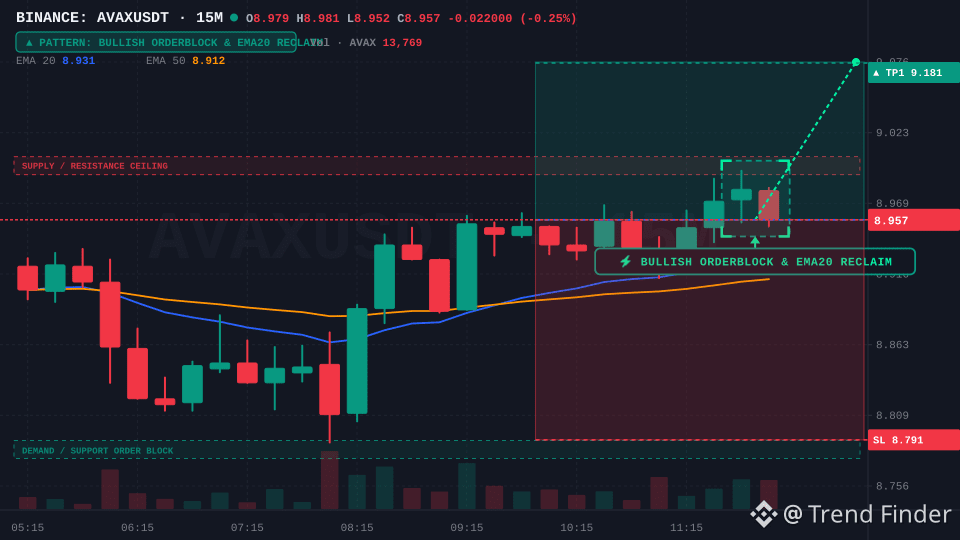
Strong spot bids are actively defending the current $AVAX range while $BTC consolidates. This verified 55-pt 15M LONG breakout and EMA20 reclaim with RSI 56 signals that institutional players are front-running the pump.
Entry: 8.957 | SL: 8.791 | TP1: 9.181 | TP2: 9.331 (R:R 1:2.25)
#BinanceSquare #CryptoTrading #AVAX
Strong spot bids are actively defending the current $AVAX range while $BTC consolidates. This verified 55-pt 15M LONG breakout and EMA20 reclaim with RSI 56 signals that institutional players are front-running the pump.
Entry: 8.957 | SL: 8.791 | TP1: 9.181 | TP2: 9.331 (R:R 1:2.25)
#BinanceSquare #CryptoTrading #AVAX
Entry: 8.957 | SL: 8.791 | TP1: 9.181 | TP2: 9.331 (R:R 1:2.25)
#BinanceSquare #CryptoTrading #AVAX

·
--
AVAX/USDT – 1H Market Outlook
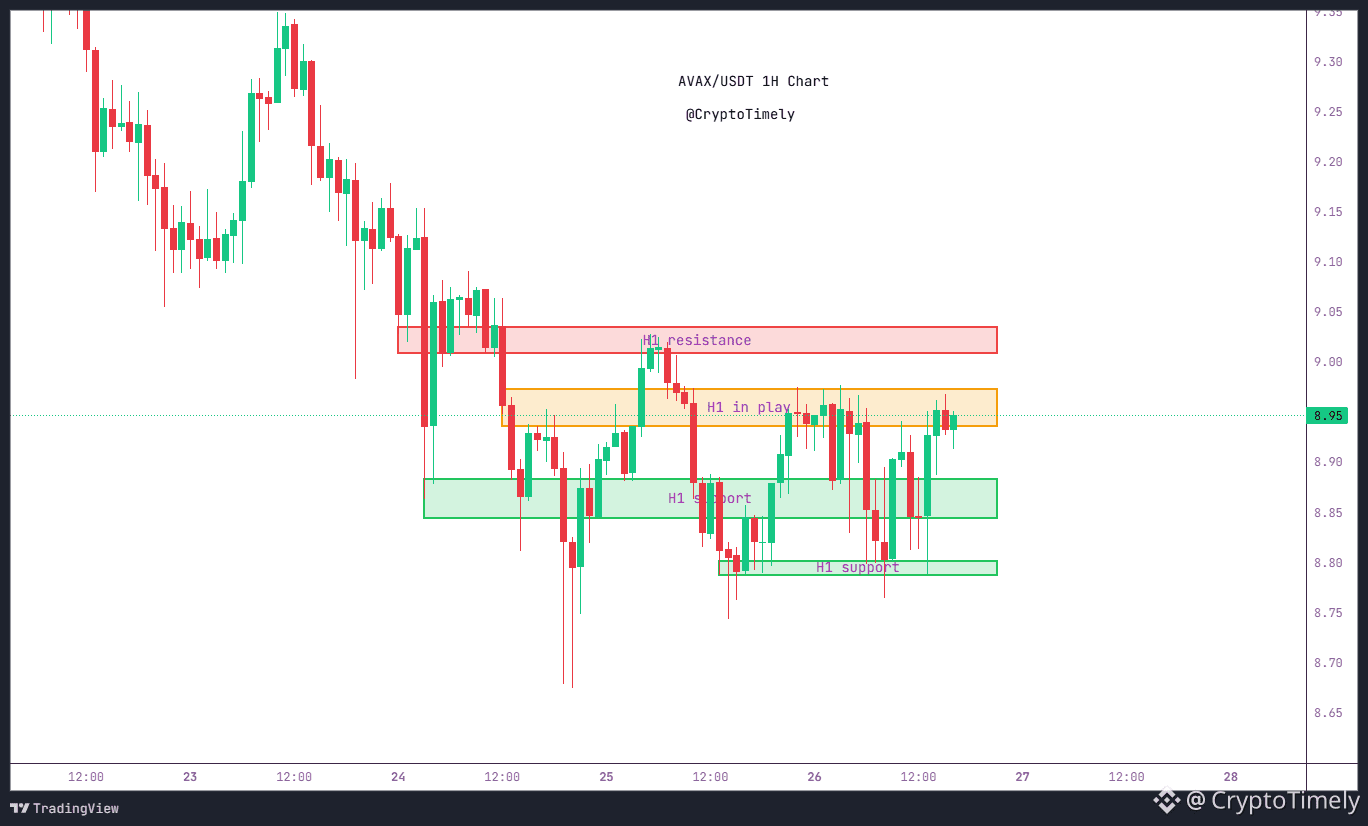
$AVAX remains in a weak 1H downtrend but is currently consolidating. The last 1H candle closed at 8.93, with price trading near 8.92.
Resistance stands at 8.93- 8.97.
A confirmed 1H close above 8.97 could improve the short-term structure, while a break below support at 8.78 - 8.80 could open the way toward 8.67.
Daily Outlook: Price remains range-bound, with support at 8.11 - 8.37 and resistance at 9.15 - 9.40.
#AVAX #AvalancheAVAX
$AVAX
{future}(AVAXUSDT)
AVAX/USDT – 1H Market Outlook
$AVAX remains in a weak 1H downtrend but is currently consolidating. The last 1H candle closed at 8.93, with price trading near 8.92.
Resistance stands at 8.93- 8.97.
A confirmed 1H close above 8.97 could improve the short-term structure, while a break below support at 8.78 - 8.80 could open the way toward 8.67.
Daily Outlook: Price remains range-bound, with support at 8.11 - 8.37 and resistance at 9.15 - 9.40.
#AVAX #AvalancheAVAX
$AVAX
$AVAX remains in a weak 1H downtrend but is currently consolidating. The last 1H candle closed at 8.93, with price trading near 8.92.
Resistance stands at 8.93- 8.97.
A confirmed 1H close above 8.97 could improve the short-term structure, while a break below support at 8.78 - 8.80 could open the way toward 8.67.
Daily Outlook: Price remains range-bound, with support at 8.11 - 8.37 and resistance at 9.15 - 9.40.
#AVAX #AvalancheAVAX
$AVAX
63
·
--
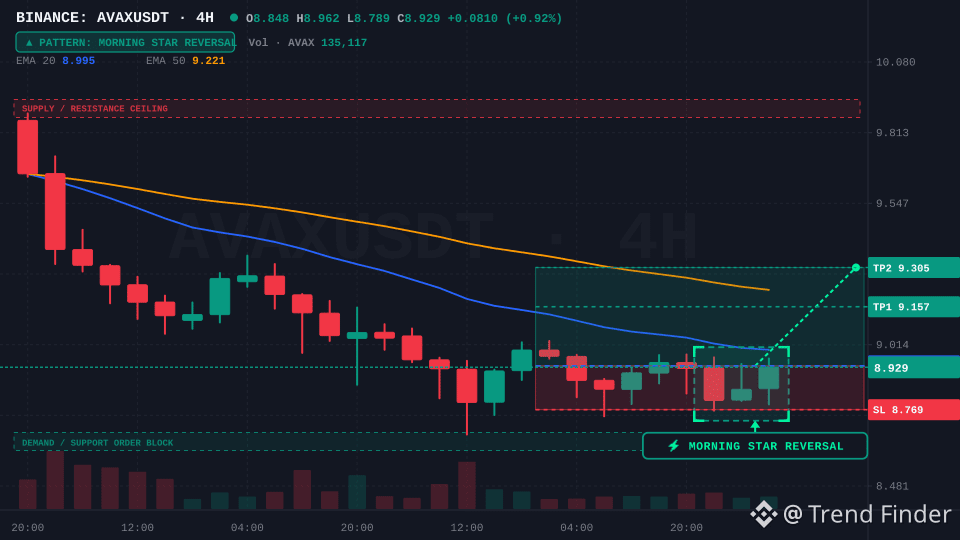
Bears are hitting a massive wall of buy-side liquidity on $AVAX right now. Institutional bids are silently absorbing every sell order at the 4H EMA20, forcing a squeeze while $BTC stays buoyant. This Morning Star reversal is a clear 55-point breakout with RSI holding at 56.
Entry: 8.934
SL: 8.769
TP1: 9.157
TP2: 9.305
#BinanceSquare #CryptoTrading #AVAX
Bears are hitting a massive wall of buy-side liquidity on $AVAX right now. Institutional bids are silently absorbing every sell order at the 4H EMA20, forcing a squeeze while $BTC stays buoyant. This Morning Star reversal is a clear 55-point breakout with RSI holding at 56.
Entry: 8.934
SL: 8.769
TP1: 9.157
TP2: 9.305
#BinanceSquare #CryptoTrading #AVAX
Entry: 8.934
SL: 8.769
TP1: 9.157
TP2: 9.305
#BinanceSquare #CryptoTrading #AVAX
3

·
--
📊 $AVAX : Bullish Reversal Setup in Focus
Avalanche is trading near $8.83, testing support within a 1H falling wedge.
🔑 Key Levels:
Resistance: $9.50–$10.00
Upside Target: $11.70
A breakout above $10 could signal a momentum shift toward $11.70, but confirmation is essential.
⚠️ Bears remain in control until buyers reclaim resistance. Watch the breakout, not the hype.
#AVAX #Avalanche #Crypto #Binance #Crypto
📊 $AVAX : Bullish Reversal Setup in Focus
Avalanche is trading near $8.83, testing support within a 1H falling wedge.
🔑 Key Levels:
Resistance: $9.50–$10.00
Upside Target: $11.70
A breakout above $10 could signal a momentum shift toward $11.70, but confirmation is essential.
⚠️ Bears remain in control until buyers reclaim resistance. Watch the breakout, not the hype.
#AVAX #Avalanche #Crypto #Binance #Crypto
Avalanche is trading near $8.83, testing support within a 1H falling wedge.
🔑 Key Levels:
Resistance: $9.50–$10.00
Upside Target: $11.70
A breakout above $10 could signal a momentum shift toward $11.70, but confirmation is essential.
⚠️ Bears remain in control until buyers reclaim resistance. Watch the breakout, not the hype.
#AVAX #Avalanche #Crypto #Binance #Crypto
2
53

🚀 $AVAX BREAKOUT ALERT! 🔥 $9.00 NEXT OR CRASH TO $8.67? 👀
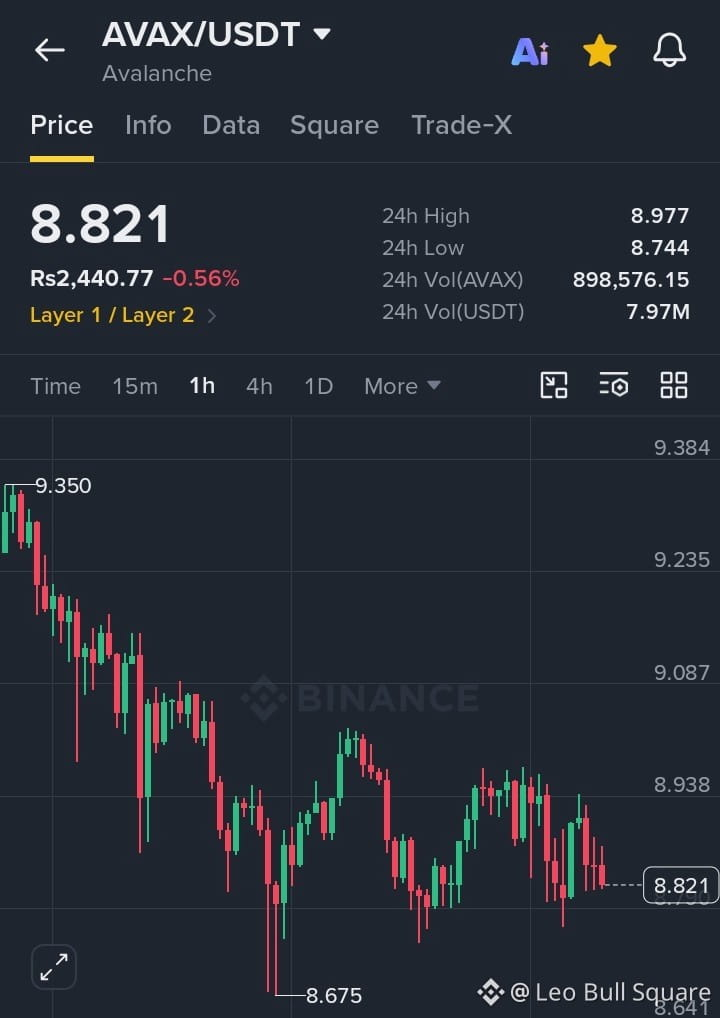
🚨 $AVAX /USDT is trading at $8.821, down 0.56%, as bulls battle bears near a crucial support zone! The 1-hour chart reveals a bearish structure with lower highs, but repeated rebounds suggest buyers are defending the $8.75–$8.80 demand zone. A strong breakout above $8.94 could trigger bullish momentum toward $9.08–$9.35. However, losing $8.75 may expose the previous swing low at $8.675. ⚡
📊 Technical Trading Setup:
- 🟢 Entry Watch: $8.80–$8.85 after bullish confirmation
- 🎯 Target 1: $8.94
- 🎯 Target 2: $9.08
- 🚀 Target 3: $9.35
- 🛑 Stop-Loss Idea: Below $8.74
- 🔥 Bullish Trigger: 1H candle close above $8.94
💥 TRADERS, WATCH THIS LEVEL! A breakout backed by strong volume could spark a recovery rally, while rejection may keep sellers in control. Wait for confirmation, manage risk, and avoid chasing fake breakouts!
#AVAX #Avalanche #CryptoTrading #Binance #Altcoins #CryptoSignals
#AVAX
{spot}(AVAXUSDT)
🚀 $AVAX BREAKOUT ALERT! 🔥 $9.00 NEXT OR CRASH TO $8.67? 👀
🚨 $AVAX /USDT is trading at $8.821, down 0.56%, as bulls battle bears near a crucial support zone! The 1-hour chart reveals a bearish structure with lower highs, but repeated rebounds suggest buyers are defending the $8.75–$8.80 demand zone. A strong breakout above $8.94 could trigger bullish momentum toward $9.08–$9.35. However, losing $8.75 may expose the previous swing low at $8.675. ⚡
📊 Technical Trading Setup:
- 🟢 Entry Watch: $8.80–$8.85 after bullish confirmation
- 🎯 Target 1: $8.94
- 🎯 Target 2: $9.08
- 🚀 Target 3: $9.35
- 🛑 Stop-Loss Idea: Below $8.74
- 🔥 Bullish Trigger: 1H candle close above $8.94
💥 TRADERS, WATCH THIS LEVEL! A breakout backed by strong volume could spark a recovery rally, while rejection may keep sellers in control. Wait for confirmation, manage risk, and avoid chasing fake breakouts!
#AVAX #Avalanche #CryptoTrading #Binance #Altcoins #CryptoSignals
#AVAX
🚨 $AVAX /USDT is trading at $8.821, down 0.56%, as bulls battle bears near a crucial support zone! The 1-hour chart reveals a bearish structure with lower highs, but repeated rebounds suggest buyers are defending the $8.75–$8.80 demand zone. A strong breakout above $8.94 could trigger bullish momentum toward $9.08–$9.35. However, losing $8.75 may expose the previous swing low at $8.675. ⚡
📊 Technical Trading Setup:
- 🟢 Entry Watch: $8.80–$8.85 after bullish confirmation
- 🎯 Target 1: $8.94
- 🎯 Target 2: $9.08
- 🚀 Target 3: $9.35
- 🛑 Stop-Loss Idea: Below $8.74
- 🔥 Bullish Trigger: 1H candle close above $8.94
💥 TRADERS, WATCH THIS LEVEL! A breakout backed by strong volume could spark a recovery rally, while rejection may keep sellers in control. Wait for confirmation, manage risk, and avoid chasing fake breakouts!
#AVAX #Avalanche #CryptoTrading #Binance #Altcoins #CryptoSignals
#AVAX
1
79

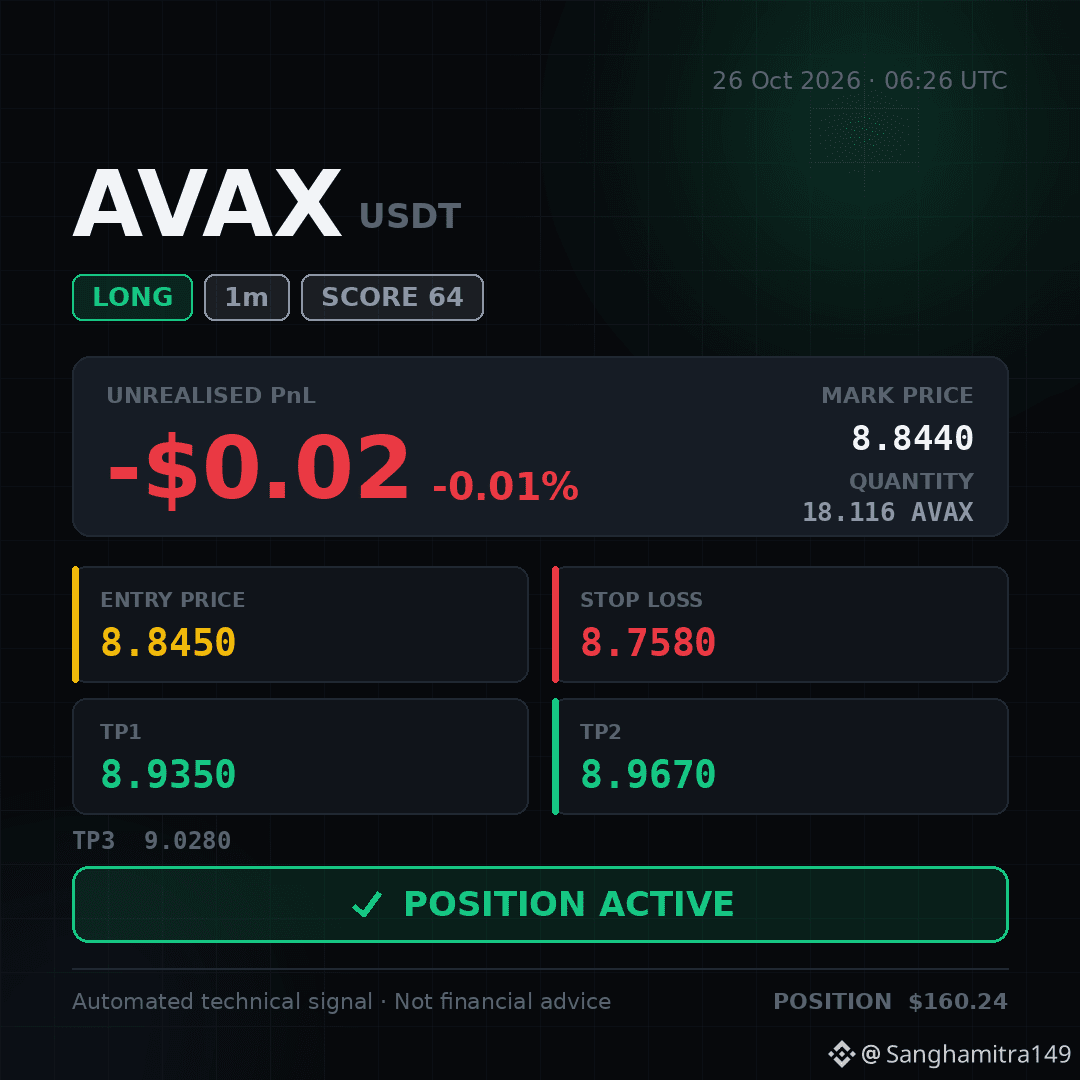
✅ POSITION ACTIVE — I've taken this long. Running at -0.01%.
🚨 #AVAX SMC SWEEP TRIGGERED, RIDE THE SURGE! 🤯💪
I'm jumping in this long now $AVAX 👇
Long..... Waves..... Feel the rush..... Boom.....‼️‼️‼️
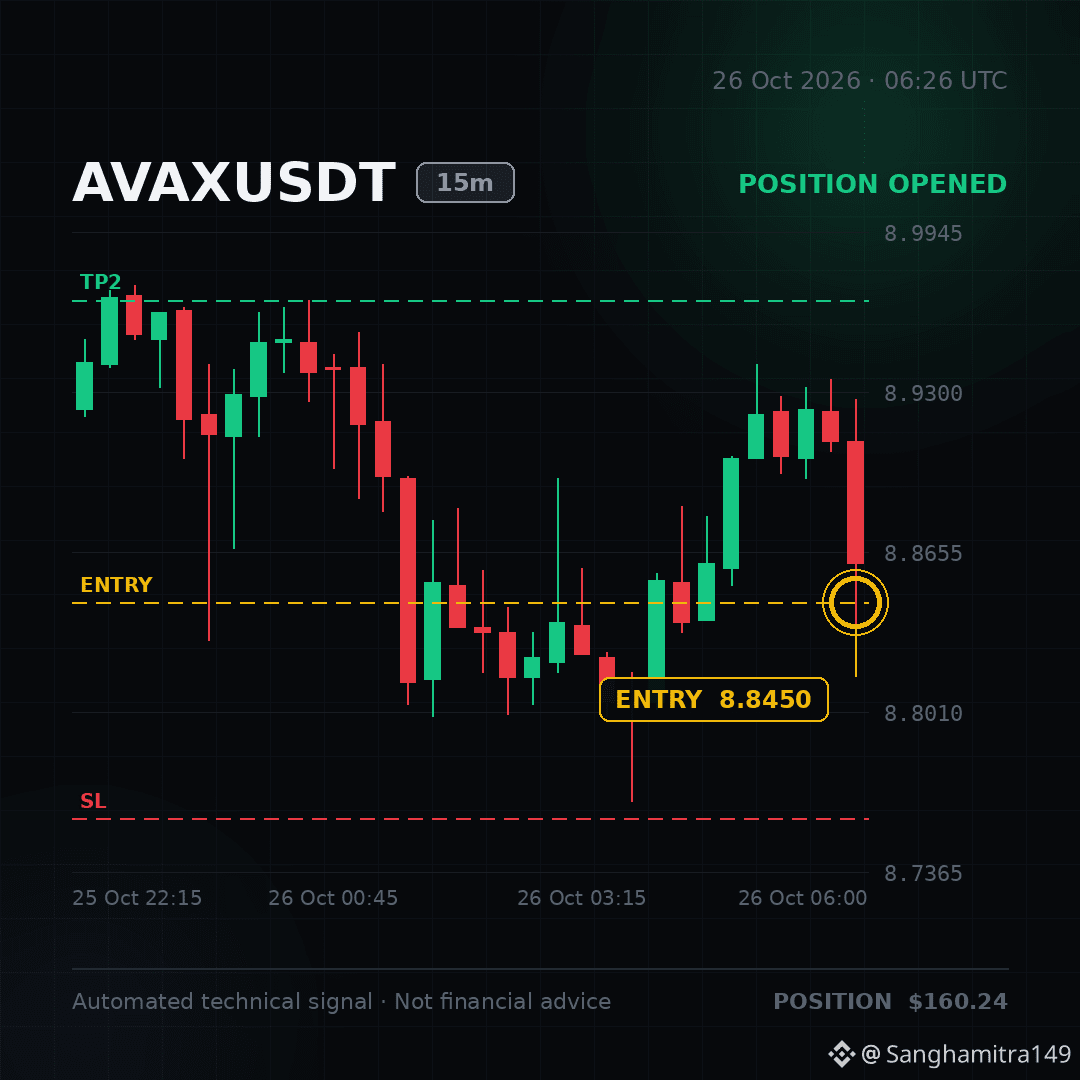
Entry: 8.8350 – 8.8450
Stop-loss: 8.7580
🟢 TP1: 8.9350
🟢 TP2: 8.9670
🟢 TP3: 9.0280
Trade with me, let’s roll! 👇⬇️⬇️ Long.. With meee...👇⬇️ $AVAX
✅ POSITION ACTIVE — I've taken this long. Running at -0.01%.
🚨 #AVAX SMC SWEEP TRIGGERED, RIDE THE SURGE! 🤯💪
I'm jumping in this long now $AVAX 👇
Long..... Waves..... Feel the rush..... Boom.....‼️‼️‼️
Entry: 8.8350 – 8.8450
Stop-loss: 8.7580
🟢 TP1: 8.9350
🟢 TP2: 8.9670
🟢 TP3: 9.0280
Trade with me, let’s roll! 👇⬇️⬇️ Long.. With meee...👇⬇️ $AVAX
🚨 #AVAX SMC SWEEP TRIGGERED, RIDE THE SURGE! 🤯💪
I'm jumping in this long now $AVAX 👇
Long..... Waves..... Feel the rush..... Boom.....‼️‼️‼️
Entry: 8.8350 – 8.8450
Stop-loss: 8.7580
🟢 TP1: 8.9350
🟢 TP2: 8.9670
🟢 TP3: 9.0280
Trade with me, let’s roll! 👇⬇️⬇️ Long.. With meee...👇⬇️ $AVAX
1


·
--
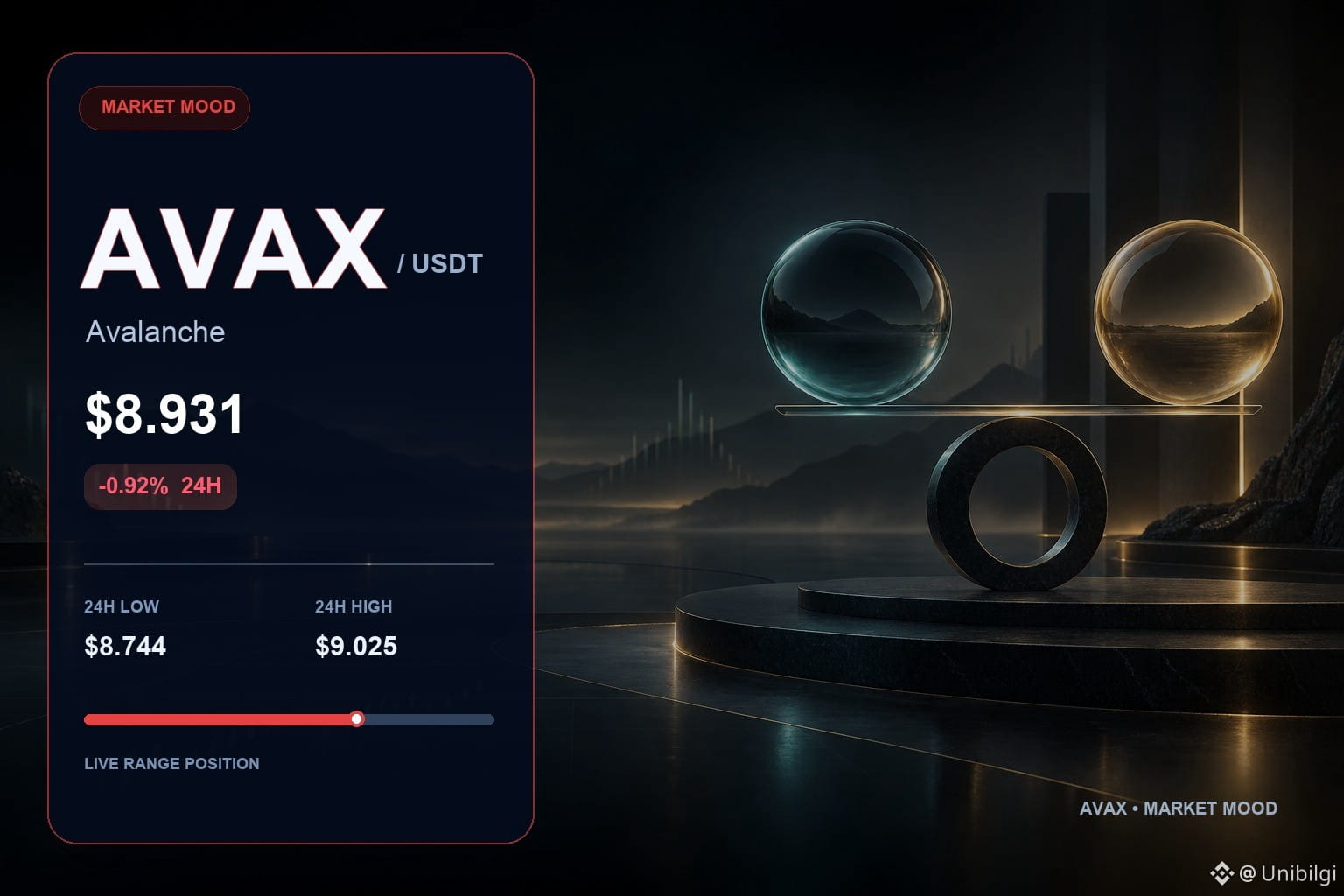
It feels like $AVAX is taking a cozy afternoon nap right now. Currently trading at $8.931 with a tiny 24h change of -0.921%, the market is giving us a calm break from the usual roller coaster.
Over the past day, we saw a modest 24h high of $9.025 and a low of $8.744, basically crab-walking in a comfortable range. As always, this is not financial advice, so remember to DYOR before making any moves! ☕ 🏔️ 🦀
#Write2Earn #Crypto #AVAX #Layer1
It feels like $AVAX is taking a cozy afternoon nap right now. Currently trading at $8.931 with a tiny 24h change of -0.921%, the market is giving us a calm break from the usual roller coaster.
Over the past day, we saw a modest 24h high of $9.025 and a low of $8.744, basically crab-walking in a comfortable range. As always, this is not financial advice, so remember to DYOR before making any moves! ☕ 🏔️ 🦀
#Write2Earn #Crypto #AVAX #Layer1
Over the past day, we saw a modest 24h high of $9.025 and a low of $8.744, basically crab-walking in a comfortable range. As always, this is not financial advice, so remember to DYOR before making any moves! ☕ 🏔️ 🦀
#Write2Earn #Crypto #AVAX #Layer1
91

·
--
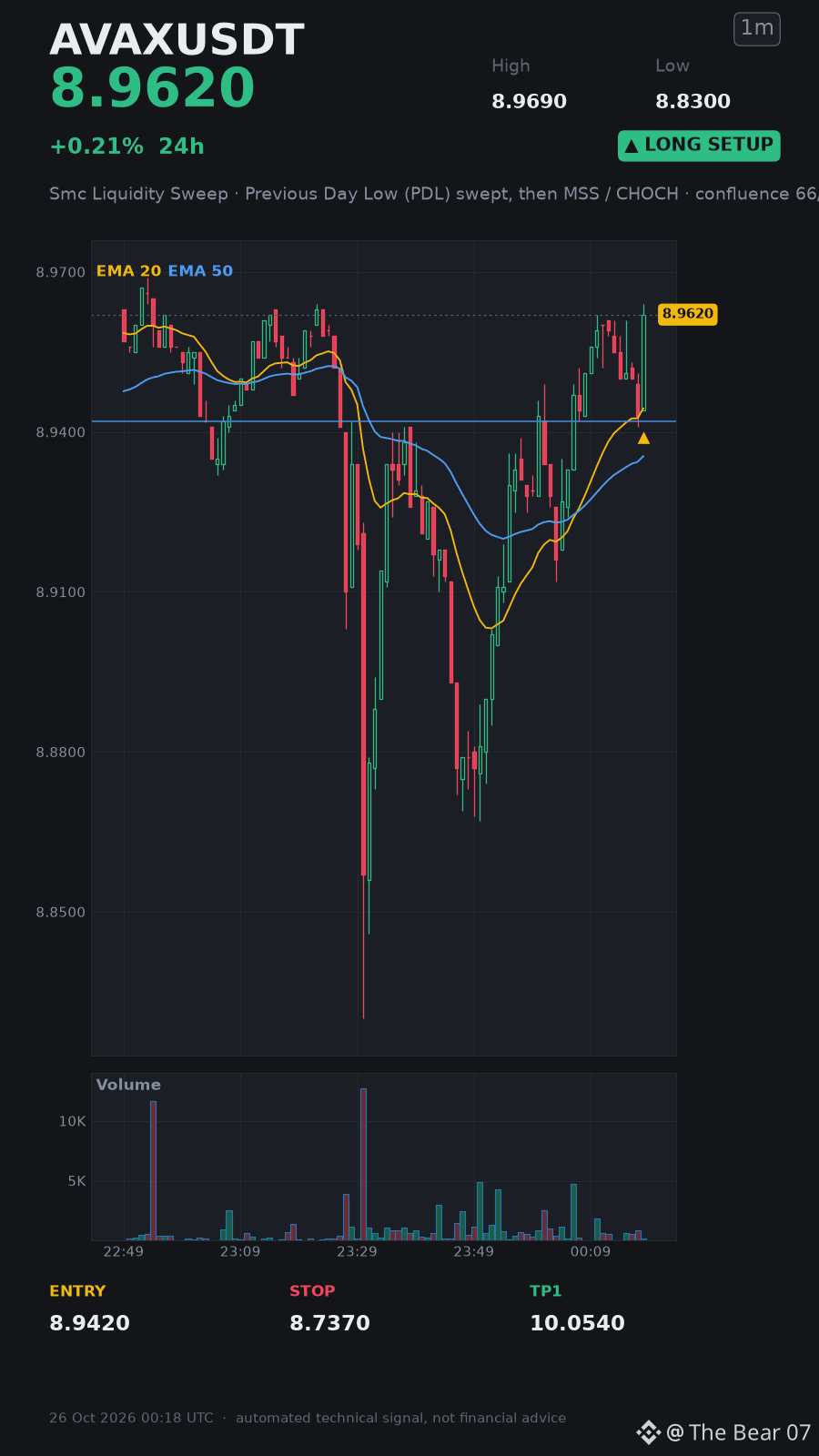
🚨 #AVAX SMC SWEEP IGNITES A RALLY! 🤯🚀
I'm on board with this long $AVAX 👇
Long..... Sweeping..... Watch the wave..... Boom.....‼️‼️‼️
Entry: 8.9330 – 8.9420
Stop-loss: 8.7370
🟢 TP1: 10.0540
Join me, trade this move now 👇⬇️⬇️ Long.. With meee...👇⬇️ $AVAX
🚨 #AVAX SMC SWEEP IGNITES A RALLY! 🤯🚀
I'm on board with this long $AVAX 👇
Long..... Sweeping..... Watch the wave..... Boom.....‼️‼️‼️
Entry: 8.9330 – 8.9420
Stop-loss: 8.7370
🟢 TP1: 10.0540
Join me, trade this move now 👇⬇️⬇️ Long.. With meee...👇⬇️ $AVAX
I'm on board with this long $AVAX 👇
Long..... Sweeping..... Watch the wave..... Boom.....‼️‼️‼️
Entry: 8.9330 – 8.9420
Stop-loss: 8.7370
🟢 TP1: 10.0540
Join me, trade this move now 👇⬇️⬇️ Long.. With meee...👇⬇️ $AVAX
66

·
--
$AVAX volume is dying while price sits at 8.9290
I am passing on $AVAX right here because volume is only 0.4x the weekly average
This price action is entirely hollow with no real market backing the current move
I need an hourly close and hold above 9.0280 before considering longs
Alternatively I want to see a pullback hold 8.7440 and bounce cleanly
It could keep running without me and a bad entry costs more than a missed move
Chasing $AVAX here or waiting for 8.7440
#AVAX #RiskManagement
$AVAX volume is dying while price sits at 8.9290
I am passing on $AVAX right here because volume is only 0.4x the weekly average
This price action is entirely hollow with no real market backing the current move
I need an hourly close and hold above 9.0280 before considering longs
Alternatively I want to see a pullback hold 8.7440 and bounce cleanly
It could keep running without me and a bad entry costs more than a missed move
Chasing $AVAX here or waiting for 8.7440
#AVAX #RiskManagement
I am passing on $AVAX right here because volume is only 0.4x the weekly average
This price action is entirely hollow with no real market backing the current move
I need an hourly close and hold above 9.0280 before considering longs
Alternatively I want to see a pullback hold 8.7440 and bounce cleanly
It could keep running without me and a bad entry costs more than a missed move
Chasing $AVAX here or waiting for 8.7440
#AVAX #RiskManagement
1
·
--
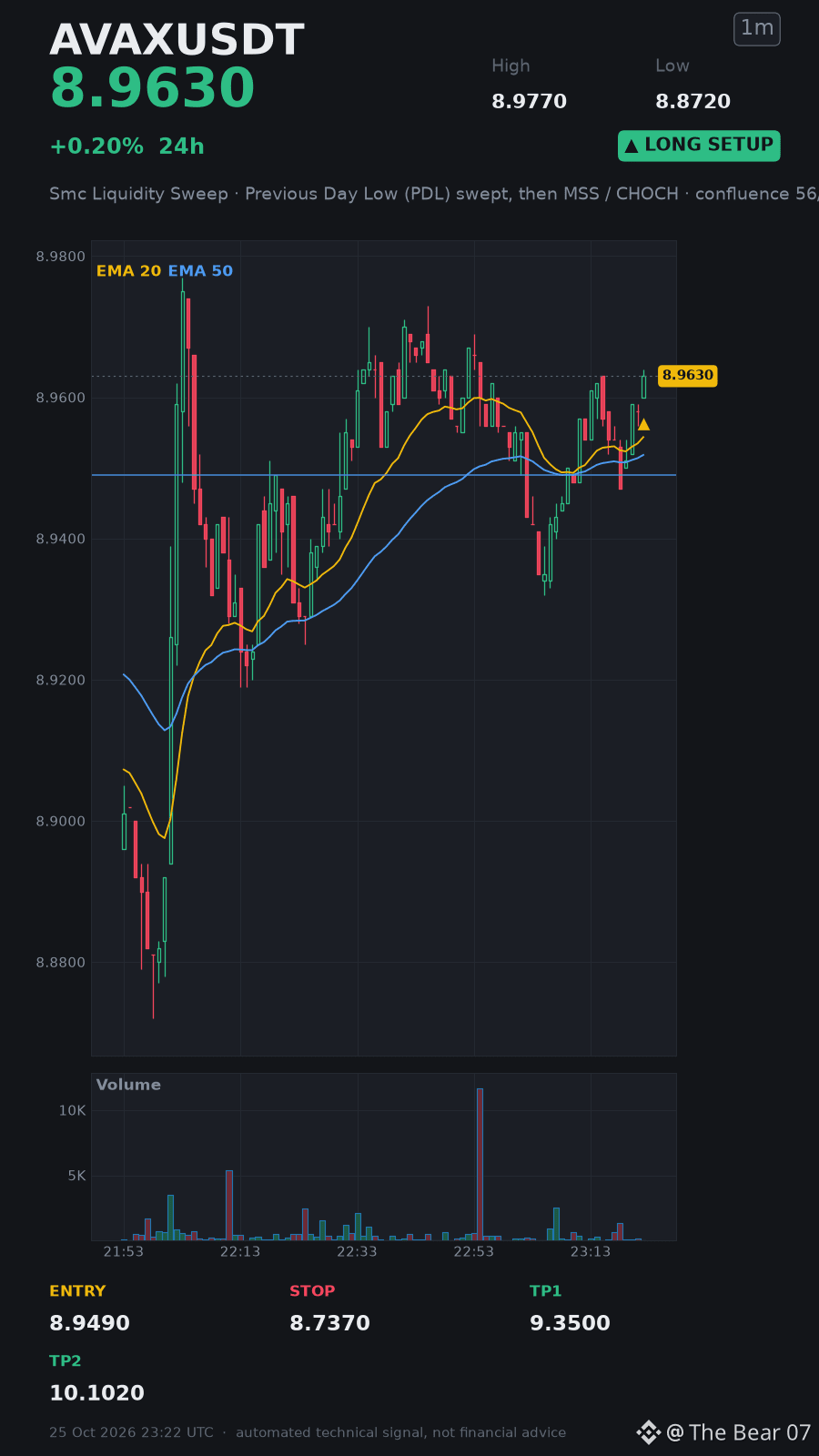
🚨 #AVAX SMC SWEEP BLASTS HIGH! 🤯💪
I’m taking this trade now $AVAX 👇
Long..... Sweeping..... Ride the wave.....‼️‼️‼️
Entry: 8.9480 – 8.9490
Stop-loss: 8.7370
🟢 TP1: 9.3500
🟢 TP2: 10.1020
Join me, trade the swing together 👇⬇️⬇️ Long.. With meee...👇⬇️ $AVAX
🚨 #AVAX SMC SWEEP BLASTS HIGH! 🤯💪
I’m taking this trade now $AVAX 👇
Long..... Sweeping..... Ride the wave.....‼️‼️‼️
Entry: 8.9480 – 8.9490
Stop-loss: 8.7370
🟢 TP1: 9.3500
🟢 TP2: 10.1020
Join me, trade the swing together 👇⬇️⬇️ Long.. With meee...👇⬇️ $AVAX
I’m taking this trade now $AVAX 👇
Long..... Sweeping..... Ride the wave.....‼️‼️‼️
Entry: 8.9480 – 8.9490
Stop-loss: 8.7370
🟢 TP1: 9.3500
🟢 TP2: 10.1020
Join me, trade the swing together 👇⬇️⬇️ Long.. With meee...👇⬇️ $AVAX
3

·
--
Baissier
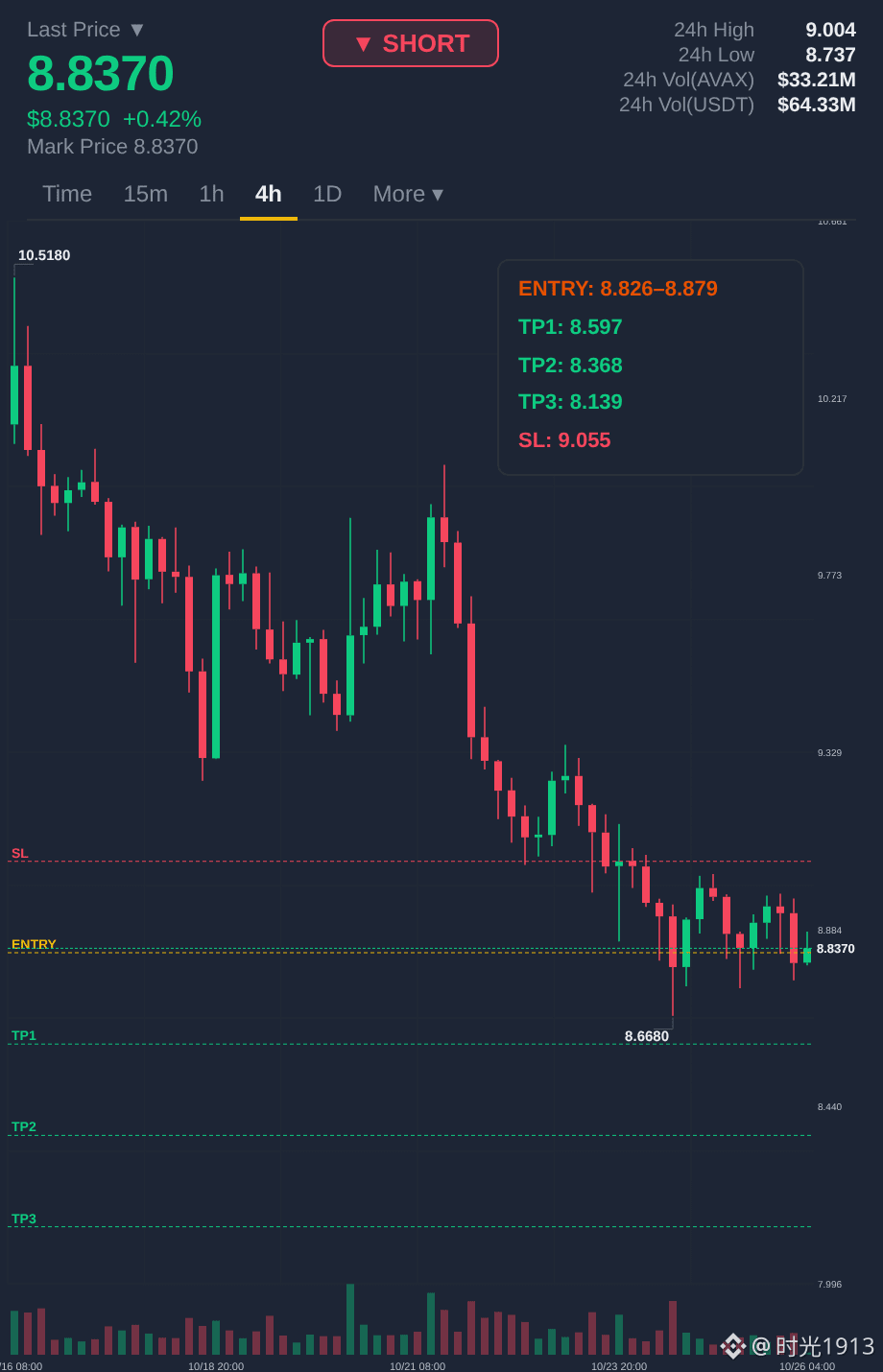
⚡ AVAX/USDT — INTRADAY SHORT SETUP | OCTOBER 25
🔥 Avalanche: Trade the breakdown, not the hype.
💰 Reference price: $8.82
🎯 Key support: $8.76
📉 Entry zone: $8.73–$8.76 — only after a confirmed breakdown below support and a failed retest.
🛑 Stop-Loss: $8.89
✅ TP1: $8.50
🎯 TP2: $8.33
📊 Trading plan: I wait for sellers to confirm the breakdown. I define my risk before entering and never chase a falling price.
⚠️ $AVAX
{future}(AVAXUSDT)
is showing short-term bearish pressure. These are conditional technical levels based on October 25 market data, not verified live entry signals. If support holds, I skip the SHORT trade.
No confirmation, no trade. Protect capital first.
#AVAX #Avalanche #Crypto #Trading #Binance #TechnicalAnalysis #RiskManagement
⚡ AVAX/USDT — INTRADAY SHORT SETUP | OCTOBER 25
🔥 Avalanche: Trade the breakdown, not the hype.
💰 Reference price: $8.82
🎯 Key support: $8.76
📉 Entry zone: $8.73–$8.76 — only after a confirmed breakdown below support and a failed retest.
🛑 Stop-Loss: $8.89
✅ TP1: $8.50
🎯 TP2: $8.33
📊 Trading plan: I wait for sellers to confirm the breakdown. I define my risk before entering and never chase a falling price.
⚠️ $AVAX
is showing short-term bearish pressure. These are conditional technical levels based on October 25 market data, not verified live entry signals. If support holds, I skip the SHORT trade.
No confirmation, no trade. Protect capital first.
#AVAX #Avalanche #Crypto #Trading #Binance #TechnicalAnalysis #RiskManagement
🔥 Avalanche: Trade the breakdown, not the hype.
💰 Reference price: $8.82
🎯 Key support: $8.76
📉 Entry zone: $8.73–$8.76 — only after a confirmed breakdown below support and a failed retest.
🛑 Stop-Loss: $8.89
✅ TP1: $8.50
🎯 TP2: $8.33
📊 Trading plan: I wait for sellers to confirm the breakdown. I define my risk before entering and never chase a falling price.
⚠️ $AVAX
is showing short-term bearish pressure. These are conditional technical levels based on October 25 market data, not verified live entry signals. If support holds, I skip the SHORT trade.
No confirmation, no trade. Protect capital first.
#AVAX #Avalanche #Crypto #Trading #Binance #TechnicalAnalysis #RiskManagement
1
153

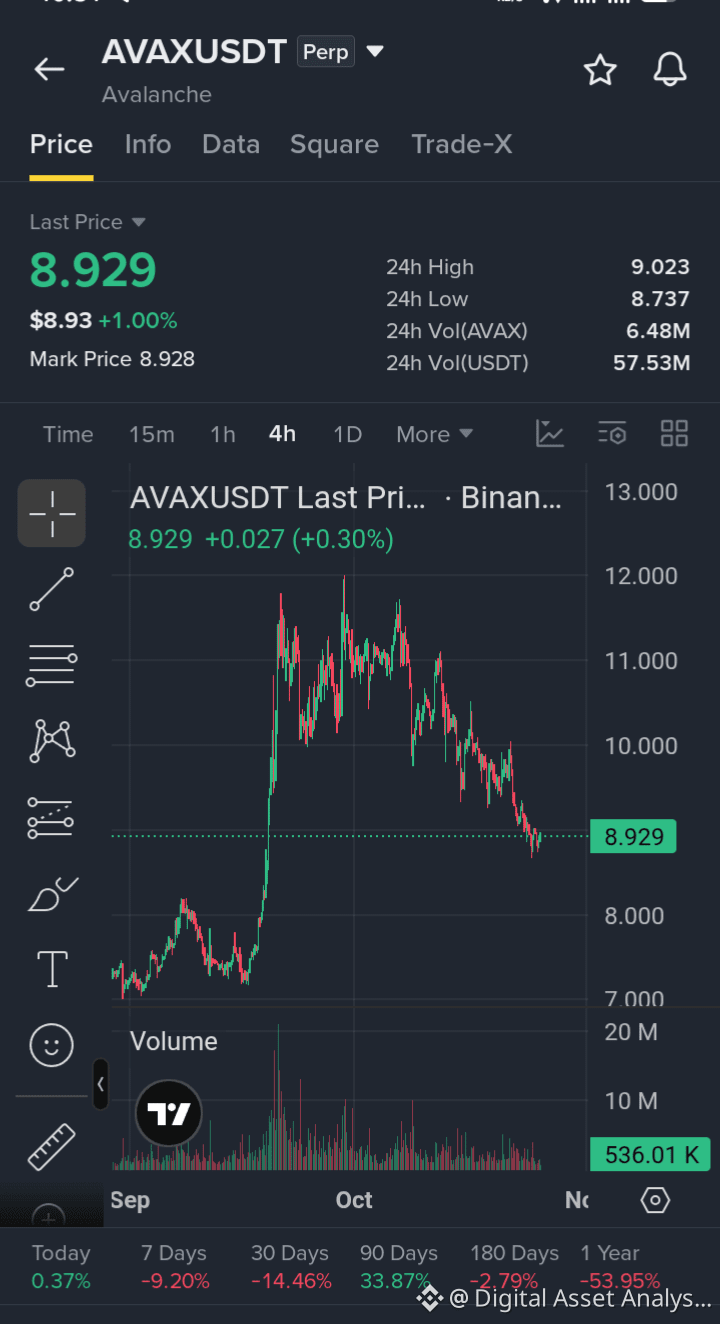
🚨 $AVAX USDT: Buyers Need to Prove Themselves Here.
$AVAX is trading around $8.93 on the 4H chart, but the structure still looks weak to me.
After a strong move from the $7 area toward $12, price failed to hold its highs. Since then, we have seen lower highs and lower lows. Sellers are still controlling the short-term trend.
• Key Levels I'm Watching:
Resistance: $9.20–$9.50
Major Resistance: $10.00–$10.30
Support: $8.70–$8.75
Next Support: $8.00
• My Chart Read:
Price is now sitting close to the $8.70 support zone. If buyers defend this area and push price above $9.20–$9.50, we could see a relief move toward $10.
But if $8.70 breaks with strong selling, #AVAX could move lower toward the $8.00 area.
One thing I don't like here is the series of lower highs. A small bounce alone is not enough to confirm a trend reversal.
Now I'm watching one thing closely:
Will #AVAX hold $8.70 and give buyers a chance, or will sellers push it toward $8.00 next?
What's your view — bounce from support or breakdown to lower levels? Tell me your reason in the comments.
This is my personal chart analysis for educational purposes only. Not financial advice. Always manage your risk.
{future}(AVAXUSDT)
🚨 $AVAX USDT: Buyers Need to Prove Themselves Here.
$AVAX is trading around $8.93 on the 4H chart, but the structure still looks weak to me.
After a strong move from the $7 area toward $12, price failed to hold its highs. Since then, we have seen lower highs and lower lows. Sellers are still controlling the short-term trend.
• Key Levels I'm Watching:
Resistance: $9.20–$9.50
Major Resistance: $10.00–$10.30
Support: $8.70–$8.75
Next Support: $8.00
• My Chart Read:
Price is now sitting close to the $8.70 support zone. If buyers defend this area and push price above $9.20–$9.50, we could see a relief move toward $10.
But if $8.70 breaks with strong selling, #AVAX could move lower toward the $8.00 area.
One thing I don't like here is the series of lower highs. A small bounce alone is not enough to confirm a trend reversal.
Now I'm watching one thing closely:
Will #AVAX hold $8.70 and give buyers a chance, or will sellers push it toward $8.00 next?
What's your view — bounce from support or breakdown to lower levels? Tell me your reason in the comments.
This is my personal chart analysis for educational purposes only. Not financial advice. Always manage your risk.
$AVAX is trading around $8.93 on the 4H chart, but the structure still looks weak to me.
After a strong move from the $7 area toward $12, price failed to hold its highs. Since then, we have seen lower highs and lower lows. Sellers are still controlling the short-term trend.
• Key Levels I'm Watching:
Resistance: $9.20–$9.50
Major Resistance: $10.00–$10.30
Support: $8.70–$8.75
Next Support: $8.00
• My Chart Read:
Price is now sitting close to the $8.70 support zone. If buyers defend this area and push price above $9.20–$9.50, we could see a relief move toward $10.
But if $8.70 breaks with strong selling, #AVAX could move lower toward the $8.00 area.
One thing I don't like here is the series of lower highs. A small bounce alone is not enough to confirm a trend reversal.
Now I'm watching one thing closely:
Will #AVAX hold $8.70 and give buyers a chance, or will sellers push it toward $8.00 next?
What's your view — bounce from support or breakdown to lower levels? Tell me your reason in the comments.
This is my personal chart analysis for educational purposes only. Not financial advice. Always manage your risk.
94
·
--
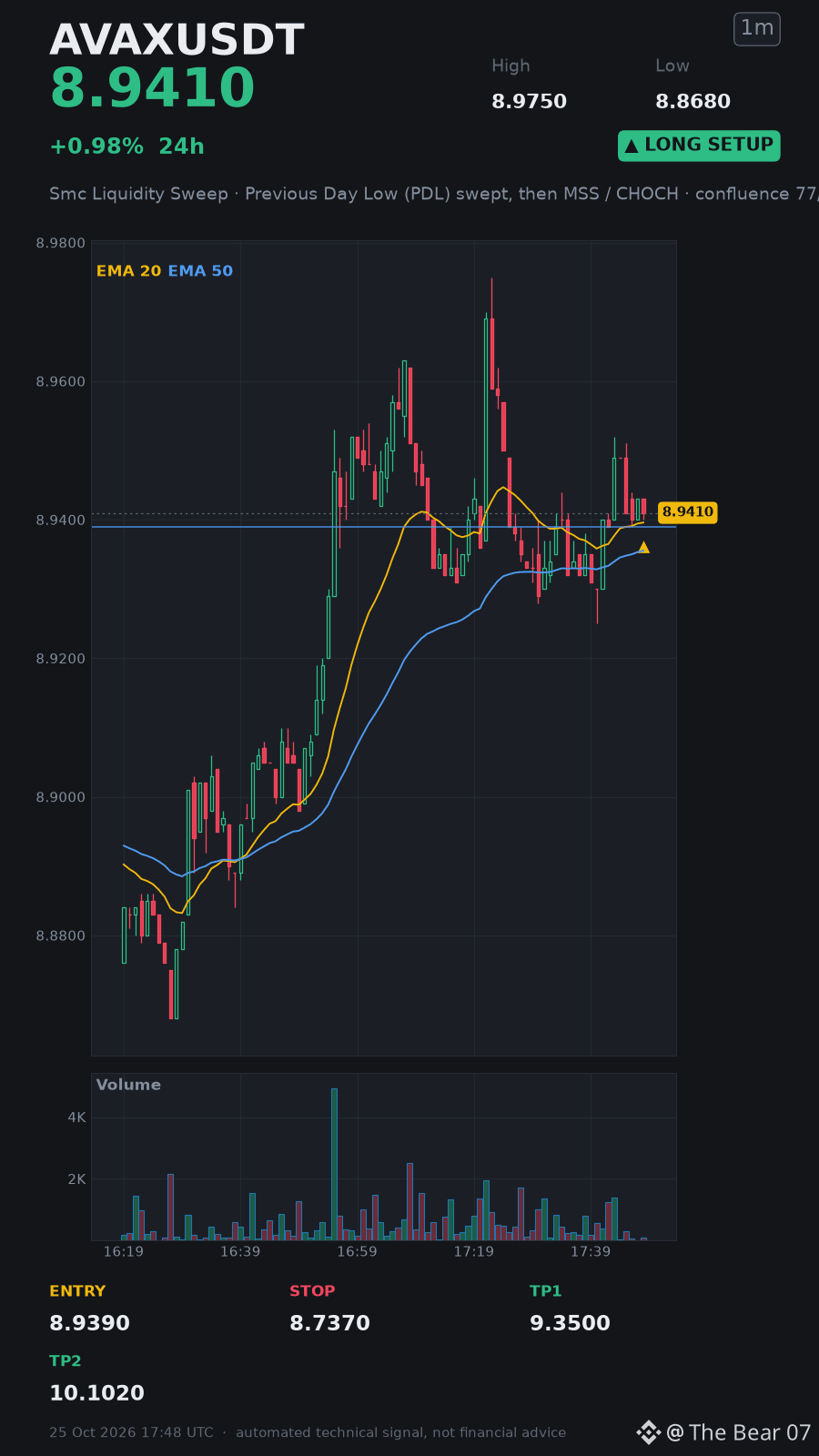
🚨 #AVAX SMC LIQUIDITY SWEEP TRIGGERS RAMPAGE! 🤯🔥
I am jumping on this long now $AVAX 👇
Long..... First..... Thank meee... Later.....‼️‼️‼️
Entry: 8.9360 – 8.9390
Stop-loss: 8.7370
🟢 TP1: 9.3500
🟢 TP2: 10.1020
Trade with me, let's ride! 👇⬇️⬇️ Long.. With meee...👇⬇️ $AVAX
🚨 #AVAX SMC LIQUIDITY SWEEP TRIGGERS RAMPAGE! 🤯🔥
I am jumping on this long now $AVAX 👇
Long..... First..... Thank meee... Later.....‼️‼️‼️
Entry: 8.9360 – 8.9390
Stop-loss: 8.7370
🟢 TP1: 9.3500
🟢 TP2: 10.1020
Trade with me, let's ride! 👇⬇️⬇️ Long.. With meee...👇⬇️ $AVAX
I am jumping on this long now $AVAX 👇
Long..... First..... Thank meee... Later.....‼️‼️‼️
Entry: 8.9360 – 8.9390
Stop-loss: 8.7370
🟢 TP1: 9.3500
🟢 TP2: 10.1020
Trade with me, let's ride! 👇⬇️⬇️ Long.. With meee...👇⬇️ $AVAX
1

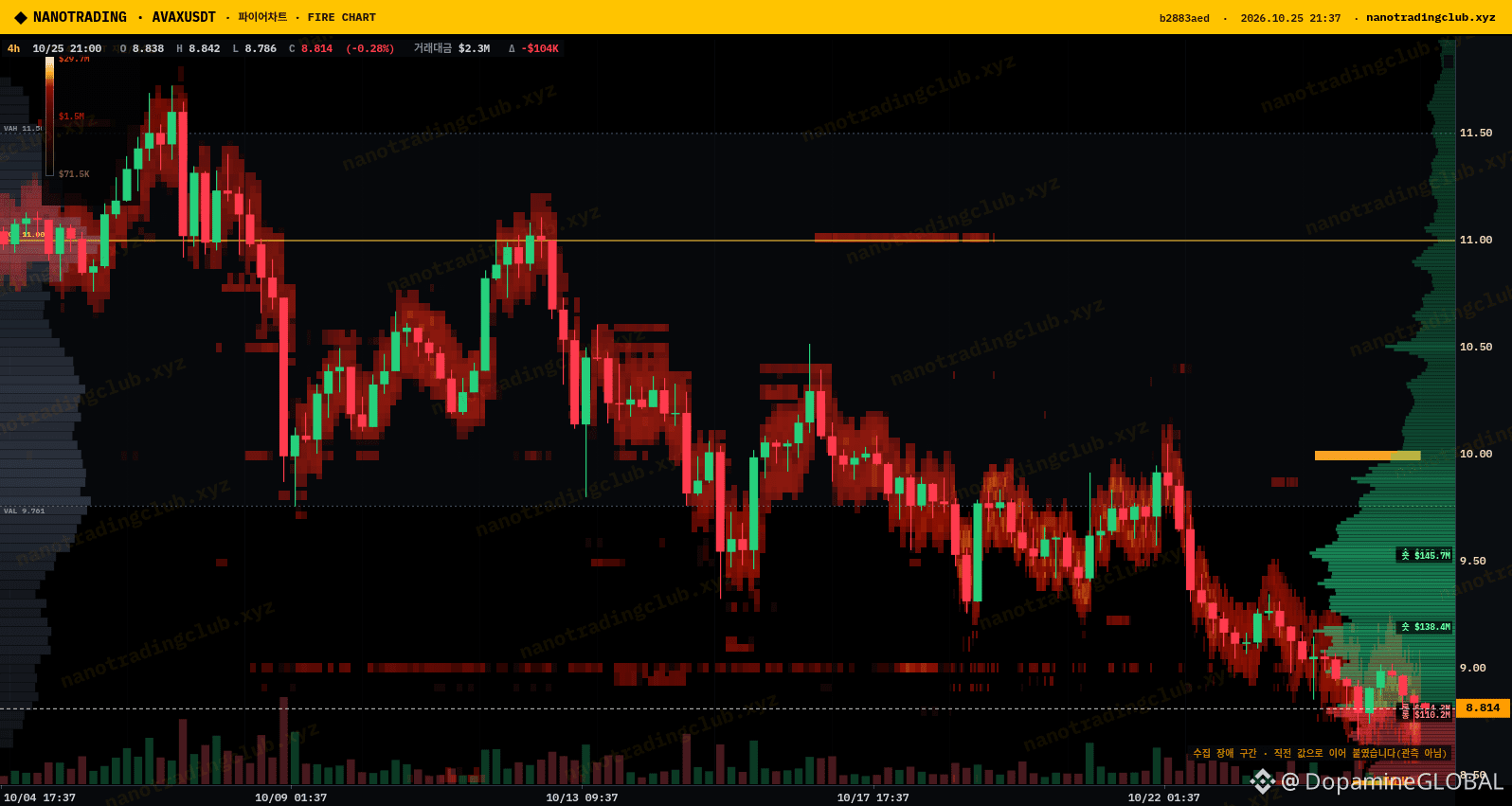
$AVAX keeps grinding along the bottom of its range and I don't love how quiet it is. Price is around 8.81, the 24h low tagged 8.67, and it's been sliding lower since that bounce near 10.2 about a week ago.
On the NanoTrading Fire chart 4h the heatmap shows a thick liquidity band right around 9.00 stretching across most of the chart, so every bounce into 9 has been getting sold. Above that, the next real pocket is the bright block near 10.00. Below price there isn't much on the map until the lows, which is what bugs me.
Binance futures look like dip buyers are still positioned for a bounce that isn't coming yet. Open interest bled from about $89.5M to $86.4M over the last day, funding is basically flat, and roughly 60% of accounts are long while top traders sit around 69% long (L/S 2.24). Crowded longs plus falling OI near range lows usually means one more flush first.
My read: as long as $AVAX stays under 9.00 I'm leaning bearish and watching for a wick below 8.67. A clean 4h reclaim of 9.00 would flip me and put 10.00 back in play.
Do you think 9 flips to support this week or do we see 8.5 first?
NFA, just my chart notes 👀
Source: NanoTrading Fire chart (nanotradingclub.xyz)
#AVAX #Avalanche #NanoTrading
$AVAX keeps grinding along the bottom of its range and I don't love how quiet it is. Price is around 8.81, the 24h low tagged 8.67, and it's been sliding lower since that bounce near 10.2 about a week ago.
On the NanoTrading Fire chart 4h the heatmap shows a thick liquidity band right around 9.00 stretching across most of the chart, so every bounce into 9 has been getting sold. Above that, the next real pocket is the bright block near 10.00. Below price there isn't much on the map until the lows, which is what bugs me.
Binance futures look like dip buyers are still positioned for a bounce that isn't coming yet. Open interest bled from about $89.5M to $86.4M over the last day, funding is basically flat, and roughly 60% of accounts are long while top traders sit around 69% long (L/S 2.24). Crowded longs plus falling OI near range lows usually means one more flush first.
My read: as long as $AVAX stays under 9.00 I'm leaning bearish and watching for a wick below 8.67. A clean 4h reclaim of 9.00 would flip me and put 10.00 back in play.
Do you think 9 flips to support this week or do we see 8.5 first?
NFA, just my chart notes 👀
Source: NanoTrading Fire chart (nanotradingclub.xyz)
#AVAX #Avalanche #NanoTrading
On the NanoTrading Fire chart 4h the heatmap shows a thick liquidity band right around 9.00 stretching across most of the chart, so every bounce into 9 has been getting sold. Above that, the next real pocket is the bright block near 10.00. Below price there isn't much on the map until the lows, which is what bugs me.
Binance futures look like dip buyers are still positioned for a bounce that isn't coming yet. Open interest bled from about $89.5M to $86.4M over the last day, funding is basically flat, and roughly 60% of accounts are long while top traders sit around 69% long (L/S 2.24). Crowded longs plus falling OI near range lows usually means one more flush first.
My read: as long as $AVAX stays under 9.00 I'm leaning bearish and watching for a wick below 8.67. A clean 4h reclaim of 9.00 would flip me and put 10.00 back in play.
Do you think 9 flips to support this week or do we see 8.5 first?
NFA, just my chart notes 👀
Source: NanoTrading Fire chart (nanotradingclub.xyz)
#AVAX #Avalanche #NanoTrading
3
115

·
--
Haussier
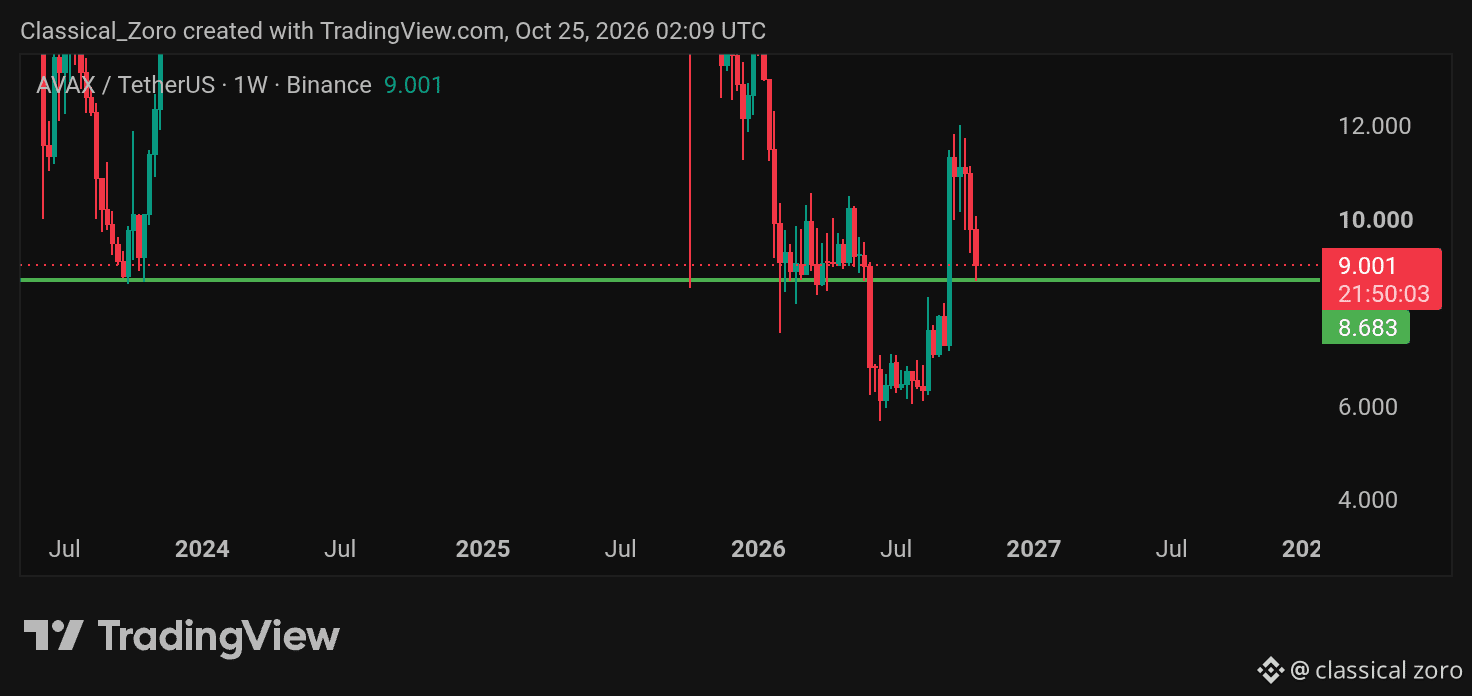
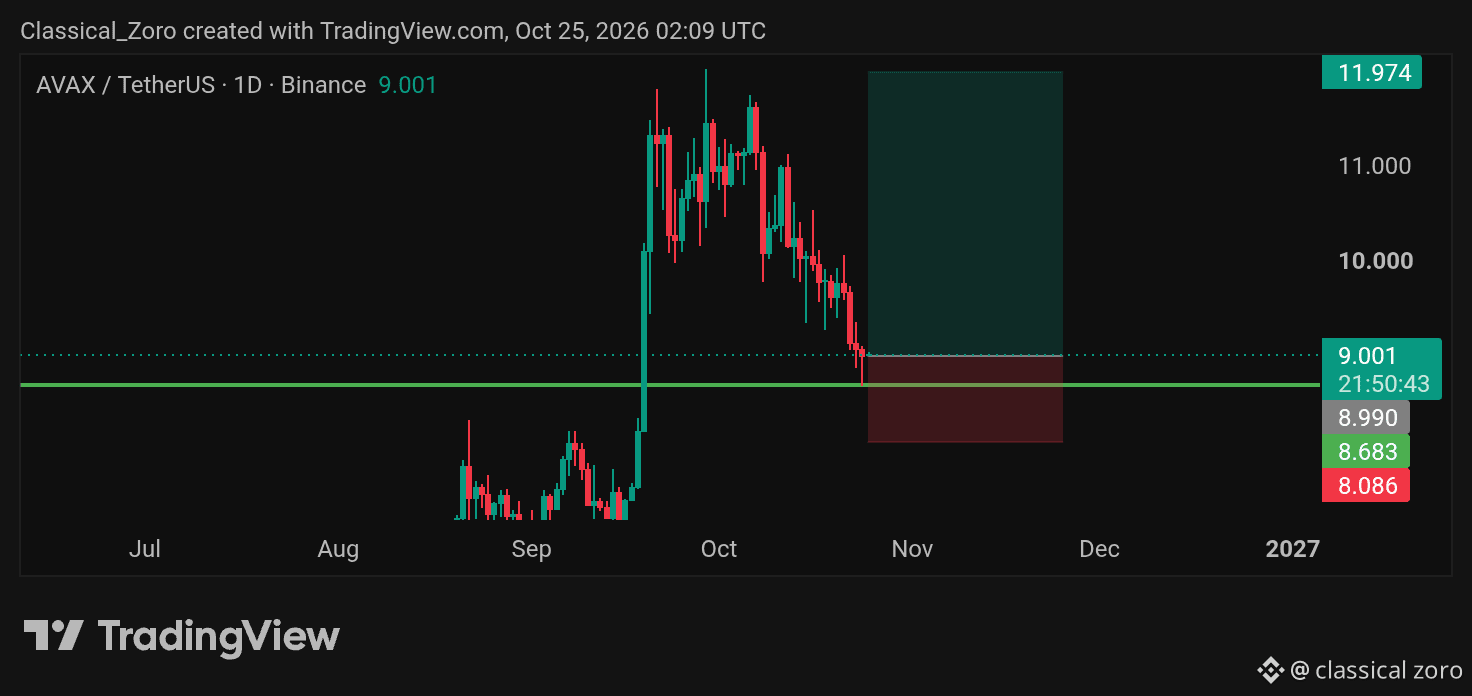
$AVAX bulls are making a stand right where it matters most.
The price has dropped directly into a major weekly support zone at 8.683, and buyers are finally showing signs of life.
Despite the heavy selling pressure, the daily chart just printed a clear bullish pin bar.
Yes, the candle closed red, but that long lower wick tells the real story: sellers pushed the price down, but buyers aggressively stepped in to reject the lows.
The price is currently hovering right at the 8.783 level, defending this weekly floor.
If this support holds and the pin bar confirms a reversal, we could see a strong bounce back toward the 10.00 and 11.00 resistance levels.
Lose the 8.683 weekly support, though, and the bullish thesis is invalidated, opening the door for a much deeper correction.
Bulls have the first signal, but a strong daily close here is needed to truly shift the momentum.
{spot}(AVAXUSDT)
#AVAX
$AVAX bulls are making a stand right where it matters most.
The price has dropped directly into a major weekly support zone at 8.683, and buyers are finally showing signs of life.
Despite the heavy selling pressure, the daily chart just printed a clear bullish pin bar.
Yes, the candle closed red, but that long lower wick tells the real story: sellers pushed the price down, but buyers aggressively stepped in to reject the lows.
The price is currently hovering right at the 8.783 level, defending this weekly floor.
If this support holds and the pin bar confirms a reversal, we could see a strong bounce back toward the 10.00 and 11.00 resistance levels.
Lose the 8.683 weekly support, though, and the bullish thesis is invalidated, opening the door for a much deeper correction.
Bulls have the first signal, but a strong daily close here is needed to truly shift the momentum.
#AVAX
The price has dropped directly into a major weekly support zone at 8.683, and buyers are finally showing signs of life.
Despite the heavy selling pressure, the daily chart just printed a clear bullish pin bar.
Yes, the candle closed red, but that long lower wick tells the real story: sellers pushed the price down, but buyers aggressively stepped in to reject the lows.
The price is currently hovering right at the 8.783 level, defending this weekly floor.
If this support holds and the pin bar confirms a reversal, we could see a strong bounce back toward the 10.00 and 11.00 resistance levels.
Lose the 8.683 weekly support, though, and the bullish thesis is invalidated, opening the door for a much deeper correction.
Bulls have the first signal, but a strong daily close here is needed to truly shift the momentum.
#AVAX
Kadupg:
O BTC quando cai muito leva todas para baixo, isso vai acontecer nos próximos dias.
Não existe cripto subir com queda brusca do BTC.
4
1
816
Connectez-vous pour découvrir plus de contenu
Rejoignez la communauté mondiale des adeptes de cryptomonnaies sur Binance Square
⚡️ Suviez les dernières informations importantes sur les cryptomonnaies.
💬 Jugé digne de confiance par la plus grande plateforme d’échange de cryptomonnaies au monde.
👍 Découvrez les connaissances que partagent les créateurs vérifiés.
Adresse e-mail/Nº de téléphone
Sujets d’actualité
1
#BinancePick
2.8M vues
146,374 mentions
2
#EarningsSeason
5.1M vues
25,010 mentions
3
#AnthropicTTMRevenueGrewAbout1200%
93 vues
32 mentions
4
#AnthropicS1ExpectedToday
1,165 vues
58 mentions
5
#SouthKoreaReportedlyWeighsFourthCryptoTaxDelay
9,555 vues
231 mentions
6
#FranklinTempletonFilesForTwoDividendToBitcoinETFs
15,866 vues
352 mentions
7
#StrategyMSTRSurpassesNasdaqInMarketCap
13,021 vues
282 mentions
8
#CanadaProposesStablecoinRedemptionWithin3BusinessDays
583 vues
30 mentions
9
#ElectrumWalletBugLetRogueServersStealFunds
17,960 vues
393 mentions
10
#ArgentineCourtDismissesLIBRACaseAgainstMilei
28,347 vues
465 mentions