

Researcher_Crypto
8 Publicaciones

Researcher_Crypto
Denunciar
Bloquear usuario
16 Siguiendo
5 Seguidores
0 Me gusta
Publicaciones
Todo
Cotizaciones

Artículo
🔗 ¿Cómo funcionan realmente los oráculos de blockchain? ¿Y dónde encaja LINK?Tomemos un ejemplo de la vida real.
Imagina que un agricultor compra un seguro de cosecha con una condición simple:
🌾 “Si la lluvia durante la temporada de cultivo es inferior a 50 mm, el agricultor recibe 100.000 rupias.”
El contrato inteligente puede gestionar las reglas del seguro y el pago, pero hay un problema:
¿Cómo sabe la blockchain cuánta lluvia realmente cayó?
No puede simplemente mirar afuera y comprobar el clima.
Ahí es donde entra un oráculo.
🌧️ Un oráculo obtiene información desde fuera de la blockchain y pone esa información a disposición del contrato inteligente.
🔗 ¿Cómo funcionan realmente los oráculos de blockchain? ¿Y dónde encaja LINK?
Tomemos un ejemplo de la vida real.
Imagina que un agricultor compra un seguro de cosecha con una condición simple:
🌾 “Si la lluvia durante la temporada de cultivo es inferior a 50 mm, el agricultor recibe 100.000 rupias.”
El contrato inteligente puede gestionar las reglas del seguro y el pago, pero hay un problema:
¿Cómo sabe la blockchain cuánta lluvia realmente cayó?
No puede simplemente mirar afuera y comprobar el clima.
Ahí es donde entra un oráculo.
🌧️ Un oráculo obtiene información desde fuera de la blockchain y pone esa información a disposición del contrato inteligente.
Imagina que un agricultor compra un seguro de cosecha con una condición simple:
🌾 “Si la lluvia durante la temporada de cultivo es inferior a 50 mm, el agricultor recibe 100.000 rupias.”
El contrato inteligente puede gestionar las reglas del seguro y el pago, pero hay un problema:
¿Cómo sabe la blockchain cuánta lluvia realmente cayó?
No puede simplemente mirar afuera y comprobar el clima.
Ahí es donde entra un oráculo.
🌧️ Un oráculo obtiene información desde fuera de la blockchain y pone esa información a disposición del contrato inteligente.
94
⚙️ Solana: Más que un token $Sol⚙️ ¿Qué ocurre realmente cuando envías una transacción en Solana?
Cuando presionas “Enviar” en una billetera de Solana, ocurren varios procesos en segundo plano antes de que la transacción se finalice.
1️⃣ Se crea la transacción
Tu billetera crea y firma una transacción que contiene:
• Instrucciones
• Cuentas involucradas
• Blockhash reciente
• Firma criptográfica
La transacción firmada queda lista para ingresar a la red de Solana.
2️⃣ La transacción entra en la red
La transacción se envía a un nodo Solana RPC, que la reenvía a través de la red hacia el líder actualmente programado.
⚙️ Solana: Más que un token $Sol
⚙️ ¿Qué ocurre realmente cuando envías una transacción en Solana?
Cuando presionas “Enviar” en una billetera de Solana, ocurren varios procesos en segundo plano antes de que la transacción se finalice.
1️⃣ Se crea la transacción
Tu billetera crea y firma una transacción que contiene:
• Instrucciones
• Cuentas involucradas
• Blockhash reciente
• Firma criptográfica
La transacción firmada queda lista para ingresar a la red de Solana.
2️⃣ La transacción entra en la red
La transacción se envía a un nodo Solana RPC, que la reenvía a través de la red hacia el líder actualmente programado.
Cuando presionas “Enviar” en una billetera de Solana, ocurren varios procesos en segundo plano antes de que la transacción se finalice.
1️⃣ Se crea la transacción
Tu billetera crea y firma una transacción que contiene:
• Instrucciones
• Cuentas involucradas
• Blockhash reciente
• Firma criptográfica
La transacción firmada queda lista para ingresar a la red de Solana.
2️⃣ La transacción entra en la red
La transacción se envía a un nodo Solana RPC, que la reenvía a través de la red hacia el líder actualmente programado.
109
¿Y si $ZEC tocara $BTC el máximo histórico de $126000? ¿Qué crees que Zcash superará a Bitcoin? ¿Debemos mantener algo de $ZEC? La respuesta debe
¿Y si $ZEC tocara $BTC el máximo histórico de $126000? ¿Qué crees que Zcash superará a Bitcoin? ¿Debemos mantener algo de $ZEC ? La respuesta debe
249
Ver traducción
what do you guys think about the future price of $ZEC . reply with your price target prediction!
what do you guys think about the future price of $ZEC . reply with your price target prediction!
Researcher_Crypto
·
--
$BITCOIN vs $ZCASH — ¿CUÁL ES LA DIFERENCIA? 🔐
$Bitcoin (BTC) y $Zcash (ZEC) son criptomonedas descentralizadas con un suministro máximo de 21 millones, minería de Prueba de Trabajo (Proof-of-Work) y sin un banco central que controle sus redes.
Pero hay una gran diferencia que distingue a Zcash: la privacidad.
🟠 BITCOIN (BTC)
Bitcoin se creó como dinero digital descentralizado que funciona sin una autoridad central.
Las transacciones de Bitcoin se registran en una blockchain pública, lo que significa que cualquiera puede inspeccionar el historial de transacciones, las direcciones de las billeteras, los montos y el movimiento de las monedas.
Pero hay una gran diferencia que distingue a Zcash: la privacidad.
🟠 BITCOIN (BTC)
Bitcoin se creó como dinero digital descentralizado que funciona sin una autoridad central.
Las transacciones de Bitcoin se registran en una blockchain pública, lo que significa que cualquiera puede inspeccionar el historial de transacciones, las direcciones de las billeteras, los montos y el movimiento de las monedas.
64
$BITCOIN vs $ZCASH — ¿CUÁL ES LA DIFERENCIA? 🔐$Bitcoin (BTC) y $Zcash (ZEC) son criptomonedas descentralizadas con un suministro máximo de 21 millones, minería de Prueba de Trabajo (Proof-of-Work) y sin un banco central que controle sus redes.
Pero hay una gran diferencia que distingue a Zcash: la privacidad.
🟠 BITCOIN (BTC)
Bitcoin se creó como dinero digital descentralizado que funciona sin una autoridad central.
Las transacciones de Bitcoin se registran en una blockchain pública, lo que significa que cualquiera puede inspeccionar el historial de transacciones, las direcciones de las billeteras, los montos y el movimiento de las monedas.
$BITCOIN vs $ZCASH — ¿CUÁL ES LA DIFERENCIA? 🔐
$Bitcoin (BTC) y $Zcash (ZEC) son criptomonedas descentralizadas con un suministro máximo de 21 millones, minería de Prueba de Trabajo (Proof-of-Work) y sin un banco central que controle sus redes.
Pero hay una gran diferencia que distingue a Zcash: la privacidad.
🟠 BITCOIN (BTC)
Bitcoin se creó como dinero digital descentralizado que funciona sin una autoridad central.
Las transacciones de Bitcoin se registran en una blockchain pública, lo que significa que cualquiera puede inspeccionar el historial de transacciones, las direcciones de las billeteras, los montos y el movimiento de las monedas.
Pero hay una gran diferencia que distingue a Zcash: la privacidad.
🟠 BITCOIN (BTC)
Bitcoin se creó como dinero digital descentralizado que funciona sin una autoridad central.
Las transacciones de Bitcoin se registran en una blockchain pública, lo que significa que cualquiera puede inspeccionar el historial de transacciones, las direcciones de las billeteras, los montos y el movimiento de las monedas.
1
159
Ver traducción
JUST IN: 🇷🇺 Russia's largest bank Sberbank plans to accept Bitcoin, Ethereum and USDT as collateral for loans, subject to regulatory approval.
#BTC
JUST IN: 🇷🇺 Russia's largest bank Sberbank plans to accept Bitcoin, Ethereum and USDT as collateral for loans, subject to regulatory approval.
#BTC
#BTC
72
Ver traducción
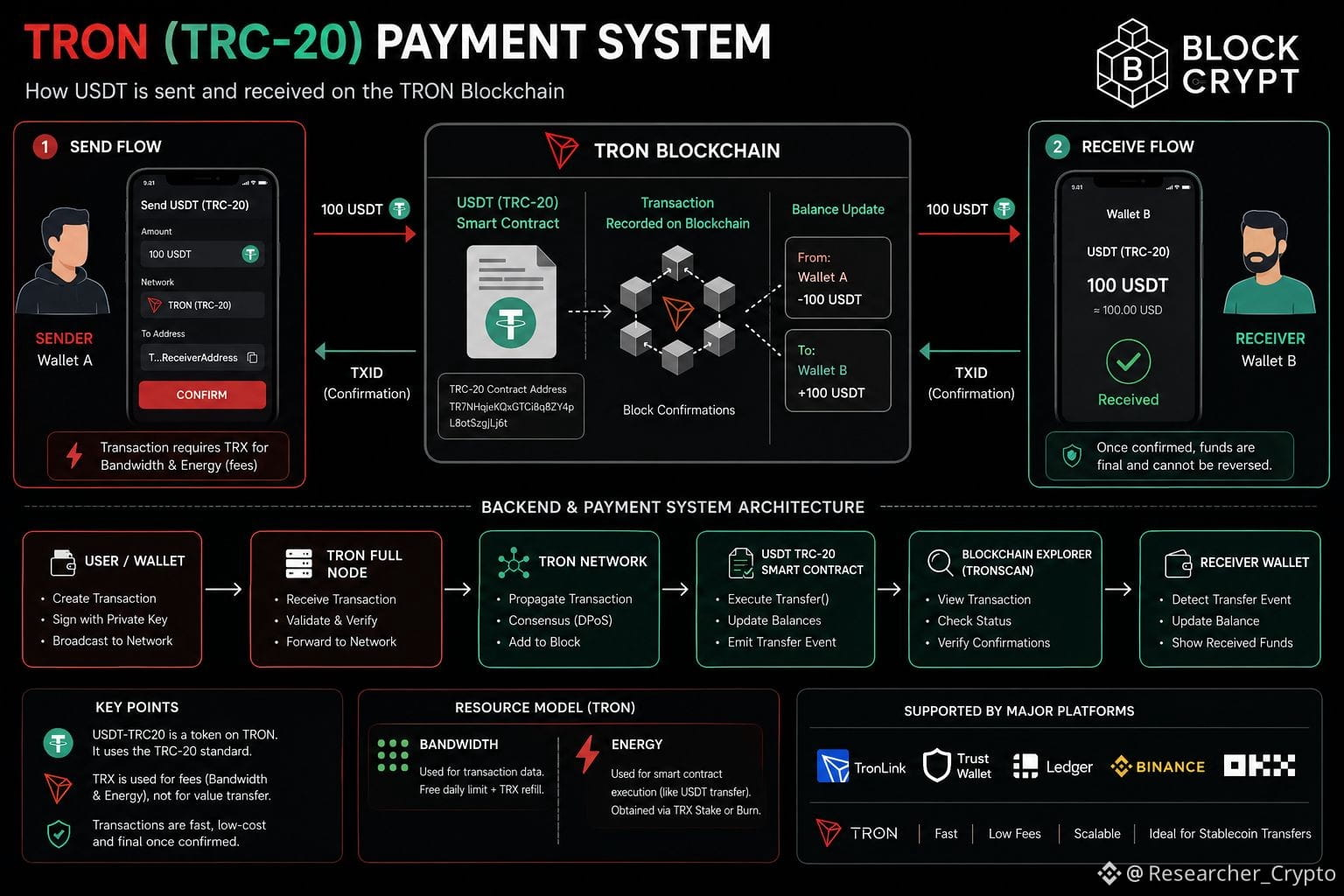
🟢 TRON, TRX & TRC-20 Explained — And How USDT Moves on the TRON Blockchain
Note: "Don't forget to like, share and follow our page to learn crypto and blockchain"
Now to the topic:
If you've ever sent or received USDT and seen options like ERC-20, TRC-20, BEP-20 or Solana, you may have wondered:
👉 What exactly is TRON?
👉 What is TRC-20?
👉 Why is TRX needed when sending USDT?
👉 How does USDT actually move from one wallet to another?
Let's break it all down. 👇
---
🔹 What is TRON?
TRON is a blockchain network designed to support digital assets, smart contracts and decentralized applications.
Its native cryptocurrency is TRX.
TRX is used within the TRON ecosystem for network activity, staking, governance and paying for blockchain resources.
Think of TRON as a road or payment network on which digital assets can move.
TRON = Blockchain/network
TRX = Native cryptocurrency of the network
---
🔹 What is TRC-20?
One of the most important things to understand is:
TRC-20 is NOT a cryptocurrency.
TRC-20 is a token standard on the TRON blockchain.
It defines technical rules that fungible tokens can follow, including functions for transferring tokens, checking balances and approving other addresses or smart contracts.
If you've heard of ERC-20 on Ethereum, TRC-20 is a similar concept on TRON.
For example:
Ethereum → ERC-20 → USDT
while:
TRON → TRC-20 → USDT
Therefore, when an exchange says:
USDT — TRC-20
it means:
«USDT is being transferred using the TRON blockchain.»
---
🔹 What is USDT-TRC20?
USDT is the stablecoin issued by Tether.
Tether has issued USDT on multiple blockchain networks.
One of those networks is TRON.
Therefore:
USDT-TRC20 = USDT running as a TRC-20 token on the TRON blockchain.
This is different from:
USDT-ERC20 = USDT on Ethereum
and other versions of USDT that exist on different supported networks.
The underlying idea is the same—USDT represents a dollar-denominated stablecoin—but the blockchain network carrying the token is different.
🟢 TRON, TRX & TRC-20 Explained — And How USDT Moves on the TRON Blockchain
Note: "Don't forget to like, share and follow our page to learn crypto and blockchain"
Now to the topic:
If you've ever sent or received USDT and seen options like ERC-20, TRC-20, BEP-20 or Solana, you may have wondered:
👉 What exactly is TRON?
👉 What is TRC-20?
👉 Why is TRX needed when sending USDT?
👉 How does USDT actually move from one wallet to another?
Let's break it all down. 👇
---
🔹 What is TRON?
TRON is a blockchain network designed to support digital assets, smart contracts and decentralized applications.
Its native cryptocurrency is TRX.
TRX is used within the TRON ecosystem for network activity, staking, governance and paying for blockchain resources.
Think of TRON as a road or payment network on which digital assets can move.
TRON = Blockchain/network
TRX = Native cryptocurrency of the network
---
🔹 What is TRC-20?
One of the most important things to understand is:
TRC-20 is NOT a cryptocurrency.
TRC-20 is a token standard on the TRON blockchain.
It defines technical rules that fungible tokens can follow, including functions for transferring tokens, checking balances and approving other addresses or smart contracts.
If you've heard of ERC-20 on Ethereum, TRC-20 is a similar concept on TRON.
For example:
Ethereum → ERC-20 → USDT
while:
TRON → TRC-20 → USDT
Therefore, when an exchange says:
USDT — TRC-20
it means:
«USDT is being transferred using the TRON blockchain.»
---
🔹 What is USDT-TRC20?
USDT is the stablecoin issued by Tether.
Tether has issued USDT on multiple blockchain networks.
One of those networks is TRON.
Therefore:
USDT-TRC20 = USDT running as a TRC-20 token on the TRON blockchain.
This is different from:
USDT-ERC20 = USDT on Ethereum
and other versions of USDT that exist on different supported networks.
The underlying idea is the same—USDT represents a dollar-denominated stablecoin—but the blockchain network carrying the token is different.
Note: "Don't forget to like, share and follow our page to learn crypto and blockchain"
Now to the topic:
If you've ever sent or received USDT and seen options like ERC-20, TRC-20, BEP-20 or Solana, you may have wondered:
👉 What exactly is TRON?
👉 What is TRC-20?
👉 Why is TRX needed when sending USDT?
👉 How does USDT actually move from one wallet to another?
Let's break it all down. 👇
---
🔹 What is TRON?
TRON is a blockchain network designed to support digital assets, smart contracts and decentralized applications.
Its native cryptocurrency is TRX.
TRX is used within the TRON ecosystem for network activity, staking, governance and paying for blockchain resources.
Think of TRON as a road or payment network on which digital assets can move.
TRON = Blockchain/network
TRX = Native cryptocurrency of the network
---
🔹 What is TRC-20?
One of the most important things to understand is:
TRC-20 is NOT a cryptocurrency.
TRC-20 is a token standard on the TRON blockchain.
It defines technical rules that fungible tokens can follow, including functions for transferring tokens, checking balances and approving other addresses or smart contracts.
If you've heard of ERC-20 on Ethereum, TRC-20 is a similar concept on TRON.
For example:
Ethereum → ERC-20 → USDT
while:
TRON → TRC-20 → USDT
Therefore, when an exchange says:
USDT — TRC-20
it means:
«USDT is being transferred using the TRON blockchain.»
---
🔹 What is USDT-TRC20?
USDT is the stablecoin issued by Tether.
Tether has issued USDT on multiple blockchain networks.
One of those networks is TRON.
Therefore:
USDT-TRC20 = USDT running as a TRC-20 token on the TRON blockchain.
This is different from:
USDT-ERC20 = USDT on Ethereum
and other versions of USDT that exist on different supported networks.
The underlying idea is the same—USDT represents a dollar-denominated stablecoin—but the blockchain network carrying the token is different.
77
Con verificación
Ver traducción
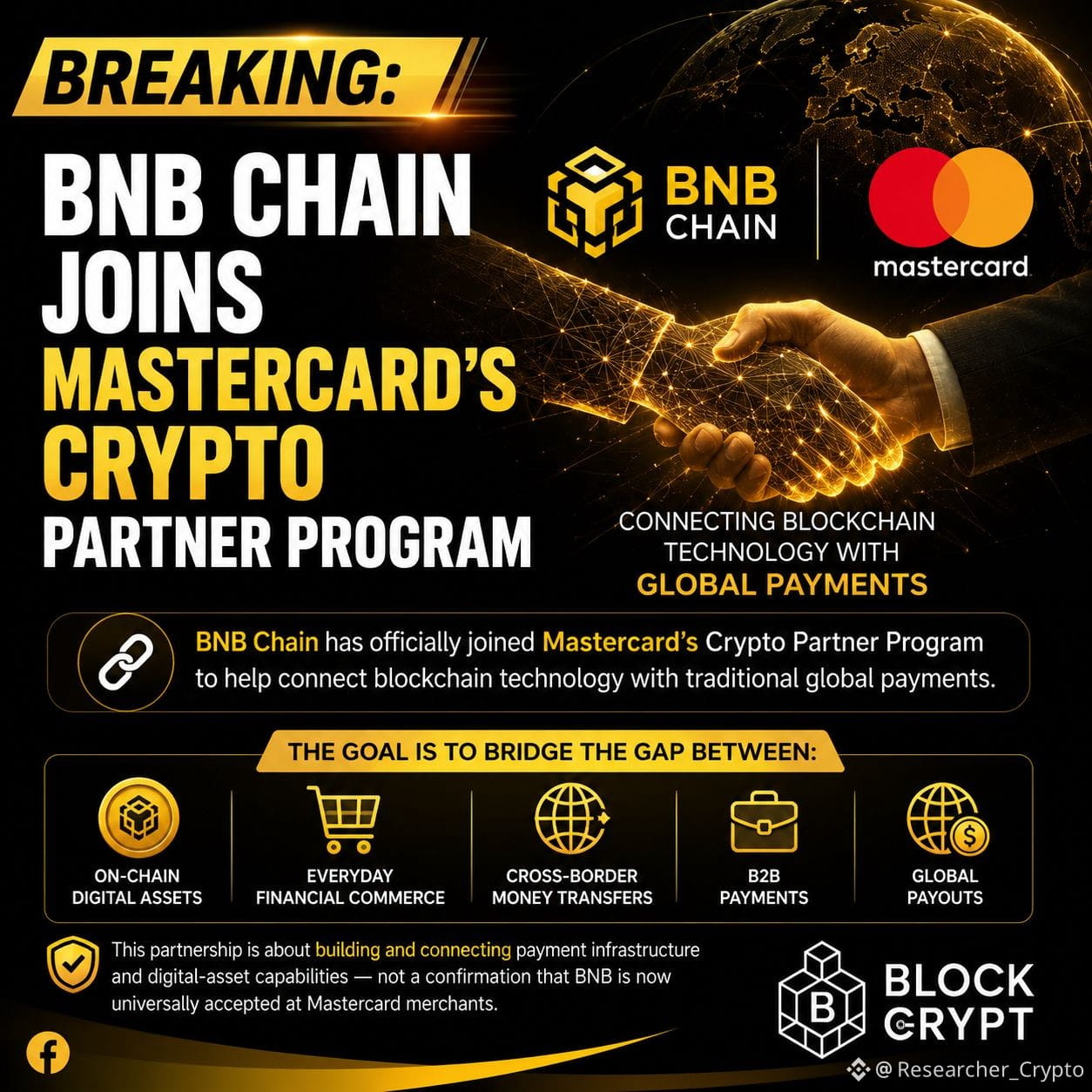
BREAKING: BNB CHAIN JOINS MASTERCARD’S CRYPTO PARTNER PROGRAM
BNB Chain has joined Mastercard’s Crypto Partner Program, marking another step toward connecting blockchain technology with the traditional global payments ecosystem.
The collaboration aims to help bridge the gap between:
🔹 On-chain digital assets
🔹 Everyday financial commerce
🔹 Cross-border money transfers
🔹 B2B payments
🔹 Global payouts
🔹 Blockchain-based payment infrastructure
Mastercard’s digital-asset ecosystem supports multiple blockchain networks, including BNB Chain, creating potential pathways between on-chain assets and traditional payment rails.
⚠️ Important: This does not mean BNB is now universally accepted at Mastercard merchants. The partnership is about building and connecting payment infrastructure and digital-asset capabilities.
🌐 Blockchain × Traditional Finance = A rapidly evolving payment ecosystem.
#BNBChain #Mastercard #Crypto #Blockchain #DigitalAssets #Payments #Web3 #BNB #FinTech #Cryptocurrency
BREAKING: BNB CHAIN JOINS MASTERCARD’S CRYPTO PARTNER PROGRAM
BNB Chain has joined Mastercard’s Crypto Partner Program, marking another step toward connecting blockchain technology with the traditional global payments ecosystem.
The collaboration aims to help bridge the gap between:
🔹 On-chain digital assets
🔹 Everyday financial commerce
🔹 Cross-border money transfers
🔹 B2B payments
🔹 Global payouts
🔹 Blockchain-based payment infrastructure
Mastercard’s digital-asset ecosystem supports multiple blockchain networks, including BNB Chain, creating potential pathways between on-chain assets and traditional payment rails.
⚠️ Important: This does not mean BNB is now universally accepted at Mastercard merchants. The partnership is about building and connecting payment infrastructure and digital-asset capabilities.
🌐 Blockchain × Traditional Finance = A rapidly evolving payment ecosystem.
#BNBChain #Mastercard #Crypto #Blockchain #DigitalAssets #Payments #Web3 #BNB #FinTech #Cryptocurrency
BNB Chain has joined Mastercard’s Crypto Partner Program, marking another step toward connecting blockchain technology with the traditional global payments ecosystem.
The collaboration aims to help bridge the gap between:
🔹 On-chain digital assets
🔹 Everyday financial commerce
🔹 Cross-border money transfers
🔹 B2B payments
🔹 Global payouts
🔹 Blockchain-based payment infrastructure
Mastercard’s digital-asset ecosystem supports multiple blockchain networks, including BNB Chain, creating potential pathways between on-chain assets and traditional payment rails.
⚠️ Important: This does not mean BNB is now universally accepted at Mastercard merchants. The partnership is about building and connecting payment infrastructure and digital-asset capabilities.
🌐 Blockchain × Traditional Finance = A rapidly evolving payment ecosystem.
#BNBChain #Mastercard #Crypto #Blockchain #DigitalAssets #Payments #Web3 #BNB #FinTech #Cryptocurrency
53
Inicia sesión para explorar más contenidos
Únete a usuarios de criptomonedas de todo el mundo en Binance Square
⚡️ Obtén la información más reciente y útil sobre criptomonedas.
💬 Confía en el mayor exchange de criptomonedas del mundo.
👍 Descubre opiniones reales de creadores verificados.
Correo electrónico/número de teléfono
Temas en tendencia
CircleMints500MUSDCOnSolana
51,561 visualizaciones
1,281 participa(n) en el debate
#CircleMints500MUSDCOnSolana
Circle emite 500 millones de nuevos USDC en la red Solana.
Los datos en cadena muestran que la Tesorería USDC de Circle acuñó 500 millones de nuevos tokens USDC en Solana en dos transacciones el 26 de septiembre de 2026.
Esta medida responde al creciente interés en la inclusión de nuevos tokens en las principales blockchains y la rápida finalización y las bajas comisiones de Solana siguen atrayendo la actividad de las stablecoins.
Según información: Hoy a las 5:42 y a las 11:04, hora de Pekín, la Tesorería de USDC de Circle acuñó 250 millones de USDC cada una en la red Solana, para un total de 500 millones de USDC recién acuñados.
$CIRC.US
$GOOGL.US
$NVDA.US
ManuelRD
·2 «Me gusta»
·140 visualizaciones
PolymarketBankFailureBetsDrawFDICConcern
65,139 visualizaciones
1,339 participa(n) en el debate
BlackRockBuildsTokenizedPortfoliosForOndo
51,482 visualizaciones
935 participa(n) en el debate