𝗛𝗼𝘄 𝗧𝗼 𝗖𝗼𝗺𝗽𝗮𝗿𝗲 𝘁𝗵𝗲 𝗧𝗿𝘂𝗲 𝗖𝗼𝘀𝘁 𝗼𝗳 𝗧𝘄𝗼 𝗖𝗿𝗼𝘀𝘀-𝗖𝗵𝗮𝗶𝗻 𝗥𝗼𝘂𝘁𝗲𝘀
Don't compare routes by looking at the biggest “fee” number.
Start with the most important question:
How much of the asset I actually want will arrive on the destination chain?
Then work backwards.
1. Compare the quoted destination amount
A route that advertises a low fee can still deliver less if its exchange rate, liquidity or price impact is worse.
2. Add the full cost
Look at:
• Source-chain gas
• Provider/protocol fees
• Destination-chain gas
• Any DEX swap fee
• Price impact/slippage
Cross-chain costs are often spread across several steps, so the headline fee isn't necessarily the true cost.
3. Check whether another swap is required
A bridge route may get your funds onto the destination chain first, but you could still need another DEX swap to obtain the asset you actually want.
That means another transaction, another gas cost and potentially another source of price impact.
4. Check the asset you receive
Are you receiving the native destination asset, or a wrapped/mirrored representation?
Those aren't equivalent from a usability and architecture perspective. Omniston's model quotes and settles directly into the native destination asset rather than requiring a wrapped representation.
5. Compare the complete outcome
For example:
Route A — Bridge + Swap
USDT → bridge → destination USDT/wrapped asset → DEX swap → USDC
Route B — Omniston
USDT → RFQ → resolver → native USDC on destination
The correct comparison isn't “Which has the lower advertised fee?”
It's:
Which route gives me the better final destination amount after all relevant costs and steps?
STON.fi can be one route in that comparison, but the same checklist should be applied to both routes using their current live quotes.
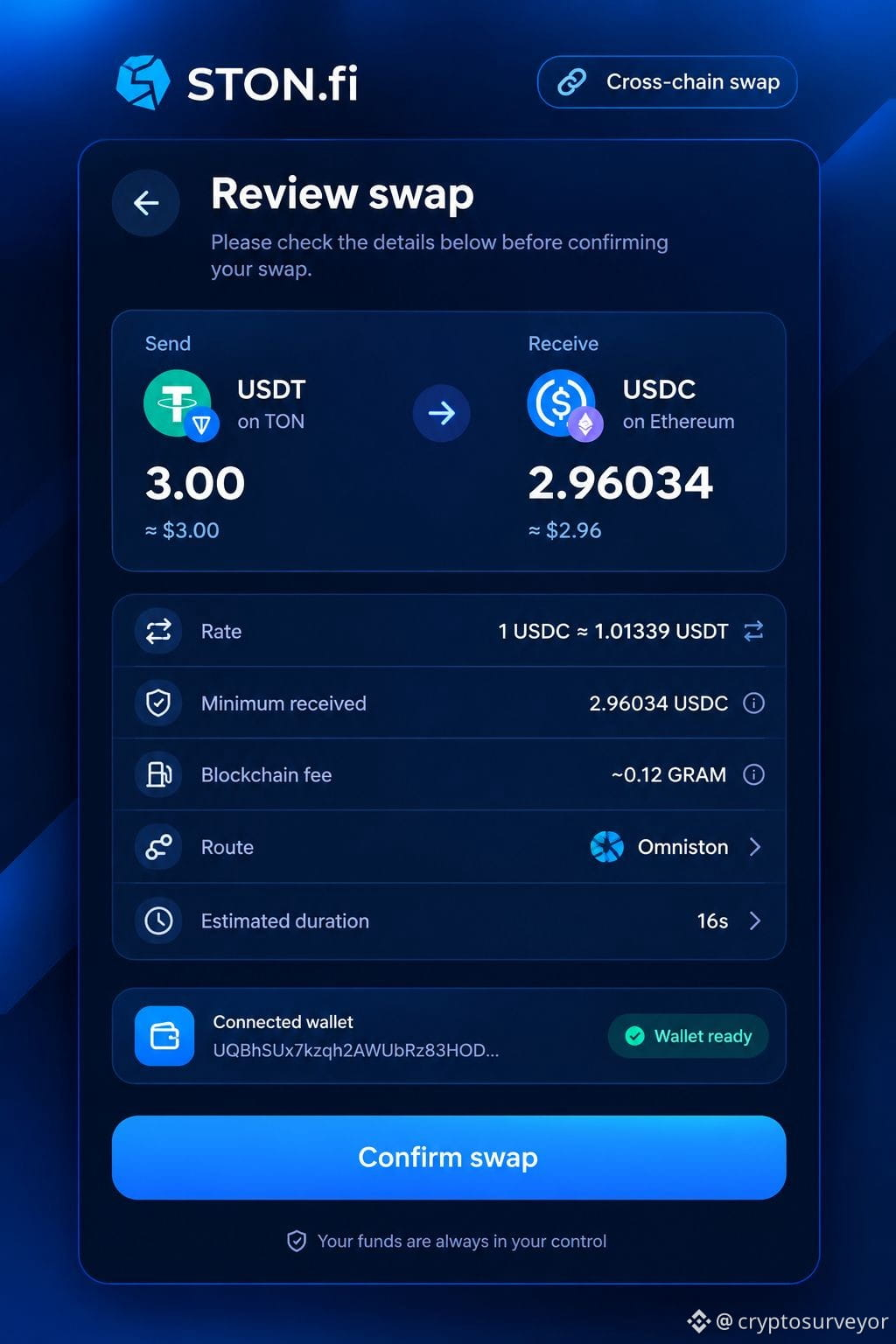
On STON.fi, the review screen exposes the quoted output, rate, minimum received, blockchain fee and route before confirmation.
Don't compare routes by looking at the biggest “fee” number.
Start with the most important question:
How much of the asset I actually want will arrive on the destination chain?
Then work backwards.
1. Compare the quoted destination amount
A route that advertises a low fee can still deliver less if its exchange rate, liquidity or price impact is worse.
2. Add the full cost
Look at:
• Source-chain gas
• Provider/protocol fees
• Destination-chain gas
• Any DEX swap fee
• Price impact/slippage
Cross-chain costs are often spread across several steps, so the headline fee isn't necessarily the true cost.
3. Check whether another swap is required
A bridge route may get your funds onto the destination chain first, but you could still need another DEX swap to obtain the asset you actually want.
That means another transaction, another gas cost and potentially another source of price impact.
4. Check the asset you receive
Are you receiving the native destination asset, or a wrapped/mirrored representation?
Those aren't equivalent from a usability and architecture perspective. Omniston's model quotes and settles directly into the native destination asset rather than requiring a wrapped representation.
5. Compare the complete outcome
For example:
Route A — Bridge + Swap
USDT → bridge → destination USDT/wrapped asset → DEX swap → USDC
Route B — Omniston
USDT → RFQ → resolver → native USDC on destination
The correct comparison isn't “Which has the lower advertised fee?”
It's:
Which route gives me the better final destination amount after all relevant costs and steps?
STON.fi can be one route in that comparison, but the same checklist should be applied to both routes using their current live quotes.
On STON.fi, the review screen exposes the quoted output, rate, minimum received, blockchain fee and route before confirmation.