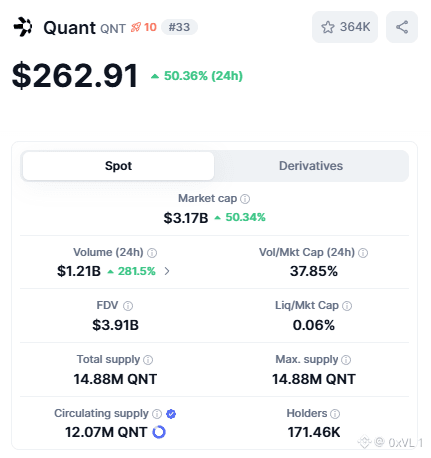
I have been tracking the recent movement on QNT, and the catalyst makes total sense when you look at the fundamental developments. The fact that The Clearing House chose Quant to provide the interoperability and orchestration layer for their On-Chain Money Initiative is a clear validation of the Overledger platform. When you consider that systems like CHIPS handle over $2 trillion in daily volume, seeing them move toward tokenized deposits using Quant's enterprise infrastructure explains why we saw active addresses accelerate and the price follow suit. It is a strong signal that traditional financial institutions are moving beyond test environments and actually integrating distributed ledger technology into their core settlement rails.
However, I do have some genuine reservations about how this translates into long-term value for everyday token holders. The enterprise licensing model requires institutions to lock $QNT for 12 months, which restricts the circulating supply in the short term and drives up the price during these initial adoption phases. But once these licenses are locked, the actual daily transaction fees paid to gateway operators might not create enough sustained buying pressure to justify a permanently higher valuation. Furthermore, we are still looking at a projected network launch in the first half of 2027, meaning there is a long gap where speculative momentum could fade before actual utility takes over. The centralization risks around how the Quant treasury manages these license renewals also makes me wonder if the economic model benefits the corporate treasury far more than the broader decentralized ecosystem.
However, I do have some genuine reservations about how this translates into long-term value for everyday token holders. The enterprise licensing model requires institutions to lock $QNT for 12 months, which restricts the circulating supply in the short term and drives up the price during these initial adoption phases. But once these licenses are locked, the actual daily transaction fees paid to gateway operators might not create enough sustained buying pressure to justify a permanently higher valuation. Furthermore, we are still looking at a projected network launch in the first half of 2027, meaning there is a long gap where speculative momentum could fade before actual utility takes over. The centralization risks around how the Quant treasury manages these license renewals also makes me wonder if the economic model benefits the corporate treasury far more than the broader decentralized ecosystem.