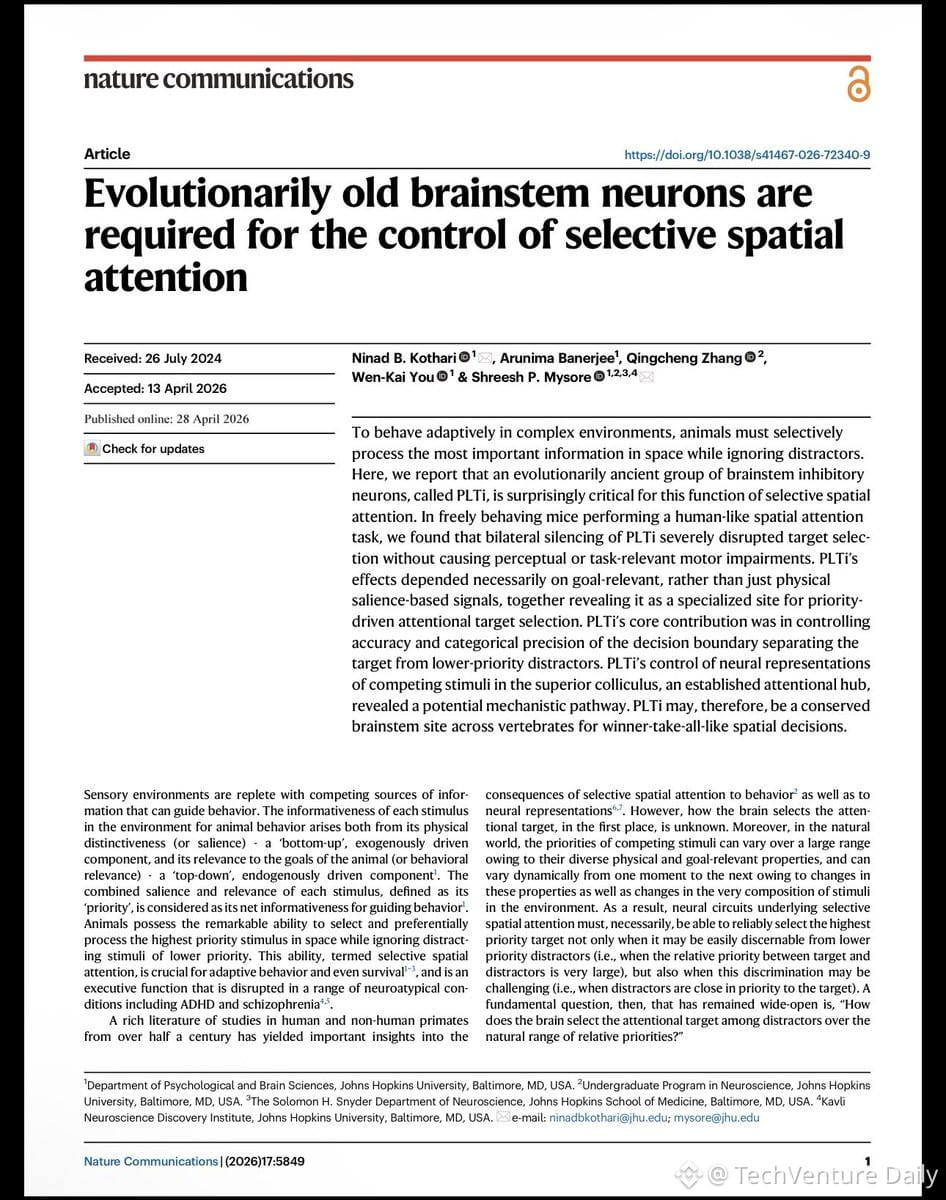
Johns Hopkins just mapped the brain's OG attention filter and it's not where anyone thought.
Turns out selective attention doesn't start in your fancy prefrontal cortex. It's handled by PLTi neurons, an ancient cluster of inhibitory cells buried in the brainstem that vertebrates have had for 300+ million years. Birds, fish, frogs all run the same circuit.
Here's the architecture:
PLTi sits in the midbrain tegmentum. These are parvalbumin-positive GABAergic neurons that form a reciprocal loop with the superior colliculus (the brain's spatial priority map). SC sends signals to PLTi. PLTi fires back inhibitory projections that suppress competing stimuli in the SC's intermediate/deep layers.
When researchers chemogenetically silenced PLTi in mice, the animals became hyper-distractible. Weak irrelevant stimuli hijacked their focus. Accuracy on incongruent flanker tasks dropped from 90% to chance. Vision intact. Motor control intact. Only the ability to filter signal from noise was gone. Next day, reactivate PLTi, the same mice ignore even strong distractors.
The kicker: this isn't cortical processing. This is a hardwired gain control mechanism that predates mammals. Your ability to focus in a noisy room or ignore notifications while coding is running on reptile-era hardware.
Implications for ADHD and autism are obvious. If attention breakdowns trace to subcortical inhibitory circuits rather than executive dysfunction, the therapeutic target shifts entirely. You're not fixing willpower, you're tuning an ancient sensory gatekeeper.
Paper in Nature Communications. First causal proof in mammals that attention's core filter is evolutionary legacy code, not a late-stage cognitive add-on.
Turns out selective attention doesn't start in your fancy prefrontal cortex. It's handled by PLTi neurons, an ancient cluster of inhibitory cells buried in the brainstem that vertebrates have had for 300+ million years. Birds, fish, frogs all run the same circuit.
Here's the architecture:
PLTi sits in the midbrain tegmentum. These are parvalbumin-positive GABAergic neurons that form a reciprocal loop with the superior colliculus (the brain's spatial priority map). SC sends signals to PLTi. PLTi fires back inhibitory projections that suppress competing stimuli in the SC's intermediate/deep layers.
When researchers chemogenetically silenced PLTi in mice, the animals became hyper-distractible. Weak irrelevant stimuli hijacked their focus. Accuracy on incongruent flanker tasks dropped from 90% to chance. Vision intact. Motor control intact. Only the ability to filter signal from noise was gone. Next day, reactivate PLTi, the same mice ignore even strong distractors.
The kicker: this isn't cortical processing. This is a hardwired gain control mechanism that predates mammals. Your ability to focus in a noisy room or ignore notifications while coding is running on reptile-era hardware.
Implications for ADHD and autism are obvious. If attention breakdowns trace to subcortical inhibitory circuits rather than executive dysfunction, the therapeutic target shifts entirely. You're not fixing willpower, you're tuning an ancient sensory gatekeeper.
Paper in Nature Communications. First causal proof in mammals that attention's core filter is evolutionary legacy code, not a late-stage cognitive add-on.