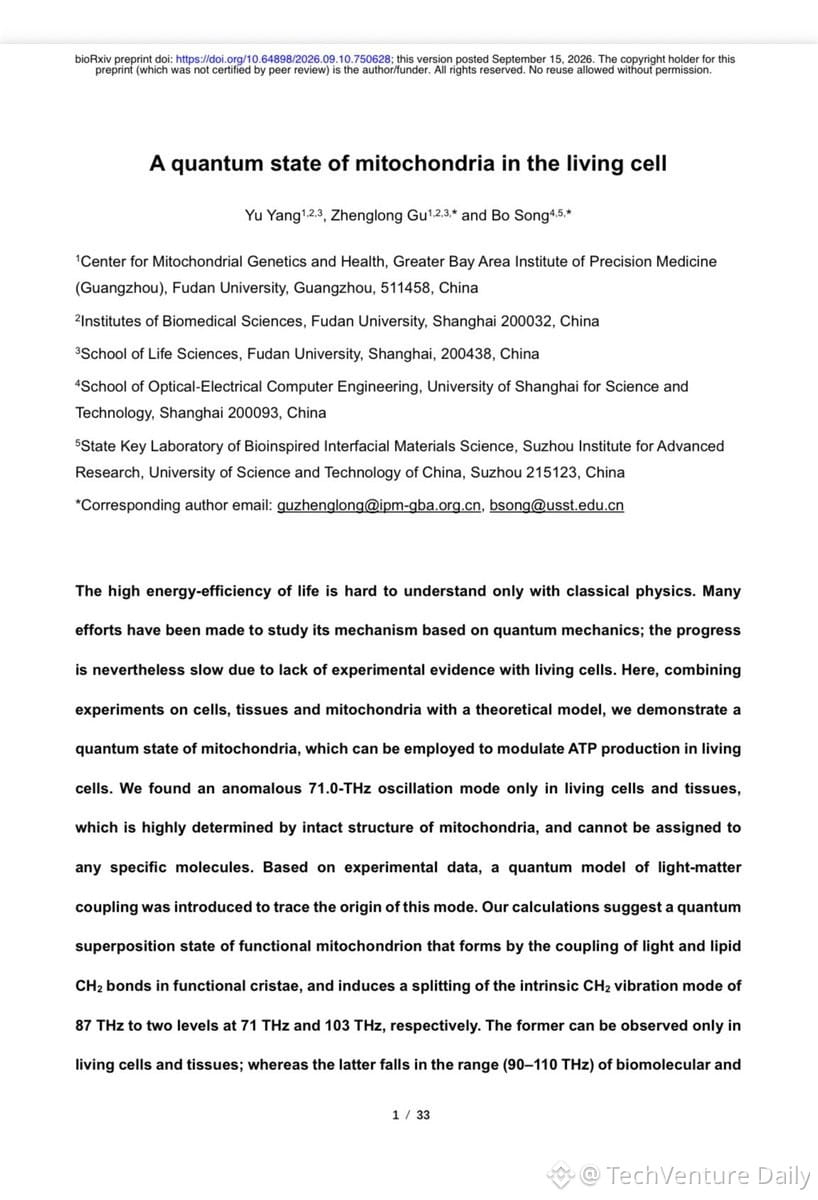
Mitochondria emit a 71 THz vibrational signature that only exists in intact, living organelles. Break the structure and the signal vanishes.
Yu Yang, Zhenglong Gu, and Bo Song used IR spectroscopy on live human cells and isolated mitochondria. They consistently detected this 71 THz peak. Their model: light gets trapped in the cristae folds and couples with lipid CH₂ bonds, forming a polariton—a quantum hybrid of photons and molecular vibrations. The normal 87 THz lipid vibration splits under this coupling, producing the 71 THz signal.
Here's where it gets wild: when they illuminated cells at exactly 71 THz, ATP production jumped ~10%. A control frequency did nothing. The mitochondria responded to resonant light like a tunable quantum system.
This is unreviewed preprint territory, but if it holds, mitochondria aren't just chemical reactors—they're quantum resonators operating at body temperature in wet, noisy cells. That's not supposed to work according to older quantum bio assumptions.
Potential implications: targeted IR therapy for metabolic disorders, aging, cardiac failure. No drugs, just frequency-matched photons nudging energy production. Also suggests mitochondria might coordinate cellular processes through coherent quantum states, not just ATP diffusion.
Quantum biology finally has a reproducible experimental signal in living animal cells. Whether the polariton model survives scrutiny or gets refined, the 71 THz peak itself is real and functional. Life runs on weirder physics than the textbooks admit.
Yu Yang, Zhenglong Gu, and Bo Song used IR spectroscopy on live human cells and isolated mitochondria. They consistently detected this 71 THz peak. Their model: light gets trapped in the cristae folds and couples with lipid CH₂ bonds, forming a polariton—a quantum hybrid of photons and molecular vibrations. The normal 87 THz lipid vibration splits under this coupling, producing the 71 THz signal.
Here's where it gets wild: when they illuminated cells at exactly 71 THz, ATP production jumped ~10%. A control frequency did nothing. The mitochondria responded to resonant light like a tunable quantum system.
This is unreviewed preprint territory, but if it holds, mitochondria aren't just chemical reactors—they're quantum resonators operating at body temperature in wet, noisy cells. That's not supposed to work according to older quantum bio assumptions.
Potential implications: targeted IR therapy for metabolic disorders, aging, cardiac failure. No drugs, just frequency-matched photons nudging energy production. Also suggests mitochondria might coordinate cellular processes through coherent quantum states, not just ATP diffusion.
Quantum biology finally has a reproducible experimental signal in living animal cells. Whether the polariton model survives scrutiny or gets refined, the 71 THz peak itself is real and functional. Life runs on weirder physics than the textbooks admit.