


CÓMO EMPEZÓ
Lanzamos Last Pixel: un experimento social con forma de juego de supervivencia.
Las reglas son simples. Un lienzo de un millón de cuadrados, uno por persona. Reclama un
cuadrado y luego confirma que sigues ahí antes de que se cierre tu ventana: 24 horas a
el inicio, un minuto al final. Falla una vez y tu casilla queda oscura para siempre.
Quien aún esté confirmando después de que todos los demás se hayan rendido se lleva la piscina — un
el lienzo completo mete un millón de dólares en ello.
Ninguna habilidad. Ninguna estrategia. Ninguna suerte. Pura terquedad.
Recuerda eso. Todo lo de abajo depende de ello.
CÓMO EJECUTAMOS EL AIRDROP
Un lienzo vacío no atrae a nadie, así que para sembrarlo reservamos 10,000 cuadrados gratis.
Completa una misión corta, consigue un cuadrado, no pagues nada.
Anunciamos eso en una de las comunidades de airdrop más grandes: dos millones de seguidores
en Telegram y 1.6 millones en X. La publicación costó 449 dólares.
Salió a las 13:42.
CÓMO LOS ATRAPAMOS
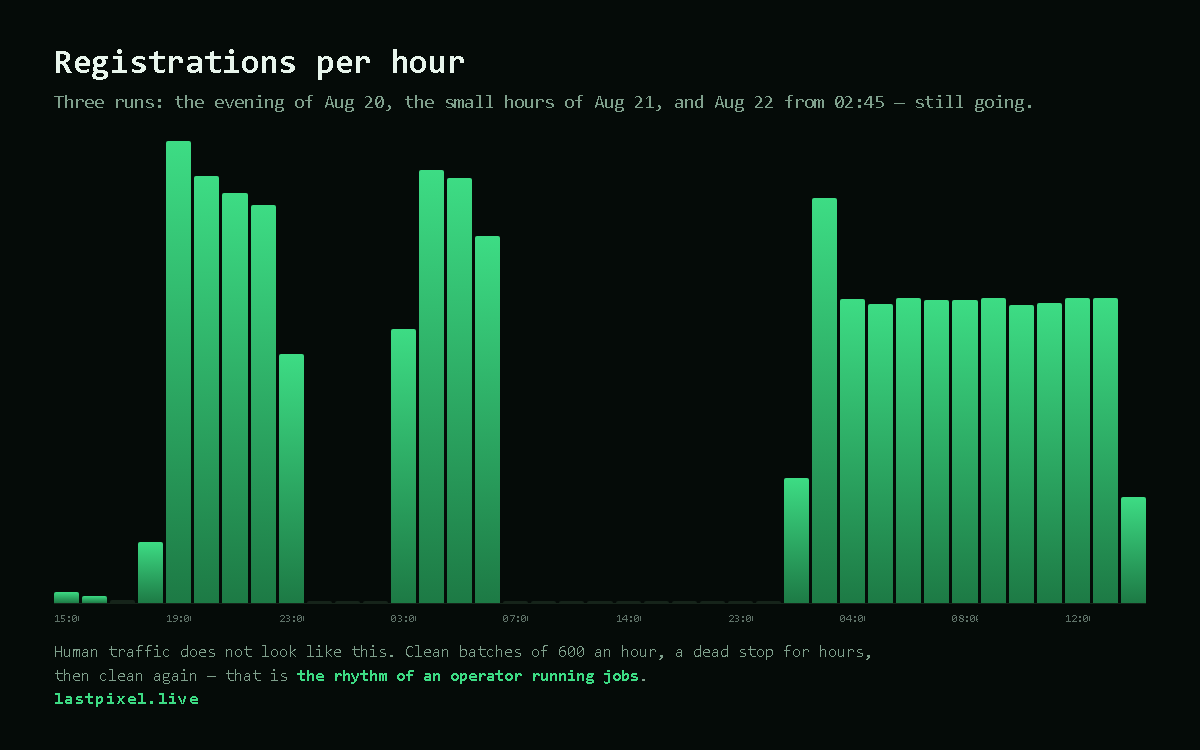
Lo que parecía estar mal primero no era el volumen. Era qué tan uniforme era. Los cuadrados
salía demasiado fácil para una multitud de gente real.
Agrupamos las cuentas por el enlace de referencia que las trajo. Diez enlaces corrieron muy lejos
delante de todo lo demás. Esto es cuántos trajo cada uno:
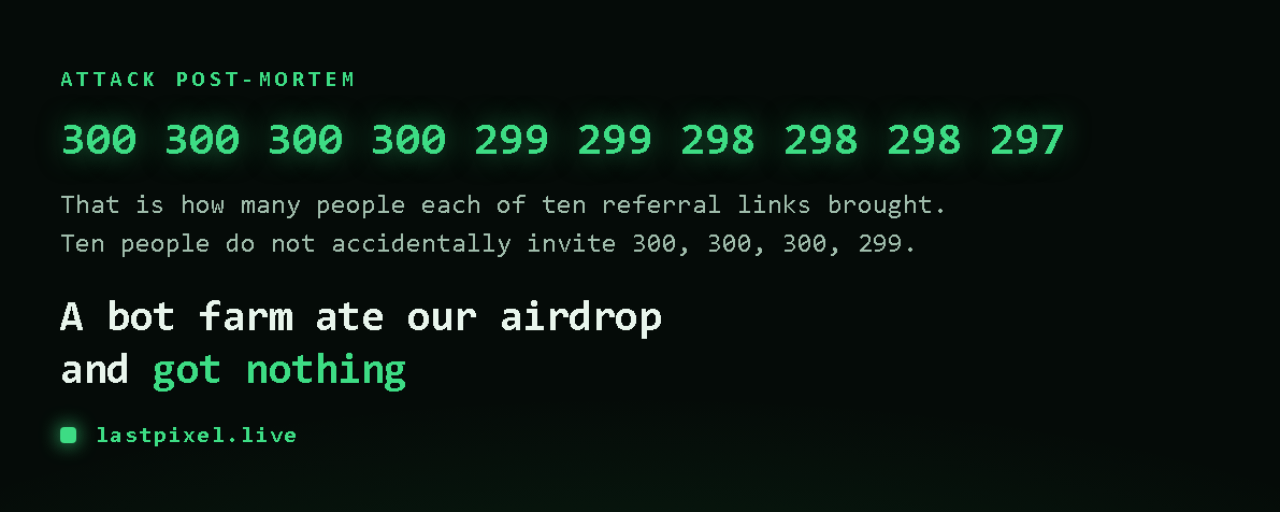
300 300 300 300 299 299 298 298 298 297
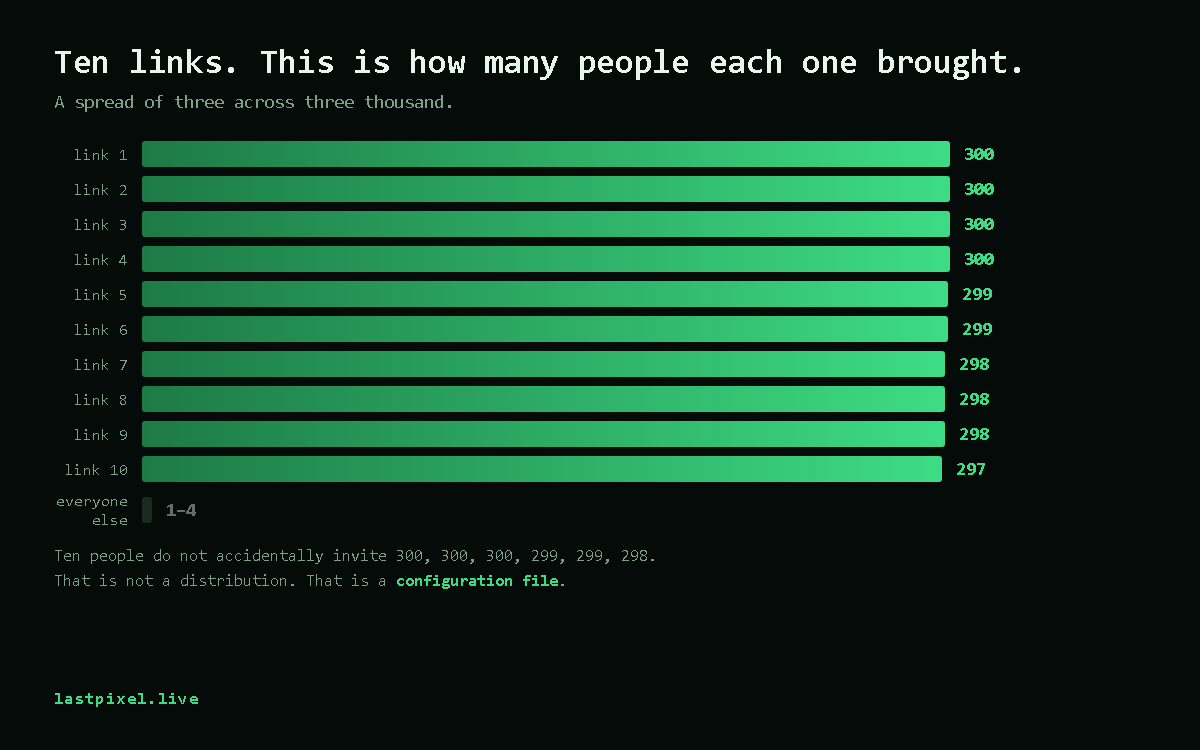
Diez personas no invitan accidentalmente a 300, 300, 300, 299, 299, 298. Eso no es
estadísticas. Eso es un archivo de configuración.
Luego miramos las cuentas mismas. Sus IDs de Telegram están todos entre
1.3 y 2.0 mil millones — registros de 2020 y 2021, ninguno reciente entre
ellos. No usuarios nuevos. Stock antiguo, comprado al por mayor.
Luego revisamos el reloj.
La publicación salió a las 13:42. El primero de las diez cuentas distribuidoras apareció
a las 17:38, la décima a las 18:25 — tres de ellos dentro de dos segundos entre sí.
A las 19:01 comenzó la inundación.
Leyeron la publicación, pasaron cuatro horas construyendo el montaje y nos lo apuntaron
la misma tarde.
LAS OTRAS SEÑALES
La misión tenía una tarea opcional: unirse a nuestro Discord. No dio nada y contó
por nada — lo marcamos como opcional porque es el paso más pesado con el
menor retorno.
Fue completada por 5,439 de 5,439.
La gente real nunca llega a cien por ciento. No en los pasos obligatorios, y
seguro que no en el de ningún premio.
Y el tiempo medio desde el registro hasta tener un cuadrado: 48 segundos. Ningún humano
se une a un canal, espera la verificación de membresía, lee una pregunta del quiz y
lo resuelve en un minuto.
EL RIESGO EN CADA ALCANCE DE TELEGRAM AIRDROP
Aquí está lo que vale la pena saber si entregas tokens.
La publicación por la que pagas es un anuncio para tu audiencia y una pista para una granja
operador al mismo tiempo. Lee esos canales con precisión porque eso es
donde se publican los regalos. Asume que está en tu lista de destinatarios antes de que
ni siquiera han hecho clic en "pagar."
Un captcha no te salva. Cloudflare Turnstile estaba delante del registro
todo el tiempo y se resolvió doce mil veces. Eso no es una queja
sobre Cloudflare: resolver cuesta alrededor de un dólar por cada mil, y cada captcha
sigue el mismo camino sin importar de quién sea. Como defensa anti-bots, el captcha
está terminado.
LUCHANDO CONTRA LA GRANJA
Una vez que quedó claro que el airdrop había fallado, hicimos dos cosas seguidas.
Primero recortamos el sorteo de 10,000 a 6,000 y lo detuvimos.
Luego cerramos la sesión de todos. Cada sesión, cada cookie, todo de una vez. Para
confirmar ahora tu ventana tenías que iniciar sesión otra vez a través de Telegram.
El razonamiento era estrecho. Tenían el registro automatizado por completo — doce
mil cuentas lo demostraron. Pero la reautenticación es una ruta de código distinta, y
los scripts que se construyen para ejecuciones de registro generalmente no lo tienen: después de registrarse se quedan
la cookie y reutilízala para siempre.
Estábamos apostando a la brecha entre "puede crear una cuenta" y "puede crear un
cuenta dos veces."
No eliminamos a nadie. Le pedimos a todos que iniciaran sesión otra vez.
NO VOLVIERON
La ventana se cerró a las 23:48 UTC.
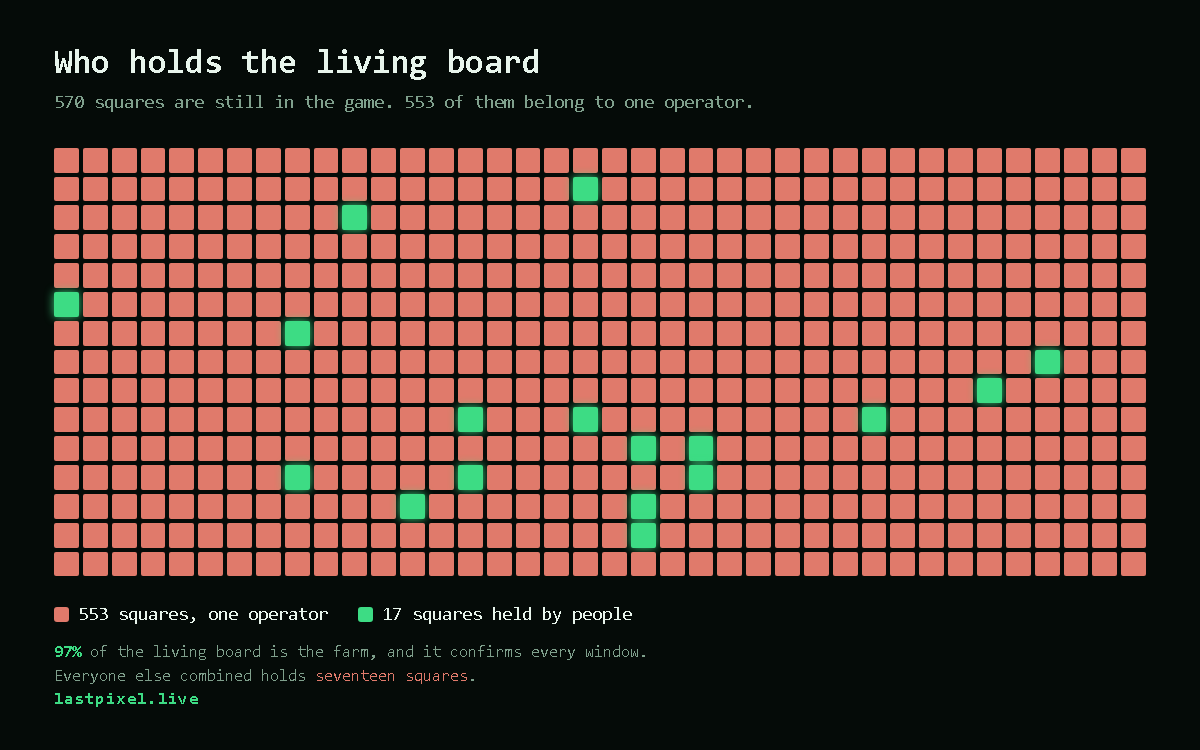
Para entonces, los 6,000 cuadrados que habíamos regalado estaban en oscuridad. Los primeros 5,439 se fueron
antes de cerrar sesión, por su cuenta: simplemente no volvieron para confirmar su
primera ventana. Las últimas 553 se apagaron después de eso. Ninguna de esas cuentas inició sesión de nuevo.
El script podía pasar un captcha doce mil veces. Responde el quiz. Únete al
canal. Marca la casilla opcional. Adjunta una billetera nueva. Confirma en el horario para
dos días seguidos.
No pudo iniciar sesión por segunda vez.
Esa es toda la defensa. No un captcha más inteligente. No aprendizaje automático. No un
puntuación de fraude. Un botón de cerrar sesión.
También nos costó algo. El cierre de sesión golpeó a todos indiscriminadamente, y uno real
un jugador perdió su cuadrado simplemente porque nunca se dio cuenta de que lo habían cerrado sesión.
Lo devolvimos y le dimos una ventana completa y nueva. No hizo nada mal. Nuestro
lo hizo.
LO QUE REALMENTE IBAN A BUSCAR
Su manual de juego nunca cambia: completar el airdrop, adjuntar una billetera, esperar
el token, venderlo todo en la primera hora después del listado. La billetera es la
el objetivo final. Ahí es donde se supone que caen los tokens.
De 12,821 cuentas, 12,680 adjuntaron una. Cada dirección distinta, no se repite ninguna
en doce mil. Eso no son personas. Eso es un generador.
No hay token. Nunca lo hubo.
La misión entregó un cuadrado: sin mercado, sin transferencia, sin reventa. La única forma
para usarlo es seguir volviendo durante semanas y presionar un botón.
Doce mil cuentas antiguas de Telegram, quemadas para el derecho a vigilar un botón.
Y la prueba que no deja lugar a dudas: cuando se acabaron los cuadrados gratis,
otra 6,686 cuentas se registraron igual. 6,656 adjuntaron una billetera. Cero completó
el cuestionario. Cero obtuvo un cuadrado.
ni siquiera lo intentaron. Inicia sesión, adjunta la billetera, para.
No querían un cuadrado. Querían una fila en la base de datos con una billetera puesta en
cuando llegó la instantánea.
LA PARTE INCÓMODA
Cientos de nuevos airdrops pasan por canales de Telegram cada día.
Los fundadores creen que han atraído participantes reales — personas que se quedarán en
el proyecto, haz algo dentro de él, quédate con algo. Cuentan las registraciones,
celebren el crecimiento, repórtenlo a los inversionistas.
En realidad, el regalo va a granjas. Y el día del listado, todo eso lo venden
una vez, colapsando el precio exactamente en las personas reales que sí aparecieron.
Lo logramos con poco: no había token, así que no había nada que llevarse. La granja
quemaron doce mil cuentas contra nosotros y no obtuvimos nada. Los proyectos con un token
no tengas tanta suerte.
Comprobar quién está en tu lista cuesta una consulta:
SELECT referred_by, count(*) FROM users
SELECT referred_by, count(*) FROM users
Si ves 300, 300, 300, 299 ahí, ya sabes lo que significa.
Y para quien esté ejecutando la granja: sabemos que estás leyendo esto. Busca
uno más y lo escribiremos con los mismos números y el mismo detalle. No
sin rencores. Ese es el experimento.
EL TABLERO ESTÁ BLANCO OTRA VEZ
Esta mañana, de un millón de cuadrados, seis están vivos.
Hace dos días había 6,000.
Vacío.
Así que la propuesta honesta no es "ven a derrotar a los bots" — ya se fueron. Es esto:
el lienzo está vacío, y no volverá a estar tan vacío. Quien toma un cuadrado
hoy no es unirse a una partida en progreso. Ellos son la partida en progreso.
Un cuadrado cuesta 4 dólares — un precio simbólico, el costo de un café. La entrada pagada es lo único
ahora. El registro cierra a principios de septiembre, y después no hay
no hay forma de entrar.
Sin habilidad. Sin estrategia. Sin suerte. Quien se rinde al final gana — y ahora casi
nadie ha empezado.
Rellena el lienzo y el premio llega a un millón de dólares. El fondo está en
smart contract: ni nosotros ni nadie más puede retirarlo, y el pago es
en cadena.
Los bots se fueron. Vengan a ocupar su lugar.
lastpixel.live