
As decentralized applications expand in complexity, the economics of data storage have become a limiting factor in system design. Centralized providers offer efficiency but undermine decentralization, while early decentralized storage systems often sacrifice performance or privacy. This economic tension highlights the need for storage models that balance cost, reliability, and decentralization without reverting to trusted intermediaries.
Walrus approaches this challenge by embedding economic coordination directly into its storage architecture. The protocol uses the WAL token to regulate access, incentivize resource contribution, and align participant behavior across a distributed network of storage providers.
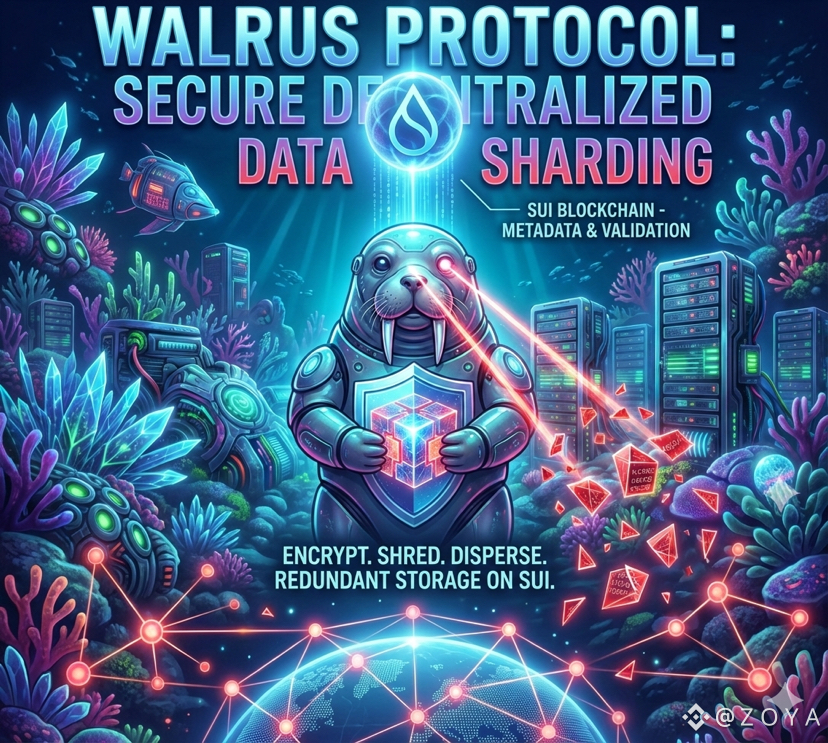
Built on the Sui blockchain, Walrus benefits from a state model that treats data as modular objects rather than a single global state. This allows storage updates to occur independently, reducing synchronization overhead and enabling horizontal scaling. The result is a system capable of supporting data-heavy applications without imposing execution bottlenecks.
The underlying storage mechanism relies on erasure coding, which divides data into encrypted fragments distributed across multiple nodes. Unlike full replication, this approach minimizes redundancy while preserving recoverability. From an economic standpoint, this reduces the total storage burden on the network, lowering costs for users while maintaining resilience.
Privacy considerations significantly influence Walrus’s economic design. Since nodes cannot interpret stored data, value extraction is limited to protocol-defined incentives rather than data exploitation. This reinforces trustlessness but shifts responsibility for indexing and analysis to application layers built on top of the protocol.
WAL serves as the medium through which storage pricing and rewards are determined. Storage providers are compensated based on availability and compliance with protocol rules, while users pay proportionally for the resources they consume. Governance mechanisms allow token holders to adjust parameters as network conditions evolve.

This incentive structure aims to maintain equilibrium between supply and demand for storage capacity. By avoiding excessive replication, Walrus can potentially offer more competitive pricing than systems that prioritize redundancy over efficiency.
Use cases range from decentralized application hosting to enterprise data storage where privacy guarantees are critical. The protocol’s flexibility allows it to serve as a backend infrastructure rather than a standalone consumer product.
However, sustaining this economic model requires consistent demand. Without active applications generating storage usage, incentives alone cannot maintain long-term network participation. Market volatility also introduces challenges in maintaining predictable pricing.
Overall, Walrus represents an experiment in aligning decentralized storage economics with technical design. Its success depends on whether incentive coordination can scale alongside real-world data demands.

