Binance Square
Valentien
20 Publicaciones

Valentien

My Mom, God & Luck
10 Siguiendo
3 Seguidores
7 Me gusta
Publicaciones
·
--
Have you heard about Save The Life (@savethelife_SL)? 👀 If not, here’s a simple introduction. SL is building around an interesting intersection of AI, blockchain, and healthcare 🧬🤖⛓️ The bigger idea behind this space is how technology can help make health data more useful, transparent, and connected while exploring new possibilities for decentralized science (DeSci). What makes SL interesting to me is the combination of these three narratives. AI is evolving fast, blockchain is changing how data and ownership can work, and healthcare is an area where better technology can have a real-world impact. I’m still doing my own research, so I’m not here to say “this will definitely succeed.” But discovering projects early is exactly what makes Web3 interesting. 👀 I’ll be watching @savethelife_SL and seeing how the ecosystem develops. Have you heard about SL before? #Binance #SaveTheLife #DeSci #AI #Web3
Have you heard about Save The Life (@savethelife_SL)? 👀

If not, here’s a simple introduction.

SL is building around an interesting intersection of AI, blockchain, and healthcare 🧬🤖⛓️

The bigger idea behind this space is how technology can help make health data more useful, transparent, and connected while exploring new possibilities for decentralized science (DeSci).

What makes SL interesting to me is the combination of these three narratives. AI is evolving fast, blockchain is changing how data and ownership can work, and healthcare is an area where better technology can have a real-world impact.

I’m still doing my own research, so I’m not here to say “this will definitely succeed.”

But discovering projects early is exactly what makes Web3 interesting. 👀

I’ll be watching @savethelife_SL and seeing how the ecosystem develops.

Have you heard about SL before?

#Binance #SaveTheLife #DeSci #AI #Web3
⚡ ETH 15M: THE DECISION ZONE IS GETTING TIGHT $ETH is sitting around $2,423, and the 15M chart is showing an interesting battle. 📈 Bullish trigger: $ETH breaks and holds $2,428–$2,439 → momentum could expand toward higher levels. 📉 Bearish trigger: rejection from that zone + loss of $2,420 → $2,402 becomes the next area to watch. Current RSI is around 51, so neither side has a clear advantage yet. {future}(ETHUSDT) My read for $ETH Above $2,439 → bulls gain control. Below $2,420 → bears start getting interesting. Between those levels? It's a battlefield. Don't guess—wait for the breakout or rejection. 👀 #ETH #Ethereum #Crypto #Futures #Trading #BinanceSquare Educational discussion only. Not financial advice.
⚡ ETH 15M: THE DECISION ZONE IS GETTING TIGHT

$ETH is sitting around $2,423, and the 15M chart is showing an interesting battle.

📈 Bullish trigger: $ETH breaks and holds $2,428–$2,439 → momentum could expand toward higher levels.

📉 Bearish trigger: rejection from that zone + loss of $2,420 → $2,402 becomes the next area to watch.

Current RSI is around 51, so neither side has a clear advantage yet.


My read for $ETH

Above $2,439 → bulls gain control.
Below $2,420 → bears start getting interesting.

Between those levels?

It's a battlefield. Don't guess—wait for the breakout or rejection. 👀

#ETH #Ethereum #Crypto #Futures #Trading #BinanceSquare

Educational discussion only. Not financial advice.
🌉 $BTC : THE BRIDGE IS FALLING? Bitcoin spent the last few days climbing higher... Everyone started thinking: “Here we go again. 🚀” Then $BTC reached higher levels… …and suddenly today: 📈 Up 📉 Down 📈 Up 📉 Again? It feels a little like: 🎵 London Bridge is falling down… 👀 But here's the interesting part: A pullback doesn't automatically mean the bullish trend is over. After a strong rally, traders naturally start asking: Is this just a healthy correction? or Is the market losing momentum? That's why watching the price structure, volume, and key support levels can be more useful than simply watching the green percentage. Bitcoin doesn't need to go straight up to remain bullish. Sometimes the market needs to shake out the passengers before deciding where the next train goes. 🚂 So… is the bridge actually falling, or are we just watching $BTC rebuild it one candle at a time? 👀 #Bitcoin #BTC #Crypto #Trading #BinanceSquare Educational discussion only. Not financial advice.
🌉 $BTC : THE BRIDGE IS FALLING?

Bitcoin spent the last few days climbing higher...

Everyone started thinking:

“Here we go again. 🚀”

Then $BTC reached higher levels…

…and suddenly today:

📈 Up
📉 Down
📈 Up
📉 Again?

It feels a little like:

🎵 London Bridge is falling down… 👀

But here's the interesting part:

A pullback doesn't automatically mean the bullish trend is over.

After a strong rally, traders naturally start asking:

Is this just a healthy correction?

or

Is the market losing momentum?

That's why watching the price structure, volume, and key support levels can be more useful than simply watching the green percentage.

Bitcoin doesn't need to go straight up to remain bullish.

Sometimes the market needs to shake out the passengers before deciding where the next train goes. 🚂

So… is the bridge actually falling, or are we just watching $BTC rebuild it one candle at a time? 👀

#Bitcoin #BTC #Crypto #Trading #BinanceSquare

Educational discussion only. Not financial advice.
Artículo
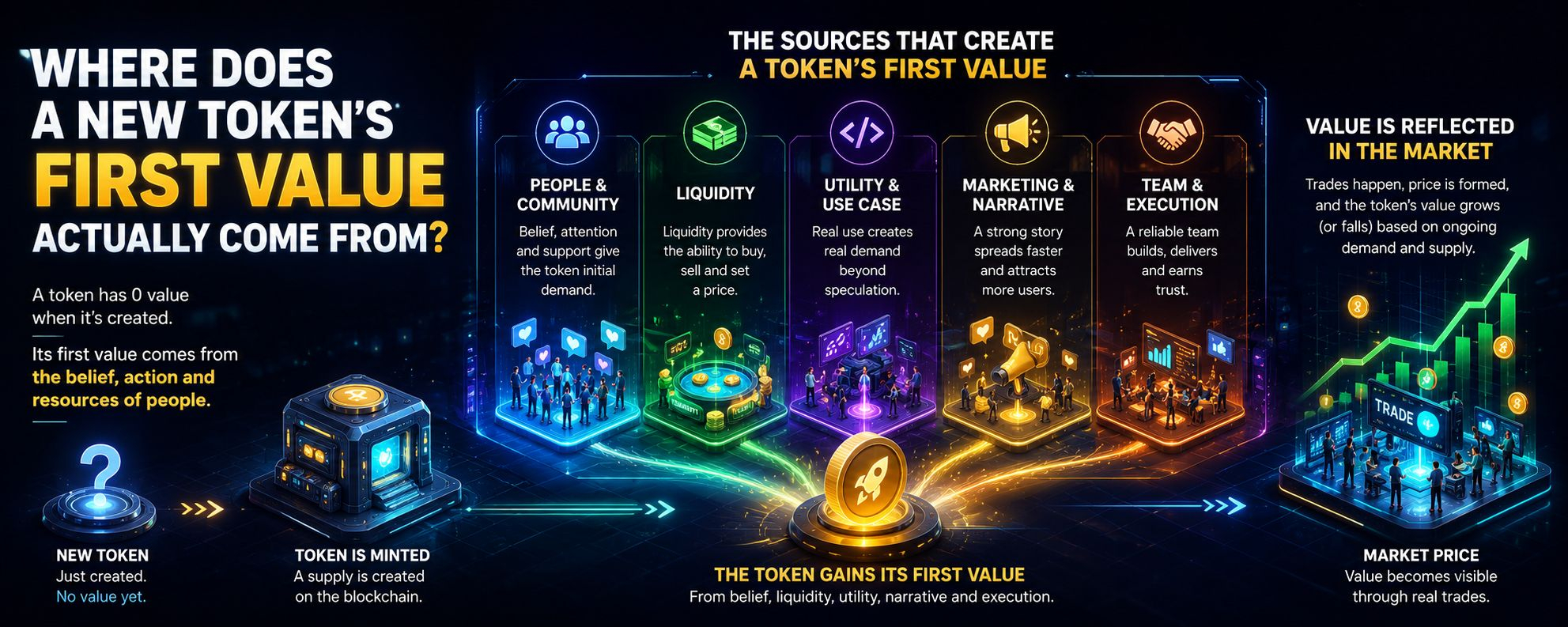
🪙WHERE DOES A NEW TOKEN'S FIRST VALUE ACTUALLY COME FROM?When a brand-new token appears at $0.00000…, many people immediately think: “Wow, it's extremely cheap.” But here's the twist: The token didn't necessarily start with that value. On an AMM-based DEX, a new token needs liquidity before normal swapping can happen. The initial liquidity provider deposits both the new token and another asset—for example BNB, ETH, SOL, or a stablecoin. The initial ratio between those assets establishes the starting exchange price. � Uniswap Developers +1 Imagine: 1,000,000 ABC + 1 BNB That ratio creates the initial ABC/BNB price. If someone buys ABC using BNB, the pool's balances change. The AMM then adjusts the price according to its pricing mechanism. In the classic constant-product model: x × y = k So the price isn't coming from some central authority saying: “ABC is worth $0.000001.” It's emerging from the assets placed into the market and subsequent trading activity. � Uniswap Developers +1 🤯 And this is where it gets interesting. A token can have: 1,000,000,000 tokens and trade at: $0.000001 while another token has: 1,000,000 tokens and trades at: $1 The first token isn't automatically cheaper. Supply matters. That's why looking only at the number after the dollar sign can be extremely misleading. 🌐 The same basic idea appears across ecosystems. BNB Chain can have $BNB /token pools. Ethereum can have $ETH /token pools. Solana can have $SOL /token pools. The native asset isn't being “broken into” the new token. Instead, it becomes one side of the economic trading pair. And here's the question I think is much more interesting: Who provides the first BNB, ETH, SOL or stablecoins that gives a brand-new token its first market price? Because that first liquidity isn't just a number. It's the moment a token moves from being a smart-contract balance to becoming a tradable market. And that leads to an even bigger question: If the initial liquidity is tiny, how meaningful is the token's displayed market price? That's where things get really interesting. Educational discussion only. Crypto markets are highly volatile and this is not financial advice. #Crypto #Tokenomics #DeFi #LiquidityPool #Blockchain #Web3 #BNBChain #Ethereum #Solana #BinanceSquare

🪙WHERE DOES A NEW TOKEN'S FIRST VALUE ACTUALLY COME FROM?

When a brand-new token appears at $0.00000…, many people immediately think:
“Wow, it's extremely cheap.”
But here's the twist:
The token didn't necessarily start with that value.
On an AMM-based DEX, a new token needs liquidity before normal swapping can happen. The initial liquidity provider deposits both the new token and another asset—for example BNB, ETH, SOL, or a stablecoin. The initial ratio between those assets establishes the starting exchange price. �
Uniswap Developers +1
Imagine:
1,000,000 ABC + 1 BNB
That ratio creates the initial ABC/BNB price.
If someone buys ABC using BNB, the pool's balances change. The AMM then adjusts the price according to its pricing mechanism. In the classic constant-product model:
x × y = k
So the price isn't coming from some central authority saying:
“ABC is worth $0.000001.”
It's emerging from the assets placed into the market and subsequent trading activity. �
Uniswap Developers +1
🤯 And this is where it gets interesting.
A token can have:
1,000,000,000 tokens
and trade at:
$0.000001
while another token has:
1,000,000 tokens
and trades at:
$1
The first token isn't automatically cheaper.
Supply matters.
That's why looking only at the number after the dollar sign can be extremely misleading.
🌐 The same basic idea appears across ecosystems.
BNB Chain can have $BNB /token pools.
Ethereum can have $ETH /token pools.
Solana can have $SOL /token pools.
The native asset isn't being “broken into” the new token.
Instead, it becomes one side of the economic trading pair.
And here's the question I think is much more interesting:
Who provides the first BNB, ETH, SOL or stablecoins that gives a brand-new token its first market price?
Because that first liquidity isn't just a number.
It's the moment a token moves from being a smart-contract balance to becoming a tradable market.
And that leads to an even bigger question:
If the initial liquidity is tiny, how meaningful is the token's displayed market price?
That's where things get really interesting.
Educational discussion only. Crypto markets are highly volatile and this is not financial advice.
#Crypto #Tokenomics #DeFi #LiquidityPool #Blockchain #Web3 #BNBChain #Ethereum #Solana #BinanceSquare
🚨 THE MARKET CAP RANKING TRAP For years, crypto investors have asked: “What rank is this token?” But what if ranking isn't enough anymore? A token can have a huge market cap while showing limited real usage. Meanwhile, a lower-ranked project might have: 📈 Growing users 💧 Strong liquidity 💰 Rising fees/revenue 🔄 Increasing trading activity 🏗️ Real ecosystem development Market cap tells you what the market is valuing. It doesn't tell you why. And with token unlocks, inflation and huge FDVs becoming increasingly important, looking only at market-cap ranking can hide a lot. Maybe the smarter question isn't: > “Which coin is #20?” It's: > “What is actually happening behind #20 !? The next crypto winners may not simply be found by scrolling down a ranking list. Look beyond the number. 👀 #Crypto #Bitcoin #Altcoins #DeFi #Tokenomics #Web3 #BinanceSquare Educational discussion only. Not financial advice.
🚨 THE MARKET CAP RANKING TRAP

For years, crypto investors have asked:

“What rank is this token?”

But what if ranking isn't enough anymore?

A token can have a huge market cap while showing limited real usage.

Meanwhile, a lower-ranked project might have:

📈 Growing users
💧 Strong liquidity
💰 Rising fees/revenue
🔄 Increasing trading activity
🏗️ Real ecosystem development

Market cap tells you what the market is valuing.

It doesn't tell you why.

And with token unlocks, inflation and huge FDVs becoming increasingly important, looking only at market-cap ranking can hide a lot.

Maybe the smarter question isn't:

> “Which coin is #20?”

It's:

> “What is actually happening behind #20 !?

The next crypto winners may not simply be found by scrolling down a ranking list.

Look beyond the number. 👀

#Crypto #Bitcoin #Altcoins #DeFi #Tokenomics #Web3 #BinanceSquare

Educational discussion only. Not financial advice.
"PRIVATE DOESN’T HAVE TO MEAN INVISIBLE" This is one of the biggest problems in blockchain. Traditional finance needs privacy. Public blockchains need transparency. So what happens when an asset needs both? That’s where @Dusk_Foundation gets interesting. Instead of treating privacy and compliance as opposites, Dusk is building infrastructure around privacy-preserving transactions, regulated assets, and compliant onchain markets. Think about tokenized real-world assets. You may want the transaction to be verifiable without exposing every piece of sensitive information to everyone. That’s the interesting part of $DUSK The bigger opportunity may not be another chain for trading memes. It could be infrastructure for bringing regulated financial assets onchain while giving users more control over what information is actually revealed. And here's the part worth watching: If blockchain adoption eventually moves beyond crypto-native assets, privacy + compliance could become just as important as speed and fees. Maybe the future isn't: “Everything is public.” Maybe it's: “Everything is verifiable — but not everything has to be visible.” 👀 What do you think? #dusk
"PRIVATE DOESN’T HAVE TO MEAN INVISIBLE"

This is one of the biggest problems in blockchain.

Traditional finance needs privacy.

Public blockchains need transparency.

So what happens when an asset needs both?

That’s where @Dusk gets interesting.

Instead of treating privacy and compliance as opposites, Dusk is building infrastructure around privacy-preserving transactions, regulated assets, and compliant onchain markets.

Think about tokenized real-world assets.

You may want the transaction to be verifiable without exposing every piece of sensitive information to everyone.

That’s the interesting part of $DUSK

The bigger opportunity may not be another chain for trading memes.

It could be infrastructure for bringing regulated financial assets onchain while giving users more control over what information is actually revealed.

And here's the part worth watching:

If blockchain adoption eventually moves beyond crypto-native assets, privacy + compliance could become just as important as speed and fees.

Maybe the future isn't:

“Everything is public.”

Maybe it's:

“Everything is verifiable — but not everything has to be visible.” 👀

What do you think?

#dusk

Artículo
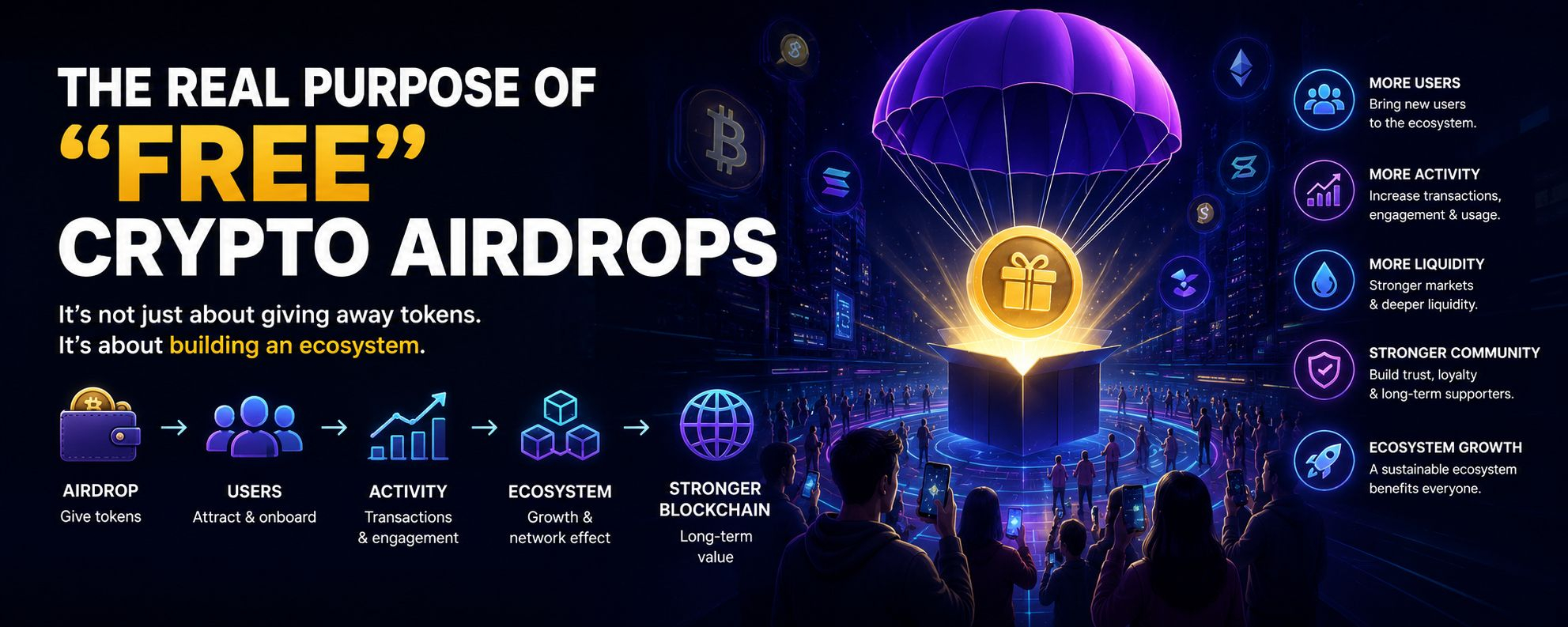
🧩THE REAL PURPOSE OF “FREE” CRYPTO AIRDROPSWe usually see an airdrop and think: “Free tokens. Nice.” But what if we're looking at the wrong side of the equation? A blockchain ecosystem doesn't only need tokens. 🛑 It needs users. And users create activity. A small project can distribute tokens to thousands of wallets and suddenly create: 👛 New active wallets 🔄 More transactions 🌐 More dApp interaction 💧 More liquidity 👥 A larger community The token may be tiny. The network effect isn't. Think about the cycle: Blockchain → Projects → Airdrops → Users → Activity → Ecosystem Growth This isn't unique to one chain. We've seen different versions of this strategy across Ethereum, BNB Chain, Solana, Layer-2 networks and other ecosystems. And there's an interesting economic question hiding underneath: > Are some “free” tokens actually an ecosystem's customer-acquisition cost? Instead of paying for traditional advertising, a project gives users something they can potentially value. The project gets: attention + wallets + activity + community The user gets: tokens + an opportunity to participate Of course, not every airdrop succeeds. Some tokens disappear. Some projects lose activity after incentives end. And some distributions are simply marketing campaigns. But when you zoom out, airdrops start looking less like free money... …and more like infrastructure for bootstrapping an economy. The real question isn't: “How much is this airdrop worth?” It's: “How much activity can this airdrop create?” That's where things get interesting. 👀 #Crypto #Airdrop #Blockchain #Web3 #DeFi #Ethereum #Solana #BNBChain #BinanceSquare Educational discussion only. Not financial advice.

🧩THE REAL PURPOSE OF “FREE” CRYPTO AIRDROPS

We usually see an airdrop and think:
“Free tokens. Nice.”
But what if we're looking at the wrong side of the equation?
A blockchain ecosystem doesn't only need tokens.
🛑 It needs users.
And users create activity.
A small project can distribute tokens to thousands of wallets and suddenly create:
👛 New active wallets
🔄 More transactions
🌐 More dApp interaction
💧 More liquidity
👥 A larger community
The token may be tiny.
The network effect isn't.
Think about the cycle:
Blockchain → Projects → Airdrops → Users → Activity → Ecosystem Growth
This isn't unique to one chain.
We've seen different versions of this strategy across Ethereum, BNB Chain, Solana, Layer-2 networks and other ecosystems.
And there's an interesting economic question hiding underneath:
> Are some “free” tokens actually an ecosystem's customer-acquisition cost?
Instead of paying for traditional advertising, a project gives users something they can potentially value.
The project gets:
attention + wallets + activity + community
The user gets:
tokens + an opportunity to participate
Of course, not every airdrop succeeds.
Some tokens disappear.
Some projects lose activity after incentives end.
And some distributions are simply marketing campaigns.
But when you zoom out, airdrops start looking less like free money...
…and more like infrastructure for bootstrapping an economy.
The real question isn't:
“How much is this airdrop worth?”
It's:
“How much activity can this airdrop create?”
That's where things get interesting. 👀
#Crypto #Airdrop #Blockchain #Web3 #DeFi #Ethereum #Solana #BNBChain #BinanceSquare
Educational discussion only. Not financial advice.
Artículo
🧩 HOW DOES A TINY TOKEN GROW INSIDE A GIANT BLOCKCHAIN?A Tiny token can appear almost out of nowhere. One day, nobody knows it. The next day: A new token exists. It has a contract. It has holders. It has a market. But here's the question: Where does the big blockchain come into the picture? A common misconception is that a small token somehow receives a “piece” of BNB, ETH, or SOL from the blockchain itself. That's not exactly how it works. The blockchain is more like the infrastructure. Think of it like a massive city. 🏙️ Blockchain = the city 🏗️ Smart contracts = buildings 🪙 Tokens = businesses inside those buildings 👥 Users = customers 💧 Liquidity = the capital that allows trading to happen The blockchain provides the environment where the token can exist and operate. For example, Ethereum allows developers to deploy ERC-20 token contracts. Once deployed, the contract keeps track of the token's supply and balances. � ethereum.org +1 On BNB Smart Chain, BNB is the native asset used to pay transaction fees, while developers can deploy compatible smart contracts and build applications on the network. � BNB Chain +1 And on Solana, tokens are created through its Token Programs, with a Mint Account defining things such as supply and mint authority. Transactions on the network require SOL for fees. � Solana +1 So the flow looks more like this: BIG BLOCKCHAIN ⬇️ Provides infrastructure ⬇️ DEVELOPER Creates a token/smart contract ⬇️ TOKEN Gets its own supply, rules and identity ⬇️ LIQUIDITY The token gets paired with assets such as BNB, ETH, SOL or stablecoins ⬇️ USERS Start interacting, trading and using the token ⬇️ ECOSYSTEM The token potentially grows into a larger project. And here's the fascinating part: The blockchain doesn't necessarily need to give the token free $BNB $ETH or $SOL The project may need to acquire the native asset itself to pay network fees and build its initial infrastructure. But a growing ecosystem can provide something even more valuable: standards + infrastructure + users + applications + liquidity + visibility. That's why a tiny token can grow much faster when it is built inside an established ecosystem rather than trying to build an entire blockchain from scratch. Ethereum, BNB Chain, Solana and other major networks essentially provide the roads. The small projects build the vehicles. And if enough people start using those vehicles... the entire ecosystem becomes bigger. So maybe the better question isn't: “How does a tiny token get a piece of a giant blockchain?” It's: “How does a giant blockchain turn thousands of tiny tokens and projects into a growing economy?” And that's where the relationship between blockchains and the tokens built on top of them becomes really interesting. 👀 #Crypto #Blockchain #Tokenomics #Web3 #DeFi #Ethereum #Solana #BNBChain #BinanceSquare *Educational discussion only. Not financial advice.*

🧩 HOW DOES A TINY TOKEN GROW INSIDE A GIANT BLOCKCHAIN?

A Tiny token can appear almost out of nowhere.
One day, nobody knows it.
The next day:
A new token exists.
It has a contract.
It has holders.
It has a market.
But here's the question:
Where does the big blockchain come into the picture?
A common misconception is that a small token somehow receives a “piece” of BNB, ETH, or SOL from the blockchain itself.
That's not exactly how it works.
The blockchain is more like the infrastructure.
Think of it like a massive city.
🏙️ Blockchain = the city
🏗️ Smart contracts = buildings
🪙 Tokens = businesses inside those buildings
👥 Users = customers
💧 Liquidity = the capital that allows trading to happen
The blockchain provides the environment where the token can exist and operate.
For example, Ethereum allows developers to deploy ERC-20 token contracts. Once deployed, the contract keeps track of the token's supply and balances. �
ethereum.org +1
On BNB Smart Chain, BNB is the native asset used to pay transaction fees, while developers can deploy compatible smart contracts and build applications on the network. �
BNB Chain +1
And on Solana, tokens are created through its Token Programs, with a Mint Account defining things such as supply and mint authority. Transactions on the network require SOL for fees. �
Solana +1
So the flow looks more like this:
BIG BLOCKCHAIN
⬇️
Provides infrastructure
⬇️
DEVELOPER
Creates a token/smart contract
⬇️
TOKEN
Gets its own supply, rules and identity
⬇️
LIQUIDITY
The token gets paired with assets such as BNB, ETH, SOL or stablecoins
⬇️
USERS
Start interacting, trading and using the token
⬇️
ECOSYSTEM
The token potentially grows into a larger project.
And here's the fascinating part:
The blockchain doesn't necessarily need to give the token free $BNB $ETH or $SOL
The project may need to acquire the native asset itself to pay network fees and build its initial infrastructure.
But a growing ecosystem can provide something even more valuable:
standards + infrastructure + users + applications + liquidity + visibility.
That's why a tiny token can grow much faster when it is built inside an established ecosystem rather than trying to build an entire blockchain from scratch.
Ethereum, BNB Chain, Solana and other major networks essentially provide the roads.
The small projects build the vehicles.
And if enough people start using those vehicles...
the entire ecosystem becomes bigger.
So maybe the better question isn't:
“How does a tiny token get a piece of a giant blockchain?”
It's:
“How does a giant blockchain turn thousands of tiny tokens and projects into a growing economy?”
And that's where the relationship between blockchains and the tokens built on top of them becomes really interesting. 👀
#Crypto #Blockchain #Tokenomics #Web3 #DeFi #Ethereum #Solana #BNBChain #BinanceSquare
*Educational discussion only. Not financial advice.*
Artículo
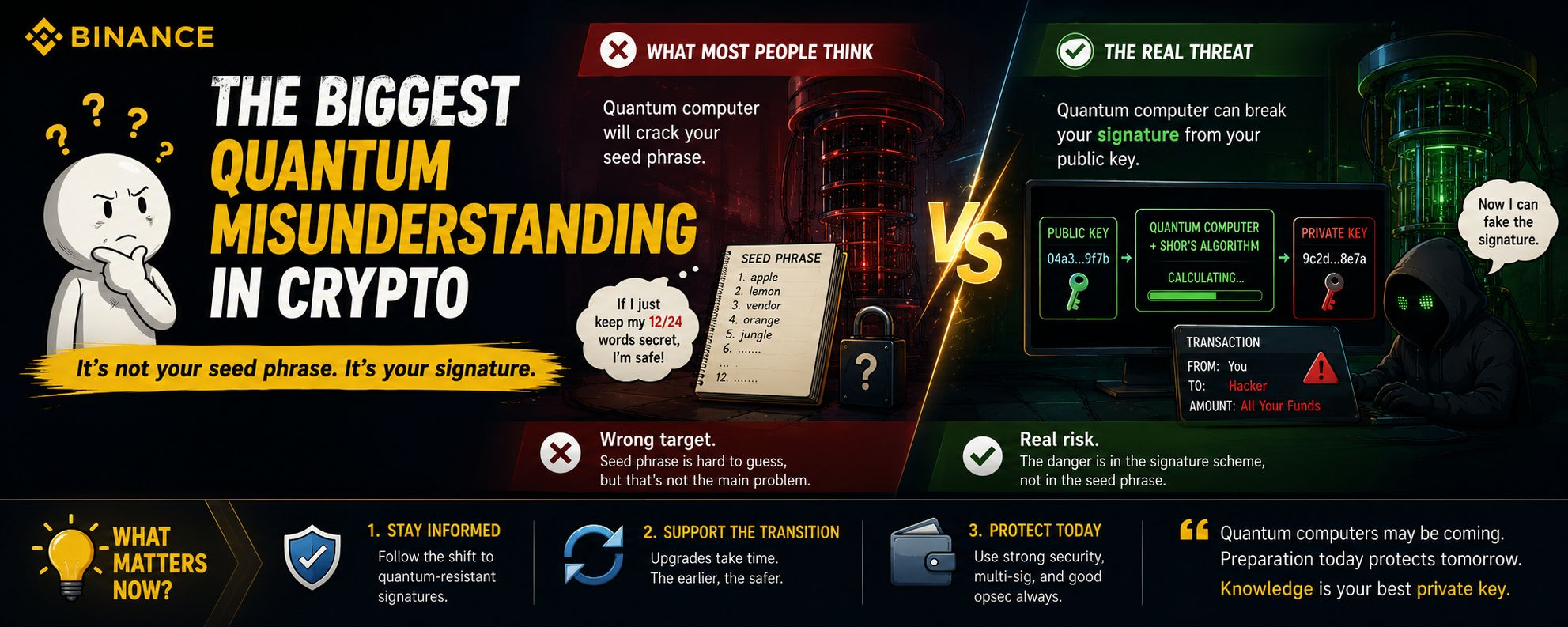
⚛️ YOUR SEED PHRASE MAY NOT BE THE REAL PROBLEMThere’s a crypto myth that keeps getting repeated: “Quantum computers will crack your 12 or 24-word seed phrase.” Not exactly. And this distinction could become VERY important. Your seed phrase isn't simply a password that a quantum computer sits down and “guesses.” The bigger issue is the cryptographic signature system used to authorize transactions. Think about it like this: 🔐 Seed phrase = the key to your wallet ✍️ Digital signature = the proof that you are allowed to move the funds A sufficiently powerful quantum computer could theoretically threaten some of today's public-key cryptography through algorithms such as Shor's algorithm. So the real question isn't: “When will quantum computers crack seed phrases?” It's: “Will blockchains upgrade their signature systems BEFORE quantum computers become powerful enough to threaten them?” And this isn't science fiction anymore. NIST has already standardized post-quantum digital-signature algorithms including ML-DSA and SLH-DSA, while continuing research into additional schemes. � NIST Computer Security Resource Center +1 That means the cryptography industry is already preparing for the transition. Now look at the major networks: 🔵 $BTC The world's largest crypto network—and one of the most interesting candidates to watch when the industry eventually debates quantum-resistant signatures. 🔷 $ETH Ethereum's huge smart-contract ecosystem makes cryptographic migration particularly interesting because changing signature infrastructure isn't simply a wallet problem. 🟣 $SOL Another major ecosystem where the long-term question isn't only scalability—it is also how cryptographic security evolves as computing technology changes. None of these tickers should be interpreted as “quantum safe” simply because they're mentioned here. That's exactly the point. The future battle may not be Seed Phrase vs Quantum Computer. It could be: OLD SIGNATURES 🆚 NEW CRYPTOGRAPHY And whoever migrates successfully before the threat becomes practical may have a massive advantage. The most dangerous sentence in crypto might not be: “My seed phrase is exposed.” It could be: “My seed phrase is perfectly safe… but the signature protecting my coins isn't.” 👀 $BTC $ETH $SOL Which blockchain do you think will be best prepared for the post-quantum era? #Bitcoin #Ethereum #Solana #BTC #ETH #SOL #QuantumComputing #PostQuantum #CryptoSecurity #BinanceSquare

⚛️ YOUR SEED PHRASE MAY NOT BE THE REAL PROBLEM

There’s a crypto myth that keeps getting repeated:
“Quantum computers will crack your 12 or 24-word seed phrase.”
Not exactly.
And this distinction could become VERY important.
Your seed phrase isn't simply a password that a quantum computer sits down and “guesses.”
The bigger issue is the cryptographic signature system used to authorize transactions.
Think about it like this:
🔐 Seed phrase = the key to your wallet
✍️ Digital signature = the proof that you are allowed to move the funds
A sufficiently powerful quantum computer could theoretically threaten some of today's public-key cryptography through algorithms such as Shor's algorithm.
So the real question isn't:
“When will quantum computers crack seed phrases?”
It's:
“Will blockchains upgrade their signature systems BEFORE quantum computers become powerful enough to threaten them?”
And this isn't science fiction anymore.
NIST has already standardized post-quantum digital-signature algorithms including ML-DSA and SLH-DSA, while continuing research into additional schemes. �
NIST Computer Security Resource Center +1
That means the cryptography industry is already preparing for the transition.
Now look at the major networks:
🔵 $BTC
The world's largest crypto network—and one of the most interesting candidates to watch when the industry eventually debates quantum-resistant signatures.
🔷 $ETH
Ethereum's huge smart-contract ecosystem makes cryptographic migration particularly interesting because changing signature infrastructure isn't simply a wallet problem.
🟣 $SOL
Another major ecosystem where the long-term question isn't only scalability—it is also how cryptographic security evolves as computing technology changes.
None of these tickers should be interpreted as “quantum safe” simply because they're mentioned here.
That's exactly the point.
The future battle may not be Seed Phrase vs Quantum Computer.
It could be:
OLD SIGNATURES 🆚 NEW CRYPTOGRAPHY
And whoever migrates successfully before the threat becomes practical may have a massive advantage.
The most dangerous sentence in crypto might not be:
“My seed phrase is exposed.”
It could be:
“My seed phrase is perfectly safe… but the signature protecting my coins isn't.”
👀 $BTC $ETH $SOL
Which blockchain do you think will be best prepared for the post-quantum era?
#Bitcoin #Ethereum #Solana #BTC #ETH #SOL #QuantumComputing #PostQuantum #CryptoSecurity #BinanceSquare
·
--
Alcista
🕵️ THE $0.06 QUESTION NOBODY IS ASKING ABOUT $DUSK Forget the green candles for a moment. Forget the “next 100x” calls. There’s a more interesting question: What if $DUSK is being valued for what it is today… instead of what it is trying to become? @Dusk_Foundation {future}(DUSKUSDT) is building around a very different corner of crypto: 🏦 Regulated financial markets 🔐 Privacy 🌍 Real-world assets ⚙️ EVM compatibility And now developers can experiment with DuskEVM using familiar Ethereum tooling. But here's the catch 👇 A testnet doesn't create value by itself. Developers do. Apps do. Users do. Liquidity does. That's why I'm watching $DUSK differently. Not: ❌ “Will it pump tomorrow?” But: 🔥 “Will anyone actually build something people want to use on Dusk?” If the answer eventually becomes YES… the market may have to rethink how it values this network. If the answer is NO… then all the narratives in the world won't matter. 👀 Open $DUSK. Don't look at the candle first. Look at the story behind the ticker. What do you see? #dusk #DuskNetwork #Crypto #RWA #DeFi #BinanceSquare #Web3 Educational discussion only. Crypto is highly volatile and this is not financial advice.
🕵️ THE $0.06 QUESTION NOBODY IS ASKING ABOUT $DUSK

Forget the green candles for a moment.

Forget the “next 100x” calls.

There’s a more interesting question:

What if $DUSK is being valued for what it is today… instead of what it is trying to become?

@Dusk
is building around a very different corner of crypto:

🏦 Regulated financial markets
🔐 Privacy
🌍 Real-world assets
⚙️ EVM compatibility

And now developers can experiment with DuskEVM using familiar Ethereum tooling.

But here's the catch 👇

A testnet doesn't create value by itself.

Developers do.
Apps do.
Users do.
Liquidity does.

That's why I'm watching $DUSK differently.

Not:

❌ “Will it pump tomorrow?”

But:

🔥 “Will anyone actually build something people want to use on Dusk?”

If the answer eventually becomes YES…

the market may have to rethink how it values this network.

If the answer is NO…

then all the narratives in the world won't matter.

👀 Open $DUSK .

Don't look at the candle first.

Look at the story behind the ticker.

What do you see?

#dusk #DuskNetwork #Crypto #RWA #DeFi #BinanceSquare #Web3

Educational discussion only. Crypto is highly volatile and this is not financial advice.
🔴 BTC IS DROPPING — BUT IS THIS THE MOMENT TO LOOK FOR A LONG? Bitcoin is currently under pressure around the $62K–$63K area. At first glance, a falling price can look like a Long opportunity. But remember: A lower price does NOT automatically mean a bottom. 📉 BEARISH SCENARIO If $BTC loses the current support with a confirmed candle close, sellers could remain in control and another leg lower becomes possible. 📈 BULLISH SCENARIO If buyers defend the support, reclaim nearby resistance, and hold the retest with stronger volume, a relief bounce becomes more interesting. 🧠 MY APPROACH on $BTC I wouldn't chase the first green candle. I'd wait for: Support → Reclaim → Retest → Confirmation For anyone considering futures, I'd keep leverage conservative in this kind of market. 👉 2×–3× gives significantly more breathing room than 5×, 10× or 20×. Personally, I would rather use 2×–3× with a clear invalidation level than gamble with extremely high leverage. 🎯 Support: $62K–$63K 🚀 Bullish confirmation: reclaim + successful retest ⚠️ Bearish confirmation: clean breakdown + failed reclaim The question isn't: “Is $BTC cheap?” It's: “Has BTC actually shown that buyers are back?” That's the confirmation I'm watching. 🔎 $BTC Market analysis only. Not financial advice. Futures and leverage involve substantial risk. No leverage level guarantees profit. #Bitcoin #BTC #Crypto #BinanceSquare #BitcoinAnalysis #Trading {future}(BTCUSDT)
🔴 BTC IS DROPPING — BUT IS THIS THE MOMENT TO LOOK FOR A LONG?

Bitcoin is currently under pressure around the $62K–$63K area.

At first glance, a falling price can look like a Long opportunity.

But remember:

A lower price does NOT automatically mean a bottom.

📉 BEARISH SCENARIO

If $BTC loses the current support with a confirmed candle close, sellers could remain in control and another leg lower becomes possible.

📈 BULLISH SCENARIO

If buyers defend the support, reclaim nearby resistance, and hold the retest with stronger volume, a relief bounce becomes more interesting.

🧠 MY APPROACH on $BTC

I wouldn't chase the first green candle.

I'd wait for:

Support → Reclaim → Retest → Confirmation

For anyone considering futures, I'd keep leverage conservative in this kind of market.

👉 2×–3× gives significantly more breathing room than 5×, 10× or 20×.

Personally, I would rather use 2×–3× with a clear invalidation level than gamble with extremely high leverage.

🎯 Support: $62K–$63K
🚀 Bullish confirmation: reclaim + successful retest
⚠️ Bearish confirmation: clean breakdown + failed reclaim

The question isn't:

“Is $BTC cheap?”

It's:

“Has BTC actually shown that buyers are back?”

That's the confirmation I'm watching.

🔎 $BTC

Market analysis only. Not financial advice. Futures and leverage involve substantial risk. No leverage level guarantees profit.

#Bitcoin #BTC #Crypto #BinanceSquare #BitcoinAnalysis #Trading
🚀 $BANK — IS THIS THE LONG SETUP PEOPLE ARE WAITING FOR? $BANK is showing a setup worth watching. The interesting part isn't simply that the price is moving — it's whether buyers can take control of the next breakout. 📈 Breakout above resistance 📊 Volume confirmation 🔄 Successful retest 🔥 Momentum returning If those pieces line up, the Long thesis becomes much more interesting. But don't blindly chase the candle. Watch the chart and let price action confirm the setup. 👀 $BANK — LONG DO IT NOW !!! Disclosure: I may receive a fee from eligible ticker interactions/trading. This is not financial advice. Crypto trading, especially leveraged trading, carries substantial risk. #BANK #LorenzoProtocol #CryptoTrading #BinanceSquare #Altcoins
🚀 $BANK — IS THIS THE LONG SETUP PEOPLE ARE WAITING FOR?

$BANK is showing a setup worth watching.

The interesting part isn't simply that the price is moving — it's whether buyers can take control of the next breakout.

📈 Breakout above resistance
📊 Volume confirmation
🔄 Successful retest
🔥 Momentum returning

If those pieces line up, the Long thesis becomes much more interesting.

But don't blindly chase the candle.

Watch the chart and let price action confirm the setup.

👀 $BANK — LONG DO IT NOW !!!

Disclosure: I may receive a fee from eligible ticker interactions/trading. This is not financial advice. Crypto trading, especially leveraged trading, carries substantial risk.

#BANK #LorenzoProtocol #CryptoTrading #BinanceSquare #Altcoins
🧨 BITCOIN ISN’T CRASHING. IT’S BEING TRAPPED. Everyone is asking the same question: “Is Bitcoin going up or down?” Wrong question. The more interesting question is: WHO IS WINNING THE FIGHT AROUND $63K–$66K? $BTC has been stuck in roughly this range for weeks. ETF demand is providing buying pressure, but selling from miners and large holders has been absorbing that demand. That creates something interesting: A market that looks boring… can become extremely explosive. Think of Bitcoin like a spring. The longer it stays compressed, the more important the eventual breakout becomes. 🟢 THE BULL CASE If BTC can reclaim the upper part of the range and actually hold above resistance, the current consolidation could turn into the foundation for another expansion. 🔴 THE BEAR CASE If the $62K–$63K area fails decisively, the entire structure changes. And here's the part many traders overlook: A breakdown doesn't necessarily mean “Bitcoin is finished.” It can simply mean the market is searching for the next area where buyers are willing to step in. 🧠 MY BIGGEST TAKEAWAY Right now, I don't want to predict the candle. I want to watch where the market proves me wrong. Because the best trade idea isn't: > “I KNOW $BTC WILL PUMP.” or > “I KNOW BTC WILL DUMP.” It's: > “I KNOW WHICH LEVEL WOULD CHANGE MY MIND.” That is the difference between a prediction and a thesis. So let me ask you: 👇 If $BTC breaks first, which side do you think wins? 🟢 $66K breakout 🔴 $62K breakdown ⚪ Neither — more consolidation Don't just comment “bull” or “bear.” Tell me the level that makes you change your mind. #Bitcoin #BTC #Crypto #BinanceSquare #CryptoTrading #BitcoinAnalysis #Ethereum #CryptoMarket For educational discussion only, not financial advice.

🧨 BITCOIN ISN’T CRASHING. IT’S BEING TRAPPED.

Everyone is asking the same question:

“Is Bitcoin going up or down?”

Wrong question.

The more interesting question is:

WHO IS WINNING THE FIGHT AROUND $63K–$66K?

$BTC has been stuck in roughly this range for weeks. ETF demand is providing buying pressure, but selling from miners and large holders has been absorbing that demand.

That creates something interesting:

A market that looks boring… can become extremely explosive.

Think of Bitcoin like a spring.

The longer it stays compressed, the more important the eventual breakout becomes.

🟢 THE BULL CASE

If BTC can reclaim the upper part of the range and actually hold above resistance, the current consolidation could turn into the foundation for another expansion.

🔴 THE BEAR CASE

If the $62K–$63K area fails decisively, the entire structure changes.

And here's the part many traders overlook:

A breakdown doesn't necessarily mean “Bitcoin is finished.”

It can simply mean the market is searching for the next area where buyers are willing to step in.

🧠 MY BIGGEST TAKEAWAY

Right now, I don't want to predict the candle.

I want to watch where the market proves me wrong.

Because the best trade idea isn't:

> “I KNOW $BTC WILL PUMP.”

or

> “I KNOW BTC WILL DUMP.”

It's:

> “I KNOW WHICH LEVEL WOULD CHANGE MY MIND.”

That is the difference between a prediction and a thesis.

So let me ask you:

👇 If $BTC breaks first, which side do you think wins?

🟢 $66K breakout
🔴 $62K breakdown
⚪ Neither — more consolidation

Don't just comment “bull” or “bear.”
Tell me the level that makes you change your mind.

#Bitcoin #BTC #Crypto #BinanceSquare #CryptoTrading #BitcoinAnalysis #Ethereum #CryptoMarket

For educational discussion only, not financial advice.
Artículo
🚨 BIP-110 FAILED — BUT IS THIS REALLY BAD NEWS FOR BITCOIN?Bitcoin just faced one of its most controversial governance battles in 2026. And while the headline says “BIP-110 failed,” the real story is much more interesting. This is not simply a story about Bitcoin winning or losing. It is a story about who gets to decide Bitcoin’s future. ⚡ WHAT ACTUALLY HAPPENED? BIP-110 was designed to restrict the use of Bitcoin block space for certain types of non-financial data, including images, text and other arbitrary data. Supporters argued that limiting this activity could reduce competition for block space and keep Bitcoin focused on financial transactions. Critics argued that if a transaction is valid and pays the required fee, users should be free to use Bitcoin’s block space as they choose. The controversy reached a critical point when BIP-110 entered its mandatory-signaling phase. But miner support was extremely low. The result? A minority chain split away from the main Bitcoin network. And then something remarkable happened. The BIP-110 chain produced only TWO blocks before effectively stalling. Meanwhile, the $BTC main chain continued operating normally and moved far ahead. 🧨 SO… DID BITCOIN FAIL? No. This is where the headline can be misleading. BIP-110 failed to gain enough support to become a meaningful change to the Bitcoin network. But Bitcoin itself continued operating. No global Bitcoin shutdown. No collapse of the main chain. No sudden change to Bitcoin's consensus rules on the main network. Instead, the episode demonstrated something important: Changing Bitcoin is extremely difficult without broad consensus. That may actually be one of Bitcoin's biggest strengths. ⚔️ BUT THE DEBATE IS FAR FROM OVER The failure of BIP-110 does not mean the underlying debate has disappeared. Bitcoin's block space remains scarce. Developers, miners, node operators and users continue to disagree about how that scarce resource should be used. Should Bitcoin prioritize financial transactions? Should users be allowed to store other types of data as long as they pay the required fees? Or should the protocol actively restrict certain uses? There is no simple answer!! And that's exactly why BIP-110 became so controversial. 🇺🇸 WHAT ABOUT THE CLARITY ACT? This is another important distinction. The CLARITY Act and BIP-110 are NOT the same event. BIP-110 concerns Bitcoin's protocol and governance. The CLARITY Act concerns U.S. regulation of digital assets. The U.S. Senate deferred its procedural vote on the CLARITY Act rather than holding the expected vote before the August recess. The legislation is therefore delayed, not automatically dead. So putting both stories under a single “Bitcoin is failing” narrative would be misleading. 📈 IS THIS BULLISH OR BEARISH FOR $BTC ? Here's where things get interesting. 🟢 Potentially bullish interpretation The BIP-110 episode demonstrates that Bitcoin's consensus rules cannot easily be changed by a small minority. The main network remained intact. That could reinforce the idea that Bitcoin's monetary rules and network consensus are difficult to manipulate. 🔴 Potentially bearish interpretation The controversy also highlights a deeper problem: Bitcoin's community remains divided over the future use of block space. If similar disputes return with stronger economic support, future attempts could create greater market uncertainty. So the immediate failure of BIP-110 does not automatically mean BTC should go up or down. The bigger issue is what happens next. 👀 THE REAL STORY BIP-110 may have failed as a network-wide change. But the argument behind it is still alive. And that means the next $BTC governance battle could look very different. The most important question isn't: “Did BIP-110 win?” It's: “What happens when the next proposal gets significantly more economic support?” Bitcoin has once again shown that consensus is not easy. And perhaps that's the real lesson from this episode: > Bitcoin doesn't change because someone wants it to. It changes only when enough of the ecosystem agrees. What do you think? Was the failure of BIP-110 a victory for Bitcoin's decentralization, or a sign that Bitcoin's governance debate is becoming even more complicated? #Bitcoin #BTC #BIP110 #Crypto #Blockchain #BitcoinNews #Web3 #CLARITYAct ⚠️ Disclaimer: This article is for informational purposes only and is not financial advice. Always do your own research.

🚨 BIP-110 FAILED — BUT IS THIS REALLY BAD NEWS FOR BITCOIN?

Bitcoin just faced one of its most controversial governance battles in 2026.
And while the headline says “BIP-110 failed,” the real story is much more interesting.
This is not simply a story about Bitcoin winning or losing.
It is a story about who gets to decide Bitcoin’s future.
⚡ WHAT ACTUALLY HAPPENED?
BIP-110 was designed to restrict the use of Bitcoin block space for certain types of non-financial data, including images, text and other arbitrary data.
Supporters argued that limiting this activity could reduce competition for block space and keep Bitcoin focused on financial transactions.
Critics argued that if a transaction is valid and pays the required fee, users should be free to use Bitcoin’s block space as they choose.
The controversy reached a critical point when BIP-110 entered its mandatory-signaling phase.
But miner support was extremely low.
The result?
A minority chain split away from the main Bitcoin network.
And then something remarkable happened.
The BIP-110 chain produced only TWO blocks before effectively stalling.
Meanwhile, the $BTC main chain continued operating normally and moved far ahead.
🧨 SO… DID BITCOIN FAIL?
No.
This is where the headline can be misleading.
BIP-110 failed to gain enough support to become a meaningful change to the Bitcoin network.
But Bitcoin itself continued operating.
No global Bitcoin shutdown.
No collapse of the main chain.
No sudden change to Bitcoin's consensus rules on the main network.
Instead, the episode demonstrated something important:
Changing Bitcoin is extremely difficult without broad consensus.
That may actually be one of Bitcoin's biggest strengths.
⚔️ BUT THE DEBATE IS FAR FROM OVER
The failure of BIP-110 does not mean the underlying debate has disappeared.
Bitcoin's block space remains scarce.
Developers, miners, node operators and users continue to disagree about how that scarce resource should be used.
Should Bitcoin prioritize financial transactions?
Should users be allowed to store other types of data as long as they pay the required fees?
Or should the protocol actively restrict certain uses?
There is no simple answer!!
And that's exactly why BIP-110 became so controversial.
🇺🇸 WHAT ABOUT THE CLARITY ACT?
This is another important distinction.
The CLARITY Act and BIP-110 are NOT the same event.
BIP-110 concerns Bitcoin's protocol and governance.
The CLARITY Act concerns U.S. regulation of digital assets.
The U.S. Senate deferred its procedural vote on the CLARITY Act rather than holding the expected vote before the August recess. The legislation is therefore delayed, not automatically dead.
So putting both stories under a single “Bitcoin is failing” narrative would be misleading.
📈 IS THIS BULLISH OR BEARISH FOR $BTC ?
Here's where things get interesting.
🟢 Potentially bullish interpretation
The BIP-110 episode demonstrates that Bitcoin's consensus rules cannot easily be changed by a small minority.
The main network remained intact.
That could reinforce the idea that Bitcoin's monetary rules and network consensus are difficult to manipulate.
🔴 Potentially bearish interpretation
The controversy also highlights a deeper problem:
Bitcoin's community remains divided over the future use of block space.
If similar disputes return with stronger economic support, future attempts could create greater market uncertainty.
So the immediate failure of BIP-110 does not automatically mean BTC should go up or down.
The bigger issue is what happens next.
👀 THE REAL STORY
BIP-110 may have failed as a network-wide change.
But the argument behind it is still alive.
And that means the next $BTC governance battle could look very different.
The most important question isn't:
“Did BIP-110 win?”
It's:
“What happens when the next proposal gets significantly more economic support?”
Bitcoin has once again shown that consensus is not easy.
And perhaps that's the real lesson from this episode:
> Bitcoin doesn't change because someone wants it to. It changes only when enough of the ecosystem agrees.
What do you think?
Was the failure of BIP-110 a victory for Bitcoin's decentralization, or a sign that Bitcoin's governance debate is becoming even more complicated?
#Bitcoin #BTC #BIP110 #Crypto #Blockchain #BitcoinNews #Web3 #CLARITYAct
⚠️ Disclaimer: This article is for informational purposes only and is not financial advice. Always do your own research.
Artículo
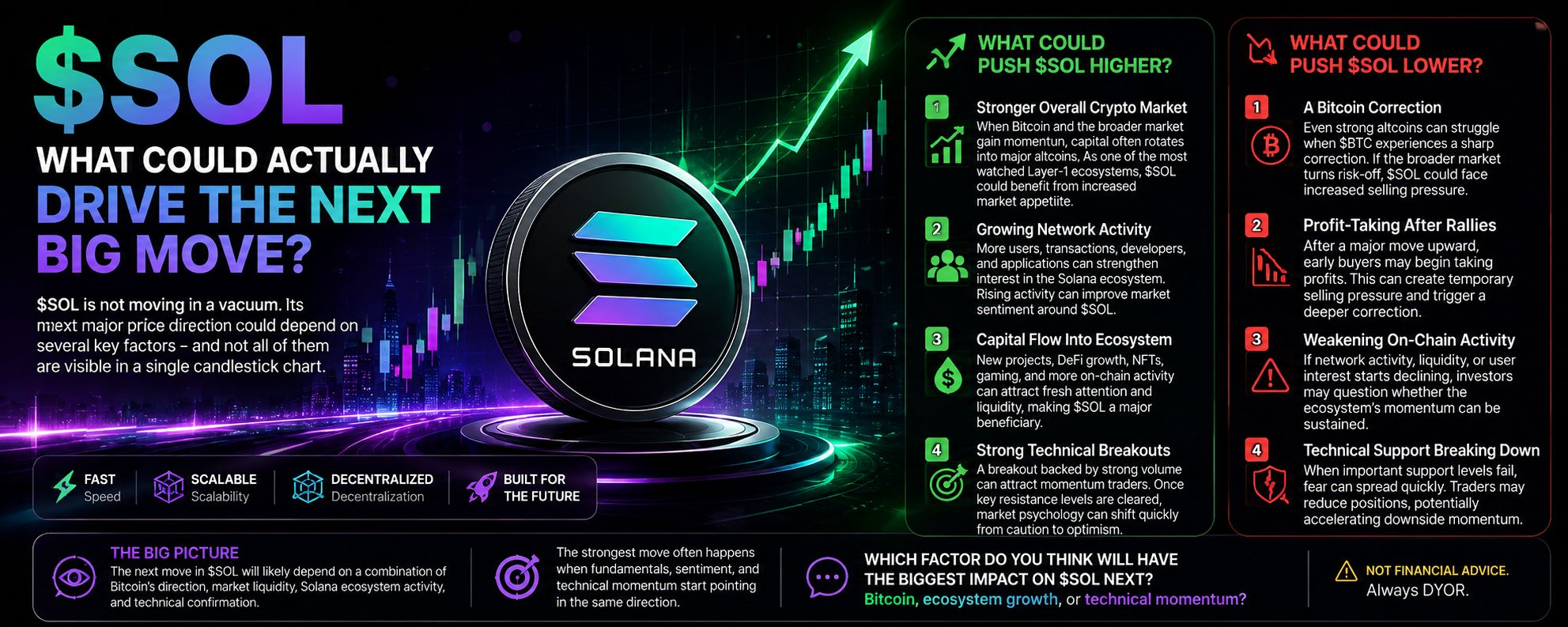
SOL: WHAT COULD ACTUALLY DRIVE THE NEXT BIG MOVE?$SOL is not moving in a vacuum. Its next major price direction could depend on several key factors — and not all of them are visible in a single candlestick chart. 🚀 WHAT COULD PUSH $SOL HIGHER? 1️⃣ Stronger Overall Crypto Market When Bitcoin and the broader market gain momentum, capital often starts rotating into major altcoins. As one of the most closely watched Layer-1 ecosystems. $SOL could benefit from increased market appetite. 2️⃣ Growing Network Activity More users, transactions, developers, and applications can strengthen interest in the Solana ecosystem. Rising activity doesn't guarantee higher prices, but it can improve market sentiment around $SOL. 3️⃣ Capital Flow Into the Solana Ecosystem New projects, DeFi growth, NFTs, gaming, and other on-chain activity can attract fresh attention. If liquidity continues flowing into the ecosystem, $SOL could become one of the major beneficiaries. 4️⃣ Strong Technical Breakouts A breakout supported by strong volume can attract momentum traders. Once key resistance levels are cleared, market psychology can quickly shift from caution to optimism. 📉 WHAT COULD PUSH $SOL LOWER? 1️⃣ A Bitcoin Correction Even strong altcoins can struggle when $BTC experiences a sharp correction. If the broader market turns risk-off, $SOL could face increased selling pressure. 2️⃣ Profit-Taking After Strong Rallies After a major move upward, early buyers may begin taking profits. This can create temporary selling pressure and trigger a deeper correction. 3️⃣ Weakening On-Chain Activity If network activity, liquidity, or user interest starts declining, investors may question whether the ecosystem's momentum can be sustained. 4️⃣ Technical Support Breaking Down When important support levels fail, fear can spread quickly. Traders may reduce positions, potentially accelerating downside momentum. 👀 THE BIG PICTURE For me, the next move in $SOL will likely depend on a combination of Bitcoin's direction, market liquidity, Solana ecosystem activity, and technical confirmation. That's why I'm watching more than just whether the next candle is green or red. The strongest move often happens when fundamentals, sentiment, and technical momentum start pointing in the same direction. 💬 Which factor do you think will have the biggest impact on $SOL next: Bitcoin, ecosystem growth, or technical momentum? #Solana #SOL #Crypto #CryptoNews #Web3 #Altcoins #DeFi ⚠️ Not financial advice. Always DYOR.

SOL: WHAT COULD ACTUALLY DRIVE THE NEXT BIG MOVE?

$SOL is not moving in a vacuum. Its next major price direction could depend on several key factors — and not all of them are visible in a single candlestick chart.
🚀 WHAT COULD PUSH $SOL HIGHER?
1️⃣ Stronger Overall Crypto Market
When Bitcoin and the broader market gain momentum, capital often starts rotating into major altcoins. As one of the most closely watched Layer-1 ecosystems. $SOL could benefit from increased market appetite.
2️⃣ Growing Network Activity
More users, transactions, developers, and applications can strengthen interest in the Solana ecosystem. Rising activity doesn't guarantee higher prices, but it can improve market sentiment around $SOL .
3️⃣ Capital Flow Into the Solana Ecosystem
New projects, DeFi growth, NFTs, gaming, and other on-chain activity can attract fresh attention. If liquidity continues flowing into the ecosystem, $SOL could become one of the major beneficiaries.
4️⃣ Strong Technical Breakouts
A breakout supported by strong volume can attract momentum traders. Once key resistance levels are cleared, market psychology can quickly shift from caution to optimism.
📉 WHAT COULD PUSH $SOL LOWER?
1️⃣ A Bitcoin Correction
Even strong altcoins can struggle when $BTC experiences a sharp correction. If the broader market turns risk-off, $SOL could face increased selling pressure.
2️⃣ Profit-Taking After Strong Rallies
After a major move upward, early buyers may begin taking profits. This can create temporary selling pressure and trigger a deeper correction.
3️⃣ Weakening On-Chain Activity
If network activity, liquidity, or user interest starts declining, investors may question whether the ecosystem's momentum can be sustained.
4️⃣ Technical Support Breaking Down
When important support levels fail, fear can spread quickly. Traders may reduce positions, potentially accelerating downside momentum.
👀 THE BIG PICTURE
For me, the next move in $SOL will likely depend on a combination of Bitcoin's direction, market liquidity, Solana ecosystem activity, and technical confirmation.
That's why I'm watching more than just whether the next candle is green or red.
The strongest move often happens when fundamentals, sentiment, and technical momentum start pointing in the same direction.
💬 Which factor do you think will have the biggest impact on $SOL next: Bitcoin, ecosystem growth, or technical momentum?
#Solana #SOL #Crypto #CryptoNews #Web3 #Altcoins #DeFi
⚠️ Not financial advice. Always DYOR.
🚨 $SOL IS MOVING… AND THE MARKET IS STARTING TO PAY ATTENTION. Something interesting is happening around $SOL. The chart is entering a zone where one strong move could change the short-term narrative completely. Buyers and sellers are fighting for control — and the next few candles could reveal who is winning. 📊 WHY IS $SOL WORTH WATCHING RIGHT NOW? {spot}(SOLUSDT) ⚡ Momentum can return quickly when volume starts to build. ⚡ Solana remains one of the most talked-about ecosystems in crypto. ⚡ A breakout above key resistance could bring fresh attention to $SOL. ⚡ But failure to hold support could trigger another wave of volatility. 👀 MY GAME PLAN: I’m not chasing green candles. I’m watching for confirmation. A strong breakout with convincing volume? That gets my attention. 📈 A rejection at resistance? Then patience becomes the strategy. ⏳ Because in crypto, the best move is not always being first — sometimes it’s waiting until the market shows its hand. 🔥 So here’s the big question: Will $SOL surprise the market with its next breakout… or will the bears take control first? 👇 BULLISH or BEARISH? Drop your prediction below! #Solana #SOL #Crypto #CryptoNews #Altcoins #Trading #Web3 ⚠️ Not financial advice. DYOR.
🚨 $SOL IS MOVING… AND THE MARKET IS STARTING TO PAY ATTENTION.

Something interesting is happening around $SOL .

The chart is entering a zone where one strong move could change the short-term narrative completely. Buyers and sellers are fighting for control — and the next few candles could reveal who is winning.

📊 WHY IS $SOL WORTH WATCHING RIGHT NOW?


⚡ Momentum can return quickly when volume starts to build.
⚡ Solana remains one of the most talked-about ecosystems in crypto.
⚡ A breakout above key resistance could bring fresh attention to $SOL .
⚡ But failure to hold support could trigger another wave of volatility.

👀 MY GAME PLAN:

I’m not chasing green candles.

I’m watching for confirmation.

A strong breakout with convincing volume? That gets my attention. 📈

A rejection at resistance? Then patience becomes the strategy. ⏳

Because in crypto, the best move is not always being first — sometimes it’s waiting until the market shows its hand.

🔥 So here’s the big question:

Will $SOL surprise the market with its next breakout… or will the bears take control first?

👇 BULLISH or BEARISH? Drop your prediction below!

#Solana #SOL #Crypto #CryptoNews #Altcoins #Trading #Web3

⚠️ Not financial advice. DYOR.
Inicia sesión para explorar más contenidos
Únete a usuarios globales de criptomonedas en Binance Square
⚡️ Obtén información útil y actualizada sobre criptos.
💬 Avalado por el mayor exchange de criptomonedas en el mundo.
👍 Descubre perspectivas reales de creadores verificados.
Email/número de teléfono
Mapa del sitio
Preferencias de cookies
Términos y condiciones de la plataforma