

追风Lab
74 Posts

追风Lab
 Square Verified
Report
Block User
提高认知,做投资冲浪者;带你领略币圈知识,不断自我升华。https://linktr.ee/ZFlab

Macro KOL

原创之星
13 Following
955 Followers
1.3K+ Liked
2 Badges
Posts
All
Quotes
Videos
·
--
Verified
Seeing Aethir update its tokenomics feels oddly familiar, especially since the airdrop back then was pretty generous.
The main thing this time is that ATH is finally trying to link revenue from its real computing-power business to the token’s value. After all, the biggest risk for DePIN projects is talking about business growth while relying on token emissions to keep the network going. Revenue from real customers is an important indicator of whether a project can go the distance.
Of course, burning tokens doesn’t guarantee a price increase. ATH’s existing emission schedule hasn’t changed, so whether this can improve the supply-demand balance still depends on the volume of real orders, the network’s revenue, and whether the amount burned can offset new supply.
At the moment, $AGPU is also an Aethir customer and holds a large amount of ATH. That gives me another reason to be hopeful.
If AGPU’s AI computing business continues to gain traction and generate more real demand, while Aethir’s revenue and ATH burn mechanism gradually get up and running, then ATH’s performance could theoretically have a positive impact on the value of the ATH assets held by AGPU.
In an ideal scenario, the two businesses would boost each other and create a virtuous cycle—kind of like stepping on one foot with the other to climb upward.
But this is only an idealized scenario. Whether it can happen depends on computing-power delivery, actual revenue, and token supply-and-demand data—not just wishful thinking.
As someone who’s been left holding the bag on both of these before, I’m obviously hoping they can make this kind of move. But more than short-term price swings, I want to see how much real revenue actually enters the burn mechanism after it launches in November, how many tokens are actually burned, and how many sustained orders the additional computing power can bring in.
Announcements can talk about expectations, but on-chain data and real revenue are the final answers.
For now, I’ll keep watching and verifying. I hope this time it’s not just a pipe dream, and that they can truly connect business growth with token value.
1
554
·
--
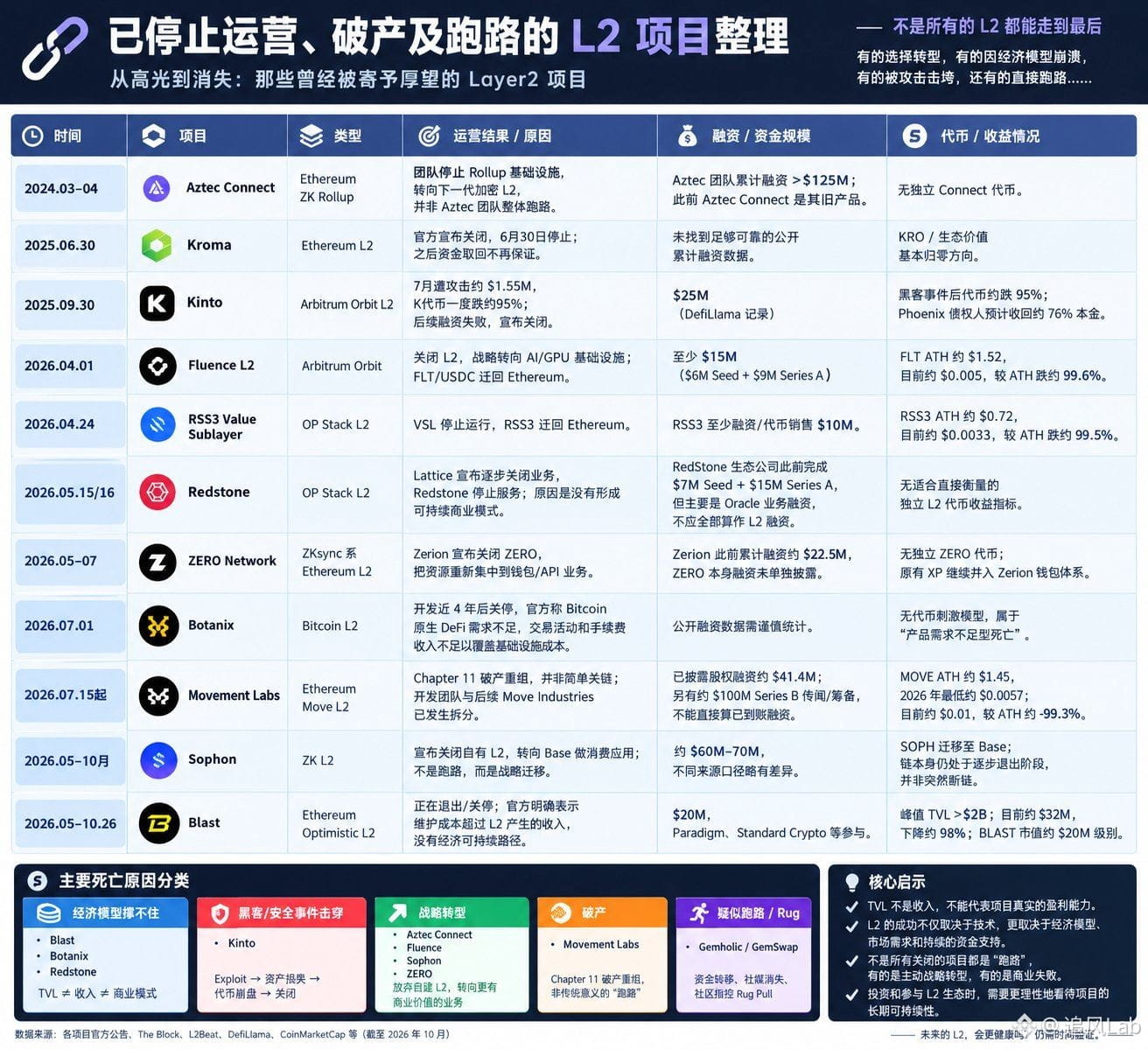
As of now, we can confirm that quite a number of L2 / Rollup projects have ceased operations, but the reasons vary greatly, including:
· Proactive shutdown / strategic pivot
· The economic model cannot be sustained
· Shutting down after being attacked
· Bankruptcy
· Team disappears / suspected rug-pull / running off
And our Blast, from 2B➡️32M, is mainly shut down for the same reason:
L2 operating costs > the revenue generated by L2
This actually points to a very real issue:
TVL ≠ revenue ≠ business model
If we reclassify by “cause of death,” it becomes even more interesting:
① The economic model couldn’t hold up
Blast, Botanix, Redstone
Shared characteristics: technical capability, funding, and users/TVL—but the real fee revenue cannot cover the ongoing operating costs.
Blast is especially典型:once it had $2B+ TVL → around $32M, and ultimately the official team directly admitted that the revenue could not cover the costs.
② Hacker / security incidents
Kinto isn’t really about “not having users,” but rather:
Exploit → asset losses → token collapse → debt / funding pressure → shutdown.
③ Strategic pivot
Aztec Connect, Fluence, Sophon, ZERO
These shouldn’t be called “running off.” A more accurate description is: giving up maintaining their own L2 and shifting resources to businesses with higher commercial value.
For example, Fluence directly shut down its L2 and migrated assets back to Ethereum; Sophon shifted its chain-migration strategy toward Base applications.
④ Bankruptcy
The most worth listing separately right now is: Movement Labs
This is strictly a company-level Chapter 11 bankruptcy, but it’s also not the traditional “exit scam/rug-pull with cash.”
⑤ Suspected rug-pull / ran off
Gemholic / GemSwap: the project previously locked about 921 ETH due to smart contract issues; after funds were restored, the team transferred approximately $3.3M in assets and deleted/disappeared their social accounts, and was then hit with rug-pull allegations.
In this market, it’s really not easy to survive—every month and every week, projects across various tracks stop operating. As the saying goes: watch your pocket, and safety should always come first!
210
·
--
Mid-Autumn Moon Viewing, and Binance also rolled out a “Moon Landing Plan.”
In plain terms, it’s not complicated: complete the event tasks to share in the 10,000U, plus there will also be 170 random prizes—30 custom Mid-Autumn shoes, iPhone Duo, Apple Watch, and more, along with cash red packets and merchandise...
I just received the shoes this morning—Mid-Autumn limited. Wearing them out really feels ceremonial. The rules are also simple: repost this main post, and include the event link and hashtags—#BinanceMidAutumnMoonLandingPlan
Mooncakes can be eaten a bit later; I got the tasks done first. For events like this, not joining would be a waste. First, help yourself step on the Moon’s surface—whether you win or not depends on your luck.

439
·
--
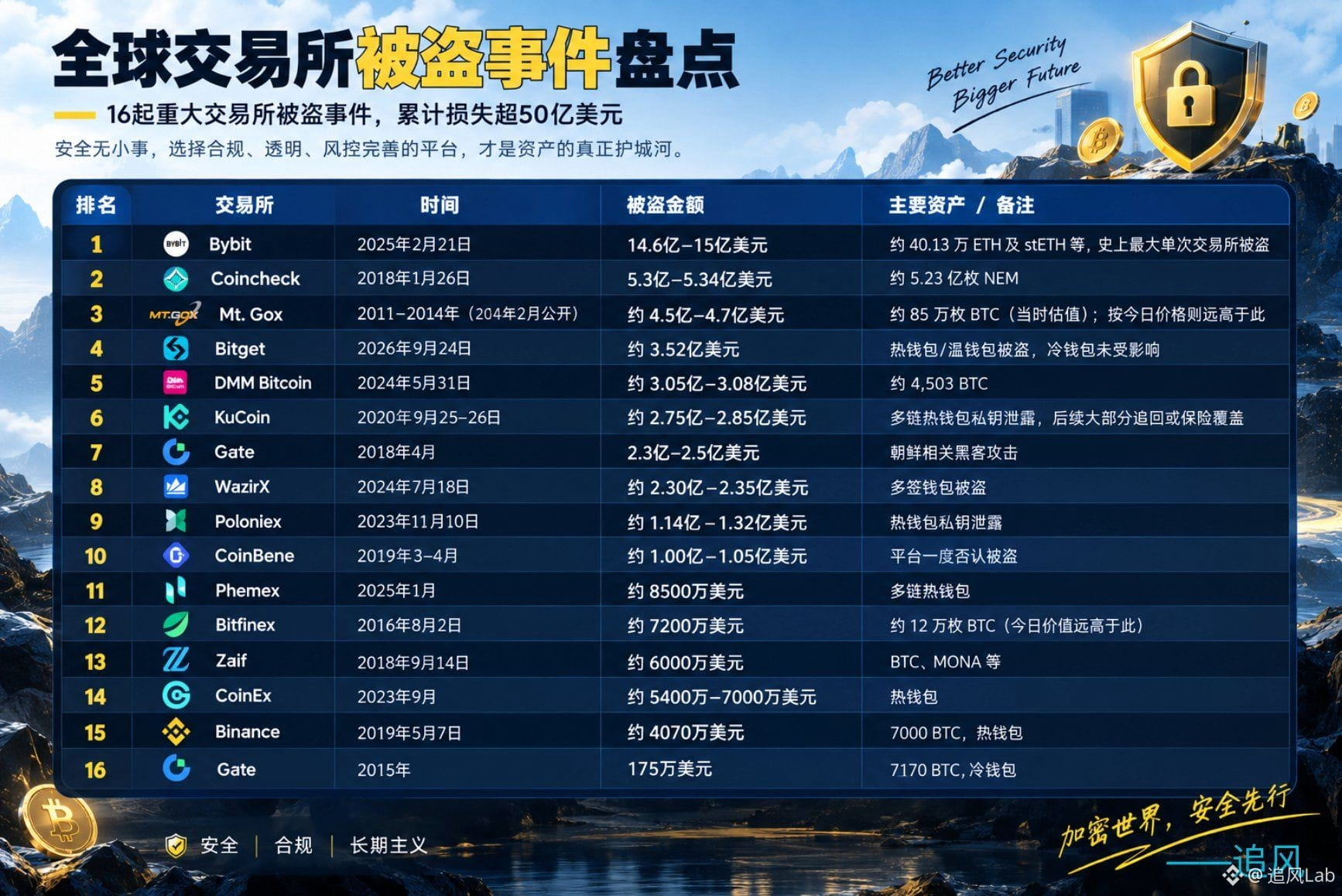
I took stock of the exchange hack incidents that have occurred over the years. What has been publicly disclosed is only a portion of them—some incidents have not been fully revealed to the public even to this day.
When you look at the past few years, most CEXs have, to one degree or another, experienced security incidents. The difference may lie in whether they have the ability to withstand the fallout, and whether they can stabilize users’ losses and confidence.
When it comes to CEX security, nobody can guarantee that problems will never happen. What truly matters might be whether, after something goes wrong, the platform has sufficient reserves, the right mechanisms, and the sense of responsibility to handle the situation properly.
After all, for users, security is never just a slogan—it’s whether the platform can hold up when it matters most.
244
·
--
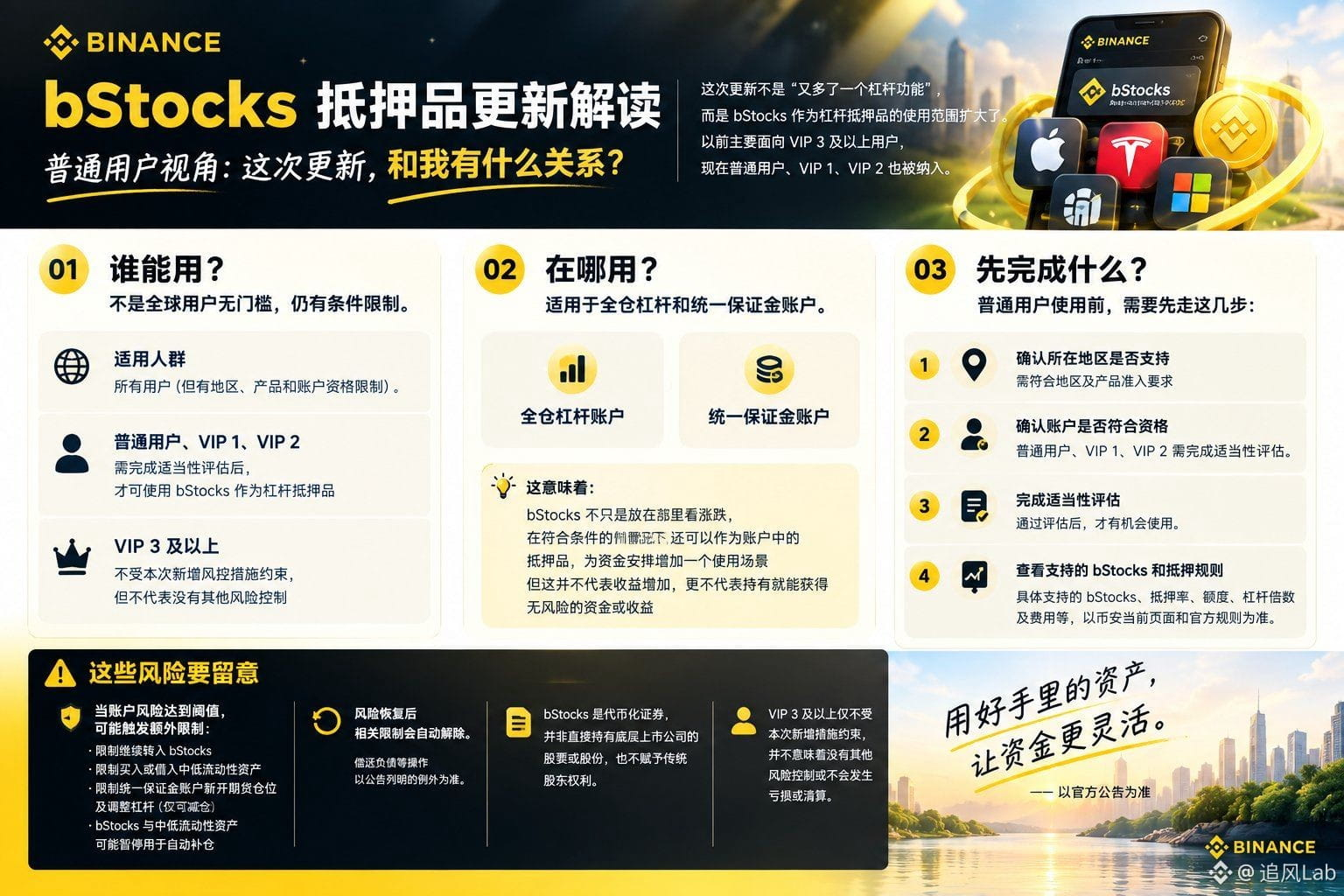
I think this update from Binance about bStocks is something that ordinary users should pay attention to.
In short, the eligibility has been expanded to all users’ cross-margin accounts and unified margin accounts. For ordinary users, VIP 1, and VIP 2: as long as your region and product meet the requirements and you complete the required suitability assessment, you may be able to use this feature.
So if you’re already paying attention to bStocks, what does this update have to do with you? I think you can look at it in three points:
First, who can use it?
“All users” doesn’t mean it’s opened globally without any conditions.
You still need to meet relevant eligibility requirements such as region, product, and account type. And for ordinary users, VIP 1, and VIP 2, before using bStocks as collateral, you must first complete the suitability assessment. So the first step is to confirm whether you are eligible.
Second, where can it be used?
At present, the focus is on cross-margin and unified margin accounts. In other words, bStocks isn’t just something you keep to watch price movements—if you meet the conditions, it can also be used as collateral within your account, adding another use case for your funds.
This is also what I think is worth paying attention to in this update. Of course, this doesn’t mean increased profits, and it doesn’t mean holding bStocks lets you obtain funds without risk.
Third, the risk hasn’t been removed.
If ordinary users, VIP 1, and VIP 2 hold bStocks as collateral, and the account risk reaches the corresponding threshold, it may trigger additional restrictions—for example, limiting further transfers of bStocks, restricting the purchase or borrowing of certain low-to-medium liquidity assets, and restricting opening new futures positions in unified margin accounts.
When the account risk returns to a safe level, the related restrictions will automatically be lifted.
One more detail you must pay attention to: VIP 3 and above are not subject to these newly added risk-control measures. That doesn’t mean VIP 3 has no other risk controls, nor does it mean losses or liquidations can’t happen.
Also, bStocks are tokenized securities. They are not directly holding the corresponding listed company’s stocks or shares, and they do not confer traditional shareholder rights.
So, the core of this update can be condensed into one sentence: bStocks has moved from “can be traded, can be held” to further adding the scenario “can be used as collateral when you meet the conditions,” and this eligibility now covers a wider range of users.
198
·
--
Verified
I’ve recently been paying more attention to a product by DeAgentAI: the AI Token Smart Router. Many people are still asking, what exactly is the AI Token Smart Router?
In simple terms, it’s not building yet another new large language model. Instead, it consolidates the different AI models that enterprises previously had to integrate and call separately into a single unified entry point.
Previously, companies had to connect to multiple models, which often meant working with different vendors. Now, the Router is more like an “AI model master router”—it unifies multi-model calls so that enterprises can choose, measure, and reconcile more easily. Even more importantly, this product has moved beyond just a slide-deck stage.
According to data recently disclosed by the official team, during the trial operation phase, the AI Token Smart Router already had B2B customers using it. The latest official disclosures also show that since the start of its internal testing, it has served 8 B2B customers, processed more than 54 million external model calls in total, and monthly revenue has already exceeded $1 million. The product has now also been officially opened to B2B customers.
So I think what’s truly worth watching now is:
How many do these businesses actually use?
Can the Router keep generating revenue?
And how does that revenue ultimately connect back to $AIA?
That’s also what I find particularly interesting about the relationship between AI Token Smart Router and $AIA.
It’s currently following a fairly direct value chain: enterprises call AI → the Router generates commercial revenue → protocol/business revenue is generated → part of the funds is used for $AIA buybacks and burns.
DeAgentAI has also previously announced a mechanism for $AIA buyback and burn based on real protocol revenues.
So if, going forward, the number of the Router’s B2B customers, the volume of model calls, and revenue can continue to grow, then it’s effectively turning “AI usage volume” into “real business revenue,” which in turn creates value inflow back into $AIA.
Personally, I’m keeping a close eye on three data points:
① Whether the number of B2B customers continues to increase
② Whether the volume of model calls can keep rising beyond the tens-of-millions range
③ Whether the revenue → buyback/burn of $AIA link can continue to be realized
This is easier to verify than just telling the narrative of an AI project.
In plain words, what the AI Token Smart Router really needs to prove is one sentence: whether there are real enterprises using it, and whether these real calls can ultimately translate into real revenue.
1
668
·
--
Verified

Article
AIA’s Value Flywheel: How to Become Profitable and Truly Give Back to the TokenIn the slowest, coldest days of the bear market, most projects either told stories or waited for narratives to play out. And DeAgentAI chose to lay a solid infrastructure foundation—getting business lines that could run up and running first. Now the new official website is live. The team has clearly positioned itself at the protocol layer + the economic layer. The most visible external signals are the public release of the AI Agents platform and the launch of its first Agent—Sentry.
As an outsider, what I care about most is the real closed loop that has been proven to work behind this: value capture → real profitability → buyback & burn $AIA → deflation → value appreciation.
AIA’s Value Flywheel: How to Become Profitable and Truly Give Back to the Token
In the slowest, coldest days of the bear market, most projects either told stories or waited for narratives to play out. And DeAgentAI chose to lay a solid infrastructure foundation—getting business lines that could run up and running first. Now the new official website is live. The team has clearly positioned itself at the protocol layer + the economic layer. The most visible external signals are the public release of the AI Agents platform and the launch of its first Agent—Sentry.
As an outsider, what I care about most is the real closed loop that has been proven to work behind this: value capture → real profitability → buyback & burn $AIA → deflation → value appreciation.
As an outsider, what I care about most is the real closed loop that has been proven to work behind this: value capture → real profitability → buyback & burn $AIA → deflation → value appreciation.
650
·
--
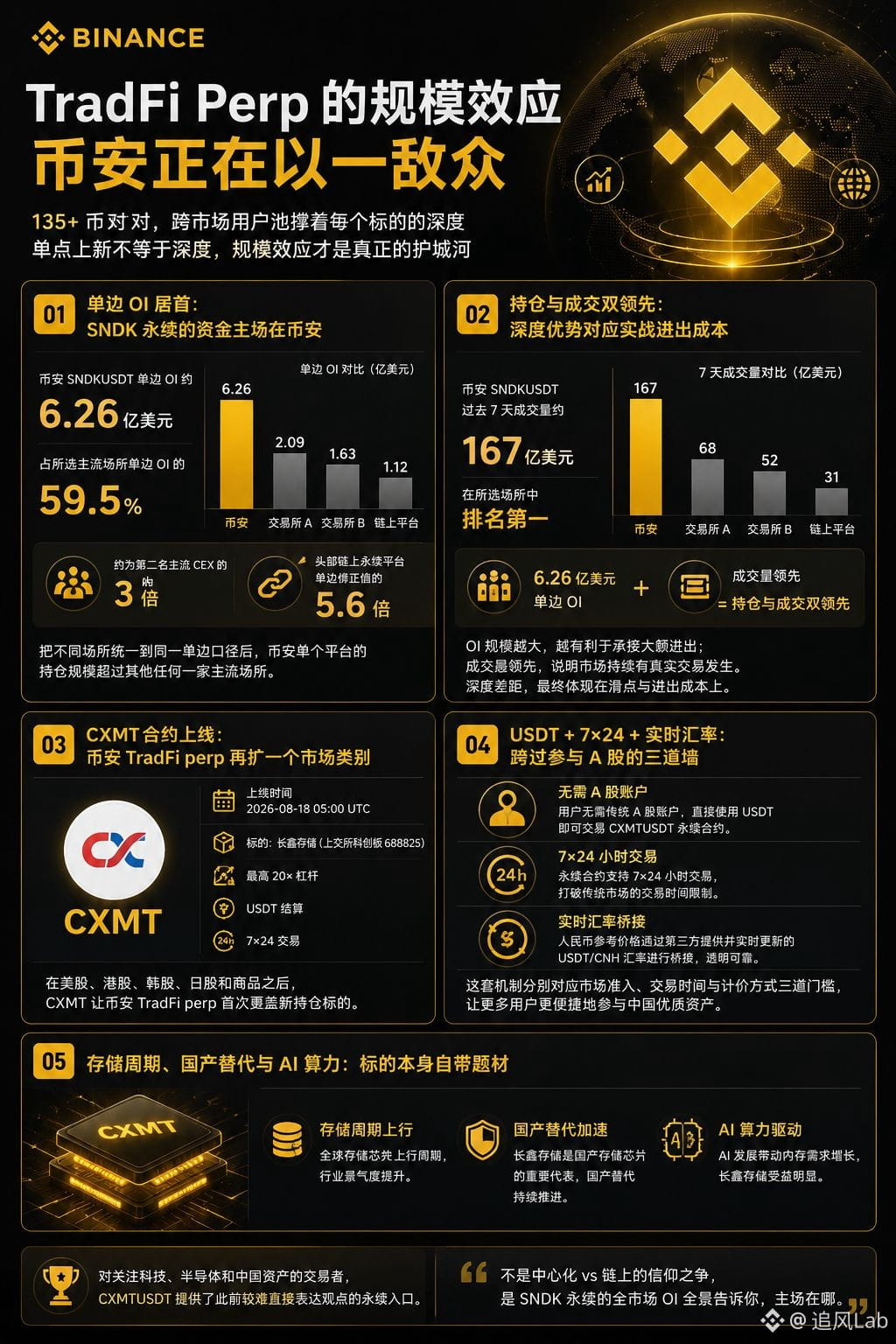
After recently looking at Binance’s TradFi Perps, I’m increasingly convinced that competition has shifted from “who can launch first” to “who can make the market deeper.”
Take SNDKUSDT as an example. Binance’s one-way OI is about $626 million, accounting for roughly 59.5% of the selected major venues—about 3 times that of the second place. Over the past 7 days, trading volume was about $16.7 billion. With both OI and volume leading at the same time, it indicates clear advantages in both capital staying power and trading activity.
Behind this is a classic scale effect: more assets → more users → deeper liquidity → it’s easier to make new listings deep as well.
Today, Binance already covers 135+ TradFi perpetual trading pairs, spanning everything from U.S. stocks, Hong Kong stocks, Korean stocks, and Japanese stocks to commodities, and it’s further expanding into Chinese tech assets such as CXMT.
So the real competition in TradFi Perps isn’t about “who can launch,” but rather who can truly concentrate capital, trading activity, and liquidity.
735
·
--
Remember to join Binance’s TermMaxFi Booster event.
The event has a total of 2,000,000 $TMX. Of that, 1,700,000 will be distributed to 80,000 winners—about 21 coins per person. Currently, 40,000 people have joined, so it’s not very competitive. The tasks are very simple, mainly social tasks. For the last task, just log in with a Binance non-custodial wallet.
The second event awards 300,000. Post on Binance Square with a word count greater than 100 words. The reward goes to the first 1,000 people, with about 300 $TMX per person. This one is more competitive—there are already 10,000+ participants.

1
1.4k
·
--
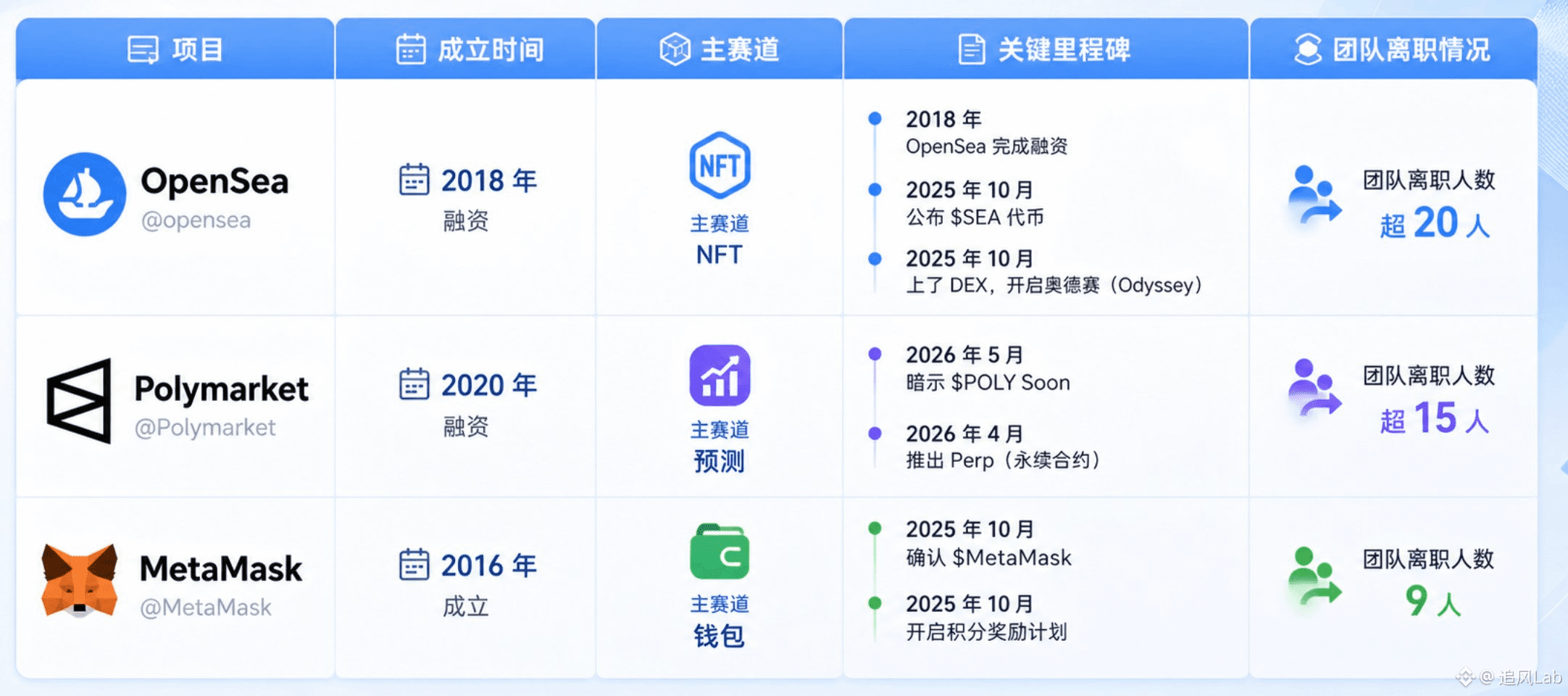
Three ancient projects share a common trait: they launch an IPO only to fail, then return to announce their own token, and afterward restart another PUA cycle. Instead of properly developing their own lane, they insist on doing things they’re not good at. In the end, they end up with a “四不像”....
OpenSea was founded in 2018, with its main track being NFTs. In October 2025, it announced SEA, and then listed on a DEX to kick off “Odyssey.” The number of team members who resigned exceeds 20!!
Polymarket was founded in 2020, with its main track being prediction. In May 2026, it hinted at POLY. Soon; In April 2026, it launched Perp. The number of team members who resigned exceeds 15.
Metamask was founded in 2016, with its main track being wallets. In October 2025, it confirmed Metamask, and then launched an points rewards program—its wallet includes a cross-chain bridge, DEX, Perp... The number of team members who resigned exceeds 9.
194
·
--
Disputed
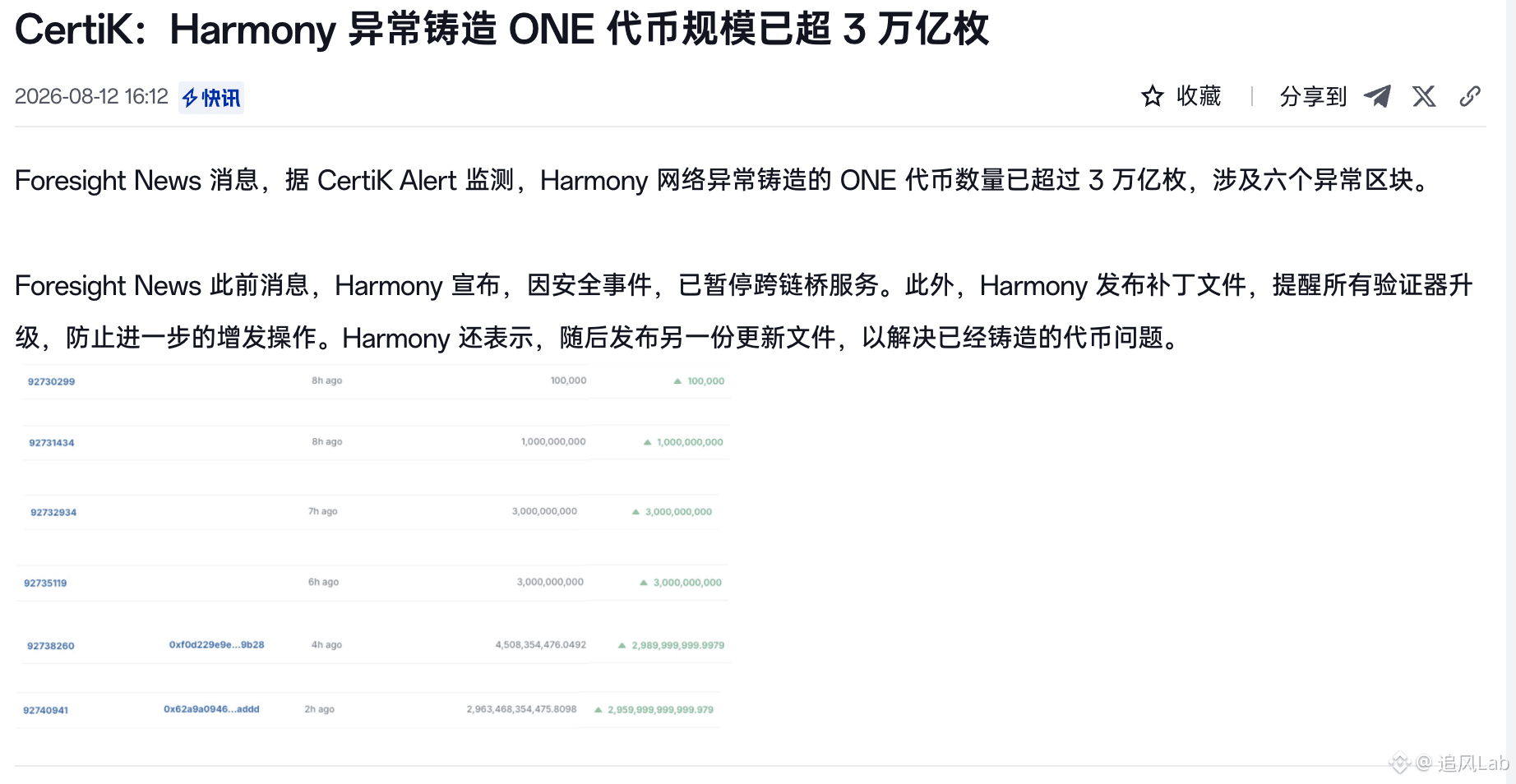
Harmony is ruined. I originally thought it would just be made into 4 billion, but now it’s 3 trillion. The last time something reached the level of billions and beyond—when I thought of $LUNA
Harmony is ruined. I originally thought it would just be made into 4 billion, but now it’s 3 trillion. The last time something reached the level of billions and beyond—when I thought of $LUNA
1.2k
·
--
Another long-established Layer 1 blockchain, Harmony, has a bug again—$ONE plummets by dozens of points!
The attacker exploited an unoccupied block to mint 4 billion $ONE without authorization. 97% of the freshly minted tokens have already been transferred to a CEX to dump the price, causing a massive crash. The project team has urged CEXs to freeze several transfer addresses in an attempt to regain control of the situation. However, the community is the one most harmed.
$ONE hit an all-time high price of 0.38U, but now it’s only 0.0008U—a drop of over 99%. What does that mean? If someone bought $10,000 at the peak, there’s now only about 20 left!
5
3
9.6k
·
--
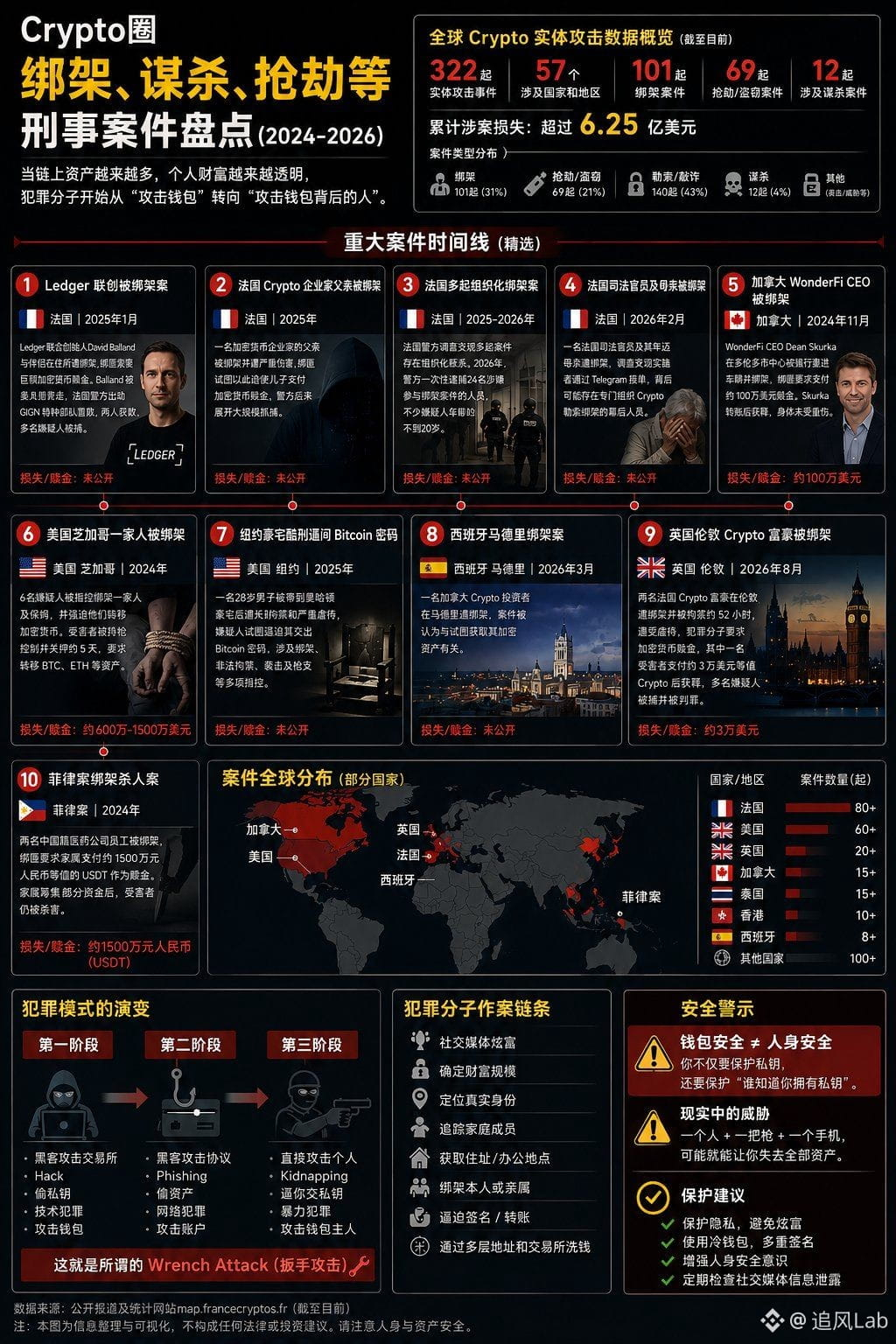
In the past three years, there have been 322 documented cases involving Web3, spanning 57 countries. Of these, 101 involved kidnapping, 69 involved robbery, and 12 involved murder, with total losses exceeding $625 million.
In some cases, the most dangerous thing isn’t your private key being exposed. It’s your wealth, identity, and address all being exposed at the same time.
Wallet security does not equal personal safety.
A truly mature asset security system for the future should include at least four layers:
First layer: Asset security
· Cold wallets, multisig, MPC, permission isolation.
Second layer: Account security
· 2FA, hardware keys, independent devices, email isolation.
Third layer: Privacy security
· Reduce public exposure of wealth, addresses, home addresses, and family information.
Fourth layer: Personal safety
· Don’t allow on-chain assets to form an overly clear mapping to your real-world identity, residence, and family members.
139
·
--
Not sure if it's true or not, but in the future, Web3 users will also have to pay taxes.
The video that Foresight News has made is quite good—it fully explains the scope of this tax and the timing, etc.
The content is excellent. Everyone should take a moment to savor and think it through, because it concerns each person's immediate interests!
The video that Foresight News has made is quite good—it fully explains the scope of this tax and the timing, etc.
The content is excellent. Everyone should take a moment to savor and think it through, because it concerns each person's immediate interests!
321
·
--
Traditional securities brokerage markets rest on weekends, but Wbe3 is never off-duty! With global markets open and closed, bStocks trading opportunities don’t.
Latest data shows that during weekend tokenized stock trading, 94.4% of it happens on Binance! What a concept—almost a cliff-like monopoly in this track.
Meanwhile, the U.S. stock session accounts for 69%, and the after-hours session is even as high as 82%. Whether it’s day trading—chasing gains and cutting losses—or late-night capturing surprises, Binance is open 7×24 hours with 7,000+ popular assets available to trade at any time. With the weekend approaching, will the market continue to deliver surprises?
Don’t let traditional market close times limit your pace—come to Binance, where trading never stops!

164
·
--
Verified
It’s undeniable that TEDA really has money. Just this year’s Q2 alone, it bought 14 tons of gold.
It has now become the world’s largest private holder of gold, with a total amount of 146 tons. Its value is $18.8 billion. As of now, the amount of circulating USDT is about 18.355 billion USDT, and the total supply (infinite) is about 18.909 billion USDT. Essentially, it’s already pegged to the value of gold.
With so much gold, even if you use trucks with a 10-ton capacity, it would take 15 vehicles to transport it all.

1
1.8k
·
--
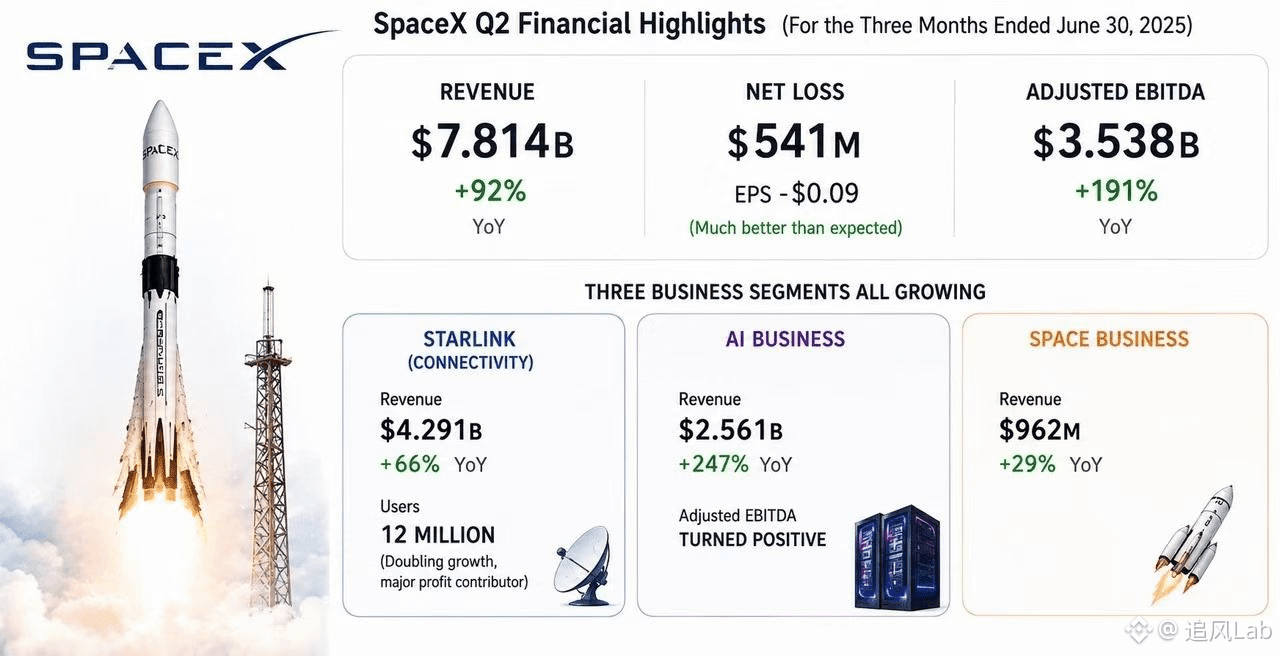
SpaceX’s 2Q financial report in 26 years: Revenue hits $7.814 billion, up 92% year over year; net loss narrows to $541 million, improving a lot versus the same period last year; adjusted EBITDA $3.538 billion, up 191% year over year.
All three metrics indicate that the core business is already very healthy. Starlink, AI, and rocket launches all grew.
At present, SpaceX is operating on a three-wheel drive structure: “Starlink earns money to support the family + AI is expanding aggressively + rockets continue to burn cash to work on Mars.”
This evening, the first batch of 910 million shares from SpaceX will be unlocked. The float will expand from 640 million shares to 1.55 billion shares! Can they drop the price to give retail investors a chance to get on board?
1k
·
--
Saw two resignation announcements early. Coincidentally, both are stepping down from their current roles and continuing on as consultants.
1: X platform product lead Nikita Bier resigns as X product lead and shifts into a consultant role
2: Mysten Labs co-founder and CTO Sam Blackshear will leave Mysten Labs and join Anthropic to work on defensive security research. He will continue to serve as a consultant for the Mysten and Sui ecosystems, and participate in the Move Foundation that’s currently being prepared.
Everyone should thank Sam Blackshear for his vision—so that $SUI can become the stuff of legend. No need to do anything else; just join DC early to qualify.
Such opportunities are rare—hope to see you again on the next project!

539
·
--
These past two days, the technology stocks and the overall market are really going crazy! Buoyed by the strong positive news from both Q2 revenue and adjusted earnings per share all beating expectations across the board, the stock price of Big Bull Palantir surged by nearly 30% in after-hours trading and the following day, directly igniting market sentiment—once again proving that AI remains one of the global capital’s most watched main themes.
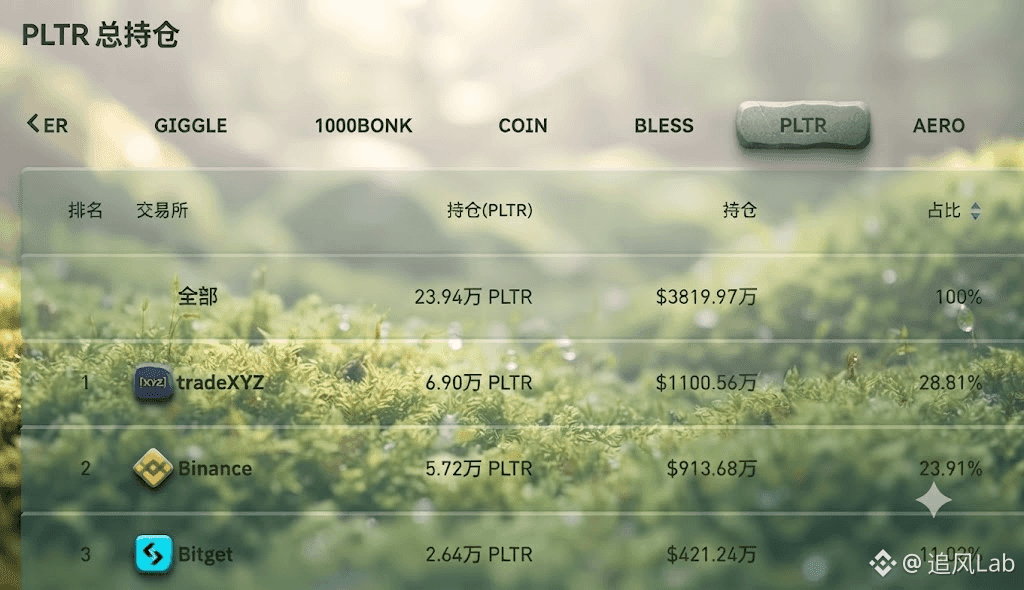
Worth noting is that funds have not only poured into the US stock spot market, but have also rapidly flowed into the crypto market’s $PLTR contract trading. CoinGlass data shows that PLTR’s total open interest across the network is approaching $38.2 million, with tradeXYZ, Binance, and Bitget ranking in the top three by open interest, together accounting for roughly 64% of the market share, forming the core tier. Looks like many people have already positioned themselves early with contracts or chased the rally.
The boundary between traditional finance and the crypto market is becoming even more intertwined. When a popular US stock issues good news, capital can complete price discovery and risk hedging on-chain 7×24 hours a day, without being constrained by traditional trading hours. Perhaps this is the direction global asset trading will move toward in the next phase.
263
·
--
The worst part of this market is that you didn’t make any money—and even being in cash, you still got cut with a loss!
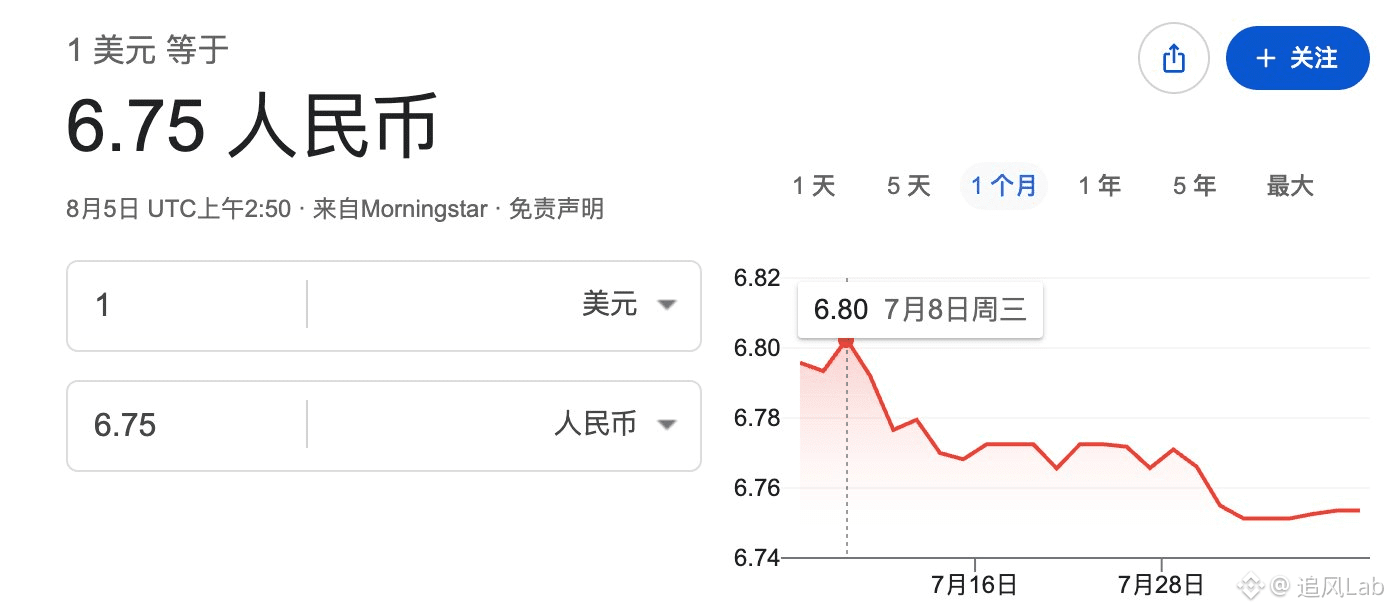
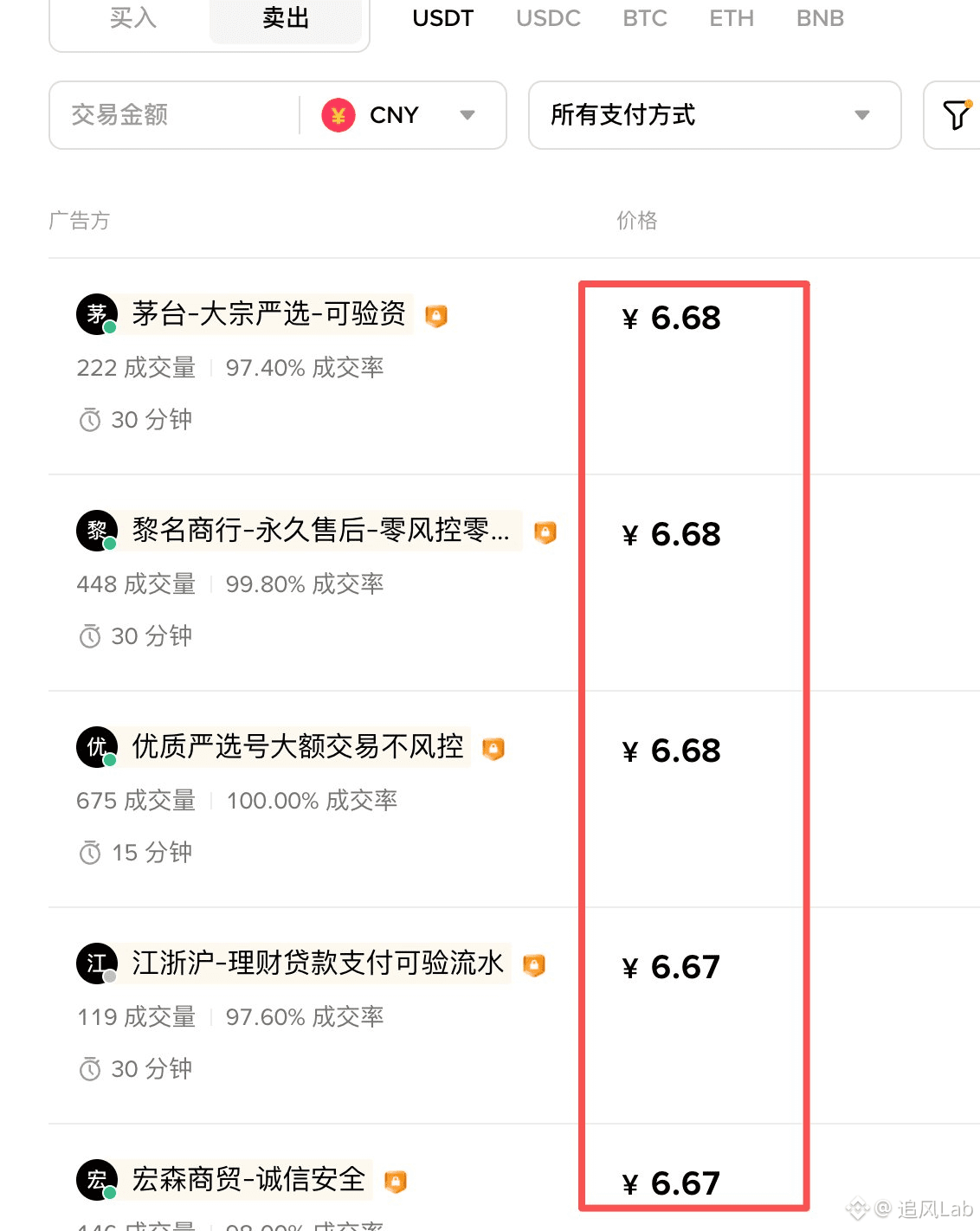
The latest RMB exchange rate is 6.75. Now U is trading at a negative premium, and market sentiment is low!
I miss the $USDT at 7.3 and 7.4. Come on, U!
The worst part of this market is that you didn’t make any money—and even being in cash, you still got cut with a loss!
The latest RMB exchange rate is 6.75. Now U is trading at a negative premium, and market sentiment is low!
I miss the $USDT at 7.3 and 7.4. Come on, U!
The latest RMB exchange rate is 6.75. Now U is trading at a negative premium, and market sentiment is low!
I miss the $USDT at 7.3 and 7.4. Come on, U!
153
Log in to explore more content
Join global crypto users on Binance Square
⚡️ Get latest and useful information about crypto.
💬 Trusted by the world’s largest crypto exchange.
👍 Discover real insights from verified creators.
Email / Phone number