
UKong
951 Posts

UKong
 Square Verified
Report
Block User
知足常乐
290 Following
16.2K+ Followers
10.2K+ Liked
Posts
All
Quotes
Videos
Live
·
--
Bearish
$IOST
I’ve been through a round of this and it feels pretty good—quite an easy-to-operate asset.
This is the pullback section after the main uptrend wave ends and after high-level distribution.
The 0.00222 candle is clearly topping; the following volume-increasing bearish candles, and then the rebound gets weaker and weaker.
The short-term structure is bearish—first we need to see whether it pulls back or breaks the previous low directly.
As for support: first look at 0.00122–0.00128. Below that are 0.00110 and 0.00095.
As for resistance: it’s at 0.00146–0.00152. Above that, 0.00162–0.00168 is a defensive zone for the bears—if it can’t get through, it will most likely keep dropping.
Personal plan: short.
Entry: on rebounds to 0.00146–0.00152, short in batches.
Stop-loss: 0.00172.
Take-profit: first target 0.00110—sell half there, and the rest will aim for 0.00092–0.00088.
If the downtrend accelerates and liquidity flows back to the lows, the extended leg could go even lower. Not a full position—this coin’s volatility is extremely high, so start with a small position.
{future}(IOSTUSDT)
$IOST
I’ve been through a round of this and it feels pretty good—quite an easy-to-operate asset.
This is the pullback section after the main uptrend wave ends and after high-level distribution.
The 0.00222 candle is clearly topping; the following volume-increasing bearish candles, and then the rebound gets weaker and weaker.
The short-term structure is bearish—first we need to see whether it pulls back or breaks the previous low directly.
As for support: first look at 0.00122–0.00128. Below that are 0.00110 and 0.00095.
As for resistance: it’s at 0.00146–0.00152. Above that, 0.00162–0.00168 is a defensive zone for the bears—if it can’t get through, it will most likely keep dropping.
Personal plan: short.
Entry: on rebounds to 0.00146–0.00152, short in batches.
Stop-loss: 0.00172.
Take-profit: first target 0.00110—sell half there, and the rest will aim for 0.00092–0.00088.
If the downtrend accelerates and liquidity flows back to the lows, the extended leg could go even lower. Not a full position—this coin’s volatility is extremely high, so start with a small position.
I’ve been through a round of this and it feels pretty good—quite an easy-to-operate asset.
This is the pullback section after the main uptrend wave ends and after high-level distribution.
The 0.00222 candle is clearly topping; the following volume-increasing bearish candles, and then the rebound gets weaker and weaker.
The short-term structure is bearish—first we need to see whether it pulls back or breaks the previous low directly.
As for support: first look at 0.00122–0.00128. Below that are 0.00110 and 0.00095.
As for resistance: it’s at 0.00146–0.00152. Above that, 0.00162–0.00168 is a defensive zone for the bears—if it can’t get through, it will most likely keep dropping.
Personal plan: short.
Entry: on rebounds to 0.00146–0.00152, short in batches.
Stop-loss: 0.00172.
Take-profit: first target 0.00110—sell half there, and the rest will aim for 0.00092–0.00088.
If the downtrend accelerates and liquidity flows back to the lows, the extended leg could go even lower. Not a full position—this coin’s volatility is extremely high, so start with a small position.
2
1.4k
·
--
Bullish
$ZEC
I'm a bit tempted to add to my position. Tonight it must break 13000.
Remember, the integer level will definitely be broken~
{future}(ZECUSDT)
$ZEC
I'm a bit tempted to add to my position. Tonight it must break 13000.
Remember, the integer level will definitely be broken~
I'm a bit tempted to add to my position. Tonight it must break 13000.
Remember, the integer level will definitely be broken~
UKong
·
--
Bullish$ZEC
People laugh at me, saying I'm too crazy, thinking that the take-profit at 1610 I wrote is just random. Now that we've broken to new highs, let's see if this is already seeing hope.
Time to push higher—there’s room to go up, my darlings!!
Keep the long positions team intact—drill it hard for me~
People laugh at me, saying I'm too crazy, thinking that the take-profit at 1610 I wrote is just random. Now that we've broken to new highs, let's see if this is already seeing hope.
Time to push higher—there’s room to go up, my darlings!!
Keep the long positions team intact—drill it hard for me~
2
1.4k
·
--
Bullish
$ZEC
People laugh at me, saying I'm too crazy, thinking that the take-profit at 1610 I wrote is just random. Now that we've broken to new highs, let's see if this is already seeing hope.
Time to push higher—there’s room to go up, my darlings!!
Keep the long positions team intact—drill it hard for me~
{future}(ZECUSDT)
$ZEC
People laugh at me, saying I'm too crazy, thinking that the take-profit at 1610 I wrote is just random. Now that we've broken to new highs, let's see if this is already seeing hope.
Time to push higher—there’s room to go up, my darlings!!
Keep the long positions team intact—drill it hard for me~
People laugh at me, saying I'm too crazy, thinking that the take-profit at 1610 I wrote is just random. Now that we've broken to new highs, let's see if this is already seeing hope.
Time to push higher—there’s room to go up, my darlings!!
Keep the long positions team intact—drill it hard for me~
UKong
·
--
Bullish$ZEC
Serious divergence has emerged in the community: one side is shouting that narrative is squeezing out price and that targets are higher, while the other is cursing overbought conditions that should pull back.
Structurally, after the 6th touched around 1250, it started giving back; on the 7th, price crashed from 1230 down into the 1140 area. Today it added a long bearish candle with volume, dipping to a low of 1104.08, then quickly rebounded. Now it’s around 1175, with a 24h high at 1179.
This pin/needle is crucial: it swept out both the stop-losses near the prior lows and the short-side profits. After volume expanded, it promptly recovered most of the drop—typical liquidity hunting, not a one-way breakdown.
Personal plan: go long (buy the dip, don’t chase highs).
Entry: wait for a pullback into the 1160–1170 area to scale in, or around 1175 now to试/try a small long position.
Stop loss: 1088.
Take profit: look toward around 1610. Along the way, you can trim some at 1220 and 1250; the rest is for holding for potential extension.
Don’t go all-in—volatility is still high. Add if price holds and stabilizes around 1160 on the retest. If it breaks below 1104, admit you’re wrong immediately. This move is essentially “washout,” and then we see whether it can challenge the previous high again.
Serious divergence has emerged in the community: one side is shouting that narrative is squeezing out price and that targets are higher, while the other is cursing overbought conditions that should pull back.
Structurally, after the 6th touched around 1250, it started giving back; on the 7th, price crashed from 1230 down into the 1140 area. Today it added a long bearish candle with volume, dipping to a low of 1104.08, then quickly rebounded. Now it’s around 1175, with a 24h high at 1179.
This pin/needle is crucial: it swept out both the stop-losses near the prior lows and the short-side profits. After volume expanded, it promptly recovered most of the drop—typical liquidity hunting, not a one-way breakdown.
Personal plan: go long (buy the dip, don’t chase highs).
Entry: wait for a pullback into the 1160–1170 area to scale in, or around 1175 now to试/try a small long position.
Stop loss: 1088.
Take profit: look toward around 1610. Along the way, you can trim some at 1220 and 1250; the rest is for holding for potential extension.
Don’t go all-in—volatility is still high. Add if price holds and stabilizes around 1160 on the retest. If it breaks below 1104, admit you’re wrong immediately. This move is essentially “washout,” and then we see whether it can challenge the previous high again.
1
2
3.5k
·
--
Bullish
$ZEC
Serious divergence has emerged in the community: one side is shouting that narrative is squeezing out price and that targets are higher, while the other is cursing overbought conditions that should pull back.
Structurally, after the 6th touched around 1250, it started giving back; on the 7th, price crashed from 1230 down into the 1140 area. Today it added a long bearish candle with volume, dipping to a low of 1104.08, then quickly rebounded. Now it’s around 1175, with a 24h high at 1179.
This pin/needle is crucial: it swept out both the stop-losses near the prior lows and the short-side profits. After volume expanded, it promptly recovered most of the drop—typical liquidity hunting, not a one-way breakdown.
Personal plan: go long (buy the dip, don’t chase highs).
Entry: wait for a pullback into the 1160–1170 area to scale in, or around 1175 now to试/try a small long position.
Stop loss: 1088.
Take profit: look toward around 1610. Along the way, you can trim some at 1220 and 1250; the rest is for holding for potential extension.
Don’t go all-in—volatility is still high. Add if price holds and stabilizes around 1160 on the retest. If it breaks below 1104, admit you’re wrong immediately. This move is essentially “washout,” and then we see whether it can challenge the previous high again.
{future}(ZECUSDT)
$ZEC
Serious divergence has emerged in the community: one side is shouting that narrative is squeezing out price and that targets are higher, while the other is cursing overbought conditions that should pull back.
Structurally, after the 6th touched around 1250, it started giving back; on the 7th, price crashed from 1230 down into the 1140 area. Today it added a long bearish candle with volume, dipping to a low of 1104.08, then quickly rebounded. Now it’s around 1175, with a 24h high at 1179.
This pin/needle is crucial: it swept out both the stop-losses near the prior lows and the short-side profits. After volume expanded, it promptly recovered most of the drop—typical liquidity hunting, not a one-way breakdown.
Personal plan: go long (buy the dip, don’t chase highs).
Entry: wait for a pullback into the 1160–1170 area to scale in, or around 1175 now to试/try a small long position.
Stop loss: 1088.
Take profit: look toward around 1610. Along the way, you can trim some at 1220 and 1250; the rest is for holding for potential extension.
Don’t go all-in—volatility is still high. Add if price holds and stabilizes around 1160 on the retest. If it breaks below 1104, admit you’re wrong immediately. This move is essentially “washout,” and then we see whether it can challenge the previous high again.
Serious divergence has emerged in the community: one side is shouting that narrative is squeezing out price and that targets are higher, while the other is cursing overbought conditions that should pull back.
Structurally, after the 6th touched around 1250, it started giving back; on the 7th, price crashed from 1230 down into the 1140 area. Today it added a long bearish candle with volume, dipping to a low of 1104.08, then quickly rebounded. Now it’s around 1175, with a 24h high at 1179.
This pin/needle is crucial: it swept out both the stop-losses near the prior lows and the short-side profits. After volume expanded, it promptly recovered most of the drop—typical liquidity hunting, not a one-way breakdown.
Personal plan: go long (buy the dip, don’t chase highs).
Entry: wait for a pullback into the 1160–1170 area to scale in, or around 1175 now to试/try a small long position.
Stop loss: 1088.
Take profit: look toward around 1610. Along the way, you can trim some at 1220 and 1250; the rest is for holding for potential extension.
Don’t go all-in—volatility is still high. Add if price holds and stabilizes around 1160 on the retest. If it breaks below 1104, admit you’re wrong immediately. This move is essentially “washout,” and then we see whether it can challenge the previous high again.
1
1
5.5k
·
--
Bearish
$IOST
Binance’s hot wallet transferred over two billion coins to a cold wallet a few days ago, and Bitkub has also made transfers. With circulating supply decreasing a bit, and then adding momentum capital, this is how it got lifted—pure order book action plus expectations of contracting on-chain supply.
There have been quite a few bearish candles near the highs. After the pullback, it’s been hovering around 0.00107. Overall it’s still an uptrend channel, but in the short term the move has shifted from acceleration to consolidation. Volume has started to tighten after peaking at the top.
Personal trade setup: short.
Stop-loss: 0.001225
Take-profit: first target 0.00098, second target 0.00088–0.00085. If it’s weak, watch for 0.00076–0.00074.
If it breaks out with volume and holds above 0.00119, the short position should be closed first;
If it breaks below 0.00100 and fails to reclaim it, you can consider adding to the position.
Manage position size well—after old coins have been pumped, they tend to give back.
{future}(IOSTUSDT)
$IOST
Binance’s hot wallet transferred over two billion coins to a cold wallet a few days ago, and Bitkub has also made transfers. With circulating supply decreasing a bit, and then adding momentum capital, this is how it got lifted—pure order book action plus expectations of contracting on-chain supply.
There have been quite a few bearish candles near the highs. After the pullback, it’s been hovering around 0.00107. Overall it’s still an uptrend channel, but in the short term the move has shifted from acceleration to consolidation. Volume has started to tighten after peaking at the top.
Personal trade setup: short.
Stop-loss: 0.001225
Take-profit: first target 0.00098, second target 0.00088–0.00085. If it’s weak, watch for 0.00076–0.00074.
If it breaks out with volume and holds above 0.00119, the short position should be closed first;
If it breaks below 0.00100 and fails to reclaim it, you can consider adding to the position.
Manage position size well—after old coins have been pumped, they tend to give back.
Binance’s hot wallet transferred over two billion coins to a cold wallet a few days ago, and Bitkub has also made transfers. With circulating supply decreasing a bit, and then adding momentum capital, this is how it got lifted—pure order book action plus expectations of contracting on-chain supply.
There have been quite a few bearish candles near the highs. After the pullback, it’s been hovering around 0.00107. Overall it’s still an uptrend channel, but in the short term the move has shifted from acceleration to consolidation. Volume has started to tighten after peaking at the top.
Personal trade setup: short.
Stop-loss: 0.001225
Take-profit: first target 0.00098, second target 0.00088–0.00085. If it’s weak, watch for 0.00076–0.00074.
If it breaks out with volume and holds above 0.00119, the short position should be closed first;
If it breaks below 0.00100 and fails to reclaim it, you can consider adding to the position.
Manage position size well—after old coins have been pumped, they tend to give back.
2
1.7k
·
--
Bearish
$SOPH
No fundamental catalyst; it’s driven purely by the order book/price action and technicals + sentiment.
The structure is still in an uptrend, but it has shifted from a parabolic move to consolidation with pullbacks. After the volume expanded at the top, it began to decline, suggesting that late-chasers are starting to hesitate.
My plan: short.
Entry: wait for a rebound into the 0.0108–0.0112 range, then short.
Stop-loss: 0.01205
Take-profit: first target 0.0090, second target 0.0078–0.0075. If the momentum is weak, you could see 0.0068.
High volatility—don’t take a heavy position. If it breaks below 0.0098 and can’t get back above, the short can be added a bit. If it instead breaks directly above 0.0117 with a significant volume increase and holds, then pull the short for now.
{future}(SOPHUSDT)
$SOPH
No fundamental catalyst; it’s driven purely by the order book/price action and technicals + sentiment.
The structure is still in an uptrend, but it has shifted from a parabolic move to consolidation with pullbacks. After the volume expanded at the top, it began to decline, suggesting that late-chasers are starting to hesitate.
My plan: short.
Entry: wait for a rebound into the 0.0108–0.0112 range, then short.
Stop-loss: 0.01205
Take-profit: first target 0.0090, second target 0.0078–0.0075. If the momentum is weak, you could see 0.0068.
High volatility—don’t take a heavy position. If it breaks below 0.0098 and can’t get back above, the short can be added a bit. If it instead breaks directly above 0.0117 with a significant volume increase and holds, then pull the short for now.
No fundamental catalyst; it’s driven purely by the order book/price action and technicals + sentiment.
The structure is still in an uptrend, but it has shifted from a parabolic move to consolidation with pullbacks. After the volume expanded at the top, it began to decline, suggesting that late-chasers are starting to hesitate.
My plan: short.
Entry: wait for a rebound into the 0.0108–0.0112 range, then short.
Stop-loss: 0.01205
Take-profit: first target 0.0090, second target 0.0078–0.0075. If the momentum is weak, you could see 0.0068.
High volatility—don’t take a heavy position. If it breaks below 0.0098 and can’t get back above, the short can be added a bit. If it instead breaks directly above 0.0117 with a significant volume increase and holds, then pull the short for now.
5
4.6k
·
--
Bearish
$WLD
Sam Altman/OpenAI’s new model has reignited AI identity narratives. On top of that, there are rumors about an event involving roughly 69 million WLD in supply, Kalshi listing WLD perpetuals, and funds rotating into AI-related coins—this is narrative plus increased volume and aggressive accumulation.
Structurally, 0.5056 is a hard resistance. If it can’t hold, any breakout will be a fake one. First support to watch is 0.467, the pullback level after this wave’s launch. Below that are 0.445 and 0.424; if it breaks further, it may return to 0.407, today’s low. Volume has fallen from its peak, so short positions have the edge in the near term.
Personal plan: short
Entry: on a rebound into the 0.490–0.498 range, short in batches
Stop loss: 0.514
Take profit: first target at 0.445—cut half; the remainder I’m watching around 0.392
When volume surges and then drops at high levels, it’s easiest to get whipsawed—keep position size lighter. If it re-accumulates volume and stands back above 0.5056 and doesn’t fall back, then this short thesis is wrong and I’ll exit.
{future}(WLDUSDT)
$WLD
Sam Altman/OpenAI’s new model has reignited AI identity narratives. On top of that, there are rumors about an event involving roughly 69 million WLD in supply, Kalshi listing WLD perpetuals, and funds rotating into AI-related coins—this is narrative plus increased volume and aggressive accumulation.
Structurally, 0.5056 is a hard resistance. If it can’t hold, any breakout will be a fake one. First support to watch is 0.467, the pullback level after this wave’s launch. Below that are 0.445 and 0.424; if it breaks further, it may return to 0.407, today’s low. Volume has fallen from its peak, so short positions have the edge in the near term.
Personal plan: short
Entry: on a rebound into the 0.490–0.498 range, short in batches
Stop loss: 0.514
Take profit: first target at 0.445—cut half; the remainder I’m watching around 0.392
When volume surges and then drops at high levels, it’s easiest to get whipsawed—keep position size lighter. If it re-accumulates volume and stands back above 0.5056 and doesn’t fall back, then this short thesis is wrong and I’ll exit.
Sam Altman/OpenAI’s new model has reignited AI identity narratives. On top of that, there are rumors about an event involving roughly 69 million WLD in supply, Kalshi listing WLD perpetuals, and funds rotating into AI-related coins—this is narrative plus increased volume and aggressive accumulation.
Structurally, 0.5056 is a hard resistance. If it can’t hold, any breakout will be a fake one. First support to watch is 0.467, the pullback level after this wave’s launch. Below that are 0.445 and 0.424; if it breaks further, it may return to 0.407, today’s low. Volume has fallen from its peak, so short positions have the edge in the near term.
Personal plan: short
Entry: on a rebound into the 0.490–0.498 range, short in batches
Stop loss: 0.514
Take profit: first target at 0.445—cut half; the remainder I’m watching around 0.392
When volume surges and then drops at high levels, it’s easiest to get whipsawed—keep position size lighter. If it re-accumulates volume and stands back above 0.5056 and doesn’t fall back, then this short thesis is wrong and I’ll exit.
3
10.3k
·
--
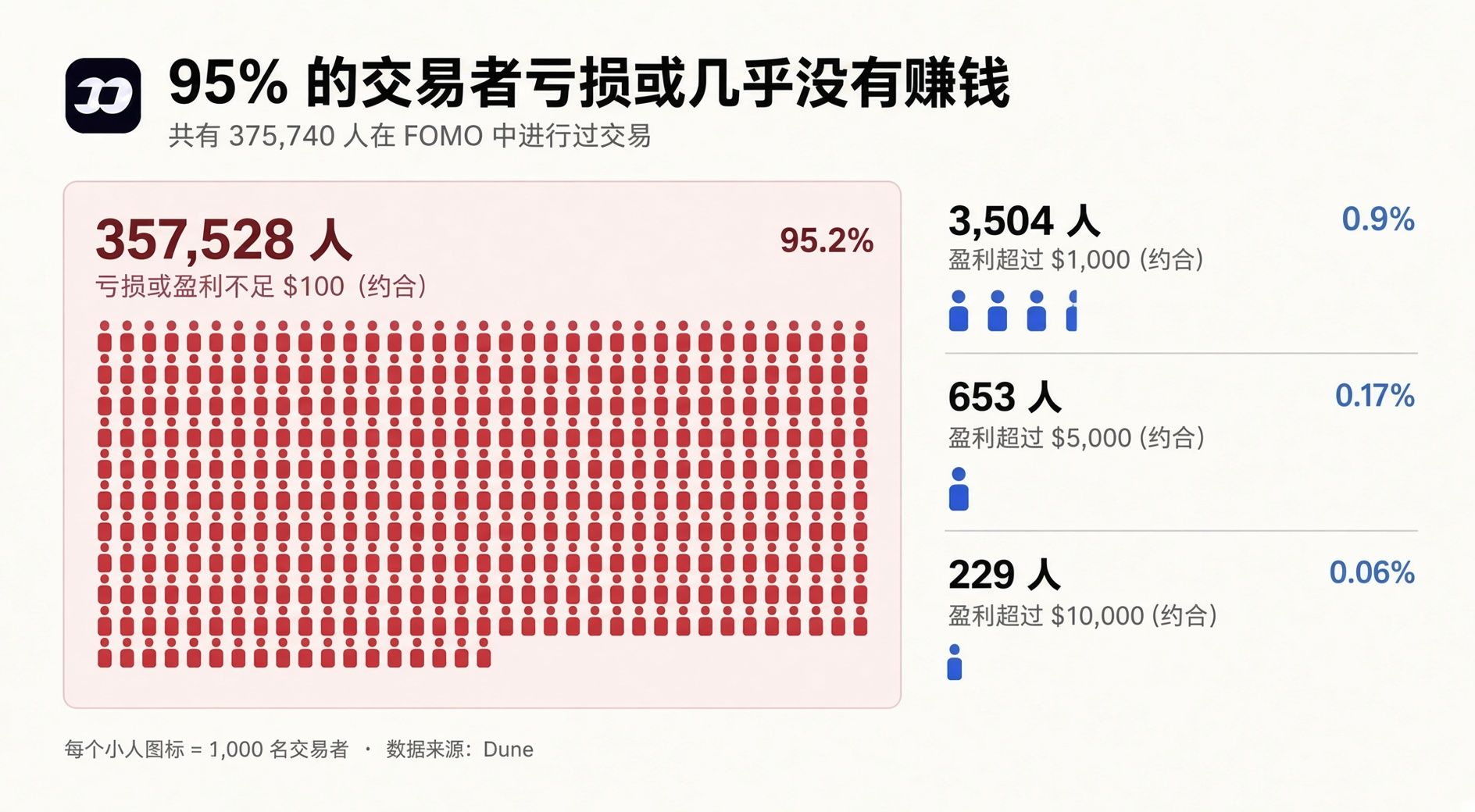
Data shows that on the FOMO platform, among the 370,000 users, 95% are currently losing money or not making any profit on Meme. Only 1.13% are profitable by more than $1,000, and only 0.23% are profitable by more than $5,000.
Meme has only corrected for a little over 1 day, and it is still basically at a high level. The proportion of people making money remains just 5%. Once the market turns and prices continue to fall, this proportion will only get even lower.
Data shows that on the FOMO platform, among the 370,000 users, 95% are currently losing money or not making any profit on Meme. Only 1.13% are profitable by more than $1,000, and only 0.23% are profitable by more than $5,000.
Meme has only corrected for a little over 1 day, and it is still basically at a high level. The proportion of people making money remains just 5%. Once the market turns and prices continue to fall, this proportion will only get even lower.
Meme has only corrected for a little over 1 day, and it is still basically at a high level. The proportion of people making money remains just 5%. Once the market turns and prices continue to fall, this proportion will only get even lower.
1
3
2.2k
·
--
Bullish
$SKHYNIX
OpenAI's new model GPT-6 Astra has boosted expectations for AI storage, along with news about U.S.-Korea chip tariff/investment talks. The market is also speculating about HBM and DRAM shortages.
The structure is still bullish overall, but it is already near the intraday high. Immediate resistance is 1339-1342; only after breaking that does there appear to be another leg of upside room. First support is the 1328 launch platform, then 1315 and 1300; if those break, we need to revisit the 1276 low. Off-hours premium is still there, but the trend has not been broken.
Personal action: Long
Entry: Buy in batches on a pullback to the 1320-1328 range
Stop loss: 1295
Take profit: Reduce half at the first target of 1360, hold the rest for around 1470
The Korea session has already run up for a round, so don't size overnight positions too large. If it breaks below 1315 with volume and fails to reclaim it, exit this long idea and admit the mistake.
{future}(SKHYNIXUSDT)
$SKHYNIX
OpenAI's new model GPT-6 Astra has boosted expectations for AI storage, along with news about U.S.-Korea chip tariff/investment talks. The market is also speculating about HBM and DRAM shortages.
The structure is still bullish overall, but it is already near the intraday high. Immediate resistance is 1339-1342; only after breaking that does there appear to be another leg of upside room. First support is the 1328 launch platform, then 1315 and 1300; if those break, we need to revisit the 1276 low. Off-hours premium is still there, but the trend has not been broken.
Personal action: Long
Entry: Buy in batches on a pullback to the 1320-1328 range
Stop loss: 1295
Take profit: Reduce half at the first target of 1360, hold the rest for around 1470
The Korea session has already run up for a round, so don't size overnight positions too large. If it breaks below 1315 with volume and fails to reclaim it, exit this long idea and admit the mistake.
OpenAI's new model GPT-6 Astra has boosted expectations for AI storage, along with news about U.S.-Korea chip tariff/investment talks. The market is also speculating about HBM and DRAM shortages.
The structure is still bullish overall, but it is already near the intraday high. Immediate resistance is 1339-1342; only after breaking that does there appear to be another leg of upside room. First support is the 1328 launch platform, then 1315 and 1300; if those break, we need to revisit the 1276 low. Off-hours premium is still there, but the trend has not been broken.
Personal action: Long
Entry: Buy in batches on a pullback to the 1320-1328 range
Stop loss: 1295
Take profit: Reduce half at the first target of 1360, hold the rest for around 1470
The Korea session has already run up for a round, so don't size overnight positions too large. If it breaks below 1315 with volume and fails to reclaim it, exit this long idea and admit the mistake.
1.2k
·
--
Bearish
$SNDK
The AI storage supercycle is still being hyped, NAND shortages are pushing up prices. On Friday, US stocks—SanDisk itself surged by about 12%. There are also reports that it teamed up with Dell to replace Nike in the S&P 100. So the spot move is being driven by narrative.
In the early session it was lifted from around 1765, then was directly dumped to 1763.79 and V-shaped back up. It topped out near 1794 (24-hour high 1797), then kept making lower highs. Now it has fallen back to 1782. The volume on the spike looks decent, but the volume during the pullback is average—typical of switching/rotation at high levels. There are many long upper and lower wicks, indicating that both bulls and bears are trading aggressively between 1780 and 1795, and neither side has fully taken control of the direction.
Spot is around 1731, while the perpetual contract is still hanging around 1782. The premium is still there. After the US market opens, this kind of premium is easiest to get wiped out.
Personal plan: short.
Entry: scale in on rebounds within the 1788–1794 range.
Stop loss: 1810.
Take profit: first target 1763 to cut half off; the remainder is expected to be around 1695.
The US market hasn’t opened yet, so keep position size light. If, after the open, the spot keeps going crazy and the perpetual reclaims 1797, then this short thesis is wrong—exit and reassess. Only decide whether to flip once things have played out.
{future}(SNDKUSDT)
$SNDK
The AI storage supercycle is still being hyped, NAND shortages are pushing up prices. On Friday, US stocks—SanDisk itself surged by about 12%. There are also reports that it teamed up with Dell to replace Nike in the S&P 100. So the spot move is being driven by narrative.
In the early session it was lifted from around 1765, then was directly dumped to 1763.79 and V-shaped back up. It topped out near 1794 (24-hour high 1797), then kept making lower highs. Now it has fallen back to 1782. The volume on the spike looks decent, but the volume during the pullback is average—typical of switching/rotation at high levels. There are many long upper and lower wicks, indicating that both bulls and bears are trading aggressively between 1780 and 1795, and neither side has fully taken control of the direction.
Spot is around 1731, while the perpetual contract is still hanging around 1782. The premium is still there. After the US market opens, this kind of premium is easiest to get wiped out.
Personal plan: short.
Entry: scale in on rebounds within the 1788–1794 range.
Stop loss: 1810.
Take profit: first target 1763 to cut half off; the remainder is expected to be around 1695.
The US market hasn’t opened yet, so keep position size light. If, after the open, the spot keeps going crazy and the perpetual reclaims 1797, then this short thesis is wrong—exit and reassess. Only decide whether to flip once things have played out.
The AI storage supercycle is still being hyped, NAND shortages are pushing up prices. On Friday, US stocks—SanDisk itself surged by about 12%. There are also reports that it teamed up with Dell to replace Nike in the S&P 100. So the spot move is being driven by narrative.
In the early session it was lifted from around 1765, then was directly dumped to 1763.79 and V-shaped back up. It topped out near 1794 (24-hour high 1797), then kept making lower highs. Now it has fallen back to 1782. The volume on the spike looks decent, but the volume during the pullback is average—typical of switching/rotation at high levels. There are many long upper and lower wicks, indicating that both bulls and bears are trading aggressively between 1780 and 1795, and neither side has fully taken control of the direction.
Spot is around 1731, while the perpetual contract is still hanging around 1782. The premium is still there. After the US market opens, this kind of premium is easiest to get wiped out.
Personal plan: short.
Entry: scale in on rebounds within the 1788–1794 range.
Stop loss: 1810.
Take profit: first target 1763 to cut half off; the remainder is expected to be around 1695.
The US market hasn’t opened yet, so keep position size light. If, after the open, the spot keeps going crazy and the perpetual reclaims 1797, then this short thesis is wrong—exit and reassess. Only decide whether to flip once things have played out.
3
10.8k
·
--
Lincoln has 5,000 people, with per capita spending of 3,800 soft RMB in just 5 days.
Looks like even the Americans’ money isn’t easy to make—Chinese money is easier to earn 🙄
Lincoln has 5,000 people, with per capita spending of 3,800 soft RMB in just 5 days.
Looks like even the Americans’ money isn’t easy to make—Chinese money is easier to earn 🙄
Looks like even the Americans’ money isn’t easy to make—Chinese money is easier to earn 🙄

7
7
25.4k
·
--
Bearish
Verified
$XAU
On Friday, US non-farm payrolls came in hot (August added 162k, far above expectations). The market has pushed up the probability of a Fed rate hike on September 15–16. Treasury yields and the US dollar strengthened, so non-yielding assets like gold have been pressured lower. This week also brings PPI and CPI, so short-term sentiment will revolve around rate-expectation moves.
Near-term support to watch: today’s low at 4389. If it doesn’t hold, the next stop is roughly in the 4370–4360 area. Right now price is hovering around the intraday low, which signals a weak rebound.
Personal plan: go short.
Entry: scale in short on the rebound in the 4408–4418 range.
Stop loss: 4448.
Take profit: first target 4370—reduce half there. The remaining position can look toward around 4220.
There’s a lot of data this week, so don’t run your short position too heavily. If CPI expectations change, and price rises back above 4438 and holds there, then this short call is wrong—exit the trade.
{future}(XAUUSDT)
$XAU
On Friday, US non-farm payrolls came in hot (August added 162k, far above expectations). The market has pushed up the probability of a Fed rate hike on September 15–16. Treasury yields and the US dollar strengthened, so non-yielding assets like gold have been pressured lower. This week also brings PPI and CPI, so short-term sentiment will revolve around rate-expectation moves.
Near-term support to watch: today’s low at 4389. If it doesn’t hold, the next stop is roughly in the 4370–4360 area. Right now price is hovering around the intraday low, which signals a weak rebound.
Personal plan: go short.
Entry: scale in short on the rebound in the 4408–4418 range.
Stop loss: 4448.
Take profit: first target 4370—reduce half there. The remaining position can look toward around 4220.
There’s a lot of data this week, so don’t run your short position too heavily. If CPI expectations change, and price rises back above 4438 and holds there, then this short call is wrong—exit the trade.
On Friday, US non-farm payrolls came in hot (August added 162k, far above expectations). The market has pushed up the probability of a Fed rate hike on September 15–16. Treasury yields and the US dollar strengthened, so non-yielding assets like gold have been pressured lower. This week also brings PPI and CPI, so short-term sentiment will revolve around rate-expectation moves.
Near-term support to watch: today’s low at 4389. If it doesn’t hold, the next stop is roughly in the 4370–4360 area. Right now price is hovering around the intraday low, which signals a weak rebound.
Personal plan: go short.
Entry: scale in short on the rebound in the 4408–4418 range.
Stop loss: 4448.
Take profit: first target 4370—reduce half there. The remaining position can look toward around 4220.
There’s a lot of data this week, so don’t run your short position too heavily. If CPI expectations change, and price rises back above 4438 and holds there, then this short call is wrong—exit the trade.
3.4k
·
--
Bearish
$DOOD
Fake rotation and a sudden surge in volume—this momentum is essentially driven by the capital itself, stirring the move
It was gradually lifted from 0.001667, with repeated choppy oscillations in between, and the volume stayed mediocre. Then suddenly it released a huge volume spike and pushed upward, topping out around 0.002350. That volume bar was especially conspicuous—a classic short-term emotional climax. After the push, it quickly fell back to the 0.00208 area and is now ranging around 0.00220-0.00226, with both upper and lower shadows, indicating that at the highs there are people distributing. Bulls and bears are switching hands.
Structurally, this is an acceleration rally after grinding in a low position, but the acceleration is too steep, and the short-term has already been overextended. The immediate resistance is the prior high at 0.002350. If it can’t hold there, it’s easy to give back. For support, first watch the 0.00208 dip low from this pullback; below that are 0.00193 and 0.00178. If it breaks, it likely returns toward the 0.00166 launch level.
Personal plan: short.
Entry: on rebounds into the 0.00228-0.00233 range, short in batches.
Stop loss: 0.00242.
Take profit: first target 0.00193—cut half off there; keep the rest for around 0.00168.
Now that volume has fallen from the climax, don’t let the shorts overcommit and hard-fight. If it releases volume again and holds above 0.00235 without pulling back, then this short thesis is wrong—exit and admit the mistake.
{future}(DOODUSDT)
$DOOD
Fake rotation and a sudden surge in volume—this momentum is essentially driven by the capital itself, stirring the move
It was gradually lifted from 0.001667, with repeated choppy oscillations in between, and the volume stayed mediocre. Then suddenly it released a huge volume spike and pushed upward, topping out around 0.002350. That volume bar was especially conspicuous—a classic short-term emotional climax. After the push, it quickly fell back to the 0.00208 area and is now ranging around 0.00220-0.00226, with both upper and lower shadows, indicating that at the highs there are people distributing. Bulls and bears are switching hands.
Structurally, this is an acceleration rally after grinding in a low position, but the acceleration is too steep, and the short-term has already been overextended. The immediate resistance is the prior high at 0.002350. If it can’t hold there, it’s easy to give back. For support, first watch the 0.00208 dip low from this pullback; below that are 0.00193 and 0.00178. If it breaks, it likely returns toward the 0.00166 launch level.
Personal plan: short.
Entry: on rebounds into the 0.00228-0.00233 range, short in batches.
Stop loss: 0.00242.
Take profit: first target 0.00193—cut half off there; keep the rest for around 0.00168.
Now that volume has fallen from the climax, don’t let the shorts overcommit and hard-fight. If it releases volume again and holds above 0.00235 without pulling back, then this short thesis is wrong—exit and admit the mistake.
Fake rotation and a sudden surge in volume—this momentum is essentially driven by the capital itself, stirring the move
It was gradually lifted from 0.001667, with repeated choppy oscillations in between, and the volume stayed mediocre. Then suddenly it released a huge volume spike and pushed upward, topping out around 0.002350. That volume bar was especially conspicuous—a classic short-term emotional climax. After the push, it quickly fell back to the 0.00208 area and is now ranging around 0.00220-0.00226, with both upper and lower shadows, indicating that at the highs there are people distributing. Bulls and bears are switching hands.
Structurally, this is an acceleration rally after grinding in a low position, but the acceleration is too steep, and the short-term has already been overextended. The immediate resistance is the prior high at 0.002350. If it can’t hold there, it’s easy to give back. For support, first watch the 0.00208 dip low from this pullback; below that are 0.00193 and 0.00178. If it breaks, it likely returns toward the 0.00166 launch level.
Personal plan: short.
Entry: on rebounds into the 0.00228-0.00233 range, short in batches.
Stop loss: 0.00242.
Take profit: first target 0.00193—cut half off there; keep the rest for around 0.00168.
Now that volume has fallen from the climax, don’t let the shorts overcommit and hard-fight. If it releases volume again and holds above 0.00235 without pulling back, then this short thesis is wrong—exit and admit the mistake.
3
3.9k
·
--
Bearish
$CATI
GameFi/cat-themed rotation + momentum formed by the market itself. The volatility is basically funds grinding out at low levels and then suddenly rushing in to buy, with leverage following the surge in volume.
Starting from 0.05146, it slowly moved up. In the middle, it kept fluctuating back and forth in the 0.054-0.058 range for quite a while, with volume staying relatively small. Later, it suddenly expanded in volume and pushed higher, with one green candle after another driving the price to 0.06265. It has now pulled back to around 0.0613. The surge phase clearly saw an increase in trading volume, which shows some holders took profits at higher levels.
Structurally, this is a typical acceleration after a range breakout, but the acceleration phase is too steep, so the short-term move is already somewhat overextended. The immediate resistance is the previous high at 0.06265. Beyond that, further upside depends on whether new funds continue to push it up. Support first looks at the pullback level after this move started around 0.0598-0.0600. Below that is the former range top around 0.0575, and if that breaks, it may fall back to 0.054 or even 0.051.
Personal trade: short
Entry: scale in short on a rebound to the 0.0618-0.0623 range
Stop loss: 0.0638
Take profit: reduce half at the first target of 0.0575, keep the rest for around 0.0530
Volume is still there for now, so bears should not be too aggressive; manage position size yourself.
If it reclaims 0.06265 with increased volume and holds above it, then admit the short was wrong and exit.
Wait for the market to play out before deciding whether to flip long
{future}(CATIUSDT)
$CATI
GameFi/cat-themed rotation + momentum formed by the market itself. The volatility is basically funds grinding out at low levels and then suddenly rushing in to buy, with leverage following the surge in volume.
Starting from 0.05146, it slowly moved up. In the middle, it kept fluctuating back and forth in the 0.054-0.058 range for quite a while, with volume staying relatively small. Later, it suddenly expanded in volume and pushed higher, with one green candle after another driving the price to 0.06265. It has now pulled back to around 0.0613. The surge phase clearly saw an increase in trading volume, which shows some holders took profits at higher levels.
Structurally, this is a typical acceleration after a range breakout, but the acceleration phase is too steep, so the short-term move is already somewhat overextended. The immediate resistance is the previous high at 0.06265. Beyond that, further upside depends on whether new funds continue to push it up. Support first looks at the pullback level after this move started around 0.0598-0.0600. Below that is the former range top around 0.0575, and if that breaks, it may fall back to 0.054 or even 0.051.
Personal trade: short
Entry: scale in short on a rebound to the 0.0618-0.0623 range
Stop loss: 0.0638
Take profit: reduce half at the first target of 0.0575, keep the rest for around 0.0530
Volume is still there for now, so bears should not be too aggressive; manage position size yourself.
If it reclaims 0.06265 with increased volume and holds above it, then admit the short was wrong and exit.
Wait for the market to play out before deciding whether to flip long
GameFi/cat-themed rotation + momentum formed by the market itself. The volatility is basically funds grinding out at low levels and then suddenly rushing in to buy, with leverage following the surge in volume.
Starting from 0.05146, it slowly moved up. In the middle, it kept fluctuating back and forth in the 0.054-0.058 range for quite a while, with volume staying relatively small. Later, it suddenly expanded in volume and pushed higher, with one green candle after another driving the price to 0.06265. It has now pulled back to around 0.0613. The surge phase clearly saw an increase in trading volume, which shows some holders took profits at higher levels.
Structurally, this is a typical acceleration after a range breakout, but the acceleration phase is too steep, so the short-term move is already somewhat overextended. The immediate resistance is the previous high at 0.06265. Beyond that, further upside depends on whether new funds continue to push it up. Support first looks at the pullback level after this move started around 0.0598-0.0600. Below that is the former range top around 0.0575, and if that breaks, it may fall back to 0.054 or even 0.051.
Personal trade: short
Entry: scale in short on a rebound to the 0.0618-0.0623 range
Stop loss: 0.0638
Take profit: reduce half at the first target of 0.0575, keep the rest for around 0.0530
Volume is still there for now, so bears should not be too aggressive; manage position size yourself.
If it reclaims 0.06265 with increased volume and holds above it, then admit the short was wrong and exit.
Wait for the market to play out before deciding whether to flip long
2.2k
·
--
Bullish
$ZEC
This round I really fell in love with ZEC. I made a few trades, only lost on one of them, and they were all small losses and big gains — very comfortable!
It pushed up all the way from around 1162, topping out near 1257 before getting sold off immediately. A classic move: surge higher, then profit-taking. It pulled back to around 1180 where there was support, and now it has bounced to around 1208 and is moving sideways. Volume expanded significantly during the surge and the dump, while the bounce volume has been average, which suggests the bears finished selling but the bulls haven’t fully taken over yet. In the short term, this is just consolidation at a high level.
Structurally, the previous high at 1257 is strong resistance. 1180-1190 is the first support for this pullback. Below that, 1162 and 1125 (24-hour low) are the major supports. Right now the price is stuck in the middle, and both bulls and bears are waiting for direction.
Personal plan: Long
Entry: Buy in batches on a pullback to the 1190-1200 range (don’t go all in)
Stop loss: 1150 (if broken, it means the pullback isn’t over and it may test 1125)
Take profit: Reduce half near the first target around 1250, and hold the rest for 1380-1400
Manage risk and calculate position size yourself; don’t go crazy with leverage.
High-level choppy trading is the easiest way to get stopped out repeatedly. It’s more stable to wait until it holds 1190 before entering.
We can see whether to add more once the move develops.
{future}(ZECUSDT)
$ZEC
This round I really fell in love with ZEC. I made a few trades, only lost on one of them, and they were all small losses and big gains — very comfortable!
It pushed up all the way from around 1162, topping out near 1257 before getting sold off immediately. A classic move: surge higher, then profit-taking. It pulled back to around 1180 where there was support, and now it has bounced to around 1208 and is moving sideways. Volume expanded significantly during the surge and the dump, while the bounce volume has been average, which suggests the bears finished selling but the bulls haven’t fully taken over yet. In the short term, this is just consolidation at a high level.
Structurally, the previous high at 1257 is strong resistance. 1180-1190 is the first support for this pullback. Below that, 1162 and 1125 (24-hour low) are the major supports. Right now the price is stuck in the middle, and both bulls and bears are waiting for direction.
Personal plan: Long
Entry: Buy in batches on a pullback to the 1190-1200 range (don’t go all in)
Stop loss: 1150 (if broken, it means the pullback isn’t over and it may test 1125)
Take profit: Reduce half near the first target around 1250, and hold the rest for 1380-1400
Manage risk and calculate position size yourself; don’t go crazy with leverage.
High-level choppy trading is the easiest way to get stopped out repeatedly. It’s more stable to wait until it holds 1190 before entering.
We can see whether to add more once the move develops.
This round I really fell in love with ZEC. I made a few trades, only lost on one of them, and they were all small losses and big gains — very comfortable!
It pushed up all the way from around 1162, topping out near 1257 before getting sold off immediately. A classic move: surge higher, then profit-taking. It pulled back to around 1180 where there was support, and now it has bounced to around 1208 and is moving sideways. Volume expanded significantly during the surge and the dump, while the bounce volume has been average, which suggests the bears finished selling but the bulls haven’t fully taken over yet. In the short term, this is just consolidation at a high level.
Structurally, the previous high at 1257 is strong resistance. 1180-1190 is the first support for this pullback. Below that, 1162 and 1125 (24-hour low) are the major supports. Right now the price is stuck in the middle, and both bulls and bears are waiting for direction.
Personal plan: Long
Entry: Buy in batches on a pullback to the 1190-1200 range (don’t go all in)
Stop loss: 1150 (if broken, it means the pullback isn’t over and it may test 1125)
Take profit: Reduce half near the first target around 1250, and hold the rest for 1380-1400
Manage risk and calculate position size yourself; don’t go crazy with leverage.
High-level choppy trading is the easiest way to get stopped out repeatedly. It’s more stable to wait until it holds 1190 before entering.
We can see whether to add more once the move develops.
1
2
4.7k
·
--
Bearish
$哈基米
Binance just listed HAKIMI USDT perpetual today (up to 3x), and the community is celebrating that it finally got listed. The volatility is basically the capital game after the listing expectation is realized.
After opening around 0.0697, it immediately surged with a big bullish candle to 0.0904, a typical FOMO spike right after launch, with volume piling in instantly.
After hitting the high, it was sold off right away, pulling back to around 0.073 at the low, forming a clear spike-and-drop pattern.
Later it rebounded again to around 0.083, but the volume was clearly weaker than the first wave, and now it has fallen back to around 0.080 and is consolidating.
Overall, this is the classic post-listing structure of “pump once - dump once - weak rebound.” The highs are getting lower, volume is shrinking from a surge to a pullback, and signs that bears are starting to take control are fairly obvious.
My personal move: short.
Entry: short on a rebound to around 0.082-0.083
Stop loss: 0.0915
Take profit: first target 0.068, second around 0.055.
If it breaks below 0.073 with strong volume, that would further confirm the bears, and you can consider adding to the position or holding. Meme contract volatility right after listing is extreme, so keep the position light and don’t go all in.
$哈基米
Binance just listed HAKIMI USDT perpetual today (up to 3x), and the community is celebrating that it finally got listed. The volatility is basically the capital game after the listing expectation is realized.
After opening around 0.0697, it immediately surged with a big bullish candle to 0.0904, a typical FOMO spike right after launch, with volume piling in instantly.
After hitting the high, it was sold off right away, pulling back to around 0.073 at the low, forming a clear spike-and-drop pattern.
Later it rebounded again to around 0.083, but the volume was clearly weaker than the first wave, and now it has fallen back to around 0.080 and is consolidating.
Overall, this is the classic post-listing structure of “pump once - dump once - weak rebound.” The highs are getting lower, volume is shrinking from a surge to a pullback, and signs that bears are starting to take control are fairly obvious.
My personal move: short.
Entry: short on a rebound to around 0.082-0.083
Stop loss: 0.0915
Take profit: first target 0.068, second around 0.055.
If it breaks below 0.073 with strong volume, that would further confirm the bears, and you can consider adding to the position or holding. Meme contract volatility right after listing is extreme, so keep the position light and don’t go all in.
Binance just listed HAKIMI USDT perpetual today (up to 3x), and the community is celebrating that it finally got listed. The volatility is basically the capital game after the listing expectation is realized.
After opening around 0.0697, it immediately surged with a big bullish candle to 0.0904, a typical FOMO spike right after launch, with volume piling in instantly.
After hitting the high, it was sold off right away, pulling back to around 0.073 at the low, forming a clear spike-and-drop pattern.
Later it rebounded again to around 0.083, but the volume was clearly weaker than the first wave, and now it has fallen back to around 0.080 and is consolidating.
Overall, this is the classic post-listing structure of “pump once - dump once - weak rebound.” The highs are getting lower, volume is shrinking from a surge to a pullback, and signs that bears are starting to take control are fairly obvious.
My personal move: short.
Entry: short on a rebound to around 0.082-0.083
Stop loss: 0.0915
Take profit: first target 0.068, second around 0.055.
If it breaks below 0.073 with strong volume, that would further confirm the bears, and you can consider adding to the position or holding. Meme contract volatility right after listing is extreme, so keep the position light and don’t go all in.
4
4k
·
--
Bullish
Verified
$ARB
The official H1 progress report was released: DAO revenue in the first half of the year reached 6.19 million USD, total RWA value surpassed 1 billion, and it also backed Robinhood's tokenization narrative. The key catalyst was Robinhood (built on ARB Orbit) where fees exploded, and per the rules, 10% flows back to the ecosystem/DAO. The market directly repriced ARB as a "rental income asset," driving this nearly 50% rally. Around mid-September there will also be another round of team/investor unlocks (roughly 90 million tokens), so we need to keep an eye on the selling pressure.
From around 0.143, it has been pushed up in a stair-step pattern, with lows continuously rising, bullish candles dominating, and volume clearly expanding in the middle-to-late stage, especially during the move above 0.20 where trading volume matched reasonably well. After reaching a high of 0.2068, it began consolidating at elevated levels and pulled back; currently it has retraced to around 0.1949. In the short term, it looks a bit like profit-taking, but the structure has not broken yet. Overall, it is still in a strong bullish trend, just that the rise was too fast, so after becoming overbought it naturally needs some digestion. The early bottom-building phase had average volume, and the real volume expansion happened when it pushed above 0.18. The pullback volume has since shrunk, which is a sign of healthy consolidation rather than a direct collapse.
My action: long
Entry: wait for a pullback into the 0.188-0.192 range and build a long position in batches
Stop loss: 0.175
Take profit: first target 0.220, second around 0.250.
If it directly falls below 0.175, stay on the sidelines for now and consider again after the structure stabilizes.
Contract volatility is high, control your position size, and don't use full leverage.
Brothers, make your own judgment, the market changes fast.
{future}(ARBUSDT)
$ARB
The official H1 progress report was released: DAO revenue in the first half of the year reached 6.19 million USD, total RWA value surpassed 1 billion, and it also backed Robinhood's tokenization narrative. The key catalyst was Robinhood (built on ARB Orbit) where fees exploded, and per the rules, 10% flows back to the ecosystem/DAO. The market directly repriced ARB as a "rental income asset," driving this nearly 50% rally. Around mid-September there will also be another round of team/investor unlocks (roughly 90 million tokens), so we need to keep an eye on the selling pressure.
From around 0.143, it has been pushed up in a stair-step pattern, with lows continuously rising, bullish candles dominating, and volume clearly expanding in the middle-to-late stage, especially during the move above 0.20 where trading volume matched reasonably well. After reaching a high of 0.2068, it began consolidating at elevated levels and pulled back; currently it has retraced to around 0.1949. In the short term, it looks a bit like profit-taking, but the structure has not broken yet. Overall, it is still in a strong bullish trend, just that the rise was too fast, so after becoming overbought it naturally needs some digestion. The early bottom-building phase had average volume, and the real volume expansion happened when it pushed above 0.18. The pullback volume has since shrunk, which is a sign of healthy consolidation rather than a direct collapse.
My action: long
Entry: wait for a pullback into the 0.188-0.192 range and build a long position in batches
Stop loss: 0.175
Take profit: first target 0.220, second around 0.250.
If it directly falls below 0.175, stay on the sidelines for now and consider again after the structure stabilizes.
Contract volatility is high, control your position size, and don't use full leverage.
Brothers, make your own judgment, the market changes fast.
The official H1 progress report was released: DAO revenue in the first half of the year reached 6.19 million USD, total RWA value surpassed 1 billion, and it also backed Robinhood's tokenization narrative. The key catalyst was Robinhood (built on ARB Orbit) where fees exploded, and per the rules, 10% flows back to the ecosystem/DAO. The market directly repriced ARB as a "rental income asset," driving this nearly 50% rally. Around mid-September there will also be another round of team/investor unlocks (roughly 90 million tokens), so we need to keep an eye on the selling pressure.
From around 0.143, it has been pushed up in a stair-step pattern, with lows continuously rising, bullish candles dominating, and volume clearly expanding in the middle-to-late stage, especially during the move above 0.20 where trading volume matched reasonably well. After reaching a high of 0.2068, it began consolidating at elevated levels and pulled back; currently it has retraced to around 0.1949. In the short term, it looks a bit like profit-taking, but the structure has not broken yet. Overall, it is still in a strong bullish trend, just that the rise was too fast, so after becoming overbought it naturally needs some digestion. The early bottom-building phase had average volume, and the real volume expansion happened when it pushed above 0.18. The pullback volume has since shrunk, which is a sign of healthy consolidation rather than a direct collapse.
My action: long
Entry: wait for a pullback into the 0.188-0.192 range and build a long position in batches
Stop loss: 0.175
Take profit: first target 0.220, second around 0.250.
If it directly falls below 0.175, stay on the sidelines for now and consider again after the structure stabilizes.
Contract volatility is high, control your position size, and don't use full leverage.
Brothers, make your own judgment, the market changes fast.
5
4.6k
·
--
Bearish
$BULLA
Let's try another round of a pullback.
With the new contract launch + short squeeze action, it has now pulled back from the highs, so the priority is to look for shorts.
It first spiked to around 0.092, then started sweeping up and down; each high is weaker than the last. Now this big bearish candle smashed it down to 0.072, and the volume has already shrunk compared with the pump. 24h high/low: 0.0924/0.0536, amplitude 14%+, shorts are a bit crowded.
For this kind of meme coin, after the first wave, the most common pattern is to go sideways first and then dump back half or even more.
My personal plan: short
Entry: wait for a rebound to around 0.078-0.082 and scale in shorts.
Stop loss: set at 0.094-0.095
Take profit: first target 0.055, second target 0.042-0.045.
If it breaks 0.053, there is still room to move toward 0.03. Don't use too much size; this kind of coin can swing back and forth several times in a day.
If there is no new news, trade based on the price action. If the rebound stays weak, short it. If volume pushes it above 0.092, then change the plan. Manage your own risk; don't go all in.
{future}(BULLAUSDT)
$BULLA
Let's try another round of a pullback.
With the new contract launch + short squeeze action, it has now pulled back from the highs, so the priority is to look for shorts.
It first spiked to around 0.092, then started sweeping up and down; each high is weaker than the last. Now this big bearish candle smashed it down to 0.072, and the volume has already shrunk compared with the pump. 24h high/low: 0.0924/0.0536, amplitude 14%+, shorts are a bit crowded.
For this kind of meme coin, after the first wave, the most common pattern is to go sideways first and then dump back half or even more.
My personal plan: short
Entry: wait for a rebound to around 0.078-0.082 and scale in shorts.
Stop loss: set at 0.094-0.095
Take profit: first target 0.055, second target 0.042-0.045.
If it breaks 0.053, there is still room to move toward 0.03. Don't use too much size; this kind of coin can swing back and forth several times in a day.
If there is no new news, trade based on the price action. If the rebound stays weak, short it. If volume pushes it above 0.092, then change the plan. Manage your own risk; don't go all in.
Let's try another round of a pullback.
With the new contract launch + short squeeze action, it has now pulled back from the highs, so the priority is to look for shorts.
It first spiked to around 0.092, then started sweeping up and down; each high is weaker than the last. Now this big bearish candle smashed it down to 0.072, and the volume has already shrunk compared with the pump. 24h high/low: 0.0924/0.0536, amplitude 14%+, shorts are a bit crowded.
For this kind of meme coin, after the first wave, the most common pattern is to go sideways first and then dump back half or even more.
My personal plan: short
Entry: wait for a rebound to around 0.078-0.082 and scale in shorts.
Stop loss: set at 0.094-0.095
Take profit: first target 0.055, second target 0.042-0.045.
If it breaks 0.053, there is still room to move toward 0.03. Don't use too much size; this kind of coin can swing back and forth several times in a day.
If there is no new news, trade based on the price action. If the rebound stays weak, short it. If volume pushes it above 0.092, then change the plan. Manage your own risk; don't go all in.
4
9.6k
·
--
Bearish
$MARSCOIN
Binance listed a Meme spot token for the first time in over a year, and it even came with a Seed tag. Its market cap surged from tens of millions straight to around 240 million to 260 million, hitting a new high, while large holders were also distributing at elevated levels.
After a period of consolidation and accumulation in the middle, it made a direct pump to 0.26971, with trading volume expanding noticeably during the rally. After topping out, it failed to consolidate and hold above the highs, then kept drifting lower in successive declines, with each high lower than the last. It is now around 0.223 and still grinding downward. From the peak, it has already retraced about 17%. Volume has contracted during the pullback, which is a classic sign of a pump-and-distribute move.
The 24-hour low is 0.174 and the high is 0.269, so volatility is extremely large. The short-term structure has weakened. If the 0.21-0.20 support below cannot hold, it may keep digging lower.
Personal trade: short
Entry: around the current price of 0.223, you can try a short directly; for a safer setup, wait for a rebound to 0.228-0.232 and then short.
Stop loss: 0.248
Take profit: first target 0.195, second target 0.175, third target 0.155-0.150.
After a Meme token gets listed, volatility is extremely high, so position sizing must be controlled well. Don’t go all in and fight it head-on.
If the rebound fails to break 0.235, you can add to the short. If 0.210 breaks and downside accelerates, you may consider moving the take-profit up.
$MARSCOIN
Binance listed a Meme spot token for the first time in over a year, and it even came with a Seed tag. Its market cap surged from tens of millions straight to around 240 million to 260 million, hitting a new high, while large holders were also distributing at elevated levels.
After a period of consolidation and accumulation in the middle, it made a direct pump to 0.26971, with trading volume expanding noticeably during the rally. After topping out, it failed to consolidate and hold above the highs, then kept drifting lower in successive declines, with each high lower than the last. It is now around 0.223 and still grinding downward. From the peak, it has already retraced about 17%. Volume has contracted during the pullback, which is a classic sign of a pump-and-distribute move.
The 24-hour low is 0.174 and the high is 0.269, so volatility is extremely large. The short-term structure has weakened. If the 0.21-0.20 support below cannot hold, it may keep digging lower.
Personal trade: short
Entry: around the current price of 0.223, you can try a short directly; for a safer setup, wait for a rebound to 0.228-0.232 and then short.
Stop loss: 0.248
Take profit: first target 0.195, second target 0.175, third target 0.155-0.150.
After a Meme token gets listed, volatility is extremely high, so position sizing must be controlled well. Don’t go all in and fight it head-on.
If the rebound fails to break 0.235, you can add to the short. If 0.210 breaks and downside accelerates, you may consider moving the take-profit up.
Binance listed a Meme spot token for the first time in over a year, and it even came with a Seed tag. Its market cap surged from tens of millions straight to around 240 million to 260 million, hitting a new high, while large holders were also distributing at elevated levels.
After a period of consolidation and accumulation in the middle, it made a direct pump to 0.26971, with trading volume expanding noticeably during the rally. After topping out, it failed to consolidate and hold above the highs, then kept drifting lower in successive declines, with each high lower than the last. It is now around 0.223 and still grinding downward. From the peak, it has already retraced about 17%. Volume has contracted during the pullback, which is a classic sign of a pump-and-distribute move.
The 24-hour low is 0.174 and the high is 0.269, so volatility is extremely large. The short-term structure has weakened. If the 0.21-0.20 support below cannot hold, it may keep digging lower.
Personal trade: short
Entry: around the current price of 0.223, you can try a short directly; for a safer setup, wait for a rebound to 0.228-0.232 and then short.
Stop loss: 0.248
Take profit: first target 0.195, second target 0.175, third target 0.155-0.150.
After a Meme token gets listed, volatility is extremely high, so position sizing must be controlled well. Don’t go all in and fight it head-on.
If the rebound fails to break 0.235, you can add to the short. If 0.210 breaks and downside accelerates, you may consider moving the take-profit up.
1
3
8.7k
·
--
Bullish
$ZEC
It has to be my old sweetheart pampering me, done for the day
{future}(ZECUSDT)
$ZEC
It has to be my old sweetheart pampering me, done for the day
It has to be my old sweetheart pampering me, done for the day
UKong
·
--
Bullish$ZEC
I'm back again.
From around 965, it has been oscillating and rising all the way up. Although there were pullbacks in the middle, the lows kept moving higher. Just now, a huge bullish candlestick suddenly pushed it directly to 1086.08, with volume clearly expanding, a typical breakout acceleration.
After the surge, it did not collapse immediately, but instead moved sideways around 1067-1072. For now, it is still holding relatively steadily around 1070.
The structure is still biased bullish, and the key support for this rally has not been broken. The 24-hour low is 996, the high is 1086, and the range is not small, but the buying support at higher levels is still okay.
Personal action: Long
Entry: Around the current price of 1070, you can open a small long position directly. More conservatively, wait for a pullback to 1060-1065 before adding.
Stop loss: 1035
Take profit: First target 1125, second target 1180-1200, and if it gets stronger, 1250.
Don’t use too much position size. This thing is highly volatile, and a single spike can knock you out.
If it breaks above 1086 and holds, you can consider adding to the position; if it falls below 1045, wait and don’t force it.
I'm back again.
From around 965, it has been oscillating and rising all the way up. Although there were pullbacks in the middle, the lows kept moving higher. Just now, a huge bullish candlestick suddenly pushed it directly to 1086.08, with volume clearly expanding, a typical breakout acceleration.
After the surge, it did not collapse immediately, but instead moved sideways around 1067-1072. For now, it is still holding relatively steadily around 1070.
The structure is still biased bullish, and the key support for this rally has not been broken. The 24-hour low is 996, the high is 1086, and the range is not small, but the buying support at higher levels is still okay.
Personal action: Long
Entry: Around the current price of 1070, you can open a small long position directly. More conservatively, wait for a pullback to 1060-1065 before adding.
Stop loss: 1035
Take profit: First target 1125, second target 1180-1200, and if it gets stronger, 1250.
Don’t use too much position size. This thing is highly volatile, and a single spike can knock you out.
If it breaks above 1086 and holds, you can consider adding to the position; if it falls below 1045, wait and don’t force it.
828
Log in to explore more content
Join global crypto users on Binance Square
⚡️ Get latest and useful information about crypto.
💬 Trusted by the world’s largest crypto exchange.
👍 Discover real insights from verified creators.
Email / Phone number
Trending Topics
US10YTreasuryYieldHitsHighestSinceNov2023
498 views
33 Discussing
#us10ytreasuryyieldhitshighestsincenov2023 You can't make this up.
The
US Treasury
just announced it is tripling long-term buybacks to $6 billion and yields STILL rallied on the news.
That means the
US Treasury
went from doubling, to "at least doubling," to tripling long-term bond buybacks and yields are still rising.
This puts the 10Y Note Yield above 4.85% for the first time since November 2023, up +15 basis points from pre-announcement levels.
The bond market is quite literally fighting the US Treasury as the Iran War continues, with the 10Y Note Yield nearing a +100 basis point move since the war began.
Without an end to the Iran War, we are on track to see the 10Y Note Yield above 5.00% by next week.
American consumers, homebuyers, and borrowers are in for a rude awakening.$KAT $MINA $NET
Isabella-I
·0 Likes
·70 views
USTreasuryToBuyBackUpTo$6BLongDatedDebt
7,538 views
122 Discussing
BitcoinSurpasses$79K
50,484 views
243 Discussing