
Tasifch786
254 Posts

Tasifch786
124 Following
59 Followers
250 Liked
Posts
All
Quotes
PINNED
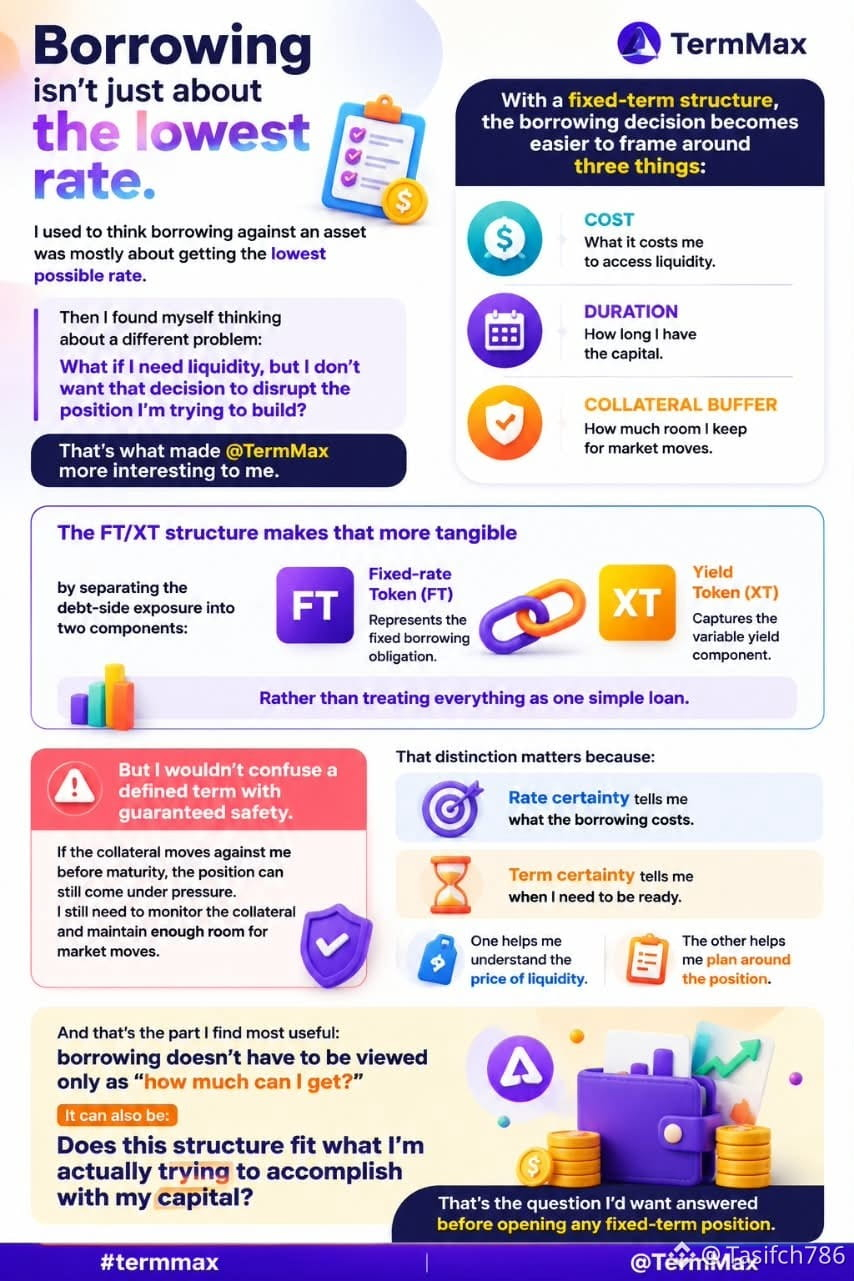
I used to think borrowing against an asset was mostly about getting the lowest possible rate.
Then I found myself thinking about a different problem:
What if I need liquidity, but I don’t want that decision to disrupt the position I’m trying to build?
That’s what made @TermMax more interesting to me.
With a fixed term structure, the borrowing decision becomes easier to frame around three things:
cost + duration + collateral buffer
The FT/XT structure makes that more tangible by separating the debt-side exposure into a Fixed-rate Token (FT) and a Yield Token (XT) rather than treating everything as one simple loan.
But I wouldn’t confuse a defined term with guaranteed safety.
If the collateral moves against me before maturity, the position can still come under pressure. I still need to monitor the collateral and maintain enough room for market moves.
That distinction matters because:
Rate certainty tells me what the borrowing costs.
Term certainty tells me when I need to be ready.
One helps me understand the price of liquidity.
The other helps me plan around the position.
And that’s the part I find most useful: borrowing doesn't have to be viewed only as “how much can I get?”
It can also be:
Does this structure fit what I’m actually trying to accomplish with my capital?
That’s the question I’d want answered before opening any fixed-term position.
#termmax @TermMax $BTC #defi #Crypto
Then I found myself thinking about a different problem:
What if I need liquidity, but I don’t want that decision to disrupt the position I’m trying to build?
That’s what made @TermMax more interesting to me.
With a fixed term structure, the borrowing decision becomes easier to frame around three things:
cost + duration + collateral buffer
The FT/XT structure makes that more tangible by separating the debt-side exposure into a Fixed-rate Token (FT) and a Yield Token (XT) rather than treating everything as one simple loan.
But I wouldn’t confuse a defined term with guaranteed safety.
If the collateral moves against me before maturity, the position can still come under pressure. I still need to monitor the collateral and maintain enough room for market moves.
That distinction matters because:
Rate certainty tells me what the borrowing costs.
Term certainty tells me when I need to be ready.
One helps me understand the price of liquidity.
The other helps me plan around the position.
And that’s the part I find most useful: borrowing doesn't have to be viewed only as “how much can I get?”
It can also be:
Does this structure fit what I’m actually trying to accomplish with my capital?
That’s the question I’d want answered before opening any fixed-term position.
#termmax @TermMax $BTC #defi #Crypto
PINNED
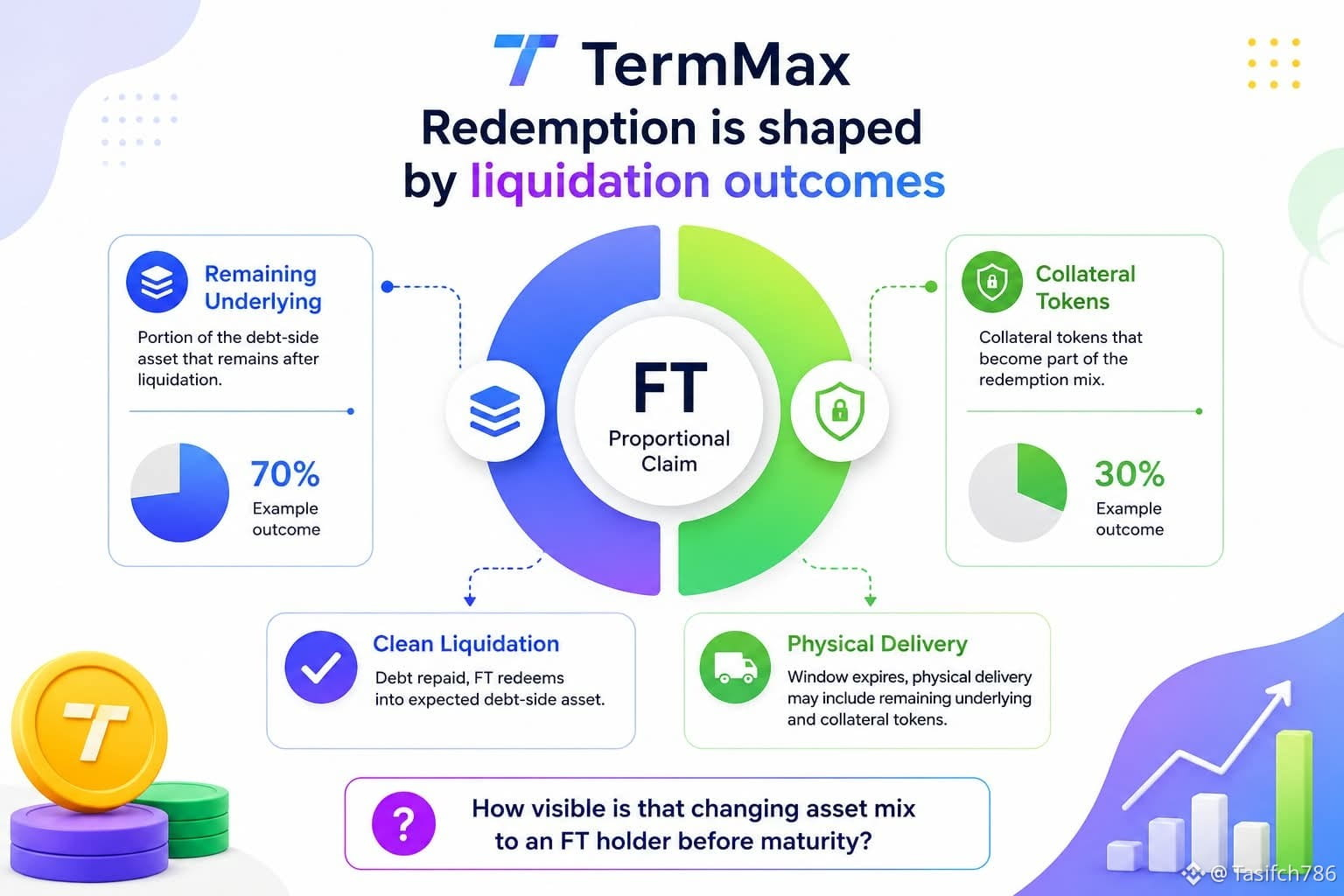
I started looking at @TermMax redemption from a different angle: not “what do I get at maturity?” but “what determines the thing I get ?”
If everything goes normally, the answer is easy. The debt is repaid, the FT matures, and the holder receives the expected debt
side asset.
But the more interesting case starts when liquidation does not finish cleanly. Once the allowed window expires, physical delivery can take over, meaning the redemption outcome can reflect both the remaining underlying and collateral tokens.
That makes an FT less like a simple maturity receipt and more like a proportional claim whose final asset mix can change with the liquidation outcome.
So the question I keep coming back to is: how visible is that changing asset mix to an FT holder before maturity?
@TermMax #TermMax $BTC $BNB #crypto
If everything goes normally, the answer is easy. The debt is repaid, the FT matures, and the holder receives the expected debt
side asset.
But the more interesting case starts when liquidation does not finish cleanly. Once the allowed window expires, physical delivery can take over, meaning the redemption outcome can reflect both the remaining underlying and collateral tokens.
That makes an FT less like a simple maturity receipt and more like a proportional claim whose final asset mix can change with the liquidation outcome.
So the question I keep coming back to is: how visible is that changing asset mix to an FT holder before maturity?
@TermMax #TermMax $BTC $BNB #crypto
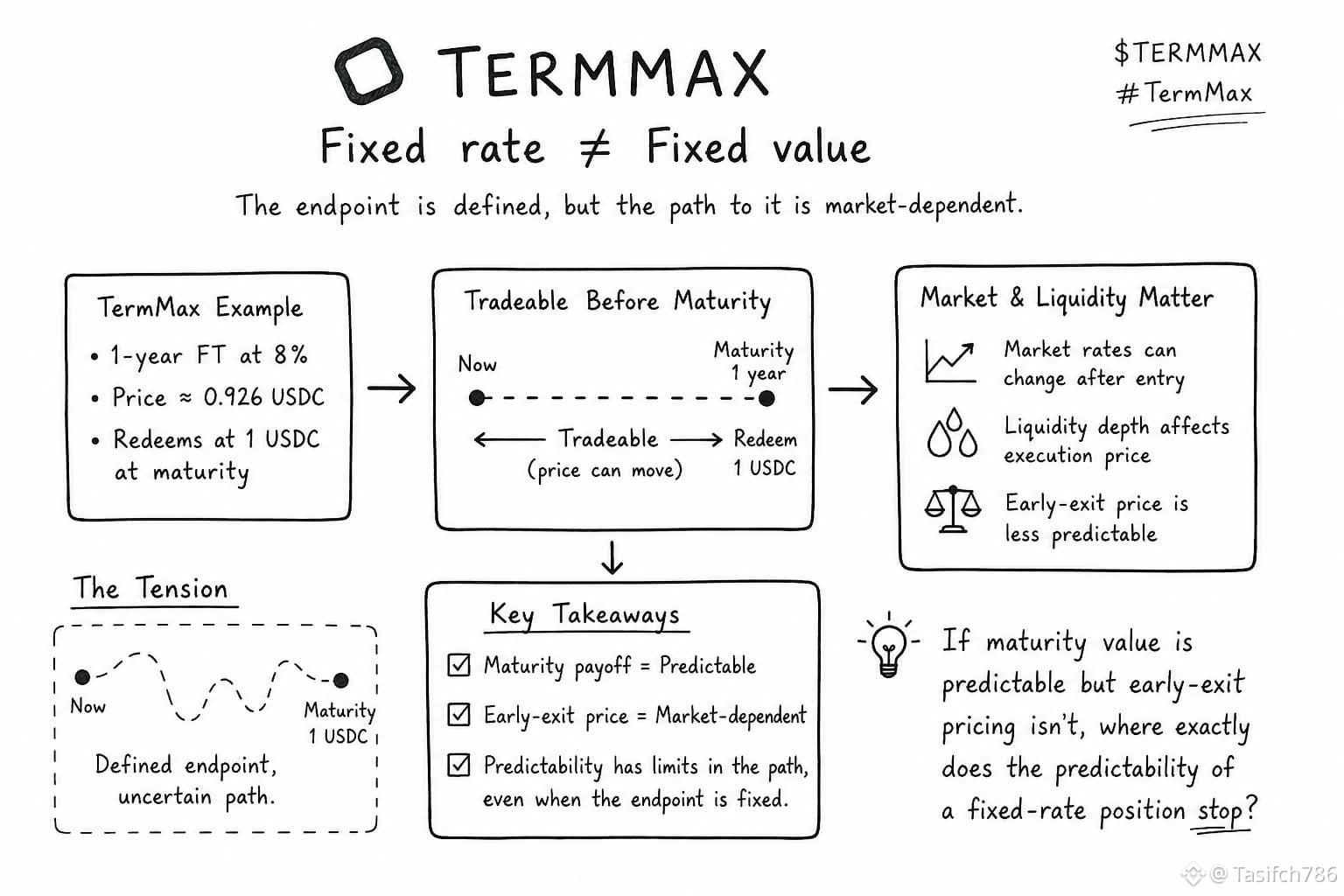
I kept coming back to one detail while looking at @TermMax : “fixed rate” and “fixed value” are two different things.
TermMax own example makes this concrete: a 1-year FT at 8% is priced around 0.926 USDC and redeems at 1 USDC at maturity. That maturity payoff is defined, but the FT can still be traded before then.
So if market rates move after entry, buyers can value that existing FT differently. And when liquidity is thin, the price you can actually execute at may become less predictable.
That creates the tension I find interesting: the endpoint is defined, but the path to it is still market-dependent.
If maturity value is predictable but early exit pricing isn’t, where exactly does the predictability of a fixed rate position stop?
#TermMax
TermMax own example makes this concrete: a 1-year FT at 8% is priced around 0.926 USDC and redeems at 1 USDC at maturity. That maturity payoff is defined, but the FT can still be traded before then.
So if market rates move after entry, buyers can value that existing FT differently. And when liquidity is thin, the price you can actually execute at may become less predictable.
That creates the tension I find interesting: the endpoint is defined, but the path to it is still market-dependent.
If maturity value is predictable but early exit pricing isn’t, where exactly does the predictability of a fixed rate position stop?
#TermMax
#termmax
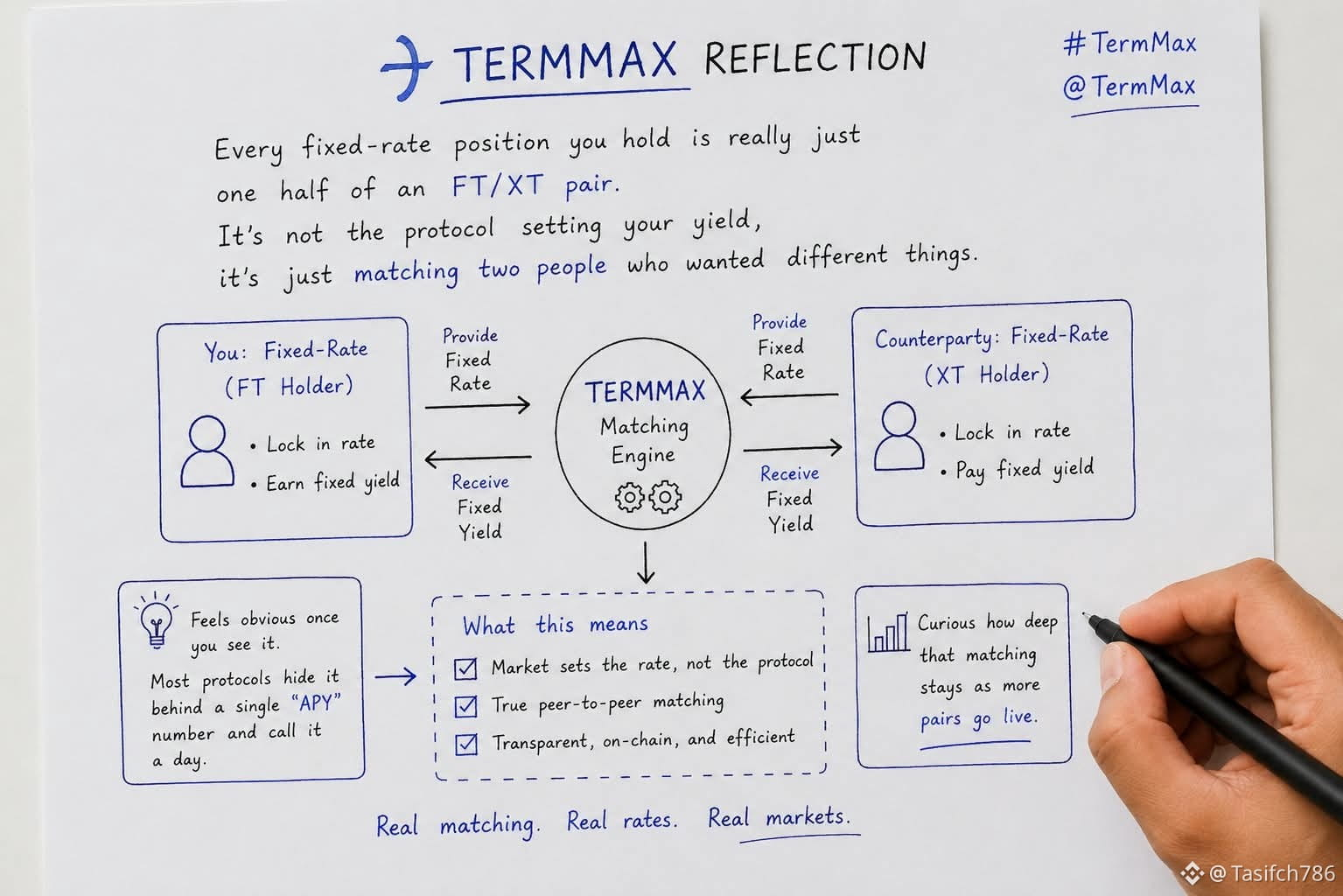
Went back to check my TermMax positions after the airdrop settled, and something clicked I hadn't noticed before. Every fixed-rate position you hold is really just one half of an FT/XT pair — someone locked in the rate you're getting because someone else needed the opposite exposure. It's not the protocol setting your yield, it's just matching two people who wanted different things. Feels obvious once you see it, but most fixed-rate protocols hide that behind a single "APY" number and call it a day. This one doesn't. Curious how deep that matching stays as more pairs go live.
#TermMax @TermMax
Went back to check my TermMax positions after the airdrop settled, and something clicked I hadn't noticed before. Every fixed-rate position you hold is really just one half of an FT/XT pair — someone locked in the rate you're getting because someone else needed the opposite exposure. It's not the protocol setting your yield, it's just matching two people who wanted different things. Feels obvious once you see it, but most fixed-rate protocols hide that behind a single "APY" number and call it a day. This one doesn't. Curious how deep that matching stays as more pairs go live.
#TermMax @TermMax
I used to think fixed-rate meant just knowing what I'd pay at maturity.
Then @TermMax showed me what happens before that.
An FT makes the fixed-rate claim tradable. Maturity stays fixed — but its value keeps moving as rates shift and liquidity changes.
Knowing what it pays at maturity is one thing.
Knowing what it's worth today is another.
Here's the part most miss: if an FT trades below face value, the borrower can buy it back and settle debt cheaper.
Same market that prices your exit... also prices someone else's way out.
That's the real experiment — not just fixing a rate, but making people want to trade it later.
#TermMax
What's the real insight in this thread?
Then @TermMax showed me what happens before that.
An FT makes the fixed-rate claim tradable. Maturity stays fixed — but its value keeps moving as rates shift and liquidity changes.
Knowing what it pays at maturity is one thing.
Knowing what it's worth today is another.
Here's the part most miss: if an FT trades below face value, the borrower can buy it back and settle debt cheaper.
Same market that prices your exit... also prices someone else's way out.
That's the real experiment — not just fixing a rate, but making people want to trade it later.
#TermMax
What's the real insight in this thread?
Fixed value at maturity
100%
Tradable value before maturity
0%
2 votes • Voting closed
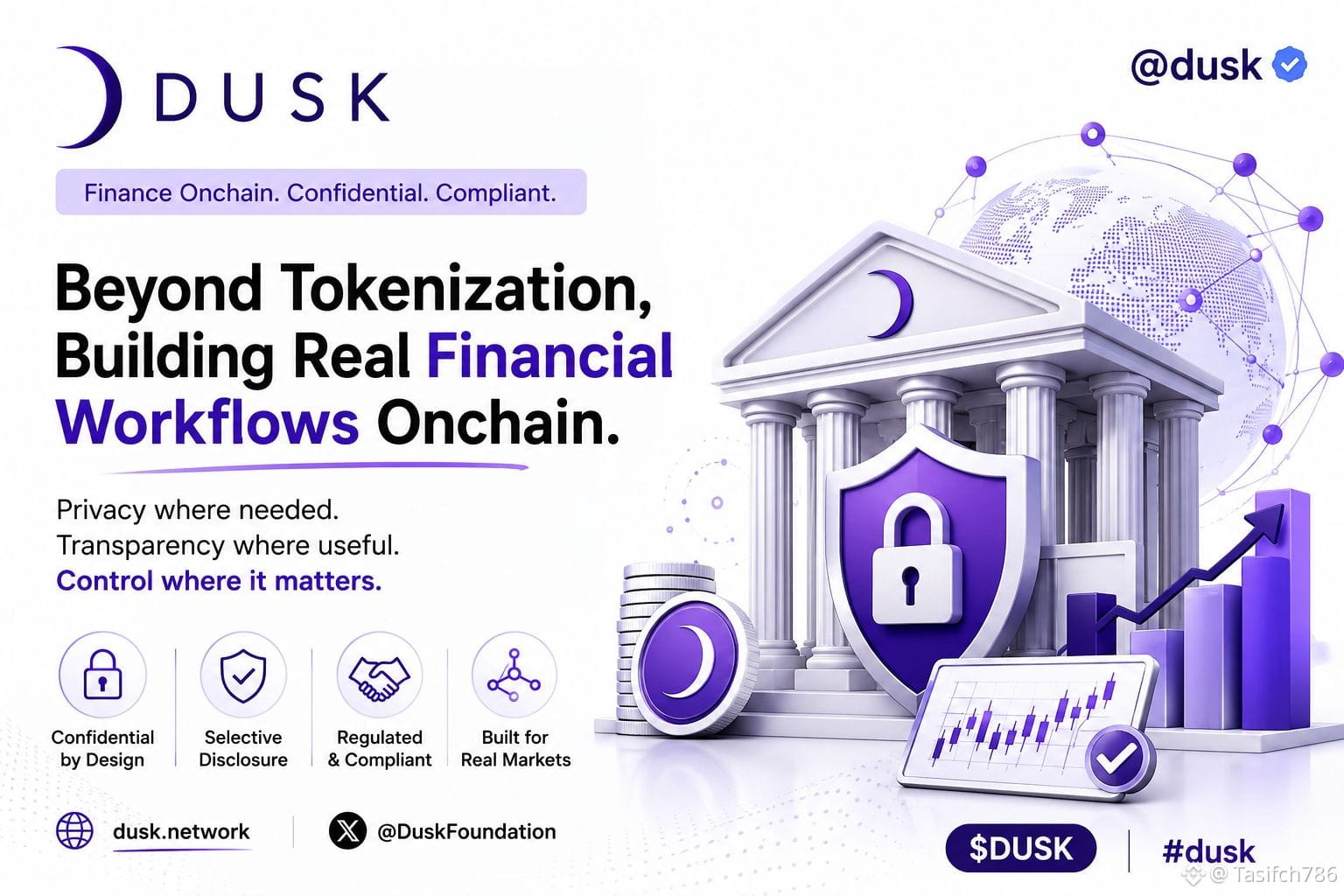
@Dusk I used to think bringing finance onchain was mostly about tokenizing assets. But the deeper challenge seems to start after the asset exists — when real financial workflows begin.
Issuance is only the first layer. Trading, settlement, investor access, and disclosure create a much more demanding set of requirements.
That’s why DuskEVM stands out to me. It combines familiar EVM workflows with confidential financial logic, while still allowing selective disclosure when authorized review is required.
Because regulated finance does not need everything exposed, and it does not need everything hidden either. It needs control over what stays private, what can be verified, and who gets access to that information.
Could programmable privacy be the missing layer between tokenized assets and truly workable financial markets onchain?
$DUSK #dusk
Issuance is only the first layer. Trading, settlement, investor access, and disclosure create a much more demanding set of requirements.
That’s why DuskEVM stands out to me. It combines familiar EVM workflows with confidential financial logic, while still allowing selective disclosure when authorized review is required.
Because regulated finance does not need everything exposed, and it does not need everything hidden either. It needs control over what stays private, what can be verified, and who gets access to that information.
Could programmable privacy be the missing layer between tokenized assets and truly workable financial markets onchain?
$DUSK #dusk
@Dusk $DUSK #dusk
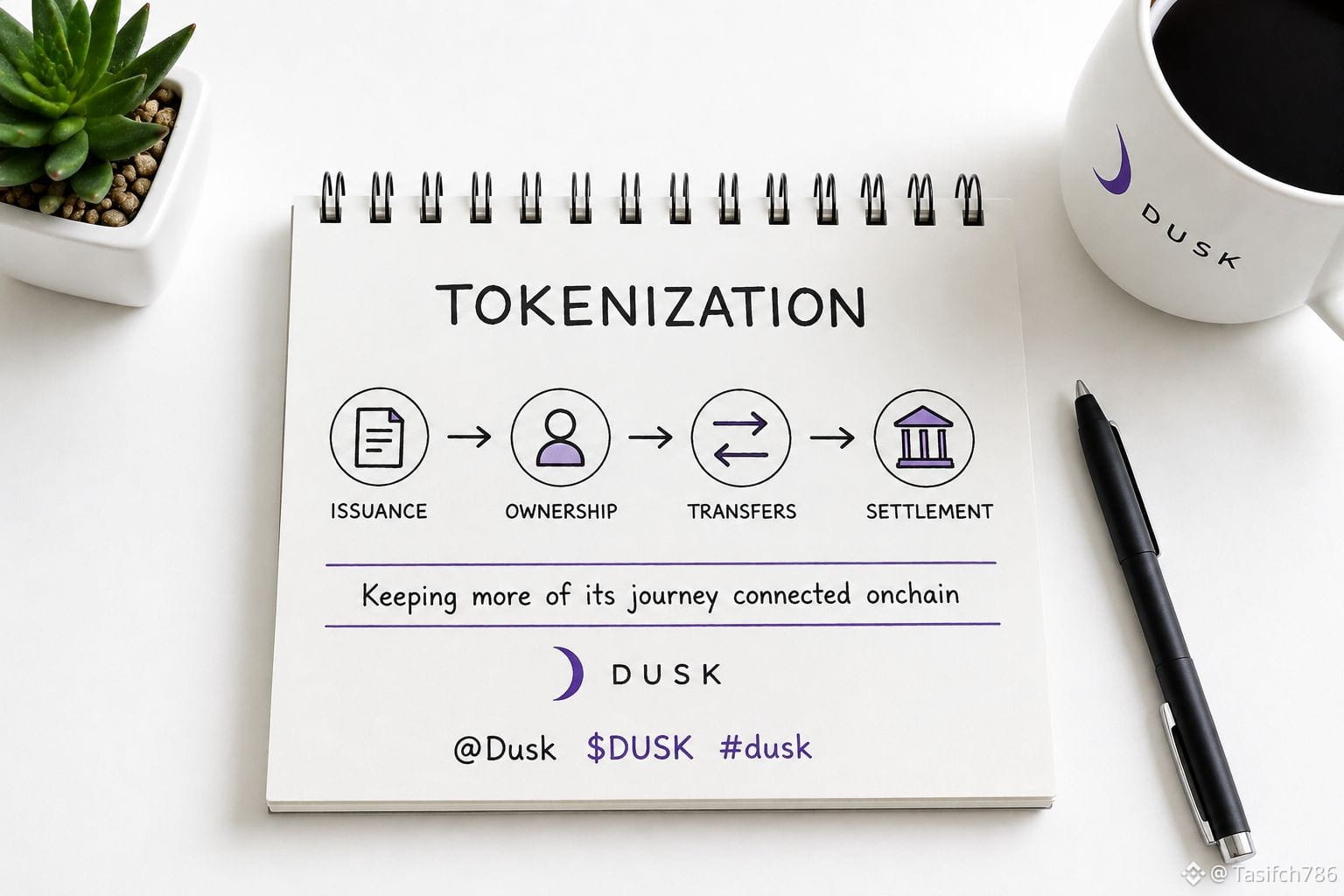
I used to think tokenization was mostly about putting an existing asset onchain. But the more I look at native issuance, the more that idea feels incomplete.
Maybe the bigger shift isn’t creating a digital version of an asset, but keeping more of its journey connected onchain—from issuance and ownership to transfers and settlement.
And that’s where the harder question begins. Moving an asset onto a blockchain is one thing; building infrastructure that institutions can actually use within regulated markets is another.
If more of that journey can happen natively onchain, does “tokenization” still fully describe what’s happening?
I used to think tokenization was mostly about putting an existing asset onchain. But the more I look at native issuance, the more that idea feels incomplete.
Maybe the bigger shift isn’t creating a digital version of an asset, but keeping more of its journey connected onchain—from issuance and ownership to transfers and settlement.
And that’s where the harder question begins. Moving an asset onto a blockchain is one thing; building infrastructure that institutions can actually use within regulated markets is another.
If more of that journey can happen natively onchain, does “tokenization” still fully describe what’s happening?
Verified
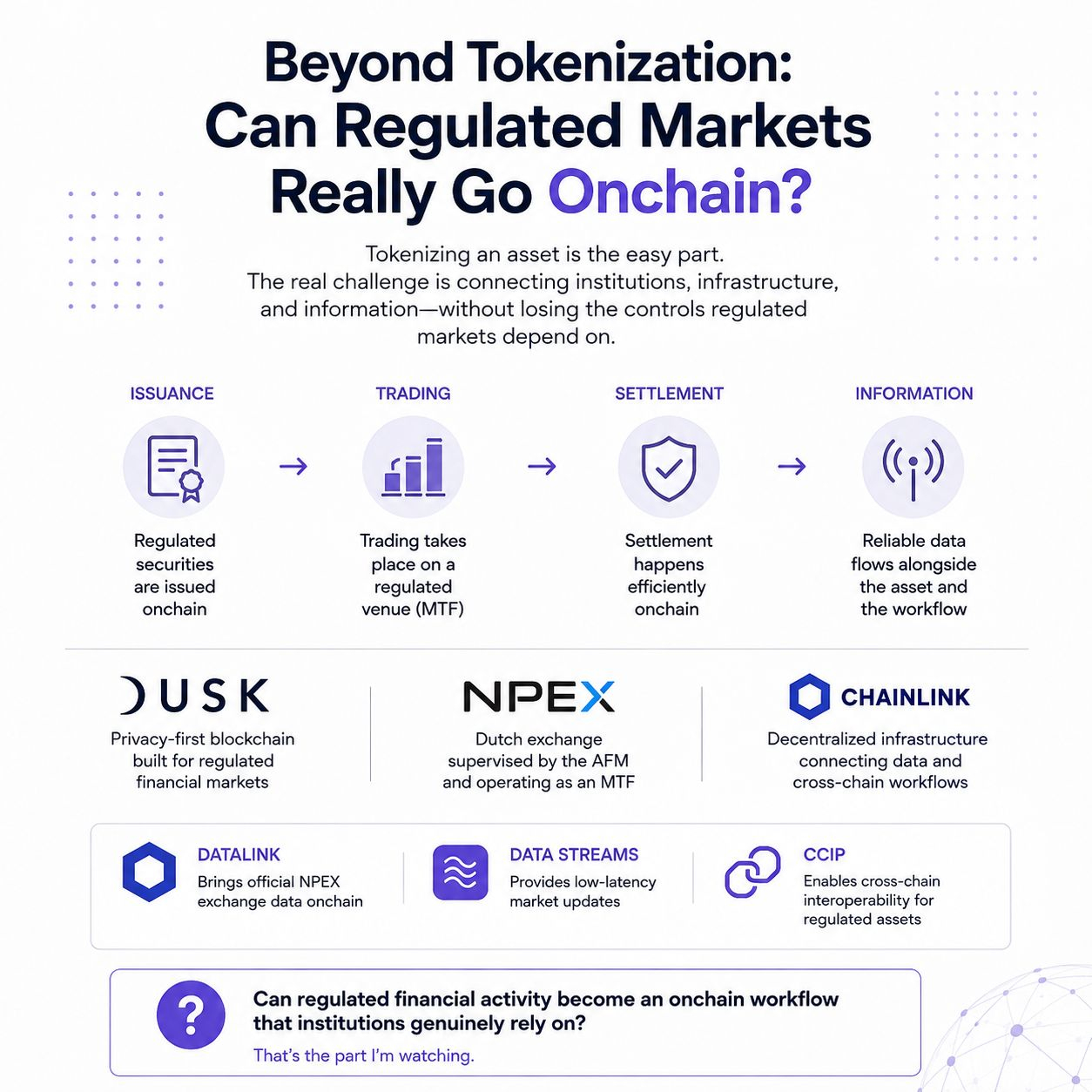
I still think the hardest part of bringing financial markets onchain isn’t tokenizing an asset. It’s getting the institutions, infrastructure, and information around that asset to work together without losing the controls regulated markets depend on.
That’s why I keep coming back to the Dusk NPEX story.
NPEX is a Dutch stock exchange supervised by the AFM and operates as an MTF. What caught my attention is that the Dusk relationship goes beyond simply putting securities on a blockchain. What interests me is the attempt to connect issuance, trading and settlement with onchain infrastructure, rather than treating tokenization as the finish line.
Then I noticed something easy to overlook:
The asset itself isn’t enough.
A functioning market also needs reliable information around that asset. That’s where the Chainlink integration becomes interesting. Dusk says DataLink is intended to bring official NPEX exchange data onchain, Data Streams is designed for low-latency market updates, and CCIP adds cross-chain interoperability.
That changed how I look at the Dusk thesis.
It feels less like “put RWAs on a blockchain” and more like connecting the different pieces required for regulated financial activity to actually operate onchain.
But this is where the real test begins.
Infrastructure can connect the pieces. It can’t prove that institutions will actually change how they issue, trade and settle financial assets.
So the question I’m left with is:
Can regulated financial activity become an onchain workflow that institutions genuinely rely on?
That’s the part I’m watching.
@Dusk $DUSK #dusk
That’s why I keep coming back to the Dusk NPEX story.
NPEX is a Dutch stock exchange supervised by the AFM and operates as an MTF. What caught my attention is that the Dusk relationship goes beyond simply putting securities on a blockchain. What interests me is the attempt to connect issuance, trading and settlement with onchain infrastructure, rather than treating tokenization as the finish line.
Then I noticed something easy to overlook:
The asset itself isn’t enough.
A functioning market also needs reliable information around that asset. That’s where the Chainlink integration becomes interesting. Dusk says DataLink is intended to bring official NPEX exchange data onchain, Data Streams is designed for low-latency market updates, and CCIP adds cross-chain interoperability.
That changed how I look at the Dusk thesis.
It feels less like “put RWAs on a blockchain” and more like connecting the different pieces required for regulated financial activity to actually operate onchain.
But this is where the real test begins.
Infrastructure can connect the pieces. It can’t prove that institutions will actually change how they issue, trade and settle financial assets.
So the question I’m left with is:
Can regulated financial activity become an onchain workflow that institutions genuinely rely on?
That’s the part I’m watching.
@Dusk $DUSK #dusk
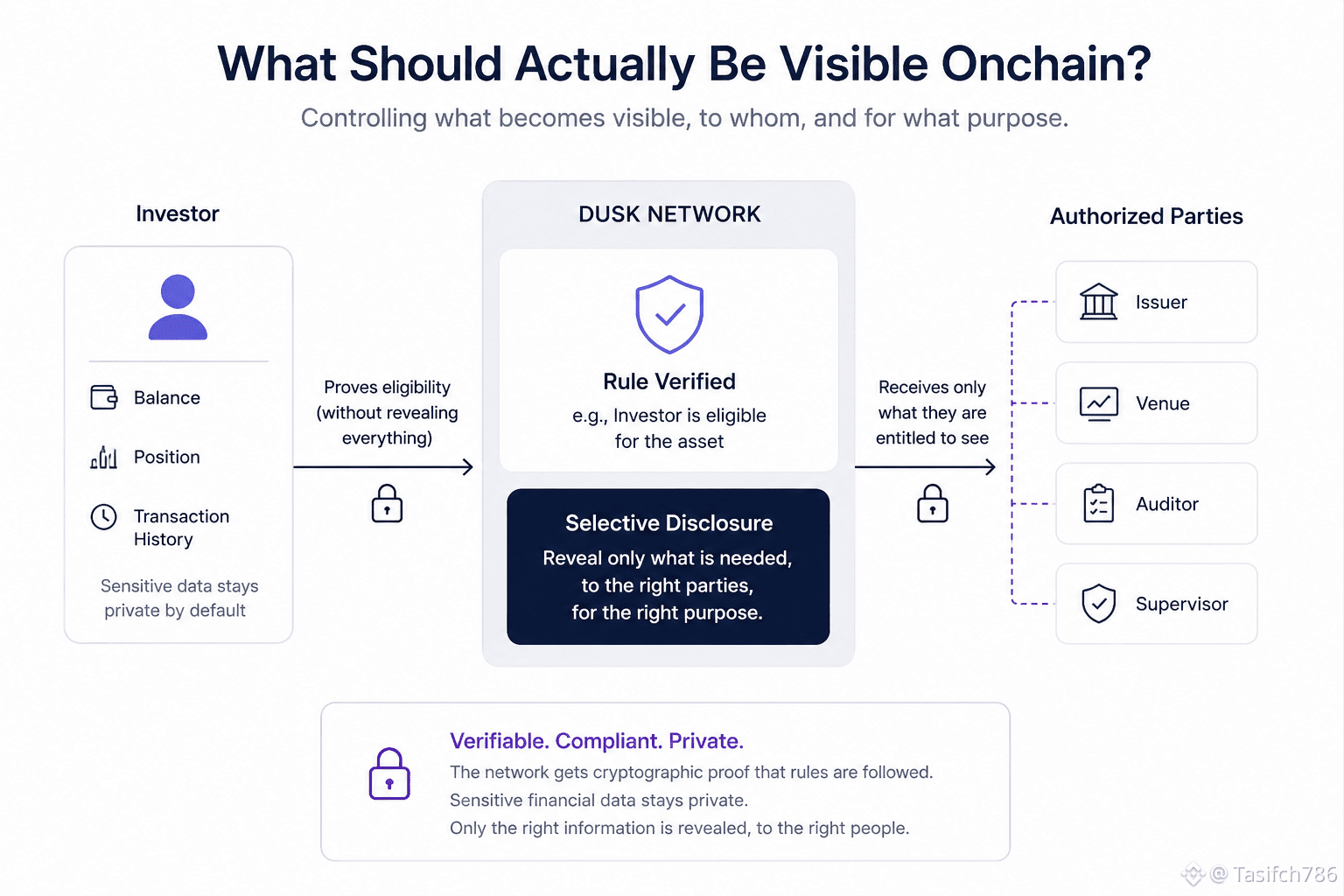
I still think the hardest problem in putting financial markets onchain isn’t tokenization. It’s deciding what should actually be visible.
The more I looked into @Dusk , the more I noticed something interesting: its privacy approach seems less about making financial activity invisible and more about controlling what becomes visible, to whom, and for what purpose.
That sounds like a small distinction, but for regulated finance, it changes the problem completely.
Take a simple example. An institution may need to prove an investor is eligible for a regulated asset. The network needs evidence that the rule was satisfied. But why should every other participant also see that investor’s balance, position, or transaction history?
What I found particularly interesting in Dusk’s documentation is this idea of deciding what should remain confidential and what can be selectively disclosed when required.
That philosophy also shows up in the technology. DuskEVM provides a familiar Solidity/EVM environment, while Hedger supports confidential EVM workflows using homomorphic encryption and zero-knowledge proofs.
So privacy doesn’t have to mean hiding everything. It can become something an application uses when needed, while still keeping execution verifiable.
The tension I keep coming back to is this:
Regulated markets need transparency for oversight, but too much transparency can expose sensitive financial information.
Maybe the real challenge isn’t choosing between privacy and transparency.
It’s building a system that knows the difference.
Can a blockchain prove that the right rules were followed while revealing only what the right people are actually entitled to see?
$DUSK #dusk
The more I looked into @Dusk , the more I noticed something interesting: its privacy approach seems less about making financial activity invisible and more about controlling what becomes visible, to whom, and for what purpose.
That sounds like a small distinction, but for regulated finance, it changes the problem completely.
Take a simple example. An institution may need to prove an investor is eligible for a regulated asset. The network needs evidence that the rule was satisfied. But why should every other participant also see that investor’s balance, position, or transaction history?
What I found particularly interesting in Dusk’s documentation is this idea of deciding what should remain confidential and what can be selectively disclosed when required.
That philosophy also shows up in the technology. DuskEVM provides a familiar Solidity/EVM environment, while Hedger supports confidential EVM workflows using homomorphic encryption and zero-knowledge proofs.
So privacy doesn’t have to mean hiding everything. It can become something an application uses when needed, while still keeping execution verifiable.
The tension I keep coming back to is this:
Regulated markets need transparency for oversight, but too much transparency can expose sensitive financial information.
Maybe the real challenge isn’t choosing between privacy and transparency.
It’s building a system that knows the difference.
Can a blockchain prove that the right rules were followed while revealing only what the right people are actually entitled to see?
$DUSK #dusk
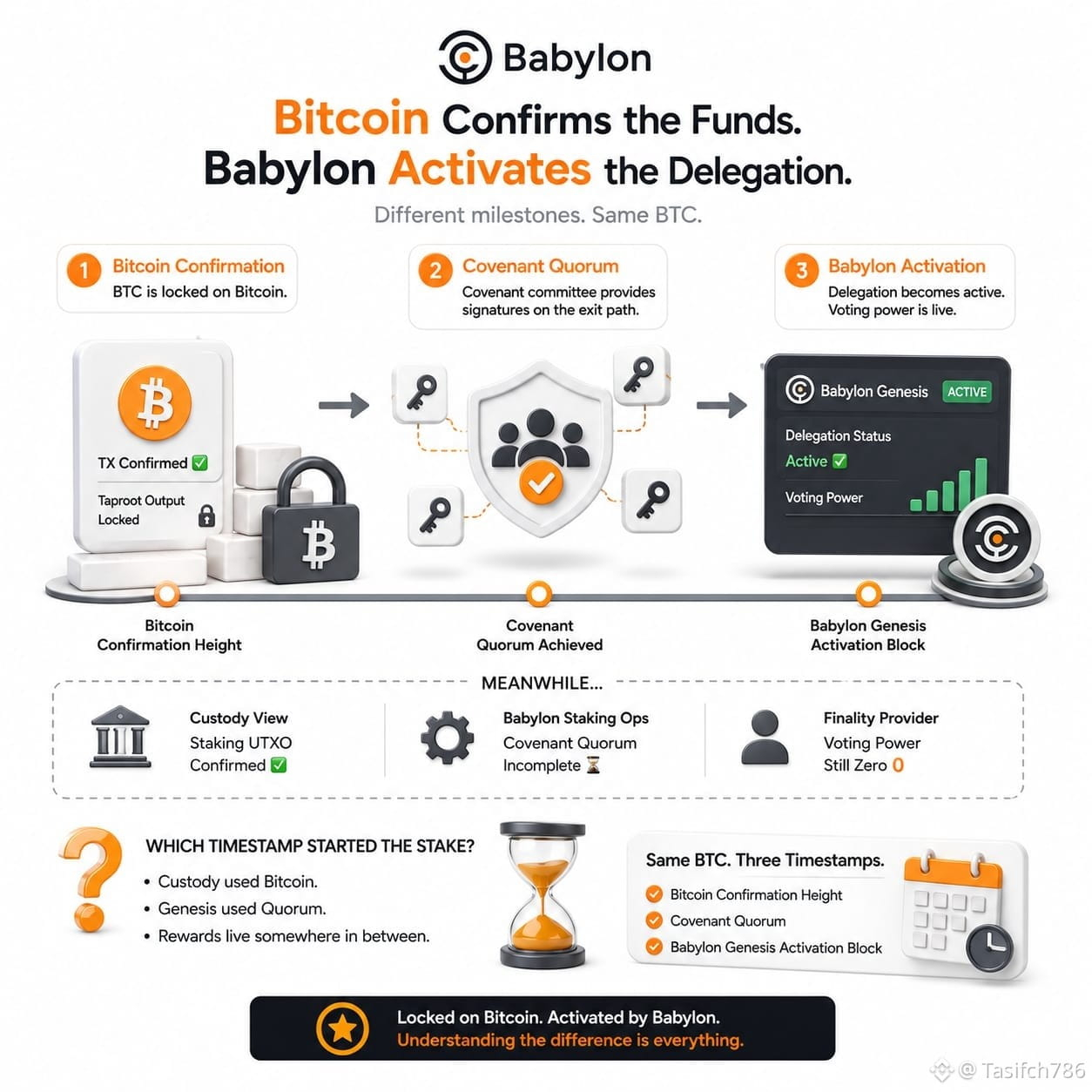
I expected Bitcoin confirmation to be the moment a Babylon stake became "live."
The more I looked, the more I realized there are multiple milestones—and they don't all happen at the same time.
A confirmed Bitcoin transaction proves the BTC is locked.
But that alone doesn't immediately give the stake influence inside Babylon.
Before the delegation becomes active, additional protocol conditions still have to be satisfied. Until then:
🔸 BTC is already locked on Bitcoin.
🔸 The delegation isn't yet contributing to Babylon's security.
🔸 Finality providers don't gain voting power from that stake.
That creates an interesting distinction:
Bitcoin confirms the funds.
Babylon activates the delegation.
They're related, but they're not the same event.
For users, the important question isn't just "Is my transaction confirmed?"
It's "Has my stake actually become active inside the protocol?"
Understanding that difference makes Babylon's staking flow much easier to reason about—and avoids confusing Bitcoin settlement with protocol activation.
Curious how others think wallet dashboards should present these separate stages so users always know where their stake stands.
@BabylonLabs_io #baby $BABY $GIGGLE $KOMA
The more I looked, the more I realized there are multiple milestones—and they don't all happen at the same time.
A confirmed Bitcoin transaction proves the BTC is locked.
But that alone doesn't immediately give the stake influence inside Babylon.
Before the delegation becomes active, additional protocol conditions still have to be satisfied. Until then:
🔸 BTC is already locked on Bitcoin.
🔸 The delegation isn't yet contributing to Babylon's security.
🔸 Finality providers don't gain voting power from that stake.
That creates an interesting distinction:
Bitcoin confirms the funds.
Babylon activates the delegation.
They're related, but they're not the same event.
For users, the important question isn't just "Is my transaction confirmed?"
It's "Has my stake actually become active inside the protocol?"
Understanding that difference makes Babylon's staking flow much easier to reason about—and avoids confusing Bitcoin settlement with protocol activation.
Curious how others think wallet dashboards should present these separate stages so users always know where their stake stands.
@BabylonLabs_io #baby $BABY $GIGGLE $KOMA
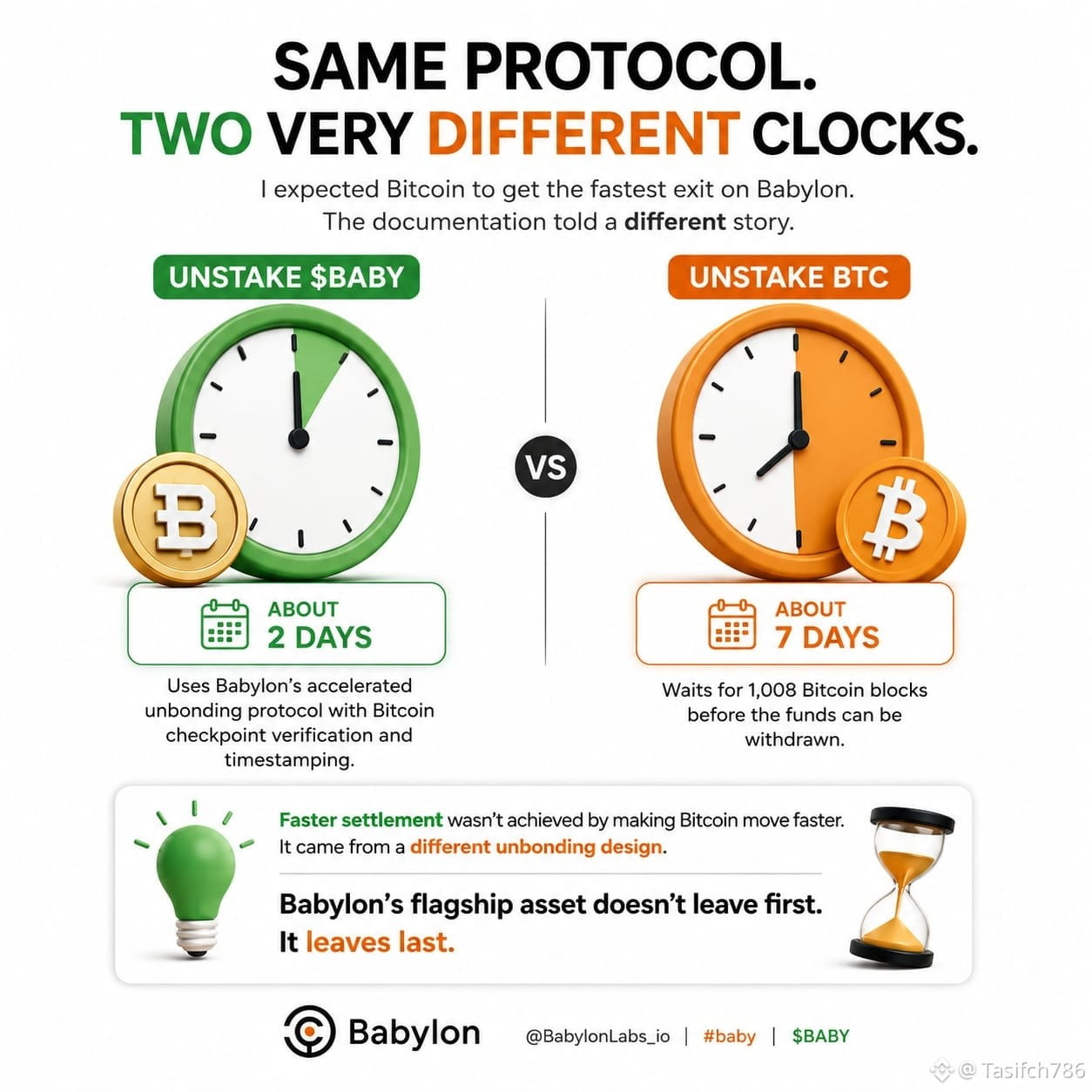
I expected Bitcoin to get the fastest exit on Babylon.
The documentation told a different story.
🟢 Unstake $BABY → around 2 days
🟠 Unstake BTC → around 7 days (after 1,008 Bitcoin blocks)
At first glance, it feels backwards.
But the delay isn't about Bitcoin being inefficient.
The two assets follow different unbonding paths.
$BABY uses Babylon's accelerated unbonding process, where Bitcoin checkpoints and timestamp verification help shorten the waiting period.
Native BTC staking follows Bitcoin's own security assumptions, requiring a much longer withdrawal window before funds are released.
Same ecosystem.
Different security models.
Sometimes the most interesting part of a protocol isn't what moves faster it's why it moves differently.
@BabylonLabs_io #baby $BABY
The documentation told a different story.
🟢 Unstake $BABY → around 2 days
🟠 Unstake BTC → around 7 days (after 1,008 Bitcoin blocks)
At first glance, it feels backwards.
But the delay isn't about Bitcoin being inefficient.
The two assets follow different unbonding paths.
$BABY uses Babylon's accelerated unbonding process, where Bitcoin checkpoints and timestamp verification help shorten the waiting period.
Native BTC staking follows Bitcoin's own security assumptions, requiring a much longer withdrawal window before funds are released.
Same ecosystem.
Different security models.
Sometimes the most interesting part of a protocol isn't what moves faster it's why it moves differently.
@BabylonLabs_io #baby $BABY
awesome 👍

Rizwan ch
·
--
One detail changed the way I look at @BabylonLabs_io . It wasn't the BTC locked or the staking numbers—it was how the system is designed so that trust comes from protocol rules instead of a central organisation.
The more I explored Trustless Bitcoin Vaults and Bitcoin staking, the clearer it became that validators, cryptographic proofs, and transparent rules are expected to do the heavy lifting. That means resilience depends on independent participants following the same rules, not on someone stepping in to reverse problems later.
For me, that is one of the strongest ideas behind Babylon: reducing reliance on human intervention and increasing reliance on verifiable coordination. It's a different way of thinking about security, and one that could shape how Bitcoin participates in decentralised ecosystems.
@BabylonLabs_io $BABY #baby
What gives you the most confidence in a Bitcoin staking protocol like @BabylonLabs_io?
The more I explored Trustless Bitcoin Vaults and Bitcoin staking, the clearer it became that validators, cryptographic proofs, and transparent rules are expected to do the heavy lifting. That means resilience depends on independent participants following the same rules, not on someone stepping in to reverse problems later.
For me, that is one of the strongest ideas behind Babylon: reducing reliance on human intervention and increasing reliance on verifiable coordination. It's a different way of thinking about security, and one that could shape how Bitcoin participates in decentralised ecosystems.
@BabylonLabs_io $BABY #baby
What gives you the most confidence in a Bitcoin staking protocol like @BabylonLabs_io?
good

Asif The Trader
·
--
BearishBitcoin security often gets discussed in terms of cryptography, but Babylon adds another layer: economic credibility.
One detail that stood out to me is how the protocol treats Finality Providers. The goal isn't simply to discourage misconduct it is to make trust measurable.
A Finality Provider is expected to produce a single, consistent view of finality. If it equivocates by signing conflicting messages, the consequences go beyond a financial penalty. The provider loses its role in the active set, and the protocol is designed so that the network no longer relies on that identity for finality. That makes reputation part of the security model, not just stake.
This creates an interesting trade-off.
@BabylonLabs_io A softer approach could allow operators to recover from mistakes and preserve experience within the network.
instead prioritises long term confidence by ensuring that proven equivocation has lasting consequences.
It raises an important question for dec
entralisation: can a network maintain a healthy and diverse Finality Provider set while enforcing such strict accountability?
Strong security is not only about preventing attacks it's also about deciding how much trust can ever be restored after one occurs.
@BabylonLabs_io $BABY #baby
What's more important for Babylon's security model?
One detail that stood out to me is how the protocol treats Finality Providers. The goal isn't simply to discourage misconduct it is to make trust measurable.
A Finality Provider is expected to produce a single, consistent view of finality. If it equivocates by signing conflicting messages, the consequences go beyond a financial penalty. The provider loses its role in the active set, and the protocol is designed so that the network no longer relies on that identity for finality. That makes reputation part of the security model, not just stake.
This creates an interesting trade-off.
@BabylonLabs_io A softer approach could allow operators to recover from mistakes and preserve experience within the network.
instead prioritises long term confidence by ensuring that proven equivocation has lasting consequences.
It raises an important question for dec
entralisation: can a network maintain a healthy and diverse Finality Provider set while enforcing such strict accountability?
Strong security is not only about preventing attacks it's also about deciding how much trust can ever be restored after one occurs.
@BabylonLabs_io $BABY #baby
What's more important for Babylon's security model?
I kept thinking Babylon was mainly about letting Bitcoin secure PoS networks.
Then I looked closer and realised the harder challenge isn't only security it is agreement.
Bitcoin and Babylon Genesis don't share the same native view of events. Someone has to prove that a Bitcoin event really happened, and someone else has to verify that proof without introducing a central point of failure.
That's where Babylon's design caught my attention.
Instead of depending on one bridge operator, responsibilities are split across different participants that independently move, verify, and observe checkpoint data between Bitcoin and Genesis.
The interesting part isn't that this removes trust completely.
It's that trust shifts from who controls the bridge to whether a decentralised set of participants keeps performing their roles over time.
If incentives remain strong, the system keeps synchronising. If participation weakens, coordination not cryptography becomes the first thing to face pressure.
For me, that's one of the more overlooked questions in Bitcoin staking. The protocol may be trust-minimised, but its long-term resilience also depends on the people and incentives that keep information flowing between chains.
What do you think matters more over the long run: stronger cryptography or stronger incentive design?
@BabylonLabs_io #baby $BABY
📊 What's more critical for Babylon's long-term success?
Then I looked closer and realised the harder challenge isn't only security it is agreement.
Bitcoin and Babylon Genesis don't share the same native view of events. Someone has to prove that a Bitcoin event really happened, and someone else has to verify that proof without introducing a central point of failure.
That's where Babylon's design caught my attention.
Instead of depending on one bridge operator, responsibilities are split across different participants that independently move, verify, and observe checkpoint data between Bitcoin and Genesis.
The interesting part isn't that this removes trust completely.
It's that trust shifts from who controls the bridge to whether a decentralised set of participants keeps performing their roles over time.
If incentives remain strong, the system keeps synchronising. If participation weakens, coordination not cryptography becomes the first thing to face pressure.
For me, that's one of the more overlooked questions in Bitcoin staking. The protocol may be trust-minimised, but its long-term resilience also depends on the people and incentives that keep information flowing between chains.
What do you think matters more over the long run: stronger cryptography or stronger incentive design?
@BabylonLabs_io #baby $BABY
📊 What's more critical for Babylon's long-term success?
🔐 Strong incentive design
75%
⚙️ Strong cryptography
25%
4 votes • Voting closed
One thing changed the way I think about Bitcoin.
I used to measure BTC by one metric: how long I could hold it.
Now I find myself asking a different question:
Can Bitcoin strengthen other blockchain networks without giving up the properties that made it valuable in the first place?
That question led me to explore @BabylonLabs_io .
What I find compelling isn't just the idea of Bitcoin staking it is the possibility of extending Bitcoin's security beyond its own chain while users keep custody of their BTC. If that model continues to mature, it could reshape how Proof-of-Stake ecosystems think about economic security.
The role of $BABY is also worth watching as it helps coordinate activity and governance within the Babylon ecosystem.
Crypto does not always move forward through louder narratives. Sometimes the biggest changes come from improving the foundations that other networks depend on.
If Bitcoin can help secure more than just itself, its impact could reach far beyond being a long term asset.
Do you think Bitcoin's future is limited to being digital gold, or could it become a core security layer for Web3?
@BabylonLabs_io $BABY #baby
📊 What interests you most about Babylon?
I used to measure BTC by one metric: how long I could hold it.
Now I find myself asking a different question:
Can Bitcoin strengthen other blockchain networks without giving up the properties that made it valuable in the first place?
That question led me to explore @BabylonLabs_io .
What I find compelling isn't just the idea of Bitcoin staking it is the possibility of extending Bitcoin's security beyond its own chain while users keep custody of their BTC. If that model continues to mature, it could reshape how Proof-of-Stake ecosystems think about economic security.
The role of $BABY is also worth watching as it helps coordinate activity and governance within the Babylon ecosystem.
Crypto does not always move forward through louder narratives. Sometimes the biggest changes come from improving the foundations that other networks depend on.
If Bitcoin can help secure more than just itself, its impact could reach far beyond being a long term asset.
Do you think Bitcoin's future is limited to being digital gold, or could it become a core security layer for Web3?
@BabylonLabs_io $BABY #baby
📊 What interests you most about Babylon?
🔒 Self-custodial BTC staking
50%
🛡️ Bitcoin security
33%
🌐 PoS innovation
0%
📚 Still learning
17%
6 votes • Voting closed
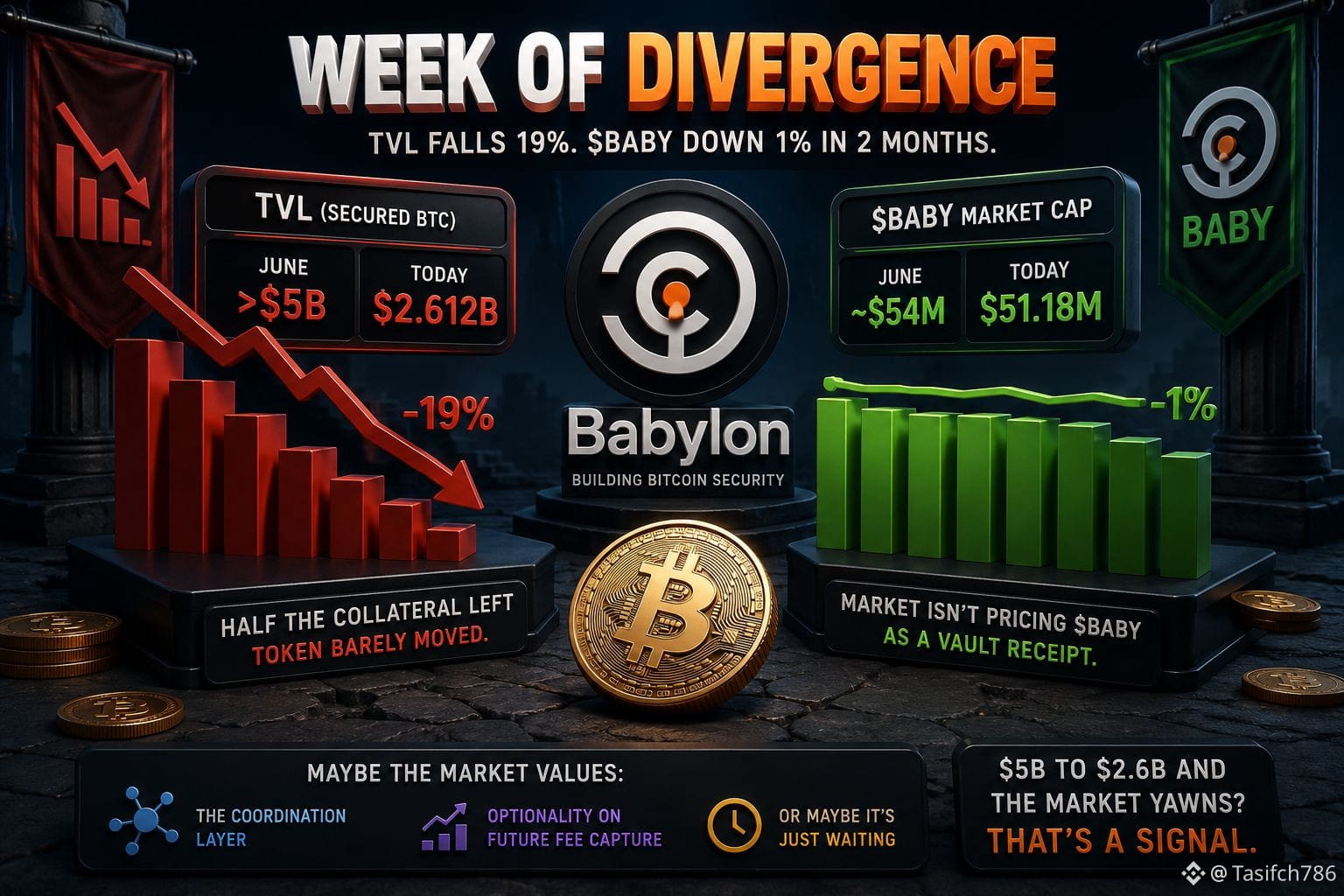
One of the most interesting things happening in Babylon right now isn't the token price it's the disconnect between TVL and valuation.
In the past week alone, Babylon's TVL dropped around 19%. Since June, secured BTC has fallen from more than $5B to roughly $2.612B. That's a major reduction in collateral. Yet over the same period, $BABY has remained relatively stable, with its market cap moving only from around $54M to about $51.18M.
@BabylonLabs_io If BABY were simply a proxy for the BTC secured in Babylon vaults, this price action wouldn't make much sense. A much larger decline would be expected. Instead, the market seems to be pricing something beyond today's TVL.
Maybe investors see BABY as the coordination layer of the Babylon ecosystem. Maybe they're valuing governance rights, future fee generation, or the network's long-term role in Bitcoin staking rather than the current amount of BTC secured.
This divergence does not automatically mean BABY is bullish or bearish. It simply suggests that the market may no longer view TVL as the primary driver of the token's value.
A network can lose billions in secured BTC while the token barely moves. Whether that relationship continues will be one of the most interesting things to watch in the coming months.
@BabylonLabs_io #baby $BABY
In the past week alone, Babylon's TVL dropped around 19%. Since June, secured BTC has fallen from more than $5B to roughly $2.612B. That's a major reduction in collateral. Yet over the same period, $BABY has remained relatively stable, with its market cap moving only from around $54M to about $51.18M.
@BabylonLabs_io If BABY were simply a proxy for the BTC secured in Babylon vaults, this price action wouldn't make much sense. A much larger decline would be expected. Instead, the market seems to be pricing something beyond today's TVL.
Maybe investors see BABY as the coordination layer of the Babylon ecosystem. Maybe they're valuing governance rights, future fee generation, or the network's long-term role in Bitcoin staking rather than the current amount of BTC secured.
This divergence does not automatically mean BABY is bullish or bearish. It simply suggests that the market may no longer view TVL as the primary driver of the token's value.
A network can lose billions in secured BTC while the token barely moves. Whether that relationship continues will be one of the most interesting things to watch in the coming months.
@BabylonLabs_io #baby $BABY
For a long time, I believed the safest strategy was simply to buy Bitcoin and never touch it. But as the ecosystem evolves, I have started asking a different question: can BTC do more without compromising its security?
That question led me to @BabylonLabs_io .
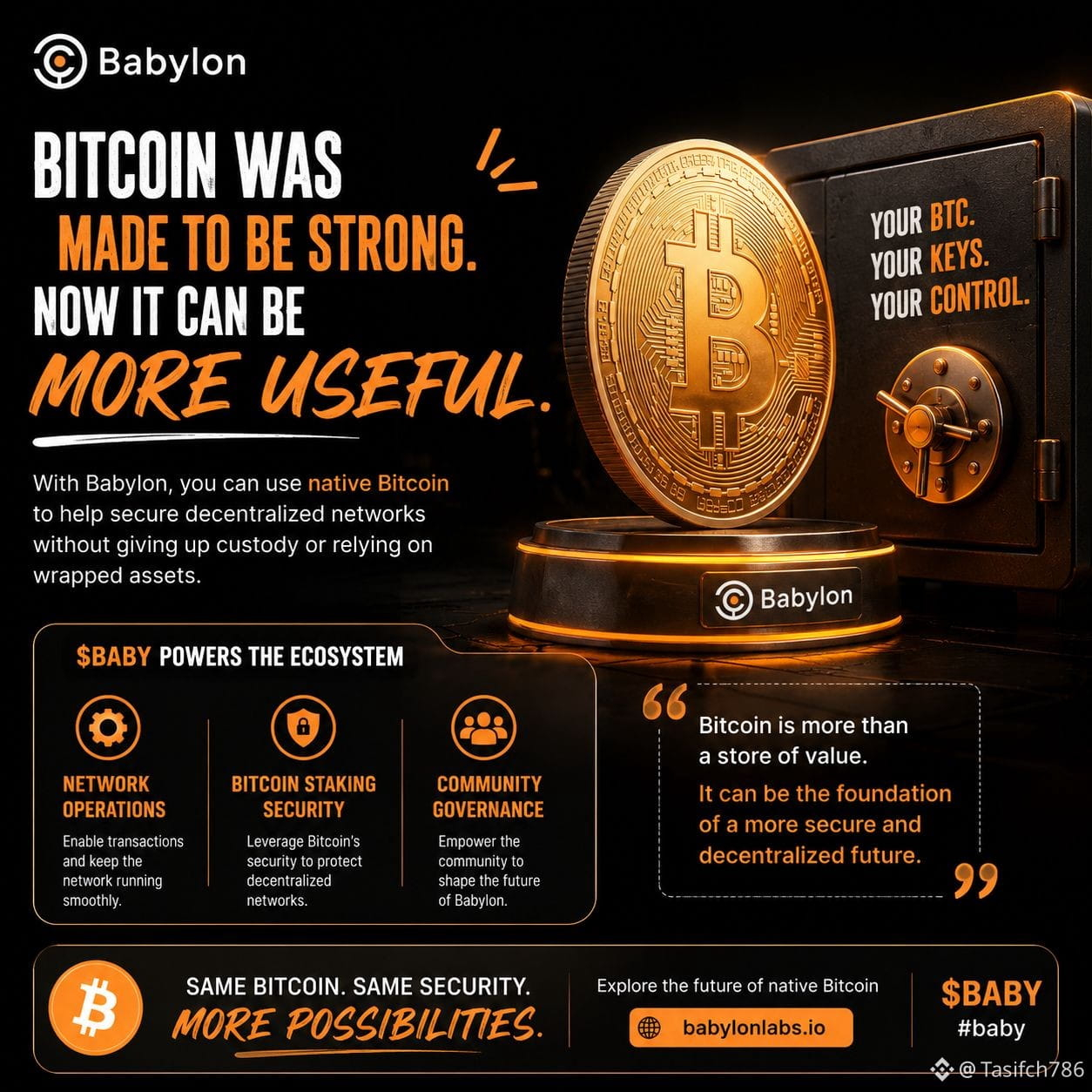
What I find compelling is the focus on using native Bitcoin instead of wrapped assets or complex bridge solutions. Keeping Bitcoin true to its original design while giving it additional utility is a powerful idea.
The $BABY token helps drive the Babylon ecosystem by supporting:
⚡ Network operations
🔐 Bitcoin staking security
🗳️ Community governance
Bitcoin has already changed the way we think about money. The next chapter could be about making it even more useful while preserving decentralization and self-custody.
What’s your view? Will native Bitcoin utility become a major trend in the years ahead?
#baby $BABY
That question led me to @BabylonLabs_io .
What I find compelling is the focus on using native Bitcoin instead of wrapped assets or complex bridge solutions. Keeping Bitcoin true to its original design while giving it additional utility is a powerful idea.
The $BABY token helps drive the Babylon ecosystem by supporting:
⚡ Network operations
🔐 Bitcoin staking security
🗳️ Community governance
Bitcoin has already changed the way we think about money. The next chapter could be about making it even more useful while preserving decentralization and self-custody.
What’s your view? Will native Bitcoin utility become a major trend in the years ahead?
#baby $BABY

Crypto genius master
·
--
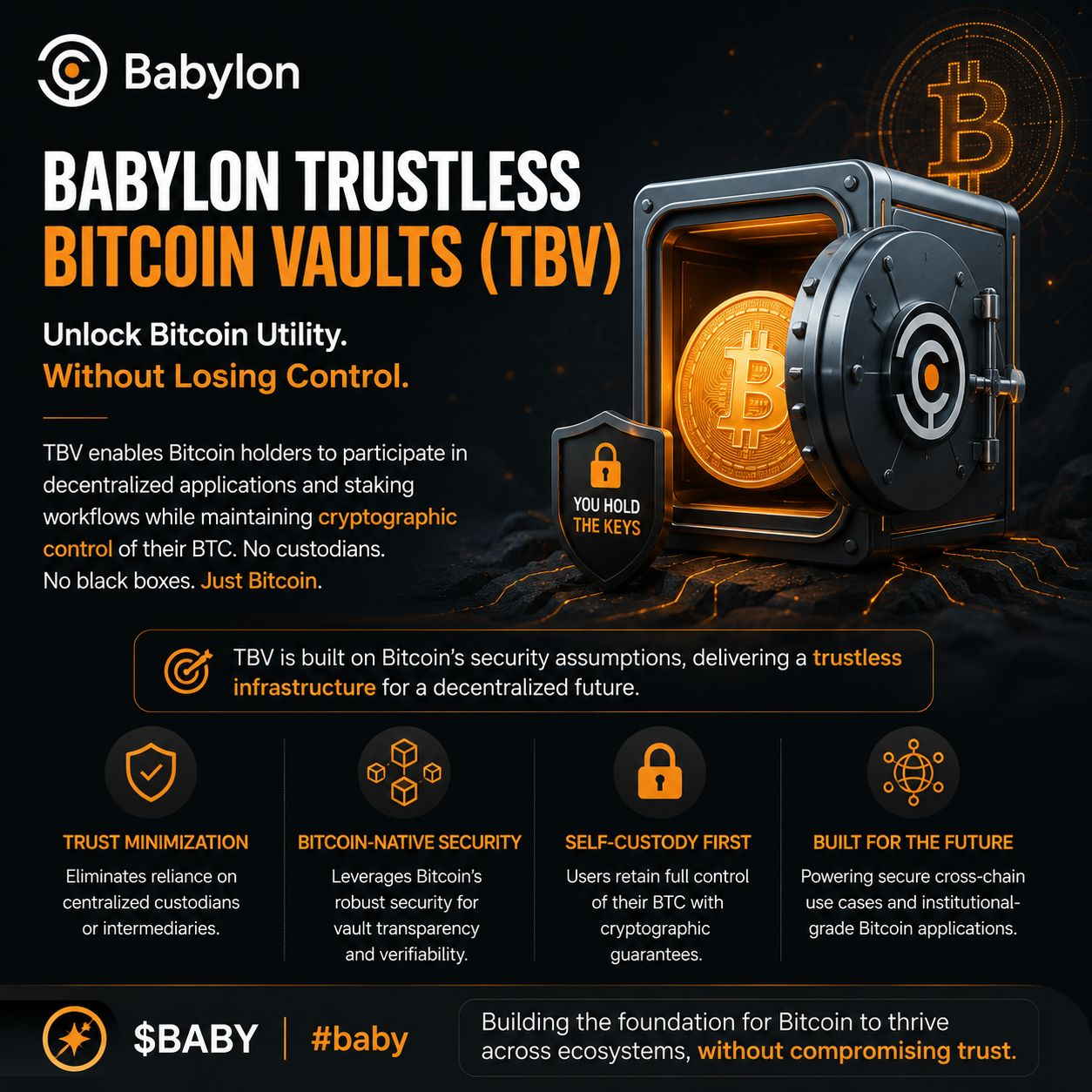
Bitcoin security should stay trustless as BTC becomes more useful across Web3. @BabylonLabs_io is advancing that vision with Babylon Trustless Bitcoin Vaults (TBV), giving users cryptographic control of their Bitcoin while reducing dependence on centralized custodians. With Bitcoin-native security, transparency, and stronger self-custody, TBV lays the groundwork for the next wave of decentralized Bitcoin apps.#baby $BABY
Good
Asif The Trader
·
--
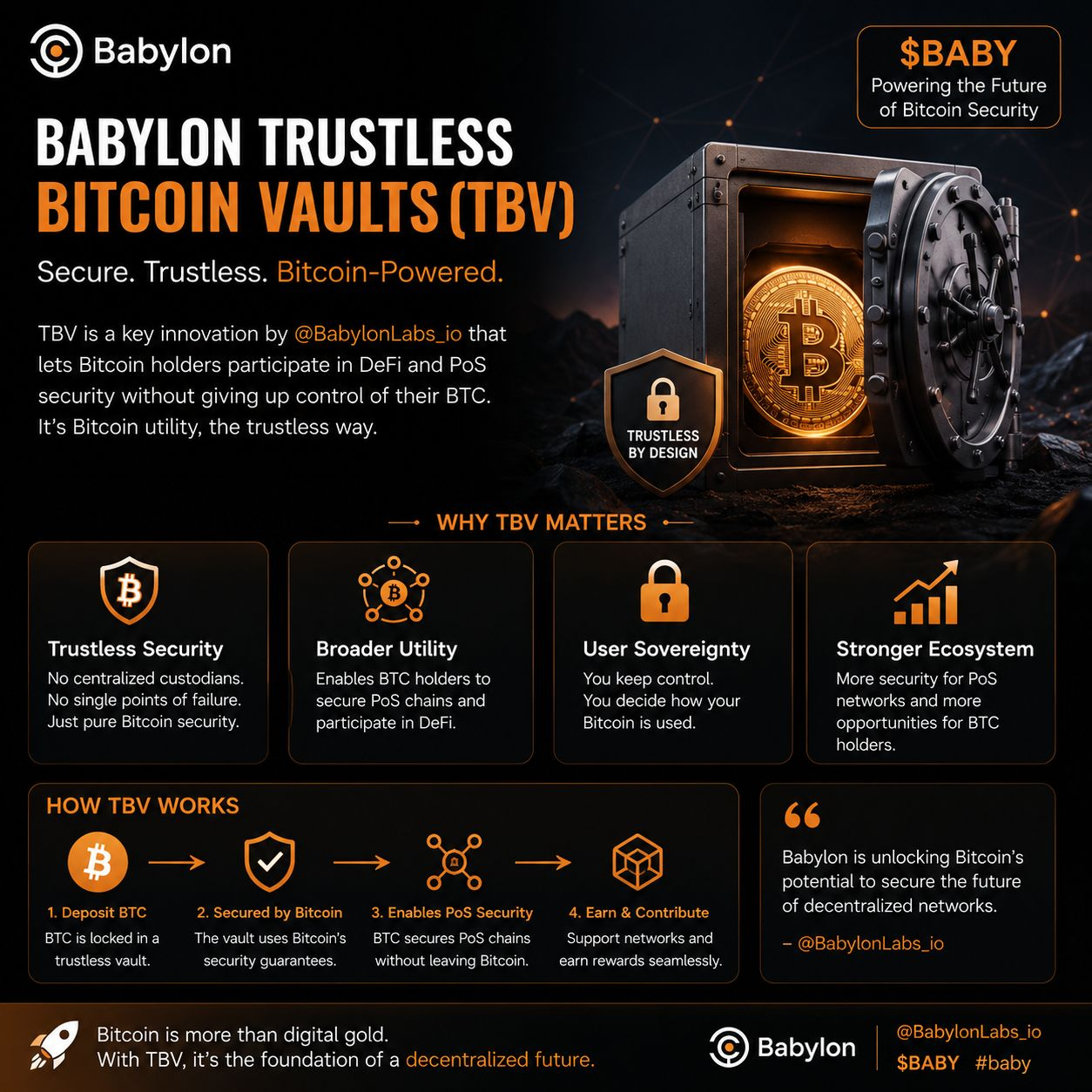
I have been exploring the concept behind Babylon Trustless Bitcoin Vaults (TBV), and it's one of the more interesting approaches to Bitcoin security and utility. Instead of depending on centralized custody,TBV is designed to let Bitcoin remain protected while enabling broader participation in decentralized finance through trust-minimized mechanisms.
If this model continues to mature, it could unlock new opportunities for long-term BTC holders who value both security and flexibility. Excited to follow the progress from @BabylonLabs_io and the growing $BABY ecosystem. #baby
If this model continues to mature, it could unlock new opportunities for long-term BTC holders who value both security and flexibility. Excited to follow the progress from @BabylonLabs_io and the growing $BABY ecosystem. #baby
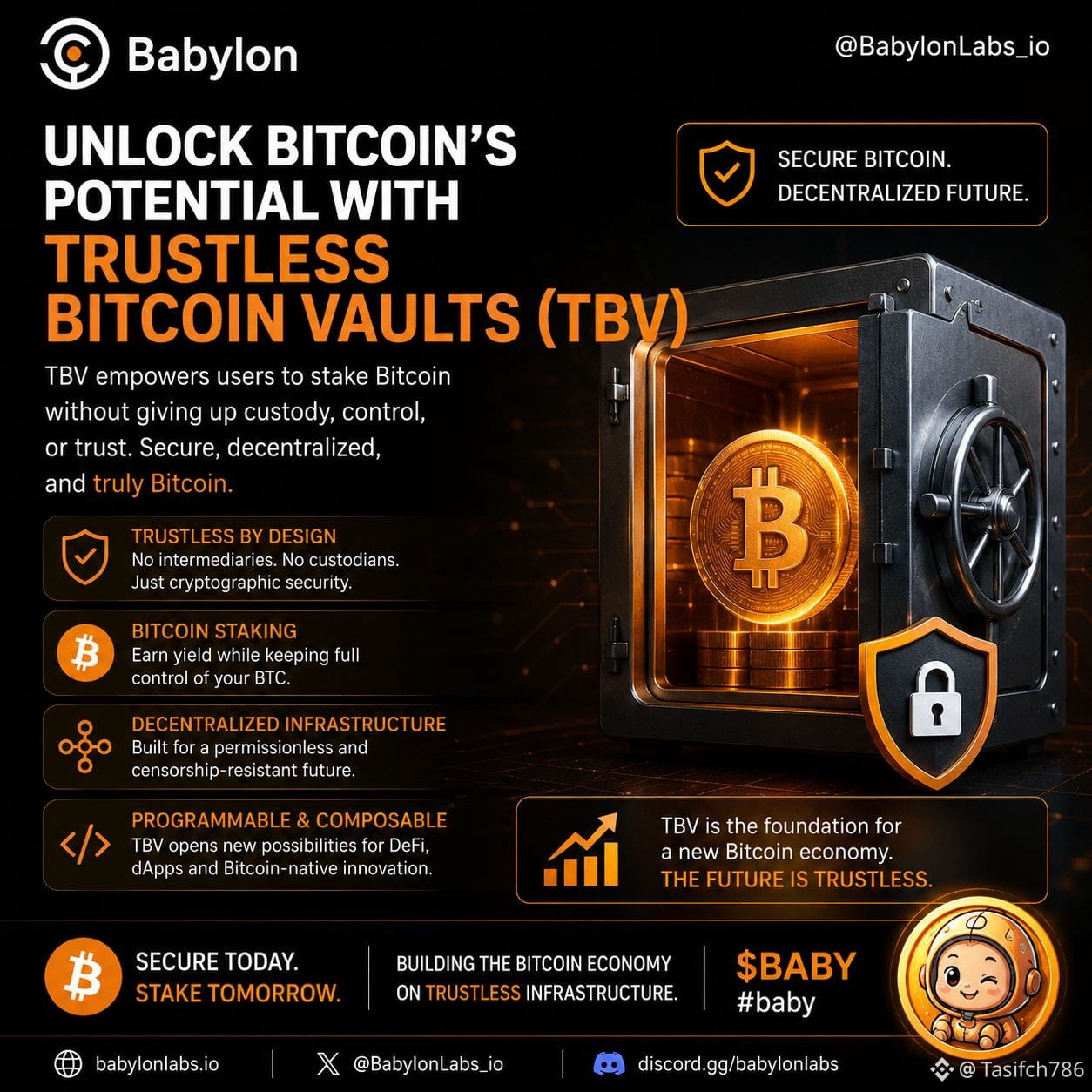
Bitcoin security is entering a new era with @BabylonLabs_io and its Trustless Bitcoin Vaults (TBV). By enabling programmable, self-custodied Bitcoin vaults without relying on trusted intermediaries, TBV strengthens security while preserving user control. This innovation expands Bitcoin’s utility for staking and decentralized finance without compromising its core principles. The future of Bitcoin infrastructure is being built with transparency, security, and trust minimization.#baby $BABY
Log in to explore more content