
B中心
243 Posts

B中心
Report
Block User
2 Following
107 Followers
437 Liked
Posts
All
Quotes
Videos
·
--
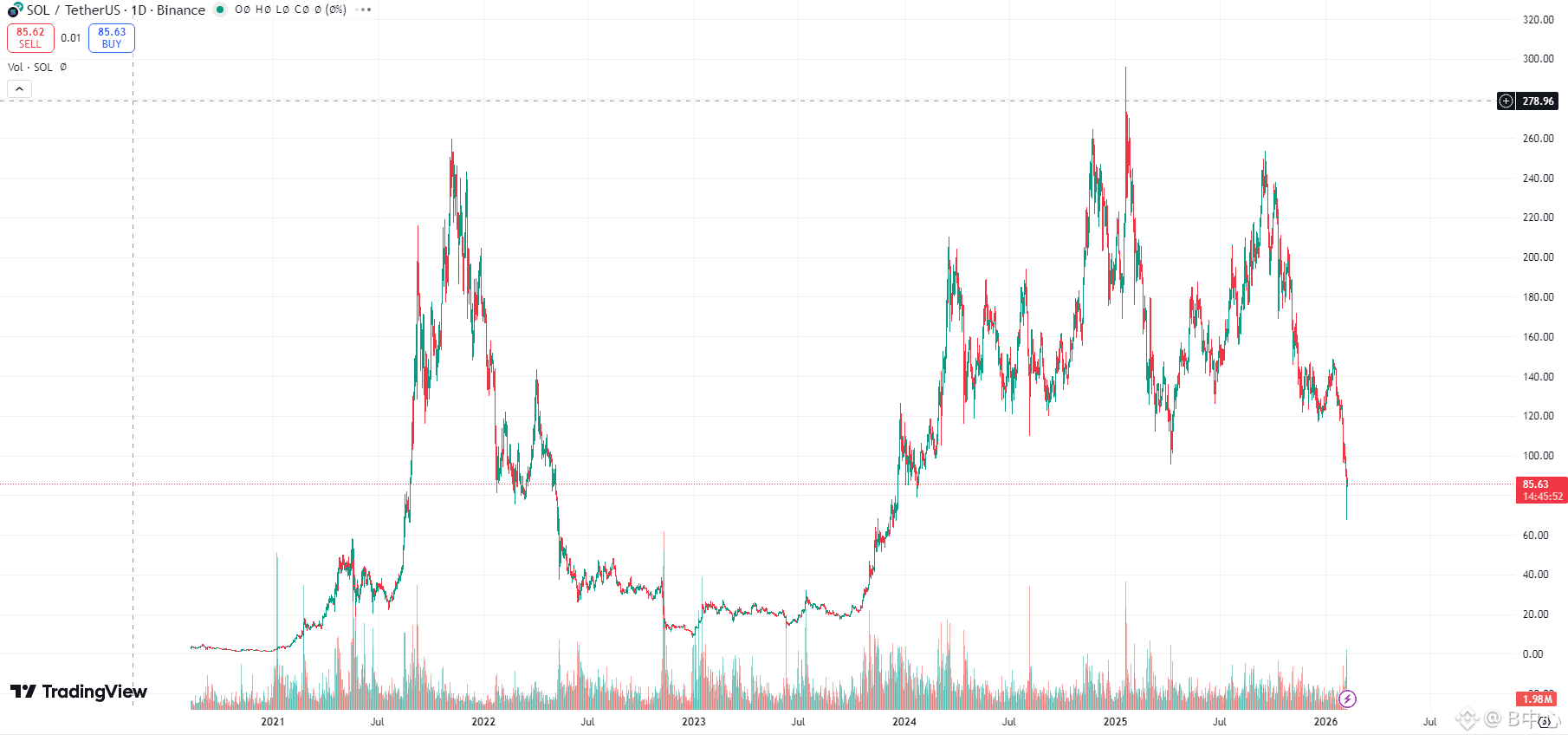
Solana (SOLUSDT | Daily Level) Technical Analysis | 2026.02.07
From the daily structure, SOL formed a clear historical high around $280 and has entered a typical pattern of wide fluctuations at high levels—shifting the center of gravity downward—followed by a breakout with increased volume. The current price has quickly retraced to around $85, which is precisely the key area of dense trading before the last bull market started, and also the dividing line for the long-term trend.
The rhythm of the current decline is significantly faster than the previous adjustment, representing an accelerated downward phase after the completion of high-level distribution. From the characteristics of the trend, it is not merely dragged down by the overall market, but rather SOL itself is undergoing deep repricing of its valuation and chip structure after a substantial prior increase. Previous rebounds have repeatedly stopped below the descending trend line, indicating a complete shift in dominance to the bears.
The current major issue is: the price has fallen below the $120 central platform and the rebound is without volume, which means the previous main upward trend has been confirmed to have ended, and the market has officially entered a medium-term—longer cycle adjustment.
Key level judgment:
$85–$80 range: Core support at the daily level. If it cannot stabilize and show a rebound with volume, the price is likely to test $70 / $60, corresponding to the starting range of the last complete bull market and the long-term cost zone.
$110–$120: First resistance zone. Only by regaining this range and consolidating can the downward trend be alleviated.
Above $150: The dividing line for medium-term bullish and bearish trends. Below this level, all rebounds should be viewed as corrective movements in the downward process.
Rhythm judgment:
It is more likely to follow the path of "sharp decline + long-term horizontal digestion," completing the reconstruction of chips through time instead of a quick V-shaped reversal.
Summary in one sentence:
SOL has entered the deep waters of medium-term adjustment, with $85 being the critical defense line. Until it returns to $120, the overall strategy should remain focused on defense and position control.
Solana (SOLUSDT | Daily Level) Technical Analysis | 2026.02.07
From the daily structure, SOL formed a clear historical high around $280 and has entered a typical pattern of wide fluctuations at high levels—shifting the center of gravity downward—followed by a breakout with increased volume. The current price has quickly retraced to around $85, which is precisely the key area of dense trading before the last bull market started, and also the dividing line for the long-term trend.
The rhythm of the current decline is significantly faster than the previous adjustment, representing an accelerated downward phase after the completion of high-level distribution. From the characteristics of the trend, it is not merely dragged down by the overall market, but rather SOL itself is undergoing deep repricing of its valuation and chip structure after a substantial prior increase. Previous rebounds have repeatedly stopped below the descending trend line, indicating a complete shift in dominance to the bears.
The current major issue is: the price has fallen below the $120 central platform and the rebound is without volume, which means the previous main upward trend has been confirmed to have ended, and the market has officially entered a medium-term—longer cycle adjustment.
Key level judgment:
$85–$80 range: Core support at the daily level. If it cannot stabilize and show a rebound with volume, the price is likely to test $70 / $60, corresponding to the starting range of the last complete bull market and the long-term cost zone.
$110–$120: First resistance zone. Only by regaining this range and consolidating can the downward trend be alleviated.
Above $150: The dividing line for medium-term bullish and bearish trends. Below this level, all rebounds should be viewed as corrective movements in the downward process.
Rhythm judgment:
It is more likely to follow the path of "sharp decline + long-term horizontal digestion," completing the reconstruction of chips through time instead of a quick V-shaped reversal.
Summary in one sentence:
SOL has entered the deep waters of medium-term adjustment, with $85 being the critical defense line. Until it returns to $120, the overall strategy should remain focused on defense and position control.
From the daily structure, SOL formed a clear historical high around $280 and has entered a typical pattern of wide fluctuations at high levels—shifting the center of gravity downward—followed by a breakout with increased volume. The current price has quickly retraced to around $85, which is precisely the key area of dense trading before the last bull market started, and also the dividing line for the long-term trend.
The rhythm of the current decline is significantly faster than the previous adjustment, representing an accelerated downward phase after the completion of high-level distribution. From the characteristics of the trend, it is not merely dragged down by the overall market, but rather SOL itself is undergoing deep repricing of its valuation and chip structure after a substantial prior increase. Previous rebounds have repeatedly stopped below the descending trend line, indicating a complete shift in dominance to the bears.
The current major issue is: the price has fallen below the $120 central platform and the rebound is without volume, which means the previous main upward trend has been confirmed to have ended, and the market has officially entered a medium-term—longer cycle adjustment.
Key level judgment:
$85–$80 range: Core support at the daily level. If it cannot stabilize and show a rebound with volume, the price is likely to test $70 / $60, corresponding to the starting range of the last complete bull market and the long-term cost zone.
$110–$120: First resistance zone. Only by regaining this range and consolidating can the downward trend be alleviated.
Above $150: The dividing line for medium-term bullish and bearish trends. Below this level, all rebounds should be viewed as corrective movements in the downward process.
Rhythm judgment:
It is more likely to follow the path of "sharp decline + long-term horizontal digestion," completing the reconstruction of chips through time instead of a quick V-shaped reversal.
Summary in one sentence:
SOL has entered the deep waters of medium-term adjustment, with $85 being the critical defense line. Until it returns to $120, the overall strategy should remain focused on defense and position control.
1
595
·
--
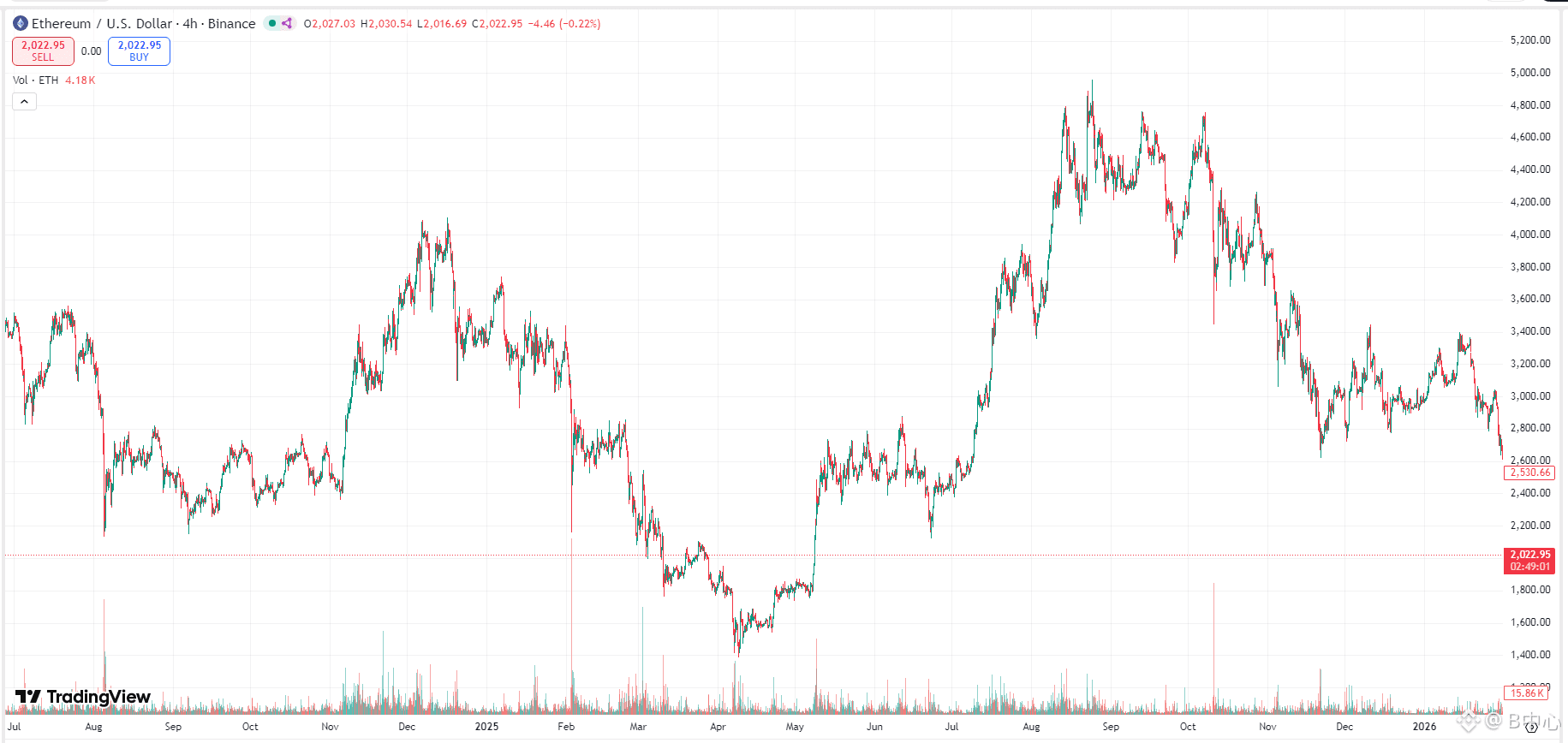
Ethereum (ETHUSDT|4-hour level) Technical Analysis|2026.02.07
From the 4-hour structure, ETH has formed a clear mid-term top in the $4,800–$5,000 range, and the price is running along a downward channel, showing typical bearish trend characteristics of lower highs, weak rebounds, and breaking down immediately. Recently, it accelerated downward from the $3,300 line to around $2,000, which belongs to an extension phase in the trend, rather than a panic sell-off at the end.
The current price is operating near the psychological level of $2,000, which is also the lower edge of the previous round of oscillation, possessing technical speculative value in the short term. However, it is important to emphasize that this position leans more towards emotional support and structural pullback, rather than a confirmed trend bottom. As long as the rebound cannot reclaim key resistance, the bearish structure still prevails.
Structurally, the current downward rhythm is clear and orderly, with rebounds mainly for repair, indicating that capital is still primarily retreating in a trend-oriented manner, rather than a concentrated panic. The biggest hidden danger now is: the height of the rebound is continuously limited, ETH is obviously weaker than BTC, and there is insufficient willingness to absorb capital.
Key level judgments:
$2,000–$1,950: 4H level first support zone, core of short-term long-short game
$1,850–$1,800: If $2,000 breaks down with volume, the market will likely extend to this range
$2,300–$2,350: First rebound resistance, corresponding to breaking the previous platform
$2,500–$2,600: Mid-term structural strong resistance area, must regain stability to have the possibility of trend repair
Rhythm-wise, it tends more towards oscillation after a decline, repeated turnover, then choosing a direction, rather than a rapid V rebound. Before BTC shows a clear strength, the sustainability of ETH's rebound needs to be treated with caution.
In summary:
ETH is still in a 4-hour level bearish trend, $2,000 is a speculative position rather than a bottom, and before reclaiming $2,500, all rebounds should be viewed as repairs to the market, with an overall strategy focusing on defense.
Ethereum (ETHUSDT|4-hour level) Technical Analysis|2026.02.07
From the 4-hour structure, ETH has formed a clear mid-term top in the $4,800–$5,000 range, and the price is running along a downward channel, showing typical bearish trend characteristics of lower highs, weak rebounds, and breaking down immediately. Recently, it accelerated downward from the $3,300 line to around $2,000, which belongs to an extension phase in the trend, rather than a panic sell-off at the end.
The current price is operating near the psychological level of $2,000, which is also the lower edge of the previous round of oscillation, possessing technical speculative value in the short term. However, it is important to emphasize that this position leans more towards emotional support and structural pullback, rather than a confirmed trend bottom. As long as the rebound cannot reclaim key resistance, the bearish structure still prevails.
Structurally, the current downward rhythm is clear and orderly, with rebounds mainly for repair, indicating that capital is still primarily retreating in a trend-oriented manner, rather than a concentrated panic. The biggest hidden danger now is: the height of the rebound is continuously limited, ETH is obviously weaker than BTC, and there is insufficient willingness to absorb capital.
Key level judgments:
$2,000–$1,950: 4H level first support zone, core of short-term long-short game
$1,850–$1,800: If $2,000 breaks down with volume, the market will likely extend to this range
$2,300–$2,350: First rebound resistance, corresponding to breaking the previous platform
$2,500–$2,600: Mid-term structural strong resistance area, must regain stability to have the possibility of trend repair
Rhythm-wise, it tends more towards oscillation after a decline, repeated turnover, then choosing a direction, rather than a rapid V rebound. Before BTC shows a clear strength, the sustainability of ETH's rebound needs to be treated with caution.
In summary:
ETH is still in a 4-hour level bearish trend, $2,000 is a speculative position rather than a bottom, and before reclaiming $2,500, all rebounds should be viewed as repairs to the market, with an overall strategy focusing on defense.
From the 4-hour structure, ETH has formed a clear mid-term top in the $4,800–$5,000 range, and the price is running along a downward channel, showing typical bearish trend characteristics of lower highs, weak rebounds, and breaking down immediately. Recently, it accelerated downward from the $3,300 line to around $2,000, which belongs to an extension phase in the trend, rather than a panic sell-off at the end.
The current price is operating near the psychological level of $2,000, which is also the lower edge of the previous round of oscillation, possessing technical speculative value in the short term. However, it is important to emphasize that this position leans more towards emotional support and structural pullback, rather than a confirmed trend bottom. As long as the rebound cannot reclaim key resistance, the bearish structure still prevails.
Structurally, the current downward rhythm is clear and orderly, with rebounds mainly for repair, indicating that capital is still primarily retreating in a trend-oriented manner, rather than a concentrated panic. The biggest hidden danger now is: the height of the rebound is continuously limited, ETH is obviously weaker than BTC, and there is insufficient willingness to absorb capital.
Key level judgments:
$2,000–$1,950: 4H level first support zone, core of short-term long-short game
$1,850–$1,800: If $2,000 breaks down with volume, the market will likely extend to this range
$2,300–$2,350: First rebound resistance, corresponding to breaking the previous platform
$2,500–$2,600: Mid-term structural strong resistance area, must regain stability to have the possibility of trend repair
Rhythm-wise, it tends more towards oscillation after a decline, repeated turnover, then choosing a direction, rather than a rapid V rebound. Before BTC shows a clear strength, the sustainability of ETH's rebound needs to be treated with caution.
In summary:
ETH is still in a 4-hour level bearish trend, $2,000 is a speculative position rather than a bottom, and before reclaiming $2,500, all rebounds should be viewed as repairs to the market, with an overall strategy focusing on defense.
1
290
·
--
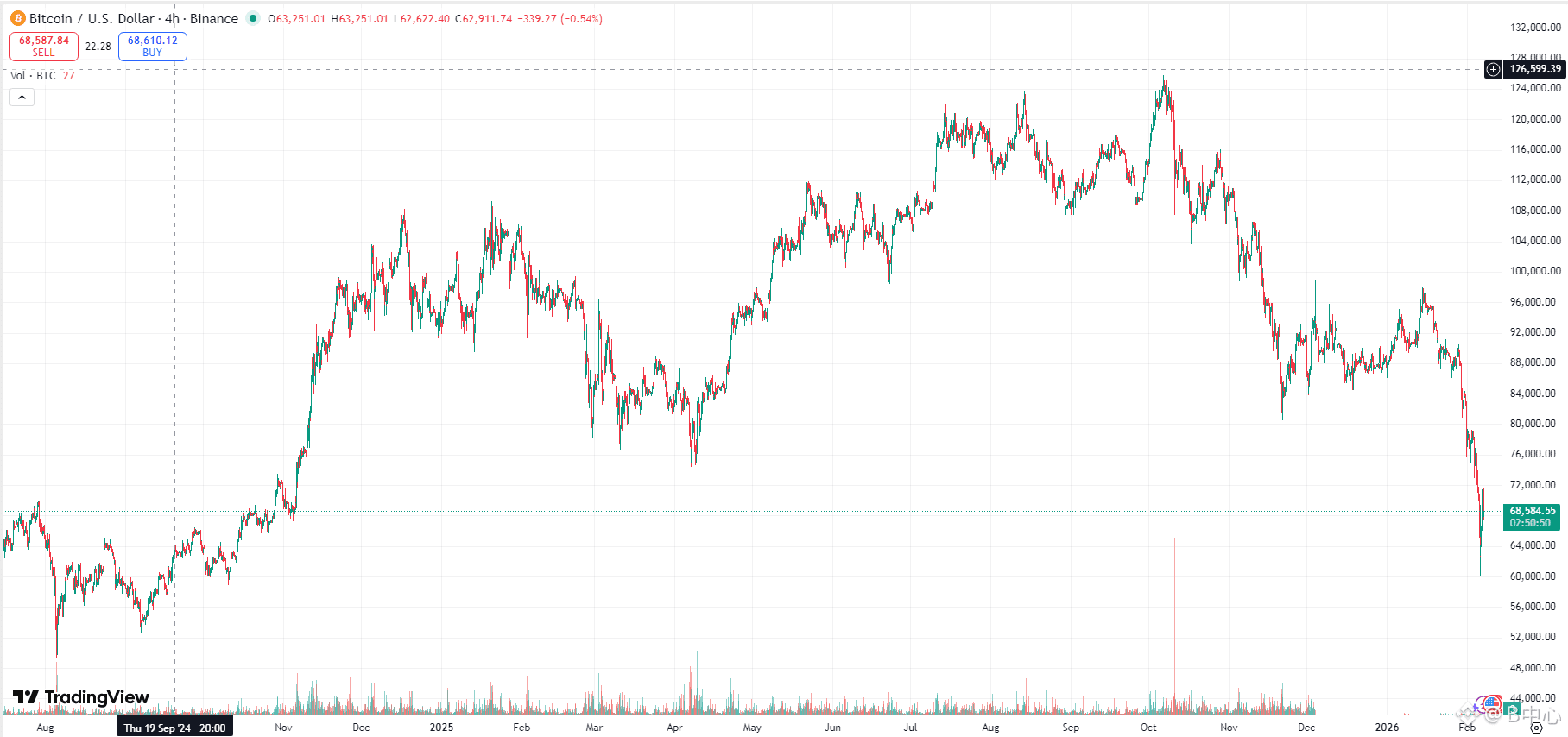
Bitcoin (BTCUSDT|4-hour level) Technical Analysis|2026.02.07
4-hour structure judgment:
From the 4H structure, BTC completed a medium-term top at the 126,000 USD level, and the price has shown a stair-step decline characteristic: rebound heights are decreasing step by step, and lows are continuously moving down, which is a typical bearish structure. Currently, this round of decline has evolved from a "trend pullback" to an acceleration phase, with a very clear bearish dominance.
The latest drop directly broke through the 72,000–70,000 USD range and showed a quick spike to around 63,000, indicating that passive stop-losses and strong liquidations in that area were triggered, representing an emotional release after a structural breakdown. However, it is important to note that the current situation does not signify the end of the trend, but rather the entry into the "post-breakout game phase."
Significance of the current price position:
68,000–70,000 was originally the core support at the daily level, but it has been confirmed as lost at the 4H level, and this area has officially transformed from "support" to the first resistance zone. As long as the price cannot quickly recover and stabilize within this range, the downward trend is still not over.
The nature of the current rebound is more inclined towards a technical repair after a decline, rather than a trend reversal.
Key level judgment:
63,000–60,000 USD: The first support area at the 4-hour level, also the area for the emotional release's long-short game. If this range stabilizes, it is expected to unfold into a consolidation repair; if it breaks down with volume, the market will enter a deeper round of trend pullback.
70,000–72,000 USD: The currently most critical resistance area; only by returning and consolidating back in this zone can the bearish trend pressure be alleviated, otherwise, all rebounds will be viewed as bullish traps or repairs.
76,000–78,000 USD: A strong pressure zone under the bearish trend, corresponding to the starting point of the previous round of accelerated decline, which hardly has the conditions for a single breakthrough.
Rhythm deduction:
At the 4-hour level, it is more likely to see:
"Sharp drop → Weak rebound → Further probing / consolidation" rhythm, rather than a continuous strong reversal. Even if a rebound occurs, it is likely to be primarily a consolidation exhaustion, giving the market time to digest high-level chips and leverage risks.
In summary:
The 4-hour structure has clearly turned bearish, and below 70,000 belongs to the bearish advantage area. Until it re-establishes above 72,000, the rebound can only be treated as a repair, with the trend still leaning towards downward.
Bitcoin (BTCUSDT|4-hour level) Technical Analysis|2026.02.07
4-hour structure judgment:
From the 4H structure, BTC completed a medium-term top at the 126,000 USD level, and the price has shown a stair-step decline characteristic: rebound heights are decreasing step by step, and lows are continuously moving down, which is a typical bearish structure. Currently, this round of decline has evolved from a "trend pullback" to an acceleration phase, with a very clear bearish dominance.
The latest drop directly broke through the 72,000–70,000 USD range and showed a quick spike to around 63,000, indicating that passive stop-losses and strong liquidations in that area were triggered, representing an emotional release after a structural breakdown. However, it is important to note that the current situation does not signify the end of the trend, but rather the entry into the "post-breakout game phase."
Significance of the current price position:
68,000–70,000 was originally the core support at the daily level, but it has been confirmed as lost at the 4H level, and this area has officially transformed from "support" to the first resistance zone. As long as the price cannot quickly recover and stabilize within this range, the downward trend is still not over.
The nature of the current rebound is more inclined towards a technical repair after a decline, rather than a trend reversal.
Key level judgment:
63,000–60,000 USD: The first support area at the 4-hour level, also the area for the emotional release's long-short game. If this range stabilizes, it is expected to unfold into a consolidation repair; if it breaks down with volume, the market will enter a deeper round of trend pullback.
70,000–72,000 USD: The currently most critical resistance area; only by returning and consolidating back in this zone can the bearish trend pressure be alleviated, otherwise, all rebounds will be viewed as bullish traps or repairs.
76,000–78,000 USD: A strong pressure zone under the bearish trend, corresponding to the starting point of the previous round of accelerated decline, which hardly has the conditions for a single breakthrough.
Rhythm deduction:
At the 4-hour level, it is more likely to see:
"Sharp drop → Weak rebound → Further probing / consolidation" rhythm, rather than a continuous strong reversal. Even if a rebound occurs, it is likely to be primarily a consolidation exhaustion, giving the market time to digest high-level chips and leverage risks.
In summary:
The 4-hour structure has clearly turned bearish, and below 70,000 belongs to the bearish advantage area. Until it re-establishes above 72,000, the rebound can only be treated as a repair, with the trend still leaning towards downward.
4-hour structure judgment:
From the 4H structure, BTC completed a medium-term top at the 126,000 USD level, and the price has shown a stair-step decline characteristic: rebound heights are decreasing step by step, and lows are continuously moving down, which is a typical bearish structure. Currently, this round of decline has evolved from a "trend pullback" to an acceleration phase, with a very clear bearish dominance.
The latest drop directly broke through the 72,000–70,000 USD range and showed a quick spike to around 63,000, indicating that passive stop-losses and strong liquidations in that area were triggered, representing an emotional release after a structural breakdown. However, it is important to note that the current situation does not signify the end of the trend, but rather the entry into the "post-breakout game phase."
Significance of the current price position:
68,000–70,000 was originally the core support at the daily level, but it has been confirmed as lost at the 4H level, and this area has officially transformed from "support" to the first resistance zone. As long as the price cannot quickly recover and stabilize within this range, the downward trend is still not over.
The nature of the current rebound is more inclined towards a technical repair after a decline, rather than a trend reversal.
Key level judgment:
63,000–60,000 USD: The first support area at the 4-hour level, also the area for the emotional release's long-short game. If this range stabilizes, it is expected to unfold into a consolidation repair; if it breaks down with volume, the market will enter a deeper round of trend pullback.
70,000–72,000 USD: The currently most critical resistance area; only by returning and consolidating back in this zone can the bearish trend pressure be alleviated, otherwise, all rebounds will be viewed as bullish traps or repairs.
76,000–78,000 USD: A strong pressure zone under the bearish trend, corresponding to the starting point of the previous round of accelerated decline, which hardly has the conditions for a single breakthrough.
Rhythm deduction:
At the 4-hour level, it is more likely to see:
"Sharp drop → Weak rebound → Further probing / consolidation" rhythm, rather than a continuous strong reversal. Even if a rebound occurs, it is likely to be primarily a consolidation exhaustion, giving the market time to digest high-level chips and leverage risks.
In summary:
The 4-hour structure has clearly turned bearish, and below 70,000 belongs to the bearish advantage area. Until it re-establishes above 72,000, the rebound can only be treated as a repair, with the trend still leaning towards downward.
188
·
--
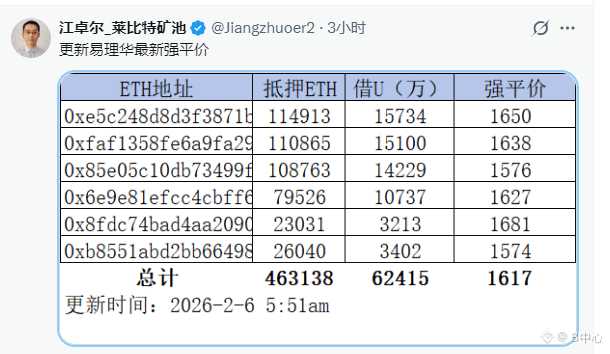
Easy Li Hua latest forced liquidation price $1617 $ETH
Easy Li Hua latest forced liquidation price $1617 $ETH
1
409
·
--
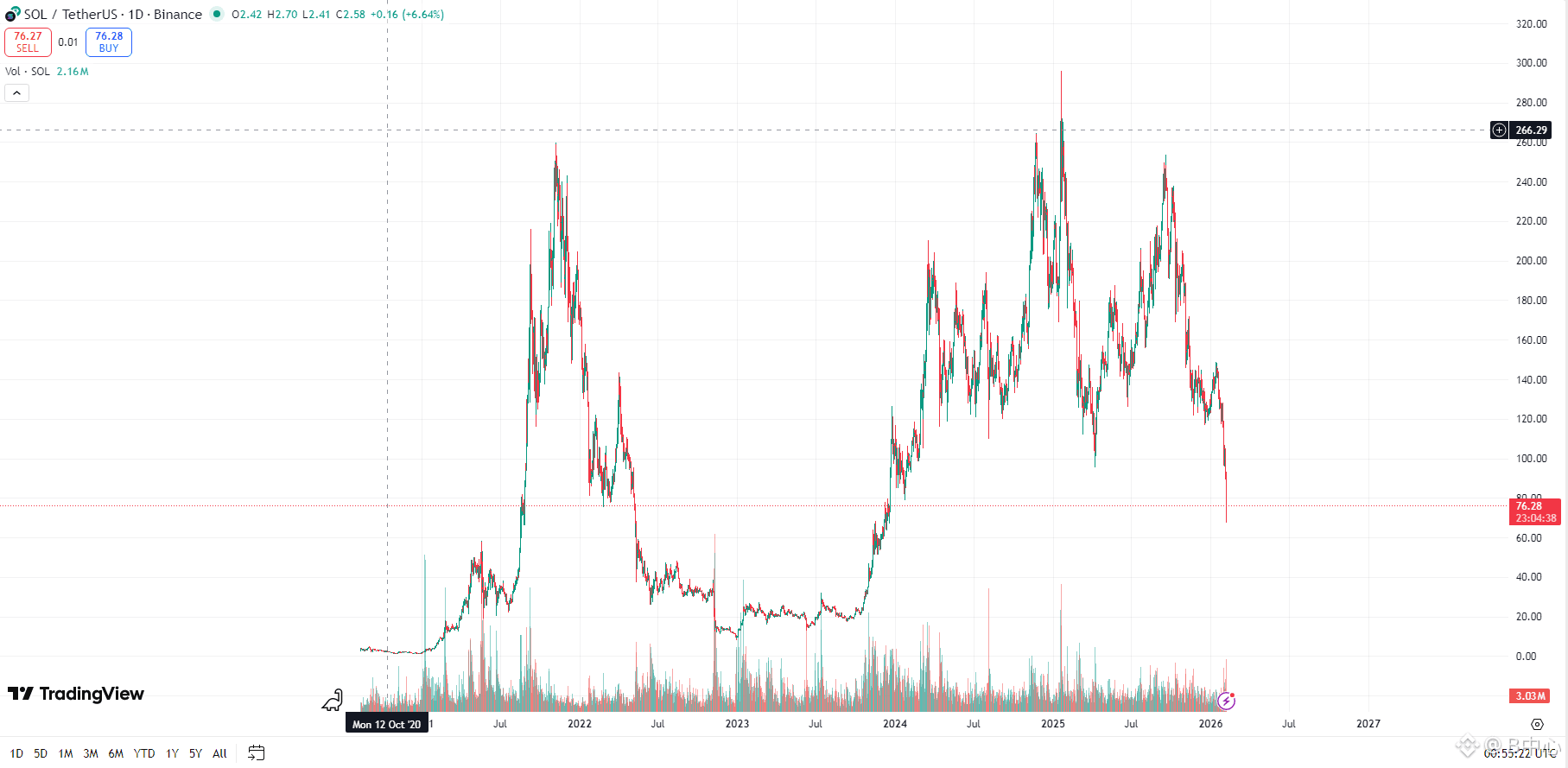
From a macro perspective, SOL has confirmed its entry into a deep retracement phase. The peak area in 2025 is between $260 and $300, and the current price has fallen back to around $80, essentially retracing more than 60% of the previous major upward wave, with the trend officially switching from 'high-level fluctuations' to the bottom-seeking phase of a downtrend.
Structurally:
Daily highs continue to decline, with lows being consistently breached, indicating a systematic failure of the bullish defense line.
The most recent long bearish candle with high volume broke through previous horizontal support (around $100–110), which is a signal of trend acceleration.
Key positions:
First support: $70–75 (current range, short-term speculation level)
Strong support zone: $55–60 (previous bull market starting zone + dense trading area)
Extreme defense: $40–45 (2023 platform area, bull-bear boundary)
Resistance level:
$90–95 (resistance after the breakdown)
$120 (medium-term resistance that cannot be surpassed before trend reversal)
Operational thoughts (considering your 40% position, average price 165):
It is not recommended to blindly add positions around $80.
If it bounces back to $90–100, consider reducing pressure or hedging.
The area truly worth adding positions for the medium to long term is around $60±5.
After breaking below $55, prepare psychologically and financially for the $40 range.
In summary:
SOL is currently still in the bottom-seeking phase of a downtrend. $80 is not a safe bottom; below $60 is the real value speculation zone in the medium term.
From a macro perspective, SOL has confirmed its entry into a deep retracement phase. The peak area in 2025 is between $260 and $300, and the current price has fallen back to around $80, essentially retracing more than 60% of the previous major upward wave, with the trend officially switching from 'high-level fluctuations' to the bottom-seeking phase of a downtrend.
Structurally:
Daily highs continue to decline, with lows being consistently breached, indicating a systematic failure of the bullish defense line.
The most recent long bearish candle with high volume broke through previous horizontal support (around $100–110), which is a signal of trend acceleration.
Key positions:
First support: $70–75 (current range, short-term speculation level)
Strong support zone: $55–60 (previous bull market starting zone + dense trading area)
Extreme defense: $40–45 (2023 platform area, bull-bear boundary)
Resistance level:
$90–95 (resistance after the breakdown)
$120 (medium-term resistance that cannot be surpassed before trend reversal)
Operational thoughts (considering your 40% position, average price 165):
It is not recommended to blindly add positions around $80.
If it bounces back to $90–100, consider reducing pressure or hedging.
The area truly worth adding positions for the medium to long term is around $60±5.
After breaking below $55, prepare psychologically and financially for the $40 range.
In summary:
SOL is currently still in the bottom-seeking phase of a downtrend. $80 is not a safe bottom; below $60 is the real value speculation zone in the medium term.
Structurally:
Daily highs continue to decline, with lows being consistently breached, indicating a systematic failure of the bullish defense line.
The most recent long bearish candle with high volume broke through previous horizontal support (around $100–110), which is a signal of trend acceleration.
Key positions:
First support: $70–75 (current range, short-term speculation level)
Strong support zone: $55–60 (previous bull market starting zone + dense trading area)
Extreme defense: $40–45 (2023 platform area, bull-bear boundary)
Resistance level:
$90–95 (resistance after the breakdown)
$120 (medium-term resistance that cannot be surpassed before trend reversal)
Operational thoughts (considering your 40% position, average price 165):
It is not recommended to blindly add positions around $80.
If it bounces back to $90–100, consider reducing pressure or hedging.
The area truly worth adding positions for the medium to long term is around $60±5.
After breaking below $55, prepare psychologically and financially for the $40 range.
In summary:
SOL is currently still in the bottom-seeking phase of a downtrend. $80 is not a safe bottom; below $60 is the real value speculation zone in the medium term.
516
·
--
Ethereum (ETHUSD|Daily) Technical Analysis|2026.02.06
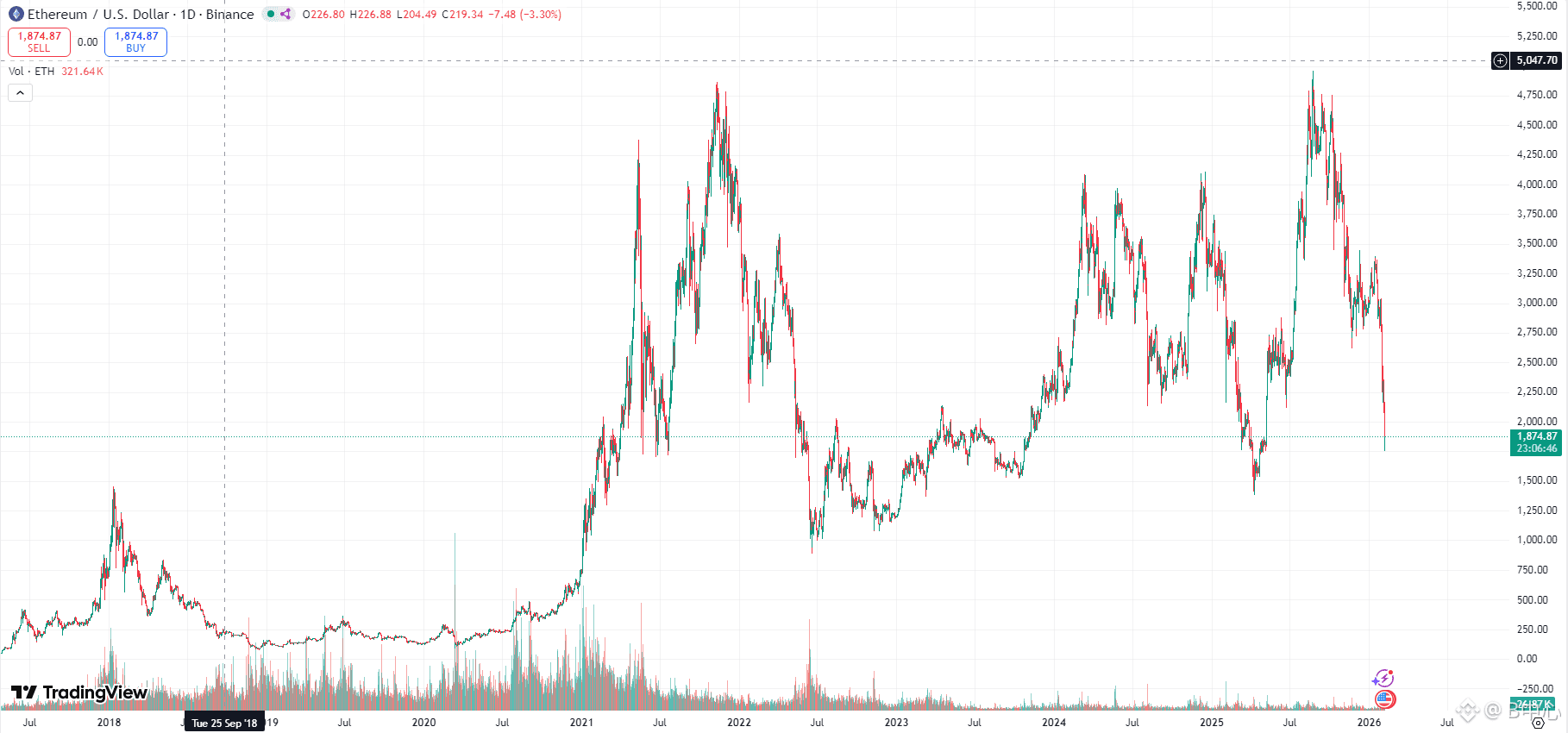
From the daily structure, ETH's current trend is weaker than BTC, with clear signals of a deteriorating trend. The price has currently retraced to around $1,870, which is a very critical position as it corresponds to the central region of oscillation that has repeatedly occurred over the past year, and is also the 'cost zone' for long-term bulls and bears.
First, looking at the structure:
After ETH peaked above $5,000 in 2025, it formed a typical head-and-shoulders pattern, with subsequent highs continuously declining (5000 → 4200 → 3500), and lows also moving downwards in sync, indicating that the daily line has entered a descending channel. Recently, this wave of decline has broken below the $2,000 integer level with increased volume, and the close did not quickly recover, indicating that it is not a simple washout, but rather that capital is actively retreating.
Key technical level assessment:
$2,000: Has turned from support to the first resistance level, with a high probability of encountering obstacles when rebounding to this level.
$1,850–$1,800: Current short-term support area, determining whether to enter an accelerated decline.
$1,500: Once $1,800 is breached, this is the core target for mid-term retracement.
$2,400–$2,600: Only if it stands back and consolidates, the trend could possibly repair.
In terms of rhythm, ETH's decline lags behind BTC, but the catch-up is more severe, which usually occurs when:
The market enters a mid to late-stage adjustment period, where capital prioritizes retreating from assets with higher β.
From an operational perspective, it is not suitable to emotionally bottom-fish here; a more reasonable strategy is:
Wait to see if there is 'stop decline + reduced volume + structural reconstruction' near $1,800; otherwise, it is better to remain in cash and wait.
In summary:
ETH has turned bearish after breaking below $2,000, with $1,800 being the lifeline for bulls. Before stabilizing, the focus should be on defense.
Ethereum (ETHUSD|Daily) Technical Analysis|2026.02.06
From the daily structure, ETH's current trend is weaker than BTC, with clear signals of a deteriorating trend. The price has currently retraced to around $1,870, which is a very critical position as it corresponds to the central region of oscillation that has repeatedly occurred over the past year, and is also the 'cost zone' for long-term bulls and bears.
First, looking at the structure:
After ETH peaked above $5,000 in 2025, it formed a typical head-and-shoulders pattern, with subsequent highs continuously declining (5000 → 4200 → 3500), and lows also moving downwards in sync, indicating that the daily line has entered a descending channel. Recently, this wave of decline has broken below the $2,000 integer level with increased volume, and the close did not quickly recover, indicating that it is not a simple washout, but rather that capital is actively retreating.
Key technical level assessment:
$2,000: Has turned from support to the first resistance level, with a high probability of encountering obstacles when rebounding to this level.
$1,850–$1,800: Current short-term support area, determining whether to enter an accelerated decline.
$1,500: Once $1,800 is breached, this is the core target for mid-term retracement.
$2,400–$2,600: Only if it stands back and consolidates, the trend could possibly repair.
In terms of rhythm, ETH's decline lags behind BTC, but the catch-up is more severe, which usually occurs when:
The market enters a mid to late-stage adjustment period, where capital prioritizes retreating from assets with higher β.
From an operational perspective, it is not suitable to emotionally bottom-fish here; a more reasonable strategy is:
Wait to see if there is 'stop decline + reduced volume + structural reconstruction' near $1,800; otherwise, it is better to remain in cash and wait.
In summary:
ETH has turned bearish after breaking below $2,000, with $1,800 being the lifeline for bulls. Before stabilizing, the focus should be on defense.
From the daily structure, ETH's current trend is weaker than BTC, with clear signals of a deteriorating trend. The price has currently retraced to around $1,870, which is a very critical position as it corresponds to the central region of oscillation that has repeatedly occurred over the past year, and is also the 'cost zone' for long-term bulls and bears.
First, looking at the structure:
After ETH peaked above $5,000 in 2025, it formed a typical head-and-shoulders pattern, with subsequent highs continuously declining (5000 → 4200 → 3500), and lows also moving downwards in sync, indicating that the daily line has entered a descending channel. Recently, this wave of decline has broken below the $2,000 integer level with increased volume, and the close did not quickly recover, indicating that it is not a simple washout, but rather that capital is actively retreating.
Key technical level assessment:
$2,000: Has turned from support to the first resistance level, with a high probability of encountering obstacles when rebounding to this level.
$1,850–$1,800: Current short-term support area, determining whether to enter an accelerated decline.
$1,500: Once $1,800 is breached, this is the core target for mid-term retracement.
$2,400–$2,600: Only if it stands back and consolidates, the trend could possibly repair.
In terms of rhythm, ETH's decline lags behind BTC, but the catch-up is more severe, which usually occurs when:
The market enters a mid to late-stage adjustment period, where capital prioritizes retreating from assets with higher β.
From an operational perspective, it is not suitable to emotionally bottom-fish here; a more reasonable strategy is:
Wait to see if there is 'stop decline + reduced volume + structural reconstruction' near $1,800; otherwise, it is better to remain in cash and wait.
In summary:
ETH has turned bearish after breaking below $2,000, with $1,800 being the lifeline for bulls. Before stabilizing, the focus should be on defense.
743
·
--
Bitcoin (BTCUSD | Daily) Technical Analysis | 2026.02.06
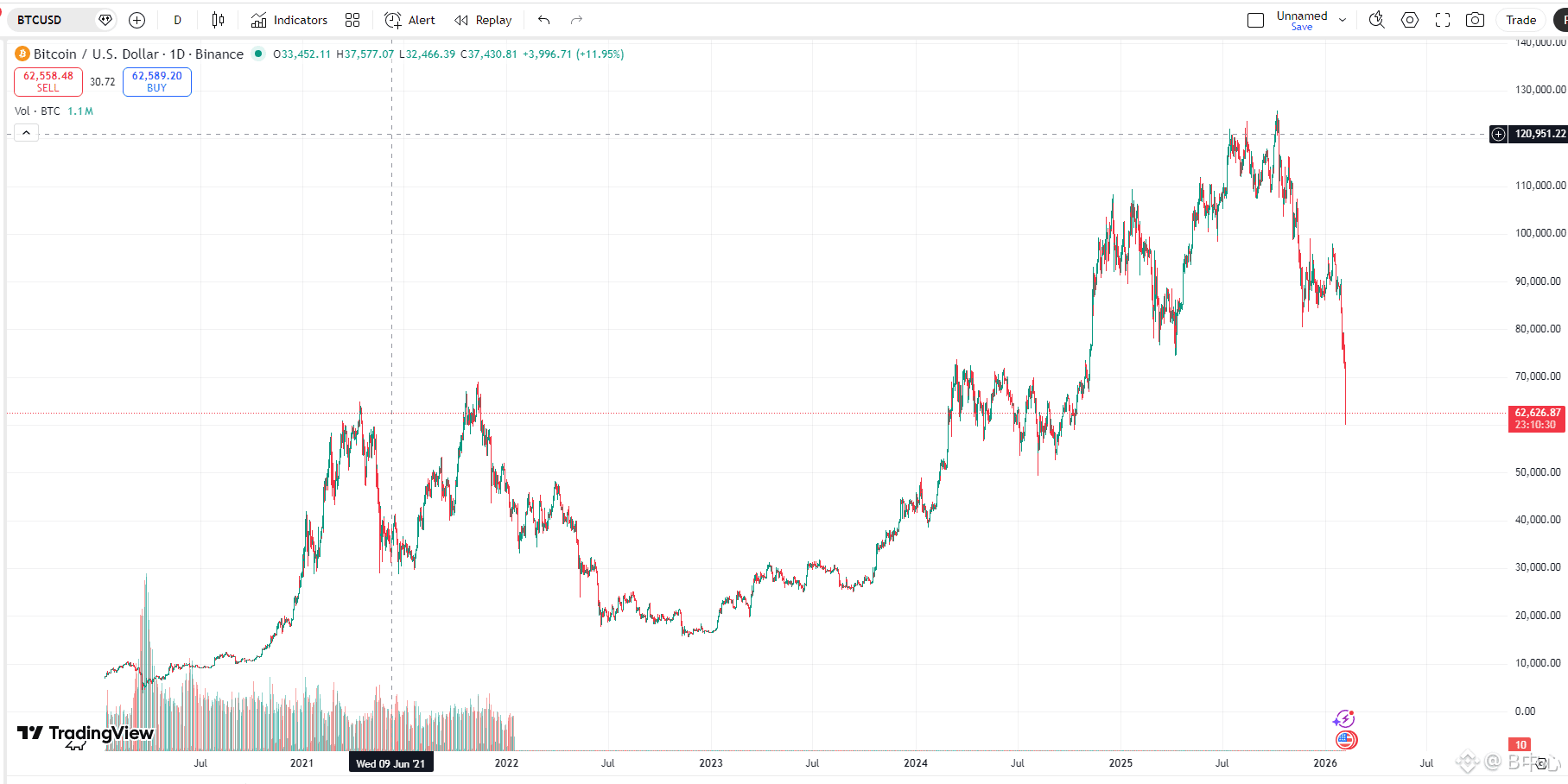
From this updated daily chart, BTC has shown a very critical signal change: the price has effectively broken below the support level of $65,000, dipping to around $62,600. This step means that the medium-term adjustment has upgraded from a 'high-level pullback' to a 'trend breakdown'.
Structurally, $65,000 was originally:
An important sideways area before the main upward wave starting in 2024
Also a 'continuation platform' in the previous round of increase
Now it has been directly pierced by a larger solid daily bearish candle, and the close could not pull back, which technically constitutes an effective break, not a false breakdown.
From a rhythm perspective, this is not an emotional one-shot kill, but rather more like:
High-level distribution completed → Trend turns bearish → The first phase of the main downward wave unfolds.
Next, even if a rebound occurs, it is more likely to be a technical pullback, rather than a new round of main upward movement.
Key points summary:
$65,000: has turned into the first resistance level, a rebound here is likely to face resistance again
$60,000: psychological barrier + previous structural support, a must-contend point between bulls and bears in the short term
$55,000–$52,000: once $60k is lost, medium-term pullback target range
Above $80,000: only by regaining and consolidating can we talk about trend restoration
In terms of operational thinking, it is more suitable to reduce positions and control risks, rather than aggressively trying to catch the bottom on the left side. What is truly worth paying attention to is whether $60,000 can hold and form a new daily structure.
In summary:
$65,000 has been broken, BTC enters the medium-term downward phase, $60,000 is the last defense line for bulls, and it is not advisable to act aggressively before it is reclaimed.
Bitcoin (BTCUSD | Daily) Technical Analysis | 2026.02.06
From this updated daily chart, BTC has shown a very critical signal change: the price has effectively broken below the support level of $65,000, dipping to around $62,600. This step means that the medium-term adjustment has upgraded from a 'high-level pullback' to a 'trend breakdown'.
Structurally, $65,000 was originally:
An important sideways area before the main upward wave starting in 2024
Also a 'continuation platform' in the previous round of increase
Now it has been directly pierced by a larger solid daily bearish candle, and the close could not pull back, which technically constitutes an effective break, not a false breakdown.
From a rhythm perspective, this is not an emotional one-shot kill, but rather more like:
High-level distribution completed → Trend turns bearish → The first phase of the main downward wave unfolds.
Next, even if a rebound occurs, it is more likely to be a technical pullback, rather than a new round of main upward movement.
Key points summary:
$65,000: has turned into the first resistance level, a rebound here is likely to face resistance again
$60,000: psychological barrier + previous structural support, a must-contend point between bulls and bears in the short term
$55,000–$52,000: once $60k is lost, medium-term pullback target range
Above $80,000: only by regaining and consolidating can we talk about trend restoration
In terms of operational thinking, it is more suitable to reduce positions and control risks, rather than aggressively trying to catch the bottom on the left side. What is truly worth paying attention to is whether $60,000 can hold and form a new daily structure.
In summary:
$65,000 has been broken, BTC enters the medium-term downward phase, $60,000 is the last defense line for bulls, and it is not advisable to act aggressively before it is reclaimed.
From this updated daily chart, BTC has shown a very critical signal change: the price has effectively broken below the support level of $65,000, dipping to around $62,600. This step means that the medium-term adjustment has upgraded from a 'high-level pullback' to a 'trend breakdown'.
Structurally, $65,000 was originally:
An important sideways area before the main upward wave starting in 2024
Also a 'continuation platform' in the previous round of increase
Now it has been directly pierced by a larger solid daily bearish candle, and the close could not pull back, which technically constitutes an effective break, not a false breakdown.
From a rhythm perspective, this is not an emotional one-shot kill, but rather more like:
High-level distribution completed → Trend turns bearish → The first phase of the main downward wave unfolds.
Next, even if a rebound occurs, it is more likely to be a technical pullback, rather than a new round of main upward movement.
Key points summary:
$65,000: has turned into the first resistance level, a rebound here is likely to face resistance again
$60,000: psychological barrier + previous structural support, a must-contend point between bulls and bears in the short term
$55,000–$52,000: once $60k is lost, medium-term pullback target range
Above $80,000: only by regaining and consolidating can we talk about trend restoration
In terms of operational thinking, it is more suitable to reduce positions and control risks, rather than aggressively trying to catch the bottom on the left side. What is truly worth paying attention to is whether $60,000 can hold and form a new daily structure.
In summary:
$65,000 has been broken, BTC enters the medium-term downward phase, $60,000 is the last defense line for bulls, and it is not advisable to act aggressively before it is reclaimed.
1
159
·
--
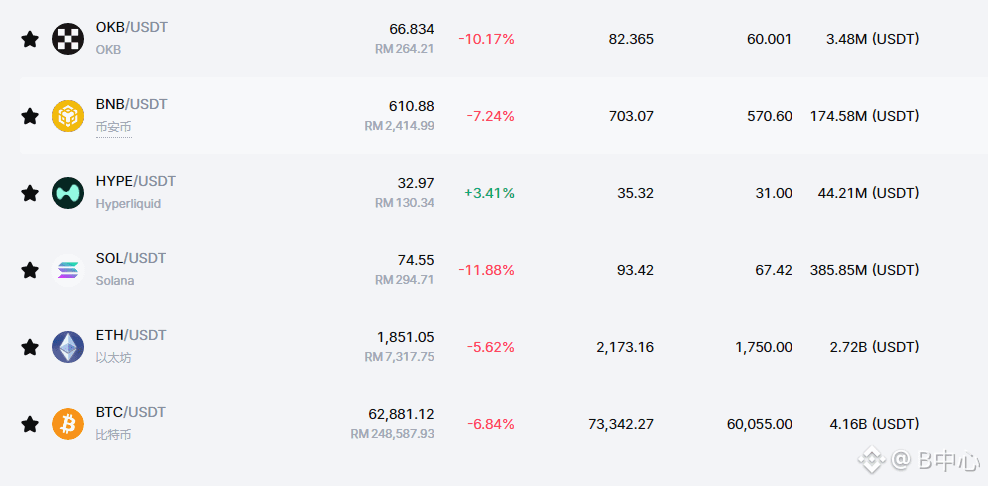
2026.02.06 Simple Record
$btc 62800 $ETH 1851 $SOL
{spot}(SOLUSDT)
2026.02.06 Simple Record
$btc 62800 $ETH 1851 $SOL
$btc 62800 $ETH 1851 $SOL
400
·
--
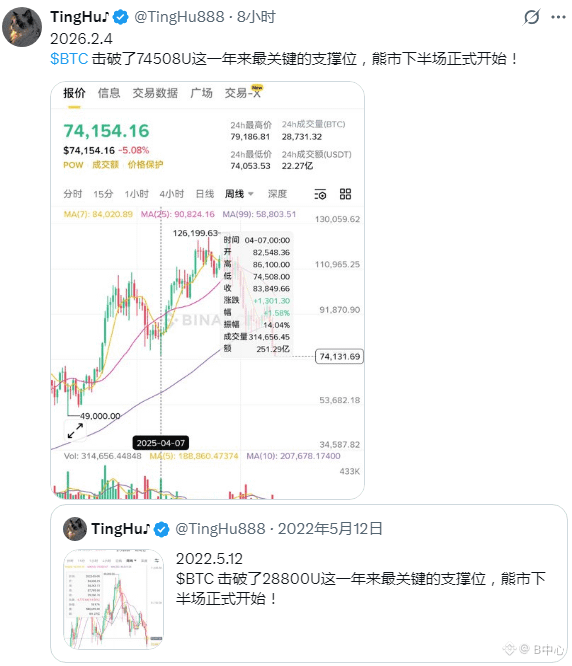
The reason this judgment has attracted attention is not because of the "breakout" itself, but because it precisely hit the most vulnerable psychological anchor point in the market. $74508, repeatedly emphasized as the "most critical support level of the year," once breached, the technical signals only indicate one thing: the trend switches from high-level fluctuations to a medium-term pullback. Historical reference to the scene in 2022 at $28800 is not alarmist — back then, it was also a "seemingly solid support," and once it broke, the bear market did not collapse immediately, but slowly drained the bulls.
What is truly worth being vigilant about is not the price drop, but the structural change. The current issue with BTC is not the fundamentals, but an overabundance of consensus: a long-term bullish outlook has become the default position, and pullbacks are habitually interpreted as "money being given away," resulting in a shift in positions and increased leverage. Once the key level is breached, the selling pressure does not come from panic selling, but rather from rational positions that "have to reduce their holdings" and passive liquidations.
More importantly, the second half of a bear market is often not characterized by a crash, but rather by time exchanging for space: rebounds give hope, while drops test patience, until most people stop discussing bull and bear markets, and only say, "forget it, I won't look anymore." This is the phase with the greatest destructive power.
In summary: a breach of support levels is not scary; what is scary is that the market is still using a bull market mindset to deal with a trend that has already transformed.
The reason this judgment has attracted attention is not because of the "breakout" itself, but because it precisely hit the most vulnerable psychological anchor point in the market. $74508, repeatedly emphasized as the "most critical support level of the year," once breached, the technical signals only indicate one thing: the trend switches from high-level fluctuations to a medium-term pullback. Historical reference to the scene in 2022 at $28800 is not alarmist — back then, it was also a "seemingly solid support," and once it broke, the bear market did not collapse immediately, but slowly drained the bulls.
What is truly worth being vigilant about is not the price drop, but the structural change. The current issue with BTC is not the fundamentals, but an overabundance of consensus: a long-term bullish outlook has become the default position, and pullbacks are habitually interpreted as "money being given away," resulting in a shift in positions and increased leverage. Once the key level is breached, the selling pressure does not come from panic selling, but rather from rational positions that "have to reduce their holdings" and passive liquidations.
More importantly, the second half of a bear market is often not characterized by a crash, but rather by time exchanging for space: rebounds give hope, while drops test patience, until most people stop discussing bull and bear markets, and only say, "forget it, I won't look anymore." This is the phase with the greatest destructive power.
In summary: a breach of support levels is not scary; what is scary is that the market is still using a bull market mindset to deal with a trend that has already transformed.
What is truly worth being vigilant about is not the price drop, but the structural change. The current issue with BTC is not the fundamentals, but an overabundance of consensus: a long-term bullish outlook has become the default position, and pullbacks are habitually interpreted as "money being given away," resulting in a shift in positions and increased leverage. Once the key level is breached, the selling pressure does not come from panic selling, but rather from rational positions that "have to reduce their holdings" and passive liquidations.
More importantly, the second half of a bear market is often not characterized by a crash, but rather by time exchanging for space: rebounds give hope, while drops test patience, until most people stop discussing bull and bear markets, and only say, "forget it, I won't look anymore." This is the phase with the greatest destructive power.
In summary: a breach of support levels is not scary; what is scary is that the market is still using a bull market mindset to deal with a trend that has already transformed.
178
·
--
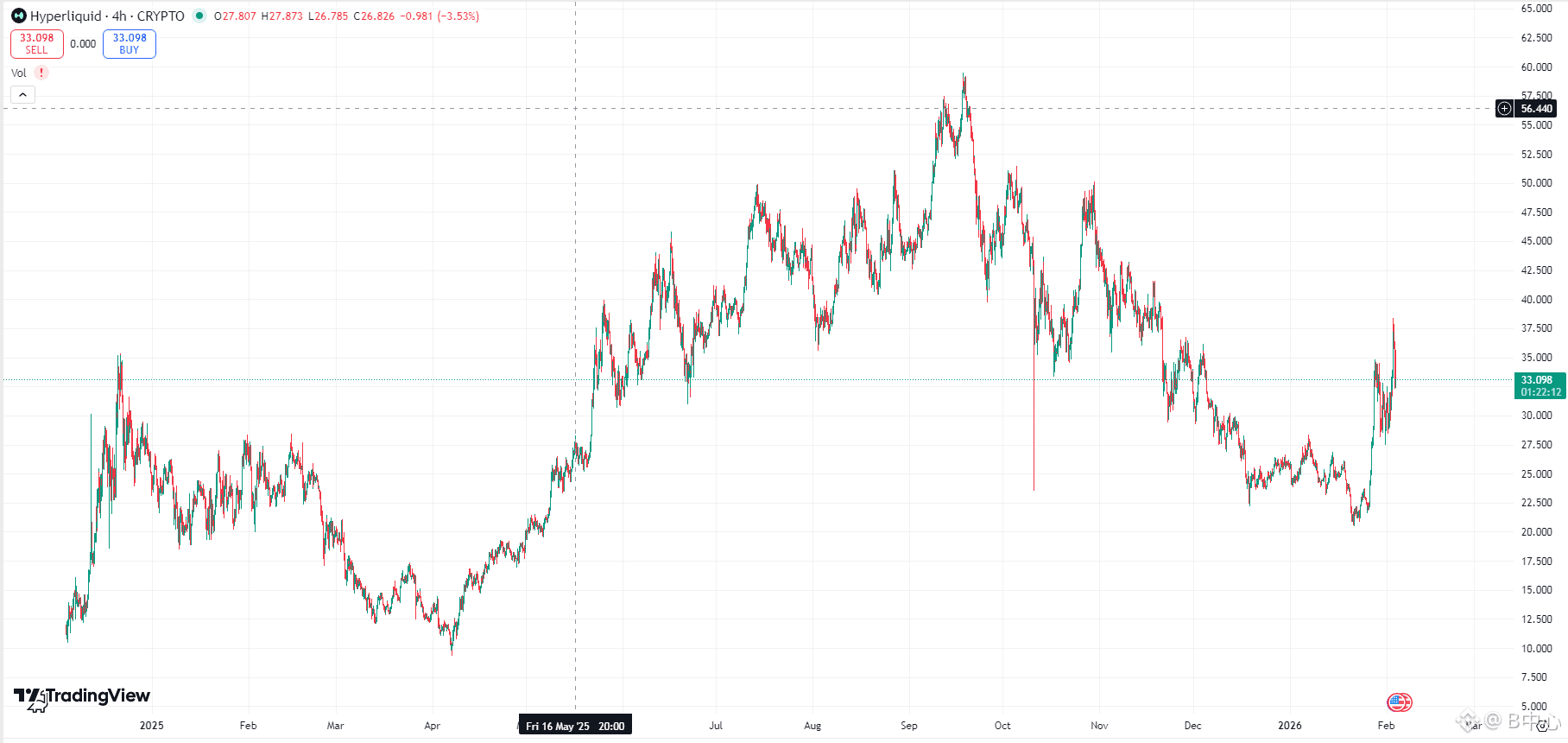
HYPE (Hyperliquid | 4H Level) Technical Analysis | 2026.02.04
From the 4-hour structure perspective, this round of HYPE belongs to a typical high-level trend reversal followed by a pullback. An obvious phase top was formed in the 56–58 USD range, followed by a continuous lower high + lower low downward structure, indicating a trend shift from bullish to bearish. The current price has rebounded to around 33 USD, which coincides with the overlapping resistance area of the previous consolidation platform and the midline of the downward channel, making the position unsafe.
Upon detailed examination of the structure, this 4H level rebound looks more like a technical pullback driven by short covering, rather than a trend reversal:
The rebound slope is relatively steep, but the trading volume has not significantly increased
The high has yet to break through the previous rebound high
The moving average system still shows a bearish arrangement (price is below the medium to long-term moving averages)
At key positions, 33–35 USD is a short-term bull-bear dividing line:
If it repeatedly faces resistance in this area, with a significant long upper shadow or consecutive bearish candles, the market is likely to weaken again.
The primary support below is at 30 USD; if it breaks down, it can easily retest the previous low area of 27 / 25 USD.
Only if it effectively holds above 36 USD and consolidates can there be a possibility of a structure change to "reversal rather than pullback."
Overall rhythm judgment: HYPE is still in the rebound phase within a medium-term downward trend, which is more suitable for a defensive mindset rather than chasing high-risk trades.
Key points:
Resistance levels: 35 / 38
Support levels: 30 / 27
In summary: HYPE is currently in a pullback after a decline; if it does not break 33–35, it remains bearish, and caution is needed if it falls back below 30 for a potential second bottom test.
HYPE (Hyperliquid | 4H Level) Technical Analysis | 2026.02.04
From the 4-hour structure perspective, this round of HYPE belongs to a typical high-level trend reversal followed by a pullback. An obvious phase top was formed in the 56–58 USD range, followed by a continuous lower high + lower low downward structure, indicating a trend shift from bullish to bearish. The current price has rebounded to around 33 USD, which coincides with the overlapping resistance area of the previous consolidation platform and the midline of the downward channel, making the position unsafe.
Upon detailed examination of the structure, this 4H level rebound looks more like a technical pullback driven by short covering, rather than a trend reversal:
The rebound slope is relatively steep, but the trading volume has not significantly increased
The high has yet to break through the previous rebound high
The moving average system still shows a bearish arrangement (price is below the medium to long-term moving averages)
At key positions, 33–35 USD is a short-term bull-bear dividing line:
If it repeatedly faces resistance in this area, with a significant long upper shadow or consecutive bearish candles, the market is likely to weaken again.
The primary support below is at 30 USD; if it breaks down, it can easily retest the previous low area of 27 / 25 USD.
Only if it effectively holds above 36 USD and consolidates can there be a possibility of a structure change to "reversal rather than pullback."
Overall rhythm judgment: HYPE is still in the rebound phase within a medium-term downward trend, which is more suitable for a defensive mindset rather than chasing high-risk trades.
Key points:
Resistance levels: 35 / 38
Support levels: 30 / 27
In summary: HYPE is currently in a pullback after a decline; if it does not break 33–35, it remains bearish, and caution is needed if it falls back below 30 for a potential second bottom test.
From the 4-hour structure perspective, this round of HYPE belongs to a typical high-level trend reversal followed by a pullback. An obvious phase top was formed in the 56–58 USD range, followed by a continuous lower high + lower low downward structure, indicating a trend shift from bullish to bearish. The current price has rebounded to around 33 USD, which coincides with the overlapping resistance area of the previous consolidation platform and the midline of the downward channel, making the position unsafe.
Upon detailed examination of the structure, this 4H level rebound looks more like a technical pullback driven by short covering, rather than a trend reversal:
The rebound slope is relatively steep, but the trading volume has not significantly increased
The high has yet to break through the previous rebound high
The moving average system still shows a bearish arrangement (price is below the medium to long-term moving averages)
At key positions, 33–35 USD is a short-term bull-bear dividing line:
If it repeatedly faces resistance in this area, with a significant long upper shadow or consecutive bearish candles, the market is likely to weaken again.
The primary support below is at 30 USD; if it breaks down, it can easily retest the previous low area of 27 / 25 USD.
Only if it effectively holds above 36 USD and consolidates can there be a possibility of a structure change to "reversal rather than pullback."
Overall rhythm judgment: HYPE is still in the rebound phase within a medium-term downward trend, which is more suitable for a defensive mindset rather than chasing high-risk trades.
Key points:
Resistance levels: 35 / 38
Support levels: 30 / 27
In summary: HYPE is currently in a pullback after a decline; if it does not break 33–35, it remains bearish, and caution is needed if it falls back below 30 for a potential second bottom test.
116
·
--
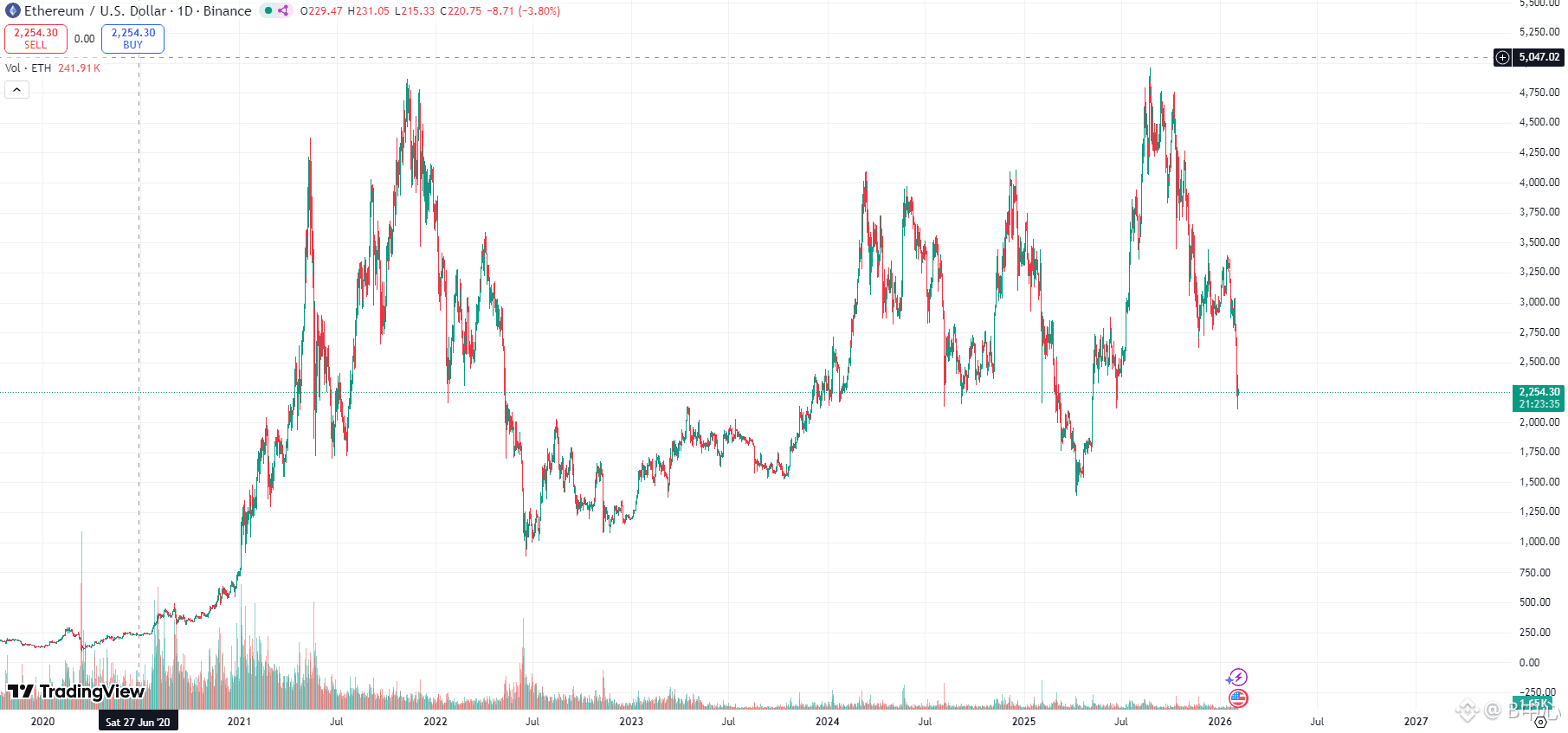
Ethereum (ETHUSDT | Daily Level) Technical Analysis | 2026.02.04
From the daily structure, ETH's current trend is significantly weaker than Bitcoin, which is a typical characteristic of a secondary asset with 'insufficient rebound and deeper retracement.' The previous high formed a clear top in the 4,800–5,000 USD range, and the subsequent decline has seen the height of rebounds gradually decrease. The current price has retreated to around 2,250 USD, sitting at the middle-lower edge of the medium-term downward channel.
From a key structural perspective, 2,400–2,500 USD was originally an important platform support but has been effectively broken, now converting to the first resistance zone. Operating below this range indicates that the market's risk appetite for ETH is clearly insufficient, and funds are primarily focused on reducing positions rather than bottom-fishing. The short-term support below is at 2,200 USD; if the daily line continues to break down with increased volume, it is likely to probe 1,900–2,000 USD, which is the central point of the previous round of fluctuations and also the last line of defense for the medium-term bulls.
In terms of rhythm, ETH is currently still in a phase of trend-based decline, without typical panic volume spikes or rapid recovery candlesticks, indicating that the decline is not yet fully over. It is more likely to complete the bottoming process through 'gradual decline + weak rebound.' Only by stabilizing above 2,600 USD and forming a series of increasing bullish candlesticks will there be a possibility of structural strengthening.
Key Levels:
Support Levels: 2,200 / 2,000
Resistance Levels: 2,500 / 2,600
Summary: Ethereum's medium-term structure is weak. If 2,200 is lost, it will continue to fall towards 2,000. No trend reversal is expected before returning to 2,600.
Ethereum (ETHUSDT | Daily Level) Technical Analysis | 2026.02.04
From the daily structure, ETH's current trend is significantly weaker than Bitcoin, which is a typical characteristic of a secondary asset with 'insufficient rebound and deeper retracement.' The previous high formed a clear top in the 4,800–5,000 USD range, and the subsequent decline has seen the height of rebounds gradually decrease. The current price has retreated to around 2,250 USD, sitting at the middle-lower edge of the medium-term downward channel.
From a key structural perspective, 2,400–2,500 USD was originally an important platform support but has been effectively broken, now converting to the first resistance zone. Operating below this range indicates that the market's risk appetite for ETH is clearly insufficient, and funds are primarily focused on reducing positions rather than bottom-fishing. The short-term support below is at 2,200 USD; if the daily line continues to break down with increased volume, it is likely to probe 1,900–2,000 USD, which is the central point of the previous round of fluctuations and also the last line of defense for the medium-term bulls.
In terms of rhythm, ETH is currently still in a phase of trend-based decline, without typical panic volume spikes or rapid recovery candlesticks, indicating that the decline is not yet fully over. It is more likely to complete the bottoming process through 'gradual decline + weak rebound.' Only by stabilizing above 2,600 USD and forming a series of increasing bullish candlesticks will there be a possibility of structural strengthening.
Key Levels:
Support Levels: 2,200 / 2,000
Resistance Levels: 2,500 / 2,600
Summary: Ethereum's medium-term structure is weak. If 2,200 is lost, it will continue to fall towards 2,000. No trend reversal is expected before returning to 2,600.
From the daily structure, ETH's current trend is significantly weaker than Bitcoin, which is a typical characteristic of a secondary asset with 'insufficient rebound and deeper retracement.' The previous high formed a clear top in the 4,800–5,000 USD range, and the subsequent decline has seen the height of rebounds gradually decrease. The current price has retreated to around 2,250 USD, sitting at the middle-lower edge of the medium-term downward channel.
From a key structural perspective, 2,400–2,500 USD was originally an important platform support but has been effectively broken, now converting to the first resistance zone. Operating below this range indicates that the market's risk appetite for ETH is clearly insufficient, and funds are primarily focused on reducing positions rather than bottom-fishing. The short-term support below is at 2,200 USD; if the daily line continues to break down with increased volume, it is likely to probe 1,900–2,000 USD, which is the central point of the previous round of fluctuations and also the last line of defense for the medium-term bulls.
In terms of rhythm, ETH is currently still in a phase of trend-based decline, without typical panic volume spikes or rapid recovery candlesticks, indicating that the decline is not yet fully over. It is more likely to complete the bottoming process through 'gradual decline + weak rebound.' Only by stabilizing above 2,600 USD and forming a series of increasing bullish candlesticks will there be a possibility of structural strengthening.
Key Levels:
Support Levels: 2,200 / 2,000
Resistance Levels: 2,500 / 2,600
Summary: Ethereum's medium-term structure is weak. If 2,200 is lost, it will continue to fall towards 2,000. No trend reversal is expected before returning to 2,600.
245
·
--
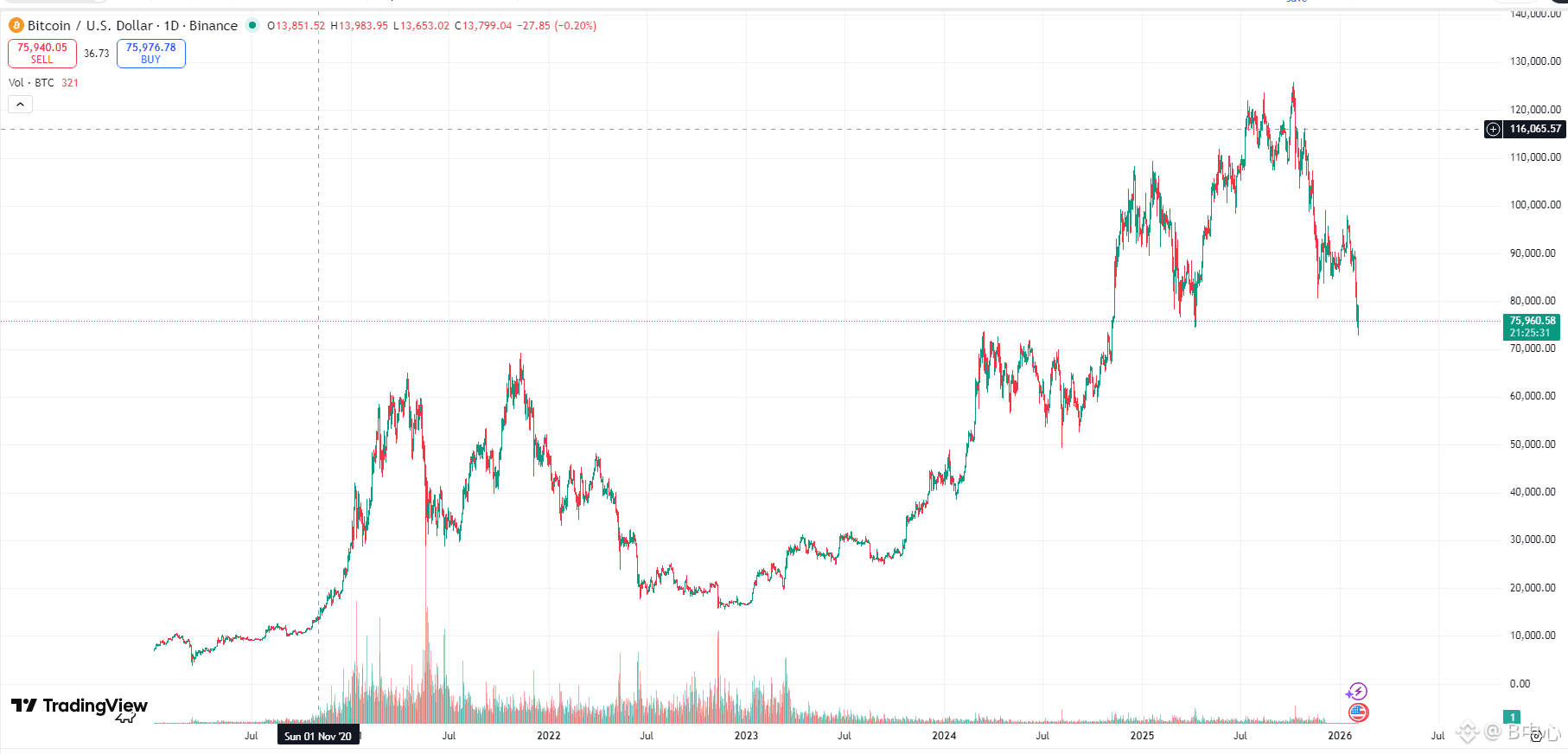
Bitcoin (BTCUSDT | Daily Level) Technical Analysis | 2026.02.04
From the daily chart you provided, Bitcoin has clearly entered a medium-term adjustment structure. Previously, a phase top was formed in the $115,000–$120,000 range, and after multiple failed attempts to rise, a significant drop occurred. The current price has retreated to around $76,000, representing a complete 'top-out—break down—accelerated decline' pattern.
In terms of structure, the $90,000–$95,000 range was originally a strong support area, but it was effectively broken below during a significant long bearish candle and has now turned into a rebound resistance zone. As long as the price operates below this area, the market is still treated as a rebound for shorting, rather than a trend reversal. Looking downwards, $75,000 is the short-term dividing line between bulls and bears, and is currently being tested; if the daily line cannot quickly recover, it is highly likely to further dip to $68,000–$70,000, which is a key platform from the last major upward wave and also a position that the medium-term bulls must defend.
In terms of rhythm, it is currently not the 'end of a crash', but rather a retracement phase after the distribution of high-level chips. In the future, it is more likely to oscillate downwards or move sideways widely to digest trapped positions, rather than a V-shaped reversal. Only by stabilizing above $95,000 again will the structure turn strong again.
Key levels:
Support: $75,000 / $70,000
Resistance: $90,000 / $95,000
In summary: Bitcoin is in a medium-term adjustment cycle; if $75,000 is lost, it will continue to probe lower, and no trend reversal is expected until it stands back above $95,000.
Bitcoin (BTCUSDT | Daily Level) Technical Analysis | 2026.02.04
From the daily chart you provided, Bitcoin has clearly entered a medium-term adjustment structure. Previously, a phase top was formed in the $115,000–$120,000 range, and after multiple failed attempts to rise, a significant drop occurred. The current price has retreated to around $76,000, representing a complete 'top-out—break down—accelerated decline' pattern.
In terms of structure, the $90,000–$95,000 range was originally a strong support area, but it was effectively broken below during a significant long bearish candle and has now turned into a rebound resistance zone. As long as the price operates below this area, the market is still treated as a rebound for shorting, rather than a trend reversal. Looking downwards, $75,000 is the short-term dividing line between bulls and bears, and is currently being tested; if the daily line cannot quickly recover, it is highly likely to further dip to $68,000–$70,000, which is a key platform from the last major upward wave and also a position that the medium-term bulls must defend.
In terms of rhythm, it is currently not the 'end of a crash', but rather a retracement phase after the distribution of high-level chips. In the future, it is more likely to oscillate downwards or move sideways widely to digest trapped positions, rather than a V-shaped reversal. Only by stabilizing above $95,000 again will the structure turn strong again.
Key levels:
Support: $75,000 / $70,000
Resistance: $90,000 / $95,000
In summary: Bitcoin is in a medium-term adjustment cycle; if $75,000 is lost, it will continue to probe lower, and no trend reversal is expected until it stands back above $95,000.
From the daily chart you provided, Bitcoin has clearly entered a medium-term adjustment structure. Previously, a phase top was formed in the $115,000–$120,000 range, and after multiple failed attempts to rise, a significant drop occurred. The current price has retreated to around $76,000, representing a complete 'top-out—break down—accelerated decline' pattern.
In terms of structure, the $90,000–$95,000 range was originally a strong support area, but it was effectively broken below during a significant long bearish candle and has now turned into a rebound resistance zone. As long as the price operates below this area, the market is still treated as a rebound for shorting, rather than a trend reversal. Looking downwards, $75,000 is the short-term dividing line between bulls and bears, and is currently being tested; if the daily line cannot quickly recover, it is highly likely to further dip to $68,000–$70,000, which is a key platform from the last major upward wave and also a position that the medium-term bulls must defend.
In terms of rhythm, it is currently not the 'end of a crash', but rather a retracement phase after the distribution of high-level chips. In the future, it is more likely to oscillate downwards or move sideways widely to digest trapped positions, rather than a V-shaped reversal. Only by stabilizing above $95,000 again will the structure turn strong again.
Key levels:
Support: $75,000 / $70,000
Resistance: $90,000 / $95,000
In summary: Bitcoin is in a medium-term adjustment cycle; if $75,000 is lost, it will continue to probe lower, and no trend reversal is expected until it stands back above $95,000.
80
·
--
This paragraph appears to be about "stabilizing the military morale," but essentially exposes the most typical divergence in the current cryptocurrency market: faith remains, but the rhythm is chaotic. Jacky Yi's logic is very complete — bullish in the long term, reducing risk in the short term, respecting cycles, and believing history will repeat itself, which is almost a textbook expression in the "bull narrative." But the problem lies precisely here: when a statement can be applied to any downturn, it is no longer a judgment but an attitude.
He said, "ETH will be over ten thousand, BTC will be two hundred thousand," which is a directional judgment; he said, "make some adjustments to short-term risks," which is risk management; but what the market really cares about is under what conditions one is wrong, and at what point one must admit defeat. And this part is something that almost all long-term bulls selectively skip. History has indeed proven many times: those who stick to the trend laugh last, but history also repeatedly unfolds — those who leverage midway and hold heavily through drawdowns often do not wait for the "end."
More critically, when "now is the optimal buying period" becomes a consensus, it is often no longer safe. The truly comfortable bottom is one that makes people hesitate and dare not buy; rather than when every bull can articulate a set of reasons for why this is the time to heavily invest.
This is not a denial of the long-term trend, but a reminder of a neglected reality: the market never lacks directional judgment; what it lacks is the ability to price errors.
In summary: being right in the long term does not mean being right at this step; surviving through the entire cycle is the only qualification to discuss the realization of faith.
This paragraph appears to be about "stabilizing the military morale," but essentially exposes the most typical divergence in the current cryptocurrency market: faith remains, but the rhythm is chaotic. Jacky Yi's logic is very complete — bullish in the long term, reducing risk in the short term, respecting cycles, and believing history will repeat itself, which is almost a textbook expression in the "bull narrative." But the problem lies precisely here: when a statement can be applied to any downturn, it is no longer a judgment but an attitude.
He said, "ETH will be over ten thousand, BTC will be two hundred thousand," which is a directional judgment; he said, "make some adjustments to short-term risks," which is risk management; but what the market really cares about is under what conditions one is wrong, and at what point one must admit defeat. And this part is something that almost all long-term bulls selectively skip. History has indeed proven many times: those who stick to the trend laugh last, but history also repeatedly unfolds — those who leverage midway and hold heavily through drawdowns often do not wait for the "end."
More critically, when "now is the optimal buying period" becomes a consensus, it is often no longer safe. The truly comfortable bottom is one that makes people hesitate and dare not buy; rather than when every bull can articulate a set of reasons for why this is the time to heavily invest.
This is not a denial of the long-term trend, but a reminder of a neglected reality: the market never lacks directional judgment; what it lacks is the ability to price errors.
In summary: being right in the long term does not mean being right at this step; surviving through the entire cycle is the only qualification to discuss the realization of faith.
He said, "ETH will be over ten thousand, BTC will be two hundred thousand," which is a directional judgment; he said, "make some adjustments to short-term risks," which is risk management; but what the market really cares about is under what conditions one is wrong, and at what point one must admit defeat. And this part is something that almost all long-term bulls selectively skip. History has indeed proven many times: those who stick to the trend laugh last, but history also repeatedly unfolds — those who leverage midway and hold heavily through drawdowns often do not wait for the "end."
More critically, when "now is the optimal buying period" becomes a consensus, it is often no longer safe. The truly comfortable bottom is one that makes people hesitate and dare not buy; rather than when every bull can articulate a set of reasons for why this is the time to heavily invest.
This is not a denial of the long-term trend, but a reminder of a neglected reality: the market never lacks directional judgment; what it lacks is the ability to price errors.
In summary: being right in the long term does not mean being right at this step; surviving through the entire cycle is the only qualification to discuss the realization of faith.

379
·
--
ETH Three Giants are Currently in Loss
The degree of loss varies
ETH Three Giants are Currently in Loss
The degree of loss varies
The degree of loss varies

305
·
--
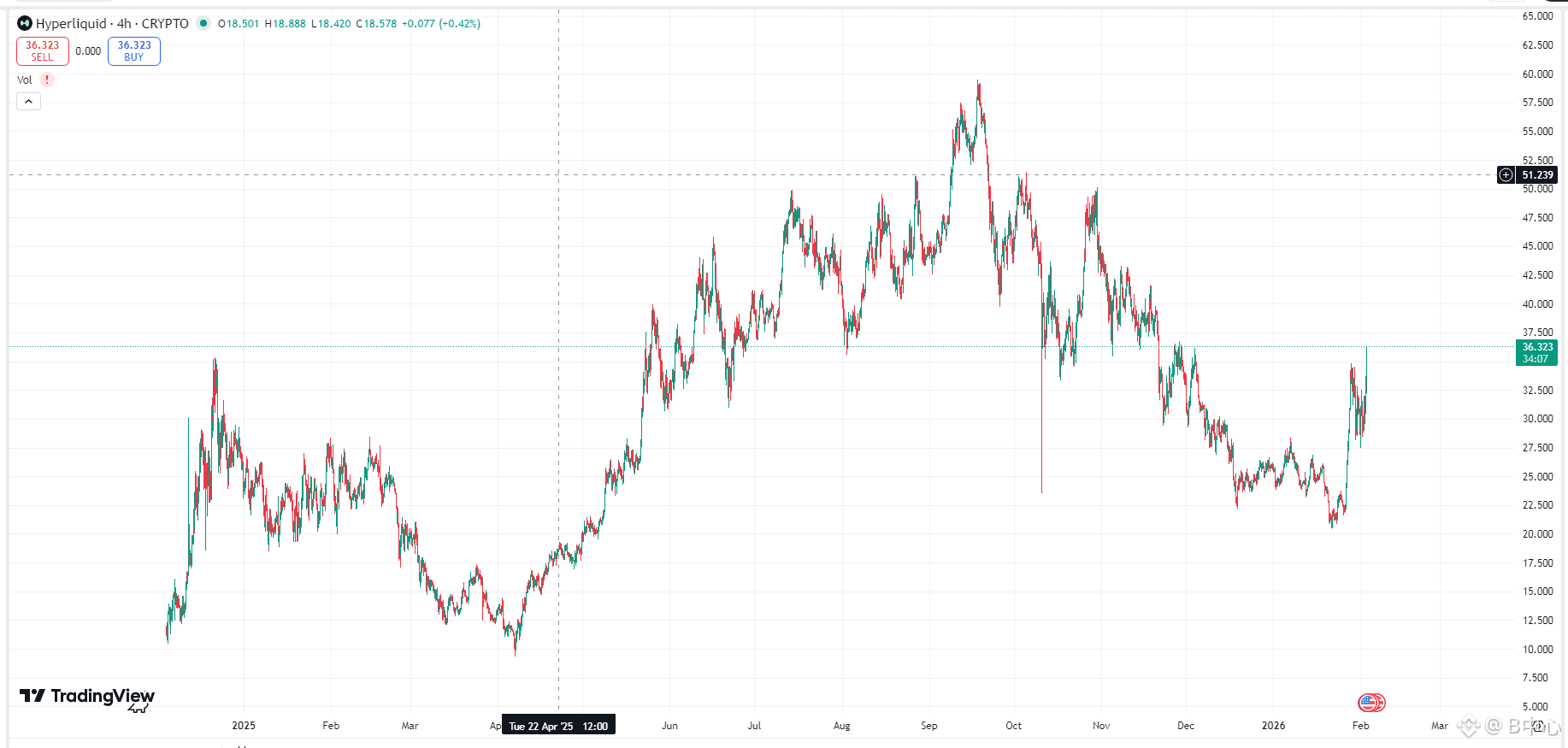
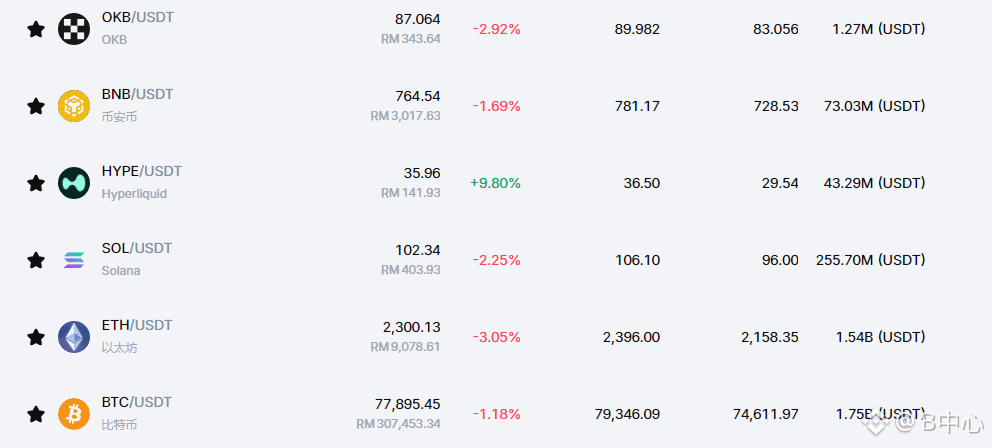
HYPE (Hyperliquid | 4-Hour Level) Technical Analysis | 2026.02.03
From the 4H structure, HYPE peaked around 60 USD and has overall entered a high-level pullback → medium-term downtrend. The core characteristics of the current trend are: high points continuously decreasing, rebound heights progressively lowering, a typical descending channel structure. Recently, a rapid rebound occurred around 22–24 USD, indicating that there is temporary capital support below, but this is more of a technical rebound rather than a trend reversal.
The current price has rebounded to around 36 USD, which is a very critical position:
On one hand, it corresponds to a strong resistance zone that has seen multiple consolidations and breakouts in the past; on the other hand, it is also a common rebound endpoint for short positions to cover during a downtrend. If the trading volume cannot continue to expand and the candlestick cannot effectively hold above 38–40 USD on the 4H level, then this rebound is likely to end with a "high pullback."
Looking downwards, 32–30 USD is the first short-term support; once breached, there is still a risk of retracing to 26–24 USD or even testing the previous low of 22 USD again; looking upwards, only a volume breakout and stabilization above 40 USD can reverse the structure and open up the space to test 46 / 52 USD.
Key levels:
Support levels: 32 / 30 / 24
Resistance levels: 38–40 / 46 / 52
Summary in one sentence: HYPE is currently still in the rebound phase of a downtrend, with 36–40 being the dividing line between bulls and bears; it is not advisable to have overly high expectations for a trend reversal before breaking through.
HYPE (Hyperliquid | 4-Hour Level) Technical Analysis | 2026.02.03
From the 4H structure, HYPE peaked around 60 USD and has overall entered a high-level pullback → medium-term downtrend. The core characteristics of the current trend are: high points continuously decreasing, rebound heights progressively lowering, a typical descending channel structure. Recently, a rapid rebound occurred around 22–24 USD, indicating that there is temporary capital support below, but this is more of a technical rebound rather than a trend reversal.
The current price has rebounded to around 36 USD, which is a very critical position:
On one hand, it corresponds to a strong resistance zone that has seen multiple consolidations and breakouts in the past; on the other hand, it is also a common rebound endpoint for short positions to cover during a downtrend. If the trading volume cannot continue to expand and the candlestick cannot effectively hold above 38–40 USD on the 4H level, then this rebound is likely to end with a "high pullback."
Looking downwards, 32–30 USD is the first short-term support; once breached, there is still a risk of retracing to 26–24 USD or even testing the previous low of 22 USD again; looking upwards, only a volume breakout and stabilization above 40 USD can reverse the structure and open up the space to test 46 / 52 USD.
Key levels:
Support levels: 32 / 30 / 24
Resistance levels: 38–40 / 46 / 52
Summary in one sentence: HYPE is currently still in the rebound phase of a downtrend, with 36–40 being the dividing line between bulls and bears; it is not advisable to have overly high expectations for a trend reversal before breaking through.
From the 4H structure, HYPE peaked around 60 USD and has overall entered a high-level pullback → medium-term downtrend. The core characteristics of the current trend are: high points continuously decreasing, rebound heights progressively lowering, a typical descending channel structure. Recently, a rapid rebound occurred around 22–24 USD, indicating that there is temporary capital support below, but this is more of a technical rebound rather than a trend reversal.
The current price has rebounded to around 36 USD, which is a very critical position:
On one hand, it corresponds to a strong resistance zone that has seen multiple consolidations and breakouts in the past; on the other hand, it is also a common rebound endpoint for short positions to cover during a downtrend. If the trading volume cannot continue to expand and the candlestick cannot effectively hold above 38–40 USD on the 4H level, then this rebound is likely to end with a "high pullback."
Looking downwards, 32–30 USD is the first short-term support; once breached, there is still a risk of retracing to 26–24 USD or even testing the previous low of 22 USD again; looking upwards, only a volume breakout and stabilization above 40 USD can reverse the structure and open up the space to test 46 / 52 USD.
Key levels:
Support levels: 32 / 30 / 24
Resistance levels: 38–40 / 46 / 52
Summary in one sentence: HYPE is currently still in the rebound phase of a downtrend, with 36–40 being the dividing line between bulls and bears; it is not advisable to have overly high expectations for a trend reversal before breaking through.
205
·
--
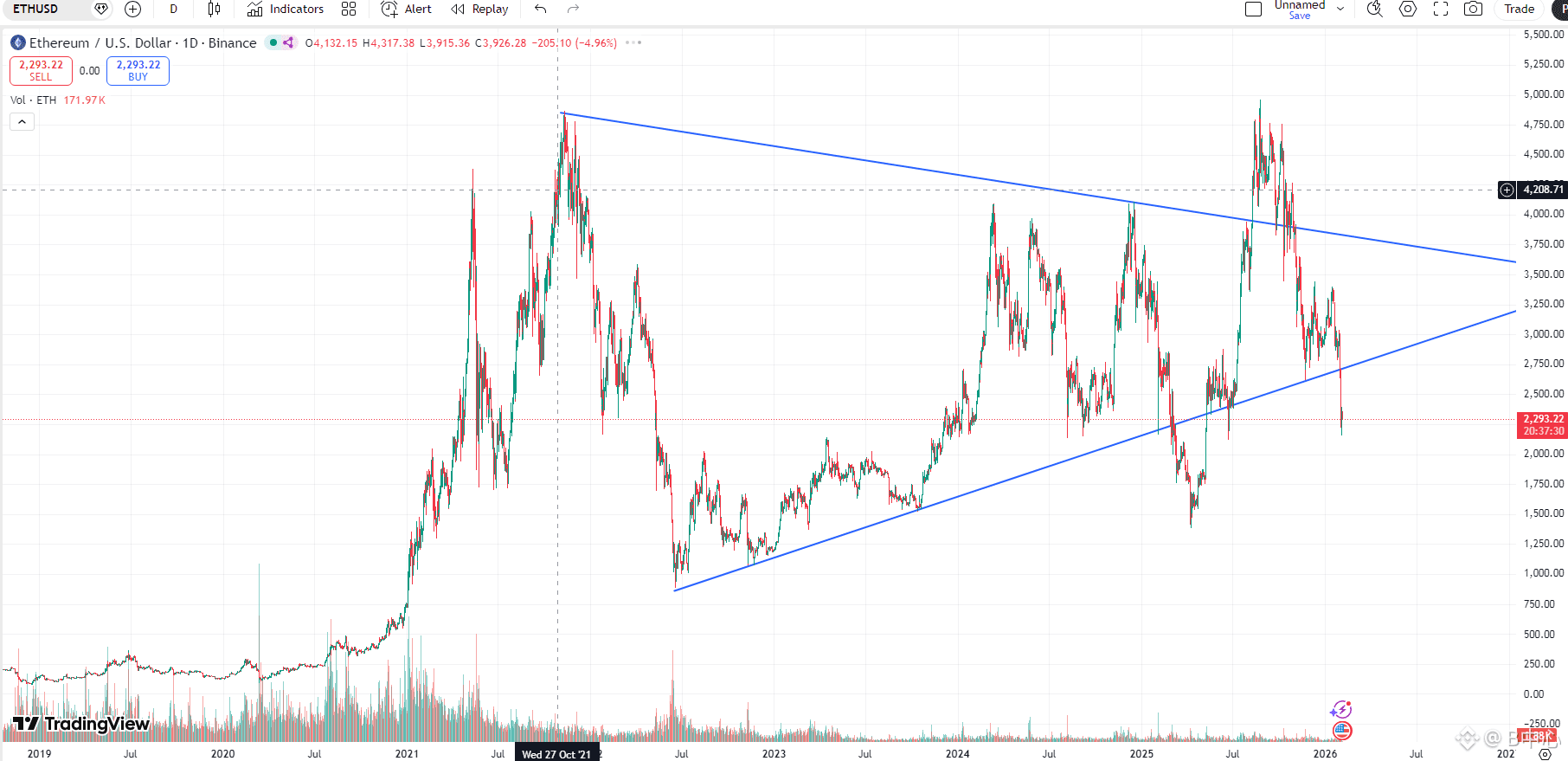
ETH (Daily Level) Technical Analysis | 2026.02.03
From the daily structure perspective, Ethereum has entered a high-level convergence—breakdown process after peaking around 4800 USD. The chart clearly shows a long-term ascending triangle/converging wedge structure. Currently, the price has broken down the lower trend line and quickly retreated to the 2300 USD level, indicating that the medium-term trend has shifted from strong to weak, and the structure has changed.
Currently, the 2300 USD corresponds to an important fluctuation center for 2023–2024, and it is also a densely traded area, providing technical support in the short term. However, it is necessary to be vigilant as the volume of this round of decline has expanded, and the rebounds are weak, indicating that this is not a simple washout, but more like a trend-level readjustment. If the price cannot quickly recover to the 2600–2700 USD range, ETH is likely to enter a longer period of fluctuating downward.
Looking downward, if 2300 USD is effectively broken, the next key support level is at the integer level of 2000 USD, and below that is 1750–1800 USD (previous low points multiple times). Looking upward, only by standing firmly above 3000 USD can it be confirmed as a false breakdown and return to the medium-term bullish structure.
Key Levels:
Support Levels: 2300 / 2000 / 1800
Resistance Levels: 2700 / 3000 / 3600
Summary in One Sentence: Ethereum has broken below the long-term convergence structure, with 2300 below being the line of life and death for bulls and bears; failing to hold will enter a medium-term adjustment cycle.
ETH (Daily Level) Technical Analysis | 2026.02.03
From the daily structure perspective, Ethereum has entered a high-level convergence—breakdown process after peaking around 4800 USD. The chart clearly shows a long-term ascending triangle/converging wedge structure. Currently, the price has broken down the lower trend line and quickly retreated to the 2300 USD level, indicating that the medium-term trend has shifted from strong to weak, and the structure has changed.
Currently, the 2300 USD corresponds to an important fluctuation center for 2023–2024, and it is also a densely traded area, providing technical support in the short term. However, it is necessary to be vigilant as the volume of this round of decline has expanded, and the rebounds are weak, indicating that this is not a simple washout, but more like a trend-level readjustment. If the price cannot quickly recover to the 2600–2700 USD range, ETH is likely to enter a longer period of fluctuating downward.
Looking downward, if 2300 USD is effectively broken, the next key support level is at the integer level of 2000 USD, and below that is 1750–1800 USD (previous low points multiple times). Looking upward, only by standing firmly above 3000 USD can it be confirmed as a false breakdown and return to the medium-term bullish structure.
Key Levels:
Support Levels: 2300 / 2000 / 1800
Resistance Levels: 2700 / 3000 / 3600
Summary in One Sentence: Ethereum has broken below the long-term convergence structure, with 2300 below being the line of life and death for bulls and bears; failing to hold will enter a medium-term adjustment cycle.
From the daily structure perspective, Ethereum has entered a high-level convergence—breakdown process after peaking around 4800 USD. The chart clearly shows a long-term ascending triangle/converging wedge structure. Currently, the price has broken down the lower trend line and quickly retreated to the 2300 USD level, indicating that the medium-term trend has shifted from strong to weak, and the structure has changed.
Currently, the 2300 USD corresponds to an important fluctuation center for 2023–2024, and it is also a densely traded area, providing technical support in the short term. However, it is necessary to be vigilant as the volume of this round of decline has expanded, and the rebounds are weak, indicating that this is not a simple washout, but more like a trend-level readjustment. If the price cannot quickly recover to the 2600–2700 USD range, ETH is likely to enter a longer period of fluctuating downward.
Looking downward, if 2300 USD is effectively broken, the next key support level is at the integer level of 2000 USD, and below that is 1750–1800 USD (previous low points multiple times). Looking upward, only by standing firmly above 3000 USD can it be confirmed as a false breakdown and return to the medium-term bullish structure.
Key Levels:
Support Levels: 2300 / 2000 / 1800
Resistance Levels: 2700 / 3000 / 3600
Summary in One Sentence: Ethereum has broken below the long-term convergence structure, with 2300 below being the line of life and death for bulls and bears; failing to hold will enter a medium-term adjustment cycle.
279
·
--
BTC (Daily Level) Technical Analysis | 2026.02.03
From the daily structure, Bitcoin has formed a phase top above $120,000, and the trend has switched from a one-sided rise to a high-level wide pullback structure. The current price has fallen to around $78,000, which is the launch area of the previous main upward wave and also an important mid-term bull-bear dividing line. The recent continuous pullback and weak rebounds indicate that high-level chips are loosening, and the market is undergoing a trend-level repricing.
Structurally, BTC has broken below the lower edge of the previous rising channel, and the short-term moving averages are turning downward, with the daily rhythm leaning bearish. However, it is important to note that the $75,000–$78,000 area corresponds to the major breakthrough platform in 2024, with dense historical trading. If it stops falling here and moves into a low-volume sideways range, there is still a chance to construct a mid-term consolidation platform, rather than directly entering a bear market.
If it effectively breaks below $75,000 subsequently, it will quickly point to the structural support area of $68,000 / $62,000; conversely, if it can regain above $85,000, the market will turn into a volatile repair, with further rebound targets looking at $95,000–$100,000.
Key Levels:
Support: $75,000 / $68,000
Resistance: $85,000 / $100,000
In summary: Bitcoin is currently in a critical support area after a high-level pullback. Holding above $75,000 indicates strong consolidation, while losing it will enter a mid-term adjustment.
BTC (Daily Level) Technical Analysis | 2026.02.03
From the daily structure, Bitcoin has formed a phase top above $120,000, and the trend has switched from a one-sided rise to a high-level wide pullback structure. The current price has fallen to around $78,000, which is the launch area of the previous main upward wave and also an important mid-term bull-bear dividing line. The recent continuous pullback and weak rebounds indicate that high-level chips are loosening, and the market is undergoing a trend-level repricing.
Structurally, BTC has broken below the lower edge of the previous rising channel, and the short-term moving averages are turning downward, with the daily rhythm leaning bearish. However, it is important to note that the $75,000–$78,000 area corresponds to the major breakthrough platform in 2024, with dense historical trading. If it stops falling here and moves into a low-volume sideways range, there is still a chance to construct a mid-term consolidation platform, rather than directly entering a bear market.
If it effectively breaks below $75,000 subsequently, it will quickly point to the structural support area of $68,000 / $62,000; conversely, if it can regain above $85,000, the market will turn into a volatile repair, with further rebound targets looking at $95,000–$100,000.
Key Levels:
Support: $75,000 / $68,000
Resistance: $85,000 / $100,000
In summary: Bitcoin is currently in a critical support area after a high-level pullback. Holding above $75,000 indicates strong consolidation, while losing it will enter a mid-term adjustment.
From the daily structure, Bitcoin has formed a phase top above $120,000, and the trend has switched from a one-sided rise to a high-level wide pullback structure. The current price has fallen to around $78,000, which is the launch area of the previous main upward wave and also an important mid-term bull-bear dividing line. The recent continuous pullback and weak rebounds indicate that high-level chips are loosening, and the market is undergoing a trend-level repricing.
Structurally, BTC has broken below the lower edge of the previous rising channel, and the short-term moving averages are turning downward, with the daily rhythm leaning bearish. However, it is important to note that the $75,000–$78,000 area corresponds to the major breakthrough platform in 2024, with dense historical trading. If it stops falling here and moves into a low-volume sideways range, there is still a chance to construct a mid-term consolidation platform, rather than directly entering a bear market.
If it effectively breaks below $75,000 subsequently, it will quickly point to the structural support area of $68,000 / $62,000; conversely, if it can regain above $85,000, the market will turn into a volatile repair, with further rebound targets looking at $95,000–$100,000.
Key Levels:
Support: $75,000 / $68,000
Resistance: $85,000 / $100,000
In summary: Bitcoin is currently in a critical support area after a high-level pullback. Holding above $75,000 indicates strong consolidation, while losing it will enter a mid-term adjustment.
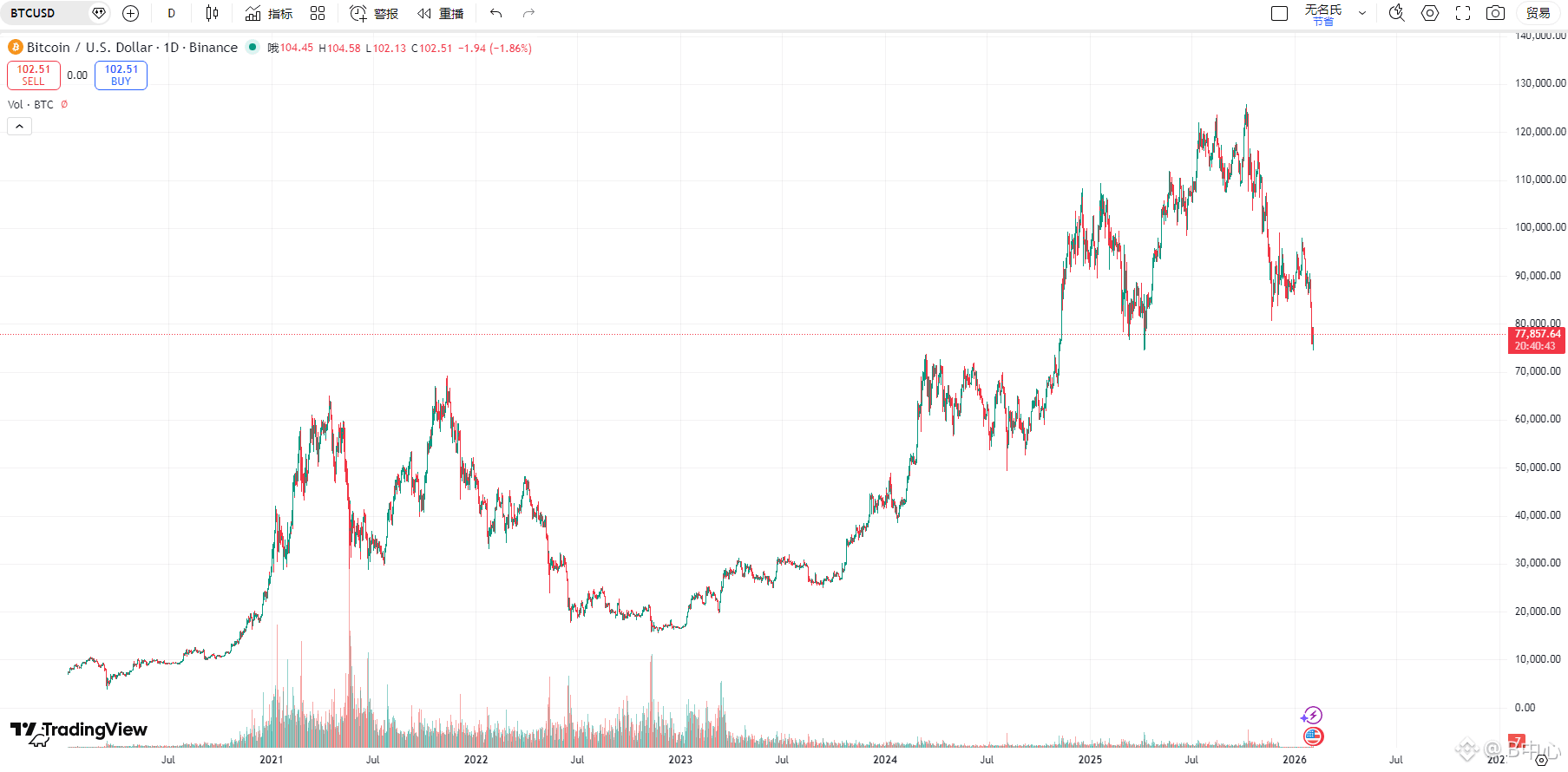
141
·
--
The reasons for the significant drop in gold prices on January 30, 2026, mainly include the following points:
1. Profit-taking and technical correction
From 2025 to early 2026, gold prices increased by more than 70%, accumulating substantial profit. When prices reached high levels above $5500 per ounce, investors tended to lock in profits, leading to concentrated selling. Technical indicators such as RSI showed overbought conditions, indicating a demand for correction, further exacerbating the price decline.
2. Shift in Federal Reserve policy expectations
The Federal Reserve maintained interest rates in the January meeting and hinted at a decreased probability of rate cuts in the first half of the year, breaking the market's previous strong expectations for significant rate cuts. As a non-interest-bearing asset, gold's appeal weakened due to rising holding costs, causing funds to shift towards interest-bearing assets such as U.S. Treasury bonds and the dollar, suppressing gold prices.
3. Dollar index rebound
Influenced by expectations of a hawkish Federal Reserve policy, the dollar index rebounded, making gold priced in dollars more expensive for non-dollar investors, leading to decreased demand and subsequently pushing prices down.
4. Easing geopolitical tensions
U.S. President Trump reached an agreement with Senate Democrats to avoid a government shutdown, and the announcement of ceasefire arrangements related to the Russia-Ukraine conflict reduced market risk aversion, decreasing the demand for gold as a safe-haven asset.
These factors combined led to the significant drop in gold prices on January 30, 2026.
The reasons for the significant drop in gold prices on January 30, 2026, mainly include the following points:
1. Profit-taking and technical correction
From 2025 to early 2026, gold prices increased by more than 70%, accumulating substantial profit. When prices reached high levels above $5500 per ounce, investors tended to lock in profits, leading to concentrated selling. Technical indicators such as RSI showed overbought conditions, indicating a demand for correction, further exacerbating the price decline.
2. Shift in Federal Reserve policy expectations
The Federal Reserve maintained interest rates in the January meeting and hinted at a decreased probability of rate cuts in the first half of the year, breaking the market's previous strong expectations for significant rate cuts. As a non-interest-bearing asset, gold's appeal weakened due to rising holding costs, causing funds to shift towards interest-bearing assets such as U.S. Treasury bonds and the dollar, suppressing gold prices.
3. Dollar index rebound
Influenced by expectations of a hawkish Federal Reserve policy, the dollar index rebounded, making gold priced in dollars more expensive for non-dollar investors, leading to decreased demand and subsequently pushing prices down.
4. Easing geopolitical tensions
U.S. President Trump reached an agreement with Senate Democrats to avoid a government shutdown, and the announcement of ceasefire arrangements related to the Russia-Ukraine conflict reduced market risk aversion, decreasing the demand for gold as a safe-haven asset.
These factors combined led to the significant drop in gold prices on January 30, 2026.
1. Profit-taking and technical correction
From 2025 to early 2026, gold prices increased by more than 70%, accumulating substantial profit. When prices reached high levels above $5500 per ounce, investors tended to lock in profits, leading to concentrated selling. Technical indicators such as RSI showed overbought conditions, indicating a demand for correction, further exacerbating the price decline.
2. Shift in Federal Reserve policy expectations
The Federal Reserve maintained interest rates in the January meeting and hinted at a decreased probability of rate cuts in the first half of the year, breaking the market's previous strong expectations for significant rate cuts. As a non-interest-bearing asset, gold's appeal weakened due to rising holding costs, causing funds to shift towards interest-bearing assets such as U.S. Treasury bonds and the dollar, suppressing gold prices.
3. Dollar index rebound
Influenced by expectations of a hawkish Federal Reserve policy, the dollar index rebounded, making gold priced in dollars more expensive for non-dollar investors, leading to decreased demand and subsequently pushing prices down.
4. Easing geopolitical tensions
U.S. President Trump reached an agreement with Senate Democrats to avoid a government shutdown, and the announcement of ceasefire arrangements related to the Russia-Ukraine conflict reduced market risk aversion, decreasing the demand for gold as a safe-haven asset.
These factors combined led to the significant drop in gold prices on January 30, 2026.
316
Log in to explore more content
Join global crypto users on Binance Square
⚡️ Get latest and useful information about crypto.
💬 Trusted by the world’s largest crypto exchange.
👍 Discover real insights from verified creators.
Email / Phone number
Trending Topics
BOJRaisesRatesTo31YearHigh
116,533 views
1,823 Discussing
#BOJRaisesRatesTo31YearHigh
#BOJRaisesRatesTo31YearHigh 🇯🇵📈
The Bank of Japan has taken another major step by raising interest rates to their highest level in 31 years, putting global markets on alert. The move signals a continued shift away from Japan’s long-standing ultra-loose monetary policy. Higher Japanese rates could strengthen the yen, influence global bond yields, and potentially impact capital flows across financial markets. Crypto and risk assets may also react as investors reassess liquidity and risk exposure. Traders are now watching the BOJ’s next statements closely for clues about future rate decisions. Volatility could increase as markets digest the policy change and its potential global impact. #BOJ #Japan #Crypto #Markets #InterestRates $NVDAB
maqsoodahmed1
·1 Likes
·40 views
BuffettStepsDownAsBerkshireChairman
54,819 views
886 Discussing
XRPExchangeReservesHitSevenYearLow
57,790 views
842 Discussing