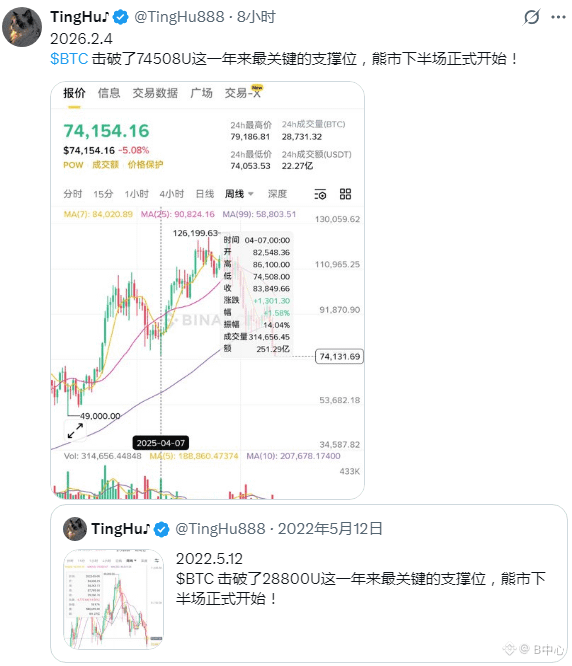
The reason this judgment has attracted attention is not because of the "breakout" itself, but because it precisely hit the most vulnerable psychological anchor point in the market. $74508, repeatedly emphasized as the "most critical support level of the year," once breached, the technical signals only indicate one thing: the trend switches from high-level fluctuations to a medium-term pullback. Historical reference to the scene in 2022 at $28800 is not alarmist — back then, it was also a "seemingly solid support," and once it broke, the bear market did not collapse immediately, but slowly drained the bulls.
What is truly worth being vigilant about is not the price drop, but the structural change. The current issue with BTC is not the fundamentals, but an overabundance of consensus: a long-term bullish outlook has become the default position, and pullbacks are habitually interpreted as "money being given away," resulting in a shift in positions and increased leverage. Once the key level is breached, the selling pressure does not come from panic selling, but rather from rational positions that "have to reduce their holdings" and passive liquidations.
More importantly, the second half of a bear market is often not characterized by a crash, but rather by time exchanging for space: rebounds give hope, while drops test patience, until most people stop discussing bull and bear markets, and only say, "forget it, I won't look anymore." This is the phase with the greatest destructive power.
In summary: a breach of support levels is not scary; what is scary is that the market is still using a bull market mindset to deal with a trend that has already transformed.
What is truly worth being vigilant about is not the price drop, but the structural change. The current issue with BTC is not the fundamentals, but an overabundance of consensus: a long-term bullish outlook has become the default position, and pullbacks are habitually interpreted as "money being given away," resulting in a shift in positions and increased leverage. Once the key level is breached, the selling pressure does not come from panic selling, but rather from rational positions that "have to reduce their holdings" and passive liquidations.
More importantly, the second half of a bear market is often not characterized by a crash, but rather by time exchanging for space: rebounds give hope, while drops test patience, until most people stop discussing bull and bear markets, and only say, "forget it, I won't look anymore." This is the phase with the greatest destructive power.
In summary: a breach of support levels is not scary; what is scary is that the market is still using a bull market mindset to deal with a trend that has already transformed.