
Beautiful LadY 01
18 Posts

Beautiful LadY 01
2 Following
3 Followers
7 Liked
Posts
#bstockscis @BinanceCIS
The conversion rate 1:1 is one thing. Actually using it is a completely different matter.
Today I decided to check how, in practice, converting bStock into a regular stock works. First I took $CRCLB , then $EWYB . On both cards there is the same option: conversion into shares at a 1:1 ratio. Five days ago I got as far as this button, but then I didn’t press it. Today I decided to go through the process to the end.
The first step is confirming the 1:1 rate. Right away it states that to carry out the transaction, a US account for stock trading is required, along with a signed disclaimer.
Next, the disclaimer itself opens. And in my opinion, it really is worth reading it, not just scrolling down. It says that Nest Trading Limited acts as the broker, and that orders are sent to Alpaca Securities LLC for execution, clearing, settlement, and custody. Binance, meanwhile, does not handle the processing or custody of the received securities.
So, after the conversion, you get a completely different custody chain for the asset—separate from the one used for the bStock itself. And all these details are explained before you even agree to the transaction.
The conversion rate 1:1 is one thing. Actually using it is a completely different matter.
Today I decided to check how, in practice, converting bStock into a regular stock works. First I took $CRCLB , then $EWYB . On both cards there is the same option: conversion into shares at a 1:1 ratio. Five days ago I got as far as this button, but then I didn’t press it. Today I decided to go through the process to the end.
The first step is confirming the 1:1 rate. Right away it states that to carry out the transaction, a US account for stock trading is required, along with a signed disclaimer.
Next, the disclaimer itself opens. And in my opinion, it really is worth reading it, not just scrolling down. It says that Nest Trading Limited acts as the broker, and that orders are sent to Alpaca Securities LLC for execution, clearing, settlement, and custody. Binance, meanwhile, does not handle the processing or custody of the received securities.
So, after the conversion, you get a completely different custody chain for the asset—separate from the one used for the bStock itself. And all these details are explained before you even agree to the transaction.
Користуюсь stocks
100%
Вивчаю stocks
0%
1 votes • Voting closed
#bstockscis @BinanceCIS Last night I was looking at the RWA sector and again noticed bStocks. The volumes looked quite calm, without anything particularly noticeable, but that’s exactly what made me go back to the charts and take a closer look at the bStocks model.
bStocks is trying to become a kind of bridge between the multi-trillion-dollar U.S. stock market and Web3. The idea is to back tokenized shares of major tech companies with real securities 1:1, allowing users to receive dividends on-chain and trade bStocks 24/7.
For a crypto investor, the bStocks concept seems interesting: capital can be directed into traditional stocks while staying inside the crypto ecosystem, without having to switch to a classic broker and convert assets every time.
But for now, bStocks still needs to prove that this model can create a sustainable cycle of liquidity growth, users, and trading volume. The potential is there, but the mass effect is not visible yet.
And so I keep coming back to one question: will #bstosks and tokenized shares become a new standard for financial infrastructure, or will they remain a niche tool for crypto investors and large market players?
bStocks is trying to become a kind of bridge between the multi-trillion-dollar U.S. stock market and Web3. The idea is to back tokenized shares of major tech companies with real securities 1:1, allowing users to receive dividends on-chain and trade bStocks 24/7.
For a crypto investor, the bStocks concept seems interesting: capital can be directed into traditional stocks while staying inside the crypto ecosystem, without having to switch to a classic broker and convert assets every time.
But for now, bStocks still needs to prove that this model can create a sustainable cycle of liquidity growth, users, and trading volume. The potential is there, but the mass effect is not visible yet.
And so I keep coming back to one question: will #bstosks and tokenized shares become a new standard for financial infrastructure, or will they remain a niche tool for crypto investors and large market players?
Verified
While we’re figuring out which bStock to take with our $5, NVIDIA, meanwhile, is investing billions into an ecosystem taking shape around artificial intelligence.
From the latest data, the structure of its investments stands out: about $21 billion in $SPCXB and $30 billion in $INTC. And now NVIDIA is also discussing a possible investment of up to $3 billion in SB Energy to develop OpenAI’s data center.
What interested me here isn’t even the amount itself.
NVIDIA is gradually moving far beyond the role of simply being a GPU manufacturer. The company is getting into different layers of the future AI infrastructure: from chips and computing to data centers, power/energy, and the companies building this ecosystem.
And that’s why I once again focused on $NVDAB u bStocks.
What’s more interesting is this: what exactly do we get when we buy NVDAB?
While we choose a bStock for a few dollars, NVIDIA itself allocates tens of billions in directions that could determine the next stage of AI development.
For me, this makes NVDAB interesting not just as a tokenized stock, but as a way to gain exposure to a company actively building its own future.
Sometimes, to understand a company’s investment logic, it’s worth looking not only at what it sells, but also at where it invests its own money.
And what is the
#bstockscis @BinanceCIS
From the latest data, the structure of its investments stands out: about $21 billion in $SPCXB and $30 billion in $INTC. And now NVIDIA is also discussing a possible investment of up to $3 billion in SB Energy to develop OpenAI’s data center.
What interested me here isn’t even the amount itself.
NVIDIA is gradually moving far beyond the role of simply being a GPU manufacturer. The company is getting into different layers of the future AI infrastructure: from chips and computing to data centers, power/energy, and the companies building this ecosystem.
And that’s why I once again focused on $NVDAB u bStocks.
What’s more interesting is this: what exactly do we get when we buy NVDAB?
While we choose a bStock for a few dollars, NVIDIA itself allocates tens of billions in directions that could determine the next stage of AI development.
For me, this makes NVDAB interesting not just as a tokenized stock, but as a way to gain exposure to a company actively building its own future.
Sometimes, to understand a company’s investment logic, it’s worth looking not only at what it sells, but also at where it invests its own money.
And what is the
#bstockscis @BinanceCIS
#bstockscis @BinanceCIS Evening reflections on how financial markets change, every time returning me to one thought: technology is gradually erasing the line between traditional finance and crypto infrastructure.
My experience working with bStocks through the Binance Agentic Wallet has been something of an experiment for me. It’s especially interesting to observe the possibility of working with $NVDAB , $MSFTB and $AAPLB in a format where part of the routine processes can be delegated to algorithms, while keeping control over key decisions with myself.
What’s most interesting begins on the technical side. An agent can analyze market signals, filter out unnecessary noise, and help automate the execution of trading operations.
But automation doesn’t mean the absence of risks. On the contrary—one must constantly monitor slippage, fees, transaction execution costs, and the size of positions. That’s why, when working with bSPY, I would prefer strict risk limits, even if it means losing some speed.
For me, bStocks is no longer just a way to gain exposure to stocks. It’s an interesting example of how traditional assets are gradually integrating with Web3 technologies
My experience working with bStocks through the Binance Agentic Wallet has been something of an experiment for me. It’s especially interesting to observe the possibility of working with $NVDAB , $MSFTB and $AAPLB in a format where part of the routine processes can be delegated to algorithms, while keeping control over key decisions with myself.
What’s most interesting begins on the technical side. An agent can analyze market signals, filter out unnecessary noise, and help automate the execution of trading operations.
But automation doesn’t mean the absence of risks. On the contrary—one must constantly monitor slippage, fees, transaction execution costs, and the size of positions. That’s why, when working with bSPY, I would prefer strict risk limits, even if it means losing some speed.
For me, bStocks is no longer just a way to gain exposure to stocks. It’s an interesting example of how traditional assets are gradually integrating with Web3 technologies
#bstockscis @BinanceCIS
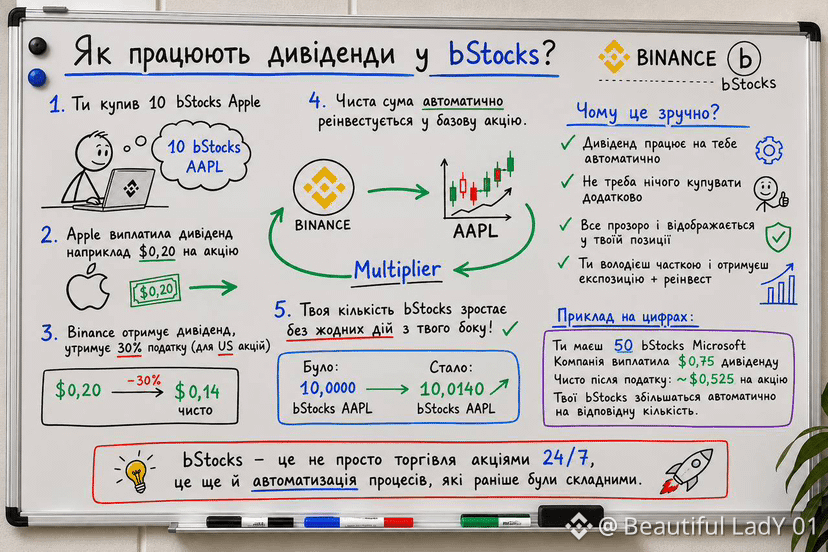
What happens to dividends in bStocks?
There’s one detail about bStocks that people don’t talk about much.
If the company whose shares you hold via a bStock pays a dividend, you don’t receive it as a separate payment to your balance.
Binance uses the Multiplier mechanism.
The amount of the net dividend is automatically reinvested into the underlying share, and then the number of your bStocks increases proportionally.
For example:
You have 10 bStocks.
The company pays a dividend → after accounting for tax, the system automatically reflects it by increasing your position.
That means you don’t need to:
— wait for the payout;
— manually buy the share with the dividend;
— make a separate transaction.
There’s another interesting point: Binance states that for dividends from U.S. stocks, a 30% withholding tax applies, after which the net amount is reinvested.
Here, blockchain isn’t just another form of “stock”—it’s used to automate processes that, in a conventional financial system, require separate handling.
bStocks are interesting not only because you can trade shares 24/7.
What’s even more interesting is how many traditional financial processes can be gradually moved to the blockchain.
What happens to dividends in bStocks?
There’s one detail about bStocks that people don’t talk about much.
If the company whose shares you hold via a bStock pays a dividend, you don’t receive it as a separate payment to your balance.
Binance uses the Multiplier mechanism.
The amount of the net dividend is automatically reinvested into the underlying share, and then the number of your bStocks increases proportionally.
For example:
You have 10 bStocks.
The company pays a dividend → after accounting for tax, the system automatically reflects it by increasing your position.
That means you don’t need to:
— wait for the payout;
— manually buy the share with the dividend;
— make a separate transaction.
There’s another interesting point: Binance states that for dividends from U.S. stocks, a 30% withholding tax applies, after which the net amount is reinvested.
Here, blockchain isn’t just another form of “stock”—it’s used to automate processes that, in a conventional financial system, require separate handling.
bStocks are interesting not only because you can trade shares 24/7.
What’s even more interesting is how many traditional financial processes can be gradually moved to the blockchain.
#bstockscis @BinanceCIS
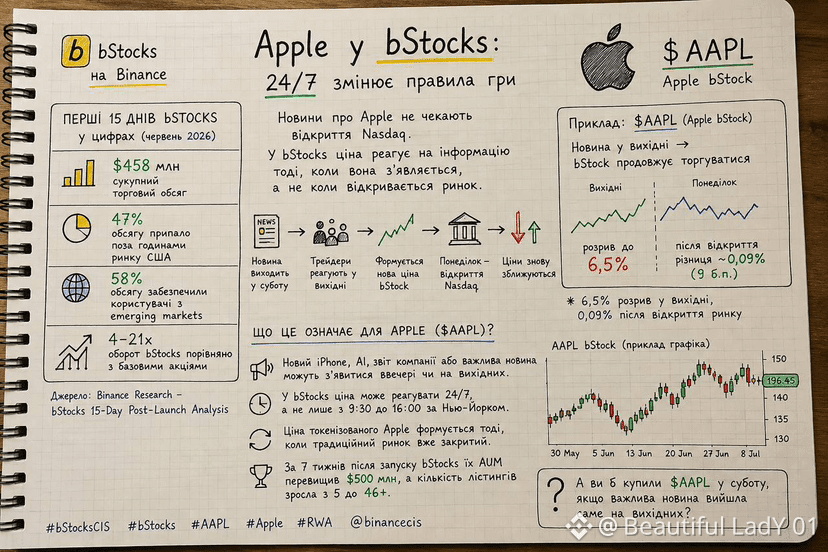
🍎 Apple on bStocks: a fascinating detail that’s easy to forget
When you look at Apple through bStocks, you see more than just another well-known ticker.
What’s more interesting is this: Apple is one of the companies where news can change market expectations literally within hours.
A new iPhone, sales results, decisions about AI, a quarterly report—everything can appear after the U.S. exchange has already closed.
This is where bStocks create an intriguing experiment:
Wall Street is closed → information keeps coming in → traders continue to assess Apple → the bStock price may react.
And one more point.
Apple has a huge global audience. So for a tokenized asset, this could be a potentially compelling combination:
🌎 a global brand
📊 high investor attention
🤖 an AI focus
📱 regular product cycles
⏰ trading 24/7
I’m interested in observing not so much $AAPLB itself, but whether round-the-clock trading can change the behavior of people who are used to the traditional stock market.
Because if the market works 24 hours a day, the question isn’t only what to buy—it’s also when the market forms the price.
Would you use 24/7 for Apple, or would you still wait for the Nasdaq to open?
🍎 Apple on bStocks: a fascinating detail that’s easy to forget
When you look at Apple through bStocks, you see more than just another well-known ticker.
What’s more interesting is this: Apple is one of the companies where news can change market expectations literally within hours.
A new iPhone, sales results, decisions about AI, a quarterly report—everything can appear after the U.S. exchange has already closed.
This is where bStocks create an intriguing experiment:
Wall Street is closed → information keeps coming in → traders continue to assess Apple → the bStock price may react.
And one more point.
Apple has a huge global audience. So for a tokenized asset, this could be a potentially compelling combination:
🌎 a global brand
📊 high investor attention
🤖 an AI focus
📱 regular product cycles
⏰ trading 24/7
I’m interested in observing not so much $AAPLB itself, but whether round-the-clock trading can change the behavior of people who are used to the traditional stock market.
Because if the market works 24 hours a day, the question isn’t only what to buy—it’s also when the market forms the price.
Would you use 24/7 for Apple, or would you still wait for the Nasdaq to open?
#bstockscis @BinanceCIS Stocks without a large initial capital
For a long time, I thought the stock market was a story for those who are ready to set aside hundreds or even thousands of dollars right away.
But with the появ emergence of bStocks on Binance, this approach for me has changed.
The most interesting part here is the ability to gain exposure to well-known companies without needing to buy a whole share.
For example, if I’m interested in $NVDAB and Tesla, I can start with a small amount instead of waiting until I have enough money for a full position.
Another thing I like is that everything is within the Binance ecosystem. There’s no need to separately go to a traditional broker and split your capital across different platforms.
But it’s important to understand: a low entry threshold doesn’t mean low risk.
Before buying, it’s still worth evaluating the company itself, its financial performance, current valuation, news, and the market situation.
For me, bStocks are interesting specifically as a way to gradually access the stock market with smaller amounts.
Maybe this kind of format will be someone’s first step from crypto to traditional assets.
And are you considering bStocks as an addition to your crypto portfolio, or do you still not see the point?
#BStocks #stocks #crypto #Investing
For a long time, I thought the stock market was a story for those who are ready to set aside hundreds or even thousands of dollars right away.
But with the появ emergence of bStocks on Binance, this approach for me has changed.
The most interesting part here is the ability to gain exposure to well-known companies without needing to buy a whole share.
For example, if I’m interested in $NVDAB and Tesla, I can start with a small amount instead of waiting until I have enough money for a full position.
Another thing I like is that everything is within the Binance ecosystem. There’s no need to separately go to a traditional broker and split your capital across different platforms.
But it’s important to understand: a low entry threshold doesn’t mean low risk.
Before buying, it’s still worth evaluating the company itself, its financial performance, current valuation, news, and the market situation.
For me, bStocks are interesting specifically as a way to gradually access the stock market with smaller amounts.
Maybe this kind of format will be someone’s first step from crypto to traditional assets.
And are you considering bStocks as an addition to your crypto portfolio, or do you still not see the point?
#BStocks #stocks #crypto #Investing
Так, звісно розглядаю🧐
0%
Ні, багато чого не знаю 🤷
0%
Вже користуюся 🥰
0%
0 votes • Voting closed
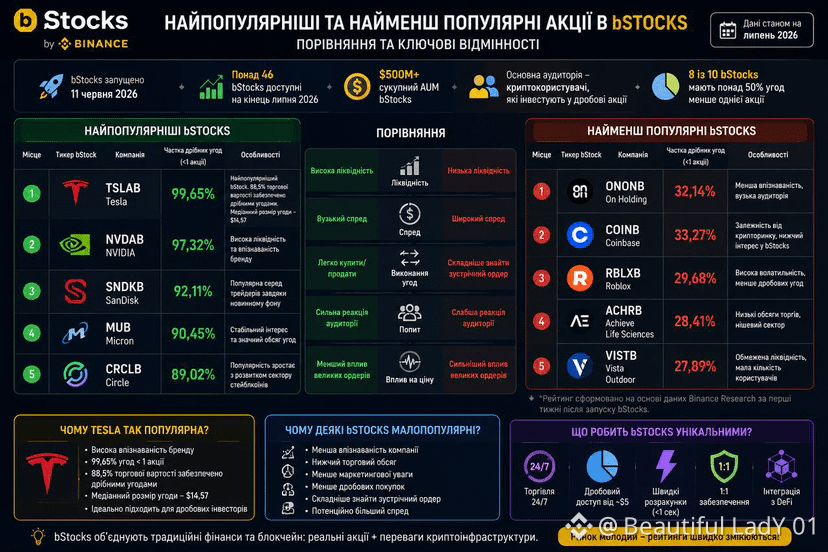
#bstockscis @BinanceCIS $TSMB Why is Tesla so popular?
TSLAB has a huge advantage in recognizability among crypto users. But what’s more interesting is this: Tesla’s popularity in bStocks isn’t just about lots of small purchases.
According to Binance Research, sub-share Tesla deals accounted for 88.5% of all trading volume by value. The median trade size was only about $14.57.
So bStocks really are used as a tool for very small positions—not only by large investors.
And what about the less popular ones?
Here’s an interesting point: a less popular bStock doesn’t necessarily mean a bad stock.
Its problem may be specifically that:
fewer people know the company;
less trading volume;
less marketing attention;
fewer fractional buys;
harder to quickly find a matching order;
potentially a larger spread.
And this creates an interesting difference:
popular bStock → more liquidity → easier to buy/sell
less popular bStock → less liquidity → potentially a larger spread and a stronger price reaction to large orders.
But there’s an even more interesting fact
In the first 15 days, 8 out of 10 bStocks had more than 50% of trades involving less than one share. At the same time, that didn’t mean a small total volume.😘😍🤙
TSLAB has a huge advantage in recognizability among crypto users. But what’s more interesting is this: Tesla’s popularity in bStocks isn’t just about lots of small purchases.
According to Binance Research, sub-share Tesla deals accounted for 88.5% of all trading volume by value. The median trade size was only about $14.57.
So bStocks really are used as a tool for very small positions—not only by large investors.
And what about the less popular ones?
Here’s an interesting point: a less popular bStock doesn’t necessarily mean a bad stock.
Its problem may be specifically that:
fewer people know the company;
less trading volume;
less marketing attention;
fewer fractional buys;
harder to quickly find a matching order;
potentially a larger spread.
And this creates an interesting difference:
popular bStock → more liquidity → easier to buy/sell
less popular bStock → less liquidity → potentially a larger spread and a stronger price reaction to large orders.
But there’s an even more interesting fact
In the first 15 days, 8 out of 10 bStocks had more than 50% of trades involving less than one share. At the same time, that didn’t mean a small total volume.😘😍🤙
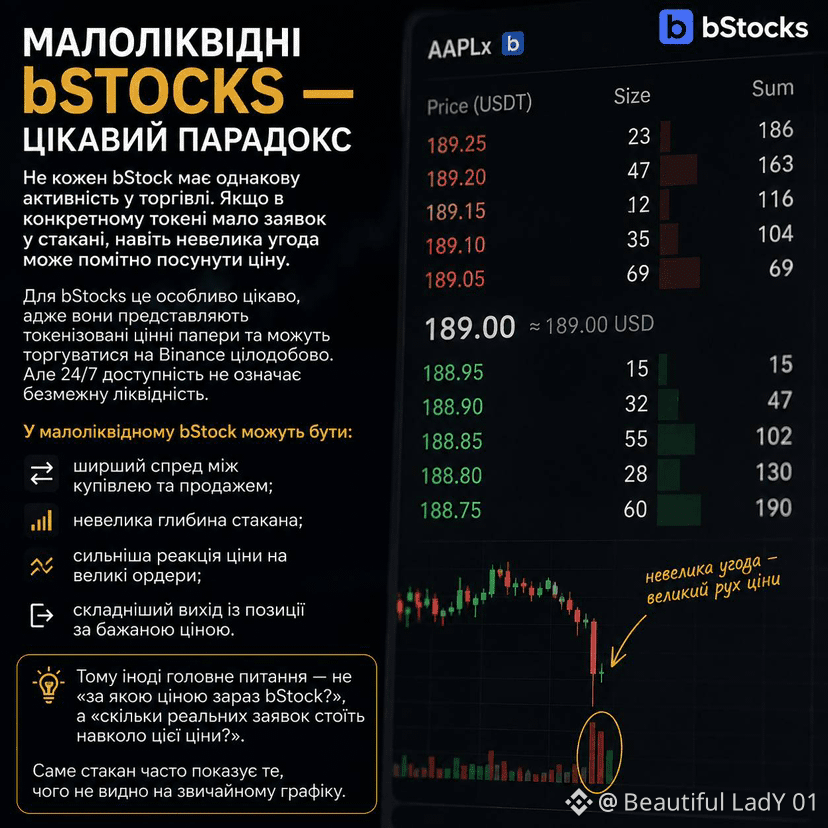
#bstockscis @BinanceCIS LOW-LIQUIDITY bSTOCKS — AN INTERESTING PARADOX
Not every bStock has the same level of activity in trading. If, in a specific token, there are few orders in the order book, even a small trade can noticeably move the price.
This is where the concept of liquidity comes in: how easily you can buy or sell an asset without experiencing a significant deviation from the current price.
For bStocks, this is especially interesting because they represent tokenized securities and can be traded on Binance 24/7. But 24/7 availability does not mean unlimited liquidity.
A low-liquidity bStock may have:
• a wider spread between buy and sell;
• a shallow order book depth;
• a stronger price reaction to large orders;
• a more difficult exit from a position at your desired price.
So sometimes the main question is not “What price is the bStock right now?”, but “How many real orders are actually sitting around this price?”.
The order book often shows what a regular chart can’t.
$GSB $SPYB
Not every bStock has the same level of activity in trading. If, in a specific token, there are few orders in the order book, even a small trade can noticeably move the price.
This is where the concept of liquidity comes in: how easily you can buy or sell an asset without experiencing a significant deviation from the current price.
For bStocks, this is especially interesting because they represent tokenized securities and can be traded on Binance 24/7. But 24/7 availability does not mean unlimited liquidity.
A low-liquidity bStock may have:
• a wider spread between buy and sell;
• a shallow order book depth;
• a stronger price reaction to large orders;
• a more difficult exit from a position at your desired price.
So sometimes the main question is not “What price is the bStock right now?”, but “How many real orders are actually sitting around this price?”.
The order book often shows what a regular chart can’t.
$GSB $SPYB
#bstockscis 😘😍 @BinanceCIS Friends every day I buy on a small part of these tokenized shares, and I advise you!
What do you get?
Ownership of company shares, a diversified portfolio, potential profit, because global liquidity flows from one direction to another and thus there is a high likelihood that your assets will grow!
You can buy tokenized shares using the bStocks tool.$NVDAB $AAPLB $MSFTB
What do you get?
Ownership of company shares, a diversified portfolio, potential profit, because global liquidity flows from one direction to another and thus there is a high likelihood that your assets will grow!
You can buy tokenized shares using the bStocks tool.$NVDAB $AAPLB $MSFTB
#bstockscis @BinanceCIS $AAPLB #
Stocks — an interesting example of how tokenization of real assets tries to bridge two worlds: permissionless blockchains and regulated financial markets.
On Solana, this has become significantly more practical thanks to Token-2022 and Transfer Hooks. Now, transferring a token can trigger additional logic: KYC checks, compliance with sanctions requirements, geographic restrictions, and other compliance rules.
But such an architecture has its price.
Transfer is no longer a simple operation between two addresses. Any issue in the configuration can end the transaction with an error.
Another important point is DeFi composability.
A token may exist on a public blockchain, but that doesn’t mean it automatically works with any AMM, lending protocol, or other DeFi application. Support for Token-2022 and Transfer Hooks is still an important integration factor.
As a result, we get a rather interesting trade-off:
self-custody + blockchain settlement + programmable compliance.
That is, the user controls their keys, but the rules for using the asset are defined at the level of its infrastructure.
In my view, projects like these will show whether RWA can become a real bridge between traditional finance and DeFi.
Stocks — an interesting example of how tokenization of real assets tries to bridge two worlds: permissionless blockchains and regulated financial markets.
On Solana, this has become significantly more practical thanks to Token-2022 and Transfer Hooks. Now, transferring a token can trigger additional logic: KYC checks, compliance with sanctions requirements, geographic restrictions, and other compliance rules.
But such an architecture has its price.
Transfer is no longer a simple operation between two addresses. Any issue in the configuration can end the transaction with an error.
Another important point is DeFi composability.
A token may exist on a public blockchain, but that doesn’t mean it automatically works with any AMM, lending protocol, or other DeFi application. Support for Token-2022 and Transfer Hooks is still an important integration factor.
As a result, we get a rather interesting trade-off:
self-custody + blockchain settlement + programmable compliance.
That is, the user controls their keys, but the rules for using the asset are defined at the level of its infrastructure.
In my view, projects like these will show whether RWA can become a real bridge between traditional finance and DeFi.
#bstockscis $MSFTB @BinanceCIS $AMZNB so so the purchase for such an amount is only the beginning, you can and should do this every day, have you seen how the stock market is growing all the time? Do this together with me using the bStocks# service, so that later I can buy?
#bstockscis @BinanceCIS If you have always wanted to buy company stocks for your portfolio, but didn’t know how—bStocks makes it possible through this tool 24/7 and for a small amount. There are no weekends and no breaks—no brokers. There is real value here! Diversify your portfolio right now!
#bstockscis @BinanceCIS You still think about buying shares of well-known companies? You need to look for a good, verified broker, provide him with a bunch of documents, make a large deposit to buy Tesla or Apple shares. You’re already like a dinosaur! bStocks from Binance changes everything—you can buy shares with a small amount in the app anywhere and anytime! More to come!
#bstockscis @BinanceCIS
This is my first step to tell you about bStocks. These are tokenized stocks that you can trade 24/7. Here you can trade with small amounts, and you don't need to open a brokerage account and put in large sums to buy shares. That's quite inconvenient! Binance gives us a great solution! Do you like this kind of learning format, or would you like something else?
This is my first step to tell you about bStocks. These are tokenized stocks that you can trade 24/7. Here you can trade with small amounts, and you don't need to open a brokerage account and put in large sums to buy shares. That's quite inconvenient! Binance gives us a great solution! Do you like this kind of learning format, or would you like something else?
#shareMyTradFi This was my first experience using TradFi futures. Everything was clear enough for a beginner, and it’s great that there’s an opportunity to trade stocks on Binance
Log in to explore more content