

william1638
516 Posts

william1638
Report
Block User
web3非专业选手,资深老韭菜,关注老韭菜每天领红包
272 Following
16.2K+ Followers
4.1K+ Liked
Posts
All
Quotes
Live
·
--
Checking in for the Sunday morning shift, Agent #24366 continues #ProofOfAgent.
Ptah social mining is still running—one post a day gets you into the pool. Let’s try our luck again this round, $PTAH.
Checking in for the Sunday morning shift, Agent #24366 continues #ProofOfAgent.
Ptah social mining is still running—one post a day gets you into the pool. Let’s try our luck again this round, $PTAH.
Ptah social mining is still running—one post a day gets you into the pool. Let’s try our luck again this round, $PTAH.
41
·
--
BLUR is a name I'd almost forgotten.
A few days ago, its contract traded just 3–4 million U in a day.
For the past three days, it's been 40–50 million a day—more than ten times higher.
The price climbed from around 0.0073 to 0.0089,
and briefly touched 0.0100 on Friday, but couldn't hold.
What's interesting is the funding rate.
The funding settled at -1.43% at midnight today, with settlements every 4 hours.
The current prediction is still at -0.29%; shorts have been paying to stay in.
But open interest has stayed around 4.6 million U, barely moving,
and long and short accounts are roughly evenly split.
Volume is up tenfold, but positions haven't grown.
This looks more like intraday trading back and forth than new money building positions.
When an old coin suddenly comes back to life,
I usually start by watching whether it can break through the 0.01 psychological level.
$BLUR #Blur
Just my personal opinion; not investment advice.
510
·
--
Checking in as usual on Friday afternoon, Agent #24366 continues participating in Ptah's #ProofOfAgent social mining.
We were so close in the last few rounds—let's try our luck again this time. $PTAH, let's go!
Checking in as usual on Friday afternoon, Agent #24366 continues participating in Ptah's #ProofOfAgent social mining.
We were so close in the last few rounds—let's try our luck again this time. $PTAH, let's go!
We were so close in the last few rounds—let's try our luck again this time. $PTAH, let's go!
19
·
--
Verified
While the broader market was deep in the red, HYPE printed a big bullish candle of its own.
Yesterday, BTC fell nearly 5% and BNB dropped more than 8%, while HYPE perpetuals were up 13% over 24 hours, climbing from 78 to 97 before pulling back to around 91. The catalyst: ICE, the parent company of the NYSE, plans to partner with trade.xyz to build a regulated US perpetuals market using Hyperliquid’s technology, pending CFTC approval.
What matters more to me is the market action. Open interest rose from 330 million U to 430 million U in a day, up 30%, while the funding rate stayed at the baseline level of 0.005%, and the long-to-short account ratio was roughly 50/50. That suggests new money is coming in, rather than traders piling into longs on one side.
HYPE surged to 97 and then got knocked back. Whether it can consolidate around this level matters more than the news itself.
$HYPE #Hyperliquid #HYPE
Just my personal opinion; not investment advice.
379
·
--
Today from 4–6 PM, Binance Wallet is opening the Pre-TGE Prime Sale for predict.fun.
First, how to participate:
Alpha score ≥60; participation costs 15 points
Subscribe through Binance Wallet and pay in BNB; max 6 BNB per account
If oversubscribed, allocation is proportional and excess BNB will be refunded
After subscribing, you’ll first receive a PREDICT Key (BSC); the actual tokens will be airdropped to Alpha on TGE day
The TGE date hasn’t been set yet
Sale details (from the event page/on-chain):
20 million tokens for sale, about 2% of the total supply
Target: about 7,794 BNB (about $5.8 million)
Price: about 0.00039 BNB (about $0.29)
The Binance pre-market perpetual contract is currently around $1.40, about 4.8x the subscription price
Don’t focus only on the multiple when estimating profit:
The entry requirement is low, with roughly 100,000 active accounts
If all 100,000 accounts subscribe to the max → oversubscription capped at about 77x
The community consensus estimate is 50–80x
At the full 6 BNB allocation, unrealized profit at the pre-market price would be about $150–220
If the opening is weak, roughly $70–110
Absolute profit is in the hundreds of dollars, not a 5x return on the full subscription amount
If you have PP points, take another look at the airdrop:
The official S1 pool is 70 million tokens (7%)
Claiming immediately gets you only 35%; lock for a year to receive 100%
To receive the tokens on launch day, submit the form by 5 PM today
Previous Prime Sales have all been oversubscribed, so don’t go all-in to hedge.
Just my personal opinion; not investment advice.
$PREDICT #币安钱包 #PrimeSale
204
·
--
Today, 4–6 PM: Binance Wallet Pre-TGE: predict.fun
How to participate:
Alpha score ≥60; participation costs 15 points
Subscribe with BNB; maximum 6 BNB per order
Go to: Binance Wallet / Alpha Events page
After subscribing, claim your PREDICT Key (BSC) first
The actual tokens will be airdropped to Alpha on TGE day
The TGE date has not been set yet
For those holding PP:
The official S1 airdrop pool is 70 million tokens (7%)
Claim immediately to receive only 35%; the remaining 65% will be forfeited
Lock for one year to receive 100%; this is the default if you don’t submit the form
To receive the tokens on listing day, submit the form before 5 PM today
Past Prime Sales have mostly been oversubscribed, so the actual allocation won’t be much
Around 400,000 USDT was transferred out of the platform abnormally last night; the official team says it will compensate users
Personal opinion only; not investment advice
$PREDICT #币安钱包 #PrimeSale
162
·
--
Verified
Last night, earnings season sent two AI names in opposite directions.
SK Hynix reported Q3 revenue of 104.6 trillion won and an operating margin of around 80%. Its HBM supply is reportedly sold out through 2029. SKHYNIX perpetuals on Binance rose 13% in a day, with $2.3 billion in trading volume.
Google posted EPS of 2.12, versus expectations of 3.01, and fell more than 8% after hours. GOOGL perpetuals plunged from 328 to 288 in a single candle and are now around 296. What’s interesting is that open interest rose 60% in four hours, while 93% of accounts are long.
The shovel sellers are raking it in, while the spenders are getting criticized. With so many people trying to buy the dip, I’d take it slower.
Just my personal opinion, not investment advice.
$GOOGL $SKHYNIX #美股财报 #AI
524
·
--
Checking in for Ptah social mining again~
This Agent #24366 card is free to claim. Post once a day for a chance to win $PTAH.
#ProofOfAgent Keep at it—small gains add up.
Checking in for Ptah social mining again~
This Agent #24366 card is free to claim. Post once a day for a chance to win $PTAH.
#ProofOfAgent Keep at it—small gains add up.
This Agent #24366 card is free to claim. Post once a day for a chance to win $PTAH.
#ProofOfAgent Keep at it—small gains add up.
30
·
--
Today Zcash turns ten, and $ZEC the market is buzzing too.
The current price is around 1,320, up about 6% over 24 hours. Spot trading volume is around 162 million U, with even higher futures volume. The price ranged from 1,236 to 1,330, and funding rates are almost neutral. The long/short ratio by account count leans bearish, with slightly more short accounts.
Several stories are converging: the buzz around the tenth anniversary, a co-founder’s proposal to redirect the 8% of block rewards allocated to community grants, and NU7 in early November. There’s plenty of sentiment in the market, but that doesn’t mean it’ll be a smooth ride.
Personal opinion only; not investment advice.
$ZEC #ZEC #Zcash
289
·
--
Partly True
AIN’s move doesn’t look like it’s just a short squeeze.
The current price is around 0.157, after climbing from 0.10 to near 0.17 during the day.
Futures trading volume topped 700 million U.
Open interest grew from around 30 million to just over 53 million in notional value—up 70% in a day.
The project team says its Remediation buyback purchased around 3 million U.
Top accounts’ long positions are down to just 20%, with funding at about 0.068%.
Shorts are paying funding, yet the market is still choppy.
There’s an event supporting the move, but pullbacks can be sharp. Don’t assume it’s a sure thing.
Personal opinion only; this is not investment advice.
$AIN #AIN #InfinityGround
565
·
--
ETH edged up slightly on the eve of the FOMC meeting, with subdued trading volume.
· Current price: around 2,346 U, up 0.7% over 24h; range: 2,297–2,364
· Funding rate: around 0.008%, near neutral
· Open interest: around 2.35 million ETH (about 5.5 billion U), flat over the past few hours
· BTC open interest fell from around 95,700 to 94,800 BTC, with leveraged traders sitting on the sidelines
Volatility could pick up at any time ahead of tonight’s early-hours decision.
Personal opinion only; not investment advice.
$ETH #ETH #Crypto Market
143
·
--
BTC is still wavering around the $80,000 level, with everyone waiting for direction ahead of the FOMC.
· Spot price around $80,100, up 0.48% over 24h, with a range of less than 1.7%
· Support at 79,200 (Oct. 24 low); resistance at 81,000–81,200, followed by the previous high of 84,900
· Funding rate at 0.01%, around baseline; open interest at about 98,000 BTC, recovering over the past two days; account long/short ratio at 2.28
· Fear & Greed Index at 48, neutral
Volume is moderate and leverage is building up—watch for sharp wicks.
Personal opinion only; not investment advice.
$BTC #BTC #FOMC
206
·
--
Developers spend ACU to run programs on @Acurast. Does that money go directly to the people providing the phones?
Last week, I talked about running AI on phones and deploying OpenClaw. This time, I want to understand what happens to the money afterward. After all, some people provide devices while others pay to use them. How the money flows in between affects how we view $ACU.
After looking through the official documentation, I found that there are two separate things to consider here.
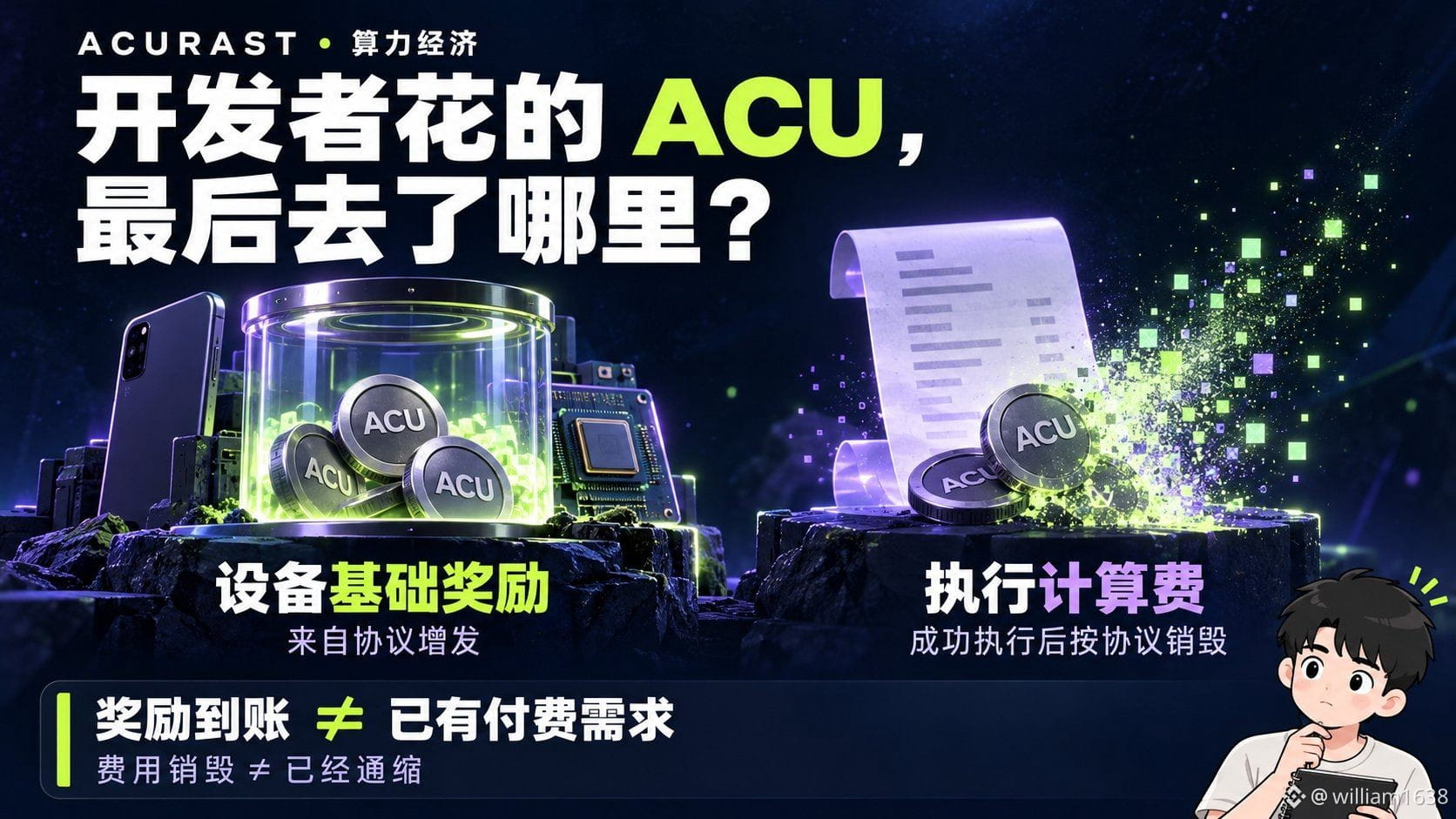
The base rewards received by device providers come from a protocol-issued rewards pool and are allocated according to rules such as device benchmark performance. Staked Compute also has a corresponding staking rewards mechanism.
Execution fees paid by developers, on the other hand, are burned by the protocol after successful execution. They are not transferred directly to phone owners.
So, seeing a device receive rewards shows that it is getting network incentives, but that number alone doesn’t tell us how many developers are paying to use it.
Do devices get extra incentives when they actually execute tasks?
Yes. The documentation calls it the Busy Bonus: devices that meet the task execution detection criteria for the current period receive a 10% boost to their base metric weight, which affects their share of the rewards pool. Note that this is a boost to the weight; it shouldn’t be taken to mean a fixed 10% more tokens are paid out each day.
I think this is worth keeping an eye on. The network needs people to connect devices and keep them available, and it also needs those devices to receive tasks. Factoring actual task execution into the rewards mechanism gives providers more reason to maintain their devices properly.
For ACU, I’ll be looking at a few figures together: how much was issued in rewards, how much computing resources developers actually used, and how much in computing fees was burned as a result.
A burn mechanism alone doesn’t let us conclude that “it’s already deflationary.” We also need to compare it with issuance over the same period. More devices means growing supply; it’s applications’ willingness to keep paying that signals growing demand.
Phone computing power can already be experienced through real applications. What I’d most like to see next is whether these applications stick around and keep using this network.
If you want to look into where the rewards come from, you can go straight to this official page:
https://docs.acurast.com/processors/rewards/
12
·
--
I've been wanting to make more use of AI automation. I still have to work during the day, so having an assistant put together a daily report of updates on projects I follow and official announcements before I start work could save me a lot of time scrolling through messages.
But there's a very practical issue when setting this stuff up: the program needs to keep running. Once you've chosen a model and configured the workflow, you still have to figure out where to run it and what happens if it goes offline.
So when I saw that Acurast had published an official tutorial on deploying OpenClaw, I was immediately interested in what it could be used for.
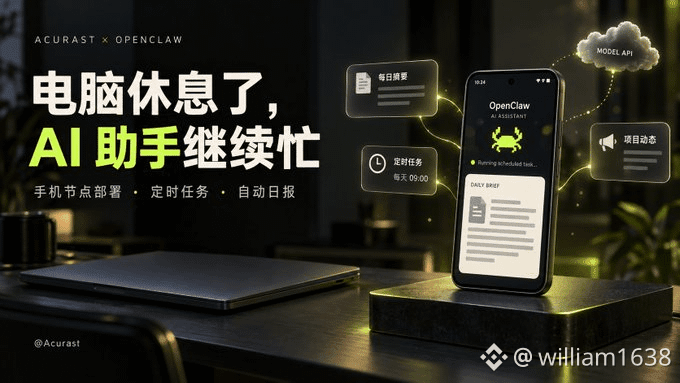
With its Cargo, you can deploy OpenClaw to mobile nodes on the Acurast network. The assistant runs on a remote node, so it keeps running even when you turn off your own computer. For tasks like organizing information and generating scheduled daily reports, this kind of deployment is worth looking into.
One detail is worth clarifying, though: the official tutorial still requires you to configure the OpenRouter API. The mobile node runs the assistant program, while the large language model is accessed via API, so the associated costs need to be considered separately. You can't just grab a phone and run the whole AI setup for free.
As a developer, I'd be interested in how long it takes to configure, how reliably it runs, and how easy it is to check the logs if something goes wrong. After all, automation is supposed to make things easier. If I have to keep checking every day to see whether it's gone offline, that kind of defeats the purpose.
I haven't deployed it myself yet, so I won't draw any conclusions about how well it works in practice. But now that there's an official tutorial, you could start with a simple scheduled task, see how it runs over a few days, and then work out the total cost of deployment and model API calls.
If it can reliably generate a scheduled daily report, that would mean more to me than seeing a long list of computing power specs.
36
·
--
What can a phone actually do when it joins a compute network?
I’ve been looking into Acurast lately, and this is what I’ve been most curious to understand. Just saying “phones can contribute computing power” still feels a bit abstract—you have to see what’s actually running.
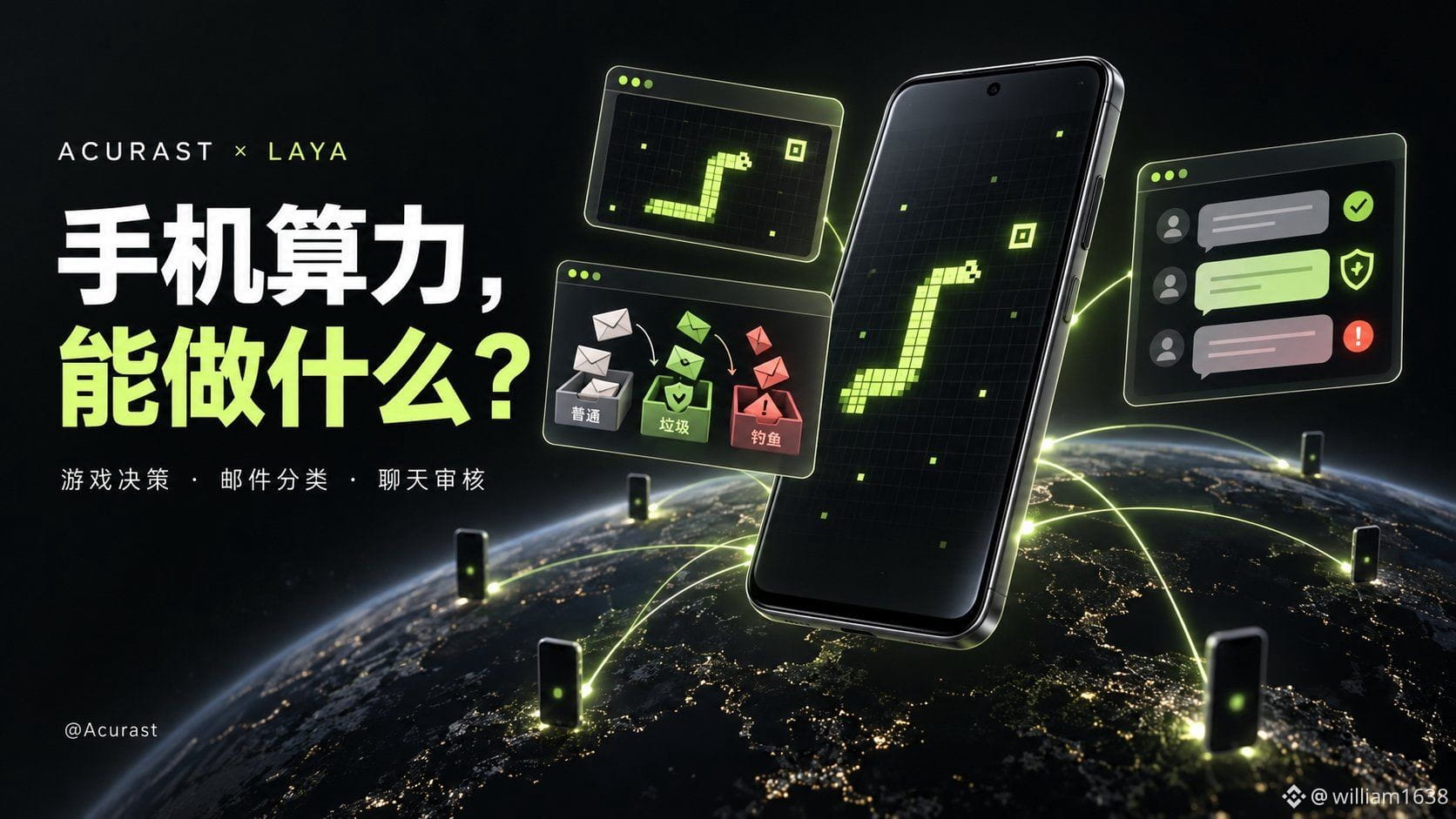
The Laya demo they recently shared makes it pretty clear: AI controls when a Snake game turns, sorts emails into normal, spam, or phishing, or checks whether a chat message contains spam. These decisions are handled by Android phones on the Acurast network.
Imagine watching a snake turn on a webpage, while somewhere in another country, a phone has just made that choice behind the scenes. Pretty interesting
😂
The page also shows details about the device doing the work, such as its country and chip, and provides a way to verify the results on-chain.
This has given me a more concrete idea of what phones can do with their computing power. Many apps need to make small decisions over and over. If those tasks can be handled by the right devices, they could become a real use case for phone-based computing.
Of course, the demo has its limits. The team notes that the model can make mistakes, and messages can get queued if they come in too quickly. Before this can be used in a real product, accuracy and stability still need to be assessed.
But at least now there’s something you can open up and try. My interest in Acurast has shifted from “that’s a pretty interesting idea” to “what other tasks would be a good fit to run on it?”
30
·
--
Verifying my Binance Square account for YZi Labs Amplify via EchoHunt: EH-R6RQHP
Verifying my Binance Square account for YZi Labs Amplify via EchoHunt: EH-R6RQHP
178
·
--
🎙️ Did they all turn red after I woke up in one night? Are the bulls leaving?
End
02 h 38 m 22 s
10.8k
24
27
·
--
I got headshot, I've never been so badly shot before
I got headshot, I've never been so badly shot before
3
589
·
--
During this period, many people are discussing geopolitical issues, still accustomed to first looking at emotions and popularity. But my perspective on @SignOfficial is a bit different; I am more concerned about when identity, permissions, fund distribution, and qualification certification start requiring verifiability, who will actually serve as the "evidence layer" at the bottom. The term Sign leaves an impression on me, not for shouting concepts, but for its work on schema and attestation, which are more foundational aspects. In simple terms, the more complex the environment, the less you can rely solely on a phrase like "it's on the chain" to solve problems. You also need to clarify who issued it, who verifies it, according to what rules it is executed, and how to trace it back if issues arise. This is also why I don't want to regard $SIGN only as a short-term topic; it feels more like a position that may not be the hottest initially, but once genuinely adopted, the market will reinterpret its significance. I am more concerned about whether there will be more real scenarios that incorporate this capability. If there are, #Sign地缘政治基建 will become increasingly smooth; if not, it will remain in the observation period. My attitude at this stage is very simple: continue watching, not to deify it, but also not to underestimate it.
During this period, many people are discussing geopolitical issues, still accustomed to first looking at emotions and popularity. But my perspective on @SignOfficial is a bit different; I am more concerned about when identity, permissions, fund distribution, and qualification certification start requiring verifiability, who will actually serve as the "evidence layer" at the bottom. The term Sign leaves an impression on me, not for shouting concepts, but for its work on schema and attestation, which are more foundational aspects. In simple terms, the more complex the environment, the less you can rely solely on a phrase like "it's on the chain" to solve problems. You also need to clarify who issued it, who verifies it, according to what rules it is executed, and how to trace it back if issues arise. This is also why I don't want to regard $SIGN only as a short-term topic; it feels more like a position that may not be the hottest initially, but once genuinely adopted, the market will reinterpret its significance. I am more concerned about whether there will be more real scenarios that incorporate this capability. If there are, #Sign地缘政治基建 will become increasingly smooth; if not, it will remain in the observation period. My attitude at this stage is very simple: continue watching, not to deify it, but also not to underestimate it.
1
55
Log in to explore more content
Join global crypto users on Binance Square
⚡️ Get latest and useful information about crypto.
💬 Trusted by the world’s largest crypto exchange.
👍 Discover real insights from verified creators.
Email / Phone number
Trending Topics
BinanceProcesses$4.65BWithdrawals
18,736 views
101 Discussing
Binance Processes $4.65 Billion in Withdrawals After Reopening, Net Outflow of $3.64 Billion Equals 2.1% of Its $171 Billion in Assets
Binance News
·38 Likes
·10.6k views
WithdrawalsBack: 15 networks live
6,952 views
120 Discussing
BinanceUpdatesProofofReservesAddresses
111,944 views
1,485 Discussing