
Ruruyung
19 Posts

Ruruyung
Report
Block User
人生只有一次,当然要一直前进!

BTC Holder
Frequent Trader
1.7 Years
9 Following
12 Followers
3 Liked
Posts
·
--
Bearish
CPI is out: October rose 0.4% month over month, versus expectations of just 0.3%; core CPI rose 0.3%, also hotter than the expected 0.2%. The government shutdown last October, so year-over-year figures weren’t provided this time.
U.S. stocks have also closed: S&P 500 7,520.93 (-0.38%), Dow 52,231.89 (-0.30%), Nasdaq 25,065.87 (-0.74%).
It’s hotter than expected, so be it. I wouldn’t chase the initial bounce—let’s wait and see.
U.S. stocks have also closed: S&P 500 7,520.93 (-0.38%), Dow 52,231.89 (-0.30%), Nasdaq 25,065.87 (-0.74%).
It’s hotter than expected, so be it. I wouldn’t chase the initial bounce—let’s wait and see.

1
97
·
--
Many people misunderstand on-chain strategies, thinking they’re just the same old “black-box dashboard” from traditional ETF investing moved online. That couldn’t be more wrong!!
When you buy a traditional ETF, you have no idea what the fund manager is doing behind closed doors with your money. All you can do is look at their “polished PPTs” every quarter—which are no different from doctored photos (centralized).
On-chain, you can see every portfolio rebalance laid out in the open. But what really matters is the moment the portfolio is rebalanced: Where did the money go? Why was it moved? Can you look it up yourself and get the full picture, instead of just taking the manager’s word for it? (Decentralized)
OWL AI now records the weights and reasons behind every rebalance directly in an on-chain smart contract (ERC-4626), where nobody can change them. Performance can be misleading, but code doesn’t lie. That’s what real “transparency” and accountability to retail investors look like.
👉 When you’re copy trading, what are you most afraid the manager might secretly do? Tell Jennie in the comments!
#RWA #defiance #加密投资

33
·
--

Article
From TV Reporter to a $4.8 Billion Computing-Power Deal Maker: A Roadmap to the “Career-Change Stepping Stones” Anyone Can ReplicateAlice Huang (黄乐) has an exceptionally wide-ranging career: reporter for Hunan TV and CCTV → assistant to the president of HSBC Private Banking → vice president in a business division at CITIC Securities → fund manager at Hexi Investment → managing director at Singapore-based Megaspeed. At first glance, these roles seem completely unrelated. But break down her career, and you can see how each step paved the way for the next. For most people, what’s truly worth learning from isn’t her specific job titles, but the “transferable skills” she built at each stop.
First stop: Four years in the media—honing the skills of “finding people, asking questions, and getting information”
She previously worked as a reporter for Hunan TV and CCTV. This experience may seem unrelated to the GPU business, but the core skills reporters develop are finding the right people quickly, asking the questions that get to the key information, and building trust over meals and on camera. These skills are invaluable in private banking, securities firms, private equity, and the computing-power industry—the essence is gathering information and building rapport.
From TV Reporter to a $4.8 Billion Computing-Power Deal Maker: A Roadmap to the “Career-Change Stepping Stones” Anyone Can Replicate
Alice Huang (黄乐) has an exceptionally wide-ranging career: reporter for Hunan TV and CCTV → assistant to the president of HSBC Private Banking → vice president in a business division at CITIC Securities → fund manager at Hexi Investment → managing director at Singapore-based Megaspeed. At first glance, these roles seem completely unrelated. But break down her career, and you can see how each step paved the way for the next. For most people, what’s truly worth learning from isn’t her specific job titles, but the “transferable skills” she built at each stop.
First stop: Four years in the media—honing the skills of “finding people, asking questions, and getting information”
She previously worked as a reporter for Hunan TV and CCTV. This experience may seem unrelated to the GPU business, but the core skills reporters develop are finding the right people quickly, asking the questions that get to the key information, and building trust over meals and on camera. These skills are invaluable in private banking, securities firms, private equity, and the computing-power industry—the essence is gathering information and building rapport.
NVDA-6.64%
HSBCUS-1.02%
162
·
--
Bullish
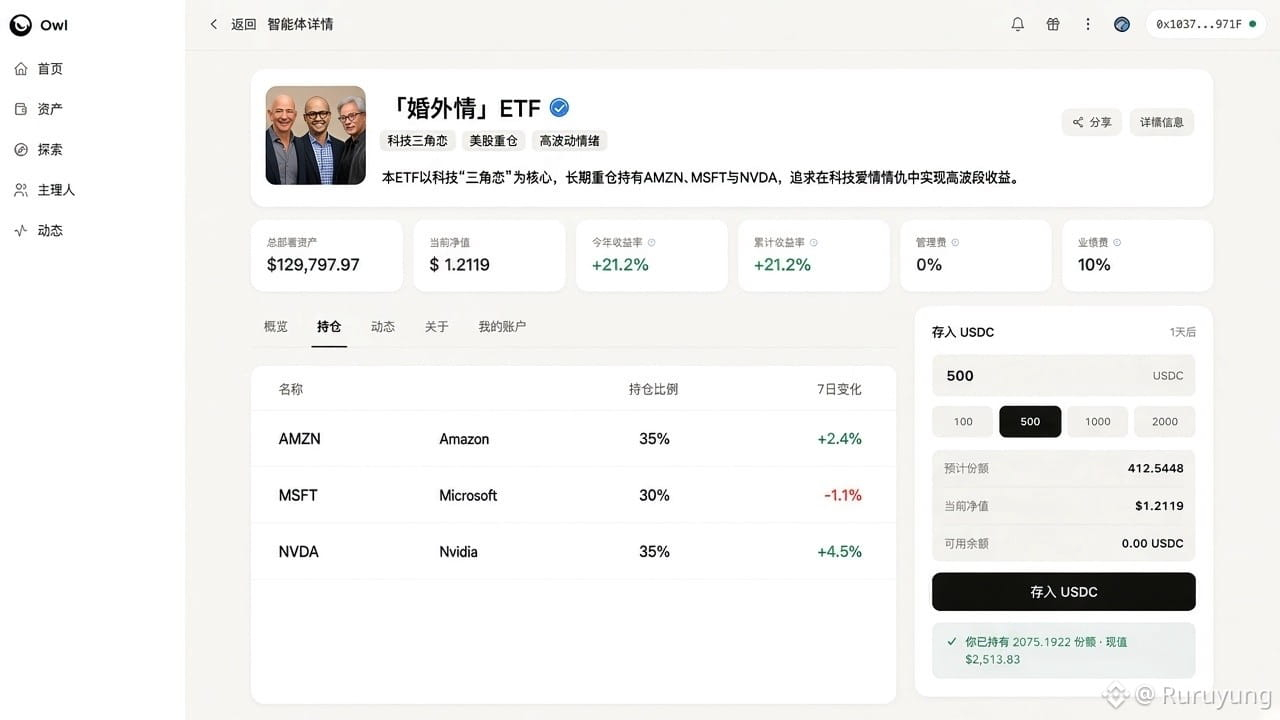
Affair ETF Bull Case:
$AMZN
Jeff Bezos’s net worth has increased by $2 trillion since his affair in 2019.
$MSFT
Bill Gates’s net worth has increased by $2 trillion since his affair in 2021.
$NVDA Bull case just announced
Affair ETF Bull Case:
$AMZN
Jeff Bezos’s net worth has increased by $2 trillion since his affair in 2019.
$MSFT
Bill Gates’s net worth has increased by $2 trillion since his affair in 2021.
$NVDA Bull case just announced
$AMZN
Jeff Bezos’s net worth has increased by $2 trillion since his affair in 2019.
$MSFT
Bill Gates’s net worth has increased by $2 trillion since his affair in 2021.
$NVDA Bull case just announced
74
·
--
{future}(NVDAUSDT)
Jensen Huang sent employees an internal letter apologizing for controversy related to his personal life, and said he would continue to lead Nvidia. A company spokesperson said the investigation would not affect business operations.
Chip stocks broadly weakened in overnight trading: Nvidia fell more than 2%, while TSMC, AMD, and SK Hynix were all down more than 1%.
When China’s A-share computing-power sector opens today, sentiment may need some time to digest the news. Investors will also be watching how funds react to areas such as optical modules and PCBs.
Is this just a short-term disturbance, or is the market starting to reassess the computing-power sector? Is the sector’s anchor still holding firm?
104
·
--

Article
US stocks plunge, BTC falls below 80,000: How intense is the selling pressure?This morning, US stocks and BTC fell together. The point isn’t just to say again that “the two markets are correlated.”
The Nasdaq fell −5.52%, with tech stocks under broad pressure; Bitcoin also briefly fell below 80,000 over the past 24 hours. The two moved in the same direction, but they don’t share the same closing window: the US stock market has closed, while crypto prices are still moving. Don’t rush to judge which one dragged the other down, or treat liquidated long positions as if they directly reveal who was selling in this market move. What we can see is clear selling pressure in both markets: media reports mostly attribute the US stock decline to pressure on AI and chip trades; in crypto derivatives, large numbers of long positions were also forcibly liquidated. These two things can be considered together, but we can’t say they were caused by the same trade.
US stocks plunge, BTC falls below 80,000: How intense is the selling pressure?
This morning, US stocks and BTC fell together. The point isn’t just to say again that “the two markets are correlated.”
The Nasdaq fell −5.52%, with tech stocks under broad pressure; Bitcoin also briefly fell below 80,000 over the past 24 hours. The two moved in the same direction, but they don’t share the same closing window: the US stock market has closed, while crypto prices are still moving. Don’t rush to judge which one dragged the other down, or treat liquidated long positions as if they directly reveal who was selling in this market move. What we can see is clear selling pressure in both markets: media reports mostly attribute the US stock decline to pressure on AI and chip trades; in crypto derivatives, large numbers of long positions were also forcibly liquidated. These two things can be considered together, but we can’t say they were caused by the same trade.
The Nasdaq fell −5.52%, with tech stocks under broad pressure; Bitcoin also briefly fell below 80,000 over the past 24 hours. The two moved in the same direction, but they don’t share the same closing window: the US stock market has closed, while crypto prices are still moving. Don’t rush to judge which one dragged the other down, or treat liquidated long positions as if they directly reveal who was selling in this market move. What we can see is clear selling pressure in both markets: media reports mostly attribute the US stock decline to pressure on AI and chip trades; in crypto derivatives, large numbers of long positions were also forcibly liquidated. These two things can be considered together, but we can’t say they were caused by the same trade.
409
·
--
Last night, U.S. stocks and crypto markets both experienced a sharp sell-off.
The Nasdaq fell 5.52% in a single day, entering correction territory; the S&P 500 dropped 4.36%, and the Dow fell 3.44%. Chip and AI-related stocks were hit especially hard, and the market is starting to worry that the pace of AI infrastructure expansion could change.
BTC also briefly fell from above $80,800 to around $76,100, a drop of more than 5%. The sell-off in U.S. stocks, combined with liquidations of leveraged long positions, amplified short-term volatility.
What’s worth watching now isn’t just “how much it fell,” but whether the risk-off sentiment will spread from AI and chip stocks to more high-volatility assets. U.S. nonfarm payrolls data is also due tonight, and the market will use it to reassess employment and interest-rate expectations.
Do you think this is more like a short-term deleveraging event, or are risk appetites starting to shift?
#美股 #BTC #加密市场 #市场观察

68
·
--
Tokenized stocks have been a hot topic lately, and more and more related platforms are emerging.
But more platforms doesn’t mean these assets have really made their way into DeFi. One estimate I saw suggests that only about 6.4% of the nominal value can currently enter DeFi.
Rather than focusing on how many trading venues there are, I care more about something practical: How are assets allocated? When are portfolios rebalanced? And why? These questions need clear answers, especially when U.S. stocks, ETFs, crypto assets, and commodities are all in the same portfolio.
That’s what OWL AI aims to do: bring different assets together in strategy portfolios that you can follow. You can Follow, Star, or Subscribe to strategies in a way that suits you.
Not investment advice.
#RWA #Tokenization

46
·
--
Let's flatten it first and pick it back up later 😘
Let's flatten it first and pick it back up later 😘
65
·
--

Article
U.S. Stocks Rebound | Oil Prices Retreat | BTC Still One to WatchElection results are in, and markets are moving for different reasons: U.S. stocks rebounded sharply on Wednesday, with the Dow up about 3%; oil prices, however, fell more than 8%; Bitcoin climbed back above $80,000, but ETF outflows haven’t stopped.
My take is that it’s too soon to simply call this a full-fledged return of risk appetite. U.S. stocks seem to be pricing in less political uncertainty, while oil is betting that tensions in the Middle East may ease. The crypto market still faces pressure from fund flows and security incidents.
So I’m not rushing to draw conclusions based on a single day of big gains. What I’m most interested in watching next: whether the stock market rebound holds, whether BTC ETFs see inflows again, and whether oil prices keep falling. Which one do you think is most worth watching right now? Share your thoughts in the comments~
U.S. Stocks Rebound | Oil Prices Retreat | BTC Still One to Watch
Election results are in, and markets are moving for different reasons: U.S. stocks rebounded sharply on Wednesday, with the Dow up about 3%; oil prices, however, fell more than 8%; Bitcoin climbed back above $80,000, but ETF outflows haven’t stopped.
My take is that it’s too soon to simply call this a full-fledged return of risk appetite. U.S. stocks seem to be pricing in less political uncertainty, while oil is betting that tensions in the Middle East may ease. The crypto market still faces pressure from fund flows and security incidents.
So I’m not rushing to draw conclusions based on a single day of big gains. What I’m most interested in watching next: whether the stock market rebound holds, whether BTC ETFs see inflows again, and whether oil prices keep falling. Which one do you think is most worth watching right now? Share your thoughts in the comments~
552
·
--
Stablecoins shrink by $4.2B in a week
Prices have stopped falling, but capital on the sidelines is still leaving.
According to DefiLlama, the total stablecoin market cap was about $298.34 billion on 11/1, down about $4.26 billion in a week (from about $302.6 billion on 10/25). It has declined for four consecutive days since 10/29. USDT was about $179.30 billion, down about $3.12 billion in a week and about $4.55 billion in a month; USDC was about $71.64 billion, also down about $110 million in a week. Both major stablecoins are shrinking at the same time—not a shift from one to the other, but an exit.
Sentiment has improved slightly: the Fear and Greed Index rose from 30 (11/1) to 34 (11/2), but remains in fear territory. The Binance BTCUSDT retail long/short ratio is about 2.25, with longs at around 69%—it’s mainly retail traders trying to buy the dip.
In a nutshell: the price has stopped falling thanks to retail traders adding to their long positions, while the supply of stablecoins—which represents fresh buying power—is still flowing out. Without new money coming in to take over, this isn’t a solid bottom, and any rebound could be choppy. The habit I picked up from TradFi is to look at capital flows before sentiment. The shrinking stablecoin supply stands out more than the index’s recovery.
A few things to watch today (Asia/Shanghai):
· Binance’s preliminary Proof of Reserves (PoR) snapshot, expected to be published on 11/2
· 22:30 US stock market open; 23:00 ISM Manufacturing PMI
· Tomorrow, 11/3: US midterm elections
Rather than guessing where the bottom is, keep an eye on whether “new money is coming back.” For example, set a rule: reassess risk-asset exposure only after the total stablecoin supply has increased for 3 consecutive days. Until then, keep risk allocation relatively low. A clearly stated rule can be checked every day.
Would you look at stablecoin flows first, or retail positioning?
OWL is a decentralized portfolio strategy platform covering US stocks, ETFs, crypto assets, and commodities, built on ERC-4626 vaults. Strategy managers turn their allocation ideas into public, trackable on-chain strategies: what conditions trigger adding to a position, and what conditions call for staying in low-volatility assets—all can be verified afterward. You can start by following managers you’re interested in and starring their strategies, then decide whether to subscribe.
70
·
--
Binance Hot Wallet Hack: The Scary Part Wasn’t “Losing the Private Key”—It Was Someone Remotely Controlling the Signing System
I reviewed Binance’s roughly $6.3 billion hot wallet theft this morning. Many people’s first reaction was “another smart contract vulnerability” or “the private key was stolen.” Based on the reconstruction by security firms so far, neither is the more likely explanation.
The real problem was a layer deeper: after the hot wallet’s signing infrastructure (HSM / MPC + policy engine) was compromised, the hackers gained the ability to “sign on demand”—they didn’t necessarily need to get hold of the complete plaintext private key; they could still make the system keep producing valid signatures.
Two on-chain details help illustrate what happened. In the attack on Binance 14, the attackers submitted 50 consecutive Nonce EIP-7702 signatures all at once. If they already had the complete private key, there would usually be no need to “blindly spray” signatures like this. It looks more like they could command the signing machine to sign, but couldn’t predict which Nonce would be current when the transactions hit the chain. Also, within roughly 24 seconds, hot wallets across multiple chains and using different signature algorithms showed activity almost simultaneously. That looks more like a breach of the centralized, top-level orchestration system than the theft of a single key.
The timeline is chilling, too: the hackers were lurking for at least roughly 37 hours. They first withdrew Gas from Tornado Cash, then used about $7 million in stablecoins to conduct an EIP-7702 “live-fire rehearsal” sweep. Only after the rehearsal did they launch the main attack. BTC moved first, followed by a single-transaction drain of multiple assets on the Ethereum side using EIP-7702. The community initially blamed EIP-7702, but the mechanism itself requires a valid signature to attach malicious logic—it was more a tool to speed up the sweep than the root cause.
For ordinary users, I think it’s enough to remember these points: “Keeping assets on an exchange” does not mean “they’re absolutely safe.” No matter how sophisticated a hot wallet is, once its signing pipeline is compromised, the window for risk controls to respond can shrink to almost nothing. Don’t focus only on smart contract audits. For custodians, it’s more important to ask who can trigger signatures, whether the policy engine is behaving abnormally, and whether multiple chains share the same orchestration system. Freezes on the stablecoin side and on-chain tracking are important, but they’re remedies after something goes wrong. Beforehand, the best measures are still to diversify custody, limit hot wallet exposure, and route large amounts through slower but more controllable channels.
These are personal reading notes and a risk reminder only, not investment advice.
2
463
Log in to explore more content
Join global crypto users on Binance Square
⚡️ Get latest and useful information about crypto.
💬 Trusted by the world’s largest crypto exchange.
👍 Discover real insights from verified creators.
Email / Phone number
Trending Topics
HuangExitNvidiaStrategyInFocus
47,846 views
716 Discussing
STOCKS | Nvidia’s Jensen Huang Resigns, Colette Kress Named as Interim CEO
Binance News
·20 Likes
·24.1k views
AnthropicRejectsIPODelayValuationinQuestion
628,233 views
5,018 Discussing
BitMineReports$6.3BNetLossForFiscal2026
5,533 views
88 Discussing