

User-0d00
39 Posts

User-0d00
Report
Block User
13 Following
81 Followers
23 Liked
Posts
All
Quotes
·
--
$844 million in short sellers getting decisively liquidated and the liquidity released is pushing the “big cake” toward the most dangerous high-position chips like musical chairs.
This morning, $BTC squeezed straight up and topped at 87,395 dollars, while $DOGE surged more than 11% in a single day. On the surface, it looks like a whole-network celebration feast for the long side—but the underlying logic on the chart is extremely dangerous. This breakout rally isn’t active accumulation by major spot funds; it’s passive buying pressure created by shorts being forced liquidated in a concentrated stampede. With open interest across the market skyrocketing, once the shorts have been cleaned out, the price action must rely on much larger amounts of real, physical spot “gold and silver” to hold the 85,000 level. If spot fails to follow through with sufficient buying, the heavily leveraged long positions piled up to the peak will trigger a reversal and detonation.
My live trading response right now: above 86,000, I refuse to chase with any additional spot buys. My long positions’ defensive take-profit is moved up to around the 83,800 area—if price breaks below it, I’ll immediately lock in profits and exit. If there’s an intraday pullback to 84,200–84,500 and spot shows dense absorption/support, I’ll consider doing a light-size T trade; otherwise, I’d rather stay fully in cash and watch.
A行情 pushed up by the other side’s liquidation—when it retraces, it gets smashed harder than anyone else.
#比特币突破85K #Shorts liquidated
$844 million in short sellers getting decisively liquidated and the liquidity released is pushing the “big cake” toward the most dangerous high-position chips like musical chairs.
This morning, $BTC squeezed straight up and topped at 87,395 dollars, while $DOGE surged more than 11% in a single day. On the surface, it looks like a whole-network celebration feast for the long side—but the underlying logic on the chart is extremely dangerous. This breakout rally isn’t active accumulation by major spot funds; it’s passive buying pressure created by shorts being forced liquidated in a concentrated stampede. With open interest across the market skyrocketing, once the shorts have been cleaned out, the price action must rely on much larger amounts of real, physical spot “gold and silver” to hold the 85,000 level. If spot fails to follow through with sufficient buying, the heavily leveraged long positions piled up to the peak will trigger a reversal and detonation.
My live trading response right now: above 86,000, I refuse to chase with any additional spot buys. My long positions’ defensive take-profit is moved up to around the 83,800 area—if price breaks below it, I’ll immediately lock in profits and exit. If there’s an intraday pullback to 84,200–84,500 and spot shows dense absorption/support, I’ll consider doing a light-size T trade; otherwise, I’d rather stay fully in cash and watch.
A行情 pushed up by the other side’s liquidation—when it retraces, it gets smashed harder than anyone else.
#比特币突破85K #Shorts liquidated
This morning, $BTC squeezed straight up and topped at 87,395 dollars, while $DOGE surged more than 11% in a single day. On the surface, it looks like a whole-network celebration feast for the long side—but the underlying logic on the chart is extremely dangerous. This breakout rally isn’t active accumulation by major spot funds; it’s passive buying pressure created by shorts being forced liquidated in a concentrated stampede. With open interest across the market skyrocketing, once the shorts have been cleaned out, the price action must rely on much larger amounts of real, physical spot “gold and silver” to hold the 85,000 level. If spot fails to follow through with sufficient buying, the heavily leveraged long positions piled up to the peak will trigger a reversal and detonation.
My live trading response right now: above 86,000, I refuse to chase with any additional spot buys. My long positions’ defensive take-profit is moved up to around the 83,800 area—if price breaks below it, I’ll immediately lock in profits and exit. If there’s an intraday pullback to 84,200–84,500 and spot shows dense absorption/support, I’ll consider doing a light-size T trade; otherwise, I’d rather stay fully in cash and watch.
A行情 pushed up by the other side’s liquidation—when it retraces, it gets smashed harder than anyone else.
#比特币突破85K #Shorts liquidated
358
·
--
Institutional funds are using real money to carry out the most thorough asset segregation.
The latest disclosed data is brutal: on Friday, spot Bitcoin ETFs recorded a net inflow of $433 million again, with just Fidelity’s FBTC alone accumulating $310 million; while $ETH ETF ended four consecutive weeks of net buying and flipped directly to a net outflow. The deeper backdrop is that the U.S. Congress’s clear-cut crypto regulatory bill, the Clarity Act, has once again stalled in the Senate. Wall Street’s response is extremely practical: instead of getting entangled in the wrangling over the regulatory bill, they treat the $BTC as a macro hedge position to counter potential Fed tightening. Any public chain that relies on the compliant ecosystem to actually take off is left by the wayside.
My current live-trading response is equally clear: in the short term, completely abandon any fantasy of a rebound in the Ethereum exchange rate, and liquidate and close out all exchange-rate positions. Until the weekly chart is confirmed to hold steady above the 80000 level, I will only set high-probability grid buy orders at the key support levels of BTC. I will never misallocate defensive capital into assets that lack institutional incremental demand.
When Wall Street only recognizes BTC, those who cling to the fantasy of a broad-based market-wide uptrend are destined only to pay the bill for institutions’ rebalancing.
#比特币ETF #Federal Reserve monetary policy
Institutional funds are using real money to carry out the most thorough asset segregation.
The latest disclosed data is brutal: on Friday, spot Bitcoin ETFs recorded a net inflow of $433 million again, with just Fidelity’s FBTC alone accumulating $310 million; while $ETH ETF ended four consecutive weeks of net buying and flipped directly to a net outflow. The deeper backdrop is that the U.S. Congress’s clear-cut crypto regulatory bill, the Clarity Act, has once again stalled in the Senate. Wall Street’s response is extremely practical: instead of getting entangled in the wrangling over the regulatory bill, they treat the $BTC as a macro hedge position to counter potential Fed tightening. Any public chain that relies on the compliant ecosystem to actually take off is left by the wayside.
My current live-trading response is equally clear: in the short term, completely abandon any fantasy of a rebound in the Ethereum exchange rate, and liquidate and close out all exchange-rate positions. Until the weekly chart is confirmed to hold steady above the 80000 level, I will only set high-probability grid buy orders at the key support levels of BTC. I will never misallocate defensive capital into assets that lack institutional incremental demand.
When Wall Street only recognizes BTC, those who cling to the fantasy of a broad-based market-wide uptrend are destined only to pay the bill for institutions’ rebalancing.
#比特币ETF #Federal Reserve monetary policy
The latest disclosed data is brutal: on Friday, spot Bitcoin ETFs recorded a net inflow of $433 million again, with just Fidelity’s FBTC alone accumulating $310 million; while $ETH ETF ended four consecutive weeks of net buying and flipped directly to a net outflow. The deeper backdrop is that the U.S. Congress’s clear-cut crypto regulatory bill, the Clarity Act, has once again stalled in the Senate. Wall Street’s response is extremely practical: instead of getting entangled in the wrangling over the regulatory bill, they treat the $BTC as a macro hedge position to counter potential Fed tightening. Any public chain that relies on the compliant ecosystem to actually take off is left by the wayside.
My current live-trading response is equally clear: in the short term, completely abandon any fantasy of a rebound in the Ethereum exchange rate, and liquidate and close out all exchange-rate positions. Until the weekly chart is confirmed to hold steady above the 80000 level, I will only set high-probability grid buy orders at the key support levels of BTC. I will never misallocate defensive capital into assets that lack institutional incremental demand.
When Wall Street only recognizes BTC, those who cling to the fantasy of a broad-based market-wide uptrend are destined only to pay the bill for institutions’ rebalancing.
#比特币ETF #Federal Reserve monetary policy
1
248
·
--
As long as the broader market dips slightly with reduced volume, the huge trading volume of the “altcoin leader” becomes a litmus test—the mirror that reveals who’s swimming naked.
$ZEC blasted out $280 million in a single day to top the charts, yet the price still plunged nearly 8% from the highs. This indicates that the “whale” is not accumulating at all; instead, it’s riding the high momentum to conduct perpetual/futures arbitrage and distribute holdings on a large scale. On the other side, $ONE surged 87% against the trend, with trading volume breaking 92 million. But what the order book exposes is pure liquidity imbalance at negative funding rates that follows after short liquidations—once the squeeze momentum runs out, it turns into the classic head-chopping “termination blade.” $AVAX rose 10% against the trend as well, but spot trading has already been suppressed entirely within the prior strong resistance zone. The intent behind the market maker’s order placement and turnover is extremely obvious.
My current live-game response: before the broader market confirms stabilization around the 80000 level, I won’t touch any spot assets on the “big surge” board. $ONE is only waiting for the opportunity on the right side after the funding rate turns positive; for $AVAX , around 9.8 I will firmly take profit in batches, and I won’t participate in tail-end bargain-chasing.
In a game where the available capital is a shrinking pool, if your risk control isn’t solid, the “big surge” board is the cruelest liquidity graveyard.
#山寨币行情 #主力盘口分析
As long as the broader market dips slightly with reduced volume, the huge trading volume of the “altcoin leader” becomes a litmus test—the mirror that reveals who’s swimming naked.
$ZEC blasted out $280 million in a single day to top the charts, yet the price still plunged nearly 8% from the highs. This indicates that the “whale” is not accumulating at all; instead, it’s riding the high momentum to conduct perpetual/futures arbitrage and distribute holdings on a large scale. On the other side, $ONE surged 87% against the trend, with trading volume breaking 92 million. But what the order book exposes is pure liquidity imbalance at negative funding rates that follows after short liquidations—once the squeeze momentum runs out, it turns into the classic head-chopping “termination blade.” $AVAX rose 10% against the trend as well, but spot trading has already been suppressed entirely within the prior strong resistance zone. The intent behind the market maker’s order placement and turnover is extremely obvious.
My current live-game response: before the broader market confirms stabilization around the 80000 level, I won’t touch any spot assets on the “big surge” board. $ONE is only waiting for the opportunity on the right side after the funding rate turns positive; for $AVAX , around 9.8 I will firmly take profit in batches, and I won’t participate in tail-end bargain-chasing.
In a game where the available capital is a shrinking pool, if your risk control isn’t solid, the “big surge” board is the cruelest liquidity graveyard.
#山寨币行情 #主力盘口分析
$ZEC blasted out $280 million in a single day to top the charts, yet the price still plunged nearly 8% from the highs. This indicates that the “whale” is not accumulating at all; instead, it’s riding the high momentum to conduct perpetual/futures arbitrage and distribute holdings on a large scale. On the other side, $ONE surged 87% against the trend, with trading volume breaking 92 million. But what the order book exposes is pure liquidity imbalance at negative funding rates that follows after short liquidations—once the squeeze momentum runs out, it turns into the classic head-chopping “termination blade.” $AVAX rose 10% against the trend as well, but spot trading has already been suppressed entirely within the prior strong resistance zone. The intent behind the market maker’s order placement and turnover is extremely obvious.
My current live-game response: before the broader market confirms stabilization around the 80000 level, I won’t touch any spot assets on the “big surge” board. $ONE is only waiting for the opportunity on the right side after the funding rate turns positive; for $AVAX , around 9.8 I will firmly take profit in batches, and I won’t participate in tail-end bargain-chasing.
In a game where the available capital is a shrinking pool, if your risk control isn’t solid, the “big surge” board is the cruelest liquidity graveyard.
#山寨币行情 #主力盘口分析
87
·
--
The so-called “market recovery” in the current counterfeit market isn’t really a recovery at all—it’s a blatant hunt for derivatives-position chips.
On the surface, there’s a frenzy of local hot spots where demons run wild; in reality, everyone is just digging into each other’s pockets. Look at $ONE : a single-day surge of more than 80%. The perpetual contract funding rate was directly inverted to -0.0282%—purely a negative-fee liquidation cascade, where short-side liquidity was repeatedly wiped out, forcing a short squeeze.
Now look at trading volume topping 280 million to take the lead, $ZEC. But across the whole network, the share of long accounts is only 32%. Large players are basically using the heat to put on huge hedges and flip position chips. In contrast, for $AVAX, whose price increase is among the top performers, the proportion of retail long accounts skyrockets to 71%. Yet the buy-sell ratio for active trading drops to around 0.7—classic behavior where retail limit orders are waiting to be the bagholders, while the main forces use the momentum to offload their chips to retail.
Don’t mistake this kind of localized derivatives squeeze for a full-blown “alt season” starting up. In a low-volume game of tug-of-war, once the squeeze ends, spot buyers who impulsively chase will turn into the liquidity leftovers for the next round of price action.
#山寨币异动 #Contract long/short tug-of-war
The so-called “market recovery” in the current counterfeit market isn’t really a recovery at all—it’s a blatant hunt for derivatives-position chips.
On the surface, there’s a frenzy of local hot spots where demons run wild; in reality, everyone is just digging into each other’s pockets. Look at $ONE : a single-day surge of more than 80%. The perpetual contract funding rate was directly inverted to -0.0282%—purely a negative-fee liquidation cascade, where short-side liquidity was repeatedly wiped out, forcing a short squeeze.
Now look at trading volume topping 280 million to take the lead, $ZEC . But across the whole network, the share of long accounts is only 32%. Large players are basically using the heat to put on huge hedges and flip position chips. In contrast, for $AVAX , whose price increase is among the top performers, the proportion of retail long accounts skyrockets to 71%. Yet the buy-sell ratio for active trading drops to around 0.7—classic behavior where retail limit orders are waiting to be the bagholders, while the main forces use the momentum to offload their chips to retail.
Don’t mistake this kind of localized derivatives squeeze for a full-blown “alt season” starting up. In a low-volume game of tug-of-war, once the squeeze ends, spot buyers who impulsively chase will turn into the liquidity leftovers for the next round of price action.
#山寨币异动 #Contract long/short tug-of-war
On the surface, there’s a frenzy of local hot spots where demons run wild; in reality, everyone is just digging into each other’s pockets. Look at $ONE : a single-day surge of more than 80%. The perpetual contract funding rate was directly inverted to -0.0282%—purely a negative-fee liquidation cascade, where short-side liquidity was repeatedly wiped out, forcing a short squeeze.
Now look at trading volume topping 280 million to take the lead, $ZEC . But across the whole network, the share of long accounts is only 32%. Large players are basically using the heat to put on huge hedges and flip position chips. In contrast, for $AVAX , whose price increase is among the top performers, the proportion of retail long accounts skyrockets to 71%. Yet the buy-sell ratio for active trading drops to around 0.7—classic behavior where retail limit orders are waiting to be the bagholders, while the main forces use the momentum to offload their chips to retail.
Don’t mistake this kind of localized derivatives squeeze for a full-blown “alt season” starting up. In a low-volume game of tug-of-war, once the squeeze ends, spot buyers who impulsively chase will turn into the liquidity leftovers for the next round of price action.
#山寨币异动 #Contract long/short tug-of-war
538
·
--
Wall Street's attitude toward the crypto market is becoming extremely ruthless.
Don’t be fooled by the fact that on Friday the ETF net inflows have been recorded again at $433 million, and Fidelity alone scooped up $310 million—pushing $BTC to barely hold above $80,000. But the market details fully reveal the real intentions of the main players. Throughout the weekend, spot trading around the 81,900 area repeatedly met resistance; trading volume shrank step by step, while $ETH directly broke below 2,600, ending four consecutive weeks of net capital inflows.
What institutions want is never some counterfeit-story narrative. They only want to treat Bitcoin as a macro hedge—an asset to park against the prospect of tightening by the Federal Reserve. The Fed’s latest moves have already caused a split in the U.S. stock market, and the liquidity on the exchange is simply nowhere near sufficient to support a full-scale long offensive.
Misreading institutions’ defensive reallocation as the start of an all-out bull market is the root cause of most people losing money. Once the $80,000 threshold is breached before the weekly close, the empty gap in the order book beneath will instantly deliver a liquidity liquidation lesson to those chasing long positions with leverage.
#美联储加息 #Bitcoin $80,000 battleground
Wall Street's attitude toward the crypto market is becoming extremely ruthless.
Don’t be fooled by the fact that on Friday the ETF net inflows have been recorded again at $433 million, and Fidelity alone scooped up $310 million—pushing $BTC to barely hold above $80,000. But the market details fully reveal the real intentions of the main players. Throughout the weekend, spot trading around the 81,900 area repeatedly met resistance; trading volume shrank step by step, while $ETH directly broke below 2,600, ending four consecutive weeks of net capital inflows.
What institutions want is never some counterfeit-story narrative. They only want to treat Bitcoin as a macro hedge—an asset to park against the prospect of tightening by the Federal Reserve. The Fed’s latest moves have already caused a split in the U.S. stock market, and the liquidity on the exchange is simply nowhere near sufficient to support a full-scale long offensive.
Misreading institutions’ defensive reallocation as the start of an all-out bull market is the root cause of most people losing money. Once the $80,000 threshold is breached before the weekly close, the empty gap in the order book beneath will instantly deliver a liquidity liquidation lesson to those chasing long positions with leverage.
#美联储加息 #Bitcoin $80,000 battleground
Don’t be fooled by the fact that on Friday the ETF net inflows have been recorded again at $433 million, and Fidelity alone scooped up $310 million—pushing $BTC to barely hold above $80,000. But the market details fully reveal the real intentions of the main players. Throughout the weekend, spot trading around the 81,900 area repeatedly met resistance; trading volume shrank step by step, while $ETH directly broke below 2,600, ending four consecutive weeks of net capital inflows.
What institutions want is never some counterfeit-story narrative. They only want to treat Bitcoin as a macro hedge—an asset to park against the prospect of tightening by the Federal Reserve. The Fed’s latest moves have already caused a split in the U.S. stock market, and the liquidity on the exchange is simply nowhere near sufficient to support a full-scale long offensive.
Misreading institutions’ defensive reallocation as the start of an all-out bull market is the root cause of most people losing money. Once the $80,000 threshold is breached before the weekly close, the empty gap in the order book beneath will instantly deliver a liquidity liquidation lesson to those chasing long positions with leverage.
#美联储加息 #Bitcoin $80,000 battleground
1
226
·
--
The big pancake is consolidating sideways in the 81,000 high zone; the truly smart money has already quietly pulled liquidity into altcoins.
SOL directly surged back above 111 and held steady there, AVAX saw a single-day spike of over 8%, and ZEC even kept expanding its volume and blasted through the 1,560 level. This altcoin flurry isn’t mindless chasing—it’s precise “hunting” by funds after majors stop falling. On-chain Meme and high-beta assets have seen an exponential surge in trading volume. As the panic from off-chain finally ebbed, the FOMO switch on the inside has been completely pressed down.
$SOL —if it pulls back without breaking below the 108 defense level, it’s a classic accumulation-and-breakout pattern. $AVAX is currently testing the previous neckline resistance, and the continued volume expansion of $ZEC clearly shows that old-school strong money has begun to flow back. Don’t hesitate before BTC makes a new high—every time the majors stall and create divergence, it’s a frenzy window where liquidity overflows into strong altcoins. Follow the rhythm of the money flows: stay tightly with the strong coins at the early stage of divergence, and enjoy the acceleration bonus of this altcoin season.
The big pancake is consolidating sideways in the 81,000 high zone; the truly smart money has already quietly pulled liquidity into altcoins.
SOL directly surged back above 111 and held steady there, AVAX saw a single-day spike of over 8%, and ZEC even kept expanding its volume and blasted through the 1,560 level. This altcoin flurry isn’t mindless chasing—it’s precise “hunting” by funds after majors stop falling. On-chain Meme and high-beta assets have seen an exponential surge in trading volume. As the panic from off-chain finally ebbed, the FOMO switch on the inside has been completely pressed down.
$SOL —if it pulls back without breaking below the 108 defense level, it’s a classic accumulation-and-breakout pattern. $AVAX is currently testing the previous neckline resistance, and the continued volume expansion of $ZEC clearly shows that old-school strong money has begun to flow back. Don’t hesitate before BTC makes a new high—every time the majors stall and create divergence, it’s a frenzy window where liquidity overflows into strong altcoins. Follow the rhythm of the money flows: stay tightly with the strong coins at the early stage of divergence, and enjoy the acceleration bonus of this altcoin season.
SOL directly surged back above 111 and held steady there, AVAX saw a single-day spike of over 8%, and ZEC even kept expanding its volume and blasted through the 1,560 level. This altcoin flurry isn’t mindless chasing—it’s precise “hunting” by funds after majors stop falling. On-chain Meme and high-beta assets have seen an exponential surge in trading volume. As the panic from off-chain finally ebbed, the FOMO switch on the inside has been completely pressed down.
$SOL —if it pulls back without breaking below the 108 defense level, it’s a classic accumulation-and-breakout pattern. $AVAX is currently testing the previous neckline resistance, and the continued volume expansion of $ZEC clearly shows that old-school strong money has begun to flow back. Don’t hesitate before BTC makes a new high—every time the majors stall and create divergence, it’s a frenzy window where liquidity overflows into strong altcoins. Follow the rhythm of the money flows: stay tightly with the strong coins at the early stage of divergence, and enjoy the acceleration bonus of this altcoin season.
389
·
--
When everyone thought the market would grind lower, Da Bing instead pulled back above 81,000. This bullish candle completely absorbed all the liquidity from those chasing shorts.
The funding rate is still staying in a healthy single-digit annualized range, indicating that this rebound has been mainly driven by spot demand and short-covering—not reckless leverage. Macroscopically, Wall Street is still trying to interpret the Fed’s wording, but the chart has already expressed its stance in advance. While the CFTC and SEC quietly spar over the bill, they are also advancing tokenization rules behind the scenes. Truly smart capital never waits for regulation to pave every path before entering.
At this stage, holding above the 80,000 level is more effective than any spoken bullishness from $BTC . Likewise, $SOL has followed through and regained 110. Structurally, the market has shifted from passive defense to a range-bound, slightly bullish consolidation. There’s no need to guess whether tomorrow will immediately make a new high. Focus on how strongly price holds on the pullback to 80,000 and 79,200. As long as below-side liquidity doesn’t break, going long in sequence has a far higher win rate than blindly trying to call the top. Stay disciplined with position sizing and let profits run through uncertainty.
When everyone thought the market would grind lower, Da Bing instead pulled back above 81,000. This bullish candle completely absorbed all the liquidity from those chasing shorts.
The funding rate is still staying in a healthy single-digit annualized range, indicating that this rebound has been mainly driven by spot demand and short-covering—not reckless leverage. Macroscopically, Wall Street is still trying to interpret the Fed’s wording, but the chart has already expressed its stance in advance. While the CFTC and SEC quietly spar over the bill, they are also advancing tokenization rules behind the scenes. Truly smart capital never waits for regulation to pave every path before entering.
At this stage, holding above the 80,000 level is more effective than any spoken bullishness from $BTC . Likewise, $SOL has followed through and regained 110. Structurally, the market has shifted from passive defense to a range-bound, slightly bullish consolidation. There’s no need to guess whether tomorrow will immediately make a new high. Focus on how strongly price holds on the pullback to 80,000 and 79,200. As long as below-side liquidity doesn’t break, going long in sequence has a far higher win rate than blindly trying to call the top. Stay disciplined with position sizing and let profits run through uncertainty.
The funding rate is still staying in a healthy single-digit annualized range, indicating that this rebound has been mainly driven by spot demand and short-covering—not reckless leverage. Macroscopically, Wall Street is still trying to interpret the Fed’s wording, but the chart has already expressed its stance in advance. While the CFTC and SEC quietly spar over the bill, they are also advancing tokenization rules behind the scenes. Truly smart capital never waits for regulation to pave every path before entering.
At this stage, holding above the 80,000 level is more effective than any spoken bullishness from $BTC . Likewise, $SOL has followed through and regained 110. Structurally, the market has shifted from passive defense to a range-bound, slightly bullish consolidation. There’s no need to guess whether tomorrow will immediately make a new high. Focus on how strongly price holds on the pullback to 80,000 and 79,200. As long as below-side liquidity doesn’t break, going long in sequence has a far higher win rate than blindly trying to call the top. Stay disciplined with position sizing and let profits run through uncertainty.
250
·
--
Binance Life Breaks Into the Mainstream: A Deep-Dive Replay of the “Chip Truth” Behind 96,000 Holders and $9 Million in LiquidityWhile retail traders across the entire network are still scrambling on other chains, fighting over gains in daily intraday limit-order “trash coins” that fail within ten minutes, “Binance Life” on-chain has quietly delivered a series of on-chain phenomena that many people would never dare to believe.
Look at a set of cold yet highly impactful on-chain real data. From the Fourmeme launchpad to today, the number of on-chain holding addresses in “Binance Life” has surged past 96,228, racing toward the 100,000 holding-address milestone at a speed visible to the naked eye. Even more unexpectedly, the DEX liquidity pools have accumulated real liquidity of as much as $9.12 million, and the market cap has been pushed to nearly $500 million—an impressive “half-giant” scale.
Binance Life Breaks Into the Mainstream: A Deep-Dive Replay of the “Chip Truth” Behind 96,000 Holders and $9 Million in Liquidity
While retail traders across the entire network are still scrambling on other chains, fighting over gains in daily intraday limit-order “trash coins” that fail within ten minutes, “Binance Life” on-chain has quietly delivered a series of on-chain phenomena that many people would never dare to believe.
Look at a set of cold yet highly impactful on-chain real data. From the Fourmeme launchpad to today, the number of on-chain holding addresses in “Binance Life” has surged past 96,228, racing toward the 100,000 holding-address milestone at a speed visible to the naked eye. Even more unexpectedly, the DEX liquidity pools have accumulated real liquidity of as much as $9.12 million, and the market cap has been pushed to nearly $500 million—an impressive “half-giant” scale.
Look at a set of cold yet highly impactful on-chain real data. From the Fourmeme launchpad to today, the number of on-chain holding addresses in “Binance Life” has surged past 96,228, racing toward the 100,000 holding-address milestone at a speed visible to the naked eye. Even more unexpectedly, the DEX liquidity pools have accumulated real liquidity of as much as $9.12 million, and the market cap has been pushed to nearly $500 million—an impressive “half-giant” scale.
274
·
--
Many retail investors are still digging through a junk pile for the next 100x meme, but they haven’t noticed that the capital has quietly switched blades.
Today, $UNI surged nearly 30% intraday, approaching the $8.9 mark. Trading volume immediately exploded to $210 million, and Binance futures whales’ net long position ratio jumped to 74.3% in an instant. Including $NEAR , liquidity leaders all moved up together—this is absolutely not a price-action structure generated by retail investors impulsively chasing highs.
What ignited the order book wasn’t empty narrative. It was the U.S. regulators giving the green light to compliant tokenized U.S. stock trading, prompting whale capital to reprice the cash flows of top protocols. As the permissioned pool directly takes in the settlement of compliant U.S. equities and real-world assets, Uniswap’s September protocol forecast expects to capture fees of about $250 million. In the past, people mocked governance tokens as nothing but voting scraps, but before the gateway to cross-chain circulation of trillion-dollar traditional securities assets, only the underlying matching liquidity leader can capture this compliant toll.
In the last “shanzhai season,” the hype was built on imaginary dreams and inflated FDV bubbles. This round, the capital appetite is extremely realistic. A pure-air shanzhai with no real fee-driven “blood” and no ability to connect compliant assets—any rally is just the final liquidity exit window.
#美股代币化合规试点 #DeFi real yield revaluation
Many retail investors are still digging through a junk pile for the next 100x meme, but they haven’t noticed that the capital has quietly switched blades.
Today, $UNI surged nearly 30% intraday, approaching the $8.9 mark. Trading volume immediately exploded to $210 million, and Binance futures whales’ net long position ratio jumped to 74.3% in an instant. Including $NEAR , liquidity leaders all moved up together—this is absolutely not a price-action structure generated by retail investors impulsively chasing highs.
What ignited the order book wasn’t empty narrative. It was the U.S. regulators giving the green light to compliant tokenized U.S. stock trading, prompting whale capital to reprice the cash flows of top protocols. As the permissioned pool directly takes in the settlement of compliant U.S. equities and real-world assets, Uniswap’s September protocol forecast expects to capture fees of about $250 million. In the past, people mocked governance tokens as nothing but voting scraps, but before the gateway to cross-chain circulation of trillion-dollar traditional securities assets, only the underlying matching liquidity leader can capture this compliant toll.
In the last “shanzhai season,” the hype was built on imaginary dreams and inflated FDV bubbles. This round, the capital appetite is extremely realistic. A pure-air shanzhai with no real fee-driven “blood” and no ability to connect compliant assets—any rally is just the final liquidity exit window.
#美股代币化合规试点 #DeFi real yield revaluation
Today, $UNI surged nearly 30% intraday, approaching the $8.9 mark. Trading volume immediately exploded to $210 million, and Binance futures whales’ net long position ratio jumped to 74.3% in an instant. Including $NEAR , liquidity leaders all moved up together—this is absolutely not a price-action structure generated by retail investors impulsively chasing highs.
What ignited the order book wasn’t empty narrative. It was the U.S. regulators giving the green light to compliant tokenized U.S. stock trading, prompting whale capital to reprice the cash flows of top protocols. As the permissioned pool directly takes in the settlement of compliant U.S. equities and real-world assets, Uniswap’s September protocol forecast expects to capture fees of about $250 million. In the past, people mocked governance tokens as nothing but voting scraps, but before the gateway to cross-chain circulation of trillion-dollar traditional securities assets, only the underlying matching liquidity leader can capture this compliant toll.
In the last “shanzhai season,” the hype was built on imaginary dreams and inflated FDV bubbles. This round, the capital appetite is extremely realistic. A pure-air shanzhai with no real fee-driven “blood” and no ability to connect compliant assets—any rally is just the final liquidity exit window.
#美股代币化合规试点 #DeFi real yield revaluation
787
·
--
The Federal Reserve has raised the benchmark interest rate to the 3.75%–4.00% range. Short-term macro liquidity is tightened again, but Bitcoin has remained unmoved above $78,000.
On the board, the most intriguing aspect is the derivatives data. The current $BTC contract’s funding rate has been pushed directly down to an all-time low of 0.0040%. On Polymarket, the odds of a drop below 75K by the end of the month are even more than half. This indicates that the leveraged longs in the venue were already liquidated, and even the air is filled with risk-averse, pessimistic expectations.
But the real macro trump card is being revealed on the other side. A U.S. House committee has just advanced the H.R. 8957 Strategic Bitcoin Reserve Act, and a JPMorgan research report has also clearly pointed out that ETF institutions’ hedging positions are starting to unwind. Retail investors are piling on short positions for the sake of interest from these 25 basis points, while at the sovereign and top-institution level, they are using the regulatory framework to turn core on-chain assets into hard-currency reserves.
At the end of every interest-rate cycle, the market tends to treat the squeeze of the remaining liquidity as a sign of a crash. A market without high leverage is the hardest to break through. When everyone is waiting to buy the 75K dip, the chips have already changed hands to people who no longer need to hand over their positions.
#美联储加息25bp #Strategic Bitcoin Reserve Act
The Federal Reserve has raised the benchmark interest rate to the 3.75%–4.00% range. Short-term macro liquidity is tightened again, but Bitcoin has remained unmoved above $78,000.
On the board, the most intriguing aspect is the derivatives data. The current $BTC contract’s funding rate has been pushed directly down to an all-time low of 0.0040%. On Polymarket, the odds of a drop below 75K by the end of the month are even more than half. This indicates that the leveraged longs in the venue were already liquidated, and even the air is filled with risk-averse, pessimistic expectations.
But the real macro trump card is being revealed on the other side. A U.S. House committee has just advanced the H.R. 8957 Strategic Bitcoin Reserve Act, and a JPMorgan research report has also clearly pointed out that ETF institutions’ hedging positions are starting to unwind. Retail investors are piling on short positions for the sake of interest from these 25 basis points, while at the sovereign and top-institution level, they are using the regulatory framework to turn core on-chain assets into hard-currency reserves.
At the end of every interest-rate cycle, the market tends to treat the squeeze of the remaining liquidity as a sign of a crash. A market without high leverage is the hardest to break through. When everyone is waiting to buy the 75K dip, the chips have already changed hands to people who no longer need to hand over their positions.
#美联储加息25bp #Strategic Bitcoin Reserve Act
On the board, the most intriguing aspect is the derivatives data. The current $BTC contract’s funding rate has been pushed directly down to an all-time low of 0.0040%. On Polymarket, the odds of a drop below 75K by the end of the month are even more than half. This indicates that the leveraged longs in the venue were already liquidated, and even the air is filled with risk-averse, pessimistic expectations.
But the real macro trump card is being revealed on the other side. A U.S. House committee has just advanced the H.R. 8957 Strategic Bitcoin Reserve Act, and a JPMorgan research report has also clearly pointed out that ETF institutions’ hedging positions are starting to unwind. Retail investors are piling on short positions for the sake of interest from these 25 basis points, while at the sovereign and top-institution level, they are using the regulatory framework to turn core on-chain assets into hard-currency reserves.
At the end of every interest-rate cycle, the market tends to treat the squeeze of the remaining liquidity as a sign of a crash. A market without high leverage is the hardest to break through. When everyone is waiting to buy the 75K dip, the chips have already changed hands to people who no longer need to hand over their positions.
#美联储加息25bp #Strategic Bitcoin Reserve Act
49
·
--
JPMorgan’s research note has just exposed a key detail: if institutional funds begin trimming their gold ETF hedging positions, the liquidity “boost” Bitcoin is getting could even turn out to outperform gold.
On the other hand, the U.S. Federal Reserve has just issued a decision statement that’s the shortest since 2007—only 130 words in total. The shorter the wording, the clearer the macro expectations are, and they no longer bother about short-term volatility. Meanwhile, the 10-year U.S. Treasury yield is going through one of the worst sell-off cycles in nearly a century. The traditional fixed-income market has repeatedly been drained, and the liquidity held by institutions will sooner or later need a new place to be absorbed.
Retail investors are still watching the price action for a few-point trading-range “top,” but Wall Street has already moved its chips from defensive safe-haven assets to non-sovereign hard currency. Liquidity-cycle turning points never listen to the noise: what shrinks is hedging appetite, and what expands is risk exposure.
$BTC $PAXG
#美联储宏观决议 #Bitcoin institutional liquidity
JPMorgan’s research note has just exposed a key detail: if institutional funds begin trimming their gold ETF hedging positions, the liquidity “boost” Bitcoin is getting could even turn out to outperform gold.
On the other hand, the U.S. Federal Reserve has just issued a decision statement that’s the shortest since 2007—only 130 words in total. The shorter the wording, the clearer the macro expectations are, and they no longer bother about short-term volatility. Meanwhile, the 10-year U.S. Treasury yield is going through one of the worst sell-off cycles in nearly a century. The traditional fixed-income market has repeatedly been drained, and the liquidity held by institutions will sooner or later need a new place to be absorbed.
Retail investors are still watching the price action for a few-point trading-range “top,” but Wall Street has already moved its chips from defensive safe-haven assets to non-sovereign hard currency. Liquidity-cycle turning points never listen to the noise: what shrinks is hedging appetite, and what expands is risk exposure.
$BTC $PAXG
#美联储宏观决议 #Bitcoin institutional liquidity
On the other hand, the U.S. Federal Reserve has just issued a decision statement that’s the shortest since 2007—only 130 words in total. The shorter the wording, the clearer the macro expectations are, and they no longer bother about short-term volatility. Meanwhile, the 10-year U.S. Treasury yield is going through one of the worst sell-off cycles in nearly a century. The traditional fixed-income market has repeatedly been drained, and the liquidity held by institutions will sooner or later need a new place to be absorbed.
Retail investors are still watching the price action for a few-point trading-range “top,” but Wall Street has already moved its chips from defensive safe-haven assets to non-sovereign hard currency. Liquidity-cycle turning points never listen to the noise: what shrinks is hedging appetite, and what expands is risk exposure.
$BTC $PAXG
#美联储宏观决议 #Bitcoin institutional liquidity
219
·
--
The US regulator has just given the green light for tokenized US stock trading. Securitize promptly surged, and Binance followed by announcing the listing of multiple TradFi perpetual contracts and expanding the bStocks collateral. The market always runs ahead of most people—while many are still debating the liquidity squeeze after the interest-rate decision, Wall Street and top-tier exchanges have already fully opened the channels for bringing US stocks and traditional assets on-chain.
This is not just a compliance tailwind at the narrative level, but a real, tangible influx of incremental assets. Big Pie $BTC , despite macro pressure, directly held above the $77,000 mark; Ethereum $ETH reclaimed the $2,500 level. Even JPMorgan’s latest research report goes so far as to say that once ETF hedging positions unwind, Bitcoin’s market absorption power will comprehensively outperform gold. Capital’s sensitivity to liquidity is ten times sharper than that of retail traders. The process of on-chain assets moving from fringe “toys” to mainstream financial base-layer assets will simply not be interrupted by a single rate decision.
Funding rates remain at an extremely healthy low level. Spot buyers are quietly accumulating, while shorts halfway up the mountain don’t dare to fire easily. In this kind of structure, the rally is often the most lethal: there’s no flashy, blow-off style surge—only a gradual step-by-step lift in the center of gravity.
When traditional stocks, bonds, and crypto spot are settled within the same liquidity pool, the old era’s valuation ceiling is completely shattered. People still waiting to board after a deep pullback will likely be forced to hand over their chips on an even higher liquidity plateau.
#美股代币化合规 #JPMorgan turns bullish on Bitcoin
The US regulator has just given the green light for tokenized US stock trading. Securitize promptly surged, and Binance followed by announcing the listing of multiple TradFi perpetual contracts and expanding the bStocks collateral. The market always runs ahead of most people—while many are still debating the liquidity squeeze after the interest-rate decision, Wall Street and top-tier exchanges have already fully opened the channels for bringing US stocks and traditional assets on-chain.
This is not just a compliance tailwind at the narrative level, but a real, tangible influx of incremental assets. Big Pie $BTC , despite macro pressure, directly held above the $77,000 mark; Ethereum $ETH reclaimed the $2,500 level. Even JPMorgan’s latest research report goes so far as to say that once ETF hedging positions unwind, Bitcoin’s market absorption power will comprehensively outperform gold. Capital’s sensitivity to liquidity is ten times sharper than that of retail traders. The process of on-chain assets moving from fringe “toys” to mainstream financial base-layer assets will simply not be interrupted by a single rate decision.
Funding rates remain at an extremely healthy low level. Spot buyers are quietly accumulating, while shorts halfway up the mountain don’t dare to fire easily. In this kind of structure, the rally is often the most lethal: there’s no flashy, blow-off style surge—only a gradual step-by-step lift in the center of gravity.
When traditional stocks, bonds, and crypto spot are settled within the same liquidity pool, the old era’s valuation ceiling is completely shattered. People still waiting to board after a deep pullback will likely be forced to hand over their chips on an even higher liquidity plateau.
#美股代币化合规 #JPMorgan turns bullish on Bitcoin
This is not just a compliance tailwind at the narrative level, but a real, tangible influx of incremental assets. Big Pie $BTC , despite macro pressure, directly held above the $77,000 mark; Ethereum $ETH reclaimed the $2,500 level. Even JPMorgan’s latest research report goes so far as to say that once ETF hedging positions unwind, Bitcoin’s market absorption power will comprehensively outperform gold. Capital’s sensitivity to liquidity is ten times sharper than that of retail traders. The process of on-chain assets moving from fringe “toys” to mainstream financial base-layer assets will simply not be interrupted by a single rate decision.
Funding rates remain at an extremely healthy low level. Spot buyers are quietly accumulating, while shorts halfway up the mountain don’t dare to fire easily. In this kind of structure, the rally is often the most lethal: there’s no flashy, blow-off style surge—only a gradual step-by-step lift in the center of gravity.
When traditional stocks, bonds, and crypto spot are settled within the same liquidity pool, the old era’s valuation ceiling is completely shattered. People still waiting to board after a deep pullback will likely be forced to hand over their chips on an even higher liquidity plateau.
#美股代币化合规 #JPMorgan turns bullish on Bitcoin
219
·
--
ZEC over the past two days has broken away from the overall market and moved into an extreme independent trend—straight up to the $1,400 level. After Paradigm 联创 Matt Huang publicly disclosed that institutions have entered the position heavily, and coupled with community votes confirming to keep the same Bitcoin-style halving model, the sentiment on the forums and Twitter was instantly ignited.
Many people are used to treating $ZEC as old legacy code from the previous cycle, but if you place it in today’s micro environment, look at it this way: in the existing battle phase where BTC ($BTC ) has been pinned around the $76,000 area with contraction in volume, and the macro backdrop just added a 25-basis-point rate hike—top crypto funds never step in to buy on the “sentiment” that retail traders talk about. They’re here because they see the perfect squeeze created by the sudden surge in mining difficulty combined with the fixed halving mechanism.
Two days ago, the contract negative funding rate was pushed deep into negative territory. The shorts were forced into a squeeze, and a cascade of liquidation-driven stop-outs became the biggest fuel for this leg of the primary upswing. But the more insane the price action gets, the more you need to understand the logic of the positioning: after a vertical breakout with no volume pullback, regardless of how grand the narrative sounds, what usually remains after the liquidity climax is a liquidity gap.
Rebuilding the narrative with old coins backed by institutions really does sound sexy. But in the late stage of a short squeeze—chasing and selling at the wrong time—at its core you’re still using your own principal as the counterparty for early-position holders.
#Zcash区块时间缩短 # U.S. Senate vote against the Bitcoin Transparency Act
ZEC over the past two days has broken away from the overall market and moved into an extreme independent trend—straight up to the $1,400 level. After Paradigm 联创 Matt Huang publicly disclosed that institutions have entered the position heavily, and coupled with community votes confirming to keep the same Bitcoin-style halving model, the sentiment on the forums and Twitter was instantly ignited.
Many people are used to treating $ZEC as old legacy code from the previous cycle, but if you place it in today’s micro environment, look at it this way: in the existing battle phase where BTC ($BTC ) has been pinned around the $76,000 area with contraction in volume, and the macro backdrop just added a 25-basis-point rate hike—top crypto funds never step in to buy on the “sentiment” that retail traders talk about. They’re here because they see the perfect squeeze created by the sudden surge in mining difficulty combined with the fixed halving mechanism.
Two days ago, the contract negative funding rate was pushed deep into negative territory. The shorts were forced into a squeeze, and a cascade of liquidation-driven stop-outs became the biggest fuel for this leg of the primary upswing. But the more insane the price action gets, the more you need to understand the logic of the positioning: after a vertical breakout with no volume pullback, regardless of how grand the narrative sounds, what usually remains after the liquidity climax is a liquidity gap.
Rebuilding the narrative with old coins backed by institutions really does sound sexy. But in the late stage of a short squeeze—chasing and selling at the wrong time—at its core you’re still using your own principal as the counterparty for early-position holders.
#Zcash区块时间缩短 # U.S. Senate vote against the Bitcoin Transparency Act
Many people are used to treating $ZEC as old legacy code from the previous cycle, but if you place it in today’s micro environment, look at it this way: in the existing battle phase where BTC ($BTC ) has been pinned around the $76,000 area with contraction in volume, and the macro backdrop just added a 25-basis-point rate hike—top crypto funds never step in to buy on the “sentiment” that retail traders talk about. They’re here because they see the perfect squeeze created by the sudden surge in mining difficulty combined with the fixed halving mechanism.
Two days ago, the contract negative funding rate was pushed deep into negative territory. The shorts were forced into a squeeze, and a cascade of liquidation-driven stop-outs became the biggest fuel for this leg of the primary upswing. But the more insane the price action gets, the more you need to understand the logic of the positioning: after a vertical breakout with no volume pullback, regardless of how grand the narrative sounds, what usually remains after the liquidity climax is a liquidity gap.
Rebuilding the narrative with old coins backed by institutions really does sound sexy. But in the late stage of a short squeeze—chasing and selling at the wrong time—at its core you’re still using your own principal as the counterparty for early-position holders.
#Zcash区块时间缩短 # U.S. Senate vote against the Bitcoin Transparency Act
477
·
--
A U.S. Senate vote kept the Digital Assets Clarity Act out of reach by blocking it behind a 60-vote threshold. The moment news hit that Washington’s regulatory framework had fallen through, many groups immediately started panicking and shouting orders to sell, expecting it to drop back into the 6-thousands.
But based on what the charts show, the big BTC contract, $BTC , not only didn’t break down—it actually held steady around 76,200 after the 25-basis-point rate-hike “shoe” landed. Ethereum, $ETH , also showed remarkable resilience, holding around 2,429. If a bill being delayed could smash the bull market, why would institutional funds keep trading heavily near 75K during a downturn?
Equating political back-and-forth with an immediate spot-market collapse is classic linear thinking from retail traders. The real underlying logic of the market is always the accumulation of position inventory (chips) and liquidity-based pricing. Every time the market is flooded with policy-negative headlines and retail traders rush to dump and open shorts at key support levels, it’s often the safest time for big players to accumulate and build positions.
Before Washington politicians argue to a result, your core holdings matter more than anything else. Watch the support levels and follow the trend accordingly—don’t let Wall Street headlines lead you around.
#美国参议院投票反对比特币透明法案 #《明晰法案》未通过
A U.S. Senate vote kept the Digital Assets Clarity Act out of reach by blocking it behind a 60-vote threshold. The moment news hit that Washington’s regulatory framework had fallen through, many groups immediately started panicking and shouting orders to sell, expecting it to drop back into the 6-thousands.
But based on what the charts show, the big BTC contract, $BTC , not only didn’t break down—it actually held steady around 76,200 after the 25-basis-point rate-hike “shoe” landed. Ethereum, $ETH , also showed remarkable resilience, holding around 2,429. If a bill being delayed could smash the bull market, why would institutional funds keep trading heavily near 75K during a downturn?
Equating political back-and-forth with an immediate spot-market collapse is classic linear thinking from retail traders. The real underlying logic of the market is always the accumulation of position inventory (chips) and liquidity-based pricing. Every time the market is flooded with policy-negative headlines and retail traders rush to dump and open shorts at key support levels, it’s often the safest time for big players to accumulate and build positions.
Before Washington politicians argue to a result, your core holdings matter more than anything else. Watch the support levels and follow the trend accordingly—don’t let Wall Street headlines lead you around.
#美国参议院投票反对比特币透明法案 #《明晰法案》未通过
But based on what the charts show, the big BTC contract, $BTC , not only didn’t break down—it actually held steady around 76,200 after the 25-basis-point rate-hike “shoe” landed. Ethereum, $ETH , also showed remarkable resilience, holding around 2,429. If a bill being delayed could smash the bull market, why would institutional funds keep trading heavily near 75K during a downturn?
Equating political back-and-forth with an immediate spot-market collapse is classic linear thinking from retail traders. The real underlying logic of the market is always the accumulation of position inventory (chips) and liquidity-based pricing. Every time the market is flooded with policy-negative headlines and retail traders rush to dump and open shorts at key support levels, it’s often the safest time for big players to accumulate and build positions.
Before Washington politicians argue to a result, your core holdings matter more than anything else. Watch the support levels and follow the trend accordingly—don’t let Wall Street headlines lead you around.
#美国参议院投票反对比特币透明法案 #《明晰法案》未通过
266
·
--
On the eve of the Fed’s decision, the overall market and certain local sectors showed an extremely split, divergent trading pattern.
Bitcoin—$BTC —was still repeatedly tugging at the 76,000 key support line. Meanwhile, large funds were hedging to guard against macro “black swan” risks. But just as mainstream assets were collectively bleeding, local themes instead put on a “monster run.”
The long-established privacy coin—$ZEC —broke through the $1,200 mark, with nearly $300 million in volume over the past 24 hours. On the surface, it looks like a Grayscale-related theme and mining收益 (earnings) are heating up. But beneath the surface, the contract funding rate was driven to a severe negative spread of -0.0077%. The liquidation of short positions ended up literally fueling the longs. On the other side, $ARB , spurred by a Standard Chartered research report, surged against the trend by more than 17%, becoming the toughest player in the whole arena.
In a phase of competition among existing liquidity, “impulse-style” mania coins in a weak broader market are never inclusive gift-hampers. Instead, they’re liquidity highs engineered by a very small number of covert big players, using good news as the catalyst.
Chasers who can’t understand the underlying chip/position structure often become the top priority on the main players’ distribution (exit) list precisely at the moment they excitedly enter.
#Zcash挖矿激增 #全网爆仓
On the eve of the Fed’s decision, the overall market and certain local sectors showed an extremely split, divergent trading pattern.
Bitcoin—$BTC —was still repeatedly tugging at the 76,000 key support line. Meanwhile, large funds were hedging to guard against macro “black swan” risks. But just as mainstream assets were collectively bleeding, local themes instead put on a “monster run.”
The long-established privacy coin—$ZEC —broke through the $1,200 mark, with nearly $300 million in volume over the past 24 hours. On the surface, it looks like a Grayscale-related theme and mining收益 (earnings) are heating up. But beneath the surface, the contract funding rate was driven to a severe negative spread of -0.0077%. The liquidation of short positions ended up literally fueling the longs. On the other side, $ARB , spurred by a Standard Chartered research report, surged against the trend by more than 17%, becoming the toughest player in the whole arena.
In a phase of competition among existing liquidity, “impulse-style” mania coins in a weak broader market are never inclusive gift-hampers. Instead, they’re liquidity highs engineered by a very small number of covert big players, using good news as the catalyst.
Chasers who can’t understand the underlying chip/position structure often become the top priority on the main players’ distribution (exit) list precisely at the moment they excitedly enter.
#Zcash挖矿激增 #全网爆仓
Bitcoin—$BTC —was still repeatedly tugging at the 76,000 key support line. Meanwhile, large funds were hedging to guard against macro “black swan” risks. But just as mainstream assets were collectively bleeding, local themes instead put on a “monster run.”
The long-established privacy coin—$ZEC —broke through the $1,200 mark, with nearly $300 million in volume over the past 24 hours. On the surface, it looks like a Grayscale-related theme and mining收益 (earnings) are heating up. But beneath the surface, the contract funding rate was driven to a severe negative spread of -0.0077%. The liquidation of short positions ended up literally fueling the longs. On the other side, $ARB , spurred by a Standard Chartered research report, surged against the trend by more than 17%, becoming the toughest player in the whole arena.
In a phase of competition among existing liquidity, “impulse-style” mania coins in a weak broader market are never inclusive gift-hampers. Instead, they’re liquidity highs engineered by a very small number of covert big players, using good news as the catalyst.
Chasers who can’t understand the underlying chip/position structure often become the top priority on the main players’ distribution (exit) list precisely at the moment they excitedly enter.
#Zcash挖矿激增 #全网爆仓
743
·
--
US Senate procedural votes directly deadlocked the much-anticipated digital asset bill. Last night, the big one—Bitcoin spot ETF—was directly hammered, with a net outflow of nearly $600 million in a single day.
Bitcoin $BTC smashed through support and is currently barely hanging on around 75,800. Many people see MARA bottom-fishing and think there’s an institutional backstop—yet the reality is that Ethereum $ETH is even struggling to hold above the 2,400 whole-number level; contract funding rates remain persistently at a discount, and longs simply cannot organize any effective resistance.
On the macro front, global Treasury yields surged to the highest levels in decades. Regulatory-positive expectations instantly fizzled out, and existing capital is stampeding to get out. The cruelest part of a market washout is this: while most people are still clinging to their beliefs, institutions have already voted with real money by exiting with their feet.
Don’t fantasize about a V-shaped reversal while prices are falling. In a market that hasn’t fully flushed, there’s no value in catching falling knives.
#贝莱德买入 #Full network liquidations
US Senate procedural votes directly deadlocked the much-anticipated digital asset bill. Last night, the big one—Bitcoin spot ETF—was directly hammered, with a net outflow of nearly $600 million in a single day.
Bitcoin $BTC smashed through support and is currently barely hanging on around 75,800. Many people see MARA bottom-fishing and think there’s an institutional backstop—yet the reality is that Ethereum $ETH is even struggling to hold above the 2,400 whole-number level; contract funding rates remain persistently at a discount, and longs simply cannot organize any effective resistance.
On the macro front, global Treasury yields surged to the highest levels in decades. Regulatory-positive expectations instantly fizzled out, and existing capital is stampeding to get out. The cruelest part of a market washout is this: while most people are still clinging to their beliefs, institutions have already voted with real money by exiting with their feet.
Don’t fantasize about a V-shaped reversal while prices are falling. In a market that hasn’t fully flushed, there’s no value in catching falling knives.
#贝莱德买入 #Full network liquidations
Bitcoin $BTC smashed through support and is currently barely hanging on around 75,800. Many people see MARA bottom-fishing and think there’s an institutional backstop—yet the reality is that Ethereum $ETH is even struggling to hold above the 2,400 whole-number level; contract funding rates remain persistently at a discount, and longs simply cannot organize any effective resistance.
On the macro front, global Treasury yields surged to the highest levels in decades. Regulatory-positive expectations instantly fizzled out, and existing capital is stampeding to get out. The cruelest part of a market washout is this: while most people are still clinging to their beliefs, institutions have already voted with real money by exiting with their feet.
Don’t fantasize about a V-shaped reversal while prices are falling. In a market that hasn’t fully flushed, there’s no value in catching falling knives.
#贝莱德买入 #Full network liquidations
182
·
--
Recently, as I watch overseas media financial headlines, every major institution is keeping a close eye on “Warsh's credibility is on the line this week ...”. The tightening knife of macro liquidity has already been placed over our heads.
BTC $BTC has been pinned around 75,879 and whipsawed there for several days. The intraday swing is even less than 1%, yet many people are still fantasizing about an immediate violent surge—pure self-deception. In a phase where liquidity is drying up, every time price spikes higher on the pulse, it’s a textbook bait-and-trap to lure you in.
Ethereum $ETH is even weaker with no suspense at all. It has been under persistent pressure around 2,403, while the contract funding rate has been hovering steadily at a low of -0.0054%. Before the macro interest-rate turning point becomes clear, big institutional money simply cannot enter and act as the bag holder in this kind of position.
When the market is hanging there—neither dead nor alive—rather than using high leverage at elevated levels to hand fees to market makers, it’s better to face reality: until the broader trend clearly breaks out, staying disciplined is the biggest profit.
#贝莱德买入 #HashFly fly miner
Recently, as I watch overseas media financial headlines, every major institution is keeping a close eye on “Warsh's credibility is on the line this week ...”. The tightening knife of macro liquidity has already been placed over our heads.
BTC $BTC has been pinned around 75,879 and whipsawed there for several days. The intraday swing is even less than 1%, yet many people are still fantasizing about an immediate violent surge—pure self-deception. In a phase where liquidity is drying up, every time price spikes higher on the pulse, it’s a textbook bait-and-trap to lure you in.
Ethereum $ETH is even weaker with no suspense at all. It has been under persistent pressure around 2,403, while the contract funding rate has been hovering steadily at a low of -0.0054%. Before the macro interest-rate turning point becomes clear, big institutional money simply cannot enter and act as the bag holder in this kind of position.
When the market is hanging there—neither dead nor alive—rather than using high leverage at elevated levels to hand fees to market makers, it’s better to face reality: until the broader trend clearly breaks out, staying disciplined is the biggest profit.
#贝莱德买入 #HashFly fly miner
BTC $BTC has been pinned around 75,879 and whipsawed there for several days. The intraday swing is even less than 1%, yet many people are still fantasizing about an immediate violent surge—pure self-deception. In a phase where liquidity is drying up, every time price spikes higher on the pulse, it’s a textbook bait-and-trap to lure you in.
Ethereum $ETH is even weaker with no suspense at all. It has been under persistent pressure around 2,403, while the contract funding rate has been hovering steadily at a low of -0.0054%. Before the macro interest-rate turning point becomes clear, big institutional money simply cannot enter and act as the bag holder in this kind of position.
When the market is hanging there—neither dead nor alive—rather than using high leverage at elevated levels to hand fees to market makers, it’s better to face reality: until the broader trend clearly breaks out, staying disciplined is the biggest profit.
#贝莱德买入 #HashFly fly miner
179
·
--
Wintermute makes a massive sudden move! After the market gets hit from both sides, these key levels must be closely watchedUS core CPI hits a 66-month low, yet the crypto market is witnessing an extreme shakeout! Based on on-chain market maker and smart money activity, there are a few key signals to watch closely right now:
1. Market maker whale moves: Wintermute deposits 61,000 ETH to Binance
On-chain data shows that the top market maker, Wintermute, has just transferred 61,847 ETH to Binance and Coinbase (worth about $160 million). After Ethereum surged to $2,666, it is currently pulling back to test the $2,480 support level. When market makers consolidate large spot holdings, it often signals replenishment of market-making liquidity or options hedging—watch for buy-side support in the $2,420–$2,450 range.
Wintermute makes a massive sudden move! After the market gets hit from both sides, these key levels must be closely watched
US core CPI hits a 66-month low, yet the crypto market is witnessing an extreme shakeout! Based on on-chain market maker and smart money activity, there are a few key signals to watch closely right now:
1. Market maker whale moves: Wintermute deposits 61,000 ETH to Binance
On-chain data shows that the top market maker, Wintermute, has just transferred 61,847 ETH to Binance and Coinbase (worth about $160 million). After Ethereum surged to $2,666, it is currently pulling back to test the $2,480 support level. When market makers consolidate large spot holdings, it often signals replenishment of market-making liquidity or options hedging—watch for buy-side support in the $2,420–$2,450 range.
1. Market maker whale moves: Wintermute deposits 61,000 ETH to Binance
On-chain data shows that the top market maker, Wintermute, has just transferred 61,847 ETH to Binance and Coinbase (worth about $160 million). After Ethereum surged to $2,666, it is currently pulling back to test the $2,480 support level. When market makers consolidate large spot holdings, it often signals replenishment of market-making liquidity or options hedging—watch for buy-side support in the $2,420–$2,450 range.
71
·
--
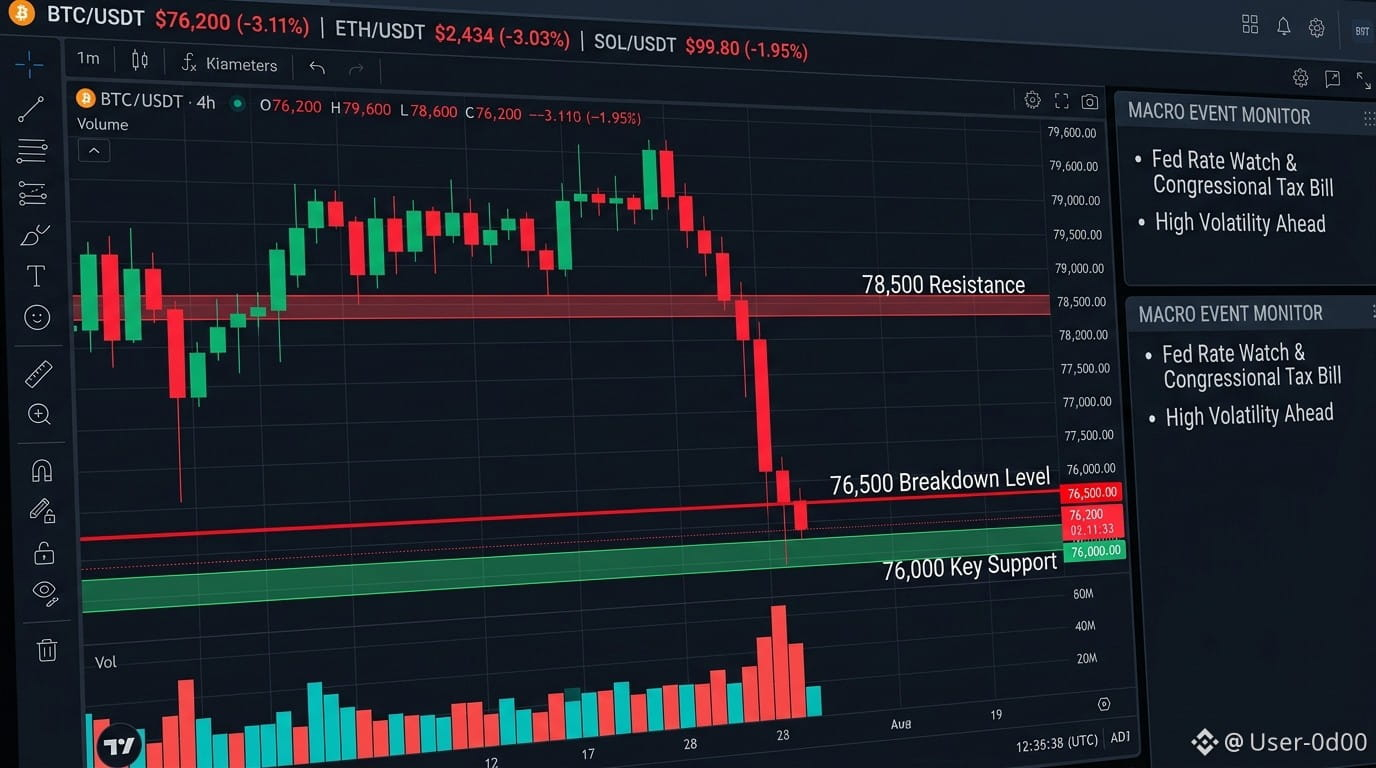
The U.S. House unexpectedly passes a crypto tax bill, and the Federal Reserve’s interest-rate decision is imminent—Big Cake plunges more than 3,400 points in a single day, directly breaking through the 76,500 “lifeline”!
Latest live market conditions are broadly weak: $BTC has slipped all the way from the intraday high of 79,600, now at 76,200, down over 3.1%; Ethereum $ETH has broken below the 2,450 support level and slid to 2,434; $SOL even fell through the 100 mark, retreating to 99.8.
With the macro “tightening spell” returning, the market’s wait-and-see mood ahead of the Fed decision was sparked into a frenzy by news of the bill. Leverage on the long side was concentrated and liquidations turned into a stampede. On the chart, 76,500 has now completely shifted from a strong support area into a rebound ceiling. As long as there is no institutional-scale net spot buying at the 76,000 round-number level, any slight rebound is standard “trap-and-sell” liquidity manipulation.
In this high-stakes macro showdown window, blindly catching falling knives against the trend often ends up getting killed halfway up the hill. Control your position size and leverage, and understand the true accumulation intentions of market makers in the 76,000 defense zone before taking action—this is the only rule for surviving the shakeout cycle.
#FedRateWatch #BTC reserve bill
The U.S. House unexpectedly passes a crypto tax bill, and the Federal Reserve’s interest-rate decision is imminent—Big Cake plunges more than 3,400 points in a single day, directly breaking through the 76,500 “lifeline”!
Latest live market conditions are broadly weak: $BTC has slipped all the way from the intraday high of 79,600, now at 76,200, down over 3.1%; Ethereum $ETH has broken below the 2,450 support level and slid to 2,434; $SOL even fell through the 100 mark, retreating to 99.8.
With the macro “tightening spell” returning, the market’s wait-and-see mood ahead of the Fed decision was sparked into a frenzy by news of the bill. Leverage on the long side was concentrated and liquidations turned into a stampede. On the chart, 76,500 has now completely shifted from a strong support area into a rebound ceiling. As long as there is no institutional-scale net spot buying at the 76,000 round-number level, any slight rebound is standard “trap-and-sell” liquidity manipulation.
In this high-stakes macro showdown window, blindly catching falling knives against the trend often ends up getting killed halfway up the hill. Control your position size and leverage, and understand the true accumulation intentions of market makers in the 76,000 defense zone before taking action—this is the only rule for surviving the shakeout cycle.
#FedRateWatch #BTC reserve bill
Latest live market conditions are broadly weak: $BTC has slipped all the way from the intraday high of 79,600, now at 76,200, down over 3.1%; Ethereum $ETH has broken below the 2,450 support level and slid to 2,434; $SOL even fell through the 100 mark, retreating to 99.8.
With the macro “tightening spell” returning, the market’s wait-and-see mood ahead of the Fed decision was sparked into a frenzy by news of the bill. Leverage on the long side was concentrated and liquidations turned into a stampede. On the chart, 76,500 has now completely shifted from a strong support area into a rebound ceiling. As long as there is no institutional-scale net spot buying at the 76,000 round-number level, any slight rebound is standard “trap-and-sell” liquidity manipulation.
In this high-stakes macro showdown window, blindly catching falling knives against the trend often ends up getting killed halfway up the hill. Control your position size and leverage, and understand the true accumulation intentions of market makers in the 76,000 defense zone before taking action—this is the only rule for surviving the shakeout cycle.
#FedRateWatch #BTC reserve bill
1k
·
--
Trump Compromises to Advance the Clear Act Final Draft; the Big Cake Surges Straight to 77,500—Is This a Real Bull Market, or Just the Final Round of a Trade-Attraction Drop?
The Block’s latest exclusive disclosure: the U.S. Senate has officially released the final version draft of the Clarity Act. Trump has agreed to key conflict-of-interest avoidance provisions, clearing the biggest legislative hurdle for the U.S. top-tier crypto regulatory bill.
The moment the news hit, the market instantly ignited. The big cake $BTC , after stabilizing at 76,500 support last night, surged with heavy volume and broke above 77,478. The contract funding rate spiked to the top, turning positive to 0.0100%. Ethereum $ETH also followed suit, reclaiming the 2,510 level.
On the public stage, Anthony Pompliano, who is bullish on Bitcoin, even jumped the hype straight to 470,000, landing at #1 on the trending search list.
Many retail traders, seeing the legislative tailwind, immediately start shouting that it will break 80,000 right away. But take a calm look at the order book and you’ll find: above 78,200 still lies the heavy resistance zone from the earlier period of dense trading. A sudden stimulus from a draft bill alone can’t replace the real, billion-dollar-scale spot net-buying.
Whenever a major piece of news lands, it’s often accompanied by the main players using the good news to distribute their holdings to chase-up buyers. As long as 78,200 hasn’t seen a volume-expanding big bullish candle that holds, going long blindly at high leverage can easily turn into cannon fodder while large institutions wash the market.
#Anthony Pompliano #Wintermute transfer
Trump Compromises to Advance the Clear Act Final Draft; the Big Cake Surges Straight to 77,500—Is This a Real Bull Market, or Just the Final Round of a Trade-Attraction Drop?
The Block’s latest exclusive disclosure: the U.S. Senate has officially released the final version draft of the Clarity Act. Trump has agreed to key conflict-of-interest avoidance provisions, clearing the biggest legislative hurdle for the U.S. top-tier crypto regulatory bill.
The moment the news hit, the market instantly ignited. The big cake $BTC , after stabilizing at 76,500 support last night, surged with heavy volume and broke above 77,478. The contract funding rate spiked to the top, turning positive to 0.0100%. Ethereum $ETH also followed suit, reclaiming the 2,510 level.
On the public stage, Anthony Pompliano, who is bullish on Bitcoin, even jumped the hype straight to 470,000, landing at #1 on the trending search list.
Many retail traders, seeing the legislative tailwind, immediately start shouting that it will break 80,000 right away. But take a calm look at the order book and you’ll find: above 78,200 still lies the heavy resistance zone from the earlier period of dense trading. A sudden stimulus from a draft bill alone can’t replace the real, billion-dollar-scale spot net-buying.
Whenever a major piece of news lands, it’s often accompanied by the main players using the good news to distribute their holdings to chase-up buyers. As long as 78,200 hasn’t seen a volume-expanding big bullish candle that holds, going long blindly at high leverage can easily turn into cannon fodder while large institutions wash the market.
#Anthony Pompliano #Wintermute transfer
The Block’s latest exclusive disclosure: the U.S. Senate has officially released the final version draft of the Clarity Act. Trump has agreed to key conflict-of-interest avoidance provisions, clearing the biggest legislative hurdle for the U.S. top-tier crypto regulatory bill.
The moment the news hit, the market instantly ignited. The big cake $BTC , after stabilizing at 76,500 support last night, surged with heavy volume and broke above 77,478. The contract funding rate spiked to the top, turning positive to 0.0100%. Ethereum $ETH also followed suit, reclaiming the 2,510 level.
On the public stage, Anthony Pompliano, who is bullish on Bitcoin, even jumped the hype straight to 470,000, landing at #1 on the trending search list.
Many retail traders, seeing the legislative tailwind, immediately start shouting that it will break 80,000 right away. But take a calm look at the order book and you’ll find: above 78,200 still lies the heavy resistance zone from the earlier period of dense trading. A sudden stimulus from a draft bill alone can’t replace the real, billion-dollar-scale spot net-buying.
Whenever a major piece of news lands, it’s often accompanied by the main players using the good news to distribute their holdings to chase-up buyers. As long as 78,200 hasn’t seen a volume-expanding big bullish candle that holds, going long blindly at high leverage can easily turn into cannon fodder while large institutions wash the market.
#Anthony Pompliano #Wintermute transfer
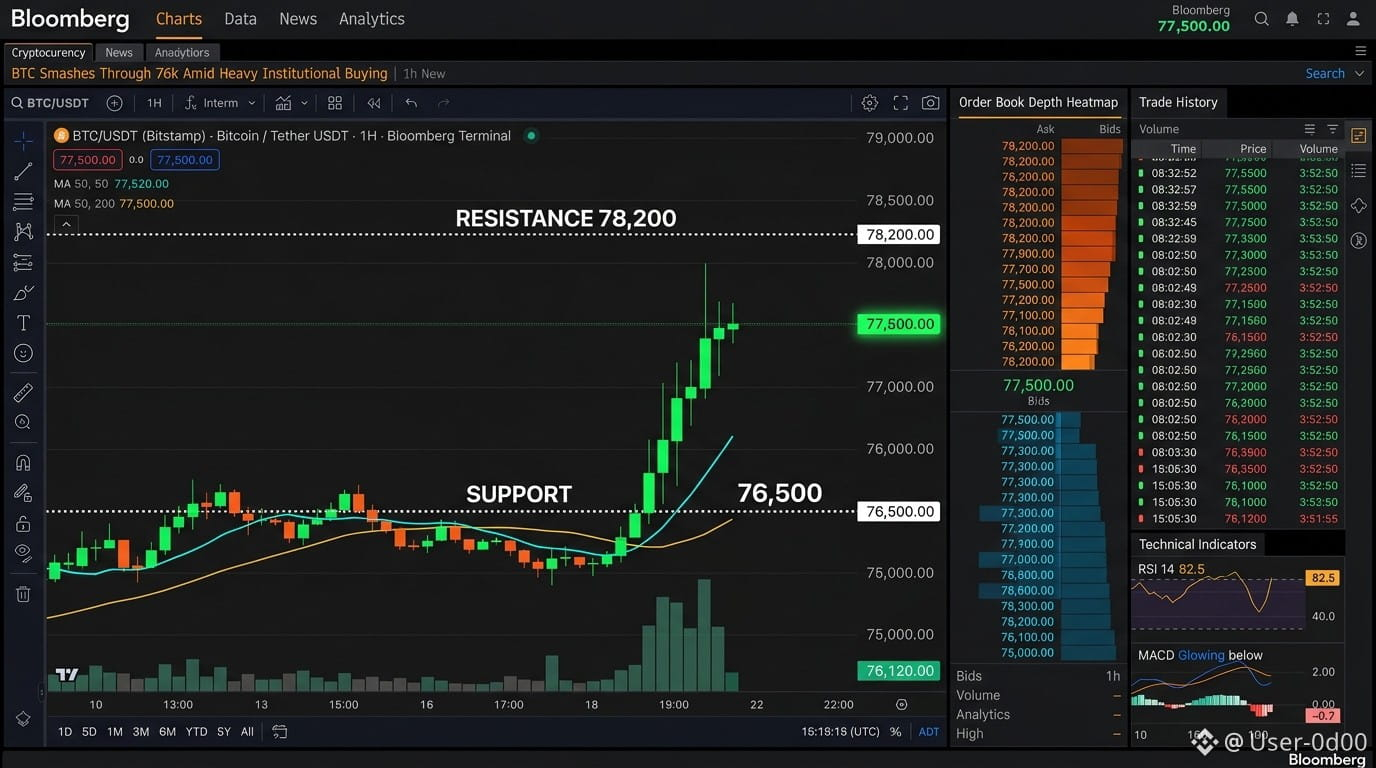
229
Log in to explore more content
Join global crypto users on Binance Square
⚡️ Get latest and useful information about crypto.
💬 Trusted by the world’s largest crypto exchange.
👍 Discover real insights from verified creators.
Email / Phone number