
明天可以暴富吗
330 Posts

明天可以暴富吗
Report
Block User
73 Following
587 Followers
416 Liked
Posts
All
Quotes
·
--
Send a red envelope to those who support me 🧧
Send a red envelope to those who support me 🧧

感谢兄弟关注我
From 明天可以暴富吗
Fully Claimed
46
6
94
192
·
--
#币安神算子 Tonight's gen should be a sure thing. I'm going all in without a second thought.
#币安神算子 Tonight's gen should be a sure thing. I'm going all in without a second thought.

·
--
#币安神算子 There haven't been many matches lately, and those are all 1:1. This one is more exciting, so I went with it.
#币安神算子 There haven't been many matches lately, and those are all 1:1. This one is more exciting, so I went with it.

1
·
--
#币安神算子 I only know LOL; I don't understand anything else. What about you guys? What have you been going all-in on lately?
#币安神算子 I only know LOL; I don't understand anything else. What about you guys? What have you been going all-in on lately?

·
--
#币安神算子 Guys, this game is so hard. Every time I try to play it safe, I lose; when I take a shot at a big win, nothing hits.
#币安神算子 Guys, this game is so hard. Every time I try to play it safe, I lose; when I take a shot at a big win, nothing hits.

·
--
#币安神算子 Damn, I lost it all in one go. That's brutal. Anyone willing to carry me today?
#币安神算子 Damn, I lost it all in one go. That's brutal. Anyone willing to carry me today?

2
·
--
#币安神算子 pulled off a TES play yesterday and it felt amazing. Just like Dota, the Chinese server is basically done for.
#币安神算子 pulled off a TES play yesterday and it felt amazing. Just like Dota, the Chinese server is basically done for.

·
--
#币安神算子 I'm still at zero, seeing if I can make a big play. Let's try to break into the top 2,000, brothers.
#币安神算子 I'm still at zero, seeing if I can make a big play. Let's try to break into the top 2,000, brothers.

2
·
--
#币安神算子 didn't participate in any predictions yesterday. Let's see how things go today.
#币安神算子 didn't participate in any predictions yesterday. Let's see how things go today.

5
·
--
#币安神算子 is back to zero again—starting over today. I can't miss a day of points.
#币安神算子 is back to zero again—starting over today. I can't miss a day of points.

1
·
--
#币安神算子 You guys are way too competitive! The weekly rankings are already this intense—how can I make it onto the leaderboard?
#币安神算子 You guys are way too competitive! The weekly rankings are already this intense—how can I make it onto the leaderboard?

·
--
#币安神算子 Guys, the rankings are way too competitive this week. One slip and you're back to zero.
#币安神算子 Guys, the rankings are way too competitive this week. One slip and you're back to zero.

2
·
--
#币安神算子 took a huge loss and lost everything in one go 🥲 Starting over from scratch
#币安神算子 took a huge loss and lost everything in one go 🥲 Starting over from scratch

2
·
--
#币安神算子 , I hope I wake up to a big BLG win tomorrow morning! Go BLG!
#币安神算子 , I hope I wake up to a big BLG win tomorrow morning! Go BLG!

56
·
--
#币安神算子 Binance's prediction contest is really good, with prizes of up to 2,000 U. Today is the first day.
#币安神算子 Binance's prediction contest is really good, with prizes of up to 2,000 U. Today is the first day.

86
·
--
Today BTC wobbled around 78,000 all day, and people in my group are arguing again. Those with no position shout “wait for a pullback.” Those fully in shout “I’m seeing 100,000.” I said nothing in between. Because I’ve been out of the market for almost two months—starting from 62,000 all the way down/up to 78,000 as I’ve been bearish. Every bullish candle has been slapping my face.
This feeling is way too familiar. If I chase it and it breaks 79,000, above that is the 80,000 level. What if it can’t push through and gets hammered back? Then I’ll be the one guarding the top of the mountain. If I don’t chase it and this wave really runs up to 80,000, then I’ll have to watch another two months of jokes. Shorting gives me no nerve; going long makes me fear heights. That anxiety of being in cash—that’s probably the “three difficulties” shared by everyone who’s missed the move.
Recently, I couldn’t take this anymore, so I changed my thinking. If I’m afraid to bet on direction, can I still participate in the market without betting on direction? Later, I put part of my U into TermMax to lend it out for 90 days. The logic is simple: I don’t guess whether prices will rise or fall. I lend money to the people who do, and they pay me interest. When the market rises, more borrowers come in, and my rate goes up with the tide. When the market falls, people still borrow to buy the dip, and I still collect my interest. Direction is their business—I earn money from the market’s existence itself.
Once I got this positioning clear in my head, the stone in my heart finally dropped. I no longer obsess every day about whether to chase, because I’m already in the market—just in a different position. While others are in the frontline fighting hand-to-hand, I’m in the back collecting rent. Of course the returns can’t compare to those who correctly call it, but it’s still better than sitting in cash and staring blankly. More importantly, I’m back in the game: my mindset shifted from spectator to player.
But let’s be clear: there’s a cost to this path. When you lend your money out, you lock it for 90 days. If you truly encounter a brutal drop mid-way and want to buy the dip, the money isn’t in your hands—you’re just anxious. The interest rate is fixed. When the market goes wild, watching others make in a day what you’d earn in a year is impossible to feel nothing. And also, if the borrowers truly run into systemic risk, both interest and principal can hang in the balance—no matter how many safeguards the mechanism has, it’s not absolutely risk-free.
So this isn’t a perfect solution—it’s a compromise that lets people with fear of heights sleep at night. You don’t necessarily have to choose between chasing and going short. There’s a third way: become a creditor of the market.
Are you currently chasing, or going short—or are you also fear-height like me?
#termmax @termmax
Today BTC wobbled around 78,000 all day, and people in my group are arguing again. Those with no position shout “wait for a pullback.” Those fully in shout “I’m seeing 100,000.” I said nothing in between. Because I’ve been out of the market for almost two months—starting from 62,000 all the way down/up to 78,000 as I’ve been bearish. Every bullish candle has been slapping my face.
This feeling is way too familiar. If I chase it and it breaks 79,000, above that is the 80,000 level. What if it can’t push through and gets hammered back? Then I’ll be the one guarding the top of the mountain. If I don’t chase it and this wave really runs up to 80,000, then I’ll have to watch another two months of jokes. Shorting gives me no nerve; going long makes me fear heights. That anxiety of being in cash—that’s probably the “three difficulties” shared by everyone who’s missed the move.
Recently, I couldn’t take this anymore, so I changed my thinking. If I’m afraid to bet on direction, can I still participate in the market without betting on direction? Later, I put part of my U into TermMax to lend it out for 90 days. The logic is simple: I don’t guess whether prices will rise or fall. I lend money to the people who do, and they pay me interest. When the market rises, more borrowers come in, and my rate goes up with the tide. When the market falls, people still borrow to buy the dip, and I still collect my interest. Direction is their business—I earn money from the market’s existence itself.
Once I got this positioning clear in my head, the stone in my heart finally dropped. I no longer obsess every day about whether to chase, because I’m already in the market—just in a different position. While others are in the frontline fighting hand-to-hand, I’m in the back collecting rent. Of course the returns can’t compare to those who correctly call it, but it’s still better than sitting in cash and staring blankly. More importantly, I’m back in the game: my mindset shifted from spectator to player.
But let’s be clear: there’s a cost to this path. When you lend your money out, you lock it for 90 days. If you truly encounter a brutal drop mid-way and want to buy the dip, the money isn’t in your hands—you’re just anxious. The interest rate is fixed. When the market goes wild, watching others make in a day what you’d earn in a year is impossible to feel nothing. And also, if the borrowers truly run into systemic risk, both interest and principal can hang in the balance—no matter how many safeguards the mechanism has, it’s not absolutely risk-free.
So this isn’t a perfect solution—it’s a compromise that lets people with fear of heights sleep at night. You don’t necessarily have to choose between chasing and going short. There’s a third way: become a creditor of the market.
Are you currently chasing, or going short—or are you also fear-height like me?
#termmax @TermMax
This feeling is way too familiar. If I chase it and it breaks 79,000, above that is the 80,000 level. What if it can’t push through and gets hammered back? Then I’ll be the one guarding the top of the mountain. If I don’t chase it and this wave really runs up to 80,000, then I’ll have to watch another two months of jokes. Shorting gives me no nerve; going long makes me fear heights. That anxiety of being in cash—that’s probably the “three difficulties” shared by everyone who’s missed the move.
Recently, I couldn’t take this anymore, so I changed my thinking. If I’m afraid to bet on direction, can I still participate in the market without betting on direction? Later, I put part of my U into TermMax to lend it out for 90 days. The logic is simple: I don’t guess whether prices will rise or fall. I lend money to the people who do, and they pay me interest. When the market rises, more borrowers come in, and my rate goes up with the tide. When the market falls, people still borrow to buy the dip, and I still collect my interest. Direction is their business—I earn money from the market’s existence itself.
Once I got this positioning clear in my head, the stone in my heart finally dropped. I no longer obsess every day about whether to chase, because I’m already in the market—just in a different position. While others are in the frontline fighting hand-to-hand, I’m in the back collecting rent. Of course the returns can’t compare to those who correctly call it, but it’s still better than sitting in cash and staring blankly. More importantly, I’m back in the game: my mindset shifted from spectator to player.
But let’s be clear: there’s a cost to this path. When you lend your money out, you lock it for 90 days. If you truly encounter a brutal drop mid-way and want to buy the dip, the money isn’t in your hands—you’re just anxious. The interest rate is fixed. When the market goes wild, watching others make in a day what you’d earn in a year is impossible to feel nothing. And also, if the borrowers truly run into systemic risk, both interest and principal can hang in the balance—no matter how many safeguards the mechanism has, it’s not absolutely risk-free.
So this isn’t a perfect solution—it’s a compromise that lets people with fear of heights sleep at night. You don’t necessarily have to choose between chasing and going short. There’s a third way: become a creditor of the market.
Are you currently chasing, or going short—or are you also fear-height like me?
#termmax @TermMax




1
340
·
--
Today, this BTC “big bullish candle” has once again put holders who are reluctant to sell in a real squeeze. Up 11 points in a day, and once it breaks above 72,000, that inner struggle in my account comes back. Sell? I’m afraid I’ll sell and then it keeps going up. Don’t sell? I’m afraid it will pull back, and this level doesn’t look low anymore either. When it goes up you want to sell, but if you don’t, you’re afraid—this is the deadlock every holder can never untangle.
I’m way too familiar with this kind of torment. In 2023, I went through the same thing. When BTC climbed to just over 30,000, I panicked about a pullback and sold half, thinking I’d lock in some profit. But it kept marching all the way to 45,000. When it came time to buy back, I couldn’t bring myself to—while not buying made me miserable every day. That feeling was more torturous than actually losing money. Later on, not long ago, I took out a loan in USDC by pledging BTC on TermMax, and I finally realized there’s a third path besides selling or holding until death.
The logic is very simple. The coins are still kept in the protocol as collateral, and they’re still yours—so if the price rises, you still benefit. The borrowed USDC is in your hand. If there’s a real pullback, you have money to top up; if there isn’t, you don’t lose anything—you just pay some interest. In plain terms, you pay a bit of interest to gain the flexibility to act either way.
This market move clearly shows the advantage. Today it rallied 11 points. The USDC I borrowed didn’t move a cent; the upside from the coin price didn’t diminish at all, and I’m still holding a chunk of cash in reserve. If it truly dips, I can top up right away.
It’s basically two different worlds compared to the time when BTC was 30,000 and I sold too early, fearing I’d miss the run.
But this isn’t free. You have to pay interest when you borrow. If the coin price goes sideways or drifts down, the interest becomes pure expense—your position bleeds slowly every day. You need to accept that cost. Also, collateral comes with a liquidation threshold. With BTC’s volatility, when it crashes, the liquidation won’t be polite—never set your collateral ratio at the maximum. And topping up sounds easy but is hard in practice. When it really drops, will you dare to add margin? How much will you add? That’s a test of human nature. Don’t assume that just because you have USDC, you’ll definitely do the right thing.
My own habit is: for most of the time, I just leave the borrowed USDC sitting there, as备用子弹 (backup ammunition). Only when the market truly gives an opportunity does it make sense for that USDC to come out. Otherwise, I treat it like paying for peace of mind.
Have you ever sold too early on BTC and then missed out? What did you do in the end? #termmax @termmax
Today, this BTC “big bullish candle” has once again put holders who are reluctant to sell in a real squeeze. Up 11 points in a day, and once it breaks above 72,000, that inner struggle in my account comes back. Sell? I’m afraid I’ll sell and then it keeps going up. Don’t sell? I’m afraid it will pull back, and this level doesn’t look low anymore either. When it goes up you want to sell, but if you don’t, you’re afraid—this is the deadlock every holder can never untangle.
I’m way too familiar with this kind of torment. In 2023, I went through the same thing. When BTC climbed to just over 30,000, I panicked about a pullback and sold half, thinking I’d lock in some profit. But it kept marching all the way to 45,000. When it came time to buy back, I couldn’t bring myself to—while not buying made me miserable every day. That feeling was more torturous than actually losing money. Later on, not long ago, I took out a loan in USDC by pledging BTC on TermMax, and I finally realized there’s a third path besides selling or holding until death.
The logic is very simple. The coins are still kept in the protocol as collateral, and they’re still yours—so if the price rises, you still benefit. The borrowed USDC is in your hand. If there’s a real pullback, you have money to top up; if there isn’t, you don’t lose anything—you just pay some interest. In plain terms, you pay a bit of interest to gain the flexibility to act either way.
This market move clearly shows the advantage. Today it rallied 11 points. The USDC I borrowed didn’t move a cent; the upside from the coin price didn’t diminish at all, and I’m still holding a chunk of cash in reserve. If it truly dips, I can top up right away.
It’s basically two different worlds compared to the time when BTC was 30,000 and I sold too early, fearing I’d miss the run.
But this isn’t free. You have to pay interest when you borrow. If the coin price goes sideways or drifts down, the interest becomes pure expense—your position bleeds slowly every day. You need to accept that cost. Also, collateral comes with a liquidation threshold. With BTC’s volatility, when it crashes, the liquidation won’t be polite—never set your collateral ratio at the maximum. And topping up sounds easy but is hard in practice. When it really drops, will you dare to add margin? How much will you add? That’s a test of human nature. Don’t assume that just because you have USDC, you’ll definitely do the right thing.
My own habit is: for most of the time, I just leave the borrowed USDC sitting there, as备用子弹 (backup ammunition). Only when the market truly gives an opportunity does it make sense for that USDC to come out. Otherwise, I treat it like paying for peace of mind.
Have you ever sold too early on BTC and then missed out? What did you do in the end? #termmax @TermMax
I’m way too familiar with this kind of torment. In 2023, I went through the same thing. When BTC climbed to just over 30,000, I panicked about a pullback and sold half, thinking I’d lock in some profit. But it kept marching all the way to 45,000. When it came time to buy back, I couldn’t bring myself to—while not buying made me miserable every day. That feeling was more torturous than actually losing money. Later on, not long ago, I took out a loan in USDC by pledging BTC on TermMax, and I finally realized there’s a third path besides selling or holding until death.
The logic is very simple. The coins are still kept in the protocol as collateral, and they’re still yours—so if the price rises, you still benefit. The borrowed USDC is in your hand. If there’s a real pullback, you have money to top up; if there isn’t, you don’t lose anything—you just pay some interest. In plain terms, you pay a bit of interest to gain the flexibility to act either way.
This market move clearly shows the advantage. Today it rallied 11 points. The USDC I borrowed didn’t move a cent; the upside from the coin price didn’t diminish at all, and I’m still holding a chunk of cash in reserve. If it truly dips, I can top up right away.
It’s basically two different worlds compared to the time when BTC was 30,000 and I sold too early, fearing I’d miss the run.
But this isn’t free. You have to pay interest when you borrow. If the coin price goes sideways or drifts down, the interest becomes pure expense—your position bleeds slowly every day. You need to accept that cost. Also, collateral comes with a liquidation threshold. With BTC’s volatility, when it crashes, the liquidation won’t be polite—never set your collateral ratio at the maximum. And topping up sounds easy but is hard in practice. When it really drops, will you dare to add margin? How much will you add? That’s a test of human nature. Don’t assume that just because you have USDC, you’ll definitely do the right thing.
My own habit is: for most of the time, I just leave the borrowed USDC sitting there, as备用子弹 (backup ammunition). Only when the market truly gives an opportunity does it make sense for that USDC to come out. Otherwise, I treat it like paying for peace of mind.
Have you ever sold too early on BTC and then missed out? What did you do in the end? #termmax @TermMax




1
112
·
--
Everyone who trades stocks has probably used broker financing before. You don’t want to sell the shares you hold, so you pledge them to a brokerage, borrow a bit of money for working capital, keep the position as-is, and profit from the price increase as usual. This is basically standard operating procedure in the stock world.
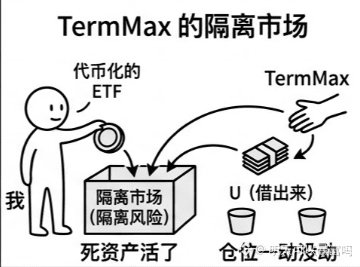
Recently, I wanted to do something similar on-chain. I have some tokenized ETF holdings, and I wanted to pledge them to borrow a bit of U. I looked around for a while and almost couldn’t find a place that would do it. Most lending protocols don’t accept this kind of collateral at all, and the ones that do accept it only offer a sort of one-size-fits-all shared pool where everyone’s bad debt gets thrown into the same pot. In the end, I got it sorted out on TermMax’s isolated market—deposit the crypto as collateral, borrow U out, and the position didn’t move.
To be honest, the significance of this matters more than the loan itself. The volume of tokenized stocks is growing larger and larger, but once these assets are on-chain they become basically dead—there’s nothing to do except hold and wait for them to rise. After collateralized borrowing, dead assets come back to life. The stock world has been doing this for years; on-chain, it’s only just starting.
But let me get the ugly parts out of the way. This kind of collateral is completely different from ETH. The biggest issue is liquidity—buying and selling is usually fine, but on the day of a real liquidation, who’s going to take the other side? If it can’t be liquidated, the rules require physical settlement, and then it gets dumped on the lender. You’d end up holding a bunch of illiquid tokenized stock—just thinking about it is a headache. And there’s also the fact that this stuff is tied to the real world behind the scenes—custody, compliance, redemptions, and so on. If any link fails, the on-chain price immediately goes out of whack. Plus the loan-to-value ratio is low: borrowing against the same value gets you much less money than the mainstream coins.
My use case is simple: treat it as a working-capital tool. If you’re temporarily short on cash, it’s convenient. If you want to use it to amplify your position size, then forget it.
Do you have any tokenized stock ETFs in your hands? Have you ever used them as collateral? #termmax @termmax
Everyone who trades stocks has probably used broker financing before. You don’t want to sell the shares you hold, so you pledge them to a brokerage, borrow a bit of money for working capital, keep the position as-is, and profit from the price increase as usual. This is basically standard operating procedure in the stock world.
Recently, I wanted to do something similar on-chain. I have some tokenized ETF holdings, and I wanted to pledge them to borrow a bit of U. I looked around for a while and almost couldn’t find a place that would do it. Most lending protocols don’t accept this kind of collateral at all, and the ones that do accept it only offer a sort of one-size-fits-all shared pool where everyone’s bad debt gets thrown into the same pot. In the end, I got it sorted out on TermMax’s isolated market—deposit the crypto as collateral, borrow U out, and the position didn’t move.
To be honest, the significance of this matters more than the loan itself. The volume of tokenized stocks is growing larger and larger, but once these assets are on-chain they become basically dead—there’s nothing to do except hold and wait for them to rise. After collateralized borrowing, dead assets come back to life. The stock world has been doing this for years; on-chain, it’s only just starting.
But let me get the ugly parts out of the way. This kind of collateral is completely different from ETH. The biggest issue is liquidity—buying and selling is usually fine, but on the day of a real liquidation, who’s going to take the other side? If it can’t be liquidated, the rules require physical settlement, and then it gets dumped on the lender. You’d end up holding a bunch of illiquid tokenized stock—just thinking about it is a headache. And there’s also the fact that this stuff is tied to the real world behind the scenes—custody, compliance, redemptions, and so on. If any link fails, the on-chain price immediately goes out of whack. Plus the loan-to-value ratio is low: borrowing against the same value gets you much less money than the mainstream coins.
My use case is simple: treat it as a working-capital tool. If you’re temporarily short on cash, it’s convenient. If you want to use it to amplify your position size, then forget it.
Do you have any tokenized stock ETFs in your hands? Have you ever used them as collateral? #termmax @TermMax
Recently, I wanted to do something similar on-chain. I have some tokenized ETF holdings, and I wanted to pledge them to borrow a bit of U. I looked around for a while and almost couldn’t find a place that would do it. Most lending protocols don’t accept this kind of collateral at all, and the ones that do accept it only offer a sort of one-size-fits-all shared pool where everyone’s bad debt gets thrown into the same pot. In the end, I got it sorted out on TermMax’s isolated market—deposit the crypto as collateral, borrow U out, and the position didn’t move.
To be honest, the significance of this matters more than the loan itself. The volume of tokenized stocks is growing larger and larger, but once these assets are on-chain they become basically dead—there’s nothing to do except hold and wait for them to rise. After collateralized borrowing, dead assets come back to life. The stock world has been doing this for years; on-chain, it’s only just starting.
But let me get the ugly parts out of the way. This kind of collateral is completely different from ETH. The biggest issue is liquidity—buying and selling is usually fine, but on the day of a real liquidation, who’s going to take the other side? If it can’t be liquidated, the rules require physical settlement, and then it gets dumped on the lender. You’d end up holding a bunch of illiquid tokenized stock—just thinking about it is a headache. And there’s also the fact that this stuff is tied to the real world behind the scenes—custody, compliance, redemptions, and so on. If any link fails, the on-chain price immediately goes out of whack. Plus the loan-to-value ratio is low: borrowing against the same value gets you much less money than the mainstream coins.
My use case is simple: treat it as a working-capital tool. If you’re temporarily short on cash, it’s convenient. If you want to use it to amplify your position size, then forget it.
Do you have any tokenized stock ETFs in your hands? Have you ever used them as collateral? #termmax @TermMax


1
1
246
·
--
I spent a weekend going through the on-chain activity records of a few top vaults on TermMax. I originally wanted to copy the playbook—figure out exactly how Curator makes money, and learn to do it myself. After reading everything, I closed the notebook. This is a job I can’t do; I’ll just be honest and deposit the money instead.
Their sources of yield are far more complex than I’d imagined. The same amount of USDC can get different results: in Market A, demand for borrowing is strong, so the interest rate can be as high as 8%; in Market B, it’s cold and quiet, only 4%. The 4-point gap in between is the cross-market interest spread—move capital from the low side to the high side and you earn the difference for free. Another example is the term structure: the yield for a 30-day instrument isn’t the same as for a 90-day one. When the curve is steep, buying the long end and holding it works because as maturity approaches, the price converges toward par. That riding-through segment of gains is also basically “free.” These are just the parts I can understand.
The problem is that understanding and doing are two different things. Nobody knows how long the spread window will stay open—it might close in just a few hours. Someone has to monitor it around the clock. Rebalancing costs gas; with a smaller principal, you end up shuttling back and forth, and most of the profit gets handed over to the miners. In essence, this kind of money is about scale, about speed, about tooling—retail traders have none of those.
So the “quality” of vault yield really is higher than plain lending income. Lending is the floor; spreads and the term structure are the higher layers. That’s also why, depositing the same USDC can result in very different performance depending on the Curator.
But the more diverse the yield sources are, the more you have to break them down and examine each part. The more strategies you add, the more potential failure points you introduce. Earning spreads across markets means you’re exposed to risks in multiple markets at the same time—if any pool goes wrong, you’re dragged along. Also, spreads get competed away. All Curators are watching the same opportunities; when crowded trades roll in, today’s excess return becomes tomorrow’s mean. The more mature the track, the less of this spread component remains. And then there’s the most real-world layer: in current performance, how much is genuine spread versus empty incentive expectations stacked up? Before the Aug 25 TGE, nobody could answer you.
So when I look at vaults now, I only focus on one thing: the breakdown of the yield. Lending as the base, spreads to thicken it, incentives as garnish—the higher you go among these layers, the less stable it is. If you only give me one total APR without a detailed breakdown, I won’t touch it.
Would you rather have lower returns that you can understand, or higher returns that you can’t?
#termmax @termmax
I spent a weekend going through the on-chain activity records of a few top vaults on TermMax. I originally wanted to copy the playbook—figure out exactly how Curator makes money, and learn to do it myself. After reading everything, I closed the notebook. This is a job I can’t do; I’ll just be honest and deposit the money instead.
Their sources of yield are far more complex than I’d imagined. The same amount of USDC can get different results: in Market A, demand for borrowing is strong, so the interest rate can be as high as 8%; in Market B, it’s cold and quiet, only 4%. The 4-point gap in between is the cross-market interest spread—move capital from the low side to the high side and you earn the difference for free. Another example is the term structure: the yield for a 30-day instrument isn’t the same as for a 90-day one. When the curve is steep, buying the long end and holding it works because as maturity approaches, the price converges toward par. That riding-through segment of gains is also basically “free.” These are just the parts I can understand.
The problem is that understanding and doing are two different things. Nobody knows how long the spread window will stay open—it might close in just a few hours. Someone has to monitor it around the clock. Rebalancing costs gas; with a smaller principal, you end up shuttling back and forth, and most of the profit gets handed over to the miners. In essence, this kind of money is about scale, about speed, about tooling—retail traders have none of those.
So the “quality” of vault yield really is higher than plain lending income. Lending is the floor; spreads and the term structure are the higher layers. That’s also why, depositing the same USDC can result in very different performance depending on the Curator.
But the more diverse the yield sources are, the more you have to break them down and examine each part. The more strategies you add, the more potential failure points you introduce. Earning spreads across markets means you’re exposed to risks in multiple markets at the same time—if any pool goes wrong, you’re dragged along. Also, spreads get competed away. All Curators are watching the same opportunities; when crowded trades roll in, today’s excess return becomes tomorrow’s mean. The more mature the track, the less of this spread component remains. And then there’s the most real-world layer: in current performance, how much is genuine spread versus empty incentive expectations stacked up? Before the Aug 25 TGE, nobody could answer you.
So when I look at vaults now, I only focus on one thing: the breakdown of the yield. Lending as the base, spreads to thicken it, incentives as garnish—the higher you go among these layers, the less stable it is. If you only give me one total APR without a detailed breakdown, I won’t touch it.
Would you rather have lower returns that you can understand, or higher returns that you can’t?
#termmax @TermMax
Their sources of yield are far more complex than I’d imagined. The same amount of USDC can get different results: in Market A, demand for borrowing is strong, so the interest rate can be as high as 8%; in Market B, it’s cold and quiet, only 4%. The 4-point gap in between is the cross-market interest spread—move capital from the low side to the high side and you earn the difference for free. Another example is the term structure: the yield for a 30-day instrument isn’t the same as for a 90-day one. When the curve is steep, buying the long end and holding it works because as maturity approaches, the price converges toward par. That riding-through segment of gains is also basically “free.” These are just the parts I can understand.
The problem is that understanding and doing are two different things. Nobody knows how long the spread window will stay open—it might close in just a few hours. Someone has to monitor it around the clock. Rebalancing costs gas; with a smaller principal, you end up shuttling back and forth, and most of the profit gets handed over to the miners. In essence, this kind of money is about scale, about speed, about tooling—retail traders have none of those.
So the “quality” of vault yield really is higher than plain lending income. Lending is the floor; spreads and the term structure are the higher layers. That’s also why, depositing the same USDC can result in very different performance depending on the Curator.
But the more diverse the yield sources are, the more you have to break them down and examine each part. The more strategies you add, the more potential failure points you introduce. Earning spreads across markets means you’re exposed to risks in multiple markets at the same time—if any pool goes wrong, you’re dragged along. Also, spreads get competed away. All Curators are watching the same opportunities; when crowded trades roll in, today’s excess return becomes tomorrow’s mean. The more mature the track, the less of this spread component remains. And then there’s the most real-world layer: in current performance, how much is genuine spread versus empty incentive expectations stacked up? Before the Aug 25 TGE, nobody could answer you.
So when I look at vaults now, I only focus on one thing: the breakdown of the yield. Lending as the base, spreads to thicken it, incentives as garnish—the higher you go among these layers, the less stable it is. If you only give me one total APR without a detailed breakdown, I won’t touch it.
Would you rather have lower returns that you can understand, or higher returns that you can’t?
#termmax @TermMax




164
·
--
On Sunday, I flipped through my bookmarks and came across an AI on-chain competition benchmark table I copied half a year ago. The number of models each company listed varied from two digits to three digits. I casually opened the on-chain dashboard for @OpenGradient . Model Hub has already hosted more than 4,500 models—several times the total number of items in that old table. I wasn’t in a rush to be amazed; I wanted to see whether this scale genuinely supports real use, or whether it’s just a pile of empty files that were never called.
I picked a five-day workweek and pulled the models that were actually called in that day from Model Hub across four dimensions: weight hashes, the distribution of hosting nodes, scheduling records from the capability routing middleware, and the receipts from the Verification Layer. Each day I sampled twelve models—60 groups of data total. For every row, I pulled the deployment time, the first-call latency, and the receipt signature, and checked them line by line. The result was quite clean: among those more than 4,500 models, a substantial portion had real traffic in the previous week, and the long tail could still be brought up via cold-start.
In public discussions, people mainly debate model hosting counts and focus almost entirely on quantity comparisons. The truly verifiable difference for OpenGradient is much more subtle: the scale isn’t built by stacking upload counters. Each set of weights is sliced and stored in Walrus; when called, the capability routing middleware reassembles them according to availability, and they’re stamped by the Verification Layer. If you only “hang” models, you have to bind storage capacity; if you’re actually called, you leave a trace in the receipts. The data-refresh cost is even higher than the cost of doing the work. Four thousand five hundred isn’t just a line in a table—it’s a set of real capacity.
Metrics also need to change. I don’t look at how many models OpenGradient has accumulated. I focus on a dissenting—almost non-consensus—data point: the proportion of models that get raised by at least one real paid call every week and have receipts left in the Verification Layer. The former measures “being onboarded.” The latter measures whether this hosting layer is truly being used by developers.
If $OPG is only covering a matchmaking fee for a single model call, then it’s more like a call-billing token. But if, in the future, the hosting capacity is collateralized around it—along with cold-start incentives, receipt issuance, long-tail revenue sharing, and even penalties for zombie models being cleared—then what it carries is no longer just a billing token. It becomes the capacity credit asset of the model hosting network.
No rush to draw conclusions. Scale only matters if it’s repeatedly validated in the long tail. I’m willing to keep watching the samples that OpenGradient mainnet and subsequent model providers hand over.
#opg
On Sunday, I flipped through my bookmarks and came across an AI on-chain competition benchmark table I copied half a year ago. The number of models each company listed varied from two digits to three digits. I casually opened the on-chain dashboard for @OpenGradient . Model Hub has already hosted more than 4,500 models—several times the total number of items in that old table. I wasn’t in a rush to be amazed; I wanted to see whether this scale genuinely supports real use, or whether it’s just a pile of empty files that were never called.
I picked a five-day workweek and pulled the models that were actually called in that day from Model Hub across four dimensions: weight hashes, the distribution of hosting nodes, scheduling records from the capability routing middleware, and the receipts from the Verification Layer. Each day I sampled twelve models—60 groups of data total. For every row, I pulled the deployment time, the first-call latency, and the receipt signature, and checked them line by line. The result was quite clean: among those more than 4,500 models, a substantial portion had real traffic in the previous week, and the long tail could still be brought up via cold-start.
In public discussions, people mainly debate model hosting counts and focus almost entirely on quantity comparisons. The truly verifiable difference for OpenGradient is much more subtle: the scale isn’t built by stacking upload counters. Each set of weights is sliced and stored in Walrus; when called, the capability routing middleware reassembles them according to availability, and they’re stamped by the Verification Layer. If you only “hang” models, you have to bind storage capacity; if you’re actually called, you leave a trace in the receipts. The data-refresh cost is even higher than the cost of doing the work. Four thousand five hundred isn’t just a line in a table—it’s a set of real capacity.
Metrics also need to change. I don’t look at how many models OpenGradient has accumulated. I focus on a dissenting—almost non-consensus—data point: the proportion of models that get raised by at least one real paid call every week and have receipts left in the Verification Layer. The former measures “being onboarded.” The latter measures whether this hosting layer is truly being used by developers.
If $OPG is only covering a matchmaking fee for a single model call, then it’s more like a call-billing token. But if, in the future, the hosting capacity is collateralized around it—along with cold-start incentives, receipt issuance, long-tail revenue sharing, and even penalties for zombie models being cleared—then what it carries is no longer just a billing token. It becomes the capacity credit asset of the model hosting network.
No rush to draw conclusions. Scale only matters if it’s repeatedly validated in the long tail. I’m willing to keep watching the samples that OpenGradient mainnet and subsequent model providers hand over.
#opg
I picked a five-day workweek and pulled the models that were actually called in that day from Model Hub across four dimensions: weight hashes, the distribution of hosting nodes, scheduling records from the capability routing middleware, and the receipts from the Verification Layer. Each day I sampled twelve models—60 groups of data total. For every row, I pulled the deployment time, the first-call latency, and the receipt signature, and checked them line by line. The result was quite clean: among those more than 4,500 models, a substantial portion had real traffic in the previous week, and the long tail could still be brought up via cold-start.
In public discussions, people mainly debate model hosting counts and focus almost entirely on quantity comparisons. The truly verifiable difference for OpenGradient is much more subtle: the scale isn’t built by stacking upload counters. Each set of weights is sliced and stored in Walrus; when called, the capability routing middleware reassembles them according to availability, and they’re stamped by the Verification Layer. If you only “hang” models, you have to bind storage capacity; if you’re actually called, you leave a trace in the receipts. The data-refresh cost is even higher than the cost of doing the work. Four thousand five hundred isn’t just a line in a table—it’s a set of real capacity.
Metrics also need to change. I don’t look at how many models OpenGradient has accumulated. I focus on a dissenting—almost non-consensus—data point: the proportion of models that get raised by at least one real paid call every week and have receipts left in the Verification Layer. The former measures “being onboarded.” The latter measures whether this hosting layer is truly being used by developers.
If $OPG is only covering a matchmaking fee for a single model call, then it’s more like a call-billing token. But if, in the future, the hosting capacity is collateralized around it—along with cold-start incentives, receipt issuance, long-tail revenue sharing, and even penalties for zombie models being cleared—then what it carries is no longer just a billing token. It becomes the capacity credit asset of the model hosting network.
No rush to draw conclusions. Scale only matters if it’s repeatedly validated in the long tail. I’m willing to keep watching the samples that OpenGradient mainnet and subsequent model providers hand over.
#opg
4500+ 模型,还说啥呢冲!
100%
调用是不是真实付费的?
0%
1 votes • Voting closed
3
1
142
Log in to explore more content
Join global crypto users on Binance Square
⚡️ Get latest and useful information about crypto.
💬 Trusted by the world’s largest crypto exchange.
👍 Discover real insights from verified creators.
Email / Phone number