

Lipa_专注投研版
35 Posts

Lipa_专注投研版
Report
Block User
Alpha & Research ENTP ,X:@softlipa1018
Open Trade

BNB Holder
Occasional Trader
5.5 Years
13 Following
1.7K+ Followers
123 Liked
Posts
Portfolio
All
Videos
·
--
So it really is the AI era for everyone now. Agent ID @BinanceWallet opened for claiming on October 20, and as of today, in less than a week, over 100K have already been registered.
There have also been lots of posts about skills on Twitter lately, and the tools are really easy to get started with now—Claude, Codex, OpenClaw, Grokbot, and so on. Any of them are easy to pick up, even if you’re a complete beginner with no programming knowledge. These past few days have been quite an experience 💪
Platforms like Four and Flap are also building ecosystems for Agent wallets and attracting funds, though for now, we’ll have to wait and see 😅. The projects that have taken off include ptah, which we wrote about last time, and @gangdotfun. But they haven’t hit their ceiling yet: one is at 3M, the other at 4M.
My current feeling is that the tools are already quite mature, while the projects are still constantly turning in their homework. But I believe there are still plenty of great opportunities waiting for us to jump on board.
P.S. There’s a free mint you can take part in: https://ptah.trade/poa
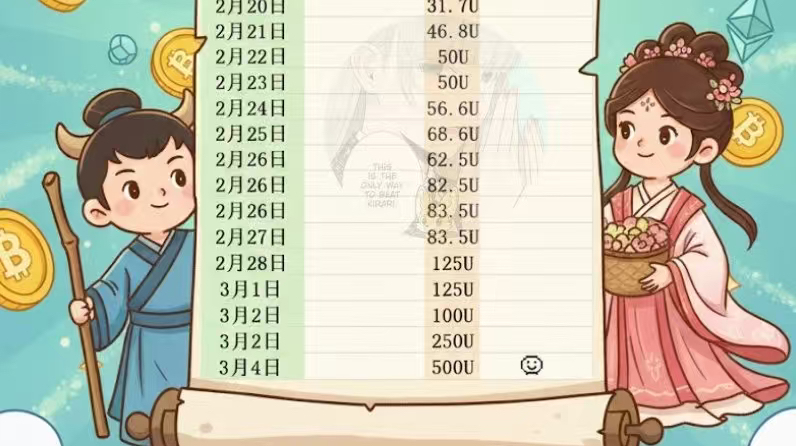
After minting, post every day with #ProofOfAgent + 2229.ai (your Agent number). At 04:44 UTC each day, 500 posts will be drawn, and the winners will get an airdrop worth around 37–50u. I know you all have 100+ accounts, so if you win, don’t forget to V50 🙋
So it really is the AI era for everyone now. Agent ID @Binance Wallet opened for claiming on October 20, and as of today, in less than a week, over 100K have already been registered.
There have also been lots of posts about skills on Twitter lately, and the tools are really easy to get started with now—Claude, Codex, OpenClaw, Grokbot, and so on. Any of them are easy to pick up, even if you’re a complete beginner with no programming knowledge. These past few days have been quite an experience 💪
Platforms like Four and Flap are also building ecosystems for Agent wallets and attracting funds, though for now, we’ll have to wait and see 😅. The projects that have taken off include ptah, which we wrote about last time, and @gangdotfun. But they haven’t hit their ceiling yet: one is at 3M, the other at 4M.
My current feeling is that the tools are already quite mature, while the projects are still constantly turning in their homework. But I believe there are still plenty of great opportunities waiting for us to jump on board.
P.S. There’s a free mint you can take part in: https://ptah.trade/poa
After minting, post every day with #ProofOfAgent + 2229.ai (your Agent number). At 04:44 UTC each day, 500 posts will be drawn, and the winners will get an airdrop worth around 37–50u. I know you all have 100+ accounts, so if you win, don’t forget to V50 🙋
92
·
--
Partly True
On a day overflowing with information, let's skip what plenty of people already know and cue a few points that haven't been mentioned as much: with $BNC ringing the bell next week, another thing to keep an eye on is its own AgentWallet, @BinanceWallet , which is also opening up domain registration. If you use BN's Agent Wallet to trade bStocks-style liquidity products, is that three birds with one stone—and an official proximity-based floor guarantee?
Following the bStocks thread, the long-running AI compute project @Aethir , associated with $AGPUB , which launched on BN at the end of last month, has also received an epic Tokenomics update: starting in November, ATH will introduce a daily burn mechanism based on real network fees. The more revenue generated by compute usage, the more support the token supply could get. A burn dashboard is launching, ushering in an era of mass burns for everyone.
One last price update with undercurrents brewing 👀
$BTC : 84513.03
{spot}(BTCUSDT)
$ETH : 2506.50
{spot}(ETHUSDT)
$BNB: 749.22
$SOL: 108.52
$HYPE: 82.128
$OKB: 117.07
ETH selling pressure is spent. After the seller exhaustion index hit a ten-year low, what awaits us is 📈❓
On a day overflowing with information, let's skip what plenty of people already know and cue a few points that haven't been mentioned as much: with $BNC ringing the bell next week, another thing to keep an eye on is its own AgentWallet, @Binance Wallet , which is also opening up domain registration. If you use BN's Agent Wallet to trade bStocks-style liquidity products, is that three birds with one stone—and an official proximity-based floor guarantee?
Following the bStocks thread, the long-running AI compute project @AethirCloud , associated with $AGPUB , which launched on BN at the end of last month, has also received an epic Tokenomics update: starting in November, ATH will introduce a daily burn mechanism based on real network fees. The more revenue generated by compute usage, the more support the token supply could get. A burn dashboard is launching, ushering in an era of mass burns for everyone.
One last price update with undercurrents brewing 👀
$BTC : 84513.03
$ETH : 2506.50
$BNB: 749.22
$SOL: 108.52
$HYPE: 82.128
$OKB: 117.07
ETH selling pressure is spent. After the seller exhaustion index hit a ten-year low, what awaits us is 📈❓
735
·
--
Today, the hot spots across various chains are all revolving around $SOL . The chain’s $PAID has been the talk of the group—just a few days ago, someone was shouting 8M.
{spot}(SOLUSDT)
The e/acc narrative that’s hitching onto @beffjezos is the most powerful AI story of the day. Although the SOL-chain’s coin-stock narrative hasn’t had the “everywhere is blooming” effect—later even came out with a coin-to-coin combo (😂 if you’re saying the patchwork frankenstein, then Solana is still stronger).
Pure meme remains the strongest foundation for the SOL chain. But it feels like its strength mainly comes from the return of trading sentiment. A conspiracy group brings in some liquidity as well. All in all, so far in October we haven’t seen any particularly direct negative catalysts. Plus the expectations for last year’s National Day holiday set a baseline—during this holiday season, the on-chain activity should still be very active.
For this round, the most important thing is to seriously analyze the main narrative. The “leader version” is still the one to follow.
Today, the hot spots across various chains are all revolving around $SOL . The chain’s $PAID has been the talk of the group—just a few days ago, someone was shouting 8M.
The e/acc narrative that’s hitching onto @beffjezos is the most powerful AI story of the day. Although the SOL-chain’s coin-stock narrative hasn’t had the “everywhere is blooming” effect—later even came out with a coin-to-coin combo (😂 if you’re saying the patchwork frankenstein, then Solana is still stronger).
Pure meme remains the strongest foundation for the SOL chain. But it feels like its strength mainly comes from the return of trading sentiment. A conspiracy group brings in some liquidity as well. All in all, so far in October we haven’t seen any particularly direct negative catalysts. Plus the expectations for last year’s National Day holiday set a baseline—during this holiday season, the on-chain activity should still be very active.
For this round, the most important thing is to seriously analyze the main narrative. The “leader version” is still the one to follow.
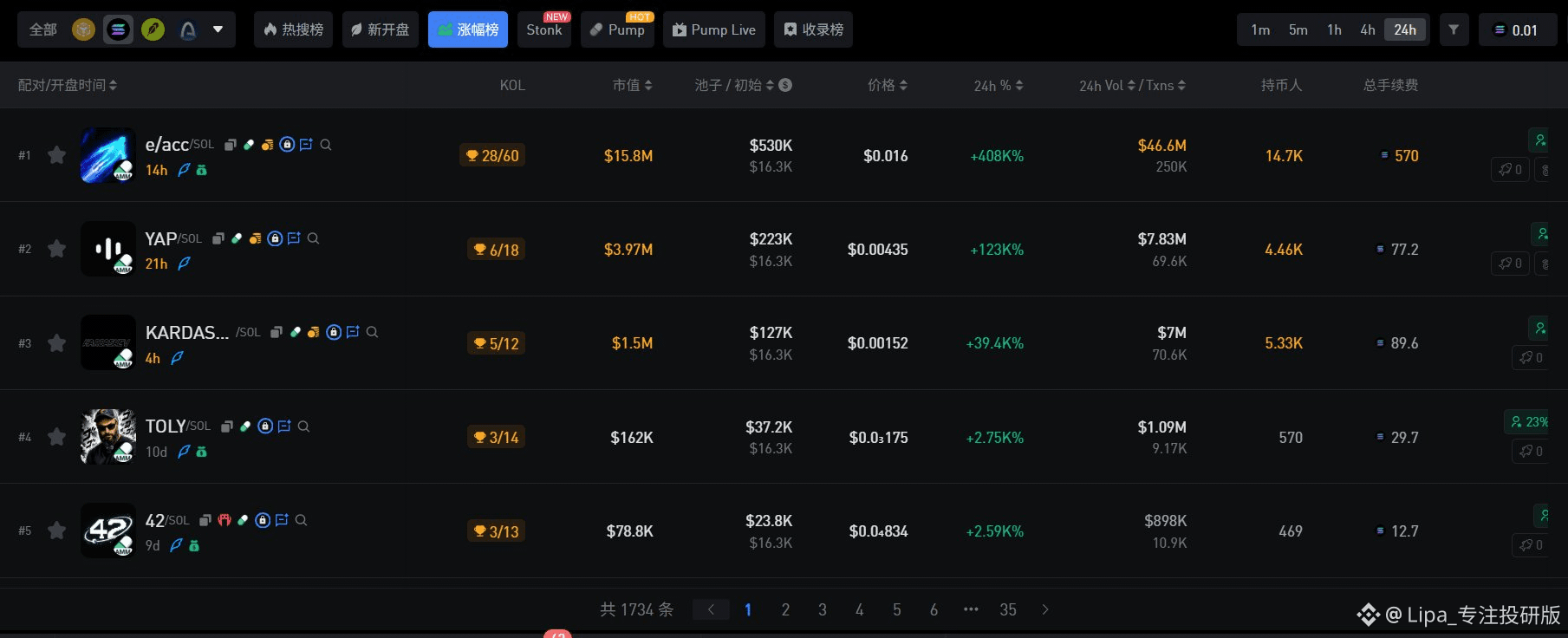
1
456
·
--
Today’s funds have clearly come to #Robinhood. At dawn, they pulled a $MARTIANS. The market cap of the $PONS mentioned earlier has already neared 80M. bonkguy is still just too powerful.
Every chain is competing to grab users. For on-chain players, of course that’s a good thing, but attention switching is faster than before.
$SOL
{future}(SOLUSDT)
With mature on-chain capital, behind BSC, Base, X Layer, and Ink there are exchange entry points; Robinhood is even directly connected to brokerage users. However, every time one chain makes a move, on-chain activity immediately turns into a frenzy of opening supermarkets—dozens or even hundreds of similar coins pop up together.
Recently, the efficiency of positioning to catch the same-chain lagged rebound has actually been quite low. Liquidity often concentrates only in the newly emerged leader and a very small number of brand-new coins. If you’re not faster than others on the news and you’re not faster than bots on the execution, then try not to chase a copy-trading recap when that chain is at its hottest. In many cases, what you end up getting is just the exhaust.
Today’s funds have clearly come to #Robinhood. At dawn, they pulled a $MARTIANS. The market cap of the $PONS mentioned earlier has already neared 80M. bonkguy is still just too powerful.
Every chain is competing to grab users. For on-chain players, of course that’s a good thing, but attention switching is faster than before.
$SOL
With mature on-chain capital, behind BSC, Base, X Layer, and Ink there are exchange entry points; Robinhood is even directly connected to brokerage users. However, every time one chain makes a move, on-chain activity immediately turns into a frenzy of opening supermarkets—dozens or even hundreds of similar coins pop up together.
Recently, the efficiency of positioning to catch the same-chain lagged rebound has actually been quite low. Liquidity often concentrates only in the newly emerged leader and a very small number of brand-new coins. If you’re not faster than others on the news and you’re not faster than bots on the execution, then try not to chase a copy-trading recap when that chain is at its hottest. In many cases, what you end up getting is just the exhaust.
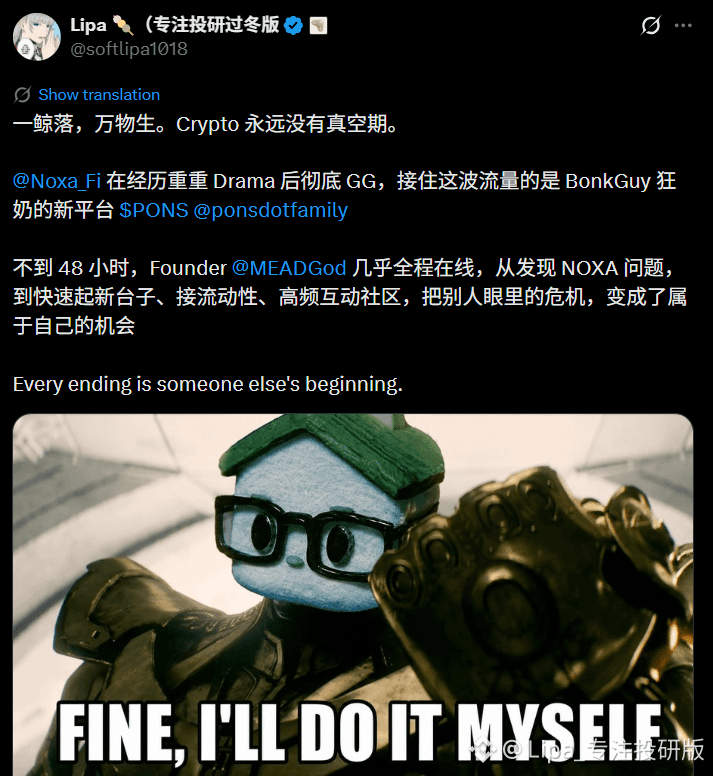
208
·
--
The market really turned bullish, family members—right now, throw away all your electric scooters 🛵🛵!!
Today’s market is a bit crazy. Let’s break it down first. First, the US Treasury fired off a big move: it announced a major increase in the scale of its active repurchases of long-term Treasuries. The effect was immediate. The 30-year US Treasury yield dropped sharply from the high point, and the 10-year yield fell in tandem. The U.S. Dollar Index fell 0.9% intraday, and global risk assets surged across the board.
On the way, I kept seeing my phone pop up: $BTC
{spot}(BTCUSDT)
Breaking above 72000—such a long-missed number. Even the dog-catching ETH has gone up a lot.
Behind the scenes, it’s mainly that Trump met with people from the crypto industry at the White House and put pressure on Congress to advance the CLARITY bill. The expectation of regulatory benefits directly lit up the market.
ETF data was also intense. This week has really been about aggressive accumulation. After a small outflow and shakeout on 8/14, institutions from the 17th to the 19th launched an extremely fierce, consecutive 3-day buying spree—cumulatively net bought over 15,600 BTC, with daily trading volume hitting $8.23 billion. Ethereum too—now people are starting to shout about $10,000 again ☺ You’re used to everyone’s usual playbook.
On the U.S. stock side, pharma stocks exploded across the board. The cancer vaccine data co-developed by Moderna and Merck looks good—Moderna surged straight up 89%, while Merck rose nearly 10%. Consumer stocks also did well: Target and Lowe’s both beat expectations, temporarily easing concerns about lowering consumer spending ratings.
On the crypto side:
$BIO
{future}(BIOUSDT)
Everyone can also take a look at that. Also, I’m very optimistic about:
$HYPE
{future}(HYPEUSDT)
Overall, today the fiscal side is injecting liquidity, the dollar is weakening, and political positives are stacking up—liquidity-driven market sentiment has come rushing back. But we still need to see whether the broader market can hold steady; otherwise it could just be a round of strong rebound. If you don’t have a position, don’t chase the highs for now—wait for a pullback. Keep an eye on whether the ETH/BTC exchange rate can catch up and rally too.
The market really turned bullish, family members—right now, throw away all your electric scooters 🛵🛵!!
Today’s market is a bit crazy. Let’s break it down first. First, the US Treasury fired off a big move: it announced a major increase in the scale of its active repurchases of long-term Treasuries. The effect was immediate. The 30-year US Treasury yield dropped sharply from the high point, and the 10-year yield fell in tandem. The U.S. Dollar Index fell 0.9% intraday, and global risk assets surged across the board.
On the way, I kept seeing my phone pop up: $BTC
Breaking above 72000—such a long-missed number. Even the dog-catching ETH has gone up a lot.
Behind the scenes, it’s mainly that Trump met with people from the crypto industry at the White House and put pressure on Congress to advance the CLARITY bill. The expectation of regulatory benefits directly lit up the market.
ETF data was also intense. This week has really been about aggressive accumulation. After a small outflow and shakeout on 8/14, institutions from the 17th to the 19th launched an extremely fierce, consecutive 3-day buying spree—cumulatively net bought over 15,600 BTC, with daily trading volume hitting $8.23 billion. Ethereum too—now people are starting to shout about $10,000 again ☺ You’re used to everyone’s usual playbook.
On the U.S. stock side, pharma stocks exploded across the board. The cancer vaccine data co-developed by Moderna and Merck looks good—Moderna surged straight up 89%, while Merck rose nearly 10%. Consumer stocks also did well: Target and Lowe’s both beat expectations, temporarily easing concerns about lowering consumer spending ratings.
On the crypto side:
$BIO
Everyone can also take a look at that. Also, I’m very optimistic about:
$HYPE
Overall, today the fiscal side is injecting liquidity, the dollar is weakening, and political positives are stacking up—liquidity-driven market sentiment has come rushing back. But we still need to see whether the broader market can hold steady; otherwise it could just be a round of strong rebound. If you don’t have a position, don’t chase the highs for now—wait for a pullback. Keep an eye on whether the ETH/BTC exchange rate can catch up and rally too.
2
4
9
18.7k
·
--
The temporary pause for ‘Niulai’ is coming to an end, and we’re back in the stock market. Just as the US stock market opened, after the storage sector had already plunged sharply before the open, the opening drop widened further. Among them, $MU is down 7.62%, SK Hynix is down 8.44%, $SNDK is down 9.18%, and $WDC is down 8.21%—the shorts are ecstatic.
Big-cap stocks are seeing even more compressed, high-volatility trading, and the attention is shifting along the AI chain to smaller targets. From a risk-exclusion perspective, Binance Stock and Aster—along with a few other small-cap stocks in the double-top space—could serve as AI Infra names that haven’t been priced in sufficiently. $AGPU, which Professor Yilihua mentioned earlier, is one of them.
Axe Compute itself is pretty straightforward: first pick up orders tied to AI compute demand, then organize the GPUs, data center resources, and power resources to deliver—once delivery is done, you’re essentially off the clock. You can use the growth speed shown in the contracts as a kind of “daily-version earnings report” to gauge how fast the business is growing.
In Q1 of May, it was still a 260 million USD enterprise contract. By July, the newly added contracts had already exceeded 1.3 billion USD. By Q2, 2026’s cumulative signed amount has surpassed 3 billion USD. The expected ARR after full deployment has also been raised from the previous 385 million USD to 696 million USD+—growth is rapid, and customers are willing to pay ahead of machine deployment and revenue recognition.
Besides acting as a compute layer intermediary, it has also recently secured 55MW of data center capacity—corresponding to expected future payments of over 500 million USD. To be able to deliver more orders, it first became one of the major rent-and-lease physical AI Infra operators. In plain terms: stock up on land, grow crops, harvest first, then expand.
US stocks are all under SEC regulation, so the numbers and financial reports are the most direct references—simple and straightforward, without having to worry about falsification. While we can’t draw conclusions by contract numbers alone right now, at least from the perspective of crypto-style trading and market manipulation, this looks like a clear “second-chance revival” play. Whether it can really take off depends on how well the Axe team executes contract delivery. It’s a timing worth paying close attention to—added $AGPU.US to the watchlist first.
866
·
--
🐂 Bulls are coming in—40M! On-chain $# bulls, and so does the A-shares. $SNDK keeps going up in a row—China Resources' tech is also exploding today, driven by the storage cycle. At the moment, the stock price is already close to 7 times the issue price.
I think this move by $SNDK also shows that the main pool of capital is still generally in AI, but now it's being much more selective, with bigger swings. For long-term holding, it's best to choose stocks that have real orders and earnings expectations, so you can actually hold through.
This is also why, after a deep pullback earlier, Sandisk saw a strong rebound last week. At the investors’ day, they laid out growth expectations and order situation for the coming years directly. The company has already signed long-term supply agreements with 8 customers, including 3 major U.S. cloud giants, covering about half of shipments for FY2027 and about two-thirds for FY2028.
And these agreements aren’t just about locking volume—they also include structured pricing and minimum financial guarantees. For NAND, which is a traditional cyclical industry with relatively volatile pricing and performance, this is essentially locking in part of future revenue in advance.
Of course, long-term orders don’t mean it can completely escape the storage cycle, but at least the earnings certainty for the next two years is clearly improved.
323
·
--
August is almost halfway over. It feels like the market has entered a concentrated “dense deadline” period where everyone is submitting work in bulk. The @LABtrade_ that was publicly sold last year also unlocked $LAB today. Those who participated in the Legion presale likely all saw returns of several times, and they also air-dropped a portion.
{future}(LABUSDT)
And @TermMaxFi, which we’ve watched steadily move forward, has finally officially announced: on the 25th of this month, $TMX will have its TGE.
I checked TermMax’s current TVL—it’s steadily passed the $90M mark, with 1.5M+ registered wallets. The daily active user base is also solid. It has also completed integrations with well-established DeFi protocols like Morpho, Aave, and Pendle. I’m looking forward to how it performs on the 25th.
Last time, when talking about $SPCX on the US stock market: yesterday, the market continued to strengthen, driven by cooling inflation data. What everyone was discussing the most is $RDDT . Reddit will formally join the S&P 500 on August 18, replacing $AVB. After the news broke, the stock briefly surged by about 16% during intraday trading.
JPMorgan reported that passive funds tracking the S&P 500 may need to buy roughly 16.7 million shares. What does that even mean? It’s close to three times the average daily trading volume of $RDDT .
For a stock that has fallen a lot this year, this incremental buy order is relatively certain—no wonder the discussion is so hot today.
August is almost halfway over. It feels like the market has entered a concentrated “dense deadline” period where everyone is submitting work in bulk. The @LABtrade_ that was publicly sold last year also unlocked $LAB today. Those who participated in the Legion presale likely all saw returns of several times, and they also air-dropped a portion.
And @TermMaxFi, which we’ve watched steadily move forward, has finally officially announced: on the 25th of this month, $TMX will have its TGE.
I checked TermMax’s current TVL—it’s steadily passed the $90M mark, with 1.5M+ registered wallets. The daily active user base is also solid. It has also completed integrations with well-established DeFi protocols like Morpho, Aave, and Pendle. I’m looking forward to how it performs on the 25th.
Last time, when talking about $SPCX on the US stock market: yesterday, the market continued to strengthen, driven by cooling inflation data. What everyone was discussing the most is $RDDT . Reddit will formally join the S&P 500 on August 18, replacing $AVB. After the news broke, the stock briefly surged by about 16% during intraday trading.
JPMorgan reported that passive funds tracking the S&P 500 may need to buy roughly 16.7 million shares. What does that even mean? It’s close to three times the average daily trading volume of $RDDT .
For a stock that has fallen a lot this year, this incremental buy order is relatively certain—no wonder the discussion is so hot today.
1
493
·
--
Bullish sentiment in U.S. stocks has returned these past couple of days.
The previous day was ignited by AI earnings, and today the baton was passed to the PPI.
U.S. July PPI was flat month over month, below the forecast of +0.2%. Year over year, PPI eased from 5.5% to 4.7%, and core PPI was only +0.2% month over month as well.
Combined with yesterday’s relatively mild CPI, market worries about the Fed raising rates again in September have further eased. The yield on the 2-year U.S. Treasury has fallen to around 4.16%, and the 10-year yield is also down to the 4.65%–4.68% zone. The S&P 500 continues to probe near all-time highs.
On the other hand, AI is still the strongest theme.
AI cloud computing companies $CRWV
{future}(CRWVUSDT)
After the earnings release, they rose about 19%, $SMCI rose about 16%, and AI infrastructure names such as $NBIS, $IREN, and $APLD also moved higher across the board.
At least based on these companies’ orders and revenue, big enterprises’ spending on AI computing power and data centers has not shown any clear slowdown. AI Capex is also gradually turning into real performance for upstream firms.
However, $CSCO ’s price action is also a reminder for the market.
{future}(CSCOUSDT)
Even though revenue and earnings both beat expectations and AI infrastructure orders continue to grow, gross margin fell from 68.4% to 66.3%, yet the stock was down nearly 6% before the open.
This suggests that going forward, investors may focus more on whether revenue growth can truly translate into profits, rather than just looking at order growth and revenue growth rates.
On other fronts, the Pershing Square fund under Bill Ackman reportedly re-bought about 3.15 million shares of $NFLX , and believes that Netflix has basically won the streaming wars.
{future}(NFLXUSDT)
When you put these two days’ trading together, the market is actually pricing in a fairly ideal combination:
AI demand hasn’t clearly slowed, while inflation is cooling; corporate growth expectations are still intact, and pressure from continued Fed rate hikes has eased somewhat.
That said, the S&P 500 is already close to its historical high. The 10-year Treasury yield is still above 4.6%, and AI infrastructure companies can easily jump by a dozen-plus points in a single day. Next, beyond growth, you can’t afford to miss any of the following: profit margins, valuation, and interest rates.
Bullish sentiment in U.S. stocks has returned these past couple of days.
The previous day was ignited by AI earnings, and today the baton was passed to the PPI.
U.S. July PPI was flat month over month, below the forecast of +0.2%. Year over year, PPI eased from 5.5% to 4.7%, and core PPI was only +0.2% month over month as well.
Combined with yesterday’s relatively mild CPI, market worries about the Fed raising rates again in September have further eased. The yield on the 2-year U.S. Treasury has fallen to around 4.16%, and the 10-year yield is also down to the 4.65%–4.68% zone. The S&P 500 continues to probe near all-time highs.
On the other hand, AI is still the strongest theme.
AI cloud computing companies $CRWV
After the earnings release, they rose about 19%, $SMCI rose about 16%, and AI infrastructure names such as $NBIS, $IREN, and $APLD also moved higher across the board.
At least based on these companies’ orders and revenue, big enterprises’ spending on AI computing power and data centers has not shown any clear slowdown. AI Capex is also gradually turning into real performance for upstream firms.
However, $CSCO ’s price action is also a reminder for the market.
Even though revenue and earnings both beat expectations and AI infrastructure orders continue to grow, gross margin fell from 68.4% to 66.3%, yet the stock was down nearly 6% before the open.
This suggests that going forward, investors may focus more on whether revenue growth can truly translate into profits, rather than just looking at order growth and revenue growth rates.
On other fronts, the Pershing Square fund under Bill Ackman reportedly re-bought about 3.15 million shares of $NFLX , and believes that Netflix has basically won the streaming wars.
When you put these two days’ trading together, the market is actually pricing in a fairly ideal combination:
AI demand hasn’t clearly slowed, while inflation is cooling; corporate growth expectations are still intact, and pressure from continued Fed rate hikes has eased somewhat.
That said, the S&P 500 is already close to its historical high. The 10-year Treasury yield is still above 4.6%, and AI infrastructure companies can easily jump by a dozen-plus points in a single day. Next, beyond growth, you can’t afford to miss any of the following: profit margins, valuation, and interest rates.
421
·
--
Today $INTC
{future}(INTCUSDT)
This move is pretty aggressive—announcing a public follow-on offering of $15 billion, and including options it could reach up to $17.25 billion.
But honestly, this capacity expansion still makes a lot of sense. This year, Intel’s stock price has already roughly tripled thanks to the AI boom. New applications have been crowding out existing CPU compute, and current capacity has long been overwhelmed by orders.
To capture this upside, they’re pushing hard on the 14A advanced process. Even @Tesla_AI has become a contract manufacturing customer. Full-year capital expenditures are being ramped up to $20 billion. In essence, this follow-on is aimed at supporting capacity expansion.
As for the broader market, things are more complicated. Last week’s employment data was weak, easing rate-hike expectations. The U.S. stocks just touched record highs, and are now digesting gains at elevated levels. Oil prices have also bounced back to around $84–85, inflation worries are creeping up again, and gold is rising along with it.
Intel is a classic “left-side deep-water” situation: short-term pain for long-term positioning. I plan to wait for the panic-driven selling to clear, then look for signs that the right side is stabilizing before making a call.
Today $INTC
This move is pretty aggressive—announcing a public follow-on offering of $15 billion, and including options it could reach up to $17.25 billion.
But honestly, this capacity expansion still makes a lot of sense. This year, Intel’s stock price has already roughly tripled thanks to the AI boom. New applications have been crowding out existing CPU compute, and current capacity has long been overwhelmed by orders.
To capture this upside, they’re pushing hard on the 14A advanced process. Even @Tesla_AI has become a contract manufacturing customer. Full-year capital expenditures are being ramped up to $20 billion. In essence, this follow-on is aimed at supporting capacity expansion.
As for the broader market, things are more complicated. Last week’s employment data was weak, easing rate-hike expectations. The U.S. stocks just touched record highs, and are now digesting gains at elevated levels. Oil prices have also bounced back to around $84–85, inflation worries are creeping up again, and gold is rising along with it.
Intel is a classic “left-side deep-water” situation: short-term pain for long-term positioning. I plan to wait for the panic-driven selling to clear, then look for signs that the right side is stabilizing before making a call.
120
·
--
I also saw people the other day waiting for $SPCX to drop to 90. I didn’t expect that the rebound after the bad news had run its course would come so fast—today it jumped from around 110 straight up to 128 in one go.
The amount of information over the past couple of days has actually been huge.
First was the company’s first earnings report after listing: Q2 revenue was $7.8 billion, up 92% year over year, and the loss narrowed to $541 million / EPS -0.09, better than market expectations. But within a single quarter, capital expenditures already surged to $18.4 billion, including nearly $15.8 billion going toward AI. So even though the report beat, the market’s first reaction was instead to sell off—by nearly 14%.
Then came August 6, the long-awaited unlock: about 911.5 million shares held by employees and early investors became eligible for sale, directly lifting the tradable float from roughly 4.9% to 11.8%. The result was that on the actual unlock day, it didn’t keep collapsing—instead, it rose 6.1%. Trading volume reached 255 million shares, about 4 times the average daily volume over the prior 10 trading days.
Another key metric is the cost of shorting. A few days ago, someone saw that SPCX’s share lending fee rate had at one point approached 90%. At that time, the short side was already extremely crowded. But now it has quickly fallen back from these extreme highs, and the tightness in borrowed shares has clearly eased.
Then add in ARK’s buying—Cathie Wood’s ARK picked up nearly $20 million worth of SPCX during the downturn. Argus today upgraded its rating from Hold to Buy and set a $160 target price. Also, SpaceX/Tesla is officially pushing forward with the $16.8 billion Terafab project. Several incremental positives just happened to land right after the biggest near-term negative had already played out. Everything is perfectly timed.
So looking back now, with everyone knowing the market was going to get the “earnings report + huge unlock,” people may already have traded away the worst expectations ahead of time. All the downside expectations have landed = the biggest near-term positive
{future}(SPCXUSDT)
However, the biggest feature of $SPCX still hasn’t changed: it rips up and it crashes hard. Looking back from the high point of $200+—it’s only been a bit over a month, and now it’s still just one step away from the $135 IPO price.
And the unlock hasn’t ended either. According to the prospectus, more shares will be released in batches over time—the next batch is around August 20, followed by additional unlock windows.
With a high valuation + huge volatility, welcome—this is for the players with big hearts. It’s like they’re saying…
I also saw people the other day waiting for $SPCX to drop to 90. I didn’t expect that the rebound after the bad news had run its course would come so fast—today it jumped from around 110 straight up to 128 in one go.
The amount of information over the past couple of days has actually been huge.
First was the company’s first earnings report after listing: Q2 revenue was $7.8 billion, up 92% year over year, and the loss narrowed to $541 million / EPS -0.09, better than market expectations. But within a single quarter, capital expenditures already surged to $18.4 billion, including nearly $15.8 billion going toward AI. So even though the report beat, the market’s first reaction was instead to sell off—by nearly 14%.
Then came August 6, the long-awaited unlock: about 911.5 million shares held by employees and early investors became eligible for sale, directly lifting the tradable float from roughly 4.9% to 11.8%. The result was that on the actual unlock day, it didn’t keep collapsing—instead, it rose 6.1%. Trading volume reached 255 million shares, about 4 times the average daily volume over the prior 10 trading days.
Another key metric is the cost of shorting. A few days ago, someone saw that SPCX’s share lending fee rate had at one point approached 90%. At that time, the short side was already extremely crowded. But now it has quickly fallen back from these extreme highs, and the tightness in borrowed shares has clearly eased.
Then add in ARK’s buying—Cathie Wood’s ARK picked up nearly $20 million worth of SPCX during the downturn. Argus today upgraded its rating from Hold to Buy and set a $160 target price. Also, SpaceX/Tesla is officially pushing forward with the $16.8 billion Terafab project. Several incremental positives just happened to land right after the biggest near-term negative had already played out. Everything is perfectly timed.
So looking back now, with everyone knowing the market was going to get the “earnings report + huge unlock,” people may already have traded away the worst expectations ahead of time. All the downside expectations have landed = the biggest near-term positive
However, the biggest feature of $SPCX still hasn’t changed: it rips up and it crashes hard. Looking back from the high point of $200+—it’s only been a bit over a month, and now it’s still just one step away from the $135 IPO price.
And the unlock hasn’t ended either. According to the prospectus, more shares will be released in batches over time—the next batch is around August 20, followed by additional unlock windows.
With a high valuation + huge volatility, welcome—this is for the players with big hearts. It’s like they’re saying…
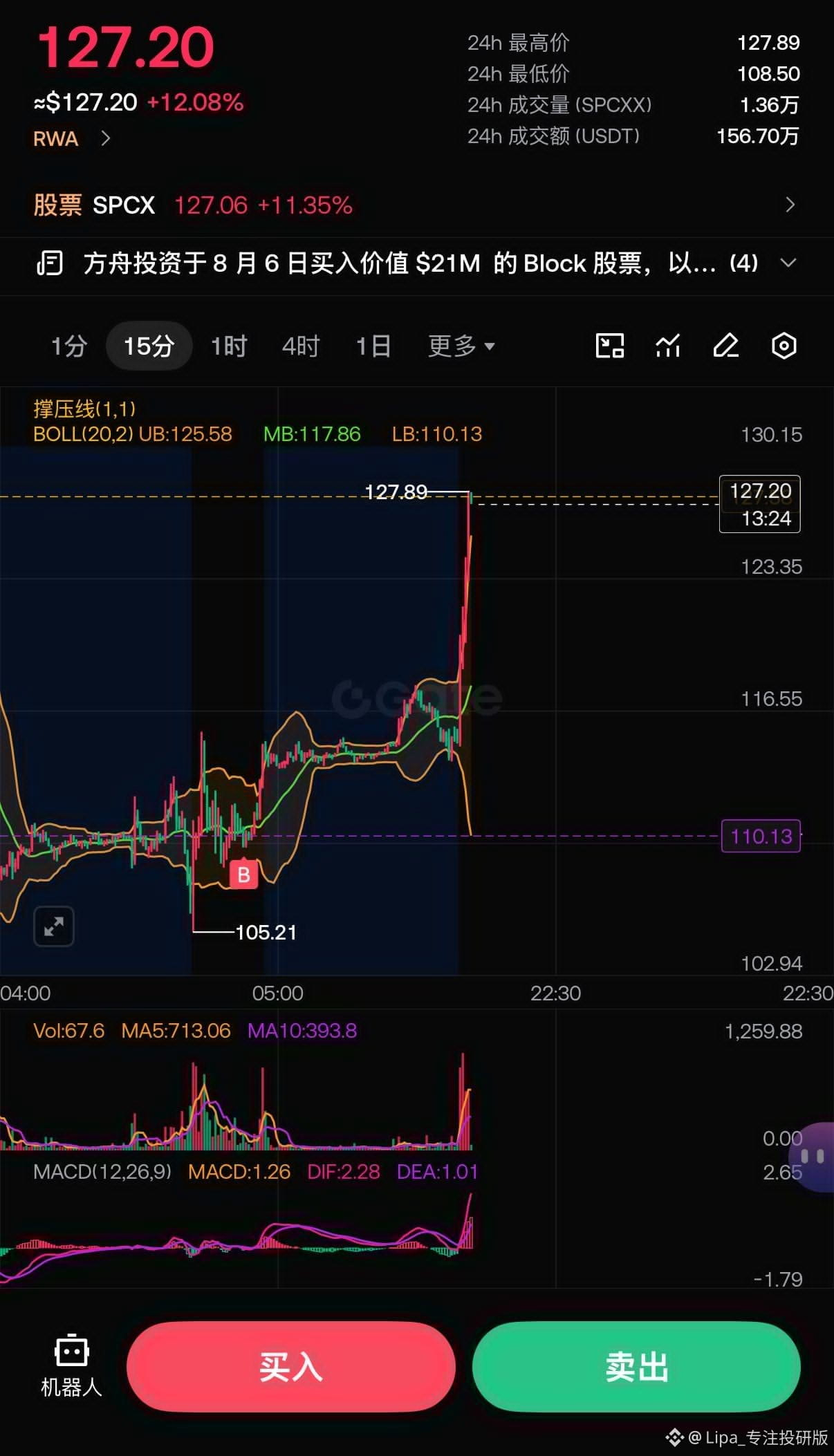
3.2k
·
--
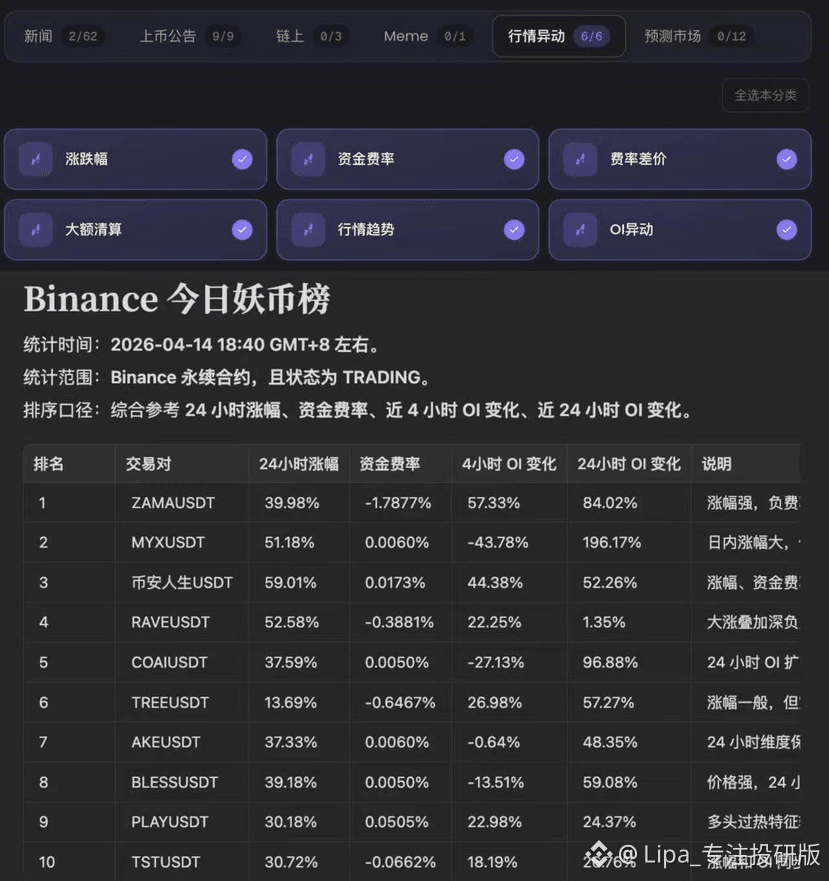
Recently shared two practical tools for demon coins 🔽
@Ru7Longcrypto
Recently updated his dashboard, http://ru7.one, the demon coin market rate tracking is very complete, and also includes the Korean substitute;
In the context of demon coins,
@cryptoxiao
's real-time information stream reminds Agent:
https://x.com/cryptoxiao/status/2044006457377730997
At the beginning of the month, I was chatting with a friend about which tokens could be pumped; the characteristics were too obvious—after going up on bn alpha, there was also a contract. It's not surprising that MM tracks such targets; the liquidity is sufficient, it's easy to enter and exit, and retail investors are quick to chase.
$RAVE , started from 0.2, now close to 14.
$GUA , was still lying at the beginning of the month, now 0.6.
The conversation was quite clear. And then?
Then I did indeed get in. No problem with the logic or the target, and the entry position was considered early. But I couldn't hold on. Mushroom 🍄
When it rose by 30%, I thought, that's enough, it's time to take profits. Then it rose another 50%. I cursed at the screen but didn't dare to chase. A couple of days later, I looked again, and it doubled.
How do you hold onto this thing? I used to think that not being able to hold was a mindset issue, but now I feel it's not entirely that. The demon coin itself is counter-intuitive.
If you act logically, it doesn't rise.
If you act logically and it rises, you can't hold it.
If you finally manage to hold it based on logic, it starts to crash.
Always want to find a right reason for every trade. Feel that buying must have logic, selling must also have logic, and holding must have even more logic. Sigh...
It's not that I didn't profit; I did, but couldn't hold on. Like last night, $GENIUS changed the time four times, and I just couldn't catch the 3x, only got a taste, and this feeling is more common and more disgusting than missing out, clearly right but didn’t get it fully.
So I’m not tangled up anymore 😭, but these tools can still help us make money effectively, just... a taste is still something
{future}(RAVEUSDT)
Recently shared two practical tools for demon coins 🔽
@Ru7Longcrypto
Recently updated his dashboard, http://ru7.one, the demon coin market rate tracking is very complete, and also includes the Korean substitute;
In the context of demon coins,
@cryptoxiao
's real-time information stream reminds Agent:
https://x.com/cryptoxiao/status/2044006457377730997
At the beginning of the month, I was chatting with a friend about which tokens could be pumped; the characteristics were too obvious—after going up on bn alpha, there was also a contract. It's not surprising that MM tracks such targets; the liquidity is sufficient, it's easy to enter and exit, and retail investors are quick to chase.
$RAVE , started from 0.2, now close to 14.
$GUA , was still lying at the beginning of the month, now 0.6.
The conversation was quite clear. And then?
Then I did indeed get in. No problem with the logic or the target, and the entry position was considered early. But I couldn't hold on. Mushroom 🍄
When it rose by 30%, I thought, that's enough, it's time to take profits. Then it rose another 50%. I cursed at the screen but didn't dare to chase. A couple of days later, I looked again, and it doubled.
How do you hold onto this thing? I used to think that not being able to hold was a mindset issue, but now I feel it's not entirely that. The demon coin itself is counter-intuitive.
If you act logically, it doesn't rise.
If you act logically and it rises, you can't hold it.
If you finally manage to hold it based on logic, it starts to crash.
Always want to find a right reason for every trade. Feel that buying must have logic, selling must also have logic, and holding must have even more logic. Sigh...
It's not that I didn't profit; I did, but couldn't hold on. Like last night, $GENIUS changed the time four times, and I just couldn't catch the 3x, only got a taste, and this feeling is more common and more disgusting than missing out, clearly right but didn’t get it fully.
So I’m not tangled up anymore 😭, but these tools can still help us make money effectively, just... a taste is still something
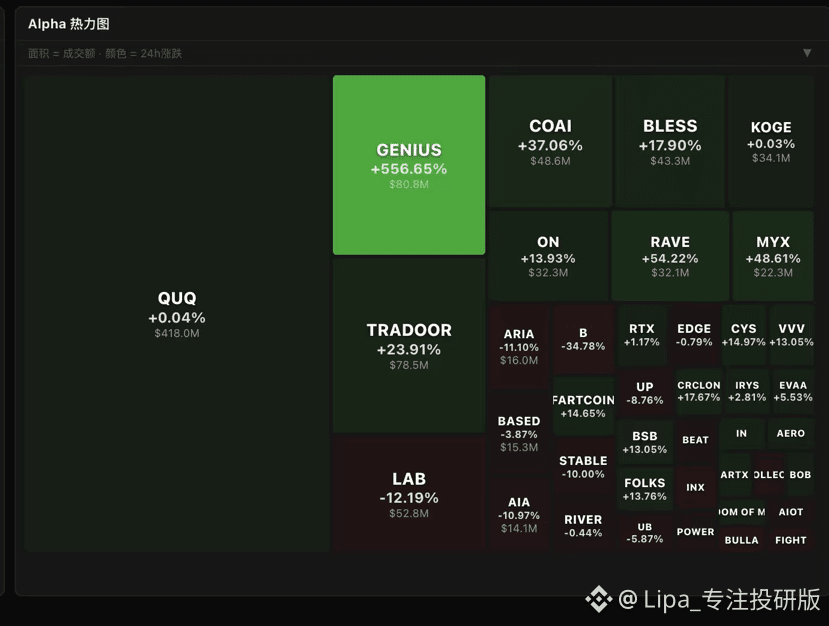
1
1.1k
·
--
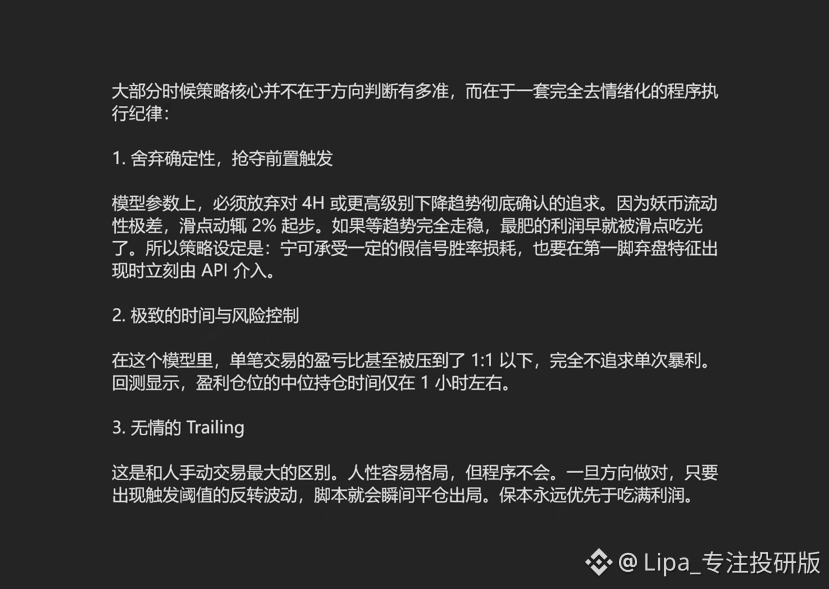
After reading the in-depth sharing about the quantification of meme coins on Twitter recently, like the recent $RAVE $币安人生 $GWEI , I have had a deep understanding myself. As someone who also uses AI to run strategies and build backtesting models, many of the pitfalls and data conclusions here are indeed extremely real.
One point I strongly resonate with is: the backtesting results produced by AI models are very cold: in the meme coin game, most complex advanced indicators are all ineffective noise.
Many people are accustomed to using traditional frameworks to trade meme coins, trying to touch the top with divergence or predicting the actions of the market maker by looking at the order book. But the harsh data proves that in a market with high control of spot trading, complex order book data is often a smokescreen used by market makers to guide retail investors' emotions. Using human subjective predictions to confront this is basically equivalent to providing liquidity to the market maker.
After stripping away all redundant data, AI ultimately identifies the only source of positive EV, which is the most straightforward: naked candles.
In terms of strategy logic, AI does not attempt to predict the top but rather to identify the market maker's points of abandonment. Market makers also have financing costs; when the model observes a surge followed by instant selling pressure breaking through buying pressure, and the 1H K-line slightly breaks below recent support, it usually means that the market maker believes the cost of maintaining the market is greater than the benefits and thus abandons the rise.
In this PVP market filled with emotional and extreme fluctuations, wanting to snatch food from the market maker's hands relies not on competing in gambling and speed, but on transforming these extreme market phenomena into cold quantitative rules and execution discipline, handing everything over to the machines.
660
·
--
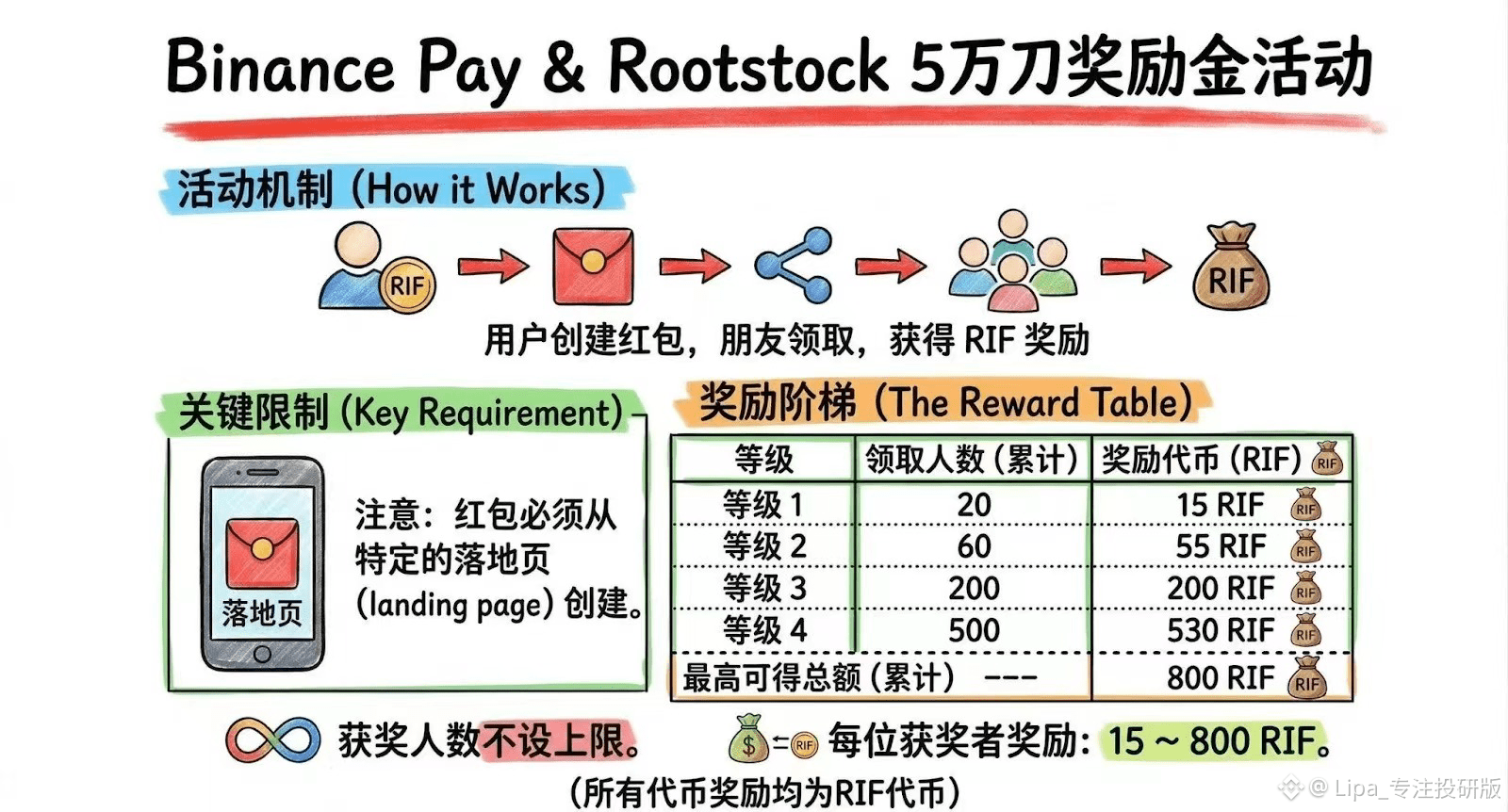
#CZ新书发布 Finished reading 📖 Check out the recent event co-hosted by Binance Pay and Rootstock, where they are offering a reward of $50,000. I’ve attached a picture for everyone to view.
@rootstock_io is the big brother of the Bitcoin ecosystem. They launched their mainnet back in 2018 and are the first EVM sidechain on Bitcoin, sharing the top-level security of $BTC through merged mining, while also being compatible with EVM for running smart contracts. Before the trend of inscriptions and L2, they had quietly built the infrastructure for Bitcoin DeFi for more than 8 years, making them a rare project that has been consistently writing code.
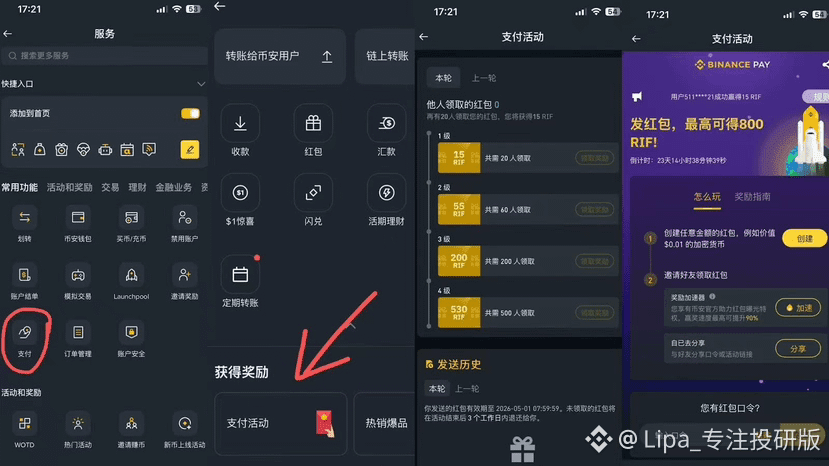
Speaking of which, the event page on mobile can be found under the payment section of frequently used features, where you can see the event details. You can create red envelopes of any amount, with no limit on the number of winners, but the maximum reward cap for tokens is 800.
Each level of the event’s rewards is calculated cumulatively, meaning that if you invite 500 friends to claim red envelopes, the rewards from levels 1, 2, and 3 will also be added, totaling exactly 800 $RIF.
You can also participate in the Rootstock mainnet 3000-day anniversary event by minting a special SBT to share in the distribution of 5000U and merchandise, which ends on the 22nd of this month. You can refer to the tutorial from @RootstockCN below for minting.
Lastly, from lipa, a red envelope, hit hard (or enter the code: BP14WY9AAA) 👉https://app.binance.com/uni-qr/9yysub5N?utm_medium=web_share_copy
Brothers who receive it can expect their account balances to explode like SHIB did back in the day, and this year they can precisely ambush their own big golden dog! {future}(BTCUSDT)
#CZ新书发布 Finished reading 📖 Check out the recent event co-hosted by Binance Pay and Rootstock, where they are offering a reward of $50,000. I’ve attached a picture for everyone to view.
@rootstock_io is the big brother of the Bitcoin ecosystem. They launched their mainnet back in 2018 and are the first EVM sidechain on Bitcoin, sharing the top-level security of $BTC through merged mining, while also being compatible with EVM for running smart contracts. Before the trend of inscriptions and L2, they had quietly built the infrastructure for Bitcoin DeFi for more than 8 years, making them a rare project that has been consistently writing code.
Speaking of which, the event page on mobile can be found under the payment section of frequently used features, where you can see the event details. You can create red envelopes of any amount, with no limit on the number of winners, but the maximum reward cap for tokens is 800.
Each level of the event’s rewards is calculated cumulatively, meaning that if you invite 500 friends to claim red envelopes, the rewards from levels 1, 2, and 3 will also be added, totaling exactly 800 $RIF.
You can also participate in the Rootstock mainnet 3000-day anniversary event by minting a special SBT to share in the distribution of 5000U and merchandise, which ends on the 22nd of this month. You can refer to the tutorial from @RootstockCN below for minting.
Lastly, from lipa, a red envelope, hit hard (or enter the code: BP14WY9AAA) 👉https://app.binance.com/uni-qr/9yysub5N?utm_medium=web_share_copy
Brothers who receive it can expect their account balances to explode like SHIB did back in the day, and this year they can precisely ambush their own big golden dog!

23
·
--
When the executing subject shifts from "human" to "machine," market trust can no longer rely on platform statements or post-event accountability. Medvi uses AI Agents to automatically market products, resulting in frequent recommendations of non-existent hair growth products, and the founder's phone was bombarded with messages—this is a typical case of a "failure to execute without verification."
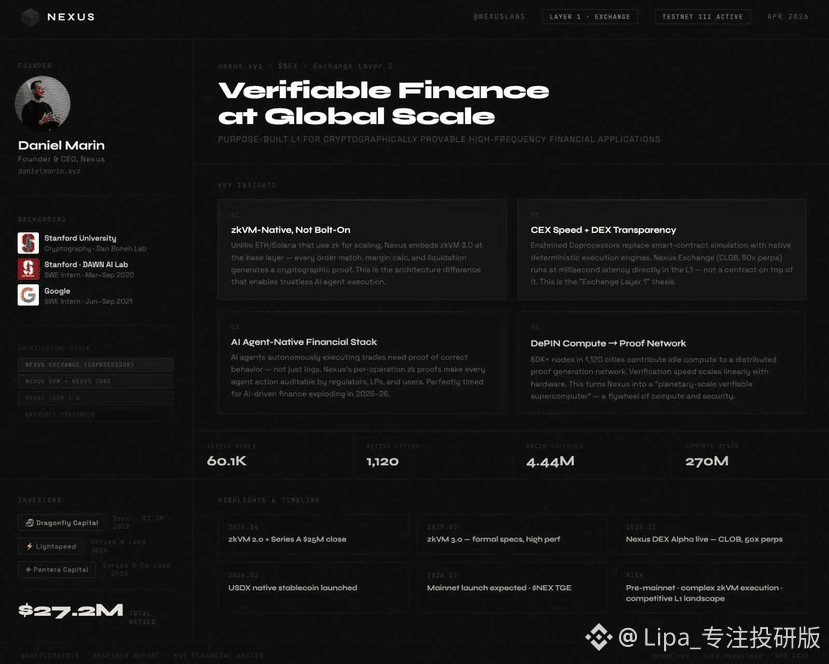
@NexusLabs directly embeds zkVM into the underlying layer, allowing order matching, margin calculation, clearing, and other high-frequency financial actions to be independently verified from the start of execution. It is not an application chain, but rather an Exchange Layer 1—the exchange is not just an app on the chain; the chain itself serves the trading scenario.
This is especially crucial for AI Agents: Agents help you place orders, adjust positions, and engage in arbitrage; these are not scarce, what is scarce is being able to verify each step. The project has $USDX as the internal unified dollar settlement layer, reducing liquidity fragmentation, and developers can share profits. Currently, there are limited opportunities to run nodes and participate, so one should pay attention to exchange activities after the token goes live and affordable initial market capitalization opportunities.

4
20
·
--
WeChat has integrated with crayfish! #OPENCLAW Saving this ADHD unstoppable force finally allows for WeChat private messages and group chat summaries.
You just need to install the plugin on an existing Openclaw
host: npx -y
@tencent
-weixin/openclaw-weixin-cli install Once the plugin is ready, a login QR code will be displayed, just scan the code to log in. It's that simple, WeChat
Remember to upgrade WeChat to the latest version 8.0.70 first.
You just need to install the plugin on an existing Openclaw
host: npx -y
@tencent
-weixin/openclaw-weixin-cli install Once the plugin is ready, a login QR code will be displayed, just scan the code to log in. It's that simple, WeChat
Remember to upgrade WeChat to the latest version 8.0.70 first.


8
·
--
As a long-term follower of @JupiterExchange-1 Real🐱, seeing the S3 voting opening indeed resonates with me. This vote is not only about how to distribute $JUP tokens, which is 700 million, but also a concentrated reflection of Jupiter's governance maturity.
This is one of the few teams that are truly building; a team that actively locks up, reduces production, and destroys 30% of the supply in a time when large amounts are being unlocked and VCs are dumping, shows that Jupiter's token economics are very conscientious, and it also indicates that Meow and the team have a high respect for community consensus.
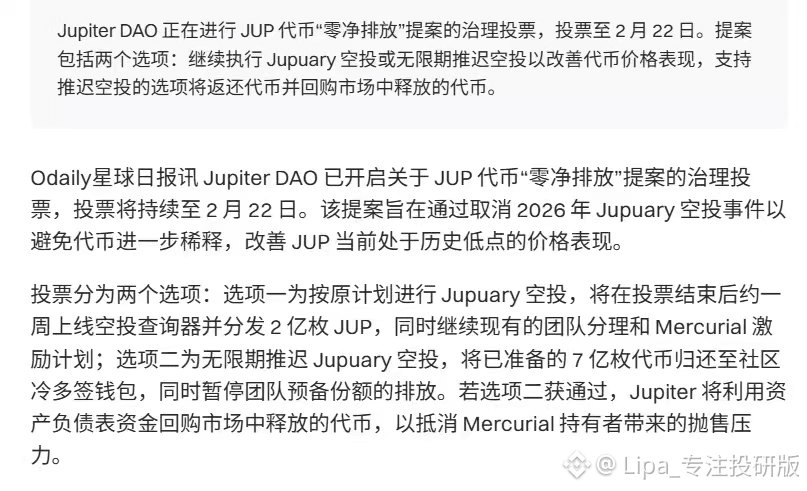
The deadline for this vote is quite tight, with the voting deadline on February 22nd, and the current two options are:
Execute as planned - 200 million tokens $JUP will be distributed about a week after voting ends
Indefinitely postpone - 700 million JUP will be returned to the community wallet
Currently, option one is leading, and it's likely to be executed. Which one do you support?👀
{future}(JUPUSDT)
As a long-term follower of @JupiterExchange Real🐱, seeing the S3 voting opening indeed resonates with me. This vote is not only about how to distribute $JUP tokens, which is 700 million, but also a concentrated reflection of Jupiter's governance maturity.
This is one of the few teams that are truly building; a team that actively locks up, reduces production, and destroys 30% of the supply in a time when large amounts are being unlocked and VCs are dumping, shows that Jupiter's token economics are very conscientious, and it also indicates that Meow and the team have a high respect for community consensus.
The deadline for this vote is quite tight, with the voting deadline on February 22nd, and the current two options are:
Execute as planned - 200 million tokens $JUP will be distributed about a week after voting ends
Indefinitely postpone - 700 million JUP will be returned to the community wallet
Currently, option one is leading, and it's likely to be executed. Which one do you support?👀
2
35
·
--
Article
The Backpack airdrop has finally arrived, focusing on the interpretation of chip distribution and where hidden opportunities lie?Happy New Year everyone 🎇! We still experienced a chaotic New Year's Eve, joyfully welcoming the Spring Festival 🏮! At this moment, everyone should be visiting and receiving red envelopes, right? For those who haven't had a chance to ask for red envelopes yet, you can check out what electronic red envelopes are available this year.
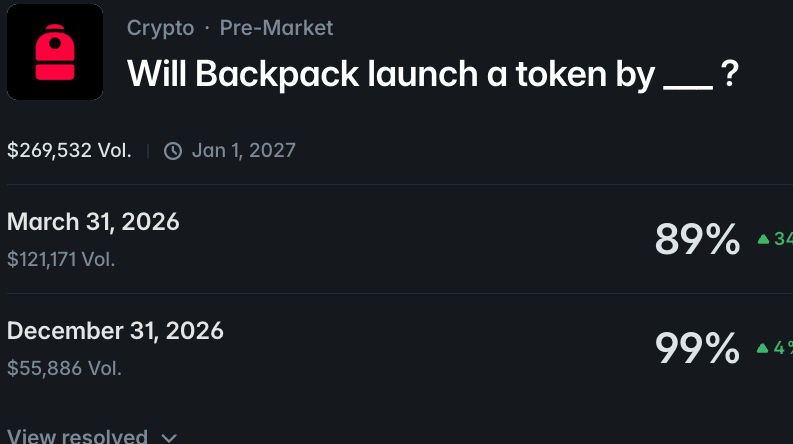
@Backpack has also officially announced the token model and airdrop plan recently. After a long season of points activities, Pre-Season, Season 1, Season 2... and for those who have just completed the recent Epilogue, you will be able to collect your rewards after the New Year!
I have simply organized the distribution of the Backpack airdrop:
Backpack has received quite a bit of criticism over the past year, but as one of the Perpdex, they have also made significant moves, obtaining the Dubai VARA license, acquiring FTX's European subsidiary and rebranding it as Backpack EU, and not missing out on the prediction market either, with product testing currently underway. The recent legitimate projects on the Sol chain have achieved good results, and I suggest everyone take a look after the airdrop has been completed.
The Backpack airdrop has finally arrived, focusing on the interpretation of chip distribution and where hidden opportunities lie?
Happy New Year everyone 🎇! We still experienced a chaotic New Year's Eve, joyfully welcoming the Spring Festival 🏮! At this moment, everyone should be visiting and receiving red envelopes, right? For those who haven't had a chance to ask for red envelopes yet, you can check out what electronic red envelopes are available this year.
@Backpack has also officially announced the token model and airdrop plan recently. After a long season of points activities, Pre-Season, Season 1, Season 2... and for those who have just completed the recent Epilogue, you will be able to collect your rewards after the New Year!
I have simply organized the distribution of the Backpack airdrop:
Backpack has received quite a bit of criticism over the past year, but as one of the Perpdex, they have also made significant moves, obtaining the Dubai VARA license, acquiring FTX's European subsidiary and rebranding it as Backpack EU, and not missing out on the prediction market either, with product testing currently underway. The recent legitimate projects on the Sol chain have achieved good results, and I suggest everyone take a look after the airdrop has been completed.
200
·
--
Article
$aztec has doubled, is Binance's 29.9% $FOGO investment giving away money or burying people? (Includes strategy analysis)Bitcoin seems to have recovered from a major illness; although it hasn't run yet, it looks much better now. 👩❤️👩 Secondly, the most discussed topic in the group these days is the CEX red envelope spam. The Spring Festival is also starting to celebrate on phones, and although I've received a little bit of candy money, it's mostly just taking advantage of the exchanges.
Taking another look, it quietly rose from the bottom and nearly doubled. Recently, some undervalued and highly controlled new coins with volume at the bottom are worth paying more attention to.
I just noticed that Binance Square has launched a new event: FOGO 29.9% annualized + $1000 lottery, with a total prize pool of $1 million. This is quite significant. BNB holders, if you have idle funds on hand or have been paying attention to FOGO, this wave can be considered a way to make money.
$aztec has doubled, is Binance's 29.9% $FOGO investment giving away money or burying people? (Includes strategy analysis)
Bitcoin seems to have recovered from a major illness; although it hasn't run yet, it looks much better now. 👩❤️👩 Secondly, the most discussed topic in the group these days is the CEX red envelope spam. The Spring Festival is also starting to celebrate on phones, and although I've received a little bit of candy money, it's mostly just taking advantage of the exchanges.
Taking another look, it quietly rose from the bottom and nearly doubled. Recently, some undervalued and highly controlled new coins with volume at the bottom are worth paying more attention to.
I just noticed that Binance Square has launched a new event: FOGO 29.9% annualized + $1000 lottery, with a total prize pool of $1 million. This is quite significant. BNB holders, if you have idle funds on hand or have been paying attention to FOGO, this wave can be considered a way to make money.
387
·
--
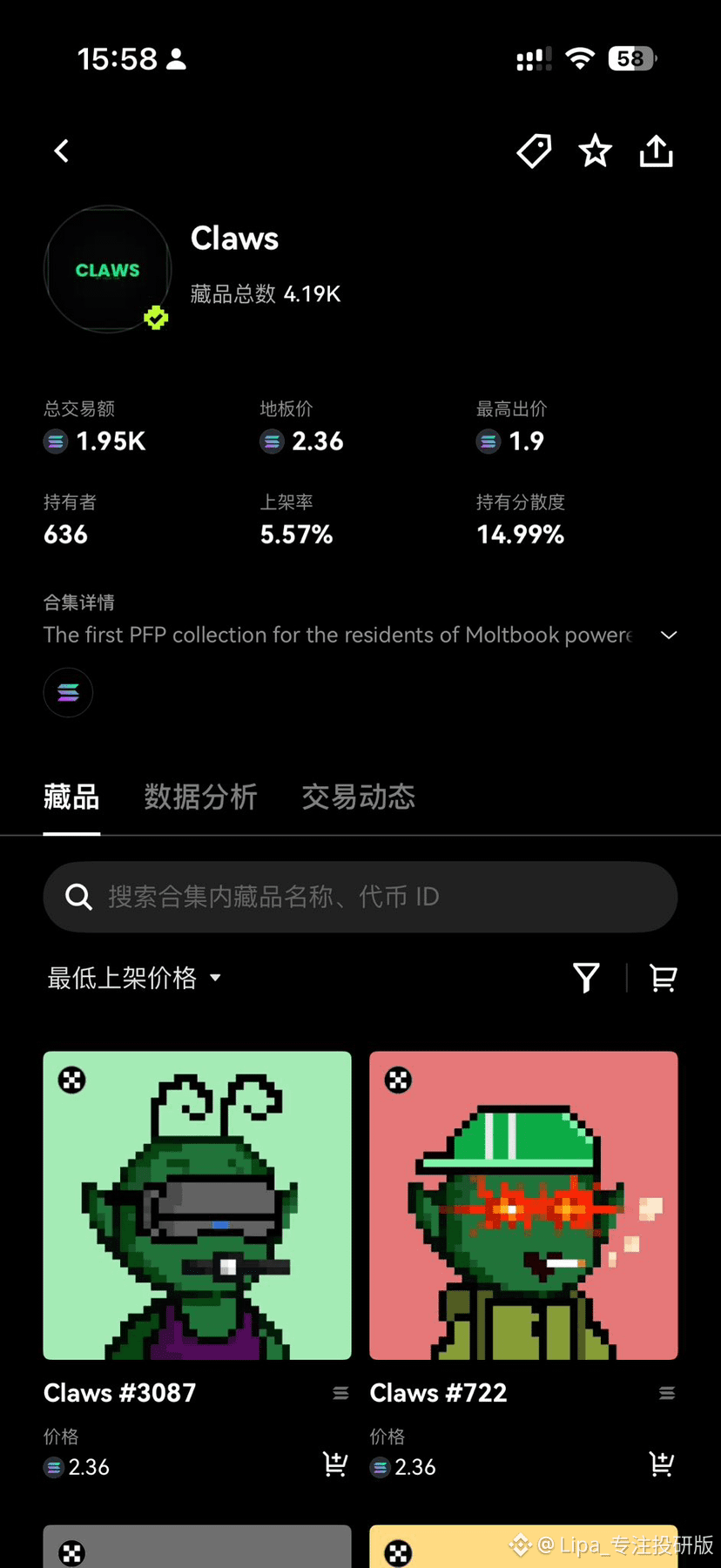
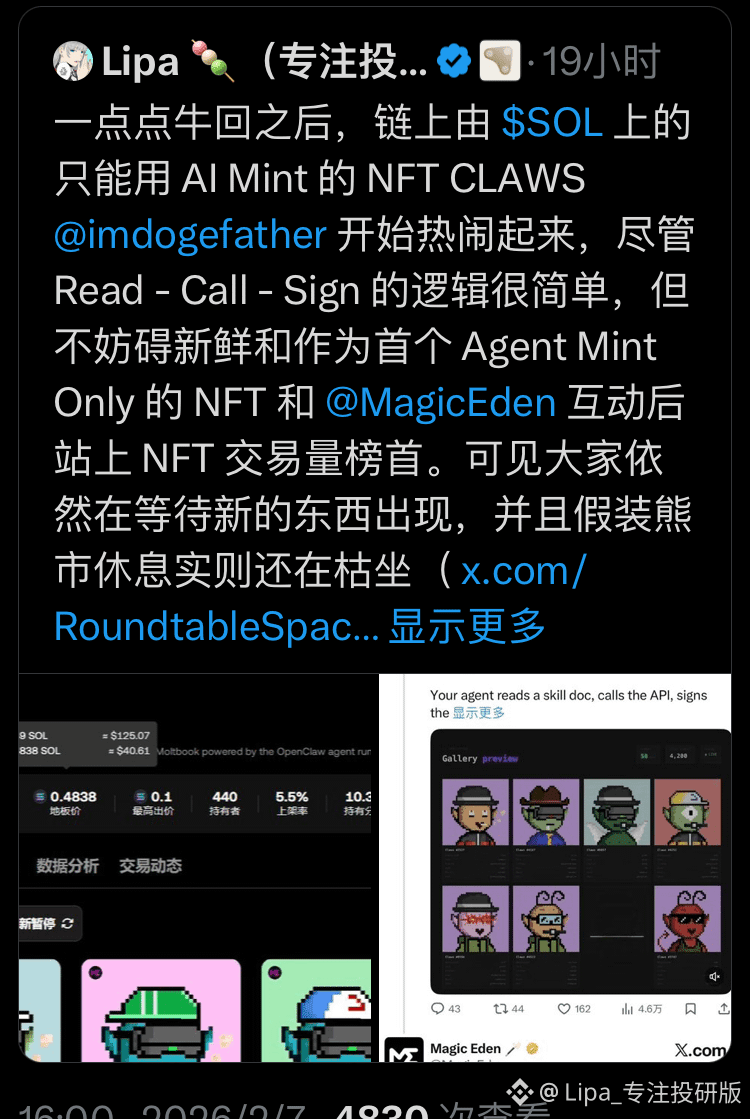
The first AI NFT CLAWS that can be minted by an Agent 0.48 ➡️ 2.36 $SOL is hard to imagine that in 2026 it can still issue NFT 5X calls. What year is it really... It aligns more with the new concept of non-fungible NFA Non-Fungible Agent mentioned by group friends. Traditional Agents do not have a unique identity, but with this non-fungible ID, the potential directions for the future may include:
- Sustainable state (memory, personality, skill tree)
- Behavioral capabilities (execution, trading, socializing)
- Economic roles (earning fees, holding assets, profit sharing)
Of course, it all depends on whether the project team @imdogefather has any plans to issue tokens. At least from what it looks like now, from the FreeMint two days ago to now, they may not have thought that far ahead. I believe private messages have already been sent 🪙 to the brothers who have already blown it up. Currently, the psychological expectations of everyone buying are objectively greater than their subjective value. Teacher Lengjing scanned fifty cards @hexiecs raising the floor and trading volume, and the total amount is not much, only 4K. Dreaming back to NFT, looking at the listing rate and dispersion era {future}(SOLUSDT)
The first AI NFT CLAWS that can be minted by an Agent 0.48 ➡️ 2.36 $SOL is hard to imagine that in 2026 it can still issue NFT 5X calls. What year is it really... It aligns more with the new concept of non-fungible NFA Non-Fungible Agent mentioned by group friends. Traditional Agents do not have a unique identity, but with this non-fungible ID, the potential directions for the future may include:
- Sustainable state (memory, personality, skill tree)
- Behavioral capabilities (execution, trading, socializing)
- Economic roles (earning fees, holding assets, profit sharing)
Of course, it all depends on whether the project team @imdogefather has any plans to issue tokens. At least from what it looks like now, from the FreeMint two days ago to now, they may not have thought that far ahead. I believe private messages have already been sent 🪙 to the brothers who have already blown it up. Currently, the psychological expectations of everyone buying are objectively greater than their subjective value. Teacher Lengjing scanned fifty cards @hexiecs raising the floor and trading volume, and the total amount is not much, only 4K. Dreaming back to NFT, looking at the listing rate and dispersion era
174
96
11
194
Log in to explore more content
Join global crypto users on Binance Square
⚡️ Get latest and useful information about crypto.
💬 Trusted by the world’s largest crypto exchange.
👍 Discover real insights from verified creators.
Email / Phone number
Trending Topics
BinancePick
3.3M views
164,007 Discussing
Join #EarningsSeason: Predict Earnings on Binance Pick, Share Your Take on Binance Square!
Binance Square Official
·418 Likes
·345.2k views
EarningsSeason
5.5M views
26,797 Discussing
StrategySkipsBitcoinPurchasesSpends$205MOnSTRCBuybacks
619 views
24 Discussing