
链上冷读_加密与热点
362 Posts

链上冷读_加密与热点
Report
Block User
追踪加密、AI与全球市场热点,拆解新闻背后的资金与情绪。少一点喊单,多一点冷思考。内容仅供交流,不构成投资建议。
Open Trade

BNB Holder
Frequent Trader
5.8 Years
6 Following
41 Followers
42 Liked
Posts
Portfolio
·
--
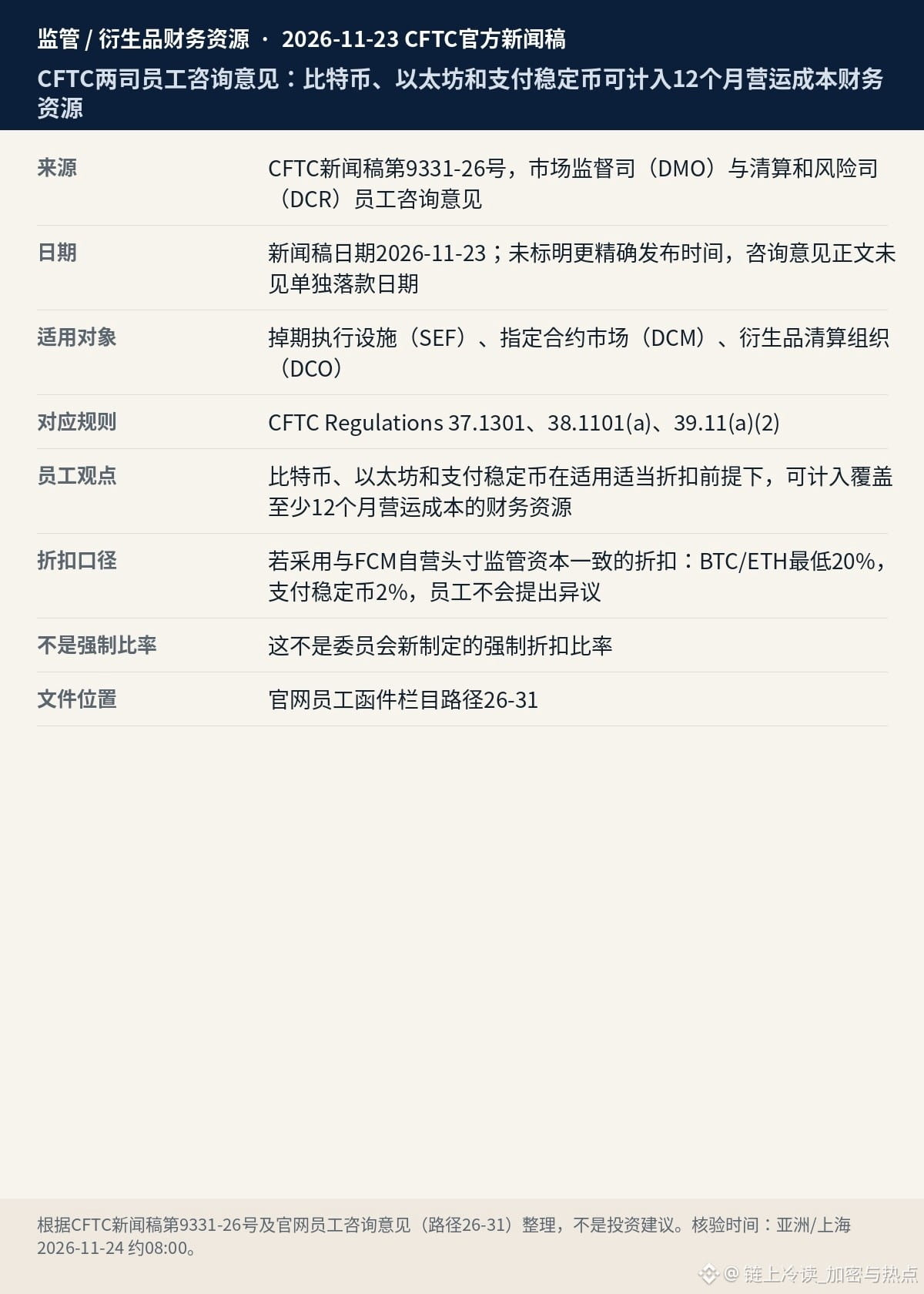
On November 23, 2026, the U.S. Commodity Futures Trading Commission (CFTC) issued Press Release No. 9331-26, announcing that its Division of Market Oversight (DMO) and Division of Clearing and Risk (DCR) had issued staff advisory opinions that day explaining how swap execution facilities (SEFs), designated contract markets (DCMs), and derivatives clearing organizations (DCOs) may use crypto assets to meet financial resource requirements related to operating costs under Regulations 37.1301, 38.1101(a), and 39.11(a)(2). The press release did not specify a more precise release time; the advisory opinions themselves do not appear to carry a separate date, so this post uses the press release date. The documents are available in the Staff Letters section of the official website under path 26-31.
Staff of the two divisions believe that Bitcoin, Ethereum, and payment stablecoins may count toward financial resources covering at least 12 months of operating costs, provided appropriate haircuts are applied. Staff stated that they would not object to haircuts consistent with the regulatory capital treatment of futures commission merchant (FCM) proprietary positions: a minimum of 20% for Bitcoin and Ethereum, and 2% for payment stablecoins. These are not newly mandated ratios established by the Commission. Crypto assets that are not readily marketable and are not payment stablecoins generally require a 100% haircut, and therefore cannot be used to meet this requirement. The advisory opinions provide a specific definition of “payment stablecoin” and distinguish between the definitions before and after the GENIUS Act takes effect; this does not mean that all stablecoins qualify.
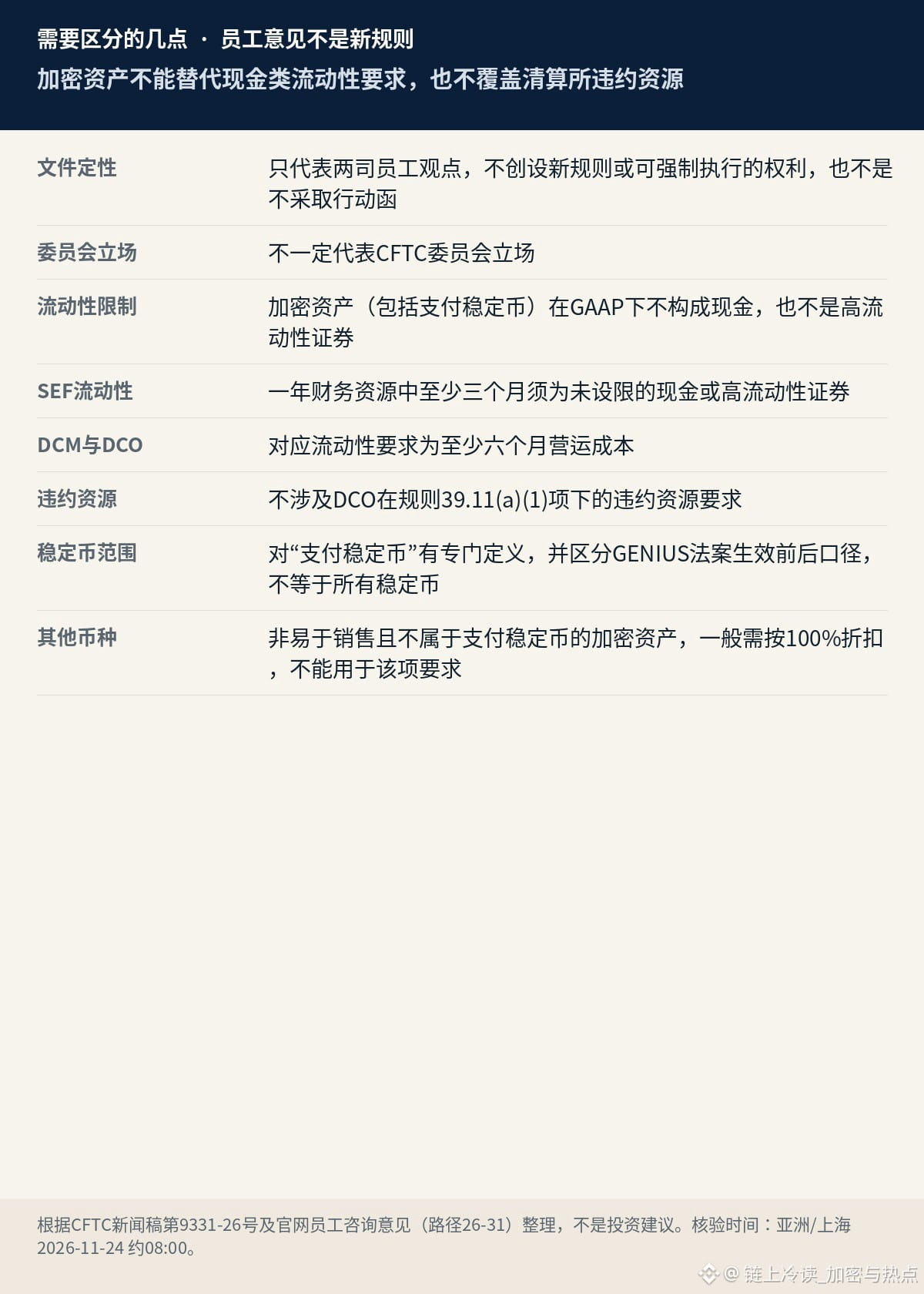
However, crypto assets (including payment stablecoins) do not constitute “cash” under U.S. generally accepted accounting principles and are not “highly liquid securities,” so they cannot be used to meet the separate liquidity requirement: SEFs must hold at least three months’ worth of their one-year financial resources in unencumbered cash or highly liquid securities; the corresponding requirement for DCMs and DCOs is at least six months of operating costs. The advisory opinions also state that this does not concern the default resources requirement for DCOs under Regulation 39.11(a)(1).
This represents only the views of staff in the two divisions identified above. It does not create a new rule or enforceable rights, is not a no-action letter, and does not necessarily represent the Commission’s position.
Are you more concerned about whether regulated exchanges will consequently count Bitcoin or Ethereum toward their operating buffers, or whether the cash-like liquidity floor will be the practical constraint?
$BTC $ETH
#Regulation
289
·
--
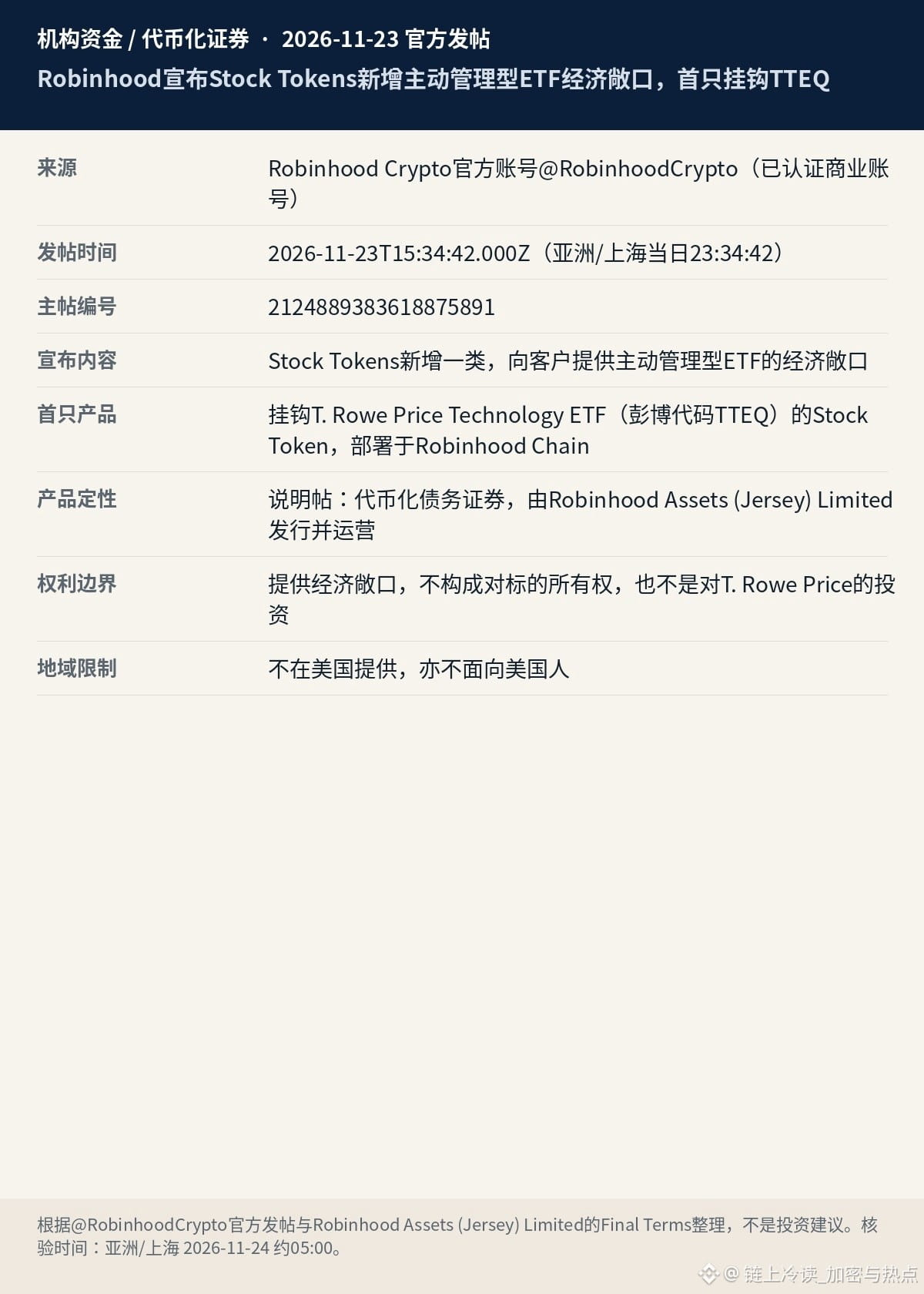
The official Robinhood Crypto account @RobinhoodCrypto posted at 2026-11-23T15:34:42Z (corresponding to 23:34:42 that day in Asia/Shanghai), announcing a new category of Robinhood Stock Tokens that gives customers economic exposure to actively managed ETFs. The first Stock Token to launch on Robinhood Chain is linked to the T. Rowe Price Technology ETF (Bloomberg ticker TTEQ). An explanatory post published at the same second stated that Stock Tokens are tokenized debt securities issued and operated by Robinhood Assets (Jersey) Limited. They provide economic exposure to an underlying ETF or other asset, but do not confer ownership of the underlying asset itself and are not an investment in T. Rowe Price. They are not available in the United States or to U.S. persons.
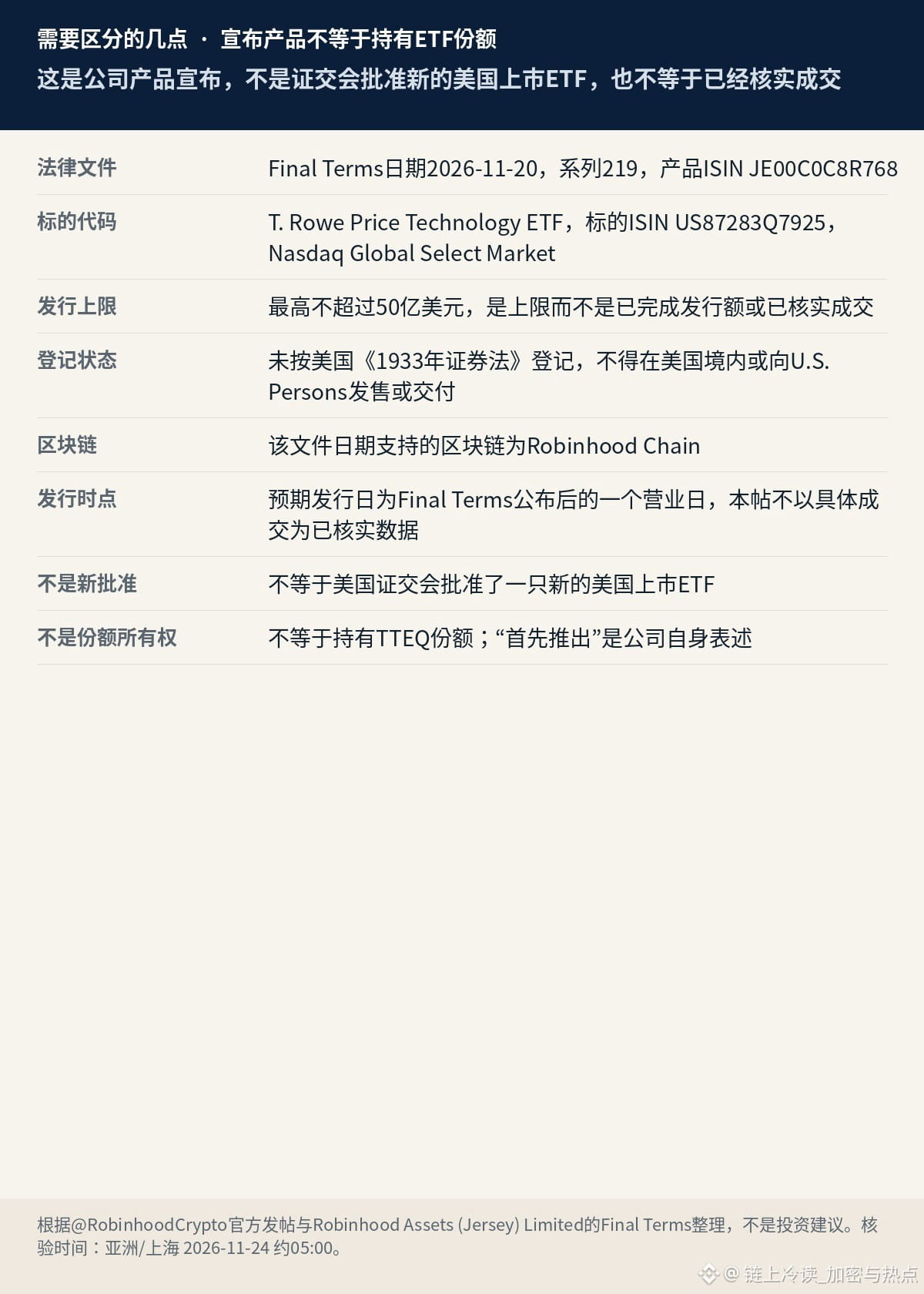
The verifiable legal document is the Final Terms dated November 20, 2026, under the company’s Tokenised Products Programme: Series 219, product ISIN JE00C0C8R768, linked to the ETF noted above (underlying ISIN US87283Q7925, listed on the Nasdaq Global Select Market), with a maximum issuance size of up to $5 billion. This is an issuance cap; it does not mean that the full amount has already been issued, nor is it a separately verified trading volume. The document states that the product has not been registered under the U.S. Securities Act of 1933 and may not be offered or delivered in the United States or to U.S. persons as defined by Regulation S. As of the date of that document, Robinhood Chain was the supported blockchain. The expected issue date is one business day after publication of the Final Terms; this post does not treat any specific launch or trade as verified data.
This is a company product announcement. It does not mean that the U.S. Securities and Exchange Commission has approved a new U.S.-listed ETF, nor does it mean that holders own shares of TTEQ.
For this type of tokenized debt instrument, which matters more to you: the limits of holders’ rights, or its actual tradability in markets outside the United States?
$TTEQ
TTEQETF-0.08%
TROWUS+0.01%
6
·
--
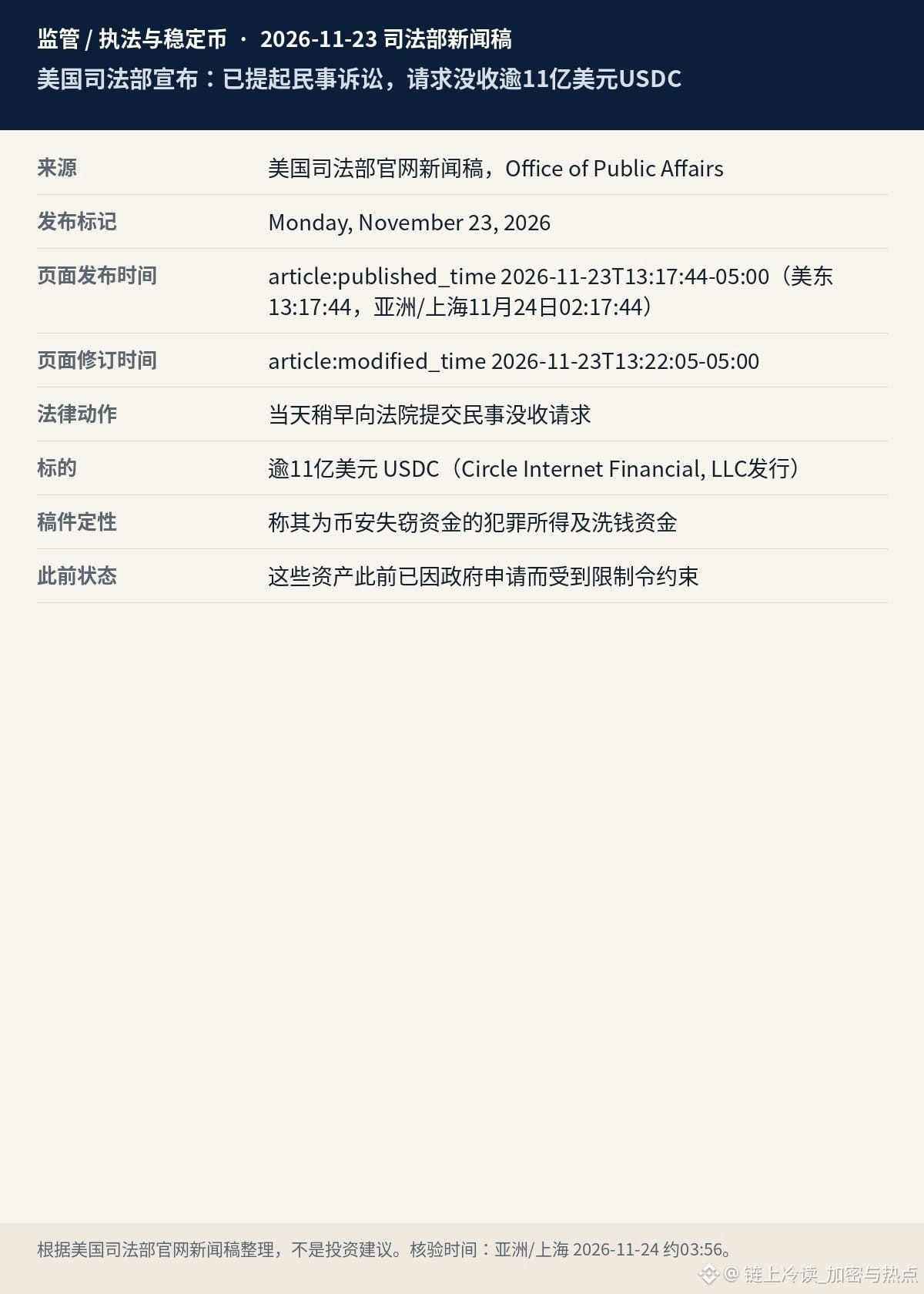
The U.S. Department of Justice issued a press release on November 23, 2026, announcing that it had filed a civil lawsuit seeking the forfeiture of more than $1.1 billion in USDC. The press release page lists the publication time as 2026-11-23T13:17:44-05:00 (1:17:44 p.m. Eastern Time that day, corresponding to 2:17:44 a.m. on November 24 in Asia/Shanghai). The release states that this was a civil forfeiture complaint filed with the court earlier that day, seeking Circle Internet Financial, LLC-issued dollar stablecoin USDC. It also alleges that these assets are proceeds of crime and money laundering funds derived from stolen Binance funds, and that they had already been subject to restraining orders following a government application.
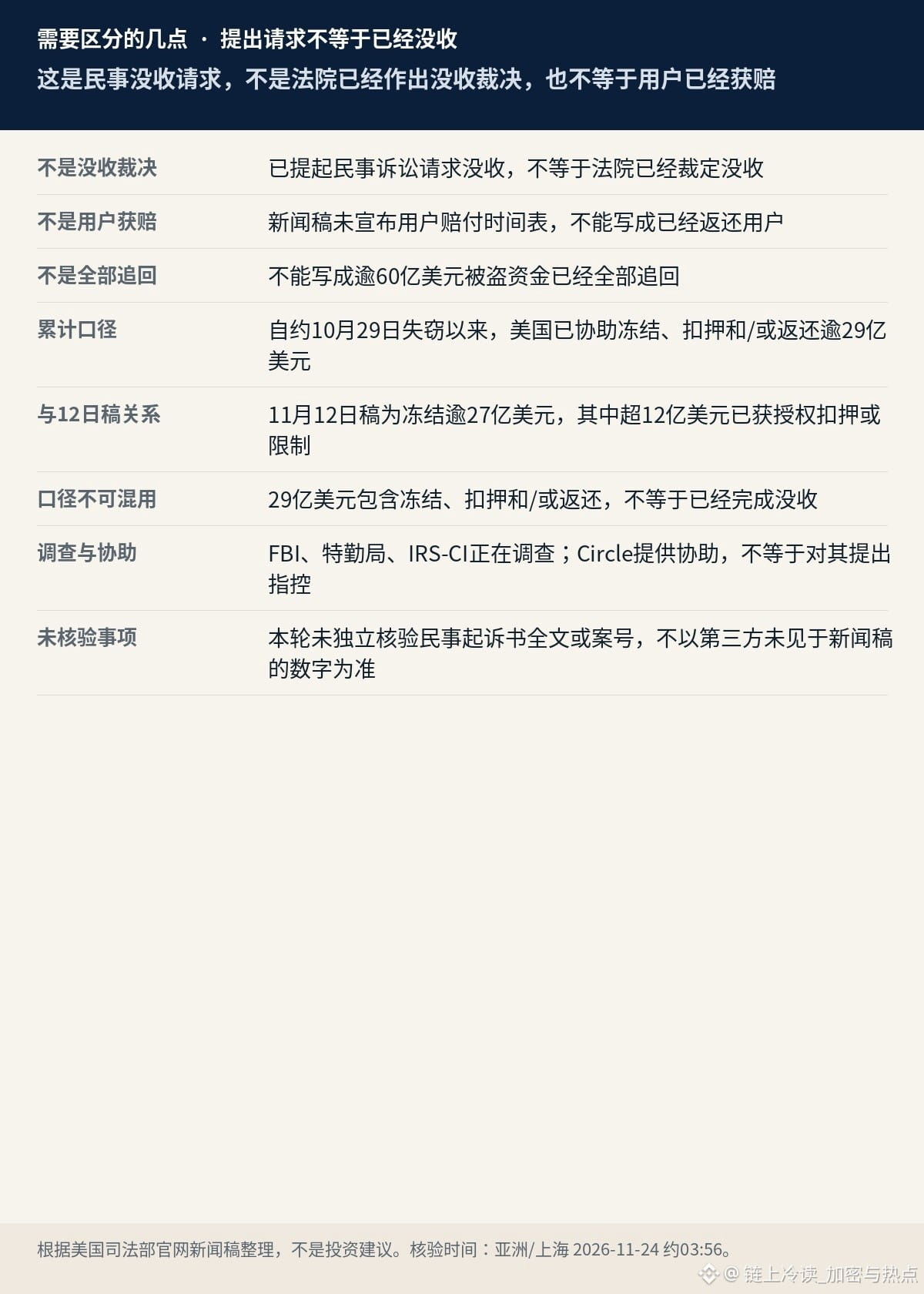
This is a request for forfeiture, not a forfeiture ruling already issued by the court. Nor does it mean that users have already been compensated, and it should not be described as all the stolen funds having been recovered.
The same press release states that, since the theft around October 29, the United States has assisted in freezing, seizing, and/or returning more than $2.9 billion in crypto assets from multiple sources; this action is part of efforts to help Binance recover more than $6 billion in stolen assets. This is not measured on the same basis as the November 12 press release, which said that more than $2.7 billion had been frozen in total, of which more than $1.2 billion had been authorized by a court for seizure or restriction: the $2.9 billion figure includes assets frozen, seized, and/or returned, and does not mean that forfeiture has been completed.
The Federal Bureau of Investigation, the U.S. Secret Service, and the Internal Revenue Service’s Criminal Investigation division are investigating the case, with assistance from Circle. This does not mean that Circle has been charged.
In your view, now that more than $1.1 billion in USDC has entered formal forfeiture proceedings, what is more important to watch: whether the court will grant the request, or how much of the remaining stolen funds can still be recovered?
$USDC
64
·
--
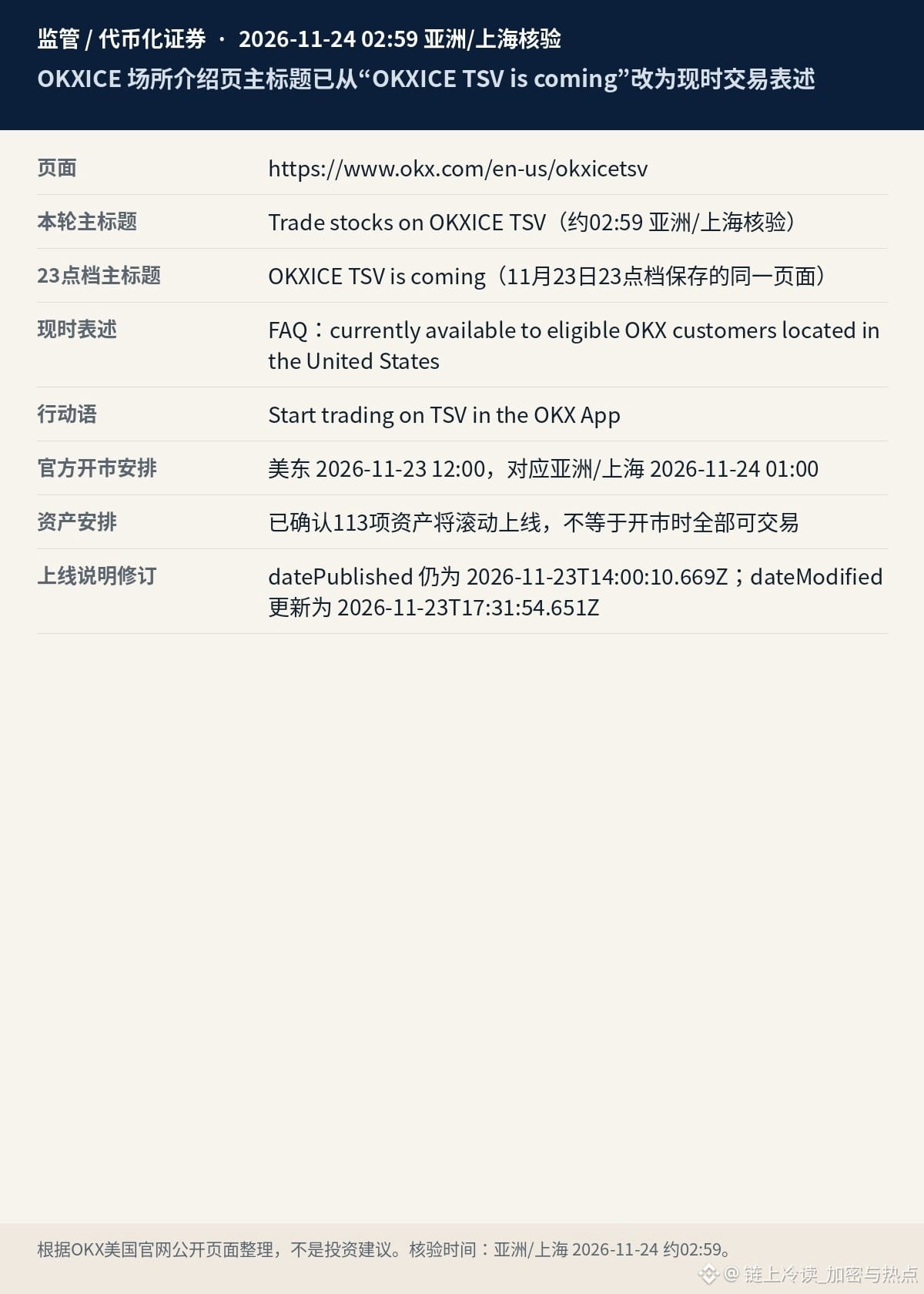
At approximately 02:59 Asia/Shanghai time on November 24, 2026, a check of the venue introduction page on the OKX U.S. website found that the headline had changed to “Trade stocks on OKXICE TSV.” The FAQ stated that the venue is now available to eligible U.S. customers (the original wording was “currently available”), and the page included “Start trading on TSV in the OKX App.” This differs from the same page at the 23:00 hour on November 23, when its headline still read “OKXICE TSV is coming.” OKX had previously stated that, starting at 12:00 ET on November 23 (01:00 on November 24 in Asia/Shanghai), eligible U.S. customers could trade assets made available on the TSV tab in the OKX app; 113 assets had been confirmed for a phased rollout.
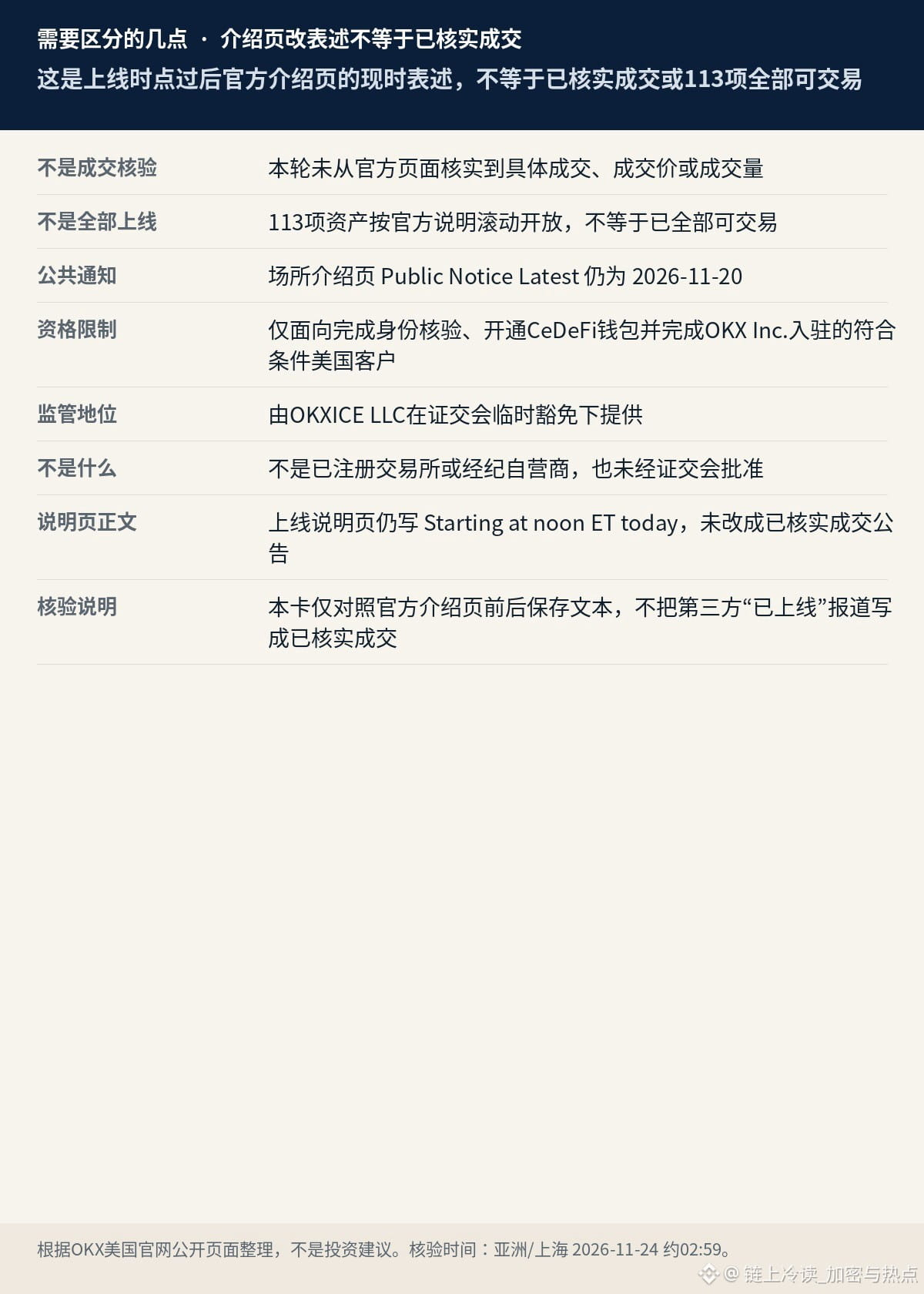
The introduction page’s shift from “coming soon” to present-tense trading guidance does not mean that this check verified any specific trades, execution prices, or trading volumes, nor does it mean that all 113 assets are tradable. The page’s “Latest” legal public notice is still dated November 20, 2026. The venue is only for eligible U.S. customers who have completed identity verification, set up a CeDeFi wallet, and completed onboarding with OKX Inc. OKXICE TSV is provided by OKXICE LLC under a temporary SEC exemption; it is not a registered exchange or broker-dealer, and it has not been approved by the SEC. The body of the launch information page still says “Starting at noon ET today”; the page’s structured data lists dateModified as 2026-11-23T17:31:54.651Z.
Are you more interested in which assets are now available, or whether after-hours prices could deviate significantly from the underlying stocks?
22
·
--
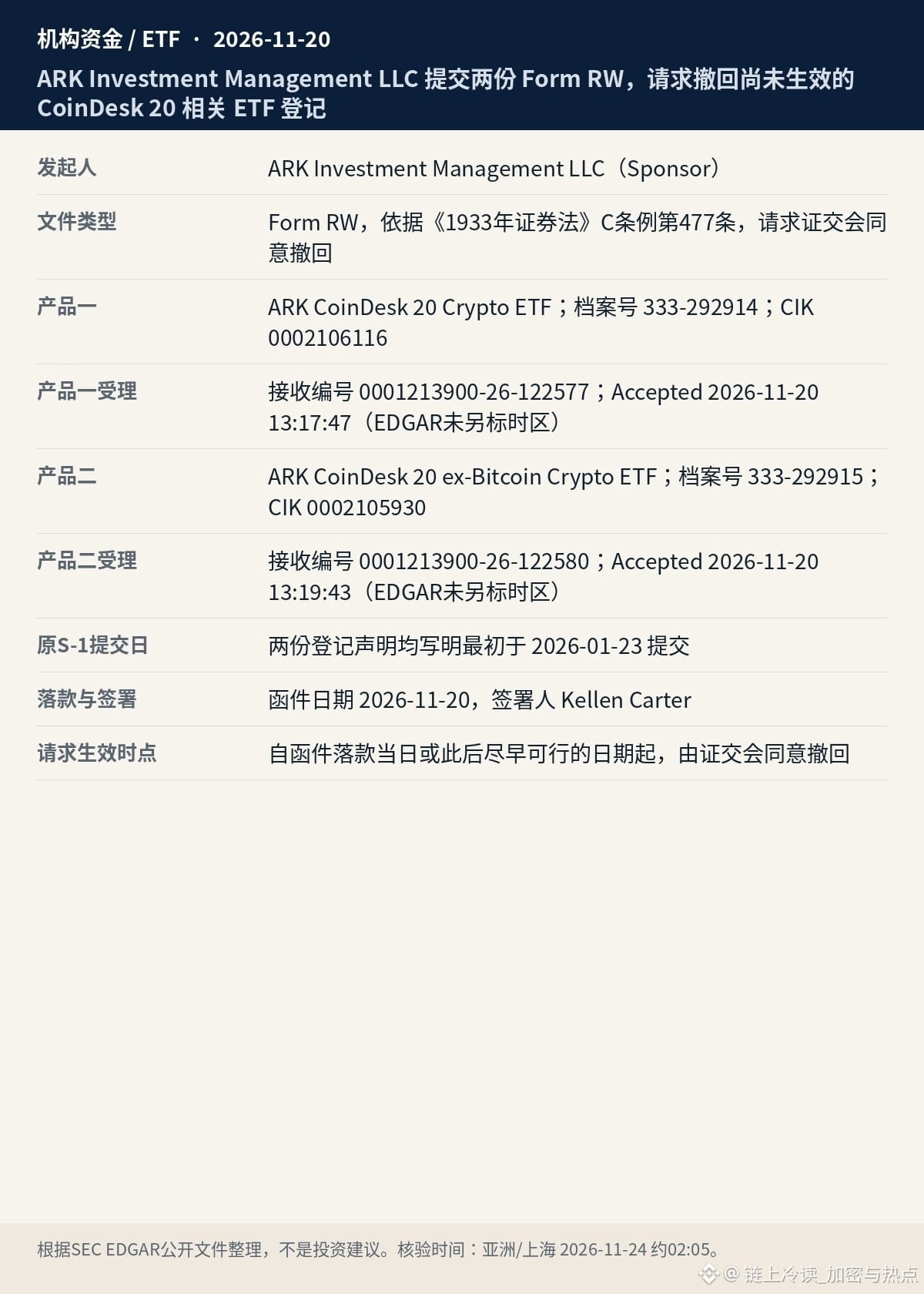
ARK Investment Management LLC, as sponsor, filed two Form RW requests with the SEC’s Division of Corporation Finance through EDGAR on November 20, 2026, under Rule 477 of Regulation C of the Securities Act of 1933, asking the SEC to consent to the withdrawal of the Form S-1 registration statements, together with all exhibits, for two cryptocurrency index ETFs that had not yet become effective. Both letters are dated November 20, 2026, and signed by Kellen Carter.
The first is the ARK CoinDesk 20 Crypto ETF, file number 333-292914, CIK 0002106116, accession number 0001213900-26-122577, Accepted 2026-11-20 13:17:47. The second is the ARK CoinDesk 20 ex-Bitcoin Crypto ETF, file number 333-292915, CIK 0002105930, accession number 0001213900-26-122580, Accepted 2026-11-20 13:19:43. These are the Accepted times recorded by EDGAR; no time zone is separately indicated in the public filings. Both registration statements state that they were initially filed on January 23, 2026.
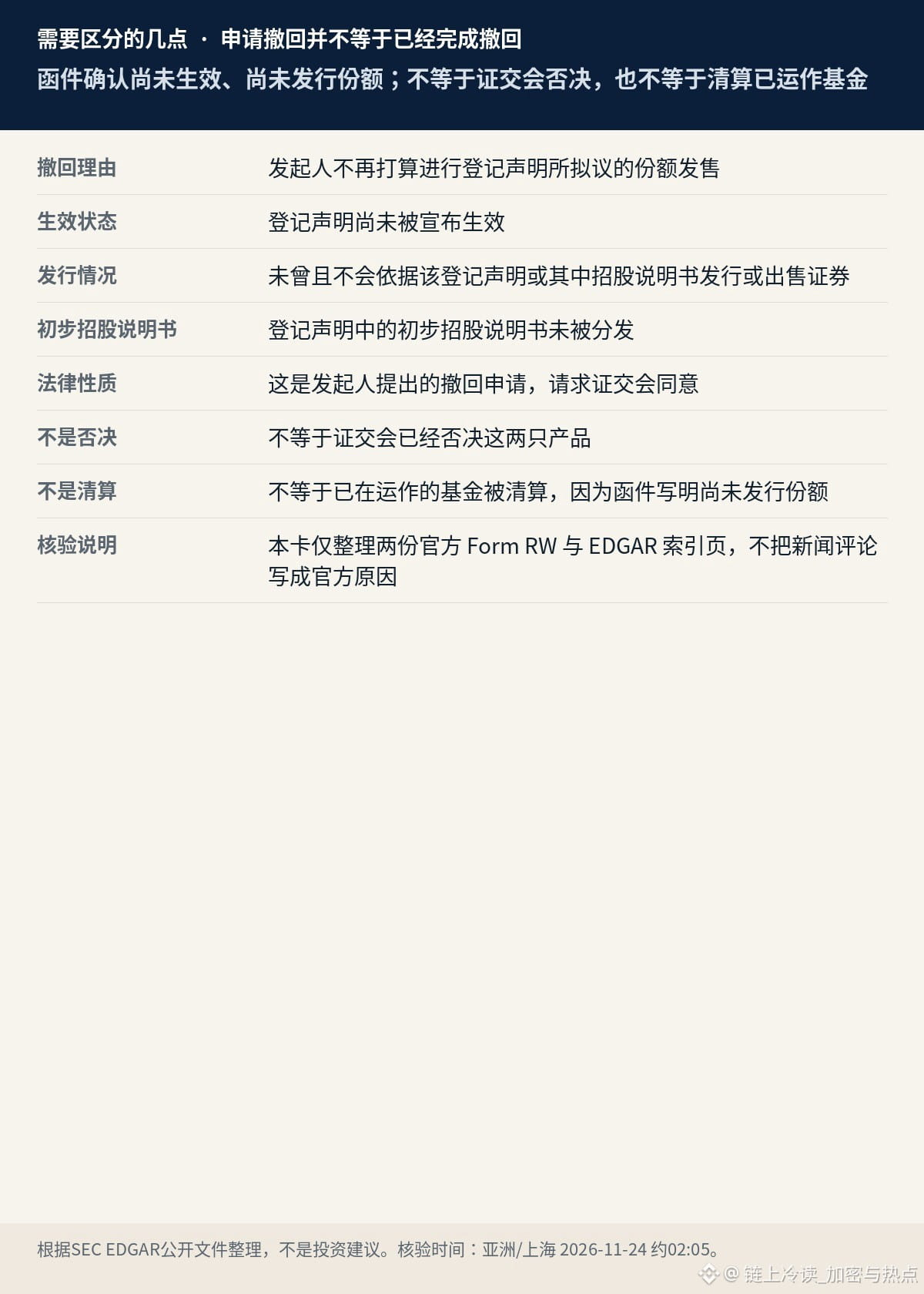
The letters give as the reason for withdrawal that the sponsor no longer intends to proceed with the offering of shares contemplated by the registration statements. They also confirm that the registration statements have not been declared effective; no securities have been or will be issued or sold under the registration statements or the prospectuses included in them; and the preliminary prospectuses in the registration statements have not been distributed. This is the sponsor’s request to withdraw the filings and obtain the SEC’s consent; it does not mean the SEC has already rejected these products, nor does it mean that operating funds have been liquidated, since the letters state that no shares have been issued.
To determine whether the withdrawals have been completed, which type of subsequent public filing would you prefer to check first: whether the SEC has expressly consented, or whether the registration filing statuses have been updated?
5
·
--
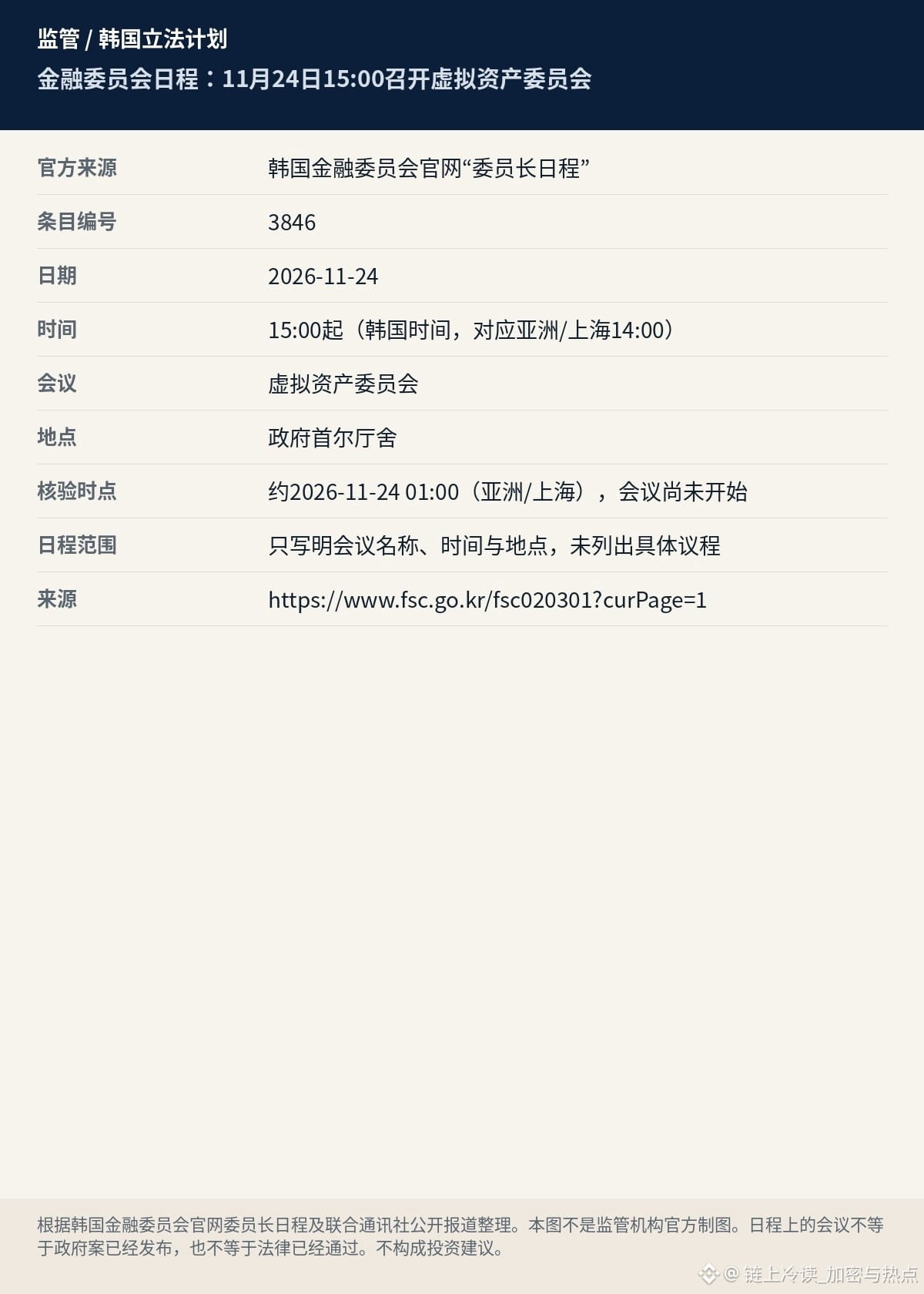
The “Chairperson’s Schedule” on the official website of South Korea’s Financial Services Commission lists a “Virtual Asset Committee” meeting at 15:00 on November 24, 2026 (Korea time, corresponding to 14:00 in Asia/Shanghai) at the Government Complex Seoul. The time of this verification is approximately 2026-11-24 01:00 (Asia/Shanghai, corresponding to approximately 02:00 Korea time), and the meeting has not yet begun. The schedule lists only the meeting name, time, and location; it does not provide a specific agenda. Therefore, topics that have not yet been announced should not be presented as confirmed items.
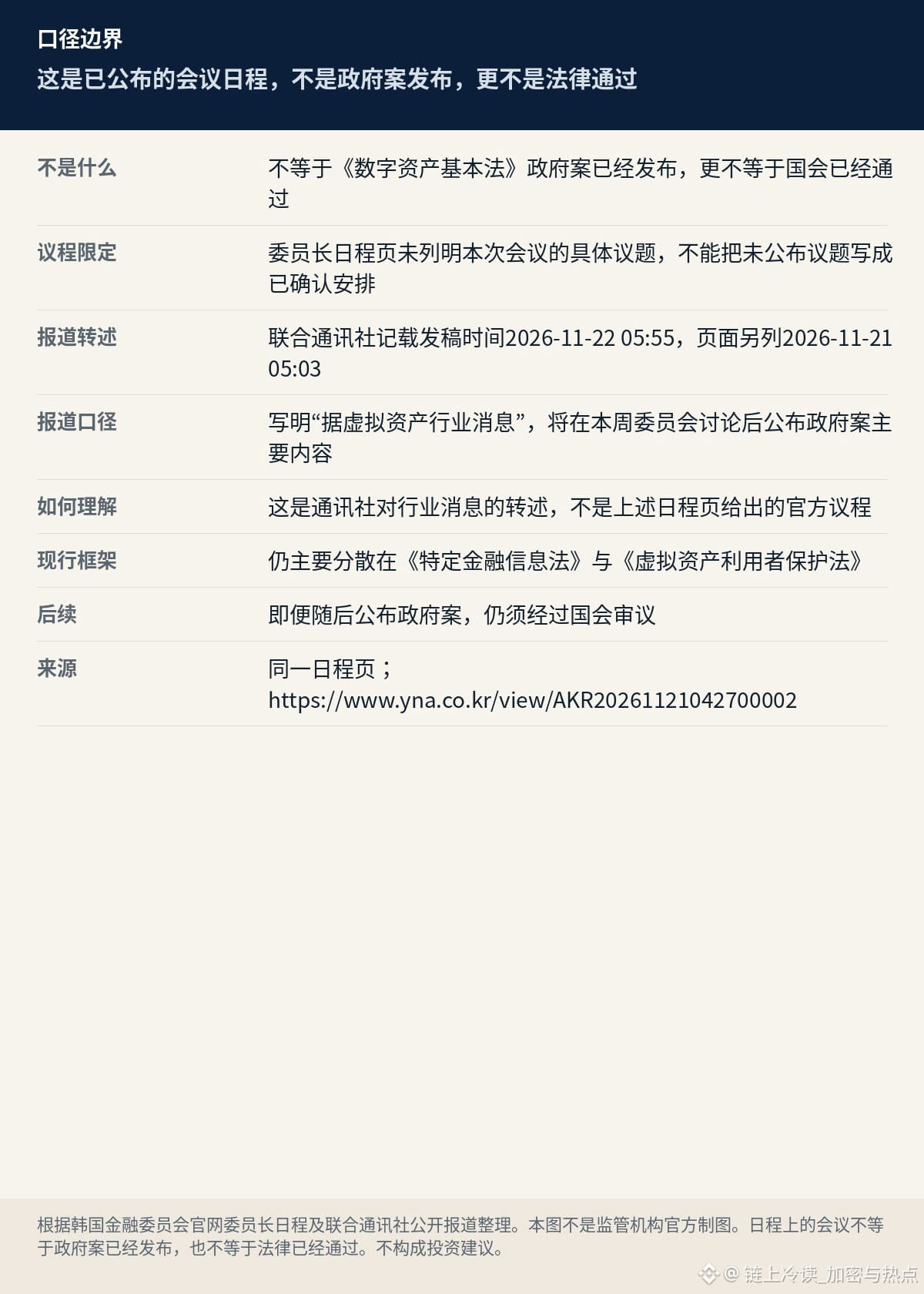
This does not mean that the government’s draft of the Digital Asset Framework Act has been released, much less that the relevant legislation has been passed by the National Assembly. The Yonhap News Agency article records its publication time as 05:55 on November 22, 2026, while the page also lists the date as 2026-11-21 05:03; both are stated as recorded on that page. The report says that, “according to sources in the virtual asset industry,” the Financial Services Commission will announce the main contents of the government’s draft after discussing it at a Virtual Asset Committee meeting this week. This is the news agency’s account of industry sources, not an official agenda provided by the schedule page above. The specific contents should still be verified against the official announcement after the meeting.
South Korea’s current framework remains largely divided between reporting and anti-money laundering obligations under the Act on Reporting and Using Specified Financial Transaction Information, and user protection and unfair trading regulations under the Virtual Asset User Protection Act. Even if the government’s draft is subsequently announced, it will still need to undergo National Assembly deliberation. A committee meeting listed on the schedule should not be taken to mean that legislation has already been enacted.
If an official announcement comes out after the meeting, would you prefer to first verify the classification of businesses and licensing requirements, or the entities that may issue won-denominated stablecoins?
#Regulation
·
--
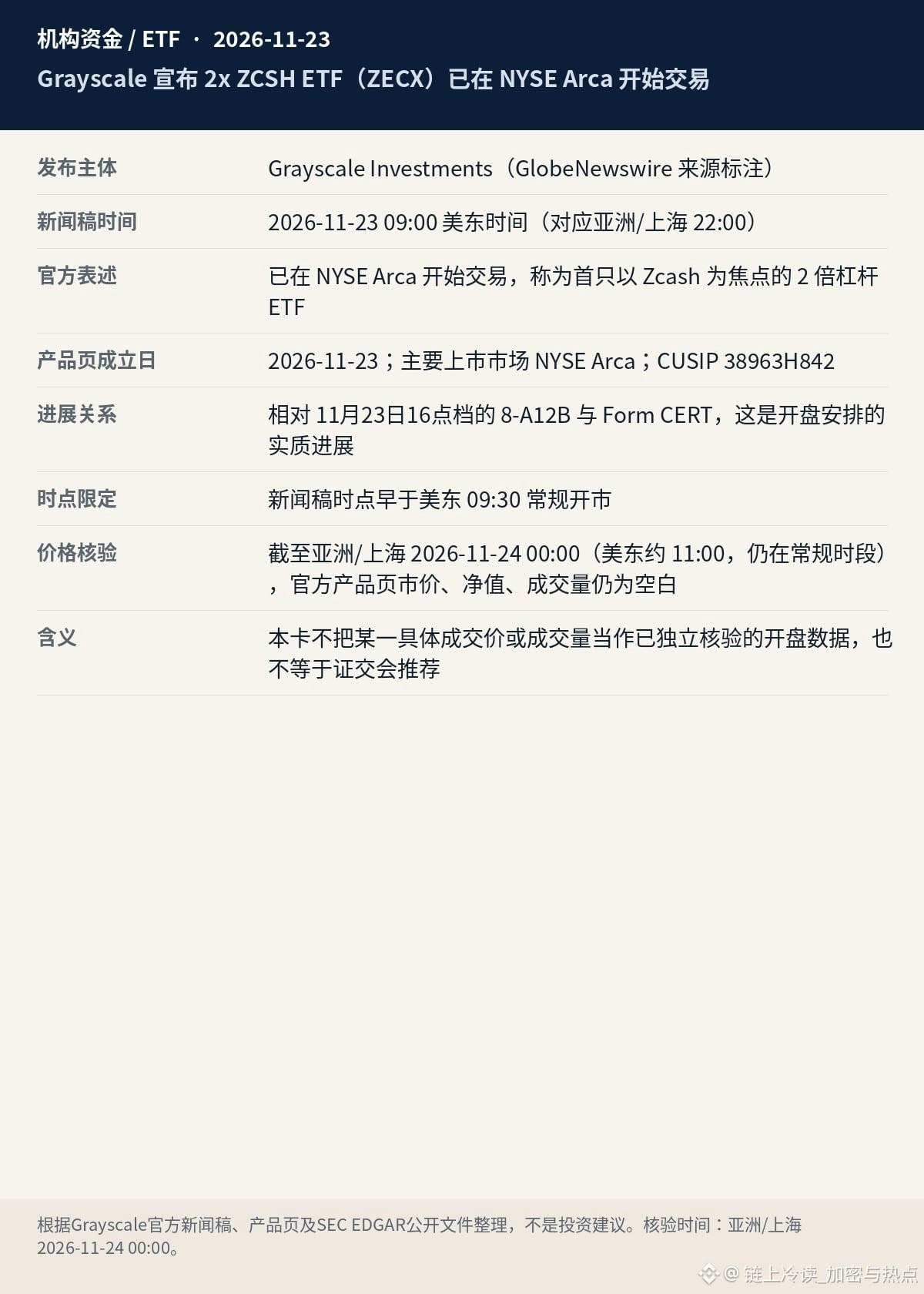
Grayscale Investments issued a press release via GlobeNewswire on November 23, 2026, at 09:00 Eastern Time (22:00 in Asia/Shanghai), announcing that its 2x ZCSH ETF (ticker: ZECX) had begun trading on NYSE Arca, calling it the first 2x leveraged ETF focused on Zcash. The company’s website news center listed the release on the same day. The product page lists its inception date as November 23, 2026, its primary listing market as NYSE Arca, and its CUSIP as 38963H842.
This is a substantive development beyond the Form 8-A12B and NYSE Arca listing certification recorded in the November 23, 16:00 update: at that point, the process had reached the listing and Exchange Act registration stages, and the update noted that this did not mean opening trades had been confirmed. It is also important to note that the press release came before the regular market open at 09:30 Eastern Time. As of verification at approximately 2026-11-24 00:00 Asia/Shanghai (approximately 11:00 on November 23 Eastern Time, still within regular trading hours), the official product page still showed no market price, NAV, or daily trading volume. Therefore, this post does not cite any specific trade price or volume as independently verified opening data.
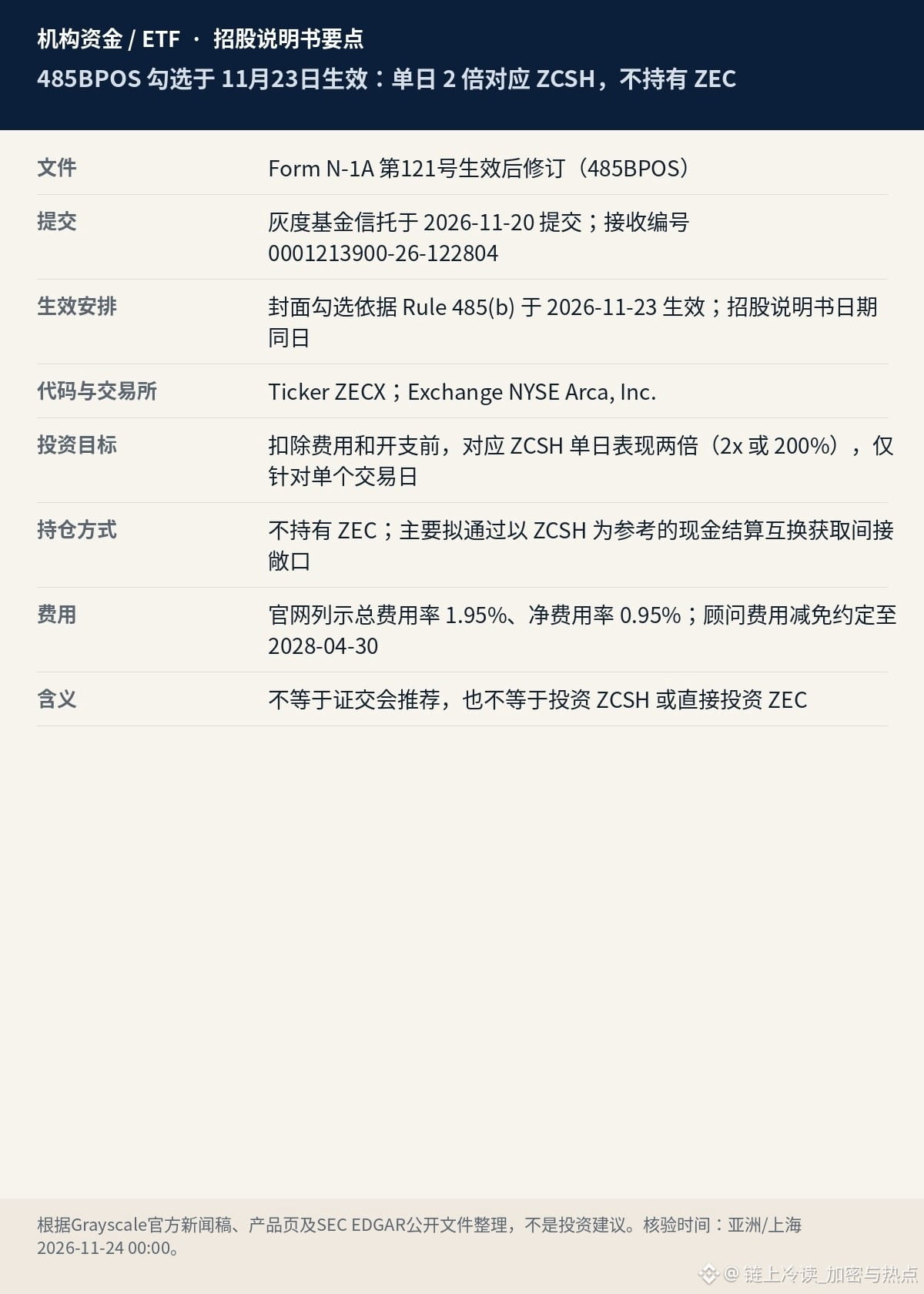
The verifiable prospectus is from the Grayscale Funds Trust’s 121st post-effective amendment to Form N-1A, filed on November 20 (485BPOS, accession number 0001213900-26-122804). The cover indicates that it became effective on November 23 under Rule 485(b), and the prospectus is dated November 23. The document states that, before fees and expenses, the fund seeks daily investment results corresponding to twice (2x or 200%) the daily performance of The Zcash ETF (ZCSH), and that this objective applies only to a single trading day. It does not hold ZEC and intends to obtain indirect exposure primarily through cash-settled swaps referencing ZCSH. The website lists a gross expense ratio of 1.95% and a net expense ratio of 0.95%; the fee waiver agreement runs through April 30, 2028. This does not mean the SEC recommends the product, nor is it equivalent to investing in ZCSH or directly in ZEC.
$ZEC
For this kind of single-day leveraged product, are you more interested in when the official page first reports trades and premiums or discounts, or in how returns diverge from the daily 2x target when held for multiple days?
176
·
--
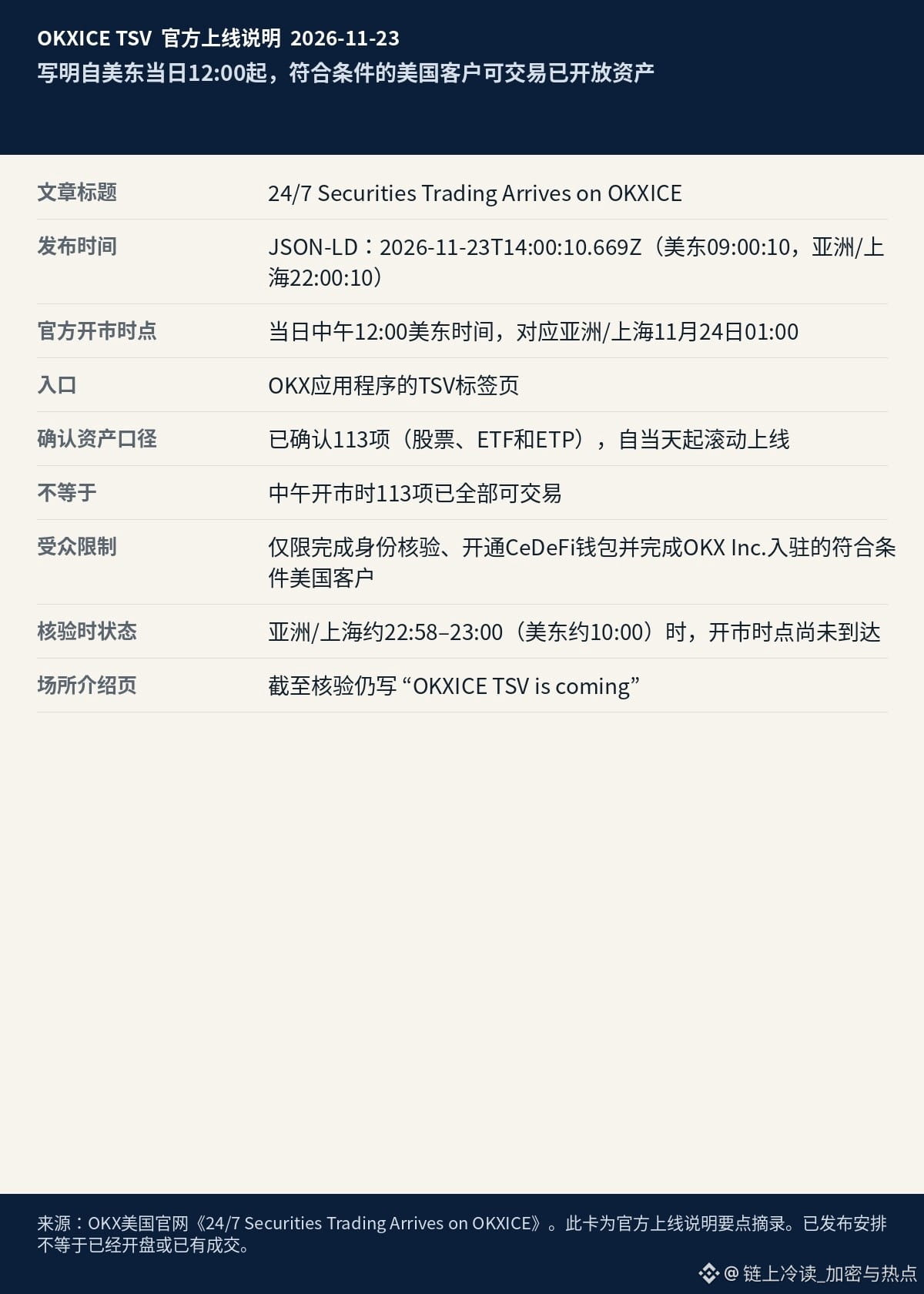
On November 23, 2026, OKX’s U.S. website published “24/7 Securities Trading Arrives on OKXICE.” The page’s structured data lists the publication time as 2026-11-23T14:00:10.669Z, corresponding to 09:00:10 Eastern Time and 22:00:10 Asia/Shanghai time that day. The article states that, starting at 12:00 p.m. that day (Eastern Time, corresponding to 01:00 on November 24 in Asia/Shanghai), eligible U.S. customers can trade available assets around the clock in the TSV tab of the OKX app.
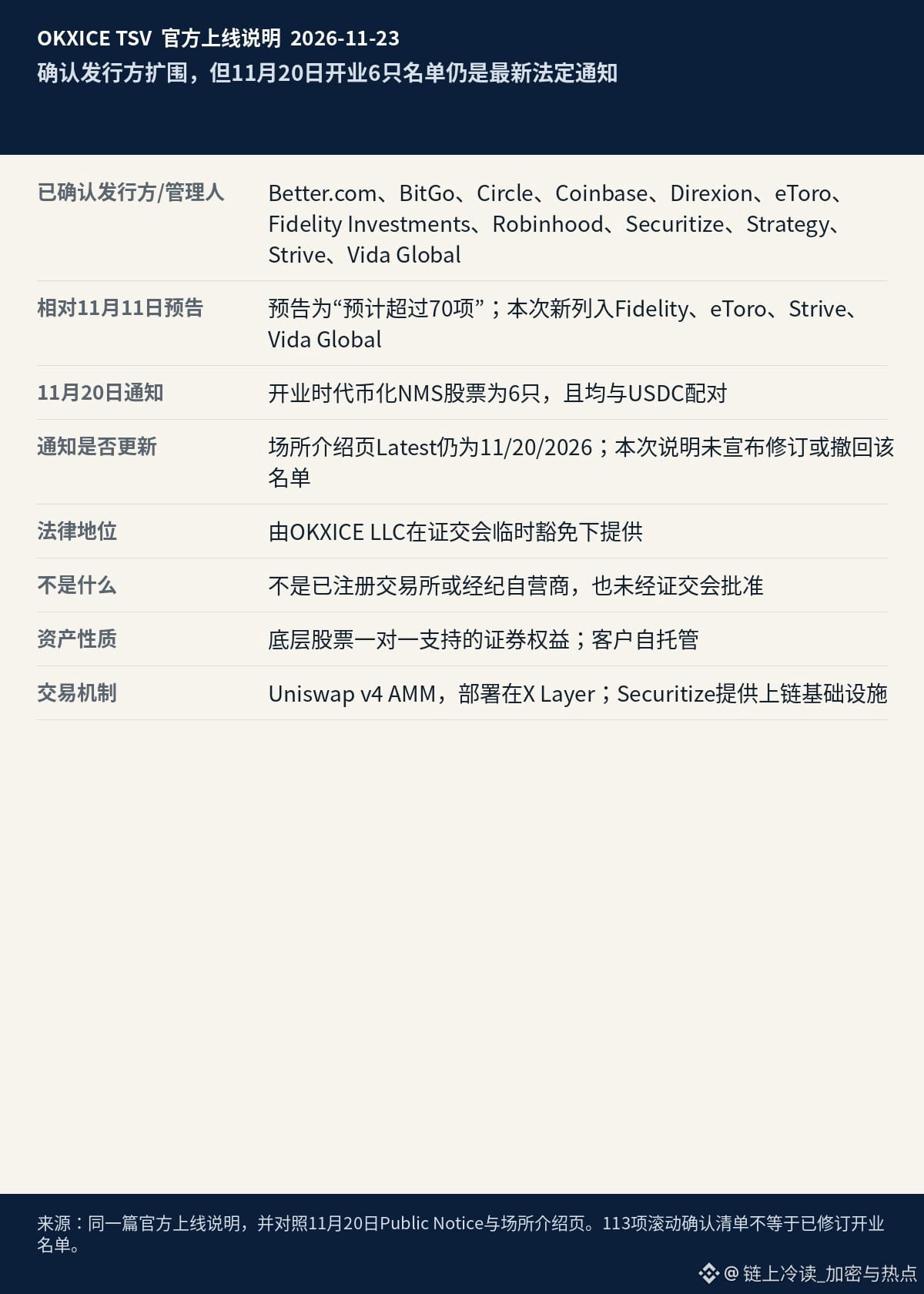
The website says the venue has confirmed 113 assets—including stocks, ETFs, and ETPs—which will be rolled out starting that day; this does not mean all 113 will be tradable when trading opens at noon. Confirmed issuers and asset managers include Better.com, BitGo, Circle, Coinbase, Direxion, eToro, Fidelity Investments, Robinhood, Securitize, Strategy, Strive, and Vida Global. Compared with the November 11 preview page’s wording, “more than 70 expected,” Fidelity Investments, eToro, Strive, and Vida Global are newly listed this time. The statutory public notice dated November 20 still states that six tokenized NMS stocks, all paired with USDC, will be available to trade at launch. As of this round of verification, that notice is still marked “Latest” on the venue overview page, and the new launch announcement does not say that the launch list has been amended or withdrawn.
To be clear: OKXICE TSV is offered by OKXICE LLC under a temporary SEC exemption; it is not a registered exchange or broker-dealer, nor has it been approved by the SEC. It is available only to eligible U.S. customers who have completed identity verification, opened a CeDeFi wallet, and completed onboarding with OKX Inc., and is subject to geographic and other eligibility restrictions. The page states that each digital asset represents a securities interest backed one-to-one by the underlying stock. Trading takes place through automated market maker liquidity pools on Uniswap v4, deployed on OKX’s Ethereum Layer 2 network, X Layer; Securitize provides the on-chain infrastructure. Customers hold the assets in self-custody wallets, and OKXICE TSV does not hold customers’ assets or private keys.
As of the time of this post’s verification (around 22:58–23:00 on November 23 in Asia/Shanghai, corresponding to around 09:58–10:00 Eastern Time), the official opening time had not yet arrived, and the venue overview page still said “OKXICE TSV is coming.” So this is a published launch plan, not confirmation that trading has already opened or that any trades have taken place.
My take: what’s still worth watching is whether the assets actually available to trade after noon remain the six listed in the November 20 notice, or whether they will increase as the 113 confirmed assets are rolled out. Are you more interested in which assets will be available in the first batch, or in whether the one-to-one securities interest and self-custody arrangements will work as described?
375
·
--
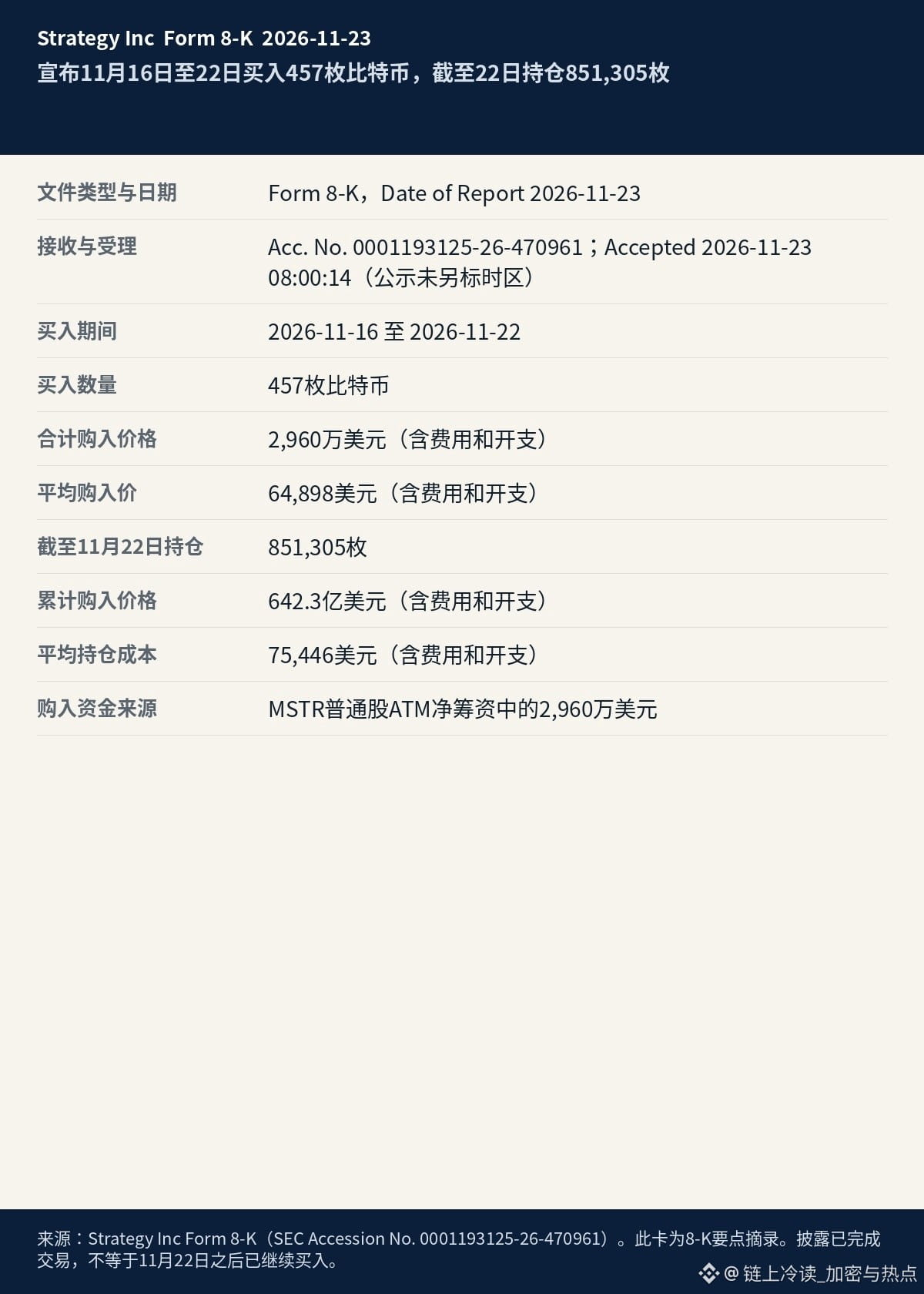
On November 23, 2026, Strategy Inc filed a Form 8-K with the U.S. Securities and Exchange Commission, announcing that it had purchased 457 bitcoins between November 16 and 22 for a total purchase price of $29.6 million, at an average purchase price of $64,898. As of November 22, its bitcoin holdings stood at 851,305, acquired for a total purchase price of $64.23 billion, with an average cost basis of $75,446. The EDGAR accession number is 0001193125-26-470961, accepted that day at 08:00:14; this is the Accepted time recorded by EDGAR, and the public filing does not specify a time zone. The company published a corresponding press release on its website the same day, whose title also identifies it as a Form 8-K disclosure.
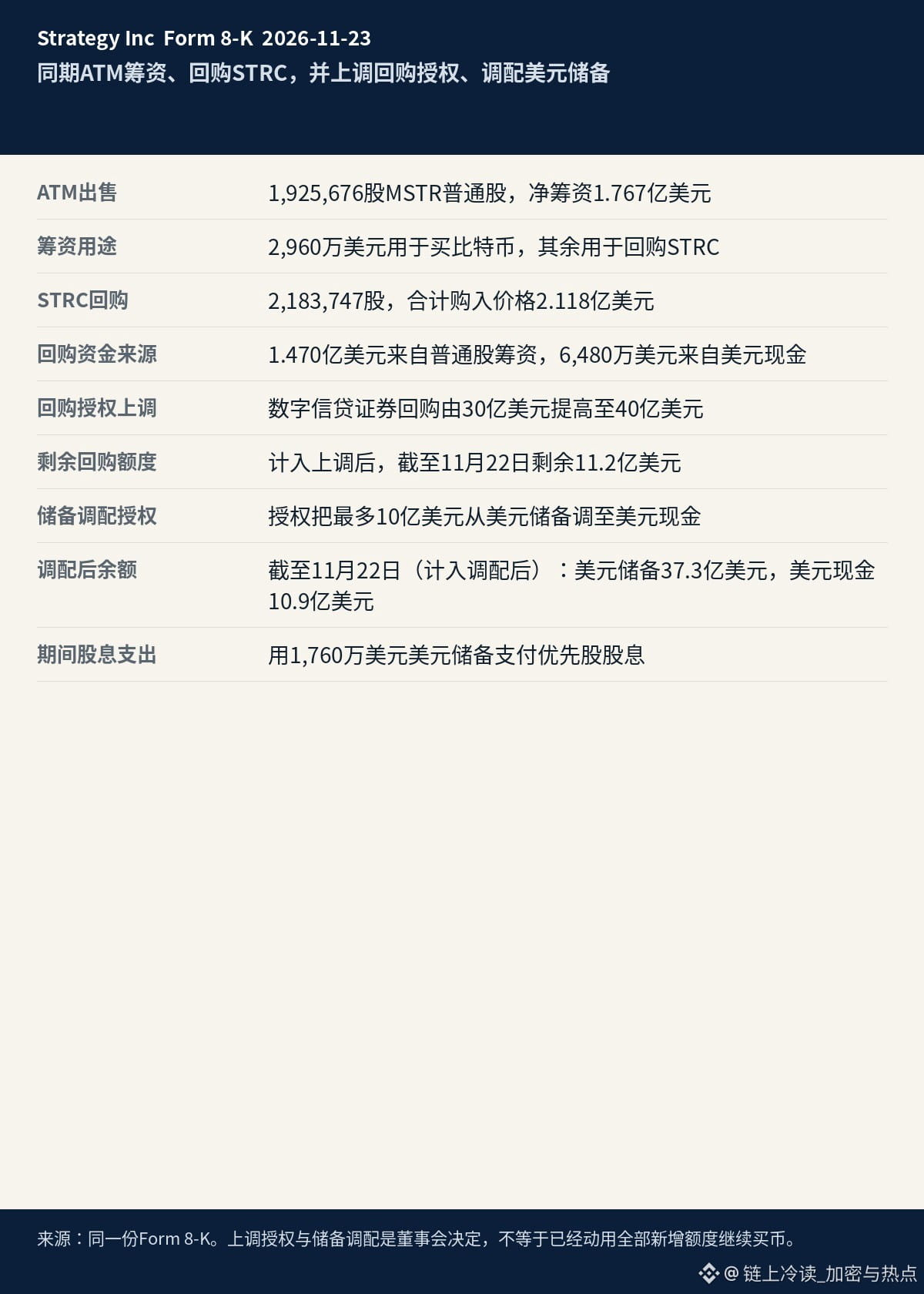
During the same period, the company sold 1,925,676 shares of MSTR common stock through its ATM program, raising net proceeds of $176.7 million; $29.6 million of that amount was used to purchase bitcoin, and the remainder to repurchase STRC preferred stock. Over the same period, it repurchased 2,183,747 shares of STRC for a total purchase price of $211.8 million, of which $147.0 million came from the common stock proceeds described above and $64.8 million from U.S. dollar cash. On the same day, the board increased the total authorization for repurchases of digital credit securities from $3 billion to $4 billion and authorized management to transfer up to $1 billion from its U.S. dollar reserve to U.S. dollar cash. According to the 8-K, after accounting for these increases and transfers, as of November 22 the U.S. dollar reserve was $3.73 billion, U.S. dollar cash was $1.09 billion, and $1.12 billion remained under the digital credit securities repurchase program.
This disclosure covers completed transactions and authorizations; it does not mean that further purchases had already been made after November 22, nor does it constitute a commitment to increase holdings in the future. Both the average purchase price and the average cost basis include fees. Are you more interested in the size of this purchase relative to total holdings, or in how the increased repurchase authorization and reserve transfer affect funds available for future use?
$BTC
91
·
--
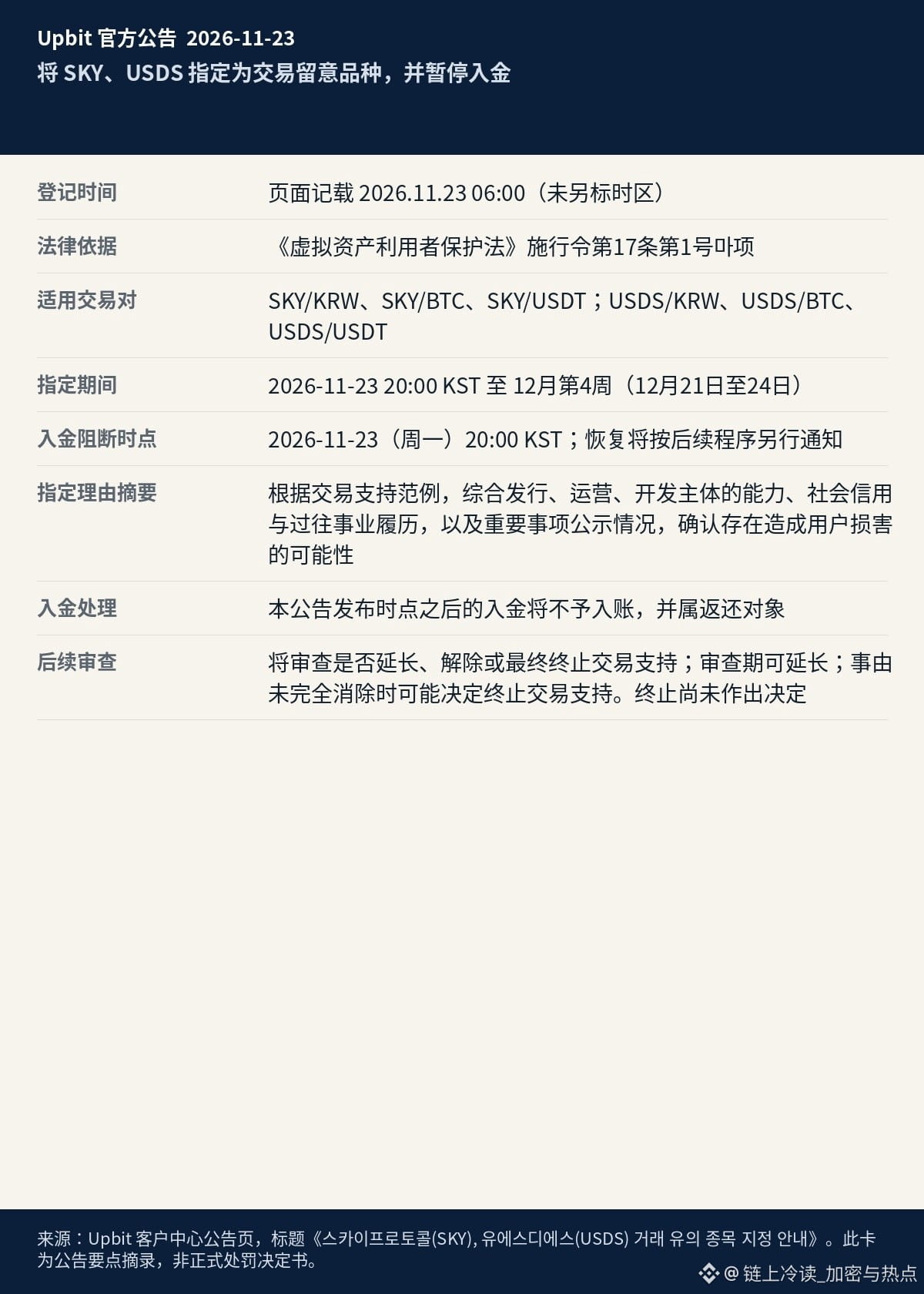
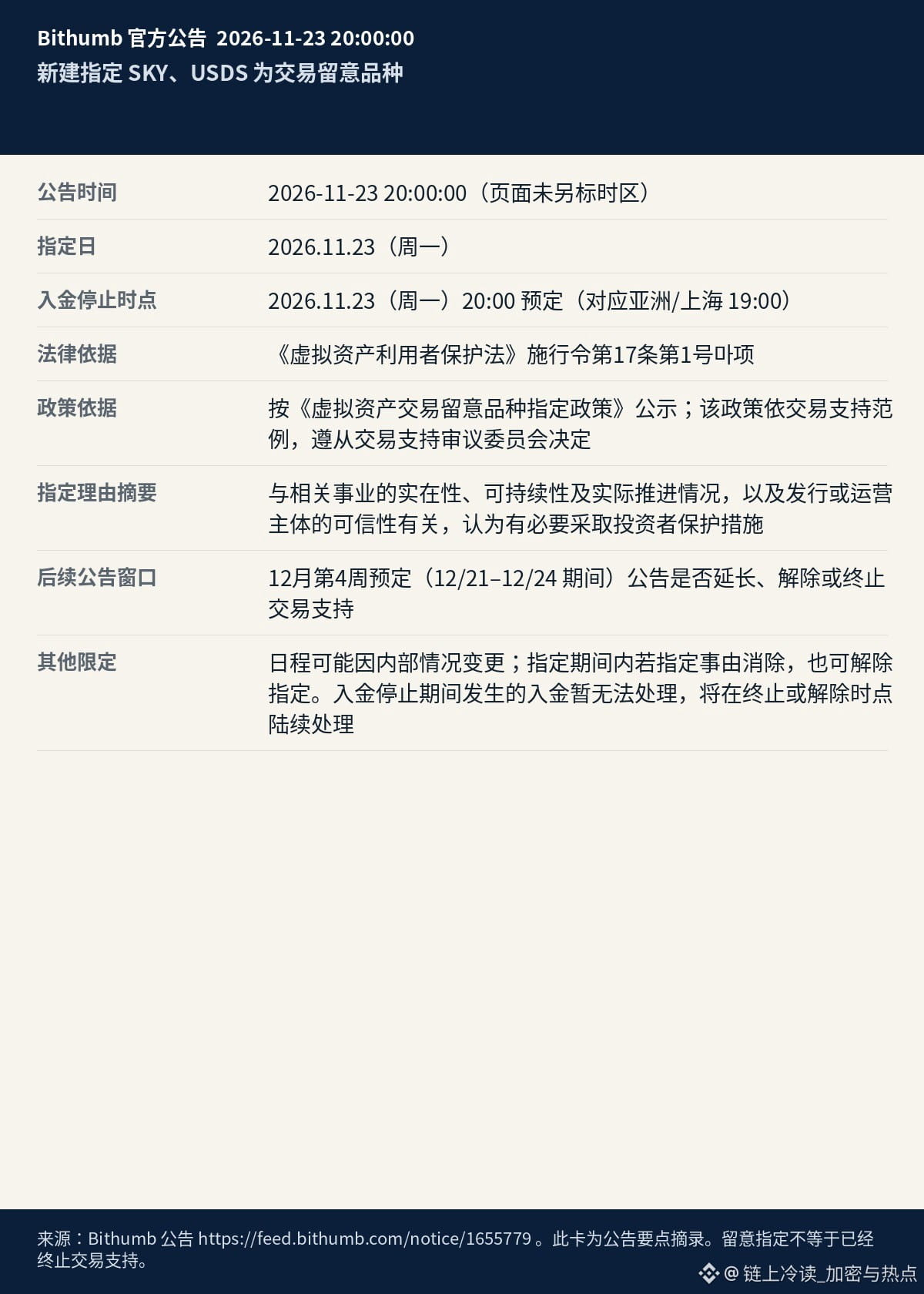
South Korean exchanges Upbit and Bithumb each announced on November 23, 2026, that Sky Protocol (SKY) and its stablecoin USDS had been designated as “assets requiring caution,” and that deposits would be suspended starting at 20:00 that day (Korea time, corresponding to 19:00 in Asia/Shanghai). This is an investor-protection measure taken by the exchanges under Article 17, Item 1(m) of the Enforcement Decree of the Virtual Asset User Protection Act. It does not mean that trading support has already been terminated, nor does it mean that South Korean financial authorities have imposed a penalty or ban.
Upbit’s announcement page lists the registration time as 06:00 on November 23 (the page does not specify a time zone) and the designation period as November 23 at 20:00 KST through the fourth week of December (December 21–24). The affected trading pairs are SKY and USDS, each paired with KRW, BTC, and USDT. Upbit stated that, in accordance with its virtual asset trading support guidelines, it had considered the capabilities, social credibility, and business track records of the entities involved in issuance, operation, and development, as well as whether the issuing or operating entities had disclosed material information, and determined that there was a possibility of user harm. The announcement also stated that deposits made after the time of publication would not be credited and would be subject to refund; the resumption of deposit services would be announced separately through subsequent procedures.
Bithumb’s announcement was posted at 20:00:00 on November 23 (the page does not specify a time zone; it states that deposits were scheduled to stop at 20:00 that day), and the designation date is November 23. The stated reason was that investor-protection measures were considered necessary in relation to the substance, sustainability, and actual progress of the relevant business, as well as the credibility of the issuing or operating entity. Bithumb will announce during the fourth week of December (between December 21 and 24) whether trading support will be extended, lifted, or terminated, noting that the schedule may change due to internal circumstances. The designation may also be lifted if the grounds for it are resolved during the designation period.
Both exchanges stated that, following the designation, they will review whether to extend or lift it, or terminate trading support; no decision has yet been made to terminate trading support. Are you more concerned about the deposit suspension itself, or the trading-support decision that may be made in late December? $SKY $USDS
131
·
--
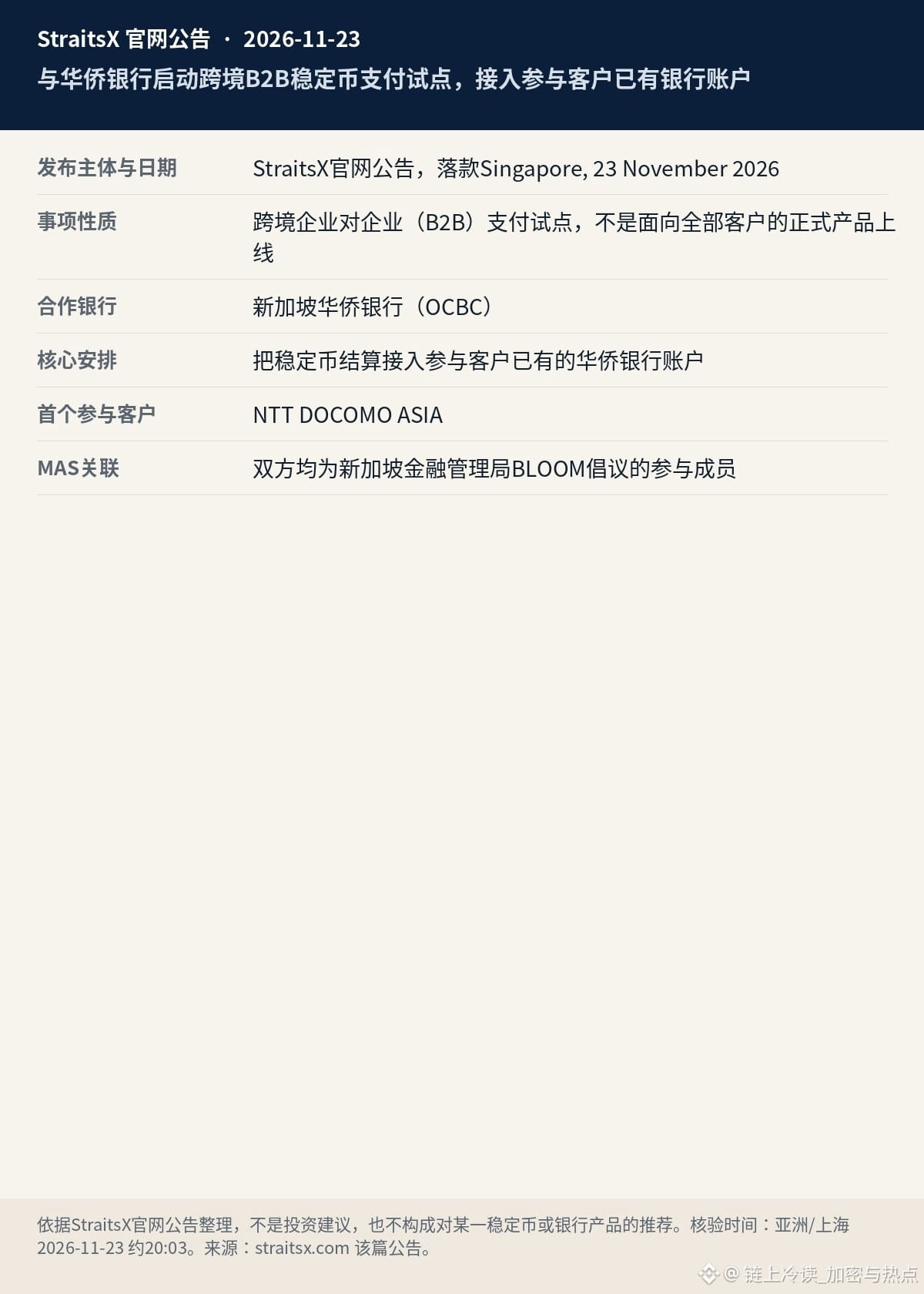
On November 23, 2026, StraitsX announced on its official website that it had launched a cross-border business-to-business (B2B) payments pilot with Singapore’s Oversea-Chinese Banking Corporation (OCBC), integrating stablecoin settlement with participating clients’ existing OCBC accounts.
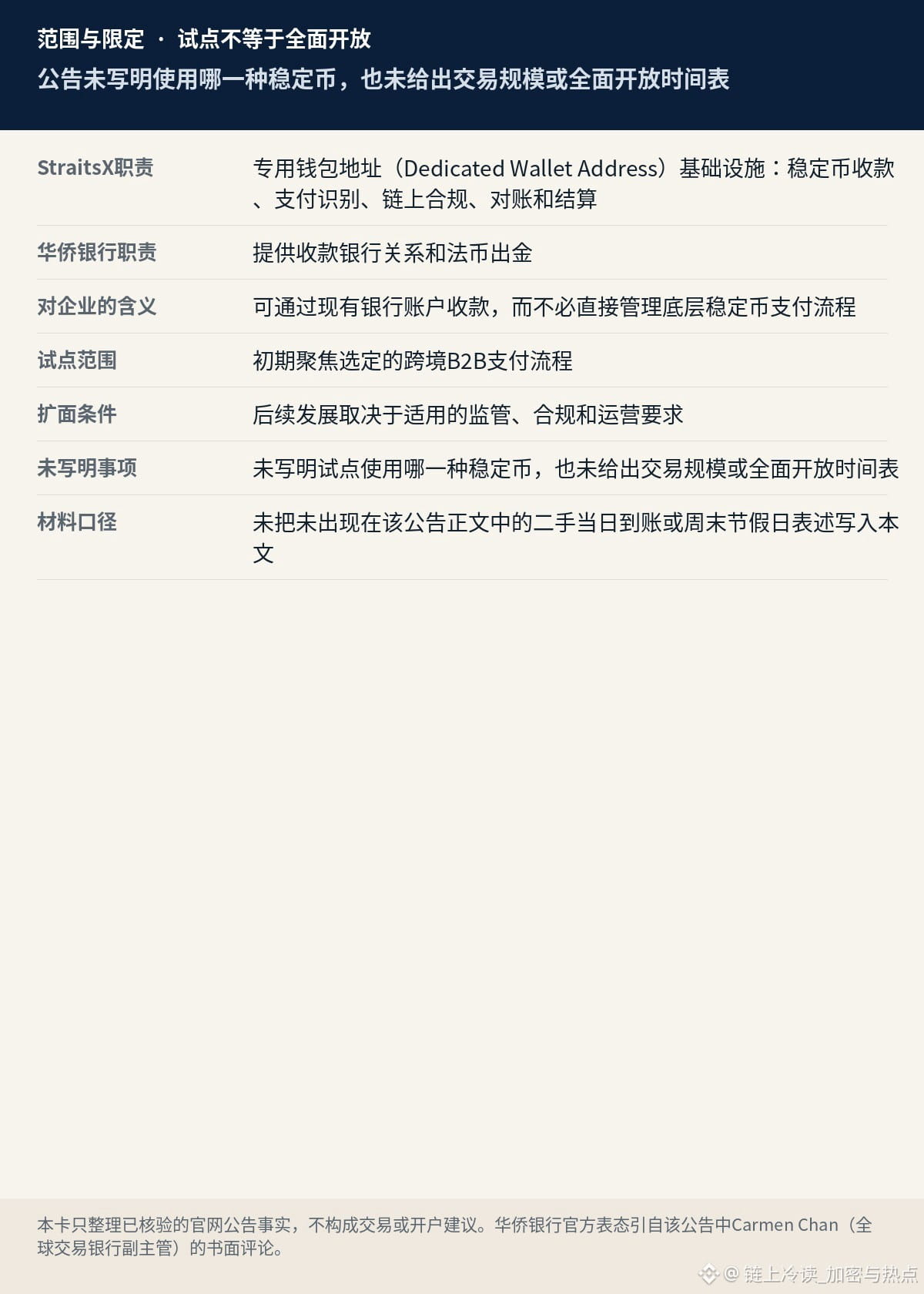
This is not a formal product launch for all customers. The announcement said that StraitsX provides Dedicated Wallet Address infrastructure and handles stablecoin collection, payment identification, on-chain compliance, reconciliation, and settlement; OCBC provides the banking relationships for receiving funds and fiat off-ramping. Participating businesses can receive payments through their existing bank accounts without having to manage the underlying stablecoin payment process directly. The announcement named NTT DOCOMO ASIA as the pilot’s first participating client.
The initial phase of the pilot will focus on selected cross-border B2B payment flows, with further development subject to applicable regulatory, compliance, and operational requirements. The announcement did not specify which stablecoin the pilot will use, nor did it provide transaction volumes or a timeline for wider availability. Both parties also stated that they are participating members of the Monetary Authority of Singapore’s (MAS) BLOOM initiative.
My take: The key change is that cross-border stablecoin payments are being integrated into businesses’ existing bank accounts, rather than requiring them to manage wallets and off-ramping separately. However, this is still a limited-scope pilot, and any expansion will depend on regulatory and operational conditions. Are you more interested in which payment corridors the pilot will cover first, or in how funds will be credited to bank accounts and the related compliance arrangements?
3
·
--
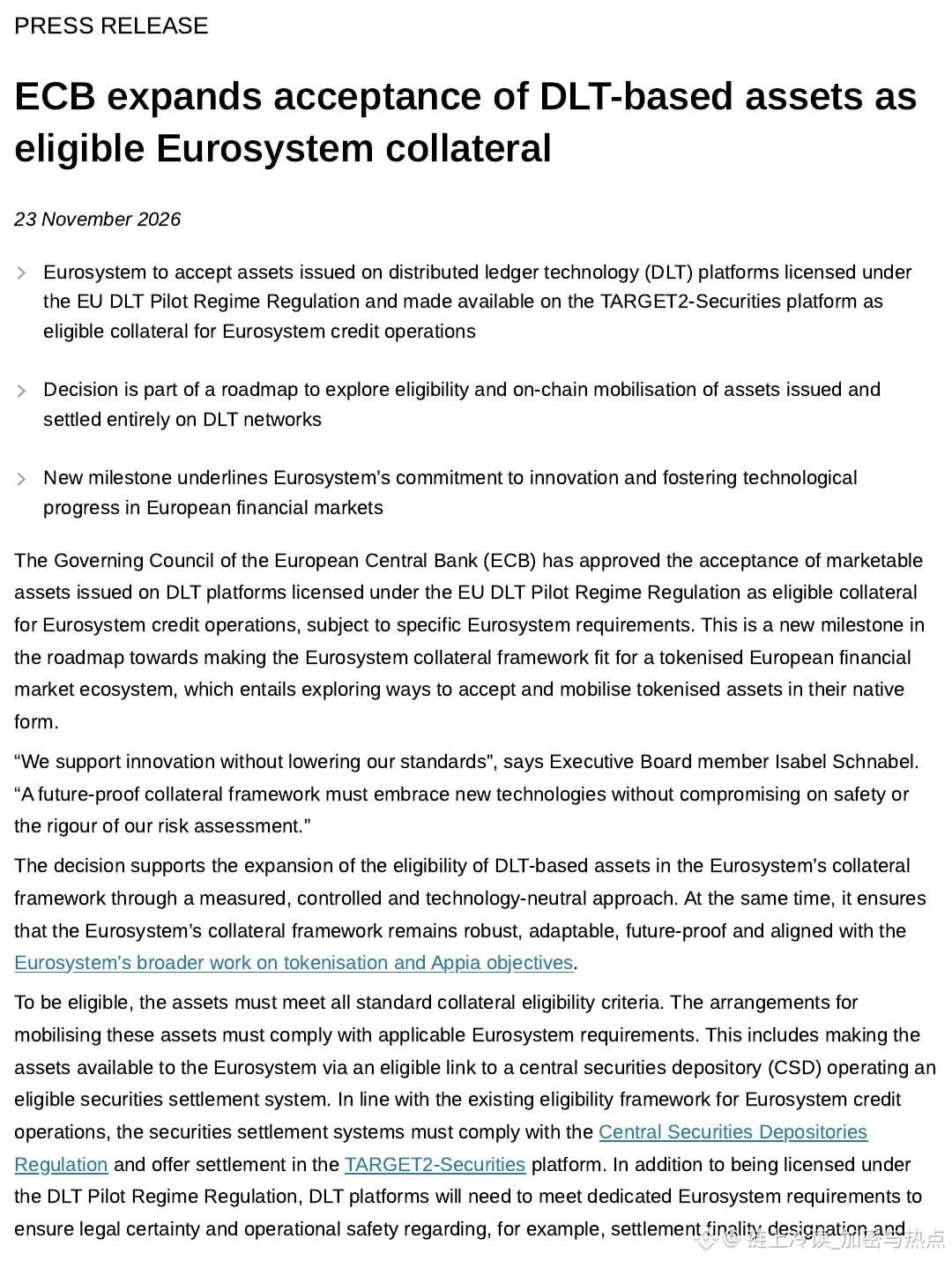
The European Central Bank published a press release on its website on 23 November 2026: The Governing Council has approved the acceptance as eligible collateral for Eurosystem credit operations of marketable assets issued on distributed ledger platforms licensed under the EU Distributed Ledger Technology Pilot Regime Regulation and made available via the TARGET2-Securities platform, subject to specific Eurosystem requirements. The press release described this as a new milestone in the roadmap for adapting the collateral framework to tokenised markets.
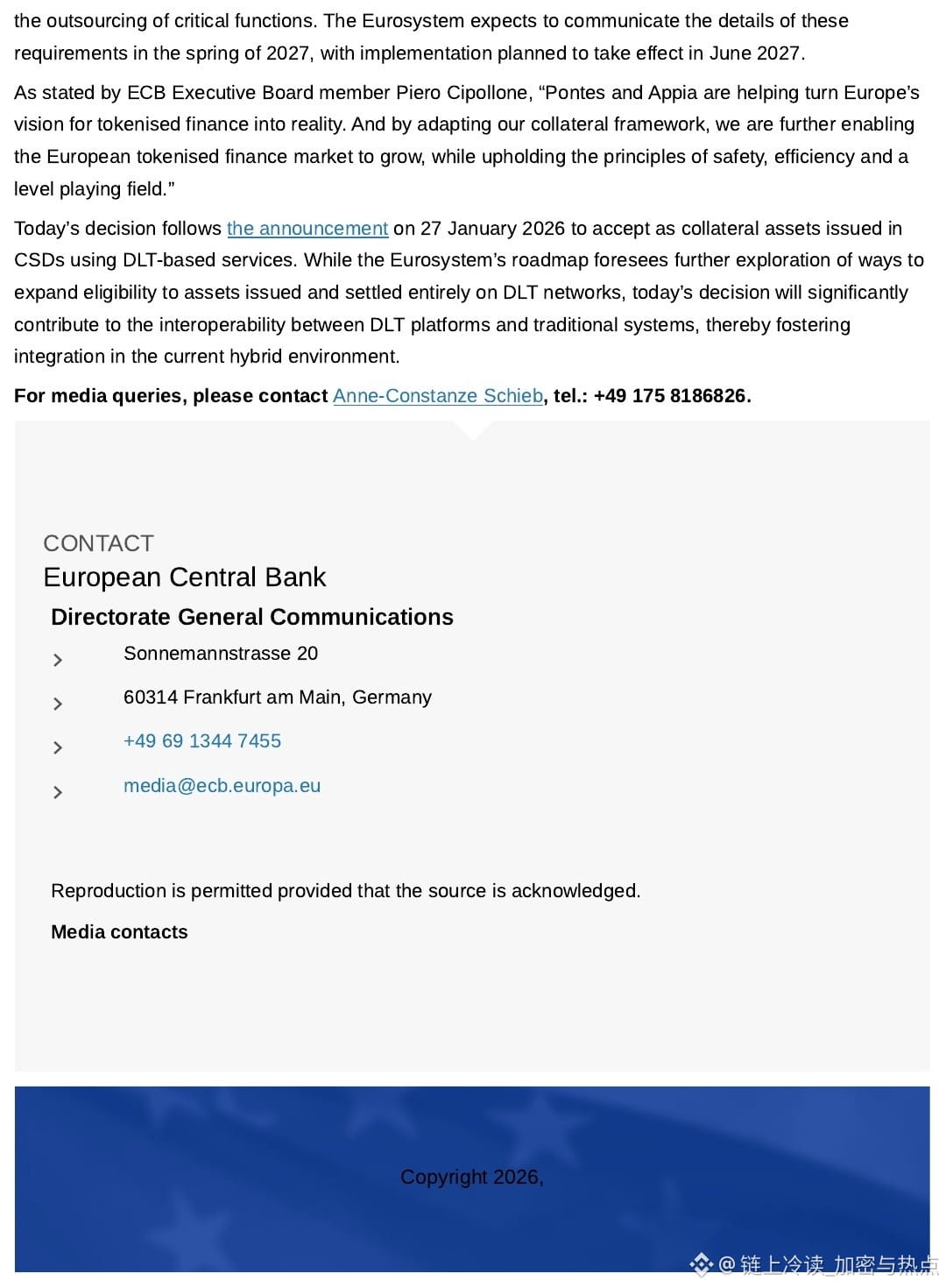
To be clear, this is an approval decision by the Governing Council; it does not mean that the relevant assets can be used immediately for central bank credit operations. The press release states that the assets must still meet all existing eligibility criteria for collateral. Mobilisation arrangements must comply with Eurosystem requirements, including making the assets available through an eligible link to a central securities depository operating an eligible securities settlement system. That settlement system must comply with the Central Securities Depositories Regulation and provide TARGET2-Securities settlement. In addition to being licensed under the Pilot Regime, distributed ledger platforms must meet further requirements set by the Eurosystem, such as legal certainty and operational security in relation to the designation of settlement finality and the outsourcing of critical functions. Details of these requirements are expected to be published in spring 2027, with implementation planned to take effect in June 2027.
This decision is distinct from the arrangement announced on 27 January 2026, under which assets issued using distributed ledger services at central securities depositories would be accepted as collateral from 30 March. The press release states that today’s decision will help distributed ledger platforms interoperate with traditional systems, but the inclusion of assets issued and settled entirely on-chain remains subject to further exploration. Nor does this mean that crypto-assets such as Bitcoin or Ethereum, which were not issued under this framework, have been accepted as Eurosystem collateral.
My view is that the key change is the expansion of the scope from “assets issued using distributed ledger services at traditional depositories” to “assets issued on licensed platforms but still required to connect to TARGET2-Securities.” Actual implementation will have to wait for the publication of the detailed requirements and the June 2027 implementation date. Are you more interested in what additional requirements will be announced in the spring, or in when fully on-chain settled assets might be considered for inclusion?
·
--
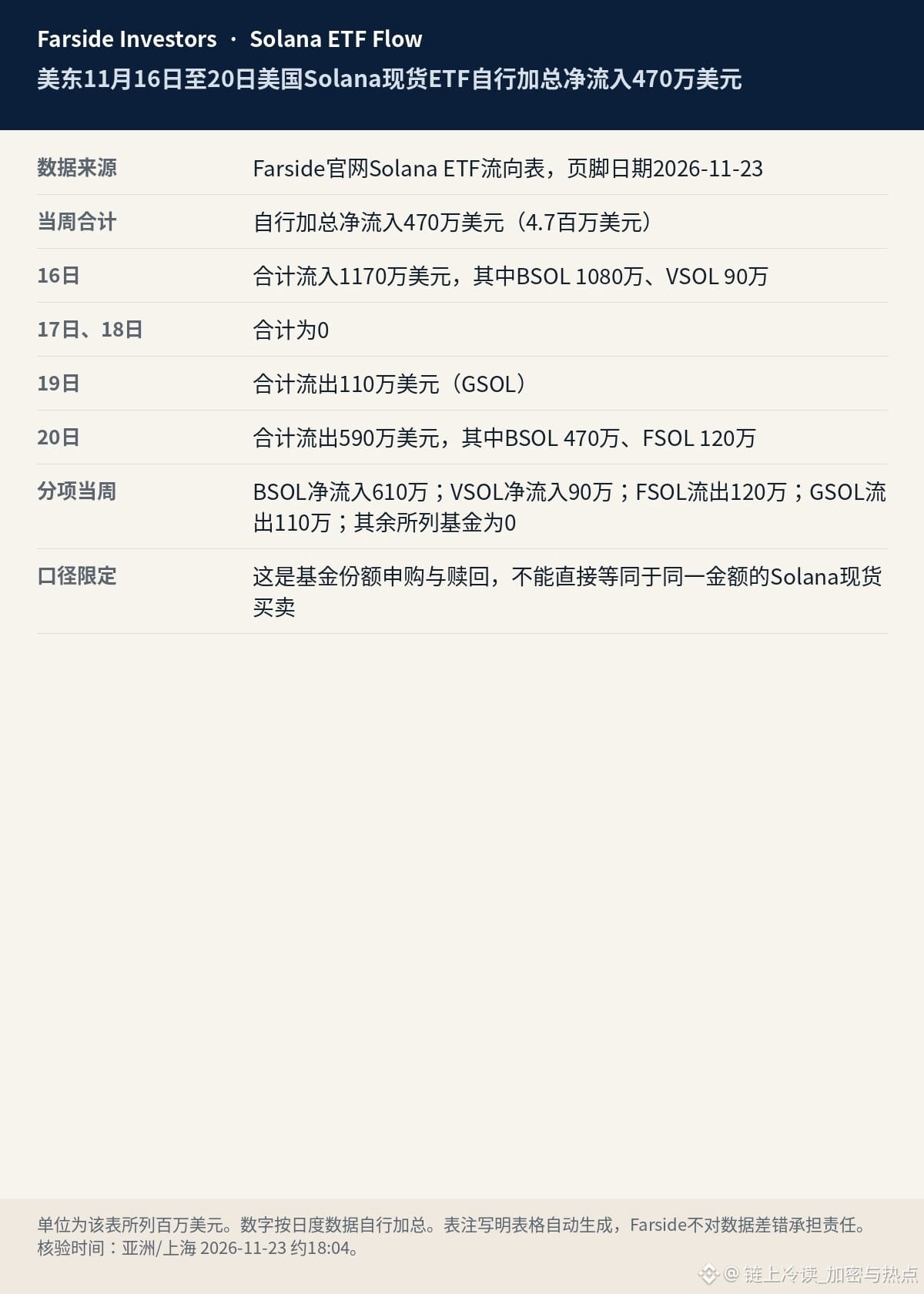
The Solana ETF flow table on the Farside Investors website (footer date: November 23, 2026) shows that, based on a sum of the table’s daily figures, U.S. spot Solana ETFs had a combined net inflow of $4.7 million during the trading week of November 16–20, U.S. Eastern Time. Flows were not positive every day: there was a combined inflow of $11.7 million on the 16th, zero on the 17th and 18th, an outflow of $1.1 million on the 19th, and an outflow of $5.9 million on the 20th. By fund, Bitwise’s BSOL had a net inflow of $6.1 million for the week, including an inflow of $10.8 million on the 16th and an outflow of $4.7 million on the 20th; VanEck’s VSOL had an inflow of $900,000 on the 16th; Fidelity’s FSOL had an outflow of $1.2 million on the 20th; Grayscale’s GSOL had an outflow of $1.1 million on the 19th; and the other listed funds had zero flows for the week.
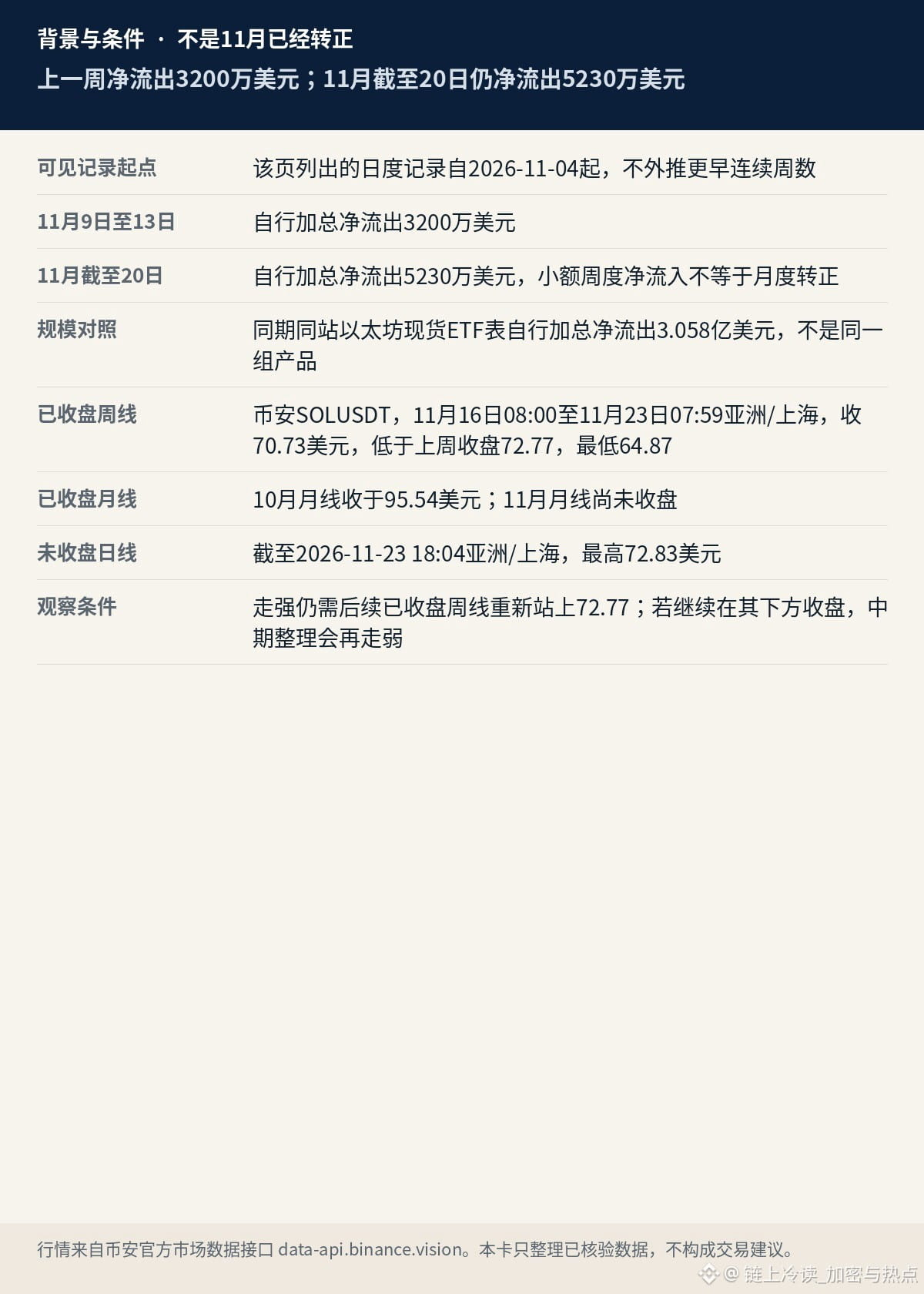
The page currently lists daily records starting November 4. The previous trading week (November 9–13) totaled a net outflow of $32 million, based on my own calculation; the net outflow for November through the 20th totaled $52.3 million. So the modest net inflow from the 16th to the 20th does not mean November’s overall flows have turned positive. The page does not list daily records before November 4, so this article does not extrapolate an earlier consecutive weekly streak. ETF net inflows represent fund share creations and cannot be directly equated with an equal amount of spot Solana buying. The same site’s daily figures for spot Ethereum ETFs over the same period total a net outflow of $305.8 million, provided only as a comparison of scale and not as the same group of products.
The most recently closed weekly candle for Binance SOLUSDT (November 16, 08:00 to November 23, 07:59, Asia/Shanghai) closed at $70.73, below the previous closed week’s close of $72.77; the low for the week was $64.87. The October monthly candle closed at $95.54; the November monthly candle has not yet closed. As of November 23, 2026, 18:04 Asia/Shanghai, the high of the still-open daily candle was $72.83. For strength to continue, first watch whether a subsequent closed weekly candle can move back above $72.77; if it continues to close below that level, the medium-term consolidation will weaken further. Are you more interested in whether the $4.7 million inflow will continue into the next trading week, or in whether November’s cumulative net outflow will keep growing?
$SOL
SOL+1.62%
VSOLETF+0.10%
41
·
--
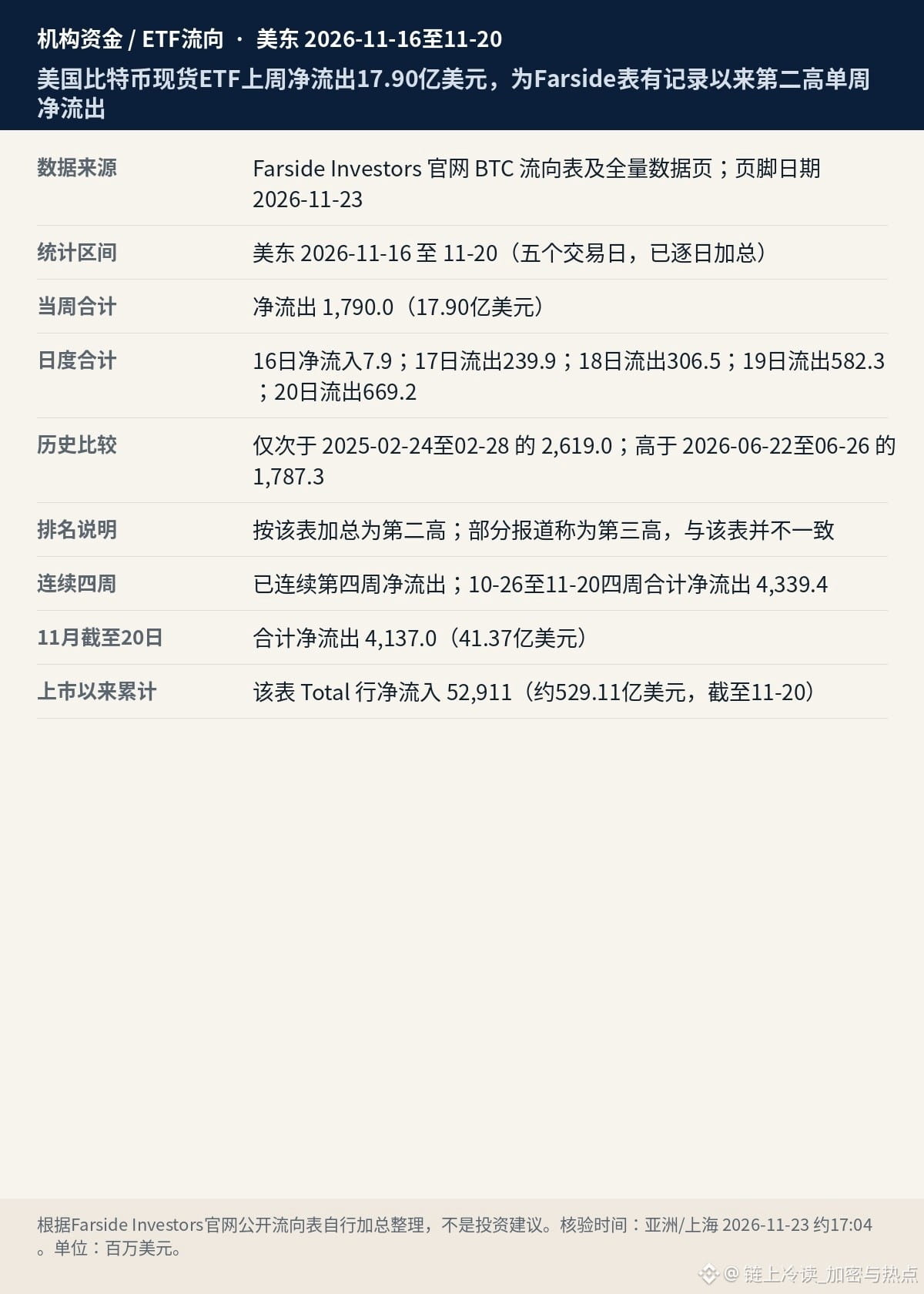
The Farside Investors website’s Bitcoin spot ETF flow table (footer dated November 23, 2026; cross-checked against the full data page) shows that U.S. Bitcoin spot ETFs saw total net outflows of $1.790 billion during the trading week of November 16–20, Eastern Time. Summing the site’s full daily data, this was the second-largest weekly net outflow on record in the table, behind only the $2.619 billion outflow during the week of February 24–28, 2025, and slightly higher than the $1.7873 billion outflow during the week of June 22–26, 2026. Some reports call it the “third-largest,” which does not match the sum of the table; this article follows Farside’s figures.
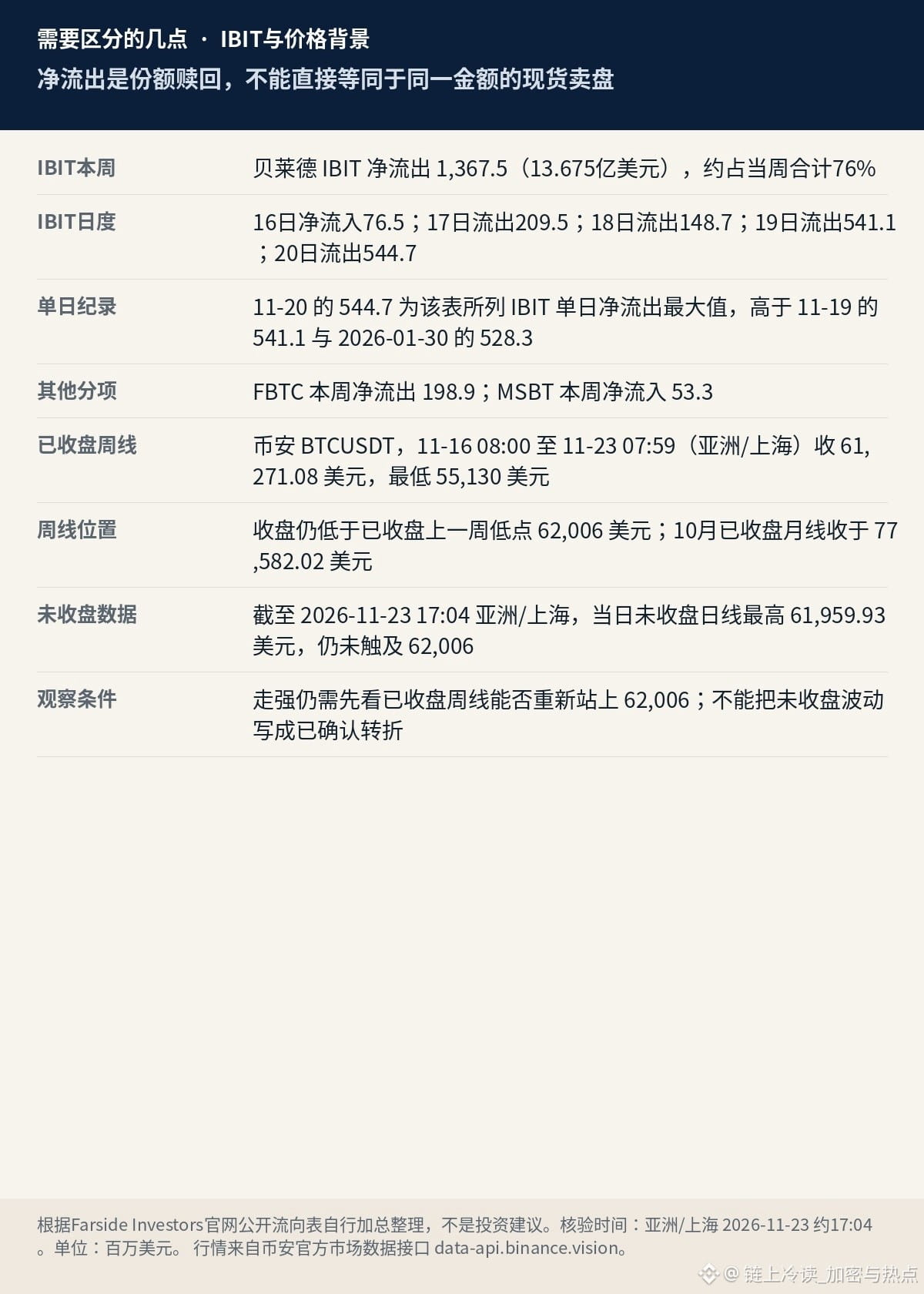
BlackRock’s IBIT saw net outflows of $1.3675 billion this week, about 76% of the weekly total. Outflows were $541.1 million on November 19 and $544.7 million on the 20th; the 20th was the largest single-day net outflow for IBIT listed in the table. This marks a fourth consecutive week of net outflows, totaling $4.3394 billion over the four weeks. Net outflows for November through the 20th totaled $4.137 billion. ETF net outflows reflect redemptions of fund shares and cannot be directly equated with spot selling of the same amount.
The most recently closed weekly candle for Binance BTCUSDT (November 16, 08:00 to November 23, 07:59, Asia/Shanghai) closed at $61,271.08, with a low of $55,130; the close remained below the previous closed week’s low of $62,006. The October monthly candle closed at $77,582.02; the November monthly candle has not yet closed. As of November 23, 2026, 17:04 Asia/Shanghai, the current, still-open daily candle had a high of $61,959.93, still short of $62,006. For a recovery to gain strength, the first level to watch is whether a closed weekly candle can reclaim $62,006. If subsequent weekly candles continue to close below that level, the medium-term consolidation will weaken further. Are you more concerned about whether the four consecutive weeks of redemptions will continue this week, or would you first watch to see whether price can close a weekly candle above $62,006?
$BTC
5
·
--
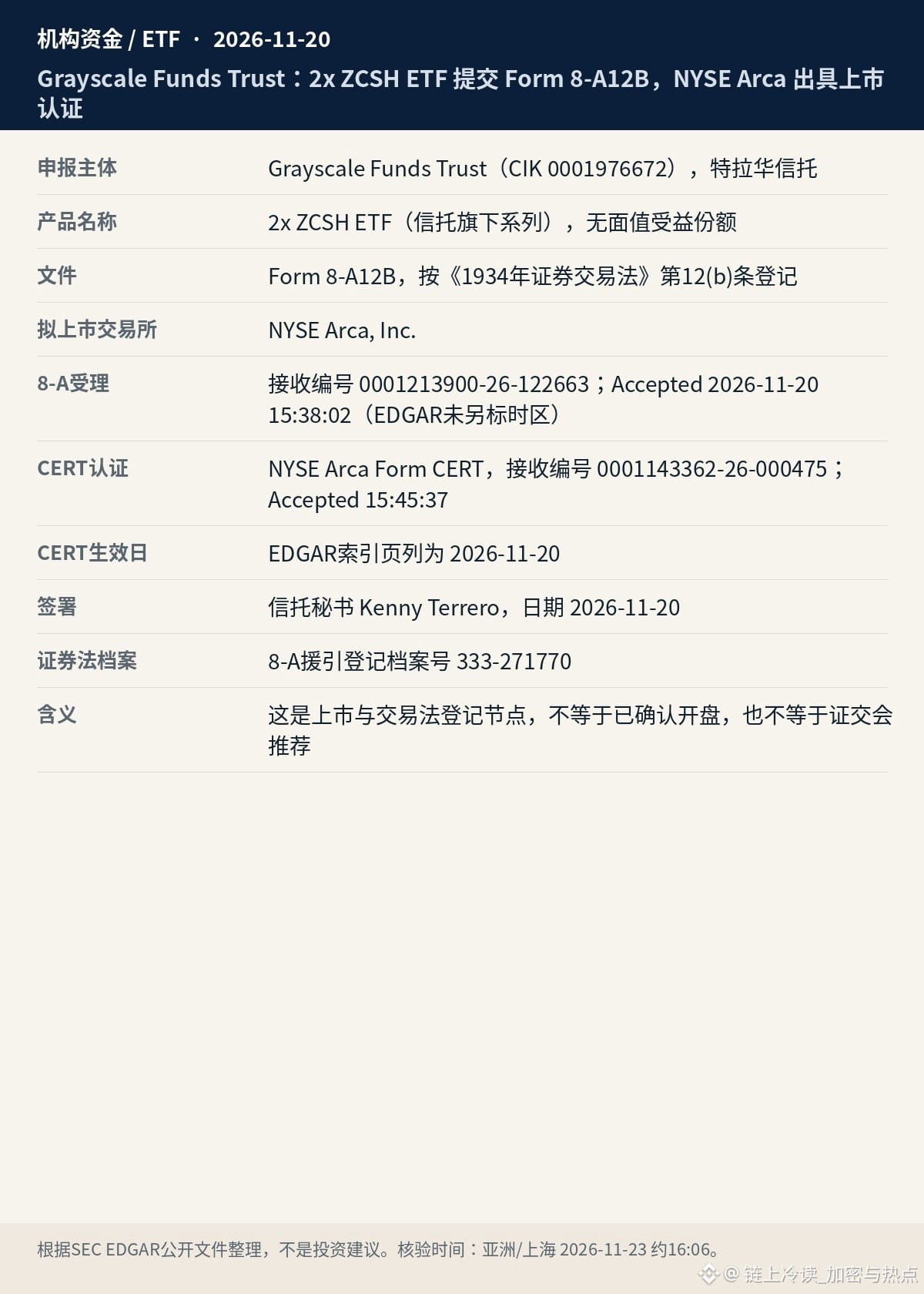
Grayscale Funds Trust filed Form 8-A12B with the U.S. Securities and Exchange Commission on November 20, 2026, to register the no-par-value beneficial shares of its series “2x ZCSH ETF” under Section 12(b) of the Securities Exchange Act of 1934, with a proposed listing on NYSE Arca. The EDGAR filing index lists accession number 0001213900-26-122663, accepted that day at 15:38:02. On the same day, NYSE Arca filed a listing registration certification (Form CERT, accession number 0001143362-26-000475), accepted at 15:45:37; the index page lists November 20, 2026, as the effective date. These times are the Accepted times recorded by EDGAR; the public filings do not specify a time zone. The 8-A checked the box for a Section 12(b) registration to become effective under General Instruction A.(c) or (e), and was signed on November 20 by the trust’s secretary, Kenny Terrero. This is a listing and Exchange Act registration milestone; it does not mean that an opening trade has been confirmed, nor that the SEC recommends the product.
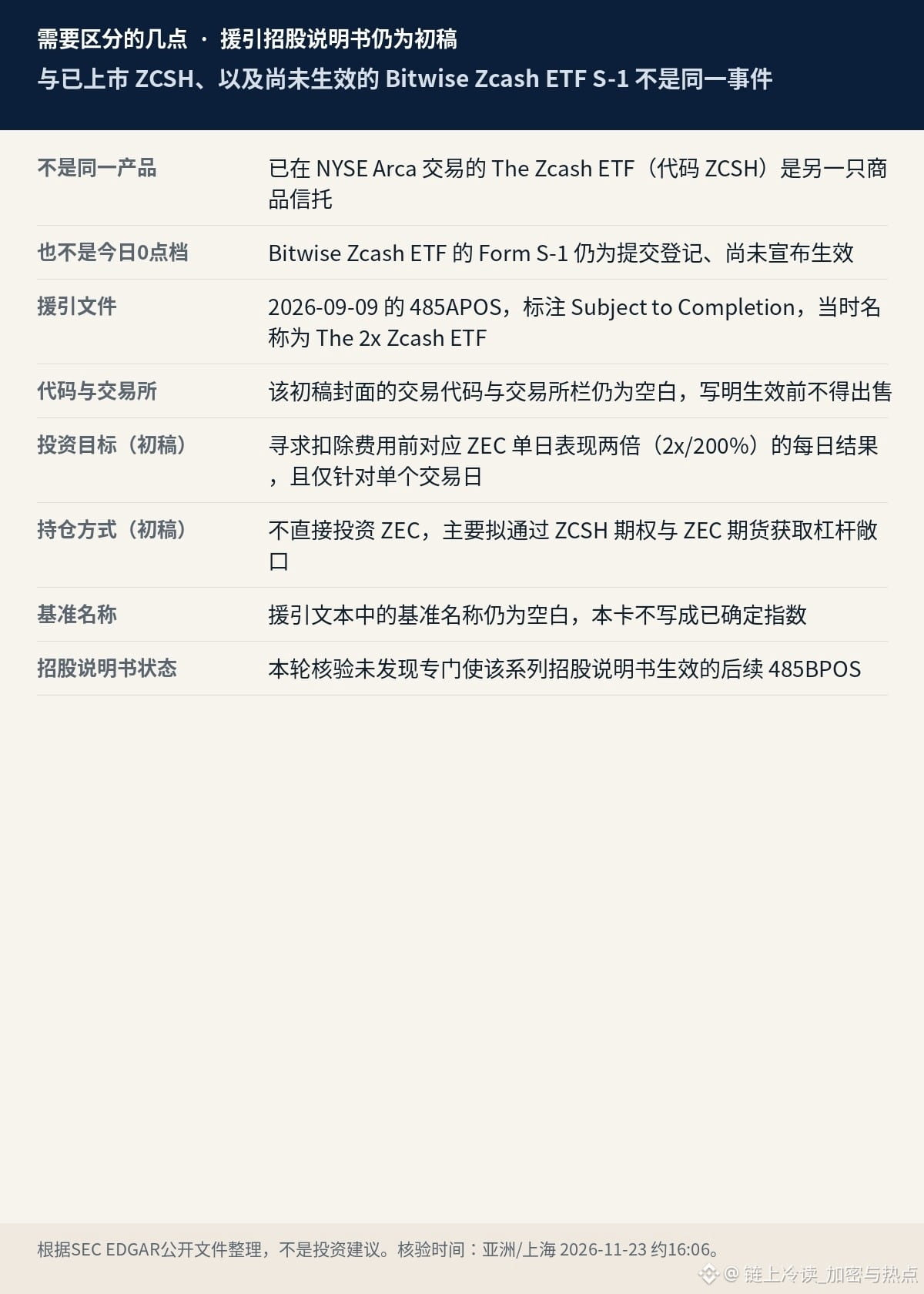
This product is not the same fund as The Zcash ETF, which already trades on NYSE Arca under the ticker ZCSH, and it is also different from the Bitwise Zcash ETF in today’s midnight filing, whose Form S-1 has not yet become effective. The 8-A incorporates by reference an amendment to Form N-1A filed on September 9, 2026, marked “incomplete and subject to change” (485APOS, file number 333-271770). At the time, the document was titled “The 2x Zcash ETF”; the ticker and exchange fields were still blank, and it stated that shares could not be sold before the registration statement became effective. The prospectus states that, before fees and expenses, the fund seeks daily investment results corresponding to twice (2x or 200%) the daily performance of ZEC. It does not invest directly in ZEC, and instead primarily intends to obtain leveraged exposure through ZCSH options and ZEC futures. This objective applies only to a single trading day. This round of verification found no subsequent 485BPOS specifically making the series’ prospectus effective, and the benchmark name in the incorporated text remains blank.
$ZEC
If the exchange has certified the listing, are you more concerned about when the first trade will occur, or about how a 2x product’s performance may diverge from its single-day objective when held for multiple days?
149
·
--
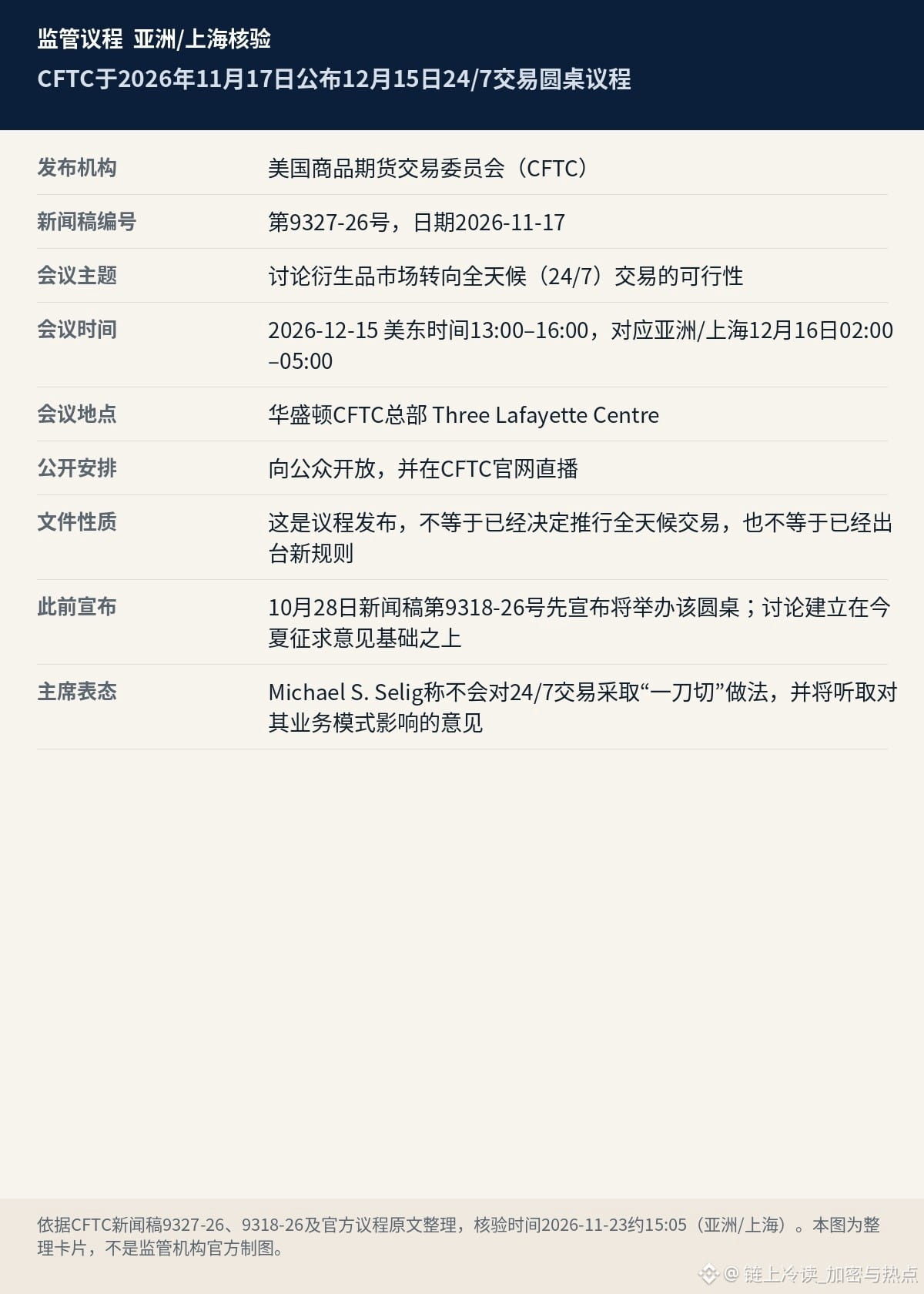
On November 17, 2026, the U.S. Commodity Futures Trading Commission (CFTC) issued Press Release No. 9327-26, announcing the agenda for an industry roundtable on December 15 to discuss the feasibility of moving derivatives markets to around-the-clock (24/7) trading. The meeting will take place from 13:00 to 16:00 Eastern Time, corresponding to 02:00 to 05:00 on December 16 in Asia/Shanghai. It will be held at CFTC headquarters in Washington, open to the public, and livestreamed on the CFTC website. The announcement of an agenda does not mean the Commission has decided to implement 24/7 trading, nor does it mean new rules have been issued.
This roundtable agenda supplements the meeting announced in the CFTC’s October 28 Press Release No. 9318-26. The October 28 release stated that the discussion would build on the request for comment on 24/7 trading issued this summer. Then-Chairman Michael S. Selig also said the CFTC would not take a “one-size-fits-all” approach to 24/7 trading. In the November 17 release, he said he looked forward to hearing directly from industry participants about the effects of 24/7 trading on their business models, so the Commission can appropriately tailor its regulatory framework for different types of market participants.
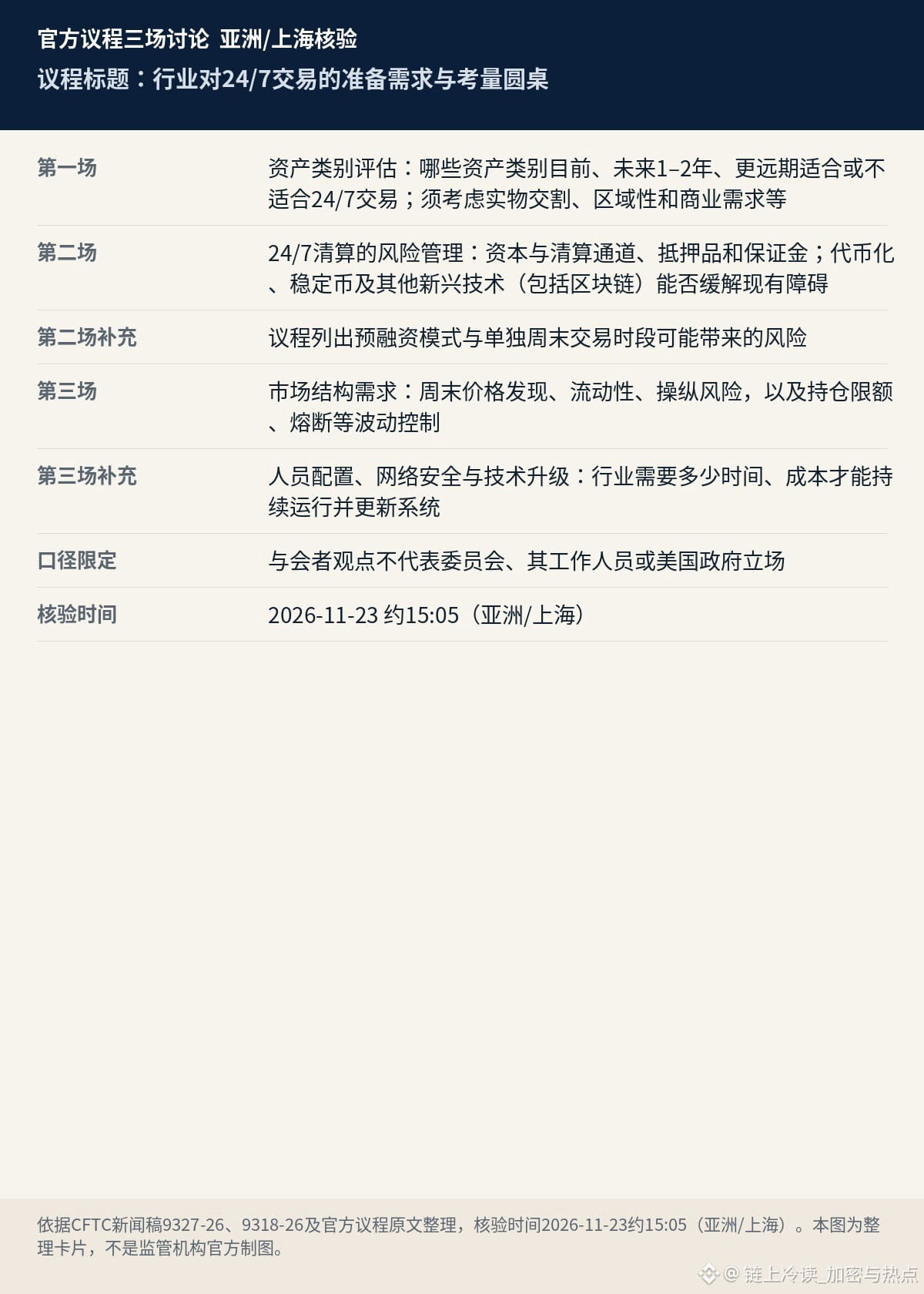
The official agenda is titled “Industry Readiness Needs and Considerations for 24/7 Trading Roundtable” and consists of three sessions. The first will assess which asset classes are suitable or unsuitable for 24/7 trading now, over the next one to two years, and further into the future. The second will discuss risk management for 24/7 clearing, including capital and clearing access, collateral and margin, and whether emerging technologies such as tokenization, stablecoins, and blockchain could help address existing obstacles. It will also examine risks that could arise from prefunding models and separate weekend trading sessions. The third will discuss market structure issues such as weekend price discovery, liquidity, manipulation risks, volatility controls, staffing, and cybersecurity. Participants’ views do not represent the Commission’s position.
Which interests you more: which asset classes might be considered suitable for 24/7 trading first, or whether tokenization and stablecoins could be used to address obstacles to clearing and margin?
#Regulation
1
·
--
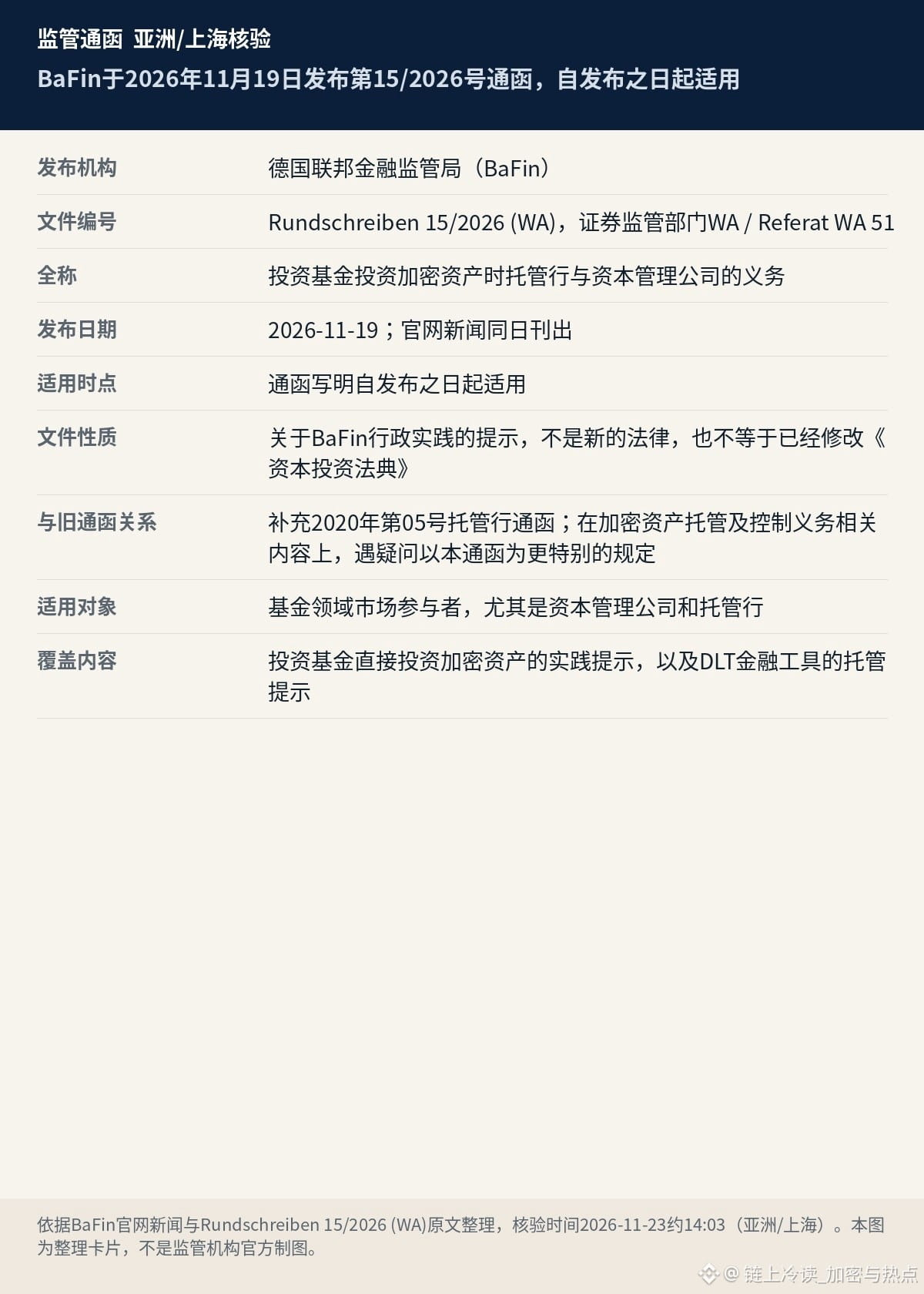
On November 19, 2026, the German Federal Financial Supervisory Authority (BaFin) published Circular No. 15/2026 (Securities Supervision Division WA), titled “Obligations of Depositaries and Capital Management Companies When Investment Funds Invest in Crypto-Assets.” A notice was published on its website the same day. The circular states that it applies from the date of publication. It provides guidance on BaFin’s administrative practice, supplements Circular No. 05/2020 on depositaries, and serves as a more specific provision regarding the custody of crypto-assets and related control obligations; it is not a new law and does not mean that the German Capital Investment Code has been amended.
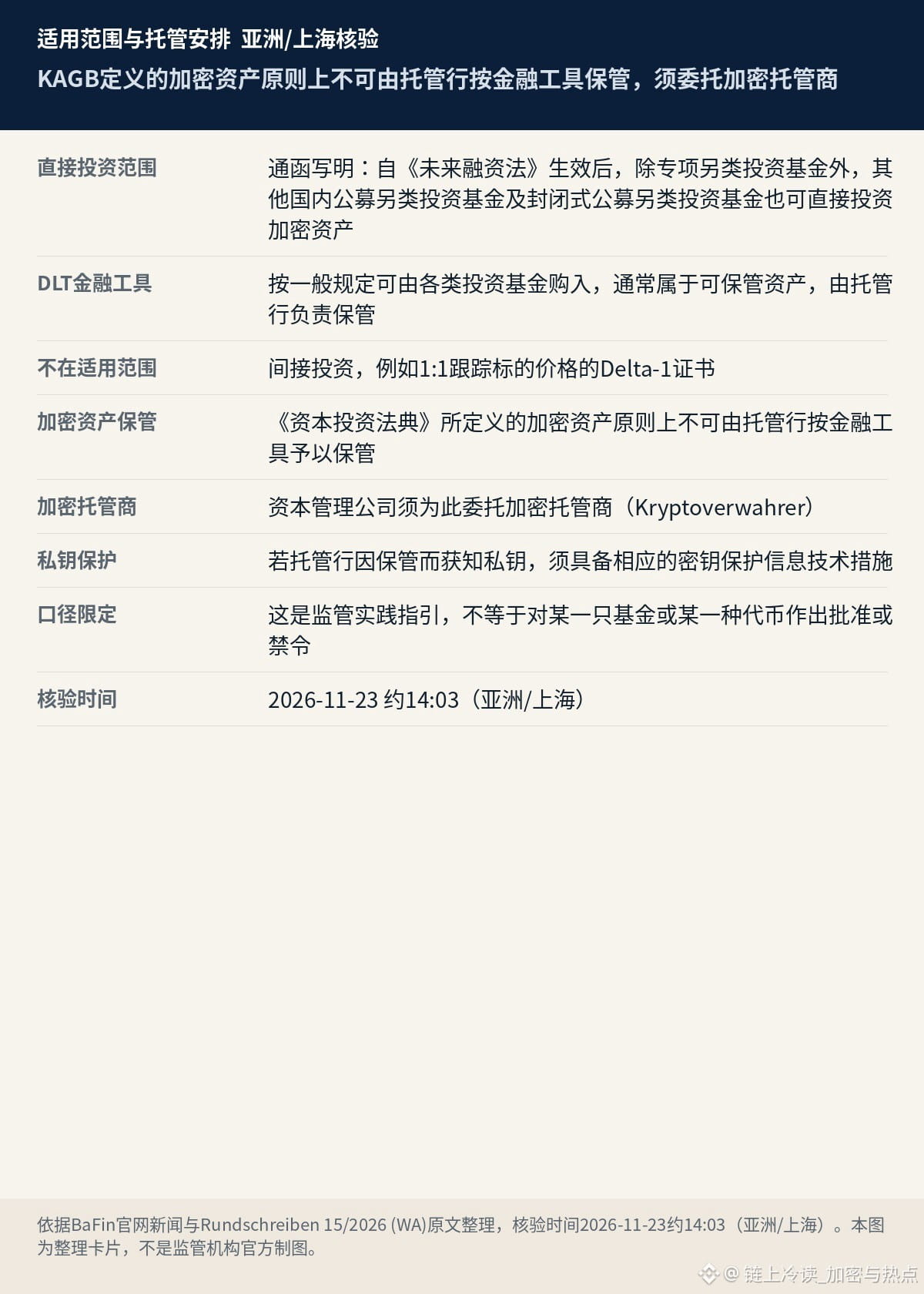
The circular is addressed to market participants in the fund sector, particularly capital management companies and depositaries, and provides practical guidance on investment funds’ direct investments in crypto-assets. It also includes guidance on the custody of financial instruments issued using distributed ledger technology (DLT). The document states that, following the entry into force of the Future Financing Act, domestic public alternative investment funds other than special alternative investment funds, as well as closed-ended public alternative investment funds, may also invest directly in crypto-assets; under the general rules, all types of investment funds may acquire DLT financial instruments. Indirect investments (for example, Delta-1 certificates that track the price of an underlying asset on a 1:1 basis) are outside the scope of the circular.
Regarding custody arrangements, the circular states that crypto-assets as defined in the Capital Investment Code generally cannot be held in custody by a depositary as financial instruments, and that capital management companies must therefore engage a crypto custodian. DLT financial instruments, by contrast, are generally assets that can be held in custody, and their safekeeping is the responsibility of the depositary. If a depositary gains knowledge of private keys in the course of safekeeping, it must have appropriate information technology measures in place to protect those keys. This implements guidance on regulatory practice and does not constitute an approval or prohibition of any particular fund or type of token.
Are you more interested in how crypto-assets that cannot be held in custody should be entrusted to a crypto custodian, or in the resources and process requirements that depositaries must meet after public alternative investment funds invest directly in crypto-assets?
5
·
--
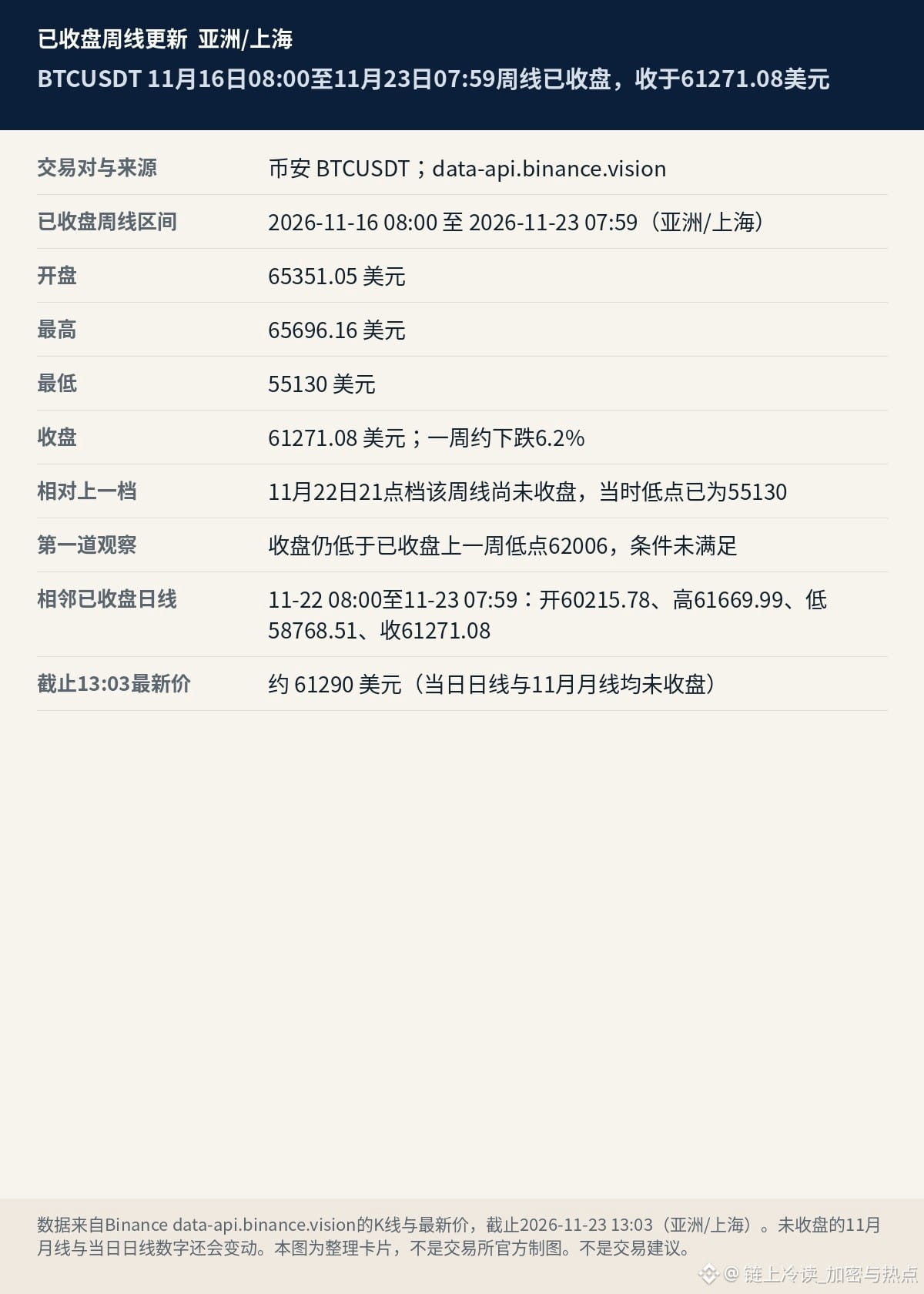
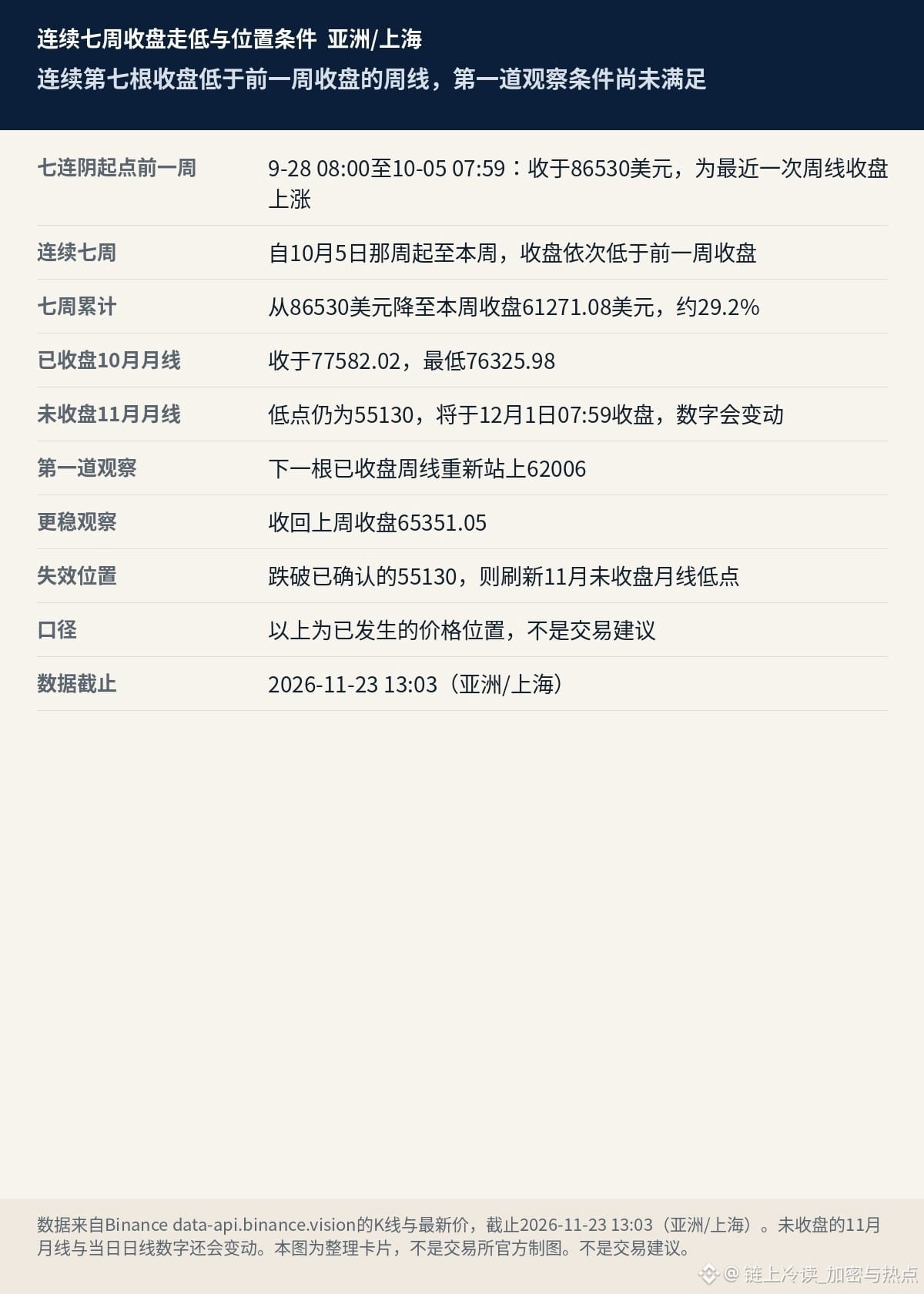
The weekly candle on Binance BTCUSDT from November 16 at 08:00 to November 23 at 07:59 (Asia/Shanghai) has closed: it opened at $65,351.05, reached a high of $65,696.16 and a low of $55,130, and closed at $61,271.08, down about 6.2% for the week. The close remained below the previous completed week's low of $62,006, as well as below last week's close of $65,351.05. Therefore, the first monitoring condition raised in the November 22, 21:00 update—“this week's close moves back above $62,006”—was not met by this completed weekly candle.
This is the seventh consecutive weekly candle to close below the previous week's close. The last weekly close to rise was the candle from September 28 at 08:00 to October 5 at 07:59, which closed at $86,530. The seven consecutive weekly declines since then have taken the close from $86,530 to this week's $61,271.08, a cumulative drop of about 29.2%.
The completed October monthly candle closed at $77,582.02, with a low of $76,325.98. The November monthly candle has not yet closed (it will close on December 1 at 07:59). At the time of verification, the low of the still-open monthly candle remained $55,130, and the latest price was about $61,290, still below October's close. Figures for the unclosed candle may still change. The adjacent completed daily candle (November 22 at 08:00 to November 23 at 07:59) opened at $60,215.78, reached a high of $61,669.99 and a low of $58,768.51, and closed at $61,271.08—the same closing time as the weekly candle.
Conditional assessment: The first monitoring condition mentioned earlier will be met only if the next completed weekly candle moves back above $62,006; reclaiming $65,351.05 would be a stronger signal. If the confirmed low of $55,130 is broken, the low of the still-open November monthly candle will be surpassed, and the rebound since the November 21 low will also be invalidated. These are observations about price levels that have already occurred, not trading advice. Data is from Binance's data-api.binance.vision candlesticks and latest price, as of November 23 at 13:03 (Asia/Shanghai). $BTC
10
·
--
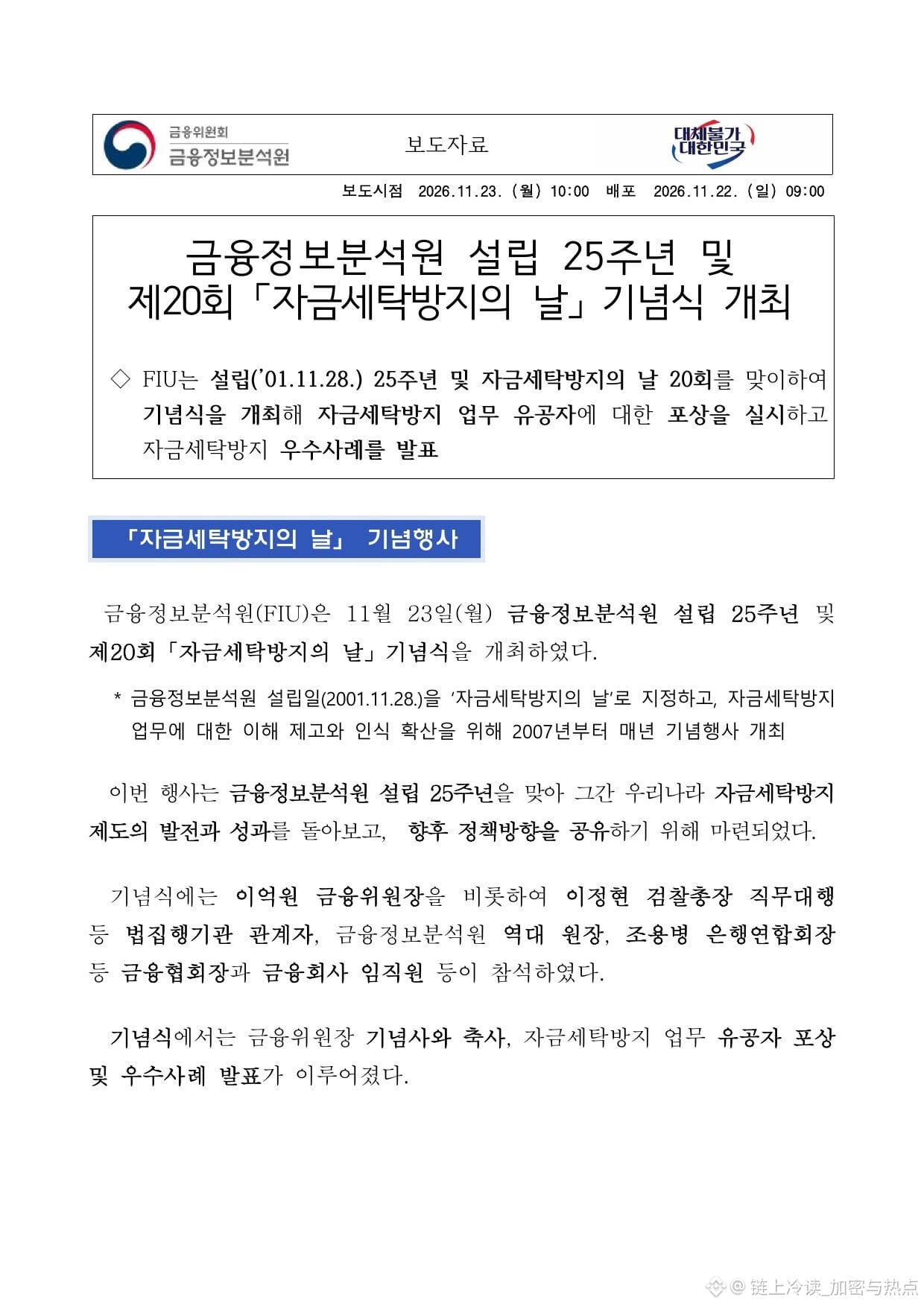
The Korea Financial Intelligence Unit (KoFIU) said in a press release published on the Financial Services Commission’s website on November 23, 2026, that it had held an event that day to mark the 25th anniversary of its establishment and the 20th “Anti-Money Laundering Day.” In his commemorative address, Financial Services Commission Chairman Lee Eok-won outlined three key policy priorities. The second was a more proactive response to the use of virtual assets for money laundering.
The press release stated that in August this year, the financial authorities revised the Enforcement Decree of the Act on Reporting and Using Specified Financial Transaction Information, clarifying the reporting requirements for virtual asset service providers and the scope of major shareholder screening, while strengthening anti-money laundering oversight of virtual asset transfers. Going forward, they will tighten reporting and screening requirements for virtual asset service providers and continue stepping up efforts against unregistered virtual asset businesses. They also plan to abolish the threshold for applying the Travel Rule and to more strictly monitor transfers of funds to high-risk overseas virtual asset service providers and personal wallets, in order to improve transaction transparency.
It is important to distinguish between what has already happened and what is planned: the August revision to the enforcement decree has taken effect, but abolishing the Travel Rule threshold and tightening oversight of transfers to high-risk overseas platforms and personal wallets were described in the press release as measures to be pursued. This does not mean that all related rules are already in force, nor that any particular exchange has been penalized. The same commemorative address also described expanding the freezing of suspicious account transactions to cover serious crimes that harm the public, and imposing anti-money laundering obligations on lawyers, accountants, tax accountants, and others, as plans to be pursued—not legislation that has already been enacted.
Will these measures have a more direct impact on deposits and withdrawals in South Korea and cross-border transfers, or will they ultimately also change the compliance bar for high-risk overseas platforms? #Regulation

34
·
--
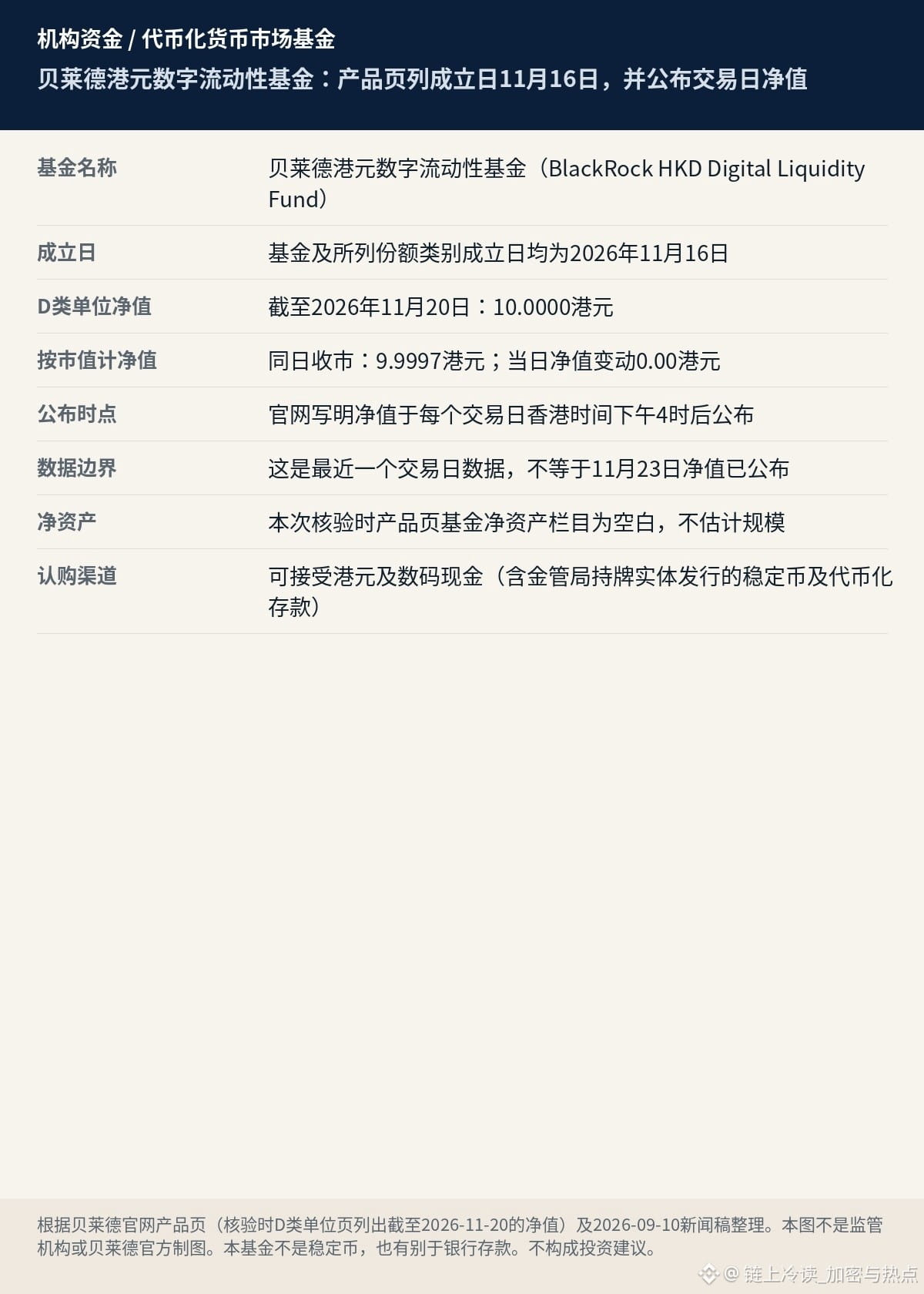
BlackRock’s official product page shows that both the inception date of the BlackRock HKD Digital Liquidity Fund and the inception date of its listed share class are November 16, 2026. As of November 20, 2026, the net asset value per Class D unit was HKD 10.0000, while the closing net asset value calculated on a market-value basis was HKD 9.9997; the change in net asset value that day was HKD 0.00. The website states that net asset values are published after 4 p.m. Hong Kong time on each trading day. These are the latest trading-day figures listed on the page; they do not mean that the net asset value for November 23 has already been published. At the time of this review, the fund net assets field on the product page was blank, so this article does not estimate the fund’s size.
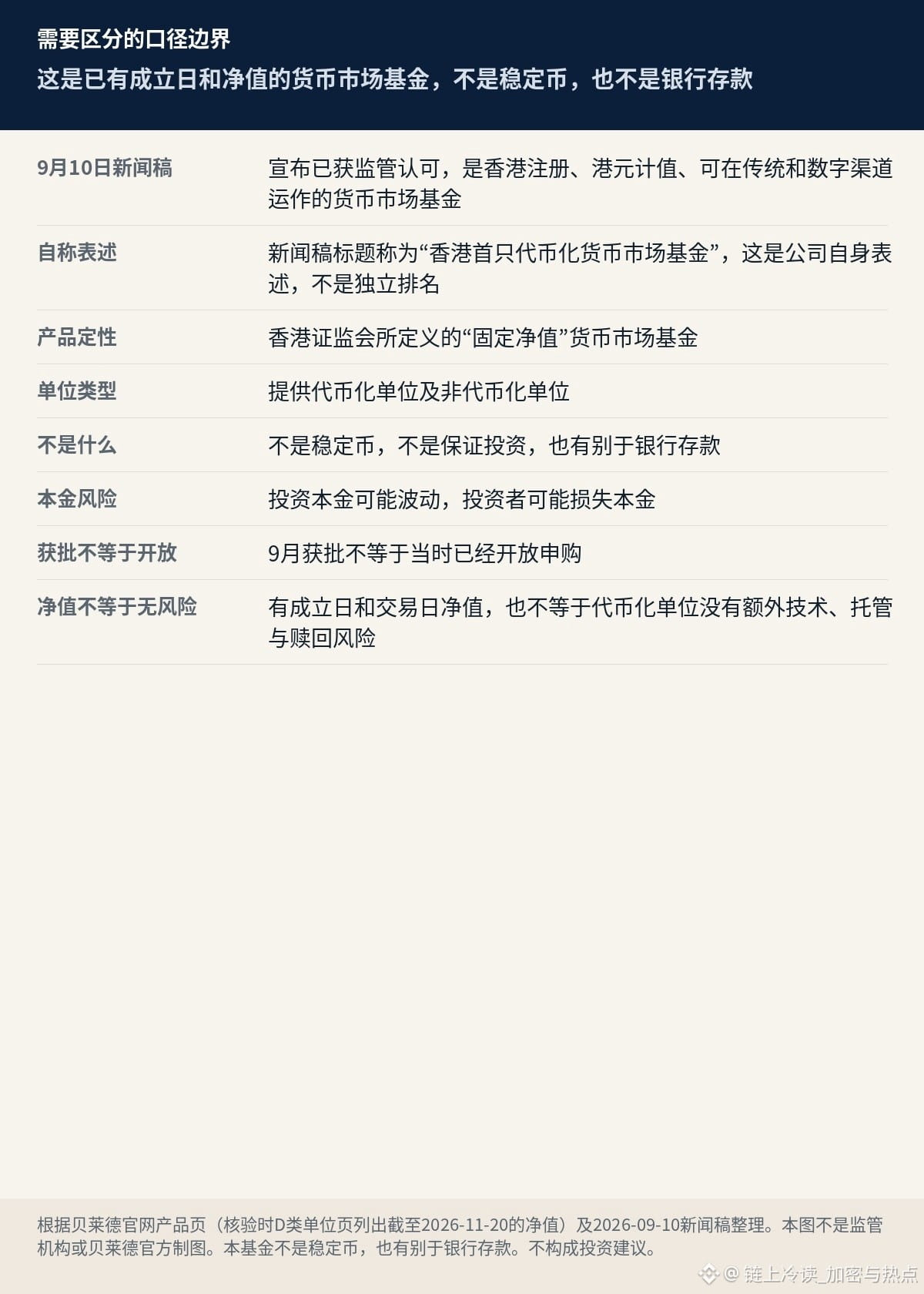
In a September 10, 2026 press release, BlackRock announced that the fund had received regulatory approval. It is a Hong Kong-domiciled, HKD-denominated money market fund designed to operate through both traditional and digital channels. The press release headline calls it “Hong Kong’s first tokenized money market fund”—a description by the company itself, not an independent ranking or a regulatory determination. The website states that the fund is a “constant net asset value” money market fund, as defined by the Hong Kong Securities and Futures Commission, and offers both tokenized and non-tokenized units. It can accept subscriptions and redemptions in digital cash, including stablecoins issued by entities licensed by the Hong Kong Monetary Authority and tokenized deposits. The website also states that the fund is not a stablecoin, is not a guaranteed investment, and is distinct from a bank deposit; the principal invested may fluctuate, and investors may lose their principal. Approval in September did not mean that subscriptions were already open at the time; likewise, having an inception date and trading-day net asset values now does not mean tokenized units are free of additional technology, custody, and redemption risks.
My view is that the key development is the fund’s progress from “approved” to the product stage, with an inception date and published trading-day net asset values. However, its size has not yet been disclosed on the product page, and accepting subscriptions in digital cash does not mean that the stablecoin itself has become the fund. Are you more interested in which share classes’ net assets will be disclosed next, or in the practical settlement arrangements for digital-cash redemptions?
BLKUS+0.52%
54
Log in to explore more content
Join global crypto users on Binance Square
⚡️ Get latest and useful information about crypto.
💬 Trusted by the world’s largest crypto exchange.
👍 Discover real insights from verified creators.
Email / Phone number
Trending Topics
NVIDIAReinstatesJensenHuangasCEO
113,964 views
945 Discussing
TradFi News | Nvidia Board Unanimously Reinstates Jensen Huang as CEO; Shares Jump 30% Premarket
Binance News
·42 Likes
·43.2k views
WillMarketsStageAThanksgivingReliefRally?
222,303 views
1,923 Discussing
WillOctCorePCEShiftFedHikeExpectations?
77,719 views
829 Discussing