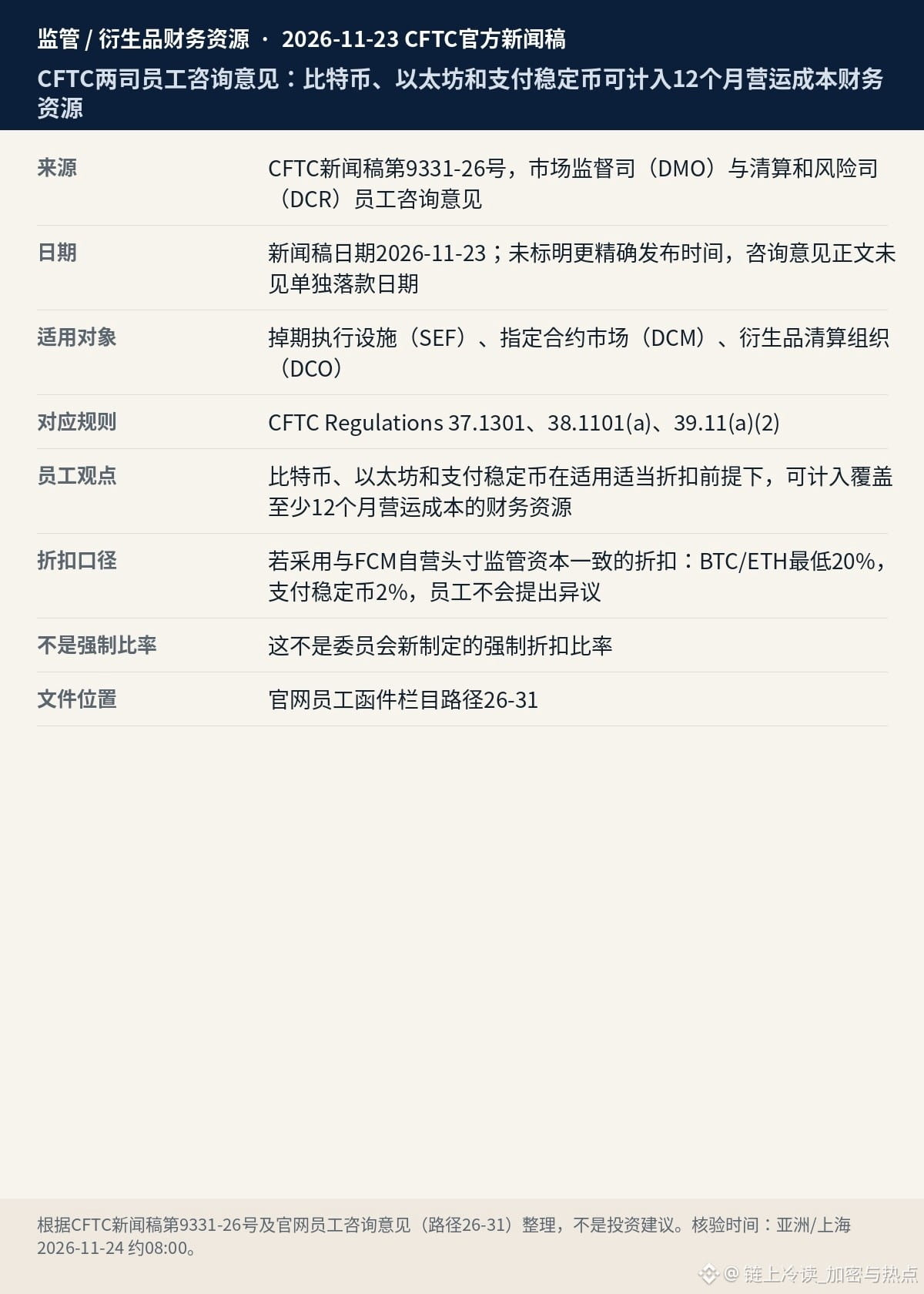
On November 23, 2026, the U.S. Commodity Futures Trading Commission (CFTC) issued Press Release No. 9331-26, announcing that its Division of Market Oversight (DMO) and Division of Clearing and Risk (DCR) had issued staff advisory opinions that day explaining how swap execution facilities (SEFs), designated contract markets (DCMs), and derivatives clearing organizations (DCOs) may use crypto assets to meet financial resource requirements related to operating costs under Regulations 37.1301, 38.1101(a), and 39.11(a)(2). The press release did not specify a more precise release time; the advisory opinions themselves do not appear to carry a separate date, so this post uses the press release date. The documents are available in the Staff Letters section of the official website under path 26-31.
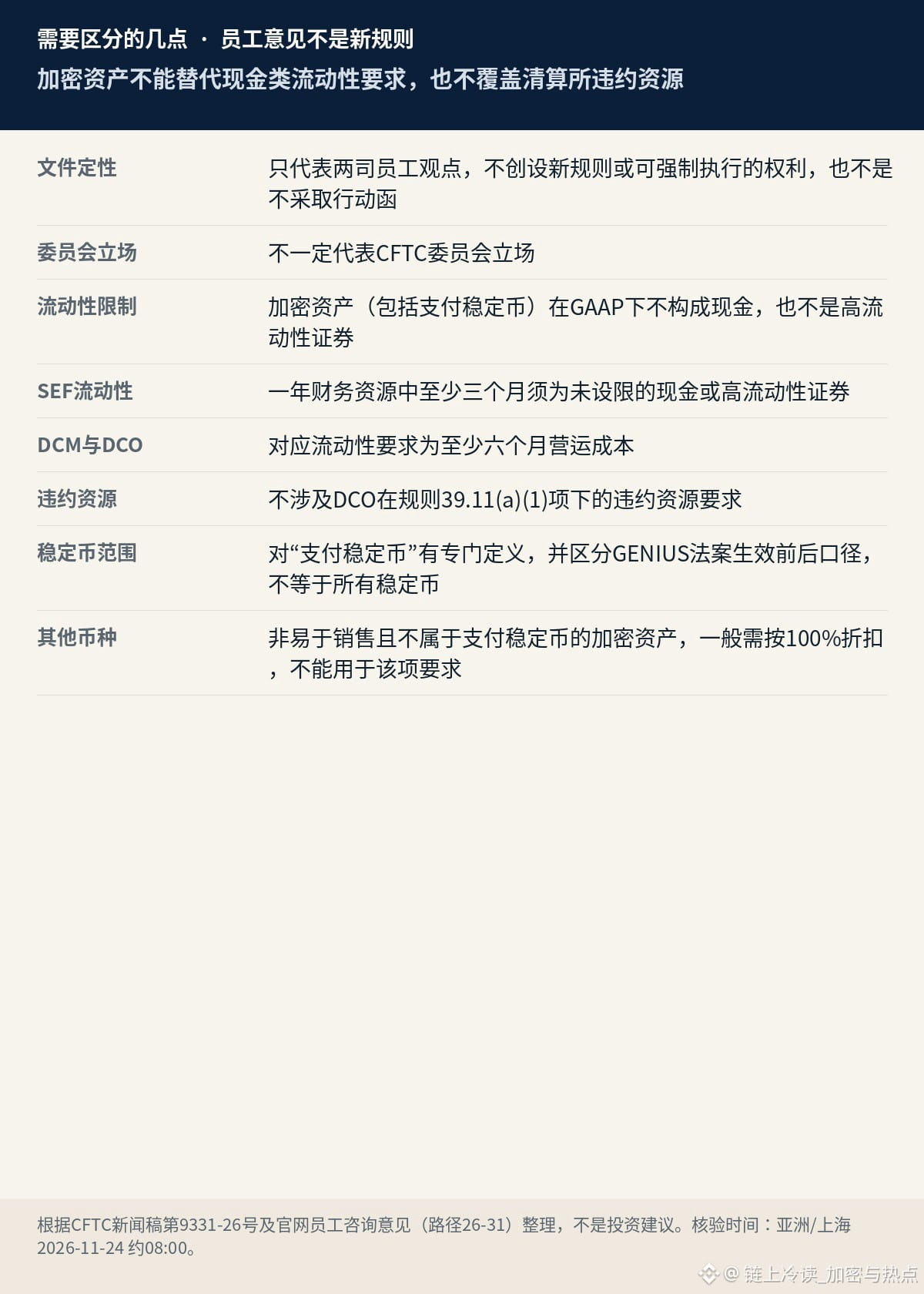
Staff of the two divisions believe that Bitcoin, Ethereum, and payment stablecoins may count toward financial resources covering at least 12 months of operating costs, provided appropriate haircuts are applied. Staff stated that they would not object to haircuts consistent with the regulatory capital treatment of futures commission merchant (FCM) proprietary positions: a minimum of 20% for Bitcoin and Ethereum, and 2% for payment stablecoins. These are not newly mandated ratios established by the Commission. Crypto assets that are not readily marketable and are not payment stablecoins generally require a 100% haircut, and therefore cannot be used to meet this requirement. The advisory opinions provide a specific definition of “payment stablecoin” and distinguish between the definitions before and after the GENIUS Act takes effect; this does not mean that all stablecoins qualify.
However, crypto assets (including payment stablecoins) do not constitute “cash” under U.S. generally accepted accounting principles and are not “highly liquid securities,” so they cannot be used to meet the separate liquidity requirement: SEFs must hold at least three months’ worth of their one-year financial resources in unencumbered cash or highly liquid securities; the corresponding requirement for DCMs and DCOs is at least six months of operating costs. The advisory opinions also state that this does not concern the default resources requirement for DCOs under Regulation 39.11(a)(1).
This represents only the views of staff in the two divisions identified above. It does not create a new rule or enforceable rights, is not a no-action letter, and does not necessarily represent the Commission’s position.
Are you more concerned about whether regulated exchanges will consequently count Bitcoin or Ethereum toward their operating buffers, or whether the cash-like liquidity floor will be the practical constraint?
$BTC $ETH
#Regulation