

园长
253 Posts

园长
 Square Verified
Report
Block User
区块链投资基金 SanyuanCapital 和 Web3 招聘平台 DeJob 创始人
6 Following
10.7K+ Followers
3.8K+ Liked
Posts
·
--
Verified
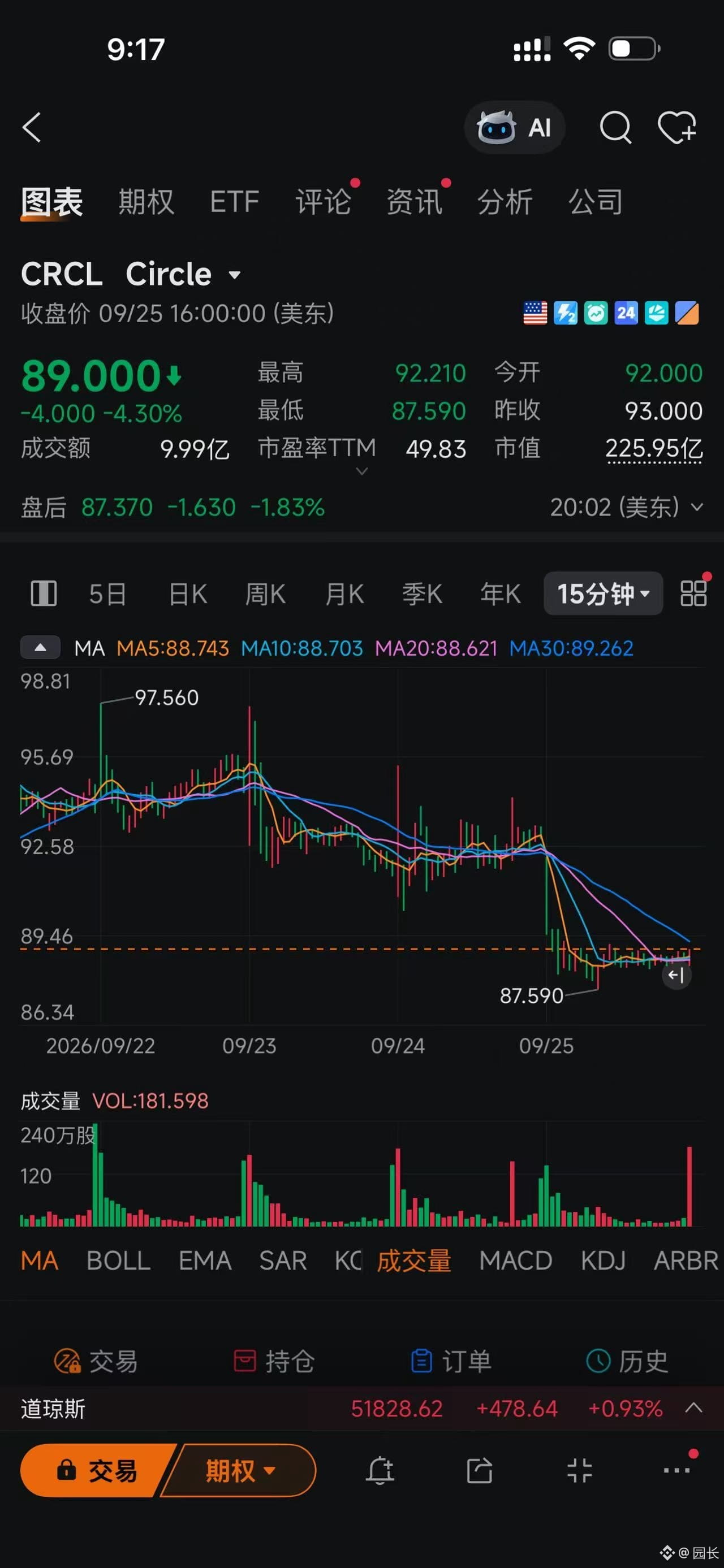
$CRCL So fast, are they already falling from the pedestal?
After the Friday US stock market close, the company dropped a shocking bombshell:
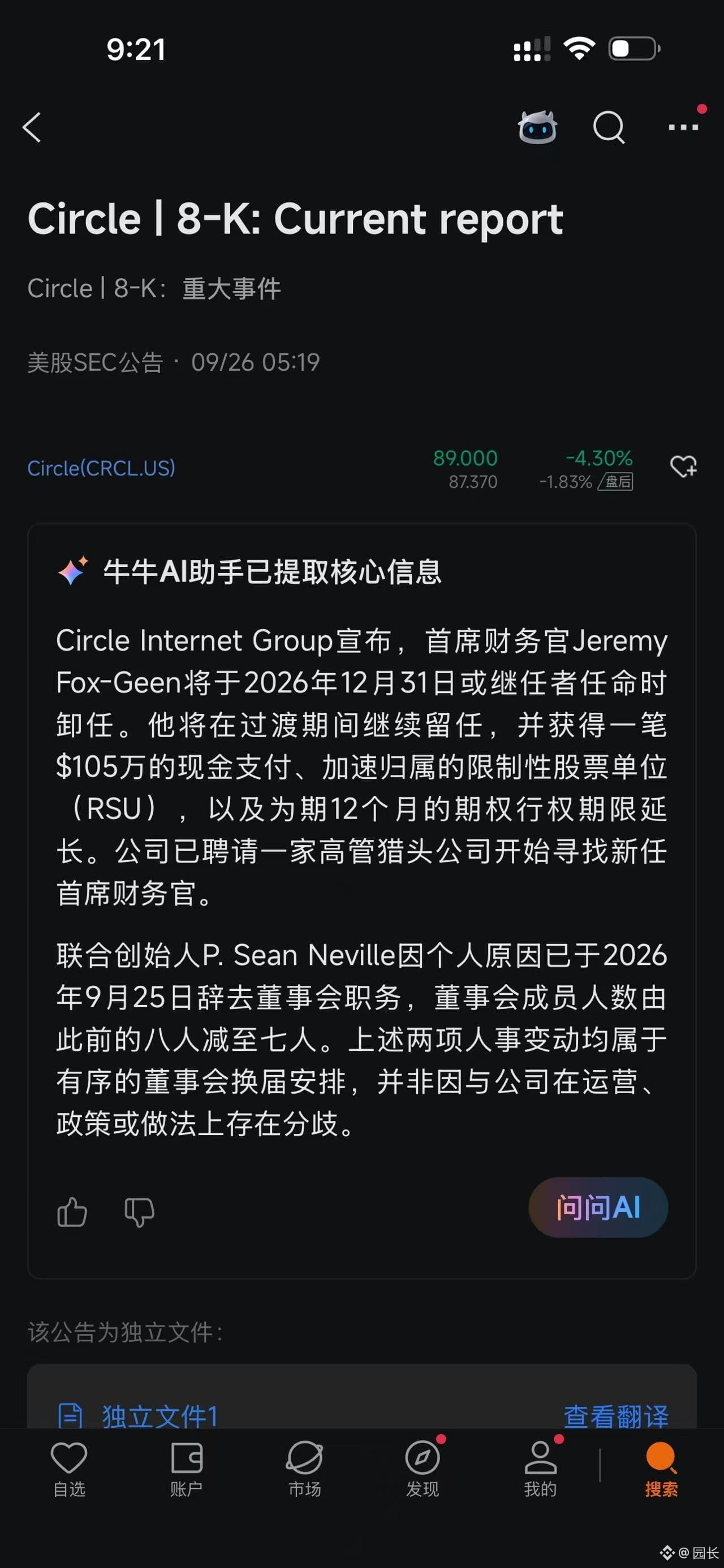
Circle’s CFO is preparing to step down at the end of the year.
The reason is simply that he wants to rest and move on to the next stage of life.
He’s currently just beginning to look for a successor,
but no candidate has been announced yet.
Not only that—another co-founder also immediately stepped down from the board,
for personal reasons.
According to the official explanation, neither of their departures was due to a disagreement with the company.
Before the announcement, $CRCL had already pulled back by about 4%.
But once the news broke, the stock price continued to fall in response.
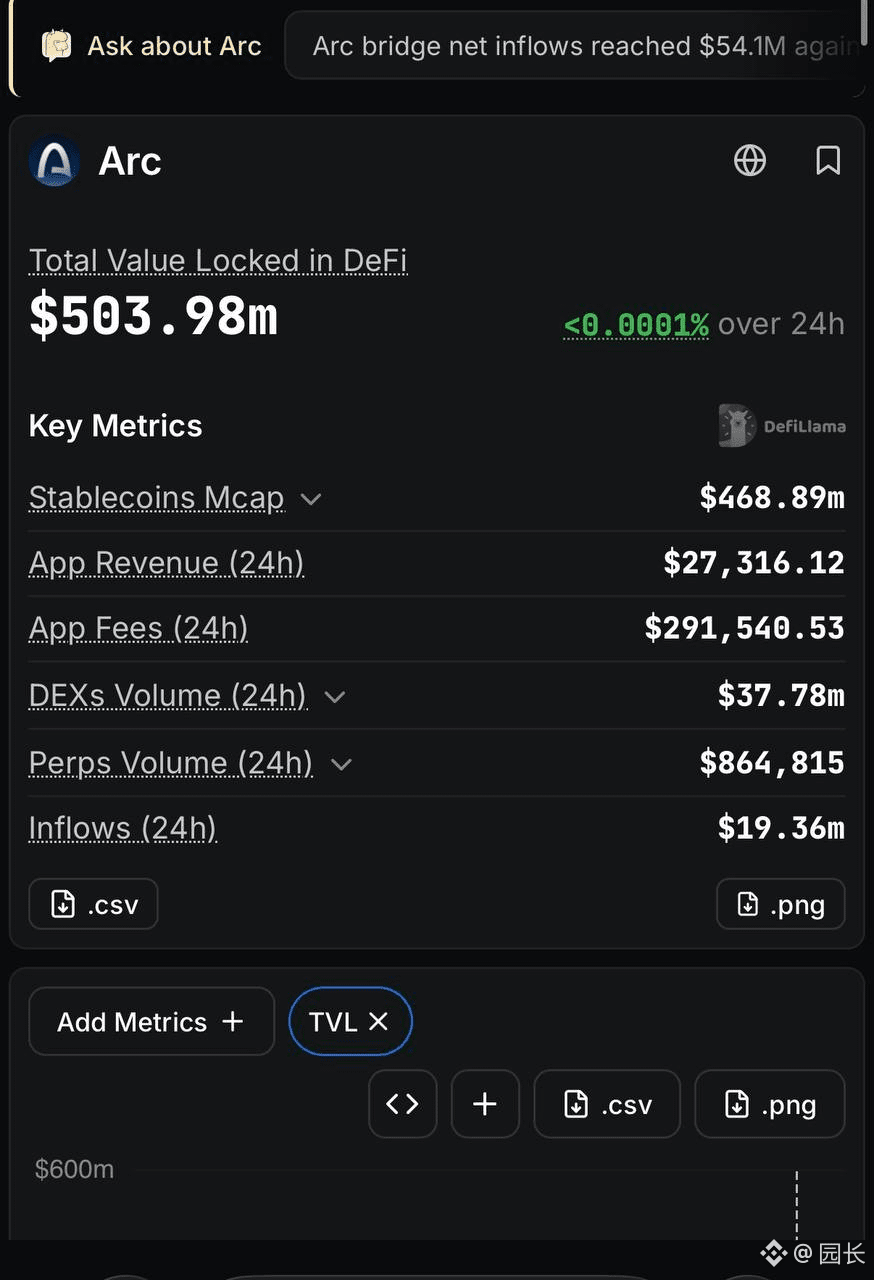
CRCL’s new public chain, Arc, just went live. Although on-chain data so far isn’t bad,
there still aren’t any flagship projects that have really emerged.
In terms of feel, it’s still got that “thunder with little rain” vibe 😂
Binance’s investment in CRCL is definitely a positive,
but it seems like it benefits Binance even more.
Now that two key figures are leaving at the same time, it’s normal for the market to be a bit cautious.
My view remains unchanged:
as long as $CRCL can avoid becoming overly dependent on reserve earnings,
and the other businesses continue to grow,
I don’t think the departure of the person at the helm is a big deal.
{future}(CRCLUSDT)
$CRCL So fast, are they already falling from the pedestal?
After the Friday US stock market close, the company dropped a shocking bombshell:
Circle’s CFO is preparing to step down at the end of the year.
The reason is simply that he wants to rest and move on to the next stage of life.
He’s currently just beginning to look for a successor,
but no candidate has been announced yet.
Not only that—another co-founder also immediately stepped down from the board,
for personal reasons.
According to the official explanation, neither of their departures was due to a disagreement with the company.
Before the announcement, $CRCL had already pulled back by about 4%.
But once the news broke, the stock price continued to fall in response.
CRCL’s new public chain, Arc, just went live. Although on-chain data so far isn’t bad,
there still aren’t any flagship projects that have really emerged.
In terms of feel, it’s still got that “thunder with little rain” vibe 😂
Binance’s investment in CRCL is definitely a positive,
but it seems like it benefits Binance even more.
Now that two key figures are leaving at the same time, it’s normal for the market to be a bit cautious.
My view remains unchanged:
as long as $CRCL can avoid becoming overly dependent on reserve earnings,
and the other businesses continue to grow,
I don’t think the departure of the person at the helm is a big deal.
After the Friday US stock market close, the company dropped a shocking bombshell:
Circle’s CFO is preparing to step down at the end of the year.
The reason is simply that he wants to rest and move on to the next stage of life.
He’s currently just beginning to look for a successor,
but no candidate has been announced yet.
Not only that—another co-founder also immediately stepped down from the board,
for personal reasons.
According to the official explanation, neither of their departures was due to a disagreement with the company.
Before the announcement, $CRCL had already pulled back by about 4%.
But once the news broke, the stock price continued to fall in response.
CRCL’s new public chain, Arc, just went live. Although on-chain data so far isn’t bad,
there still aren’t any flagship projects that have really emerged.
In terms of feel, it’s still got that “thunder with little rain” vibe 😂
Binance’s investment in CRCL is definitely a positive,
but it seems like it benefits Binance even more.
Now that two key figures are leaving at the same time, it’s normal for the market to be a bit cautious.
My view remains unchanged:
as long as $CRCL can avoid becoming overly dependent on reserve earnings,
and the other businesses continue to grow,
I don’t think the departure of the person at the helm is a big deal.
3
3
10k
·
--
Verified
$ENA One-week drawdown more than 50%
The first few weeks only just announced a buyback boost, and now there’s new news again—something big is coming?
Previously, we discussed that Ethena uses cryptocurrencies and stablecoins as underlying assets,
while also trading perps to short—hedging out price volatility—and then issuing USDe.
Especially in bull markets, when everyone is going crazy longing,
Ethena shorts for hedging and also captures a round of funding fees.
Now, Ethena has joined Binance’s bStocks using the same concept,
earning funding rates and the basis from contracts.
It expands its own arbitrage range—from original cryptocurrencies to tokenized stocks.
In the past 6 months, bStocks has averaged an annualized return of over 11%.
And over the last 3 months, open positions have been growing by an average of 30% each month.
Binance will also lower Ethena’s ADL priority.
What does that mean?
It means that in extreme market conditions, it’s less likely to be the one automatically reduced,
reducing the risk that the hedging position suddenly disappears during extreme swings.
Now that RWA no longer satisfies the need to put US stocks on-chain,
directly using tokenized stocks as collateral for stablecoins.
Back to Ethena.
Earlier, we also raised a question: when a bear market comes and funding rates aren’t as high,
what does Ethena do?
Ethena has a very good answer.
Now Ethena is no longer relying solely on funding rates from the crypto market.
With the addition of tokenized US stocks, it gains another revenue stream,
which—more or less—reduces dependence on crypto-market funding fees and lets it ride through the bull-and-bear cycle.
{future}(ENAUSDT)
$ENA One-week drawdown more than 50%
The first few weeks only just announced a buyback boost, and now there’s new news again—something big is coming?
Previously, we discussed that Ethena uses cryptocurrencies and stablecoins as underlying assets,
while also trading perps to short—hedging out price volatility—and then issuing USDe.
Especially in bull markets, when everyone is going crazy longing,
Ethena shorts for hedging and also captures a round of funding fees.
Now, Ethena has joined Binance’s bStocks using the same concept,
earning funding rates and the basis from contracts.
It expands its own arbitrage range—from original cryptocurrencies to tokenized stocks.
In the past 6 months, bStocks has averaged an annualized return of over 11%.
And over the last 3 months, open positions have been growing by an average of 30% each month.
Binance will also lower Ethena’s ADL priority.
What does that mean?
It means that in extreme market conditions, it’s less likely to be the one automatically reduced,
reducing the risk that the hedging position suddenly disappears during extreme swings.
Now that RWA no longer satisfies the need to put US stocks on-chain,
directly using tokenized stocks as collateral for stablecoins.
Back to Ethena.
Earlier, we also raised a question: when a bear market comes and funding rates aren’t as high,
what does Ethena do?
Ethena has a very good answer.
Now Ethena is no longer relying solely on funding rates from the crypto market.
With the addition of tokenized US stocks, it gains another revenue stream,
which—more or less—reduces dependence on crypto-market funding fees and lets it ride through the bull-and-bear cycle.
The first few weeks only just announced a buyback boost, and now there’s new news again—something big is coming?
Previously, we discussed that Ethena uses cryptocurrencies and stablecoins as underlying assets,
while also trading perps to short—hedging out price volatility—and then issuing USDe.
Especially in bull markets, when everyone is going crazy longing,
Ethena shorts for hedging and also captures a round of funding fees.
Now, Ethena has joined Binance’s bStocks using the same concept,
earning funding rates and the basis from contracts.
It expands its own arbitrage range—from original cryptocurrencies to tokenized stocks.
In the past 6 months, bStocks has averaged an annualized return of over 11%.
And over the last 3 months, open positions have been growing by an average of 30% each month.
Binance will also lower Ethena’s ADL priority.
What does that mean?
It means that in extreme market conditions, it’s less likely to be the one automatically reduced,
reducing the risk that the hedging position suddenly disappears during extreme swings.
Now that RWA no longer satisfies the need to put US stocks on-chain,
directly using tokenized stocks as collateral for stablecoins.
Back to Ethena.
Earlier, we also raised a question: when a bear market comes and funding rates aren’t as high,
what does Ethena do?
Ethena has a very good answer.
Now Ethena is no longer relying solely on funding rates from the crypto market.
With the addition of tokenized US stocks, it gains another revenue stream,
which—more or less—reduces dependence on crypto-market funding fees and lets it ride through the bull-and-bear cycle.
1
2
5.7k
·
--
Verified
Recently, old coins are trending again with a fresh wave of炒作.
Suddenly, I remembered Polygon—the Polygon that once swept the market.
Back then in 2021, Ethereum gas fees were insanely high.
Polygon became a new star from a small, barely-noticed project, thanks to its faster speed and lower fees.
It turned into a favorite for top DeFi players like Aave, Curve, and SushiSwap, with TVL surpassing $10 billion.
At that time, its token was still called MATIC. Who among us didn’t use Polygon for transfers, cross-chain, and recharges back then?
Haha, the dead memory attack hit me.
Back then, transfers were fast—waiting only about 5 minutes; if slow, you’d wait for the next hour.
Now, if it hasn’t arrived in over two minutes, people start suspecting the coins are lost 😂
The times really are different.
Today, Polygon’s main battlefield isn’t only in DeFi anymore—
it’s AI agents + the payments narrative.
Polygon is focusing on the wallet market for AI robots.
It believes that the biggest payment market in the future will be AI agents that can call countless APIs in seconds.
Polygon’s cumulative transfer volume is already around $3 trillion, with an average cost per transaction of just $0.002—extremely cheap.
Its latest payment channels can even handle AI payment updates off-chain, and only batch-submit them for settlement on Polygon at the end.
By doing it in less time and at lower cost, it can process more micro-payments.
After talking about Polygon, back to the token itself:
When gas costs keep dropping, a large number of micro-payments can be handled off-chain first.
Even if payment volume reaches astronomical levels in the future,
whether it can bring real value to POL is still unknown.
$POL currently still has a 2% annual issuance rate.
But just yesterday, it burned 100 million $POL —about 1% of the total supply.
This batch of coins comes from accumulated Base fees from the past.
The more the network gets used in the future, the more Base Fees accumulate, and the more POL can be burned.
This year, $POL has already reached net deflation.
Polygon’s narrative is really solid,
and POL’s highlights are slowly coming into view.
Let’s keep watching.
{future}(POLUSDT)
Recently, old coins are trending again with a fresh wave of炒作.
Suddenly, I remembered Polygon—the Polygon that once swept the market.
Back then in 2021, Ethereum gas fees were insanely high.
Polygon became a new star from a small, barely-noticed project, thanks to its faster speed and lower fees.
It turned into a favorite for top DeFi players like Aave, Curve, and SushiSwap, with TVL surpassing $10 billion.
At that time, its token was still called MATIC. Who among us didn’t use Polygon for transfers, cross-chain, and recharges back then?
Haha, the dead memory attack hit me.
Back then, transfers were fast—waiting only about 5 minutes; if slow, you’d wait for the next hour.
Now, if it hasn’t arrived in over two minutes, people start suspecting the coins are lost 😂
The times really are different.
Today, Polygon’s main battlefield isn’t only in DeFi anymore—
it’s AI agents + the payments narrative.
Polygon is focusing on the wallet market for AI robots.
It believes that the biggest payment market in the future will be AI agents that can call countless APIs in seconds.
Polygon’s cumulative transfer volume is already around $3 trillion, with an average cost per transaction of just $0.002—extremely cheap.
Its latest payment channels can even handle AI payment updates off-chain, and only batch-submit them for settlement on Polygon at the end.
By doing it in less time and at lower cost, it can process more micro-payments.
After talking about Polygon, back to the token itself:
When gas costs keep dropping, a large number of micro-payments can be handled off-chain first.
Even if payment volume reaches astronomical levels in the future,
whether it can bring real value to POL is still unknown.
$POL currently still has a 2% annual issuance rate.
But just yesterday, it burned 100 million $POL —about 1% of the total supply.
This batch of coins comes from accumulated Base fees from the past.
The more the network gets used in the future, the more Base Fees accumulate, and the more POL can be burned.
This year, $POL has already reached net deflation.
Polygon’s narrative is really solid,
and POL’s highlights are slowly coming into view.
Let’s keep watching.
Suddenly, I remembered Polygon—the Polygon that once swept the market.
Back then in 2021, Ethereum gas fees were insanely high.
Polygon became a new star from a small, barely-noticed project, thanks to its faster speed and lower fees.
It turned into a favorite for top DeFi players like Aave, Curve, and SushiSwap, with TVL surpassing $10 billion.
At that time, its token was still called MATIC. Who among us didn’t use Polygon for transfers, cross-chain, and recharges back then?
Haha, the dead memory attack hit me.
Back then, transfers were fast—waiting only about 5 minutes; if slow, you’d wait for the next hour.
Now, if it hasn’t arrived in over two minutes, people start suspecting the coins are lost 😂
The times really are different.
Today, Polygon’s main battlefield isn’t only in DeFi anymore—
it’s AI agents + the payments narrative.
Polygon is focusing on the wallet market for AI robots.
It believes that the biggest payment market in the future will be AI agents that can call countless APIs in seconds.
Polygon’s cumulative transfer volume is already around $3 trillion, with an average cost per transaction of just $0.002—extremely cheap.
Its latest payment channels can even handle AI payment updates off-chain, and only batch-submit them for settlement on Polygon at the end.
By doing it in less time and at lower cost, it can process more micro-payments.
After talking about Polygon, back to the token itself:
When gas costs keep dropping, a large number of micro-payments can be handled off-chain first.
Even if payment volume reaches astronomical levels in the future,
whether it can bring real value to POL is still unknown.
$POL currently still has a 2% annual issuance rate.
But just yesterday, it burned 100 million $POL —about 1% of the total supply.
This batch of coins comes from accumulated Base fees from the past.
The more the network gets used in the future, the more Base Fees accumulate, and the more POL can be burned.
This year, $POL has already reached net deflation.
Polygon’s narrative is really solid,
and POL’s highlights are slowly coming into view.
Let’s keep watching.
3
5
4.7k
·
--
Verified
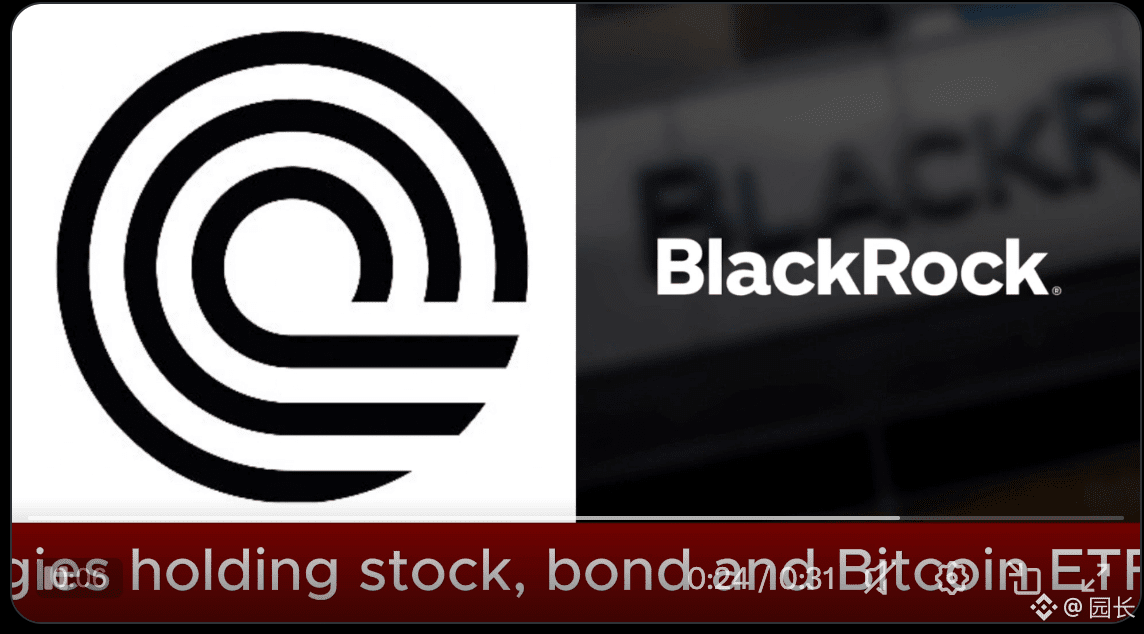
BlackRock tokenizes model portfolio investments through Ondo Finance
Many people are underestimating this news.
BlackRock designs an investment portfolio strategy for $ONDO , and ONDO packages them into Ondo Intelligent Portfolios.
Ondo Intelligent Portfolios puts the entire portfolio strategy into a single token.
Users don’t need to buy a bunch of US stocks or ETPs, and they don’t need to allocate positions. They can complete asset allocation simply by buying the token.
BlackRock designed three different strategies for $ONDO :
$BLKHIon is an income-focused portfolio.
Its main holdings are bonds, high-yield bonds, and credit ETFs.
The main source of returns is collecting interest, making it suitable for users who want relatively low volatility.
$BLKDIGon is a more balanced portfolio.
About 70% is allocated to stocks, 30% to bonds and other assets, with a tiny bit of Bitcoin.
This token is the closest to the classic Wall Street allocation, but in a more aggressive version.
It’s suitable for users who want to benefit from stock upside but don’t want volatility to be too high.
$BLKGRWon is direct and simple.
It allocates 95% to stocks and 5% to Bitcoin.
It’s more suitable for users who can tolerate volatility and pursue long-term growth.
Higher returns naturally come with higher risk.
This is indeed a new narrative for RWA. $ONDO has moved beyond just putting stocks and ETPs on-chain—it's also copying Wall Street operations onto the chain.
{future}(ONDOUSDT)
BlackRock tokenizes model portfolio investments through Ondo Finance
Many people are underestimating this news.
BlackRock designs an investment portfolio strategy for $ONDO , and ONDO packages them into Ondo Intelligent Portfolios.
Ondo Intelligent Portfolios puts the entire portfolio strategy into a single token.
Users don’t need to buy a bunch of US stocks or ETPs, and they don’t need to allocate positions. They can complete asset allocation simply by buying the token.
BlackRock designed three different strategies for $ONDO :
$BLKHIon is an income-focused portfolio.
Its main holdings are bonds, high-yield bonds, and credit ETFs.
The main source of returns is collecting interest, making it suitable for users who want relatively low volatility.
$BLKDIGon is a more balanced portfolio.
About 70% is allocated to stocks, 30% to bonds and other assets, with a tiny bit of Bitcoin.
This token is the closest to the classic Wall Street allocation, but in a more aggressive version.
It’s suitable for users who want to benefit from stock upside but don’t want volatility to be too high.
$BLKGRWon is direct and simple.
It allocates 95% to stocks and 5% to Bitcoin.
It’s more suitable for users who can tolerate volatility and pursue long-term growth.
Higher returns naturally come with higher risk.
This is indeed a new narrative for RWA. $ONDO has moved beyond just putting stocks and ETPs on-chain—it's also copying Wall Street operations onto the chain.
Many people are underestimating this news.
BlackRock designs an investment portfolio strategy for $ONDO , and ONDO packages them into Ondo Intelligent Portfolios.
Ondo Intelligent Portfolios puts the entire portfolio strategy into a single token.
Users don’t need to buy a bunch of US stocks or ETPs, and they don’t need to allocate positions. They can complete asset allocation simply by buying the token.
BlackRock designed three different strategies for $ONDO :
$BLKHIon is an income-focused portfolio.
Its main holdings are bonds, high-yield bonds, and credit ETFs.
The main source of returns is collecting interest, making it suitable for users who want relatively low volatility.
$BLKDIGon is a more balanced portfolio.
About 70% is allocated to stocks, 30% to bonds and other assets, with a tiny bit of Bitcoin.
This token is the closest to the classic Wall Street allocation, but in a more aggressive version.
It’s suitable for users who want to benefit from stock upside but don’t want volatility to be too high.
$BLKGRWon is direct and simple.
It allocates 95% to stocks and 5% to Bitcoin.
It’s more suitable for users who can tolerate volatility and pursue long-term growth.
Higher returns naturally come with higher risk.
This is indeed a new narrative for RWA. $ONDO has moved beyond just putting stocks and ETPs on-chain—it's also copying Wall Street operations onto the chain.
1
7
4k
·
--
Lately, there’s been a lot of talk about privacy, and even Vitalik has emphasized this track.
So let’s take a look together: where exactly is the privacy difference between $ZEC , $NEAR, and $ZAMA.
First up is $ZEC. It mainly hides transaction records.
In privacy transaction mode, third parties can’t see who truly transferred, how much was transferred, or wallet balances.
$NEAR, as we discussed before,
hides order intent and execution processes before a trade is completed,
so large orders don’t get sniped or run ahead by others.
It protects your trading strategy.
$ZAMA’s privacy is fully homomorphic encryption (FHE).
It encrypts data, balances, and positions end-to-end.
If we just keep the data off-chain, wouldn’t that solve the privacy problem?
But at the same time, the blockchain can’t use that data either.
The valuable part of FHE is that its data doesn’t need to be decrypted.
Smart contracts can still automatically compute, trade, lend, and settle.
Ordinary encryption can only keep parts of data secret while stored; if you need to compute, you have to decrypt everything.
Who says you can’t have both fish and bear’s paw?
$ZAMA can also support selective authorization.
For example, when compliance is needed, you can delegate permissions to specific parties,
so regulators and institutions get privacy as well.
However, FHE’s computation costs aren’t cheap right now, and it’s also relatively slow.
So privacy has many directions.
$ZEC is the big leader.
$NEAR has already been discussed in several articles.
$ZAMA is technically impressive and has big room for future imagination—but it still needs to overcome speed and cost.
Although $ZAMA is the smallest market cap among these three projects, it’s still 230 million, and its FDV is also over 1 billion.
But with new things, you buy a core position first and then look slowly.
{future}(NEARUSDT)
{future}(ZAMAUSDT)
{future}(ZECUSDT)
Lately, there’s been a lot of talk about privacy, and even Vitalik has emphasized this track.
So let’s take a look together: where exactly is the privacy difference between $ZEC , $NEAR , and $ZAMA .
First up is $ZEC . It mainly hides transaction records.
In privacy transaction mode, third parties can’t see who truly transferred, how much was transferred, or wallet balances.
$NEAR , as we discussed before,
hides order intent and execution processes before a trade is completed,
so large orders don’t get sniped or run ahead by others.
It protects your trading strategy.
$ZAMA ’s privacy is fully homomorphic encryption (FHE).
It encrypts data, balances, and positions end-to-end.
If we just keep the data off-chain, wouldn’t that solve the privacy problem?
But at the same time, the blockchain can’t use that data either.
The valuable part of FHE is that its data doesn’t need to be decrypted.
Smart contracts can still automatically compute, trade, lend, and settle.
Ordinary encryption can only keep parts of data secret while stored; if you need to compute, you have to decrypt everything.
Who says you can’t have both fish and bear’s paw?
$ZAMA can also support selective authorization.
For example, when compliance is needed, you can delegate permissions to specific parties,
so regulators and institutions get privacy as well.
However, FHE’s computation costs aren’t cheap right now, and it’s also relatively slow.
So privacy has many directions.
$ZEC is the big leader.
$NEAR has already been discussed in several articles.
$ZAMA is technically impressive and has big room for future imagination—but it still needs to overcome speed and cost.
Although $ZAMA is the smallest market cap among these three projects, it’s still 230 million, and its FDV is also over 1 billion.
But with new things, you buy a core position first and then look slowly.
So let’s take a look together: where exactly is the privacy difference between $ZEC , $NEAR , and $ZAMA .
First up is $ZEC . It mainly hides transaction records.
In privacy transaction mode, third parties can’t see who truly transferred, how much was transferred, or wallet balances.
$NEAR , as we discussed before,
hides order intent and execution processes before a trade is completed,
so large orders don’t get sniped or run ahead by others.
It protects your trading strategy.
$ZAMA ’s privacy is fully homomorphic encryption (FHE).
It encrypts data, balances, and positions end-to-end.
If we just keep the data off-chain, wouldn’t that solve the privacy problem?
But at the same time, the blockchain can’t use that data either.
The valuable part of FHE is that its data doesn’t need to be decrypted.
Smart contracts can still automatically compute, trade, lend, and settle.
Ordinary encryption can only keep parts of data secret while stored; if you need to compute, you have to decrypt everything.
Who says you can’t have both fish and bear’s paw?
$ZAMA can also support selective authorization.
For example, when compliance is needed, you can delegate permissions to specific parties,
so regulators and institutions get privacy as well.
However, FHE’s computation costs aren’t cheap right now, and it’s also relatively slow.
So privacy has many directions.
$ZEC is the big leader.
$NEAR has already been discussed in several articles.
$ZAMA is technically impressive and has big room for future imagination—but it still needs to overcome speed and cost.
Although $ZAMA is the smallest market cap among these three projects, it’s still 230 million, and its FDV is also over 1 billion.
But with new things, you buy a core position first and then look slowly.
1
5
4.9k
·
--
Verified
NEAR and ONDO have joined forces
ONDO brings tokenized U.S. stocks and ETFs to near.com
Ondo Stocks’ TVL has already exceeded $1 billion, with cumulative trading volume surpassing $20 billion—making it the largest tokenized stock platform today.
And last month, Near Intents’ trading volume already broke $27 billion, with more than 30 million transactions.
NEAR solves one of ONDO’s most headache-inducing problems:
How to attract more capital?
After connecting ONDO with NEAR Intents, it also brings in funding entry points from more than 30 chains.
Users can directly use $BTC, $SOL, $ETH, or other assets to buy tokenized stocks provided by Ondo.
The first batch includes stocks such as $NVDA, $TSLA, and $AAPL, as well as ETFs like $QQQ.
The whole process only requires using a near.com account to place the order.
No need to switch between different wallets as before, or handle cross-chain routing and prepare Gas yourself.
Just give the instruction: “I want to buy $NVDA.”
NEAR Intents will take care of the rest of the transaction route in the background.
The combination of $NEAR and $ONDO is not only reasonable—it’s also perfect.
Ondo tokenizes U.S. stocks on-chain,
while Near opens the user entry points for it.
Now RWA is not only gaining more assets, but operations are also getting simpler.
{future}(NEARUSDT)
{future}(ONDOUSDT)
NEAR and ONDO have joined forces
ONDO brings tokenized U.S. stocks and ETFs to near.com
Ondo Stocks’ TVL has already exceeded $1 billion, with cumulative trading volume surpassing $20 billion—making it the largest tokenized stock platform today.
And last month, Near Intents’ trading volume already broke $27 billion, with more than 30 million transactions.
NEAR solves one of ONDO’s most headache-inducing problems:
How to attract more capital?
After connecting ONDO with NEAR Intents, it also brings in funding entry points from more than 30 chains.
Users can directly use $BTC, $SOL, $ETH, or other assets to buy tokenized stocks provided by Ondo.
The first batch includes stocks such as $NVDA, $TSLA, and $AAPL, as well as ETFs like $QQQ.
The whole process only requires using a near.com account to place the order.
No need to switch between different wallets as before, or handle cross-chain routing and prepare Gas yourself.
Just give the instruction: “I want to buy $NVDA.”
NEAR Intents will take care of the rest of the transaction route in the background.
The combination of $NEAR and $ONDO is not only reasonable—it’s also perfect.
Ondo tokenizes U.S. stocks on-chain,
while Near opens the user entry points for it.
Now RWA is not only gaining more assets, but operations are also getting simpler.
ONDO brings tokenized U.S. stocks and ETFs to near.com
Ondo Stocks’ TVL has already exceeded $1 billion, with cumulative trading volume surpassing $20 billion—making it the largest tokenized stock platform today.
And last month, Near Intents’ trading volume already broke $27 billion, with more than 30 million transactions.
NEAR solves one of ONDO’s most headache-inducing problems:
How to attract more capital?
After connecting ONDO with NEAR Intents, it also brings in funding entry points from more than 30 chains.
Users can directly use $BTC, $SOL, $ETH, or other assets to buy tokenized stocks provided by Ondo.
The first batch includes stocks such as $NVDA, $TSLA, and $AAPL, as well as ETFs like $QQQ.
The whole process only requires using a near.com account to place the order.
No need to switch between different wallets as before, or handle cross-chain routing and prepare Gas yourself.
Just give the instruction: “I want to buy $NVDA.”
NEAR Intents will take care of the rest of the transaction route in the background.
The combination of $NEAR and $ONDO is not only reasonable—it’s also perfect.
Ondo tokenizes U.S. stocks on-chain,
while Near opens the user entry points for it.
Now RWA is not only gaining more assets, but operations are also getting simpler.
3
3k
·
--
Verified
V just talked about privacy, and at that moment a privacy AI coin quietly hit a new high: $VVV.
Venice.ai is a privacy-focused AI platform. It won’t store users’ Prompts on its servers. Venice is a bit like the Web3 privacy version of ChatGPT, and VVV is its platform token.
If you buy $VVV and stake it, you can directly get Venice Pro membership. That means more AI models, text generation, and image features.
After staking, you can further lock sVVV to mint DIEM.
What’s DIEM for?
It’s the usage allowance for the Venice API. 1 DIEM corresponds to $1 worth of API quota per day. Developers and AI agents can use it to call models.
DIEM can also be transferred to others who need it.
Staking lets you do more than wait for the token price to rise—you can also sell the quota.
Venice will also use part of its subscription revenue to buy $VVV from the market and burn it. Now the new Pro, Pro+, and Max subscriptions will also automatically trigger small-scale buyback and burn.
As long as Venice’s paying user base grows, theoretically it could bring more $VVV buy pressure.
Venice already has 3.5 million registered users. It processes 1.3 trillion Tokens per month, and there are also about 2 million API calls per day.
However, its current market cap is roughly $1.5 billion, and its FDV is about $2.55 billion.
Venice’s company valuation in its most recent funding round was only around $1 billion.
Although these two aren’t directly comparable, $VVV is also just a utility token for Venice.
In the past year, it has already climbed more than 10x.
At this point, I still won’t chase.
{future}(VVVUSDT)
V just talked about privacy, and at that moment a privacy AI coin quietly hit a new high: $VVV .
Venice.ai is a privacy-focused AI platform. It won’t store users’ Prompts on its servers. Venice is a bit like the Web3 privacy version of ChatGPT, and VVV is its platform token.
If you buy $VVV and stake it, you can directly get Venice Pro membership. That means more AI models, text generation, and image features.
After staking, you can further lock sVVV to mint DIEM.
What’s DIEM for?
It’s the usage allowance for the Venice API. 1 DIEM corresponds to $1 worth of API quota per day. Developers and AI agents can use it to call models.
DIEM can also be transferred to others who need it.
Staking lets you do more than wait for the token price to rise—you can also sell the quota.
Venice will also use part of its subscription revenue to buy $VVV from the market and burn it. Now the new Pro, Pro+, and Max subscriptions will also automatically trigger small-scale buyback and burn.
As long as Venice’s paying user base grows, theoretically it could bring more $VVV buy pressure.
Venice already has 3.5 million registered users. It processes 1.3 trillion Tokens per month, and there are also about 2 million API calls per day.
However, its current market cap is roughly $1.5 billion, and its FDV is about $2.55 billion.
Venice’s company valuation in its most recent funding round was only around $1 billion.
Although these two aren’t directly comparable, $VVV is also just a utility token for Venice.
In the past year, it has already climbed more than 10x.
At this point, I still won’t chase.
Venice.ai is a privacy-focused AI platform. It won’t store users’ Prompts on its servers. Venice is a bit like the Web3 privacy version of ChatGPT, and VVV is its platform token.
If you buy $VVV and stake it, you can directly get Venice Pro membership. That means more AI models, text generation, and image features.
After staking, you can further lock sVVV to mint DIEM.
What’s DIEM for?
It’s the usage allowance for the Venice API. 1 DIEM corresponds to $1 worth of API quota per day. Developers and AI agents can use it to call models.
DIEM can also be transferred to others who need it.
Staking lets you do more than wait for the token price to rise—you can also sell the quota.
Venice will also use part of its subscription revenue to buy $VVV from the market and burn it. Now the new Pro, Pro+, and Max subscriptions will also automatically trigger small-scale buyback and burn.
As long as Venice’s paying user base grows, theoretically it could bring more $VVV buy pressure.
Venice already has 3.5 million registered users. It processes 1.3 trillion Tokens per month, and there are also about 2 million API calls per day.
However, its current market cap is roughly $1.5 billion, and its FDV is about $2.55 billion.
Venice’s company valuation in its most recent funding round was only around $1 billion.
Although these two aren’t directly comparable, $VVV is also just a utility token for Venice.
In the past year, it has already climbed more than 10x.
At this point, I still won’t chase.
1
4
1.9k
·
--
Partly True
Yesterday’s content sparked a lot of interest among everyone.
Today, let’s continue and talk about which kind of burn is truly high-value.
As of today, $UNI has cumulatively burned 112 million coins, accounting for more than 11% of the initial supply.
I think this is high-value—not just because of the number burned, but because it has a continuous burn mechanism.
Just this year alone, UNI has burned 11.7 million coins through this setup.
After users trade on Uniswap, trading fees are generated.
These fees may be $ETH, $USDC, or other tokens.
All of these tokens are then consolidated into the fee treasury, TokenJar.
Then once the assets inside reach a sufficiently high level, arbitrage opportunities start to emerge outside.
For example, if TokenJar holds $101,000 $ETH , Uniswap’s burn smart contract only requires burning $100,000 worth of UNI.
Participants can buy UNI worth $100,000 to burn it, then withdraw the $ETH inside.
The participants profit by $1,000, while also burning $UNI.
As long as Uniswap continues to have trading volume, the more fees there are, the more UNI will be burned.
What’s more, the SEC has just given the green light to tokenized stocks, and UNI’s Permissioned Pool benefits from it as well.
Although this continuous burn mechanism is very beneficial for $UNI ,
we’ll still be strict about the numbers:
this year, there’s no minting of new coins, but roughly 15 million are being released.
Burned this year is about 11.7 million, while releases are about 15 million.
In terms of circulating supply, releases exceed burns by about 3.3 million coins, so potential circulating supply could still increase.
However, judging by this momentum,
by the end of the year, there’s a chance that burns could catch up to releases.
Let’s keep watching and see.
Yesterday’s content sparked a lot of interest among everyone.
Today, let’s continue and talk about which kind of burn is truly high-value.
As of today, $UNI has cumulatively burned 112 million coins, accounting for more than 11% of the initial supply.
I think this is high-value—not just because of the number burned, but because it has a continuous burn mechanism.
Just this year alone, UNI has burned 11.7 million coins through this setup.
After users trade on Uniswap, trading fees are generated.
These fees may be $ETH , $USDC, or other tokens.
All of these tokens are then consolidated into the fee treasury, TokenJar.
Then once the assets inside reach a sufficiently high level, arbitrage opportunities start to emerge outside.
For example, if TokenJar holds $101,000 $ETH , Uniswap’s burn smart contract only requires burning $100,000 worth of UNI.
Participants can buy UNI worth $100,000 to burn it, then withdraw the $ETH inside.
The participants profit by $1,000, while also burning $UNI .
As long as Uniswap continues to have trading volume, the more fees there are, the more UNI will be burned.
What’s more, the SEC has just given the green light to tokenized stocks, and UNI’s Permissioned Pool benefits from it as well.
Although this continuous burn mechanism is very beneficial for $UNI ,
we’ll still be strict about the numbers:
this year, there’s no minting of new coins, but roughly 15 million are being released.
Burned this year is about 11.7 million, while releases are about 15 million.
In terms of circulating supply, releases exceed burns by about 3.3 million coins, so potential circulating supply could still increase.
However, judging by this momentum,
by the end of the year, there’s a chance that burns could catch up to releases.
Let’s keep watching and see.
Today, let’s continue and talk about which kind of burn is truly high-value.
As of today, $UNI has cumulatively burned 112 million coins, accounting for more than 11% of the initial supply.
I think this is high-value—not just because of the number burned, but because it has a continuous burn mechanism.
Just this year alone, UNI has burned 11.7 million coins through this setup.
After users trade on Uniswap, trading fees are generated.
These fees may be $ETH , $USDC, or other tokens.
All of these tokens are then consolidated into the fee treasury, TokenJar.
Then once the assets inside reach a sufficiently high level, arbitrage opportunities start to emerge outside.
For example, if TokenJar holds $101,000 $ETH , Uniswap’s burn smart contract only requires burning $100,000 worth of UNI.
Participants can buy UNI worth $100,000 to burn it, then withdraw the $ETH inside.
The participants profit by $1,000, while also burning $UNI .
As long as Uniswap continues to have trading volume, the more fees there are, the more UNI will be burned.
What’s more, the SEC has just given the green light to tokenized stocks, and UNI’s Permissioned Pool benefits from it as well.
Although this continuous burn mechanism is very beneficial for $UNI ,
we’ll still be strict about the numbers:
this year, there’s no minting of new coins, but roughly 15 million are being released.
Burned this year is about 11.7 million, while releases are about 15 million.
In terms of circulating supply, releases exceed burns by about 3.3 million coins, so potential circulating supply could still increase.
However, judging by this momentum,
by the end of the year, there’s a chance that burns could catch up to releases.
Let’s keep watching and see.
2
1.2k
·
--
Why do some buybacks feel like “taking off your pants to fart”?
If a project burns 10 million tokens, but at the same time unlocks or mints 100 million more
it sounds like a burn, but in reality there’s no deflation at all.
It’s just using a “good news” headline to mask sell pressure.
For example, this year’s $FLOW
burned more than 50 million $FLOW,
which looks like a very bullish move.
But this round of burns happened to deal with abnormal supply created after a fake-coin incident, not tokens that were normally circulating in the market.
At the same time, $FLOW continues to mint tokens to pay validator rewards.
Burning on one side while minting on the other means the net issuance rate is still close to 5% per year.
Of course, there are healthier examples too.
In August this year, $CAKE burned 2.746 million $CAKE tokens and also added 674,000 tokens.
With this basic math, I believe everyone can work it out:
after accounting for the additional minting, the net amount burned is about 2.072 million.
This also marks the 36th consecutive month that $CAKE achieved a net supply decrease.
There’s also $LIT that I mentioned earlier.
And Lighter will take its earnings to buy back $LIT in the market, then permanently burn the tokens it buys.
However, by the end of this year, there will also be linear unlocks for both the team and investors.
Whether the burn speed can keep up with (or exceed) the unlock speed is still an unknown.
So when you see the words “burn,” don’t immediately get overly excited 😂
If they’re minting and burning at the same time,
then it’s better not to burn at all.
{future}(CAKEUSDT)
{future}(FLOWUSDT)
Why do some buybacks feel like “taking off your pants to fart”?
If a project burns 10 million tokens, but at the same time unlocks or mints 100 million more
it sounds like a burn, but in reality there’s no deflation at all.
It’s just using a “good news” headline to mask sell pressure.
For example, this year’s $FLOW
burned more than 50 million $FLOW ,
which looks like a very bullish move.
But this round of burns happened to deal with abnormal supply created after a fake-coin incident, not tokens that were normally circulating in the market.
At the same time, $FLOW continues to mint tokens to pay validator rewards.
Burning on one side while minting on the other means the net issuance rate is still close to 5% per year.
Of course, there are healthier examples too.
In August this year, $CAKE burned 2.746 million $CAKE tokens and also added 674,000 tokens.
With this basic math, I believe everyone can work it out:
after accounting for the additional minting, the net amount burned is about 2.072 million.
This also marks the 36th consecutive month that $CAKE achieved a net supply decrease.
There’s also $LIT that I mentioned earlier.
And Lighter will take its earnings to buy back $LIT in the market, then permanently burn the tokens it buys.
However, by the end of this year, there will also be linear unlocks for both the team and investors.
Whether the burn speed can keep up with (or exceed) the unlock speed is still an unknown.
So when you see the words “burn,” don’t immediately get overly excited 😂
If they’re minting and burning at the same time,
then it’s better not to burn at all.
If a project burns 10 million tokens, but at the same time unlocks or mints 100 million more
it sounds like a burn, but in reality there’s no deflation at all.
It’s just using a “good news” headline to mask sell pressure.
For example, this year’s $FLOW
burned more than 50 million $FLOW ,
which looks like a very bullish move.
But this round of burns happened to deal with abnormal supply created after a fake-coin incident, not tokens that were normally circulating in the market.
At the same time, $FLOW continues to mint tokens to pay validator rewards.
Burning on one side while minting on the other means the net issuance rate is still close to 5% per year.
Of course, there are healthier examples too.
In August this year, $CAKE burned 2.746 million $CAKE tokens and also added 674,000 tokens.
With this basic math, I believe everyone can work it out:
after accounting for the additional minting, the net amount burned is about 2.072 million.
This also marks the 36th consecutive month that $CAKE achieved a net supply decrease.
There’s also $LIT that I mentioned earlier.
And Lighter will take its earnings to buy back $LIT in the market, then permanently burn the tokens it buys.
However, by the end of this year, there will also be linear unlocks for both the team and investors.
Whether the burn speed can keep up with (or exceed) the unlock speed is still an unknown.
So when you see the words “burn,” don’t immediately get overly excited 😂
If they’re minting and burning at the same time,
then it’s better not to burn at all.
1
4
6.8k
·
--
Verified
Written on the occasion of the new heights of $ETH .
V God said: as long as you give up, you will die.
I won’t give up—I’ll even double down.
V God suddenly emphasized privacy.
Now Layer 1 doesn’t lack speed, and it doesn’t lack cheap fees.
Instead, privacy is becoming more and more important.
If institutions want to put things on-chain, they really need to hide orders and the execution process.
Once exposed, they’ll be directly targeted by MEV bots—front-running and potentially leaking the entire trading strategy.
Uniswap Permissioned Pools is responsible for keeping the pool secure,
while NEAR Confidential Intents is responsible for hiding the intent behind orders and the execution process before a trade is finalized.
So what does $ETH want to do?
First, it wants to cut off address linkage.
Right now, as long as an address has been used with Uniswap, Aave, or NFTs, someone with intent can gradually piece together the whole set of assets and behaviors.
Ethereum hopes to make it harder for applications and applications to see direct connections by using temporary addresses.
Then $ETH also wants to hide access records.
Even if you don’t trade, as long as you connect your wallet and use the RPC to query balances, it may still expose your IP address and the wallets you’re currently viewing.
Finally, it hopes it can selectively disclose—only to specific parties, such as banks or regulatory agencies—without announcing it to the whole world.
Mainstream partner chains are no longer fashionable for competing on fees and speed; they’ve started competing on privacy.
{future}(ETHUSDT)
Written on the occasion of the new heights of $ETH .
V God said: as long as you give up, you will die.
I won’t give up—I’ll even double down.
V God suddenly emphasized privacy.
Now Layer 1 doesn’t lack speed, and it doesn’t lack cheap fees.
Instead, privacy is becoming more and more important.
If institutions want to put things on-chain, they really need to hide orders and the execution process.
Once exposed, they’ll be directly targeted by MEV bots—front-running and potentially leaking the entire trading strategy.
Uniswap Permissioned Pools is responsible for keeping the pool secure,
while NEAR Confidential Intents is responsible for hiding the intent behind orders and the execution process before a trade is finalized.
So what does $ETH want to do?
First, it wants to cut off address linkage.
Right now, as long as an address has been used with Uniswap, Aave, or NFTs, someone with intent can gradually piece together the whole set of assets and behaviors.
Ethereum hopes to make it harder for applications and applications to see direct connections by using temporary addresses.
Then $ETH also wants to hide access records.
Even if you don’t trade, as long as you connect your wallet and use the RPC to query balances, it may still expose your IP address and the wallets you’re currently viewing.
Finally, it hopes it can selectively disclose—only to specific parties, such as banks or regulatory agencies—without announcing it to the whole world.
Mainstream partner chains are no longer fashionable for competing on fees and speed; they’ve started competing on privacy.
V God said: as long as you give up, you will die.
I won’t give up—I’ll even double down.
V God suddenly emphasized privacy.
Now Layer 1 doesn’t lack speed, and it doesn’t lack cheap fees.
Instead, privacy is becoming more and more important.
If institutions want to put things on-chain, they really need to hide orders and the execution process.
Once exposed, they’ll be directly targeted by MEV bots—front-running and potentially leaking the entire trading strategy.
Uniswap Permissioned Pools is responsible for keeping the pool secure,
while NEAR Confidential Intents is responsible for hiding the intent behind orders and the execution process before a trade is finalized.
So what does $ETH want to do?
First, it wants to cut off address linkage.
Right now, as long as an address has been used with Uniswap, Aave, or NFTs, someone with intent can gradually piece together the whole set of assets and behaviors.
Ethereum hopes to make it harder for applications and applications to see direct connections by using temporary addresses.
Then $ETH also wants to hide access records.
Even if you don’t trade, as long as you connect your wallet and use the RPC to query balances, it may still expose your IP address and the wallets you’re currently viewing.
Finally, it hopes it can selectively disclose—only to specific parties, such as banks or regulatory agencies—without announcing it to the whole world.
Mainstream partner chains are no longer fashionable for competing on fees and speed; they’ve started competing on privacy.

2
2.3k
·
--
$HYPE is getting closer to $100.
Who will be Perp DEX’s #2 dragon?
Based on contract trading volume, Hyperliquid sits firmly in first place with $227.8B, while Aster ($71B) and Lighter ($54.3B) rank second and third, respectively.
There’s no doubt that $ASTER is currently the #2 dragon.
But actually, the gap between Aster and Lighter isn’t as big as you might think—it’s only a 31% difference in their trading volume.
Recently, the rise of the Robinhood Chain has brought about a qualitative change for $LIT.
In Lighter’s past 30 days, its perpetual trading volume was about $54.3B. Robinhood Chain contributed roughly $9.5B, accounting for only 18%.
However, Robinhood Chain contributed $1.28M in fee revenue, which makes up 27% of Lighter’s total revenue.
Even though the trading volume isn’t the largest, the revenue share is higher.
More efficient monetization.
And Lighter will use its earnings to market buy back $LIT, then permanently burn the coins it buys back.
So far, Lighter has cumulatively repurchased and burned 15.64M $LIT, about 6.3% of the circulating supply at the time.
Therefore, as long as Lighter’s trading volume increases and fees increase,
repurchases will increase too, and naturally, burns will become more and more.
Now looking at token price: $ASTER ’s circulating market cap is about $2B, while $LIT’s circulating market cap is about $1.17B.
Their trading volumes differ by only 31%, but $ASTER ’s circulating market cap is about 71% higher than $LIT’s.
So who do you think will become the #2 dragon?
{future}(ASTERUSDT)
{future}(HYPEUSDT)
$HYPE is getting closer to $100.
Who will be Perp DEX’s #2 dragon?
Based on contract trading volume, Hyperliquid sits firmly in first place with $227.8B, while Aster ($71B) and Lighter ($54.3B) rank second and third, respectively.
There’s no doubt that $ASTER is currently the #2 dragon.
But actually, the gap between Aster and Lighter isn’t as big as you might think—it’s only a 31% difference in their trading volume.
Recently, the rise of the Robinhood Chain has brought about a qualitative change for $LIT.
In Lighter’s past 30 days, its perpetual trading volume was about $54.3B. Robinhood Chain contributed roughly $9.5B, accounting for only 18%.
However, Robinhood Chain contributed $1.28M in fee revenue, which makes up 27% of Lighter’s total revenue.
Even though the trading volume isn’t the largest, the revenue share is higher.
More efficient monetization.
And Lighter will use its earnings to market buy back $LIT, then permanently burn the coins it buys back.
So far, Lighter has cumulatively repurchased and burned 15.64M $LIT, about 6.3% of the circulating supply at the time.
Therefore, as long as Lighter’s trading volume increases and fees increase,
repurchases will increase too, and naturally, burns will become more and more.
Now looking at token price: $ASTER ’s circulating market cap is about $2B, while $LIT’s circulating market cap is about $1.17B.
Their trading volumes differ by only 31%, but $ASTER ’s circulating market cap is about 71% higher than $LIT’s.
So who do you think will become the #2 dragon?
Who will be Perp DEX’s #2 dragon?
Based on contract trading volume, Hyperliquid sits firmly in first place with $227.8B, while Aster ($71B) and Lighter ($54.3B) rank second and third, respectively.
There’s no doubt that $ASTER is currently the #2 dragon.
But actually, the gap between Aster and Lighter isn’t as big as you might think—it’s only a 31% difference in their trading volume.
Recently, the rise of the Robinhood Chain has brought about a qualitative change for $LIT.
In Lighter’s past 30 days, its perpetual trading volume was about $54.3B. Robinhood Chain contributed roughly $9.5B, accounting for only 18%.
However, Robinhood Chain contributed $1.28M in fee revenue, which makes up 27% of Lighter’s total revenue.
Even though the trading volume isn’t the largest, the revenue share is higher.
More efficient monetization.
And Lighter will use its earnings to market buy back $LIT, then permanently burn the coins it buys back.
So far, Lighter has cumulatively repurchased and burned 15.64M $LIT, about 6.3% of the circulating supply at the time.
Therefore, as long as Lighter’s trading volume increases and fees increase,
repurchases will increase too, and naturally, burns will become more and more.
Now looking at token price: $ASTER ’s circulating market cap is about $2B, while $LIT’s circulating market cap is about $1.17B.
Their trading volumes differ by only 31%, but $ASTER ’s circulating market cap is about 71% higher than $LIT’s.
So who do you think will become the #2 dragon?
1
5
5.7k
·
--
Verified
$AVAX has been on the car.
Now the market is chasing $UNI and $NEAR ,
but the New York Stock Exchange (NYSE) has already been testing avax’s technology for nearly a year.
Just recently, Ava Labs’ president disclosed that they have been working with NYSE’s parent company, ICE, to study whether Avalanche can be used in the infrastructure for tokenized securities.
People may have forgotten what avax is for.
Avalanche is also an old “main chain” narrative.
The same old storyline: again aiming to solve the problems of slow public-chain speeds and high fees,
then once again competing with Ethereum for DeFi and DApps.
During the DeFi Summer era, it was also dubbed “the Ethereum killer.”
(How many times does Ethereum have to be “killed”—and each time it’s called the Ethereum killer?)
However, after 2022, avax gradually shifted its focus to institutional finance, RWA, payments, and tokenized assets.
This year, the NYSE is also preparing to develop a platform to support 24/7 trading of U.S. stocks and ETFs, instant on-chain settlement, and stablecoin deposits.
And yet the NYSE has been quietly testing avax for a year—
with nothing officially announced,
and nothing has happened.
Those who know, know.
{future}(AVAXUSDT)
$AVAX has been on the car.
Now the market is chasing $UNI and $NEAR ,
but the New York Stock Exchange (NYSE) has already been testing avax’s technology for nearly a year.
Just recently, Ava Labs’ president disclosed that they have been working with NYSE’s parent company, ICE, to study whether Avalanche can be used in the infrastructure for tokenized securities.
People may have forgotten what avax is for.
Avalanche is also an old “main chain” narrative.
The same old storyline: again aiming to solve the problems of slow public-chain speeds and high fees,
then once again competing with Ethereum for DeFi and DApps.
During the DeFi Summer era, it was also dubbed “the Ethereum killer.”
(How many times does Ethereum have to be “killed”—and each time it’s called the Ethereum killer?)
However, after 2022, avax gradually shifted its focus to institutional finance, RWA, payments, and tokenized assets.
This year, the NYSE is also preparing to develop a platform to support 24/7 trading of U.S. stocks and ETFs, instant on-chain settlement, and stablecoin deposits.
And yet the NYSE has been quietly testing avax for a year—
with nothing officially announced,
and nothing has happened.
Those who know, know.
Now the market is chasing $UNI and $NEAR ,
but the New York Stock Exchange (NYSE) has already been testing avax’s technology for nearly a year.
Just recently, Ava Labs’ president disclosed that they have been working with NYSE’s parent company, ICE, to study whether Avalanche can be used in the infrastructure for tokenized securities.
People may have forgotten what avax is for.
Avalanche is also an old “main chain” narrative.
The same old storyline: again aiming to solve the problems of slow public-chain speeds and high fees,
then once again competing with Ethereum for DeFi and DApps.
During the DeFi Summer era, it was also dubbed “the Ethereum killer.”
(How many times does Ethereum have to be “killed”—and each time it’s called the Ethereum killer?)
However, after 2022, avax gradually shifted its focus to institutional finance, RWA, payments, and tokenized assets.
This year, the NYSE is also preparing to develop a platform to support 24/7 trading of U.S. stocks and ETFs, instant on-chain settlement, and stablecoin deposits.
And yet the NYSE has been quietly testing avax for a year—
with nothing officially announced,
and nothing has happened.
Those who know, know.
5
14
17.6k
·
--
Verified
$UNI and $NEAR have already had a run; the next watchlist can be $ZRO
LayerZero is best known for its cross-chain bridge. Now it has created a new system called ATLAS.
It’s specifically prepared as an on-chain trading backend for exchanges and institutions.
The Permissioned Pools of $UNI enable certified wallets to trade within certified pools.
But after trading, institutions still need a system that can support cross-chain issuance, matching, clearing, and settlement—and ATLAS fits this gap well.
Coincidentally, the SEC has given the green light to tokenization, and demand in this area has risen immediately.
So what does this system have to do with the token itself?
According to the ZRO token mechanism, if an exchange integrates ATLAS, the more staking you do, the more ZRO you stake and the higher your trading volume, the higher the rebates you can receive.
After rebates, the remaining trading fees are split: 25% to the market makers, and the remaining 75% is used directly to buy back and burn ZRO on the market.
It sounds definitely very beneficial, but don’t FOMO just yet.
Today, ZRO also has a large unlock—about 2.57% of the total supply.
Right now, the cumulative buybacks are only 2.375 million tokens ($ZRO ). The scale is still not strong enough
{future}(ZROUSDT)
Just add it to the watchlist for now.
$UNI and $NEAR have already had a run; the next watchlist can be $ZRO
LayerZero is best known for its cross-chain bridge. Now it has created a new system called ATLAS.
It’s specifically prepared as an on-chain trading backend for exchanges and institutions.
The Permissioned Pools of $UNI enable certified wallets to trade within certified pools.
But after trading, institutions still need a system that can support cross-chain issuance, matching, clearing, and settlement—and ATLAS fits this gap well.
Coincidentally, the SEC has given the green light to tokenization, and demand in this area has risen immediately.
So what does this system have to do with the token itself?
According to the ZRO token mechanism, if an exchange integrates ATLAS, the more staking you do, the more ZRO you stake and the higher your trading volume, the higher the rebates you can receive.
After rebates, the remaining trading fees are split: 25% to the market makers, and the remaining 75% is used directly to buy back and burn ZRO on the market.
It sounds definitely very beneficial, but don’t FOMO just yet.
Today, ZRO also has a large unlock—about 2.57% of the total supply.
Right now, the cumulative buybacks are only 2.375 million tokens ($ZRO ). The scale is still not strong enough
Just add it to the watchlist for now.
LayerZero is best known for its cross-chain bridge. Now it has created a new system called ATLAS.
It’s specifically prepared as an on-chain trading backend for exchanges and institutions.
The Permissioned Pools of $UNI enable certified wallets to trade within certified pools.
But after trading, institutions still need a system that can support cross-chain issuance, matching, clearing, and settlement—and ATLAS fits this gap well.
Coincidentally, the SEC has given the green light to tokenization, and demand in this area has risen immediately.
So what does this system have to do with the token itself?
According to the ZRO token mechanism, if an exchange integrates ATLAS, the more staking you do, the more ZRO you stake and the higher your trading volume, the higher the rebates you can receive.
After rebates, the remaining trading fees are split: 25% to the market makers, and the remaining 75% is used directly to buy back and burn ZRO on the market.
It sounds definitely very beneficial, but don’t FOMO just yet.
Today, ZRO also has a large unlock—about 2.57% of the total supply.
Right now, the cumulative buybacks are only 2.375 million tokens ($ZRO ). The scale is still not strong enough
Just add it to the watchlist for now.
4
10.1k
·
--
Verified
According to reports, Anthropic has already chosen Nasdaq and aims to go public next month.
There’s a chance the valuation could break the IPO record of $SPCX , pushing it to $2 trillion.
{future}(SPCXUSDT)
There are also reports that Anthropic has even started seeking an investment-grade credit rating, planning to enter the bond market after the IPO.
Just after the IPO, it issues debt—AI is really burning money.
Even before the company officially listed, the three major players in crypto—Binance, OKX, and Hyperliquid—had already set up their trading venues.
All three have already shown Anthropic Pre-IPO perpetual contracts.
The valuation being traded right now is roughly around $2 trillion,
although the stock hasn’t even been officially priced yet, the crypto market has already started trading rumors about the IPO price.
Sure enough, the crypto world is always a step ahead.
According to reports, Anthropic has already chosen Nasdaq and aims to go public next month.
There’s a chance the valuation could break the IPO record of $SPCX , pushing it to $2 trillion.
There are also reports that Anthropic has even started seeking an investment-grade credit rating, planning to enter the bond market after the IPO.
Just after the IPO, it issues debt—AI is really burning money.
Even before the company officially listed, the three major players in crypto—Binance, OKX, and Hyperliquid—had already set up their trading venues.
All three have already shown Anthropic Pre-IPO perpetual contracts.
The valuation being traded right now is roughly around $2 trillion,
although the stock hasn’t even been officially priced yet, the crypto market has already started trading rumors about the IPO price.
Sure enough, the crypto world is always a step ahead.
There’s a chance the valuation could break the IPO record of $SPCX , pushing it to $2 trillion.
There are also reports that Anthropic has even started seeking an investment-grade credit rating, planning to enter the bond market after the IPO.
Just after the IPO, it issues debt—AI is really burning money.
Even before the company officially listed, the three major players in crypto—Binance, OKX, and Hyperliquid—had already set up their trading venues.
All three have already shown Anthropic Pre-IPO perpetual contracts.
The valuation being traded right now is roughly around $2 trillion,
although the stock hasn’t even been officially priced yet, the crypto market has already started trading rumors about the IPO price.
Sure enough, the crypto world is always a step ahead.
3
3k
·
--
Verified
I find that the coin is still the old one that’s the most fragrant
Recently, the biggest craze has been RWA. Besides narratives like ONDO tokenization, the data, verification, and cross-chain infrastructure behind RWA have also taken off along with it.
For example, the old-school leader $LINK
LINK and multiple banks have collaborated to test cross-chain functions such as tokenized asset settlement and putting fund NAVs on-chain.
Now, the biggest goal is to string the entire financial process into one unified system—integrating data, identity verification, compliance checks, cross-chain, and settlement into a single workflow.
Say that now I buy a tokenized fund. The bank first KYC’s my identity. Then LINK sends the KYC verification result to the smart contract. The bank calculates the fund NAV. Then LINK puts the data on-chain, deducts my stablecoin, and then sends my fund shares to another chain, recording the final result.
Isn’t this basically a Web3 version of SWIFT?
The narrative is great—but what direct relevance does it have for us ordinary token holders?
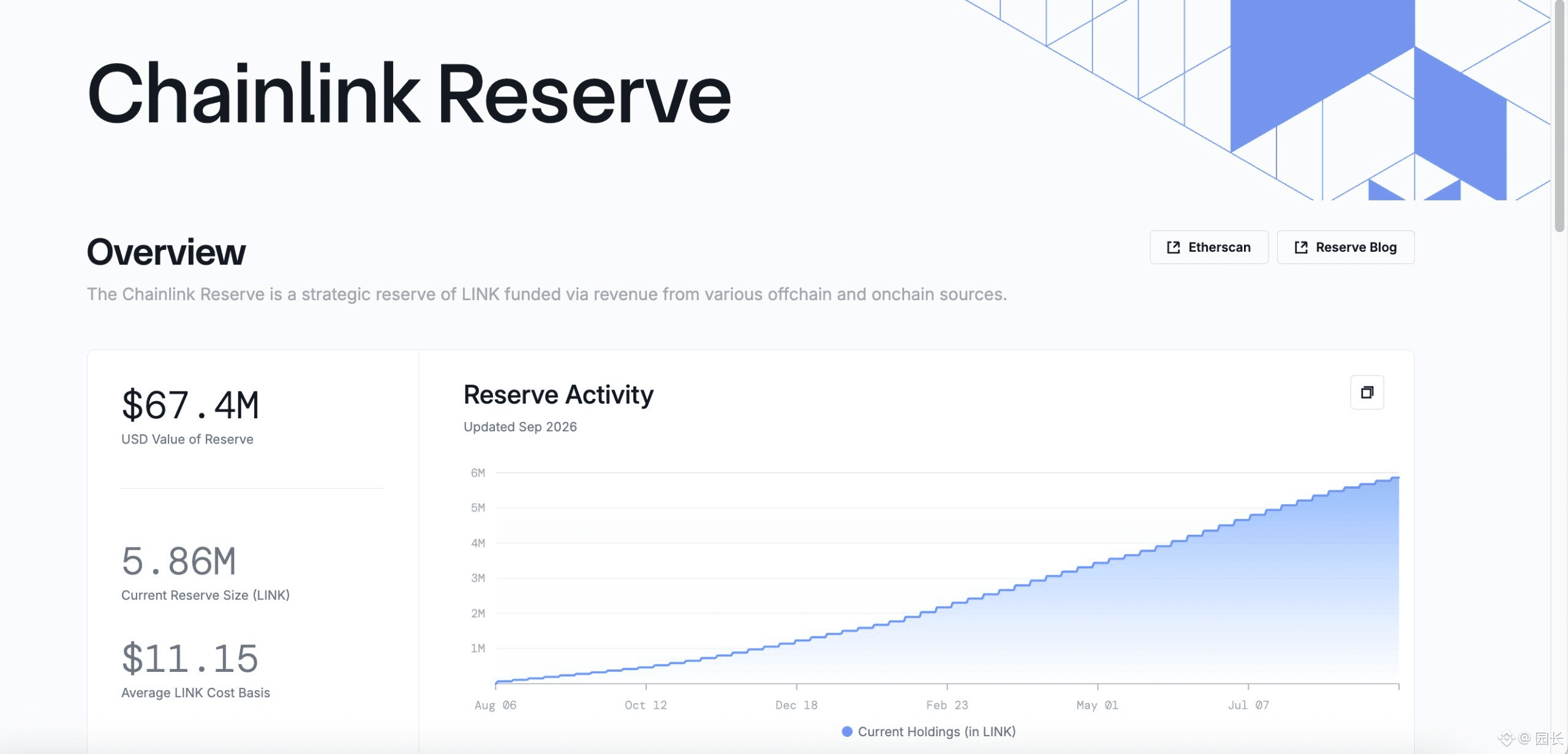
Chainlink now automatically converts part of its revenue into $LINK , then stores it in Chainlink’s own reserves, forming long-term, continuous automated buybacks.
So far, the reserves have already accumulated $LINK worth $67.4 million, totaling as many as 5.86 million tokens.
From the oracle work in the past,
to now cooperating with banks and financial institutions—every step has steadily stayed on the right path.
{future}(LINKUSDT)
{future}(ONDOUSDT)
I find that the coin is still the old one that’s the most fragrant
Recently, the biggest craze has been RWA. Besides narratives like ONDO tokenization, the data, verification, and cross-chain infrastructure behind RWA have also taken off along with it.
For example, the old-school leader $LINK
LINK and multiple banks have collaborated to test cross-chain functions such as tokenized asset settlement and putting fund NAVs on-chain.
Now, the biggest goal is to string the entire financial process into one unified system—integrating data, identity verification, compliance checks, cross-chain, and settlement into a single workflow.
Say that now I buy a tokenized fund. The bank first KYC’s my identity. Then LINK sends the KYC verification result to the smart contract. The bank calculates the fund NAV. Then LINK puts the data on-chain, deducts my stablecoin, and then sends my fund shares to another chain, recording the final result.
Isn’t this basically a Web3 version of SWIFT?
The narrative is great—but what direct relevance does it have for us ordinary token holders?
Chainlink now automatically converts part of its revenue into $LINK , then stores it in Chainlink’s own reserves, forming long-term, continuous automated buybacks.
So far, the reserves have already accumulated $LINK worth $67.4 million, totaling as many as 5.86 million tokens.
From the oracle work in the past,
to now cooperating with banks and financial institutions—every step has steadily stayed on the right path.
Recently, the biggest craze has been RWA. Besides narratives like ONDO tokenization, the data, verification, and cross-chain infrastructure behind RWA have also taken off along with it.
For example, the old-school leader $LINK
LINK and multiple banks have collaborated to test cross-chain functions such as tokenized asset settlement and putting fund NAVs on-chain.
Now, the biggest goal is to string the entire financial process into one unified system—integrating data, identity verification, compliance checks, cross-chain, and settlement into a single workflow.
Say that now I buy a tokenized fund. The bank first KYC’s my identity. Then LINK sends the KYC verification result to the smart contract. The bank calculates the fund NAV. Then LINK puts the data on-chain, deducts my stablecoin, and then sends my fund shares to another chain, recording the final result.
Isn’t this basically a Web3 version of SWIFT?
The narrative is great—but what direct relevance does it have for us ordinary token holders?
Chainlink now automatically converts part of its revenue into $LINK , then stores it in Chainlink’s own reserves, forming long-term, continuous automated buybacks.
So far, the reserves have already accumulated $LINK worth $67.4 million, totaling as many as 5.86 million tokens.
From the oracle work in the past,
to now cooperating with banks and financial institutions—every step has steadily stayed on the right path.
1
3k
·
--
Verified
Do you remember Uniswap v4 Hooks?
It’s the shitcoin narrative that was hyped up in the first half of this year—$SATO and $uPEG.
$UNI has just launched the StablePair Hook, applying v4 Hooks to stablecoin market making.
Actually, as early as June 2023, Uniswap already announced the concept of v4 Hooks, and it went live in January 2025.
But it only became widely known again during the early-year shitcoin run.
Now $UNI is finally turning Hooks into a product—before, most of it was more experimental.
The first batch of StablePair Hooks is for USDC/USDT and USDC/USDG pools.
When the stablecoin price in the pool de-pegs, the StablePair Hook first raises the fee, and then gradually lowers it block by block until arbitrage bots are willing to step in.
It sounds a bit complicated, so let me explain with a simple example:
Suppose the USDC in the pool is worth only $0.99 due to the price deviation. Arbitrage bots then start doing the “buy low, sell high” trade: buy USDC with $0.99, then sell it elsewhere for $1.00. Each token earns the bot $0.01.
So the arbitrage bot only needs to pay a tiny amount of fees; the entire price spread profit goes to the bot.
The StablePair Hook blocks that $0.01 profit right from the start by charging $0.01 in fees, making the bot temporarily unprofitable.
Then it gradually lowers the fee:
- Fee $0.009: bot net profit $0.001;
- Fee $0.006: bot net profit $0.004;
- Fee $0.003: bot net profit $0.007.
Once the bot is willing to accept a lower profit, the trade gets executed.
In the end, of the profit that initially would have gone entirely to the bot, a portion is returned to the pool.
I’m personally looking forward to what new things Hooks might enable. Whether it’s
$SATO and $uPEG, or this round’s StablePair, they’re all refreshingly novel.
$UNI is worth keeping an eye on.
{future}(UNIUSDT)
Do you remember Uniswap v4 Hooks?
It’s the shitcoin narrative that was hyped up in the first half of this year—$SATO and $uPEG.
$UNI has just launched the StablePair Hook, applying v4 Hooks to stablecoin market making.
Actually, as early as June 2023, Uniswap already announced the concept of v4 Hooks, and it went live in January 2025.
But it only became widely known again during the early-year shitcoin run.
Now $UNI is finally turning Hooks into a product—before, most of it was more experimental.
The first batch of StablePair Hooks is for USDC/USDT and USDC/USDG pools.
When the stablecoin price in the pool de-pegs, the StablePair Hook first raises the fee, and then gradually lowers it block by block until arbitrage bots are willing to step in.
It sounds a bit complicated, so let me explain with a simple example:
Suppose the USDC in the pool is worth only $0.99 due to the price deviation. Arbitrage bots then start doing the “buy low, sell high” trade: buy USDC with $0.99, then sell it elsewhere for $1.00. Each token earns the bot $0.01.
So the arbitrage bot only needs to pay a tiny amount of fees; the entire price spread profit goes to the bot.
The StablePair Hook blocks that $0.01 profit right from the start by charging $0.01 in fees, making the bot temporarily unprofitable.
Then it gradually lowers the fee:
- Fee $0.009: bot net profit $0.001;
- Fee $0.006: bot net profit $0.004;
- Fee $0.003: bot net profit $0.007.
Once the bot is willing to accept a lower profit, the trade gets executed.
In the end, of the profit that initially would have gone entirely to the bot, a portion is returned to the pool.
I’m personally looking forward to what new things Hooks might enable. Whether it’s
$SATO and $uPEG, or this round’s StablePair, they’re all refreshingly novel.
$UNI is worth keeping an eye on.
It’s the shitcoin narrative that was hyped up in the first half of this year—$SATO and $uPEG.
$UNI has just launched the StablePair Hook, applying v4 Hooks to stablecoin market making.
Actually, as early as June 2023, Uniswap already announced the concept of v4 Hooks, and it went live in January 2025.
But it only became widely known again during the early-year shitcoin run.
Now $UNI is finally turning Hooks into a product—before, most of it was more experimental.
The first batch of StablePair Hooks is for USDC/USDT and USDC/USDG pools.
When the stablecoin price in the pool de-pegs, the StablePair Hook first raises the fee, and then gradually lowers it block by block until arbitrage bots are willing to step in.
It sounds a bit complicated, so let me explain with a simple example:
Suppose the USDC in the pool is worth only $0.99 due to the price deviation. Arbitrage bots then start doing the “buy low, sell high” trade: buy USDC with $0.99, then sell it elsewhere for $1.00. Each token earns the bot $0.01.
So the arbitrage bot only needs to pay a tiny amount of fees; the entire price spread profit goes to the bot.
The StablePair Hook blocks that $0.01 profit right from the start by charging $0.01 in fees, making the bot temporarily unprofitable.
Then it gradually lowers the fee:
- Fee $0.009: bot net profit $0.001;
- Fee $0.006: bot net profit $0.004;
- Fee $0.003: bot net profit $0.007.
Once the bot is willing to accept a lower profit, the trade gets executed.
In the end, of the profit that initially would have gone entirely to the bot, a portion is returned to the pool.
I’m personally looking forward to what new things Hooks might enable. Whether it’s
$SATO and $uPEG, or this round’s StablePair, they’re all refreshingly novel.
$UNI is worth keeping an eye on.
1
5
5.5k
·
--
Verified
$NEAR Although it’s an older L1 coin, it’s definitely not like those outdated old coins that just live off their past glory.
In the last bull market, NEAR’s selling points were fast speed and low fees—basically just an ordinary L1. I didn’t pay it much attention.
Recently I found that $NEAR has built a very hardcore cross-chain system: NEAR Intents.
You just need to give an instruction—say, today I want to swap ETH for SOL. The system will send this requirement to different platforms. They will compete with each other for a quote; the winner is responsible for completing the swap, the cross-chain transfer, and settlement.
You don’t need to pick cross-chain bridges yourself, and you don’t have to shuffle coins around and then go to an exchange to buy gas. It’s hassle-free and effortless.
And this process can also be seamlessly integrated with a privacy execution layer.
This privacy layer mainly hides your order intent and execution process before the trade is actually completed—so large orders aren’t front-run by others.
Imagine that one day you want to sell 100 million USD worth of BTC and buy SOL.
If your order is exposed early, the market can buy SOL first and wait for you to come raise their hand.
Currently, the cross-chain transactions already handled by NEAR Intents exceed 13 billion USD.
And this year it has started charging fees, turning trading volume into real revenue.
If you still treat $NEAR as a plain old L1 chain, you’ll most likely be missing the point.
But the bull market has only just started—everything is still in time.
{future}(NEARUSDT)
$NEAR Although it’s an older L1 coin, it’s definitely not like those outdated old coins that just live off their past glory.
In the last bull market, NEAR’s selling points were fast speed and low fees—basically just an ordinary L1. I didn’t pay it much attention.
Recently I found that $NEAR has built a very hardcore cross-chain system: NEAR Intents.
You just need to give an instruction—say, today I want to swap ETH for SOL. The system will send this requirement to different platforms. They will compete with each other for a quote; the winner is responsible for completing the swap, the cross-chain transfer, and settlement.
You don’t need to pick cross-chain bridges yourself, and you don’t have to shuffle coins around and then go to an exchange to buy gas. It’s hassle-free and effortless.
And this process can also be seamlessly integrated with a privacy execution layer.
This privacy layer mainly hides your order intent and execution process before the trade is actually completed—so large orders aren’t front-run by others.
Imagine that one day you want to sell 100 million USD worth of BTC and buy SOL.
If your order is exposed early, the market can buy SOL first and wait for you to come raise their hand.
Currently, the cross-chain transactions already handled by NEAR Intents exceed 13 billion USD.
And this year it has started charging fees, turning trading volume into real revenue.
If you still treat $NEAR as a plain old L1 chain, you’ll most likely be missing the point.
But the bull market has only just started—everything is still in time.
In the last bull market, NEAR’s selling points were fast speed and low fees—basically just an ordinary L1. I didn’t pay it much attention.
Recently I found that $NEAR has built a very hardcore cross-chain system: NEAR Intents.
You just need to give an instruction—say, today I want to swap ETH for SOL. The system will send this requirement to different platforms. They will compete with each other for a quote; the winner is responsible for completing the swap, the cross-chain transfer, and settlement.
You don’t need to pick cross-chain bridges yourself, and you don’t have to shuffle coins around and then go to an exchange to buy gas. It’s hassle-free and effortless.
And this process can also be seamlessly integrated with a privacy execution layer.
This privacy layer mainly hides your order intent and execution process before the trade is actually completed—so large orders aren’t front-run by others.
Imagine that one day you want to sell 100 million USD worth of BTC and buy SOL.
If your order is exposed early, the market can buy SOL first and wait for you to come raise their hand.
Currently, the cross-chain transactions already handled by NEAR Intents exceed 13 billion USD.
And this year it has started charging fees, turning trading volume into real revenue.
If you still treat $NEAR as a plain old L1 chain, you’ll most likely be missing the point.
But the bull market has only just started—everything is still in time.
1
2
2.2k
·
--
Are you anxious seeing everyone in full screen showing off $4stock quick-swap “profit from whole-board trading”? If you’re anxious, go buy a bit of $BNC . For the BNC-four.meme—BNB ecosystem’s flywheel to start spinning, what ignites it is the meme profit momentum.
And to keep it spinning, you need to create ongoing profit momentum (even if it’s just an illusion). Robinhood’s users are outside the crypto world—they trade stocks. Memes are a brand-new novelty for them, so emotions can escalate easily, and the “try-it-out” period tends to last longer.
But Binance’s user base is already made of crypto traders. For them, US stocks are the novelty. Memes are too familiar—fast PVP, no lingering. By the time Robinhood’s P-side rookies slowly figure out the patterns, they’ll also enter the fast PVP mode. So if you want to keep this flywheel turning for a long time, it’s not easy with just a $4stock.
Instead, the biggest beneficiary is the US stock $BNC —it has attracted how much attention these days. Getting back to the 2–3 dollar level again probably won’t be easy. It’s now at $5, and $BNB itself is also gradually moving out of the bottom range.
{stock_us}(BNC.US)
{future}(BNBUSDT)
Are you anxious seeing everyone in full screen showing off $4stock quick-swap “profit from whole-board trading”? If you’re anxious, go buy a bit of $BNC . For the BNC-four.meme—BNB ecosystem’s flywheel to start spinning, what ignites it is the meme profit momentum.
And to keep it spinning, you need to create ongoing profit momentum (even if it’s just an illusion). Robinhood’s users are outside the crypto world—they trade stocks. Memes are a brand-new novelty for them, so emotions can escalate easily, and the “try-it-out” period tends to last longer.
But Binance’s user base is already made of crypto traders. For them, US stocks are the novelty. Memes are too familiar—fast PVP, no lingering. By the time Robinhood’s P-side rookies slowly figure out the patterns, they’ll also enter the fast PVP mode. So if you want to keep this flywheel turning for a long time, it’s not easy with just a $4stock.
Instead, the biggest beneficiary is the US stock $BNC —it has attracted how much attention these days. Getting back to the 2–3 dollar level again probably won’t be easy. It’s now at $5, and $BNB itself is also gradually moving out of the bottom range.
And to keep it spinning, you need to create ongoing profit momentum (even if it’s just an illusion). Robinhood’s users are outside the crypto world—they trade stocks. Memes are a brand-new novelty for them, so emotions can escalate easily, and the “try-it-out” period tends to last longer.
But Binance’s user base is already made of crypto traders. For them, US stocks are the novelty. Memes are too familiar—fast PVP, no lingering. By the time Robinhood’s P-side rookies slowly figure out the patterns, they’ll also enter the fast PVP mode. So if you want to keep this flywheel turning for a long time, it’s not easy with just a $4stock.
Instead, the biggest beneficiary is the US stock $BNC —it has attracted how much attention these days. Getting back to the 2–3 dollar level again probably won’t be easy. It’s now at $5, and $BNB itself is also gradually moving out of the bottom range.
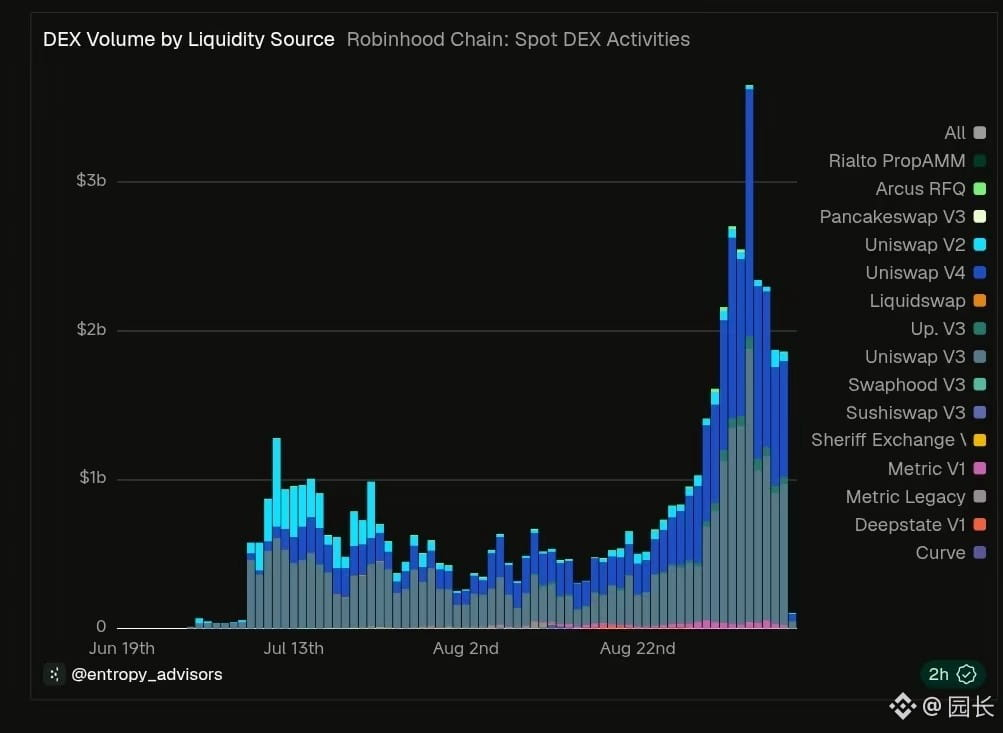
1
3
4.3k
·
--
$BTC 77300-82300 This range doesn’t know how much longer it can hold on. Everyone is watching this week’s inflation data, worried it could affect the decision-making of the policy meeting. Right now, the market-implied probability of a rate hike is 54%.
Looking at the chart: if $BTC breaks through 82300 and holds firm, then there should be further upside. Otherwise, it will need to correct lower. In that case, 77300 is the key level.
From the perspective of the “main force” (the operators), the best scenario, in my view, is to use the news to drive a push higher and lure in buyers, then during the pullback try to break below 70,000. After baiting the shorts, they then make a decisive move up again, leading to a larger rally. Timing-wise, it could be in February or March.
{future}(BTCUSDT)
$BTC 77300-82300 This range doesn’t know how much longer it can hold on. Everyone is watching this week’s inflation data, worried it could affect the decision-making of the policy meeting. Right now, the market-implied probability of a rate hike is 54%.
Looking at the chart: if $BTC breaks through 82300 and holds firm, then there should be further upside. Otherwise, it will need to correct lower. In that case, 77300 is the key level.
From the perspective of the “main force” (the operators), the best scenario, in my view, is to use the news to drive a push higher and lure in buyers, then during the pullback try to break below 70,000. After baiting the shorts, they then make a decisive move up again, leading to a larger rally. Timing-wise, it could be in February or March.
Looking at the chart: if $BTC breaks through 82300 and holds firm, then there should be further upside. Otherwise, it will need to correct lower. In that case, 77300 is the key level.
From the perspective of the “main force” (the operators), the best scenario, in my view, is to use the news to drive a push higher and lure in buyers, then during the pullback try to break below 70,000. After baiting the shorts, they then make a decisive move up again, leading to a larger rally. Timing-wise, it could be in February or March.
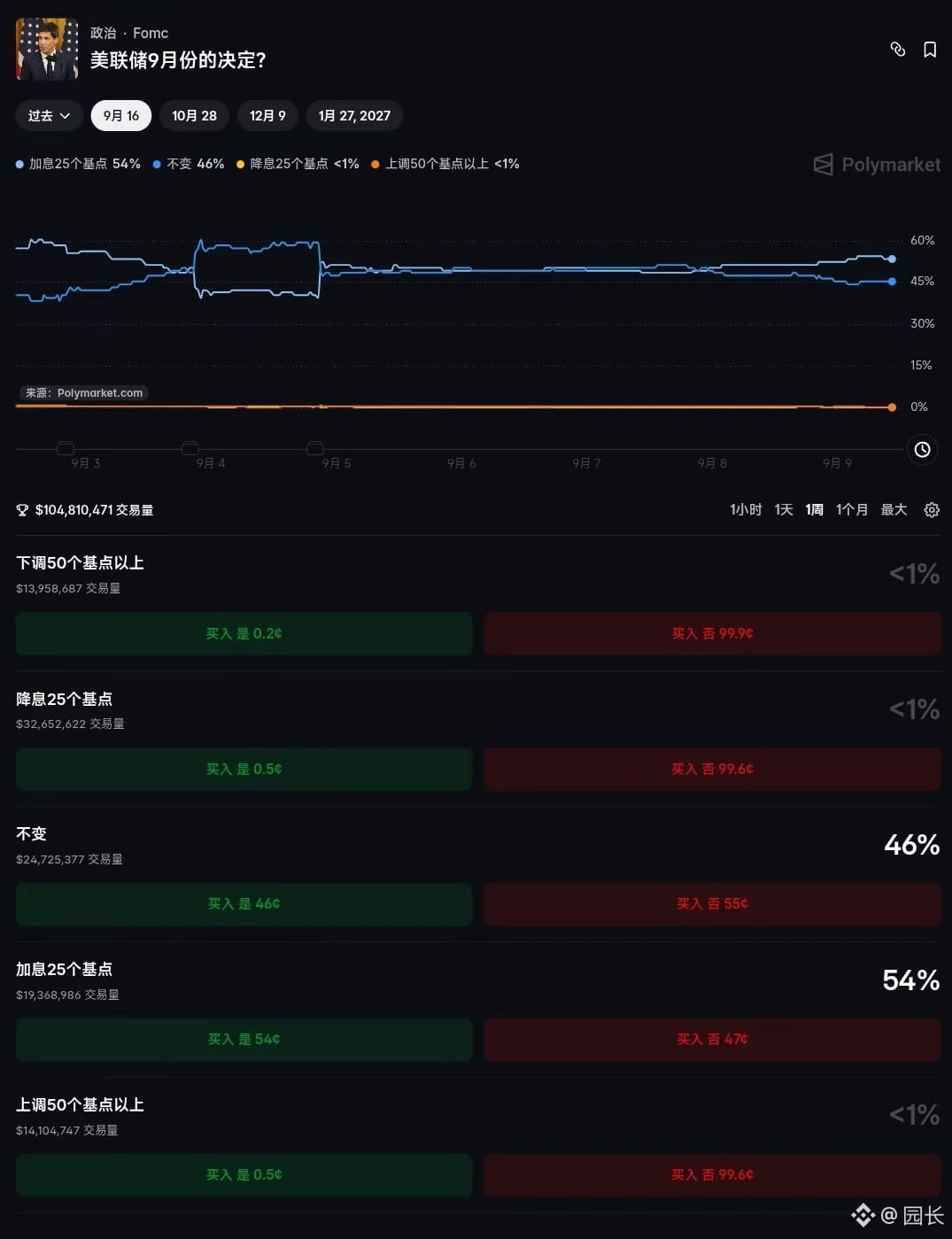
1
4.7k
·
--
Partly True
Has $PUMP become outdated?
In the past 24 hours, Pump.fun’s fee revenue was only $700,000.
At its peak, it was $15.5 million—an aggressive drop.
On the same day, the newcomer $PONS saw $8.15 million.
First, PONS siphoned off hot money into $HOOD; then $STONK keeps “doing shenanigans” by bundling crypto or stocks.
Can PUMP truly keep its position as the leading launch platform?
Fee revenue has dropped significantly, but $PUMP ’s coin price is still relatively high.
Whether Pump.fun can maintain its leading position is another question if it can’t find anything new.
{future}(PONSUSDT)
{future}(PUMPUSDT)
Has $PUMP become outdated?
In the past 24 hours, Pump.fun’s fee revenue was only $700,000.
At its peak, it was $15.5 million—an aggressive drop.
On the same day, the newcomer $PONS saw $8.15 million.
First, PONS siphoned off hot money into $HOOD; then $STONK keeps “doing shenanigans” by bundling crypto or stocks.
Can PUMP truly keep its position as the leading launch platform?
Fee revenue has dropped significantly, but $PUMP ’s coin price is still relatively high.
Whether Pump.fun can maintain its leading position is another question if it can’t find anything new.
In the past 24 hours, Pump.fun’s fee revenue was only $700,000.
At its peak, it was $15.5 million—an aggressive drop.
On the same day, the newcomer $PONS saw $8.15 million.
First, PONS siphoned off hot money into $HOOD; then $STONK keeps “doing shenanigans” by bundling crypto or stocks.
Can PUMP truly keep its position as the leading launch platform?
Fee revenue has dropped significantly, but $PUMP ’s coin price is still relatively high.
Whether Pump.fun can maintain its leading position is another question if it can’t find anything new.
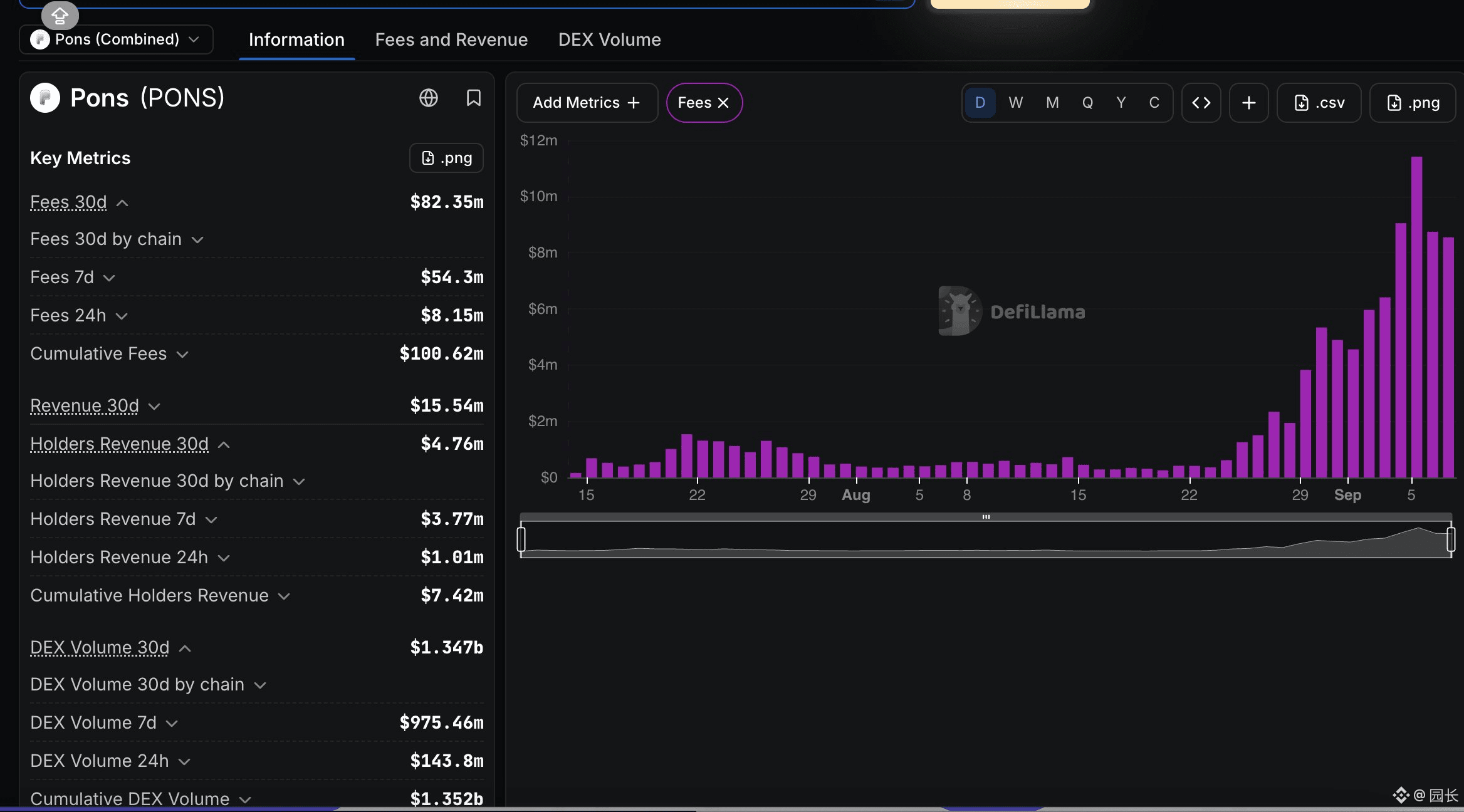
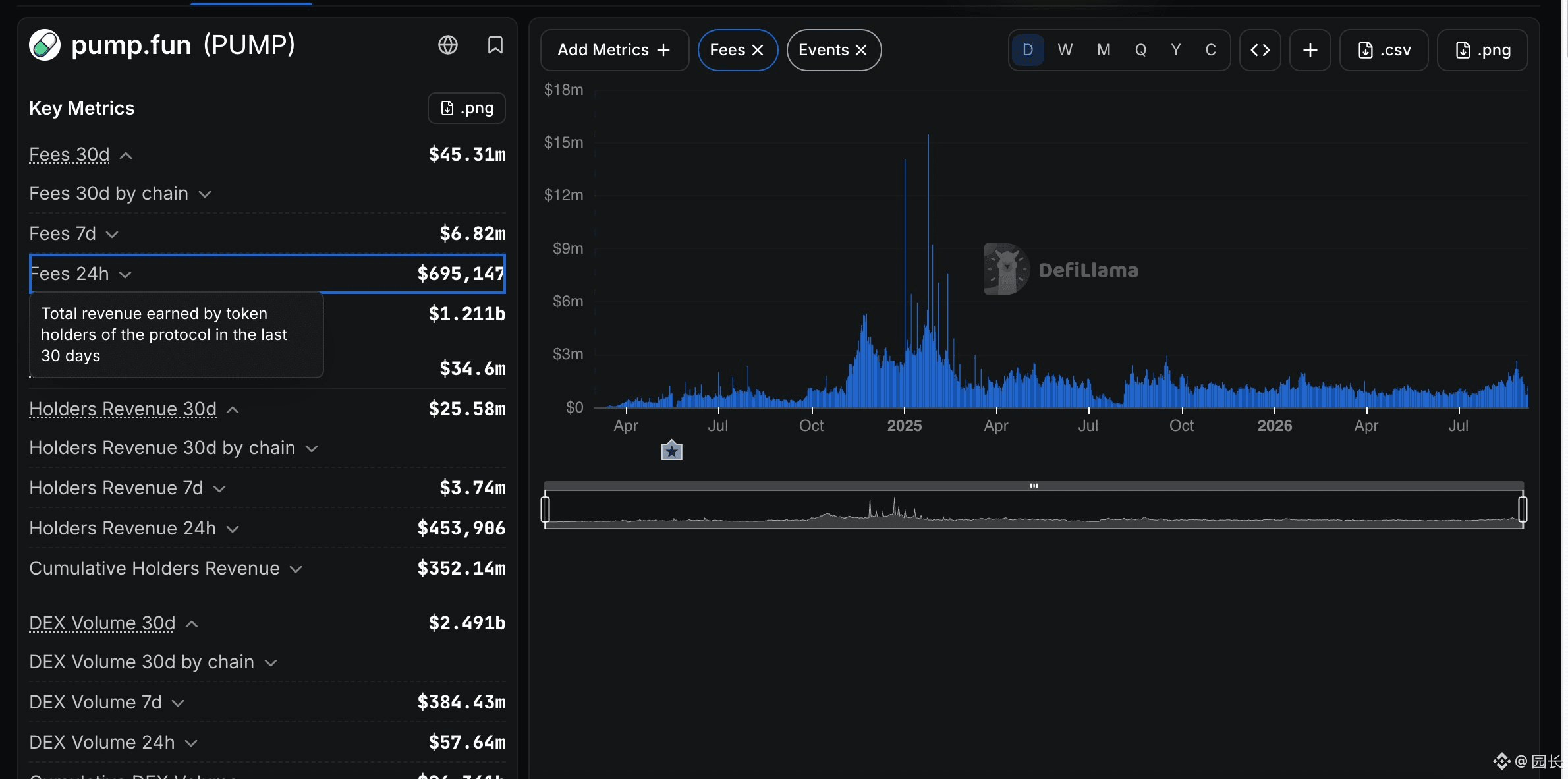
4
12.4k
Log in to explore more content
Join global crypto users on Binance Square
⚡️ Get latest and useful information about crypto.
💬 Trusted by the world’s largest crypto exchange.
👍 Discover real insights from verified creators.
Email / Phone number
Trending Topics
UKFCAWinsCourtOrderToRecover851400Pounds
42,648 views
860 Discussing
🚨 CRYPTO REGULATION JUST ENTERED A NEW PHASE: THEY’RE NOT ONLY WRITING RULES — THEY’RE TAKING MONEY BACK.
The UK’s FCA has secured another court-backed asset recovery, reinforcing a broader enforcement push against unauthorized financial and crypto-related activity.
And look at what’s happening simultaneously:
🇬🇧 FCA → enforcement + asset recovery
🇺🇸 SEC → clearer rules for functional crypto assets
🇺🇸 Fed → formal stablecoin supervision under the GENIUS Act
That combination matters.
Regulators are no longer debating whether crypto belongs inside the financial system.
They’re increasingly deciding who gets access, what rules they follow, and what happens when those rules are broken.
The next crypto cycle may not be “regulation vs innovation.”
It may be regulated crypto vs everyone who can’t meet the standard. 👀
$COIN $CRCL $BTC
#ukfcawinscourtordertorecover851400pounds #ChainlinkLaunchesCCIP2WithEnterpriseVerification #GoldFallsTo$4144 #QNTFallsOver40%FromMorningHigh #USDTAdds845900HoldersInPast7Days
KimHotbae
·3 Likes
·4.4k views
ChainlinkLaunchesCCIP2WithEnterpriseVerification
54,206 views
1,016 Discussing
GoldFallsTo$4144
18,241 views
170 Discussing