Written on the occasion of the new heights of $ETH .
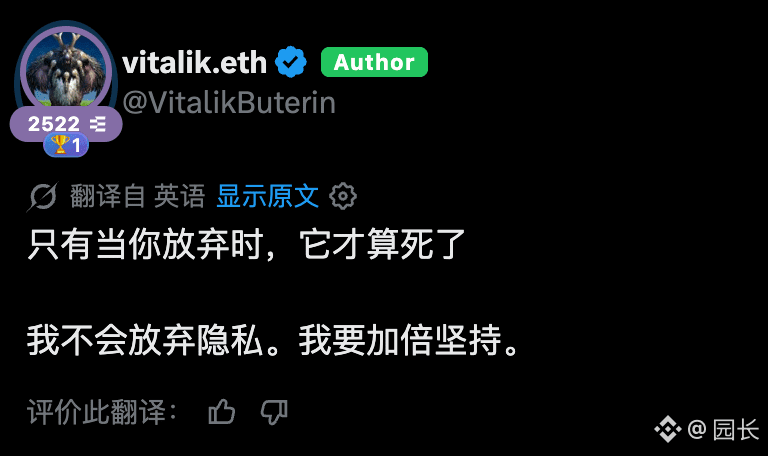
V God said: as long as you give up, you will die.
I won’t give up—I’ll even double down.
V God suddenly emphasized privacy.
Now Layer 1 doesn’t lack speed, and it doesn’t lack cheap fees.
Instead, privacy is becoming more and more important.
If institutions want to put things on-chain, they really need to hide orders and the execution process.
Once exposed, they’ll be directly targeted by MEV bots—front-running and potentially leaking the entire trading strategy.
Uniswap Permissioned Pools is responsible for keeping the pool secure,
while NEAR Confidential Intents is responsible for hiding the intent behind orders and the execution process before a trade is finalized.
So what does $ETH want to do?
First, it wants to cut off address linkage.
Right now, as long as an address has been used with Uniswap, Aave, or NFTs, someone with intent can gradually piece together the whole set of assets and behaviors.
Ethereum hopes to make it harder for applications and applications to see direct connections by using temporary addresses.
Then $ETH also wants to hide access records.
Even if you don’t trade, as long as you connect your wallet and use the RPC to query balances, it may still expose your IP address and the wallets you’re currently viewing.
Finally, it hopes it can selectively disclose—only to specific parties, such as banks or regulatory agencies—without announcing it to the whole world.
Mainstream partner chains are no longer fashionable for competing on fees and speed; they’ve started competing on privacy.
V God said: as long as you give up, you will die.
I won’t give up—I’ll even double down.
V God suddenly emphasized privacy.
Now Layer 1 doesn’t lack speed, and it doesn’t lack cheap fees.
Instead, privacy is becoming more and more important.
If institutions want to put things on-chain, they really need to hide orders and the execution process.
Once exposed, they’ll be directly targeted by MEV bots—front-running and potentially leaking the entire trading strategy.
Uniswap Permissioned Pools is responsible for keeping the pool secure,
while NEAR Confidential Intents is responsible for hiding the intent behind orders and the execution process before a trade is finalized.
So what does $ETH want to do?
First, it wants to cut off address linkage.
Right now, as long as an address has been used with Uniswap, Aave, or NFTs, someone with intent can gradually piece together the whole set of assets and behaviors.
Ethereum hopes to make it harder for applications and applications to see direct connections by using temporary addresses.
Then $ETH also wants to hide access records.
Even if you don’t trade, as long as you connect your wallet and use the RPC to query balances, it may still expose your IP address and the wallets you’re currently viewing.
Finally, it hopes it can selectively disclose—only to specific parties, such as banks or regulatory agencies—without announcing it to the whole world.
Mainstream partner chains are no longer fashionable for competing on fees and speed; they’ve started competing on privacy.